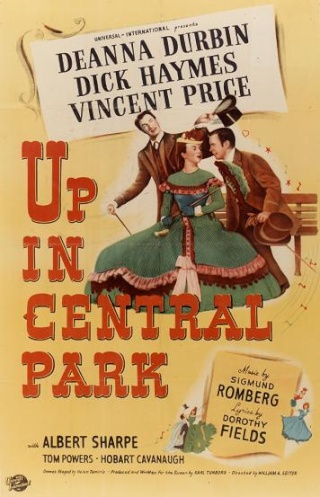
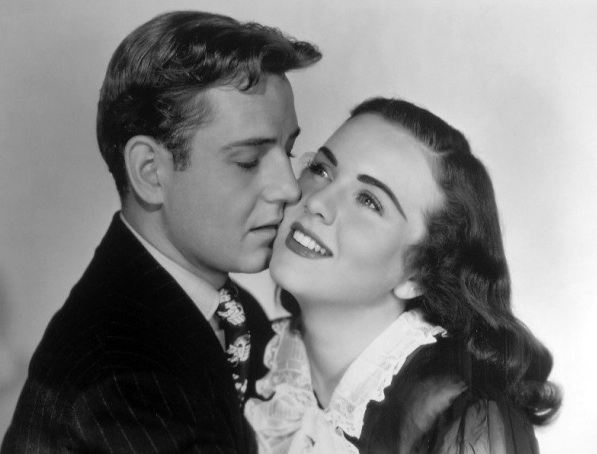
 If you’re a regular reader of this blog, you know that I have a special place in my heart for Deanna Durbin.
I think Durbin is one of the most charming, talented, and attractive performers to ever appear on screen. If some of the material she appeared in was beneath her, it’s hard to tell, since she brought the same vivacity, humor, and clear-as-a-bell singing voice to every one of her roles.
Durbin — a.k.a. “Winnipeg’s Sweetheart” — went from nearly single-handedly saving Universal Pictures from bankruptcy at the age of 14 with her first feature, Three Smart Girls (1936), to permanently retiring from acting in 1948 after appearing in her last film, For the Love of Mary.
Up in Central Park was Durbin’s penultimate picture. She was nearly 27 years old, and was tired of working within a stultifying studio system and playing the same type of character she’d been playing since she was 14. After appearing in For the Love of Mary, Durbin married producer Charles David and settled in a small village in rural France. She never appeared in another film.
Up in Central Park was based on the successful Broadway musical of the same name that opened in 1945. It takes place in 19th-century New York and stars another of my all-time favorite actors — Vincent Price — as the notoriously corrupt Boss Tweed.
Wide-eyed Irish immigrant Rosie Moore (Durbin) and her father, Timothy Moore (Albert Sharpe), come to New York with dreams of a better life and are quickly ensnared by the agents of Boss Tweed, who set up Mr. Moore with a plum position as Central Park zookeeper, as well as a little house in the park to call their own.
When things seem too good to be true, they usually are. But Rosie loves her new life, so when a crusading reporter for The New York Times named John Matthews (played by crooner Dick Haymes) tries to convince her that Boss Tweed and his Tammany Hall cronies are no good, she refuses to believe him.
Up in Central Park is an entertaining little musical, but my favorite thing about it was watching the louche Price woo the naive Durbin, as well as chew the scenery on his own. For instance, when Tweed gives his puppet mayor Oakley (Hobart Cavanaugh) his cigar to dispose of and Oakley can’t find a spittoon, Tweed says — in a withering, condescending tone — “We use ashtrays here, Mayor. This isn’t the city hall.”
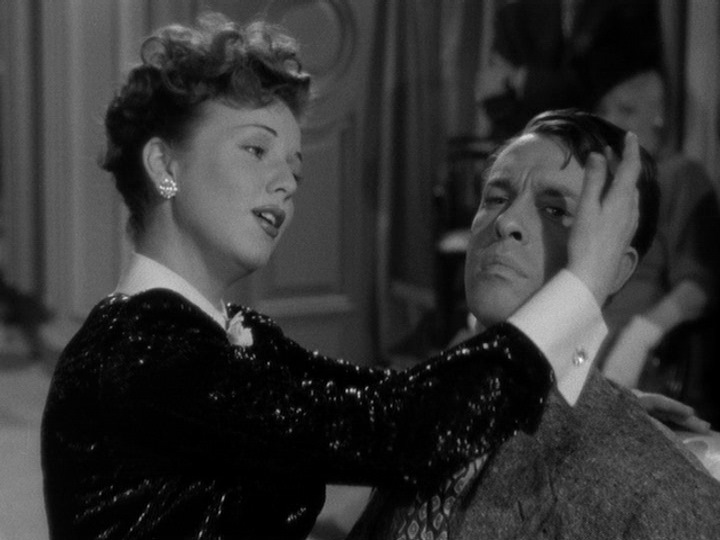
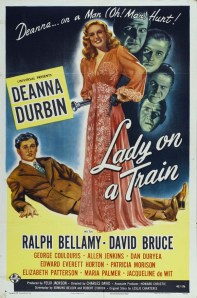 Deanna Durbin is an absolute delight in this farcical murder mystery. Durbin, a native of Winnipeg, Manitoba, was once one of the biggest stars in Hollywood, but never made a movie after 1948. (She currently lives in a small village in France, grants no interviews, and is reportedly very happy.) In Lady on a Train, she plays a young woman named Nicki Collins. When the film begins, Collins is sitting by herself in a compartment on a train entering New York on an elevated line. She has come from San Francisco to spend the holidays with her wealthy businessman father, and is currently engrossed in a mystery novel called The Case of the Headless Bride. When the train is briefly delayed, she looks out the window of her train car and witnesses a murder. Through a lighted window, she sees a young man beat an older man to death with a crowbar. She never sees the murderer’s face, however, and when she reports the murder to the police, the desk sergeant dismisses her report as the product of the overheated imagination of a girl who loves murder mysteries and can provide no real specifics of where she was when she saw the murder. Also, it’s Christmas Eve, and who want to traipse around looking for a murder that may or may not have occurred somewhere in Manhattan north of Grand Central Station?
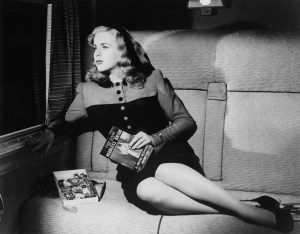 Lady on a Train is part mystery, part musical, part noir, part comedy, and part romance. The most surprising thing about this movie is that each element works perfectly, and they all complement one another. (Calling this film a noir is stretching it, but the final chase in a warehouse contains some striking chiaroscuro shot constructions, and is as tense as one could ask for.) Lady on a Train is also a delight for Durbin fetishists, since she has a different outfit and hairstyle in literally every scene. Sometimes the changes are subtle, but occasionally they’re impossible to miss, such as the scene in which she comes in out of the rain and is suddenly wearing gravity-defying, Pippi Longstocking-style braided pigtails.
 OCD Viewer