Tag Archives: Drama

The Other Love (May 14, 1947)

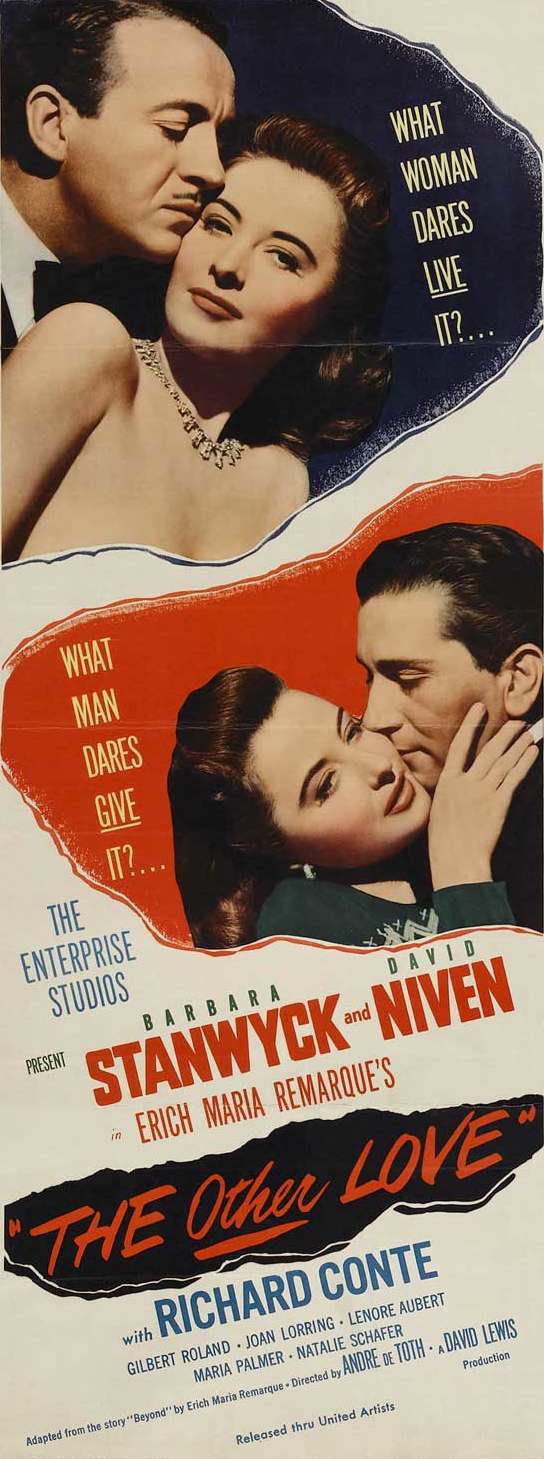
Director André de Toth is mostly associated with hairy-chested genres like westerns and war movies. The Other Love, which is based on a short story by All Quiet on the Western Front author Erich Maria Remarque, is a rare example of de Toth making a “women’s picture,” and it’s not a bad one. It’s also not a great one, so if you’re expecting Dark Victory (1939) or Now, Voyager (1942), don’t bother. But if you’re a fan of well-acted weepers, The Other Love is worth seeking out.

Karen Duncan (Barbara Stanwyck) is a world-renowned concert pianist who is gravely ill. She arrives at Mount Vierge, a sanitarium in the Swiss Alps, unaware of the seriousness of her condition. On her first night in the sanitarium her physician, Dr. Anthony Stanton (David Niven), insists she have dinner with him. He tells the nurse to have the kitchen prepare the “Grade A stimulation diet” and have it sent to Room 17.

Someone sends Karen a white orchid corsage before her “date” with Dr. Stanton, but it wasn’t he. It turns out there is a standing order to have white orchids delivered nightly to Room 17. The order came from a man who died months earlier, and was for a woman who died the day before Karen arrived, but Dr. Stanton insists this is just a rumor, and that they were both cured and moved away. Karen doesn’t believe him.

The second day, Karen has to quit smoking. The patients in Mount Vierge all seem to be on rest cures, which means convalescing outdoors on chaise longues while wrapped snugly in blankets. Karen befriends another patient, Celestine Miller (Joan Lorring), who claims she’s only there to make her philandering husband jealous, but is in fact quite ill, even though she doesn’t know it.

Karen bristles under Dr. Stanton’s inflexibility. When he stops her from playing the piano after she gets too worked up while performing a piece, she shouts, “Is everything forbidden here?” Yes, he tells her. Everything except hope. But a month of bed rest? Being treated like a child? Yes, he tells her. Until she’s well.
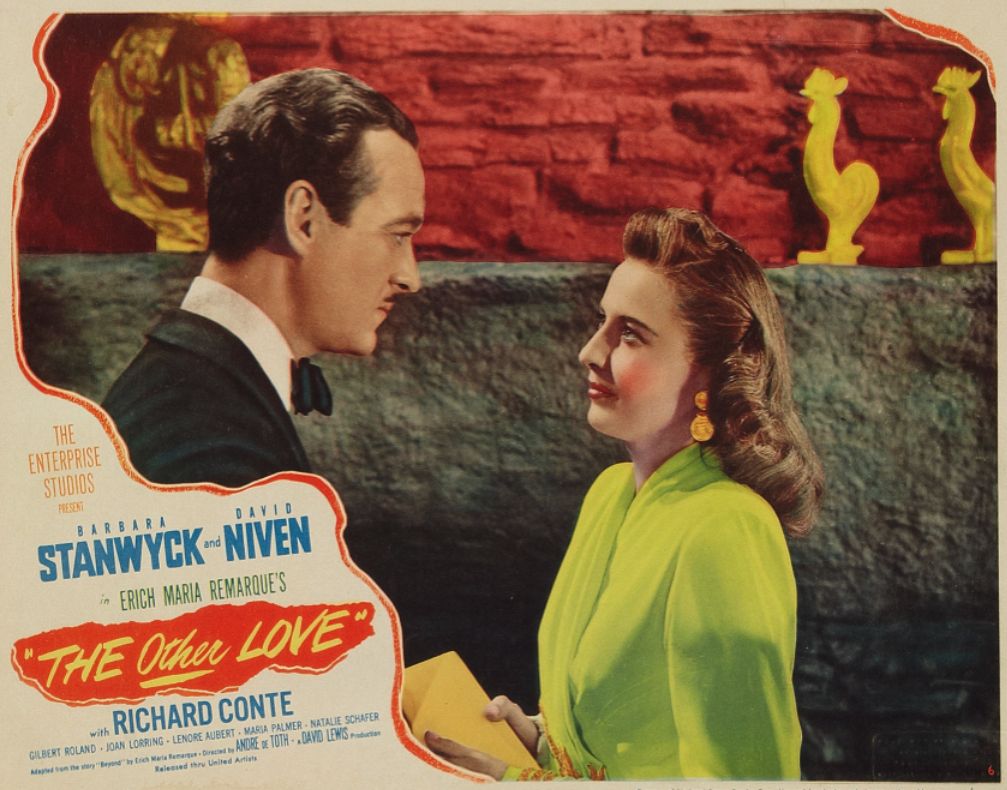
Despite being forbidden from practicing her art, smoking cigarettes, and drinking alcohol, Karen is apparently allowed to drive a horse and carriage all by herself on twisting mountain roads, which is how she meets the handsome and exciting auto racer Paul Clermont (Richard Conte). When he and his buddy Pete (Jimmy Horne) come tearing around a corner in their roadster, Karen’s horse rears up, and Paul comes to her aid after deliberately driving his car into a tree to avoid her.

Paul is in the Alps for an upcoming road race, and he and Karen are instantly attracted to each other, but Dr. Stanton refuses to let her go into the village again after learning of her affaire de cœur with Paul. Why must he take every bit of joy from her? “Too much excitement for one day,” the doctor says, simply.

Dr. Stanton tells her that she must never get overexcited. That she must be an automaton. “You haven’t got a free will anymore,” he tells her. She wants to live! He loves her! She doesn’t believe him! “Believe what you want,” he says. “But you’ve got to get well for your music! The world deserves your music!”

Karen runs away to the village for brandy and a cigarette with Paul. She gets into his car with him and reveals that she is Karen Duncan. Yes, THE Karen Duncan. “If Chopin could see me now,” he quips, and they go away to the Hotel Monaco together.

For most of the film the nature of Karen’s illness is as mysterious to the audience as it is to her. Once out of the crisp, dry air of the mountains, however, it quickly becomes clear that she’s consumptive, and she breaks down in coughing fits in the heavy air and rain of the low altitudes where Paul and she relax and play as only two well-dressed Hollywood actors in a mid-century film can play.
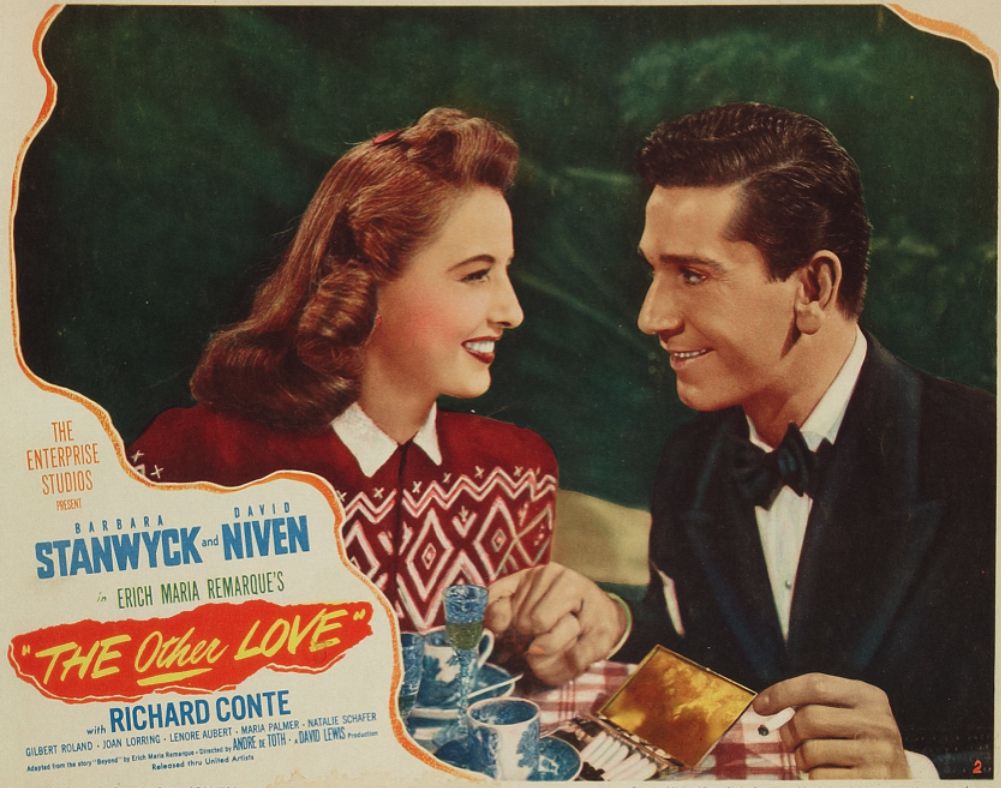
One way to see Karen’s disease in The Other Love is as part of a symbolic representation of the two men in her life. To follow Dr. Stanton’s dictates means a life of convalescence, but also one of security and contentment. To run around the world with Paul means a life of excitement and glamor, but also one of early death and frequent danger (represented quite literally by an amorous croupier, played by Gilbert “Cisco Kid” Roland, who tries to rape Karen in a doorway when she’s drunk and ill).

On the other hand, Dr. Stanton’s treatment of Karen hearkens back so strongly to the medical profession’s patronizing and deceitful treatment of women in less enlightened times that their “romance” is often more creepy than it is romantic. His refusal to reveal to her the seriousness of her illness — a subject he discusses freely with Karen’s mentor, Professor Linnaker (Richard Hale) — seems more like condescension than compassion.

The Other Love may be a “women’s picture,” but it’s certainly not a feminist one. (The Yellow Wallpaper this story is not.) But it’s a well-acted, well-directed, and beautifully staged film, so I wouldn’t hesitate to recommend it to fans of any of the principal actors, or fans of André de Toth who want to see what he could do behind the camera without Joel McCrea blowing someone away with a shotgun in front of it.
The Sea of Grass (April 25, 1947)

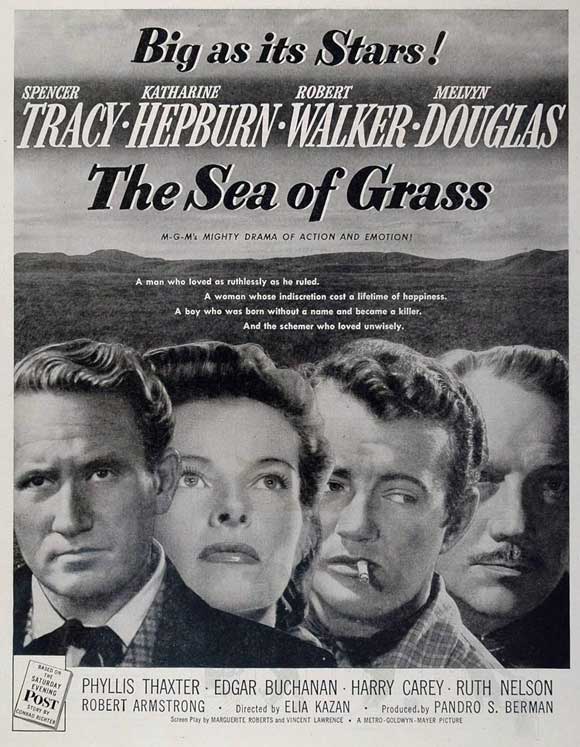
Elia Kazan’s The Sea of Grass premiered February 26, 1947, in Lincoln, Nebraska. It opened in New York City a day later, and went into wide release on April 25, 1947.

In his review of the film in The New York Times on Friday, February 28, Bosley “The Grouch” Crowther referred to the film as “Metro’s new cow-or-plow drama,” which is the best and most succinct description of the film imaginable.

This was Kazan’s second film — his first was A Tree Grows in Brooklyn (1945), and Boomerang (1947), which I reviewed earlier this year, was his third.

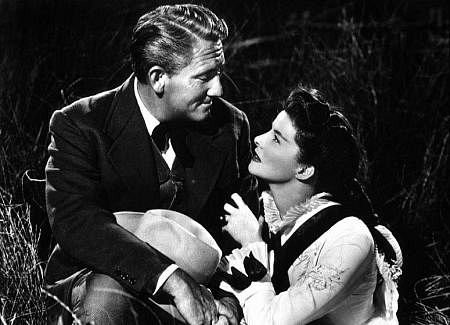
The Sea of Grass is the story of a high-born St. Louis woman, Lutie Cameron (Katharine Hepburn), who marries a cattle baron, Col. Jim Brewton (Spencer Tracy), and leaves the comfortable world of high society for a rough-and-tumble life in a place called Salt Fork, in the Territory of New Mexico. Brewton legally owns very little of the hundreds and hundreds of acres over which his cattle roam, but he fought and bled for the land, and he’ll be damned if any pussy-footing sodbusters are going to come in and reap the rewards he feels he earned for himself. Brewton’s connection to the land is full of mystical reverence, and he’s distant from people, including his wife. Lutie is driven into the arms of Brewton’s mortal enemy, Brice Chamberlain (Melvyn Douglas) — a lawyer who fights for the rights of homesteaders — just long enough to wind up carrying Chamberlain’s child. Lutie returns to Brewton and bears him a second child, a son named Brock (they already have a girl named Sara Beth).

When Brewton discovers that he has been cuckolded, he gives Lutie a choice. She can either leave and take Brock with her, exposing him as a bastard, or she can leave alone and he will raise Brock as his own son. Tearfully, Lutie takes the latter option, and lives in exile. Sara Beth grows into actress Phyllis Thaxter, and Brock grows up into snivelling punk Robert Walker. Brock’s true parentage seems to be an open secret in and around Salt Fork, and he responds by drinking, gambling, sneering, and throwing lead into anyone who disparages him. He’s an early-20th-century rebel without a cause, and tragedy always seems right around the corner whenever he’s onscreen.

The Sea of Grass is based on the 1936 novel by Conrad Richter. Kazan was so attracted to the material that he specifically asked MGM if he could direct it. (Kazan was under contract with Twentieth Century-Fox at the time, but it wasn’t an exclusive contract, and it allowed him to work with other studios.) His vision was of an on-location shoot that would last months, featuring unknown actors with leathery faces and a grand sense of scale that would express the drama and sadness of a way of life in America that is dead and gone.

There are hints of this in a few scenes. The few sweeping shots of the pre-Dust Bowl prairie land of the Great Plains, with the gently rolling oceans of grass that give the film its title, are unspeakably beautiful. But for the most part, The Sea of Grass is a melodrama that’s soapy enough to wash your car with.

Kazan was restricted by the studio to shooting on soundstages, and he found directing Spencer Tracy nearly impossible. Tracy was in a bad way during the making of the film, and he was drinking heavily. His performance isn’t bad, but it’s muted and deeply subdued, as though he’s only partly present most of the time. Katharine Hepburn, on the other hand, is histrionic, and very nearly a haughty parody of herself. There are moments of great visual excitement in the film, such as a violent confrontation between homesteader Sam Hall (James Bell) and Brewton’s men during a windstorm. At more than two hours long, however, The Sea of Grass offers very little in the way of the kind of action I look for in a western, and the soapy drama it’s packed with is pretty turgid.

The Private Affairs of Bel Ami (April 25, 1947)

The Private Affairs of Bel Ami
The Private Affairs of Bel Ami (1947)
Directed by Albert Lewin
United Artists

I love George Sanders. I don’t know what it is. I could give you a laundry list of attributes — his effortless charm, his ironic detachment, his pitch-perfect performances as cads and bounders — but that would only scratch the surface.

I like him so much that I found it impossible to root against him as the villain opposite Tyrone Power in John Cromwell’s minor swashbuckling classic Son of Fury: The Story of Benjamin Blake (1942) and I even enjoyed his role in Douglas Sirk’s lightweight A Scandal in Paris (1946).

His insouciance and Herculean detachment from the concerns of everyday life weren’t just an onscreen pose. In the suicide note he left in 1972 before taking his own life at the age of 65, Sanders wrote, “Dear World, I am leaving because I am bored. I feel I have lived long enough. I am leaving you with your worries in this sweet cesspool — good luck. Love, George.”

In life as in art, there is always the sense with Sanders that you are only seeing the tip of the iceberg. Certainly boredom was not the real reason Sanders took his own life. His brother, actor Tom Conway, had died of cirrhosis of the liver — a complication of his alcoholism — five years earlier. Sanders had four failed marriages under his belt, was himself a heavy drinker, and suffered from extremely poor health in his later years, as well as related bouts of depression. But who really knows? No one really kills themselves because they’re bored, but with Sanders, that’s all we’re left with.

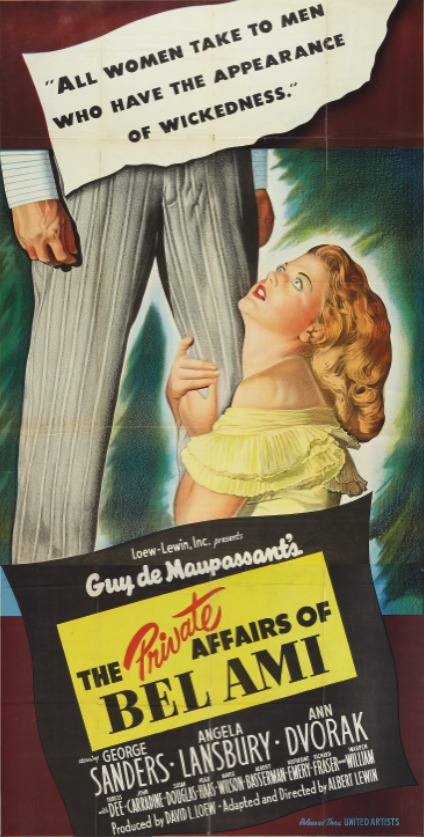
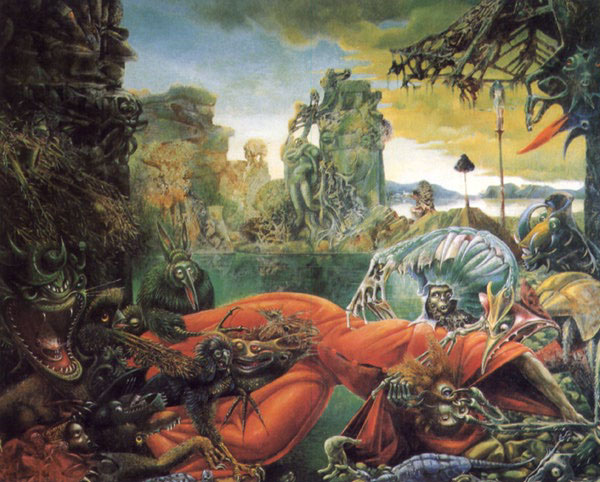
Albert Lewin’s The Private Affairs of Bel Ami is based on Guy de Maupassant’s 1885 novel Bel Ami. Dubbed “the history of a scoundrel,” the film has a lot in common with Lewin’s 1945 film The Picture of Dorian Gray, which also featured Sanders and Angela Lansbury in starring roles. Both films are black and white adaptations of 19th-century novels that feature a single oil painting shown in stunning Technicolor. In the case of The Picture of Dorian Gray, it’s Dorian Gray’s famous portrait, hidden away in an attic, revealing his corruption. In The Private Affairs of Bel Ami it’s the totally crazy and anachronistic “The Temptation of Saint Anthony,” by surrealist painter Max Ernst.

Max Ernst

Ernst’s painting isn’t the only anachronistic thing about Lewin’s film. While the film ostensibly takes place in Paris in 1880, there are no attempts at verisimilitude. Frank Paul Sylos’s art direction in The Private Affairs of Bel Ami is careful and loving, but it looks more like a picture postcard than real life.

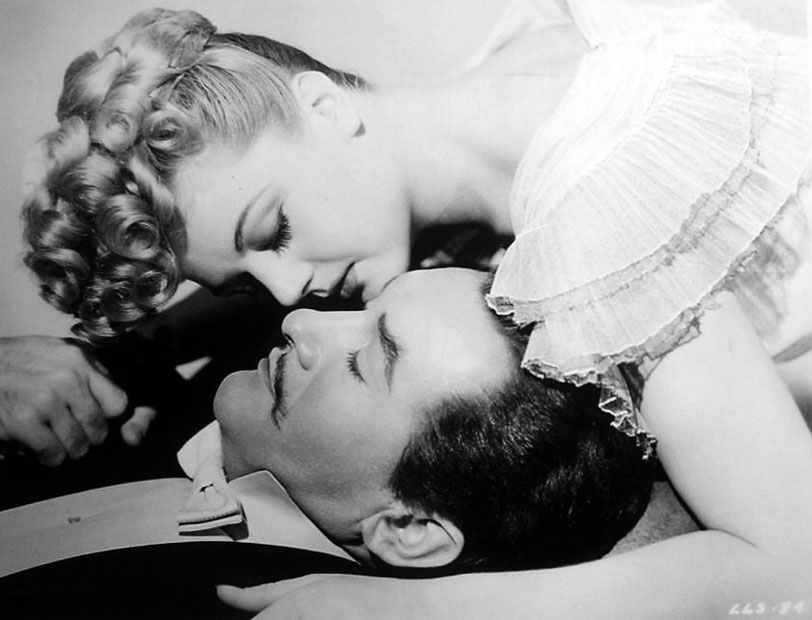
Sanders’s character, Georges Duroy, is a bored habitué of Parisian café society who seduces women and uses them for social and professional gain, then discards them as soon as a lovely new opportunity sashays across his path. The women who love him call him “Bel Ami.” The name is ironic, since Duroy is a friend only to himself. When the film begins, he is already ignoring a hurt-looking former conquest while he seduces the pale beauty Clotilde de Marelle (Angela Lansbury). He’ll soon throw Clotilde over for his business partner’s wife, Madeleine Forestier (Ann Dvorak), to whom he proposes marriage in a businesslike fashion literally as her consumptive husband, Charles Forestier (John Carradine), is drawing his last breath.

Angela Lansbury and George Sanders

Clotilde remains a presence in the film throughout. (Perhaps in an attempt to make Duroy more sympathetic, he dies with her name on his lips.)

She loves him madly, and while Duroy’s treatment of Clotilde is never less than ungentlemanly, the film never gets as sexually brutal as the poster above promises with its implication of desperate, “please-don’t-leave-me” fellatio.

With the help of his wife Madeleine, who does most of the actual writing, Duroy becomes a Victorian-era Walter Winchell with a gossip column called “Echoes.” With it, he influences politics and high society, and becomes a high-level player, but he always wants more. He attempts to buy a title from a family named “De Cantel” whose last descendant is missing, presumed dead. With the promise of his incipient nobility, Duroy courts the young heiress Suzanne Walter (Susan Douglas).

In his role as Duroy, Sanders is always doing things that telegraph his utter boredom with the here-and-now, such as playing with a ball and cup or flipping playing cards into a hat on the floor. He has a voracious appetite for fame, wealth, and women, but he almost never seems to be enjoying himself.

It’s a role tailor-made for the deadpan Sanders. In one of the last scenes of the film, in which he is preparing to fight a duel in the rain with an overheated young opponent, he casually asks for an umbrella and says, “I should not like to quit the field of honor with a bad case of the sniffles.”

New Orleans (April 18, 1947)

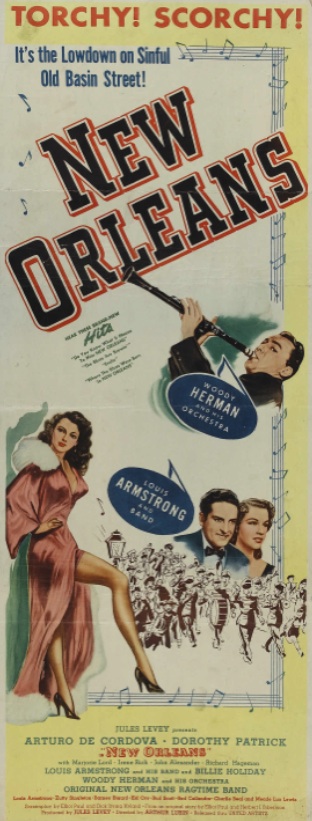
Arthur Lubin’s New Orleans takes place in 1917, the year that Storyville, the notorious red-light district of New Orleans, was shut down.

Like Edgar G. Ulmer’s Carnegie Hall (1947), New Orleans features some of the greatest musicians and performers of the ’40s shoehorned into a flat, uninteresting story.

I had high hopes for New Orleans. In the first scene, we see Nick Duquesne (pronounced “doo-cane”), who’s played by Arturo de Córdova, operate his casino and nightclub with smooth, effortless charm. Duquesne is known as the “King of Basin Street,” and de Córdova plays him well, so I was hoping to see an involving story about vice, graft, and crime.

Alas, the story quickly devolves into a maudlin melodrama about a young blond singer named Miralee Smith (Dorothy Patrick) who falls in love with both Duquesne and the Dixieland jazz she hears played by Louis Armstrong and his ragtime band. Of course, Miralee’s mother, the wealthy Mrs. Rutledge Smith (Irene Rich) doesn’t approve, and wants her daughter to sing opera.

The screenplay and acting in New Orleans are better than they are in Carnegie Hall, but the only reason most people will want to see this movie is for the music. The good news is that there’s plenty of it, especially if you’re a fan of Louis Armstrong and Billie Holiday.

Holiday plays a maid named Endie, and she doesn’t look happy in the outfit, or in the scene in which she’s dressed down by Mrs. Smith for playing the piano and singing while on the job. The strange thing is that her role as a maid is tangential to her role in the rest of the film, and she only appears in a maid’s uniform in her first scene, in which she introduces Miralee to jazz. After that, Holiday loosens up a bit, and her scenes onstage with Louis Armstrong and his band are all fantastic. Together they perform Louis Alter’s “Do You Know What It Means to Miss New Orleans,” “The Blues Are Brewin’,” and “Endie,” as well as Spencer Williams’s “Farewell to Storyville.”

Holiday and Satchmo aren’t the only great performers in the film. Woody Herman, Charlie Beal, Barney Bigard, George “Red” Callender, Meade “Lux” Lewis, Kid Ory, Bud Scott, Lucky Thompson, and Zutty Singleton all play themselves.

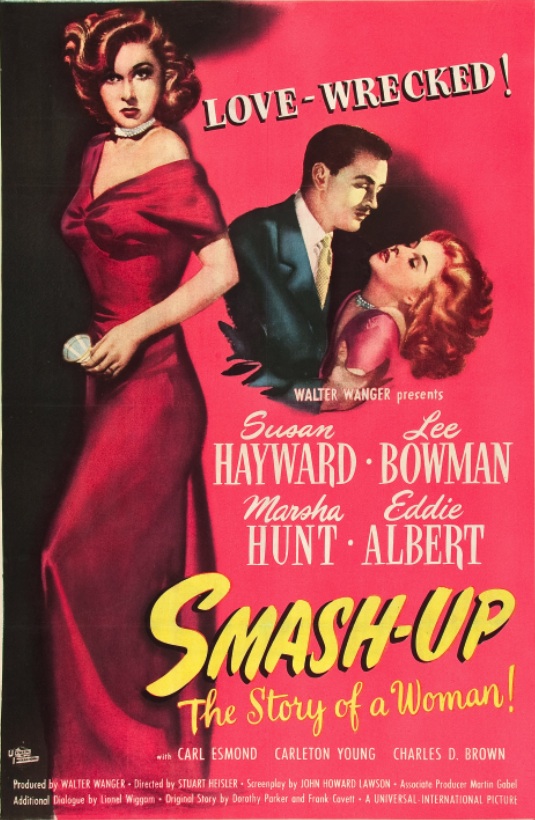
Smash-Up: The Story of a Woman (March 1947)

I suppose this had to happen.

After yesterday’s film, The Farmer’s Daughter, which was an inspirational and heartwarming story of a woman fighting to succeed in a man’s world, I got hit in the face with this wet noodle of a picture. Stuart Heisler’s Smash-Up: The Story of a Woman is a not-so-heartwarming film about a woman slipping into the depths of loneliness, depression, and alcoholism.

Inspired by the tragic life of Bing Crosby’s first wife, singer Dixie Lee, Smash-Up begins with Angelica “Angie” Conway, née Evans (Susan Hayward), lying in a hospital bed, her face and head bandaged, murmuring, “I have to go on in two minutes … I need a drink… I have to go on in two minutes … I need a drink…”

The events that brought her to this place are told in flashback. Angie and her husband, Ken Conway (Lee Bowman), both start out as struggling singers, but after he gets a job performing on the radio as “Ken Conway, the Singing Cowhand,” he grows to be a coast-to-coast sensation, and Angie’s career is derailed.

She turns to drinking to soothe her loneliness and frustration, staying home with their infant daughter while Ken is on the road with his friend and partner Steve Nelson (Eddie Albert), his manager Fred Elliott (Carleton Young), and Elliott’s beautiful secretary, Martha Gray (Marsha Hunt), which drives Angie into a spiral of jealousy and paranoia.

Angie may live in a large, beautiful home with servants (all provided with the money from Ken’s success), but none of it means anything when she’s all alone with her baby, who has a fever, and she’s singing “Hushabye Island” to her while a weighted toy swings back and forth on the dresser by the crib. Its shadow is taunting. It looks like a liquor bottle bobbing to and fro.

It would be easy to call Smash-Up a distaff version of Billy Wilder’s The Lost Weekend (1945). The two films have many similarities, but Smash-Up is as much about a disintegrating marriage as it is about dipsomania.

There’s some nice subjective camerawork in Smash-Up, like the zoom in on Angie’s face when Ken walks out after finding her drunk at her vanity table following the baby’s illness, but it never gets as wildly baroque as the depictions of Ray Milland’s delirium tremens in The Lost Weekend.

The film also sidesteps several issues. For instance, after Ken leaves with their daughter and Angie says, “I’m going to get my baby back,” there is a montage of liquor splashing into glasses, Angie’s unsteady feet on the sidewalk, and neon club signs (including the appropriately named “Club Downbeat”) that ends with Angie passing out on a stoop. She wakes up in a strange room with her clothes and a man’s clothes thrown over a chair. The camera pans up and we see an unattractive middle-aged man in his undershirt working his razor over a strop. Before the audience can get any ideas, however, we see that there is also a woman in the apartment, who tells Angie that she and her husband put her to bed, effectively quashing any hint of booze-fueled promiscuity.

Like The Lost Weekend, Smash-Up ends a little too happily for its own good. But while The Lost Weekend ended with a promise to stop drinking that might be insincere, Smash-Up pulls out all the stops. The film ends not only with Ken and Angie promising to each other that they’ll try to patch things up, but with the revelation that Angie’s face (the result of a fire caused by a half-smoked cigarette and a bellyful of liquor) is going to be fine, and there won’t be any scarring.

Smash-Up isn’t a bad film, just a gloomy one. The melancholy refrain of the song “Life Can Be Beautiful” started to drive me crazy by the end of the picture, but it suits the proceedings. The actors all play their parts well, especially Hayward, who was nominated for an Oscar for best actress.

Boomerang (March 5, 1947)

Boomerang is another fact-based drama produced by Louis de Rochemont, the maker of the “March of Time” series of newsreels. Like de Rochemont’s other films, The House on 92nd Street (1945) and 13 Rue Madeleine (1947), it features stentorian, “newsreel”-style narration by Reed Hadley, a number of the actual participants in the case playing themselves in minor roles, and a commitment to verisimilitude that is less cut-and-dried than the filmmakers would have the audience believe.

For my money, Boomerang (or Boomerang!, as it appears on the cover of a notebook in the opening credits) is far and away the best of the first three films de Rochemont produced. A great deal of that is due to the direction by Elia Kazan.

Kazan was coming off the success of A Tree Grows in Brooklyn (1945), but he was still better known for his work in the theater than in Hollywood. I think that Kazan’s enormous talent as a film director and his strong visual sense are often underestimated, but there’s no denying that he was an actor’s director. The actors in Boomerang all turn in powerful, fully realized performances, and I think a lot of that is due to Kazan’s experience directing for the stage.

Boomerang is based on a real case that took place in 1924 in Bridgeport, Connecticut. (To sidestep raw feelings, the production was filmed in Stamford.)

A beloved priest named Father Lambert (Wyrley Birch) is killed by a single .32 caliber bullet fired point blank into the back of his head on Main Street one evening. When a prime suspect does not immediately materialize, the reform party newly in power is lambasted in the press, which leads to overzealous police tactics, which means plenty of round-ups and arrests, but not much else. Finally, a drifter named John Waldron (Arthur Kennedy) is picked up by police in Ohio. Waldron has a .32 revolver in his pocket, was passing through Connecticut at the time of the murder, and is identified by numerous eyewitnesses as the shooter.

Waldron also makes a signed confession, but only after he’s subjected to days of intense grilling by police chief Harold F. “Robbie” Robinson (Lee J. Cobb) and Detective Lt. White (Karl Malden), as well as a parade of other police officers and a psychiatrist, Dr. William Rainsford (Dudley Sadler).

It seems like an open-and-shut case, and a slam-dunk for State’s Attorney Henry L. Harvey (Dana Andrews), but after talking to Waldron, Harvey has doubts about his guilt, which he shares with his wife, Madge Harvey (Jane Wyatt), before doing some investigating of his own.

When called upon to make his case in court, Harvey says, “I thought I had the case going perfectly straight and then all of a sudden it comes back and hits me right between the eyes.”

Boomerang brilliantly depicts a number of concepts that were fairly new to the public at the time of its release — the unreliability of eyewitness testimony, especially a large group of eyewitnesses, and the idea that a man who was not guilty of a crime might still make a full confession to police under duress.

Kazan also shows exactly what abuse of power looks like. It’s not committed by scheming men of pure evil, it’s committed by police officers like the one played by Lee J. Cobb — decent men with a strong moral code who are desperate to make a conviction, and are absolutely sure that they have the right man. Kazan also does a good job of weaving a story of petty, venal, small-town politics into the larger crime story and courtroom drama.

The character Dana Andrews plays is based on Homer Cummings, who would go on to be the U.S. Attorney General under Franklin D. Roosevelt, but it’s not a biopic. It’s also not a wholly nonfictional telling of the real case, since there’s a character created from whole cloth named Jim Crossman (Philip Coolidge), who may or may not have murdered the priest, and who seems to have been created purely to satisfy audience members who need to see some sort of justice done.

Luckily, false notes like the Crossman character are few and far between in Boomerang.

Carnegie Hall (Feb. 28, 1947)

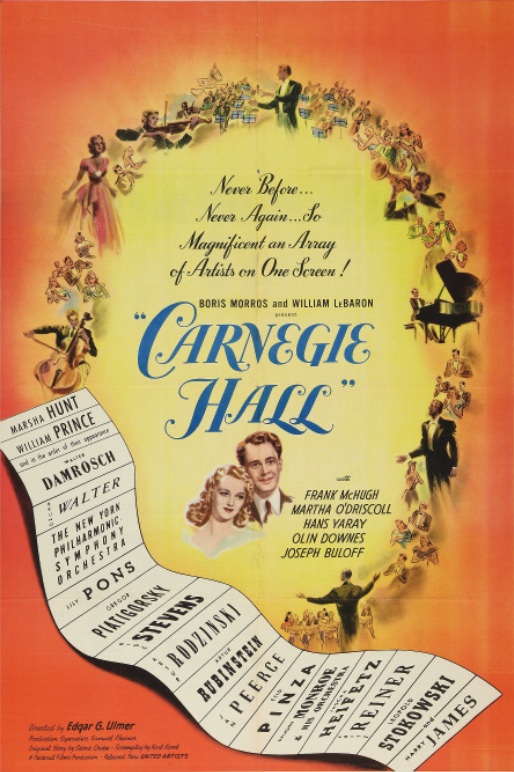
The poster for Edgar G. Ulmer’s Carnegie Hall boasts the following: “Never before … never again … so magnificent an array of artists on one screen!”

That’s true. It’s a film jam-packed with the crème de la crème of classical musicians, opera singers, and conductors from the first half of the 20th century.

What the poster doesn’t tell you is that the dramatic portions of the film are pretty dire. But if you can suffer through violinist Jascha Heifetz and conductor Fritz Reiner reading their lines in monotones as they discuss stage fright with an Irish usher named John Donovan (Frank McHugh), who says he only feels that strange feeling in the pit of his stomach when he’s eaten too much, you’ll be rewarded by hearing Heifetz play the First Movement of Tchaikovsky’s Violin Concerto in D Major with the New York Philharmonic Orchestra, under the direction of Reiner.

Carnegie Hall was directed by Edgar G. Ulmer, the poet of Poverty Row, who directed such minor masterpieces as Detour (1945), Bluebeard (1944), and The Black Cat (1934). Ulmer’s love of classical music was apparent in Detour — the main character is a nightclub pianist who, in one memorable scene, plays boogie-woogie variations on a Brahms waltz. Carnegie Hall is a love letter to great music and musicians, as well as to the eponymous edifice itself.

The plot in a nutshell (and there’s barely enough of it to fill two nutshells) involves an Irish girl named Nora Ryan (Marsha Hunt) who sees her first performance in Carnegie Hall as an adorable little rag-headed immigrant in 1891, and works her way up from cleaning woman to program director. She marries a febrile pianist named Tony Salerno (Hans Jaray, listed in the credits as “Hans Yaray”), who falls to his death while drunk when their son, Tony Jr. (William Prince), is still a baby.

Tony Salerno Jr. grows to maturity while being forced to diligently practice piano by his mother. They experience a rift after Tony Jr. falls in love with a nightclub singer named Ruth Haines (Martha O’Driscoll) and runs away to perform with crooner and band leader Vaughan Monroe. (Monroe is best known today for his version of “Let It Snow! Let It Snow! Let It Snow!” Ironically, Monroe wanted to be an opera singer, but the economic realities of the Depression coupled with a string of early hits led him to perform popular music exclusively.)

Eventually, Tony Jr. gets a record set released on RCA/Victor called “American Rhythms,” and performs his own composition, “57th Street Rhapsody,” onstage at Carnegie Hall as pianist and conductor of the New York Philharmonic, with soloist Harry James on the trumpet. It’s a performance that blends “high” and “low” music, and brings tears to his mother’s eyes. The end.

The drama is hackneyed and poorly written (and it doesn’t help that Jaray is utterly charmless as Tony Sr.), but the bulk of the film’s 2 hour and 15 minute running time is occupied by great performances — the Prelude to Die Meistersinger von Nürnberg, performed by the New York Philharmonic under the direction of Bruno Walter; soprano Lily Pons singing the “Bell Song” (“L’Air des clochettes”) from Delibes’s opera Lakmé; cellist Gregor Piatigorsky performing Saint-Saëns’s “The Swan,” from The Carnival of Animals (Le carnaval des animaux); mezzo-soprano Risë Stevens performing the end of the introduction and the start of the principal melody of Delilah’s song that seduces Samson in the second act of Saint-Saëns’s opera Samson and Delilah, followed by a performance of the Seguidilla from Act I of Bizet’s Carmen. And that’s just scratching the surface.

The DVD of Carnegie Hall that’s currently available from Kino Video looks great. The print is crisp, the blacks are deep, and the contrast is good. (And the “piano” scene from Detour is included as an extra.) As a dramatic film, Carnegie Hall doesn’t really succeed, but as a showcase for great musicians and singers, it’s a winner.

Nora Prentiss (Feb. 21, 1947)

In 1947, March was “make jokes about Nora Prentiss” month on the Jack Benny show. A week didn’t go by with at least one line like, “She makes Nora Prentiss look talkative.”

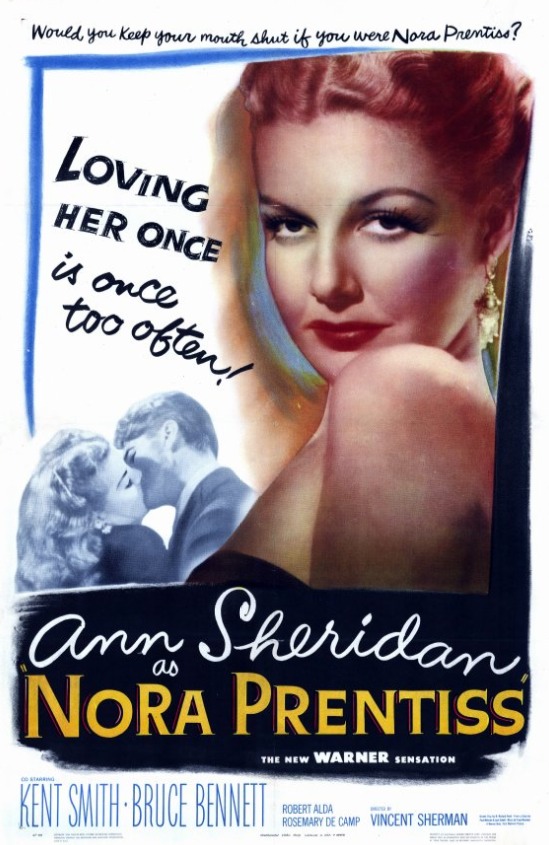
I suppose the promotional tagline for the film — “Would you keep your mouth shut if you were Nora Prentiss?” — was irresistible for comedians, especially since it’s selling the picture based on its final 10 minutes, which strain credulity a bit.

If you can swallow a few plot contrivances, however, Nora Prentiss is a fantastic film. The performances are great, Vincent Sherman’s direction is assured, Franz Waxman’s score is rich and expressive, and James Wong Howe’s black and white cinematography is crisp and beautiful, as it always was.

The title, poster, and advertising campaign for Nora Prentiss all seem to be modeled on the earlier Warner Bros. “women’s noir” Mildred Pierce (1945), but they’re very different films. Nora Prentiss, which is based on Paul Webster’s short story, “The Man Who Died Twice,” is more about its male protagonist, Dr. Richard Talbot (Kent Smith), than it is about Nora.

The film begins, as so many noirs do, at the end. A man sits in the shadows of a prison cell and refuses to say how he knew Dr. Talbot, or why he was blackmailing him.

Dr. Talbot is a 43-year-old physician with a wife (Rosemary DeCamp) and two teenaged children (Robert Arthur and Wanda Hendrix). He lives in a beautiful house in San Francisco and shares a thriving practice with his partner, Dr. Joel Merriam (Bruce Bennett).

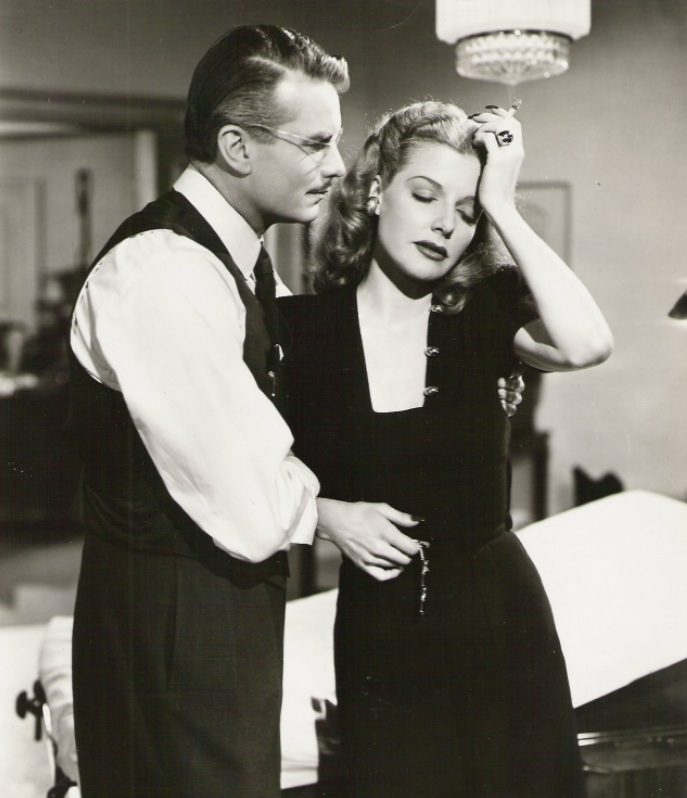
One night, Talbot comes to the aid of a beautiful nightclub singer after she’s knocked down by a car and suffers minor leg injuries. The singer, Nora Prentiss (Ann Sheridan), flirts with him a little as he tends to her, her nylon rolled down on one leg.

The strait-laced Talbot is completely smitten with Nora, but when she finds out he’s married, she resists his clumsy advances. Talbot says he doesn’t see a reason why they can’t be friends, but an afternoon at his cabin in the mountains never seems platonic, no matter what either of them says.

Nora is drawn to Talbot, but she never seems less than clear-headed about the affair. After a short, dreamy period of time with Talbot, she realizes that she doesn’t want to be “the other woman,” and attempts to break it off. He is less clear-headed, and will do anything to be with her, including — but not limited to — promising her he will divorce his wife, using a cadaver to fake his own death, and following her to New York, traveling under an assumed name.

If the logic police tend to kick down your doors of perception anytime the party in your head gets too weird, you’ll probably find yourself picking apart the plot of Nora Prentiss starting around the halfway mark.

But if you can relax, sit bank, and enjoy the ride, Nora Prentiss is an absorbing film about a man who loses everything for the love of a woman, eventually devolving into a paranoid, hard-drinking wreck who never leaves his hotel room for fear he will be recognized.

Kent Smith is very good as Talbot, but the film works as well as it does because of Ann Sheridan’s performance as Nora. Unlike noirs in which a wicked femme fatale with no discernible inner life seduces and ensnares a sad sack Everyman, Sheridan’s Nora is a three-dimensional character. She’s beautiful, intelligent, and sensible enough to pull away from Talbot when things start to go south. This has the effect of making Talbot’s obsession sadder and more believable than it would be if she were just a harpy with a beautiful face.

The Arnelo Affair (Feb. 13, 1947)

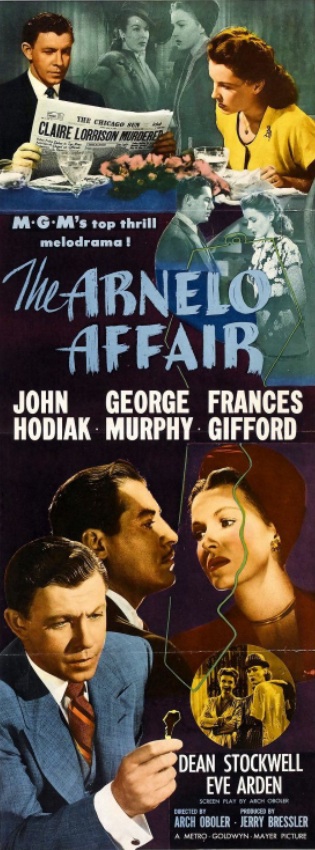
Arch Oboler’s The Arnelo Affair is a crime melodrama with so much voiceover narration that most of it can easily be understood and enjoyed by blind people.

Oboler cut his teeth in radio. His most famous work was for the horror anthology Lights Out, which is one of the scariest and most gruesome radio shows of all time. Oboler was a native of Chicago and the child of Jewish immigrants from Latvia. He was a prolific writer — one of the most talented in the medium of radio. His work as a film director is more hit or miss.

The Arnelo Affair, his third film, is based on a story by Jane Burr and takes place in Chicago. It starts out promisingly, with a lot of heat between its protagonist, Anne Parkson (Frances Gifford), and the magnetic, mustachioed nightclub owner Tony Arnelo (John Hodiak). Anne is married to a lawyer and all-around stuffed shirt named Ted (George Murphy), who’s such a drip that he won’t let their 9 year-old son, Ricky (Dean Stockwell), touch any of the tools in the room in their house marked “Ricky’s Workshop.”

The Parksons have been married for 12 years (which, if Gifford’s character is the same age as she is, means they got hitched when she was only 14 or 15), and Anne is clearly neglected and unloved. When her path crosses Arnelo’s, his persistence and menacing charm draw her to him.

Eve Arden, at this point typecast as the worldly and knowing friend of the troubled female protagonist (see also Mildred Pierce and My Reputation), plays Anne’s friend Vivian, who cautions Anne that “Canaries and hawks don’t make good playmates.”

She’s right, of course, and when Arnelo murders one of his other girlfriends in order to draw Anne closer to him, Anne will realize what a dangerous game she’s been playing.

Oboler’s script is perceptive about infidelity, and the dialogue is more believable than in most melodramas, but Oboler’s direction is flat, and he relies too heavily on voiceover narration by Gifford to explicate her character’s emotions. The Arnelo Affair isn’t bad, but after 45 minutes it loses momentum and never really picks up again. It might have made a better 60-minute B movie programmer from one of the small studios than a 90-minute maudlin MGM melodrama.

Odd Man Out (Jan. 30, 1947)

Odd Man Out
Odd Man Out (1947)
Directed by Carol Reed
Two Cities Films

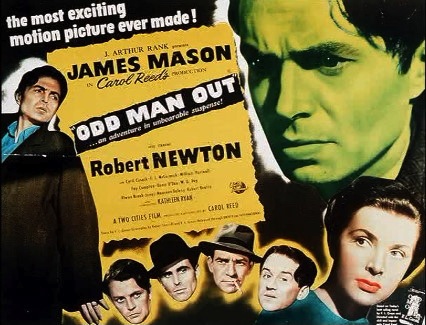
Odd Man Out is a terrific film. It might not be — as the lobby card above boasts — “the most exciting motion picture ever made,” but it’s a damned good one, with masterful direction by Carol Reed and a hypnotic lead performance by James Mason.

The film, which is based on a novel by F.L. Green, opens with a disclaimer that it isn’t “concerned with the struggle between the law and an illegal organisation, but only with the conflict in the hearts of the people when they become unexpectedly involved.”

Mason plays a revolutionary leader named Johnny McQueen, fresh out of the clink and planning a big heist. The Irish Republican Army is never mentioned outright — McQueen’s group is simply called “the organisation” — but the film takes place in Belfast, so you can connect the dots, if you care to.

However you choose to interpret the obfuscation of the I.R.A. in Odd Man Out, there’s little denying that it’s an apolitical film, more concerned with one man’s existential journey than with making any kind of political statement.

In the first scene of the film, we see Johnny McQueen holed up in a safehouse, planning a payroll robbery of a textile mill with his boys. Also present is the woman who loves him, Kathleen Sullivan (played by Kathleen Ryan). Things look and sound all right until one of Johnny’s boys approaches him, and tells him he’s concerned about Johnny’s ability to handle the job. Johnny was in prison for several years for blowing up a police station. He’s only been on the lam a little while, and confined to the safehouse the whole time.

Johnny brushes off his lieutenant’s concerns, but as soon as the plan is in motion, we realize that Johnny might have been wrong to lead the robbery. In a subjective sequence, we see the busy streets of Belfast from Johnny’s point of view. Cars whiz past, streetcars with grinding wheels pass by close enough to touch, people hurry to and fro, and the whole smoky mess looks too cramped and too large at the same time.

If you’re a fan of realistic heist movies, the robbery scene in Odd Man Out will meet with your approval. It’s not overly complicated, and it’s accomplished quickly, but it’s full of tension, especially since Johnny seems about to crack at any moment.

He and his boys make it out with the money, but a mill guard tackles Johnny as he hesitates on the front steps of the factory. The two men wrestle, and each takes a bullet. The wounded Johnny falls off the running board of the getaway car, and his boys lose him in the confusion.

Odd Man Out is a tense film. It takes place over the course of the night following the mill robbery, and Reed and his cinematographer, Robert Krasker, box their subjects in. The members of “the organisation” are pursued by police on foot, through dark alleys, over rooftops, and even through middle-class homes. (Reed frequently juxtaposes the activities of the city’s regular citizens with the activities of its criminal underclass.)

James Mason has little dialogue in the film, but his performance is amazing. He feels guilt, remorse, confusion, anger, loneliness, and even suffers hallucinations as he loses blood and seems to always be marching toward death. His performance is sympathetic, but keeps the viewer at a distance. This isn’t a film noir about a regular Joe who’s caught up in circumstances beyond his control. Every move Johnny made in his life has led him to this point, and he knows it.

Aside from Mason, most of the actors in the film were regulars on the stage of the Abbey Theatre (which could be why none of their accents sound quite right — they’re all from the wrong end of the island). Fans of British cinema and television will recognize plenty of them.

Reed’s most famous film is The Third Man, which he made in 1949. It’s been awhile since I’ve seen The Third Man, but I thought Odd Man Out was a stronger picture. Mason is a more compelling central presence than any of the actors are in The Third Man, and the music, cinematography, editing, and direction are all tighter in Odd Man Out.

Odd Man Out is a difficult film to classify. It starts out as a straightforward crime picture, but by the end of the film, Johnny’s journey takes on a surreal quality. A scene late in the picture in which he’s sheltered by a mad painter (Robert Newton) has the quality of a lively Samuel Beckett play.

The film was nominated for the Golden Lion at the Venice Film Festival in 1947, and received the BAFTA award for Best British Film in 1948. Fergus McDonnell was nominated for an Academy Award in 1948 for best editing, but Francis Lyon and Robert Parrish ended up winning for Body and Soul.