In my recent review of Decoy (1946), I mentioned that most of the movies that are now classified as film noirs were originally called “thrillers” or “melodramas.”
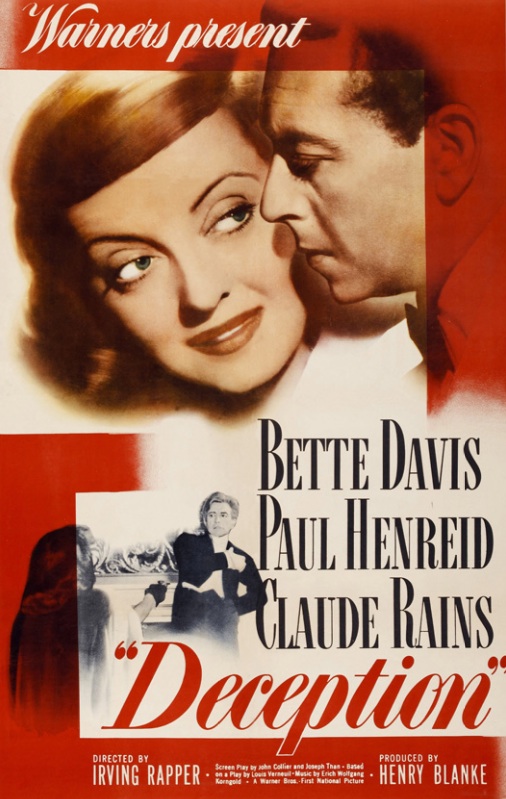
Irving Rapper’s Deception, about a love triangle in the world of classical music, sometimes gets thrown on the film noir pile, but it’s a melodrama through and through. The film reunited the director and all three stars of the popular, classy flick Now, Voyager (1942), which featured one of Bette Davis’s most iconic performances.
Lightning didn’t strike twice. While Deception, which reunited Davis with her fellow Now, Voyager alumni Paul Henreid and Claude Rains, received generally positive reviews, it was the first picture Bette Davis made for Warner Bros. that lost money. It’s a good film, but as melodramas go, it’s not terribly thrilling, and the criminal activity is kept to a minimum.
In the first scene of the film, piano teacher and musician Christine Radcliffe (Bette Davis) rushes through the driving rain to a concert in a small, second-floor performance area. She sees cellist Karel Novak (Paul Henreid), and she begins to cry. Quite by chance, she saw an announcement for the performance and couldn’t believe it, since she believed that Novak, her old flame, had died during World War II.
Their reunion is so emotional that it quickly leads to marriage. Even before the nuptials, however, Novak senses that Christine might be hiding something from him. She lives in an enormous apartment with a spectacular view of Manhattan, and her closets are full of fur coats, all improbabilities in the tight housing market of 1946, especially on a piano teacher’s salary.
Things quickly reach a head at their wedding celebration, with the appearance of Christine’s teacher, the famous composer Alexander Hollenius (Claude Rains). He has witticisms and icy remarks to spare, but he doesn’t really tip his hand until Christine sits down to play Beethoven’s Piano Sonata No. 23 in F minor, Op. 57, the “Appassionata.” Hollenius listens, enthralled, and crushes his champagne glass in his hand. When Christine rushes to tend to him, he says, “Like all women, white as a sheet at the sight of a couple of scratches. Calm and smiling like a hospital nurse in the presence of a mortal wound.”
That’s the first hint he drops about his feelings, but it won’t be the last. When Christine goes to visit him the next day, she walks into Hollenius’s conservatory and calls the piece he is playing “wonderful,” to which he responds, “Extraordinary, isn’t it, that music can exist in the same world as the basest treachery and ingratitude?”
From the beginning, Christine kept Novak in the dark about her relationship with Hollenius. Hollenius goes along with this deception, but never misses an opportunity to drop a hint or needle Novak about something. Compounding the mess is the fact that Hollenius is one of Novak’s favorite composers, and when he offers Novak the chance to be the soloist for the world premiere of his new cello concerto, Novak is ecstatic. Christine, on the other hand, senses that the mercurial Hollenius may be setting a trap for the emotionally fragile Novak.
And it certainly seems that way to the viewer, especially when Hollenius brings in Bertram Gribble (John Abbott), a journeyman cellist, to act as understudy in case Novak’s strained nerves get the better of him. Besides all the barbs and insinuations in social settings, Hollenius the conductor even seems hell-bent on tormenting Novak during the serious work of preparing for their concert, when he forces him to replay the same measure over and over during a dress rehearsal.
I’ve rarely seen a character in a film wield his art as a weapon quite so effectively as Hollenius does. It’s a perfect role for Rains, who as an actor projected a unique mix of effeteness and virility. By the time the climactic world premiere scene rolls around, the audience’s nerves are so thoroughly jangled that merely watching Henreid bow and pluck at his cello’s strings is as suspenseful as watching someone defuse a ticking time bomb. (It helps that Henreid’s pantomiming is nearly perfect. His cello parts were actually played by cellist Eleanor Aller, the wife of Felix Slatkin, when she was pregnant with their son, Frederic Zlotkin. Henreid was coached on how to properly mimic playing the instrument by Aller’s father, Gregory Aller.)
The score of Deception and all of Hollenius’s compositions were written by Erich Wolfgang Korngold (1897-1957), an Austro-Hungarian composer whose stirring, neo-Romantic scores for films like The Adventures of Robin Hood (1938) and The Sea Hawk (1940) presaged the work of John Williams. His style was too old-fashioned and his medium was too populist to attract anything but disdain and indifference from critics and scholars during his lifetime, but he was incredibly talented, even though his music was neither groundbreaking nor avant-garde. In Deception, he seems to be straining against the bonds imposed on him by the conventions of the cinema, and Novak’s cello part in the concerto is especially moving and powerful. At least I thought so.
The Jolson Story (1946)
Directed by Alfred E. Green
Columbia Pictures
Alfred E. Green’s Technicolor extravaganza The Jolson Story purports to tell the story of Al Jolson, one of the most popular singers in the United States in the 1920s and ’30s.
What it actually does is take the bare bones of Jolson’s life story and tell a mostly fictionalized show-biz story of a man’s unalloyed love of music and his tireless quest to touch the hearts of every man, woman, and child in America. That he often touches their hearts while wearing blackface makes The Jolson Story a tricky movie to watch and review in the 21st century.
Apologists for Jolson’s use of blackface usually point to two things; one, Jolson was Jewish, a minority group that itself suffered a great deal of discrimination in the U.S., especially before World War II; two, he genuinely loved the black musical forms that he appropriated. (There are also claims that he fought against segregation on Broadway, but I was unable to find any hard evidence of what he did or when he did it. If anyone has more information, please let me know.)
Unlike the white actors in blackface in D.W. Griffith’s The Birth of a Nation (1915), who blacked up to portray their characters as brutes, villains, and rapists, or the minstrel-show comedians who used burnt cork on their faces to portray “those funny little darkies” as shiftless and uneducated objects of ridicule, Jolson used blackface strictly in the context of musical performance, and there was never anything deliberately mean-spirited about it.
But no matter what the context, it’s hard today to look at a white person with black makeup covering every part of their face except a wide area around the mouth meant to convey the impression of big fat lips and not cringe.
Born Asa Yoelson in 1886, Jolson emigrated from his native Lithuania with his mother and his siblings in 1894. They joined Jolson’s father, Moses Yoelson, who had been rabbi and cantor at the Talmud Torah Synagogue in Washington, D.C., since 1891. Late in 1894, Jolson’s mother died, which had a profound effect on him, and he reportedly became completely withdrawn for seven months. In 1895, however, he was introduced to show business by entertainer Al Reeves, and by 1897, he and his brother Hirsch (whose stage name was “Harry”) were singing on street corners. The brothers continued in show business for several years, but eventually “Al” and “Harry” had a falling out.
Jolson first appeared in blackface in 1904 in a show at Keeney’s Theatre in Brooklyn. According to John Kenrick, blacking up created in Jolson “a sense of freedom and spontaneity he had never known before.” His blackface performances, and his black character, “Gus,” became wildly popular. Jolson probably wasn’t the first American popular musician who ironically experienced feelings of “freedom” by appropriating the appearance and attitude of a black man, but he was the first and perhaps most significant of the century that also gave us Benny Goodman, Elvis Presley, the Beastie Boys, Vanilla Ice, and Justin Timberlake.
Jolson’s popularity grew and grew in the ‘teens and ’20s, culminating in his appearance in the film The Jazz Singer (1927), which was the first “talkie,” or film with a synchronized soundtrack. There wasn’t much dialogue in The Jazz Singer, and most of the sound came from Jolson’s songs, but when he said, “You ain’t heard nothin’ yet” (a phrase he had already made famous in his stage performances), Jolson carved his place into history.
The Jazz Singer tells a fictionalized version of Jolson’s own life. Jolson’s character, Jake Rabinowitz, sings jazz music as “Jack Robin,” and even debuts on Broadway, but he is forever in conflict with his deeply traditional father, who wants Jake to be the sixth generation of Rabinowitz men to sing as cantors in the synagogue. The dramatic conflict is eventually resolved when he nearly misses his Broadway debut to sing the Kol Nidre in the synagogue, allowing his father to die a happy man, and then follows it up with his appearance on the stage, in blackface, in which he goes down on one knee to sing “My Mammy” to his mother, who is sitting in the front row.
In his book Black Like You, John Strausbaugh writes of this scene that, “there’s barely a hint of the racist mockery that’s supposed to be the corrupt heart of blackface entertainment. It’s much more like watching Mick Jagger or Eminem — not mockery, but the sincere mimicry of a non-Black artist who loves Black culture (or what he thinks is Black culture) so dearly he can’t resist imitating it, even to the ridiculous point of blacking up.”
As I said earlier, The Jolson Story takes a lot of liberties with the facts. It begins in Washington, D.C., at the turn of the century. Little Asa Yoelson (Scotty Beckett) is the only boy in the audience at a burlesque theater who sings along with the vaudevillian Steve Martin (William Demarest) when he asks the audience to sing along with him as he performs “On the Banks of the Wabash.” Martin cries, “Give that boy a spotlight!”
Of course, Asa’s Old World parents don’t approve of his love of popular song, especially his father, the cantor (Ludwig Donath). His mother (Tamara Shayne) is a little more understanding.
Little Asa hops a train to Baltimore to follow Martin, who wanted to make him a part of his act, but he gets picked up by a copper and taken to St. Mary’s Home for Boys. His parents come up to collect him, but when they hear him singing “Ave Maria” in the boy’s choir at the orphanage, their hearts soften.
“Singing without his cap on,” Cantor Yoelson tsks-tsks. “It’s not so much what’s on the head, as what’s in the heart,” says Father McGee (Ernest Cossart).
With his parents’ support, Asa goes on the road with Steve Martin. “Give that boy a spotlight” becomes the whole act, with Asa as Martin’s ringer in the audience. When his voice breaks during a performance, Jolson turns it into a whistling performance. He’s a consummate performer, and the show must go on.
The transition from childhood to adulthood in The Jolson Story is nicely done. Scotty Beckett and Larry Parks (who plays Jolson as an adult) look eerily alike, which helps. There’s a montage of Jolson’s performances across the nation represented as postcards sent home to his parents. He performs in all the big cities, as well as smaller towns, like Walla Walla, Washington, “the town so nice they named it twice.” Less than a half hour has gone by, and already his parents (both of whom remain living for the entire picture) are completely supportive of his musical career. The Jolson Story is pretty short on dramatic conflict.
At the half hour mark, we finally see Parks as Jolson black up when he substitutes for a performer named Tom Baron (Bill Goodwin) in Churchill Downs, Kentucky, after Tom wins a “snootful” at the tracks and gets good and drunk. This is Jolson’s breakout moment, and it’s worth noting that the blackface and nappy wig make him anonymous, and indistinguishable from a completely different-looking white performer once he corks up.
Only one person, Lew Dockstader (John Alexander) realizes the deception, and offers him a place in Dockstader’s Minstrels. (A real performing group that Jolson worked with early in his career.)
It’s not long before Jolson bristles against the mawkish and old-fashioned music he performs for Dockstader as part of the chorus. When the group performs in New Orleans, Jolson wanders off into the black part of town. This sequence features the only real black people you’ll see in The Jolson Story, although none of them have speaking parts. Jolson hears genuine ragtime music as he sits in with a band (sans blackface, of course) loving what he is hearing. He goes back to Dockstader and says, “I heard some music tonight called ‘jazz.'” But Dockstader is happy with the show the way it is. “Son, minstrels have been doing fine for fifty years, and we take pride in doing it the way it’s always been done,” Dockstader tells him.
Jolson goes off on his own, and enters a period of creative exploration. He calls the music he’s been listening to and working on, “Music nobody ever heard of before, but the only kind I want to sing.”
By “nobody,” he means, of course, no white people, since the (presumably black) composers and musicians he refers to are never shown. It could have been interesting to see Jolson work with and collaborate with black artists, but after that brief scene in New Orleans, we never see another black person.
Jolson gets a call from good old Tom Baron, and Jolson tells him he has all kinds of music that just needs to be “polished up” a little (no pun intended) and makes his debut on Broadway, singing “Mammy,” in blackface, down on one knee. Interestingly, he does so without a nappy wig — just his dark hair slicked back — and he sounds “blacker” than he ever did before.
Jolson is depicted as a man who is always desperate to make a connection with his audience. During his show “Honeymoon Express,” he even has the house lights turned up, so he can see everyone in the audience. This was also the scene in which I felt that his blackface looked the most insane. There’s a superimposition of his face singing over a left-to-right pan of the crowd, and the closeup shows just how crazy his blackface looks, with a wide area around his lips un-made up, showing the white skin around his mouth, his pink lips, and his small yellow teeth. His eyes are nearly maniacal, he’s clearly sweating under his makeup, and he’s superimposed over a crowd of laughing, happy white people. It’s the stuff of nightmares.
When it comes to Jolson’s personal life, this picture makes Jolson seem like a singing monk, when in reality he was an inveterate womanizer. In The Jolson Story, he has no relationships with women except for his lifelong chaste romance with childhood friend Ann (Jo-Carroll Dennison).
As soon as she marries another man, however, he meets his future wife, producer Florenz Ziegfeld’s newest female sensation, Julie Benson (Evelyn Keyes). He spots her in the audience at one of his shows, and asks her to request a song. After she says, “April Showers,” he practically lies down on the stage in front of her and sings his heart out. Interestingly, this is the first time in the picture he sings a really heartfelt number without blackface on. Maybe it would have been too strange for audiences of the time to see him romance a white woman while blacked up.
After the show, he finds her mimicking his performance of “California, Here I Come,” perfectly copying his resonant voice and wild arm and leg gesticulations, and he falls, hook, line, and sinker.
Even though “Julie Benson” is a complete fabrication, I would have liked to have seen even more of her. Keyes only gets one proper musical number, showing her in action as part of the Ziegfeld Follies, but her dancing and singing were impressive, not to mention the fact that she has one of the best pair of gams I’ve ever seen.
As I said, there’s not much dramatic tension in this picture. Marrying a shiksa doesn’t raise an eyebrow on either one of his parents’ faces, and the only real conflict comes later in the film, as Julie encourages Jolson to quit show business so they can have a quiet life together, but he clearly misses the limelight, even though he claims he is happy.
Jolson was something of a has-been in 1946, and he was no longer one of the most popular singers in America, but this film was a huge hit, and revitalized interest in his music. It even spawned a sequel, Jolson Sings Again (1949). Larry Parks was nominated for an Academy Award for best actor, but didn’t win. Parks was a relatively unknown B-movie actor before he was cast in this role, which launched him into stardom. Not too many years later, however, his career would be destroyed by the House Un-American Affairs Committee, when he admitted under pressure that he had once been a member of the Communist Party. He testified against his will in 1951, and was never officially blacklisted, but his career hit the skids.
His performance in The Jolson Story really is excellent. He lip-synched all of the songs to recordings of Jolson’s voice, and the effect is seamless. He plays Jolson as a man who is pathologically addicted to stardom, but never makes him seem maniacal or inhuman.
The Jolson Story took home two Oscars in 1947. Morris Stoloff won one for best musical score, and the film also won an Oscar for best sound recording. William Demarest for nominated for best supporting actor, and Joseph Walker was nominated for best color cinematography (the only other nominee in this category, The Yearling, ended up winning).
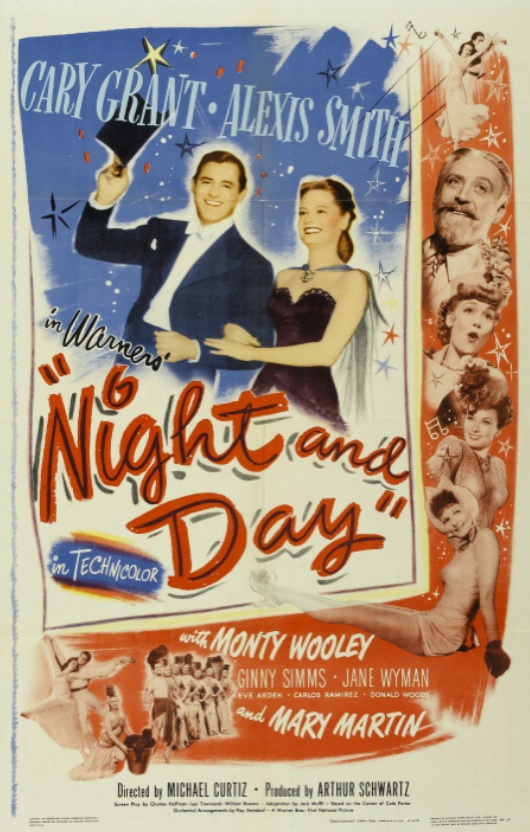
If you’re looking for a biopic about Cole Porter that tells the real story of his life, Michael Curtiz’s Night and Day is not for you. If, however, you’re merely looking for a sumptuous Technicolor musical extravaganza starring Cary Grant with great songs throughout, then it fits the bill.
The film was made with Porter’s supervision and full approval, so failures early in his career are blamed on everything but mediocre songwriting and production, and questions about his sexuality are never addressed.
The more recent Porter biopic, De-Lovely (2004), which starred Kevin Kline, implied that he was bisexual, but plenty of other sources claim he was gay, which makes more sense. His 35-year marriage to Linda Thomas was successful, if sexless, but all that means is that the two shared a genuine friendship and enjoyed each other’s company. Also, the seamier details of Porter’s parties during his time in Paris in 1917 and 1918 — “much gay and bisexual activity, Italian nobility, cross-dressing, international musicians, and a large surplus of recreational drugs” — wouldn’t have been appropriate material for a Hollywood production in the ’40s, even if Porter had been completely open about them.
Porter was an undeniably great songwriter — and one of the few Tin Pan Alley composers to write both music and lyrics — but even here the movie sanitizes things, since Porter’s lyrics were notoriously risqué. For instance, when the song “Let’s Do It” is played, you’ll heard about how “educated fleas” do it, but nothing about how roosters do it “with a doodle and a cock.” And musically, Ray Heindorf’s orchestrations tend toward the saccharine. By the end of the picture I felt as if I’d heard the same piece played over and over again.
Some of the whitewashing in Night and Day is purely ridiculous, though. Why was Porter’s first Broadway production, See America First, which was written with his Yale classmate Monty Woolley, a flop? Not because it was a critical disaster, according to this movie, but because the opening night crowd was drawn out into the streets by late-edition newspapers carrying word of the Lusitania sinking. Never mind that in real life, the New York American called the play a “high-class college show played partly by professionals.” In the world of Night and Day its failure was wholly due to a disaster outside of Woolley and Porter’s control. (Incidentally, Woolley plays himself in Night and Day, but perhaps owing to his age, his character is recast as one of Porter’s Yale professors instead of his contemporary.)
While there is no intimation that Porter may have ever produced mediocre work, there are gay undertones in the picture, if you care to look for them. Alexis Smith as Porter’s wife Linda spends a lot of the film looking dissatisfied and neglected. And the dramatic arc hits its climax at the 90-minute mark when Cole and Linda are pulled apart by the pressures of success. “You’ve put me in a small corner of your life, and every once in awhile you turn around and smile at me,” she tearfully tells him. In the film, their marital difficulties are resolved, but in an unconvincing, wordless final scene.
While the drama of Night and Day may be dishonest, the music is not, and it’s a great-looking movie.
John Cromwell’s Anna and the King of Siam isn’t nearly as well known as The King and I, the Technicolor extravaganza starring Yul Brynner and Deborah Kerr that was made a decade later. Both films tell the same story, but The King and I does it in the form of a Rodgers & Hammerstein musical. I saw The King and I when I was a kid, and have strong memories of certain scenes, but not of the film as a whole. So I came to Anna and the King of Siam relatively fresh, and was able to watch it without constantly thinking of Brynner’s iconic performance, at least most of the time. The one big difference — if memory serves correctly — is that the later, musical version of this tale was more of a love story. It’s not as if it ended with a marriage, or Kerr being added to the king’s harem or something, but there was a romance of some sort that grew over the course of the film. The closest Anna and the King of Siam gets is a couple of scenes between Anna and the king that end with the king leering, and seeming to contemplate her in a sexual fashion.
Anna and the King of Siam is the first filmed adaptation of Margaret Landon’s 1944 book of the same name. Producer Darryl F. Zanuck reportedly bought the rights to Landon’s book immediately after reading the galleys. As is often the case, the real-life Anna Owens was a considerably more interesting and complicated person than she was portrayed in the book or any of the films about her. This is largely due to her own self-invention. Anna Leonowens was born in poverty in India in 1831, the daughter of Sgt. Thomas Edwards, a soldier in the private army of the Dutch East India Company, and his wife Mary Anne Glasscott, an Anglo-Indian woman. Later in her life, Leonowens took pains to hide her origins, and claimed that her father’s rank was lieutenant (later she claimed he had been a captain), and that she had been born in Wales. It’s important to remember that these fabrications were not merely for the purpose of self-aggrandizement. As a widow and a single mother, Leonowens faced an uphill battle in life, and almost certainly would have faced discrimination if her mixed-race heritage had been known.
While Anna and the King of Siam doesn’t delve deeply into Anna’s background, there is never any intimation that she is anything but the most proper of British ladies. The Anna Owens of the film, played by Irene Dunne, embodies the best values of the “modern” British empire, while King Mongkut (Rex Harrison) represents an older form of governance; repressive, misogynistic, autocratic, and superstitious.
Reportedly, most Thai who saw the picture were shocked and angered by the portrayal of their revered nineteenth century king, and the film was banned in Thailand due to “historical inaccuracies.” It’s hard to argue with this assessment. Landon’s book and Leonowens’s own recollections were by all accounts at least partially fabricated, and overemphasized Leonowens’s role in the king’s life, as well as the harshness of his regime. And there’s the larger question of how well any white actor — even one as talented as Rex Harrison — can portray an Asian character.
Granted, the yellowface portrayals in the film look ridiculous, especially Lee J. Cobb as the “Kralahome,” or prime minister, who appears for much of the film stripped to the waist, covered with dark makeup, and sporting a pomaded pompadour. But, like Harrison, he delivers a nuanced performance, and in their scenes together they drop the stilted line deliveries that they have in their scenes with Anna or her son Louis (Richard Lyon). (They continue to speak English, of course, but the syntactical variance is still a nice touch.)
If one ignores questions of historical accuracy, Anna and the King of Siam is an excellent and involving story of cultural differences and the challenges and rewards of education in the face of adversity. The principal actors all give great performances, especially the beautiful Linda Darnell as the king’s newest and most alluring wife, Lady Tuptim. It’s a role that easily could have been one-note, but Darnell is able to create a sexy yet repulsive character who grows more complicated as the film goes on, and eventually becomes the central tragic figure of the picture. Also, Anna and the King of Siam looks fantastic. It won two Oscars, one for best black and white cinematography and the other for best art direction, and they were well-deserved.
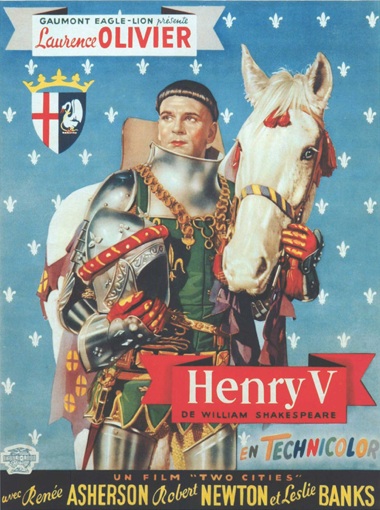
Laurence Olivier’s film adaptation of Shakespeare’s history play Henry V was originally released in the United Kingdom in November of 1944. (The date I’ve listed above is the release date of the film in the United States.) Following its release in the United States, Henry V was nominated for a 1946 Oscar for best picture, as well as Oscars for best actor, best score, and best art direction. It didn’t win in any of its nominated categories, but Olivier did receive an honorary Academy Award “for his outstanding achievement as actor, producer, and director in bringing Henry V to the screen.”
The recognition was well deserved (even though Olivier considered the award a “fob-off” from a jingoistic Academy). This film is a splendid achievement, and holds up remarkably well. Not only is it a fine cinematic adaptation of a great play, it’s a beautifully crafted film within a play within a film, in which Olivier the director has fun with convention while Olivier the actor delivers an assured and commanding performance as Henry, only recently a monarch after a misspent youth (chronicled by Shakespeare in Henry IV parts one and two).
The film’s full title is “The Chronicle History of King Henry the Fift With His Battell Fought at Agincourt in France,” and that’s how the title appears on the opening placard, which invites people to attend “Will” Shakespeare’s play, performed by the Lord Chamberlain’s Men at the Globe Playhouse this day, the first of May, 1600. There follows a panoramic vista in gorgeous, nearly surreal Technicolor of the London of Shakespeare’s day. It’s obviously a model, but it’s an effective one, with wisps of smoke rising from chimneys and tiny vessels dotting the Thames.
The beginning of the film attempts to faithfully recreate the theatrical experience one would have had at the Globe during Shakespeare’s time. There are no set dressings, and the Chorus (Leslie Banks), in each of his appearances, invites the viewer to suspend his or her disbelief, vividly describing the scene that is about to be played, and in so doing draws attention to the artifice of the play. As the film goes on, however, it moves out of the confines of the theater and becomes increasingly realistic, reaching its apex when Henry finally leads his troops in battle against the French at Agincourt.
Artifice and realism aren’t strictly delineated in Henry V, however. When the film first moves out of the theater to the court of France, the ocean is a static sea of waves that looks like the backdrop for a puppet show in Mister Rogers’ Neighborhood. And after the impressive battle, which was filmed in County Wicklow, Ireland (as a neutral country, it wasn’t ravaged by the war), artifice slowly returns in the form of phony-looking backdrops and a return to the stagey castle set of the French court.
When Olivier first appears on screen, it is as Oliver the actor, standing backstage in full costume, waiting for his entrance cue, and coughing into his hand in a decidedly unheroic fashion. As soon as he steps on stage, however, his voice commands attention. By the time he delivers his famous Saint Crispin’s Day speech, I was eating out of his hand. This is no mean feat, either, considering the historically accurate haircut Olivier saddled himself with, as well as his very noticeable eye makeup.
It’s common knowledge that Henry V was made with the cooperation of the British government and designed to be a nationalistic morale booster in the days following the Allied push into Normandy. Consequently, the scene in which Henry threatens to rape women and kill children was excised from the script, along with the hanging of Bardolph and Henry’s order to kill French prisoners. But it’s all in keeping with the tone of the film, which is more a celebration of theater and patriotism than it is a nuanced character study.
Director Joseph L. Mankiewicz’s Dragonwyck was adapted from Anya Seton’s best-selling 1944 historical novel of the same name. I haven’t read Seton’s novel, but I loved this film, and would like to dig into the book some day. Based on the description on the back cover, the introduction, and the first several pages that I leafed through, the film is a relatively faithful adaptation, as far as these things go. Neither Edgar Allan Poe nor Herman Melville make an appearance in the film, however, and the Astor Place massacre and steamboat racing both, sadly, fell outside the scope of the film.
But that’s par for the course in any 100-minute long adaptation of a 350-page novel. Taken purely as a cinematic experience, Dragonwyck is an engrossing Gothic melodrama that treads lightly the tricky boundary between romance and horror. As a Vincent Price fan, I especially loved his performance in this film. In my review of Shock, which was released earlier the same year, I mentioned that it was the first role I’d seen Vincent Price play in which there was a glimmering of the horror icon he would become. Well, he continued to blossom in this role. While never descending into outright horror territory, Dragonwyck gave Price an opportunity to exhibit more range than any role I’d seen him play previously, and the way his character changes drives the film; from coldly aristocratic to warmly romantic, and from a wielder of petty power to a broken drug addict.
The film begins in 1844. Miranda Wells (Gene Tierney) is a bright, beautiful young woman who longs to see the world. She lives on a small New England farm with her younger siblings, her mother Abigail (Anne Revere), and her deeply religious and strait-laced father Ephraim (Walter Huston). The Wellses receive a letter from their distant cousin, Nicholas Van Ryn (Price), who wishes to take Miranda away from her simple surroundings and employ her as a governess and companion to his young daughter at his home, Dragonwyck Manor, on the Hudson River. After much deliberation, Ephraim assents, even though Van Ryn’s wealth and atheism distress him. Like everything else in the film, Huston’s portrayal is fully realized. The character could have been portrayed as a two-dimensional Bible-thumper, but Huston crafts a believable and sympathetic character.
Once Miranda arrives at Dragonwyck, the obvious touchstone is Jane Eyre, but instead of a madwoman locked in the attic, there is merely Van Ryn’s fussy, compulsively overeating wife Johanna (Vivienne Osborne). Theirs is clearly a loveless marriage, and as soon as we learn that Van Ryn is not really Miranda’s cousin by blood, we can read the handwriting on the wall.
The story takes a lot of interesting turns, however, and I wasn’t ever quite sure what was going to happen next. While Van Ryn is portrayed sympathetically, he is also deeply flawed. A “patroon,” he forces his tenant farmers to pay tribute to him while he sits on a throne. It’s an anachronistic display of power, even for the mid-nineteenth century, and shows early in the film that all may not be well in Dragonwyck.
Dragonwyck also has an excellent sense of place. As Seton said in her introduction to the novel, “There was, on the Hudson, a way of life such as this, and there was a house not unlike Dragonwyck. All Gothic magnificence and eerie manifestations were not at that time inevitably confined to English castles or Southern plantations!”
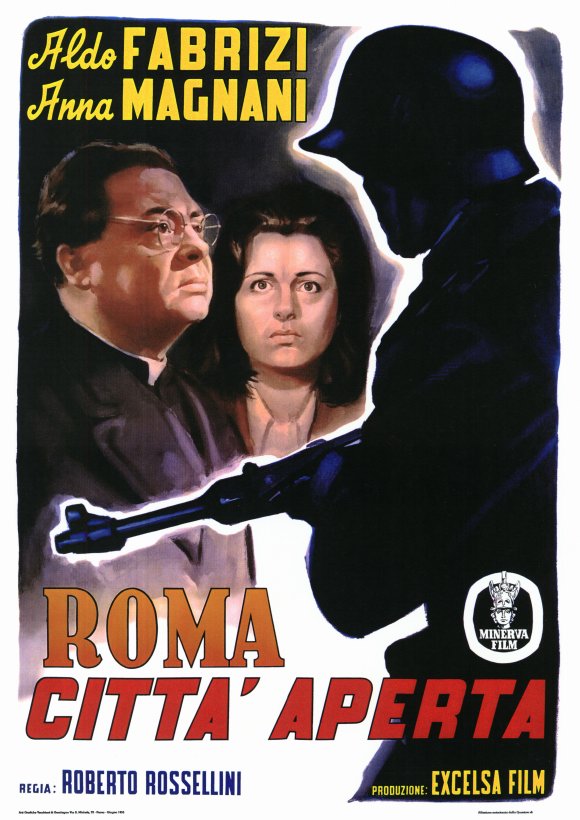
Roberto Rossellini’s Roma, Città Aperta (Rome, Open City) premiered in Italy on September 27, 1945, and premiered in New York City on February 25, 1946, at the World Theatre on 49th Street, a 300-seat theater where it would continue to play for nearly two years. It was shown at Cannes in September 1946 and won the festival’s grand prize. It also received the New York Film Critics Circle award for best foreign film of 1946. It’s cited as one of the earliest masterpieces of the Italian neorealism movement, and has been generally accepted as a great film since its release. The problem with instant masterpieces is that sometimes they coast for decades on reputations that might not be fully deserved.
Does Roma, Città Aperta fall into this category? Yes and no. The cartoonish villains and black and white morality sometimes skirt the edge of the ridiculous, and the Italian population is painted as victims of the Nazis to such a large degree that a person who saw this film in a vacuum would be forgiven for thinking that Italy was an occupied Allied power. Also, the exteriors are shot in a verité style that sometimes clashes with the more traditional interior shots. For example, a sun-drenched, slightly overexposed street scene with genuinely angry-looking extras might be followed by a carefully lighted interior scene featuring a stereotypically mincing Nazi officer and his right-hand dyke. For the most part, however, Roma, Città Aperta holds up as a suspenseful, well-crafted wartime espionage yarn that inspires and uplifts, even though … spoiler alert … all the good guys die.
Roma, Città Aperta arrived at just the right time for a positive reception. While Mussolini’s Italy was an Axis power, the country had been completely dependent on Germany since the end of 1941. Rome was occupied by the German army, with help from the Mussolini’s fascist blackshirts, but Italy has never been the most organized or politically unified country, and plenty of Rome’s citizens were understandably restive during this time. Roma, Città Aperta is a story of resistance that takes toward the end of the German occupation of Rome. Rossellini began working on the script with Federico Fellini and Sergio Amidei in August 1944, two months after the Allies had forced the Germans out of Rome, and he began shooting the picture about five months later. The picture’s politics (staunch Communist and anti-Fascist) were also perfectly suited to receive a warm reception from audiences immediately following World War II. If it had been shown in America and Britain just a few years later, the picture’s cheerleading for Communist principles would doubtlessly have gone over less well.
The new DVD from the Criterion Collection I watched looks great. It’s the full version, too, with the blowtorch torture sequence in its entirety, and while the subtitles are merely adequate, they do appear for each line of dialogue (a complaint about one available DVD version I’ve seen is that whole sections of conversation weren’t translated). Even the snatches of conversation in German are subtitled, which seemed unnecessary, since the main baddie, Maj. Bergmann, speaks Italian most of the time. (He’s played by the Austrian actor Harry Feist, who lived in Italy most of his adult life.) Visually, the film captured my interest immediately. The sequence in which resistance member Giorgio Manfredi (Marcello Pagliero) eludes the Gestapo by fleeing along the rooftops is thrilling. The human drama took a little longer to jell for me, partly because there are a lot of characters, and since this is a neorealist picture, they don’t appear at the beginning with title cards explaining their relationships. Aldo Fabrizi gets top billing. He plays the priest, Don Pietro Pellegrini, who ties all the characters together. He transmits messages, cash, and weapons for the resistance. Giorgio’s friend Francesco (Francesco Grandjacquet) is a fellow member of the resistance, but seems less dedicated to the cause than Giorgio. Giorgio’s girlfriend, Marina (Maria Michi), works at a nightclub and doesn’t seem to understand the gravity of Giorgio’s situation. Francesco’s fiancée Pina (Anna Magnani) shelters Giorgio and cares for her young son Marcello (Vito Annicchiarico), who gets involved with his own resistance against the Nazis, a sort of children’s crusade that involves blowing shit up really good.
As I said, it’s the cartoonish villains that seem most silly six decades later. Maj. Bergmann is as prissy and effeminate as he is cruel, which would be easier to ignore if he weren’t paired with an evil lesbian named Ingrid (Giovanna Galletti). The scenes in which Ingrid cajoles the easily manipulated Marina are like something out of a ’60s James Bond film.
There’s an oft-repeated story that Roma, Città Aperta was an ad hoc production, and that it was shot on scraps of discarded film, which gave it its distinctive choppy look. According to David Forgacs’s recent book on the film for the British Film Institute, however, when the Cineteca Nazionale restored the film in 1995, they found that the original negative consisted of just three types of film; one for the exteriors and two different, more sensitive, types of film for the interiors. The inconsistencies and changes in brightness are now blamed on poor processing. It’s an alluring legend, though; Rossellini and his crew shooting in a beautiful, ancient city still damaged by war, picking film up out of the gutters, but it’s just that … a legend. There’s another great story about the film, also of questionable veracity. According to Fellini’s essay “Sweet Beginnings,” the American producer of the film, Rod Geiger, was a half-drunk American private stationed in Rome who bungled his way on to the set and misrepresented himself as a producer with connections. With a copy of the film in his barracks bag, Geiger somehow managed a theatrical distribution deal when he got back to the states, even though, according to Fellini, Geiger was “a nobody and didn’t have a dime.” Geiger disputed Fellini’s account, however, and the essay was the subject of a defamation lawsuit that led to the film being banned due to legal reasons in some countries.
Roma, Città Aperta is a very good film, but I think its reputation as a masterpiece is partly due to when and how it was released. In my opinion, Luchino Visconti’s 1943 film Ossessione is just as good, if not better, but it wasn’t shown in the United States until the ’70s, partly because it was produced during the war, but mostly because it was an unauthorized adaptation of James M. Cain’s 1934 novel The Postman Always Rings Twice and legal trouble affected its distribution. It’s a must-see for students of cinema, especially ones interested in both film noir and neorealism.
The Swedish film Kris (Crisis) was acclaimed director Ingmar Bergman’s first film. His only previous credited film work was the 1944 film Hets (Frenzy), which he wrote. Based on a play by Leck Fischer, Kris opens with shots of an idyllic little town, accompanied by a voice-over narrator. A strange, worldly woman steps off the bus one morning (the town is too small to have a railway station). The narrator tells us that it is Mrs. Jenny (Marianne Löfgren), who, after 18 years, has come to see her daughter, Nelly (Inga Landgré), who has been raised by Miss Ingeborg Johnson (Dagny Lind), a piano teacher. The narrator ends his opening monologue with the ironic words, “Let the play begin. I wouldn’t call this a great or harrowing tale. It really is just an everyday drama. Almost a comedy. Let’s raise the curtain.”
Despite the source material, and the narrator’s references to theatrical convention, I thought Kris avoided staginess for the most part. A lot of this is due to the direction. If Bergman had never made another film after this one, he almost certainly would not be remembered as a great director, but Kris still shows a lot of greatness. Also, Landgré, the 18 year-old actress who plays Nelly, is incredibly pretty and naturalistic, and the film wouldn’t work nearly as well as it does without her assured performance at its center.
Nelly calls Ingeborg “Mutti” and calls her birth mother “Aunt Jenny.” Before Jenny shows up, Nelly and her mutti seem quite happy, although Nelly is beginning to champ at the bit, and longs for more excitement than her little town can offer her. Ingeborg also has a roomer, Ulf, played by the 38 year-old actor Allan Bohlin, who is in love with Nelly. She likes him, spends a lot of time with him, and affectionately calls him “Uffe,” but he’s too old to arouse her romantic interest. Ingeborg is destitute and in poor health. She borrows money from her elderly aunt and her cleaning lady. Nelly seems unaware of their financial difficulties, but when Jenny buys her a beautiful party dress for the ball she can’t wait to attend, it contrasts sharply with the simple dress Ingeborg purchased for her.
Jenny, who is approximately 40 years old, also brings with her the reedy little 25 year-old dandy Jack (Stig Olin). Jenny refers to him as her “half-brother’s son,” but he’s clearly a gigolo who services her. Things come to a head at the ball, when Jack gets Nelly liquored up and starts an impromptu swing band session that scandalizes the older townspeople. He catches up with Nelly outside, and they enjoy a tryst by the lake until Ulf shows up, chastises Nelly, and beats up Jack.
Back at home, Nelly hugs her mutti Ingeborg good night and tearfully says that she never wants to leave her. In the cold light of morning, however, with the gossipy townsfolk spreading word of the scandals the night before, Nelly runs off to the city with Jack and Jenny, and takes a job at Jenny’s beauty salon, called “Maison Jeannie,” and the love triangle between Nelly, her birth mother, and Jack plays itself out while Ingeborg suffers through loneliness and a single, painful trip to see Nelly in the city.
The dramatic arc of Kris is nothing we haven’t seen before, but the acting and the direction elevate it. The textures in the film’s outdoor scenes are especially beautiful, and hint at some of what was to come in Bergman’s career. As someone who hates day-for-night photography, however, I felt that Bergman was a little too in love with the sun-dappled lake next to which Nelly and Jack have their rendezvous. For a scene that takes place at night, it couldn’t look any more like the middle of the afternoon.
For the most part, however, I thought Kris was a very good film. Its attitude toward sexuality was a little more frank than American films of the time, and the human relationships in the film were nuanced and believable. I could have lived without having to look at Olin’s mustache the whole time, however. While its disturbing qualities were appropriate for his ne’er-do-well character, it was really hard to deal with. The poster above doesn’t really do its sleaziness justice. You have to see it for yourself.
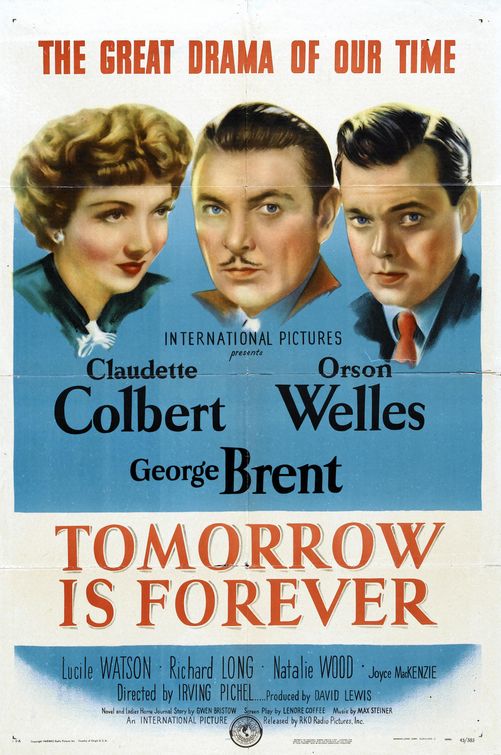
Tomorrow Is Forever (1946)
Directed by Irving Pichel
International Pictures / RKO Radio Pictures
Irving Pichel’s weepy wartime melodrama Tomorrow Is Forever premiered in London on January 18, 1946, and premiered in New York City a month later, on February 20th. If you can suspend your disbelief and accept the convoluted, coincidence-laden plot, it’s quite a fine movie, with excellent performances and a moving story.
The film begins on November 11, 1918, as the First World War is drawing to a close. Charles Hamilton (Douglas Wood), the head of the Hamilton Chemical Works, Inc., in Baltimore, is joined by his son Lawrence (George Brent) and other members of the company in toasting their success. He raises a glass to the part the company played in winning the war, as well as their contribution to the nation’s victories in the Spanish-American War and the Civil War. Lawrence Hamilton walks over to a pretty woman named Elizabeth MacDonald (Claudette Colbert) who is sitting by herself, and offers her a glass. Charles Hamilton drinks to peace and prosperity, and declares the rest of the day a holiday. Lawrence talks to Elizabeth, a research librarian at the chemical works, and learns that her husband, John, who went to war as an officer just four months earlier, is coming home soon. Elizabeth is elated.
A little time passes. Presumably it’s a little more than a month, since there’s snow on the ground, Max Steiner’s lissome score breaks into an orchestral interpretation of “Hark! The Herald Angels Sing,” and Elizabeth is carrying a little Christmas tree. When she get home, however, she receives devastating news; a telegram informing her that her husband, Lt. John Andrew MacDonald, was killed in action on November 5th. She goes to their bedroom, stands in front of the dresser, and he appears behind her in the mirror like a ghost. He’s played by Orson Welles, and he and Colbert play out a touching scene. They were clearly very much in love, and seeing him go away to war was difficult for her. In the end, he holds her tightly and promises her he will come back. (Return he does, and that’s where the audience’s suspension of disbelief will come into play, but more on that later.)
Not only has Elizabeth lost her husband, she learns that she is pregnant with his child. Lawrence Hamilton takes her in, and cares for her and her son, who is named John Andrew after his father. Elizabeth and Lawrence marry, and while it is a marriage based on friendship and respect rather than passionate love, it is also a successful marriage, and they have another son of their own, Brian (Sonny Howe). John Andrew Hamilton grows into a strapping young man (played by Richard Long), whom his parents call “Drew.” They never tell Drew, however, that Lawrence is not his biological father.
Meanwhile, we learn that John didn’t actually die in the war, but he was so badly injured that he didn’t want to live, and refused to identify himself to his attending physician, Dr. Ludwig (John Wengraf). In their scenes together, only Welles’s left eye can be seen through his mass of bandages, and he begs Dr. Ludwig to put him out of his misery. Dr. Ludwig refuses, and tells him that with extensive reconstructive surgery and physical conditioning, he can be made well again. It’s not entirely clear why John wants to be allowed to die and never see his wife again, although it seemed to me that “shattered body” was code for “irrevocably damaged genitals.”
Twenty years pass, and war again conspires to destroy Elizabeth’s happiness. Germany invades Poland, and Drew and his fraternity friends, including his best friend, “Pudge” Davis (Tom Wirick), make up their minds to go to Canada to join the R.A.F. and train as pilots. Drew is a few months away from his 21st birthday, however, and Elizabeth refuses to give her consent. Drew is the image of his father, a man she loved with a passionate intensity, and to lose him to battle would be like losing John all over again.
At this point, an Austrian chemist named Erik Kessler enters the United States as a refugee, along with a little blond girl named Margaret (Natalie Wood). Kessler is played by Orson Welles, and it soon becomes clear that he is John A. MacDonald, even though he has an Austrian accent, a beard, glasses, and walks with a limp. He goes to work for the Hamilton Chemical Works, and enters the lives of the Hamiltons.
It’s at this point that the film began to seem ludicrous to me. Kessler immediately recognizes Elizabeth when he meets her, but she does not recognize him. Welles certainly looks and speaks differently as Kessler, but he was less recognizable in his old-age makeup in Citizen Kane (1941) than he is here. How can she not recognize him? A willing suspension of disbelief is required, as well as an appreciation of the conventions of the stage. It is enough to know that Kessler received a great deal of plastic surgery to reconstruct his face, so while the audience can recognize Welles in his new guise, they have to accept that no one else in the film can. Was I able to do this? Well … sort of.
Tomorrow Is Forever is a story about loss and letting go. The performances in the film are excellent, especially Welles and Wood. Their scenes together were my favorite in the film. Just seven years old when she made this film, her first credited role, Wood was able to project a wide range of emotions and even delivered her lines in German relatively convincingly. Long was also very good in his first film role, even though his performance is pitched mostly at a single tone; earnestness. It was clearly made as a star vehicle for Colbert, however, and it’s her emotional journey that drives the film. As I said, you have to accept all the coincidences in the story and the idea that Elizabeth is not able to recognize who Kessler really is to go along for the ride, but if you can, Tomorrow Is Forever is a pretty good film.
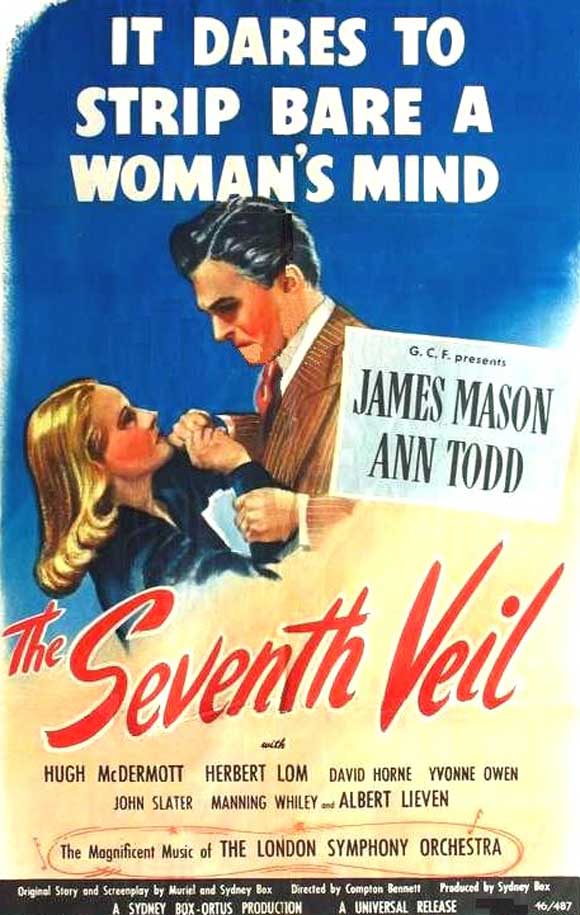
Compton Bennett’s film The Seventh Veil premiered in London on October 18, 1945. It was the biggest box office success of the year in Britain. The first record of its showing in the United States I can find is on Christmas day, 1945, in New York City. It went into wide release in the U.S. on February 15, 1946, and won an Academy Award the next year for best original screenplay. The story and script were by Sydney and Muriel Box. Sydney Box also produced the film.
The title refers to the seven veils that Salomé peeled away in history’s most famous striptease. As Dr. Larsen (Herbert Lom) explains to his colleagues, “The human mind is like Salomé at the beginning of her dance, hidden from the outside world by seven veils. Veils of reserve, shyness, fear. Now, with friends the average person will drop first one veil, then another, maybe three or four altogether. With a lover, she will take off five. Or even six. But never the seventh. Never. You see, the human mind likes to cover its nakedness, too, and keep its private thoughts to itself. Salomé dropped her seventh veil of her own free will, but you will never get the human mind to do that.”
The mind Dr. Larsen is attempting to strip bare is that of Francesca Cunningham (Ann Todd), a concert pianist who has lost the will to live, and who has been hospitalized after a suicide attempt. For the first hour of the film, her psychoanalytic sessions with Dr. Larsen act mostly as a framing device for Francesca’s flashbacks, but by the end, the high-minded hooey is laid on nearly as thick as it is in Alfred Hitchcock’s contemporaneous film Spellbound.
In her first flashback, Francesa recalls her schoolgirl days with her friend Susan Brook (Yvonne Owen). Susan’s insouciance towards academics is responsible for both of them being late to class one too many times. If Susan is punished, we don’t see it. Francesca’s punishment, however, will have dire ramifications. Brutally beaten across the backs of her hands with a ruler on the morning of her scholarship recital, she blows it completely, and is so devastated she gives up the piano.
When she is orphaned at the age of 17, Francesca is taken in by her uncle Nicholas (James Mason), a man whom she barely knows. She learns that the term “uncle” is a misnomer, since Nicholas is actually her father’s second cousin. Interestingly, both Mason and Todd were 36 years old when they appeared in this film. Their lack of an age difference isn’t too distracting, though. Todd has a wan, ethereal visage that lends itself to playing young, and Mason’s dark, Mephistophelian countenance is eternally middle-aged and handsome.
Nicholas is a confirmed bachelor who walks with a slight limp and hates women. He is also a brilliant music teacher, although his own skills as a musician are only average. Under his sometimes cruel tutelage, Francesca practices four to five hours a day, and eventually becomes an accomplished musician. Nicholas’s control over her comes at a cost. While she is studying at the Royal College of Music, Francesca falls in love with an American swing band leader named Peter Gay (Hugh McDermott). When Francesca tells Nicholas that she is engaged, he refuses to give his consent, since she has not yet reached her age of majority (in this case, 21), and tells her she will leave with him for Paris immediately. She does so, and continues her education in Europe.
For a melodrama, The Seventh Veil manages to be fairly gripping, especially if you find depictions of live performances stressful. When Francesca makes her debut with the London Symphony Orchestra (conducted by Muir Mathieson), performing Rachmaninoff’s Piano Concerto No. 2 in C minor and Grieg’s Piano Concerto in A minor, the film cuts between Francesca sitting at the piano, her hands (doubled by the pianist Eileen Joyce), Nicholas standing offstage, and her old friend Susan, who is in the front row. Not only does Susan, now a wealthy socialite, enter late and talk during the performance, but her mere presence reminds Francesca so strongly of the brutal whipping her hands received as a girl that the act of playing becomes almost too much to bear. She makes it through the performance, but when she rises to bow, she collapses from sheer exhaustion.
Francesca’s next trial — and the one that will result in her institutionalization — comes when Nicholas hires an artist named Maxwell Leyden (Albert Lieven) to paint her portrait. Francesca and Maxwell fall in love and go away to live together, despite Nicholas’s violent objections, but after a car accident, Francesca becomes convinced that her hands are irreparably damaged and she will never play again. Dr. Larsen, however, tells her there is nothing physically wrong with her, and he makes it his mission to cure her.
In the end, it is a recording of the simple, beautiful melody of the second movement of Beethoven’s Piano Sonata No. 8, “Pathétique,” along with a good old-fashioned session of hypnosis, that frees Francesca from her mental prison. The climax of the film does not hinge on whether or not she will perform again, however. It hinges on which of the three men in her life she will end up with; Peter, Maxwell, or Nicholas.
As soon as her choice is made, the film ends. There is no depiction of consequences. How satisfying the viewer finds the ending partly depends on which male character they like best, I suppose, although there are other considerations, such as how one feels about the question of whether it is better to be a great artist or to be happy, or even if Francesca can have one without the other. Personally, I found it all a bit ridiculous, but I enjoyed the film overall.
 In my recent review of Decoy (1946), I mentioned that most of the movies that are now classified as film noirs were originally called “thrillers” or “melodramas.”




 OCD Viewer