Tag Archives: Film Noir

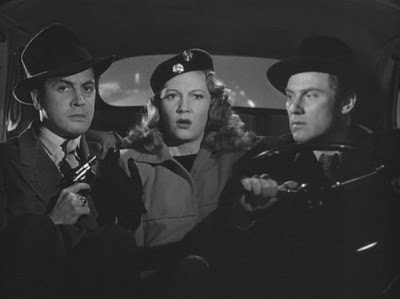
Dead Reckoning (Jan. 2, 1947)

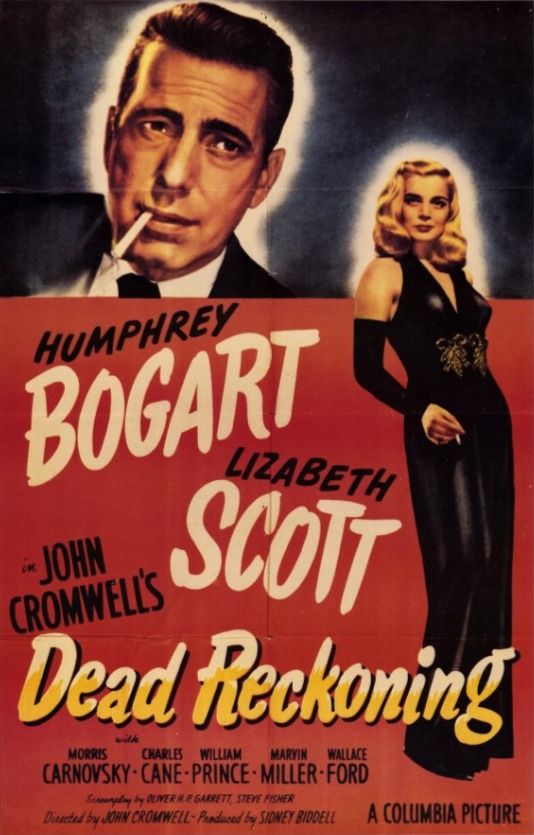
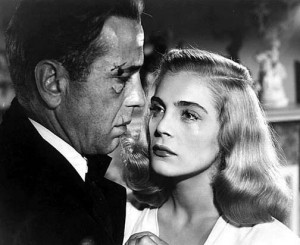
Lizabeth Scott looks a lot like Lauren Bacall. It’s hard not to compare her to Bacall even when she’s not acting opposite Humphrey Bogart.

There’s a lot of that going around in John Cromwell’s Dead Reckoning, a film that isn’t as well known as some of Bogie’s other noirs, like The Maltese Falcon (1941) or The Big Sleep (1946), and which suffers in direct comparison with them. But taken purely on its own merits, it’s a tense, well-made picture, full of post-war desperation, but with little of the silliness of a lot of returning-vet noirs, like Somewhere in the Night (1946).

Bogart plays a paratrooper, Capt. “Rip” Murdock, who was ordered to Washington, D.C., to receive the Distinguished Service Cross along with his buddy, Sgt. Johnny Drake, who was to receive the Congressional Medal of Honor. Before they could get there, Johnny hopped off the train and went on the lam before any newspaper reporters could snap his picture.

Rip finds a Yale pin from the class of ’40 that reveals that Johnny’s real name was John Joseph Preston. Rip follows the clues to Johnny’s hometown of Gulf City. (It’s unclear where Gulf City is supposed to be, but it has to be somewhere along the Gulf Coast. There are palm trees, and Bogie refers at one point to “Southern hospitality.” There is a real Gulf City in Florida, but it’s an unincorporated little town that had a population of zero by the 1920s.)

Rip rolls through the microfiche in the Gulf City public library until he finds a newspaper article dated September 3, 1943, with the headline “Rich realtor slain.” The motive was jealousy — both men loved a woman named Coral Chandler — and Johnny confessed to the murder, but disappeared before he could be sentenced, and enlisted in the army under a false name.

Rip finds a scrap of paper in his hotel room with a single word, “Geronimo,” scrawled on it. It’s from Johnny (it was what they always yelled before jumping out of planes), but the next time Rip sees Johnny, he’s a burnt-up corpse in a twisted car wreck.

Rip tracks down the woman in the case, the beautiful and statuesque Coral “Dusty” Chandler (Lizabeth Scott), a singer in a Gulf City nightclub. The scene in which she sings “Either It’s Love or It Isn’t” under a spotlight to Rip at his table is memorable, though Scott’s lip synching is pretty awful. Rip calls her “Cinderella with a husky voice,” and they embark on a whirlwind love-hate romance.

Most of the film is told in flashback. Rip sits in a pew in a church, his face hidden in the shadows, confessing his sins to Father Logan (James Bell), whom he sought out because he’s a former paratrooper. Logan was known as “the jumping padre, always the first one out of the plane.”
If you’re starting to think that Dead Reckoning might have an overabundance of references to parachuting, you’d be right, and we haven’t even scratched the surface. (The title of the film refers to flying a plane without the aid of electronic instruments — which is a metaphor for Rip’s dangerous, seat-of-the-pants investigation — and the final image of the film is a woman’s face metamorphosing into a billowing white parachute floating to earth along with the whispered word “Geronimo.”)

In many ways, Dead Reckoning feels like a pastiche of earlier Bogart film noirs. The loyalty to a dead man is straight out of The Maltese Falcon (“When a guy’s pal is killed he oughtta do something about it,” Rip says). A villain who rushes to open a door at the climax, only to be shot down, is straight out of The Big Sleep. And the film’s chief antagonists, the effete, cultured Martinelli (Morris Carnovsky) and his brutish, mildly brain-damaged henchman, Krause (Marvin Miller), are straight out of too many noirs to count.

Dead Reckoning carves out its own misanthropic place in the noir pantheon with its doses of brutal violence, fiery finale, and Rip’s distrust of dames, which is nothing new for a noir, but which Dead Reckoning takes to new heights. Rip says things like “I don’t trust anybody, especially women” and “Didn’t I tell you all females are the same with their faces washed?” And his diatribe about how women should all be shrunk down to pocket size has to be heard to be believed.

Dead Reckoning is full of memorable hard-boiled dialogue. Unfortunately, Scott can’t always pull it off the way Bogart can. The dialogue in film noir is often artificial, but it’s artificial in the same way as Shakespearean drama — it can express something more real than “naturalistic” dialogue can, but it takes a very talented actor to make it work.

Bogart had his limitations as an actor, but he perfectly delivered every single line of dialogue in every single film noir in which he appeared. Dead Reckoning is no exception, and while it’s not the greatest film I’ve ever seen, it’s damned good, and I look forward to seeing it again some day.

Dick Tracy vs. Cueball (Dec. 18, 1946)

Dick Tracy vs. Cueball begins with a montage of Dick Tracy and his rogues’ gallery from the Sunday funnies — B.O. Plenty, Gravel Gertie, Vitamin Flintheart, Flattop, etc. — and ends with a face that Chester Gould never drew. He’s a chrome-domed, pug-nosed bruiser called Cueball, and his cartoon image eventually dissolves into the visage of the character actor who plays him, Dick Wessel, looking menacing as all get-out as the recently paroled thug.

In the opening scene of the film, Cueball sneaks onto an ocean liner that has just docked, forces his way into the compartment of a passenger named Lester Abbott (Trevor Bardette), and demands he hand over his diamonds. When Abbott fights back, Cueball wraps a braided leather strap around his neck and strangles him to death. It’s not as shocking as the murder that opens Dick Tracy (1945), but it’s still fairly gruesome by ’40s standards. (We see it in silhouette, and Cueball even drives his knee into the small of Abbott’s back as he garrotes him.)

Police detectives Dick Tracy (Morgan Conway) and Pat Patton (Lyle Latell) run down clues and question Abbott’s employer, jeweler Jules Sparkle (Harry Cheshire). Pat trails Sparkle’s diamond cutter, Simon Little (Byron Foulger), to a meeting with his hideous assistant Rudolph (Skelton Knaggs), while Tracy follows Sparkle’s secretary, Mona Clyde (Rita Corday), to a rendezvous with antiques dealer Percival Priceless (Douglas Walton).

Meanwhile, Cueball seeks help from Filthy Flora (Esther Howard), the proprietor of a waterfront dive bar called “The Dripping Dagger,” and it becomes clear that he is a pawn in a game he doesn’t fully understand. He’s a pawn who kills as easily as other men breathe, however, and before the film is over, he’ll have murdered three people in his quest to get $20,000 for a score of diamonds worth $300,000.

Like Morgan Conway’s previous outing as Dick Tracy, this picture is a solid, unpretentious police procedural that moves at a nice clip. Many of the characters never appeared in Chester Gould’s comic strip, but they’re crafted in the right spirit. Gould’s bad guys may have been grotesque caricatures with ridiculous names, but he treated them with dead seriousness. Dick Tracy vs. Cueball does the same thing. There’s plenty of comic relief whenever the pill-popping Vitamin Flintheart (Ian Keith) is onscreen, but there’s nothing funny about Cueball slapping Filthy Flora across the face with his leather braid before he chokes her to death with it.

Gordon M. Douglas directs with energy and élan. His camera setups are utilitarian, but the angles and lighting create a dramatic noir atmosphere. Dick Tracy vs. Cueball is a violent B mystery thriller with 0% body fat and a lot of muscle.

Undercurrent (Nov. 28, 1946)

Undercurrent
Undercurrent (1946)
Directed by Vincente Minnelli
Metro-Goldwyn-Mayer

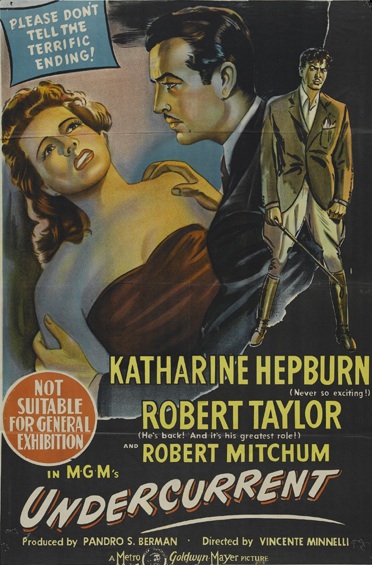
The next time you and a friend see a turgid, overlong thriller with too many twists and turns, bogus storytelling, and good actors wasted, and your friend says, “They don’t make ’em like they used to,” you can show your friend Undercurrent and prove that they make ’em exactly like they used to.

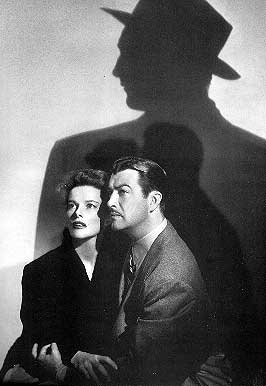
Pound for pound, Undercurrent might have boasted more talent than any other mystery melodrama in 1946. Director Vincente Minnelli and cinematographer Karl Freund were both gifted craftsmen with numerous acclaimed films under their belts. Herbert Stothart’s music is moody and evocative, especially the film’s haunting theme. Actors Robert Taylor and Katharine Hepburn were both stars of the highest magnitude, and hadn’t been seen onscreen for some time. Taylor had just finished his term of service as a flying instructor in the U.S. Naval Air Corps and Hepburn hadn’t appeared in a movie for a year and a half.

So what’s the problem? While studio tinkering could have played some part, the problem seems to mostly be Edward Chodorov’s screenplay, which was based on a story by Thelma Strabel. In a word, it’s silly. As soon as a promising situation is established, the story goes in a different direction, which serves to undercut the tension. The review of the film in the November 11, 1946, issue of Time called the plot “indigestible,” and said it was like “a woman’s magazine serial consumed at one gulp.”

Hepburn plays a young woman named Ann Hamilton who lives with her father, chemistry professor “Dink” Hamilton (Edmund Gwenn). Ann is herself chemically inclined, and prefers to spend time tinkering in the laboratory than entertaining proposals from eligible young men. All that changes when the handsome, mustachioed, and fabulously wealthy Alan Garroway (Taylor) enters her life. Alan is the inventor of the Garroway Distance Controller, which helped win the war.

Hepburn and Taylor in the shadow of Mitchum

Alan and Ann marry, and he takes her away with him to Washington, D.C., where she feels completely out of her depth in high society. Meanwhile, Alan starts making sinister insinuations about his brother Michael, who supposedly went missing years earlier with a large sum of money embezzled from the family business, and who is offscreen for most of the picture. The film seems to be setting up “What happened to Michael Garroway?” as the central mystery, but if you’ve looked at a cast list with character names, this plot thread won’t be that mysterious for you.

When Alan takes Ann away to his lovely country home in Middleburg, Virginia, the film threatens to settle down and become a solid Gothic melodrama. The estate has no phone line, and Alan’s behavior is increasingly bizarre. And as one critic noted, the central theme of Gothic fiction seems to be, “Someone is trying to kill me, and I think it may be my husband.”

True to form, however, the film goes in yet another direction, with Ann going off to explore Michael Garroway’s ludicrously appointed mansion-cum-bachelor pad, where she explores his musical instruments and books of poetry with copious underlinings, and seems to be falling in love with a man she has never met. I’m sure a good film could be made about a love triangle with one-third of the equation missing for most of the film’s running time, but this isn’t it. As Bosley Crowther said in his review of Undercurrent in the November 29, 1946, issue of the NY Times, “And if that also sounds a trifle senseless, let us hasten to assure you that it is.”

Robert Mitchum — one of my favorite actors of all time, ever since I saw him host Saturday Night Live in 1987 and asked my mom, “Who is that?” — is also in Undercurrent, but he doesn’t show up until more than halfway through the film’s running time, and only has a few scenes.

I may have made Undercurrent sound terrible. It’s not. It’s mediocre popcorn entertainment, and I had fun watching it. And it’s no worse than most of the “neo-noirs” that littered multiplexes throughout the 1990s … it’s just not much better, either.

The Chase (Nov. 16, 1946)

Arthur D. Ripley’s The Chase is based on Cornell Woolrich’s 1944 novel The Black Path of Fear, which was adapted as a screenplay by Philip Yordan.

Chuck Scott (Robert Cummings), a sailor who was decorated during World War II, is now bedraggled and broke in Miami. While staring longingly through the window of a lunch counter at a griddle full of bacon and flapjacks, he finds a lost wallet full of $20 bills. He decides to return it to its owner, Edward Roman, whose I.D. says that he lives on Hermosa Drive, but not before he “borrows” a buck and a half to buy himself breakfast.

Eddie Roman (Steve Cochran) turns out to be a smooth-talking criminal who lives in a palatial home with his creepy right-hand man Gino (Peter Lorre) and his beautiful wife Lorna (French actress Michèle Morgan), whom he keeps a virtual prisoner. Roman is sinister right from the get-go, slapping a woman (Shirley O’Hara) who pokes him while manicuring his fingernails before he talks to Scott.

Gino and his boss seem amused by Scott’s honesty. (He even owns up to the 12 bits he liberated.) Roman asks Scott why he brought the wallet back. “Now that I’m here I wonder myself,” Scott says. “I guess I’m just a sucker.”

Roman gives “Scotty” — as he calls him — a job as a driver. Scott doesn’t like or trust either Roman or Gino, but he can’t say no to paying work. Things get weird right away. Roman has a contraption in the back seat that allows him to control the accelerator, speeding the car up to more than 100 m.p.h. to see how Scott handles himself. (My wife probably wishes all cars I drove came equipped with this feature.)

One night, Roman entertains a prominent ship owner named Emmerrich Johnson (Lloyd Corrigan), an overdressed fat man who spends most of his time laughing nervously … he can never quite tell if Roman’s joking or not. Unfortunately for Johnson, he doesn’t see the depths of Roman’s villainy and sadism. He’s never joking.

After Johnson refuses to commit to sell Roman the two ships he wants to buy, Gino takes Johnson on a tour of Roman’s wine cellar. While Johnson is excitedly fussing over a bottle of 1815 Napoleon brandy, Gino slips away and locks Johnson in the wine cellar with Roman’s vicious dog. When Johnson is attacked he drops the bottle of brandy on the floor and it runs out along the floor in a convincing approximation of blood. It’s an old cinematic trick, but a good one.

Meanwhile, Scott and Mrs. Roman are busy falling for each other. After one of their many trips to the beach, where she looks out over the water longingly as he stands behind her, waiting with the car, Lorna offers him $1,000 to take her to Havana. She thinks she can trust him, and she can’t make it on her own. He mulls it over for a little while but quickly gives in, booking passage for two on the S.S. Cuba.

They make it to Havana, but their plan to continue on to South America hits a snag, and Scott finds himself on the run, accused of murder.

Things get really weird an hour into the picture, when Scott wakes up in a room with a bottle of pills on the night table and no memory of what happened to him over the course of the past few days.

I haven’t read The Black Path of Fear, but I have read other novels by Woolrich, and blackouts, amnesia, and lost periods of time were recurring themes in his work. Like a lot of Woolrich’s booze-soaked prose, The Chase starts out as a fairly standard thriller, but by the end it’s hard to tell what’s real and what isn’t. In a better film, like Detour (1945), this could be counted as a real achievement. With The Chase, however, the confusion between dreams and reality seems more the result of slapdash filmmaking than anything else.

Cummings has a pleasant way about him, and is believable as an earnest, soft-spoken Everyman. Morgan is beautiful, but the script doesn’t give her a lot to do. Cochran and Lorre are the real gems in this film. Every scene in which they appear is full of menace. Each man has a calm exterior, but there’s always violence roiling below the surface.

If you’re looking for tight plotting or a clever climax, you won’t find it here, but The Chase has just enough oddball charm to recommend it to noir enthusiasts.

Nocturne (Nov. 11, 1946)

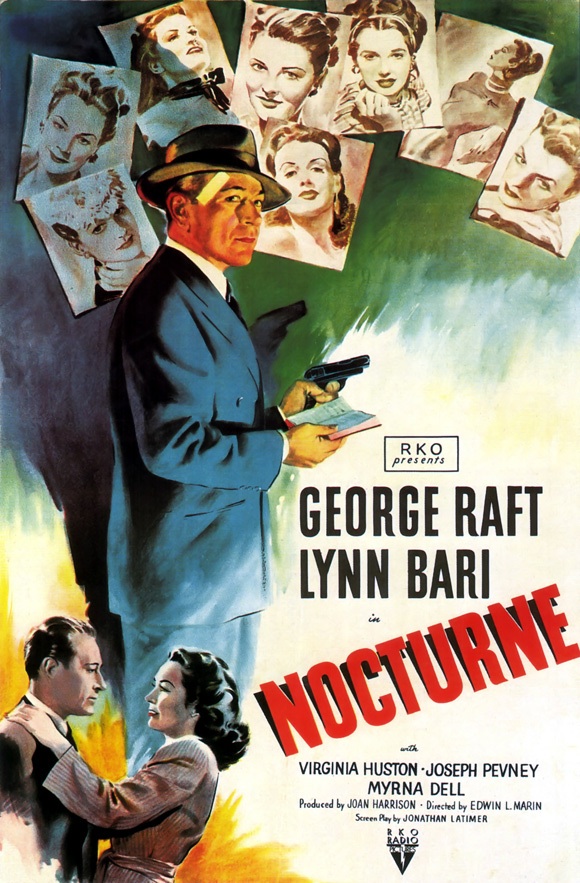
Edwin L. Marin’s Nocturne is close to being a great film noir, but not that close. It’s an entertaining mystery thriller with plenty of clipped, hard-boiled dialogue that’s fun to listen to, if not particularly credible.

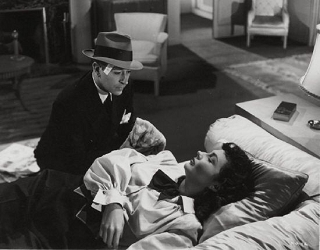
George Raft plays Lt. Joe Warne of the Los Angeles police, and it’s a role that seems designed to play to the public’s perception of Raft as a gangster and a thug. Warne conducts his murder investigation with the subtlety of a steamroller, pushing a mustachioed Lothario into the pool when he gets in his way and ripping up the roll of a player piano in a diner when the owner won’t cooperate with him.

And when was the last time you saw a hard-boiled detective who lived at home with his mother? It’s the kind of oddball detail that feels as if it would be more at home in a gangster movie starring James Cagney.

Raft’s first big role was as Paul Muni’s sidekick in Howard Hawks’s Scarface (1932). After that he starred in a string of gangster pictures, and was one of the most popular actors in crime melodramas, along with Cagney and Edward G. Robinson. His boyhood friendship with gangster Owney Madden and association with men like Bugsy Siegel and Meyer Lansky aided the public’s perception of him as a hard man who didn’t just “talk the talk.”

By the ’40s, however, his star was beginning to fade. Turning down the lead roles in High Sierra (1941), The Maltese Falcon (1941), and Double Indemnity (1944) didn’t help matters. (Raft was reportedly functionally illiterate, which may have made choosing scripts difficult.) It’s safe to say that by 1946, he was getting the scripts that Humphrey Bogart used to line his birdcage.

Raft wasn’t a very expressive actor, and he had the range of a T-bone steak, but his tight-lipped acting style was perfect for B movies like Nocturne.

A flamboyant pianist and composer named Keith Vincent (Edward Ashley) is murdered, presumably by one of the nine brunettes he was running around with. He has glamour shots of all of them lining one wall of his living room, and it’s clear they were all interchangeable for him, since he called them all “Dolores.” (This may seem like a clever device to hide the identity of the murderess from the viewer, but it’s not.)

Lt. Warne investigates with ham-handed glee, and his investigative technique is as sloppy as the filmmaking. For instance, in one scene his chief (Robert Malcolm) bawls him out for bothering a character named “Mrs. Billings,” but apparently her scenes were left on the cutting room floor. This is fine, but why leave references to her in the film? Similarly confusing is the fact that Warne’s chief gives him two days to investigate Vincent’s murder on his own, but we only find this out after the two-day period is over. And it’s only after this two-day investigative blitz that Warne goes back to Vincent’s house and notices that one of the pictures is missing, since the pattern is disrupted, and there’s an enormous nail hole in the wall. Looking at the stamp on the back of one of the other pictures leads him to a sleazy photographer named Charles Shawn (John Banner). Wouldn’t a detective worth his salt have noticed all this immediately?

The most enjoyable thing about this film is the atmosphere. Lt. Warne spends a lot of time in smoky nightclubs, including the unique Keyboard Club, in which a hulking man-child named Erik Torp (Bern Hoffman) pushes a pianist named Ned “Fingers” Ford (Joseph Pevney) and his upright around on a rolling platform so they can take requests, table by table. When they get to Warne’s table, he hands Vincent’s unfinished piece “Nocturne” to Fingers to play. When he reaches the end of the handwritten sheet music, Fingers asks, “What did your friend do, run out of notes?” Warne responds, “More or less.”

Plenty of sex and sleaze run right below the surface of the picture, but it’s all pretty lighthearted. There’s a funny scene in a dance studio in which Warne can’t learn even the most basic steps (it’s mostly funny because Raft was a professional dancer), and his romance with his prime suspect, Frances Ransom (Lynn Bari), doesn’t carry much sense of danger or menace.

Nocturne is a really fun picture, despite its shortcomings. It has some of the snappiest, most hard-boiled, least naturalistic dialogue I’ve heard since I watched The Dark Corner (1946). Fans of B noirs are encouraged to seek out this picture.

Secret of the Whistler (Nov. 7, 1946)

Secret of the Whistler
Secret of the Whistler (1946)
Directed by George Sherman
Columbia Pictures

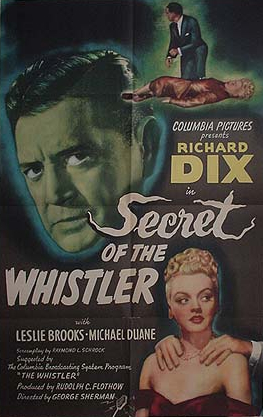
George Sherman’s Secret of the Whistler is a solid but unremarkable entry in Columbia Pictures’ series of bottom-of-the-bill programmers based on the radio show The Whistler. Each film in the series starred Richard Dix, a he-man of the silent era whose star was fading. Dix delivered sweaty, paranoid performances in a variety of roles in The Whistler series; businessman, drifter, private investigator, homicidal maniac. His health may have been failing, but he was still a solid performer.

In Secret of the Whistler he plays a painter named Ralph Harrison who is living the high life on his wealthy wife’s dime. He throws lavish parties in his studio/bachelor pad for people who aren’t really his friends, but who don’t mind eating his food and drinking his booze. Among the many attractive young women who pose for Harrison for big money is Kay Morrell (Leslie Brooks), a beautiful blonde with gams that won’t quit.

Meanwhile, Harrison’s wife, Edith Marie Harrison (Mary Currier), lies in bed at home, at death’s door. When the film begins, Harrison seems to genuinely care for his ailing wife, and she adores him. Slowly but surely, however, Harrison begins to fall for Kay. (And after the scene in which she poses for him wearing a small one-piece undergarment, I thought to myself, “Who wouldn’t?”) He buys her expensive presents and lavishes her with attention. His wife isn’t long for this world, so what’s the harm?

The only problem is that Mrs. Harrison comes under the care of a specialist, and makes a miraculous recovery. (Her cardiologist’s course of therapy seems to mostly involve getting out of bed and taking long walks, which is still good advice today.) When she drops by her husband’s studio unannounced, however, her excitement turns to horror when she overhears her husband pitching woo to Kay. She suffers a major setback and promises to write Ralph out of her will.

Fans of The Whistler radio show will have no trouble predicting what will happen next, or the panoply of complications that will arise. True to the radio show, the Whistler himself shows up several times in the film, always as a dark silhouette or a shadow thrown on a wall, speaking directly to Harrison and revealing his murderous thoughts.

The screenplay for Secret of the Whistler by Richard H. Landau and Raymond L. Schrock is the most thematically similar to the radio show of all the films in the series I’ve seen so far. If murdering your wife was your thing, The Whistler was the best show on the air. Nearly every week it seemed as if someone’s spouse was being bumped off for an inheritance and a chance at life with a younger boyfriend or girlfriend, although things never went according to plan.

With a little more than double the running time of a typical episode of the radio show, Secret of the Whistler has more time to develop its characters and its story. On the radio, there just wouldn’t be enough time to show Ralph’s tepid devotion slowly changing to disinterest. At the same time, though, the film feels a little longer than its 65-minute running time, and while its twist ending is good, it doesn’t have the devious ingenuity of the best twists of the radio show.

Still, this is a really good mystery series, with heavy doses of noir atmosphere and performances by Dix that are always interesting to watch. Secret of the Whistler is a lesser entry in the series, but it’s still a pretty good one.

Wanted for Murder (Nov. 2, 1946)

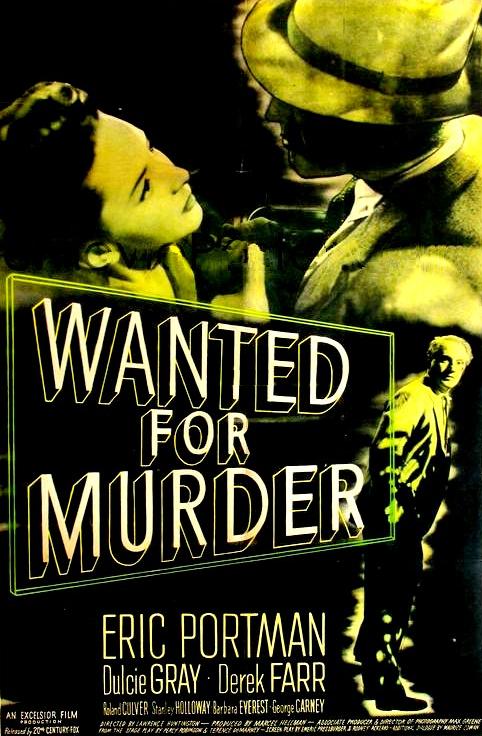
Lawrence Huntington’s Wanted for Murder, which was originally released on June 17, 1946, in the U.K., premiered in the United States on November 2, 1946. It’s an effective chiller with a dependable cast and an excellent screenplay by Rodney Ackland and Emeric Pressburger, based on the stage play by Percy Robinson and Terence de Marney.

The film boasts a terrific sense of place, with scenes filmed in Hampstead Fairground, Madame Tussaud’s wax museum, and the center of London (which, when necessary, appears as rear screen projection stock footage, a technique that can be distractingly fake-looking but here is done fairly skillfully). There are also several atmospheric nighttime murder sequences in Hampstead Heath, Regent’s Park, and Hyde Park.

Particularly effective is the music by Mischa Spoliansky, whose pop-orchestral tune “A Voice in the Night” is a motif that follows the murderer around like his shadow, and which you’ll be hard-pressed not to hum after seeing this picture.

Eric Portman plays middle-class mummy’s boy Victor James Colebrooke, a man who feels haunted by the specter of his late father, William Colebrooke, an executioner to Queen Victoria whose eerie likeness stands in Madame Tussaud’s.

Colebrooke is a handsome, superficially charming gentleman who drink Hendrick’s Gin, lives at home with his mother and a servant, and whose single-breasted suits often sport a white boutonniere and a pocket square. He’s the embodiment of the British fascination with “the murderer next door” — the outwardly ordinary man whose wife’s remains are bricked up in the basement or who strangles working girls on the weekend.

Wispy brunette Dulcie Gray plays Anne Fielding, a young woman who works in a gramophone shop and is dating Colebrooke. A starry-eyed young bus conductor named Jack Williams (Derek Farr) finds her waiting at the fairgrounds and mashes her as hard as he can. She’s attracted to him, but Colebrooke is manipulative and possessive.

Rounding out the fine cast are Roland Culver as Chief Insp. Conway and Stanley Holloway as Sgt. Sullivan, the two Scotland Yard detectives who are on the trail of the killer. Their scenes are some of the film’s most light-hearted, but they are never less than professional, and are dogged in their pursuit of the strangler.

When the first murder occurs, the audience doesn’t know who the killer is, but we strongly suspect Colebrooke. It’s not long before the film removes any doubt about his guilt, which allows for a more interesting and creepy character study than in a whodunnit, where the murderer’s identity is a secret up until the climax.

Most of the film is a game of cat and mouse, with the detectives fairly certain Colebrooke is guilty, but unable to gather anything but circumstantial evidence.

Meanwhile, Colebrooke goes about his dastardly business at night in the parks, telling young women he takes out on dates and strangles that his name is “Tom Mahon.”

Colebrooke blames his sickness on his father, whose killings were all committed in the course of his duty, but whose grim pride in his work earned him the nickname “The Happy Hangman.” The Freudian-minded viewer might blame his overbearing, possessive mother, but the film itself doesn’t draw any such trite conclusions. His father is just a picture on the wall or — in one scene — a disturbingly realistic wax figure, and his mother isn’t a bad person, even encouraging him to find a nice girl and marry her.

Wanted for Murder is a first-rate thriller. Although the adjective hadn’t been invented when it was made, I’d go so far as to call it “Hitchcockian.”

Nobody Lives Forever (Nov. 1, 1946)

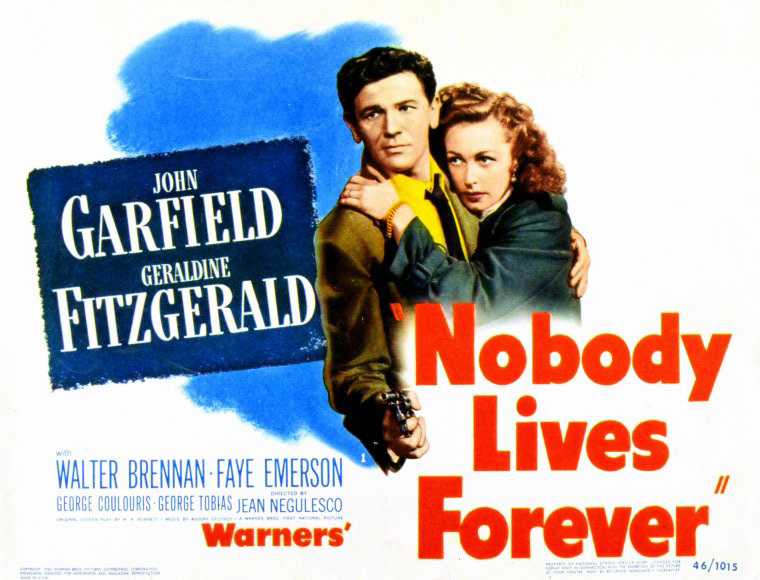
Jean Negulesco’s Nobody Lives Forever is far from a great film, but it’s crackerjack entertainment. Warner Bros. had been making crime pictures for 16 profitable years at this point. While the heyday of the Warner gangster film may have been in the ’30s, this is a fine example of the quality product the studio was still churning out in the post-war era.

The screenplay is by W.R. Burnett, whose 1929 novel Little Caesar was made into a film in 1931 starring Edward G. Robinson — the first of Warner’s great cycle of gangster movies. Nobody Lives Forever is based on Burnett’s novel I Wasn’t Born Yesterday, and while it may not be as significant as Little Caesar, it’s still a tight thriller with plenty of snappy tough-guy dialogue.

Besides the good script and excellent direction, the picture works as well as it does because of impeccable casting. When you’re looking for a hard-bitten but essentially decent con man, you can’t ask for a better protagonist than John Garfield. A kindly, doddering old mentor of cons named “Pop”? Who better than Walter Brennan? A sweaty, bug-eyed, paranoid louse named “Doc” who desperately needs one decent score to get back on top? Is George Coulouris available?

Garfield plays Nick Blake, a World War II veteran honorably discharged after being wounded in action. One of his hands doesn’t close quite right, but other than that he’s none the worse for wear. After his sidekick Al Doyle (George Tobias) picks him up from the hospital in Governor’s Island, they take the ferry back to Manhattan, where he reunites with his girl, Toni Blackburn (Faye Emerson). As she sings “You Again” in a swanky nightclub, Nick follows the mustachioed club owner Chet King (Robert Shayne) into his office to settle a beef over money. Rudi Fehr’s editing in this sequence is superb, cutting between Toni on stage, Al standing guard outside the office, and Nick bracing Chet inside.

After Toni finishes her number, Nick confronts her, then kisses her passionately, then smacks her in the face for double crossing him.

The action soon switches to California, where Al has gotten a line on a widow with a $2 million fortune, which — as Pop points out — is a lot of money, even after taxes. Nick, a handsome “diamond in the rough,” is the perfect candidate to pose as a shipping magnate and charm her out of her cash.

Unlike most long cons, Nick, Pop, Doc, Al, and the other members of their crew meet in smoky back rooms as if they’re planning a bank heist. The only problem with the job is that Nick actually starts to fall for the widow, Gladys Halvorsen (Geraldine Fitzgerald), who turns out to be younger than most widows, and a dish to boot.

When Doc pushes Nick to close the deal, he shoots back, “I’m not used to operating with a bunch of cheap, hungry chiselers who should be in the strong-arm racket. Big deals take time.”

Garfield has great chemistry with his co-stars, particularly the ladies, but the relationships take a back seat to the action, especially during the final climactic 20 minutes.

Sure, there are some holes in the plot, and there’s nothing deep about Nobody Lives Forever, but it’s a hell of a way to kill an hour and 40 minutes.

Decoy (Sept. 14, 1946)

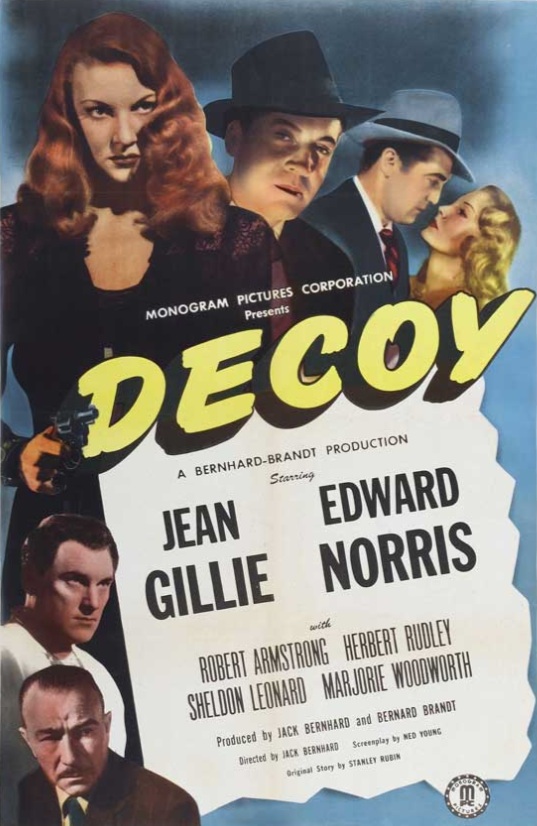
Jack Bernhard’s Decoy has built up quite a reputation in recent years. Considered a “lost” film for decades, it was written about in several books about film noir, and its perversity and violence were marveled over, as well as the coldness of its femme fatale.

When a print of the film was unearthed and shown as part of the Second Annual Festival of Film Noir in March 2000 at the Egyptian Theatre in Los Angeles, the audience reportedly went wild.

Film critic Glenn Erickson (who also does a commentary track on the DVD) wrote that “as far as violence goes, Decoy was to 1946 what Pulp Fiction is to 1994.” I’m not sure if this is true. Certainly in terms of cultural impact, Quentin Tarantino’s films made a much larger splash in the ’90s than this picture did at the time of its release. And it’s hard to compare Tarantino’s films — which are incredibly self-aware, and which owe so much to every decade of film history that preceded them — to this unselfconscious programmer.

Decoy is based on a story by Stanley Rubin, who wrote it after he got out of the Air Corps in an attempt to make some money. He first sold it to radio, and then, with a few changes, to director Bernhard at Monogram Pictures. The screenplay is by Nedrick Young. It stars British actress Jean Gillie as Margot Shelby, surely one of the most heartless femme fatales in the history of noir. (Gillie was married to the director. They met in England, and they divorced shortly after the film was finished, and she only starred in one other film before she died of complications from pneumonia at the age of 33.)

When the film begins, we see Dr. L.L. “Lloyd” Craig (Herbert Rudley) staggering out of a gas station washroom in the early dawn hours. He hitches a ride into town, and heads for a particular room in a hotel. Once he’s inside, we hear shots. Police sergeant Joe “Jo Jo” Portugal (Sheldon Leonard) rushes down the corridor. The doctor is dead, there’s a wooden box with the lock shot off (MacGuffin alert!), and Margot is lying on the couch, wounded. When Jo Jo hands her the box, she laughs and weeps, and generally acts like a petulant child.

In classic noir fashion, she narrates her own story as she lies dying. Her boyfriend, gangster Frankie Olins (Robert Armstrong) was set to die in the gas chamber, which didn’t make Margot happy. Not because she was going to miss him after he was dead, but because only he knew where the $400,000 take from a robbery was hidden.

In a convoluted scheme, Margot seduces gangster Jim Vincent (Edward Norris), who has already sunk $45,000 into an appeal for Olins that failed, and gets him to engineer the removal of Frankie’s body from the prison immediately after he dies in the gas chamber. She also seduces Dr. Craig, cajoling him away from his free clinic and his nurse (and possibly girlfriend), who is played by Marjorie Woodworth, whose acting is delightfully terrible.

Dr. Craig is also in charge of autopsies at the prison, so Margot has cooked up a plan in which Dr. Craig will administer methylene blue to Frankie to counteract the hydrocyanic acid he’ll receive in the gas chamber. (Large doses of methylene blue were actually used as an antidote to potassium cyanide poisoning as early as 1933, so kudos to Rubin for making his pseudoscience at least semi-believable.)

After he’s brought back to life, Frankie staggers around like Frankenstein’s monster, even lighting a match at one point and staring at it as though he’s never seen fire before. By the time he breaks down and says, “I’m alive,” it feels as if an hour has gone by.

While Margot not only seduces but murders nearly every man who crosses her path, I didn’t find any of it that shocking, mostly because the tone of the picture is so campy, and Gillie isn’t really a very good actress. The murder that gets talked about the most is the one she commits by running a man over with her car, but the effect of the scene may be softened in the DVD. In Arthur Lyons’s book Death on the Cheap: The Lost B Movies of Film Noir, he writes that “she runs him over repeatedly,” but in the DVD version she only runs him over once. She puts the selector in drive, steps on the gas, guns the accelerator, and that’s it. Apparently there are two different cuts of Decoy, and people who saw the print at the Egyptian Theatre in 2000 got to see the more brutal version of this murder, but most at-home viewers are going to feel that it’s rather ho-hum, as far as brutal murder scenes go.*

Movies like this all get lumped into a big pile now labeled “film noir,” which is a good designation, and one that’s stood the test of time. It was first used by French critic Nino Frank in 1946, but was completely unknown in Hollywood when “film noirs” were actually being made. Movies like Decoy were called “melodramas” (or sometimes “thrillers” or “suspense” movies) and melodrama is actually a better term to describe this movie than noir, which implies a grander style than Decoy exhibits. The sets are bare bones, the plot is ridiculous, and the acting is campy. There are plenty of night scenes and a few shadows lurking around corners, but in general, the lighting is more utilitarian than chiaroscuro.

This is not to say that Decoy isn’t a lot of fun. It is. And the plotting is clever, especially the “gotcha” ending. But it’s far from a masterpiece, and it’s too silly to be taken very seriously.

*Although both Erickson and Lyons make the claim that Margot runs her victim over with her car “repeatedly,” I’m not 100% convinced that there are two different prints of this film in circulation. The power of suggestion in horrific or violent scenes is a powerful thing, and it can trick the audience, especially after a single viewing of a film. There are critics who swore up and down that they saw the knife slashing Janet Leigh’s skin in Psycho (1960), even though it never actually does, and several critics have memories of seeing a horrific demon baby at the end of Rosemary’s Baby (1968), even though the baby is never shown.

Notorious (Sept. 6, 1946)

Notorious
Notorious (1946)
Directed by Alfred Hitchcock
RKO Radio Pictures

Notorious was Alfred Hitchcock’s second film to star Ingrid Bergman. Like the first, Spellbound (1945), it’s a perfect marriage of director and star. Later in his career, Hitchcock had a penchant for casting blond ice queens like Grace Kelly and Tippi Hedren, so it’s easy to forget how good he and the brown-haired Bergman were when they worked together.

In Notorious, Bergman plays Alicia Huberman, the daughter of a German-American man convicted of spying for the Nazis. As soon as the trial is over, she throws a little party in her Miami bungalow and gets good and blotto. The sense of intimacy that Bergman creates in this scene is remarkable. She doesn’t slur her words or make a fool of herself, but through her drunken ramblings she reveals some of her innermost thoughts.

Not so with the handsome stranger (Cary Grant) who sits alone at her party. He remains an enigma for awhile. After she throws everyone else out, she takes him out for some good old fashioned drunk driving. (And all the herky-jerky rear projection stuff made me feel a little inebriated, too.) When a motorcycle cop pulls her over, the stranger flashes a badge of some kind, and the cop lets them go. Alicia’s mood sours. She hates policemen.

Alicia learns that this handsome stranger’s name is Devlin, and he’s a government agent. He has listened to the recordings of conversations she had with her father, and knows that she is loyal to the United States, despite her anger about his imprisonment. Because of her father’s espionage work against America, however, she is the perfect person to infiltrate a group of Nazis who fled to Brazil after the war.

While waiting to begin her assignment in Rio de Janeiro, she falls in love with Devlin. It happens — as these things tend to in the movies — quickly and with little explanation. Devlin seems to love her, too, but when it comes time to put her into the field he is all business. And since part of her assignment is to seduce Alex Sebastian (Claude Rains), an old friend of her father’s and a member of the Nazi inner circle in Rio, Devlin chooses duty over love, and is cold enough to her that she eventually accepts Alex’s proposal of marriage.

Needless to say, living with a man she doesn’t love and his creepy, controlling mother (Leopoldine Konstantin) in a mansion in Rio, surrounded by Nazis who think nothing of killing traitors, is a dangerous proposition for poor Alicia, especially since her romance with Devlin continues to grow, despite both of their efforts to quell their own feelings.

Ingrid Bergman

Unlike Spellbound, which had all manner of baroque, Freudian lunacy, Notorious is an elegant and understated picture. The espionage plot isn’t overcomplicated, and it’s not really the focus of the movie. The love triangle is, as well as all the suspense and danger related to it. A sequence at one of Alex’s parties, in which Alicia and Devlin pass a key from hand to hand, achieves greatest emotional significance and more suspense than a complicated cryptography system or a series of twists and double-crosses ever could.

As a pure cinematic experience, I prefer Spellbound, despite — or perhaps because of — its craziness. Notorious is still a great movie, and Cary Grant is a less inert leading man than Gregory Peck. Ingrid Bergman is stunningly beautiful in this film, too. It’s not just the contours of her face, which are lovingly illuminated by cinematographer Ted Tetzlaff, it’s her intelligence and openness, and an ineffable quality of vulnerability.

Notorious was a critical and commercial success, and one of the biggest hits of 1946. Claude Rains was nominated for an Oscar for best supporting actor and Ben Hecht was nominated for best original screenplay, although neither won.