Tag Archives: Film Noir

The Big Sleep (Aug. 31, 1946)

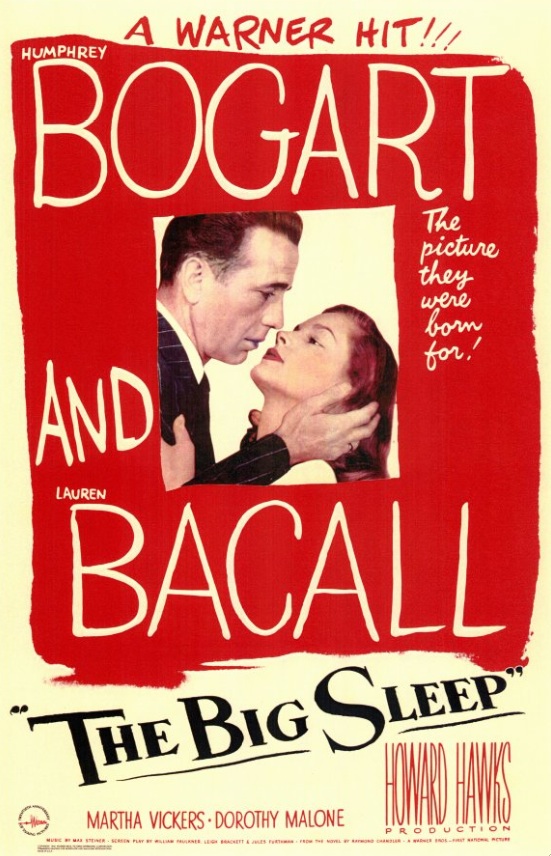
The Big Sleep is a classic of the mystery and noir genres. Humphrey Bogart’s Philip Marlowe is one of cinema’s most memorable shamuses (a term which everyone in this movie pronounces “shah-mus,” not “shay-mus”). It’s also one of the most quotable movies of all time. When asked how he likes his brandy, Marlowe says, “In a glass.” After an encounter with a young coquette, Marlowe says, “She tried to sit in my lap while I was standing up.”

And it’s not just Marlowe who gets all the good lines. Nearly every character in the movie makes an impression, even the ones who are only onscreen for a few minutes. Aging cowboy actor Bob Steele, whom I’ve recently seen in several forgettable B westerns, plays steely-eyed killer Lash Canino with icy resolve, and delivers lines like, “What do you want me to do, count three like they do in the movies?” in a way that makes you believe him.

It’s also a great showcase for Lauren Bacall and her chemistry with Bogart. She was still finding her way as an actress, but as Mrs. Vivian Rutledge, the older daughter of Marlowe’s client, General Sternwood (Charles Waldron), her star quality is undeniable. Beautiful and statuesque, with a deep, sexy voice, she doesn’t “perform” as much as she merely exists. After appearing together in To Have and Have Not (1944), Bacall and Bogart famously fell in love, got married, and — despite their nearly 25-year age difference and his three previous marriages that all ended in divorce — remained married to each other until Bogart’s death early in 1957. Of course, in 1945 no one knew whether their marriage would stand the test of time, but that didn’t stop America and the rest of the movie-going world from falling head over heels in love with “Bogie and Bacall.”

Just 20 years old when she made this film, and reportedly still extremely nervous in front of the camera, her performance was disparaged by many critics, most notoriously by infamous NY Times curmudgeon Bosley Crowther, who wrote in his August 24, 1946, review (published a day after the film’s premiere), “Miss Bacall is a dangerous looking female, but she still hasn’t learned to act.”

Time has proven this criticism unfair, and to be honest, Bogart wasn’t the greatest actor to appear onscreen either. But he was — and is — one of the biggest movie stars of all time. It doesn’t matter that his portrayal of Marlowe isn’t significantly different from his portrayal of Dashiell Hammett’s very different P.I., Sam Spade, in John Huston’s The Maltese Falcon (1941), because he is believable as both. In each of these iconic performances, he serves as the anchor for all of the seamy characters and twisting plot elements swirling around him.

The plot of The Big Sleep is notoriously byzantine. In his review of the film, Crowther wrote, “This is a frequent failing in films made from Raymond Chandler’s books … if you haven’t read the original, as we haven’t, you are stuck.” It’s possible that Crowther never read any of Chandler’s mysteries that were published before this film was released; The Big Sleep (1939), Farewell, My Lovely (1940), The High Window (1942), and The Lady in the Lake (1943). If he had, he might have known that the plots of all of the Philip Marlowe mysteries were incredibly confusing, and that having read one of Chandler’s books was no guarantee that you would understand a film adaptation of it any better than the illiterate person in the seat next to you.

I’ve read The Big Sleep and Farewell, My Lovely, and frequently get details of the two novels confused with each other. This would be a criticism if the point of Chandler’s novels were “whodunnit,” but it never was. Plot was secondary to the writing itself, and to the colorful characters who Marlowe met in the course of his investigations. After reading Farewell, My Lovely, you may forget who did what to whom, but you’re much less likely to forget the first appearance of the hulking Moose Malloy, “not more than six feet five inches tall and not wider than a beer truck … arms hung loose at his sides and a forgotten cigar smoked behind his enormous fingers.”

The dark underbelly of Los Angeles was another thing that Chandler evoked brilliantly, and his convoluted plots helped create a sense of constant movement beneath the surface, and of dark goings-on that even his superlative hero could never fully unravel.

Even Howard Hawks, the director of The Big Sleep, was confused by the novel he was adapting. When he wired Chandler to ask who had killed General Sternwood’s chauffeur, whose corpse is found floating in his sunken car, Chandler replied, “No idea.”

The screenplay by Leigh Brackett, William Faulkner, and Jules Furthman, is a fairly faithful adaptation of its source material, although a few significant elements of the novel (e.g., homosexuality, pornography) were perforce glossed over. But there is one significant moment in which Marlowe sits down in the office of the D.A. and the viewer is led to expect that a recitation of the facts of the case is about to occur. Instead, the screen fades to black, and we rejoin our hero after any explanation has come and gone.

I believe that this scene remained intact in the film’s original version. The Big Sleep was originally shot during World War II, but with the end of the war approaching and a backlog of war films in the can, Warner Bros. released one war picture after another before the public’s appetite for them could diminish too much. A mystery picture like this one, on the other hand, was relatively timeless. (Astute viewers, however, will notice a photograph of President Roosevelt hanging in a bookstore, a reference to “red points,” and the presence of a female cab driver.) Starting in January 1946, many key scenes were reshot to focus more on Bogart and Bacall, and make their romance one of the focal points of the film.

Consequently, several scenes involving the coquette I mentioned in the first paragraph, Carmen Sternwood (Martha Vickers), were left on the cutting room floor, which is too bad. Not only is she beautiful, she’s an interesting and flawed tragic character. Also, the plot was probably made even more confusing. But whether it makes for a less satisfying overall film is debatable. As with Chandler’s novels, the plot is not really that important.

The Killers (Aug. 28, 1946)

The Killers (a.k.a. Ernest Hemingway’s The Killers) was the screen debut of Hollywood legend Burt Lancaster. It was also an early but significant role for another legend, the beautiful Ava Gardner, who had been appearing onscreen in uncredited parts and small roles since 1941.

Lancaster plays a former boxer named Ole “Swede” Andersen and Gardner plays Kitty Collins, the femme fatale who ensnares him.

The film is based on Hemingway’s 1927 short story “The Killers,” which features his recurring character Nick Adams, who sits in a diner and witnesses two hit men come in and wait for a Swedish boxer, whom they are there to kill for unstated reasons. Nick and the black cook, Sam, are tied up in the kitchen, but eventually the killers leave when the boxer doesn’t show up. Nick gets out of his bonds and runs to the rooming house where the boxer lives. He warns him about the men who are there to kill him, but the boxer is resigned to his fate.

At first glance, the less than 3,000-word short story seems a strange choice to be adapted as a feature-length film. Hemingway once said, “That story probably had more left out of it than anything I ever wrote.”

Instead of just using the title and Hemingway’s name to sell the picture, as many producers would have done, Mark Hellinger’s The Killers takes the story as a jumping-off point, and spends the rest of the picture filling in the details of the boxer’s life, and eventually we learn why he was murdered. The first 12 minutes are a faithful adaptation of Hemingway’s short story, except that the killers (Charles McGraw and William Conrad) don’t constantly use the N-word to describe Sam, the cook. Otherwise the dialogue is largely unchanged. It’s a reminder of how much Hemingway’s clipped prose and naturalistic dialogue influenced the hard-boiled school.

When Nick (Phil Brown) runs to the rooming house to warn the Swede about the killers, we get our first glimpse of Lancaster’s big frame, indolently lying in bed, his face in the shadows. Nick can’t understand his passivity. The Swede refuses to even get out of bed when Nick tells him that he’s about to be murdered. “I did something wrong once,” he mutters.

There’s no twist ending to this section of the tale. Conrad and McGraw walk into the Swede’s room with their revolvers drawn and calmly pump ten bullets into him.

Enter Jim Reardon (Edmond O’Brien), an investigator for the Atlantic Casualty & Insurance Company. Nick and the Swede worked together at a gas station owned by Tri-States Oil, which carries a group policy on its employees. (It’ll be hard for fans of the radio show Yours Truly, Johnny Dollar not to think of O’Brien’s run on the show when he announces his profession, since O’Brien played the insurance investigator with the “action-packed expense account” from 1950 until 1952.)

Reardon’s investigation leads him to a payroll robbery that was masterminded by crime boss Big Jim Colfax (Albert Dekker) and netted more than a quarter of a million dollars. Reardon believes the Swede was involved, and his boss, R.S. Kenyon (Donald MacBride), grudgingly gives him a week to solve the case.

The story stops and starts, which sometimes keeps the viewer at a distance from the Swede, but in exchange we are introduced to one interesting supporting character after another; a chambermaid who once stopped him from committing suicide (Queenie Smith), a Philadelphia police lieutenant named Sam Lubinsky (Sam Levene) who grew up with the Swede and married the girl he left behind, the Swede’s elderly, astronomy-obsessed cellmate Charleston (Vince Barnett), as well as some of his former partners in crime.

Watching this film today, it’s hard to separate Burt Lancaster from the role he is playing. Lancaster had such a long, interesting career, and he was never type-cast (except possibly as a large guy with a square jaw and big teeth). Lancaster portrayed many intelligent and sensitive characters, so it’s easy to forget what a big, dumb brute the Swede is. He feels pain, both physical and emotional, but he has no depth of character. Once he falls for the alluring Kitty, he will do anything to have her, but he probably doesn’t even understand why.

Reardon may appear onscreen for nearly as much time as the Swede, but he makes less of an impression. Lancaster’s tortured performance is the dark soul of the film.

The expanded story of The Killers has a lot of moving parts, and could have been a complete mess, but the screenplay is excellent, and keeps everything moving without becoming confusing. It’s credited to Anthony Veiller, but Richard Brooks and John Huston also worked on it. (Huston’s name was left off the credits because he was under contract to Warner Bros.) Robert Siodmak’s direction is crisp and assured. He and his cinematographer, Elwood Bredell, create a dark, beautifully lit world full of shadows and smoke. Miklós Rózsa’s score is top-notch — free of the treacly strains of neo-Romanticism that dilute the effectiveness of too many film noirs from the ’30 and early ’40s.

This is a must-see for all fans of noir.

Black Angel (Aug. 2, 1946)

Black Angel was directed by Roy William Neill, the dependable craftsman responsible for eleven of Universal’s fourteen Sherlock Holmes pictures. Black Angel isn’t a masterpiece, but it’s slick, well-made entertainment and a nice opportunity to see what Neill was capable of when he stepped outside of the formula of the Basil Rathbone/Nigel Bruce Holmes films.

The screenplay, by Roy Chanslor, is based on Cornell Woolrich’s novel of the same name. Woolrich was a prolific author, and an instrumental figure in film noir, even though his actual work for the film industry occurred only during the silent era and was brief and unhappy. He apparently wrote a few screenplays under the name “William Irish,” which was one of his pseudonyms. (“George Hopley” was the other.) He was also briefly married as a young man, but it was annulled after less than three years. After that, he headed back to New York City, his hometown, and went back to live with his mother.

Woolrich mostly kept to himself. A closeted homosexual with a drinking problem, Woolrich found his niche writing stories for the pulps. He was a frequent contributor to publications like Black Mask and Argosy. More screenplays for film noirs were adapted from Woolrich’s stories and novels than from the the work of any other crime writer, but that’s not the only reason he was instrumental to the genre. The inky darkness of noir is evident in the titles of his books alone; The Bride Wore Black (1940), The Black Curtain (1941), The Black Path of Fear (1944), and Rendezvous in Black (1948) are just a few. The two novels of his I’ve read were not particularly well-written — he wasn’t a great stylist like Raymond Chandler or Dashiell Hammett — but he conveyed in his writing a sense of overwhelming dread and alienation, both emotions that are central to film noir.

Also, perhaps due to his his drinking, Woolrich’s characters frequently suffer from amnesia and alcohol-induced blackouts. In Fright, written in 1950 under the name George Hopley, a young man is convinced he has committed murder while blind drunk, but it’s not clear for most of the novel whether he actually has or not.

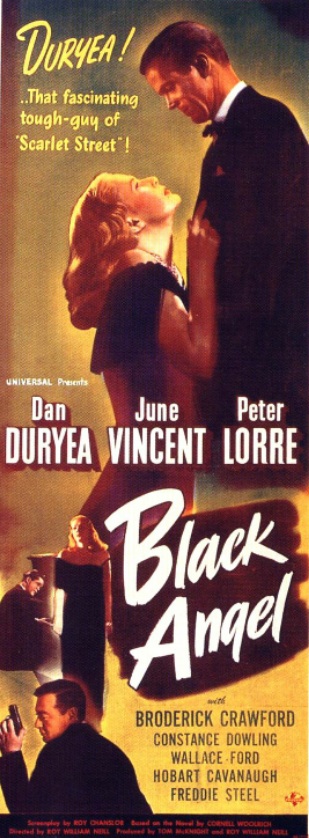
This is a theme that rears its head once again in Black Angel, in which a regular Joe named Kirk Bennett (John Phillips) is convicted of the murder of a blackmailing singer named Mavis Marlowe (Constance Dowling). Bennett’s wife Catherine (June Vincent, who bears a fairly strong resemblance to Dowling) believes he is innocent, and sets out to prove it. She enlists the aid of Martin Blair (Dan Duryea), a composer and piano player who seems like a decent guy despite his alcoholism and unhealthy obsession with the murdered woman. (In the memorable first scene of the picture, we see Duryea leaning against a wall, staring up at the high rise apartment in which Mavis lives.) As Bennett’s execution date looms, the two pose as a professional singer and piano player in order to get closer to their prime suspect, an oily club owner named Marko (Peter Lorre).

One of the things I liked best about Black Angel was the opportunity to see Duryea in a sympathetic role. He wasn’t perpetually cast early in his career as villains and sniveling punks because he lacked charisma, he had plenty. But he was whip-thin and had a perpetual scowl, and he was good at playing nasty characters. The poster for Black Angel calls him “that fascinating tough guy of Scarlet Street,” and that movie and this one were both instrumental in creating his new image as a violent, dangerous, and sexy antihero.

Sadly, this would be Neill’s last film. He died of a heart attack on December 14, 1946, while visiting relatives in England. He was 59 years old. Neill was a superior craftsman, and his Sherlock Holmes films were some of the most entertaining and well-made programmers of the ’40s. He made all kinds of films, including the campy horror movie Frankenstein Meets the Wolf Man (1943) (a personal favorite), but Black Angel showed what he was capable of in the hard-boiled noir/mystery genre. It’s a shame he wasn’t able to make more movies like it.

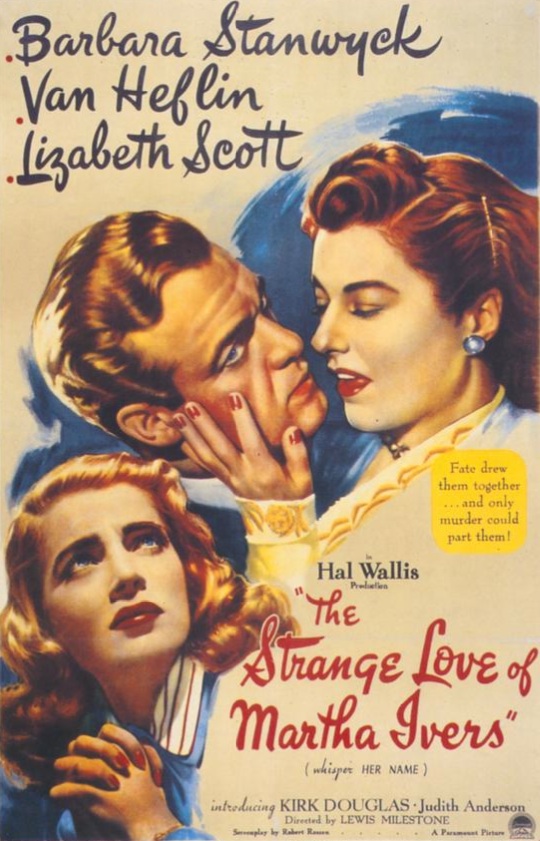
The Strange Love of Martha Ivers (July 24, 1946)

The Strange Love of Martha Ivers
The Strange Love of Martha Ivers (1946)
Directed by Lewis Milestone
Paramount Pictures

The Strange Love of Martha Ivers is based on a short story called “Love Lies Bleeding” by playwright John Patrick, who published it under the name “Jack” Patrick. I don’t know why the name was changed when it was made into a movie; possibly it was deemed too gruesome. It’s a great title, but I’m glad that it was changed to a more generic one. I had no idea what I was in for.

The film begins in 1928, in a smoke-filled Pennsylvania factory town called “Iverstown.” (Pronounced “Iverston.”) A young girl named Martha Smith Ivers (Janis Wilson) runs away from home in the pouring rain, jumping a freight car with a streetwise little tough named Sam Masterson (Darryl Hickman). It’s not the first time she’s tried to escape.

Their plans hit a snag when they’re found by the police. Sam gets away, but Martha is taken home, and we see exactly what she’s trying to get away from. Her aunt, Mrs. Ivers (Judith Anderson), is a villain straight out of a fairy tale. Mrs. Ivers is fawned over by the sycophantic Mr. O’Neil (Roman Bohnen), Martha’s tutor. O’Neil keeps dropping none too subtle hints that his bookish son Walter (Mickey Kuhn) is perfect Harvard material, if only they had the money to send him one day.

The tongue-lashing and threats Martha receive from her aunt when she’s brought home by the police are bad enough, but later that night, when the little cat that Martha keeps hidden in her room gets out, Mrs. Ivers really goes over the top in the cartoonish villainy department and attempts to beat it to death with her cane. To protect her pet, Martha pushes her aunt down the stairs. She tumbles down the staircase and breaks her neck. Walter O’Neil witnesses Mrs. Ivers’s death. His father didn’t, but he suspects what really happened. However, when the children are questioned by the police, he backs up the story Walter and Martha concoct about a mysterious intruder.

There’s just one more wrinkle. That night, Sam Masterson had snuck into Martha’s bedroom, and was somewhere in the house. Did he see what really happened? We won’t know for awhile, because Sam runs off, and isn’t seen again.

The story jumps forward 18 years to 1946. Walter O’Neil (immediately recognizable by his priggish demeanor and his wire-rimmed spectacles) is now played by Kirk Douglas. When we first see him, he’s three sheets to the wind, but through his slurred exposition we learn that he’s now the district attorney of Iverstown, and is married to Martha, who is now played by Barbara Stanwyck. Walter clearly loves Martha, but she despises him.

After the death of Mrs. Ivers, Martha’s tutor, Mr. O’Neil, took control of her family fortune, and blackmailed her into marrying his son. Walter lived up to his potential and went to Harvard with the help of Ivers money, but he is tortured by the secret he and Martha share. Not only did he help cover up Martha’s role in her aunt’s death, but years later, he prosecuted the drifter the police picked up for the murder of Mrs. Ivers, and sent the man to the death house. Martha isn’t just an innocent victim in the affair, however, and as the film goes on, she becomes more and more villainous.

Then again, so does Walter. Douglas gives a really fine performance in this film — the first of many in his long career — as a vindictive man who is morally weak but who possesses enormous political and legal power. Stanwyck, also, is fantastic as always. I think the first movie I saw her in was Billy Wilder’s Double Indemnity (1944), and I thought she was really funny-looking. I couldn’t see what Fred MacMurray saw in her, or why he would go to such ridiculous and homicidal lengths to be with her. But after seeing her in this film and the excellent melodrama My Reputation (filmed in 1944 but released theatrically in 1946), I’m starting to see it. While not a great beauty, Stanwyck has a gritty, vibrant quality that demands attention. She is always fascinating to watch.

The present-day plot gets rolling when Sam Masterson (now played by Van Heflin) rolls back into town. Now a good-natured drifter and gambler, he doesn’t even intend to visit Iverstown, but when he carelessly drives his car into a sign while giving a hitchhiker (Blake Edwards) a lift, he’s forced to.

While paying a visit to the house he grew up in, Sam meets a beautiful young woman named Antonia “Toni” Marachek (Lizabeth Scott), who has just been released from jail. The two itinerants are immediately drawn to each other, but their budding romance is going to be put through its paces as soon as Walter and Martha discover that Sam is back.

Believing that Sam has purposefully returned to blackmail them, Walter sets his thugs on both Sam and Toni, jailing Toni for violating her probation and taking Sam for a ride and leaving him beaten on the side of the road outside of town. If you’ve ever seen a film noir before, you’ll know that guys like Sam don’t like to be pushed around, and when they are, it only strengthens their resolve not to turn tail and run. But you’ll also know that dangerous women attract them like honey attracts flies, and when Martha tries to get her hooks back into Sam, things won’t be easy for any of the four leading characters.

The Strange Love of Martha Ivers is on the long side (just shy of two hours), and the plot has a lot of moving parts, but the script by Robert Rossen and an uncredited Robert Riskin is excellent, and never bogs down. Lewis Milestone’s direction is sharp. Really, this is just a great film. Everyone who likes classic cinema should see it, not just fans of noir.

On a note completed unrelated to the film, I find it interesting that three of the four principal actors worked under pseudonyms. Kirk Douglas was born “Issur Danielovitch Demsky,” Barbara Stanwyck was born “Ruby Catherine Stevens,” and Lizabeth Scott was born “Emma Matzo.”

Incidentally, Scott was born into the Matzo family in 1922 in Scranton, Pennsylvania (the state where this film takes place). With her angular features and husky voice, Lizabeth Scott reminds me a lot of Lauren Bacall, but she’s even sexier, which I didn’t think was possible until I saw this movie.

I See a Dark Stranger (July 4, 1946)

Frank Launder’s I See a Dark Stranger, which premiered in the United Kingdom on July 4, 1946, is half a loaf of noir slathered with generous helpings of romance and comedy. It’s a very enjoyable picture that’s notable as a star vehicle for the lovely Deborah Kerr before she was well-known in Hollywood.

The opening of the film is pure noir. Shadows fall heavily on the quiet nighttime streets of a little town with signs all about in French. A panicked man rushes through the town, searching for something. Suddenly there’s a shot of something that doesn’t quite fit, and the narrator’s voice appears on the soundtrack. “An Isle of Man signpost outside a French town,” he says. “That’s odd. But we’ve started this tale at the wrong moment.”

He goes on to tell us that this is really the story of Bridie Quilty (Kerr), and we see the young woman in the pub where she works as she eavesdrops on her father’s boozy tales of the Irish Revolution, rapt, even mouthing the words of his story at one point. Bridie hates the English and the memory of Oliver Cromwell as much as the most hardened member of the I.R.A. does, and wants nothing more than to join the group when she reaches the age of majority, just like her father did. The film treats her fervor lightly, however, and right off the bat the viewer knows that this coming-of-age story will contain a fair measure of disillusionment for its protagonist. But not, of course, before she gets in over her head.

As soon as Bridie turns 21, she heads for Dublin to make contact with a former compatriot of her father, a man named Michael O’Callaghan (Brefni O’Rorke). Far from the fearsome soldier she expected, O’Callaghan is a mild-mannered curator of a museum who doesn’t seem to mind seeing a large painting of Cromwell every day and feels that the terms of the Government of Ireland Act 1920 that partitioned the country were fair enough, which boggles Bridie’s mind. More significantly, he seems to have never heard of her father, which should raise a red flag, but doesn’t, since Bridie is as bull-headed as she is patriotic.

Undeterred by her experience in the museum, Bridie looks for resistance where she can find it, and falls in with a man named Miller (Raymond Huntley). He appears at first glance to be a rumpled Englishman, but Bridie learns that he’s a spy working against the English, so she goes to work for him without a second thought.

Bridie is blithely unaware of politics outside of Ireland and the U.K., and the film is clever enough to share her point of view for some time. Astute viewers, of course, will immediately be able to suss out exactly which nation Miller is spying for, but it’s not directly stated for awhile. As far as Bridie’s concerned, the enemy of her enemy is her friend. After hearing how much Bridie hates every last Englishman, Miller says to her, “For a subject of a neutral country, aren’t you being a little belligerent?” Bridie responds, “There’s nothing belligerent about it. It’s entirely a question of which side I’m neutral on.”

As I said, I See a Dark Stranger is a mixture of noir and comedy. It’s heavier on the comedy than it is on the thrills, especially toward the end, but for the first half, there are some sequences that wouldn’t be out of place in any other espionage potboiler, such as the scene in which Bridie has to dispose of a corpse, and comes up with the ingenious notion of putting the body in a wheelchair and pushing it through town as though she’s just taking an old man for a walk (she’s really heading for the cliffs overlooking the ocean). It’s never very serious, though, and the film is generally more interested in humorous situations and amusing characterizations than it is in plot points.

Kerr is fantastic, and carries the picture with ease. Trevor Howard is great, too. He plays Lt. David Baynes, a Brit who becomes infatuated with Bridie and realizes too late the amount of trouble she’s in. There are also two very funny caricatures of stiff upper-lipped British policemen, Capt. Goodhusband (Garry Marsh) and Lt. Spanswick (Tom Macaulay) who may very well have served as the inspiration for Hergé’s comic characters Dupont et Dupond (Thomson and Thompson in English translation), two detectives who are indistinguishable from each other. Spanswick and Goodhusband are both bald, have neat little black mustaches, and say things like “Cheerio, old boy.” By the end of the picture, however, they’re allowed to grow out of their stereotyped roles, are fairly easy to tell apart, and even get a few intentionally funny lines, such as when Spanswick says to a hotel manager who is afraid that German prisoners of war may have escaped from the nearby internment camp to hide out in her hotel, “If the food I’ve had here is anything to go by, they’re more likely to escape from the hotel and beat it for the internment camp.”

Somewhere in the Night (June 12, 1946)

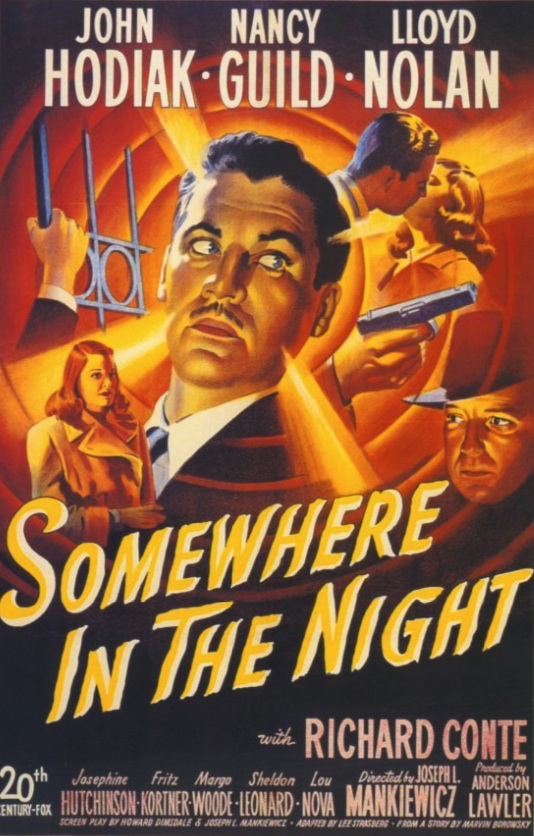
Joseph L. Mankiewicz’s Somewhere in the Night looks like a noir, talks like a noir, and walks like a noir. But when the credits rolled I felt more like I’d watched a light-hearted mystery farce than a noir. This isn’t to say that Somewhere in the Night is a bad movie. It’s actually a really fun one. But the dark journey promised by the film’s opening never pans out, and the plot twists grow increasingly ludicrous as the picture goes on.

The first few minutes of the picture are mostly shot in first-person P.O.V., as a man (played by John Hodiak) wakes up in an Army field hospital. Through voiceover and the images in front of his face, we learn that he has no idea who he is, and doesn’t remember anything leading up to this point. This opening presages Robert Montgomery’s ill-advised first-person P.O.V. extravaganza Lady in the Lake (1947). Luckily, unlike that picture, the technique is used judiciously in Somewhere in the Night.

Hodiak’s character has Army identification in the name of “George Taylor,” a Dear John letter (it’s really more of an “I Hate You, John” letter), and a letter of credit from someone named “Larry Cravat.” What’s a noir protagonist to do? Clearly, the best course of action is to head for the mean streets of Los Angeles and attempt to track down Larry Cravat, even though “Taylor” has no idea what he’s doing or who all these people are who seem to want him dead. Why should that stop him? Taylor is a Purple Heart recipient and seems to be able to handle himself. It doesn’t hurt that the briefcase he picks up in a Los Angeles train station contains a gun and a letter from Larry Cravat telling Taylor that there is $5,000 deposited in his name in an L.A. bank.

For the first half hour or so, Somewhere in the Night has a few things to say about the plight of returning G.I.s, in particular the disappointments handed them by the women they came home to (or didn’t come home to, in Taylor’s case), and the resentment some servicemen must have felt upon their return.

“You know there’s been a terrible shortage of men,” a beautiful young woman named Phyllis (Margo Woode) tells Taylor.

“Yeah, so we heard in the Pacific,” he responds. “This war must have been murder on you poor women. We used to cry our eyes out about it.”

But, as I said, the longer Somewhere in the Night goes on, the more plot points stack up, and the less time the film has to do anything but crank through its story.

When Taylor goes to the bank to try and collect his $5,000 he arouses the suspicion of the cashier and he ends up fleeing empty-handed. He follows leads to a Turkish bath and then to a nightclub. Set up at the club by the bartender, he ends up hiding from a couple of mugs in the dressing room of a pretty singer named Christy Smith, who is played by the 20-year old Nancy Guild (rhymes with “wild”).

Guild is fresh-faced, has a beautiful voice, and plays her role well. She’s not outstanding, but she does a good job, especially considering this was her first role in a film; not just as leading lady, her first film role, period. Apparently she felt out of her depth, and the production was a struggle for her. In later interviews, she credited Mankiewicz’s generous nature and sensitive direction, and said he was a real father figure to her.

Hodiak also does a decent job, but it’s a one-note performance. He sweats profusely and looks haunted, and does a great job with lines like, “I’m tired of being pushed around. The war’s over for me. I don’t have to live afraid anymore.” He sounds genuinely angry, and he also sounds as if he doesn’t believe his own words one bit.

It wasn’t until after I finished watching Somewhere in the Night that I learned that while Hodiak was born in the United States, he grew up in an immigrant family, spoke Hungarian and Polish at home, and always had to work hard at his English diction. “No part has ever come easily to me,” Hodiak once said. “Every one has been a challenge. I’ve worked as hard as I could on them all.” I never would have guessed from this film that his first language wasn’t English, but there is something about his delivery that is strange and stilted.

Luckily, Guild and Hodiak have wonderful support from two great actors who straddled the line between character actor and leading man; Lloyd Nolan and Richard Conte.

Nolan plays a police detective, Lt. Donald Kendall, who doesn’t eat lunch because it puts him to sleep and doesn’t drink coffee because it keeps him awake. He also wonders aloud several times why detectives in the movies don’t ever take their hats off. (He figures it out by the end of the picture.) And he has plenty of great lines, which he delivers in his trademark wry fashion, like “Big post-war boom in homicide.”

Conte plays a nightclub owner named Mel Phillips, who’s smooth without seeming oily, and whose motives aren’t initially clear. (If you had $5 for every time Conte played a nightclub owner in a noir, you could probably take your whole family out to a nice dinner.)

Somewhere in the Night is a good picture; well-made and a lot of fun. It was all just a little silly for my taste, though.

The Stranger (May 25, 1946)

The Stranger isn’t most people’s favorite Orson Welles film, and a lot of people even consider it his worst. (Welles did.) It’s the third film he directed, and as far as Oscar bait goes, it certainly pales in comparison with Citizen Kane (1941) and The Magnificent Ambersons (1942), but I think a lot of the criticism heaped upon it is unfair. The Stranger is a crackerjack thriller with tension and suspense to spare. I was drawn in by the first scene, and was completely involved throughout the film’s 95-minute running time.

Despite its sometimes hackneyed script and implausible situations, The Stranger shows a master in complete control of his craft. The first 15 minutes of the film are some of the most perfect cinematic storytelling I’ve ever seen. Mr. Wilson (Edward G. Robinson), an investigator for the Allied Commission for the Punishment of War Criminals, sets free a Nazi war criminal named Konrad Meinike (Konstantin Shayne) and has him tailed, believing that he will lead them to the secret architect of the Holocaust, Franz Kindler (Welles). Kindler is living in the idyllic little town of Harper, Connecticut, under the name “Charles Rankin” and is a professor at a boy’s school.

Meinike’s journey to find Kindler is an object lesson in how to tell a story with a minimum of dialogue and a maximum of tension. The shots are visually arresting, the editing is rapid without ever being confusing, and the pacing is fast. As openings go, it’s not quite the bravura performance Welles would later put on with his single crane shot that opens Touch of Evil (1958), but it’s just as good in its own way. The disconnect only appears during the first lengthy stretch of dialogue. Once Meinike tracks down Prof. Rankin, the clumsy exposition that Welles grumbles through — which explains who his character is, whom he is marrying, and who his father-in-law will be — sticks out like a sore thumb.

Meinike will prove to be just the beginning of Rankin’s troubles. The noose tightens around his neck as soon as Wilson arrives in town, posing as a dealer in antiques. Robinson plays his role well, in an understated fashion that contrasts nicely with Welles’s bug-eyed histrionics. After a few extreme close-ups of Rankin’s sweaty face as he tells lies to convince his new wife, Mary Longstreet (Loretta Young), that he is an innocent hounded by nefarious forces, there is no doubt about the depths of his villainy.

Not that there every really was any doubt, since Rankin behaves in such a despicable fashion throughout the picture. It’s not just his dinnertime conversation — in which he explicates the warlike soul of the German people and denies that Karl Marx was a German because he was a Jew — it’s his willingness to engage in wet work, killing a troublesome character without a second thought and later beating his new wife’s dog when it attempts to dig up the corpse.

In his review of The Stranger in the July 11, 1946, edition of the NY Times, Bosley Crowther wrote that Welles’s performance “gave no illusion of the sort of depraved and heartless creatures that the Nazi mass-murderers were. He is just Mr. Welles, a young actor, doing a boyishly bad acting job in a role which is highly incredible — another weak feature of the film.” Again, I think this is unfair. Welles got his start in the theater, and as a thespian, he never really grew out of it. His acting was always highly theatrical. He was a man who played to the back row, with grand gestures and a booming voice, but he did so extremely effectively. Not every film performance has to be subtle and understated.

It’s his work behind the camera, however, that really shows Welles in top form. The fast cutting in a scene in a diner, for instance, creates a tense subtext beneath Loretta Young’s seemingly casual banter with Edward G. Robinson by showing each character’s motivations by the looks on their faces. Mary is hiding something, Rankin is coercing her into doing so, and Wilson knows exactly what is going on. Director Welles and editor Ernest J. Nims make it all look easy, but it’s not, or more films would be this well-made.

The film also brilliantly uses sound. For instance, the tolling of the clock in the village square (which the clock-obsessed Rankin has fixed) underscores the tension in the film’s final half hour. The bonging of the clock has a peculiar timbre, and sounds more like incidental music from a ’70s or ’80s suspense or horror flick than any soundtrack from the ’40s I’ve ever heard before. The score itself, by Bronislau Kaper, is quite good, too, and is reminiscent of the work of Bernard Herrmann.

The screenplay, by Anthony Veiller, from a story by Victor Trivas, was imposed on Welles by the studio. The studio and the producer, Sam Spiegel (listed in the credits as “S.P. Eagle”), made plenty of other decisions Welles didn’t like. For instance, Welles wanted Agnes Moorehead to play the part of Wilson, but they forced him to go with Robinson. As far as the studio was concerned, however, everything worked out for the best, since The Stranger was the only film Welles directed that ever made a profit during its initial theatrical run.

The Stranger is a potboiler, to be sure, but it’s such a brilliantly edited, directed, and acted potboiler that it’s remarkable. This is one of those rare movies that I looked forward to seeing again as soon as it was over.

They Made Me a Killer (May 3, 1946)

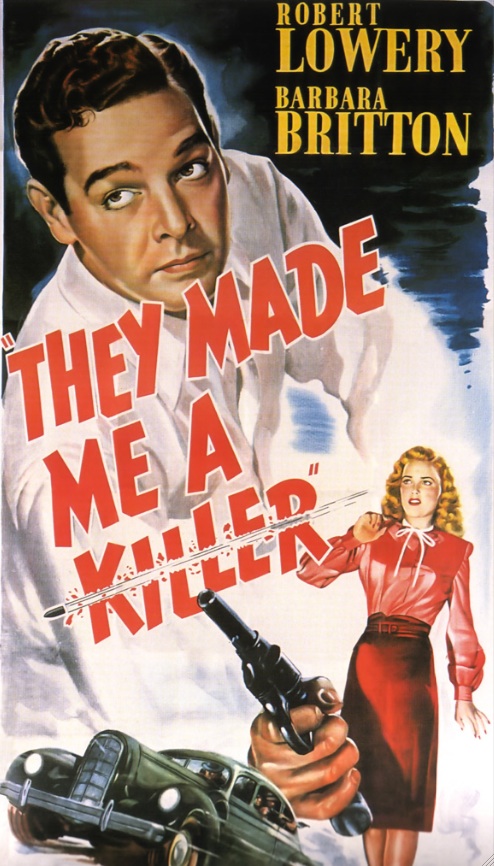
Incompetent director William C. Thomas’s They Made Me a Killer is based on a screenplay by competent writer Daniel Mainwaring, who was working under the name “Geoffrey Homes.” Mainwaring was a prolific screenwriter whose most famous contribution to film noir is his script for Out of the Past (1947), which was based on his novel Build My Gallows High (both were written under his Homes pseudonym).

The script for They Made Me a Killer isn’t the problem. In the hands of a talented director and a better cast of actors, it could have been a crisp little thriller. There’s a decent amount of complexity in its familiar tale of an innocent man on the run, and the dialogue is snappy. Unfortunately it’s all handled so poorly that the protagonist’s flexible ethics end up seeming more like sloppy storytelling than anything else, and all the clever lines are delivered in too ham-handed a fashion to make much of an impact.

Produced by William H. Pine, They Made Me a Killer was released by Pine-Thomas Productions, the B unit of Paramount Pictures. It’s normal for low-budget productions to cut corners, but this picture has some of the most egregious examples of cost-cutting I’ve ever seen. Thomas employs rear projection frequently, and not just for scenes shot in cars, which is when the technique was most commonly used. There are numerous shots in They Made Me a Killer of people standing on a street corner in which everything behind them is clearly rear projected. In one scene, two actors stand in front of a rear-projected house, then one of them turns to walk toward it. The scene immediately cuts to a shot of her ringing the doorbell, standing in front of a door that doesn’t look as though it matches the house we saw in the establishing shot. There are certainly less noticeable and more artful ways to keep a picture under budget.

When They Made Me a Killer begins, Tom Durling (Robert Lowery) is leaving Chicago. His brother was killed there, and he has no desire to stay. He’s leaving his job as an auto mechanic, and heading for San Francisco. Once in California, he stops at an intersection. San Francisco is 248 miles away, and Santa Marta, “The Pearl of the Valley,” is just five miles away. He heads for Santa Marta, hoping to sell his souped-up jalopy, which he has modified to achieve speeds of up to 120 miles per hour.

He’s approached by a potential buyer named Betty Ford (Lola Lane), who tells Durling that she wants her boyfriend to buy the car for her for her birthday. Agreeing to meet her boyfriend the next day to close the deal, he ends up parked outside the Santa Marta Trust and Savings Bank the next morning with Betty exhorting him not to move, even to drive around the block to avoid a parking ticket, while Jack Conley (Edmund MacDonald) and Frank Conley (James Bush) are inside, making a very large withdrawal.

When he had initially shown her what his blocky hot rod could do, Durling had told Betty, “All I wanna do in this town is leave it.” He’ll get his wish, but he’ll get it the hard way.

He’s not the only one. Caught in the crossfire is a hapless little punk named Steve Reynolds (Byron Barr), a bank clerk at the Santa Marta Trust and Savings Bank who’s hanging around the getaway car because he has the hots for Betty.

Betty and the Conley brothers make off with $100,000, but Durling drives them into a ditch. He’s knocked unconscious, the robbers flee, and he’s left to take the rap.

He hangs his hopes for freedom on young Steve Reynolds, who lies in the hospital dying from a bullet wound. Steve’s sister June (Barbara Britton) comes to visit him in the hospital. She and Durling are immediately attracted to each other, and she reluctantly becomes his ally as they race to prove his innocence, and Steve’s.

All of this probably sounds better on paper than it plays out on screen. The acting is bargain basement and the direction is maladroit, turning what could have been an entertaining one-hour programmer into a forgettable snoozer.

The Postman Always Rings Twice (May 2, 1946)

The Postman Always Rings Twice

The Postman Always Rings Twice (1946)
Directed by Tay Garnett
Metro-Goldwyn-Mayer

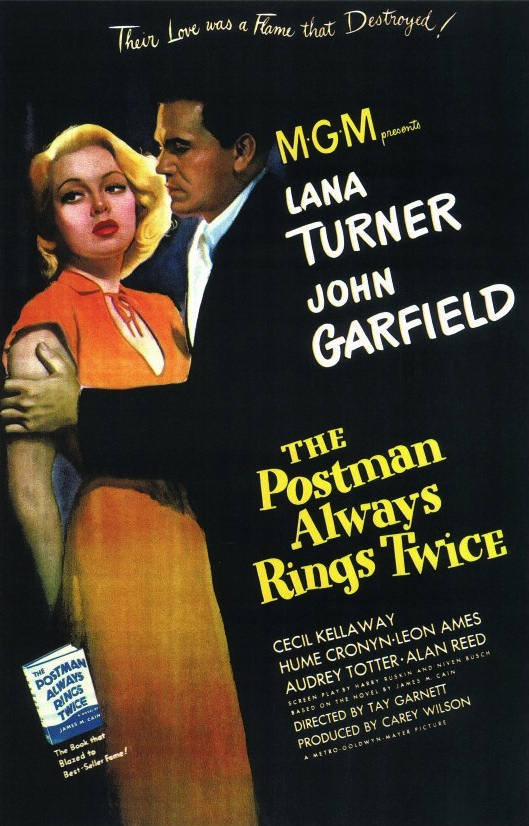
Tay Garnett’s The Postman Always Rings Twice, based on the 1934 novel by James M. Cain, opens on a lonely stretch of highway outside of Los Angeles, with a shot of a sign hanging outside a gas station that says “Man Wanted.” We’ll soon learn that the sign has a double meaning.

Itinerant drifter Frank Chambers (John Garfield) is hitchhiking from San Francisco, and has thumbed a ride with a nattily dressed man (Leon Ames) whom we’ll soon learn is the local district attorney. Nick Smith (Cecil Kellaway), the owner of the gas station/lunch counter, runs out and greets Frank, assuming he has come about the job.

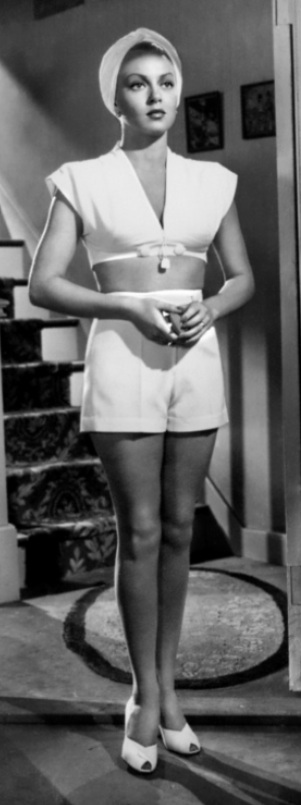
It isn’t long before Frank meets Nick’s wife, Cora, (Lana Turner), in one of the best introductions of a sexpot in ’40s cinema. As he’s eating at Nick’s lunch counter, a tube of lipstick rolls across the floor, the camera focuses on it, then pans back along the floor until it comes to rest on Turner’s legs. Cut to Garfield, his breath quickening, then to a full shot of Turner, in a skimpy white two-piece playsuit that would still turn heads today (although her turban might stand out as being a little odd).

As soon as Cora appears, we know Frank will take the job working for Nick just to be close to her. In the book, Nick is a Greek, and described in detail as a physically repulsive character. In the film, he’s just a harmless old fuddy-duddy. Things play out the same, however. Cora leaves a “Dear Nick” letter and she and Frank run off together, but life on the open road, hitchhiking with a delighted-looking Frank, who has two suitcases under his arm, doesn’t agree with Cora or her white blouse, or her white peekaboo toe pumps.

Lana Turner

So they return before Nick comes home and finds the note, and pick up again with their unhappy triangle. One murder attempt designed to look like an accident goes wrong, and after Nick announces that he is selling the business and taking Cora with him, Frank and Cora devise a simpler plan to just get Nick drunk and push him off a cliff in his car.

Technically The Postman Always Rings Twice is a film noir, but it occasionally borders on farce, especially after the murder, and is filmed in a professional and well-lighted but ultimately flat style. Too much of the film’s running time is taken up by courtroom machinations and the gamesmanship between Arthur Keats (Hume Cronyn), Frank and Cora’s lawyer, and district attorney Kyle Sackett (Ames). It’s all well-done and entertaining, but in a light and breezy way. There’s the threat of execution in the gas chamber for our two protagonists, but there’s no sense of impending doom during the courtroom proceedings, and with the focus on Ames and Cronyn, it borders on comedy. Things pick up in the noir department towards the end of the picture, but it takes too long to get there, and is undercut by a ridiculous, moralizing denouement. In some editions, Cain’s novel is barely more than 100 pages long, but this film is bloated and overlong at 113 minutes. More minutes in the film than there are pages in the original novel? There oughta be a law.

MGM wasn’t known for this kind of picture. In general, they didn’t even do crime pictures or thrillers. After the runaway success of Billy Wilder’s Double Indemnity in 1944, however, every big studio released at least one similar picture in an attempt to cash in on the craze, with all the attendant love triangles, murders, and doomed protagonists. What better choice for MGM than another novel by Cain? Especially the one most similar in its basic plot? Cain’s 1941 novel Mildred Pierce had already been done, and with a murder plot that was never in the novel, which was more of a straight kitchen sink drama. His 1937 novel Serenade was too weird. It featured a love triangle, but between a spicy Mexican prostitute, her opera-singing boyfriend who loses his voice when he’s tempted by homosexual desires, and the orchestra conductor whose magnetism threatens to draw him into a gay tryst. (Eventually Serenade was made into a film in 1956 starring tenor Mario Lanza and directed by Anthony Mann, but the gay theme was jettisoned.) And his 1942 novel Love’s Lovely Counterfeit, about a town full of gangsters and crooked politicians, seems as though it would have been a more appropriate vehicle for James Cagney or George Raft 10 or 15 years earlier.

So The Postman Always Rings Twice was a natural choice for MGM, a powerhouse of a studio that churned out high-quality product week in, week out. The film works as well as it does because of the presence of Lana Turner, who in 1946 may have been the sexiest woman in Hollywood. John Garfield turns in a credible performance, but he and Turner never quite click. So much of the film is spent setting up and knocking down plot points that their relationship seems almost like an afterthought.

A better adaptation of Cain’s novel is an unauthorized one, Luchino Visconti’s Ossessione (1943). (Cain’s publishers sued for copyright infringement, and kept the film off American movie screens until 1976.) Both the grimy working class milieu and desperate, sweaty love affair are better handled in Visconti’s film. The American version is just too sterile.

Mysterious Intruder (April 11, 1946)

Mysterious Intruder
Mysterious Intruder (1946)
Directed by William Castle
Columbia Pictures

“I may not be the greatest detective in the world … but I am the most unusual.”

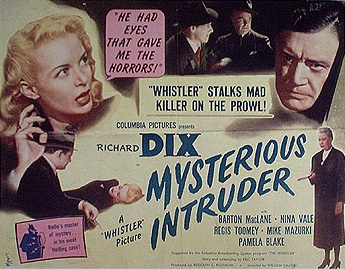
So says Don Gale, the shady private investigator played by Richard Dix in William Castle’s Mysterious Intruder, the fifth entry in Columbia’s mystery series The Whistler. Based on the CBS radio show of the same name, each film in the series featured Dix in the lead role, but unlike other B mystery series of the ’30s and ’40s, like Charlie Chan, The Falcon, Boston Blackie, Michael Shayne, and the Crime Doctor, Dix played a different character in each. The Whistler, who narrated the radio show but never participated directly in the events of the story, made similar appearances in the film series, walking in the shadows, whistling the haunting 13-note theme music by Wilbur Hatch, and occasionally offering a pithy analysis of the trouble the characters were in. The anthology format and Dix’s strange, arresting performances made The Whistler one of the more interesting series of its time.

In Mysterious Intruder, Gale is an oily operator who employs a “photographic model” named Freda Hanson (Helen Mowery) for dirty work. He also has a secretary named Joan (Nina Vale) who hates him. Clearly motivated by money, Gale walks the narrow line between self-interest and outright villainy. He’s an interesting character to watch, since his intentions remain shadowy right up to the end of the picture. This being a B-level programmer, we’re not treated to a deep character study, but Dix is a good enough performer to make Mysterious Intruder worth watching.

When the film begins, Gale is in his office, which has a spectacular view of the city and looks as if it should be home to the most expensive lawyer in town, not a small-time bedroom snooper. He’s visited by Edward Stillwell (Paul Burns), a kindly old music store owner who wishes to track down a young woman whom he hasn’t seen since she was 14, seven years ago. Her name is Elora Lund, and he has something he wants to give her. One hundred dollars is all Stillwell can afford to pay, which isn’t enough to pique Gale’s interest, but he changes his mind when Stillwell tells him that Elora Lund will pay any amount for bringing them together.

Three days pass, and Stillwell receives a visitor in his shop. She’s a tall, attractive blonde, and she convinces Stillwell that she is Elora Lund. (She’s actually Freda Hanson, Gale’s blackmail tool.) Stillwell tells “Elora” that among the countless odds and ends that her late mother brought in for him to sell was one item that will bring a fortune if sold. Unbeknownst to Freda, however, she was tailed to the store by a hulking thug named Pontos, played by dependable character actor Mike Mazurki. (Mazurki is always a welcome sight, but he doesn’t have a lot to do in this picture. It’s not too different from the role he played in Dick Tracy; a vicious killer with few to no lines.) Pontos murders Stillwell, and Freda screams and flees the scene.

Meanwhile, we learn that the real Elora Lund (Pamela Blake) is in a sanitarium, recovering from the effects of an auto accident. She’s appears to be uninjured physically, and why she wasn’t recuperating at home is never explained. Ah, the good old days of “rest cures.”

Before he became the premier schlockmeister of the ’50s and the most famous “gimmick” director in Hollywood, William Castle was a dependable director of one-hour programmers, including several Whistler and Crime Doctor pictures. Mysterious Intruder is a tight, entertaining ride that features plenty of twists and turns, as well as one of my favorite plot conceits, the private dick who constantly contaminates crime scenes and tampers with evidence for his own purposes, all while staying one step ahead of the police.