Tag Archives: Film Noir

Detour (Nov. 30, 1945)

Detour
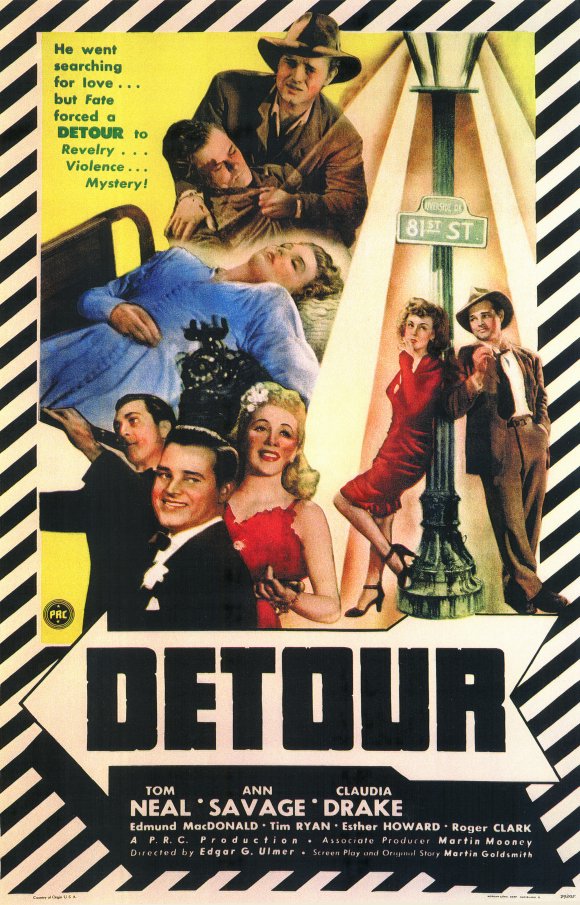
Detour (1945)
Directed by Edgar G. Ulmer
P.R.C.

There should be a picture of Tom Neal from the first few minutes of Detour next to the word “dejected” in the dictionary.

Unshaven, tie loosened, hat and suit rumpled, he walks along a California highway with his hands in his pockets, looking as though he just watched the world burn down to a cinder and he doesn’t know why he’s still standing.

Like a lot of film noirs, Edgar G. Ulmer’s Detour is told through flashback and voiceover narration. Sitting at a counter, a cup of coffee in front of him, Al Roberts (Neal) recalls his nothing-special but decent job playing piano in a Manhattan nightclub called the Break o’ Dawn, back when he had a clean jaw, a sharp tuxedo, and brilliantined hair.

“All in all I was a pretty lucky guy,” he says, recalling his romance with Sue Harvey (Claudia Drake), the singer in the club. Al has dreams of Carnegie Hall that he downplays with cynicism, while Sue dreams of making it in Hollywood. When she leaves New York to fulfill her dream, Al is still stuck in the club, performing virtuoso pieces for the occasional sawbuck tip from a drunk.

When Al decides he’s going to travel to Los Angeles to marry Sue, he has so little money that the only way he can do it is by thumbing rides. Hitchhiking in Detour isn’t the transcendent experience Jack Kerouac described in On the Road, it’s a grim necessity. “Ever done any hitchhiking? It’s not much fun, believe me,” Al says. “Oh, yeah, I know all about how it’s an education and how you get to meet a lot of people and all that, but me? From now on I’ll take my education in college, or in P.S. Sixty-Two, or I’ll send a dollar ninety-eight in stamps for ten easy lessons. Thumbing rides may save you bus fare, but it’s dangerous. You never know what’s in store for you when you hear the squeal of brakes. If only I’d known what I was getting into that day in Arizona.”

What’s in store for Al is one of the most brilliant film noirs ever made. The plot of Detour is not that different from any number of 30-minute radio plays produced for Suspense or The Whistler, and any devotee of the pulp novels of Cornell Woolrich or Jim Thompson will feel right at home while watching this film. So what is it that makes Detour so unique?

First, it’s phenomenal that such a finely crafted film was produced in just six days, and mostly in two locations; a hotel room and a car in front of a rear projection screen. Furthermore, it’s stunning how easy it is to suspend one’s disbelief during all of the driving scenes. Usually rear projection is a technique that draws attention to itself, and looks incredibly fake, but in Detour it’s just part of the background. It helps that the performances in the film are hypnotic. When Al is picked up by a man named Haskell (Edmund MacDonald), Haskell pops pills from his glove compartment and tells Al the story of how he got the deep scratches on his hand. “You know, there oughtta be a law against dames with claws,” he says. “I tossed her out of the car on her ear. Was I wrong? Give a lift to a tomato, you expect her to be nice, don’t you? After all, what kind of dames thumb rides? Sunday school teachers? The little witch. She must have thought she was riding with some fall guy.” As Haskell speaks, Al responds with noncommital little “Yep”s in a way that will be familiar to anyone who’s hitchhiked, or who’s had to sit next to a talkative creep on a Greyhound bus.

When Haskell drops dead under mysterious circumstances, Al is convinced he’ll be blamed for the murder if he reports it to the police, so he hides the corpse, switches clothes with Haskell, and takes his identification and money. His luck goes from bad to worse when he picks up a slovenly hitchhiker the next day named Vera (Ann Savage), who looks as if she’s “just been thrown off the crummiest freight train in the world.” Despite her plain looks, Al is immediately attracted to her. Unfortunately for him, Vera turns out to be the woman Haskell threw out of his car. She doesn’t recognize the car at first, and takes a nap after exchanging a few sullen words with Al. But after a minute or two, she bolts awake and says, “Where did you leave his body? Where did you leave the owner of this car? You’re not fooling anyone. This buggy belongs to a guy named Haskell. That’s not you, mister.”

The heartless Vera blackmails Al, forcing him to give her all of Haskell’s money and promise to get his hands on more, or she’ll turn him in to the cops. The two of them hole up in a lousy hotel room with a bedroom and a living room with a Murphy bed. Vera plays Al like a fiddle while getting drunk off cheap liquor and flinging abuse at him. Even so, the sexual tension between them is unbearable, which is even more remarkable considering that Savage is no great beauty, and plays the scene in which she attempts to seduce Al while wearing a bathrobe and a headscarf.

Like everything else in Detour, Neal and Savage’s performances are not Oscar-caliber, but they have an eerie power that can’t be fully explained. Neal, who was born into a wealthy family in Evanston, Illinois, was a former boxer with a Harvard law degree who played mostly tough guys in the movies. A troubled man, he was blackballed in Hollywood in 1951 after beating Franchot Tone to a pulp and giving him a concussion in a quarrel over the affections of Barbara Payton. And in 1965, Neal was tried in the shooting death of his wife Gale, and did time in prison for manslaughter.

Neal’s performance in this film is haunting, and invites a subjective judgment from the viewer. Are the things Al tells us about the deaths in the film accurate? Were they, as he claims, purely accidental? Or is he like every other murderer who pleads for clemency because it “wasn’t really my fault”? How real are the things we’re shown? Is Al really the unappreciated piano virtuoso he seems to be, or is this just another part of an elaborate fantasy world in which life refuses to hand him any breaks? This sense of nightmarish uncertainty and the pervading sense of doom make Detour one of the all-time great noirs. Edgar G. Ulmer was probably the best director who made films for the Poverty Row studio P.R.C., but Detour is head and shoulders above anything else I’ve ever seen of his.

Voice of the Whistler (Oct. 30, 1945)

Voice_of_the_Whistler
Voice of the Whistler (1945)
Directed by William Castle
Columbia Pictures

The Whistler, which was first heard on the Columbia Broadcasting System on May 16, 1942, ran for more than 13 years and was one of the best mystery and suspense programs on the radio. It didn’t feature the well-known Hollywood stars of Suspense (also broadcast on CBS), but its scripts were some of the most clever and intriguing that old-time radio had to offer, and its final twists were always satisfying, whether or not you saw them coming.

The program was hosted by a mysterious character embodied only by the sounds of footsteps and an eerie, whistled theme song. Each program began the same way, with the narrator saying, “I am the Whistler and I know many things, for I walk by night. I know many strange tales hidden in the hearts of men and women who have stepped into the shadows. Yes, I know the nameless terrors of which they dare not speak.” There were no recurring characters, but the situations were fairly similar from week to week. Greedy or vengeful people driven by dark impulses endeavored to commit perfect crimes, but were undone by a single overlooked detail or their own overreaching. Quite often, each story would contain more twists than just the one at the end. For instance, one program from October 1945 told the story of a man who killed his underworld partner and got away with it. He always wanted to reveal to the police the details of his clever scheme, but of course could not do so and remain a free man. After inadvertently faking his own death when a drifter steals his car and identification, crashes, dies, and is believed to be him, he changes his name and moves out of town. He then writes a mocking letter to the authorities laying out all the details of how he got away with murder. Immediately after mailing it, he hears on the radio that the police have determined that the body in the car wasn’t him after all, so he goes on a furious chase through the state in an attempt to retrieve the letter. He eventually attracts the attention of the police for tampering with the mail and is caught and confesses, only to find out at the end of the program that his letter was returned to his boarding house because it had incorrect postage.

Like Inner Sanctum Mysteries (another popular CBS suspense program), The Whistler was adapted as a series of B movies after it had been on the air for a couple of years. Starting with The Whistler (1944), which was directed by William Castle, the series continued with The Mark of the Whistler (1944), also directed by Castle, and The Power of the Whistler (1945), which was directed by Lew Landers. Each film starred Richard Dix, although he played a different role in each. The films did a great job of capturing the essence of the radio show. The Whistler was seen only in the shadows, just a man in a coat and a hat haunting alleyways and the dark parts of the city at night. Like the radio show, the Whistler’s voiceover often addressed the characters in the story, speaking in the second person, although he never interacted with them directly. (A typical bit might go, “You’ve really done it now, haven’t you? If you leave, they’ll see you, but if stay here, you’ll perish along with your victim. What are you going to do, George? What are you going to do?”)

Voice of the Whistler, which was directed by William Castle and written by Wilfred H. Petitt and Castle, working from a story by Allan Radar, tells the sad story of a successful industrialist named John Sinclair (Dix), whose fabulous wealth failed to provide him with either friends or health. After a breakdown, Sinclair changes his name to “John Carter” and goes away to lose himself. He sees a doctor who advises him to go to the sea coast, get some fresh air, a job, and enjoy himself. “And above everything, try to make friends,” the doctor tells him. “And never forget, Mr. Carter, that loneliness is a disease that can destroy a man’s mind.”

Sinclair moves to the coast of Maine and takes up residence in a lighthouse that has been converted into a private dwelling. Believing he doesn’t have long to live, he convinces a beautiful young nurse named Joan Martin (Lynn Merrick) to marry him. In exchange for her companionship during his last months, she will inherit all of his wealth. Although Joan is in love with a handsome young intern named Fred Graham (James Cardwell), they have been engaged for four years, and have no plans to be married until Fred can make enough money. Against Fred’s protests, Joan marries John, partly because she likes him and pities him, but mostly because his money can give her and Fred the life they’ve always wanted. After John and Joan have been married and living in the lighthouse with their jovial friend Ernie Sparrow (Rhys Williams) for several months, John’s health dramatically improves, and it looks as if Joan might have trouble collecting on their bargain. Meanwhile, John falls more and more in love with her. Eventually Fred shows up for a friendly visit that will have murderous consequences.

Richard Dix, a Hollywood star since the silent era, is great in each Whistler film I’ve seen him in so far. His glory days were behind him, but he was still a fine actor, and was equally adept at playing sympathetic protagonists and villains.

Mildred Pierce (Oct. 20, 1945)

Mildred_PierceIf you’ve only seen the film adaptation of James M. Cain’s 1941 novel Mildred Pierce, you’re forgiven for never wondering whether the striking murder set piece that opens the film and informs the entire picture was an invention of the producer and the screenwriters that never occurred in the novel.
It was. But it’s a brilliant invention. Even though long stretches of Mildred Pierce (told in flashback) are essentially melodrama, the sequence that opens the film is one of the greatest examples of film noir I’ve ever seen. It is nighttime. Heavy shadows fall over caddish playboy Monte Beragon (Zachary Scott), resplendent in a tuxedo, as he is gunned down in a Malibu beach house. Not every shot hits him. A few smash into the mirror behind him. But enough hit him to kill him, and he falls to the floor. Mildred Pierce (Joan Crawford) flees from the house, walks down the boardwalk, and looks as though she is contemplating suicide by jumping into the Pacific Ocean, but is stopped by a policeman. She talks her way out of the situation and later entices the beefy and amorous Wally Fay (Jack Carson) back to the house on the beach and locks him in, with the intention of pinning the murder on him. The scenes in which Wally realizes Mildred has left him alone in a locked house with a corpse and a revolver and he attempts to escape are stunning, and are one of the greatest noir sequences in film history.

Unlike Billy Wilder’s Double Indemnity (1944), another noir classic adapted from a novel by Cain, Michael Curtiz’s Mildred Pierce takes a lot of liberties with its source material. This is partly due to necessity. I loved Cain’s novel, and found it every bit as good as his 1934 crime classic The Postman Always Twice and more believable than his 1937 novel Serenade, which is about a male opera singer who loses his voice after he gives in to homosexual temptation. Cain’s Mildred Pierce contains no murders, just plenty of bad behavior, and the most despicable character waltzes off at the end with no punishment in sight. Apparently the moral tone of the novel was troubling to the Breen Office, so producer Jerry Wald devised a murder plot with a culprit who could be punished, which sufficiently palliated the concerns of producer and studio head Jack L. Warner, and he purchased the rights to the novel in 1944. The script for the film went through eight different versions before Ranald MacDougall’s version was accepted. William Faulkner and Catherine Turney both made uncredited contributions. (And we can all thank our lucky stars that Faulkner’s scene in which Mildred’s maid, played by Butterfly McQueen, consoled Mildred while singing a gospel song was either never filmed or was left on the cutting room floor.)

Mildred Pierce is a fantastic film. Crawford’s longtime nemesis Bette Davis and fellow fading star Rosalind Russell were both considered for the lead role, but both turned it down. It’s impossible for me to imagine anyone but Crawford playing Mildred Pierce. She brings not only her finely controlled histrionics to the role, but her own life history as a woman who crawled up from nothing.

When the picture opened, it was a huge hit, both with critics and audiences. It was nominated for best picture, best actress, best supporting actress (for Eve Arden, who plays Mildred’s wisecracking best friend), best writing, and best black and white cinematography. Joan Crawford won the Academy Award for best actress, and accepted the statuette at home, where she was sick in bed. (Her adopted daughter Christina claims she was faking, but this is hardly the worst accusation she has lobbed at her mother.)

The House on 92nd Street (Sept. 10, 1945)

House92ndStWhen The House on 92nd Street was released on DVD in 2005, it was as part of the “Fox Film Noir” collection. This is misleading, since it’s more of a docudrama than it is a noir. It’s a historically important film, however, since it was one of the first to feature location shooting for nearly all the exteriors, and one of the first to skillfully blend fact with fiction while presenting itself as essentially factual. (Charles G. Booth won an Academy Award for best original story for his work on this film.)
The House on 92nd Street stars William Eythe as Bill Dietrich, a second-generation German-American who becomes a double agent for the F.B.I., Lloyd Nolan as his contact in the Bureau, Agent George A. Briggs, and Signe Hasso as the leader of the spy ring, Elsa Gebhardt. The film is a fictionalized account of the F.B.I.’s 1941 operation against the Nazi spy ring led by Fritz Joubert Duquesne. It was one of the largest counterspy operations in U.S. history, and led to the conviction of 33 people. In reality, however, none of them were involved in anything quite as grand as the secrets of the atomic bomb, which is the MacGuffin in The House on 92nd Street. And the real Dietrich was not the all-American boy portrayed by Eythe. He actually was a German-born man named William G. Sebold who served in the German army during World War I but became a naturalized American citizen in 1936. Presumably the war was still too fresh in the minds of the American viewing public for them to accept a German as the hero of a picture.

This film also shows the beginnings of J. Edgar Hoover’s massive publicity campaign for the F.B.I., which he disguised as a simple display of information. In reality, of course, Hoover carefully controlled the information that the public saw about the F.B.I., twisting and distorting as necessary. A good example of this information control is a scene early in the film, in which we see an indoor enclosure the size of an airplane hangar, filled with filing cabinets. The booming voice of the narrator (Reed Hadley) explains that this is the F.B.I.’s collection of 100 million sets of fingerprints, a number that seems unlikely, given that the population of the United States was fewer than 140 million people in 1945. Were they counting each finger? The message, of course, is that there is no hiding from the F.B.I. If you commit a federal crime or spy for another nation, they will find you. (This was also the message of the radio show This Is Your F.B.I., which began broadcasting dramatizations of real federal cases on American Broadcasting Company stations in the spring of 1945, all with the cooperation of Hoover, who called it “the finest dramatic program on the air,” and “our show.”)

The House on 92nd Street was directed by Henry Hathaway, but much of its style can be attributed to producer Louis de Rochemont, who created the “March of Time” newsreel series. When he lacked the footage he wanted, de Rochemont would stage clever recreations, but his newsreels were presented as wholly factual. It’s important to keep in mind that American audiences were less savvy about media trickery in 1945. After all, it had only been six years since people tuned into Orson Welles’s War of the Worlds broadcast midway through the program and thought Martians were vaporizing people in New Jersey.

The House on 92nd Street begins with a compilation of actual footage of people entering and exiting the German embassy, which is interesting. Of course, the characters in this film watch a great deal of surveillance footage. Some of it is real, some is not. It’s not that audiences in 1945 didn’t realize that the film was a blending of reenactments and actual footage, it’s the overall message they were taking away from the film that was perhaps not completely accurate. For instance, in Thomas M. Pryor’s September 27, 1945 review of the film in the New York Times, he wrote the following:

Since the picture, produced by Twentieth Century-Fox with full cooperation from the F.B.I., was completed some months ago, the secret of the atomic bomb has been revealed. Now the picture carries a simple and restrained foreword explaining that the “Process 97” which the Nazi agents are attempting to steal was in reality a part of the atomic bomb formula. It is to the producers’ everlasting credit that this information is not sensationalized in the film.

In reality, however, there is no evidence that there was a single “missing piece” of the atomic bomb process that spies were in danger of transmitting back to Nazi Germany. And of course, film by its very nature presents a sensationalized picture of reality.

Also, a big deal is made at the beginning of the picture that every person playing an F.B.I. agent, aside from the principals, is an actual F.B.I. agent. This, however, does not make what is depicted any more or less truthful than if they were played by actors, but it seems to.

The House on 92nd Street is not a bad picture by any stretch. Taken at face value, it’s tense and exciting. And director Hathaway, when not constrained by the documentary-style approach of de Rochemont, creates some great sequences, such as when Dietrich gets himself arrested just to get in touch with Briggs at the F.B.I., or the meeting between Dietrich and his co-conspirators at a waterfront dive. And the final shootout, which involves tear gas grenades and a surprising disguise, is fantastic. If you’re looking for a film that uses the framework of a docudrama to present a tense film noir, however, you’d be better off watching Anthony Mann’s excellent T-Men (1947).

Lady on a Train (Aug. 17, 1945)

LadyOnATrainDeanna Durbin is an absolute delight in this farcical murder mystery. Durbin, a native of Winnipeg, Manitoba, was once one of the biggest stars in Hollywood, but never made a movie after 1948. (She currently lives in a small village in France, grants no interviews, and is reportedly very happy.) In Lady on a Train, she plays a young woman named Nicki Collins. When the film begins, Collins is sitting by herself in a compartment on a train entering New York on an elevated line. She has come from San Francisco to spend the holidays with her wealthy businessman father, and is currently engrossed in a mystery novel called The Case of the Headless Bride. When the train is briefly delayed, she looks out the window of her train car and witnesses a murder. Through a lighted window, she sees a young man beat an older man to death with a crowbar. She never sees the murderer’s face, however, and when she reports the murder to the police, the desk sergeant dismisses her report as the product of the overheated imagination of a girl who loves murder mysteries and can provide no real specifics of where she was when she saw the murder. Also, it’s Christmas Eve, and who want to traipse around looking for a murder that may or may not have occurred somewhere in Manhattan north of Grand Central Station?
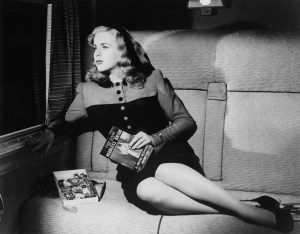
Undeterred, Collins calls up Wayne Morgan (David Bruce), the author of the mystery novel she was reading, and insinuates herself into his life, much to Morgan’s fiancée’s chagrin. After interrupting Morgan on a date at the movies, Collins see the murder victim in a newsreel, and identifies him as Josiah Waring, a shipping magnate. She heads to the Waring estate, where she is mistaken for Circus Club singer Margo Martin, who was Waring’s girlfriend. This allows her to sit in on the reading of Waring’s will, which leaves $1 to his nephew Arnold (Dan Duryea), $1 to his nephew Jonathan (Ralph Bellamy), and the rest of his substantial fortune to Martin.

Sure enough, Collins discovers that Martin has been murdered, throwing suspicion on the Arnold nephews and putting her in a tight spot, since she’s now performing at the club as the murdered girl.

DurbinLady on a Train is part mystery, part musical, part noir, part comedy, and part romance. The most surprising thing about this movie is that each element works perfectly, and they all complement one another. (Calling this film a noir is stretching it, but the final chase in a warehouse contains some striking chiaroscuro shot constructions, and is as tense as one could ask for.) Lady on a Train is also a delight for Durbin fetishists, since she has a different outfit and hairstyle in literally every scene. Sometimes the changes are subtle, but occasionally they’re impossible to miss, such as the scene in which she comes in out of the rain and is suddenly wearing gravity-defying, Pippi Longstocking-style braided pigtails.
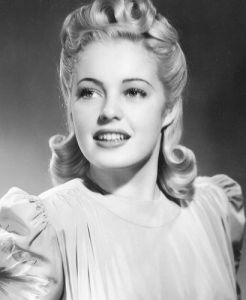
Durbin made her film debut in Three Smart Girls (1936) at the age of 14. Apparently she was so popular that she singlehandedly saved Universal Pictures from financial ruin. Here, at the age of 23, she’s a joy to watch. Unlike a lot of former teen stars, she reached maturity while retaining all of her youthful charm, without ever seeming childish or forced.

The Lady Confesses (May 16, 1945)

HughesMary Beth Hughes appeared in dozens of films from 1939 onward as a second- or third-billed actress (including films in the Charlie Chan, Cisco Kid, and Michael Shayne series), but in director Sam Newfield’s P.R.C. production The Lady Confesses she gets to strut her limited but charming stuff in a lead role. A natural redhead, Hughes usually appeared onscreen as a platinum blonde. Her round cheeks, big eyes, and moxie made up for what she lacked as a thespian.
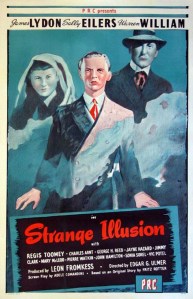
When The Lady Confesses begins, Vicki McGuire (Hughes) receives a visit from a woman named Norma (Barbara Slater), who turns out to be the wife of Vicki’s fiancé, Larry Craig (Hugh Beaumont). Norma has been missing for seven years and was presumed dead. Nasty Norma tells little sweetheart Vicki that she won’t let anyone marry her Larry, even though she doesn’t care for him one bit. Vicki runs off to find Larry, who has been stumbling around a nightclub, three sheets to the wind, generally making an ass of himself. When she finds him and wakes him up, they go to Norma’s apartment to sort things out with her. When they arrive, however, the place is lousy with cops, and Norma lies dead, strangled with a piece of wire. To convince the police of his innocence, Larry takes them to the club where he had been dead drunk for the past several hours. Everyone there admits having seen him, except for the club owner, the shady Lucky Brandon (Edmund MacDonald), who denies having seen Larry, even though Larry had talked to him and asked him for permission to sleep it off in his office. Later, under police questioning, Brandon admits he knew the dead woman, and that she had lent him $10,000 to start up the club, and had recently returned to collect interest on the loan. Suspicious of Brandon, Vicki goes undercover in his club. She waits tables, sings a few songs, and even begins to feel herself falling under his dangerous sway.

The Lady Confesses is an average bottom-of-the-bill noir, but it moves at a nice clip and Hughes is cute. Also, you get to see Beaumont (who would go on to play everyone’s favorite sitcom dad, Ward Cleaver) act totally wasted for the first 10 minutes, which is fun.

A note on the title of the film; contextually it makes no sense. Both Ladies of the Night and Undercover Girl were considered. The first might have implied that the film was about prostitutes. The second actually would have been fitting. But I suppose the point is to get asses in the seats, not to give people an accurate idea of what they’re going to be seeing, especially when it’s a Poverty Row production.

Strange Illusion (March 31, 1945)

StrangeIllusionEdgar G. Ulmer was born in 1904 in Olmütz, Moravia, Austria-Hungary (now part of the Czech Republic). Like a number of talented German and Austrian directors, he moved to the United States in the ’20s and began working in Hollywood. Unlike better-known directors like Billy Wilder or Fritz Lang, however, Ulmer toiled in obscurity for most of his career, cranking out no-budget films. At least part of this was due to the fact that he was blackballed after he had an affair with Shirley Castle, who was the wife of B-picture producer Max Alexander, a nephew of powerful Universal president Carl Laemmle. Castle divorced Alexander and married Ulmer (becoming Shirley Ulmer), but the damage to Ulmer’s career was done. He spent most of the rest of his career churning out product for P.R.C. (Producers Releasing Corporation) Studios, one of the financially strapped Hollywood studios collectively referred to as “Poverty Row.”
Today, Ulmer is best known for two films, The Black Cat (1934) and Detour (1945). I’ve seen the former, but not the latter. The Black Cat stars Boris Karloff and Bela Lugosi, and is one of the more memorable and strange Universal horror pictures. It was a big box-office success, too. I haven’t seen Detour yet, but it has a reputation as one of the best low-budget noirs.

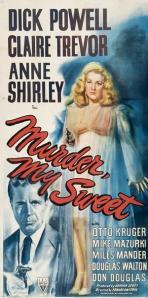
Strange Illusion, which Ulmer made for P.R.C. early in 1945, is a mixed bag. Ulmer’s ideas are clearly larger than the short shooting schedule, low budget, and B-grade actors can support. James “Jimmy” Lydon (on loan from Paramount) plays a young man named Paul Cartwright, whose late father was once the governor of California. The film opens with a stunning, Freudian dream sequence in which Paul walks with his young, attractive mother through clouds of smoke. A menacing, dark man whose face cannot be seen walks with them. He seems to have designs on Paul’s mother. Then the mysterious automobile accident in which Paul’s father died is replayed. It’s a fantastic sequence, and grabs the viewer right away. Much of what follows is prosaic, but not bad. There are a lot of great shots of Paul and other characters that incorporate an enormous portrait of the late Mr. Cartwright, towering over his survivors as though he is passing judgment on them from the afterlife. Warren William is very good as Paul’s mother’s fiancé, and he brings the right balance of charm and menace to his role. Lydon, on the other hand, really irritated me, and some of the youthful “jive” talk he has with his girlfriend is pretty stilted and painful. There’s also a little too much plot for the film’s brief running time. If by the end of this picture you haven’t figured out that this is Ulmer’s teen-oriented take on “Hamlet,” then, brother, you never took a comp lit class. Overall, Strange Illusion isn’t bad, but it’s recommended only if you really enjoy B movies from the ’40s.

Horror fans are encouraged to check out The Black Cat, as well as Bluebeard, a dreamy and beautiful horror movie Ulmer made for P.R.C. in 1944. It stars John Carradine as a homicidal puppeteer in 19th century Paris.

Murder, My Sweet (Dec. 9, 1944)

murdermysweetDick Powell was known as a song-and-dance man when he was cast as hard-boiled dick Philip Marlowe in this adaptation of Raymond Chandler’s novel Farewell, My Lovely.

He nailed the role by not overplaying it. It didn’t hurt that the script and direction were pretty good, too. Powell in Murder, My Sweet will never give Humphrey Bogart in The Big Sleep much competition, but he does a pretty good job.

This film marked a turning point in Powell’s career, too. At the age of 40, Powell was able to slough off the public’s perception of him and reinvent himself as a noir tough guy.

He would go on to star in film noirs like Cornered (1945), which, like this film, was directed by Edward Dmytryk, Johnny O’Clock (1947), To the Ends of the Earth (1948), and Pitfall (1948), among others, as well as two classic radio detective shows, Rogue’s Gallery, which premiered in 1945, and Richard Diamond, Private Detective, which premiered in 1949.