Tag Archives: Film Noir

Dick Tracy Meets Gruesome (Sept. 26, 1947)

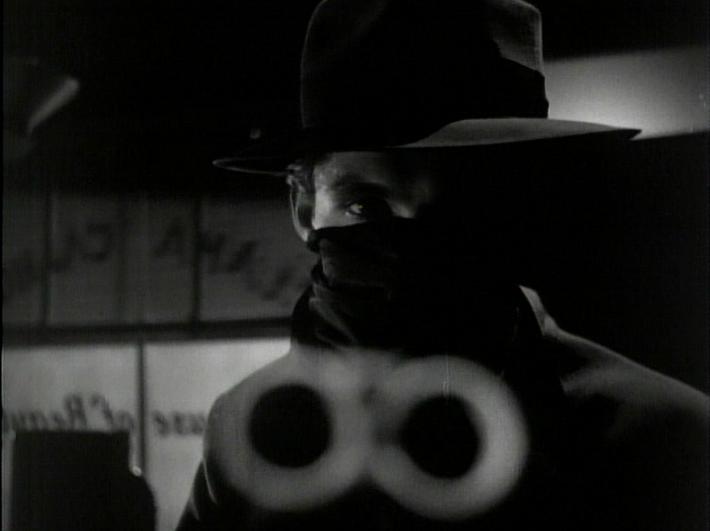
The last of RKO’s four Dick Tracy pictures employs horror icon Boris Karloff to tell a hard-boiled crime story with a sci-fi twist.

Directed by John Rawlins and produced by Herman Schlom, Dick Tracy Meets Gruesome gives top billing to Karloff, not Ralph Byrd, but it hits a lot of the same notes as the first three films.

I was sad to see the last of the Dick Tracy pictures. I thought they were some of the best programmers from the ’40s, second only to Columbia’s Whistler series. I preferred Morgan Conway — who starred in the first two movies — to Byrd, but all the films were action-packed, fast-paced police procedurals with lots of humor. In short, they were great adaptions of Chester Gould’s comic strip.

Dick Tracy Meets Gruesome begins with a dramatic shot of a noose silhouetted on a wall. But then the camera pans to the left and we see that it’s just part of the outdoor decor of a dive bar called “Hangman’s Knot.” (Not to be confused with “The Dripping Dagger,” the waterfront dive in Dick Tracy vs. Cueball.)

The hulking Karloff shambles into the bar, takes a shot without paying, and asks to talk to the disreputable-looking piano player, “Melody” Fiske (Tony Barrett).

Yes, Karloff’s character is really named “Gruesome,” and together with Melody and a Coke bottle glasses-wearing character named “X-Ray” (Skelton Knaggs), he robs banks using a unique nerve gas developed by Dr. A. Tomic (Milton Parsons) and his assistant, I.M. Learned (June Clayworth).

Gruesome learns about the nerve gas firsthand, when he accidentally doses himself and winds up with rigor mortis for about an hour. Gruesome’s “dead” body provides plenty of laughs, especially when Dick Tracy’s partner Pat Patton (Lyle Latell) tries pushing his stiff leg down, and the rest of his body rises up like a corpse rising from the grave.

“I tell you, if I didn’t know better, I’d swear we were doing business with Boris Karloff,” Pat says.

“Looks that way,” Dick Tracy responds.

Even though the gas causes temporary rigor mortis in anyone who breathes it, the scenes in which Gruesome and his crew release the gas into banks are more like one of those “stopping time” bits than anything else, since the body-freezing effect of the gas is achieved by slowing down and then stopping the film.

It’s silly, but so is a taxidermist named “Y. Stuffum” (a throwaway gag in Dick Tracy Meets Gruesome). Chester Gould always delighted in punctuating the violent goings-on in his strips with puns and silly humor, and the RKO Dick Tracy series did the same. While the series never used any of Gould’s original villains, they got the tone of the strip just right.

Railroaded (Sept. 25, 1947)

Anthony Mann’s Railroaded represents a number of missed opportunities and a few modest successes.

In 1947, Mann made his first really good film noir, Desperate, which was released by RKO Radio Pictures. It wasn’t a perfect film, but the actors were decent, the story was suspenseful, and many of the lighting setups by Mann and his cinematographer, George E. Diskant, were stunning.

Railroaded was the next film he made. While I was watching it, I found myself frequently saying “If only…”

If only the script was more focused. If only the music wasn’t so terrible. If only the actors were talented. If only the film featured more screen time for the interesting villains and less screen time for the uninteresting heroes. If only Mann had been given a larger budget. If only he had worked with cinematographer John Alton.

But if you want to watch that kind of movie, you have to dig into Mann’s later work; his six collaborations with Alton, made between 1947 and 1950, or the five westerns he made with James Stewart between 1950 and 1955. Railroaded is a modestly entertaining little picture if you have no expectations, but if you’re familiar with Mann’s later work, it’s bound to disappoint.

Mann made Railroaded for Producers Releasing Corporation (P.R.C.), a dependable old Poverty Row workhorse. It was the last really cut-rate movie that Mann would make. (P.R.C. was in the process of being bought by the powerful British film distributor J. Arthur Rank, and P.R.C.’s name would soon be changed to “Eagle-Lion International” to class it up a little. It was through Eagle-Lion that Mann’s excellent T-Men would be released later in 1947.) While Mann’s budgets were low, he was able to work with less studio control at Eagle-Lion International than he had been faced with at RKO, Universal, Paramount, and Republic.

In Jeanine Basinger’s book Anthony Mann (published in 1979; expanded and republished in 2007), she writes that Railroaded “is more unified than Desperate and points toward the coherence of Mann’s later works. It is perhaps his first really unified film, presenting the story of a young woman … and her attempts to clear her brother’s name of a murder charge.” I don’t agree with Basinger’s assessment, and find Railroaded an even more uneven film than Desperate.

Guy Roe was Mann’s cinematographer on Railroaded, and even though he’s not as good as Alton, there are still a number of impressive sequences, particularly the robbery that opens the picture.

John Ireland (the only actor in the film with any talent) plays a sneering criminal named Duke Martin who perfumes his bullets. (What’s a B-noir bad guy without a gimmick or two?)

The robbery is of a joint controlled by Jackland Ainsworth (Roy Gordon). It’s a numbers operation hidden in the back of a beauty shop run by Clara Calhoun (Jane Randolph). Clara is Duke’s girlfriend, and the inside job was supposed to be a cinch, but the cops show up, and Duke snuffs one of them, which sets the events of the film in motion.

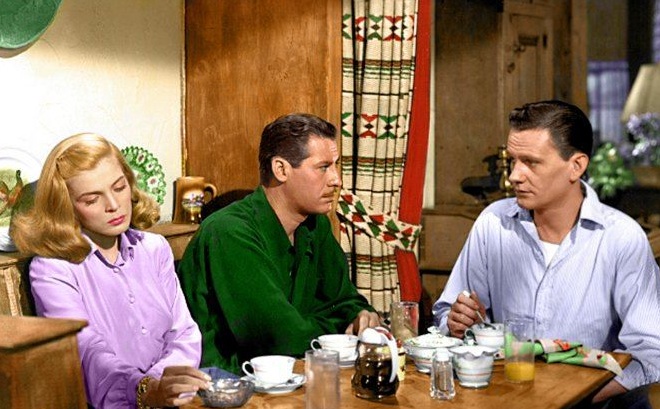
Duke arranged everything to point in the direction of a patsy, Steve Ryan (Ed Kelly). Steve is a young guy who lives with his sister, Rosie Ryan (Sheila Ryan), and his mother, Mrs. Ryan (Hermine Sterler). At the breakfast table, Rosie talks about the movie she saw the night before, and how she cried at the end, when the police got their man. Even though he was a criminal, she felt bad for him. Steve is unsympathetic, and says “Maybe some guys need a goin’ over.” Minutes later the police bust in and arrest him for murder. (John C. Higgins’s screenplay, which is based on a story by Gertrude Walker, could have used more clever and ironic moments like this one.)

Things look bad for Steve. Duke used Steve’s scarf as a mask during the robbery. Steve’s car was stolen and used as the getaway vehicle. A paraffin test to see if Steve has recently fired a gun comes up negative, but that doesn’t mean much after Duke’s partner, Cowie Kowalski (Keefe Brasselle), who was shot during the robbery, gives a deathbed confession that implicates Steve.

Railroaded isn’t actually a very accurate title for the film, since the cops don’t railroad Steve. They work with the evidence they have. (Framed would have been a more accurate title.) Unlike Desperate, which followed an innocent man’s terrifying flight from both gangsters and the police, the unjustly accused protagonist of Railroaded pretty much disappears from the film as soon as he’s jailed. Enter Sgt. Mickey Ferguson (Hugh Beaumont), a police detective who grew up in the same neighborhood as the Ryans, and is still sweet on Rosie.

Rosie believes her brother is innocent, and eventually starts to convince Sgt. Ferguson. This is where the picture really took a nosedive for me. Sheila Ryan is nice to look at, but she’s a completely unconvincing actress. Beaumont is even worse. He brings the same gravitas to his role as Sgt. Ferguson that he did to the scenes on TV a decade later in which he punished Wally and The Beav. Watching his scenes is like watching grass grow, and he and Sheila Ryan are the protagonists of Railroaded, not bit players.

With no one to root for, the only enjoyment I got out of Railroaded was watching John Ireland’s scenes, especially the ones with Jane Randolph. With the heat on, Duke orders Clara to hole up and stay off the booze. He’s planning one last score — a robbery of the Club Bombay, where the vigorish from Ainsworth’s bookie shops goes. Duke figures he can get revenge on Ainsworth and make off with $30 to $40 grand, which he’ll use to finance his and Clara’s getaway to South America. Of course, he can’t keep Clara off the sauce, but things aren’t all bad, since occasionally something exciting happens, like a vicious catfight Clara gets into with Rosie that Duke impassively watches while hidden:

Railroaded is a pretty typical P.R.C. product. The sets look like they’re made out of cardboard, the dialogue is stilted, the music is awful, and actors who can carry a scene are in the minority. Stretches of the film are entertaining, and occasionally the cinematography and editing create suspense and some real excitement, but overall, this isn’t one of Mann’s better pictures. There are plenty of people who champion the film, but for me, if a picture doesn’t have decent actors and strong characterizations, it doesn’t hang together. A few great scenes do not a great film make.

Dark Passage (Sept. 5, 1947)

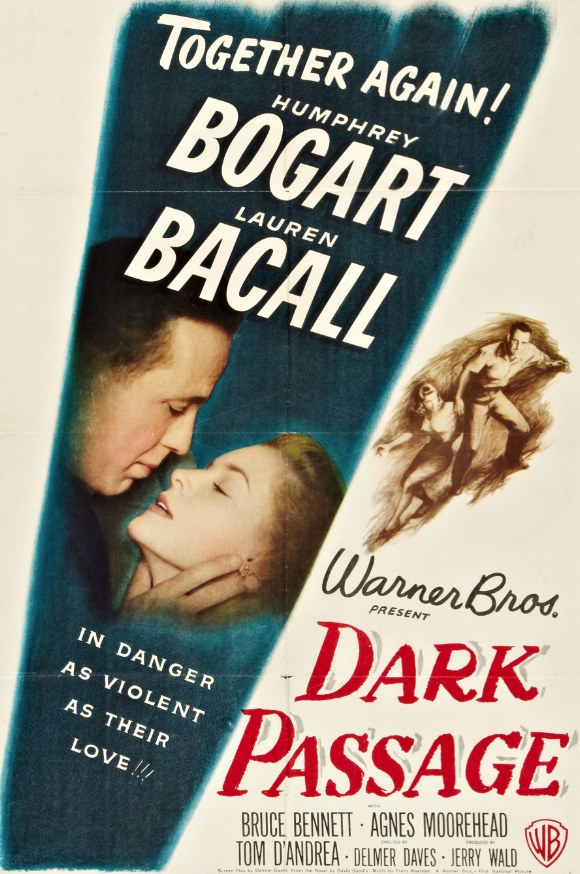
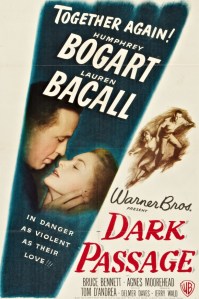
Delmer Daves’s Dark Passage is the red-headed stepchild of the Bogie-Bacall movies.

Humphrey Bogart and Lauren Bacall were married in 1945, and stayed married until Bogart’s death in 1957. They made four movies together — To Have and Have Not (1944), The Big Sleep (1946), Dark Passage, and Key Largo (1948). Of these four, Dark Passage is the strangest and the least widely acclaimed.

It was a bit of a critical and box office disappointment at the time of its release, possibly because Bogart’s face doesn’t actually appear on-screen until the picture is more than half over, and possibly because of Bogart’s involvement with the Committee for the First Amendment.

The Committee for the First Amendment was an organization that was formed to protest the treatment of Hollywood figures by the House Un-American Activities Committee. (Bogart later recanted his involvement with the organization in a letter published in the March 1948 issue of Photoplay entitled “I’m No Communist.”)

Dark Passage is based on a book by oddball crime novelist David Goodis. The film does a good job of bringing Goodis’s strong characterizations and nightmarish, occasionally surreal demimonde to the big screen.

For better or for worse, it also does a good job of bringing to life some of Goodis’s less powerful aspects, like his convoluted plots and his reliance on coincidence.

But just like the best of Goodis’s novels, the film version of Dark Passage doesn’t need to be plausible to work. It plays by its own rules, and when it works, boy does it work.

In Dark Passage, Bogart plays Vincent Parry, a man convicted of killing his wife who breaks out of San Quentin by hiding in a 55-gallon drum on the back of a flatbed truck. He manages to roll himself off the truck and into a ditch somewhere in Marin County. He strips down to his undershirt, buries his prison-issue shirt, and takes to the highway to thumb a ride. He’s picked up, first by a guy named Baker (Clifton Young), and then — when that little ride goes sour — by a beautiful artist named Irene Jansen (Lauren Bacall).

She hides him under her canvases and wet paint so they can make it through a roadblock at the entrance of the Golden Gate Bridge, then she takes him to her luxurious bachelorette pad in North Beach. Why is she helping him? Because her own father was unjustly imprisoned for a murder he didn’t commit, and because she followed Parry’s trial, even writing letters to the editor protesting his treatment by the press.

For the first 37 minutes of Dark Passage, Bogart’s face is never shown, for reasons we’ll get to in a moment. This P.O.V. style of filmmaking was pioneered by Robert Montgomery in his film Lady in the Lake (1947), but the technique works much better in Dark Passage, for a variety of reasons. First, the editing is more aggressive than in Lady in the Lake, which was essentially one long tracking shot designed to put the viewer in the shoes of the protagonist but that never quite worked. Second, there are third-person shots of Bogart in which his back is turned or his face is in shadows, which helps to break things up and make them more visually palatable.
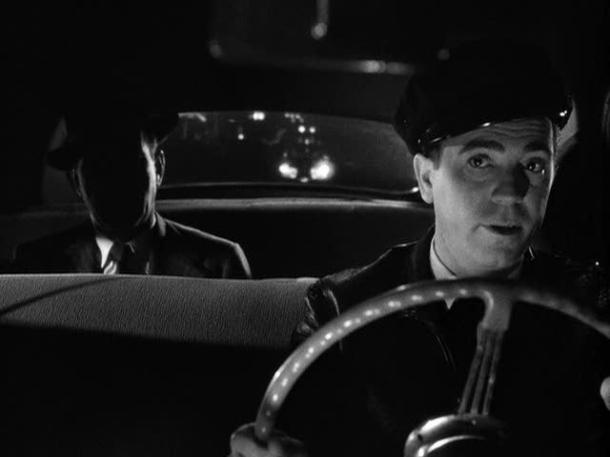
Once Parry makes it to San Francisco, Dark Passage gets really weird. Irene gives him $1,000, new clothes and a hat, and a place to stay, but if you thought that qualified Parry as the luckiest escaped convict in history, you ain’t seen nothing yet.

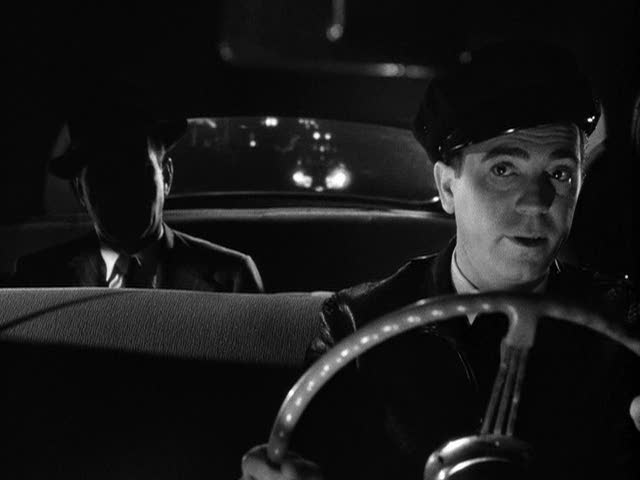
He’s picked up one night by a cabbie named Sam (Tom D’Andrea), who not only recognizes him but believes Parry got a raw deal from the court system, and hooks him up with his buddy, Dr. Walter Coley, a plastic surgeon who can change his face.

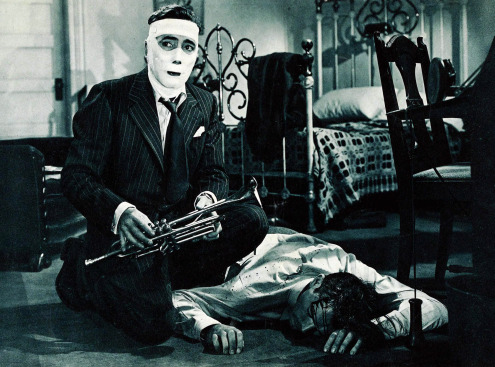
Nervous about staying with Irene, Parry goes to see his friend George Fellsinger (Rory Mallinson), a trumpet player who gives Parry a key to his place. Incidentally, we get our first shot of Parry’s “real” face on the front of a newspaper laid across his friend George’s chest as he lies in bed. The real Parry has a mustache, and doesn’t look much like Bogart.

But he looks exactly like Bogart after his trip to see Dr. Coley, who’s played by 67-year-old actor Houseley Stevenson. Dr. Coley is the most ghoulishly fun character in Dark Passage. Wrinkled, liver-spotted, and chain-smoking, Dr. Coley asks Vincent if he’s ever seen a botched plastic surgery job right before he puts him under, and the kaleidoscopic nightmare Parry has while undergoing plastic surgery is a real standout.
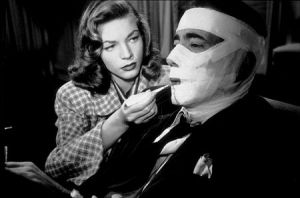
Even after the surgery, we don’t fully see Bogart’s face until more than an hour into the picture.

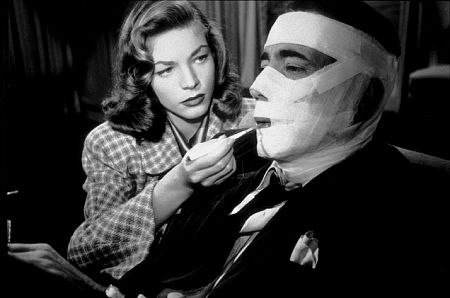
Until then, he’s covered with bandages, smoking cigarettes with long filters and communicating with Irene using pencil and paper. (Throw a pair of shades on him and he’d look like Claude Rains in The Invisible Man).

While the plot may be contrived and coincidence-laden, the characterizations are sharp, and the actors are all really good. Lauren Bacall has to carry the film for much of the first hour, and she delivers a really good performance. She’s much better at interacting with the camera than any of the actors in Lady in the Lake were. Consequently, the P.O.V. technique draws less attention to itself, and works fairly well.
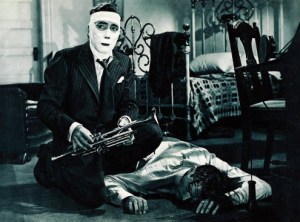
When the bandages finally come off, Parry looks at himself in the mirror and remarks, “Same eyes, same nose, same hair. Huh. Everything else seems to be in a different place. I sure look older. That’s all right, I’m not. And if it’s all right with me it oughtta be all right with you.”

The fact that Bogart and Bacall were married in real life gives this line a little humorous subtext.

Hidden behind his new face, Parry is faced with another murder to solve, cops on his tail, a chiseler who hopes to blackmail Irene after he finds out she’s been shielding Parry, the presence of Irene’s old beau Bob (Bruce Bennett), and her shrill friend Madge Rapf (Agnes Moorehead), who keeps dropping by and nosing around.

That Parry goes about solving his problems in a haphazard, roundabout way should come as a surprise to no one who’s familiar with the fiction of David Goodis.

Dark Passage may not be a perfect film, but it’s an intriguing and involving one. Sid Hickox’s cinematography is gorgeous, and the location shooting in San Francisco is really effective. It’s worth seeing at least once, and if you’re like me, you’ll probably want to see it again.

Kiss of Death (Aug. 27, 1947)

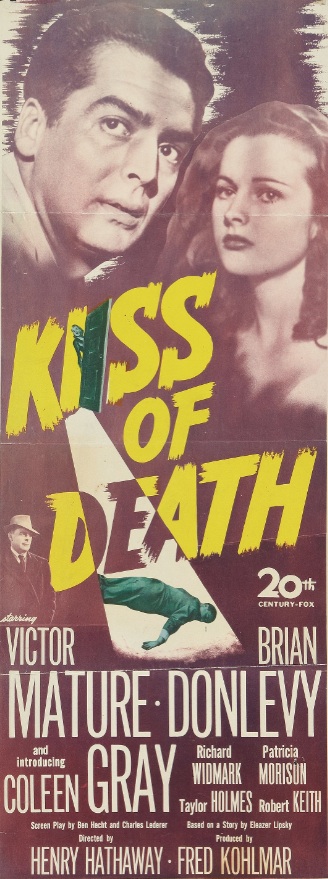
Kiss of Death is director Henry Hathaway’s greatest film noir. It’s a mix of the semi-documentary style of his earlier films The House on 92nd Street (1945) and 13 Rue Madeleine (1947) with the hard-boiled conventions of his private eye flick The Dark Corner (1946).

The film begins with the following words: “All scenes in this motion picture, both exterior and interior, were photographed in the State of New York on the actual locale associated with the story.”

Unlike The House on 92nd Street and 13 Rue Madeleine, however, this commitment to veracity isn’t in service of a true-ish retelling of World War II-era espionage, but of a hard-boiled crime drama about a three-time loser facing 15 years in stir after being nabbed for a jewel robbery.

His name is Nick Bianco (Victor Mature), and if he wants to watch his two little girls grow up, he’s going to have to stool for the district attorney’s office.

Bianco has been in this position before, and he took the full four-year rap instead of squealing.

“I’m the same guy now I was then. Nothin’ has changed. Nothin’,” he tells Assistant District Attorney Louis D’Angelo (Brian Donlevy).

On his way up the river to Sing Sing, Nick meets a cackling, sociopathic hood named Tommy Udo (Richard Widmark). Udo won’t show up again for awhile, but he’ll play a major role in Nick’s life when he does.

For awhile, Nick stays clammed up, but then his wife Maria commits suicide and he starts to rethink matters. When a pretty girl from his old neighborhood, Nettie (Coleen Gray), comes to visit him in Sing Sing and tells him that the driver on the jewelry job, a guy named Pete Rizzo, was responsible for Mrs. Bianco putting her head in the oven, Nick decides he wants to talk to the D.A. and secure his release in exchange for information. (In the original story, it was implied that Rizzo raped Nick’s wife, but that’s sidestepped in the final version, making it seem more as if she was having an affair with Rizzo.)

Nick trusts Assistant D.A. D’Angelo enough to tumble to a job in his past that he got away with — the Thompson Fur Company heist — to provide a cover for his trips to the D.A.’s office. D’Angelo promises that he’ll drop the charges later for insufficient evidence.

Things are looking up for Nick. He’s able to care for his daughters, and he’s eventually paroled, leaving him free to marry Nettie.

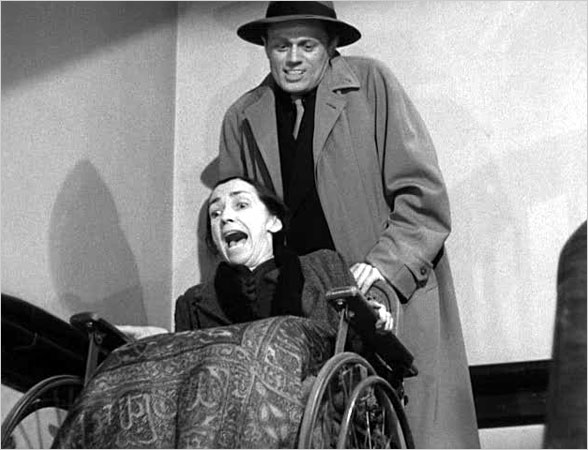
But as soon as Tommy Udo — Nick’s old pal from the trip up to Sing Sing — re-enters his life, things go very bad very quickly. Udo is the kind of guy who thinks nothing of wrapping up an older wheelchair-bound woman (played by Mildred Dunnock) in electrical cord and pushing her down a long flight of stairs, in one of the most enduring scenes of cinematic sociopathy.

Kiss of Death was Richard Widmark’s film debut, and his balls-out crazy performance is something to behold. The filmmakers thought that Widmark’s high forehead made him look too intelligent, so they outfitted him with a low-browed hairpiece. Like Heath Ledger’s performance as the Joker in The Dark Knight (2008), Widmark’s performance as Tommy Udo straddles the line between gangster movie and monster movie. Director Hathaway had toyed with the idea of casting the manic Harry “The Hipster” Gibson, who sang the 1944 druggie classic “Who Put the Benzedrine in Mrs. Murphy’s Ovaltine?” as Udo, but it’s impossible now to imagine anyone but Widmark in the role.

The screenplay for Kiss of Death was adapted by Ben Hecht and Charles Lederer from a story by Eleazar Lipsky originally called “Stoolpigeon.” Lipsky was a novelist who worked as a Manhattan assistant district attorney. He was also legal counsel for the Mystery Writers of America. Perhaps because of Lipsky’s day job, the realism of the setting of Kiss of Death is matched by the actions of its characters. Brian Donlevy, in the role of Assistant D.A. D’Angelo, is neither a hero nor a villain. When he tells Nick that he’s going to have to testify in court after all, and later that it was all for nothing, and that Tommy Udo was acquitted and is probably coming after Nick, the viewer gets the sense that D’Angelo genuinely cares for Nick, but that at the same time, putting Nick’s life in danger is just part of the job. D’Angelo might not like it, but he accepts it as a necessary evil.

Interestingly, the fictional Kiss of Death comes off as a more realistic film than either The House on 92nd Street (1945) or 13 Rue Madeleine (1947), both of which touted the “true” stories that were their inspirations. Although not every scene in Kiss of Death was shot on the actual locale associated with the story, as the title card promises (some of the interiors were clearly shot in a studio), the use of real New York City and Upstate New York locations coupled with realistic dialogue, understated performances from all the cast besides Widmark, and extremely sparse use of background music makes for a powerful, engrossing drama. There are standout set pieces, like the jewel heist in the Chrysler Building that opens the film, and spectacular shots of the Manhattan Criminal Courts Building, the Tombs, and the Triborough Bridge from the Queens side of the East River, but there are also lots of little touches that give the film its sense of realism. When Nick watches his daughters during their music lesson at the Academy of the Holy Angels in Fort Lee, New Jersey, the piano is slightly out of tune. When Nick sits in his cell at Sing Sing, the toilet in the cell is clearly visible, which is something you’d never see in a prison cell built on a Hollywood soundstage in the ’40s. (Incidentally, prior to shooting the scenes in Sing Sing, Hathaway had both Victor Mature and Richard Widmark processed through the system to give them a better sense of the characters they were playing.)

Kiss of Death isn’t a perfect movie, but it stands up to repeated viewings, and its use of music and location are both revolutionary. If you don’t believe me, take it from Walter Winchell…

Desert Fury (Aug. 15, 1947)

For me, Lewis Allen’s Desert Fury is currently running neck and neck with Felix Feist’s The Devil Thumbs a Ride for the honor of “wackiest movie of 1947.”

But maybe I’m comparing apples to oranges. While The Devil Thumbs a Ride was a zany thrill ride with oddball characters and a lot of unexpected humor, Desert Fury is a ridiculously campy melodrama in which most of the humor seems unintentional.

Also, it has gay undertones that are strong enough to power a small city for a year.

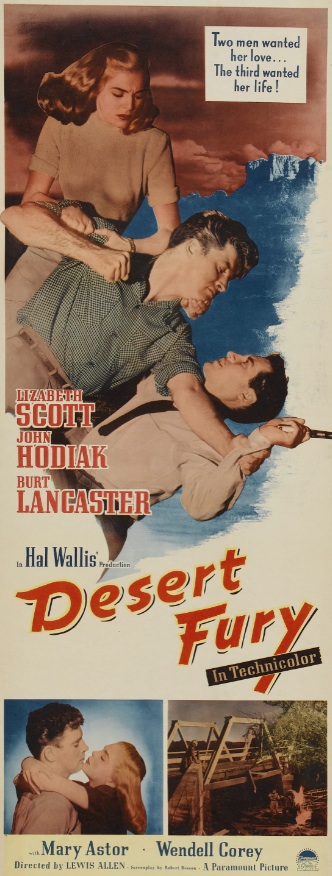
The poster on the right implies that Burt Lancaster and John Hodiak spend the movie fighting for Lizabeth Scott’s love, but that’s not the case. More accurate is the tagline: “Two men wanted her love … The third wanted her life!”

Scott plays a beautiful 19-year-old girl who lives in a “cactus graveyard” in the middle of nowhere — Chuckawalla, Nevada. She lives with her mother, Fritzi, who’s played by Mary Astor (an actress from Hollywood’s Golden Age who was just 16 years older than Lizabeth Scott). Fritzi always calls Paula “baby.” Not in a sweet, maternal way, but the way a barfly might say, “Hey, baby! C’mere!”

Fritzi wants Paula to go back to school, but Paula wants to help her mother run the Purple Sage Casino. (Paula’s father was a bootlegger who was killed when Paula was very young.)

Burt Lancaster plays Tom Hanson, a former bronco buster who barnstormed around the country, but washed out of the rodeo and now works as a sheriff’s deputy in Chuckawalla. Fritzi wants Tom to marry Paula and make an honest woman out of her. He’d like nothing more than to marry Paula, but he doesn’t push, because he knows that her love for him is strictly platonic.

Into their lives comes runty, mustachioed gangster Eddie Bendix (John Hodiak) and his gunsel Johnny (Wendell Corey), and Paula — quite inexplicably — falls head over heels in love with Eddie.

The love triangle formed by Paula, Eddie, and Tom is weak sauce compared with the love triangle formed by Paula, Eddie, and Johnny.

Johnny is more than just Eddie’s “muscle.” He’s his longtime companion, his best friend, and — just possibly — his lover.

Is he or isn’t he? Let’s look at the evidence. Eddie and Johnny form a tight unit, and seem to both know what really happened to Eddie’s first wife, who died in a car accident. Johnny hates Paula, and seems insanely jealous of her relationship with Eddie.

And how does Eddie explain to Paula how he first hooked up with Johnny?

“I was your age, maybe a year older. I was in the automat off Times Square about two o’clock in the morning on a Saturday. I was broke, he had a couple of dollars, we got to talking. He ended up paying for my ham and eggs,” he says, a note of shameful resignation creeping into his voice.

“And then?” Paula asks.

“I went home with him that night. I was locked out. Didn’t have a place to stay. His old lady ran a boarding house in the Bronx. There were a couple of vacant rooms. We were together from then on.”

The relationship between Eddie and Johnny isn’t the only hint of a gay union. Paula and Fritzi are so close in age, and Fritzi’s attitude toward her daughter lacking so much maternal warmth, that they seem more like a lesbian couple than anything else. Fritzi seems like the older, more dominant one, and Paula seems like the younger, more restive one, who might also be interested in men. (In further defense of this reading, Lizabeth Scott and Burt Lancaster might walk off into the sunset at the end of the picture, but their lips never meet. The final — and most passionate — kiss of the film is the one Fritzi plants on Paula’s lips.)

There’s a lot of talent in front of and behind the camera, but that only counts for so much. For instance, compare Miklós Rózsa’s brilliant score for Brute Force (1947) with his score for Desert Fury. His score for Desert Fury is powerful, but without the dramatic underpinning of a great film, it just writhes and flails all over the place, seemingly in search of a better movie, or at least a more lively one.

The script by Robert Rossen (with uncredited assistance from A.I. Bezzerides), which is based on Ramona Stewart’s novel Desert Town, has a lot of snappy dialogue, but the story just doesn’t move with much intensity. Also, the Technicolor cinematography really undercuts some of the noir elements of the story and the situation.

Desert Fury is campy, and worth seeing if you’re into camp, but that’s about it. Also, if you’re a connoisseur of face-slapping, there’s plenty of that going around, too.

Singapore (Aug. 13, 1947)

Note to aspiring makers of B movies — if you’re going to blatantly rip off Casablanca (1942), take a page from director John Brahm’s book. Don’t just change the characters’ names and tack on a happy ending. Do it with real panache and also change the hero’s occupation to “pearl smuggler” and spice up the love triangle by giving the heroine a case of amnesia.

True to its title, Singapore is steeped in the exoticism and heat of the Pacific Rim, but like the film noir techniques Brahm uses to tell his story, it’s mostly just window dressing for a run-of-the-mill potboiler. But that’s not entirely a bad thing. Brahm keeps things moving along nicely, and Singapore is a lot of fun if you’re in the mood for a melodrama and you can overlook some contrivances.

When Matt Gordon (MacMurray) returns to Singapore after World War II, it’s clear as soon as he steps off the plane that he has a history there. Deputy Commissioner Hewitt (Richard Haydn) has Gordon brought to his office, and he reminds him that the penalty for removing illegally obtained pearls from a British colony is a minimum of 10 years in prison.

“Before the war it was only eight,” Gordon quips. “But I guess everything’s gone up, huh?”

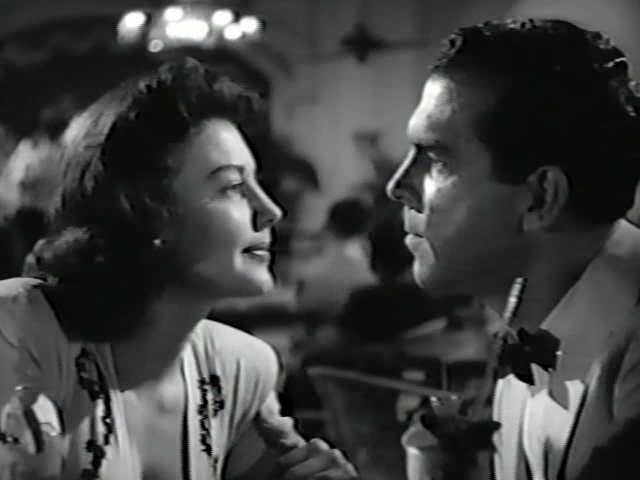
Gordon sits down in the hotel bar, orders two gin slings, and sits alone, reminiscing about life in Singapore before the war. He fell in love with a beautiful young woman named Linda Grahame (Ava Gardner), but their whirlwind romance was cut short by the beginning of hostilities with the Japanese.

They were engaged to be married, but before they could tie the knot she was killed in a bombing raid, and Allied forces had occupied his hotel room, where his $250,000 worth of pearls were secreted in the motor of the ceiling fan in his room.

He made it out of Singapore with his life, but that’s all, and now that the war is over he’s intent on retrieving his pearls. (It’s established that Gordon has a service record, and saw combat during the war, perhaps to engender audience sympathy.)

Of course, Linda didn’t really die in a bombing raid. She was injured and stricken with total amnesia. Unable to remember any details of her former life, she was interned in a Japanese concentration camp, where she met Michael Van Leyden (Roland Culver), a British plantation owner who saved her life many times during the war. Now they are married, and her name is Ann Van Leyden. No matter how many times Gordon calls her “Linda,” she just can’t remember their time together, or the love they shared.

So Gordon has two problems — winning back Linda/Ann, and somehow getting his pearls out of the ceiling fan of a hotel room that is now occupied by an obnoxious married couple. The problem of the pearls is compounded not only by the watchful eye of Deputy Commissioner Hewitt, but also by the corpulent gangster Mr. Mauribus (Thomas Gomez), who wants the pearls for himself.

There are a lot of ceiling fans in Singapore, and none of them move quickly. It’s all part of the languorous, overheated atmosphere of the film, but like I said above, it’s all just window dressing. The Asian extras in the background and the crowded streets of the port city add ambiance, but not much else. The action could be moved to any other “exotic” locale, and few details of the plot would have to be changed. (And that’s exactly what happened in 1957 when director Joseph Pevney remade Singapore as a vehicle for Errol Flynn called Istanbul.)

I liked Singapore despite its flaws, and it’s always enjoyable to watch the beautiful Ava Gardner do anything. I didn’t completely buy her relationship with the hulking, thuggish Fred MacMurray — I’ve always thought MacMurray was better in comedic roles than dramatic ones — but it works well enough to keep the film moving.

Possessed (July 26, 1947)

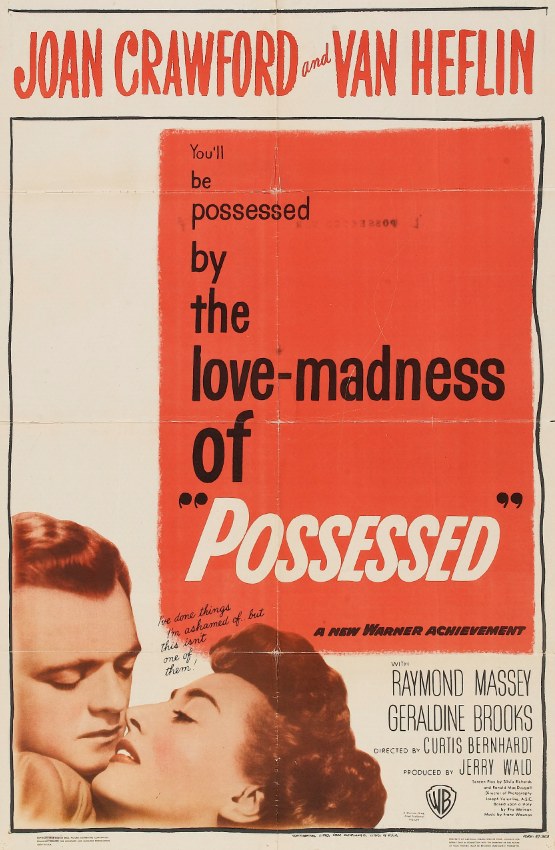
If you like to see Joan Crawford get her crazy on as much as I do, then you’ll love Possessed.

Curtis Bernhardt’s fevered noir melodrama begins with a surprisingly unglamorous-looking Crawford wandering the streets of Los Angeles in a daze, asking everyone she passes if they’ve seen “David.”

Crawford isn’t wearing any makeup, and her journey through the early dawn streets reminded me of a similar scene that appeared a decade later in Louis Malle’s Ascenseur pour l’échafaud (Elevator to the Gallows) (1958), in which Jeanne Moreau wanders the streets of Paris without makeup. (Was Malle influenced by Possessed? It’s certainly possible.)

The character Crawford plays, Louise Howell, is taken by ambulance to the psychopathic ward of the Los Angeles Municipal Hospital, where she is cared for by Dr. Willard (Stanley Ridges). He gives her narcosynthesis to lift her out of her catatonic stupor, and the tale of what brought Louise to this place is told through a haze of flashbacks and psychobabble.

Louise was a nurse in the employ of wealthy Dean Graham (Raymond Massey). Her job was to care for Graham’s infirm wife.

After a brief love affair with an average-looking but very charming architect named David Sutton (Van Heflin), Louise became hopelessly attached to him. When David told her that he wasn’t the marrying kind, and that he had to break things off with her, it began her spiral into madness. She was convinced that there was another woman, but he assured her there wasn’t.

“Louise, don’t hang onto me. You’ll get hurt,” he said in exasperation, and his words were prescient. The straitlaced, self-possessed Louise began to unravel.

Dr. Willard diagnoses her with a persecution complex. She thought that David breaking up with her was all part of a plan. Everyone was against her. Dr. Willard calls it “typical schizoid detachment … split personality.”

Despite its sometimes overheated story and dialogue, Possessed is a stylistic feast. Franz Waxman’s musical score perfectly underscores every one of Joan Crawford’s scenes, and Joseph A. Valentine’s cinematography visually expresses her madness.

There are recurring visual motifs, most notably water. For instance, when David gets into his boat and leaves Louise sobbing on the dock, the churning water symbolizes her inner turmoil. The doctors hovering over Louise’s bed discuss her case, then the scene cuts to a shot of the carafe of water by her hospital bed that dissolves into a shot of the water around Dean Graham’s home.

When Louise stops the little pendulum of her bedside clock from ticking because it’s “driving her crazy” the sound is replaced by the sound of dripping water outside her open window. She slams the window shut, trying to control her madness.

Possessed could never be called a realistic film. But that’s not its goal. It subjectively depicts an unraveling psyche, and isn’t afraid to veer into territory that sometimes seems as if it would be more at home in a horror movie than in a melodrama.

Crossfire (July 22, 1947)

Crossfire
Crossfire (1947)
Directed by Edward Dmytryk
RKO Radio Pictures

In 1947, social-issue pictures were starting to come out of Hollywood that tackled a formerly taboo subject — antisemitism.

This might not seem like such a big deal today, but it was a big deal at the time.

No matter how artful or moving some of its products are, the film industry is still a business, and any subject that challenges the status quo or that might hurt ticket sales is extremely difficult to make a film about. And despite the fact that in the ’40s the majority of studio heads were Jewish, they preferred to release films that depicted a homogenous, idealized vision of America.

Richard Brook’s 1945 novel The Brick Foxhole is about a homosexual who is beaten to death by his fellow Marines. Producer Adrian Scott convinced the studio bosses at RKO Radio Pictures that an adaptation of the book would pass muster with the production code if the gay character in the novel were changed to a Jewish character.

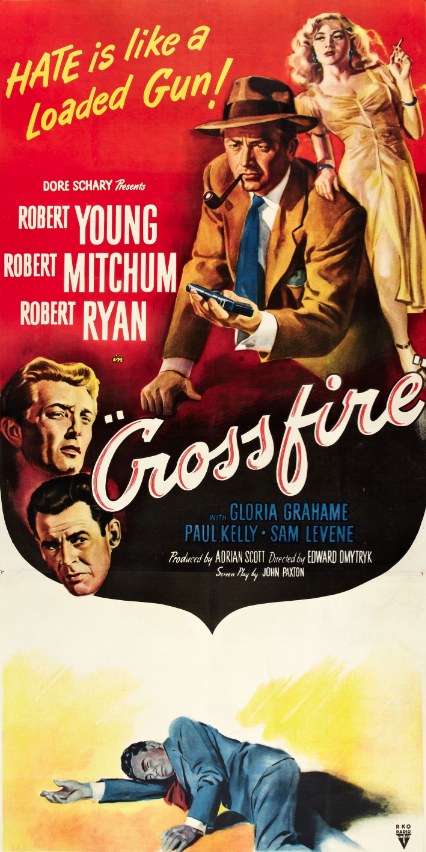
Crossfire is a social-issue picture wrapped in a murder mystery. It’s likely that many ticket buyers didn’t realize the film would contain a message about antisemitism, and were attracted by the “three Bobs” in the credits (Robert Ryan, Robert Young, and Robert Mitchum) or the lurid promise of violent death in the poster.

Whatever drew people into the theater when the film opened, however, nothing kept them away in the weeks that followed. Crossfire was a big hit, and was eventually nominated for five Academy Awards, although it lost out to Elia Kazan’s Gentleman’s Agreement, Twentieth Century-Fox’s more “prestigious” take on antisemitism. (In the case of best picture, best director, and best supporting actress, the awards went to Gentleman’s Agreement. In the case of best supporting actor and best adapted screenplay, the awards went to Miracle on 34th Street.)

Edward Dmytryk, the director of Crossfire, once said in an interview that he used “film noir” techniques primarily to save money, and because he wanted to spend more time working with the actors than doing setups. Dmytryk and his cinematographer, J. Roy Hunt, worked six and a half hours a day, and did about seven setups a day.

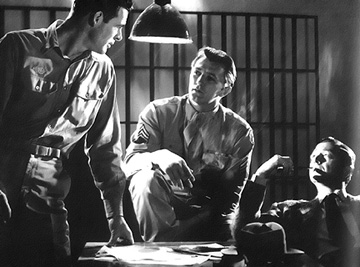
Ryan, Mitchum, and Young

Dmytryk was an excellent director, and Crossfire is an exceedingly well-made film.

He shot Crossfire in 20 days, less than the 22 days he was allowed with his $500,000 B-movie budget. Because of this, RKO was able to beat Twentieth Century-Fox’s Gentleman’s Agreement to the box office. (But not, ultimately, in the Oscar race.)

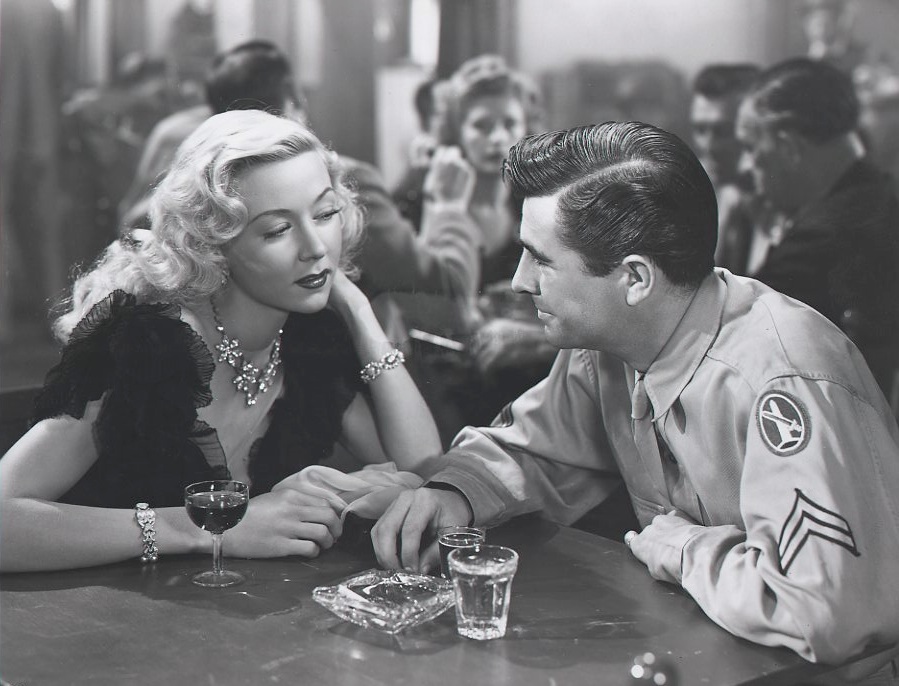
The darkness and shadows that creep into each shot disguise the simplicity of the sets, and the performances from all the actors are exceptional, especially Robert Ryan as the vicious, Jew-hating soldier named Montgomery, and Gloria Grahame as a lonely B-girl named Ginny.

The beating death of the Jewish man, Samuels (Sam Levene), that opens the film takes place in darkness, so the culprit is not seen. But the mystery doesn’t really persist. Montgomery is the likely suspect right from the beginning. His sneering dismissal of the “kind of guy” Samuels was makes his guilt seem pretty obvious during the scene in which he’s interrogated by the police detective, Finlay (Robert Montgomery).

The film quickly switches gears, however, and focuses on the search for a missing soldier named Mitchell (George Cooper), whom the police suspect of the murder. The jaded and world-weary Sgt. Keeley (Robert Mitchum) helps Detective Finlay, but ultimately shields Mitchell, helping him hide in a movie theater while Keeley and his buddies try to sort out what really happened.

Mitchell was pretty drunk, and can barely remember what happened at the party that evening. But the last words we hear Montgomery say in Mitchell’s flashback to the party — “What’s the matter, Jew boy? You afraid we’ll drink up all your stinking wonderful liquor?” — cement Montgomery’s guilt.

Grahame and Cooper

Mitchell’s sad and lonely journey through the night is classic noir stuff. His strange encounters — like the ones he has with B-girl Ginny and later with her “husband” (played by Paul Kelly), whose name we never learn — are haunting.

While Crossfire is occasionally preachy, this can be forgiven, especially considering the time when the film was released.

Unlike Brute Force (1947), which showed what American fascism could look like at the upper echelons of authority, Crossfire is a portrait of the rank and file of fascism — the dumb, mean, resentful men who “just carry out orders,” and do so happily. Ryan doesn’t overplay his role, and he’s all the more scary for it.

Brute Force (June 30, 1947)

Snitches get stitches.

Or, in the case of Jules Dassin’s Brute Force, they get forced into a giant machine press by a group of cons wielding acetylene torches. They also get tied screaming to the front of a mining cart and used as a human shield during a massive prison break.

Westgate Penitentiary is hell on earth. All the cells are filled to double capacity. The warden is a weak-willed jellyfish who cedes all authority to the sadistic Capt. Munsey (Hume Cronyn). There are punishing make-work assignments in the dreaded “drainpipe.” Capt. Munsey plants contraband on prisoners just to send them to solitary confinement. And worst of all, on movie night the cons are forced to watch The Egg and I.

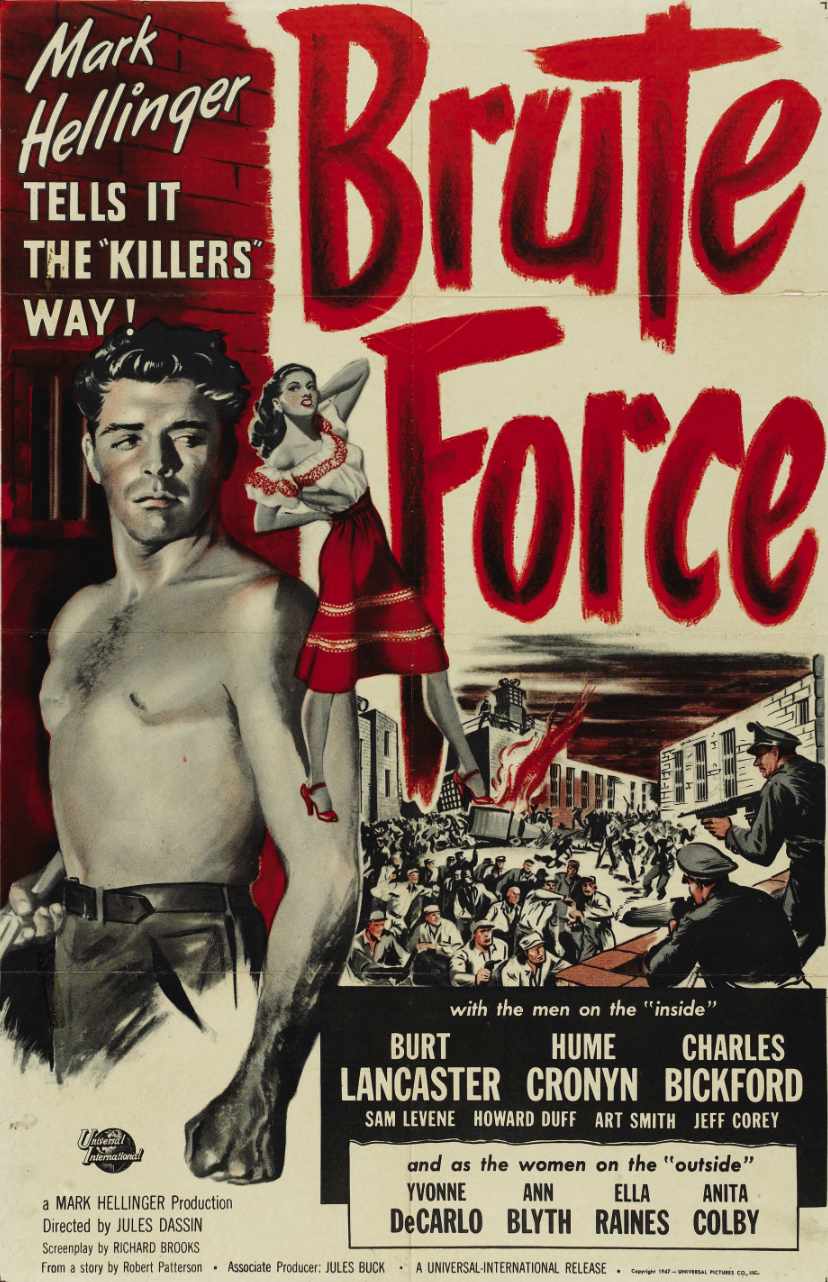
Brute Force is director Dassin’s first film noir (and still one of his best). It’s also producer Mark Hellinger’s second great film to star Burt Lancaster (the first was The Killers, in 1946).

In 1947, Lancaster wasn’t the versatile superstar he would eventually become. He was mostly known for playing “The Swede” in The Killers. The Swede was a lovesick former prizefighter; a big, dumb brute who feels pain, but little else. Brute Force allows Lancaster to stretch a little as an actor. The character he plays, Joe Collins, is the biggest, toughest man in Westgate — on the surface, not that different from The Swede — but he’s also a canny tactician who is ruthlessly efficient at getting what he wants. Collins doesn’t have a lot of dialogue, but Lancaster’s physical performance is phenomenal, and would have been at home in a silent film.

It’s a cliche to say that an actor’s body is his “instrument,” but it’s true of Lancaster, a former circus performer who expresses more with his body and his eyes in Brute Force than words ever could.

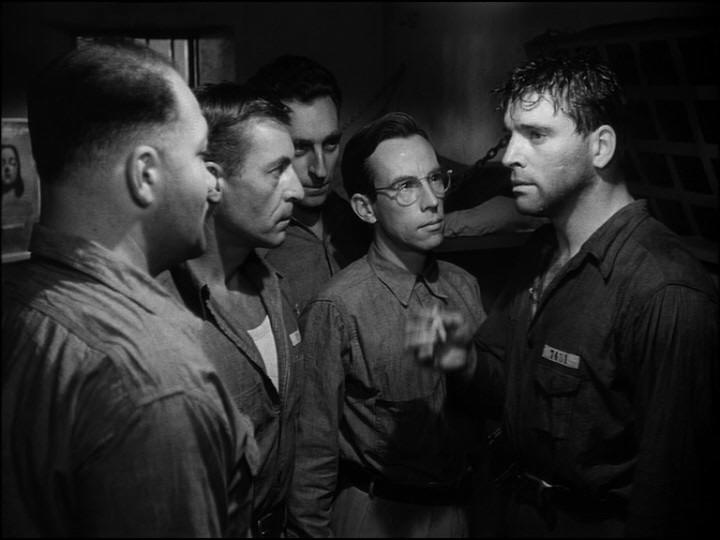
Collins is the de facto leader of the men in cell R17. He wants out of Westgate Penitentiary, but unlike all the daydreaming, hard-luck sad sacks who are behind bars with him, Collins has a plan, and it’s a good one. But for his plan to work, he has to have the support of the other five men in cell R17, as well as the cooperation and support of a hardened old convict named Gallagher (played with grumpy gravitas by the great Charles Bickford). Gallagher is up for parole, and he’s not sure if he wants to endanger his chances of release by throwing his lot in with Collins.

Brute Force is a film as lean and mean as Joe Collins himself, which makes the sentimental back stories of the convicts feel especially unnecessary. I’ve seen Brute Force at least three times now, and every time I see it I hate the flashback portions of the film more and more. I don’t think Dassin was fully committed to them either, and the abrupt tonal shifts they force on the movie are irritating and unnecessary.

They’re unnecessary because in a prison film about a sadistic captain of the guards and his unfair treatment of the prisoners, the audience will naturally identify with the prisoners without really caring about how they ended up in prison. (Imagine a flashback sequence in Cool Hand Luke that shows Paul Newman saving children from a burning orphanage — what would be the point?)

The fact that the audience knows from the outset of the film that Capt. Munsey arranged to have a shiv planted on Joe Collins in order to throw him into solitary is upsetting enough to most people’s sense of decency and fair play. We don’t also need a ridiculous subplot about Joe’s girl on the outside, Ruth (Ann Blyth), who has cancer and refuses to get the operation she needs unless Joe is with her.

Ditto for the backstory of “Soldier” (Howard Duff, in his first film role — he’s listed in the opening credits as “Radio’s Sam Spade,” the role he was best known for at the time). Duff’s boyish face and incongruously deep, soothing voice do more to elicit the audience’s sympathy than the smarmy flashback in which he’s captured by MPs in Italy and falsely accused of murder while distributed food to the hungry.

Not every backstory in the film is sentimental, nor does every backstory paint its criminal protagonist in a great light. But they are all, in their own way, unnecessary. For instance, the audience doesn’t need to see the flashback in which Tom Lister (Whit Bissell) gives his wife a fur coat with money he’s embezzled to know that he’s a white collar criminal. (Although it’s always nice to see the beautiful Ella Raines, who plays his wife.) Lister’s eyeglasses, his effete appearance, and Munsey’s line — “You’re no hoodlum, like the others in this cell. Why protect them?” — tell us all we need to know about Tom Lister.

The only flashback I enjoyed and would be sad to see excised from the film is the whimsical story Spencer (John Hoyt) tells about the beautiful girl named Flossie who helped him out of a tough jam only to turn around and take off with his money. Not only is the flashback funny and mercifully brief, it ends with the wonderful line, “I wonder who Flossie’s fleecing now.”

In fairness to producer Hellinger, who was largely responsible for the flashbacks, he knew what it took to get a picture made, and how to make a picture that would lead to another picture. The top brass at Universal probably wouldn’t have been crazy about a grim prison movie with no female characters, so the backstories of the prisoners allowed for several beautiful actresses under contract with Universal to draw people into the theater. (And even though I don’t like the flashbacks, I never mind seeing the aforementioned Raines or the beautiful Yvonne De Carlo, who plays Soldier’s Italian femme fatale.)

Also, Hellinger’s skill at wheeling and dealing helped him negotiate the film’s violence around the production code, and helped Dassin get away with things other directors might not have been able to. Brute Force is an extraordinarily violent film for 1947. Of course, it doesn’t show what really happens to human bodies blasted by Thompson submachine guns or .30 caliber machine guns, but it implies enough.

I haven’t said a lot about Hume Cronyn’s performance as Capt. Munsey, and I’d be remiss if I didn’t praise him. The diminutive, soft-voiced Cronyn is one of the most memorable villains in the film noir pantheon. Cronyn gives “Napoleon complex” a whole new meaning, and he gives lines like “I get quite a kick out of censoring the mail” a creepy, sociopathic edge.

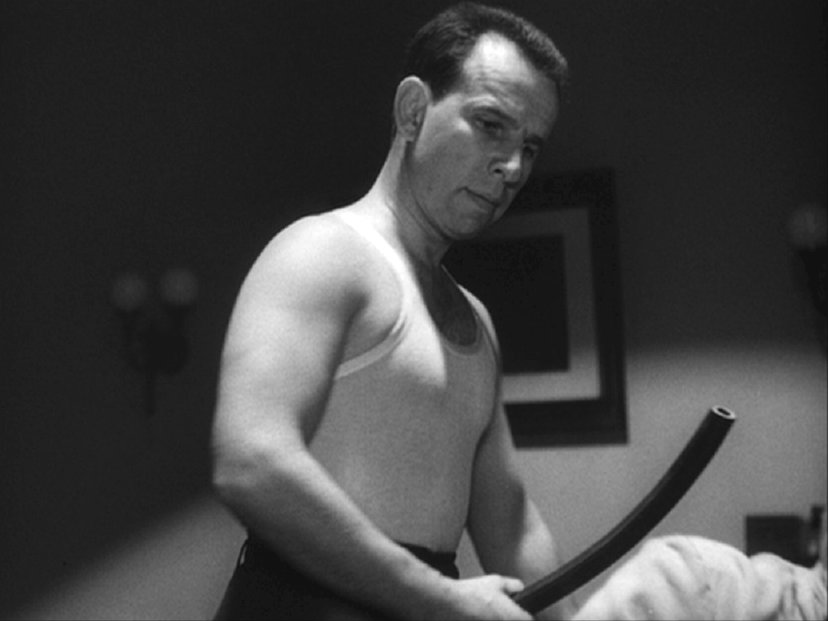
It’s pretty clear that Dassin is using Munsey to make a statement about creeping fascism in America. Munsey is a homegrown little Hitler, and just in case you don’t immediately get the connection when Munsey professes his simplistic, Social Darwinist philosophy, Dassin drives the point home with the set design of Munsey’s office, which includes a giant framed photograph of himself, enormous shotguns that he relishes stroking and polishing, and sculptures and paintings that scream homosexual body worship, not to mention a phonograph on which he plays the overture to Wagner’s “Tannhäuser” while brutally beating a hapless inmate (Sam Levene) with a length of rubber hose for information.

Despite a few missteps here and there, Brute Force is a great film, and should be seen by anyone who appreciates prison movies, film noir, violence in the cinema, finely crafted black and white cinematography, or the brilliant film scores of Miklós Rózsa.

A note about Jules Dassin: because of his French-sounding surname, and the fact that one of his best and most well-known pictures, Rififi (1955), is a French-language film, a lot of people are under the mistaken impression that Jules Dassin was French. He wasn’t. He was an American who was born in Connecticut in 1911 to Russian-Jewish immigrant parents. He immigrated to Europe after he was blacklisted following testimony about him that was given to HUAC in 1951.

Riffraff (June 28, 1947)

Ted Tetzlaff’s Riffraff, which premiered in New York City on June 28, 1947, was Tetzlaff’s first feature film as sole director. (In 1941, he co-directed the John Barrymore comedy World Premiere with the uncredited Otis Garrett and he was the uncredited co-director on Ralph Murphy’s Jackie Cooper comedy Glamour Boy.)

Before he made the leap to directing, Tetzlaff worked as a cinematographer on more than a hundred films. He started working in the silent era, and his last credited film as cinematographer was Alfred Hitchcock’s Notorious (1946). Anyone who’s seen Notorious can attest to how beautifully it’s lighted and shot, and Tetzlaff brings his considerable skill to bear on Riffraff, elevating it from the very run-of-the mill detective story it could have been.

The opening sequence in Riffraff is the most talked-about part of the film. It’s five full minutes of dialogue-free bliss. After the credits roll, the film cuts to an unnerving shot of an iguana placidly lying on a log in the pouring rain. The iguana’s cold, reptilian gaze is a harbinger of things soon to come.

It’s 2:25 in the morning at El Caribe airlines in Peru. A meek, bespectacled man (Fred Essler) boards a cargo plane, the rain sheeting down on him. He sits nervously in the cargo hold, dripping wet and hanging onto his briefcase tightly. He’s sharing the space with a bunch of squawking chickens and an oily, mustachioed fat man with an unnerving smile. (He’s played by Marc Krah, and we’ll find out later in the film that his character’s name is Charles Hasso). The man with glasses watches Hasso fearfully as Hasso stares back at him. Then Hasso stands up and plucks an errant chick from the floor and replaces it gently in its box.

There’s an exterior shot of the cargo plane flying through the rain in the night, then an interior shot of the pilots lighting up a couple of smokes. A warning tone sounds in the cockpit. The co-pilot rushes back into the hold, where the door is wide open and rain is pouring into the plane. “I couldn’t stop him! He jumped!” exclaims Hasso.

Sure he did.

The cargo plane lands in Panama, where Hasso is questioned by the head of the secret police, Major Rues (played by an oddly accent-free George Givot). Hasso is evasive when he’s questioned about his fellow passenger’s death and suggests that the man might have killed himself for love.

Sure he did.

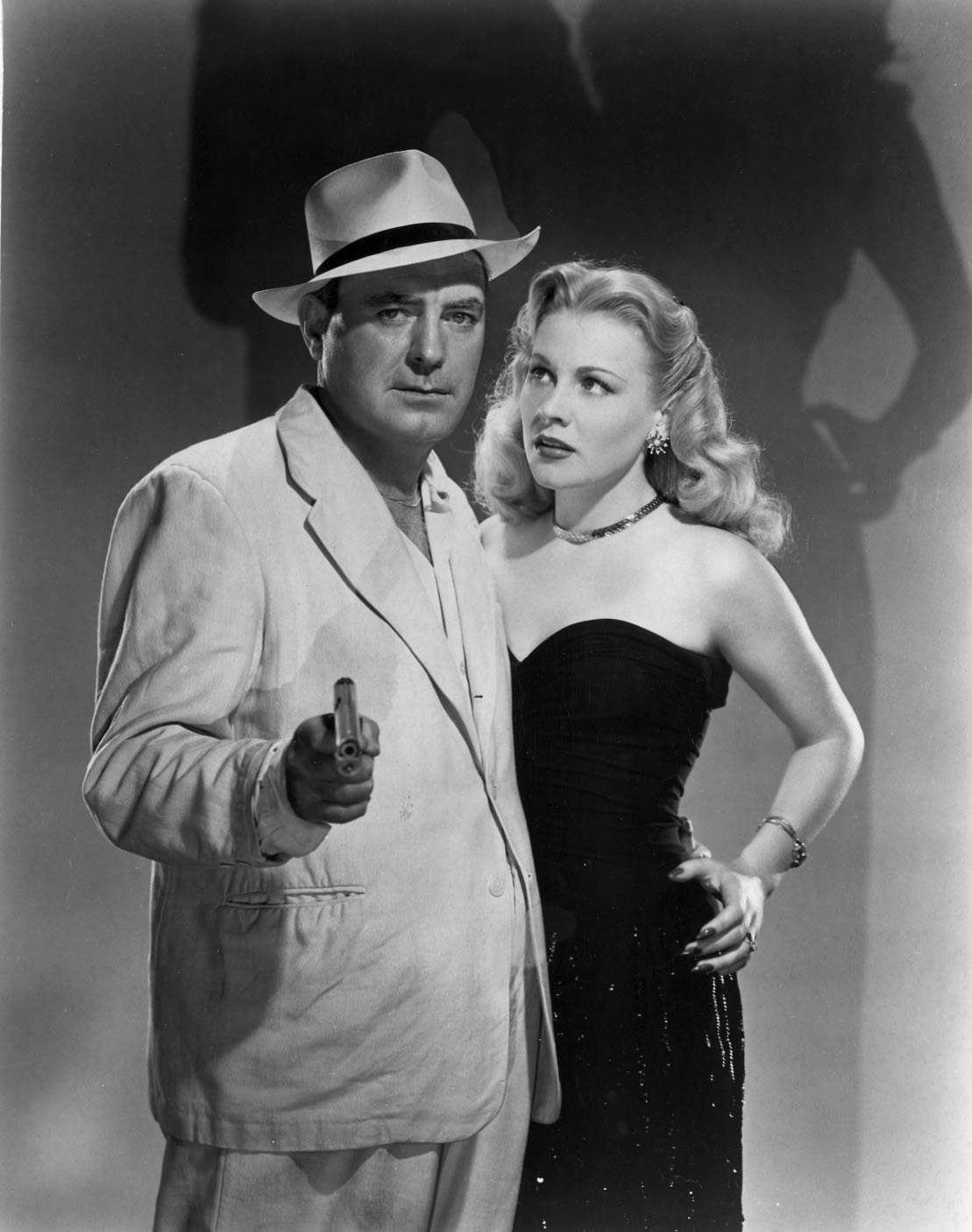
Major Rues’s suspicions (as well as the audience’s suspicions, if they’re awake) are confirmed when Hasso goes to see Dan Hammer (Pat O’Brien), president and sole operative of Zenith Services, a detective agency. Hasso hires Hammer as a bodyguard for his two-day sojourn in Panama City, and while Hammer’s back is turned, he takes the map he stole from the man on the plane and tacks it to Hammer’s cluttered bulletin board, where it will remain for most of the film’s running time (there’s no better place to hide something than in plain sight.)

Eventually we find out that the map shows the locations of a number of unregistered oil wells. Hammer is approached by a shady businessman named Walter Gredson (Jerome Cowan), who wants Hammer to find Hasso for him. Hammer talks Gredson and his assistant up to $5,000 to do the job, and of course never tells them that he already knows exactly who Hasso is and where he is staying.

Hammer is a mixture of hero and con man. In fact, nearly everyone in the film is an operator who is looking out for number one. The beautiful girl in the story is named Maxine Manning (Anne Jeffreys) and even her motives are unclear for awhile. (After a scuffle in a bar, she deliberately pours a drink on her dress just so she can get close to Hammer.)

Pat O’Brien is an interesting choice for the protagonist, since he’s a middle-aged character actor with a pear-shaped body. (Although, based on the presence of Marc Krah and Walter Slezak, who plays a vicious killer named Molinar, I suspect Tetzlaff had a fetish for fat guys.)

There’s plenty of violence in Riffraff, and more hard-boiled P.I. clichés than you can shake a stick at, but it’s ultimately not a very dark movie. Aside from all the corpses that pile up, it’s breezy, fast-paced fun in an exotic tropical setting.

Besides the performances, which are all excellent, the film is elevated by Tetzlaff’s direction and the terrific cinematography by George E. Diskant.

It’s too bad there weren’t more Dan Hammer films starring O’Brien. He’s hardly anyone’s picture of a tough-as-nails P.I., but he crafts a great character who I wouldn’t have minded seeing in more pictures. Hammer is the kind of guy who never wears a necktie because someone could choke him out with it, and who says he’s not going to give up on the case not because of any noble conviction, but rather, as he he says, because “I’ve got a lot of time invested in this thing. Plus a good shellacking!”

In case you’re wondering, I looked into it and couldn’t figure out who came first, Dan Hammer or Mike Hammer. (Mickey Spillane’s first novel, I, the Jury, was also published in 1947.) While it’s possible that Spillane took his character’s name from Martin Rackin’s script for Riffraff, or that Rackin cribbed the name from Spillane, it’s equally possible that a P.I. with the last name of “Hammer” was just a good idea whose time had come.