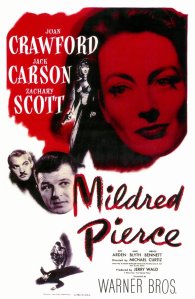
 If you’ve only seen the film adaptation of James M. Cain’s 1941 novel Mildred Pierce, you’re forgiven for never wondering whether the striking murder set piece that opens the film and informs the entire picture was an invention of the producer and the screenwriters that never occurred in the novel.
It was. But it’s a brilliant invention. Even though long stretches of Mildred Pierce (told in flashback) are essentially melodrama, the sequence that opens the film is one of the greatest examples of film noir I’ve ever seen. It is nighttime. Heavy shadows fall over caddish playboy Monte Beragon (Zachary Scott), resplendent in a tuxedo, as he is gunned down in a Malibu beach house. Not every shot hits him. A few smash into the mirror behind him. But enough hit him to kill him, and he falls to the floor. Mildred Pierce (Joan Crawford) flees from the house, walks down the boardwalk, and looks as though she is contemplating suicide by jumping into the Pacific Ocean, but is stopped by a policeman. She talks her way out of the situation and later entices the beefy and amorous Wally Fay (Jack Carson) back to the house on the beach and locks him in, with the intention of pinning the murder on him. The scenes in which Wally realizes Mildred has left him alone in a locked house with a corpse and a revolver and he attempts to escape are stunning, and are one of the greatest noir sequences in film history.
Unlike Billy Wilder’s Double Indemnity (1944), another noir classic adapted from a novel by Cain, Michael Curtiz’s Mildred Pierce takes a lot of liberties with its source material. This is partly due to necessity. I loved Cain’s novel, and found it every bit as good as his 1934 crime classic The Postman Always Twice and more believable than his 1937 novel Serenade, which is about a male opera singer who loses his voice after he gives in to homosexual temptation. Cain’s Mildred Pierce contains no murders, just plenty of bad behavior, and the most despicable character waltzes off at the end with no punishment in sight. Apparently the moral tone of the novel was troubling to the Breen Office, so producer Jerry Wald devised a murder plot with a culprit who could be punished, which sufficiently palliated the concerns of producer and studio head Jack L. Warner, and he purchased the rights to the novel in 1944. The script for the film went through eight different versions before Ranald MacDougall’s version was accepted. William Faulkner and Catherine Turney both made uncredited contributions. (And we can all thank our lucky stars that Faulkner’s scene in which Mildred’s maid, played by Butterfly McQueen, consoled Mildred while singing a gospel song was either never filmed or was left on the cutting room floor.)
Mildred Pierce is a fantastic film. Crawford’s longtime nemesis Bette Davis and fellow fading star Rosalind Russell were both considered for the lead role, but both turned it down. It’s impossible for me to imagine anyone but Crawford playing Mildred Pierce. She brings not only her finely controlled histrionics to the role, but her own life history as a woman who crawled up from nothing.
When the picture opened, it was a huge hit, both with critics and audiences. It was nominated for best picture, best actress, best supporting actress (for Eve Arden, who plays Mildred’s wisecracking best friend), best writing, and best black and white cinematography. Joan Crawford won the Academy Award for best actress, and accepted the statuette at home, where she was sick in bed. (Her adopted daughter Christina claims she was faking, but this is hardly the worst accusation she has lobbed at her mother.)
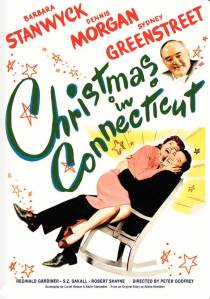 Barbara Stanwyck was a superstar of screwball comedies, and she created one of the all-time great femmes fatales in Billy Wilder’s Double Indemnity (1944). Christmas in Connecticut is one of her minor efforts, but it’s amusing enough, and if you’re specifically looking for a holiday film, you could do a lot worse.
 OCD Viewer