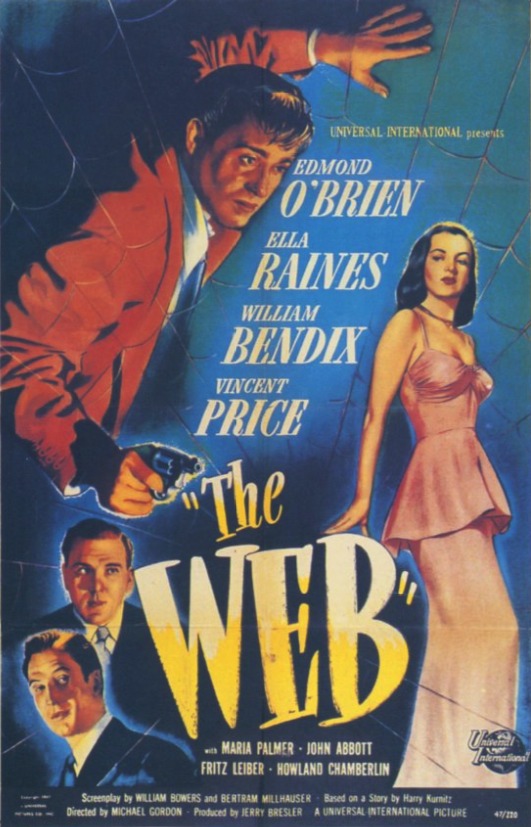
The Web (1947)
Directed by Michael Gordon
Universal Pictures
The Web is a classic case of mediocre material made incredibly entertaining by an excellent cast and a good director. The film’s plot may be run-of-the-mill, but the film itself is never boring.
The exciting opening takes the viewer along the busy Manhattan streets and overpasses that lead to Grand Central Station and culminates in a tearful reunion between an old man, Leopold Kroner (Fritz Leiber), and his daughter Martha (Maria Palmer). Kroner has just been released from prison, and he is surprised that “Mr. Colby” didn’t come to meet him at the train station. The viewer immediately knows that something sinister is going on, because we see a mug trailing Kroner and his daughter through the train station.
Next, we meet brash young attorney Robert Regan (Edmond O’Brien), who’s trying to force his way into Andrew Colby Enterprises to see the man in charge. When he pushes through several sets of doors and finally meets Noel Faraday (Ella Raines), he demands to see Mr. Colby. When she’s asks what his business with Mr. Colby is, he says, “Well, he’s been carrying on with my grandmother, and I’d like to find out what his intentions are.” When Noel tells him that she’s Mr. Colby’s personal secretary, he responds, “Well that just goes to show you how far a girl can get if she keeps her stocking seams straight.”
Their dialogue continues in this vein for the rest of the picture. Regan is the kind of person who would be known today in some circles as a “jerk,” and if he said half the things he says in The Web during working hours he’d be sued for sexual harassment.
But he’s also a tireless crusader for his clients, which becomes clear when he finally comes face to face with Andrew Colby, who’s played with smooth, villainous charm by the one and only Vincent Price. Regan is there to serve him with a summons on behalf of his client, Emilio Canepa (Tito Vuolo). As a result of Colby’s negligent driving, Canepa’s pushcart and load of bananas were damaged to the tune of $68.72.
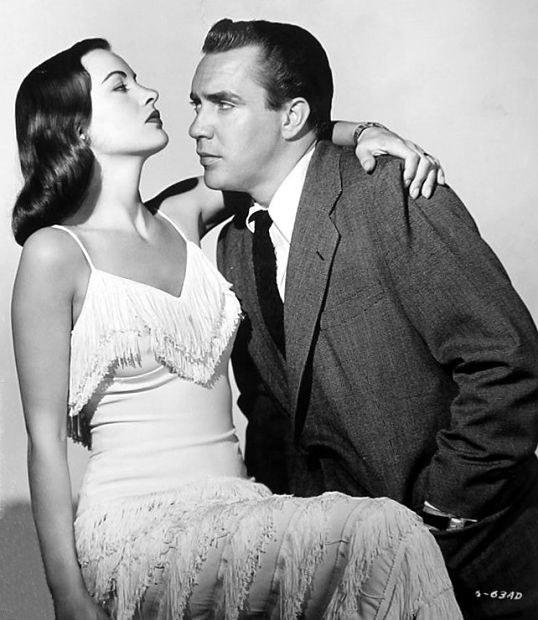
Colby sees in Regan’s bullheaded doggedness an opportunity, and offers Regan a $5,000 retainer to come and work for him. Colby tells Regan that five years ago, his business associate Leopold Kroner took nearly $1 million worth of bonds belonging to Colby’s firm, made duplicates, and sold the counterfeit bonds. He was caught and sent to prison, but now that Kroner has been released, Colby claims he’s been threatening him. Colby has a big deal coming up, and he doesn’t want it known that his life is being threatened. If he hired a bodyguard, it would become public knowledge.
If he just hired another lawyer, however, no one would think twice. All Colby asks of Regan is that he work for him for two weeks as a bodyguard and tell no one what he’s doing.
If you know what the word “patsy” means, you’ll probably have no difficulty figuring out what Colby really wants Regan for.
Rounding out the excellent main cast is William Bendix as Lt. Damico, Regan’s friend on the force. Bendix was equally adept at playing tough guys and clowns, and he gets to flex both his dramatic and comic acting muscles as the long-suffering Damico, who’s a lot wiser than Regan gives him credit for.
Even though he’s the protagonist, O’Brien is probably the weakest link in the film. Regan isn’t a very interesting character, and he’s mostly only good for one-liners, but at least they’re decent one-liners. O’Brien’s innuendo-laced banter with Raines isn’t quite Tracy-Hepburn or Bogie-Bacall, but it’s clever and fast-paced enough to satisfy discriminating noir fans, and Raines’s dark beauty and way with a retort elevate their exchanges.
The screenplay by William Bowers and Bertram Millhauser (based on a story by Harry Kurnitz) really crackles in the dialogue department, which makes up for the pedestrian plot. Director Michael Gordon keeps things moving along nicely, and delivers a satisfying final product. The Web might not be a classic film noir, but it’s thoroughly entertaining.
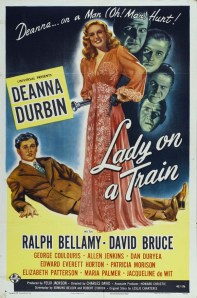 Deanna Durbin is an absolute delight in this farcical murder mystery. Durbin, a native of Winnipeg, Manitoba, was once one of the biggest stars in Hollywood, but never made a movie after 1948. (She currently lives in a small village in France, grants no interviews, and is reportedly very happy.) In Lady on a Train, she plays a young woman named Nicki Collins. When the film begins, Collins is sitting by herself in a compartment on a train entering New York on an elevated line. She has come from San Francisco to spend the holidays with her wealthy businessman father, and is currently engrossed in a mystery novel called The Case of the Headless Bride. When the train is briefly delayed, she looks out the window of her train car and witnesses a murder. Through a lighted window, she sees a young man beat an older man to death with a crowbar. She never sees the murderer’s face, however, and when she reports the murder to the police, the desk sergeant dismisses her report as the product of the overheated imagination of a girl who loves murder mysteries and can provide no real specifics of where she was when she saw the murder. Also, it’s Christmas Eve, and who want to traipse around looking for a murder that may or may not have occurred somewhere in Manhattan north of Grand Central Station?
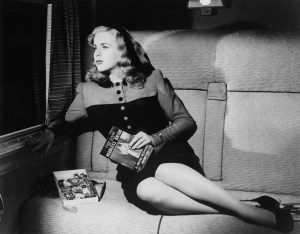 Lady on a Train is part mystery, part musical, part noir, part comedy, and part romance. The most surprising thing about this movie is that each element works perfectly, and they all complement one another. (Calling this film a noir is stretching it, but the final chase in a warehouse contains some striking chiaroscuro shot constructions, and is as tense as one could ask for.) Lady on a Train is also a delight for Durbin fetishists, since she has a different outfit and hairstyle in literally every scene. Sometimes the changes are subtle, but occasionally they’re impossible to miss, such as the scene in which she comes in out of the rain and is suddenly wearing gravity-defying, Pippi Longstocking-style braided pigtails.
 OCD Viewer