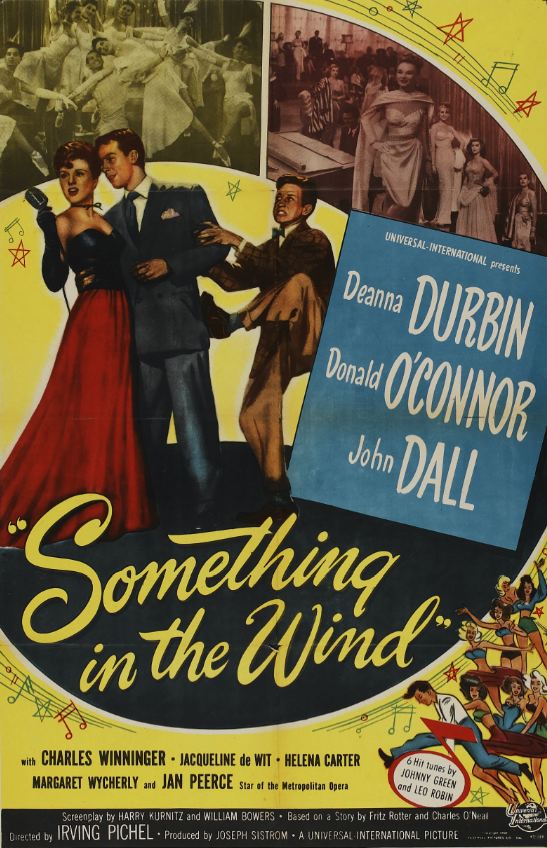
I mentioned in my review of I’ll Be Yours, which was released earlier in 1947, that Deanna Durbin called the last four films she made “terrible,” and permanently retired from acting in 1948.
But just like I’ll Be Yours, I found Something in the Wind thoroughly enjoyable. The songs are great, the dancing is spectacular, and for the most part, it’s genuinely funny.
I think that Durbin’s retirement from acting had less to do with the quality of the films she was starring in and more to do with her desire for privacy and a normal life. (She apparently hated the public persona she’d been saddled with since she appeared in her first musical comedy, Three Smart Girls, in 1936 at the age of 14.)
Something in the Wind is by no means a great film, but Durbin’s impish sense of humor, beautiful singing voice, and perfect comic timing make up for a lot. It’s also a lot of fun to see tall drink of water John Dall in a light role. (Something in the Wind was made shortly before he would stake his place in cinematic history in 1948 as one of the thrill killers in Alfred Hitchcock’s Rope and again in 1950 as the firearms-fancying protagonist of the noir classic Gun Crazy.)
Dall plays Donald Read, the scion of the wealthy Read family. When he attempts to “make things right” with the woman to whom his recently deceased grandfather has been making regular payments, he confuses Mary Collins (Durbin) with her aunt (Jean Adair), who is also named Mary Collins. Mary Collins (the younger) is a struggling radio DJ with a beautiful voice, and she has no idea what Donald is talking about, but she’s offended by the very nature of his proposal. When she finds out that her aunt has been receiving payments from the Read family after a failed love affair with the late patriarch of the family, she’s doubly offended, and sets out to ruin the Reads.
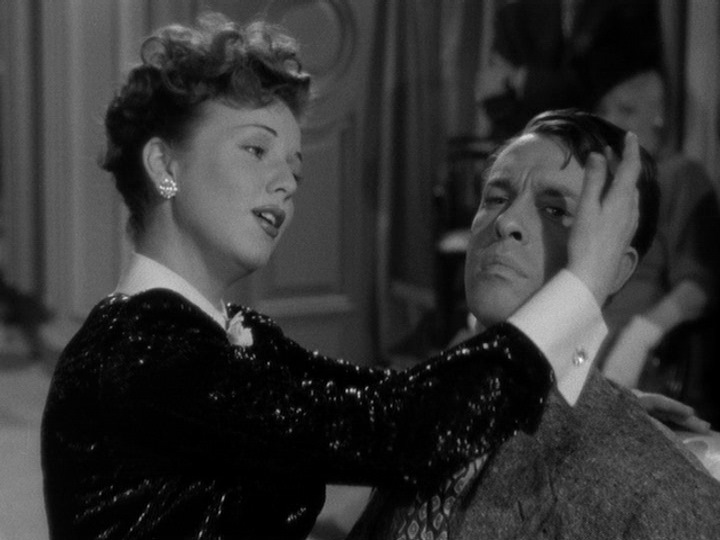
The Reads are a pleasantly screwball family — the kind that regularly engages in hilarious kidnappings and fun-loving extortion.
Donald is the straight man of the bunch, his cousin Charlie (Donald O’Connor) is the wacky cut-up, and his uncle Chester (Charles Winninger) is the blackmailing con man who will screw over anyone for a buck.
All of this is just an excuse for laughs, music, and dance, of course, but who cares? Donald O’Connor’s wild, no-holds-barred performance of Johnny Green & Leo Robin’s “I Love a Mystery” is the stuff of legend, and must be seen to be believed. And Durbin is a one-of-a-kind star, and as far as I’m concerned, every film she appeared in is worth watching.
When I sat down to watch Fiesta, those words in the credits floored me. I can’t conceive of what it was like to grow up in a world without Ricardo Montalban. His suave, white-suit-wearing Mr. Roarke, from Fantasy Island (1977-1984), is a mysterious character who was burned into my mind at a young age. Ditto for his insane and weirdly brilliant role as the villain of Star Trek II: The Wrath of Khan (1982). Or his dapper and hilarious bad guy, Vincent Ludwig, in The Naked Gun (1988). Or his work as the pitchman for Maxwell House Decaf.
Maybe it was just the movies and TV shows that I watched, but Montalban seemed ubiquitous.
By the ’80s, he always appeared to be having fun with his “Latin lover” image, but he was never parodying himself. His smooth charm was undeniable, no matter what kind of ridiculous lines were coming out of his mouth. (Like claiming that decaffeinated coffee was “good to the last drop.”)
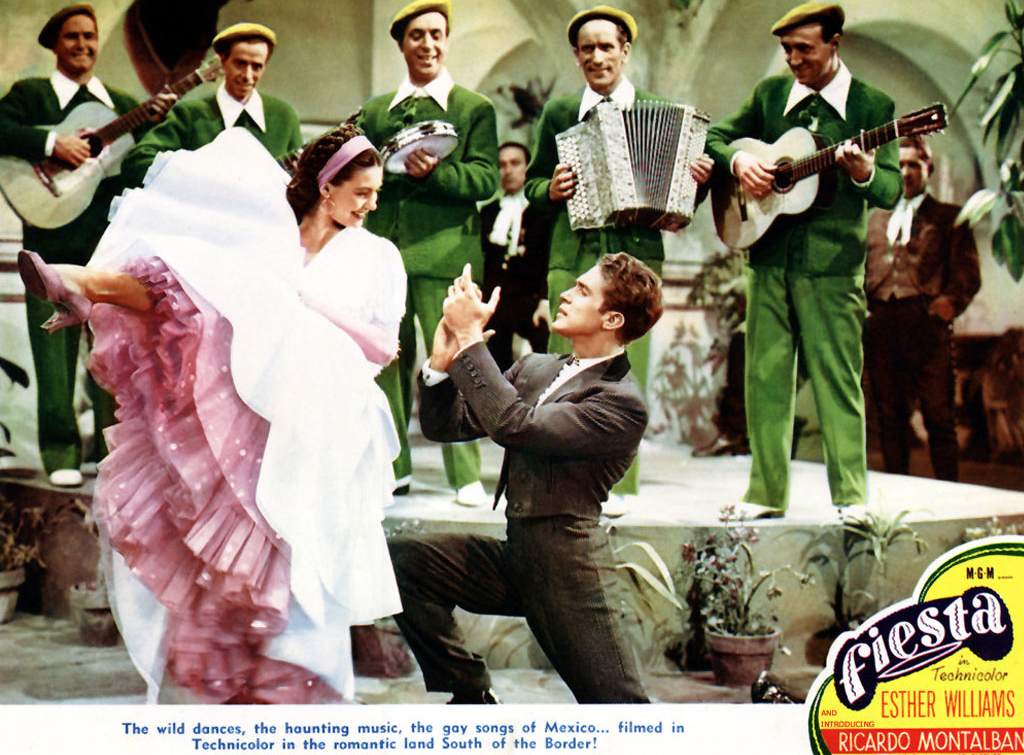
Richard Thorpe’s Fiesta wasn’t the first film to star Montalban. He’d already appeared in more than a dozen films in his native Mexico. But it was his first Hollywood film, and it was his introduction to American audiences. It was also an opportunity for Esther Williams to perform in a dramatic role that was very different from the roles that had made her famous in MGM’s “aquatic musicals.”
Williams and Montalban play twins, Maria and Mario Morales. Their father, Antonio Morales (Fortunio Bonanova), a former matador, always wanted a son to carry on his work in the ring. After confirming that he is indeed not going to have just a daughter, but rather twins, Morales proclaims his son “The future greatest matador in the whole world!”
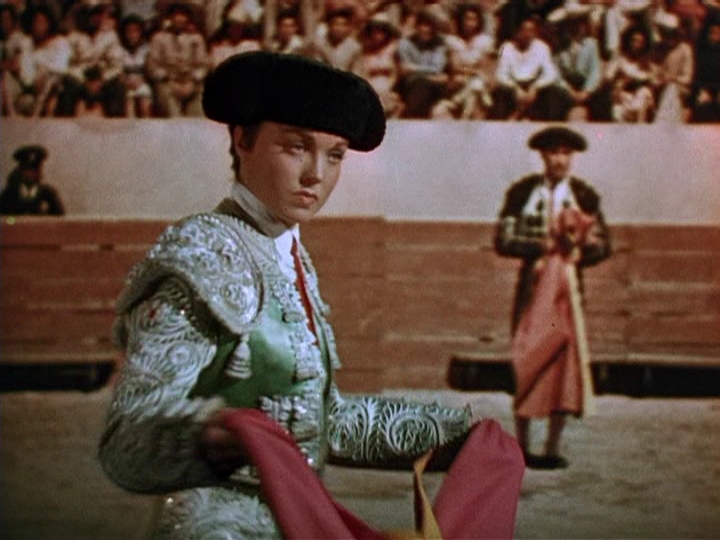
Of course, things don’t work out the way Señor Morales expects. His son Mario is a gifted musician and composer who would much rather make music than wear the traje de luces (“suit of lights”) and fight bulls (even though he’s good at it). His daughter Maria, of course, is the one with the real desire to be a torero, but her gender makes such a thing unthinkable.
Mario is torn between his father’s plans for him and the interest that conductor Maximino Contreras (Hugo Haas) shows in his music. Eventually, Mario flees the ring when he finds out his father lied to him about a visit Señor Contreras made to their house. He does so out of anger, but his action is viewed as cowardice by the spectators. Naturally, Maria comes up with a plan to don the traje de luces and impersonate her brother in the ring.
Fiesta has the kind of shopworn plot and lifeless dialogue that one can suffer through if they’re merely the framework for a musical packed with great songs and exciting dance numbers. But while Fiesta is often classified as a musical, it’s not a really a musical. It’s a turgid, woodenly acted drama whose only high points are a handful of dance sequences.
If you like dancing, then Montalban’s numbers with Cyd Charisse (playing a character named Conchita) are worth seeing. (I especially liked the number they stomped out to “La Bamba,” the traditional Mexican song that Ritchie Valens later made famous.) The scene in which Mario hears one of his compositions played on the radio by Señor Contreras’s orchestra and listens in rapture before sitting down at the piano in the cantina to play along would be at home in a musical, but it’s an organic moment. There are no scenes in Fiesta in which the characters just break into song.
In short, it’s pretty lifeless, especially when compared with other Technicolor extravaganzas from MGM. Most of the cast isn’t very interesting to watch. The great silent star Mary Astor is wasted in a thankless role as Señora Morales. Montalban is enjoyable to watch, but Williams is terribly miscast. It’s not that she doesn’t look “Mexican” (you can see plenty of women who look like Esther Williams if you watch Spanish-language television). It’s that she looks nothing like Montalban, yet the audience is asked to believe that she is a convincing double for him when she dons the traje de luces and enters the ring. Her own stunt double is also a completely unconvincing facsimile of Williams during the bullfighting sequences. His muscular buttocks, lack of breasts, crotch bulge, muscular neck, and big ears are pretty difficult to confuse with Williams’s slightly different attributes.
I like Esther Williams a lot. She’s beautiful and appealing, not to mention a hell of a swimmer. But this was just the wrong role for her. Also, her “romantic” scenes with Jose “Pepe” Ortega (John Carroll) are dead on arrival.
Although the film begins with a statement of sincere thanks to the Mexican people, the production was a troubled one. The cinematographer, Sidney Wagner, and another crew member both died of cholera after eating contaminated street food. Esther Williams’s husband, Ben Gage, and makeup artist George Lane were both expelled from Mexico after a fight with a hotel employee. And a stuntman died of an infection he contracted after being gored in the groin by a bull.
The largest problem the production ran into had to do with bullfighting, which director Thorpe chose to depict in a sanitized fashion. For example, the first time we see Mario’s moves in the ring, he skirmishes with an uninjured bull who charges at him over and over as he dances around the ring and flourishes his cape, avoiding several near misses. Eventually the bull gets too tired to continue, and the fight is over.
During the bullfights in Fiesta, only the bullfighter’s life seems to be in danger. It is presented as a dangerous sport. In reality, the outcome of a bullfight is rarely in question, and it is less a sport than an artistic, ritualized slaughter in which the torero is judged according to his grace and style, not whether or not he kills the bull. (According to this article, which was published last year in The Guardian, only 52 matadors have been killed in the ring since the year 1700. There are myriad injuries, of course, which range from minor to spectacular. If you have a strong stomach, click here.) In Fiesta there are no banderilleros jamming spikes into the bull’s back, bleeding it out and tiring it. There is no taunting of the bull or clownish antics on the part of the other toreadors in the ring, like grabbing the bull’s tail and skiing through the dirt as the bull circles. And, most important of all, there is no killing of the bull with a single sword thrust — the estocada.
Bullfighting is inextricable from the national identity of most Spanish-speaking countries. The people of Mexico were already angry that their own toreadors could not star in the film, so the depiction of bullfighting as a bloodless spectacle added insult to injury. When Thorpe had finished shooting Fiesta, his unit manager Walter Strohm convinced him that the bulls used in the film should all be killed to assuage the anger of the Mexican people. Thorpe acquiesced, even though the bulls had cost $1,000 each, which is nearly $10,000 in today’s dollars.
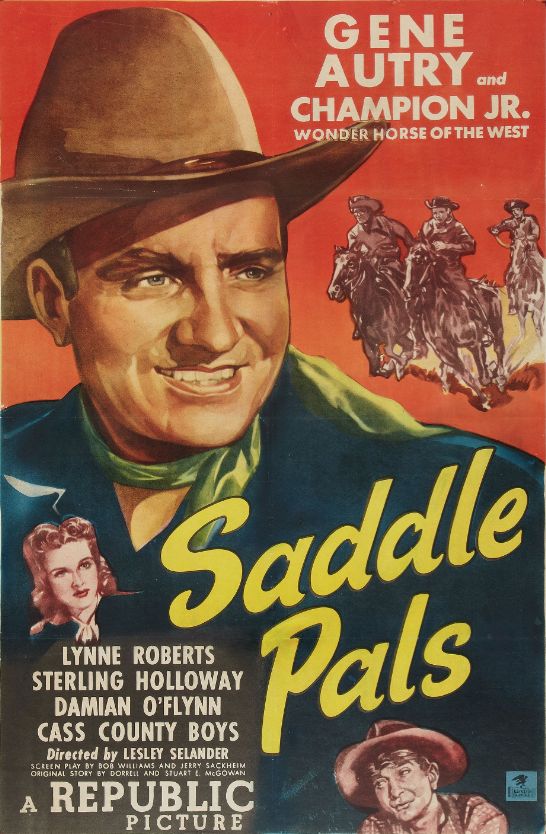
Of the movies Gene Autry made after serving in the Army Air Corps during World War II, Saddle Pals is my favorite so far.
That’s not to say that I loved the picture. I think Gene Autry is a great country singer, but as a leading man, I find him flat. But Saddle Pals is funnier and generally more entertaining than the last few Autry pictures I’ve seen, and it wasn’t a chore to sit through.
The picture begins when the beautiful, wealthy, and devil-may-care Shelly Brooks (Lynne Roberts) buzzes Gene, his boys, and their cows with her brand-new Lincoln. Of course, she blows a tire not long after, and Gene’s such a gentleman that he doesn’t hold her bad behavior against her, and changes the tire for her.
Shelly’s brother Waldo T. Brooks Jr. is raising rents on all the ranches in the valley so his wealthy family can be even wealthier. Not only is it unfair, it’s downright illegal, says attorney Thaddeus Bellweather (Irving Bacon), and he’ll handle the case for Gene just as soon as he gets back from trout season … which is going to last a long time.
So Gene and the Cass County boys (his backup band/ranch hands) head to the Brooks ranch to talk to Waldo, who turns out to be an effeminate, hysterical, rubber-faced hypochondriac played by Sterling Holloway. It turns out that Waldo is barely in control. It’s the Brooks Land Corporation that’s raising rents, under the direction of their evil leader Bradford Collins (Damian O’Flynn).
Waldo gives Gene control of his money. Gene tells Collins that he wants to buy into the corporation. Gene is then forced to come up with $50,000 in 30 days. He comes up with most of the money by selling off the Brooks’s show horses, and then decides to throw a rodeo to raise the rest of the money.
Shelly and Waldo have an adorable little sister, Robin (Jean Van), who wants desperately to be a cowgirl. She’s got the skills to pay the bills, so Gene puts her in the rodeo, but Collins uses the fact that she’s a minor to get Gene in trouble with the law.
Collins doesn’t stop there. If you’ve ever seen a B western from the ’30s or ’40s before, you know those greedy land-grabbing real estate barons never stop at legal malarkey, and sure enough, by the end of the picture there’s an out-of-control wagon on fire with Robin inside, and Gene and his horse Champion Jr. in hot pursuit.
The songs in Saddle Pals are generally good, even though there’s no single stand-out number. The songs include “You Stole My Heart,” “Which Way’d They Go,” “The Covered Wagon Rolled Right Along,” “Amapola,” and “I Wish I Never Had Met Sunshine.” Also, Sterling Holloway, who’s sort of like a less-funny, more-irritating version of Jim Carrey, is used judiciously in the picture, and most of his scenes are humorous, if not exactly hilarious.
Hey there! Do you like the comedy of Groucho Marx? Do you like the music of Carmen Miranda? Do you like the sweet song stylings of Andy Russell? Do you like beautiful women with nice legs?
You do? Well then, brother, have I got a picture for you.
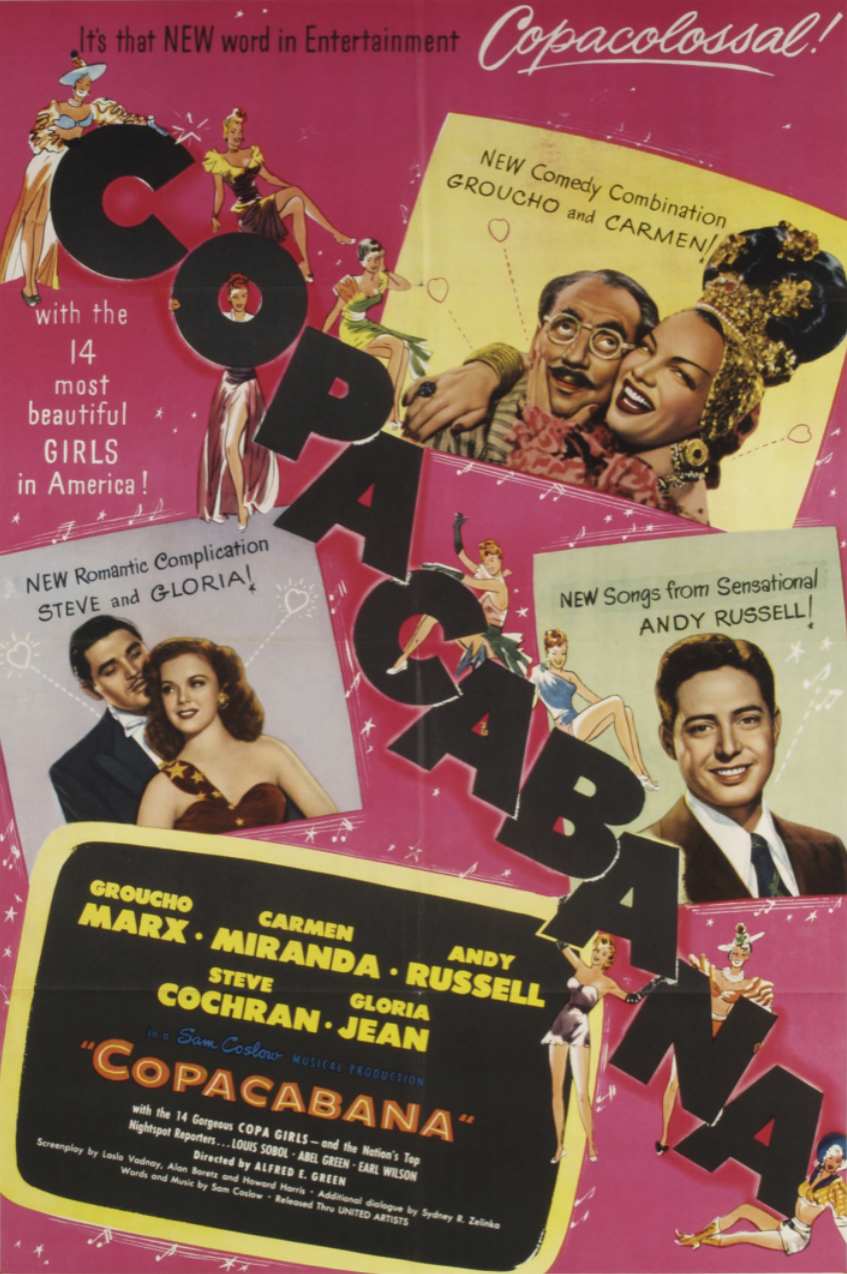
Alfred E. Green’s Copacabana is a classic example of a Hollywood product that is designed for only one purpose — to entertain.
The plot of the film is little more than an excuse to showcase Groucho Marx’s wordplay and fast-paced comedic line deliveries, Carmen Miranda’s mesmerizing vocal performances, big musical numbers featuring the 14 beautiful “Copa” girls, and Andy Russell’s syrupy, sentimental songs.
The plot, which can summarized on the back of a cocktail napkin, is this: wildly unsuccessful nightclub performer Lionel Q. Deveraux (Groucho Marx) and his fiancée of 10 years, equally unsuccessful nightclub singer Carmen Navarro (Carmen Miranda), decide that desperate measures are called for. Deveraux has been kicked out of more clubs than he can count, and threats like, “This is an outrage. You’ll hear from my lawyer, as soon as he gets a telephone,” clearly aren’t getting him anywhere.
So Deveraux decides to pass himself off as a top talent agent. He arranges for Carmen to perform for Steve Hunt (Steve Cochran), the owner of the most glamorous nightclub in Manhattan, the Copacabana. Without Deveraux onstage with her, Carmen makes a positive impression, but Steve wants to see more of Deveraux’s acts. Naturally, he has only one act — Carmen — but some quick thinking produces a second act, the beautiful and mysterious “Mademoiselle Fifi.”
Mlle. Fifi is of course just Carmen with a white costume straight out of the Arabian Nights, a blond wig piled atop her head, and a heavy veil to cover her face. Deveraux explains to Steve why she never takes the veil off. “No one but her lover is allowed to gaze upon her face,” he says. “Not even her husband.”
Meanwhile, the starry-eyed Anne Stuart (Gloria Jean) toils away in the office of the Copacabana as Steve Hunt’s gal Friday, unable to tell Steve how she really feels. Will she ever be able tell him? Will the wide-eyed, golly-gee naïveté of singer Andy Russell (played by singer Andy Russell) and his encouragement that she express herself through song help? Will that song be called “Stranger Things Have Happened”? You’ll just have to see Copacabana to find out.
I’m not the biggest fan of musicals, but I’m perfectly willing to sit back and be entertained by one if it’s well put together, and Copacabana features plenty of entertainment bang for your buck. It’s especially entertaining if you’re as much of a sucker for great gams as I am. The Copa girls are blessed with pretty faces, good singing voices (although I’m not sure if they were actually singing during their numbers), dancing ability, and — most of all — shapely getaway sticks, which are on display even when they’re in the background. When Mlle. Fifi sings her first number at the Copa, “Je Vous Aime,” the Copa girls are draped all over the place like leggy cats, listening in rapture.
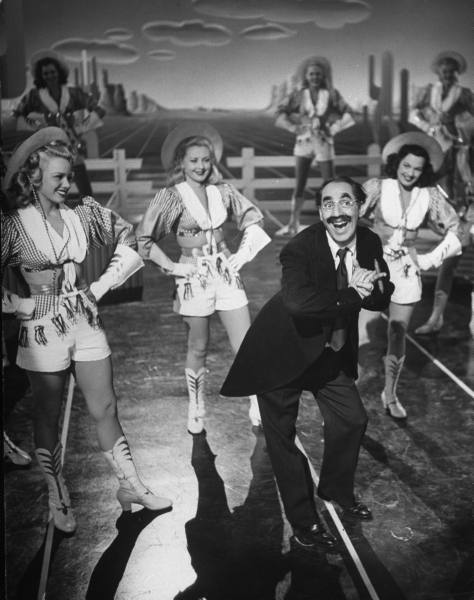
And speaking of perfect pins, I’d be remiss if I didn’t mention Gloria Jean’s final song and dance with Groucho Marx and Carmen Miranda, in which she wears a shorts and high heels outfit that might be the cutest thing I’ve seen in a movie from 1947 so far.
I believe this was the first film in which Groucho Marx appeared without his classic greasepaint mustache and thick glasses get-up. (His actual mustache and regular glasses aren’t wildly different, of course.) Also, his brothers, Harpo, Chico, and sometimes Zeppo, are nowhere to be seen in Copacabana, but it’s still worth seeing if you’re a Marx Brothers fan. It’s not as sublime as Duck Soup (1933) or A Night at the Opera (1935), but it’s still a funny, entertaining film, and offers the last chance to see Groucho in his classic get-up, when he performs Bert Kalmar and Harry Ruby’s song “Go West, Young Man” in a slightly surreal scene. (Click the name of the song to watch the performance.)
Most of the music in Copacabana is written by Sam Coslow. It’s uniformly good, but for my money, the best song in the picture is Carmen Miranda’s performance of “Tico Tico No Fubá,” which was written by Zequinha de Abreu and Aloysio de Oliveira.
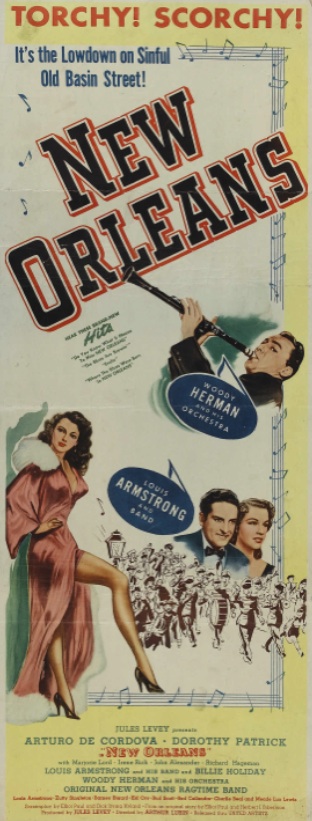
Arthur Lubin’s New Orleans takes place in 1917, the year that Storyville, the notorious red-light district of New Orleans, was shut down.
Like Edgar G. Ulmer’s Carnegie Hall (1947), New Orleans features some of the greatest musicians and performers of the ’40s shoehorned into a flat, uninteresting story.
I had high hopes for New Orleans. In the first scene, we see Nick Duquesne (pronounced “doo-cane”), who’s played by Arturo de Córdova, operate his casino and nightclub with smooth, effortless charm. Duquesne is known as the “King of Basin Street,” and de Córdova plays him well, so I was hoping to see an involving story about vice, graft, and crime.
Alas, the story quickly devolves into a maudlin melodrama about a young blond singer named Miralee Smith (Dorothy Patrick) who falls in love with both Duquesne and the Dixieland jazz she hears played by Louis Armstrong and his ragtime band. Of course, Miralee’s mother, the wealthy Mrs. Rutledge Smith (Irene Rich) doesn’t approve, and wants her daughter to sing opera.
The screenplay and acting in New Orleans are better than they are in Carnegie Hall, but the only reason most people will want to see this movie is for the music. The good news is that there’s plenty of it, especially if you’re a fan of Louis Armstrong and Billie Holiday.
Holiday plays a maid named Endie, and she doesn’t look happy in the outfit, or in the scene in which she’s dressed down by Mrs. Smith for playing the piano and singing while on the job. The strange thing is that her role as a maid is tangential to her role in the rest of the film, and she only appears in a maid’s uniform in her first scene, in which she introduces Miralee to jazz. After that, Holiday loosens up a bit, and her scenes onstage with Louis Armstrong and his band are all fantastic. Together they perform Louis Alter’s “Do You Know What It Means to Miss New Orleans,” “The Blues Are Brewin’,” and “Endie,” as well as Spencer Williams’s “Farewell to Storyville.”
Holiday and Satchmo aren’t the only great performers in the film. Woody Herman, Charlie Beal, Barney Bigard, George “Red” Callender, Meade “Lux” Lewis, Kid Ory, Bud Scott, Lucky Thompson, and Zutty Singleton all play themselves.
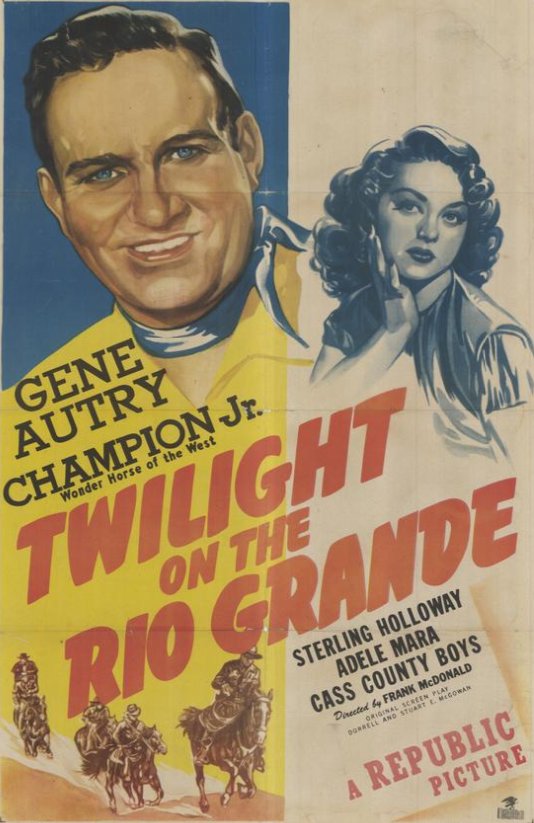
Frank McDonald’s Twilight on the Rio Grande features Gene Autry and his co-stars being put through their B-movie paces south of the border.
Crime melodramas (we call them film noirs nowadays) were very popular Hollywood products in 1947, and Twilight on the Rio Grande incorporates several elements from them, such as the hero investigating the murder of his partner, lots of nighttime photography, a plot about jewel smuggling, and a beautiful knife-throwing señorita. (They showed up in noirs every now and then, didn’t they?)
Gene Autry (played by Gene Autry) and his ranch hands, Dusty Morgan (Bob Steele), Pokie (Sterling Holloway), and the singing trio The Cass County Boys, are all down in Mexico, singing in Spanglish and ogling the ladies. (If there was a deeper purpose to their visit, I missed it.)
The diminutive Bob Steele was a western actor whose star had faded by the mid-’40s, and he picks up a pretty easy paycheck in Twilight on the Rio Grande, since his character is murdered in the first reel, which I thought was a shame. I like Steele, and would have enjoyed seeing him and Autry solve the murder of Sterling Holloway’s character, Pokie, since the loose-limbed, rubber-faced Holloway is more annoying than a barrel of Jim Carreys.
The femme fatale of the film is the beautiful and hot-blooded Elena Del Rio (Adele Mara), who throws knives at Gene while he’s singing “I Tipped My Hat and Slowly Rode Away.” She throws one after the other into the wall behind him, in order to show him how angry she is. She has a steady hand, so she doesn’t hurt him. But then Gene shows her his steady hand when he finishes his song, throws her over his knee, and spanks the bejeezus out of her with the flat of a big knife blade.
Dusty is murdered with a knife in the back, and a smuggler Gene and his boys rope out on the prairie winds up with a knife in his back that could only have been thrown, not thrust at close range, so suspicions fall on Elena.
The title song is a good one, and was never released as a record by Autry, so if you’re a fan of his music, it’s a reason to see this picture. He sings two versions, a slow, mournful version at Dusty’s funeral, and a more upbeat version to close the picture.
If you’re not a fan of Autry’s music, there is really no reason to see this picture. It’s not terrible, but there are plenty of better B westerns out there.
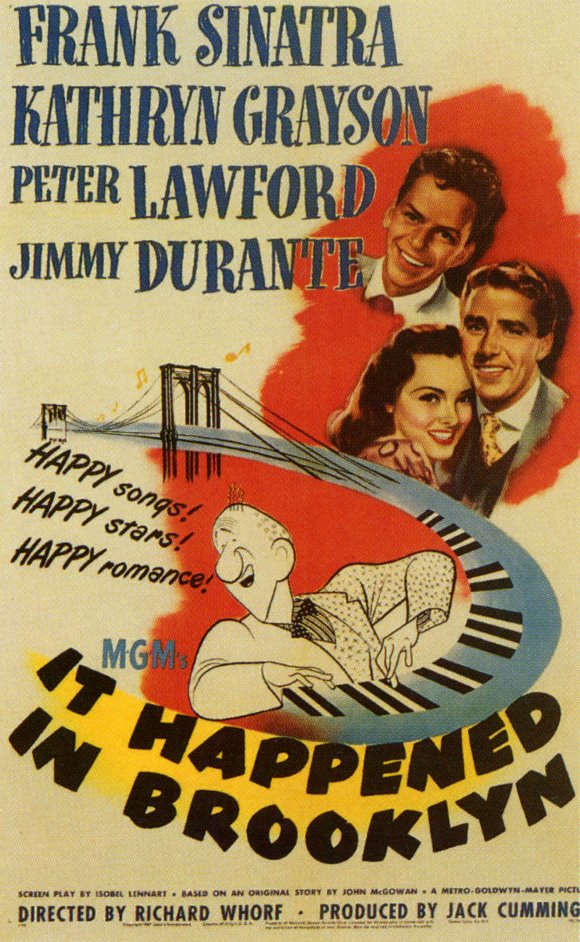
It Happened in Brooklyn (1947)
Directed by Richard Whorf
Metro-Goldwyn-Mayer
I used to be bummed out that I grew up after the era of listening booths in record stores.
After seeing Richard Whorf’s It Happened in Brooklyn, I’ve realized that as far as regrets go, that’s small potatoes. If this film is to be believed, there was once a music store in Bay Ridge where you could pick out any piece of sheet music and hand it to Frank Sinatra, the in-house “song demonstrator,” and listen to Ol’ Blue Eyes tickle the ivories while he performed it for you. Sure, you had to contend with a teeming crowd of sighing bobby-soxers, but that’s a small price to pay.
When It Happened in Brooklyn begins, Private Danny Miller (Sinatra) has been in the service for four years. World War II is drawing to a close, and he can’t wait to get home to his one true love, Brooklyn.
Danny loves Brooklyn so much that he carries a picture of the Brooklyn Bridge in his wallet. When a pretty Army nurse (Gloria Grahame) from Brooklyn refuses to believe that Danny is really from Brooklyn because he’s so restrained and cool, he pulls out the picture of the bridge and says, “Sure, that’s my pinup girl. Ain’t she a beauty?”
When Danny returns home, a traffic cop asks him why he’s so happy to be in Brooklyn when he could be across the river in New York. Danny looks incredulous and exclaims, “New York? That’s a place to look at Brooklyn from!”
Faced with the post-war housing shortage, Danny moves in with Nick Lombardi (Jimmy Durante), the janitor at New Utrecht High School, Danny’s alma mater. Nick is a kindly old geezer who idolizes the fictional teacher Mr. Chips, and doesn’t understand why all the kids in the school make fun of him.
Danny also befriends a pretty music teacher named Anne Fielding (Kathryn Grayson) and, in a remarkable example of art imitating life, teaches a British drip named Jamie Shellgrove (Peter Lawford) how to be cool.
For an MGM musical, It Happened in Brooklyn is fairly restrained. Unlike Sinatra’s previous film, the Technicolor extravaganza Anchors Aweigh (1945), which also co-starred Grayson, It Happened in Brooklyn is filmed in black and white, clocks in at under two hours, and doesn’t feature any huge production numbers.
Despite this, It Happened in Brooklyn is still a blast, especially if you’re a Sinatra fan. It’s packed with great songs by Sammy Cahn and Jule Styne, including “The Brooklyn Bridge,” “Whose Baby Are You?,” “It’s the Same Old Dream,” “The Song’s Gotta Come From the Heart,” and the classic “Time After Time.” I especially enjoyed Sinatra and Durante’s humorous performance of “I Believe” with a teenaged actor named Bobby Long, who does a great tap number. Does anyone know anything about Long? Why didn’t he ever appear in another movie? Did he have an abrasive personality? Horrible skin? Did he sleep with a producer’s wife after wooing her with his sensuous tap-dancing?
Along with all the great pop numbers, there’s a little “class” squeezed in, too. The classically trained Grayson gets to belt out a couple of operatic numbers — one from Mozart’s Don Giovanni and one from Delibes’s Lakmé — and her student Leo Kardos (Billy Roy) performs a piano concert in hopes of getting a scholarship. (Kardos’s playing was actually done by André Previn, who had just joined the music department of MGM at the age of 17.)
It Happened in Brooklyn is clichéd and occasionally silly, and it doesn’t offer the over-the-top razzle-dazzle of Anchors Aweigh, but it’s still a whole lot of fun.
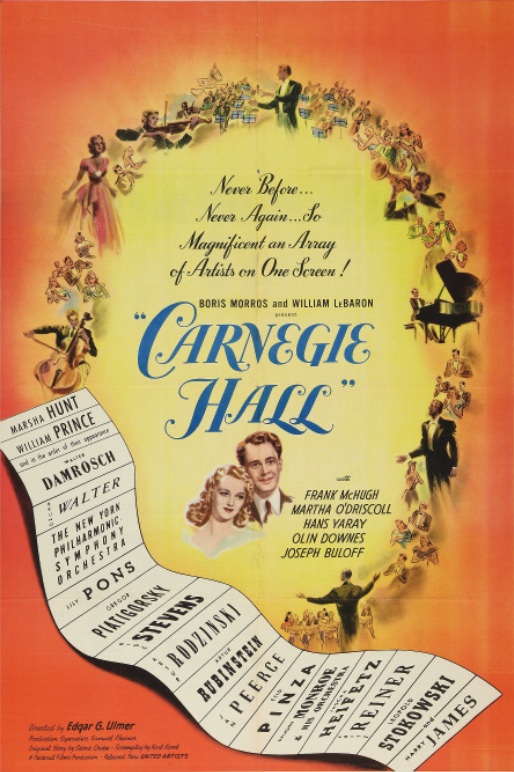
The poster for Edgar G. Ulmer’s Carnegie Hall boasts the following: “Never before … never again … so magnificent an array of artists on one screen!”
That’s true. It’s a film jam-packed with the crème de la crème of classical musicians, opera singers, and conductors from the first half of the 20th century.
What the poster doesn’t tell you is that the dramatic portions of the film are pretty dire. But if you can suffer through violinist Jascha Heifetz and conductor Fritz Reiner reading their lines in monotones as they discuss stage fright with an Irish usher named John Donovan (Frank McHugh), who says he only feels that strange feeling in the pit of his stomach when he’s eaten too much, you’ll be rewarded by hearing Heifetz play the First Movement of Tchaikovsky’s Violin Concerto in D Major with the New York Philharmonic Orchestra, under the direction of Reiner.
Carnegie Hall was directed by Edgar G. Ulmer, the poet of Poverty Row, who directed such minor masterpieces as Detour (1945), Bluebeard (1944), and The Black Cat (1934). Ulmer’s love of classical music was apparent in Detour — the main character is a nightclub pianist who, in one memorable scene, plays boogie-woogie variations on a Brahms waltz. Carnegie Hall is a love letter to great music and musicians, as well as to the eponymous edifice itself.
The plot in a nutshell (and there’s barely enough of it to fill two nutshells) involves an Irish girl named Nora Ryan (Marsha Hunt) who sees her first performance in Carnegie Hall as an adorable little rag-headed immigrant in 1891, and works her way up from cleaning woman to program director. She marries a febrile pianist named Tony Salerno (Hans Jaray, listed in the credits as “Hans Yaray”), who falls to his death while drunk when their son, Tony Jr. (William Prince), is still a baby.
Tony Salerno Jr. grows to maturity while being forced to diligently practice piano by his mother. They experience a rift after Tony Jr. falls in love with a nightclub singer named Ruth Haines (Martha O’Driscoll) and runs away to perform with crooner and band leader Vaughan Monroe. (Monroe is best known today for his version of “Let It Snow! Let It Snow! Let It Snow!” Ironically, Monroe wanted to be an opera singer, but the economic realities of the Depression coupled with a string of early hits led him to perform popular music exclusively.)
Eventually, Tony Jr. gets a record set released on RCA/Victor called “American Rhythms,” and performs his own composition, “57th Street Rhapsody,” onstage at Carnegie Hall as pianist and conductor of the New York Philharmonic, with soloist Harry James on the trumpet. It’s a performance that blends “high” and “low” music, and brings tears to his mother’s eyes. The end.
The drama is hackneyed and poorly written (and it doesn’t help that Jaray is utterly charmless as Tony Sr.), but the bulk of the film’s 2 hour and 15 minute running time is occupied by great performances — the Prelude to Die Meistersinger von Nürnberg, performed by the New York Philharmonic under the direction of Bruno Walter; soprano Lily Pons singing the “Bell Song” (“L’Air des clochettes”) from Delibes’s opera Lakmé; cellist Gregor Piatigorsky performing Saint-Saëns’s “The Swan,” from The Carnival of Animals (Le carnaval des animaux); mezzo-soprano Risë Stevens performing the end of the introduction and the start of the principal melody of Delilah’s song that seduces Samson in the second act of Saint-Saëns’s opera Samson and Delilah, followed by a performance of the Seguidilla from Act I of Bizet’s Carmen. And that’s just scratching the surface.
The DVD of Carnegie Hall that’s currently available from Kino Video looks great. The print is crisp, the blacks are deep, and the contrast is good. (And the “piano” scene from Detour is included as an extra.) As a dramatic film, Carnegie Hall doesn’t really succeed, but as a showcase for great musicians and singers, it’s a winner.
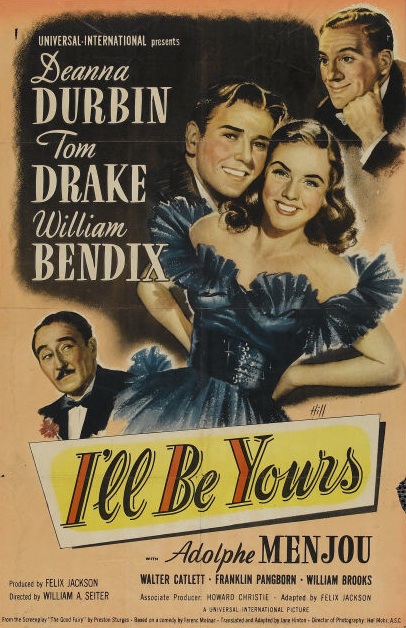
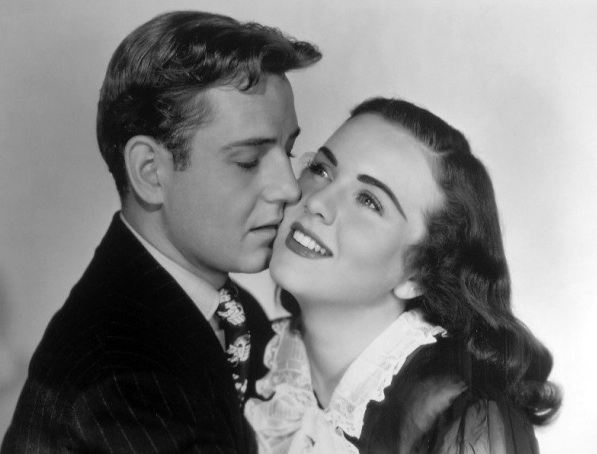
I really liked I’ll Be Yours, and not just because it stars my time-travel girlfriend, Deanna Durbin. It’s a light and frothy romantic comedy — hardly my favorite genre — but the performers are appealing, the humor is genuinely funny, and the musical numbers are great.
Durbin herself can’t be counted among the film’s fans. She retired from acting at the age of 27, after a 12-year career in the movies, and retired to France with her husband. In an interview with David Shipman in 1983, Durbin called her last four films — I’ll Be Yours, Something in the Wind (1947), Up in Central Park (1948), and For the Love of Mary (1948) — “terrible.”
I imagine that Durbin’s negative assessment of her last several films was at least partly due to her dissatisfaction with Hollywood. If she was yearning for a “normal” life and looking for a sign that she should continue acting, I’ll Be Yours is neither groundbreaking nor artful enough to qualify. But if you’re a fan of Deanna Durbin, I’ll Be Yours is wonderful entertainment. She’s as lovely and appealing in it as she was in everything else, and her singing voice was unparalleled among Hollywood ingenues.
In I’ll Be Yours, Durbin plays a naive, wide-eyed young woman with the unwieldy name of Louise Ginglebusher who leaves her hometown of Cobleskill, NY, for a life of excitement in Fun City. While eating lunch on a ridiculously tight budget, she’s befriended by a cranky but kindhearted waiter named Wechsberg (played by William Bendix, another performer who was able to overcome mediocre material).
She’s given a job as an usherette in a palatial movie house by a fellow native of Cobleskill, Mr. Buckingham (Walter Catlett), and shown kindness by a young and handsome lawyer named George Prescott (Tom Drake) who sports an unfortunate Van Dyke beard.
After Wechsberg sneaks Louise into a swanky party he’s working at the Savoy Ritz, she’s snookered into performing a musical number by a philandering millionaire named J. Conrad Nelson (Adolphe Menjou). Naturally, she pulls it off with aplomb, and the song she sings — “Granada” — is a high point of the film.
This leads to J. Conrad Nelson offering Louise a starring role in the Broadway musical he’s financing, but to fend off his advances she invents a husband for herself. In doing so, she underestimates the tenacity of Nelson’s libido. Nelson demands to know who her husband is so he can be put on his payroll and eventually be bought off and done away with.
Forced to produce a husband, Louise turns to Prescott, but his old-man beard will have to go.
All of this is ridiculous, of course, but it’s a thoroughly entertaining vehicle for a quartet of appealing performers. And the music is wonderful.
Felix Jackson wrote the script, which was adapted from Preston Sturges’s The Good Fairy (1935), which was based on a play by Ferenc Molnár. William A. Seiter directed the film.
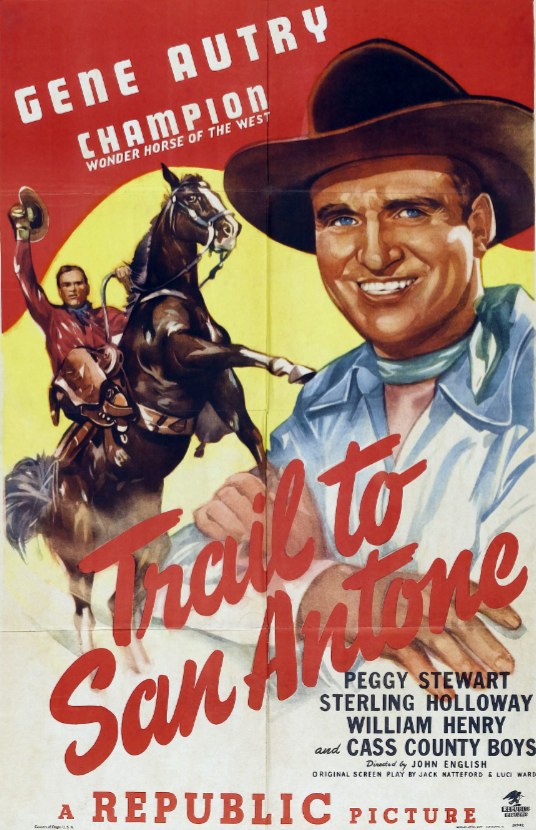
Have you ever wanted to see Gene Autry rope a stallion from the air? I hadn’t until I saw the climactic few minutes of John English’s Trail to San Antone, but as soon as Gene leaned out of the passenger side of the airplane piloted by feisty Kit Barlow (Peggy Stewart) and dropped a lariat, I said to myself, “Yee haw, Gene! Git ‘er done.”
It’s not as dangerous for the horse as it might sound. Kit doesn’t bring the plane in for a landing while Gene continues to control the horse or anything like that. As soon as the lariat is around the stallion’s neck, Gene drops the rope, which has a spare tire attached to the other end. One more good ropin’ job, and that stallion ain’t goin’ nowhere fast, pardner.
Trail to San Antone is solid entertainment for fans of Gene Autry. He’s backed up by the Cass County Boys (Fred S. Martin, Jerry Scoggins, and Bert Dodson), who do double duty as ranch hands and Autry’s back-up band. Dependable Republic Pictures heavy Tristram Coffin plays the bad guy, Cal Young, who’s attempting to derail the career of a young jockey named Ted Malloy (Johnny Duncan), whom Gene has taken under his wing. And the horrible comic relief is provided by the rubber-faced Sterling Holloway, as the cowardly and pencil-necked Droopy Stearns.
The film is bookended by performances of “Down the Trail to San Antone,” by Deuce Spriggins. Over the course of the picture, Autry and the Cass County Boys belt out plenty of pleasant country & western tunes, including Autry and Cindy Walker’s “The Cowboy Blues,” Spade Cooley’s “Shame on You,” Sid Robin’s “That’s My Home,” and Marty Symes and Joseph Burke’s “By the River of the Roses.”
 I mentioned in my review of I’ll Be Yours, which was released earlier in 1947, that Deanna Durbin called the last four films she made “terrible,” and permanently retired from acting in 1948.
 The Reads are a pleasantly screwball family — the kind that regularly engages in hilarious kidnappings and fun-loving extortion.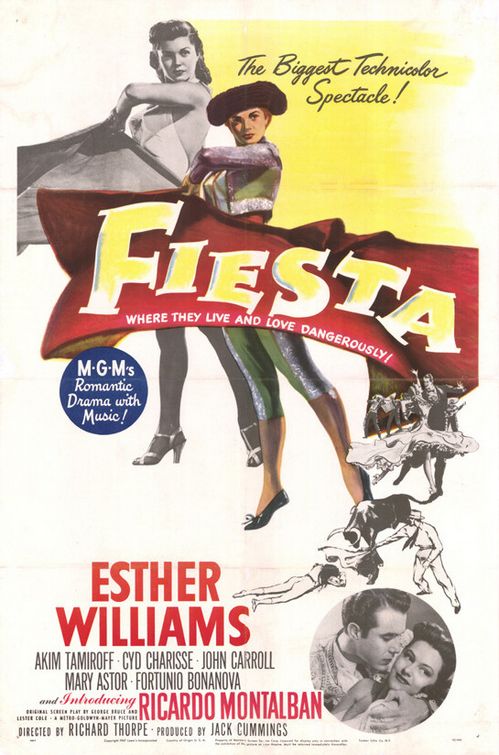

 OCD Viewer