Tag Archives: Mystery

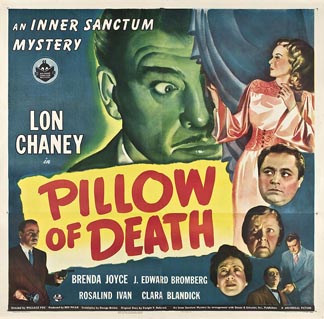
Pillow of Death (Dec. 14, 1945)

Wallace Fox’s Pillow of Death, the sixth and final film in the Inner Sanctum Mysteries series, is a haunted house mystery, the kind that Charlie Chan and the Crime Doctor excelled at solving. It lacks the ghoulish fun of the Inner Sanctum radio show, and it’s the least memorable of the film series.

The film begins when attorney Wayne Fletcher (Lon Chaney, Jr.) drops his secretary Donna Kincaid (Brenda Joyce) off at her family home after another late night of preparing briefs at the office. The crotchety patriarch of the family, Sam Kincaid (George Cleveland) grumbles, “The Kincaid women never worked,” which is funny, considering the fact that his sister Belle (Clara Blandick) waits on him hand and foot, and he employs Amelia Kincaid (Rosalind Ivan), a poor relative from England, as his housekeeper.

When Fletcher returns home, the police are waiting for him in his living room. Capt. McCracken (Wilton Graff) and his men acted on a tip from a spiritualist named “Julian” (J. Edward Bromberg), who is sitting in Fletcher’s rocking chair like he owns the place. The police inform Fletcher that Julian had a psychic presentiment that one of his adherents, Mrs. Fletcher, had come to harm. When the police arrived at the Fletcher home, they found her murdered corpse. Fletcher is now the prime suspect.

After he’s questioned and released, Fletcher goes to the Kincaid home, as does Julian, and most of the rest of the film takes place there. Donna’s amorous teenaged neighbor Bruce (Bernard Thomas) keeps popping up, skulking around the grounds and saying little, as the bodies start piling up. The haunted house clichés come fast and furious, including a séance presided over by Julian, which gives the roly-poly character actor Bromberg free rein to tilt his head back, roll his eyes up in his head, and speak very, very slowly. It’s not quite entertaining enough to be called “campy,” but it comes close.

Unlike the previous films in the series, the supernatural element is poorly handled and its role in the story is never fully explained. In other Inner Sanctum films, and on the radio show, any supernatural hokum was usually debunked and explained away. Like pulling the mask off the monster at the end of Scooby-Doo, the explanations were sometimes preposterous, but they were usually clever, or at least fun. And since Pillow of Death a straightforward mystery, the lack of explanation seems more like a product of lazy writing than anything else.

Also, with a title like Pillow of Death I was expecting something more overtly supernatural, like a pillow cursed by Satan, or a talking pillow, or possibly even a pillow with a hole in it full of sharp teeth. Instead, an ordinary pillow is used at one point as a murder weapon, in an attempt to smother someone, but that’s it. Given the pillow’s limited role in the film, the title seems almost like a joke.
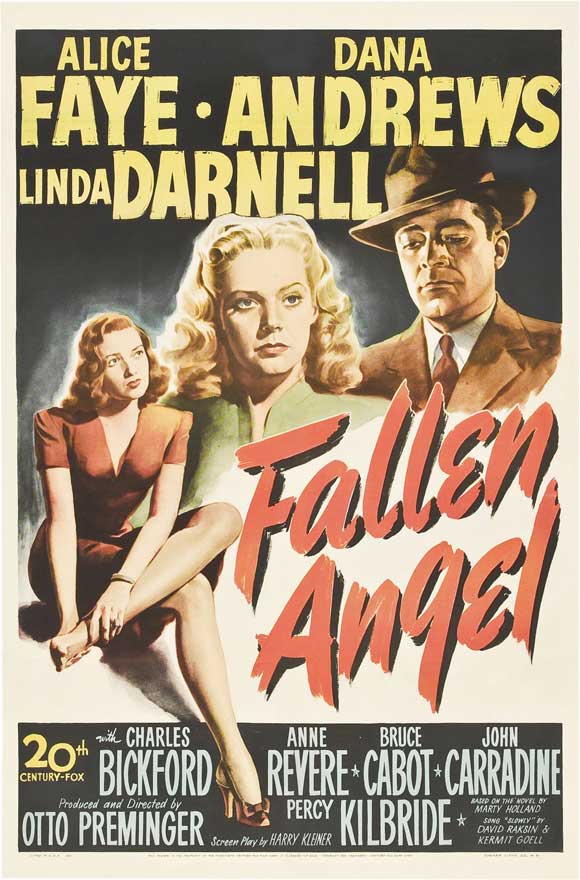
Fallen Angel (Dec. 5, 1945)

Fallen Angel, Otto Preminger’s follow-up to his smash hit Laura (1944), was slapped around by critics and passed over by audiences, but it’s not a bad film. It’s just not involving or memorable in the ways Laura was, and it’s composed of a bunch of elements that never really coalesce.

Fallen Angel reunited Preminger with the star of his previous film, Dana Andrews, and a lot of my enjoyment in the film came from watching Andrews. He’s more of a focal point in Fallen Angel than he was in Laura, and he dominates every scene he’s in. Andrews was 5’10”, but he looks well over six feet in this picture. He’s rough-looking but charming, and imposing and tough without being wooden. At the same time, he projects bitterness and alienation, barely concealed behind a handsome mask. In short, he’s the embodiment of American post-war masculinity. Andrews’s co-stars are all good as well. And I can’t fault Preminger’s direction. The film looks great, and taken one scene at a time, it’s very good.

Where Fallen Angel failed to engage me was in its pacing and storytelling. I haven’t read the Marty Holland novel the film is based on, but Fallen Angel plays like an adaptation of a sprawling book in which each section of the plot is dutifully reenacted, as opposed to a terse adaptation in which unnecessary subplots and themes are jettisoned. When drifter Eric Stanton (Andrews) is thrown off a bus in the small town of Walton, California, because he doesn’t have the $2.25 fare necessary to continue on to San Francisco, he stops in at a place called Pop’s Café. In the first few minutes of the film we’re introduced to all the major players; the phony spiritualist Professor Madley (John Carradine), whom Stanton used to shill for, hard-boiled ex-New York police detective Mark Judd (Charles Bickford), cafe owner Pop (Percy Kilbride), June Mills (Alice Faye), June’s spinster sister Clara (Anne Revere), and Pop’s pouting, sexy waitress Stella (Linda Darnell), whom every man in town seems to be obsessed with (and it’s not hard to see why).

The beginning doesn’t seem rushed, however, or as though too much information is being packed in. A lot of this can be credited to Preminger’s cinematographer, Joseph LaShelle, who also worked with Preminger on Laura, and whose fluid tracking shots and crisp black and white cinematography are both a joy to watch. Eventually, however, the way certain characters dropped out of the picture left me feeling suspended. The grifting medium and his relationship with Stanton could have filled an entire picture (although I admit being partial to John Carradine), but he leaves town before too much time has passed. Later, when Stella is murdered, it happens off screen, and just as I felt her relationship with Stanton was starting to get juicy. His romance with June and Stella could have formed the classic “good girl/bad girl” film noir tension, but his romance with June doesn’t really get started until Stella’s ticket has been punched, and once that happens, Fallen Angel becomes more of a melodrama than a noir. It’s also a mystery, since we don’t know who killed Stella, but this aspect of the film doesn’t come to much, as the second half focuses more on Stanton’s courtship of the sheltered, naïve June, and the question of whether or not he really loves her or is just out to fleece her. Meanwhile, most viewers will have the number of suspects in Stella’s murder narrowed down to two suspects, neither of whom is a more interesting culprit than the other.

I’m probably making Fallen Angel sound worse than it is. Many modern viewers consider it a lost classic of film noir, or just a really great film that has been overlooked. It’s worth seeing, especially if you’re a fan of Preminger or any of the principal actors. I found it disappointing, but that might change years from now with a second viewing.

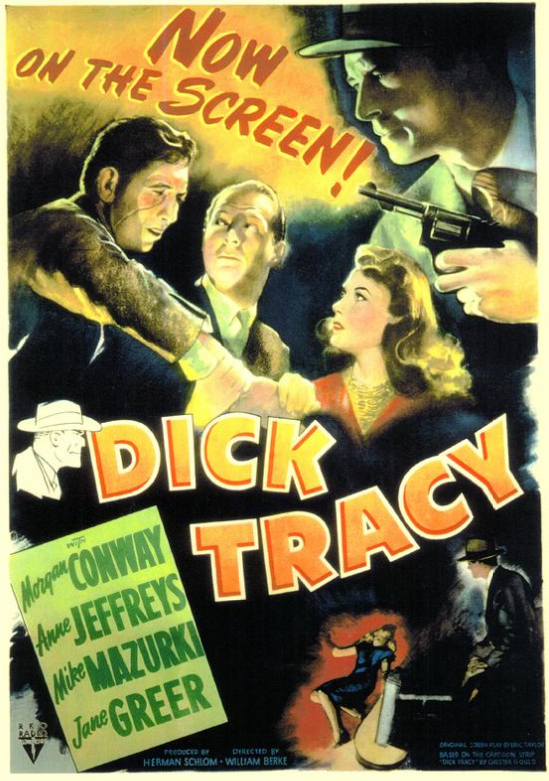
Dick Tracy (Dec. 1, 1945)

Dick Tracy, directed by William Berke and starring Morgan Conway as Dick Tracy, wasn’t the first filmed adaptation of the most famous detective in the funny pages. There had been four serials prior to it, all of which starred Ralph Byrd; Dick Tracy (1937), Dick Tracy Returns (1938), Dick Tracy’s G-Men (1939), and Dick Tracy vs. Crime Inc. (1941). The first one was also re-edited into a feature in 1937, which was a fairly common practice. These were B pictures, after all. If you had the footage, why not repackage it?

This film, however, took the character in a new direction. Played by Morgan Conway, Tracy is more believable as a real person than the way Byrd played him. Both embody aspects of the character, but they look nothing like each other. Byrd literally looked like a cartoon character. He had small, perfect features and intense eyes. But for me, his voice was too high and his nose too small to really convey the toughness of the character. Conway, on the other hand, is ugly and tough as nails. He looks like what I imagine Tracy might look like if he were a real person, although his nose is more of a “schnoz” than Tracy’s “beak.” He’s decent and brave, but still not above underhanded tricks to get his man. When we’re introduced to him, he’s interrogating a sweaty suspect named Johnny (Tommy Noonan). Tracy makes Johnny believe his mother has been killed so he’ll agree to roll over on someone. After Johnny spills the beans, Tracy admits to having tricked him. “It was the only way I could get you to talk and clear yourself at the same time,” he says. “All right boys, clean up Johnny and send him home.”

This film also features the full supporting cast of characters from Chester Gould’s daily newspaper strip, many of whom had been missing from earlier adaptations; Tracy’s sidekick Pat Patton (Lyle Latell), his best girl Tess Trueheart (Anne Jeffreys), his adopted son Junior (Mickey Kuhn), and Chief Brandon (Joseph Crehan). Gould’s violent, gruesome world is handled well in this film. Its opening may be the darkest of any film based on a comic strip character made before 1970. A high-angle shot shows a man with his back to the camera, leaning against a light pole in a quiet, suburban neighborhood at night, smoking a cigarette. When a bus stops and a single, female passenger (Mary Currier) disembarks, he moves into the shadows. A tracking shot follows her as she walks across the street, then cuts to a static shot of the man’s shadow on a wall, and the viewer can see from the movement of his shadow that he is reaching into his breast pocket for something. This is followed by a tracking shot of the woman with the camera directly behind her, presumably showing his point of view. The woman walks down the sidewalk, her heels clacking. She looks nervous. She turns around. There is no one behind her. She keeps walking. Suddenly, a shadow falls across her and she screams. The man attacks her. There is a cut to a long shot of the street, which shows her body lying on the sidewalk and the man running away.

Dick Tracy discovers a note on the woman’s viciously mutilated body, demanding that $500 in small bills be left in a street sweeper’s trash can on the corner of Lakeview and Ash. The note is signed “Splitface.” The next morning, the mayor of the city (William Halligan) receives a similar note, demanding that $10,000 be paid out or the mayor will be “slashed to pieces.”

The murdered schoolteacher, the mayor, and another man who was killed by Splitface seemingly have nothing to connect them. Tracy and Patton investigate, and Tracy comes to the conclusion that Splitface is motivated by something other than money, since the murdered woman didn’t pay, but the murdered man did.

Dick Tracy has plenty of action, with Dick and Pat chasing down suspects on foot and in cars, but it doesn’t skimp on the investigations that lead them there. It’s not rigorous enough to qualify as a police procedural, but it doesn’t gloss over any details, and Conway’s acting style and line delivery are not unlike Jack Webb’s on Dragnet.

Devotees of the daily strip will probably quibble with details, but I thought this picture did a nice job of balancing the violence with over-the-top characters. There is a loony astronomer and fortune teller named Professor Starling (Trevor Bardette), a ghoulish undertaker named Deathridge (Milton Parsons), and of course the great character actor Mike Mazurki as the villain.

Dick Tracy is a one-hour programmer, and there’s no question that it’s a B movie, but it’s an expertly directed, fast-paced, and thoroughly enjoyable one.

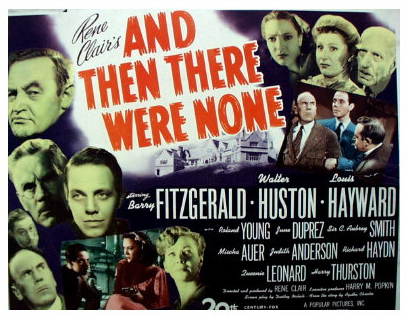
And Then There Were None (Oct. 31, 1945)

Agatha Christie’s novel And Then There Were None, originally published in England in 1939 under the unfortunate title Ten Little Niggers, is tied with J.R.R. Tolkien’s The Lord of the Rings as the second best-selling novel of all time (only J.K. Rowling’s Harry Potter and the Philosopher’s Stone has sold more copies). This makes it the most widely read mystery novel of all time, so hopefully nothing I say here will be giving much away. (But don’t worry … I’m not going to reveal “whodunnit.”)

In And Then There Were None, eight people are invited to an island off the coast of Devon by a Mr. and Mrs. “U.N. Owen.” (Get it?) When the guests arrive, they are informed that Mr. Owen is away, and that the guests will be attended to by servants Thomas and Ethel Rogers, bringing the cast of characters up to ten.

Even 70 years ago, the N-word was a more sensitive topic in America than it was in England. Presumably because of this, the novel was published in the U.S. as And Then There Were None in 1940, the name of the island was changed from “Nigger Island” to “Indian Island,” and the song that provides the structure of the story was changed from the original, which had been a standard of blackface minstrel shows since 1869, to “Ten Little Indians”:

Ten little Indian boys went out to dine; One choked his little self and then there were nine.
Nine little Indian boys sat up very late; One overslept himself and then there were eight.
Eight little Indian boys travelling in Devon; One said he’d stay there and then there were seven.
Seven little Indian boys chopping up sticks; One chopped himself in half and then there were six.
Six little Indian boys playing with a hive; A bumblebee stung one and then there were five.
Five little Indian boys going in for law; One got in Chancery and then there were four.
Four little Indian boys going out to sea; A red herring swallowed one and then there were three.
Three little Indian boys walking in the zoo; A big bear hugged one and then there were two.
Two Little Indian boys sitting in the sun; One got frizzled up and then there was one.
One little Indian boy left all alone; He went out and hanged himself and then there were none.

Each guest finds a framed copy of this gruesome little poem in his or her room, and is informed over dinner, via a phonograph record, that everyone on the island has gotten away with murder in one way or other, and that all are going to pay. Then the fun begins, as the characters are dispatched in the manner of the rhyme. The first guest drinks cyanide at dinner (choking), the second has an overdose of sleeping pills (oversleeping), the third declares that no one will leave the island and soon after is bludgeoned (one said he’d stay there), and so on.

The novel is a case of truth in advertising. At the end, all the characters are dead. The film is somewhat lighter, and allows a couple of them to escape unharmed. It follows Christie’s own 1943 stage adaptation of her novel, which softened the grim denouement. Given what’s come before, however, the happy ending feels like a bit of a cheat, and modern viewers might find themselves rolling their eyes at the finale.

And Then There Were None is still a great little mystery picture, though, and its cast of veteran character actors play their parts to the hilt. The film occasionally borders on farce, but never in a bad way. I especially enjoyed Walter Huston’s performance as the quietly maniacal Dr. Armstrong, but Louis Hayward as the cat-like Lombard and Barry Fitzgerald as the phlegmatic Judge Quinncannon are both memorable, as well.

Voice of the Whistler (Oct. 30, 1945)

Voice_of_the_Whistler
Voice of the Whistler (1945)
Directed by William Castle
Columbia Pictures

The Whistler, which was first heard on the Columbia Broadcasting System on May 16, 1942, ran for more than 13 years and was one of the best mystery and suspense programs on the radio. It didn’t feature the well-known Hollywood stars of Suspense (also broadcast on CBS), but its scripts were some of the most clever and intriguing that old-time radio had to offer, and its final twists were always satisfying, whether or not you saw them coming.

The program was hosted by a mysterious character embodied only by the sounds of footsteps and an eerie, whistled theme song. Each program began the same way, with the narrator saying, “I am the Whistler and I know many things, for I walk by night. I know many strange tales hidden in the hearts of men and women who have stepped into the shadows. Yes, I know the nameless terrors of which they dare not speak.” There were no recurring characters, but the situations were fairly similar from week to week. Greedy or vengeful people driven by dark impulses endeavored to commit perfect crimes, but were undone by a single overlooked detail or their own overreaching. Quite often, each story would contain more twists than just the one at the end. For instance, one program from October 1945 told the story of a man who killed his underworld partner and got away with it. He always wanted to reveal to the police the details of his clever scheme, but of course could not do so and remain a free man. After inadvertently faking his own death when a drifter steals his car and identification, crashes, dies, and is believed to be him, he changes his name and moves out of town. He then writes a mocking letter to the authorities laying out all the details of how he got away with murder. Immediately after mailing it, he hears on the radio that the police have determined that the body in the car wasn’t him after all, so he goes on a furious chase through the state in an attempt to retrieve the letter. He eventually attracts the attention of the police for tampering with the mail and is caught and confesses, only to find out at the end of the program that his letter was returned to his boarding house because it had incorrect postage.

Like Inner Sanctum Mysteries (another popular CBS suspense program), The Whistler was adapted as a series of B movies after it had been on the air for a couple of years. Starting with The Whistler (1944), which was directed by William Castle, the series continued with The Mark of the Whistler (1944), also directed by Castle, and The Power of the Whistler (1945), which was directed by Lew Landers. Each film starred Richard Dix, although he played a different role in each. The films did a great job of capturing the essence of the radio show. The Whistler was seen only in the shadows, just a man in a coat and a hat haunting alleyways and the dark parts of the city at night. Like the radio show, the Whistler’s voiceover often addressed the characters in the story, speaking in the second person, although he never interacted with them directly. (A typical bit might go, “You’ve really done it now, haven’t you? If you leave, they’ll see you, but if stay here, you’ll perish along with your victim. What are you going to do, George? What are you going to do?”)

Voice of the Whistler, which was directed by William Castle and written by Wilfred H. Petitt and Castle, working from a story by Allan Radar, tells the sad story of a successful industrialist named John Sinclair (Dix), whose fabulous wealth failed to provide him with either friends or health. After a breakdown, Sinclair changes his name to “John Carter” and goes away to lose himself. He sees a doctor who advises him to go to the sea coast, get some fresh air, a job, and enjoy himself. “And above everything, try to make friends,” the doctor tells him. “And never forget, Mr. Carter, that loneliness is a disease that can destroy a man’s mind.”

Sinclair moves to the coast of Maine and takes up residence in a lighthouse that has been converted into a private dwelling. Believing he doesn’t have long to live, he convinces a beautiful young nurse named Joan Martin (Lynn Merrick) to marry him. In exchange for her companionship during his last months, she will inherit all of his wealth. Although Joan is in love with a handsome young intern named Fred Graham (James Cardwell), they have been engaged for four years, and have no plans to be married until Fred can make enough money. Against Fred’s protests, Joan marries John, partly because she likes him and pities him, but mostly because his money can give her and Fred the life they’ve always wanted. After John and Joan have been married and living in the lighthouse with their jovial friend Ernie Sparrow (Rhys Williams) for several months, John’s health dramatically improves, and it looks as if Joan might have trouble collecting on their bargain. Meanwhile, John falls more and more in love with her. Eventually Fred shows up for a friendly visit that will have murderous consequences.

Richard Dix, a Hollywood star since the silent era, is great in each Whistler film I’ve seen him in so far. His glory days were behind him, but he was still a fine actor, and was equally adept at playing sympathetic protagonists and villains.

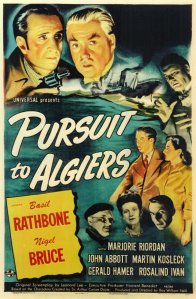
Pursuit to Algiers (Oct. 26, 1945)

Pursuit_to_AlgiersPursuit to Algiers, the twelfth film to star Basil Rathbone as Sherlock Holmes and Nigel Bruce as his boon companion Dr. John H. Watson, is a minor entry in the series, but a thoroughly enjoyable one. It’s the ninth Holmes picture directed by Roy William Neill, and his sure hand and professionalism are fully in evidence.
The film gets down to business in a wonderfully circuitous fashion, as Holmes and Watson are handed cryptic directions by a series of strangers. In each case, it takes Holmes a few beats to catch on, while Watson is oblivious the whole time. Eventually they are led to a group of men from an unnamed foreign country whose king has just been assassinated. They want Holmes to guard the life of the heir to the throne, Nikolas, who was educated in England. Holmes suggests that Nikolas pose as Watson’s nephew on a steamship voyage to Algiers. Once at sea, the film introduces a worthy cast of drawing room mystery characters, including a trio of sinister but quirky assassins.

Elements of Leonard Lee’s screenplay are taken from an otherwise unrecorded affair mentioned in the beginning of Sir Arthur Conan Doyle’s story “The Adventure of the Norwood Builder,” in particular the use of the steamship Friesland. And at one point in the film, Watson begins to share with his fellow dinner guests aboard the ship his adventure with Holmes that involved the “Giant Rat of Sumatra,” which is mentioned in Doyle’s story “The Adventure of the Sussex Vampire.” These references are similar to what Anthony Boucher and Denis Green would occasionally do in their scripts for the radio show The New Adventures of Sherlock Holmes, which was heard on the Mutual Broadcasting System, and, like the film series, starred Rathbone and Bruce. For instance, in one program, Holmes is willed a patch of land in gratitude for his successful work on a case, and he tells Watson he plans to retire there someday and keep bees. (In Conan Doyle’s stories and novels, the background of Holmes’s retirement in 1903 to the Sussex Downs, where he engaged in beekeeping, was never supplied.)

At times, Pursuit to Algiers comes dangerously close to being a musical, as one of the passengers on the ocean liner is a young and beautiful pianist named Sheila Woodbury (Marjorie Riordan), whom Dr. Watson makes a bit of a fool of himself over. It’s all in good fun, though, and Bruce’s “silly old goat” act is always fun to watch, even if his portrayal of Watson is a bit more ridiculous than Conan Doyle’s original conception of the character. Sheila plays several songs on the piano, including the beautiful “Flow Gently, Sweet Afton.” Watson even joins her at the piano toward the end of the picture for a lovely version of “Loch Lomond.” Director Neill always keeps things moving, however, and despite its minor status, Pursuit to Algiers is still a worthy entry in the Sherlock Holmes series.

Strange Confession (Oct. 5, 1945)

StrangeConfessionApparently populist rage against pharmaceutical giants is nothing new. In Strange Confession, the fifth of six “Inner Sanctum Mysteries” produced by Universal Pictures and released from 1943 to 1945, Lon Chaney, Jr. plays a brilliant chemist named Jeff Carter whose life goes from bad to worse when he twice accepts employment from the unscrupulous owner of the largest medical distributing company in an unnamed American city.
Strange Confession is more of a straight drama than the other films in the Inner Sanctum series. Except for its gruesome finale, it’s free of the Gothic overtones and murderous double-crosses found in the rest of the series. The opening few minutes are gripping, with Jeff clutching a bag in his hand and skulking through the shadowy nighttime city streets, deliberately avoiding a police officer. It’s a very noir beginning, right down to the story structure. Jeff arrives at the home of an old school chum named Mr. Brandon (Wilton Graff) and sits down to confess something horrible. He opens the bag and shows Brandon what’s inside. Brandon recoils, but the camera doesn’t reveal the bag’s contents.

Jeff recalls better days. He once had a well-paying job, a pretty wife named Mary (Brenda Joyce), and a baby boy named Tommy (Gregory Muradian). Unfortunately, his employer, Mr. Graham (J. Carrol Naish) exploited his talents and treated him poorly. He even had Jeff hard at work on Christmas Eve, composing an acceptance speech for him in which he took full credit for Jeff’s accomplishments in the lab. Jeff quit his job and worked for a small pharmacy, forced to labor on his chemistry experiments after hours in his bathroom. He was poor, but happy. But this wasn’t enough for his wife, who wanted better things in life, so a year later, Jeff went back to work for Mr. Graham. Jeff, his wife, and little Tommy started living the good life, with a house in the suburbs and an Irish housekeeper named Mrs. O’Connor (Mary Gordon).

Unfortunately, Graham, in addition to being a bad boss, was a cad. He had designs on Mary, and sent Jeff and his affable assistant Dave (Lloyd Bridges) deep into South America to work on a flu cure called “Zymurgine.” While Jeff and Dave were hard at work testing and perfecting the formula for the drug, Graham romanced Mary, who naïvely saw him as just a friend, taking her out to dinners and shows. Worse, he rushed Zymurgine into the market before Jeff’s fully tested formula was even ready to be shipped back to the United States. In a prescient moment, Graham tells his coterie of underlings, “You can sell almost anything if you advertise it enough.”

Ill-gotten profits trump integrity, and the whole thing comes full circle, personally affecting the principal characters and leading to a bloody conclusion. Strange Confession is quite a good one-hour B picture. Chaney’s performance is better than usual, and Naish is a smooth, oily antagonist. He’s well cast, too. With his hangdog features, black hair, and pencil-thin mustache he looks like a shorter version of Chaney, making him the perfect doppelgänger villain.

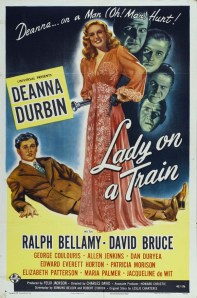
Lady on a Train (Aug. 17, 1945)

LadyOnATrainDeanna Durbin is an absolute delight in this farcical murder mystery. Durbin, a native of Winnipeg, Manitoba, was once one of the biggest stars in Hollywood, but never made a movie after 1948. (She currently lives in a small village in France, grants no interviews, and is reportedly very happy.) In Lady on a Train, she plays a young woman named Nicki Collins. When the film begins, Collins is sitting by herself in a compartment on a train entering New York on an elevated line. She has come from San Francisco to spend the holidays with her wealthy businessman father, and is currently engrossed in a mystery novel called The Case of the Headless Bride. When the train is briefly delayed, she looks out the window of her train car and witnesses a murder. Through a lighted window, she sees a young man beat an older man to death with a crowbar. She never sees the murderer’s face, however, and when she reports the murder to the police, the desk sergeant dismisses her report as the product of the overheated imagination of a girl who loves murder mysteries and can provide no real specifics of where she was when she saw the murder. Also, it’s Christmas Eve, and who want to traipse around looking for a murder that may or may not have occurred somewhere in Manhattan north of Grand Central Station?
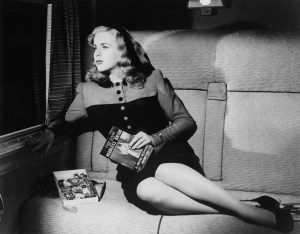
Undeterred, Collins calls up Wayne Morgan (David Bruce), the author of the mystery novel she was reading, and insinuates herself into his life, much to Morgan’s fiancée’s chagrin. After interrupting Morgan on a date at the movies, Collins see the murder victim in a newsreel, and identifies him as Josiah Waring, a shipping magnate. She heads to the Waring estate, where she is mistaken for Circus Club singer Margo Martin, who was Waring’s girlfriend. This allows her to sit in on the reading of Waring’s will, which leaves $1 to his nephew Arnold (Dan Duryea), $1 to his nephew Jonathan (Ralph Bellamy), and the rest of his substantial fortune to Martin.

Sure enough, Collins discovers that Martin has been murdered, throwing suspicion on the Arnold nephews and putting her in a tight spot, since she’s now performing at the club as the murdered girl.

DurbinLady on a Train is part mystery, part musical, part noir, part comedy, and part romance. The most surprising thing about this movie is that each element works perfectly, and they all complement one another. (Calling this film a noir is stretching it, but the final chase in a warehouse contains some striking chiaroscuro shot constructions, and is as tense as one could ask for.) Lady on a Train is also a delight for Durbin fetishists, since she has a different outfit and hairstyle in literally every scene. Sometimes the changes are subtle, but occasionally they’re impossible to miss, such as the scene in which she comes in out of the rain and is suddenly wearing gravity-defying, Pippi Longstocking-style braided pigtails.
Durbin made her film debut in Three Smart Girls (1936) at the age of 14. Apparently she was so popular that she singlehandedly saved Universal Pictures from financial ruin. Here, at the age of 23, she’s a joy to watch. Unlike a lot of former teen stars, she reached maturity while retaining all of her youthful charm, without ever seeming childish or forced.

The Woman in Green (July 27, 1945)

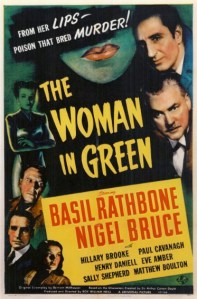
WomanGreenRoy William Neill’s The Woman in Green is the eleventh film Basil Rathbone and Nigel Bruce made together in which they played Sherlock Holmes and Dr. Watson, respectively. It’s perhaps not the best in the series, but it presents an excellent mystery, and offers everything fans of the previous Sherlock Holmes films will look for. There are gruesome yet puzzling clues, a pretty young woman who comes to Holmes for help, a bewitching femme fatale, a clever blackmailing scheme that involves hypnosis, and Professor Moriarty behind it all.
This was only the third time that Moriarty, Holmes’s archenemy and “the Napoleon of crime,” showed up in the series. The first time was in The Adventures of Sherlock Holmes (1939), when he was played by George Zucco. The second time was in Sherlock Holmes and the Secret Weapon (1943), when he was played by Lionel Atwill. Somewhat confusingly, all three men also appeared in different roles in Universal Pictures’ Sherlock Holmes series. Zucco and Daniell even appeared together as cooperating villains in Sherlock Holmes in Washington (1943). If I had my druthers, Zucco would have played Moriarty in all three films, since he’s my personal favorite, but we can’t always get what we want. And apparently Rathbone named Daniell as his favorite Moriarty, so clearly it’s just a matter of taste. Daniell was certainly one of the more dependable Hollywood villains of the ’40s. He was smooth and sophisticated with just the right touch of menace.

When The Woman in Green begins, Moriarty is presumed dead, since he is believed to have been hanged in Montevideo. Meanwhile, Holmes has his hands full in London with a series of mysterious murders. Young women are being killed, and in each case one finger is missing from the corpse. Aside from that one detail, however, there is no connection between any of the murders, and Scotland Yard can’t make heads or tails of the case. When a young woman named Maude Fenwick (Eve Amber) comes to Holmes for help, however, things start falling into place. She’s worried about her father, Sir George Fenwick (Paul Cavanagh), who has been acting very strangely ever since he took up with an alluring and mysterious woman named Lydia (Hillary Brooke). When Maude catches her father trying to bury a finger in his garden, she realizes it’s time to enlist the help of the great detective.

The way the mystery unfolds is satisfying, if somewhat fanciful. One has to suspend some disbelief in order to go along for the ride, but what else is new?

Midnight Manhunt (July 27, 1945)

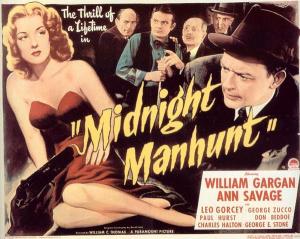
MidnightManhuntAnn Savage and William Gargan play competing newspaper reporters in this mercifully brief bottom-of-the-bill B mystery from Pine-Thomas Productions. Distributed by Paramount Pictures, Midnight Manhunt has the look and feel of a P.R.C. cheapie, right down to its minimal sets and poorly handled mixture of comedy and suspense.

The film begins promisingly, with the great George Zucco (playing a hitman named Jelke) shooting a man in a hotel room, then taking a cool quarter of a million in diamonds from the corpse’s inside jacket pocket. It’s a great sequence; wordless and thick with atmosphere (although the lack of any sound when Zucco fires his revolver is strange). Unfortunately, Zucco doesn’t show up again for awhile, and the film quickly settles into a series of shenanigans at a wax museum where Leo Gorcey works the night shift. Gorcey’s character and trademark malapropisms will both be familiar to anyone who saw him in any of the innumerable Dead End Kids/East Side Kids/Bowery Boys movies he appeared in. When the feisty girl reporter (Savage) who lives on the second floor of the wax museum discovers the body of the dead man, she recognizes him as an infamous gangster who had disappeared years earlier. Wanting the scoop for herself, she hides the body by setting it up in one of the wax museum’s displays. Gargan plays her ex-boyfriend and rival reporter. A lot transpires in the film’s short running time (an hour and four minutes), but none of it adds up to much. Savage and Gargan have good chemistry, and I would have rather the film just focused on their characters. Zucco is also good, but he doesn’t get much screen time.

Midnight Manhunt isn’t a terrible film, but it’s all over the place. It’s also really stagy and a lot of the humor is dated. If, however, lines like “I think he’s havin’ optical delusions” and “I figgered it out through a process of mental reduction” give you a chuckle, then it’s probably worth a look.