Tag Archives: RKO Radio Pictures

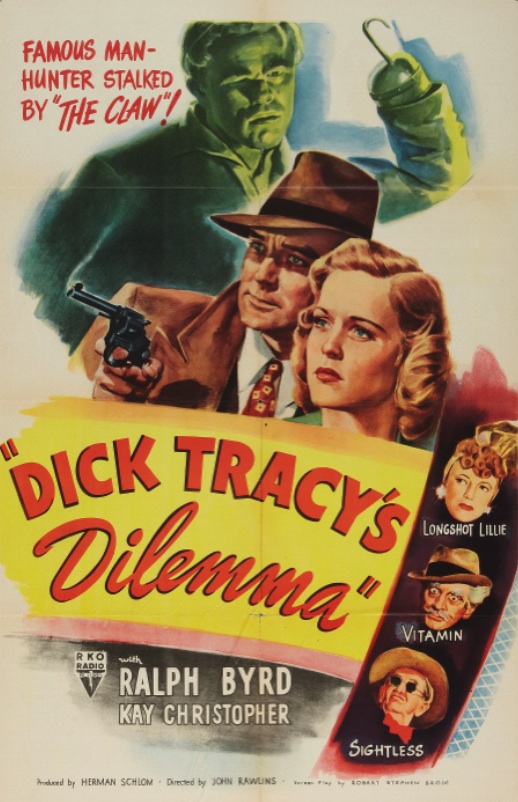
Dick Tracy’s Dilemma (May 20, 1947)

Dick Tracy’s Dilemma, directed by John Rawlins, marked Ralph Byrd’s triumphant return to playing Chester Gould’s famous police detective. Byrd played the hawk-nosed, square-jawed hero in four serials, Dick Tracy (1937), Dick Tracy Returns (1938), Dick Tracy’s G-Men (1939), and Dick Tracy vs. Crime Inc. (1941).

In William Berke’s excellent programmer Dick Tracy (1945), Morgan Conway stepped into the role. I really liked Conway as Tracy. His facial features were as big and ugly as Byrd’s were small and perfect, but he imbued the character with a humanity lacking in Byrd’s one-note performance, and I would have liked to see him in more Dick Tracy movies than just Dick Tracy and Dick Tracy vs. Cueball (1946).

On the other hand, I’m sure a lot of people who grew up watching Byrd in the Dick Tracy cliffhangers on Saturday afternoons were thrilled to see him return to the role. And besides, everything that made Dick Tracy and Dick Tracy vs. Cueball standout pieces of bottom-of-the-bill entertainment from RKO Radio Pictures is still present in Dick Tracy’s Dilemma — tight pacing, good writing, solid direction, dramatic lighting, and nicely staged action — so I enjoyed it in spite of Byrd’s somewhat wooden performance.

The plot of Dick Tracy’s Dilemma is pretty similar to the plot of Dick Tracy vs. Cueball. Instead of a chrome-domed thug with a leather garrote, the villain of the piece is a hulking Neanderthal with a club foot and a hook for a hand. He’s a 39-year-old career criminal named Steve Michel, but he’s better known in the underworld as “The Claw.” Michel was a bootlegger and hijacker during Prohibition. He lost his right hand and crippled his right leg when he was rammed by a Coast Guard cutter, and he’s looking to score some dough now that he’s back on the street. (The Claw is played by character actor Jack Lambert, who’s outfitted with bushy fake eyebrows and a glower that just won’t quit.)

The Claw is part of a crew that takes down a big score at the Flawless Fur warehouse. After the night watchman (Jason Robards Sr.) wakes up from the knockout blow The Claw gave him, he comes after the crew with a gun, and The Claw rips him up with his “hangnail” (as another member of his crew calls his hook). The murder brings in homicide detectives Dick Tracy and his partner, Pat Patton (Lyle Latell).

The Claw waits nervously with his partners for the big payoff. Tracy intercepts Longshot Lillie (Bernadene Hayes), a fence for stolen goods, with $20,000 in her purse. The crew also floats a proposal to Peter Premium (William B. Davidson), the vice president of Honesty Insurance, offering to sell him the furs for half their value before his company has to pay out on the policy.

While this is a solid police procedural with lots of violence, it’s also a Dick Tracy film, so there are plenty of comedic touches. Besides the ridiculous names of some of the characters (see above), there’s a bar called “The Blinking Skull” (not to be confused with “The Dripping Dagger,” which featured in Dick Tracy vs. Cueball), and a beggar named “Sightless” (Jimmy Conlin), who’s only pretending to be blind. Vitamin Flintheart (Ian Keith) is back, too, and provide plenty of laughs — if you’re amused by pretentiousness and narcissism, that is.

John Rawlins directs the one-hour programmer with brisk efficiency. His style is straightforward, but he and his cinematographer Frank Redman throw in plenty of nice touches, such as a man who knocks a plug out of its socket as he is being murdered by The Claw. The next shot is of The Claw rising to stand. The unplugged desk fan is in the foreground, and its blades slowly stop rotating as The Claw leaves the room. It’s a great visual metaphor for a life ending. The film also features a fine score by noir favorite Paul Sawtell.
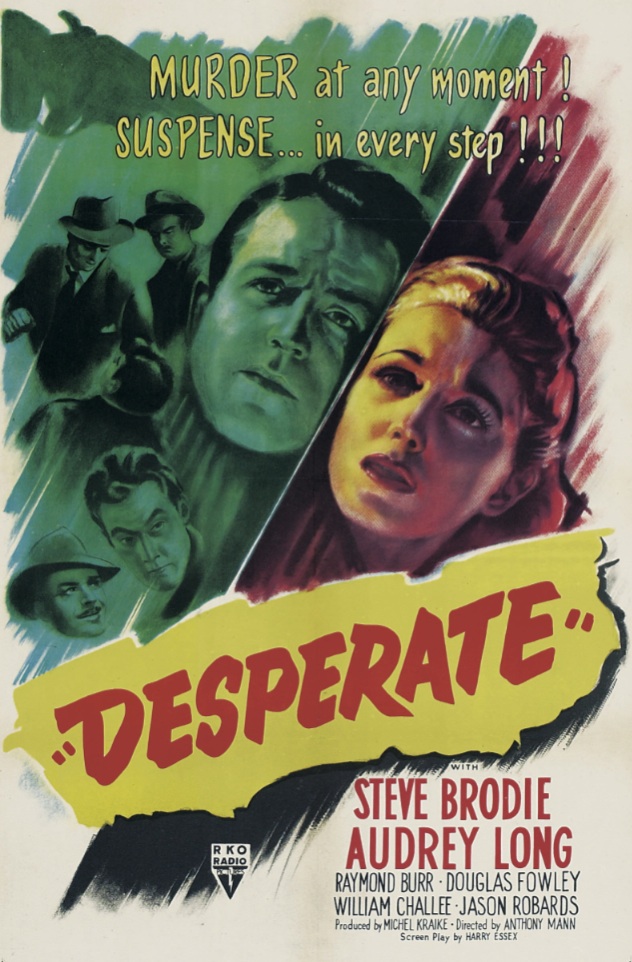
Desperate (May 9, 1947)

Anthony Mann’s Desperate stars Steve Brodie (not to be confused with the other Steve Brodie) and Audrey Long (the future Mrs. Leslie Charteris) as a young married couple on the run from sinister thugs led by the glowering Raymond Burr.

Steve Randall (Brodie), the owner and sole operator of Stephen Randall Trucking, is such a sweetie that he buys flowers for his wife Anne (Long) on their four-month anniversary. (When I watched this movie with my wife, she turned to me and said, “You didn’t get me anything for our four-month anniversary.” Thanks for making the rest of us look bad, Steve.) But the happy couple’s celebration has to be postponed when Steve gets an offer he can’t refuse … $50 for just one night’s work.

When an offer sounds too good to be true, it usually is. The crew of mugs loading merchandise from a warehouse into Steve’s truck are clearly up to no good. When one of them flashes a rod, Steve balks, so they shove him back in the truck and keep the gun on him. They need a clean “face” for the cops.

When a police officer shows up to investigate, Steve signals him with his lights, which leads to a shootout between the cops and the thieves. Steve drives away. Al Radak (Larry Nunn), who has one foot on Steve’s back bumper and the other on the loading dock, falls and is captured by the police. His older brother, Walt Radak (Raymond Burr), the leader of the crew, gets away with his henchman, Reynolds (William Challee).

Walt’s crazy about his kid brother, and Al will face the death penalty for the cop who was killed during the warehouse heist. So Walt demands that Steve turn himself in to the cops and claim he was responsible. To convince him, Walt calls in Steve’s license plate number and then has his boys work him over in a dark room with a single swinging overhead light. It’s a stunning sequence, and quintessentially noir.

When Steve doesn’t give in, Walt tries a new tactic. “Say, I’ll bet that new bride of yours is pretty,” he says while holding a broken bottle. “How ’bout it Steve?”

Walt has found Steve’s Achilles’ heel, and he agrees to Walt’s plan. Walt says, “I don’t care what you tell them, but if Al doesn’t walk out of that police station by midnight, your wife ain’t gonna be so good to look at.”

But Steve manages to slip away from Reynolds and call Anne from a pay phone. He tells her to meet him at the train station. They’ll go on the lam together, so Anne will be out of Walt’s reach.

Most of the rest of the film is an extended cross-country chase, as Steve and Anne move from place to place, establish new identities for themselves, and pick up work where Steve can find it. They’re pursued not only by Walt and Reynolds, but by the authorities, since Steve is still a person of interest in the murder of the police officer at the warehouse.

Along the way they have the obligatory conversation about how he can’t turn himself in to the police because they won’t believe him. They have a second wedding on the Minnesota farm owned by Uncle Jan and Aunt Klara (Paul E. Burns and Ilka Grüning) because their first marriage was just a courthouse deal and they deserve a big gathering with a real priest. Anne finds out she’s pregnant. They are crossed up by a sleazy private investigator named Pete Lavitch (Douglas Fowley) and they are assisted by a sympathetic police detective, Lt. Louie Ferrari (Jason Robards), who’s not above using Steve as bait to catch Walt.

Desperate is not a long film (it’s less than an hour and 15 minutes), but it drags a little during its middle act, which sometimes feels repetitive. It redeems itself completely in its final act, however, which is as dark and as tense as any film noir fan could ask for. Steve insures himself for $5,000 and heads for Walt dead-on, like a man playing chicken with an oncoming freight train. Six months have passed since Al was arrested, and he’s set to be executed. Walt gave up a long time ago on the idea that his brother could be freed, and all he wants now is the satisfaction of killing Steve at the exact moment that Al dies. A life for a life.

Walt and Reynolds take Steve to an apartment. Walt places a clock on the table between them in the kitchen. It’s a quarter to midnight. He gives Steve a last meal — sandwiches and milk — and a cigarette, and promises to shoot him at the stroke of midnight. There are increasingly tight close-ups of their three sweaty faces. “Now who was it said time flies?” Walt asks sardonically.

Desperate is the first really good noir from Anthony Mann, a director whose name is now inextricable from the term “film noir,” but who started out in Hollywood making mostly musicals and comedies. Desperate is not as interesting as T-Men (1947) or as powerful as Raw Deal (1948), but it’s a well-made, well-acted, exciting thriller. Audrey Long (recently seen as Claire Trevor’s little sister in Robert Wise’s Born to Kill) is probably the weakest actor in the film, but she’s called on to do the least. Steve Brodie is an appealing protagonist. He has a pleasant face and a regular-guy demeanor, and he’s believable as a man who’s pushed too far.

The real treat in Desperate is Raymond Burr as the vicious Walt Radak. This was only Burr’s third credited appearance on film, and while I enjoyed his role as the villain in William Berke’s Code of the West (1947), Desperate plays much better to his strengths as an actor. Burr was a remarkable heavy (no offense intended, big guy), and I never stopped to consider how ludicrous Walt’s plans were while I was watching this film. Burr sells every one of his hard-boiled lines with ruthless efficiency.

Mann’s cinematographer on Desperate, George E. Diskant, deserves mention, too. While he’s perhaps not as famous as Mann’s frequent collaborator John Alton, Diskant’s photography in Desperate is beautiful — full of darkness, hard angles, and vertigo-inducing chiaroscuro constructions.

Born to Kill (May 3, 1947)

Born to Kill
Born to Kill (1947)
Directed by Robert Wise
RKO Radio Pictures

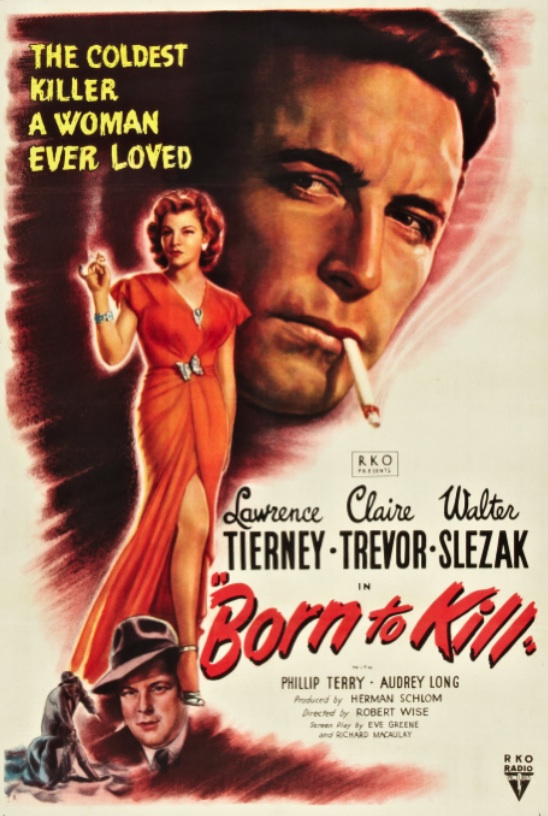
Robert Wise’s Born to Kill has never been one of my favorite noirs. It regularly tops “best of” lists, and many film noir enthusiasts whom I respect love it, so I was hoping a fresh viewing would reveal something new to me.

Alas, for me it was still the same old flick. It’s an enjoyable picture, but it’s wildly melodramatic, there are subplots that never really go anywhere, and its over-the-top characters are mostly two-dimensional. The key to a great noir, like Billy Wilder’s Double Indemnity (1944), is the sense that it could happen to you, or to someone you know. No matter how outlandish the schemes in a film are, if they’re carried out by believable characters then I’m usually able to go along for the ride without asking too many questions.

Born to Kill tells the tale of a pair of sociopathic social climbers, the recently divorced Helen Brent (Claire Trevor) and the recently paroled Sam Wild (Lawrence Tierney). Their paths cross in Reno, the biggest little city in the world. Helen is there for a quickie divorce and Sam is there with his reedy little sidekick, Mart Waterman (Elisha Cook Jr.). Helen is staying at a boarding house run by the slovenly Mrs. Kraft (Esther Howard), who, when we first see her, is getting lit up on beer in the middle of the afternoon with the adenoidal tart Laury Palmer (Isabel Jewell).

After Laury goes on a date with dapper Danny Jaden (Tony Barrett) just to make the big lug she’s dating jealous, she invites Danny inside for a nightcap. When Danny goes to the kitchen, he finds Laury’s big lug waiting for him. It’s Sam Wild, of course, and his brutal killing of both Danny and Laury is the film’s high point. (Or the lurid low point, if you’re a prissy scold.) The sound of crickets in the background, the neatly manicured suburban lawns surrounding Mrs. Kraft’s boarding house, the dog barking in the background, and the uptempo swing music playing on the radio in the kitchen all lend a sense of immediacy and familiarity to the murder.

The rest of the film, however, just doesn’t hang together for me. Sam’s little buddy Mart tells him, “You can’t just go around killing people whenever the notion strikes you. It just ain’t feasible.” I feel the same way about the plot of Born to Kill. It just ain’t feasible.

After the murder, Sam blows town. He and Helen meet again on the train to San Francisco. When they disembark, Sam suggests splitting a cab, but Helen tells him she’s going in a different direction. He responds, “That’s where you’re wrong. We’re going in the same direction, you and I.”

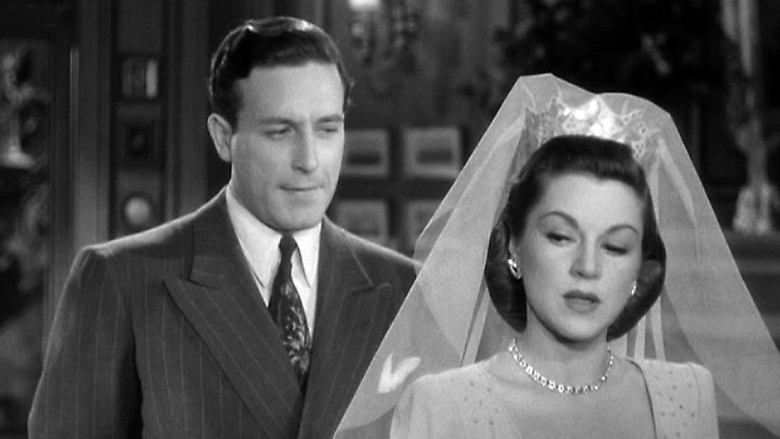
Sam insinuates himself into Helen’s life. They are clearly drawn to each other, but she tells him that nothing in the world will stop her from marrying her fiancé, Fred Grover (Phillip Terry). So Sam moves in on her sister, wealthy heiress Georgia Staples (Audrey Long), or, to be more precise, her foster sister, as Helen bitterly reveals to Sam. Not only is Georgia a beautiful blonde, but — as Sam tells Mart — “Marrying into this crowd will make it so’s I can spit in anyone’s eye.”

Meanwhile, back in Reno, Mrs. Kraft retains the services of a sleazy, corpulent private investigator named Matthew Albert Arnett (Walter Slezak). Mrs. Kraft is played by Esther Howard, and her bizarre, bug-eyed performance in this film is nearly identical to the “Filthy Flora” character she played in Dick Tracy vs. Cueball (1946).

Helen and Sam pursue their doomed, twisted love affair. (“Fred is peace and security,” Helen moans. “You, you’re strength, excitement, and depravity. You’ve a kind of corruption inside of you, Sam.”) Arnett sniffs around. Sam and Georgia quarrel after she refuses to let him run her family’s business. Mart Waterman shows up in San Francisco and starts living with the unhappy foursome. (Is he Sam’s partner or his secret lover? The film is never completely clear.) Slowly but surely, the plot threads of the film intertwine, culminating in an orgy of murder and betrayal.

This is the second or third time I’ve seen Born to Kill. While I’ve griped about the ridiculously melodramatic plot, maybe I just want it to be something it’s not. I could certainly see myself watching it again in the future and loving its over-the-top characters, unrealistic scenarios, grotesque supporting players, and generally high level of camp.

I think my biggest problem with Born to Kill is the relationship between Sam and Helen. Claire Trevor is a wonderful performer, but I was never able to accept that she’d love Sam enough to give up everything for him. Helen’s histrionics in her scenes in tastefully appointed drawing rooms with Fred, Georgia, and Sam seem more scripted than natural, and Claire Trevor’s performance as Helen seems too intelligent and composed for the debased character she’s playing.

But maybe that’s the point. Lawrence Tierney is a powerful presence, but he isn’t a particularly gifted actor, especially when either subtlety or range is called for. Not only does Sam Wild commit murder whenever the notion strikes him, he can bend others to his will, getting his friend Mart to kill for him and getting Helen to provide him with an alibi for murder at the drop of a hat. He’s a brutal alpha male, and loving him may go against all reason and sense, but that never stopped anybody before.

Born to Kill is directed by Robert Wise with vigor. The cinematography, by Robert de Grasse, is great, especially in the nighttime exteriors. Paul Sawtell’s music is exciting. I found the plot ridiculous, but that shouldn’t stop any noir fans who haven’t seen Born to Kill from seeking it out.

Tarzan and the Huntress (April 5, 1947)

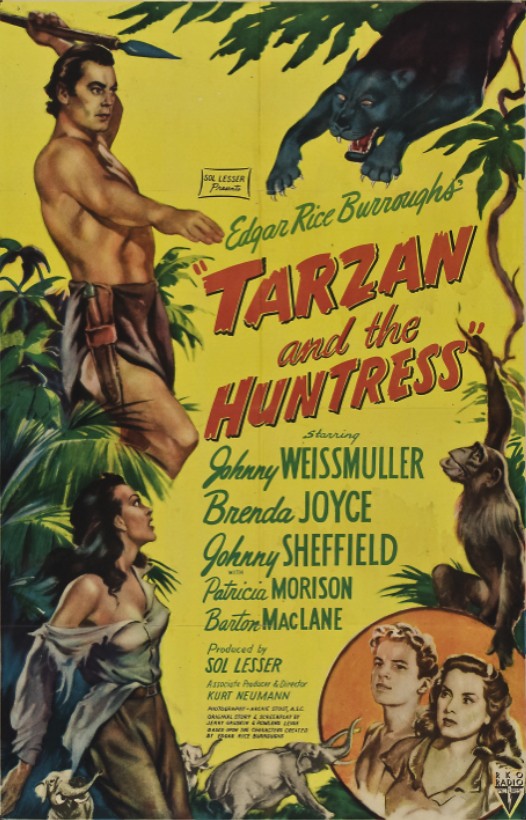
Kurt Neumann’s Tarzan and the Huntress should really be called Tarzan and the Poachers. The word “huntress” conveys more risqué sexiness than the film actually contains (the same can be said of the poster), and seems designed to draw in the same people who shivered at the sight of the muscular Johnny Weissmuller being clawed by the beautiful actress Acquanetta in his previous outing as the King of the Jungle, Tarzan and the Leopard Woman (1946).

When Tarzan and the Huntress begins, we learn that zoos around the world are facing a post-war shortage of animals. (Did lions and monkeys get drafted? I missed that.)

Enter Tanya Rawlins (Patricia Morison, stepping up from Queen of the Amazons to a higher-quality jungle movie). Tanya is an animal trainer leading a safari that also includes her villainous guide, big-game hunter Paul Weir (Barton MacLane), and the moneyman, Carl Marley (John Warburton).

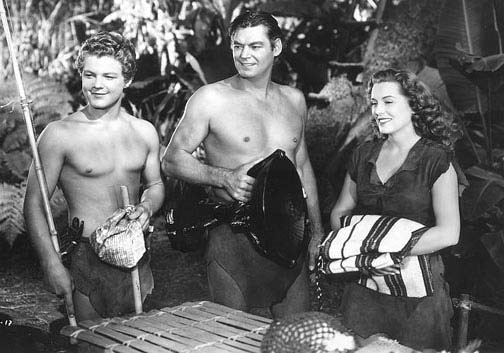
Meanwhile, a half-naked couple who live in a treehouse with their pet chimp and their boy, who calls his adoptive parents by their first names, are preparing to honor local monarch King Farrod (Charles Trowbridge) on the occasion of his birthday. No, they’re not hippies, they’re Tarzan and Jane, played by Weissmuller and Brenda Joyce. Their adopted son, “Boy,” is once again played by Johnny Sheffield, who looks as if he should probably change his name to “Man” sometime soon (or at least “The Artist Formerly Known As ‘Boy'”), since he’s nearly as big as Tarzan. (This was Sheffield’s last role in a Tarzan picture. In 1949 he struck out on his own in the Bomba, the Jungle Boy series.) When Tarzan inspects the fishing pole that Boy has fashioned for King Farrod, he smiles and says, “Everybody like fishing, even kings.” This might be a lesser entry in the Tarzan series, but the playfulness of Tarzan’s little family group and their idyllic life in the jungle is always fun to watch. If you’ve seen one Tarzan movie, however, you’ve seen them all, and you know that something will soon come to threaten their peaceful existence.

In this case, it’s a perfect storm of Tarzan-related problems — hunters and trappers arriving from the “civilized” world, treacherous locals, and Cheeta and Boy’s shared love of shiny objects.

When Weir tells Tanya that King Farrod won’t allow more than two specimens of each animal to be taken out of the jungle, Noah’s-Ark style, she sputters, “You can’t be serious!” So in a back-door deal, the king’s scheming nephew, Prince Ozira (Ted Hecht), offers Weir and Tanya a “no quota, no restrictions” offer on trapping animals, as long as they pay him a bounty per animal.

One of the members of Tanya’s safari offers to trade Boy a hand-crank flashlight for Cheeta. Boy refuses, since Cheeta’s like a member of the family, but he’s not above stealing a pair of lioness’s cubs in exchange for the nearly worthless bauble.

Tarzan returns the two cubs to their mother and draws a line in the sand. Hunters stay on their side of the river, Tarzan stay on his.

The hunting party doesn’t seem overly concerned, but then Tarzan calls all the animals to him with his powerful jungle cry, and they leave the hunters’ side and come to his.

It’s on.

Tarzan knows just how to handle the greedy poachers when they cross the river into his territory. “Hunters without guns like bees without stings. Hunters not so brave now,” he says, after he steals all of their weapons and hides them behind a waterfall.

That would be the end of the story if it weren’t for that darned Cheeta, who wants Tanya’s shiny compact so badly that she shows the hunters the way to the waterfall.

Cheeta gets her compact, the poachers get their guns, and it’s time for Tarzan and Boy to hand out the punishment, one hunter at a time.

Tarzan and the Huntress was Weissmuller’s penultimate turn as Tarzan. After appearing in Tarzan and the Mermaids (1948), he went on to star in the Jungle Jim series and Lex Barker took over starring in the franchise with Tarzan’s Magic Fountain (1949).

Weissmuller appears to have gained some weight since he made the previous picture in the series, Tarzan and the Leopard Woman, but he’s always fun to watch as the character. Brenda Joyce looks beautiful, as always, but I wasn’t sure what to make of her little slip-on pantyhose shoes.

If you’ve never seen a Tarzan picture before, Tarzan and the Huntress probably isn’t the place to start, but it’s solid entertainment for fans of the series, and offers especially good animal action and hijinks.

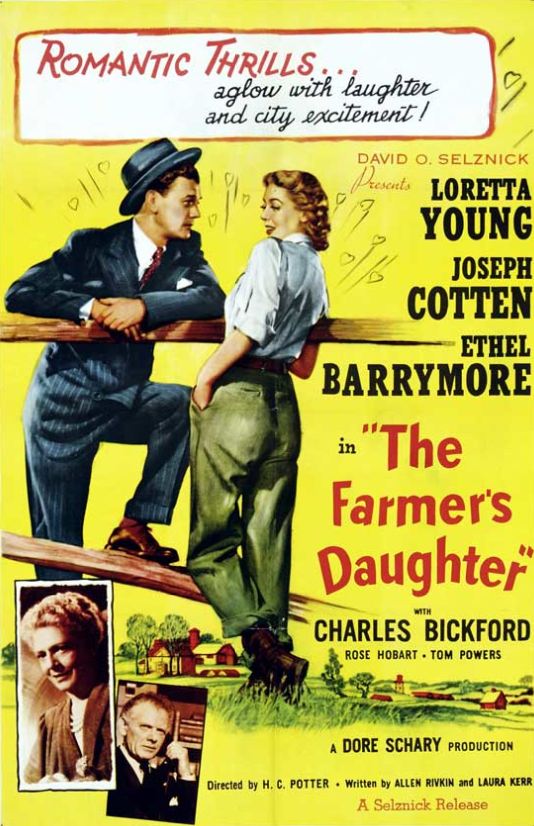
The Farmer’s Daughter (March 25, 1947)

H.C. Potter’s The Farmer’s Daughter has a title that makes it sound as if it might be an extended dirty joke that also involves a traveling salesman, but it’s not. It’s a funny, romantic, and inspiring film about a young woman whose life takes a very different direction than the one she expected it to take when she left home for the big city.

Katrin Holstrom (Loretta Young) lives on a farm in “Redwing County” with her Swedish father and mother (Harry Shannon and Anna Q. Nilsson) and her three brothers, Peter (James Arness), Olaf (Lex Barker), and Sven (Keith Andes). She goes to Capital City (a thinly veiled Chicago) to pursue a nursing degree, but an unscrupulous “friend” of her family named Adolph (Rhys Williams) weasels all of her money out of her and she’s left penniless.

She takes a job as a maid in the palatial home of Agatha Morley (Ethel Barrymore), a grand dame and behind-the-scenes political figure whose son, Glenn Morley (Joseph Cotten), is a congressman. When asked about her qualifications, Katrin tells Ethel that at home, she makes six beds every morning, does the washing and ironing for her three brothers, herself, and mama and papa, cleans all seven rooms and does dishes, helps mama with the canning — preserves, meat, eggs, dill pickles, smoked ham, and bacon — waits on tables (40 hands at harvest time), and makes glögg at Christmas. And that’s just what she does indoors. Outdoors, she plows with a horse and tractor, hoes potatoes, shucks wheat, milks cows, beds horses, butchers pigs, kills and dresses chickens, and cuts wood for both mill and stove.

She’s hired.

She doesn’t mention that she also give back-cracking, limb-twisting, lung-emptying Swedish massages, which she does for Glenn while he’s recovering after falling through the ice while skating with her.

Katrin is also a whip-smart young woman who speaks her mind as easily as she breathes. During a party for political bigwigs at the Morley home, where Katrin is serving drinks, a congressman named Wilbur Johnson (Thurston Hall) says it’s too bad Katrin has only just moved to town, because a vote from a pretty girl like her would have made his victory complete. She responds, “Oh, I’m sorry, sir, if I could have voted, I wouldn’t have voted for you.” He’s taken aback, but her Swedish-accented, lilting, matter-of-fact delivery leaves him speechless.

After the party, Glenn asks Katrin why she doesn’t like congressman Johnson, and she says it’s because he opposes a higher minimum wage. She agrees with Johnson that people should be responsible for themselves, but she believes in a living wage. When Glenn asks her what she means, she responds, “A living wage depends on whether you’re getting it or giving it.”

After Katrin stands up at a political rally and poses a series of hard questions to the Morleys’ candidate, Anders J. Finley (Art Baker), including a number of very specific questions about his record that show she’s done her homework, the opposition party asks her if she’d like to run against Finley for a seat in Congress.

Katrin’s no-nonsense, can-do, take-charge attitude takes her as far in politics as it did back on the farm, but her opposition to the Morleys’ candidate threatens the budding romance between her and Glenn. It also drives her back to her family farm in despair after a vicious smear campaign is launched against her.

As with most political movies, the film is careful not to offend anyone by getting too deeply into hot-button issues. It’s also not very nuanced. By the end of the film, Finley has gone from being a condescending chauvinist to a figure of pure evil who is in league with both gangsters and home-grown fascists.

But The Farmer’s Daughter still manages to be a very funny and occasionally sharp political satire. The script by Allen Rivkin and Laura Kerr is wonderful, and the actors all play their parts to perfection. Ethel Barrymore conveys much without even speaking, and Charles Bickford is especially good as the Morley’s crusty old butler, Joseph Clancy.

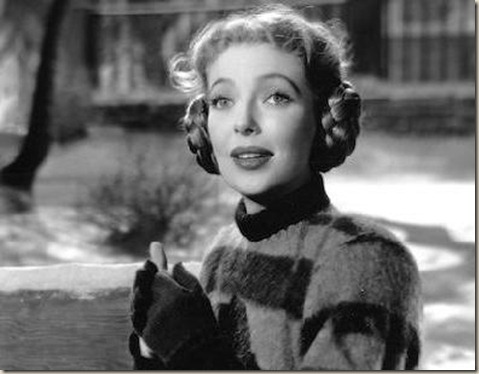
Loretta Young was the surprise winner of the Oscar for best actress at the 20th Academy Awards for her role in this film. (Rosalind Russell had been heavily favored for her performance in Mourning Becomes Electra.) I can’t compare Young’s performance to any of the other women who were nominated, because I haven’t seen their films yet, but I think her win was well-deserved. Katrin Holstrom, with her blond hair tied up in coiled buns and her Swedish accent, could have easily been a caricature, but Young imbues her with so much liveliness and depth that I fell in love with her, and was rooting for her all the way.

The Farmer’s Daughter has a light touch, and is very funny, but it’s still an inspiring film. Remember that when it was made, women had only had the right to vote at the national level for slightly more than 25 years, and only 41 women had served in the United States Congress.

It might not be the best movie I’ve seen so far this year, but it is the funniest, warmest, and most moving. Wait … maybe it is the best movie I’ve seen so far this year.

The Devil Thumbs a Ride (Feb. 20, 1947)

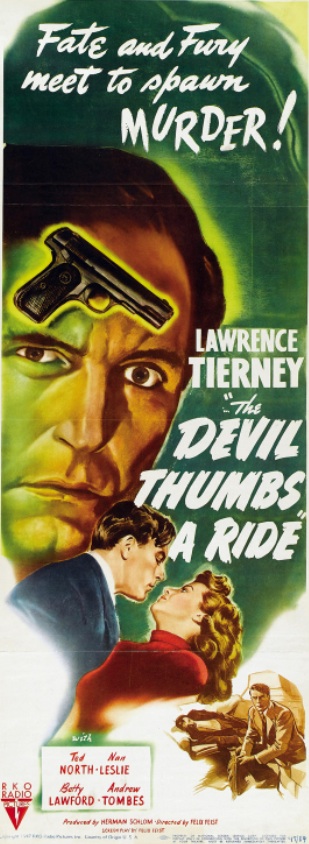
Felix Feist’s The Devil Thumbs a Ride has acquired a fearsome reputation over the years, so I wasn’t prepared for how weird and funny it ended up being.

This film has more oddball characters than you can shake a stick at. The protagonist, Jimmy Ferguson (Ted North), is a bra and panties salesman driving a 1941 gray convertible who has a bad case of the hiccups and a wine bottle on the seat next to him with a rubber nipple attached to it. It was a gag gift from his buddies, and he swears he only smells like booze. He hasn’t had a nip since before dinner. But he sure seems drunk, especially at the beginning of the movie.

There’s also a detective who keeps his dog in his car and belts his trench coat around his chest, a young gas station attendant who has a funny-looking daughter, an alcoholic night watchman who takes a $1 bet that he can’t drink an entire glass of whiskey like it’s water, and a wrongfully arrested wedding party who prove they’re not the people the cops are looking for by having the groom remove his toupee.

The one character who doesn’t come off like a caricature — and the major reason for the film’s enduring legacy — is Steve Morgan, a sociopathic robber, forger, and killer. He’s played by Lawrence Tierney, an actor whose notorious offscreen exploits — arrests for drunken brawling and driving under the influence — often overshadow his talents as an actor.

Toward the end of his life, in an interview with Rick McKay, Tierney said that he didn’t enjoy making The Devil Thumbs a Ride. He said, “I resented those pictures they put me in. I never thought of myself as that kind of guy. I thought of myself as a nice guy who wouldn’t do rotten things. I hated that character so much but I had to do it for the picture.”

Assuming Tierney wasn’t rewriting history, and he really did hate playing Steve Morgan, none of his discomfort is visible onscreen. Cruelty and duplicity are as natural for Steve as breathing, and despite this, he’s the most likable person in the film. The hapless salesman who gives Steve a lift is too goofy-acting and stiff to elicit much audience sympathy. And the cops who pursue Steve following his robbery of an old man outside of a San Diego bank are too incompetent and obsessed with playing poker to really root for.

Steve controls and manipulates people effortlessly. Within minutes of getting in Ferguson’s car, he’s renamed Ferguson “Fergie” and has picked up a couple of passengers of his own at a gas station — a bottle-blonde party girl named Agnes (Betty Lawford) and her prim, dark-haired friend Carol (Nan Leslie).

The Devil Thumbs a Ride is an hour-long paean to bad behavior. It moves too quickly for the viewer to stop and consider all the contrivances that lead Steve, Fergie, Agnes, and Carol to Fergie’s boss’s beach house in Newport. Along the way, there’s more boozing, lying, property destruction, and running from the cops than you’ll find in most movies twice as long.

It’s not quite a “lost classic” of film noir, like Detour (1945), and its humorous moments outweigh its chilling moments, but The Devil Thumbs a Ride is still well worth seeking out.

Code of the West (Feb. 20, 1947)

Code of the West, a programmer from RKO Radio Pictures, has the same pedigree as Sunset Pass (1946). Both films are based on novels by Zane Grey, the screenplays for both films were written by Norman Houston, both are directed by William Berke, both star James Warren and John Laurenz, and both feature Robert Clarke, Harry Woods, Steve Brodie, and Harry Harvey in supporting roles.

In Sunset Pass, the tall, lean, blond-haired, scowling Warren played a cowboy named “Rocky.” Here, he plays a cowboy named “Bob Wade.” John Laurenz plays the same character, Chito Rafferty, a comical, musically inclined Irish-Mexican. (Incidentally, “Chito Rafferty” was a sidekick character made famous by Richard Martin, who played the character in 33 different westerns from 1943 to 1952. Laurenz was the only other actor to play the character, and he only did so in Sunset Pass and Code of the West.)

While I won’t be able to tell you the plot of either of these films at this time next month, I thought Code of the West was the better picture, largely due to the presence of a young Raymond Burr, who is a smoother and more malevolent villain than Harry Woods was in Sunset Pass.

In Code of the West, Burr plays a land baron (what else?) named Boyd Carter. Carter and his henchmen know that the railroad is coming through town, but they’re keeping the information to themselves as they buy up all the land they can get their hands on. When a young banker named Harry Stockton (Robert Clarke) lends Bob and Chito money to stake a claim of their own, Carter’s men go into action.

If you were drawn to this film by the poster above, be forewarned that Carter’s arson-murder gang that blasts the frontier is mostly a collection of stock footage. But if you squint your eyes, suspend your disbelief, and take another sip of bourbon, you’ll be fine.

Sinbad the Sailor (Jan. 17, 1947)

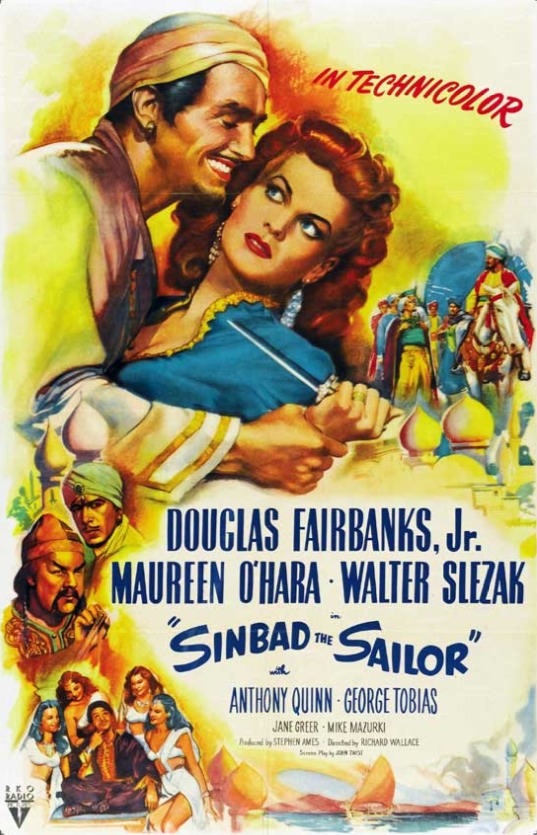
Sinbad the Sailor was the first film Douglas Fairbanks Jr. made after a decorated career serving in the Navy during World War II. The son of one of the most famous swashbucklers in Hollywood history, Fairbanks cuts a dashing figure in Richard Wallace’s overlong Orientalist fantasy, but there’s too much talk and too little excitement to recommend it to casual viewers.

I have fond memories of Nathan Juran’s The 7th Voyage of Sinbad (1958), which I saw on the big screen as a kid in the early ’80s. I don’t remember a lot about the lead performance by Kerwin Mathews, or how good the story was, but Ray Harryhausen’s stop-motion special effects blew me away. Sinbad the Sailor, on the other hand, has no wild monstrosities like the cyclops or the cobra woman. (A mynah bird on a string is the most memorable special effect, and it’s a bad one.) Instead it has fairly grown-up dialogue and a feisty romance between Sinbad (Fairbanks) and Shireen (a Kurdish woman improbably played by Maureen O’Hara).

Fairbanks plays Sinbad in a grand, theatrical style, with lots of balletic movements and arm sweeps. The Sinbad of Sinbad the Sailor is a braggart and raconteur who begins the film by promising to tell his rapt crew of his legendary “eighth voyage” — the one that never made it into the history books. It involves his quest for the lost treasure of Alexander the Great, hidden on the mysterious isle of Daryabar. He’s accompanied by his faithful (and comical) sidekick Abbu (George Tobias), a fat, effeminate cook named Melik (Walter Slezak), and a crew of roughneck sailors led by a brute named Yusuf (played by Mike Mazurki, of all people). Opposing him is the evil Emir (Anthony Quinn), who wants the treasure and the beautiful Shireen for himself.

RKO intended Sinbad the Sailor to be their big film of the 1946 Christmas season, but a strike at the Technicolor processing plant delayed its release. (A problem that plagued David O. Selznick’s Duel in the Sun, as well.) Instead, they dumped a little black and white movie called It’s a Wonderful Life into theaters. Oh well.

This was the first Douglas Fairbanks Jr. film I’ve seen, and while it wasn’t bad, it didn’t blow me away. (I’ve only seen one of Douglas Fairbanks Sr.’s films — the 1926 two-strip Technicolor adventure film The Black Pirate — and that one did blow me away.) Fairbanks channels his dad in a couple of action scenes in which he leaps from rooftop to rooftop, swings from balconies, somersaults through descending gates, and trips up legions of the Emir’s palace guards. The action sequences are good, but there are too few of them for a film that’s almost two hours long.

The lead actors are all good (I especially liked Anthony Quinn as Sinbad’s handsome antagonist), but the Arabian Nights-inspired sets are chintzy and the script is talky and repetitive. I didn’t hate Sinbad the Sailor, but I was looking at my watch a lot during the final 45 minutes.

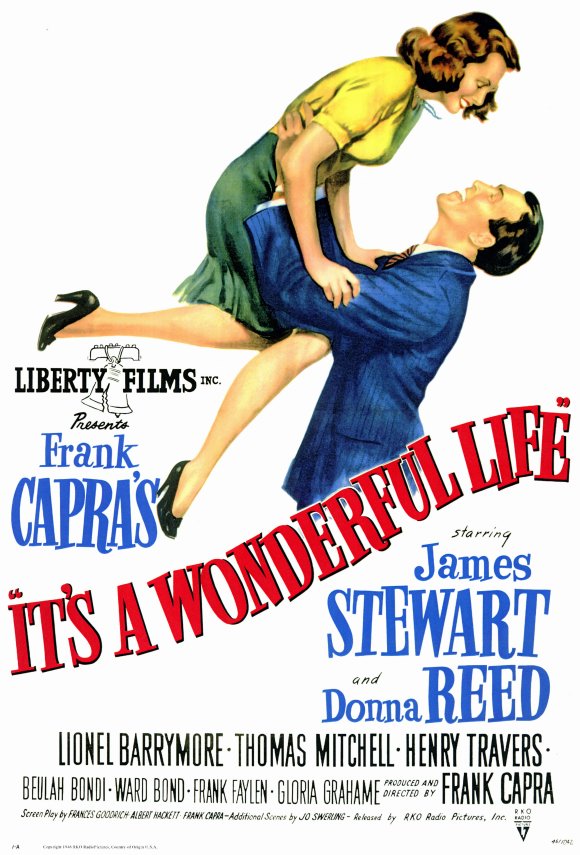
It’s a Wonderful Life (Dec. 20, 1946)

I can’t count the number of times I’ve seen Frank Capra’s It’s a Wonderful Life, and I’m not alone. When I was a kid, not a Christmas went by that it wasn’t shown on television multiple times. For many families, it’s required holiday viewing.

Like a lot of people, I didn’t see the film in its entirety until I’d already seen bits and pieces over the years and seen it satirized and referred to in countless TV shows and movies.

My first memory of seeing part of it was on my grandmother’s 13″ black & white TV. The film was almost over, and I had no idea what it was about. George Bailey (James Stewart) is experiencing what life would have been like if he’d never been born. He’s disheveled and looks terrified. Police officer Bert (Ward Bond) and cab driver Ernie (Frank Faylen) watch as he explores the abandoned, ramshackle version of his own home. The scene is full of darkness and shadows. It has the look of a film noir, and I found it scary.

If you’ve never seen It’s a Wonderful Life, you might think it’s the exact opposite — sappy and sentimental — but that’s not the case. It’s a film full of dark moments, with a sense of desperation that’s always threatening to bubble to the surface. The most famous part of the film — George seeing what life would have been like in Bedford Falls, NY, if he’d never been born — occupies a relatively small amount of the total running time. Most of the film tells the story of an ordinary man who ended up living a very different life than he dreamed he would.

When he was young, George dreamed of going to college, traveling the world, and becoming a titan of industry. His life is an emotional game of tug. He puts off college, stays in Bedford Falls, and even gives away the money he and his wife Mary (Donna Reed) put aside for their honeymoon in order to save the family business, Bailey Building & Loan. George always does the right thing because he’s a decent person, but he’s a real person, too. Each little depredation eats away at him. He loves his wife and four children, but when the evil old Mr. Potter (Lionel Barrymore) spirits away $8,000 from his absent-minded Uncle Billy (Thomas Mitchell), George loses hope. It looks as if the family business might not only be ruined, but George might also be headed to prison.

George asks Potter for a loan, and Potter points out that while he needs $8,000, he carries a life insurance policy worth $15,000, which means he’s worth more dead than alive. The desperate George takes this cruel assessment to heart. He heads home, yells at his children, trashes part of the house, and goes out to get good and drunk. After getting punched in the face in the bar, he crashes his car, stumbles to a bridge, and contemplates killing himself. It’s at this point that a frumpy angel named Clarence (Henry Travers), who has “the I.Q. of a rabbit and the faith of a child,” arrives to show him just how much he really is worth.

It’s a Wonderful Life works as well as it does because it earns every one of its emotional moments. Take, for instance, one of the pivotal moments of George Bailey’s boyhood. George (played by the wonderful Bobbie Anderson, later to be known professionally as Robert J. Anderson) has an after-school job in the local pharmacy, and stops old Mr. Gower (H.B. Warner) from making a fatal mistake. The audience knows that Gower has slipped up not only because he’s drunk, but because he’s distraught following the death of his son. When George returns, having failed to deliver the poisonous “medicine,” Gower beats him savagely. When Gower finally realizes the fatal mistake George has stopped him from making, he breaks down and embraces the boy in an outpouring of emotion.

I really meant to re-watch It’s a Wonderful Life and write a review of it before Christmas. But one thing led to another and I got behind in my movie-watching schedule. I’m glad I didn’t get around to seeing it until now, though. It reminded me just what a great film it is. So many “holiday films” are unwatchable after December 25, but It’s a Wonderful Life was just as engaging and emotionally satisfying in mid-January as it is any other time of the year.

Dick Tracy vs. Cueball (Dec. 18, 1946)

Dick Tracy vs. Cueball begins with a montage of Dick Tracy and his rogues’ gallery from the Sunday funnies — B.O. Plenty, Gravel Gertie, Vitamin Flintheart, Flattop, etc. — and ends with a face that Chester Gould never drew. He’s a chrome-domed, pug-nosed bruiser called Cueball, and his cartoon image eventually dissolves into the visage of the character actor who plays him, Dick Wessel, looking menacing as all get-out as the recently paroled thug.

In the opening scene of the film, Cueball sneaks onto an ocean liner that has just docked, forces his way into the compartment of a passenger named Lester Abbott (Trevor Bardette), and demands he hand over his diamonds. When Abbott fights back, Cueball wraps a braided leather strap around his neck and strangles him to death. It’s not as shocking as the murder that opens Dick Tracy (1945), but it’s still fairly gruesome by ’40s standards. (We see it in silhouette, and Cueball even drives his knee into the small of Abbott’s back as he garrotes him.)

Police detectives Dick Tracy (Morgan Conway) and Pat Patton (Lyle Latell) run down clues and question Abbott’s employer, jeweler Jules Sparkle (Harry Cheshire). Pat trails Sparkle’s diamond cutter, Simon Little (Byron Foulger), to a meeting with his hideous assistant Rudolph (Skelton Knaggs), while Tracy follows Sparkle’s secretary, Mona Clyde (Rita Corday), to a rendezvous with antiques dealer Percival Priceless (Douglas Walton).

Meanwhile, Cueball seeks help from Filthy Flora (Esther Howard), the proprietor of a waterfront dive bar called “The Dripping Dagger,” and it becomes clear that he is a pawn in a game he doesn’t fully understand. He’s a pawn who kills as easily as other men breathe, however, and before the film is over, he’ll have murdered three people in his quest to get $20,000 for a score of diamonds worth $300,000.

Like Morgan Conway’s previous outing as Dick Tracy, this picture is a solid, unpretentious police procedural that moves at a nice clip. Many of the characters never appeared in Chester Gould’s comic strip, but they’re crafted in the right spirit. Gould’s bad guys may have been grotesque caricatures with ridiculous names, but he treated them with dead seriousness. Dick Tracy vs. Cueball does the same thing. There’s plenty of comic relief whenever the pill-popping Vitamin Flintheart (Ian Keith) is onscreen, but there’s nothing funny about Cueball slapping Filthy Flora across the face with his leather braid before he chokes her to death with it.

Gordon M. Douglas directs with energy and élan. His camera setups are utilitarian, but the angles and lighting create a dramatic noir atmosphere. Dick Tracy vs. Cueball is a violent B mystery thriller with 0% body fat and a lot of muscle.