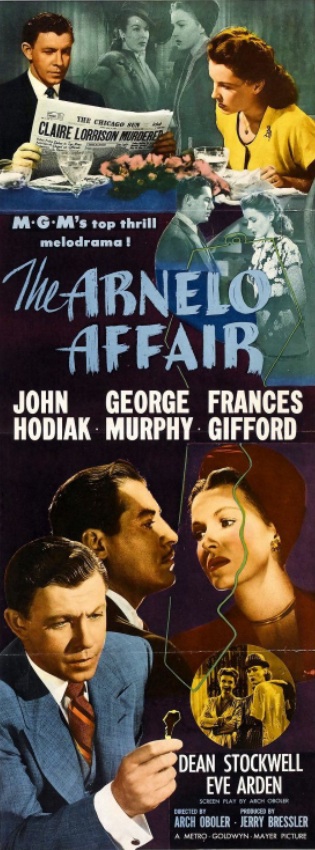
 Arch Oboler’s The Arnelo Affair is a crime melodrama with so much voiceover narration that most of it can easily be understood and enjoyed by blind people.
Oboler cut his teeth in radio. His most famous work was for the horror anthology Lights Out, which is one of the scariest and most gruesome radio shows of all time. Oboler was a native of Chicago and the child of Jewish immigrants from Latvia. He was a prolific writer — one of the most talented in the medium of radio. His work as a film director is more hit or miss.
The Arnelo Affair, his third film, is based on a story by Jane Burr and takes place in Chicago. It starts out promisingly, with a lot of heat between its protagonist, Anne Parkson (Frances Gifford), and the magnetic, mustachioed nightclub owner Tony Arnelo (John Hodiak). Anne is married to a lawyer and all-around stuffed shirt named Ted (George Murphy), who’s such a drip that he won’t let their 9 year-old son, Ricky (Dean Stockwell), touch any of the tools in the room in their house marked “Ricky’s Workshop.”
The Parksons have been married for 12 years (which, if Gifford’s character is the same age as she is, means they got hitched when she was only 14 or 15), and Anne is clearly neglected and unloved. When her path crosses Arnelo’s, his persistence and menacing charm draw her to him.
Eve Arden, at this point typecast as the worldly and knowing friend of the troubled female protagonist (see also Mildred Pierce and My Reputation), plays Anne’s friend Vivian, who cautions Anne that “Canaries and hawks don’t make good playmates.”
She’s right, of course, and when Arnelo murders one of his other girlfriends in order to draw Anne closer to him, Anne will realize what a dangerous game she’s been playing.
Oboler’s script is perceptive about infidelity, and the dialogue is more believable than in most melodramas, but Oboler’s direction is flat, and he relies too heavily on voiceover narration by Gifford to explicate her character’s emotions. The Arnelo Affair isn’t bad, but after 45 minutes it loses momentum and never really picks up again. It might have made a better 60-minute B movie programmer from one of the small studios than a 90-minute maudlin MGM melodrama.
 The Clock is the first film Judy Garland made in which she did not sing. She had specifically requested to star in a dramatic role, since the strenuous shooting schedules of lavish musicals were beginning to fray her nerves. Producer Arthur Freed approached her with the script for The Clock (also known as Under the Clock), which was based on an unpublished short story by Paul and Pauline Gallico. Originally Fred Zinnemann was set to direct, but Garland felt they had no chemistry, and she was disappointed by early footage. Zinnemann was removed from the project, and she requested that Vincente Minnelli be brought in to direct.
 OCD Viewer