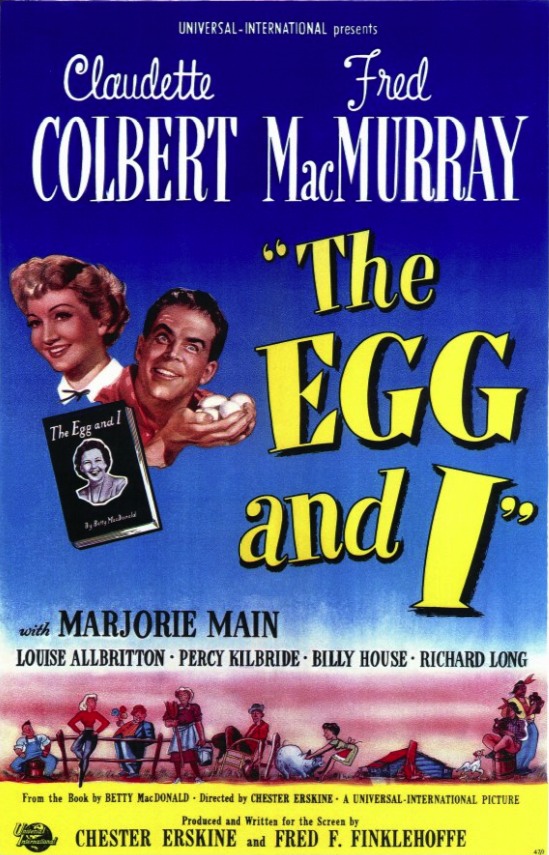
 Chester Erskine’s The Egg and I begins with Claudette Colbert dressing down a comical, goggle-eyed Pullman porter. (Was there ever any other kind of Pullman porter in the movies?) The poor fellow drops an egg on the floor of the train car. When he says, “It’s just an egg,” Colbert flips her wig and exclaims, “Just an egg?!?” She asks him if he’s ever stopped to consider how much work it takes to bring an egg into this world. After the chastened porter scurries out, she addresses the camera directly and says, “And I’ll bet you think an egg is something you casually order for breakfast when you can’t think of anything else. Well, so did I once, but that was before the egg and I.”
And then, after the opening credits roll, we’re introduced to Betty MacDonald (played by Colbert), who goes along with her goofily happy, wild-eyed husband Bob’s plan to move out to the country and run a farm.
Bob MacDonald (Fred MacMurray) served in combat in Okinawa, and he’s so happy to be back home that he’s going to make good on his foxhole promise to himself to devote himself to growing things from the soil and raising livestock. Returning to the land. Getting back to basics. The whole nine yards.
Bob actually seems a bit crazy. If this wasn’t a light comedy, I’d say Bob was suffering from post-traumatic stress disorder manifesting as mania. But since it’s a comedy, his zeal is played for laughs. He’s insensitive to everything going on around him. When Betty falls off the roof into a washbucket, he looks down and asks, “What are you doing down there?” He also buys a dog named Sport who’s already bitten everyone in town and can’t be too near livestock. (I hope he didn’t pay too much for him.)
The Egg and I was based on the 1945 best-seller by Betty MacDonald, the author of the popular series of Mrs. Piggle-Wiggle books for children. The Egg and I detailed her real-life experiences as a young woman living on a small chicken farm in Washington State with her first husband, Robert Heskett, from 1927 to 1931. I haven’t read the book, but by all accounts it’s more witty and acerbic than the film adaptation, which suffers from an overabundance of broad comedy.
If you’re in the mood for a slapstick barnyard comedy, however, The Egg and I offers everything you’ll expect — goats eating hats, ramshackle structures, leaky roofs, beds with rusty springs, leaky buckets, rotten boards, Betty sawing off the limb of the tree she’s sitting on, Betty wrestling with a sow and ending up in the mud, and hillbilly stereotypes galore, such as Bob and Betty’s neighbors, “Ma” and “Pa” Kettle, whose front yard has a hand-painted sign that says “beware of the childrun.” When Betty discusses the oldest boy, Tom Kettle (Richard Long) with Ma, and says, “He ought to go to college,” Ma responds, “College?!? What fer?”
Marjorie Main and Percy Kilbride’s earthy performances as Ma and Pa Kettle were so popular in The Egg and I that they went on to star in nine more films as the characters, Ma and Pa Kettle (1949), Ma and Pa Kettle Go to Town (1950), Ma and Pa Kettle Back on the Farm (1951), Ma and Pa Kettle at the Fair (1952), Ma and Pa Kettle on Vacation (1953), Ma and Pa Kettle at Home (1954), Ma and Pa Kettle at Waikiki (1955), The Kettles in the Ozarks (1956), and The Kettles on Old MacDonald’s Farm (1957). Main was even nominated for an Oscar for Best Supporting Actress for her role as Ma Kettle in The Egg and I. (Unsurprisingly, she lost out to Celeste Holm, who co-starred in Gentlemen’s Agreement.)
While The Egg and I was a huge hit in 1947, I can’t say I really enjoyed it. It relied too much on slapstick humor, and Colbert and MacMurray were both much too old for the roles they were playing. I thought it was mostly dumb, and you couldn’t pay me to watch any of the Ma and Pa Kettle films that followed it.*
—
*This is actually a lie. If you’re interested in paying me to watch any of the Ma and Pa Kettle films, please contact me.
 Republic Pictures is the unassailable king of the cliffhangers after the silent era. Most of the best chapterplays of the ’30s and ’40s were Republic productions. Dick Tracy (1937), The Lone Ranger (1938), Zorro’s Fighting Legion (1939), Adventures of Red Ryder (1940), Mysterious Doctor Satan (1940), Adventures of Captain Marvel (1941), Jungle Girl (1941), Spy Smasher (1942), Perils of Nyoka (1942), The Masked Marvel (1943), and Captain America (1944) are just a few of the more than sixty serials produced by Republic Pictures, most of which are still incredibly entertaining. The best Republic serials combined wild action and elaborate stunts with nicely paced stories that could be strung out over 12 to 15 weekly installments with a few subplots here and there, but nothing too complicated or that viewers couldn’t pick up with in the middle. Each chapter ended with a cliffhanger (like Captain Marvel flying toward a woman falling off a dam, or a wall of fire rushing down a tunnel toward Spy Smasher). The next week’s chapter would begin with a minute or two of the previous week’s climax and the resolution, and the cycle would repeat until the final chapter.
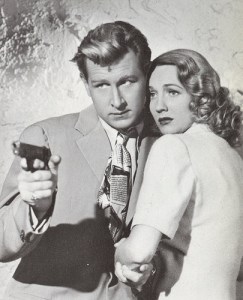 The first film serial featuring Secret Agent X-9 was made by Universal in 1937, and starred Scott Kolk as Agent X-9, a.k.a. “Dexter,” who sought to recover the crown jewels of Belgravia from a master thief called “Blackstone.” The second featured a boyish-looking 32-year-old Lloyd Bridges as Agent X-9, a.k.a. “Phil Corrigan.” Made toward the end of World War II, the 1945 iteration of the character focused on wartime intrigue and Corrigan’s cat-and-mouse games with Axis spies. Taking a cue from Casablanca (1942), the serial was set in a neutral country called “Shadow Island,” in which Americans, Japanese, Chinese, French, Germans, Australians, and the seafaring riffraff of the world freely intermingle. A fictional island nation off the coast of China, “Shadow Island” has a de facto leader named “Lucky Kamber” (Cy Kendall) who owns a bar called “House of Shadows” and has a finger in every pie, including gambling and espionage. Various German and Japanese military officers, secret agents, and thugs run amuck in this serial, but the one who most stands out is the unfortunately made-up and attired Victoria Horne as “Nabura.” In her role as a Japanese spymaster, Horne is outfitted with eyepieces that cover her upper eyelids, appearing to drag them down from sheer weight. She doesn’t look Asian, she just looks as if her eyes are closed.
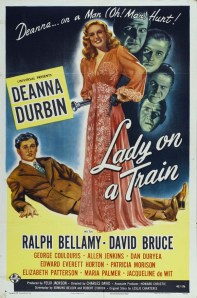 Deanna Durbin is an absolute delight in this farcical murder mystery. Durbin, a native of Winnipeg, Manitoba, was once one of the biggest stars in Hollywood, but never made a movie after 1948. (She currently lives in a small village in France, grants no interviews, and is reportedly very happy.) In Lady on a Train, she plays a young woman named Nicki Collins. When the film begins, Collins is sitting by herself in a compartment on a train entering New York on an elevated line. She has come from San Francisco to spend the holidays with her wealthy businessman father, and is currently engrossed in a mystery novel called The Case of the Headless Bride. When the train is briefly delayed, she looks out the window of her train car and witnesses a murder. Through a lighted window, she sees a young man beat an older man to death with a crowbar. She never sees the murderer’s face, however, and when she reports the murder to the police, the desk sergeant dismisses her report as the product of the overheated imagination of a girl who loves murder mysteries and can provide no real specifics of where she was when she saw the murder. Also, it’s Christmas Eve, and who want to traipse around looking for a murder that may or may not have occurred somewhere in Manhattan north of Grand Central Station?
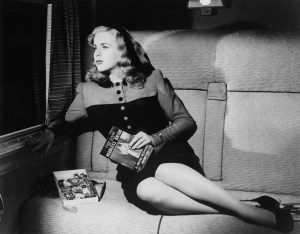 Lady on a Train is part mystery, part musical, part noir, part comedy, and part romance. The most surprising thing about this movie is that each element works perfectly, and they all complement one another. (Calling this film a noir is stretching it, but the final chase in a warehouse contains some striking chiaroscuro shot constructions, and is as tense as one could ask for.) Lady on a Train is also a delight for Durbin fetishists, since she has a different outfit and hairstyle in literally every scene. Sometimes the changes are subtle, but occasionally they’re impossible to miss, such as the scene in which she comes in out of the rain and is suddenly wearing gravity-defying, Pippi Longstocking-style braided pigtails.
 OCD Viewer