Tag Archives: United Artists

Carnegie Hall (Feb. 28, 1947)

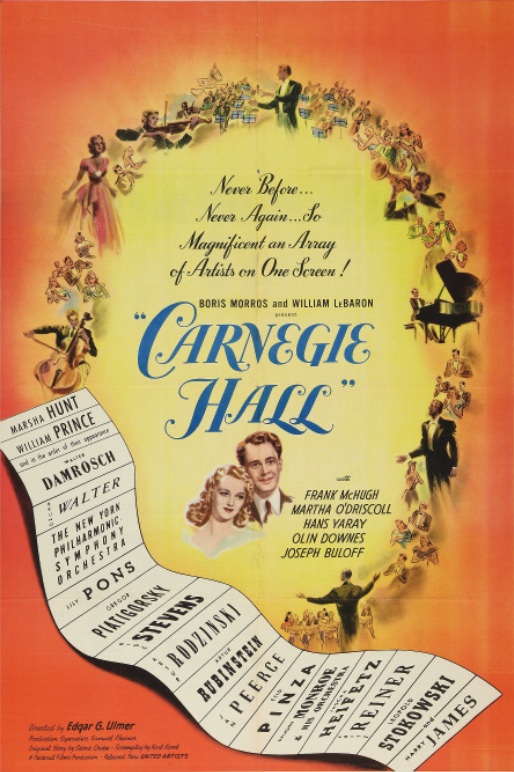
The poster for Edgar G. Ulmer’s Carnegie Hall boasts the following: “Never before … never again … so magnificent an array of artists on one screen!”

That’s true. It’s a film jam-packed with the crème de la crème of classical musicians, opera singers, and conductors from the first half of the 20th century.

What the poster doesn’t tell you is that the dramatic portions of the film are pretty dire. But if you can suffer through violinist Jascha Heifetz and conductor Fritz Reiner reading their lines in monotones as they discuss stage fright with an Irish usher named John Donovan (Frank McHugh), who says he only feels that strange feeling in the pit of his stomach when he’s eaten too much, you’ll be rewarded by hearing Heifetz play the First Movement of Tchaikovsky’s Violin Concerto in D Major with the New York Philharmonic Orchestra, under the direction of Reiner.

Carnegie Hall was directed by Edgar G. Ulmer, the poet of Poverty Row, who directed such minor masterpieces as Detour (1945), Bluebeard (1944), and The Black Cat (1934). Ulmer’s love of classical music was apparent in Detour — the main character is a nightclub pianist who, in one memorable scene, plays boogie-woogie variations on a Brahms waltz. Carnegie Hall is a love letter to great music and musicians, as well as to the eponymous edifice itself.

The plot in a nutshell (and there’s barely enough of it to fill two nutshells) involves an Irish girl named Nora Ryan (Marsha Hunt) who sees her first performance in Carnegie Hall as an adorable little rag-headed immigrant in 1891, and works her way up from cleaning woman to program director. She marries a febrile pianist named Tony Salerno (Hans Jaray, listed in the credits as “Hans Yaray”), who falls to his death while drunk when their son, Tony Jr. (William Prince), is still a baby.

Tony Salerno Jr. grows to maturity while being forced to diligently practice piano by his mother. They experience a rift after Tony Jr. falls in love with a nightclub singer named Ruth Haines (Martha O’Driscoll) and runs away to perform with crooner and band leader Vaughan Monroe. (Monroe is best known today for his version of “Let It Snow! Let It Snow! Let It Snow!” Ironically, Monroe wanted to be an opera singer, but the economic realities of the Depression coupled with a string of early hits led him to perform popular music exclusively.)

Eventually, Tony Jr. gets a record set released on RCA/Victor called “American Rhythms,” and performs his own composition, “57th Street Rhapsody,” onstage at Carnegie Hall as pianist and conductor of the New York Philharmonic, with soloist Harry James on the trumpet. It’s a performance that blends “high” and “low” music, and brings tears to his mother’s eyes. The end.

The drama is hackneyed and poorly written (and it doesn’t help that Jaray is utterly charmless as Tony Sr.), but the bulk of the film’s 2 hour and 15 minute running time is occupied by great performances — the Prelude to Die Meistersinger von Nürnberg, performed by the New York Philharmonic under the direction of Bruno Walter; soprano Lily Pons singing the “Bell Song” (“L’Air des clochettes”) from Delibes’s opera Lakmé; cellist Gregor Piatigorsky performing Saint-Saëns’s “The Swan,” from The Carnival of Animals (Le carnaval des animaux); mezzo-soprano Risë Stevens performing the end of the introduction and the start of the principal melody of Delilah’s song that seduces Samson in the second act of Saint-Saëns’s opera Samson and Delilah, followed by a performance of the Seguidilla from Act I of Bizet’s Carmen. And that’s just scratching the surface.

The DVD of Carnegie Hall that’s currently available from Kino Video looks great. The print is crisp, the blacks are deep, and the contrast is good. (And the “piano” scene from Detour is included as an extra.) As a dramatic film, Carnegie Hall doesn’t really succeed, but as a showcase for great musicians and singers, it’s a winner.
Ramrod (Feb. 21, 1947)

Ramrod
Ramrod (1947)
Directed by André De Toth
United Artists

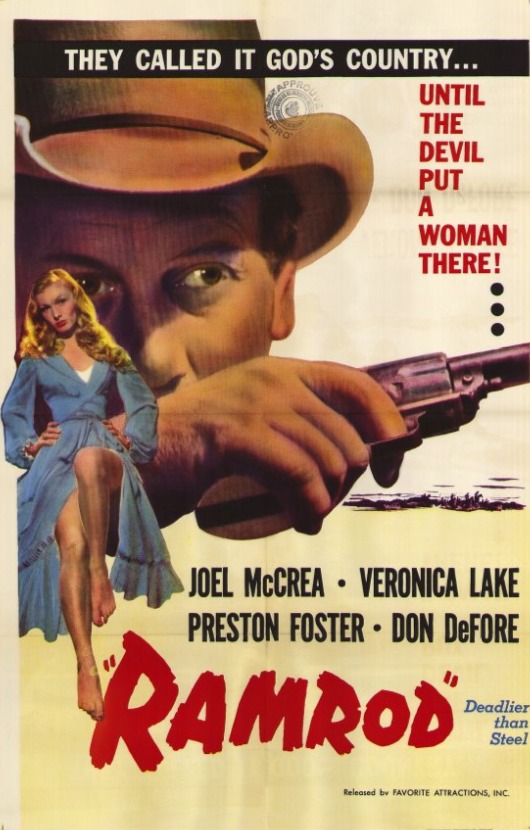
They called it God’s country … until the Devil put a woman there! screams the poster for André de Toth’s Ramrod.

That darned Scratch. Goin’ and puttin’ women where they oughtn’t to be.

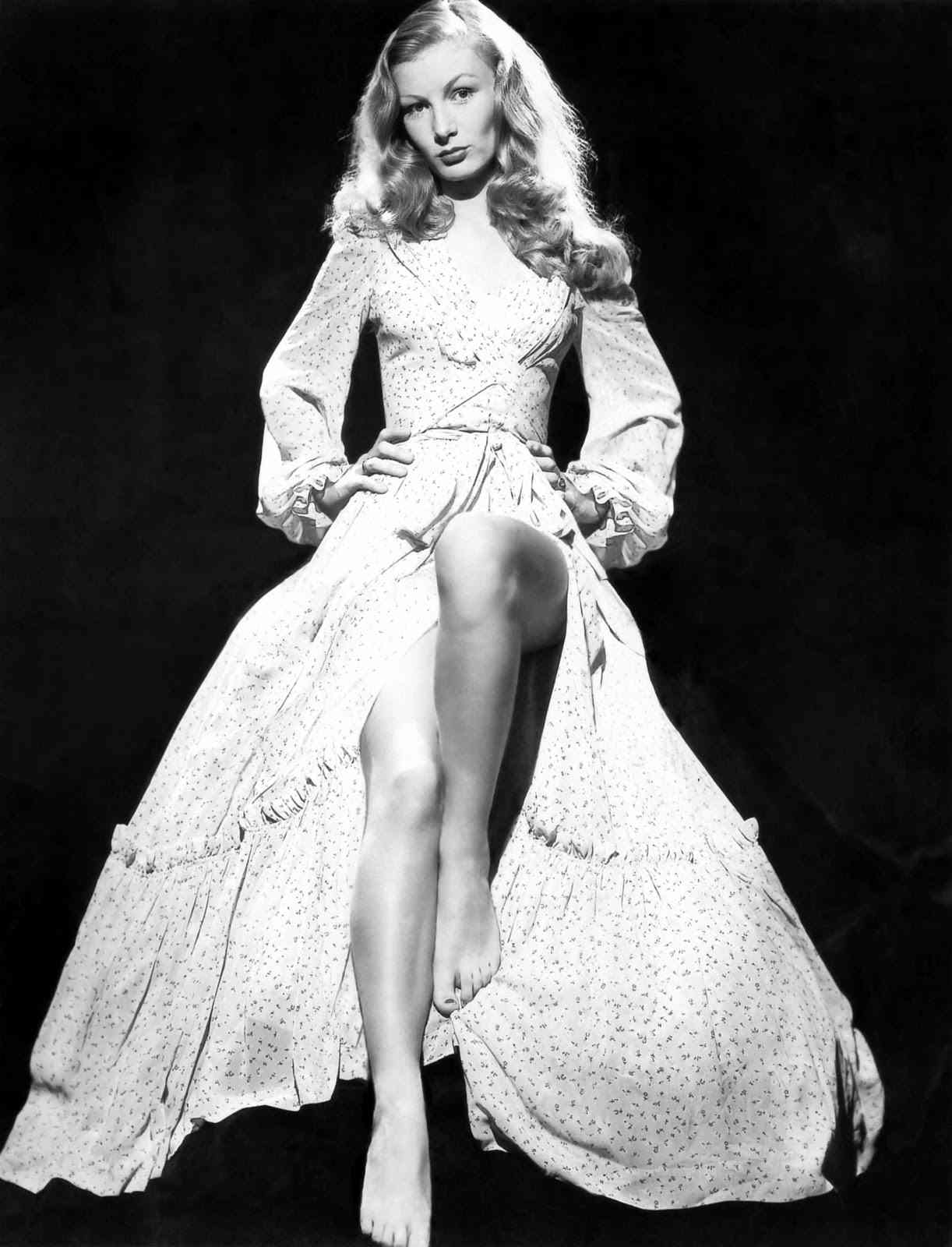
The woman in Ramrod is Connie Dickason, whose slight frame and small stature belie her will of iron. She’s played by Veronica Lake (de Toth’s wife from 1944 to 1952).

Connie’s fiancé, Walt Shipley (Ian MacDonald), plans to bring sheep through public grazing land, which hasn’t endeared him to local cattleman Frank Ivey (Preston Foster), who has Connie’s father, Ben Dickason (Charles Ruggles), in his pocket.

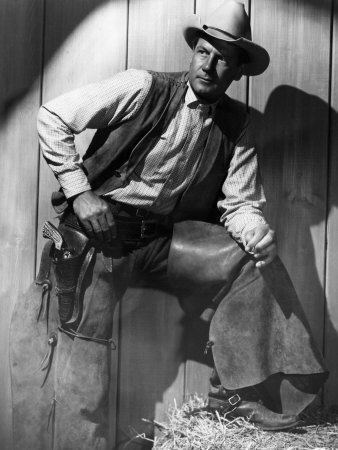
Alcoholic cowhand Dave Nash (Joel McCrea) has worked for Shipley for the past three weeks. At the request of Connie, with whom he has a history, he backs up Shipley when Ivey and his men attempt to stop Shipley from leaving on the night stage. (If Shipley gets out of town, he’ll come back with sheep.)

Sheriff Jim Crew (Donald Crisp) cautions Dave to stay out of it. When Dave says to the sheriff, “I work for Walt,” the sheriff responds, “For three weeks? What do you owe that fool, your life?”

All of this takes place in the first 10 minutes of the film. De Toth drops the viewer into the action in media res. Without a scorecard, it’s hard to keep track of who’s who during the first reel. (And it doesn’t help that Shipley and Ivey look nearly identical.)

Veronica Lake

But things become more clear as the plot rolls forward. Shipley decides that he doesn’t love Connie enough to die for her, so he heads out of town, leaving her his ranch. Connie’s father expects that she’ll do his bidding after Shipley departs, but she throws down the gauntlet with a fiery speech: “From now on I’m going to make a life of my own. And being a woman, I won’t have to use guns. This isn’t just a fight between father and daughter. You’ve pushed Frank Ivey at me ever since I can remember. For years I’ve watched him run things his way. The town, the valley, you, and now me! No one’s ever had the nerve to stand up to him. Well I have!”

Connie hires Dave to be foreman of her ranch, the Circle 66. He in turn hires an old friend of his, a handsome, charming loose cannon named Bill Schell (Don DeFore). Dave is determined that everything the Circle 66 does to fight Ivey be above board, but Connie and Bill have their own ideas. Connie may have made the decent and honest Dave “ramrod” of her outfit, but it’s the violent Bill Schell who is the true instrument of her will.

Joel McCrea

Joel McCrea has the pleasantly handsome, soft-featured face of the dad next door, but he’s tall enough and projects enough quiet menace to be convincing as the ramrod of the Circle 66 ranch. Don DeFore, who usually played pleasant, jovial men, is excellent playing against type as a cold-blooded gunman.

Ramrod is a great western. It’s based on a novel by Luke Short, and de Toth does an excellent job of capturing Short’s hard-boiled western prose and talent for characterization. The tone of the picture is closer to the film noirs of the period than it is to the westerns.

In Ramrod, de Toth creates a grim, violent world in which the righteous are just as likely to die as the wicked. Fistfights in this film don’t end with a bunch of broken furniture, they end with blood. A group of Ivey’s men beat an unarmed cowhand to death in front of Connie. When Bill Schell slaps a man in the face to enrage him, he tells Bill that he won’t be “rawhided” into drawing, so Bill burns his hand with a cigar. When Ivey shoots a man, he steps forward and finishes him off with another shot. Ramrod ends with a shootout, of course, but it doesn’t end with a quick draw or any fancy trick shooting. It ends with a shotgun blast to the gut.

True to the noir tone of the film, there’s a “good girl” to counterbalance Connie, named Rose (Arleen Whelan). The intertwined relationships of Dave, Bill, Connie, and Rose are well-played, and evolve naturally over the course of the film. Character drives the plot of Ramrod forward as much as bullets and fists.

Ramrod premiered on Friday, February 21, 1947, in Salt Lake City, at both the Utah and Capitol theaters. The world premiere event was part of Utah’s centennial celebration as a U.S. Territory. Ramrod went into wide release on May 2, 1947.

The Chase (Nov. 16, 1946)

Arthur D. Ripley’s The Chase is based on Cornell Woolrich’s 1944 novel The Black Path of Fear, which was adapted as a screenplay by Philip Yordan.

Chuck Scott (Robert Cummings), a sailor who was decorated during World War II, is now bedraggled and broke in Miami. While staring longingly through the window of a lunch counter at a griddle full of bacon and flapjacks, he finds a lost wallet full of $20 bills. He decides to return it to its owner, Edward Roman, whose I.D. says that he lives on Hermosa Drive, but not before he “borrows” a buck and a half to buy himself breakfast.

Eddie Roman (Steve Cochran) turns out to be a smooth-talking criminal who lives in a palatial home with his creepy right-hand man Gino (Peter Lorre) and his beautiful wife Lorna (French actress Michèle Morgan), whom he keeps a virtual prisoner. Roman is sinister right from the get-go, slapping a woman (Shirley O’Hara) who pokes him while manicuring his fingernails before he talks to Scott.

Gino and his boss seem amused by Scott’s honesty. (He even owns up to the 12 bits he liberated.) Roman asks Scott why he brought the wallet back. “Now that I’m here I wonder myself,” Scott says. “I guess I’m just a sucker.”

Roman gives “Scotty” — as he calls him — a job as a driver. Scott doesn’t like or trust either Roman or Gino, but he can’t say no to paying work. Things get weird right away. Roman has a contraption in the back seat that allows him to control the accelerator, speeding the car up to more than 100 m.p.h. to see how Scott handles himself. (My wife probably wishes all cars I drove came equipped with this feature.)

One night, Roman entertains a prominent ship owner named Emmerrich Johnson (Lloyd Corrigan), an overdressed fat man who spends most of his time laughing nervously … he can never quite tell if Roman’s joking or not. Unfortunately for Johnson, he doesn’t see the depths of Roman’s villainy and sadism. He’s never joking.

After Johnson refuses to commit to sell Roman the two ships he wants to buy, Gino takes Johnson on a tour of Roman’s wine cellar. While Johnson is excitedly fussing over a bottle of 1815 Napoleon brandy, Gino slips away and locks Johnson in the wine cellar with Roman’s vicious dog. When Johnson is attacked he drops the bottle of brandy on the floor and it runs out along the floor in a convincing approximation of blood. It’s an old cinematic trick, but a good one.

Meanwhile, Scott and Mrs. Roman are busy falling for each other. After one of their many trips to the beach, where she looks out over the water longingly as he stands behind her, waiting with the car, Lorna offers him $1,000 to take her to Havana. She thinks she can trust him, and she can’t make it on her own. He mulls it over for a little while but quickly gives in, booking passage for two on the S.S. Cuba.

They make it to Havana, but their plan to continue on to South America hits a snag, and Scott finds himself on the run, accused of murder.

Things get really weird an hour into the picture, when Scott wakes up in a room with a bottle of pills on the night table and no memory of what happened to him over the course of the past few days.

I haven’t read The Black Path of Fear, but I have read other novels by Woolrich, and blackouts, amnesia, and lost periods of time were recurring themes in his work. Like a lot of Woolrich’s booze-soaked prose, The Chase starts out as a fairly standard thriller, but by the end it’s hard to tell what’s real and what isn’t. In a better film, like Detour (1945), this could be counted as a real achievement. With The Chase, however, the confusion between dreams and reality seems more the result of slapdash filmmaking than anything else.

Cummings has a pleasant way about him, and is believable as an earnest, soft-spoken Everyman. Morgan is beautiful, but the script doesn’t give her a lot to do. Cochran and Lorre are the real gems in this film. Every scene in which they appear is full of menace. Each man has a calm exterior, but there’s always violence roiling below the surface.

If you’re looking for tight plotting or a clever climax, you won’t find it here, but The Chase has just enough oddball charm to recommend it to noir enthusiasts.

The Strange Woman (Oct. 25, 1946)

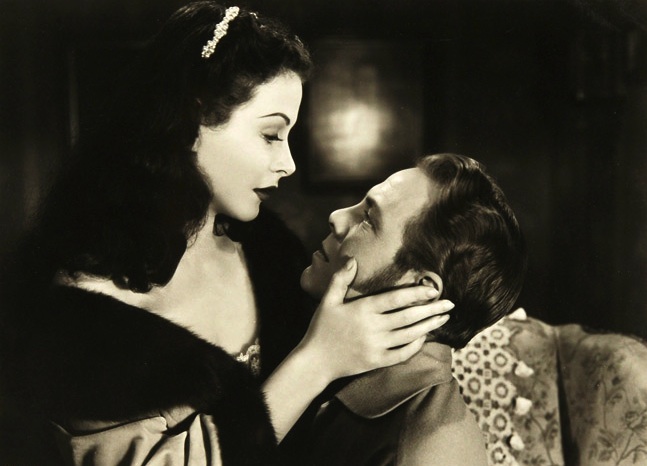
Edgar G. Ulmer’s The Strange Woman, directed with uncredited assistance from Douglas Sirk, is based on the 1945 novel of the same name by Ben Ames Williams.

Born in 1889, Williams was a prolific novelist who is probably best known today for the same reason he was famous in 1946; he wrote the novel Leave Her to Heaven in 1944, which was made into a hit film in 1945 starring Gene Tierney as Ellen Berent, a calculating sociopath with twisted ideas about love.

The Strange Woman was a natural choice to be made into a film following the success of Leave Her to Heaven. Both stories are psychosexual portraits of women with Electra complexes who use their allure to ensnare men and who don’t allow conventional morality to keep them from their goals; even taboos like murder mean nothing to them.

Unlike Leave Her to Heaven, The Strange Woman is a period piece. The film begins in Bangor, Maine, in 1824. Young Jenny Hager (Jo Ann Marlowe) is being raised by a single father (Dennis Hoey) whose only love in life seems to be drink. After Mr. Hager receives stern words from prosperous shop keeper and importer Isaiah Poster (Gene Lockhart) when he once again begs a jug of liquor off of him, the scene switches to a river bank, where young Jenny is tormenting Mr. Poster’s son Ephraim (Christopher Severn), a sickly boy who can’t swim. She pushes him into the river and holds his head under with her bare foot, but when Judge Henry Saladine (Alan Napier) arrives in a carriage, she says, “Poor, poor Ephraim,” and jumps in. She drags him to shore and blames his predicament on the boys she was with.

The judge is disgusted with Mr. Hager for stumbling through life drunk and failing to care for his daughter, but once Jenny and her father are alone, it’s clear that she loves him unconditionally. “Before long we’ll have everything,” she says. “Just as soon as I grow up we’ll have everything we want, because I’m going to be beautiful.” Mr. Hager tosses his empty jug into the river, and when the ripples clear, child actress Marlowe’s reflection has become that of the beautiful Hedy Lamarr.

Jenny may be all grown up, but clearly only a few years have passed. All the adults are played by the same actors, and things are much the same in Bangor. Her father is still a hopeless drunk and Mr. Poster is still the wealthiest, most powerful man in town. Bangor appears to be a little rowdier, however, with more commerce coming through the docks, and more drunken sailors stumbling around. Jenny and her friend Lena (June Storey) hang around the waterfront, attracting the attention of sailors. Lena tells Jenny that, with her looks, she could get the youngest and best-looking men around, but Jenny replies that she’s only interested in snagging the richest.

When her father confronts her, she flaunts her sexuality, bragging that she can make any man want her, and he beats her viciously. The whipping he gives her, while they stand face to face, is a little ambiguous, and more than a little sexual.

She runs away to Mr. Poster’s house, and shows him the stripes on her back, throwing her hair forward and dropping the back of her dress, as if she’s posing for a racy portrait, and his face registers both shock and lust.

It’s not long before Jenny marries Mr. Poster. It’s clear that he is a replacement for her father. Her physical longing, at least for the moment, is focused on her old friend — and new son-in-law — Ephraim, who has been sent away to school. She writes Ephraim a letter telling him how lucky he is to have a “nice young mother” and that she will “demand obedience and love.” She writes that if he refuses her, “I will punish you by not kissing you good night” and ends her letter with the line “…come home and see what a fine parent I can be. I do think families should be close, don’t you? Your loving mother, Jenny.”

Ephraim (now played by Louis Hayward) returns home, and he and Jenny slowly but surely fall for each other.

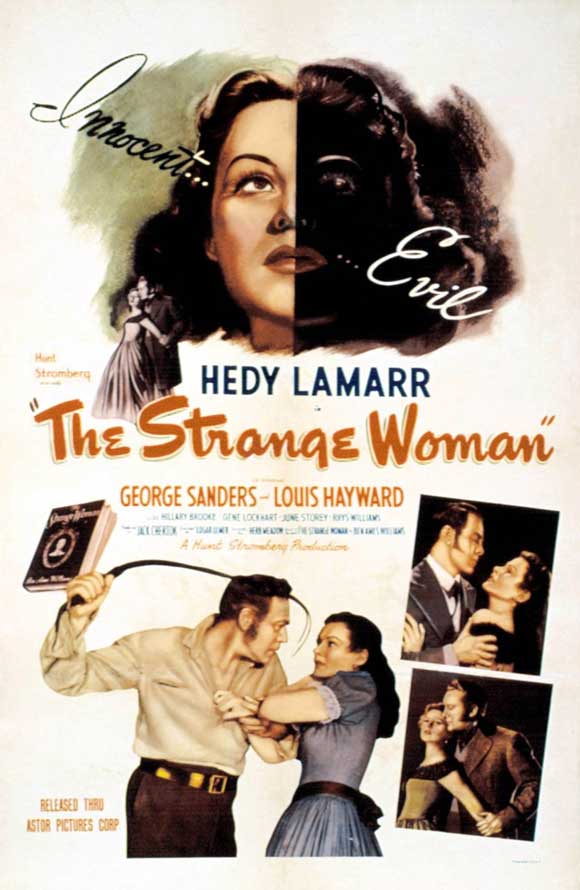
As the film poster above rather obviously shows, Jenny has two faces. For instance, when she and Ephraim sit on the banks of the river together, her recollection of pushing him into the river when he was a boy is flawed. She tells him that those rotten boys did it to him, and she tried to save him. Is she lying? Does she know she is lying? Does he know? Does he go along with it because he loves her, or does he truly believe her?

Jenny’s dual nature mirrors the nature of Bangor itself. On the one hand it is a prosperous New England town with an active churchgoing population of well-to-do people (like Mr. Poster and his young wife), but on the other hand it is a seedy little port city full of drunken sailors and “grog shops and low houses” (a.k.a. pubs and brothels). Jenny uses her husband’s money from his shipping and lumber businesses to improve the town, shaming him publicly into contributing large sums to the church. In private, however, she is carrying on with Ephraim, and even encourages him to arrange an “accident” for his father so they can be married.

Ephraim won’t be the last man in Jenny’s trail of conquest, either. As soon as she lays her eyes on John Evered (George Sanders), the tall, strapping foreman of Mr. Poster’s lumber business, it’s clear that the weak-willed Ephraim doesn’t stand a chance.

The Strange Woman is a well-made film with fine performances all around (with perhaps the exception of Gene Lockhart, who as Mr. Poster exhibits some of the most over-the-top reaction shots I’ve seen since watching Grayson Hall on Dark Shadows). Its narrative is sprawling, and clearly adapted from a novel, but the filmmakers keep everything moving along nicely.

Director Ulmer was a talented craftsman who toiled away in Poverty Row for most of his career, producing a few masterpieces, a few awful pictures, and plenty of films in between. The Strange Woman represents the rare film on his résumé with a decent budget and a reasonable shooting schedule. He was lent out by P.R.C. (Producer’s Releasing Corporation) at Lamarr’s insistence (apparently they were friends back in their native Austria-Hungary). He was paid $250 a week for the job. P.R.C. studio boss Leon Fromkess, on the other hand, received roughly $2,500 from United Artists. While he may have gotten the short end of the stick financially, the deal gave Ulmer a chance to work with a professional cinematographer (Lucien Andriot), a major star or two, a well-written script based on a hot property, and major studio distribution.

A Scandal in Paris (July 19, 1946)

This early film by renowned director Douglas Sirk is based on the life of Eugène François Vidocq, who was the founder of the Sûreté Nationale police force, and is generally regarded as the world’s first private detective. What makes Vidocq fascinating is that he became a crime-fighter only after a fairly lengthy career as a criminal.

Sirk’s film is only very loosely based on Vidocq’s ghost-written memoirs. Vidocq was the father of modern criminology. He is credited with the introduction of modern police methodology and record-keeping, as well as things we now take for granted, such as undercover work, ballistics, and plaster casts of footprints, but you won’t see much of this in A Scandal in Paris (which was also released under the title Thieves’ Holiday). It’s a lighthearted and romantic picaresque adventure in which the focus is firmly on Vidocq’s career as a rake and a rapscallion. The closest he comes to doing any actual police work is when he goes to elaborate and clever lengths to pin his crimes on a romantic rival.

In the world of the film, Vidocq was born in 1775, and came from a poor, honest family, “a little poorer than honest,” he says in voiceover. His mother stole a loaf of bread every time she went into labor in order to give birth in the only shelter available to her — prison. Vidocq claims his mother stole 11 loaves of bread and gave birth to 11 children. He spent the first 30 years of his life engaged in all matter of villainy, and used many surnames, since his father’s name was unknown.

Except for the year of his birth, none of the specifics match the official record, but George Sanders, who plays Vidocq, is such a smooth and engaging performer that I didn’t really care. When he breaks out of prison on his birthday with a file baked into a cake brought to him by the jailer’s daughter, he does so in the best tradition of cinematic Lotharios who can’t utter a true statement to save their lives, but whom you just can’t help but like.

Douglas Sirk was born “Hans Detlef Sierck” in Germany to Danish parents. He grew up in Denmark, but moved to Germany as a teenager. By 1942, he had emigrated to the United States, and was directing the stridently anti-Nazi film Hitler’s Madman (1943), which was made for the Poverty Row studio P.R.C., but was bought and distributed by the prestigious M-G-M. He directed nearly 50 films in Danish, German, and English, but today his reputation rests mainly on the lush melodramas he made in the ’50s, such as All That Heaven Allows (1955), Written on the Wind (1956), and Imitation of Life (1959).

A Scandal in Paris hasn’t gone down in history as a masterpiece, but it’s a pretty good film; light and fluffy, but always visually arresting and with plenty of sly humor. For instance, when we’re told two years have passed while he served in the army, Sanders as Vidocq says that this period of his life was omitted “Out of concern for ‘censorship (military).'”

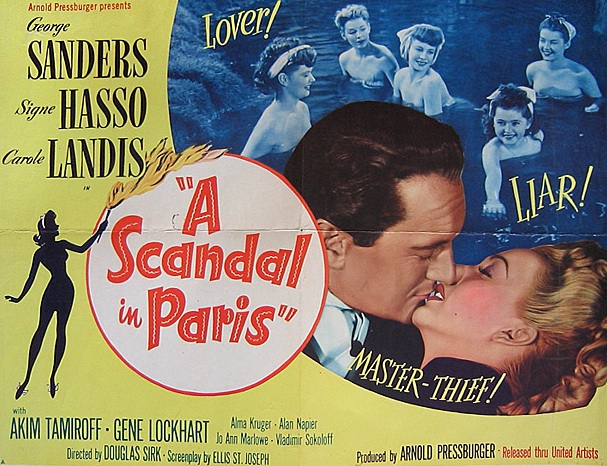
There are a number of interesting motifs running through the film, too. One of these is the English myth of St. George and the dragon. After Vidocq and his cellmate Emile (Akim Tamiroff) escape from prison, they pose for a painting as St. George and the dragon, respectively, before escaping on horseback, still in costume. The painting of them will later show up on a wall of the estate owned by Marquise de Pierremont (Alma Kruger) and Houdon de Pierremont (Alan Napier), the minister of police. Their daughter, Therese de Pierremont (Signe Hasso) falls in love with Vidocq’s image. When she meets him in the flesh, he rides to the rescue of a bunch of bathing beauties (see the poster above) who are terrified by a snake slithering along the banks of a river. Vidocq rides by, and like St. George, kills the serpent. He does so with a nonchalant lash of his riding quirt, not a lance, but the effect is the same. Therese swoons.

The scene is played lightly, as is everything else in the picture. Throughout, Sirk seems to be mocking traditional notions of heroism. Sanders is the perfect actor for the role. He never winks at the camera, but there always seems to be a joke that only he is in on. Lines like, “In crime, as in love, there are only those who do, and those who don’t dare,” could have been awfully clunky coming out of another actor’s mouth, but Sanders’s delivery is perfect.

Henry V (June 17, 1946)

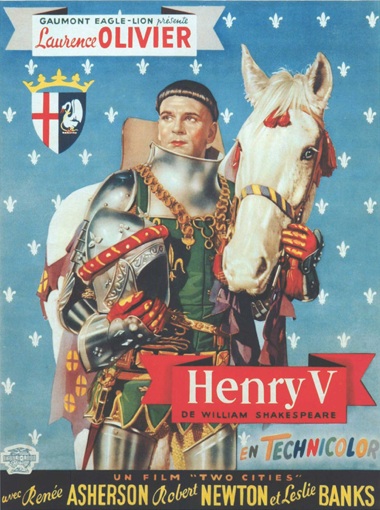
Laurence Olivier’s film adaptation of Shakespeare’s history play Henry V was originally released in the United Kingdom in November of 1944. (The date I’ve listed above is the release date of the film in the United States.) Following its release in the United States, Henry V was nominated for a 1946 Oscar for best picture, as well as Oscars for best actor, best score, and best art direction. It didn’t win in any of its nominated categories, but Olivier did receive an honorary Academy Award “for his outstanding achievement as actor, producer, and director in bringing Henry V to the screen.”

The recognition was well deserved (even though Olivier considered the award a “fob-off” from a jingoistic Academy). This film is a splendid achievement, and holds up remarkably well. Not only is it a fine cinematic adaptation of a great play, it’s a beautifully crafted film within a play within a film, in which Olivier the director has fun with convention while Olivier the actor delivers an assured and commanding performance as Henry, only recently a monarch after a misspent youth (chronicled by Shakespeare in Henry IV parts one and two).

The film’s full title is “The Chronicle History of King Henry the Fift With His Battell Fought at Agincourt in France,” and that’s how the title appears on the opening placard, which invites people to attend “Will” Shakespeare’s play, performed by the Lord Chamberlain’s Men at the Globe Playhouse this day, the first of May, 1600. There follows a panoramic vista in gorgeous, nearly surreal Technicolor of the London of Shakespeare’s day. It’s obviously a model, but it’s an effective one, with wisps of smoke rising from chimneys and tiny vessels dotting the Thames.

The beginning of the film attempts to faithfully recreate the theatrical experience one would have had at the Globe during Shakespeare’s time. There are no set dressings, and the Chorus (Leslie Banks), in each of his appearances, invites the viewer to suspend his or her disbelief, vividly describing the scene that is about to be played, and in so doing draws attention to the artifice of the play. As the film goes on, however, it moves out of the confines of the theater and becomes increasingly realistic, reaching its apex when Henry finally leads his troops in battle against the French at Agincourt.

Artifice and realism aren’t strictly delineated in Henry V, however. When the film first moves out of the theater to the court of France, the ocean is a static sea of waves that looks like the backdrop for a puppet show in Mister Rogers’ Neighborhood. And after the impressive battle, which was filmed in County Wicklow, Ireland (as a neutral country, it wasn’t ravaged by the war), artifice slowly returns in the form of phony-looking backdrops and a return to the stagey castle set of the French court.

When Olivier first appears on screen, it is as Oliver the actor, standing backstage in full costume, waiting for his entrance cue, and coughing into his hand in a decidedly unheroic fashion. As soon as he steps on stage, however, his voice commands attention. By the time he delivers his famous Saint Crispin’s Day speech, I was eating out of his hand. This is no mean feat, either, considering the historically accurate haircut Olivier saddled himself with, as well as his very noticeable eye makeup.

It’s common knowledge that Henry V was made with the cooperation of the British government and designed to be a nationalistic morale booster in the days following the Allied push into Normandy. Consequently, the scene in which Henry threatens to rape women and kill children was excised from the script, along with the hanging of Bardolph and Henry’s order to kill French prisoners. But it’s all in keeping with the tone of the film, which is more a celebration of theater and patriotism than it is a nuanced character study.

Spellbound (Dec. 28, 1945)

Spellbound
Spellbound (1945)
Directed by Alfred Hitchcock
United Artists

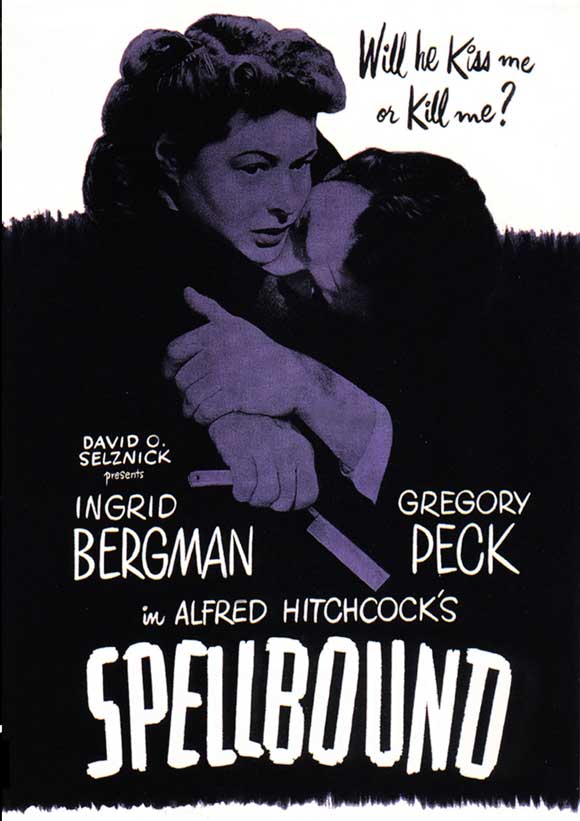
Alfred Hitchcock’s Spellbound gets knocked around for its basis in Freudian theory. Many reviews of the film written in the past 20 years use words like “dated,” “implausible,” and “preposterous.” A lot of these same reviews also praise the dream sequence, which was designed by Salvador Dalí, as the most memorable part of the film.

Freud has been knocked around, criticized, and discredited since the turn of the century, so to dismiss a film’s plot and ideas merely because they are “Freudian” seems like picking low-hanging fruit. Granted, Freud had a lot of wild ideas, but he was a brilliant thinker, and should be viewed as a philosopher and a humanist as much as a doctor or scientist. Also, many people who dismiss Freud out of hand haven’t actually read any of his writing, and cannot discuss his ideas beyond the fact that they’ve heard that they’re loony.

Upon revisiting the film, I found the much-praised dream sequence by Dalí overly gimmicky, adding little to the narrative beyond a “gee whiz” moment. (Hitchcock had almost nothing to do with its production. Dalí worked with a production unit from the Poverty Row studio Monogram Pictures on the sequence.) There’s nothing wrong with “gee whiz” moments, but Spellbound is an underappreciated film in Hitchcock’s oeuvre, and it bears rewatching as a complete work of art, not just as a showcase for pop surrealism or “dated” notions of neuroses and the unconscious.

In 1942, after winning back-to-back Academy Awards for best picture (then called “outstanding production”) for Victor Fleming’s Gone With the Wind (1939) and Alfred Hitchcock’s Rebecca (1940), producer David O. Selznick was morose. He took time off and sought treatment. His experience with the “talking cure” was so positive that he decided to produce a picture with psychoanalysis as its subject. In 1943, Hitchcock mentioned to Selznick that he owned the screen rights to the 1927 novel The House of Dr. Edwardes, written by Hilary St. George Saunders and John Palmer under the pseudonym “Francis Beeding.” The Gothic potboiler was about a homicidal lunatic who kidnaps a doctor named Murchison and impersonates him, taking over his position as head of a mental institution. A female doctor named Constance Sedgwick uncovers the impostor’s ruse and eventually marries the real Dr. Murchison.

In early 1944, Hitchcock and his friend Angus MacPhail crafted a preliminary screenplay in which Dr. Murchison was the outgoing head of the institution and Dr. Edwardes was his successor. They also created a romance between Constance and Dr. Edwardes, as well as the downhill skiing set piece that cures Edwardes of his amnesia. In March 1944, Selznick offered Hitchcock the talents of Ben Hecht, and Hitchcock and Hecht worked together for months to refine the screenplay. They even visited mental institutions, and preliminary versions of Spellbound featured more semi-documentary material than the final product does.

The final product may be, as Hitchcock told François Truffaut, “just another manhunt story wrapped up in pseudo-psychoanalysis.” But with Hitchcock behind the camera, even the most pedestrian manhunt story can become something dazzling. Hitchcock considered Spellbound one of his minor works, but part of his underestimation of the picture could have been due to all the clashes he had with Selznick, who was known for meddling with his productions. Selznick even hired his own therapist, Dr. May E. Romm, as a technical advisor for the film. There’s a story, possibly apocryphal, that when Dr. Romm told Hitchcock that an aspect of psychoanalysis in Spellbound was presented inaccurately, Hitchcock responded, “It’s only a movie.”

In Spellbound, Ingrid Bergman plays Dr. Constance Petersen, a psychoanalyst at Green Manors, a Vermont mental hospital. Dr. Murchison (Leo G. Carroll), the director of Green Manors, is being forced into retirement shortly after returning to work following a nervous breakdown. His replacement is the young, handsome Dr. Anthony Edwardes (Gregory Peck). “My age hasn’t caught up with me,” Dr. Edwardes responds when someone mentions how young he appears. But this isn’t the case, of course. He is actually an amnesiac who has no idea who he is or how he arrived at Green Manors. His state of confusion is such that he initially believed he was Dr. Edwardes, and is now playing the role because he doesn’t know what else to do. Dr. Petersen uncovers the truth, but she has already fallen instantly, madly in love with him. When the rest of the world learns the truth about Dr. Edwardes, he flees Green Manors. He still has amnesia, but he knows that his real initials are “J.B.” He heads for New York, and tells Dr. Petersen not to follow him. Does she follow his advice? Of course she doesn’t.

The romance is a high point of the film. The presentation of Dr. Petersen’s initial “frigidity” is certainly dated, but it leads to one of Hitchcock’s wildest sequences. When Bergman first kisses Peck, a shot of her forehead dissolves into a shot of a door. The door opens, revealing another door, which also opens, revealing another door, and so on.

Bergman’s performance is pitch perfect in every scene. Peck’s performance is less natural, but it works, since he is playing a man who literally doesn’t know who he is. (Apparently Peck craved more direction from Hitchcock, but Hitchcock just kept telling him things like “drain your face of all emotion.” Hitchcock had little patience for method acting.) Also, you would be hard-pressed to find two actors in 1945 who were more physically attractive than Bergman or Peck.

The cinematography by George Barnes is another high point. Each shot in Spellbound is beautifully constructed, and gives off a silvery glow. There are a number of choices that are still shocking, such as a flashback to an accidental death, or the penultimate sequence in the film, in which a P.O.V. shot shows a revolver being turned directly on the audience. When the trigger is pulled, there is a splash of red, the only instance of color in the film. It’s an assault on the audience par excellence from a man who spent his entire career assaulting his audience while almost never alienating them, which is not an easy thing to do.

Miklós Rózsa’s score for the film incorporates a haunting theremin melody, as did his score for The Lost Weekend, released around the same time. Rózsa won an Academy Award for best score for his work on Spellbound. Hitchcock was disappointed in the music, however, since it emphasized the romantic aspects of the film, and was more to Selznick’s liking than his own.

Sometimes creative dissonance leads to great creations, however. Spellbound is a great movie, whether or not its producer and director ever saw eye to eye.

Captain Kidd (Nov. 22, 1945)

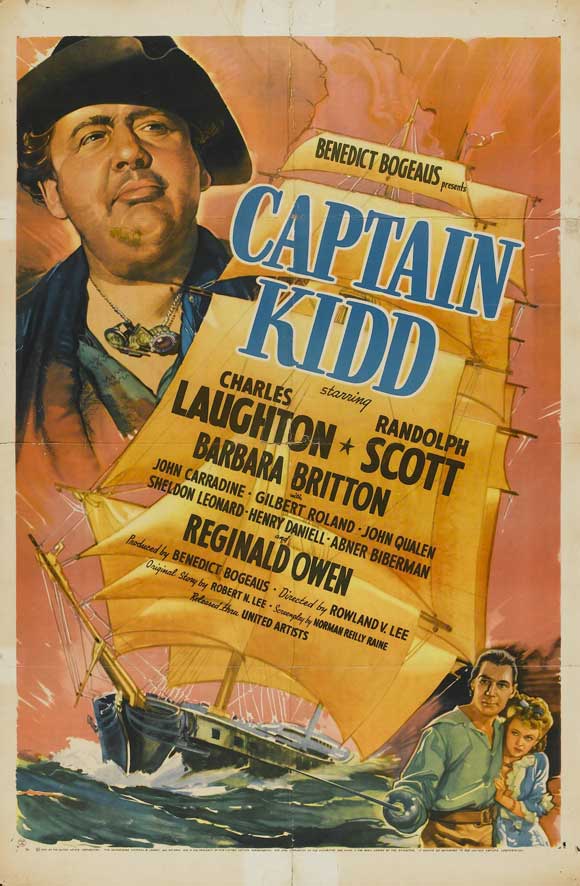
Released on Thanksgiving day in 1945, director Rowland V. Lee’s Captain Kidd is a pretty good swashbuckler, even though it’s not exactly a history lesson.

The real William Kidd was hanged for piracy in 1701, but there is still debate about the extent of his crimes on the high seas, and whether or not he should even be considered a pirate, as opposed to a privateer; someone employed by a nation to attack foreign shipping during time of war. But no matter how unjust his execution might have been, the name “Captain Kidd” and rumors of his buried treasure have passed into pirate legend along with names like Blackbeard and Calico Jack.

The film’s prologue shows the “ruthless” (according to the narrator) Captain William Kidd (Charles Laughton) and his pirate crew reduce the English galleon The Twelve Apostles to a smoking ruin near Madagascar and sneak off to a cove to bury their booty before high tide. His band of cutthroats includes B-movie stalwarts John Carradine and Gilbert Roland (playing characters named Orange Povey and José Lorenzo, respectively). When there is a dispute over the spoils, Kidd shoots one of his crew and buries him with the treasure. The impromptu eulogy he says over the grave is a masterpiece of irony.

The action moves forward to London, 1699. Kidd is receiving instructions on how to be a gentleman from a man named Shadwell (Reginald Owen), such as “A gentleman never sucks his teeth” and “A gentleman never pays his domestics high wages.” Kidd’s lust for gold is clearly matched by his lust for power. When he is granted an audience with King William III (Henry Daniell), he convinces the king that he is the right man to sail to India and give a treasure-laden ship called the Quedagh Merchant safe passage through the pirate-infested waters of Madagascar. In exchange he wants a castle and the title of a lord.

William III in this movie is pretty easily manipulated, because he also agrees to Kidd’s insane demand that he be given a crew of condemned pirates. Kidd claims the irreedeemable brigands will be loyal as long as they know a royal pardon awaits them at the completion of a successful mission. Along with some of his old mates from Newgate Prison, Kidd frees a wild card; a tall, well-spoken man named Adam Mercy (Randolph Scott), who was the master gunner to another pirate, Captain Avery. Mercy’s motives are mysterious, but it should come as no surprise to the audience when the stalwart and handsome Scott steps into the role of protagonist.

Scott is best known for his many roles in westerns. His physical appearance and his acting style were the Platonic ideal of a western hero, but he makes a decent swashbuckler, too. Scott doesn’t try too hard to hide his American accent in this movie, but he has a patrician bearing that makes up for it, and the scene in which he locks swords with Roland (who went on to play the Cisco Kid in a number of pictures) is exciting and masterfully directed. And the fact that he does it to protect Lady Anne Dunstan (Barbara Britton) from Roland’s unwanted advances should delight people who like to read into a scene’s Freudian undertones. (Scott and Roland are the two most virile men on the ship, and as they sword fight, the camera keeps cutting back to Britton, who gasps at each clash of steel on steel.)

Laughton and Scott were the same age, but they might as well have been from different species. While Scott was heroic and laconic, Laughton was a grotesque, blubbery-lipped character actor, and much of the pleasure in watching this film comes from his fantastic performance. No one else can deliver a line like, “Of all the slummocky blackguards!” and sound genuinely appalled while at the same time disgusting the viewer with his own loathsomeness.

Ernie Pyle’s “Story of G.I. Joe” (July 13, 1945)

StoryGIJoe
The Story of G.I. Joe (1945)
Directed by William A. Wellman
United Artists

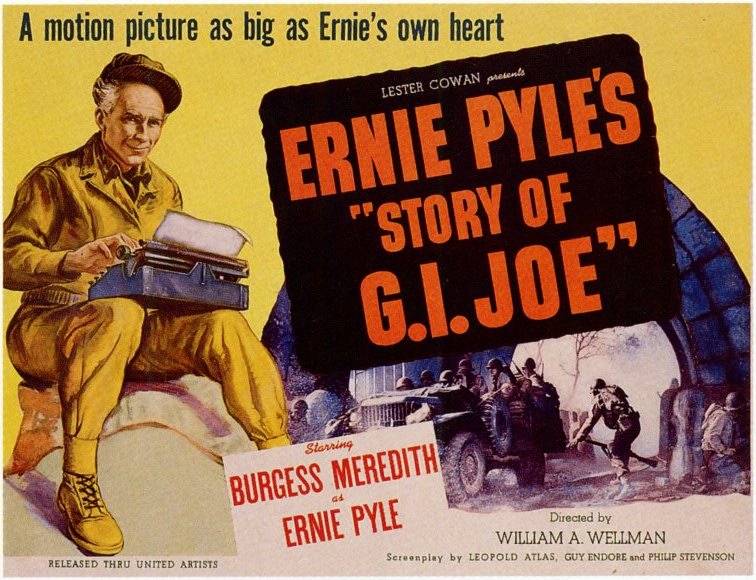
Ernie Pyle was a journalist for the Scripps-Howard newspaper chain. Long before the term “embedded journalist” entered the national consciousness, Pyle traveled with servicemen, writing about the war from their perspective. He had a conversational writing style, and attracted a huge following during World War II. He won the Pulitzer Prize in 1944 for his work as a war correspondent. He was killed in combat in 1945.

William A. Wellman’s film Ernie Pyle’s “Story of G.I. Joe” stars Burgess Meredith as Pyle, and co-stars Robert Mitchum as Lt. (later Capt.) Bill Walker and Freddie Steele as Sgt. Steve Warnicki.

Gen. Dwight D. Eisenhower said it was the finest war film he had ever seen, and I tend to agree with him. Wellman is a superior craftsman. Not only is The Story of G.I. Joe one of the best war movies I’ve seen, its gripping scenes of combat have yet to be improved upon. For all the credit that Saving Private Ryan (1998) got for ushering in a new era of realism to the World War II film, watching this film reminded me that the horrors of war don’t necessarily need to be depicted in gruesome detail to be affecting. The first combat scene comes early in the film, when a German plane attacks the company on the ground, strafing them as they return fire with mounted machine guns and BARs. After the dust has cleared, there’s a low-angle shot of the men looking down, dejected and stunned, followed by Walker brusquely saying, “All right men, in the truck. Come on, make it snappy, the medics’ll take care of him.” As the men disperse, he says to Pyle, “First death’s always the worst.” The corpse is never even shown on the screen, but the impact is huge.

The battle scenes in the film are gripping. Walker and his men fight amidst bombed-out rubble, in close quarters, in the destroyed towns and cities of Italy. But the focus of the film is on the day-to-day lives of the men in the infantry. For most of the film, Warnicki carries a phonograph recording of his baby boy’s voice that he received in the mail, but he can’t ever seem to find a record player. The living conditions of infantrymen are unglamorous. The men are nearly always unshaven, wet, filthy, tired, and underfed. Mud, rain, and fatigue are a few of the running themes. Pvt. Robert “Wingless” Murphy (played by Jack Reilly) is constantly falling asleep on his feet. His sleepiness provides a few comic moments, but not without some sadness. When he marries a WAC and they go the “bridal suite” (a truck), he passes out immediately.

Meredith is the first actor billed, and a large part of the film is about Pyle’s relationship with the men he writes about. When a G.I. asks Pyle his age, he says, “Forty-three,” and crosses himself. The G.I. responds, “I’m twenty-six. If I knew I’d live to be forty-three, I wouldn’t have a worry in the world.” Pyle says, “Oh yes you would. You’d be just like me. Worrying about whether you’d get to be forty-four.” Meredith was actually 37 years old when he made this picture, but with his dyed white hair and bald pate, he looks older. He has a natural rapport with the men, but he doesn’t try too hard to be anyone’s buddy. In fact, in most scenes, he’s almost aloof. He’s also more soft-spoken than the real Pyle, who had a blunt, straightforward style, at least in the single piece of newsreel footage I’ve seen of him.

Pyle’s ordinariness is stressed. He learns that he has been awarded the Pulitzer from a couple of servicemen during mail call. He shrugs off their praise, then sits down at his typewriter to eulogize a man who has just died, and whom he thought of as a friend. “He was just a plain Hoosier boy,” Pyle writes. “You couldn’t imagine him ever killing anybody.”

I liked Mitchum in his supporting role in the 1944 film Thirty Seconds Over Tokyo (another excellent World War II film), but he’s even better here. The Story of G.I. Joe received four Oscar nominations, including one for Mitchum for best supporting actor. It was the only Academy Award nomination he would ever receive. He never won an Oscar. In The Story of G.I. Joe he displays effortless star power, even though the film is not a star vehicle for him.

Director Wellman was a fighter pilot in World War I, where he earned the nickname “Wild Bill.” Like many pilots, he had no use for the infantry, and originally had no interest in making this film. Producer Lester Cowan went to great lengths to cajole Wellman into being his director, but Wellman only agreed to take on the job after meeting Pyle and spending time with him.

An aura of tragedy and sadness pervades the film. Pyle acted as technical advisor on the film. The extras were all American combat veterans of the campaigns in North Africa, Sicily, and Italy. Most of them were in the process of being transferred from active duty in the war in Europe to the war in the Pacific. And many of them were killed fighting in Okinawa, the battle in which Pyle himself was killed.

https://www.youtube.com/watch?v=OSaLIBfeS_E

The Southerner (April 30, 1945)

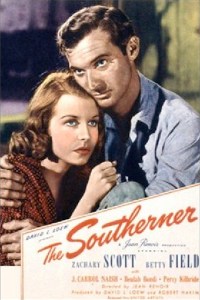
SouthernerFrench director Jean Renoir directed this adaptation of George Sessions Perry’s novel Hold Autumn in Your Hand, which won the first National Book Award in 1941. (The novel was adapted by screenwriter Hugo Butler, with uncredited contributions from Nunnally Johnson and William Faulkner.)

Zachary Scott, in a role originally intended for Joel McCrea, plays a Texas cotton picker named Sam Tucker who decides he doesn’t want to be a sharecropper anymore. He wants to grow his own cotton, harvest it, and be responsible for his own destiny. So he buys a piece of land and a ramshackle little house, and moves his wife (played by Betty Field), his children, and their crotchety grandmother onto it. Once there, the Tuckers must valiantly struggle against nature, disease, and their fellow humans to make a go of it.

The Southerner received three Academy Award nominations, including one for best director. Renoir didn’t win, but he was named best director by the National Board of Review, which also named The Southerner the third best film of 1945, after the World War II documentary The True Glory and Billy Wilder’s The Lost Weekend (which won the Oscar for best picture). Despite all these accolades, I was lukewarm about this picture. Scott is good in his role. His acting is understated, and he embodies “quiet dignity.” J. Carrol Naish is also very good as the villain of the piece, Tucker’s neighbor who seeks to destroy Tucker merely because of his inchoate hatred for anyone who tries to rise from his station in life. In fact, all the actors are good, except for perhaps Beulah Bondi, who hams it up a bit as Granny, a prickly pear if ever there was one. (Also, it might be hard for modern viewers to see her sitting in her rocking chair in the bed of a slow-moving pickup truck along with all the family’s worldly possessions and not think of The Beverly Hillbillies, which is unfortunate, since this film strives to be a realistic human drama.) My tepid reaction to the film is not related to any of the particulars, but rather to the overall feeling I had at the end. I just felt as if something was missing. Some essential component that would make me care about the characters and their situation more than I did.

Renoir is today best known for his French-language films like Grand Illusion (1937) and The Rules of the Game (1939), but he made a few English-language films besides this one. The first was Swamp Water (1941), which, like The Southerner, is about simple rural Americans. Perhaps my cool reaction to this film was due to the fact that I don’t find simple people as compelling as complicated people. Or maybe it’s just because the print I saw was kind of crummy. If the visual beauty of the countryside were allowed to shine through, maybe I would have liked it more. I’ve read that Renoir considered this his favorite American-made film. And, as I mentioned above, it was very successful with critics. So if this sounds like the kind of film you enjoy, then by all means you should see it. Meanwhile, I’ll be next door, watching a late ’40s film noir set in a big city about paranoid, sweaty people who aren’t quietly dignified in the slightest.