Tag Archives: Warner Bros.

Rope (Aug. 28, 1948)

Rope
Rope (1948)
Directed by Alfred Hitchcock
Warner Bros. / Transatlantic Pictures

Did you know that actor Dick Hogan’s last role was playing a symbolic male orgasm?

It’s true. Hogan — previously mentioned in this blog for his role in Shed No Tears (1948) — was cast in Alfred Hitchcock’s Rope as murder victim David Kentley.

It’s an important role, but a thankless one. As Kentley, Hogan has no lines, and is offscreen for most of the film’s running time.*

After the film’s opening credits have rolled, we hear his scream, then see him with a rope wrapped around his neck at the moment he is dying. He’s being murdered by a pair of thrill-killers named Brandon (John Dall) and Phillip (Farley Granger) who consider themselves “superior” and most everyone else — including their friend David — “inferior.”

Rope is based on a 1929 play written by British playwright Patrick Hamilton. Brandon and Phillip are thinly veiled versions of Leopold and Loeb, the infamous thrill-killers who in 1924 murdered a 14-year-old boy in an attempt to commit a “perfect crime.”

Leopold and Loeb were law students at the University of Chicago. Both came from wealthy families, and both had muddled ideas about Nietzsche’s concept of the “superman” and their own superiority.

Long story short, their crime was far from perfect, and they were arrested and put on trial. Leopold and Loeb were represented by Clarence Darrow, who was a staunch opponent of capitol punishment. The jury found them guilty and the judge sentenced the two young men to life in prison for murder, plus 99 years for kidnapping. Loeb was killed by another inmate in 1936, but Leopold was eventually paroled in 1958, after 33 years in prison. He died in 1971 of natural causes.
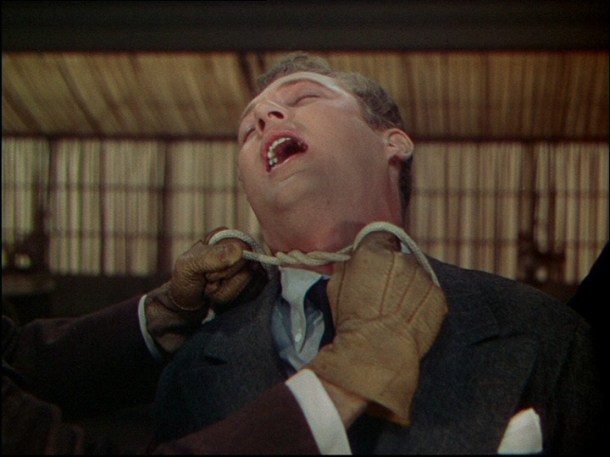
Dick Hogan

But back to the fictionalization of their crime, and that symbolic male orgasm I mentioned at the beginning.

I’m sure some will accuse me of “reading too much into” the film or seeing something that isn’t there, but I think anyone who reads up on the Leopold and Loeb case and then immediately watches Rope will find it impossible not to notice the homosexual undertones. Also, Hitchcock is one of the most self-aware filmmakers of all time, and he was fascinating by unconventional sexuality.

The very first scene — the murder — is a symbolic orgasm shared by the murderers; strangled, intense, and shameful.

The murder is a stand-in for a sexual encounter between Brandon and Phillip. Phillip doesn’t want to turn the lights on right away. “Let’s stay this way for just a minute,” he says, and Brandon lights up a post-coital cigarette. “We couldn’t have done it with the curtains open in the bright sunlight.”

This is about as explicit as a film from 1948 could be when exploring gay sex and gay desire.

Add to this the fact that the two young men are most in danger of being found out by book publisher Rupert Cadell (James Stewart), who was the boys’ headmaster in prep school. The theme of naughty little boys possibly being found out and punished by a boarding-school authority figure is just one of the many skillful pieces of homosexual innuendo that Hitchcock sprinkles throughout Rope.
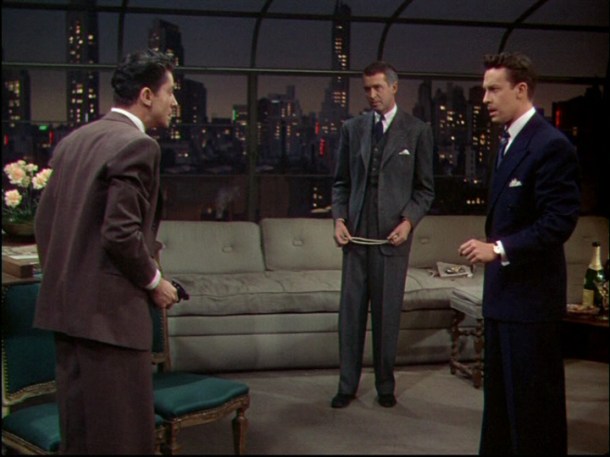
Granger, Stewart, and Dall

Rope is one of Hitchcock’s most impressive technical stunts. He filmed the action in long takes, like a play. Most of the cuts are necessitated by the length of film reels, and are done as seamlessly as possible (e.g., an actor passes in front of the camera, darkening the frame for a moment to facilitate a cut). Most of the action of Rope takes place during a dinner party at Brandon and Phillip’s apartment. They’ve arranged a buffet on top of the trunk in which David Kentley’s corpse has been hidden.

I don’t normally like films adapted from plays, but I love Rope. Stage plays are very different from screenplays, and I think the problem with most play-films is that something seems very, very “off” about the dialogue and the way the characters appear, disappear, and reappear in physical space. By filming Rope exactly like a play, however, Hitchcock ironically created a very exciting movie that works extremely well. There’s a creepy sense of intimacy created by the single setting and the actors all playing off each other without a cut every few seconds. And of course, the fact that every line in the film is colored by the viewer’s knowledge that the corpse of David Kentley is hidden away under everyone’s nose.

The way the film moves from day to night is eerie and impressive, too. The backdrop of the film is an enormous window that looks out over Manhattan, and as the film moves forward in time the sky grows darker and lights come on in the buildings and smoke curls from little smokestacks.

Rope should be seen at least once by everyone who has any interest in how films are made. And for people who love Hitchcock’s gruesome playfulness and gallows humor, it’s a film to be savored over and over.

*Interestingly, Hogan has a speaking role in the film’s trailer, but never utters a word in the film itself. Hitchcock’s films always had some of the most inventive trailers, and Rope is no exception:

Key Largo (July 31, 1948)

Key LargoJohn Huston’s Key Largo was the fourth and final film Lauren Bacall and Humphrey Bogart made together.

Hard to believe, isn’t it? Bogie and Bacall are one of the most famous couples — perhaps the most famous couple — in Hollywood history. And yet, their onscreen work together boils down to just four films made over the course of five years: To Have and Have Not (1944), The Big Sleep (1946), Dark Passage (1947), and Key Largo.

Key Largo is very loosely based on the 1939 play by Maxwell Anderson. I often don’t like films adapted from plays. The dialogue and the way the characters enter and re-enter the action usually feels very strange. But Key Largo never feels “stagey,” and confining the action to a single location only heightens the tension between the characters.

The film opens with beautiful footage of the Florida Keys. By opening with establishing shots of the steamy, summertime Keys, by the time the action is confined to a hotel while a hurricane rages outside, nothing about Key Largo feels stagey or stilted. The viewer is right in the middle of the action, and the suspense grows as the film goes on.

Summertime is the off season in the Florida Keys, when the mercury never dips below 100 degrees, and all the hotels are closed. Bogart plays Frank McCloud, a veteran of World War II who is in Key Largo to visit James Temple (Lionel Barrymore), a wheelchair-bound man whose son George was killed in the war. (McCloud was George Temple’s commanding officer.) Temple runs a hotel in Key Largo with George’s widow, Nora (Lauren Bacall).

When Bogart sits down at the bar in the Largo Hotel, he laconically introduces himself to the boozy moll Gaye Dawn (Claire Trevor) as “McCloud. Frank. By John, out of Ellen.”

Gaye is not the only oddball occupant of the Largo Hotel. There are also a trio of men — Curly (Thomas Gomez), Angel (Dan Seymour), and Toots (Harry Lewis) — and with names like those, it’s clear that their story about coming down to the Keys from Milwaukee to do a little fishing isn’t on the up-and-up.

The full terror of the situation becomes apparent when we catch our first glimpse of gangster Johnny Rocco (Edward G. Robinson), sitting in a bathtub in one of the upstairs rooms of the hotel, chewing a cigar and exuding menace.

Robinson is a great actor, and Johnny Rocco is one of his most memorable creations. Rocco craves power and money, and there will never be enough power and money to satisfy him. He delights in toying with his hostages, taunting them with their helplessness. He even goes so far as to give one of them a pistol, daring them to kill him. But his bullying takes all forms. One of the most harrowing scenes in the film is when he humiliates Gaye by forcing her to sing for everyone before he’ll give her another drink. And like most bullies, Johnny Rocco is a coward at heart. As the hurricane builds in ferocity outside the hotel, so does his fear.

Key Largo was John Huston’s second film to be released in 1948. (The first was another collaboration with Bogart, The Treasure of the Sierra Madre.) Key Largo is a masterfully directed film. The actors are all at the top of their game (Claire Trevor won the Academy Award for Best Supporting Actress for her role). The film’s music, by Max Steiner, is perfect; full of tension and menace, and — when the scene calls for it — a crushing sense of inevitability. Rudi Fehr’s editing accentuates the tension, and Karl Freund’s cinematography is beautiful.

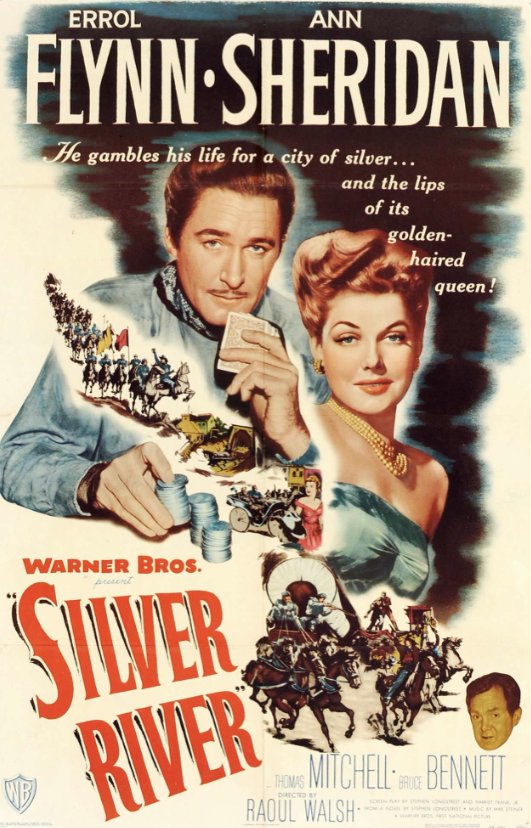
Silver River (May 18, 1948)

Silver River
Silver River (1948)
Directed by Raoul Walsh
Warner Bros.

Silver River, which was directed by Raoul Walsh, premiered in Denver on May 18, 1948, and in New York City two days later.

Walsh’s last couple of pictures — Pursued (1947) and Cheyenne (1947) — were both westerns. Silver River takes place after the Civil War, and it’s set in the west, but in terms of action, it doesn’t deliver what I look for in a western. It’s more of a drama, and in fact bears more resemblance to one of Warner’s gangster dramas that it does to a typical Warner Bros. western.

Like Little Caesar (1931), The Public Enemy (1931), and Scarface (1932), Silver River is about a man who takes control of anything and everything around him, wielding his own ruthlessness as a weapon.

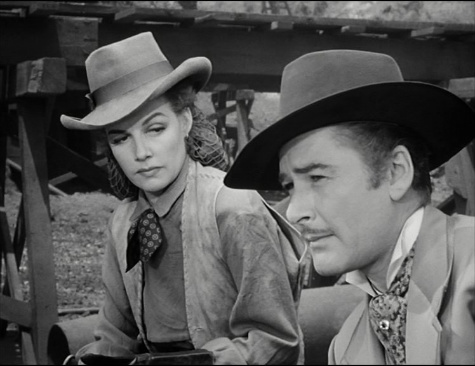
Like every good gangster, Michael J. McComb (Errol Flynn) has a faithful right-hand man, “Pistol” Porter (Tom D’Andrea), and he lusts after a woman he can never really attain. And just like every other movie gangster, he finds that once he’s on top, he’s lonelier and more isolated than ever.

When the film begins, McComb is a captain in the Union Army. During the Battle of Gettysburg he burns a wagon-load of payroll money so Jeb Stuart and the Confederates won’t be able get their hands on it. He does this in defiance of an order, so he is court-martialed and dishonorably discharged.

McComb learns his lesson and says, “If there’s gonna be any shoving around, next time I’ll do it.”

Sheridan and Flynn

So after a stint as a riverboat gambler — in which we get to see Flynn deliver a lot of smooth lines like, “…and speaking of charming ladies,” before he drops four Queens on the table to beat his opponent’s trio of Aces — he and his buddy Pistol move their operation to Silver City and open a casino. The casino rakes in cash hand over fist, which allows McComb to force his way into the Silver River Mining Company run by Stanley Moore (Bruce Bennett).

What McComb really wants, though, is Moore’s wife, the beautiful Southern belle Georgia Moore (Ann Sheridan).

McComb’s lawyer, John Plato Beck (Thomas Mitchell), drunkenly warns McComb against the path he’s headed down, and invokes the Biblical story of King David and his obsession with Bathsheba.

After a number of Warner Bros. pictures starring Errol Flynn suffered costly delays when he became too drunk by the afternoon to continue, Jack Warner was determined that Flynn be kept under control, and he made it clear that any delay in filming due to Flynn’s inebriation would be met with legal action.

I don’t know if Flynn’s controlled but uninspired performance is directly related to his forced sobriety, but throughout the film he seems as if he’s just going through the motions. He hits his marks, but that’s about it. Walsh does a good job of controlling his star and keeping everything moving, but after the pyrotechnics of the opening sequence and the breezy charm of the riverboat gambling scenes, the film settles in for a long melodramatic slog, and there just wasn’t enough action to keep me interested. Worse, when there finally is some action to end the film, it feels like a betrayal of the narrative, and isn’t true to Flynn’s character’s arc.

The Treasure of the Sierra Madre (Jan. 24, 1948)

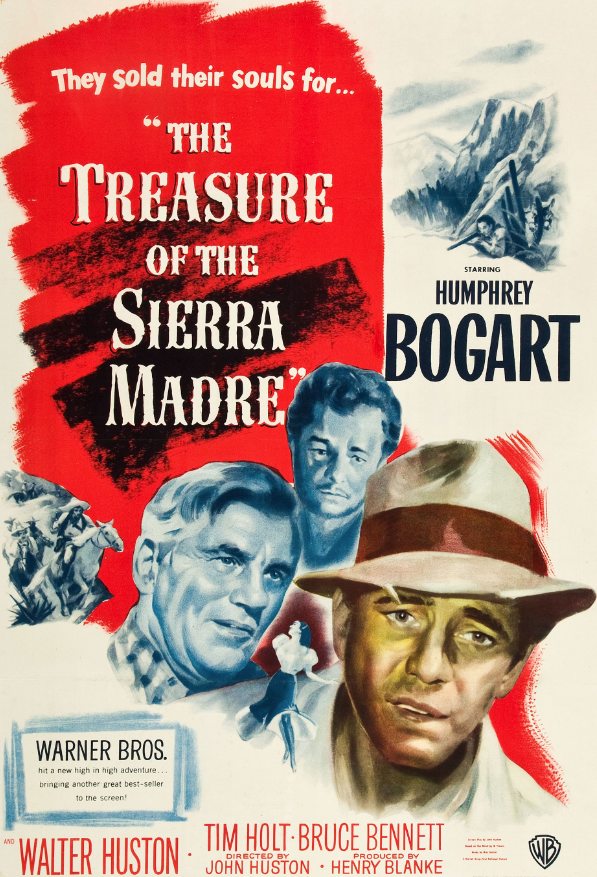
The Treasure of the Sierra Madre
The Treasure of the Sierra Madre (1948)
Directed by John Huston
Warner Bros.

In his review of Elmore Leonard’s 1995 novel Riding the Rap, Martin Amis wrote that “Mr. Leonard has only one plot. All his thrillers are Pardoner’s Tales, in which Death roams the land — usually Miami or Detroit — disguised as money.”

The same could be said of John Huston’s The Treasure of the Sierra Madre, but instead of the duffel bags full of cash found in Leonard’s hard-boiled crime novels, money in this film takes the form of gold.

The gold in The Treasure of the Sierra Madre isn’t just a disguise for death, either; it’s the impetus for all manner of human striving and weakness, and brings out the best and the worst in the men who seek it.

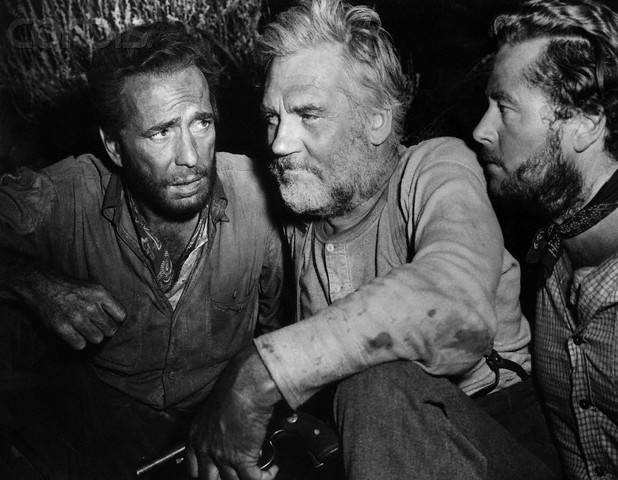
As for the film itself, it mostly brings out the best in all of its actors. Neither Humphrey Bogart nor Tim Holt are completely able to shed their well-worn personas, but the same cannot be said of Walter Huston, the director’s father, who is pitch-perfect in his role. (Also, it’s likely that many people who watch The Treasure of the Sierra Madre today will have never seen Tim Holt in any of his countless B westerns and therefore have little trouble accepting him in his role.)

Bogart plays Fred C. Dobbs, a man who finds himself penniless in Tampico, Mexico. He meets fellow American drifter Bob Curtin (Holt) and together they get jobs working in the oilfields, but their unscrupulous employer runs off without paying them, leaving them back where they started. However, luck smiles on them, and after winning a little money they hook up with an old prospector named Howard (Walter Huston) and head for the Sierra Madre mountains to mine their fortune. Howard warns Dobbs and Curtin of the dangers of “gold fever,” but they both claim they’ll deal with their windfalls sensibly if they strike it rich.

No points will be awarded first-time viewers who correctly predict that the protagonists will both strike it rich and succumb to greed and paranoia.

The Treasure of the Sierra Madre is based on the 1927 novel by the mysterious author “B. Traven.” Little is known about the possibly German-born novelist who probably lived most of his life in Mexico, which is where most of his fiction is set. According to the February 2, 1948, issue of Time, Traven was paid $5,000 for the screen rights to his novel. Traven was such a mysterious figure that although director Huston frequently corresponded with him, when it came time to meet Traven, a nervous translator named “Hal Croves” showed up in his place, claiming to be a close friend of Traven’s. Huston hired Croves as a technical adviser on the film, paying him $150 a week. Huston strongly suspected (but could never conclusively determine) that “Croves” was really Traven.

The Treasure of the Sierra Madre was nominated for four Oscars — best picture, best director, best supporting actor for Walter Huston, and best screenplay. It won every Academy Award for which it was nominated except for best picture.

The Treasure of the Sierra Madre is a great film. It’s also one of those rare movies — like Casablanca — that even people who “don’t like old movies” will usually enjoy. It has excellent pacing, an involving story, and believable characters, but most importantly, it has authenticity. It was filmed mostly on location in Mexico, and the Mexican characters actually speak Spanish. It’s ironic that this is the movie that gave us the most enduringly stereotypical “Mexican” line — “I don’t have to show you any steenking batches!” — because it’s one of the few films from the ’40s in which Mexican characters actually speak Spanish, and without even subtitles to make things easier on a gringo audience.

The Voice of the Turtle (Dec. 25, 1947)

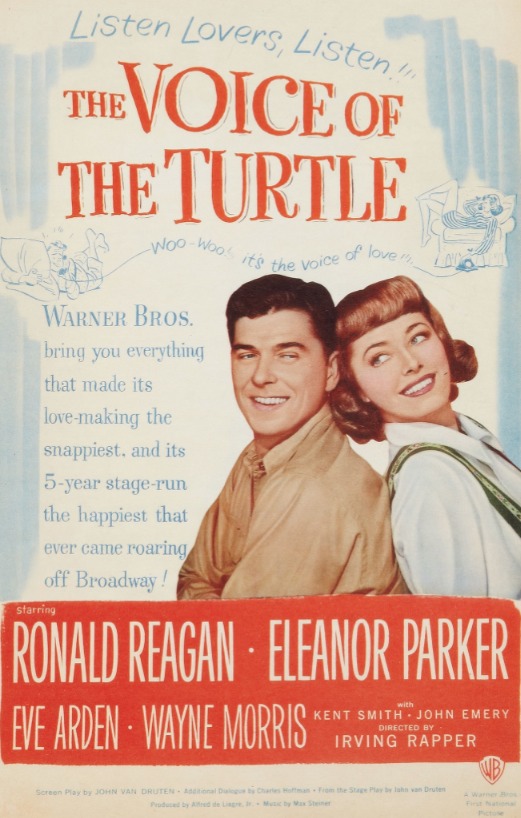
The first thing you should know before you watch Irving Rapper’s The Voice of the Turtle (or One for the Book, its title when it’s shown on TV) is that in 1947, the phrase “make love to” didn’t mean “have sexual intercourse with,” which is more or less what it means today. In the ’40s it was a nebulous expression that could mean anything from “pitching woo” to “heavy petting,” but didn’t explicitly refer to P to V contact.

So when pretty young struggling actress Sally Middleton (Eleanor Parker) says, “I was raised to think no nice girl let a man make love to her unless … unless it was serious — I mean, sort of marriage — otherwise you’d be cheapening yourself,” she’s not talking about making the beast with two backs.

Or is she?

It’s hard to say, because Rapper’s film is a sanitized version of one of the longest running plays in Broadway history. The Voice of the Turtle opened in 1943 and was nearly at the end of its run when the film version came out. John Van Druten’s play was a funny and frank look at the sexual lives of young New Yorkers during World War II. Clearly the story of a nice young man and a nice young woman who decided to go to bed together couldn’t be made into a Hollywood film without some alterations. Or, as the review of the film in the December 15, 1947, issue of Time put it, “The movie is most coyly prurient where the play was most pleasantly candid.”

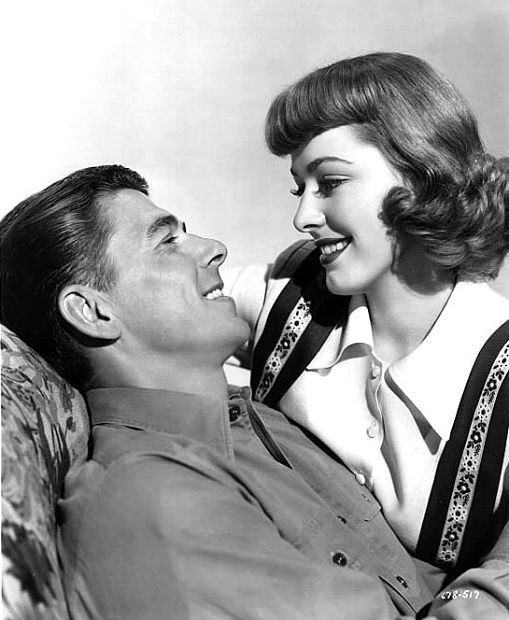
Van Druten adapted his play for the screen, and even though it contains the obligatory concessions to the Hays Code, I found it enjoyable, funny, and charming. As someone who grew up with President Reagan, it’s always a little weird seeing him as a younger man, since there are so many things about his physical appearance and line delivery that literally never changed over the course of four decades.

Even though he was 36 when he appeared in The Voice of the Turtle, Reagan still had the slightly high voice, nervous smile, and “aw shucks” attitude that exemplified youthful masculinity in the ’40s.

Other than that and a few missing wrinkles, however, I felt as if he could have been telling Mr. Gorbachev to “tear down that wall” or explaining the Strategic Defense Initiative to his fellow Americans.

But I digress. In any case, I liked Reagan as the good-natured Sgt. Bill Page, who’s pushed aside at the last moment by the worldly Olive Lashbrooke (Eve Arden) for the lunkheaded Commander Ned Burling (Wayne Morris). Bill ends up staying at Sally’s apartment over the long Christmas weekend after he can’t find a hotel in Manhattan. (Eve Arden played the heroine’s best gal pal in more movies than Randolph Scott played cowboys or Keye Luke played Chinamen, but here she gets to play a role with a little bite. She’s not a total jerk, but she clearly cares more about herself than she does about her friend.)

Despite a few inserted scenes that are meant to imply that Bill and Sally don’t really engage in any heavy hanky-panky (those scenes can easily be ignored, if you so wish), I thought The Voice of the Turtle was a funny and enjoyable look at two likable young people who fall in love with each other despite each having a broken heart and a reluctance to mend it.

The Unsuspected (Oct. 3, 1947)

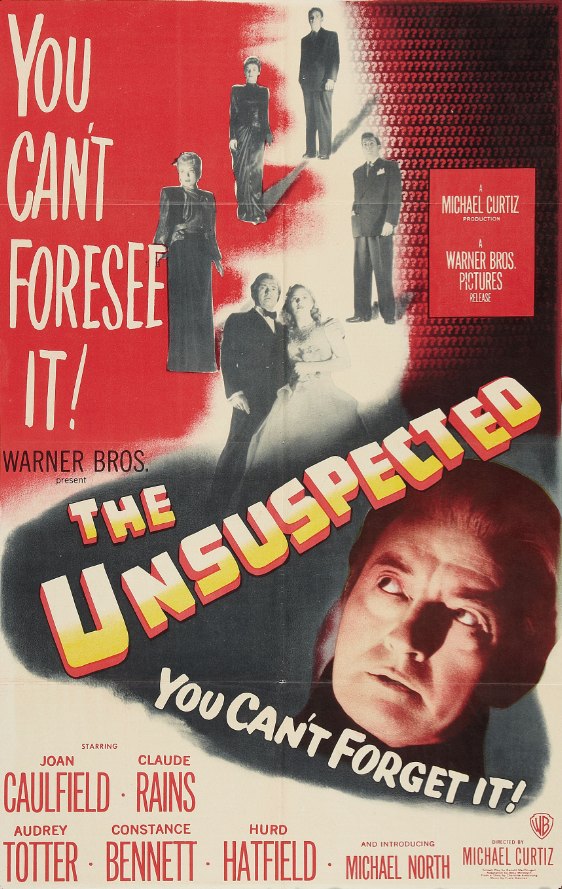
If you’re looking for proof that a mystery doesn’t have to be difficult to figure out to be thoroughly involving, look no further than Michael Curtiz’s The Unsuspected.

Claude Rains stars as Victor Grandison, the “genial host” of the radio program The Unsuspected on the fictional WMCB network. Grandison has turned his fascination with gruesome crimes into a lucrative career recounting tales of real-life murders to a nation of rapt listeners.

Roslyn Wright (Barbara Woodell), Grandison’s secretary, is the killer’s first victim. She’s working late in Grandison’s mansion in Croton, New York, when the door opens and a man’s shadow is thrown over the wall behind her. He strangles her, then hangs her from a chandelier to make it look like suicide.

Grandison lives with his niece, Althea (Audrey Totter), whom he maneuvered into seducing and then marrying Oliver Keane (Hurd Hatfield), who was set to marry Grandison’s other niece, Matilda Frazier (Joan Caulfield). Matilda is currently missing, presumed dead, after the ship she was traveling on was lost at sea. Althea is a grasping, scheming young woman who will do anything for money. Her husband Oliver really loved Matilda and has seemingly been on a bender since he married Althea.

The plot kicks into gear when Steven Francis Howard (Ted North) shows up, claiming he married Matilda shortly before she was lost at sea, and consequently is the heir to her fortune. This news is not taken well by Grandison, who has been moving the people in his life around like chess pieces in order to gain control of Matilda’s fortune.

Part of the fun of The Unsuspected is how the entire thing plays out as though it’s one of Grandison’s radio plays come to life. He’s the master of ceremonies, pushing and pulling, scheming and finagling.

He even uses 16″ transcription discs — which were used to record radio shows for later broadcast — as a part of his schemes, to divert and confuse people.

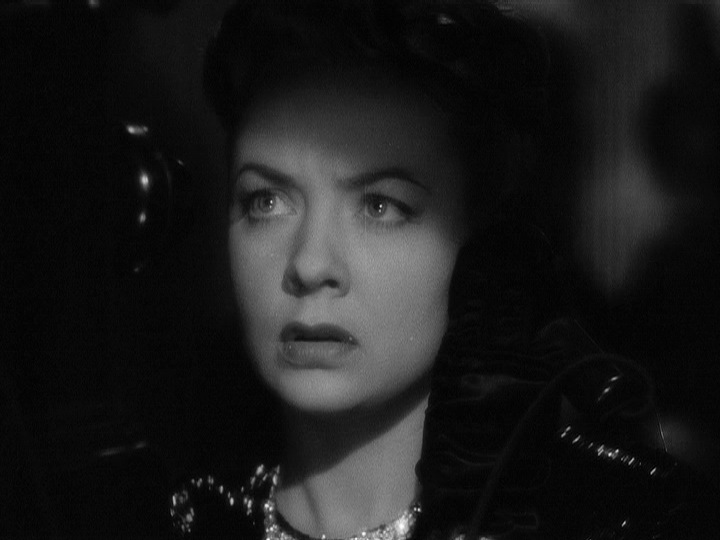
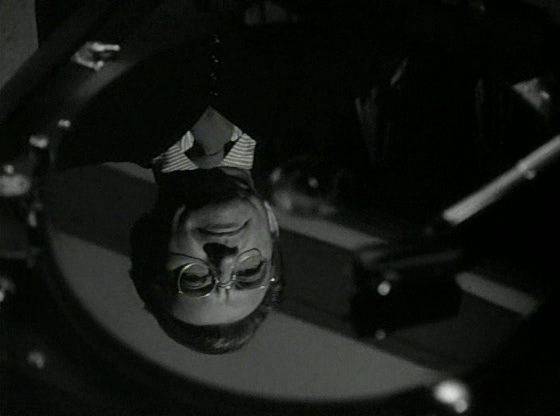
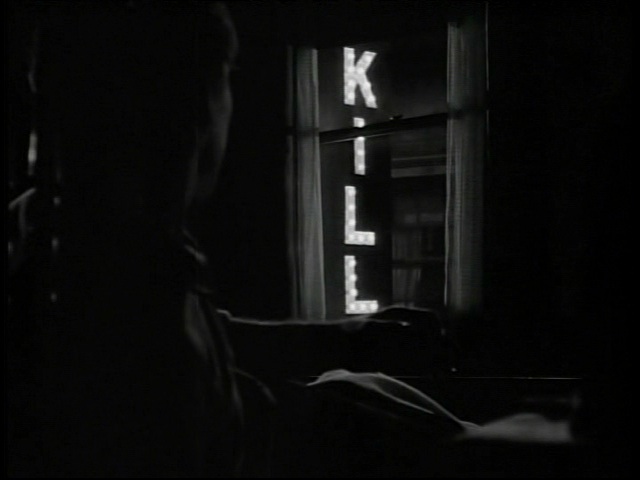
As I said, the identity of the killer isn’t difficult to suss out, and The Unsuspected is more of a thriller than a mystery, but it doesn’t matter. It’s a first-rate thriller, brilliantly directed by Curtiz and gorgeously shot by his cinematographer, Elwood “Woody” Bredell. Even though the story itself is standard stuff, the film is full of arresting visuals, recurring motifs like faces reflected upside down, and brilliant little moments like the one in which Mr. Press (Jack Lambert — recently seen as the villainous “Claw” in Dick Tracy’s Dilemma) sits in a dark hotel room. The neon sign outside says “Hotel Peekskill,” but when the shot cuts to inside the room, all we can see is “kill,” blinking on and off hypnotically.

The film isn’t perfect. Ted North isn’t a very good actor, and his scenes lack a certain something. (Interestingly, North is listed in the opening credits as “Introducing Michael North,” even though this was his last film. It was the first time he was credited as “Michael,” not “Ted,” but he’d had significant parts in plenty of films before, most recently The Devil Thumbs a Ride.)

But Curtiz wisely doesn’t make North the focus of the film, and allows Rains to carry things, propelled by taut pacing and Franz Waxman’s compelling score. Aside from North, the actors are all good, especially Totter, whose role is enjoyably juicy. I also really liked Constance Bennett as Grandison’s witty, smart-mouthed assistant, Jane Moynihan. She delivers my favorite line of the picture: “After slaving all day over a hot typewriter, there’s nothing I like better than a swan dive into a bottle of bourbon.”

If you enjoy classy, well-made thrillers, The Unsuspected is well worth seeking out.

Dark Passage (Sept. 5, 1947)

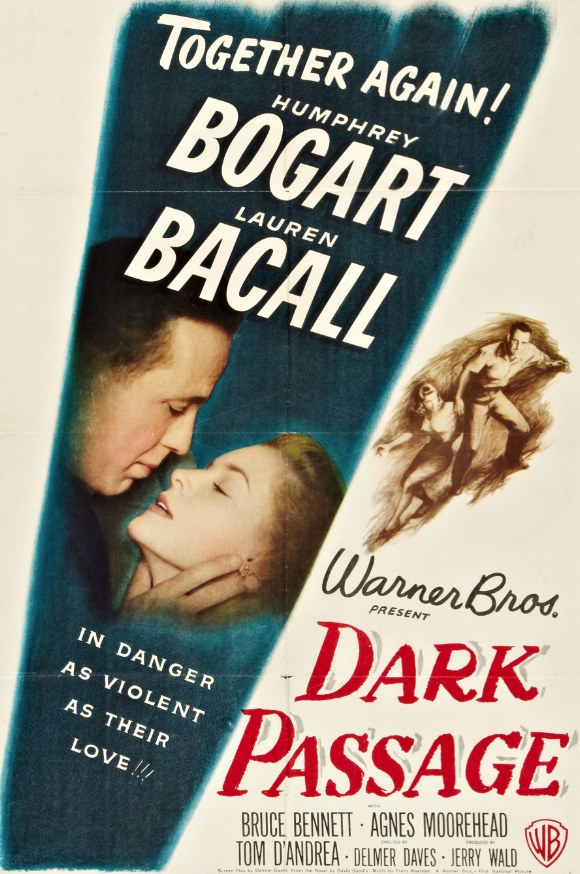
Delmer Daves’s Dark Passage is the red-headed stepchild of the Bogie-Bacall movies.

Humphrey Bogart and Lauren Bacall were married in 1945, and stayed married until Bogart’s death in 1957. They made four movies together — To Have and Have Not (1944), The Big Sleep (1946), Dark Passage, and Key Largo (1948). Of these four, Dark Passage is the strangest and the least widely acclaimed.

It was a bit of a critical and box office disappointment at the time of its release, possibly because Bogart’s face doesn’t actually appear on-screen until the picture is more than half over, and possibly because of Bogart’s involvement with the Committee for the First Amendment.

The Committee for the First Amendment was an organization that was formed to protest the treatment of Hollywood figures by the House Un-American Activities Committee. (Bogart later recanted his involvement with the organization in a letter published in the March 1948 issue of Photoplay entitled “I’m No Communist.”)

Dark Passage is based on a book by oddball crime novelist David Goodis. The film does a good job of bringing Goodis’s strong characterizations and nightmarish, occasionally surreal demimonde to the big screen.

For better or for worse, it also does a good job of bringing to life some of Goodis’s less powerful aspects, like his convoluted plots and his reliance on coincidence.

But just like the best of Goodis’s novels, the film version of Dark Passage doesn’t need to be plausible to work. It plays by its own rules, and when it works, boy does it work.

In Dark Passage, Bogart plays Vincent Parry, a man convicted of killing his wife who breaks out of San Quentin by hiding in a 55-gallon drum on the back of a flatbed truck. He manages to roll himself off the truck and into a ditch somewhere in Marin County. He strips down to his undershirt, buries his prison-issue shirt, and takes to the highway to thumb a ride. He’s picked up, first by a guy named Baker (Clifton Young), and then — when that little ride goes sour — by a beautiful artist named Irene Jansen (Lauren Bacall).

She hides him under her canvases and wet paint so they can make it through a roadblock at the entrance of the Golden Gate Bridge, then she takes him to her luxurious bachelorette pad in North Beach. Why is she helping him? Because her own father was unjustly imprisoned for a murder he didn’t commit, and because she followed Parry’s trial, even writing letters to the editor protesting his treatment by the press.

For the first 37 minutes of Dark Passage, Bogart’s face is never shown, for reasons we’ll get to in a moment. This P.O.V. style of filmmaking was pioneered by Robert Montgomery in his film Lady in the Lake (1947), but the technique works much better in Dark Passage, for a variety of reasons. First, the editing is more aggressive than in Lady in the Lake, which was essentially one long tracking shot designed to put the viewer in the shoes of the protagonist but that never quite worked. Second, there are third-person shots of Bogart in which his back is turned or his face is in shadows, which helps to break things up and make them more visually palatable.

Once Parry makes it to San Francisco, Dark Passage gets really weird. Irene gives him $1,000, new clothes and a hat, and a place to stay, but if you thought that qualified Parry as the luckiest escaped convict in history, you ain’t seen nothing yet.

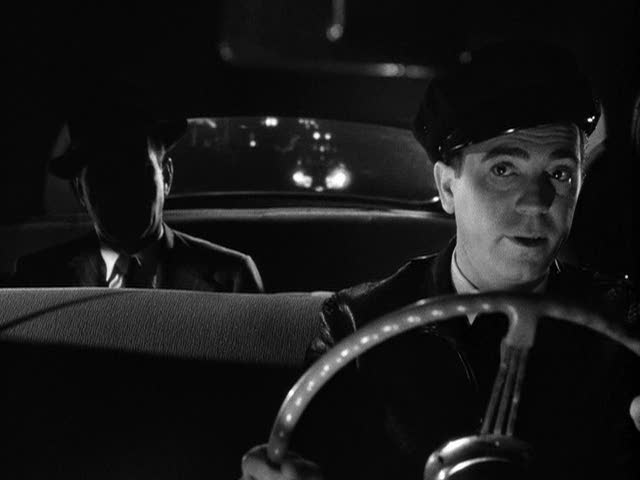
He’s picked up one night by a cabbie named Sam (Tom D’Andrea), who not only recognizes him but believes Parry got a raw deal from the court system, and hooks him up with his buddy, Dr. Walter Coley, a plastic surgeon who can change his face.

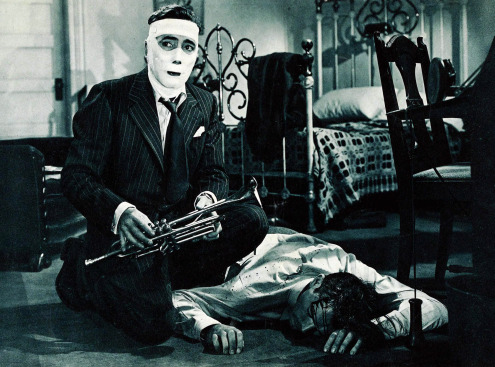
Nervous about staying with Irene, Parry goes to see his friend George Fellsinger (Rory Mallinson), a trumpet player who gives Parry a key to his place. Incidentally, we get our first shot of Parry’s “real” face on the front of a newspaper laid across his friend George’s chest as he lies in bed. The real Parry has a mustache, and doesn’t look much like Bogart.

But he looks exactly like Bogart after his trip to see Dr. Coley, who’s played by 67-year-old actor Houseley Stevenson. Dr. Coley is the most ghoulishly fun character in Dark Passage. Wrinkled, liver-spotted, and chain-smoking, Dr. Coley asks Vincent if he’s ever seen a botched plastic surgery job right before he puts him under, and the kaleidoscopic nightmare Parry has while undergoing plastic surgery is a real standout.

Even after the surgery, we don’t fully see Bogart’s face until more than an hour into the picture.

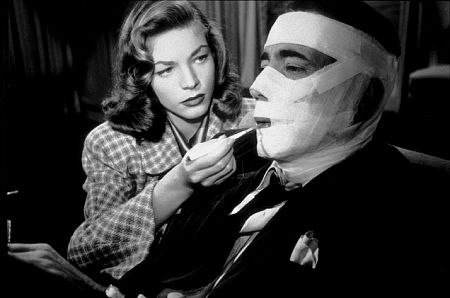
Until then, he’s covered with bandages, smoking cigarettes with long filters and communicating with Irene using pencil and paper. (Throw a pair of shades on him and he’d look like Claude Rains in The Invisible Man).

While the plot may be contrived and coincidence-laden, the characterizations are sharp, and the actors are all really good. Lauren Bacall has to carry the film for much of the first hour, and she delivers a really good performance. She’s much better at interacting with the camera than any of the actors in Lady in the Lake were. Consequently, the P.O.V. technique draws less attention to itself, and works fairly well.

When the bandages finally come off, Parry looks at himself in the mirror and remarks, “Same eyes, same nose, same hair. Huh. Everything else seems to be in a different place. I sure look older. That’s all right, I’m not. And if it’s all right with me it oughtta be all right with you.”

The fact that Bogart and Bacall were married in real life gives this line a little humorous subtext.

Hidden behind his new face, Parry is faced with another murder to solve, cops on his tail, a chiseler who hopes to blackmail Irene after he finds out she’s been shielding Parry, the presence of Irene’s old beau Bob (Bruce Bennett), and her shrill friend Madge Rapf (Agnes Moorehead), who keeps dropping by and nosing around.

That Parry goes about solving his problems in a haphazard, roundabout way should come as a surprise to no one who’s familiar with the fiction of David Goodis.

Dark Passage may not be a perfect film, but it’s an intriguing and involving one. Sid Hickox’s cinematography is gorgeous, and the location shooting in San Francisco is really effective. It’s worth seeing at least once, and if you’re like me, you’ll probably want to see it again.

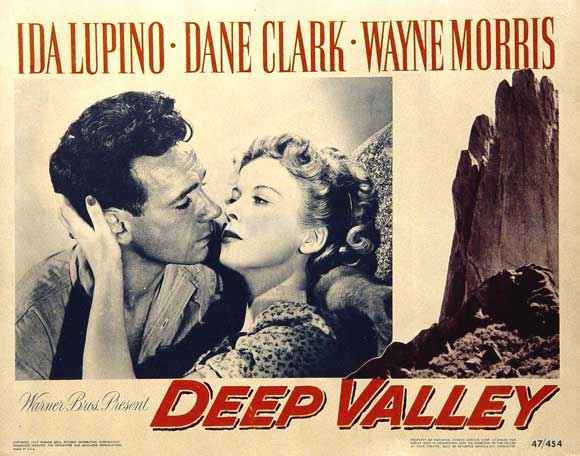
Deep Valley (July 30, 1947)

Every student of film noir knows that the genre owes its style to German Expressionism, and to the influx of European directors to the U.S. during World War II.

Jean Negulesco’s Deep Valley doesn’t really qualify as a film noir, although it has some hallmarks of the noir style. Instead, it seems as if Negulesco is drawing from an earlier German artistic movement — Sturm und Drang.

The high emotions of the film are expressed physically — often through the turbulence of the natural world. Ida Lupino plays a simple country girl named Libby Saul who lives in a broken-down old farmhouse deep in the California wilderness with her parents, Cliff Saul (Henry Hull) and Ellie Saul (Fay Bainter). One night, long ago, Libby’s father beat her mother, and her mother has never forgiven him or spoken to him again. Libby speaks with a stutter, and it is implied that it is directly related to the traumatic memory of seeing her father hit her mother.

The rift between Libby’s parents is absolute. Mrs. Saul never leaves her upstairs bedroom, and relies on Libby to wait on her. Mr. Saul never goes upstairs, and roams the ramshackle property in a perpetual foul mood.

Libby has no friends, and is isolated from the world. Her father is cruel to her and her mother, who is an invalid by choice, lives in a fantasy world and has never let go of the idea that she is an aristocratic lady. Libby’s only solace is her dog, Joe, and the woods that surround the Sauls’ property. Her only happy moments are when she is roaming the forest with Joe and communicating with nature and wild animals.

One day, she discovers a crew of prisoners working on a chain gang along the ocean, excavating and dynamiting the coastline in preparation for a highway. This destruction and remaking of the natural world will bring a steady flow of people past the Sauls’ farm, and radically change Libby’s life.

But her life is changed almost immediately when she spots a dark, handsome convict named Barry Burnette (Dane Clark) working on the line.

Naturally, fate contrives to bring them together.

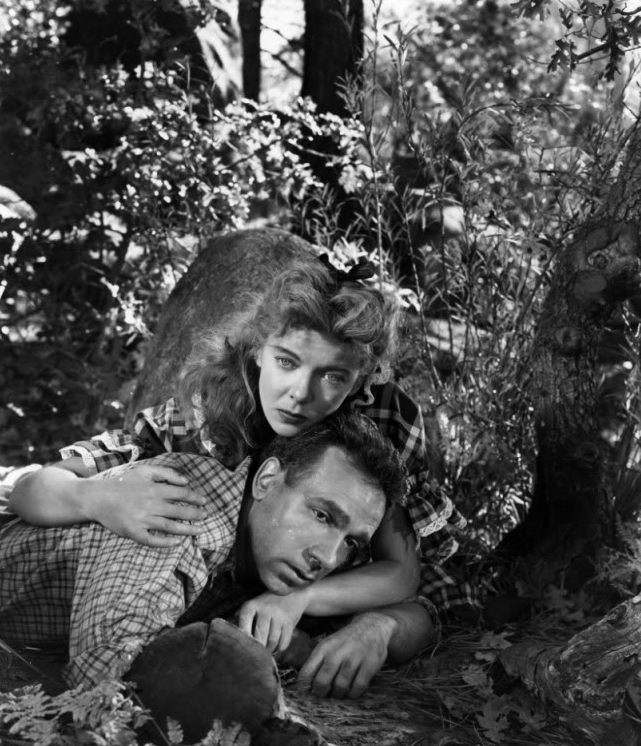
During a dark and stormy night, a landslide destroys the toolshed in which Barry and a couple of other prisoners are locked up. Libby finds Barry in the woods and helps him stay hidden from the posses that are searching for him, as well as from the good-natured but black-hearted Sheriff Akers (Willard Robertson) and the blandly handsome engineer running the highway project, Jeff Barker (Wayne Morris), who has an eye for Libby.

Libby and Barry’s romance begins in an idyllic fashion, but the weight of doom slowly crushes it. It’s not just because he’s an escaped convict. He’s also a violent hothead — never towards Libby or someone who hasn’t provoked him, but when faced with a problem, his first instinct is to lash out and break through, with no thought of what he’ll do next.

But Barry is always a likable character. Dane Clark’s performance is soulful and tortured, and his big eyes and open countenance make him sympathetic, even when he’s crouching in the second floor of a barn with a scythe, ready to kill whoever comes up the ladder.

We root for Barry and Libby, even though we know their love is impossible. As the film progresses, the shots become increasingly full of shadows and menace, and Barry and Libby are forced into smaller and smaller spaces, symbolizing the world closing in on them.

Deep Valley is based on a novel by Dan Totheroh. The screenplay is by Salka Viertel and Stephen Morehouse Avery, with uncredited assistance from William Faulkner.

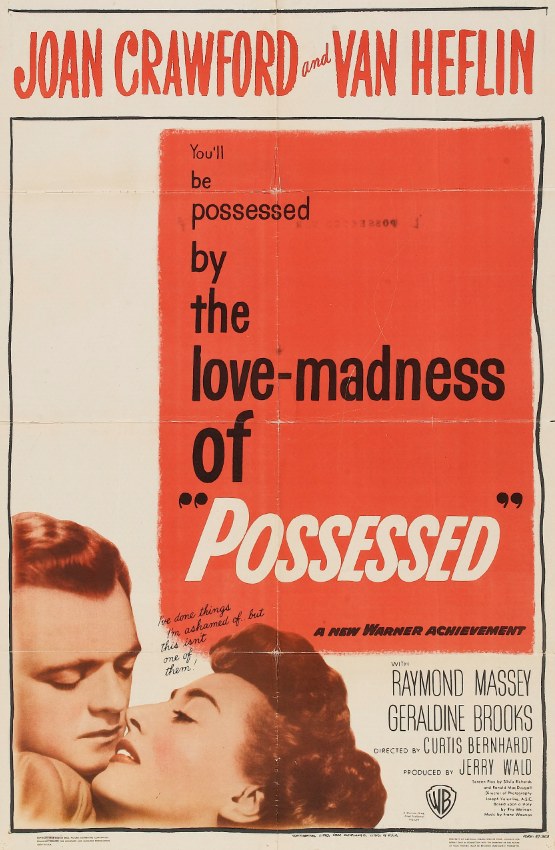
Possessed (July 26, 1947)

If you like to see Joan Crawford get her crazy on as much as I do, then you’ll love Possessed.

Curtis Bernhardt’s fevered noir melodrama begins with a surprisingly unglamorous-looking Crawford wandering the streets of Los Angeles in a daze, asking everyone she passes if they’ve seen “David.”

Crawford isn’t wearing any makeup, and her journey through the early dawn streets reminded me of a similar scene that appeared a decade later in Louis Malle’s Ascenseur pour l’échafaud (Elevator to the Gallows) (1958), in which Jeanne Moreau wanders the streets of Paris without makeup. (Was Malle influenced by Possessed? It’s certainly possible.)

The character Crawford plays, Louise Howell, is taken by ambulance to the psychopathic ward of the Los Angeles Municipal Hospital, where she is cared for by Dr. Willard (Stanley Ridges). He gives her narcosynthesis to lift her out of her catatonic stupor, and the tale of what brought Louise to this place is told through a haze of flashbacks and psychobabble.

Louise was a nurse in the employ of wealthy Dean Graham (Raymond Massey). Her job was to care for Graham’s infirm wife.

After a brief love affair with an average-looking but very charming architect named David Sutton (Van Heflin), Louise became hopelessly attached to him. When David told her that he wasn’t the marrying kind, and that he had to break things off with her, it began her spiral into madness. She was convinced that there was another woman, but he assured her there wasn’t.

“Louise, don’t hang onto me. You’ll get hurt,” he said in exasperation, and his words were prescient. The straitlaced, self-possessed Louise began to unravel.

Dr. Willard diagnoses her with a persecution complex. She thought that David breaking up with her was all part of a plan. Everyone was against her. Dr. Willard calls it “typical schizoid detachment … split personality.”

Despite its sometimes overheated story and dialogue, Possessed is a stylistic feast. Franz Waxman’s musical score perfectly underscores every one of Joan Crawford’s scenes, and Joseph A. Valentine’s cinematography visually expresses her madness.

There are recurring visual motifs, most notably water. For instance, when David gets into his boat and leaves Louise sobbing on the dock, the churning water symbolizes her inner turmoil. The doctors hovering over Louise’s bed discuss her case, then the scene cuts to a shot of the carafe of water by her hospital bed that dissolves into a shot of the water around Dean Graham’s home.

When Louise stops the little pendulum of her bedside clock from ticking because it’s “driving her crazy” the sound is replaced by the sound of dripping water outside her open window. She slams the window shut, trying to control her madness.

Possessed could never be called a realistic film. But that’s not its goal. It subjectively depicts an unraveling psyche, and isn’t afraid to veer into territory that sometimes seems as if it would be more at home in a horror movie than in a melodrama.

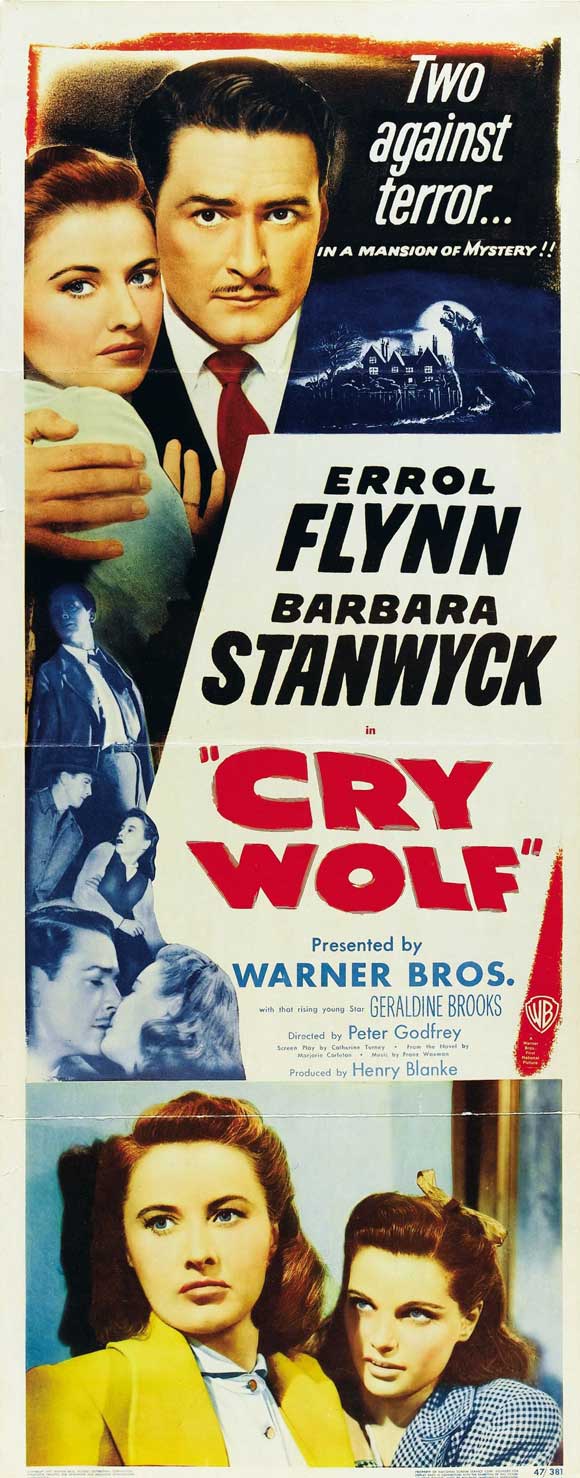
Cry Wolf (July 18, 1947)

Peter Godfrey’s Cry Wolf is a good-looking thriller with two great stars and an intriguing setup, but it never quite fulfills its promise, and eventually peters out with an ending that you can see coming a mile away.

Barbara Stanwyck plays a young widow, Sandra Demarest née Marshall, who arrives at the creepy New England mansion of Mark Caldwell (Errol Flynn). Mark is a cold, imposing patriarch who lives with his brother, Senator Charles Caldwell (Jerome Cowan), and his teenage niece, Julie Demarest (Geraldine Brooks).

Sandra claims she was married to Mark’s deceased nephew, James Caldwell Demarest (Richard Basehart). She says she was working toward her doctor’s degree in geology. Jim came to her as a friend and she helped him. She needed money. He needed his inheritance. (Jim and his sister Julie have money that is kept in trust until they are 30. If, however, Jim were to marry, control of his inheritance would immediately pass from Mark to Jim’s wife.)

Sandra tells Mark she knows he would have preferred to choose a wife for Jim himself — someone placid — and she assures Mark that she is not a placid girl.

Jim gave Sandra $2,000 to complete her studies and she was to divorce him in six months. There were no other strings. They were married five months before his death. She has come to collect his inheritance. Two thousand dollars has become $2 million.

Doubt and mistrust informs Sandra’s relationship with Mark. Mark isn’t convinced that Sandra’s marriage certificate is genuine, and Sandra suspects Mark is up to no good in his mysterious laboratory. Nevertheless, there are clearly romantic sparks between the two. Also, Mark’s niece Julie instantly becomes attached to Sandra, and begs her to stay.

So it’s a perfect setup for a Gothic thriller. Mark struts and preens about the house, a pipe clenched between his teeth, spitting out nasty one-liners like, “Next time you hear some odd noise in the night, just follow the memorable custom of your sex and stick your head under the bedclothes.” And Sandra gets to play at being a grown-up Nancy Drew, pulling herself up to Mark’s lab in a dumbwaiter and then hiding behind a door when he unexpectedly arrives, and later climbing along the eaves of the mansion and dropping down a skylight to spy on him.

Cry Wolf reminded me a lot of Vincente Minnelli’s Undercurrent (1946), which is another Gothic thriller about a not-terribly-romantic love triangle in which one-third of the equation is absent for most of the picture.

Like Undercurrent, Cry Wolf is competently put together, and it’s worth seeing if you like the film’s stars, but it never really takes flight. Franz Waxman’s musical score and Carl E. Guthrie’s cinematography are both top-notch, and add a good deal of suspense to the shadowy proceedings, but there’s only so far that atmosphere can take a picture. Ultimately, Cry Wolf is a mystery that’s not terribly mysterious.