Monthly Archives: March 2010

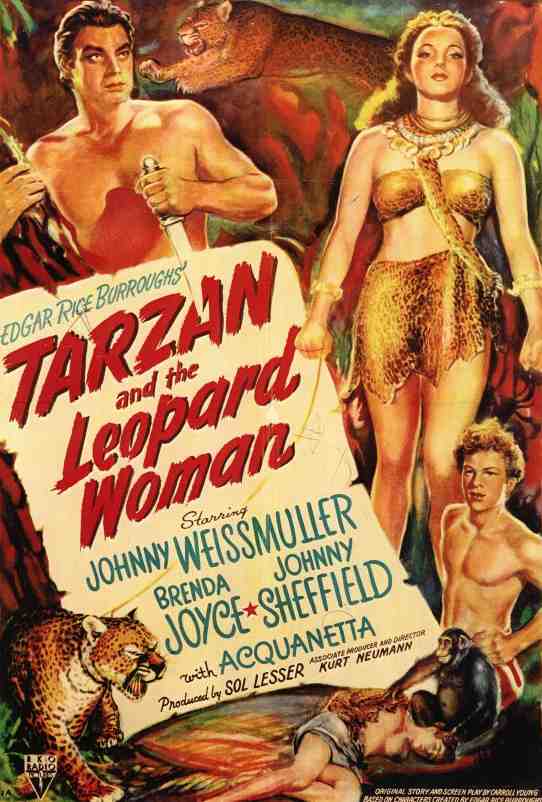
Tarzan and the Leopard Woman (January 1946)

A lot of fans of Johnny Weissmuller’s work as Tarzan in the MGM series of the ’30s like to beat up on the RKO Radio Pictures Tarzan pictures of the ’40s. They’re campier, the production values are cheaper, and Weissmuller was older when he made them. I say, so what? They’re still great Saturday-matinee entertainment, especially this one. Tarzan and the Leopard Woman moves at a good pace, it’s loony without being over-the-top, and Weissmuller is in better shape than he was in the previous few entries in the series.

Weissmuller was a big guy; 6’3″ and 190 pounds in his prime. Like a lot of athletes, he had a tendency to gain weight when he wasn’t competing professionally (when he was making the Jungle Jim series in the ’50s, he was reportedly fined $5,000 for every pound he was overweight). In Tarzan and the Leopard Woman, however, he was 41 years old, and looked better than he had in years. His face looks older and his eyes are a little pouchy, but three divorces (including one from the physically abusive Lupe Velez) will do that do a guy. Even though he was nearing middle age when he made this picture, Weissmuller was still a sight to behold. When he jumps into a river to save four winsome Zambesi maidens (played by Iris Flores, Helen Gerald, Lillian Molieri, and Kay Solinas) from crocodiles, he knifes through the water, and it’s not hard to see why he won five Olympic gold medals for swimming, and was the first man to swim the 100-meter freestyle in less than a minute.

When Tarzan and the Leopard Woman begins, the local commissioner (Dennis Hoey) is speaking to Dr. Ameer Lazar (Edgar Barrier), a native who has been educated and “civilized.” The commissioner is concerned about a spate of attacks by what seem to be leopards. Dr. Lazar appears to share his concern, but we soon learn that Lazar is a wolf in sheep’s clothing. Privately he spouts anti-Western doctrine that sounds suspiciously like Marxism, and is the leader of a tribe of men who worship leopards and wear their skins. Tarzan believes that the “leopard” attacks are really the work of men, so to throw off suspicion, Lazar releases a trio of actual leopards as cannon fodder. Their attack against the caravan is repelled, the leopards are killed, and everyone is satisfied that the terror has passed. Everyone, that is, except Tarzan, who still smells a rat.

The original shooting title of Tarzan and the Leopard Woman was Tarzan and the Leopard Men, which is probably a more accurate title, but definitely a less sexy one, especially once you see the leopard men. The eponymous leopard woman is Dr. Lazar’s sister, Lea, high priestess of the leopard cult. Played by the exotic-looking actress Acquanetta, Lea makes a few memorable appearances in the beginning of the film with her voluptuous breasts barely concealed behind a gauzy wrap, but after the halfway mark she wears a more concealing leopard-print dress, and spends most of her time standing on an altar, goading on the leopard men’s dastardly acts. For the most part, the leopard men are paunchy, pigeon-chested, middle-aged men whose poorly choreographed ritual “dancing” never stops being unintentionally hilarious.

Acquanetta was born Mildred Davenport in Ozone, Wyoming, in 1921. She changed her name to “Burnu Acquanetta,” then to just “Acquanetta,” and starred in films like Rhythm of the Islands (1943), Captive Wild Woman (1943), and Jungle Woman (1944). The raison d’être of most island pictures and jungle movies in the ’40s was to show a whole lot more skin than was considered appropriate in any other genre of the ’40s, and on that count, Tarzan and the Leopard Woman succeeds. Weissmuller’s loincloth is as skimpy as it ever was, and the scene in which he’s scratched all over by the leopard men’s metal claws, then tied tightly to a pillar and menaced by Lea surely excited plenty of future little sadomasochists in the audience.

Former model Brenda Joyce, in her second outing as Jane, has really grown into the role, and looks great. I missed Maureen O’Sullivan when she left the franchise, but Joyce has really grown on me since Tarzan and the Amazons (1945). She’s pretty and charming, not to mention stacked.

There’s a subplot in Tarzan and the Leopard Woman that I’m going to call “Battle of the Boys.” Johnny Sheffield is still playing Tarzan and Jane’s adopted son, “Boy,” but he’s quickly outgrowing the moniker. Sheffield was 14 when he made this film, but he looks older. Unlike a lot of cute child stars to whom puberty was unkind, Sheffield looks like he’s in better shape than anyone else in the movie, and he’s good-looking. Unfortunately, the same cannot be said for Tommy Cook, who’s a year older than Sheffield, but looks younger and weirder. The last time I saw Cook, he played the cute little sidekick named “Kimbu” in the 1941 Republic serial The Jungle Girl. Here, in an enormous thespic stretch, he plays Lea’s younger brother “Kimba,” who insinuates himself into the lives of Tarzan, Jane, and Boy. He might as well have been named “Bad Boy,” since he’s Boy’s evil doppelgänger. Jane takes pity on Kimba and cares for him, but his true intention is to cut out her heart in order to become a full-fledged warrior among the leopard men.

I don’t think I’ll be giving anything away if I say that Tarzan, Jane, Boy, and their pet chimp Cheetah make it through the proceedings relatively unscathed, while the bad guys all die horrible, gruesome deaths. Tarzan and the Leopard Woman might not be the greatest entry in the Tarzan franchise, but it’s far from the worst, and packs plenty of action and thrills into its 72-minute running time.
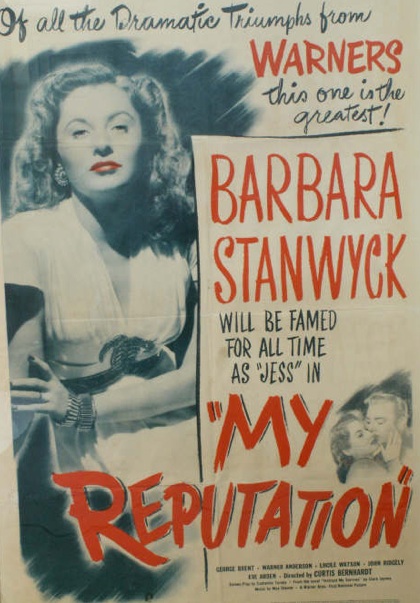
My Reputation (Jan. 25, 1946)

Curtis Bernhardt’s My Reputation, which premiered on January 25, 1946, and went into wide release a day later, was filmed in 1944. Prior to its stateside theatrical release, My Reputation was released for military use, and was shown to troops as entertainment during World War II. The screenplay, by Catherine Turney, is based on the novel Instruct My Sorrow, by Clare Jaynes.

On paper, this movie didn’t interest me, and I probably never would have watched it if I wasn’t doing this project. A prototypical “women’s picture,” My Reputation is about a young widow living among the upper crust of Lake Forest, Illinois, in 1942. Once I started watching it, however, it quickly drew me in. It’s a quality picture from beginning to end. The actors all deliver heartfelt performances, the situations and dialogue are realistic, and the direction, editing, and cinematography are all top-notch.

Barbara Stanwyck plays the protagonist, Jessica Drummond. When the film begins, Jessica’s husband has just died, leaving her a widow and their two sons, aged 12 and 14, fatherless. The executor of the late Mr. Drummond’s estate, lawyer Frank Everett (Warner Anderson) clearly has feelings for Jessica, but they are not reciprocated. Jessica’s mother, Mrs. Mary Kimball (Lucile Watson) has worn mourning clothes ever since her own husband died decades earlier. Jessica’s mother is scandalized when Jessica refuses to dress differently after her husband’s death. “Our kind of people wear black,” she says matter-of-factly.

My Reputation reminded me a little of Mildred Pierce (1945) in its nuanced portrayal of a single woman navigating tricky social waters. It didn’t hurt that Eve Arden, who played Mildred’s best friend, here performs a similar duty as Jessica’s reliable gal pal, Ginna Abbott.

When Jessica goes on a skiing vacation with Ginna and her husband, Cary (John Ridgely), she meets the the insouciant and charming Maj. Scott Landis (George Brent), who is on leave from the war. The two strike up a friendship that blossoms into a romance, but Jessica distances herself from him when he becomes too sexually forward. Landis isn’t a heel, but he is a bit of a rogue, and clearly states that he has no plans to marry. Despite this, Jessica can’t get him out of her mind, and when their paths cross again, she gives in to his advances, consenting to at least kissing. Whether more transpires between them is left up to the viewer, but there is no implication that they consumate their love. This doesn’t change the scandalous nature of their relationship, and Jessica quickly finds herself ostracized from the gossipy circles in which she runs. She stands up for herself, but the disapproval of her mother and her friends is nothing compared with the criticism she receives from children, especially her younger son, who says, “But you belong to dad. It doesn’t make any difference whether he’s dead or not.”

My Reputation ends on a hopeful note, but its depiction of an intelligent, sensitive woman living in a stifling social milieu is still hard to watch. The viewer’s frustration is mitigated, however, by the excellence of the production, especially the attention to detail that makes a well-made film such a joy to watch. For instance, in a scene in which Jessica confronts her mother, the shot is framed so that a large portrait of Jessica as a child and her mother as a younger woman hangs in the background between them. The juxtaposition says nearly as much as their heated words.

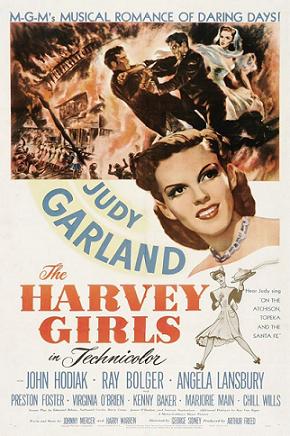
The Harvey Girls (Jan. 18, 1946)

In 1876, a 41-year-old entrepreneur named Fred Harvey opened a string of restaurants along the Atchison, Topeka, and Santa Fe Railway line. The eateries catered to middle-class and wealthy travelers alike, and at the height of the franchise’s success, there were more than 80 Harvey House restaurants. Harvey died in 1901, but the Fred Harvey Company continued to build restaurants into the 1960s.

A restaurant chain might seem an unlikely subject for a big-budget, Technicolor, Hollywood musical, but clearly the young, attractive waitresses in their crisp black and white uniforms were enough of a hook. The film opens with the following portentous prologue:

“When Fred Harvey pushed his chain of restaurants farther and farther west along the lengthening tracks of the Santa Fe, he brought with him one of the first civilizing forces this land had known … the Harvey Girls. These winsome waitresses conquered the west as surely as the Davy Crocketts and the Kit Carsons — not with powder horn and rifle, but with a beefsteak and a cup of coffee. To these unsung pioneers, whose successors today still carry on in the same tradition, we sincerely dedicate this motion picture.”

If all this is to be taken seriously, then who wouldn’t want to lionize these distaff settlers? I haven’t read Samuel Hopkins Adams’s 1942 novel that this film is based on, but it must have been a good story for Hollywood to want to pick it up. Or maybe it was just that Johnny Mercer and Harry Warren realized what a catchy rhythm the phrase “on the Atchison, Topeka, and the Santa Fe” had.

After the prologue and credits, the film opens on a shot of a moving train. Susan Bradley (Garland) is standing on the deck of the caboose, singing a forgettable song about love. She is heading out west to marry a man whom she only knows from the florid love letters he has written her. When her suitor, H.H. Hartsey (Chill Wills), turns out to be a functionally illiterate cowpoke who had a friend play Cyrano for him by penning the letters himself, Susan parts with him (mostly amicably), and becomes a Harvey girl.

The dramatic conflict, such as it is, comes from the local saloon and gambling house, which also features dancing girls. The owner of the palace of sin, Ned Trent (John Hodiak), and his star attraction, Em (played by a young and foxy Angela Lansbury), fear that the opening of the Harvey House will usher in a new era of respectability and crush their business. In real life of course, Trent’s girls would have been prostitutes and Em would have been their madam, but in the world of 1940s M-G-M musicals, dancing the cancan for hooting and hollering cowboys was about as scandalous as they could get.

Garland and Lansbury both give good performances, and are backed up by a large and talented cast. Virginia O’Brien (as the Harvey girl “Alma from Ohio”) is tough and sassy, and Ray Bolger, most famous for playing the Scarecrow in The Wizard of Oz (1939), here gets to play the Cowardly Homosexual, a popular character type in Hollywood pictures for decades. While his sexual preference is never identified outright, Bolger’s character’s effeminacy and fear of any butch labor (such as shoeing horses), as well as his spirited prancing, leaping, and tap dancing make it clear that he doesn’t have any designs on the ladies.

The Harvey Girls is an entertaining mix of musical and western. But if director George Sidney aspired for it to be anything more than breezy entertainment, it doesn’t show. Judy Garland is always a delight, but Vincente Minnelli’s ability to coax a nuanced performance from her and to tell an engaging story from beginning to end in a musical is sorely missed here. The Harvey Girls is enjoyable, but it’s no Meet Me in St. Louis (1944). Also, aside from the standout song, “On the Atchison, Topeka, and the Santa Fe” (which won an Academy Award for best song), no musical number in the picture really stands out.

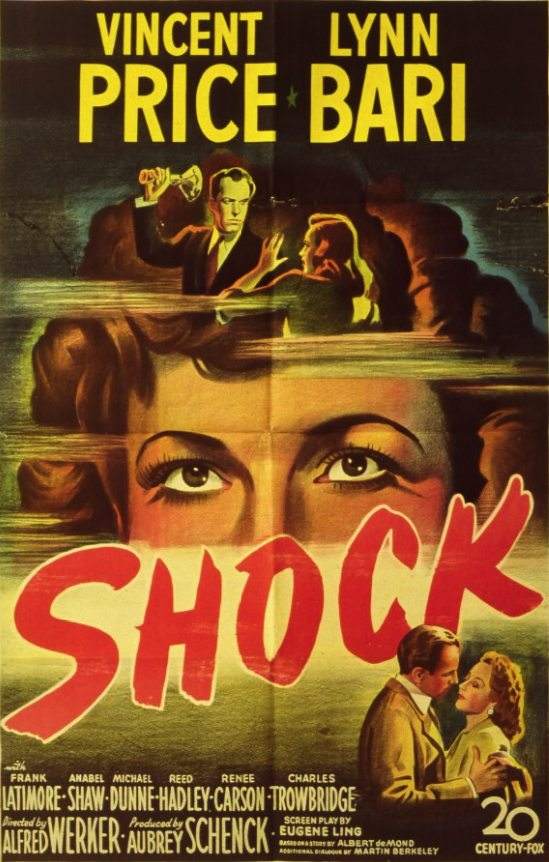
Shock (Jan. 10, 1946)

Alfred L. Werker’s thriller Shock, which had its premiere on January 10, 1946, and went into wide release on February 1st, stars Vincent Price as the murderous Dr. Richard Cross and Lynn Bari as his manipulative assistant and lover, Nurse Elaine Jordan. If you were to play a drinking game in which you took a shot of whiskey every time one of the characters in the film said the word “shock,” you would likely require medical attention after the first 20 minutes.

Price wasn’t always a horror icon. In Tower of London (1939), which was as much a costume drama about Richard III as it was a horror picture, he was a supporting player. In Brigham Young (1940), he played the founder of Mormonism, Joseph Smith. In Hudson’s Bay (1941), he played King Charles II. In Laura (1944) and Leave Her to Heaven (1945), he was the aggrieved “other man.” A tall, stately man born in St. Louis, Missouri, in 1911, Price was educated at Yale, where he studied art history and fine art. He radiated charm and erudition. He was a fine actor, and probably could have distinguished himself in any genre. As chance or fate would have it, however, his vocal delivery and arch facial expressions were perfectly suited to the ironic cinematic world of the macabre, and he is best remembered for his roles in horror pictures such as House of Wax (1953), The Fly (1958), House on Haunted Hill (1959), The Tingler (1959), and the innumerable Roger Corman-produced, Poe-influenced horror pictures that he appeared in throughout the 1960s.

While Shock is not a horror film, it has elements of one, and it’s the earliest role I’ve seen Price play in which he demonstrates some of the ghoulish mannerisms that would later make him famous. He doesn’t come close to the histrionics of some of his later horror roles, but there are some glimmerings.

The film opens in San Francisco, where a young woman named Janet (played by the somewhat sickly looking ingénue Anabel Shaw), is checking into a hotel, where she is to meet her husband, Lt. Paul Stewart (Frank Latimore), a former P.O.W. who is finally returning from World War II. Lt. Stewart doesn’t show up when he is supposed to, however, and as his emotionally fragile wife frets alone in her hotel room, she witnesses a murder. From her balcony, she can see through the window of an adjacent room. A man and a woman are arguing, and eventually the man settles the argument with a heavy candlestick.

Witnessing a murder drives Janet into a state of catatonic shock. When her husband finally arrives, she is unresponsive. When world-renowned psychiatrist Dr. Cross is brought in to consult in the case, Janet doesn’t recognize him, but Dr. Cross immediately realizes that the cause of Janet’s state of shock is the murder she witnessed him committing.

Janet is placed in Dr. Cross’s care, and he ignores the Hippocratic oath in order to save his own skin, giving Janet insulin treatments she doesn’t need, as well as using other unethical methods of driving her deeper into a state of shock so she will never be able to identify him. Cross isn’t portrayed as a total monster, however. That role is reserved for his lover, Nurse Jordan, a Lady Macbeth type who goads him on when his resolve to be wicked falters.

Shock is a programmer, to be sure, but it’s a well-made one, and kept me enthralled for all of its 70 minutes.