Yearly Archives: 2011

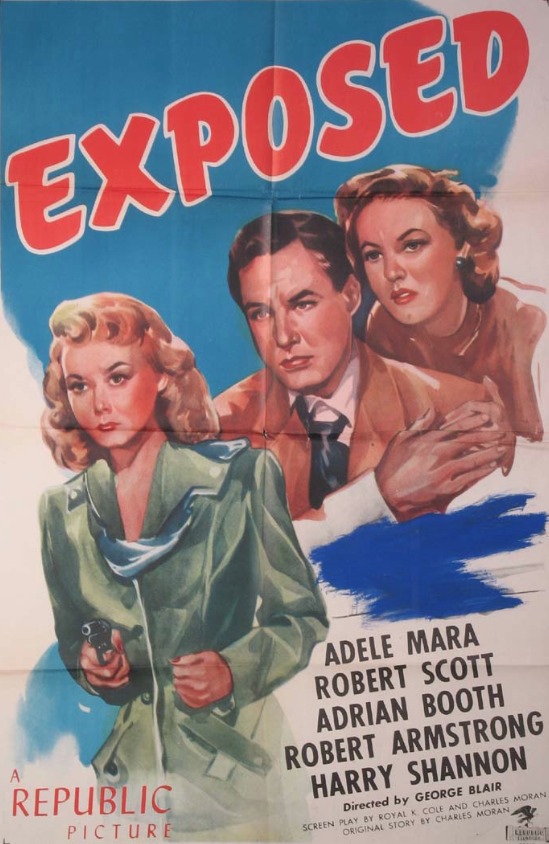
Exposed (Sept. 8, 1947)

Exposed
Exposed (1947)
Directed by George Blair
Republic Pictures

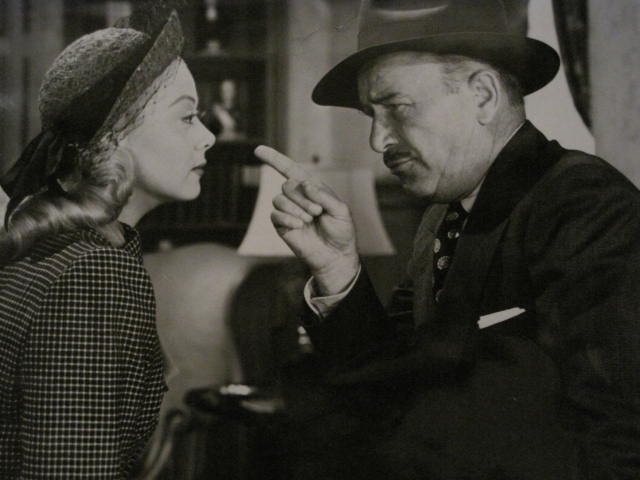
I wish that George Blair’s Exposed was a better movie, because it’s got a great setup. It’s one of those rare movies from the 1940s — like Crane Wilbur’s The Story of Molly X (1949) — that features a woman in a traditionally masculine role. In Molly X it was June Havoc as the leader of a heist crew (and later tough gal behind bars). In Exposed it’s cute-as-a-button Adela Mara as Los Angeles private eye Belinda Prentice.

Prentice is a stylishly dressed young woman who eats in the best restaurants and drives a Lincoln Continental Convertible. She has an office with marble walls and blond wood furniture. The door to her office has “B. Prentice” stenciled on pebbled glass. Her fee is $75 a day plus expenses.

When a dignified gentleman, Col. Bentry (Russell Hicks), who is looking to engage the services of a private investigator is surprised to discover that B. Prentice is a woman, she responds, “You were expecting maybe Senator Claghorn?”

Prentice is full of quips like that. When a tough little gunsel named “Chicago” (Bob Steele) sits down at her table at the Deauville Restaurant and places his fedora down with a gun under it, she says, “Take your hat off the table. I’m allergic to dandruff.”

When a waitress at a cocktail lounge warns Prentice that the man she wants to talk to is a bad egg, she responds, “Don’t worry, I’ll scramble him.”

Her dialogue may be hard-boiled, but she always comes off as cute and impish, not like a bull dagger who talks out of the side of her mouth. She achieves this by backing up all of her wiseacre comments not with her fists or a pistol, but with her assistant, a hulking ex-Marine named Iggy (William Haade).

Like I said, Exposed has a great setup. The problem is its execution.

Exposed was a B feature from Republic Pictures, but it’s top-heavy with plot, which is tough to handle with a running time of only 59 minutes. Consequently, the dialogue is nearly all exposition. The shooting schedule was obviously tight, allowing for a limited number of takes, which results in the actors all being stiff, reciting their lines without flubbing any of them, but without injecting much life into them either. (Compare, for instance Bob Steele’s performance as a gunman in this film with his similar role in Howard Hawks’s The Big Sleep.)

The plot, in a nutshell, is that Col. Bentry’s stepson, William Foresman III (Mark Roberts), has been making very large withdrawals from the family business without telling anyone. The bluenosed Col. Bentry doesn’t want to ask him anything directly because he doesn’t want to seem like he’s prying.

So he employs the services of Belinda Prentice. But by the time she arrives at the Bentry estate, Col. Bentry is dead, seemingly stabbed with a letter opener. But there’s very little blood. Could it have been a heart attack — or poison — that caused him to collapse on the letter opener? The police are called in, including Inspector Prentice (Robert Armstrong), who’s Brenda’s father.

William Foresman III seems like a nice enough young man, but that never ruled anyone out as a suspect in a murder mystery. There are also all number of creeps crawling around in the woodwork, including Prof. Ordson (Paul E. Burns), Bentry’s physician, who’s working on a chemical cure for alcoholism.

If you can overlook the stilted dialogue and the overly involved mystery, Exposed is a fun second feature. Bob Steele’s fight scene with the much-larger William Haade is pretty good, and the film’s unpretentious shooting style is a great way to see what Los Angeles looked like circa 1947.
Dark Passage (Sept. 5, 1947)

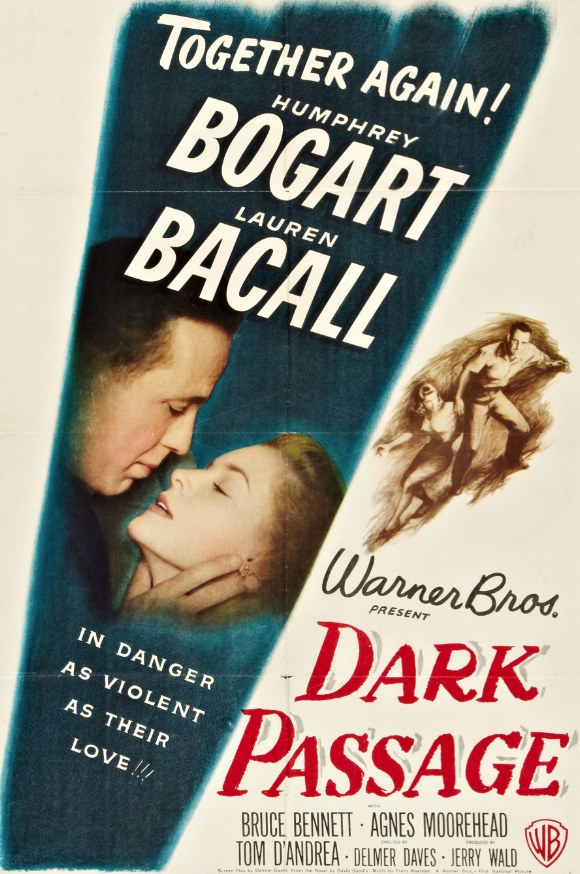
Delmer Daves’s Dark Passage is the red-headed stepchild of the Bogie-Bacall movies.

Humphrey Bogart and Lauren Bacall were married in 1945, and stayed married until Bogart’s death in 1957. They made four movies together — To Have and Have Not (1944), The Big Sleep (1946), Dark Passage, and Key Largo (1948). Of these four, Dark Passage is the strangest and the least widely acclaimed.

It was a bit of a critical and box office disappointment at the time of its release, possibly because Bogart’s face doesn’t actually appear on-screen until the picture is more than half over, and possibly because of Bogart’s involvement with the Committee for the First Amendment.

The Committee for the First Amendment was an organization that was formed to protest the treatment of Hollywood figures by the House Un-American Activities Committee. (Bogart later recanted his involvement with the organization in a letter published in the March 1948 issue of Photoplay entitled “I’m No Communist.”)

Dark Passage is based on a book by oddball crime novelist David Goodis. The film does a good job of bringing Goodis’s strong characterizations and nightmarish, occasionally surreal demimonde to the big screen.

For better or for worse, it also does a good job of bringing to life some of Goodis’s less powerful aspects, like his convoluted plots and his reliance on coincidence.

But just like the best of Goodis’s novels, the film version of Dark Passage doesn’t need to be plausible to work. It plays by its own rules, and when it works, boy does it work.

In Dark Passage, Bogart plays Vincent Parry, a man convicted of killing his wife who breaks out of San Quentin by hiding in a 55-gallon drum on the back of a flatbed truck. He manages to roll himself off the truck and into a ditch somewhere in Marin County. He strips down to his undershirt, buries his prison-issue shirt, and takes to the highway to thumb a ride. He’s picked up, first by a guy named Baker (Clifton Young), and then — when that little ride goes sour — by a beautiful artist named Irene Jansen (Lauren Bacall).

She hides him under her canvases and wet paint so they can make it through a roadblock at the entrance of the Golden Gate Bridge, then she takes him to her luxurious bachelorette pad in North Beach. Why is she helping him? Because her own father was unjustly imprisoned for a murder he didn’t commit, and because she followed Parry’s trial, even writing letters to the editor protesting his treatment by the press.

For the first 37 minutes of Dark Passage, Bogart’s face is never shown, for reasons we’ll get to in a moment. This P.O.V. style of filmmaking was pioneered by Robert Montgomery in his film Lady in the Lake (1947), but the technique works much better in Dark Passage, for a variety of reasons. First, the editing is more aggressive than in Lady in the Lake, which was essentially one long tracking shot designed to put the viewer in the shoes of the protagonist but that never quite worked. Second, there are third-person shots of Bogart in which his back is turned or his face is in shadows, which helps to break things up and make them more visually palatable.

Once Parry makes it to San Francisco, Dark Passage gets really weird. Irene gives him $1,000, new clothes and a hat, and a place to stay, but if you thought that qualified Parry as the luckiest escaped convict in history, you ain’t seen nothing yet.

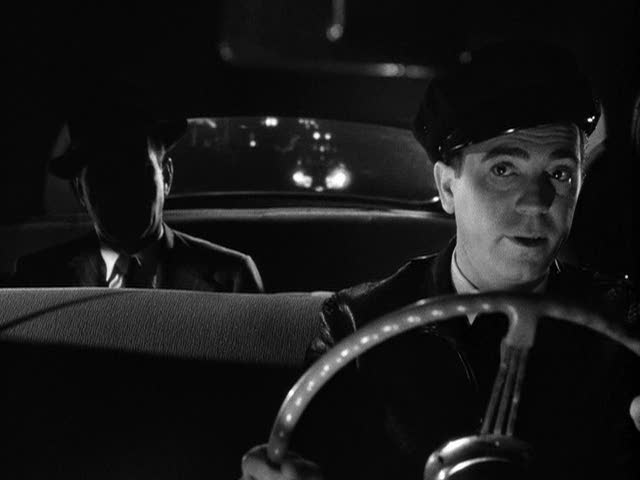
He’s picked up one night by a cabbie named Sam (Tom D’Andrea), who not only recognizes him but believes Parry got a raw deal from the court system, and hooks him up with his buddy, Dr. Walter Coley, a plastic surgeon who can change his face.

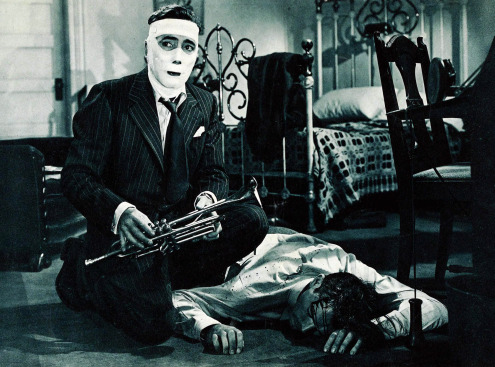
Nervous about staying with Irene, Parry goes to see his friend George Fellsinger (Rory Mallinson), a trumpet player who gives Parry a key to his place. Incidentally, we get our first shot of Parry’s “real” face on the front of a newspaper laid across his friend George’s chest as he lies in bed. The real Parry has a mustache, and doesn’t look much like Bogart.

But he looks exactly like Bogart after his trip to see Dr. Coley, who’s played by 67-year-old actor Houseley Stevenson. Dr. Coley is the most ghoulishly fun character in Dark Passage. Wrinkled, liver-spotted, and chain-smoking, Dr. Coley asks Vincent if he’s ever seen a botched plastic surgery job right before he puts him under, and the kaleidoscopic nightmare Parry has while undergoing plastic surgery is a real standout.

Even after the surgery, we don’t fully see Bogart’s face until more than an hour into the picture.

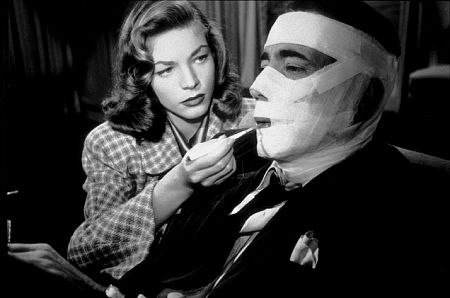
Until then, he’s covered with bandages, smoking cigarettes with long filters and communicating with Irene using pencil and paper. (Throw a pair of shades on him and he’d look like Claude Rains in The Invisible Man).

While the plot may be contrived and coincidence-laden, the characterizations are sharp, and the actors are all really good. Lauren Bacall has to carry the film for much of the first hour, and she delivers a really good performance. She’s much better at interacting with the camera than any of the actors in Lady in the Lake were. Consequently, the P.O.V. technique draws less attention to itself, and works fairly well.

When the bandages finally come off, Parry looks at himself in the mirror and remarks, “Same eyes, same nose, same hair. Huh. Everything else seems to be in a different place. I sure look older. That’s all right, I’m not. And if it’s all right with me it oughtta be all right with you.”

The fact that Bogart and Bacall were married in real life gives this line a little humorous subtext.

Hidden behind his new face, Parry is faced with another murder to solve, cops on his tail, a chiseler who hopes to blackmail Irene after he finds out she’s been shielding Parry, the presence of Irene’s old beau Bob (Bruce Bennett), and her shrill friend Madge Rapf (Agnes Moorehead), who keeps dropping by and nosing around.

That Parry goes about solving his problems in a haphazard, roundabout way should come as a surprise to no one who’s familiar with the fiction of David Goodis.

Dark Passage may not be a perfect film, but it’s an intriguing and involving one. Sid Hickox’s cinematography is gorgeous, and the location shooting in San Francisco is really effective. It’s worth seeing at least once, and if you’re like me, you’ll probably want to see it again.

The Bachelor and the Bobby-Soxer (Sept. 1, 1947)

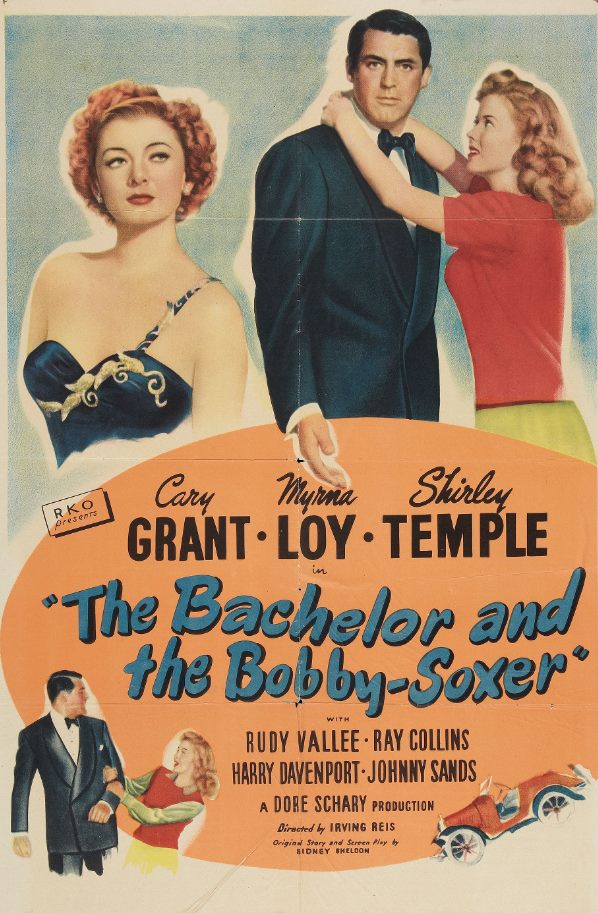
The Bachelor and the Bobby-Soxer was the surprise winner of the Oscar for best original screenplay at the 20th Academy Awards in 1948, beating out the scripts for more “serious” fare like Body and Soul, A Double Life, Monsieur Verdoux, and Sciuscià (Shoeshine).

But just because its win was surprising doesn’t mean it didn’t deserve to win. The Bachelor and the Bobby-Soxer is a very funny film. It’s a latter-day screwball comedy about a handsome artist who is forced — by court order, no less — to date a teenage girl.

Sidney Sheldon’s screenplay treats those jumpin’ and jivin’ post-war kids with affection rather than bemusement or contempt, and he has a keen understanding of the ways teenagers try to act like adults, and how they unwittingly fail.

The dialogue might not be a completely accurate evocation of the way real bobby-soxers and their jalopy-driving boyfriends actually talked (did any kid before this movie came out actually say that they felt “sklonklish”?), but the characterizations all feel right.

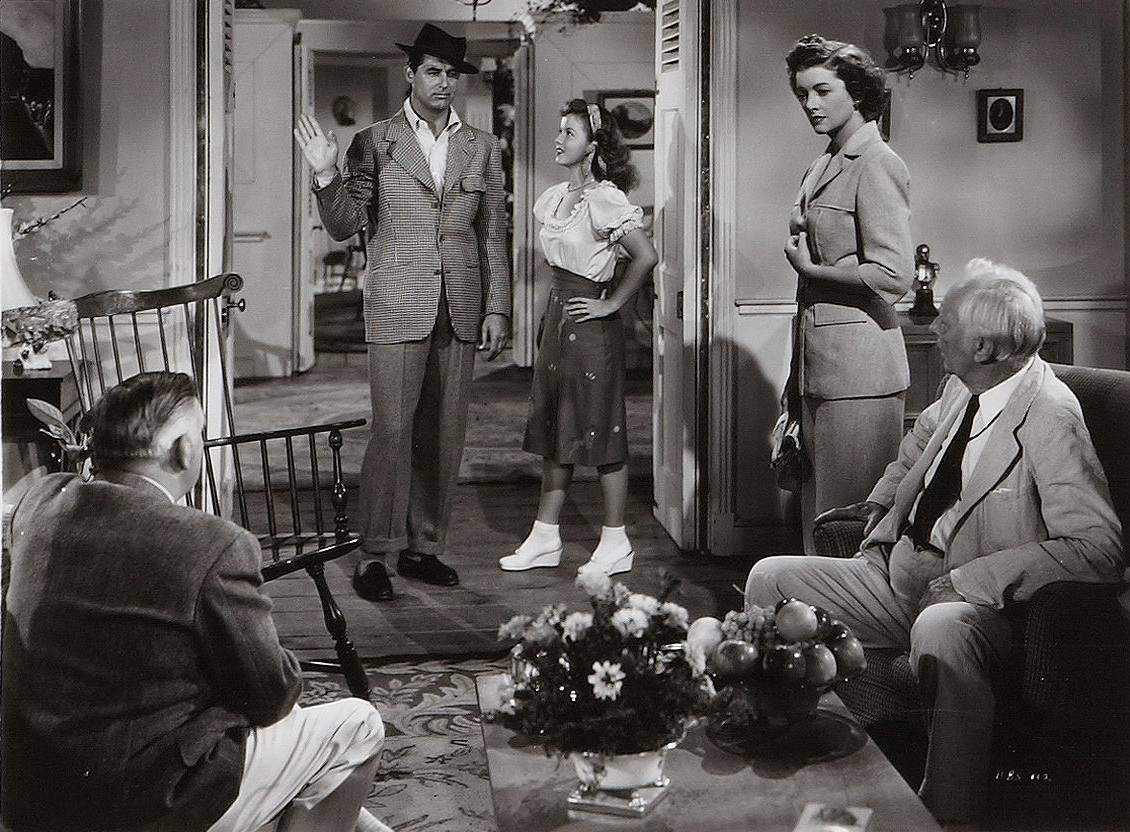
Former child star Shirley Temple — all grown up (sort of) — plays the bobby-soxer of the title, a 17-year-old high school student named Susan who lives with her older sister. Her older sister just happens to be a judge, and when the film begins, the Honorable Margaret Turner (Myrna Loy) is presiding over a case involving a kerfuffle at a nightclub between a couple of brassy gals over the affections of charming artist Richard Nugent (Cary Grant).

Margaret and Susan’s parents are dead, so Margaret is as much of a mother to Susan as she is a big sister. After the initial courtroom scene, the stage is set for the sparks of disapproval to fly as soon as Margaret learns that the object of her little sister’s affection is the same Lothario she saw in court.

Most of the humor in The Bachelor and the Bobby-Soxer comes from the fact that Richard has absolutely no desire to be with Susan, but is ordered by the court, under the recommendation of a psychologist, to take her out on dates so his mature-man forbidden fruit will sooner wither and die, and she’ll go back to her sweet, somewhat dumb high school boyfriend, Jerry (Johnny Sands).

Susan is mature for her age, but she’s still a 17-year-old. Watching Cary Grant suffer through taking her to Sunset High School basketball games and dates at the ice cream shop are some of the funniest bits I’ve seen in a long time.

Cary Grant — no stranger to screwball comedies — has an arch, deadpan comic style that’s perfectly suited to the material. Temple is really great in this movie, too. Like Deanna Durbin, she was an impossibly cute child star who blossomed into an engaging adult performer without missing a beat. And Myrna Loy is wonderful to watch, as always. It doesn’t matter that she was old enough to be Temple’s mother when she made this movie. She barely looks a decade older, and she matches Cary Grant beat for beat in all their scenes together.

The Bachelor and the Bobby-Soxer is a great comedy that stands the test of time.

Lured (Aug. 28, 1947)

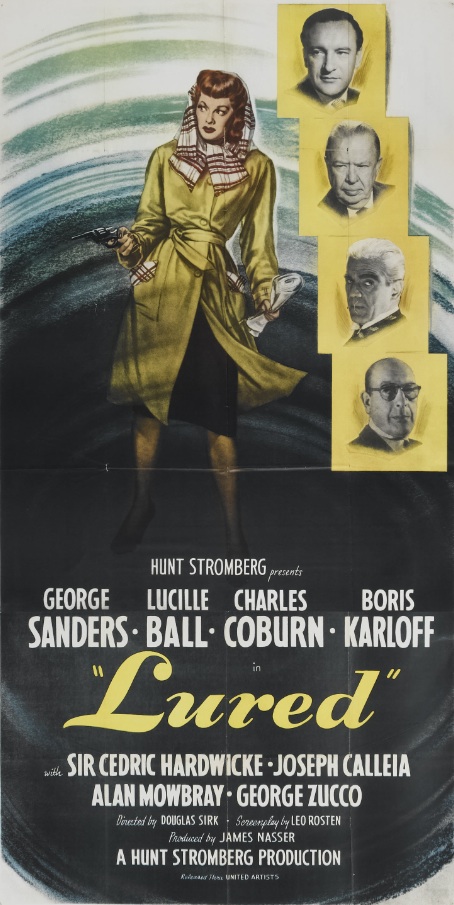
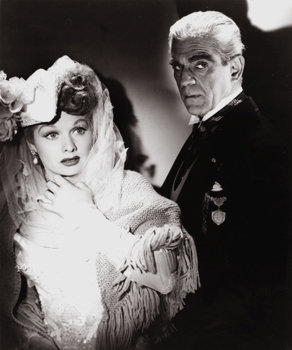
If you go solely by the current DVD cover art for Douglas Sirk’s Lured, you’ll come away thinking it’s a thriller starring Boris Karloff and Lucille Ball; possibly a Gothic melodrama in which her character marries his character and is then terrorized by him in a creepy old mansion.

Or you might not.

But in any case, that’s what I thought, so I was surprised when it turned out that Karloff’s character in Lured is essentially a throwaway, and all of his scenes could be excised from the film without affecting the plot.

Of course, excising Karloff from the film would excise much of the ghoulish fun, since the sequence in which he plays a thoroughly mad former fashion designer who forces Ball to model his “latest creations” is one of the best bits in the picture, but it ultimately has very little to do with the central mystery about a poetry-obsessed killer who places ads in the personal columns.

In Lured, Lucille Ball plays Sandra Carpenter, an American dancer and actress who came to London from New York with a show. It folded after four nights and she was broke. So now she works in a dance hall called the Broadway Palladium where “50 beautiful ravishing glamorous hostesses” dance with men off the street for six pence a twirl.

It’s no picnic. After one of Sandra’s co-workers mentions that there’s just two hours left to go in their shift, Sandra responds, “Two hours in this cement mixer’s longer than a six-day bike race.” (Incidentally, Ball played a similarly occupied character on the CBS radio show Suspense in the January 13, 1944, broadcast, “A Dime a Dance.”)

When Sandra is offered a tryout for a part in the new Fleming & Wilde show, she jumps at the chance, not so affectionately referring to her current place of employment as a “slaughterhouse.”

But just as she arranges a private audition with Mr. Fleming over the phone, she sees the headline of the London Courier. Her friend and fellow taxi dancer Lucy Barnard (Tanis Chandler) has just become the eighth victim of the “Poet Killer”!

So two very different men enter Sandra’s life, and things will never be the same for her.

One is the charming and insouciant Robert Fleming (played by the the charming and insouciant George Sanders), who initially wants to cast Sandra in his show, but soon wants her to play the leading lady in his own life, till death do them part.

The other is Inspector Harley Temple (Charles Coburn), who tests Sandra’s powers of observation and then enlists her in Scotland Yard after she passes with flying colors.

Their policewomen are very clever, he says, but the killer only places ads for young, beautiful women. (Sorry, ladies of Scotland Yard. No offense intended, I’m sure.)

Sandra then has to respond to every personal ad for young, unattached women. The police will write the responses, but Sandra will have to keep the appointments. A humorous montage follows, natch.

Lured is a mixed bag. Douglas Sirk is a great director, but Lured isn’t one of the films he’s remembered for. It’s well-done, and Sirk’s fascination with surface opulence masking (or possibly masking) darker forces is in full effect. The plot, however, twists and turns through so many contrivances that it’s hard to keep track of everything, let alone take any of it seriously.

It’s worth seeing, however, by anyone who’s a Sirk completist, or anyone who wants to see Lucille Ball in a glamorous leading role in a beautifully art-directed film. She didn’t have too many of those, you know, after I Love Lucy.

Song of the Thin Man (Aug. 28, 1947)

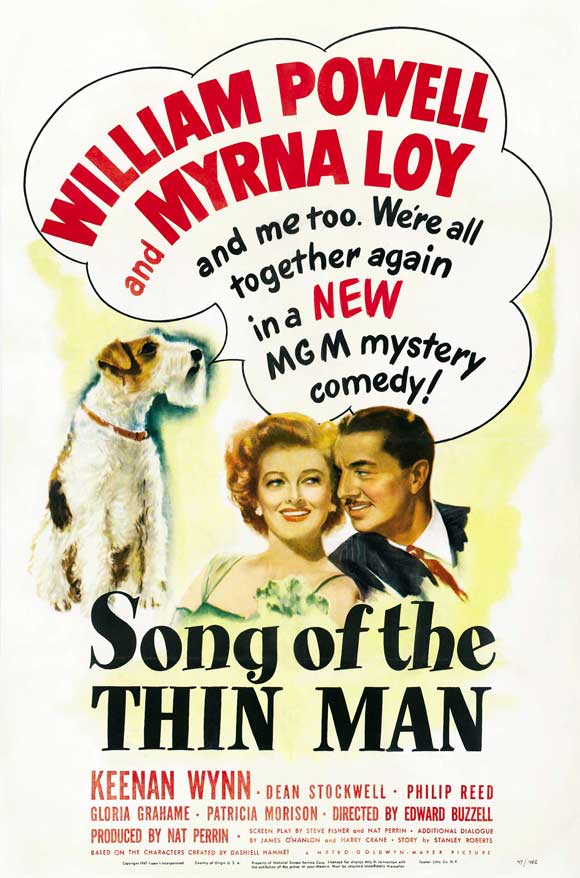
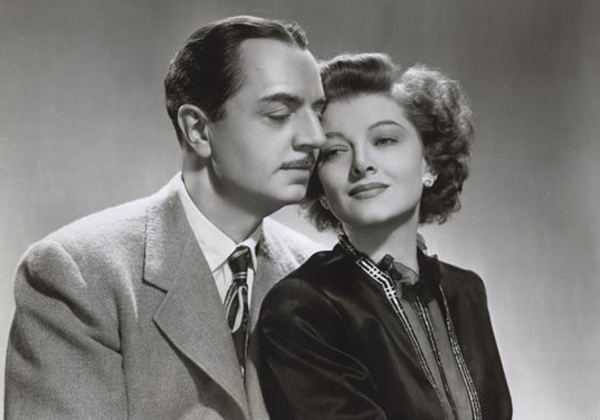
Edward Buzzell’s Song of the Thin Man was a bittersweet viewing experience for me. I’ve been a huge fan of the Thin Man series since the first film, The Thin Man (1934), so it was a little sad to know that Song of the Thin Man would be the last new film I’d see with William Powell and Myrna Loy as everyone’s favorite dipsomaniacal mystery-solving married couple, Nick and Nora Charles.

While some films in the Thin Man series are better than others, all of them are funny, well-made mysteries featuring two of the most appealing actors from Hollywood’s Golden Age.

As always, their little dog Asta is around for yuks, along with a brand new adorable little son, played by Dean Stockwell. (Yes, kids, Dean Stockwell was adorable once.)

But not to worry. Having a young son doesn’t stop Nick and Nora from continuing to booze it up and skulk around at night with flashlights, looking for clues.

The mystery they’re trying to solve this time around is the murder of a jazz band leader named Tommy Drake (Phillip Reed), who is shot aboard the S.S. Fortune, a gambling ship run by a man named Phil Brant (Bruce Cowling).

True to its title, Song of the Thin Man is all about music. Specifically jazz music, and the wacky nightclub performers who jam till dawn, like Drake’s former bandleader Buddy Hollis (Don Taylor) and his famous clarinet. Hollis is a talented musician, but he’s all whacked out from carrying a torch for the hot little cookie Fran Ledue Page (Gloria Grahame), a singer.

Keenan Wynn is also on hand as musician Clarence “Clinker” Krause, and he proves that his incredibly annoying character in The Hucksters (1947) wasn’t a case of lightning striking once.

The mystery in Song of the Thin Man isn’t that clever or involving. But as always with the Thin Man movies, the mystery and its solution is less important than all the fun Nick and Nora have carousing their way through it.

Powell and Loy were 41 years old and 28 years old, respectively, when the series began, so by the time they made Song of the Thin Man together they were starting to get on in years, but Loy looks just as beautiful as she did in 1934, and I don’t think anyone ever went to see the Thin Man movies for Powell’s looks.

All good things must come to an end, but I wish there could have been just a few more Thin Man movies with Powell and Loy.

The October Man (Aug. 28, 1947)

The only problem with a really crackerjack opening is that sometimes it can make the rest of a film seem staid.

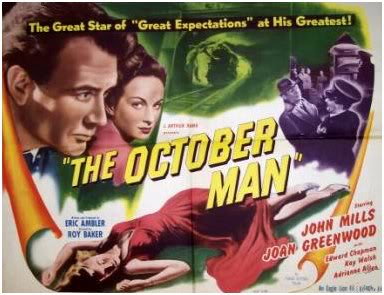
Roy Ward Baker’s The October Man, which was written and produced by spy novelist Eric Ambler, features a stunning, completely wordless opening sequence in which a bus full of passengers navigates twisting English country roads at night in the rain.

Jim Ackland (John Mills) sits next to a little girl. The two are friendly with each other, and he ties his handkerchief into a rabbit shape to amuse her. The film cuts from them to an axle under the bus with a loose screw, to the sleepy driver, and back to them. When disaster comes, it is swift.

Before the accident, Ackland had a good job as an industrial chemist and was quite sane. During the accident, however, he suffered a depressed fracture of the skull and multiple brain injuries.

The little girl on the bus next to him was the daughter of some of his friends, and he blames himself for her death, twice attempting suicide during his convalescence.

Eventually, though, Ackland starts to get his life back on track. He moves into a boarding house full of fusspots and weirdos and gets another job as a chemist. He meets a nice girl named Jenny Carden (Joan Greenwood) and starts seeing her regularly.

But when one of the other residents of Ackland’s boarding house — a woman named Molly Newman (Kay Walsh) — is murdered, suspicion falls on Ackland. The only person who should know beyond a shadow of a doubt whether he’s guilty or not — Ackland himself — isn’t even sure, since he’s a paranoiac who suffers from blackouts.

The October Man is a good film. It’s well acted and well shot, and the central mystery is intriguing, if not particularly difficult to unravel. My main problem with it is that nothing in the film is equal to the suspense and power of the first minute.

This was the first feature film that Roy Ward Baker directed. (He’s listed in the credits as “Roy Baker.”)

Baker was a prolific director of British film and television who worked into the 1990s, and who died last year at the age of 93. During World War II, Baker worked under Eric Ambler in the Army Kinematograph Unit, which eventually led to him directing The October Man. If you’re a fan of Hammer Studios’ horror films, you’ve doubtless seen films directed by Baker, but he worked in all manner of genres. His most enduring film is probably A Night to Remember (1958), about the sinking of the Titanic.

The Hucksters (Aug. 27, 1947)

It’s hard to watch Jack Conway’s The Hucksters today and not compare it with Mad Men.

While Mad Men is a TV series that began in 2007 and takes place in the early ’60s and The Hucksters takes place during the time it was filmed (the post-war ’40s), they share a number of similarities, and not just because they’re both about advertising agencies.

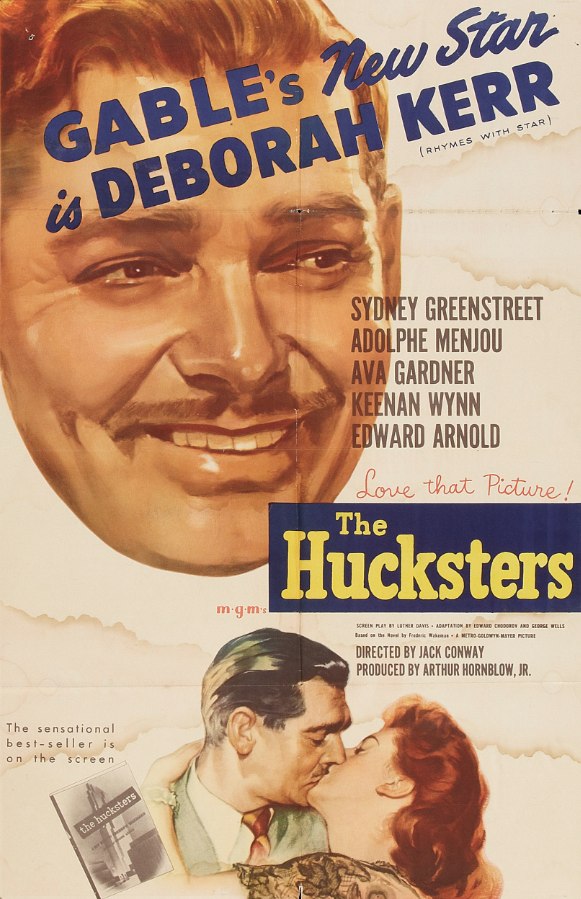
Both feature at their center a dashing leading man with rugged good looks as an advertising genius who must navigate the tricky waters of love, sex, and difficult clients. Jon Hamm was in his mid-30s when Mad Men began, while Clark Gable was in his mid-40s in 1947, but both of their characters are veterans of the most recent war and inveterate seducers of women.

The Hucksters is based on Frederic Wakeman’s 1946 novel of the same name, which spent a year at the top of the best-seller lists. Wakeman’s novel was based on a four-part exposé in The Saturday Evening Post, “The Star Spangled Octopus,” about talent and promotional agency MCA.

The novel’s racy subject matter was largely responsible for its success. Life magazine called it “Last year’s best-selling travesty on bigtime advertising.”

Metro-Goldwyn-Mayer paid nearly $200,000 for the rights to Wakeman’s novel in a pre-publication deal. Most of the salacious details, however, never made it into the final shooting script. (Clark Gable’s take on the first draft of the script was, “It’s filthy and it isn’t entertainment.”) For instance, in the novel, Gable’s character, Victor Albee Norman, has an affair with a married woman, but she was changed into a war widow for the film.

Consequently, The Hucksters never quite achieves the satirical bite of Mad Men, but there are number of bits that are funny, particularly if you’re familiar with radio advertising circa 1947.

There are plenty of reasons to see The Hucksters. It was the American film debut of Deborah Kerr, who plays Gable’s widowed love interest, Kay Dorrance, and it also features the beautiful Ava Gardner as a torch singer named Jean Ogilvie. Adolphe Menjou is wonderful as Mr. Kimberly, the head of the advertising agency, and Keenan Wynn is appropriately irritating as a third-rate radio comedian named Buddy Hare.

The most memorable actor in the film, however, is Sydney Greenstreet, who plays Evan Llewellyn Evans, the grotesque and demanding head of Beautee Soap. After Gable’s character, Victor Norman, rejects the more scandalous layout favored by Evans, Evans sits down at the head of the boardroom table, tilts his head back, hawks, and spits on the table. “Mr. Norman, you’ve just seen me do a disgusting thing,” he says. “But you’ll always remember what I just did. You see, Mr. Norman, if nobody remembers your brand, you aren’t gonna sell any soap.”

The Hucksters could have used more moments like that. It’s nearly two hours long, and Gable’s romance with Kerr takes up much of the running time. It’s perfectly well-handled and shot, but it’s a storyline one could see in any number of pictures, while the advertising angle of the story is unique, and the film could have gotten more mileage out of it.

The Hucksters earned a respectable $4.4 million during its domestic release, but was a complete flop overseas, since in those days no one outside the United States was in any way familiar with American advertising or commercial broadcasting.

Kiss of Death (Aug. 27, 1947)

Kiss of Death is director Henry Hathaway’s greatest film noir. It’s a mix of the semi-documentary style of his earlier films The House on 92nd Street (1945) and 13 Rue Madeleine (1947) with the hard-boiled conventions of his private eye flick The Dark Corner (1946).

The film begins with the following words: “All scenes in this motion picture, both exterior and interior, were photographed in the State of New York on the actual locale associated with the story.”

Unlike The House on 92nd Street and 13 Rue Madeleine, however, this commitment to veracity isn’t in service of a true-ish retelling of World War II-era espionage, but of a hard-boiled crime drama about a three-time loser facing 15 years in stir after being nabbed for a jewel robbery.

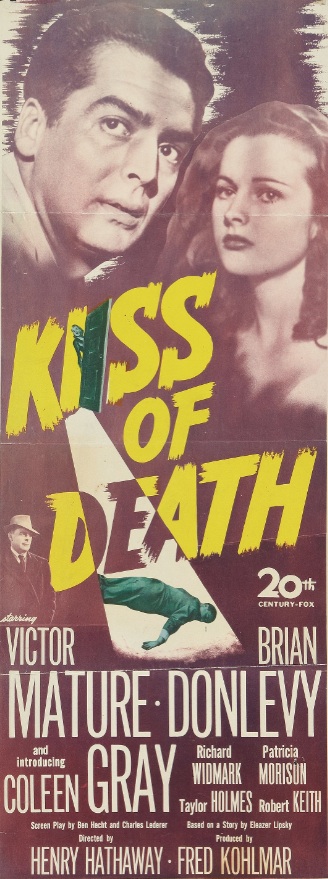
His name is Nick Bianco (Victor Mature), and if he wants to watch his two little girls grow up, he’s going to have to stool for the district attorney’s office.

Bianco has been in this position before, and he took the full four-year rap instead of squealing.

“I’m the same guy now I was then. Nothin’ has changed. Nothin’,” he tells Assistant District Attorney Louis D’Angelo (Brian Donlevy).

On his way up the river to Sing Sing, Nick meets a cackling, sociopathic hood named Tommy Udo (Richard Widmark). Udo won’t show up again for awhile, but he’ll play a major role in Nick’s life when he does.

For awhile, Nick stays clammed up, but then his wife Maria commits suicide and he starts to rethink matters. When a pretty girl from his old neighborhood, Nettie (Coleen Gray), comes to visit him in Sing Sing and tells him that the driver on the jewelry job, a guy named Pete Rizzo, was responsible for Mrs. Bianco putting her head in the oven, Nick decides he wants to talk to the D.A. and secure his release in exchange for information. (In the original story, it was implied that Rizzo raped Nick’s wife, but that’s sidestepped in the final version, making it seem more as if she was having an affair with Rizzo.)

Nick trusts Assistant D.A. D’Angelo enough to tumble to a job in his past that he got away with — the Thompson Fur Company heist — to provide a cover for his trips to the D.A.’s office. D’Angelo promises that he’ll drop the charges later for insufficient evidence.

Things are looking up for Nick. He’s able to care for his daughters, and he’s eventually paroled, leaving him free to marry Nettie.

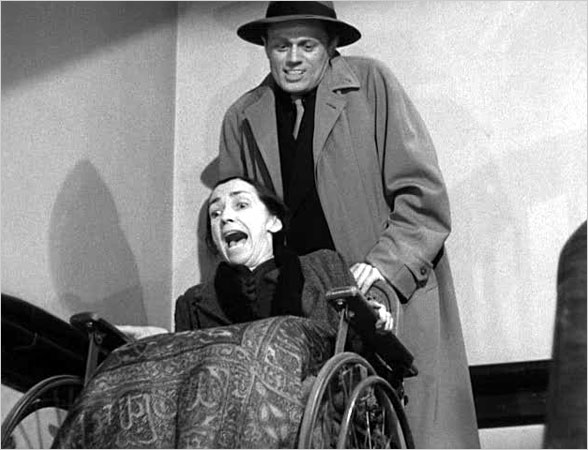
But as soon as Tommy Udo — Nick’s old pal from the trip up to Sing Sing — re-enters his life, things go very bad very quickly. Udo is the kind of guy who thinks nothing of wrapping up an older wheelchair-bound woman (played by Mildred Dunnock) in electrical cord and pushing her down a long flight of stairs, in one of the most enduring scenes of cinematic sociopathy.

Kiss of Death was Richard Widmark’s film debut, and his balls-out crazy performance is something to behold. The filmmakers thought that Widmark’s high forehead made him look too intelligent, so they outfitted him with a low-browed hairpiece. Like Heath Ledger’s performance as the Joker in The Dark Knight (2008), Widmark’s performance as Tommy Udo straddles the line between gangster movie and monster movie. Director Hathaway had toyed with the idea of casting the manic Harry “The Hipster” Gibson, who sang the 1944 druggie classic “Who Put the Benzedrine in Mrs. Murphy’s Ovaltine?” as Udo, but it’s impossible now to imagine anyone but Widmark in the role.

The screenplay for Kiss of Death was adapted by Ben Hecht and Charles Lederer from a story by Eleazar Lipsky originally called “Stoolpigeon.” Lipsky was a novelist who worked as a Manhattan assistant district attorney. He was also legal counsel for the Mystery Writers of America. Perhaps because of Lipsky’s day job, the realism of the setting of Kiss of Death is matched by the actions of its characters. Brian Donlevy, in the role of Assistant D.A. D’Angelo, is neither a hero nor a villain. When he tells Nick that he’s going to have to testify in court after all, and later that it was all for nothing, and that Tommy Udo was acquitted and is probably coming after Nick, the viewer gets the sense that D’Angelo genuinely cares for Nick, but that at the same time, putting Nick’s life in danger is just part of the job. D’Angelo might not like it, but he accepts it as a necessary evil.

Interestingly, the fictional Kiss of Death comes off as a more realistic film than either The House on 92nd Street (1945) or 13 Rue Madeleine (1947), both of which touted the “true” stories that were their inspirations. Although not every scene in Kiss of Death was shot on the actual locale associated with the story, as the title card promises (some of the interiors were clearly shot in a studio), the use of real New York City and Upstate New York locations coupled with realistic dialogue, understated performances from all the cast besides Widmark, and extremely sparse use of background music makes for a powerful, engrossing drama. There are standout set pieces, like the jewel heist in the Chrysler Building that opens the film, and spectacular shots of the Manhattan Criminal Courts Building, the Tombs, and the Triborough Bridge from the Queens side of the East River, but there are also lots of little touches that give the film its sense of realism. When Nick watches his daughters during their music lesson at the Academy of the Holy Angels in Fort Lee, New Jersey, the piano is slightly out of tune. When Nick sits in his cell at Sing Sing, the toilet in the cell is clearly visible, which is something you’d never see in a prison cell built on a Hollywood soundstage in the ’40s. (Incidentally, prior to shooting the scenes in Sing Sing, Hathaway had both Victor Mature and Richard Widmark processed through the system to give them a better sense of the characters they were playing.)

Kiss of Death isn’t a perfect movie, but it stands up to repeated viewings, and its use of music and location are both revolutionary. If you don’t believe me, take it from Walter Winchell…

Jesse James Rides Again (13 chapters) (June 2-Aug. 25, 1947)

I’ve said it before and I’ll say it again. Republic Pictures made the best serials in the business. While you could sometimes find better acting in the Saturday-afternoon chapterplays from Universal and Columbia, neither could top Republic when it came to pure slam-bang entertainment. They employed the best stuntmen in Hollywood, and their serials were action packed.

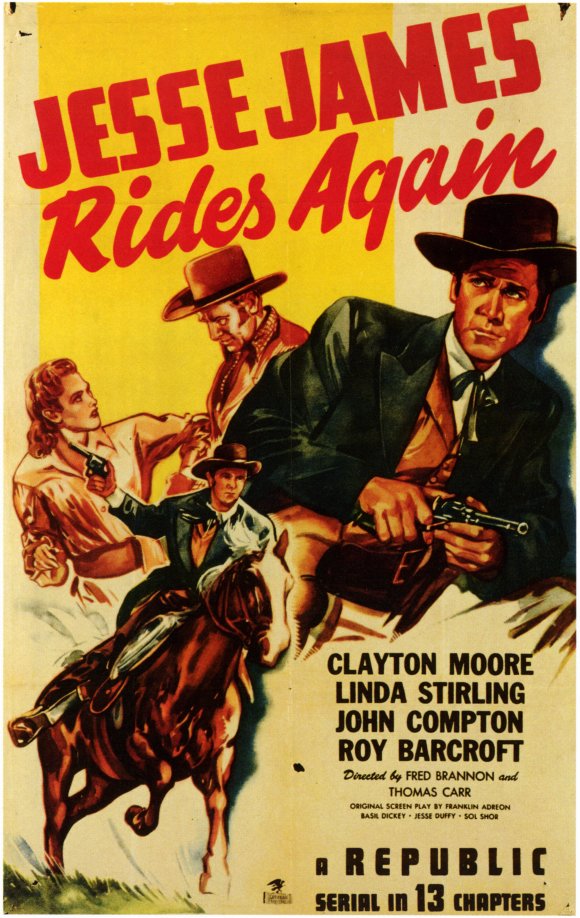
Jesse James Rides Again, which was directed by Fred C. Brannon and Thomas Carr, could have gone the Poverty-Row route and used its western setting as an excuse to deliver a cheap finished product. They had the Iverson Ranch and plenty of reusable costumes, after all. Throw in some chases on horseback, some fistfights, some gunfights, and you’re golden.

Instead, Brannon and Carr delivered a fast-moving serial with lots of pyrotechnics. Some chapters are more exciting than others, obviously, but I still wasn’t expecting so many blown-up barns, flaming logs pushed down hills, exploding riverboats, and burning oil derricks.

Every chapter opens with a shot of men on horseback. They’re all wearing black robes and black hoods. The exciting theme music by Mort Glickman incorporates elements of Stephen Foster’s “Oh! Susanna.” The black-robed riders look exactly like members of the Ku Klux Klan in photo-negative, and they’re called — not terribly creatively — the Black Raiders.

The Black Raiders are secretly working for a man named James Clark, who’s played by Tristram Coffin, a dependable Republic villain playing the most dependable villainous archetype in westerns, the greedy land baron. Clark knows that the farmers who live in Peaceful Valley, Tennessee, are sitting on a rich vein of oil, and it’s only a matter of time before they find out about it.

Clark’s plan is to have the Black Raiders drive all the farmers out of Peaceful Valley by using violence and intimidation; good, salt-of-the-earth people like Ann Bolton (Linda Stirling) and her crippled father Sam Bolton (Tom London).

So in classic western fashion, into the Boltons’ lives rides Jesse James (Clayton Moore). The ex-Confederate outlaw is on the lam for a crime he didn’t commit (the robbery of a bank in Northfield, Minnesota) along with his buddy Steve Long (John Compton).

Jesse James is traveling under the name “J.C. Howard,” and he’s a modern-day paladin, ready to take up arms in defense of the helpless, like Mr. Bolton and his daughter.

If you know anything about the real-life Jesse James, you’ve probably already realized that Jesse James Rides Again plays fast and loose with the facts.

But who cares? It’s all just an excuse for action and feats of derring-do, and as such, it succeeds admirably. Most of the chapters follow a predictable arc — J.C. Howard ( Jesse James) gets out of whatever scrape the previous chapter left him in, then it’s off to the James Clark Land Office, where Clark and his beefy henchman Frank Lawton (Roy Barcroft) discuss their nefarious plans for the oil under Peaceful Valley, just in case any of the kids in the audience are seeing the serial for the first time. Then Jesse James, Steve Long, and Ann Bolton become embroiled in another of Clark and Lawton’s plans, and have to fight their way out. (Clark’s role as villain is unknown to the protagonists until the last chapter.) And finally, each chapter ends with a cliffhanger, like Ann Bolton unconscious inside a cotton compress, or Jesse James knocked out and left behind in the boiler room of a riverboat that’s about to explode.

As the weeks go by, Jesse James and the farmers eventually discover the oil they’re sitting on, and it becomes a race to register their land, sink wells, and get the oil out of the valley. All the while, Lawton and his boys commit one act of sabotage after another.

The most explosive and exciting chapter is the penultimate one, “Chapter Twelve: Black Gold,” in which Steve Long leads a wagon train carrying barrels of oil through a prairie set afire by Lawton and his boys. There are crackups and explosions galore. It’s not quite The Road Warrior, but it’s still an impressive set piece.

Clayton Moore, who plays Jesse James, is probably best known for playing the Lone Ranger on TV from 1949 to 1957. His role in Jesse James Rides Again sometimes seems like a dry run for playing the Lone Ranger.

Moore isn’t the greatest actor in the world, but he’s a solid choice to play a stalwart western hero. Also, I really like the outfit he wore in this serial. Unlike the leather vests and dungarees favored by plenty of B western heroes, Jesse James wears a black hat, a black top coat, a black long string tie, and a dark vest over a white shirt. It’s what every Southern gentleman with a price on his head should be wearing.

Republic would make two more serials featuring Jesse James as a character; The Adventures of Frank and Jesse James (1948), which again starred Moore as Jesse and co-starred Steve Darrell as his brother Frank, and The James Brothers of Missouri (1949), which starred Robert Bice as Frank James and Keith Richards as Jesse James. (No, not the Keith Richards you’re thinking of.)

Desert Fury (Aug. 15, 1947)

For me, Lewis Allen’s Desert Fury is currently running neck and neck with Felix Feist’s The Devil Thumbs a Ride for the honor of “wackiest movie of 1947.”

But maybe I’m comparing apples to oranges. While The Devil Thumbs a Ride was a zany thrill ride with oddball characters and a lot of unexpected humor, Desert Fury is a ridiculously campy melodrama in which most of the humor seems unintentional.

Also, it has gay undertones that are strong enough to power a small city for a year.

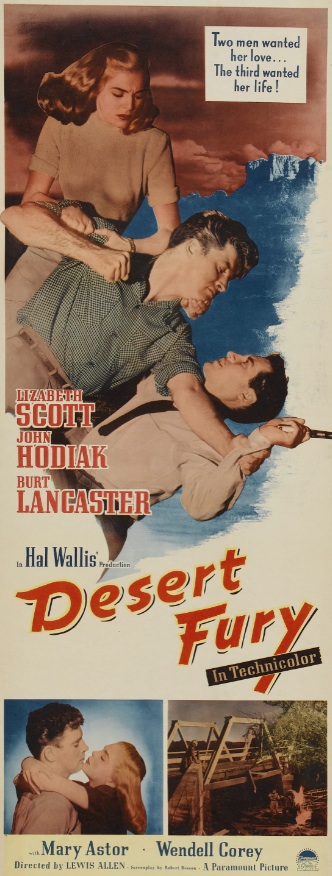
The poster on the right implies that Burt Lancaster and John Hodiak spend the movie fighting for Lizabeth Scott’s love, but that’s not the case. More accurate is the tagline: “Two men wanted her love … The third wanted her life!”

Scott plays a beautiful 19-year-old girl who lives in a “cactus graveyard” in the middle of nowhere — Chuckawalla, Nevada. She lives with her mother, Fritzi, who’s played by Mary Astor (an actress from Hollywood’s Golden Age who was just 16 years older than Lizabeth Scott). Fritzi always calls Paula “baby.” Not in a sweet, maternal way, but the way a barfly might say, “Hey, baby! C’mere!”

Fritzi wants Paula to go back to school, but Paula wants to help her mother run the Purple Sage Casino. (Paula’s father was a bootlegger who was killed when Paula was very young.)

Burt Lancaster plays Tom Hanson, a former bronco buster who barnstormed around the country, but washed out of the rodeo and now works as a sheriff’s deputy in Chuckawalla. Fritzi wants Tom to marry Paula and make an honest woman out of her. He’d like nothing more than to marry Paula, but he doesn’t push, because he knows that her love for him is strictly platonic.

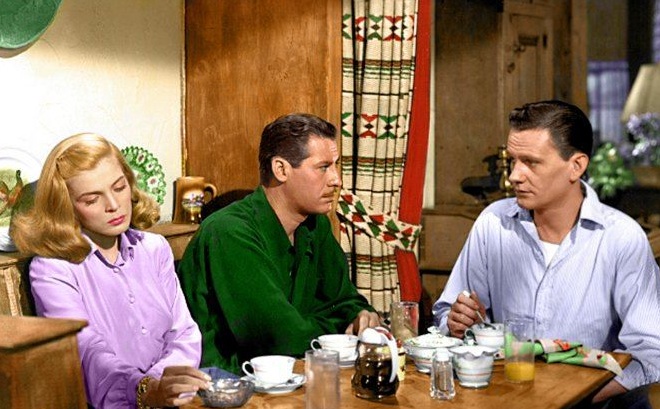
Into their lives comes runty, mustachioed gangster Eddie Bendix (John Hodiak) and his gunsel Johnny (Wendell Corey), and Paula — quite inexplicably — falls head over heels in love with Eddie.

The love triangle formed by Paula, Eddie, and Tom is weak sauce compared with the love triangle formed by Paula, Eddie, and Johnny.

Johnny is more than just Eddie’s “muscle.” He’s his longtime companion, his best friend, and — just possibly — his lover.

Is he or isn’t he? Let’s look at the evidence. Eddie and Johnny form a tight unit, and seem to both know what really happened to Eddie’s first wife, who died in a car accident. Johnny hates Paula, and seems insanely jealous of her relationship with Eddie.

And how does Eddie explain to Paula how he first hooked up with Johnny?

“I was your age, maybe a year older. I was in the automat off Times Square about two o’clock in the morning on a Saturday. I was broke, he had a couple of dollars, we got to talking. He ended up paying for my ham and eggs,” he says, a note of shameful resignation creeping into his voice.

“And then?” Paula asks.

“I went home with him that night. I was locked out. Didn’t have a place to stay. His old lady ran a boarding house in the Bronx. There were a couple of vacant rooms. We were together from then on.”

The relationship between Eddie and Johnny isn’t the only hint of a gay union. Paula and Fritzi are so close in age, and Fritzi’s attitude toward her daughter lacking so much maternal warmth, that they seem more like a lesbian couple than anything else. Fritzi seems like the older, more dominant one, and Paula seems like the younger, more restive one, who might also be interested in men. (In further defense of this reading, Lizabeth Scott and Burt Lancaster might walk off into the sunset at the end of the picture, but their lips never meet. The final — and most passionate — kiss of the film is the one Fritzi plants on Paula’s lips.)

There’s a lot of talent in front of and behind the camera, but that only counts for so much. For instance, compare Miklós Rózsa’s brilliant score for Brute Force (1947) with his score for Desert Fury. His score for Desert Fury is powerful, but without the dramatic underpinning of a great film, it just writhes and flails all over the place, seemingly in search of a better movie, or at least a more lively one.

The script by Robert Rossen (with uncredited assistance from A.I. Bezzerides), which is based on Ramona Stewart’s novel Desert Town, has a lot of snappy dialogue, but the story just doesn’t move with much intensity. Also, the Technicolor cinematography really undercuts some of the noir elements of the story and the situation.

Desert Fury is campy, and worth seeing if you’re into camp, but that’s about it. Also, if you’re a connoisseur of face-slapping, there’s plenty of that going around, too.