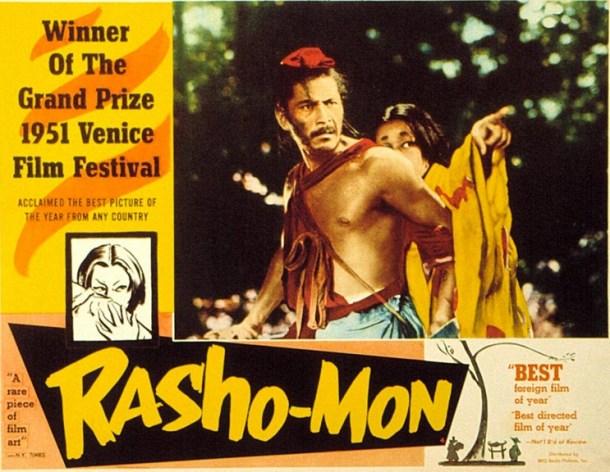
Rashomon (1950)
Directed by Akira Kurosawa
Daiei Film Co., Ltd.
Rashomon was the breakout film not just for director Akira Kurosawa, but for Japanese cinema in general. It was awarded the prize for best film of the year at the Venice Film Festival in 1951, and received the Academy Award for best foreign language film in 1952.
It took me a few years to really “get” Rashomon. I was a big fan of Kurosawa’s Ran (1985) and Seven Samurai (1954) from a young age (I saw both of them on the big screen when I was 12), but when I started exploring the rest of his filmography on VHS tapes I checked out of the library, Rashomon didn’t make much of an impression on me. I enjoyed both Yojimbo (1961) and Throne of Blood (1957), but I thought Rashomon was “boring.” (Forgive me! I was a teenager.)
I remember watching Rashomon for the first time and seeing it as a kind of “whodunnit.” I thought the different viewpoints were all leading up to some kind of pat conclusion. When it ended ambiguously, I was vaguely unsettled and a little bit angry. Perhaps, since it took place in 11th-century Japan, I was expecting more swordplay. And of course, seeing it on VHS wasn’t an ideal presentation.
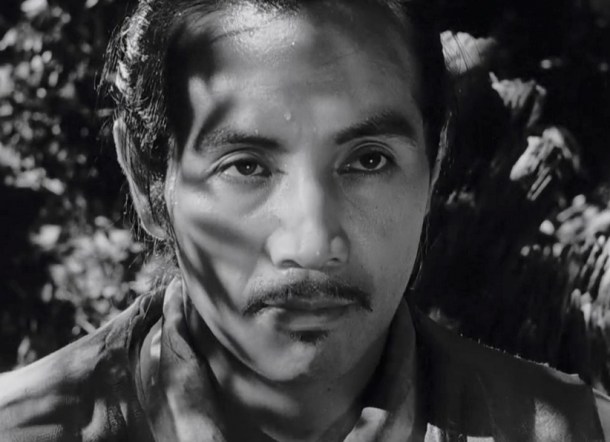
Flash forward maybe 10 years. Rashomon was playing at Film Forum in New York, so I went to see it. It was like seeing a completely different film. Not only had I grown more comfortable with ambiguity, but seeing a 35mm print on the big screen revealed what a deeply beautiful film Rashomon is. Kurosawa and his cinematographer, Kazuo Miyagawa, shot Rashomon deep in virgin forests in the heat of midsummer. Searing flashes of sunlight wash across the characters, alternating with washes of darkness. Thickets of leaves tremble in the breeze, and look so close you could reach into the screen and touch them. Sweat pools on the actors’ faces, falling from their chins in heavy drops.
Rashomon is an uncomfortable meditation on the elusiveness of truth. It exposes the world as a kind of hell, because human beings cannot even be honest with themselves. But it is also a deeply sensuous experience, and an utterly beautiful film.
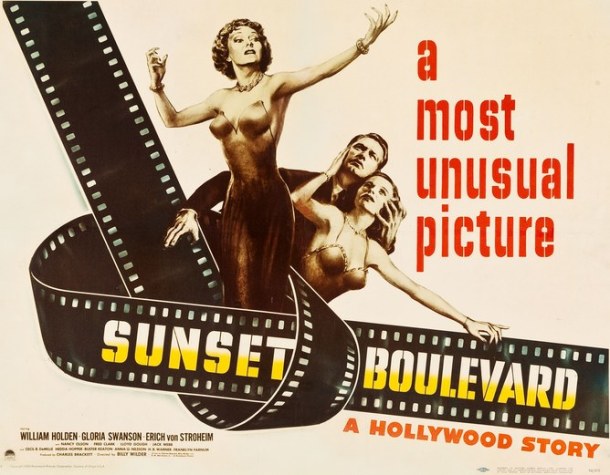
Sunset Boulevard (1950)
Directed by Billy Wilder
Paramount Pictures
I first saw Sunset Boulevard at Cornell Cinema a long, long time ago. I never attended Cornell University, but I grew up in Ithaca, NY, and I was spoiled by Cornell’s cinema program from a young age.
On Saturday afternoons I used to get dropped off and see “kid classics” like The 7th Voyage of Sinbad (1958), The Magic of Lassie (1978), Oliver Twist (1948), Captains Courageous (1937), and even silent movies like Peter Pan (1924) and Charlie Chaplin’s The Kid (1921), which I saw with my grandmother, who was a freshman in high school when The Kid was first released. I remember them showing a Laurel & Hardy short first, but I can’t remember which one. My grandma and I both laughed a lot that afternoon.
It’s no wonder I turned out how I turned out.
Anyway, I can’t remember exactly when I first saw Sunset Boulevard at Cornell Cinema, but I think it was some time when I was home from college, which means I was nominally an adult, but not really grown up yet.
I’ve seen a lot of movies as an adult (like Akira Kurosawa’s Rashômon) that resonated much more deeply for me than they did when I first saw them in my teens or 20s. But Sunset Boulevard wasn’t one of those movies. It was exactly as amazing as I remember it. I loved it when I was younger, and I love it just as much now.
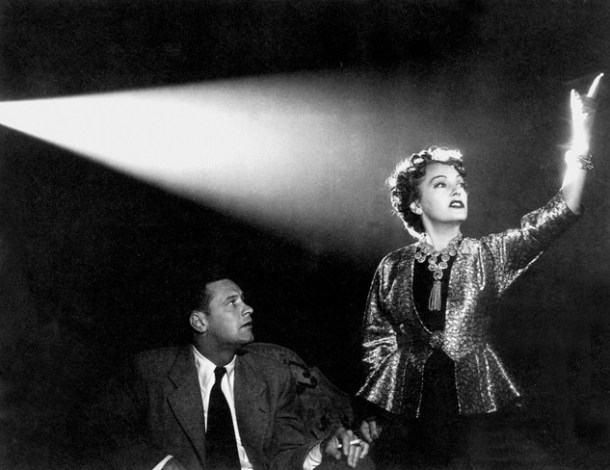
Of course, there were things I contemplated in a slightly different way this time around — like what the larger meaning of a character like Norma Desmond in Hollywood is, or the interesting gender reversal of William Holden’s character exposing himself as a “kept man” to his sweetheart, which is roughly equivalent to the cliché of the “fallen woman” but much less common.
But for the most part, I was thrilled and captivated by all the same things; Gloria Swanson’s over-the-top but utterly human portrayal of a reclusive former superstar, William Holden’s relatable Everyman, Erich von Stroheim’s semi-autobiographical performance as “Max von Mayerling,” Norma Desmond’s devoted butler who used to play a very different role in her life, and the cameos by real silent film stars like Buster Keaton.
Another thing I love about Sunset Boulevard is how it works on so many different levels. Billy Wilder is one of those rare directors (like Alfred Hitchcock) who made movies full of wit, style, and interesting ideas that can also be enjoyed strictly as popcorn entertainment. For instance, Sunset Boulevard frequently and shamelessly veers into horror-film territory. The scene early in the film where Norma Desmond and her butler Max conduct a nighttime funeral for her deceased pet chimpanzee looks eerily similar to the funeral that opens Dracula’s Daughter (1936), in which Gloria Holden and her manservant lay her father, Count Dracula, to rest. (In fact, there is probably an entire essay to be written about the connections between Dracula’s Daughter — and other Universal horror films — and Sunset Boulevard.)
Like every great classic film, Sunset Boulevard continues to speak to us while occupying its own unique place in history. (Hollywood is still a cruel place for older female actors, but Norma Desmond’s fall from the limelight is intrinsically linked with the transition from silent films to talkies.) It’s one of the greatest films about Hollywood every made.
Mystery Street (1950)
Directed by John Sturges
Metro-Goldwyn-Mayer
“Mystery Street” is too generic a title for this groundbreaking crime thriller.
To me, Mystery Street sounds like one of those mystery programmers from the ’30s and ’40s designed to run as a second feature — perhaps featuring Charlie Chan or The Crime Doctor.
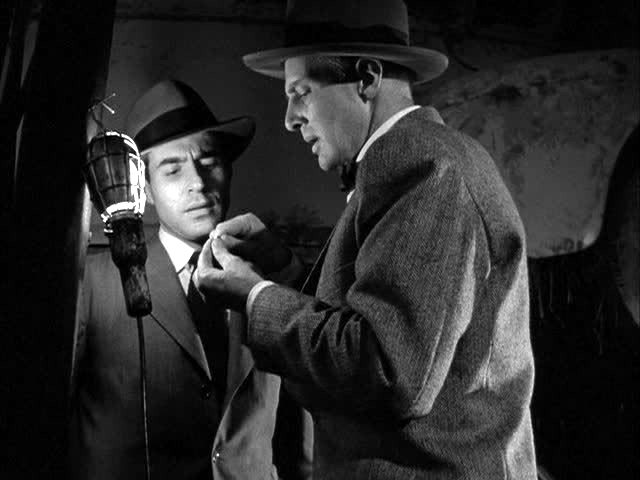
But with its focus on forensic investigation, Mystery Street is an innovative police procedural. Only its title is run-of-the-mill. If you’re a fan of TV shows like CSI: Crime Scene Investigation and Bones, make some time to watch this movie, and see where the genre got its start.
In the post-war years, “reality” entertainment was king. The “ripped-from-the-headlines” police procedurals that are still all over TV kicked off with the film He Walked by Night (1948) and the radio show Dragnet, which began broadcasting in 1949 and quickly inspired a slew of imitators.
Mystery Street follows the established formula of the police procedural, but focuses on the process of forensic investigation. When Lieutenant Peter Morales (Ricardo Montalban) is assigned to a murder case with no clues — only skeletal remains that have washed up on the beach — he turns to Dr. McAdoo (Bruce Bennett) of Harvard Medical School. (Incidentally, Mystery Street was also the first Hollywood film to shoot in Boston and Cambridge, MA.)
Discriminating fans of CSI will enjoy the outlandish example Dr. McAddoo gives Lt. Morales when he explains the kinds of crimes forensic science can solve: a seemingly open-and-shut murder case that turned out to be a combination of a bloody nose, a paroxysmal seizure, and a head injury caused by a fall. (It only looked like the woman’s husband had beaten her to death.)
Mystery Street is a stylish and very entertaining noir. It was nominated for an Academy Award for Best Story. I think it would make a great double bill with Border Incident (1949), another film that starred Ricardo Montalban when he was first establishing himself in Hollywood. He’s a compelling and charismatic leading man, and it’s fun to watch him before he was a household name.
According to Wikipedia, Mystery Street lost money at the box office, which is a shame, because it’s a great little flick. Maybe a better title would have helped?
The Furies (1950)
Directed by Anthony Mann
Paramount Pictures
It occurred to me at some point during The Furies that it might be a more realistic view of frontier life than I’m used to seeing in westerns.
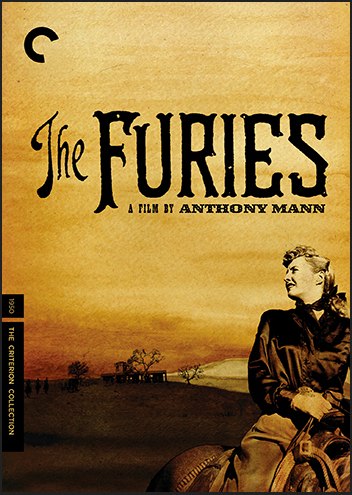
This thought occurred to me while I was struggling to find something to connect with in the movie. Anthony Mann is a director I love, and the western has been one of my favorite genres since I was a child, so I was really looking forward to The Furies. Also, the fact that The Furies is the only Mann film to get the Criterion treatment led me to believe I might be treated to the apotheosis of his sagebrush sagas.
But I just couldn’t get into The Furies the first time I tried to watch it, and I had to turn it off after about 45 minutes.
The Furies is based on a 1948 novel by Niven Busch, which seems evident in Charles Schnee’s screenplay. Like a lot of movies based on mid-century historical novels, it’s packed to the gills with dialogue, and a lot of it is expository, referring back to deceased family members and past events.
With its multi-generational plotting and Freudian undertones, The Furies reminded me of a couple of movies that I didn’t much care for, Duel in the Sun (1946) and Mourning Becomes Electra (1947). But I love Anthony Mann, so after a day or two had passed, and with a little more fire in my belly, I sat down to watch The Furies from beginning to end. Even though I didn’t love the movie unreservedly, I found a lot to like about it, and would definitely recommend it to “serious” western fans, as well as any fans of ’50s dramas.
Back to my first thought, that this might be a more “realistic” view of frontier life than I’m used to seeing in westerns.
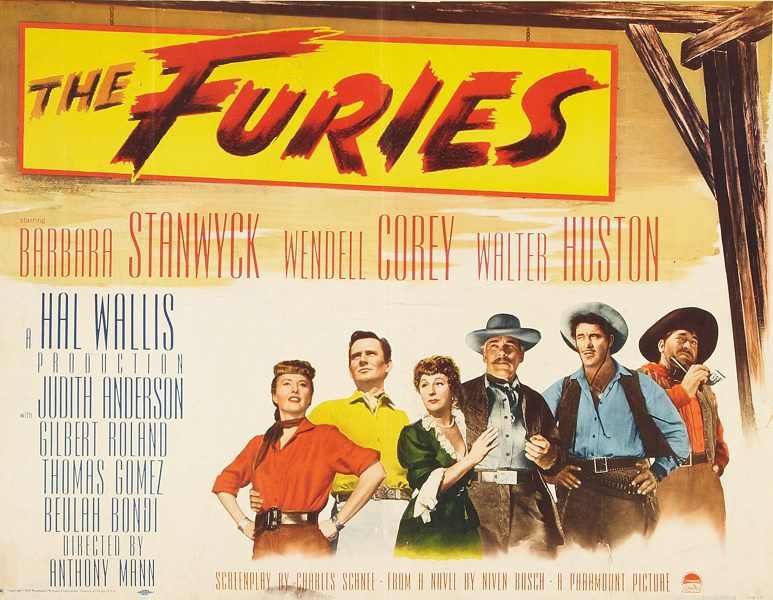
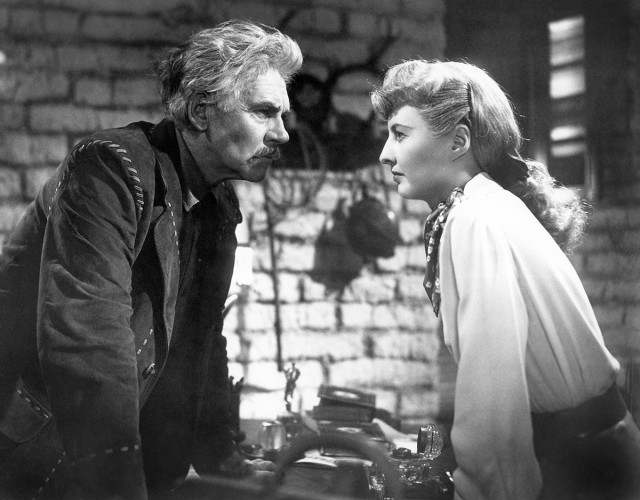
Unlike the lonely desert landscapes and violent men of few words that we’re used to seeing in westerns, The Furies is a talky melodrama focused on a specific place — the Furies ranch — and the tension between a self-made man, T.C. Jeffords (Walter Huston), and his fierce daughter, Vance (Barbara Stanwyck). It’s clear from the beginning of the film that T.C.’s son, Clay (John Bromfield), is not the heir who will take over the sprawling Furies property, it’s Vance.
But why shouldn’t a western be packed with flowery language and dense plotting? Well, no reason at all. It’s merely generic conventions that make us think the Old West was a place mostly populated by drifters and outlaws, and where quick-draw shootouts were the order of the day.
The Furies is not a typical western, and I think that’s a good thing. I could definitely see this being a movie I come back to again and again, finding new things to like in it each time. Stanwyck gives a pretty amazing performance, and the film still offers plenty of the traditional pleasures we look for in westerns, like gorgeous cinematography of wide-open spaces and larger-than-life characters.
The only really sour note in the film — and something I doubt I’ll ever warm up to — is Rip Darrow, the character played by Wendell Corey. As an actor, Corey is bereft of charisma and the character he plays is despicable, and not in a way that’s fun to watch.
By the way, I didn’t realize until I finished writing this review and watched the trailer above that Niven Busch, who wrote the novel The Furies, also wrote the novel Duel in the Sun. That explains why they felt so similar.
Broken Arrow (1950)
Directed by Delmer Daves
20th Century-Fox
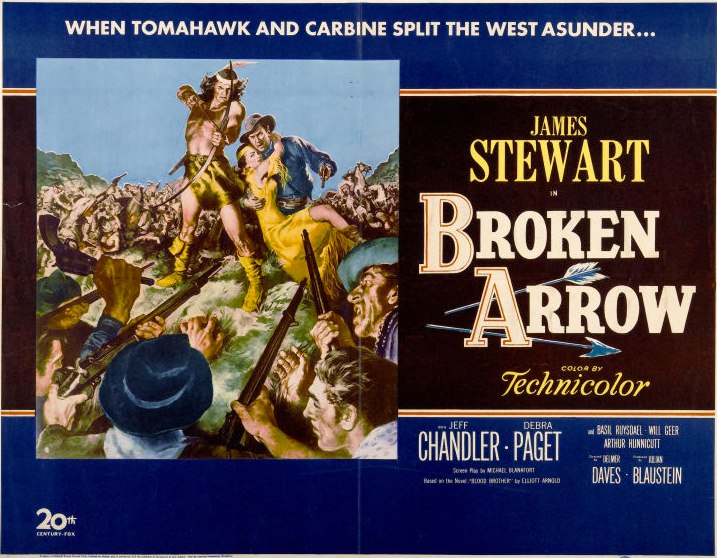
1950 was an interesting year for the Hollywood western. It was also an interesting year for the movie career of James Stewart, who appeared in two significant westerns that were released that summer, Anthony Mann’s Winchester ’73 and Delmer Daves’s Broken Arrow.
They’re both good films, and they presaged greater things on the horizon for Stewart, who was already a huge star, but was now on his way to becoming a bona fide western star, too. Broken Arrow and Winchester ’73 were also a sign of things to come, since the ’50s was the decade that the Hollywood western matured, opening itself to new possibilities and more complex storytelling, like The Gunfighter, released around the same time.
Broken Arrow and Winchester ’73 would make an entertaining double bill, but unless you’re one of those people who can’t stand to watch movies in black & white, I guarantee that you will find Winchester ’73 the more exciting and engaging film.
Broken Arrow is well-made and well-acted, but it’s more significant for its portrayal of American Indians than it is for being a cracking piece of entertainment, like Winchester ’73 is.
Not only does Broken Arrow present a sympathetic view of the Apache and their leader, Cochise, but it acknowledges that the beginning of the war between the Apache and the US Army involved broken truces and wholesale slaughter on the part of the cavalry against the Apaches. The film does a good job of depicting the Arizona territory in the midst of war; both sides hate each other with a passion, and enough atrocities have been committed on both sides for peace to be a far-fetched hope.
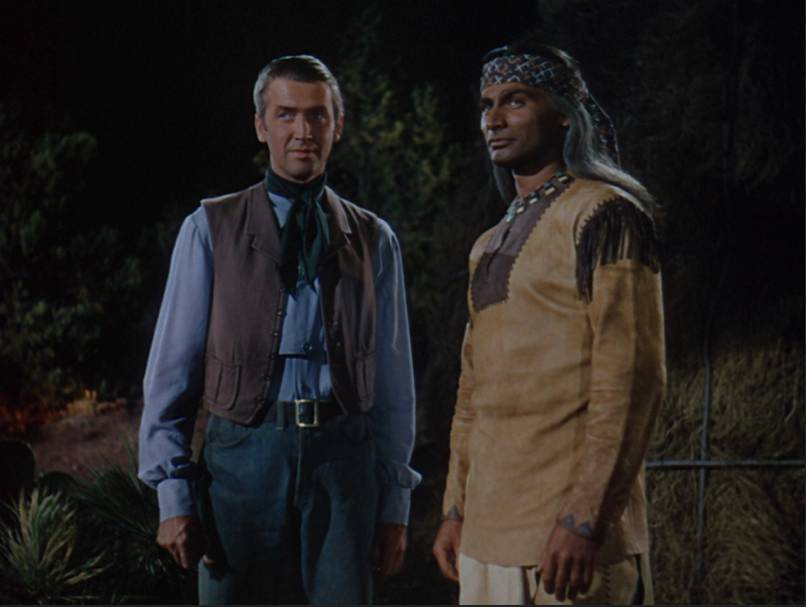
Enter Tom Jeffords (James Stewart), a former cavalry scout who learns firsthand that the Apaches are far from the inhuman savages he always believed them to be. He desires to broker a peace deal between Cochise (Jeff Chandler) and the United States, so he learns everything he can about Apache customs, beliefs, and language, and sets off to meet Cochise.
Broken Arrow is based on the historical novel Blood Brother by Elliott Arnold. The screenplay was written by blacklisted writer Albert Maltz. (The writer listed in the credits of the film is Michael Blankfort, who acted as a front for Maltz.)
The main problem with the movie is that while there are a bunch of Native American actors employed as extras, most of the key players among the Apache are portrayed by white actors wearing makeup.
I have to give credit to Jeff Chandler, who delivers a great performance as Cochise. I listen to a lot of old radio shows, and at first it was weird to hear a voice I recognized so well coming out of the mouth of a supposed Apache. (Chandler played the science teacher, Mr. Boynton, on Our Miss Brooks, but I know him best as the radio version of private detective Michael Shayne, “that reckless, red-headed Irishman.”) But once I settled in, I enjoyed Chandler’s portrayal, which is nuanced and mostly free of stereotypical vocal inflections.
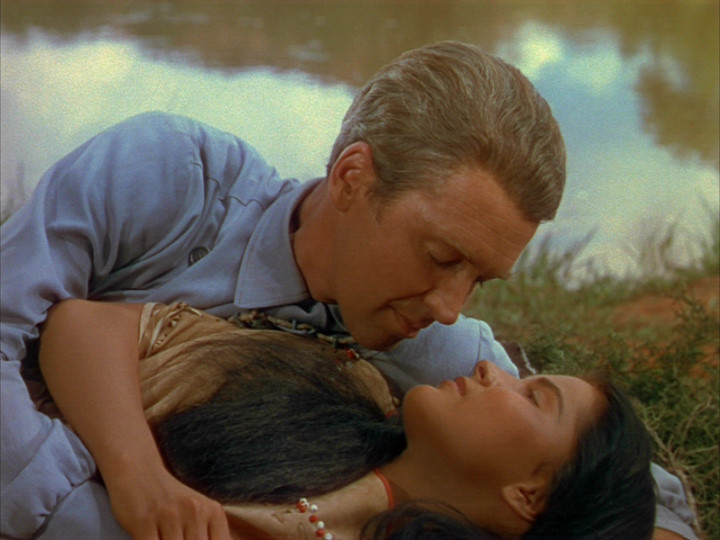
Unfortunately, I can’t say the same for Debra Paget as “Sonseeahray,” Tom Jeffords’s historically nonexistent love interest. The 16-year-old Paget is cute as a button, but she’s about as convincing an American Indian as Disney’s Pocahontas.
The most significant Apache character in the film played by an actual Native American is Geronimo, who is played by Jay Silverheels (best known as the Lone Ranger’s best friend Tonto on the long-running TV series). Silverheels has one really good dramatic scene as Geronimo and then leaves the Apache tribe to continue waging war against the United States on his own.
Delmer Daves would go on to make one of my favorite westerns of the ’50s, the original 3:10 to Yuma (1957). Broken Arrow is also good, but I wouldn’t quite call it a classic. It’s incredibly progressive in a lot of ways, and a refreshing change from westerns in which American Indian tribes were faceless hordes, so if you can get past the cognitive dissonance of seeing Apache characters played by white actors, there’s a lot to recommend Broken Arrow.
The Men (1950)
Directed by Fred Zinnemann
Stanley Kramer Productions / United Artists
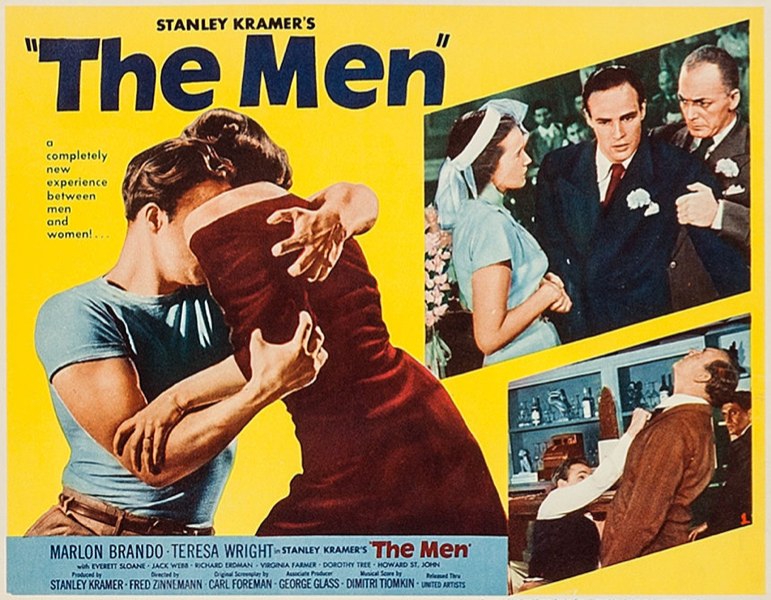
The reason most people these days will watch The Men is to see Marlon Brando in his first film role. In fact, this is probably the only place to see Marlon Brando before he became “BRANDO,” since the next film he made was A Streetcar Named Desire (1951), which cemented his status as an icon.
So it’s certainly worth seeing for fans of Brando, but it’s also a pretty solid movie about the aftermath of war, and about people coming to terms with disability.
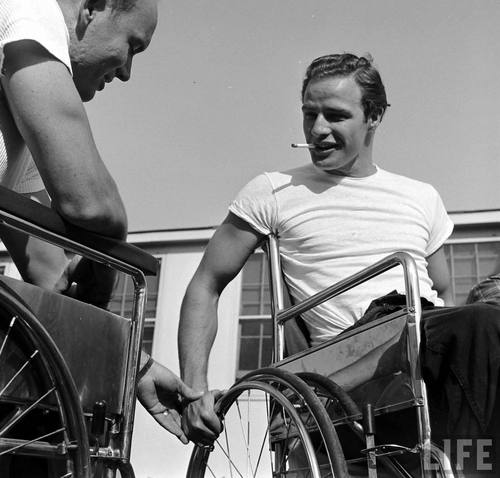
Brando stars as a corporal named Ken who was wounded in World War II and lost the use of his legs. The Men takes place in a VA hospital where the gruff Dr. Brock (Everett Sloane) treats a group of combat veterans who will never walk again. Dr. Brock has the demeanor of a drill instructor, and works to disabuse the men in his care of the notion that there is a miracle cure around the corner. The sooner they accept their paraplegia, the sooner they can work toward healing their bodies and their minds.
In the hospital, Brando is just one man among many, and the cast includes actors like Jack Webb, but also actual veterans who lost the use of their legs in the war, like Arthur Jurado, a bodybuilder with a very impressive physique.
The director of The Men, Fred Zinnemann, is best known for making High Noon (1952), but he directed a lot of good movies, and this is one of them. I thought his last two films — The Search (1948) (which introduced another ’50s acting icon, Montgomery Clift, to film audiences) and Act of Violence (1948) — were both minor masterpieces.
The Men has a lot more in common with the European postwar drama The Search than it does with the noir potboiler Act of Violence. Like The Search, The Men could have easily been turned into a sentimental, overwrought mess in another director’s hands, but Zinnemann was an unsentimental and restrained director who trusted his actors.
It’s a dated film in plenty of ways, but it’s still a pretty well-made and moving story about the effects of catastrophic disability, as well as the disconnect between combat veterans and the well-meaning people back home who thank them for their service but can’t relate to what they’ve been through. It’s also a great showcase for Marlon Brando. As this film shows, he arrived onscreen with his persona fully formed.
Where Danger Lives (1950)
Directed by John Farrow
RKO Radio Pictures
A more accurate and unique title for this film could have been A Man Concussed.
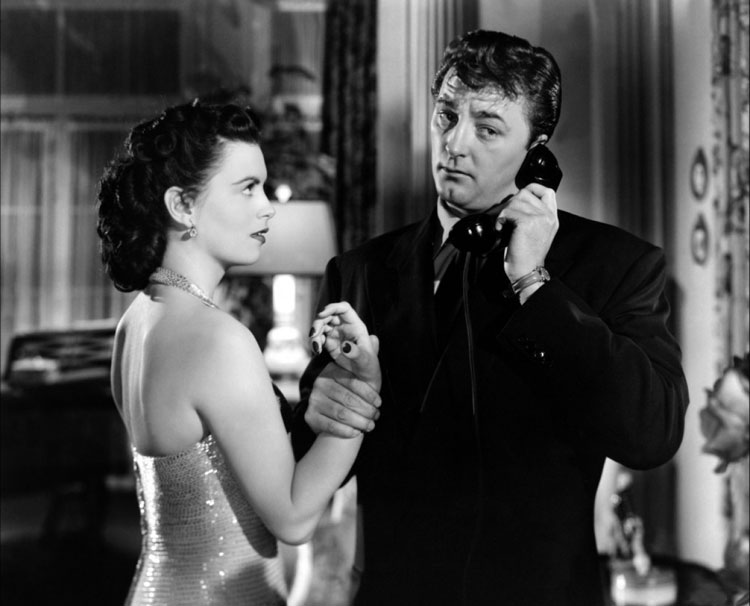
Don’t get me wrong, “Where Danger Lives” is nice and vivid, and it’s so perfectly “noir” that it’s also the name of an excellent blog you should all be reading if you have any interest in film noir. But “A Man Concussed” would have been more specific, and for whatever reason (probably inspired by the Robert Bresson film A Man Escaped), it’s the title that kept running around in my head as I watched Robert Mitchum in this film, his character suffering from a traumatic brain injury, and getting deeper and deeper in trouble.
The screenplay for Where Danger Lives was written by frequent Hitchcock collaborator Charles Bennett, who penned the scripts for The Man Who Knew Too Much (1934) and The 39 Steps (1935), as well as many others. Where Danger Lives has a good story with plenty of unique touches, but the movie never quite hit me where I live. Director John Farrow and his cinematographer, Nicholas Musuraca, certainly crafted a great-looking movie. Visually, Where Danger Lives is a great noir, but in terms of a complete experience I don’t think it’s a film noir I’ll keep coming back to.
Perhaps the trouble is Mitchum’s leading lady, Faith Domergue. She delivers a competent performance, but just doesn’t exude the same combination of allure and menace that the great femme fatales do, like Barbarba Stanwyck in Double Indemnity (1944), Jane Greer in Out of the Past (1947), Yvonne De Carlo in Criss Cross (1949), or Peggy Cummins in Gun Crazy (1950).
Where Danger Lives is certainly worth seeing at least once, especially if you’re a Robert Mitchum fan like I am. The supporting cast is pretty great, too, including brief appearances by the great Claude Rains and the always enchanting Maureen O’Sullivan.
Where the Sidewalk Ends (1950)
Directed by Otto Preminger
20th Century-Fox
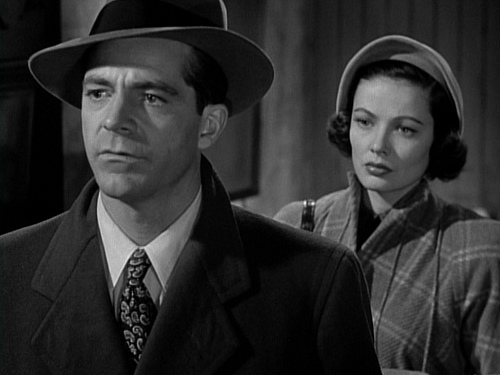
What a difference six years makes. Where the Sidewalk Ends reunited Otto Preminger, the director of Laura (1944), with Dana Andrews and Gene Tierney, the two stars of Laura.
This reunion between director and actors was nothing earthshaking. In the years between Laura and Where the Sidewalk Ends, Preminger had worked with both Andrews and Tierney again separately, and Tierney and Andrews had appeared together in the film The Iron Curtain (1948), which Preminger didn’t direct.
But comparing Laura with Where the Sidewalk Ends tells us a lot about where the genre we now know as “noir” went after World War II.
Laura is a glamorous mystery set in Manhattan high society; Where the Sidewalk Ends is a down-and-dirty drama set in the streets of New York, where ordinary people live, work, and die. In Laura, Gene Tierney is an untouchable and barely real object of desire; in Where the Sidewalk Ends, she’s a beautiful but otherwise average young woman with a job who lives with her father. In Laura, Dana Andrews is a tough but decent police detective; in Where the Sidewalk Ends, he’s a police detective whose desire to be nothing like his criminal father leads him to engage in all manner of brutality and occasionally even criminal conduct.
Where the Sidewalk Ends is a great movie about a troubled man finally forced to come to terms with himself. Andrews is excellent in the lead role, as is Tierney, and the supporting cast are wonderful, too, especially Karl Malden as a no-nonsense police lieutenant and Gary Merrill as a mean, sweaty crime boss addicted to nasal spray.
Destination Moon (1950)
Directed by Irving Pichel
United Artists
The classic era of Hollywood science fiction kicked off with Rocketship X-M (1950), but it wasn’t meant to be that way.
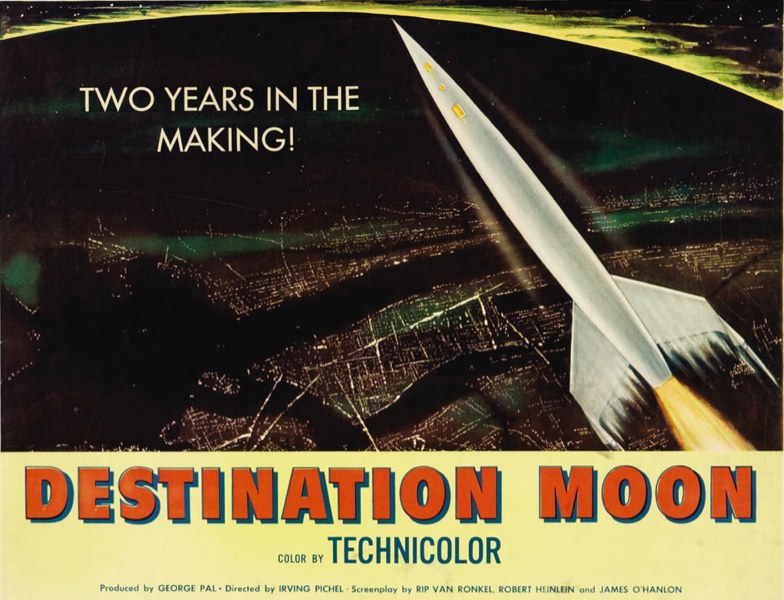
Producer George Pal’s Destination Moon was a lavish Technicolor production two years in the making that endeavored to depict space travel as realistically as possible. Rocketship X-M was a quick cash-in that was shot in less than three weeks with a budget of less than $100,000, which is how it was able to beat Destination Moon into theaters by about a month.
As a science fiction fan, I can’t help but be impressed by Destination Moon. Its dedication to scientific accuracy is admirable, and for 1950, its special effects are top-notch. On the other hand, as a fan of compelling drama, I have to admit that Rocketship X-M has a more engaging script, better actors, and is more fun to watch.
This is the problem with most “hard sci-fi,” which Destination Moon most definitely is. The ideas are fascinating, but the presentation is pretty dry.
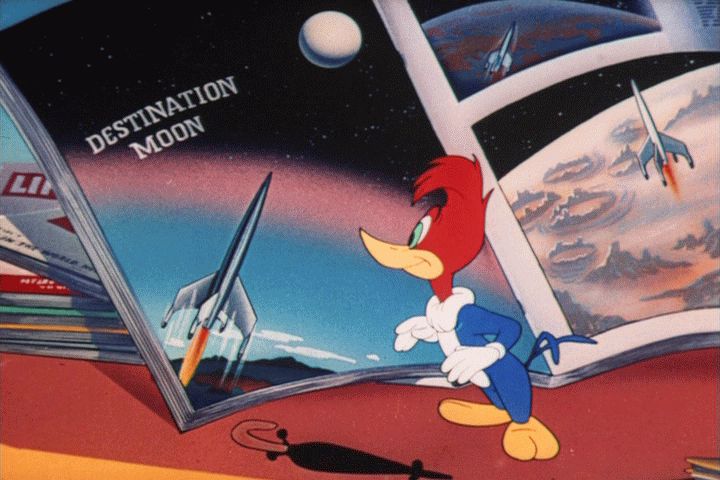
The director of Destination Moon, Irving Pichel, understood this, which is perhaps why the second reel of the movie depicts a group of men watching a film strip that explains space travel in a fun and funny way with our old friend Woody Woodpecker.
Unfortunately, other attempts to inject fun into the film, like a last-minute replacement on the crew named Joe (Dick Wesson), who’s from Brooklyn and provides comic relief by pronouncing the word “work” as “woik,” aren’t as successful.
Destination Moon is based on Robert A. Heinlein’s 1947 novel Rocket Ship Galileo, which I read a few years ago. The basic idea of a mission to the moon carried out by a small crew — as well as a general commitment to scientific accuracy — is retained in the film version, but little else is. Heinlein’s novel was the story of a trio of teenaged boys reaching the moon with the help of their uncle. Once on the moon, they thwart a plot by Germans intent on establishing a Fourth Reich with the moon as their base.
The film version dispenses with the “boys’ adventure” aspect of Heinlein’s novel, as well as the idea of an enemy force already present on the moon. (Although a character in the film does state that the U.S. must reach the moon before a foreign nation is able to establish a missile base there.)
These storytelling decisions all makes sense, since Destination Moon was intended to be a realistic film.
Even though Destination Moon doesn’t have the same dramatic verve as Rocketship X-M, and even though some of its science is dated, it’s still a tremendously successful science-fiction film, and holds up well today, provided you’re a “serious” sci-fi fan.
Sure, some of the effects look hokey today, but it’s not for nothing that the film won an Academy Award for best visual effects.
The Gunfighter (1950)
Directed by Henry King
20th Century-Fox
The 1950s was the decade during which the western genre finally grew up. The Saturday-afternoon kiddie westerns didn’t go away, but the ’50s was when Hollywood started regularly turning out serious, adult dramas that happened to take place in the Old West.
Anthony Mann’s Winchester ’73 (1950) is regularly cited as the first “adult western.” In my recent review of that movie, I talked about why I disagree with that assessment. There were plenty of westerns aimed at adults before Winchester ’73, most notably the films of John Ford, Raoul Walsh, and André De Toth.
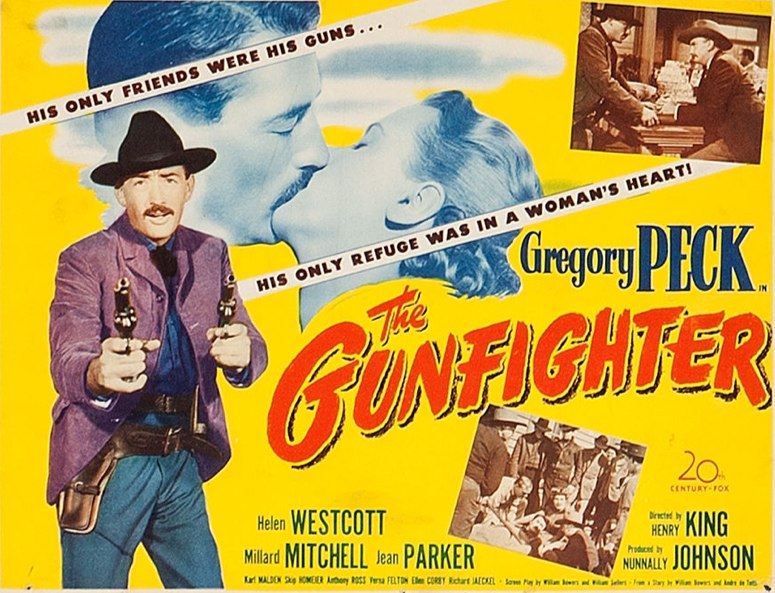
Winchester ’73 is a good movie, and is a notable example of the “adult western.” But since it wasn’t really the first (I mean, John Ford made Stagecoach in 1939, for crying out loud), if we’re going to anoint a single film as the one that ushered in a new era of realism and adult drama for the western at the dawn of the ’50s, I would like to propose Henry King’s The Gunfighter.
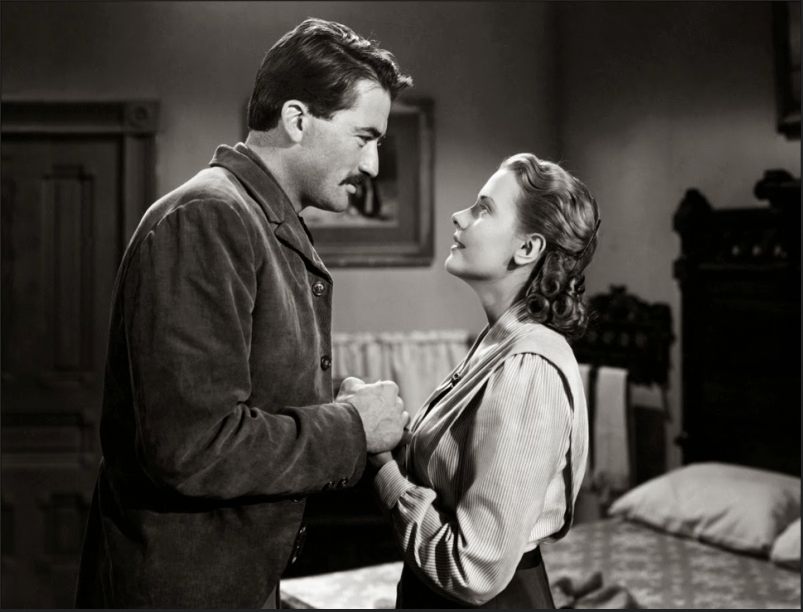
The Gunfighter stars Gregory Peck as an aging gunslinger named Jimmy Ringo. He has lived to the ripe old age of 35 by being a fast draw, but he’s tired.
In the opening scene of the film, we see that he avoids trouble as much as he can, but trouble finds him everywhere he goes, and he takes no pleasure in shooting young hotheads who want to test their skills against the fastest gun in the West. Ringo is a lonely man who drifts from town to town, never staying in one place for long. All he wants is to escape his reputation and settle down somewhere.
Like another great “adult” western that would come out a couple of years later — High Noon — much of The Gunfighter takes place more or less in real time. With three men on his trail who mean to kill him, Ringo rides into the little town of Cayenne, New Mexico, where his old friend Mark Strett is now a U.S. Marshal. (Strett is played by Millard Mitchell, who also had a major supporting role in Winchester ’73.)
The hands on the clock tick forward as Ringo waits in a saloon run by another of his old acquaintances, Mac (Karl Malden). Word quickly spreads through town, and a crowd gathers outside the saloon, hoping to catch a glimpse of the legendary Jimmy Ringo.
At the same time we count down the hours with the tired and worn-out Ringo, we see the making of his replacement, a reedy punk with a wisp of a mustache named Hunt Bromley (Skip Homeier).
Ringo desperately wants to see his old love Peggy (Helen Westcott), and the young son they had together. Over the course of the film, we learn that Marshal Mark Strett was also a lawless gunslinger for a time, just like Ringo, but he settled down and found respectability before it was too late. Ringo desperately hopes it is not too late for him, either.
This was the second film in a row that director Henry King made with star Gregory Peck. The first was Twelve O’Clock High (1949), and the two would go on to make a bunch more films together throughout the ’50s.
Like Twelve O’Clock High, The Gunfighter is a character study of an impossibly tough and highly skilled man who is slowly humanized over the course of the film.
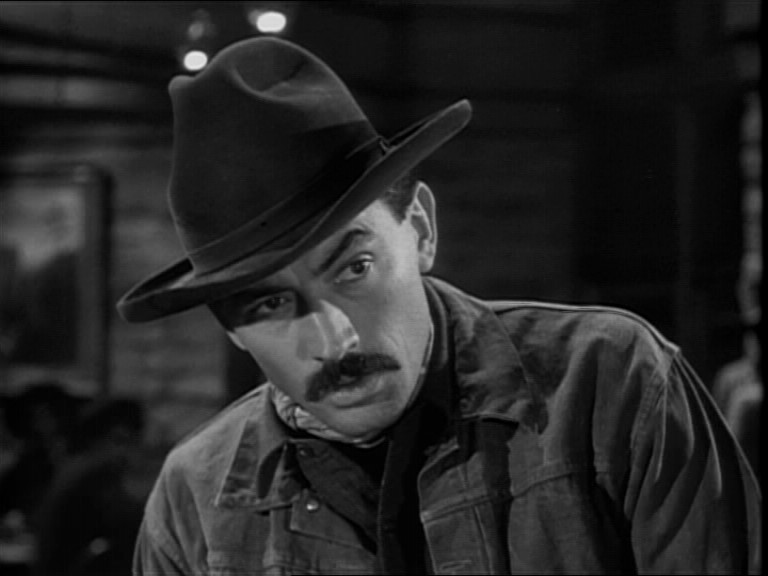
The Gunfighter contains most of the important tropes of the western, like the myth of the fast draw and the tension between community and lawlessness. The town of Cayenne is populated with fully realized characters and feels like a real community. It’s also grungier and more lived-in than the freshly painted communities in Winchester ’73, with gnarled trees and rivulets of water running down Main Street. And unlike the fresh-faced actors who populated Hollywood westerns, Peck’s bushy, drooping mustache is actually period-appropriate. (Incidentally, Darryl F. Zanuck hated Peck’s mustache in The Gunfighter, and blamed it for the the film’s mediocre performance at the box office.)
The Gunfighter is a classically structured tragedy set in the Old West. It’s a great film about public perception versus quiet, private reality, as well as the collision of our individual desires with inescapable fate.
I looked for a trailer on YouTube, and couldn’t find a trailer from 1950, but I found this fan edit, which is done in a modern style. I think it’s pretty well-done and effective:





 OCD Viewer