Category Archives: 1947

Vigilantes of Boomtown (Feb. 15, 1947)

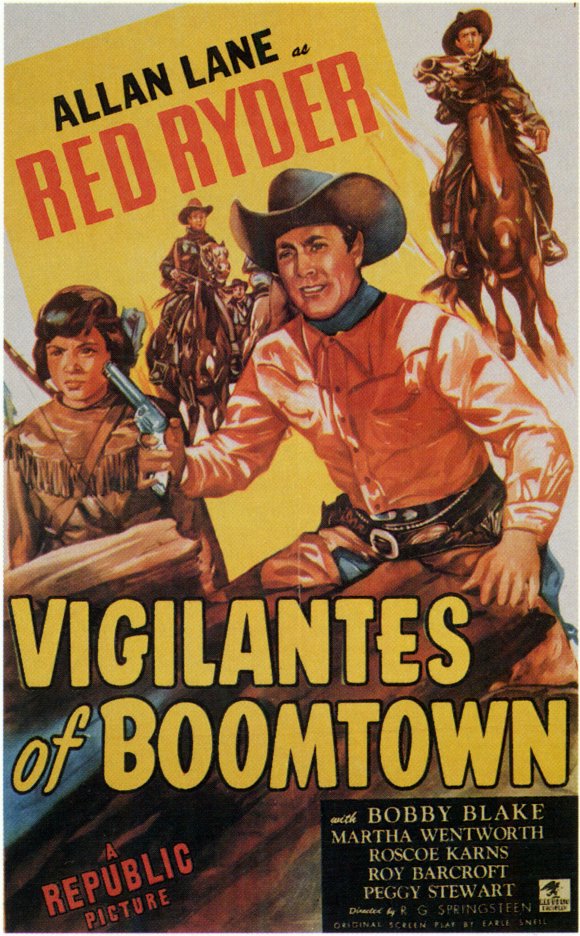
I thought Allan Lane’s third go-round as Red Ryder was his best yet, but it could just be because I’m a boxing fan.

Or maybe I’m just getting used to good old “Wild” Bill Elliott no longer playing Fred Harman’s comic-strip cowboy in his inimitable wooden style.

Either way, Vigilantes of Boomtown was a fun way to spend an hour. It begins with a tour of boomtowns, culminating with Carson City, the capital of Nevada. The year is 1897, and a bill legalizing boxing in the state has enraged Molly McVey (Peggy Stewart), the daughter of a U.S. senator. Molly believes that Nevada crawled its way to respectability, and hosting a bloodsport will make the state look like a hotbed of savagery to the rest of the country. She’s so opposed to prizefighting that she plans to hire gunmen to stop the fight if the state legislature goes ahead with its plans.

Red Ryder (Lane) and his English-challenged young sidekick, Little Beaver (Bobby Blake), are drawn into the fracas because Ryder’s aunt, the Duchess (Martha Wentworth), is leasing her ranch out to the fight’s promoters, who plan to hold their bout on St. Patrick’s Day. The combatants are a Cornish blacksmith named Fitzsimmons (John Dehner) and a bank clerk named Corbett (George Tumer).

Corbett (the more likable and handsome of the two fighters) stays with Ryder and the Duchess at their ranch, teaching Ryder a thing or two about the sweet science. When Molly hires a couple of thugs (George Chesebro and George Lloyd) to kidnap Corbett, there’s a bit of mistaken identity, which leads to them carrying off Ryder instead of Corbett, and they stash him in that cave where all bad guys go in Republic westerns. Will Corbett’s boxing lessons stand Ryder in good stead? You’ll just have to watch and find out.

Oh, and at the very end, Corbett’s referred to as “Gentleman Jim,” just in case you hadn’t already put the pieces together.

Angel and the Badman (Feb. 15, 1947)

James Edward Grant’s Angel and the Badman is a fish-out-of-water story about a gunfighter named Quirt Evans (John Wayne) who renounces violence after he is injured and nursed back to health by a pretty Quaker girl named Penelope Worth (Gail Russell) and taken in by her community. Like most Hollywood movies of this sort, Angel and the Badman has its cake and eats it too — it preaches nonviolence, but is still jam-packed with gunfights and fistfights.

The action is fast and furious from the very opening moments of the film, which begins with a close-up of a gun being drawn, the shooter fanning the hammer, firing from right to left, emptying the cylinder, and then running to his horse.

Legendary stuntman Yakima Canutt was the second unit director on this picture, and it shows. There’s a cattle raid sequence that’s among the best I’ve seen, and most of the action is well-staged. There’s one orgy of fistfighting, however, that was so over-the-top that I wasn’t sure if it was supposed to be funny or not. By the time the melee was finished, every visible piece of wood in the saloon was in splinters.

Angel and the Badman was John Wayne’s first time as a producer, and it feels like a labor of love. Unfortunately, the direction, cinematography, and pacing of the film aren’t up to the standard of Wayne’s other pictures I’ve seen from the ’40s. The music is especially bad, and is rarely appropriate for the scene it’s accompanying. At its heart, Angel and the Badman is a B picture with an A-list star.

The film ends with a line that could be interpreted as pro gun control — “Only a man who carries a gun ever needs one.” This is a rarity for a western, especially one starring John Wayne, but if you’re a traditional sort, don’t worry; all the bad guys die of lead poisoning before the film is through.

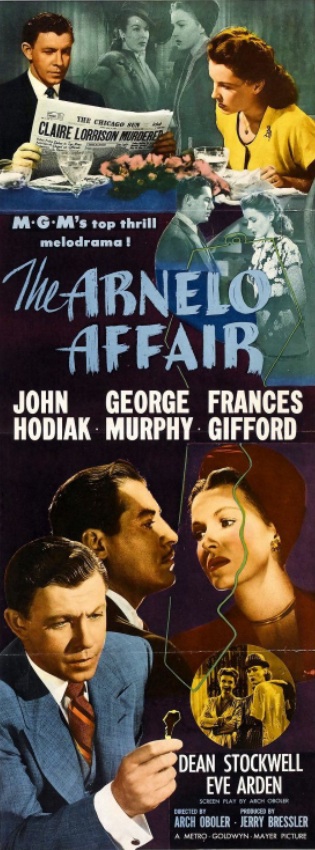
The Arnelo Affair (Feb. 13, 1947)

Arch Oboler’s The Arnelo Affair is a crime melodrama with so much voiceover narration that most of it can easily be understood and enjoyed by blind people.

Oboler cut his teeth in radio. His most famous work was for the horror anthology Lights Out, which is one of the scariest and most gruesome radio shows of all time. Oboler was a native of Chicago and the child of Jewish immigrants from Latvia. He was a prolific writer — one of the most talented in the medium of radio. His work as a film director is more hit or miss.

The Arnelo Affair, his third film, is based on a story by Jane Burr and takes place in Chicago. It starts out promisingly, with a lot of heat between its protagonist, Anne Parkson (Frances Gifford), and the magnetic, mustachioed nightclub owner Tony Arnelo (John Hodiak). Anne is married to a lawyer and all-around stuffed shirt named Ted (George Murphy), who’s such a drip that he won’t let their 9 year-old son, Ricky (Dean Stockwell), touch any of the tools in the room in their house marked “Ricky’s Workshop.”

The Parksons have been married for 12 years (which, if Gifford’s character is the same age as she is, means they got hitched when she was only 14 or 15), and Anne is clearly neglected and unloved. When her path crosses Arnelo’s, his persistence and menacing charm draw her to him.

Eve Arden, at this point typecast as the worldly and knowing friend of the troubled female protagonist (see also Mildred Pierce and My Reputation), plays Anne’s friend Vivian, who cautions Anne that “Canaries and hawks don’t make good playmates.”

She’s right, of course, and when Arnelo murders one of his other girlfriends in order to draw Anne closer to him, Anne will realize what a dangerous game she’s been playing.

Oboler’s script is perceptive about infidelity, and the dialogue is more believable than in most melodramas, but Oboler’s direction is flat, and he relies too heavily on voiceover narration by Gifford to explicate her character’s emotions. The Arnelo Affair isn’t bad, but after 45 minutes it loses momentum and never really picks up again. It might have made a better 60-minute B movie programmer from one of the small studios than a 90-minute maudlin MGM melodrama.

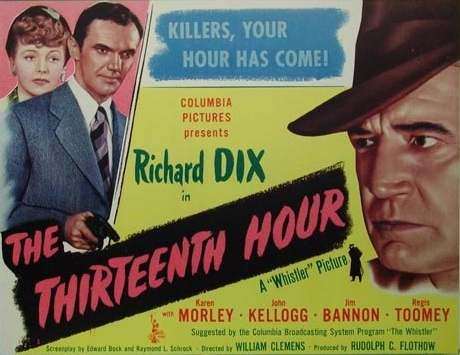
The Thirteenth Hour (Feb. 6, 1947)

The Thirteenth Hour
The Thirteenth Hour (1947)
Directed by William Clemens
Columbia Pictures

Let us bid adieu to Richard Dix.

His role in William Clemens’s The Thirteenth Hour was his last. Dix’s health was in decline when he was starring in the series of B movies based on the radio show The Whistler. After appearing in The Thirteenth Hour, the seventh in the series, Dix retired from acting. He died a couple of years later, at the age of 56, on September 20, 1949, following a heart attack he’d suffered a week earlier. (There would be one last Whistler movie, The Return of the Whistler, in 1948, starring Michael Duane.)

When asked about his role in The Thirteenth Hour, Dix said, “The part is more dramatic than the ones I used to do at Goldwyn’s and Paramount. Then, I played devil-may-care, brassy boys who were strong on wisecracks, and back in some of those early films I made the jokes via printed titles.”

His mention of printed titles is a reference to his early days in Hollywood, when the movies were still silent. Dix had a 30 year-long career, and was one of the first “he-men” of the silver screen; a rugged, square-jawed presence who loomed larger than life. His Whistler films aren’t the best of his career, but they’re nothing to be ashamed of, either. Unlike most of the formulaic, single-character mystery series of the ’40s (e.g., Boston Blackie, the Falcon, the Crime Doctor, Charlie Chan), Dix played a different role in each Whistler film, from the nastiest bad guys to the most well-intentioned good guys.

In The Thirteenth Hour, he plays a regular Joe named Steve Reynolds, a truck driver who operates his own trucking firm. He’s engaged to a roadhouse waitress named Eileen (Karen Morley), who has a young son named Tommy (Mark Dennis).

After a hot-rodding drunk runs Steve off the road one night and straight into an old man’s gas station, his license is revoked for six months. The accident wasn’t Steve’s fault, but a disappearing witness and a motorcycle cop named Don Parker (Regis Toomey), who has a vendetta against Steve, conspire against him.

To make matters worse, Steve has a competitor, Jerry Mason (Jim Bannon), an underworld character who’s undercutting Steve and is determined to run him out of business.

Finally, the night comes when Steve’s mechanic and driver Charlie (John Kellogg) is too sick to work, and Steve has no choice but to deliver a shipment himself. His license hasn’t been reinstated yet, so the decision could have terrible consequences. He starts out in the wee hours of the morning and sticks to back roads, but of course, something goes wrong. When he stops to service his truck, he’s knocked out by a masked man. The mysterious figure not only absconds with Steve’s truck, but he uses it to run over and kill a cop.

Steve goes on the lam and attempts to prove his innocence with the help of Charlie, Eileen, and Tommy. (There’s one weird, funny moment when the cops bust in on Eileen and Tommy right after Steve has slipped out the back. Tommy sits in a living room chair, looking innocent, reading a book. The detective peers at him suspiciously, and the camera zooms in on the book’s title — Studies in Necrophobia.)

If you’ve awake for most of the movie, you’ll have no trouble figuring out exactly who the killer is before Steve finds out. Even so, The Thirteenth Hour is a well-made, brisk mystery that packs plenty of excitement into its barely one-hour running time. The presence of the Whistler (an uncredited Otto Forrest) is less obtrusive than in some of the series’ entries, but he still sets the stage nicely, just as he did on his weekly radio show, which told the stories of “men and women who have stepped into the shadows.”

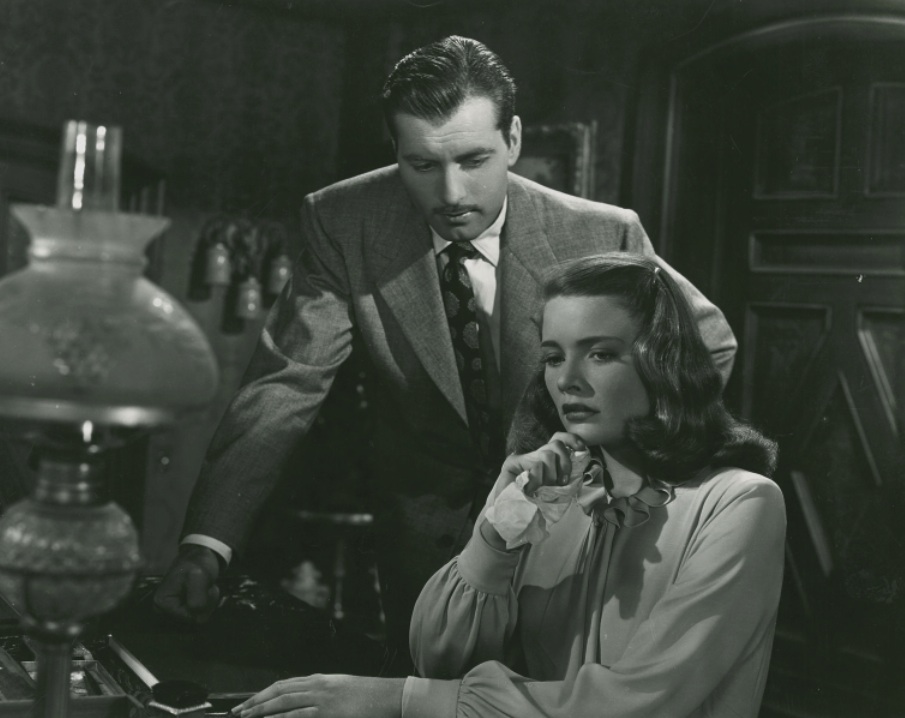
The Brasher Doubloon (Feb. 6, 1947)

Ladies, I don’t know if you know this, but the cure for frigidity is George Montgomery.

Let’s pretend that you are a young woman who is terrified of a man’s touch, due to some unstated trauma in your past. You work for a tyrannical old dowager who has an unnatural attachment to her spoiled, weak-willed son. You tremble at the sound of the old woman’s voice, and you live in her Southern California mansion as a virtual slave.

Then, one day, a man appears at the front door. He’s tall, he’s trim, he’s 30 years old, and he has high cheekbones and a nice mustache. In short, he’s the complete package. He’s come at the behest of your mistress, Mrs. Murdock, who wants him to track down a coin that has been stolen from her. The coin is the Brasher Doubloon of the title, and it’s a coin with “a romantic and violent history.”

If this man approached you privately after meeting with the old woman and you told him you don’t like to have men touch you, and he responded — “Well, in that case you better do something about your appearance. And that perfume you use … Night of Bliss. You just can’t seem to make up your mind, can you, Miss Davis?” — would you accept his offer to “take it very slowly” and cure you of your phobia?

Of course you would.

In John Brahm’s The Brasher Doubloon, private investigator Philip Marlowe (Montgomery) accepts both cases — tracking down the missing coin owned by Mrs. Murdock (Florence Bates) and curing her secretary, Merle Davis, of her frigidity.

Merle is played by Nancy Guild (rhymes with “wild”), who looks a little like a softer-featured Margot Kidder. She and Montgomery are an attractive pair, but their limits as thespians keep The Brasher Doubloon from being a top-flight picture.

Montgomery delivers every line in an emphatic huff. If it’s supposed to be hard-boiled it doesn’t come across that way. When a slimy coin dealer named Elisha Morningstar (Houseley Stevenson) asks Marlowe if he’s threatening him, Marlowe responds, “Yes…,” as though he’s not sure. When Marlowe tell Mrs. Murdock, “I do things my own way,” he sounds like a petulant child.

Throughout the film, Guild looks as though she’s been thrown into the deep end of the pool and doesn’t know how to swim. (This was only her second film — the first was Joseph L. Mankiewicz’s 1946 noir Somewhere in the Night.) Luckily, wide-eyed panic is what her character calls for. Unfortunately, her performance remains pitched at exactly the same level throughout the film.

Dorothy Bennett’s screenplay, which is adapted from Chandler’s 1942 novel The High Window, is pretty good. John Brahm’s direction is excellent. Unlike The Big Sleep (1946), this isn’t a picture that’s overly difficult to follow, and the settings — from baronial mansions to smoky underworld dives and rented rooms — are well-done.

The Brasher Doubloon is one of the least well-known films adapted from a Raymond Chandler novel. After two B movies adapted from Chandler novels that did not retain the Philip Marlowe character were released — The Falcon Takes Over (1942) and Time to Kill (1942), based on Farewell, My Lovely and The High Window, respectively — the two most famous Philip Marlowe movies were made: Murder, My Sweet (1944), which starred Dick Powell as Marlowe, and The Big Sleep (1946), which starred Humphrey Bogart as Marlowe. Robert Montgomery’s Lady in the Lake (1947) rounds out the “big three” Philip Marlowe films of the ’40s, and while it’s not as well-regarded as the other two, it’s available on DVD, and is an interesting picture.

The Brasher Doubloon is currently unavailable on DVD, which is a shame. While the acting by the two leads is pretty bad, and there’s a really cheesy scene at the end in which Marlowe assembles all of the suspects and explains to them who committed the murders, overall this is a pretty tight noir mystery.

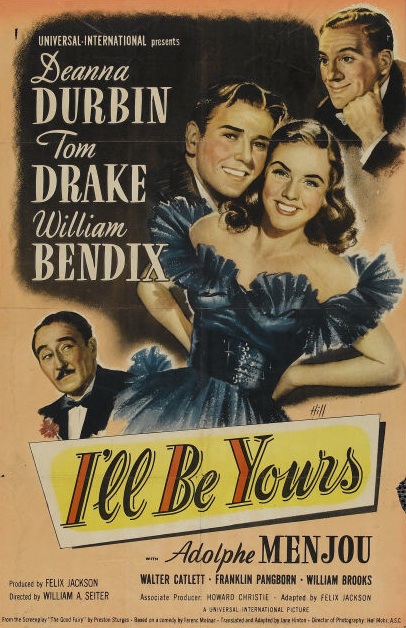
I’ll Be Yours (Feb. 2, 1947)

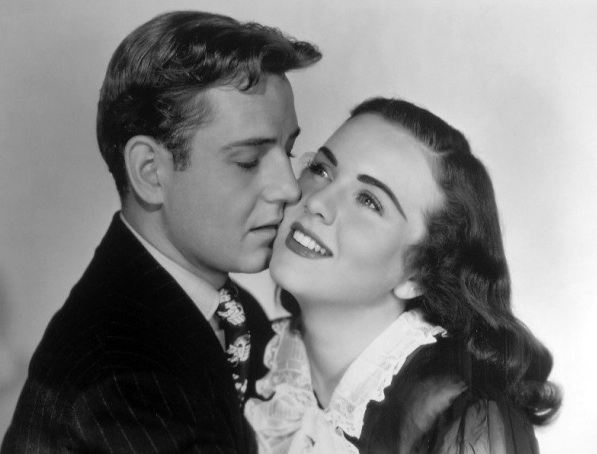
I really liked I’ll Be Yours, and not just because it stars my time-travel girlfriend, Deanna Durbin. It’s a light and frothy romantic comedy — hardly my favorite genre — but the performers are appealing, the humor is genuinely funny, and the musical numbers are great.

Durbin herself can’t be counted among the film’s fans. She retired from acting at the age of 27, after a 12-year career in the movies, and retired to France with her husband. In an interview with David Shipman in 1983, Durbin called her last four films — I’ll Be Yours, Something in the Wind (1947), Up in Central Park (1948), and For the Love of Mary (1948) — “terrible.”

I imagine that Durbin’s negative assessment of her last several films was at least partly due to her dissatisfaction with Hollywood. If she was yearning for a “normal” life and looking for a sign that she should continue acting, I’ll Be Yours is neither groundbreaking nor artful enough to qualify. But if you’re a fan of Deanna Durbin, I’ll Be Yours is wonderful entertainment. She’s as lovely and appealing in it as she was in everything else, and her singing voice was unparalleled among Hollywood ingenues.

In I’ll Be Yours, Durbin plays a naive, wide-eyed young woman with the unwieldy name of Louise Ginglebusher who leaves her hometown of Cobleskill, NY, for a life of excitement in Fun City. While eating lunch on a ridiculously tight budget, she’s befriended by a cranky but kindhearted waiter named Wechsberg (played by William Bendix, another performer who was able to overcome mediocre material).

She’s given a job as an usherette in a palatial movie house by a fellow native of Cobleskill, Mr. Buckingham (Walter Catlett), and shown kindness by a young and handsome lawyer named George Prescott (Tom Drake) who sports an unfortunate Van Dyke beard.

After Wechsberg sneaks Louise into a swanky party he’s working at the Savoy Ritz, she’s snookered into performing a musical number by a philandering millionaire named J. Conrad Nelson (Adolphe Menjou). Naturally, she pulls it off with aplomb, and the song she sings — “Granada” — is a high point of the film.

This leads to J. Conrad Nelson offering Louise a starring role in the Broadway musical he’s financing, but to fend off his advances she invents a husband for herself. In doing so, she underestimates the tenacity of Nelson’s libido. Nelson demands to know who her husband is so he can be put on his payroll and eventually be bought off and done away with.

Forced to produce a husband, Louise turns to Prescott, but his old-man beard will have to go.

All of this is ridiculous, of course, but it’s a thoroughly entertaining vehicle for a quartet of appealing performers. And the music is wonderful.

Felix Jackson wrote the script, which was adapted from Preston Sturges’s The Good Fairy (1935), which was based on a play by Ferenc Molnár. William A. Seiter directed the film.

Scared to Death (Feb. 1, 1947)

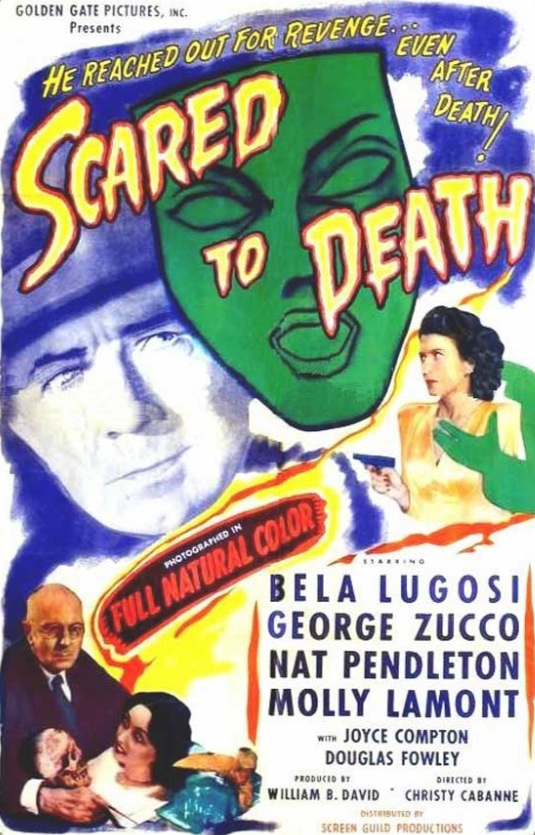
Christy Cabanne’s Scared to Death is a terrible film, but I had enormous goodwill toward it after the first reel. I get that way when the front door of a house flies open in a movie to reveal Bela Lugosi and little-person actor-extraordinaire Angelo Rossitto standing on the front porch, wearing matching black suits.

If you don’t know Rossitto by name, you might recognize him by sight. He had an incredibly long career in TV and movies, stretching from 1927 to 1987. He was the quiet, dark-haired dwarf in Tod Browning’s Freaks (1932) and Blaster’s better half, Master, in Mad Max Beyond Thunderdome (1985). Unfortunately, he doesn’t have a lot to do in Scared to Death, and the sheer awfulness of the movie ground down all my goodwill to dust by the final reel.

Scared to Death is notable for two reasons — Lugosi only appeared in three color films, and Scared to Death is the only one in which he received top billing. Also, it’s a picture that’s narrated by a dead woman on a slab in a morgue. Trust me when I tell you that neither of these things is a reason to run out and see Scared to Death.

The color process used for Scared to Death was Cinecolor, which is a two-color film process, and it just doesn’t look that good, at least in the public domain print I watched. Also, the narration by the dead woman is interesting at first, but it becomes unbearable after the first dozen or so times her corpse cuts into the action to speak its piece. Part of the problem is that the sound editing is so terrible during the transitions that the viewer will start to dread the corpse’s appearance, especially if the viewer is sensitive to loud, abrupt noises.

Scared to Death is only worth seeing if you love corny old horror-comedies or are a connoisseur of bad films. Lugosi and Rossito are always fun to watch, as is George Zucco, but everyone else in the cast is either flat or intensely grating, like Nat Pendleton, who supplies comic “relief” as the dim-witted police inspector.

Bottom line — among films narrated by a dead person, Scared to Death will never be confused with Sunset Boulevard (1950).

Odd Man Out (Jan. 30, 1947)

Odd Man Out
Odd Man Out (1947)
Directed by Carol Reed
Two Cities Films

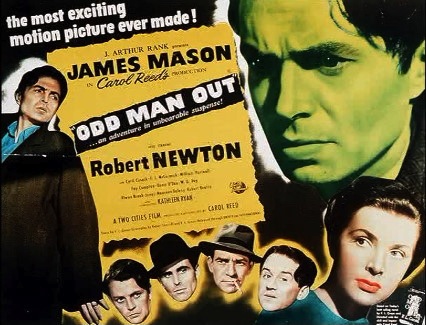
Odd Man Out is a terrific film. It might not be — as the lobby card above boasts — “the most exciting motion picture ever made,” but it’s a damned good one, with masterful direction by Carol Reed and a hypnotic lead performance by James Mason.

The film, which is based on a novel by F.L. Green, opens with a disclaimer that it isn’t “concerned with the struggle between the law and an illegal organisation, but only with the conflict in the hearts of the people when they become unexpectedly involved.”

Mason plays a revolutionary leader named Johnny McQueen, fresh out of the clink and planning a big heist. The Irish Republican Army is never mentioned outright — McQueen’s group is simply called “the organisation” — but the film takes place in Belfast, so you can connect the dots, if you care to.

However you choose to interpret the obfuscation of the I.R.A. in Odd Man Out, there’s little denying that it’s an apolitical film, more concerned with one man’s existential journey than with making any kind of political statement.

In the first scene of the film, we see Johnny McQueen holed up in a safehouse, planning a payroll robbery of a textile mill with his boys. Also present is the woman who loves him, Kathleen Sullivan (played by Kathleen Ryan). Things look and sound all right until one of Johnny’s boys approaches him, and tells him he’s concerned about Johnny’s ability to handle the job. Johnny was in prison for several years for blowing up a police station. He’s only been on the lam a little while, and confined to the safehouse the whole time.

Johnny brushes off his lieutenant’s concerns, but as soon as the plan is in motion, we realize that Johnny might have been wrong to lead the robbery. In a subjective sequence, we see the busy streets of Belfast from Johnny’s point of view. Cars whiz past, streetcars with grinding wheels pass by close enough to touch, people hurry to and fro, and the whole smoky mess looks too cramped and too large at the same time.

If you’re a fan of realistic heist movies, the robbery scene in Odd Man Out will meet with your approval. It’s not overly complicated, and it’s accomplished quickly, but it’s full of tension, especially since Johnny seems about to crack at any moment.

He and his boys make it out with the money, but a mill guard tackles Johnny as he hesitates on the front steps of the factory. The two men wrestle, and each takes a bullet. The wounded Johnny falls off the running board of the getaway car, and his boys lose him in the confusion.

Odd Man Out is a tense film. It takes place over the course of the night following the mill robbery, and Reed and his cinematographer, Robert Krasker, box their subjects in. The members of “the organisation” are pursued by police on foot, through dark alleys, over rooftops, and even through middle-class homes. (Reed frequently juxtaposes the activities of the city’s regular citizens with the activities of its criminal underclass.)

James Mason has little dialogue in the film, but his performance is amazing. He feels guilt, remorse, confusion, anger, loneliness, and even suffers hallucinations as he loses blood and seems to always be marching toward death. His performance is sympathetic, but keeps the viewer at a distance. This isn’t a film noir about a regular Joe who’s caught up in circumstances beyond his control. Every move Johnny made in his life has led him to this point, and he knows it.

Aside from Mason, most of the actors in the film were regulars on the stage of the Abbey Theatre (which could be why none of their accents sound quite right — they’re all from the wrong end of the island). Fans of British cinema and television will recognize plenty of them.

Reed’s most famous film is The Third Man, which he made in 1949. It’s been awhile since I’ve seen The Third Man, but I thought Odd Man Out was a stronger picture. Mason is a more compelling central presence than any of the actors are in The Third Man, and the music, cinematography, editing, and direction are all tighter in Odd Man Out.

Odd Man Out is a difficult film to classify. It starts out as a straightforward crime picture, but by the end of the film, Johnny’s journey takes on a surreal quality. A scene late in the picture in which he’s sheltered by a mad painter (Robert Newton) has the quality of a lively Samuel Beckett play.

The film was nominated for the Golden Lion at the Venice Film Festival in 1947, and received the BAFTA award for Best British Film in 1948. Fergus McDonnell was nominated for an Academy Award in 1948 for best editing, but Francis Lyon and Robert Parrish ended up winning for Body and Soul.
Trail to San Antone (Jan. 25, 1947)

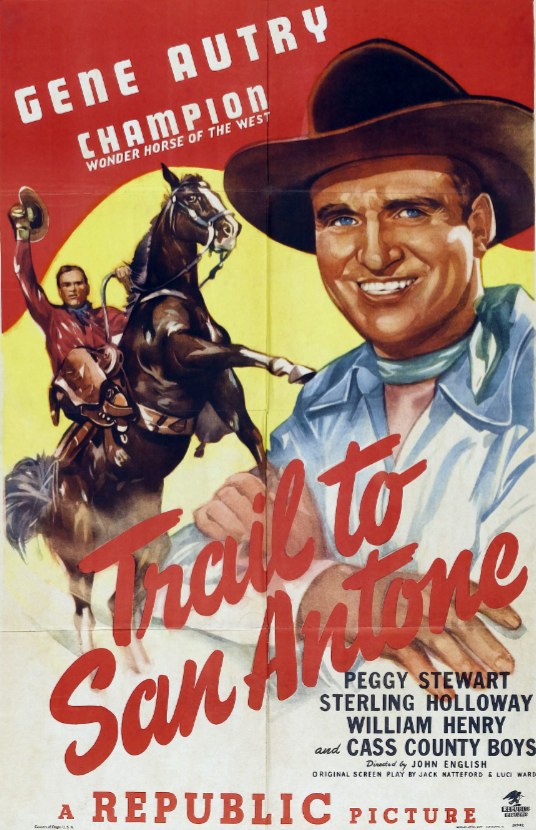
Have you ever wanted to see Gene Autry rope a stallion from the air? I hadn’t until I saw the climactic few minutes of John English’s Trail to San Antone, but as soon as Gene leaned out of the passenger side of the airplane piloted by feisty Kit Barlow (Peggy Stewart) and dropped a lariat, I said to myself, “Yee haw, Gene! Git ‘er done.”

It’s not as dangerous for the horse as it might sound. Kit doesn’t bring the plane in for a landing while Gene continues to control the horse or anything like that. As soon as the lariat is around the stallion’s neck, Gene drops the rope, which has a spare tire attached to the other end. One more good ropin’ job, and that stallion ain’t goin’ nowhere fast, pardner.

Trail to San Antone is solid entertainment for fans of Gene Autry. He’s backed up by the Cass County Boys (Fred S. Martin, Jerry Scoggins, and Bert Dodson), who do double duty as ranch hands and Autry’s back-up band. Dependable Republic Pictures heavy Tristram Coffin plays the bad guy, Cal Young, who’s attempting to derail the career of a young jockey named Ted Malloy (Johnny Duncan), whom Gene has taken under his wing. And the horrible comic relief is provided by the rubber-faced Sterling Holloway, as the cowardly and pencil-necked Droopy Stearns.

The film is bookended by performances of “Down the Trail to San Antone,” by Deuce Spriggins. Over the course of the picture, Autry and the Cass County Boys belt out plenty of pleasant country & western tunes, including Autry and Cindy Walker’s “The Cowboy Blues,” Spade Cooley’s “Shame on You,” Sid Robin’s “That’s My Home,” and Marty Symes and Joseph Burke’s “By the River of the Roses.”

Johnny O’Clock (Jan. 23, 1947)

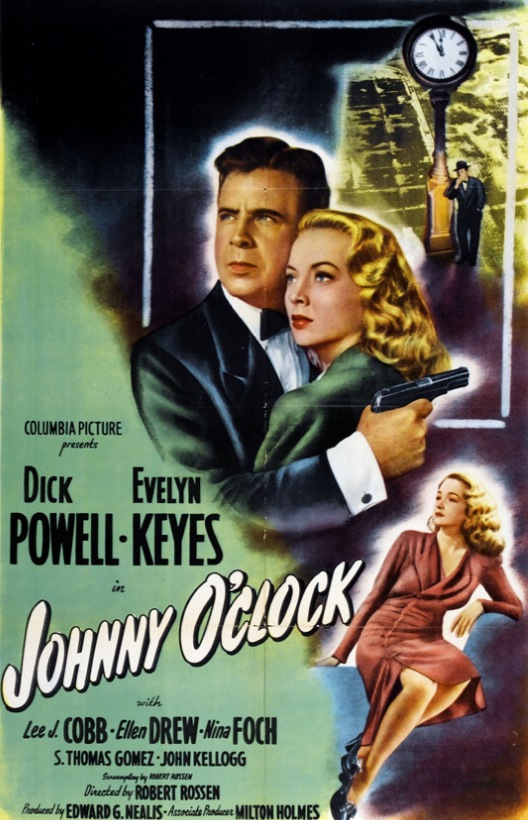
Robert Rossen’s Johnny O’Clock — yes, it’s really about a man named “Johnny O’Clock” — isn’t as good as some of Rossen’s later films, like The Hustler (1961), but it’s a great start. Rossen was a prolific writer of screenplays, but Johnny O’Clock was his first time in the director’s chair.

The improbably named protagonist is played with a light touch by former crooner Dick Powell. Johnny is a partner in a New York gambling syndicate run by an oily, overweight gangster named Pete Marchettis (Thomas Gomez).

Marchettis is married to a beautiful sloppy drunk named Nelle (Ellen Drew) who’s still carrying a torch for her ex-boyfriend, Johnny, but who loves the dough too much to ever leave Marchettis. Powell’s scenes with Gomez and Drew are some of the best of the picture, as the boozy moll falls all over Johnny in front of Marchettis and his heavy-hitters, seemingly oblivious to her husband’s jealousy. At the same time, Marchettis seems desperate for approval from both Johnny and his wife. In one scene, he goes on and on about the portrait he had a Mexican boy paint of him. When he shows it to Johnny and asks him if he likes it, Johnny simply responds, “It looks like you.”

There’s a police inspector named Koch (Lee J. Cobb) who’s hounding Johnny O’Clock, lurking in the lobby of the hotel where he lives and constantly trying to catch him riding dirty. Johnny’s association with corrupt cop Chuck Blayden (Jim Bannon) rubs the honest Inspector Koch the wrong way, especially since Blayden’s been on the winning end of more than one shootout with Marchettis’s rivals. Koch suspects that Marchettis and Johnny are using Blayden to do their dirty work under the guise of “justifiable homicide.”

When a pretty hat-check girl who works at Johnny O’Clock’s casino goes missing, things heat up. The girl, Harriet Hobson (Nina Foch), was dating Chuck Blayden, and when her body is found in her gas-filled apartment — an apparent suicide — Koch smells foul play. As soon as Harriet’s sister, Nancy Hobson (Evelyn Keyes), arrives in New York to claim her sister’s body, cracks begin to appear in Johnny O’Clock’s carefree exterior. He and Nancy are attracted to each other, but are from different worlds. She makes him want to cash out and run away with her, but if you’ve ever seen a gangster movie, you know that cashing out always comes at a price.

Johnny O’Clock is the third of many noirs to star Powell after he shed his image as a boyish Depression-era crooner and appeared as Philip Marlowe in Edward Dmytryk’s Murder, My Sweet (1944). Johnny O’Clock gives Powell a chance to craft a more three-dimensional character than he had a chance to in either Murder, My Sweet or Dmytryk’s Cornered (1945), and he’s mostly successful, although he didn’t seem fully up to the challenge of some of the more emotional moments in the film’s climax. (Powell was a breezy and charming actor who could project toughness and nastiness when he had to, but raw, naked emotion wasn’t one of the tools in his actor’s toolbox.)

While the story’s twists and turns are sometimes hard to follow, the actors are all good, and enjoyable to watch. Lee J. Cobb’s most famous role is probably as Lt. Kinderman in The Exorcist (1973), so it was fun to see him in a similar role, more than 25 years earlier.

Writer-director Rossen has a fuller vision of his criminal demi-monde that we see in most ’40s noirs, and his characters are convincing within its context. I really liked Johnny O’Clock, and I’d love to see proper DVD releases of more of Dick Powell’s film noirs in the future. I had to watch this one on a janky DVD-R recorded off of television.