Tag Archives: 20th Century-Fox

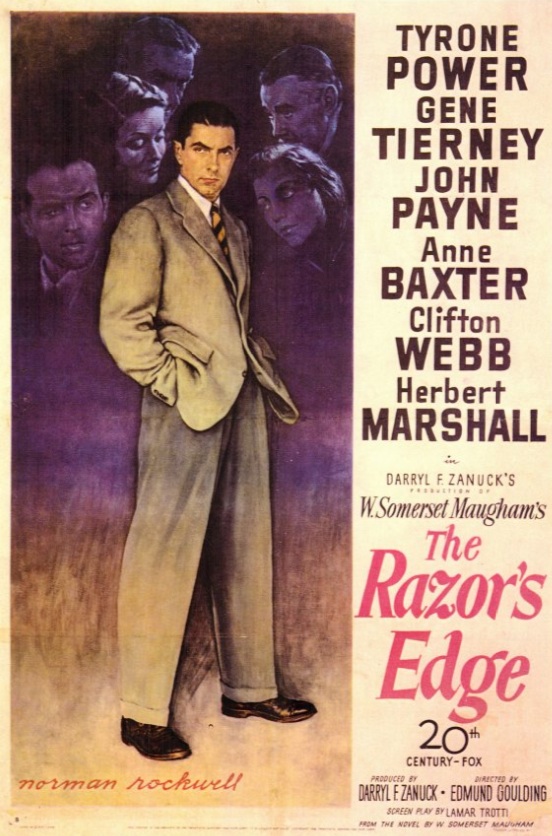
The Razor’s Edge (Nov. 19, 1946)

Edmund Goulding’s The Razor’s Edge, based on the best-selling 1944 novel by W. Somerset Maugham, features an Academy Award-winning performance by Anne Baxter in a supporting role, great-looking sets, deliciously bitchy acting by Clifton Webb, and a chance for Tyrone Power and Gene Tierney to show that they were better actors than they are usually given credit for.

So why didn’t I like it? Everything about this film reeks of “Oscar bait.” It’s high-minded, pretentious, and self-important, but ultimately shallow. There are a number of interesting characters in the framing sections of the film, but the central story about a young man named Larry Darrell (Tyrone Power) seeking enlightenment in Eastern spirituality falls flat, and everything else in the movie hangs on it.

Darrell is a veteran of the Great War who returns home to Chicago in 1919 questioning life after a fellow soldier — a friend of his — died saving his life. His confusion and guilt lead him to reject ordinary life and travel the world searching for meaning. He leaves behind his fiancée, porcelain-skinned beauty Isabel Bradley (Gene Tierney), as well as a sharply drawn cast of supporting characters; Isabel’s uncle, the fabulously wealthy and snobbish Elliott Templeton (Clifton Webb), the tragic hanger-on Sophie MacDonald (Anne Baxter), and “regular guy” Gray Maturin (John Payne). Just as in the novel, Maugham himself (played by Herbert Marshall) pops in and out of these characters’ lives.

When Tyrone Power first appears in the film, the character of Maugham says in voiceover, “This is the young man of whom I write. He is not famous. It may be that when his life at last comes to an end, he will leave no more trace of his sojourn on this earth than a stone thrown into a river leaves on the surface of the water. Yet it may be that the way of life he has chosen for himself may have an ever-growing influence over his fellow men, so that, long after his death perhaps, it may be realized that there lived in this age a very remarkable creature.”

Maugham’s words are prophetic. In the decades after he wrote The Razor’s Edge, many young men (and some women) would seek wisdom and enlightenment just as Larry does, traveling the world working a series of menial jobs and seeking truth in non-Christian religions.

While working in a coal mine in France, Larry plays cards and drinks with an old man who eventually turns out to be (unshockingly, based on the dialogue that passes between them) a defrocked priest running away from himself. The priest tells Larry of an Indian holy man who is vastly wise, and who may be able to set Larry straight.
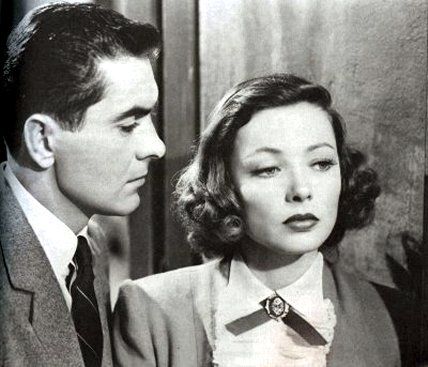
Larry makes his way to India, and it was at this point that — at least for me — the movie took a nosedive. While all kinds of terrible things are happening to the other characters — Isabel is in a loveless marriage, Sophie loses her baby and becomes an alcoholic, etc. — Larry hangs out in a set that looks left over from Anna and the King of Siam and studies with an Indian guru who is ridiculously played by British actor Cecil Humphreys. The holy man speaks only of “God,” nothing specific, and certainly nothing polytheistic. His mysticism is inoffensive New Age stuff along the lines of Deepak Chopra’s vague aphorisms.

After Larry learns all he can from books, the holy man sends him on a pilgrimage to the mountains, where he receives “enlightenment” in the form of a matte painting of sun bursting out from behind the clouds and one last mealy-mouthed conversation with the guru.

All of this might have been meaningful in the novel. I can’t say, as I haven’t read it. But at least in this film, Larry’s spiritual journey is a bunch of vague nonsense that trades on the supposed exoticism of the East without actually including anything strange or specific enough to offend Peoria. Worst of all, he returns to his circle of friends, who are now bumming around Europe, with what amounts to a bag of parlor tricks. He does some hypnosis, forcing his friend Gray to drop a coin after he counts to ten and then tells Gray that he will feel pain no longer. Stuff like that. I was surprised he hadn’t learned to turn himself invisible, like Lamont Cranston in The Shadow.

When the movie ends, we’re supposed to believe that everyone who came into contact with Larry is better, somehow, because he is possessed of the most powerful force in the universe, goodness. But what is it about him makes him so good? He agrees to marry Sophie when she is in the depths of her alcoholism, which leads another character to describe him as being in the grips of self-sacrifice, which seems more apt.

Is Larry a good person because, at the end of the film, he works his way back to America on a tramp steamer? So do legions of cruder, simpler men. Does the mere fact of Larry’s enlightened attitude make his manual labor somehow nobler than the manual labor of “lesser” men? If it does, then why? The film never answers this question, but rather asks us to accept its thesis at face value.

I love all the actors in The Razor’s Edge, and they give some of the best performances of their careers in this film. But while it contains plenty of strong individual scenes, it’s a sodden, overlong snoozefest.
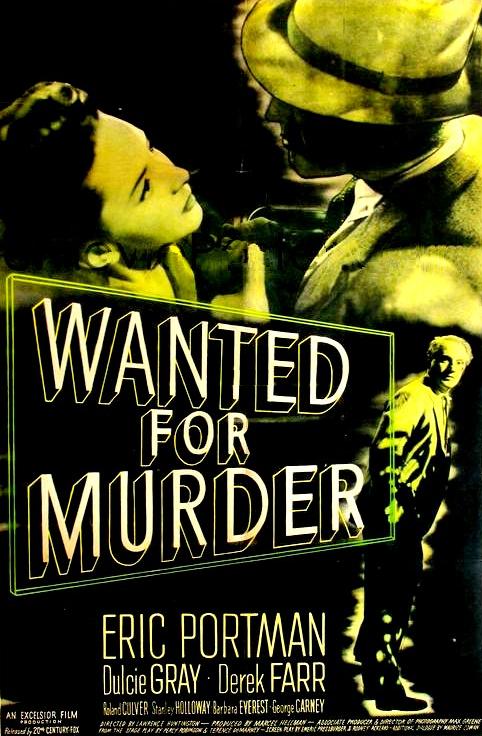
Wanted for Murder (Nov. 2, 1946)

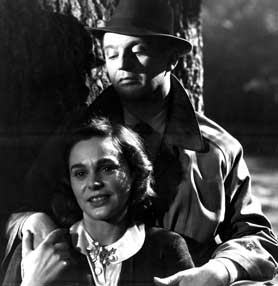
Lawrence Huntington’s Wanted for Murder, which was originally released on June 17, 1946, in the U.K., premiered in the United States on November 2, 1946. It’s an effective chiller with a dependable cast and an excellent screenplay by Rodney Ackland and Emeric Pressburger, based on the stage play by Percy Robinson and Terence de Marney.

The film boasts a terrific sense of place, with scenes filmed in Hampstead Fairground, Madame Tussaud’s wax museum, and the center of London (which, when necessary, appears as rear screen projection stock footage, a technique that can be distractingly fake-looking but here is done fairly skillfully). There are also several atmospheric nighttime murder sequences in Hampstead Heath, Regent’s Park, and Hyde Park.

Particularly effective is the music by Mischa Spoliansky, whose pop-orchestral tune “A Voice in the Night” is a motif that follows the murderer around like his shadow, and which you’ll be hard-pressed not to hum after seeing this picture.

Eric Portman plays middle-class mummy’s boy Victor James Colebrooke, a man who feels haunted by the specter of his late father, William Colebrooke, an executioner to Queen Victoria whose eerie likeness stands in Madame Tussaud’s.

Colebrooke is a handsome, superficially charming gentleman who drink Hendrick’s Gin, lives at home with his mother and a servant, and whose single-breasted suits often sport a white boutonniere and a pocket square. He’s the embodiment of the British fascination with “the murderer next door” — the outwardly ordinary man whose wife’s remains are bricked up in the basement or who strangles working girls on the weekend.

Wispy brunette Dulcie Gray plays Anne Fielding, a young woman who works in a gramophone shop and is dating Colebrooke. A starry-eyed young bus conductor named Jack Williams (Derek Farr) finds her waiting at the fairgrounds and mashes her as hard as he can. She’s attracted to him, but Colebrooke is manipulative and possessive.

Rounding out the fine cast are Roland Culver as Chief Insp. Conway and Stanley Holloway as Sgt. Sullivan, the two Scotland Yard detectives who are on the trail of the killer. Their scenes are some of the film’s most light-hearted, but they are never less than professional, and are dogged in their pursuit of the strangler.

When the first murder occurs, the audience doesn’t know who the killer is, but we strongly suspect Colebrooke. It’s not long before the film removes any doubt about his guilt, which allows for a more interesting and creepy character study than in a whodunnit, where the murderer’s identity is a secret up until the climax.

Most of the film is a game of cat and mouse, with the detectives fairly certain Colebrooke is guilty, but unable to gather anything but circumstantial evidence.

Meanwhile, Colebrooke goes about his dastardly business at night in the parks, telling young women he takes out on dates and strangles that his name is “Tom Mahon.”

Colebrooke blames his sickness on his father, whose killings were all committed in the course of his duty, but whose grim pride in his work earned him the nickname “The Happy Hangman.” The Freudian-minded viewer might blame his overbearing, possessive mother, but the film itself doesn’t draw any such trite conclusions. His father is just a picture on the wall or — in one scene — a disturbingly realistic wax figure, and his mother isn’t a bad person, even encouraging him to find a nice girl and marry her.

Wanted for Murder is a first-rate thriller. Although the adjective hadn’t been invented when it was made, I’d go so far as to call it “Hitchcockian.”

Anna and the King of Siam (June 20, 1946)

John Cromwell’s Anna and the King of Siam isn’t nearly as well known as The King and I, the Technicolor extravaganza starring Yul Brynner and Deborah Kerr that was made a decade later. Both films tell the same story, but The King and I does it in the form of a Rodgers & Hammerstein musical. I saw The King and I when I was a kid, and have strong memories of certain scenes, but not of the film as a whole. So I came to Anna and the King of Siam relatively fresh, and was able to watch it without constantly thinking of Brynner’s iconic performance, at least most of the time. The one big difference — if memory serves correctly — is that the later, musical version of this tale was more of a love story. It’s not as if it ended with a marriage, or Kerr being added to the king’s harem or something, but there was a romance of some sort that grew over the course of the film. The closest Anna and the King of Siam gets is a couple of scenes between Anna and the king that end with the king leering, and seeming to contemplate her in a sexual fashion.

Anna and the King of Siam is the first filmed adaptation of Margaret Landon’s 1944 book of the same name. Producer Darryl F. Zanuck reportedly bought the rights to Landon’s book immediately after reading the galleys. As is often the case, the real-life Anna Owens was a considerably more interesting and complicated person than she was portrayed in the book or any of the films about her. This is largely due to her own self-invention. Anna Leonowens was born in poverty in India in 1831, the daughter of Sgt. Thomas Edwards, a soldier in the private army of the Dutch East India Company, and his wife Mary Anne Glasscott, an Anglo-Indian woman. Later in her life, Leonowens took pains to hide her origins, and claimed that her father’s rank was lieutenant (later she claimed he had been a captain), and that she had been born in Wales. It’s important to remember that these fabrications were not merely for the purpose of self-aggrandizement. As a widow and a single mother, Leonowens faced an uphill battle in life, and almost certainly would have faced discrimination if her mixed-race heritage had been known.

While Anna and the King of Siam doesn’t delve deeply into Anna’s background, there is never any intimation that she is anything but the most proper of British ladies. The Anna Owens of the film, played by Irene Dunne, embodies the best values of the “modern” British empire, while King Mongkut (Rex Harrison) represents an older form of governance; repressive, misogynistic, autocratic, and superstitious.

Reportedly, most Thai who saw the picture were shocked and angered by the portrayal of their revered nineteenth century king, and the film was banned in Thailand due to “historical inaccuracies.” It’s hard to argue with this assessment. Landon’s book and Leonowens’s own recollections were by all accounts at least partially fabricated, and overemphasized Leonowens’s role in the king’s life, as well as the harshness of his regime. And there’s the larger question of how well any white actor — even one as talented as Rex Harrison — can portray an Asian character.

Granted, the yellowface portrayals in the film look ridiculous, especially Lee J. Cobb as the “Kralahome,” or prime minister, who appears for much of the film stripped to the waist, covered with dark makeup, and sporting a pomaded pompadour. But, like Harrison, he delivers a nuanced performance, and in their scenes together they drop the stilted line deliveries that they have in their scenes with Anna or her son Louis (Richard Lyon). (They continue to speak English, of course, but the syntactical variance is still a nice touch.)

If one ignores questions of historical accuracy, Anna and the King of Siam is an excellent and involving story of cultural differences and the challenges and rewards of education in the face of adversity. The principal actors all give great performances, especially the beautiful Linda Darnell as the king’s newest and most alluring wife, Lady Tuptim. It’s a role that easily could have been one-note, but Darnell is able to create a sexy yet repulsive character who grows more complicated as the film goes on, and eventually becomes the central tragic figure of the picture. Also, Anna and the King of Siam looks fantastic. It won two Oscars, one for best black and white cinematography and the other for best art direction, and they were well-deserved.

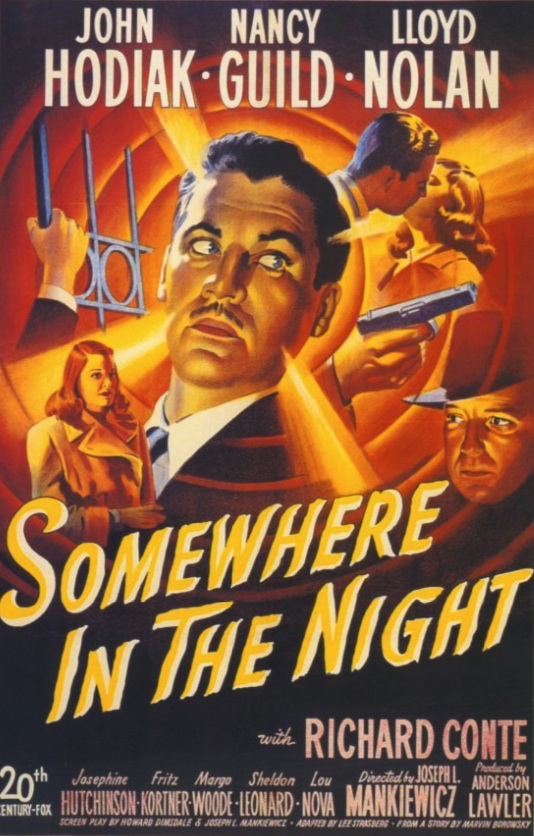
Somewhere in the Night (June 12, 1946)

Joseph L. Mankiewicz’s Somewhere in the Night looks like a noir, talks like a noir, and walks like a noir. But when the credits rolled I felt more like I’d watched a light-hearted mystery farce than a noir. This isn’t to say that Somewhere in the Night is a bad movie. It’s actually a really fun one. But the dark journey promised by the film’s opening never pans out, and the plot twists grow increasingly ludicrous as the picture goes on.

The first few minutes of the picture are mostly shot in first-person P.O.V., as a man (played by John Hodiak) wakes up in an Army field hospital. Through voiceover and the images in front of his face, we learn that he has no idea who he is, and doesn’t remember anything leading up to this point. This opening presages Robert Montgomery’s ill-advised first-person P.O.V. extravaganza Lady in the Lake (1947). Luckily, unlike that picture, the technique is used judiciously in Somewhere in the Night.

Hodiak’s character has Army identification in the name of “George Taylor,” a Dear John letter (it’s really more of an “I Hate You, John” letter), and a letter of credit from someone named “Larry Cravat.” What’s a noir protagonist to do? Clearly, the best course of action is to head for the mean streets of Los Angeles and attempt to track down Larry Cravat, even though “Taylor” has no idea what he’s doing or who all these people are who seem to want him dead. Why should that stop him? Taylor is a Purple Heart recipient and seems to be able to handle himself. It doesn’t hurt that the briefcase he picks up in a Los Angeles train station contains a gun and a letter from Larry Cravat telling Taylor that there is $5,000 deposited in his name in an L.A. bank.

For the first half hour or so, Somewhere in the Night has a few things to say about the plight of returning G.I.s, in particular the disappointments handed them by the women they came home to (or didn’t come home to, in Taylor’s case), and the resentment some servicemen must have felt upon their return.

“You know there’s been a terrible shortage of men,” a beautiful young woman named Phyllis (Margo Woode) tells Taylor.

“Yeah, so we heard in the Pacific,” he responds. “This war must have been murder on you poor women. We used to cry our eyes out about it.”

But, as I said, the longer Somewhere in the Night goes on, the more plot points stack up, and the less time the film has to do anything but crank through its story.

When Taylor goes to the bank to try and collect his $5,000 he arouses the suspicion of the cashier and he ends up fleeing empty-handed. He follows leads to a Turkish bath and then to a nightclub. Set up at the club by the bartender, he ends up hiding from a couple of mugs in the dressing room of a pretty singer named Christy Smith, who is played by the 20-year old Nancy Guild (rhymes with “wild”).

Guild is fresh-faced, has a beautiful voice, and plays her role well. She’s not outstanding, but she does a good job, especially considering this was her first role in a film; not just as leading lady, her first film role, period. Apparently she felt out of her depth, and the production was a struggle for her. In later interviews, she credited Mankiewicz’s generous nature and sensitive direction, and said he was a real father figure to her.

Hodiak also does a decent job, but it’s a one-note performance. He sweats profusely and looks haunted, and does a great job with lines like, “I’m tired of being pushed around. The war’s over for me. I don’t have to live afraid anymore.” He sounds genuinely angry, and he also sounds as if he doesn’t believe his own words one bit.

It wasn’t until after I finished watching Somewhere in the Night that I learned that while Hodiak was born in the United States, he grew up in an immigrant family, spoke Hungarian and Polish at home, and always had to work hard at his English diction. “No part has ever come easily to me,” Hodiak once said. “Every one has been a challenge. I’ve worked as hard as I could on them all.” I never would have guessed from this film that his first language wasn’t English, but there is something about his delivery that is strange and stilted.

Luckily, Guild and Hodiak have wonderful support from two great actors who straddled the line between character actor and leading man; Lloyd Nolan and Richard Conte.

Nolan plays a police detective, Lt. Donald Kendall, who doesn’t eat lunch because it puts him to sleep and doesn’t drink coffee because it keeps him awake. He also wonders aloud several times why detectives in the movies don’t ever take their hats off. (He figures it out by the end of the picture.) And he has plenty of great lines, which he delivers in his trademark wry fashion, like “Big post-war boom in homicide.”

Conte plays a nightclub owner named Mel Phillips, who’s smooth without seeming oily, and whose motives aren’t initially clear. (If you had $5 for every time Conte played a nightclub owner in a noir, you could probably take your whole family out to a nice dinner.)

Somewhere in the Night is a good picture; well-made and a lot of fun. It was all just a little silly for my taste, though.

Dragonwyck (April 10, 1946)

Director Joseph L. Mankiewicz’s Dragonwyck was adapted from Anya Seton’s best-selling 1944 historical novel of the same name. I haven’t read Seton’s novel, but I loved this film, and would like to dig into the book some day. Based on the description on the back cover, the introduction, and the first several pages that I leafed through, the film is a relatively faithful adaptation, as far as these things go. Neither Edgar Allan Poe nor Herman Melville make an appearance in the film, however, and the Astor Place massacre and steamboat racing both, sadly, fell outside the scope of the film.

But that’s par for the course in any 100-minute long adaptation of a 350-page novel. Taken purely as a cinematic experience, Dragonwyck is an engrossing Gothic melodrama that treads lightly the tricky boundary between romance and horror. As a Vincent Price fan, I especially loved his performance in this film. In my review of Shock, which was released earlier the same year, I mentioned that it was the first role I’d seen Vincent Price play in which there was a glimmering of the horror icon he would become. Well, he continued to blossom in this role. While never descending into outright horror territory, Dragonwyck gave Price an opportunity to exhibit more range than any role I’d seen him play previously, and the way his character changes drives the film; from coldly aristocratic to warmly romantic, and from a wielder of petty power to a broken drug addict.

The film begins in 1844. Miranda Wells (Gene Tierney) is a bright, beautiful young woman who longs to see the world. She lives on a small New England farm with her younger siblings, her mother Abigail (Anne Revere), and her deeply religious and strait-laced father Ephraim (Walter Huston). The Wellses receive a letter from their distant cousin, Nicholas Van Ryn (Price), who wishes to take Miranda away from her simple surroundings and employ her as a governess and companion to his young daughter at his home, Dragonwyck Manor, on the Hudson River. After much deliberation, Ephraim assents, even though Van Ryn’s wealth and atheism distress him. Like everything else in the film, Huston’s portrayal is fully realized. The character could have been portrayed as a two-dimensional Bible-thumper, but Huston crafts a believable and sympathetic character.

Once Miranda arrives at Dragonwyck, the obvious touchstone is Jane Eyre, but instead of a madwoman locked in the attic, there is merely Van Ryn’s fussy, compulsively overeating wife Johanna (Vivienne Osborne). Theirs is clearly a loveless marriage, and as soon as we learn that Van Ryn is not really Miranda’s cousin by blood, we can read the handwriting on the wall.

The story takes a lot of interesting turns, however, and I wasn’t ever quite sure what was going to happen next. While Van Ryn is portrayed sympathetically, he is also deeply flawed. A “patroon,” he forces his tenant farmers to pay tribute to him while he sits on a throne. It’s an anachronistic display of power, even for the mid-nineteenth century, and shows early in the film that all may not be well in Dragonwyck.

Dragonwyck also has an excellent sense of place. As Seton said in her introduction to the novel, “There was, on the Hudson, a way of life such as this, and there was a house not unlike Dragonwyck. All Gothic magnificence and eerie manifestations were not at that time inevitably confined to English castles or Southern plantations!”

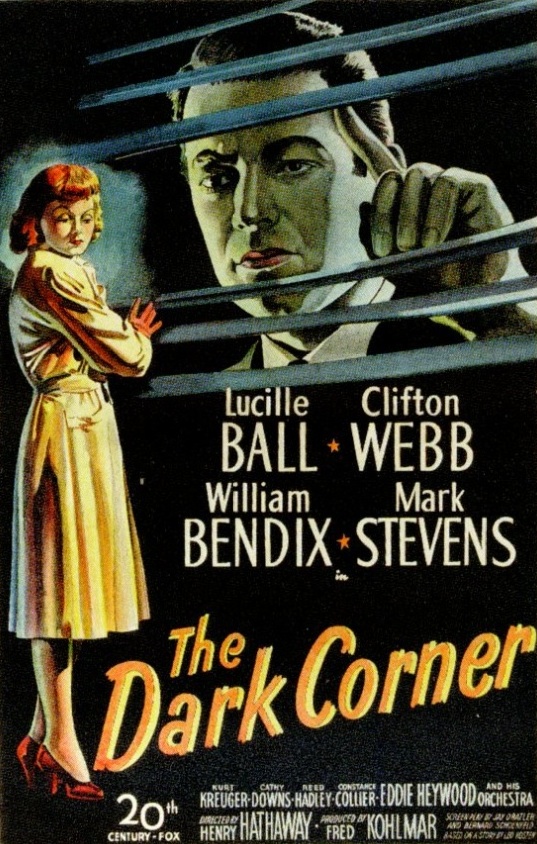
The Dark Corner (April 9, 1946)

If someone were to say to me, “What exactly is a film noir? I don’t think I’ve ever seen one,” I might direct them to Henry Hathaway’s The Dark Corner. Not because it’s the greatest noir I’ve ever seen, but because it contains so many “noir” elements; a tough-talking P.I. and his sexy secretary, blackmail, frame-ups, violence, creative use of shadows and low-angle shots, and a plethora of quotable tough-guy dialogue like “I can be framed easier than Whistler’s mother.” It’s also not a picture that’s attained the status of a true “classic” like Double Indemnity (1944) or The Big Sleep (1946), so no one’s going to be distracted by great acting, iconic characterizations, or a brilliant storyline. This is pulp. Pure and unvarnished.

I love pulpy noir, so I really enjoyed The Dark Corner. On the other hand, I first saw this movie less than a decade ago, and only remembered one scene, in which one character pushes another out of a skyscraper window and then calmly walks to his dentist appointment. I have pretty good recall, especially when it comes to films, but I didn’t remember anything about this movie, not even after watching it again. Nothing came back. And I have a feeling that I won’t remember much about it 10 years from now, either.

But that doesn’t change the fact that I enjoyed the heck out of it while I was watching it. Mark Stevens isn’t an actor who ever made a big impression on me, but he’s a passable lead. As private investigator Bradford Galt, he delivers his lines with the speed and regularity of a gal in the steno pool pounding the keys of a Smith Corona typewriter. Galt is the kind of guy who makes himself a cocktail by grabbing two bottles with one hand and pouring them into a highball glass together. He’s also the kind of guy who probably wouldn’t do well in today’s litigious corporate environment. When he tells his newly hired secretary Kathleen Stewart (Lucille Ball) that he’s taking her out on a date, she asks, “Is this part of the job?” He responds, “It is tonight.”

It turns out that he’s (mostly) telling the truth, and the reason he’s taking her out on the town is to draw out a tail he’s spotted; a big mug in a hard-to-miss white suit played by William Bendix. Their date was one of my favorite sequences in the movie. There’s a lot of great location footage of New York in The Dark Corner, but the scenes in the Tudor Penny Arcade take the cake. I don’t know if any of the scenes in the arcade were shot in back lots, but the batting cages, the Skeebowl, and the coin-operated Mutoscopes with titles like “Tahitian Nights” and “The Virgin of Bagdad” all looked pretty authentic.

Once Galt gets his hands on the guy tailing him and roughs him up for information, the plot kicks into gear. Bendix’s character, “Fred Foss,” is a heavy who claims to have been hired by a man named Jardine. Galt starts to panic as soon as he hears the name. Jardine was Galt’s partner when he was a P.I. in San Francisco. Jardine had Galt framed, which led to Galt doing two years in the pokey. Jardine (played by the blond, German-accented Kurt Kreuger) is now in New York, but still up to his old tricks, seducing married women and running blackmail schemes. The current object of his affection, Mari Cathcart (Cathy Downs), is married to the effete art dealer Hardy Cathcart, who is played by Clifton Webb. In The Dark Corner, Webb essentially reprises his role from Otto Preminger’s Laura (1944); another film noir in which a painting of a beautiful brunette played a major role.

I won’t summarize the Byzantine plot any further, but it should go without saying that all the pieces tie together. As I said, The Dark Corner isn’t the greatest noir I’ve ever seen, but it’s pretty enjoyable to watch, and it looks fantastic. The dialogue is especially cracking, and consistently verges on the ridiculous. For instance, when Cathcart tells Foss (who is on the phone with Galt) to tell Galt that he wants $200 to leave town, Foss repeats the information to Galt by saying, “I need two yards. Powder money.”

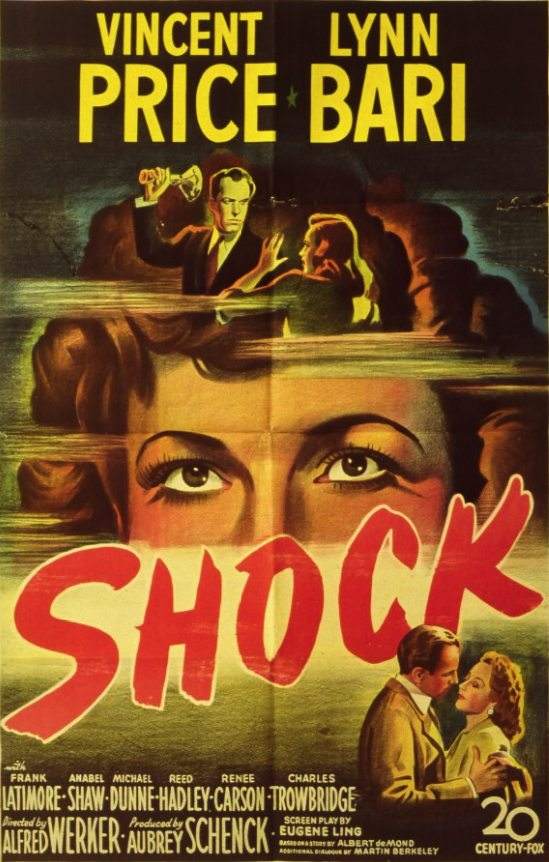
Shock (Jan. 10, 1946)

Alfred L. Werker’s thriller Shock, which had its premiere on January 10, 1946, and went into wide release on February 1st, stars Vincent Price as the murderous Dr. Richard Cross and Lynn Bari as his manipulative assistant and lover, Nurse Elaine Jordan. If you were to play a drinking game in which you took a shot of whiskey every time one of the characters in the film said the word “shock,” you would likely require medical attention after the first 20 minutes.

Price wasn’t always a horror icon. In Tower of London (1939), which was as much a costume drama about Richard III as it was a horror picture, he was a supporting player. In Brigham Young (1940), he played the founder of Mormonism, Joseph Smith. In Hudson’s Bay (1941), he played King Charles II. In Laura (1944) and Leave Her to Heaven (1945), he was the aggrieved “other man.” A tall, stately man born in St. Louis, Missouri, in 1911, Price was educated at Yale, where he studied art history and fine art. He radiated charm and erudition. He was a fine actor, and probably could have distinguished himself in any genre. As chance or fate would have it, however, his vocal delivery and arch facial expressions were perfectly suited to the ironic cinematic world of the macabre, and he is best remembered for his roles in horror pictures such as House of Wax (1953), The Fly (1958), House on Haunted Hill (1959), The Tingler (1959), and the innumerable Roger Corman-produced, Poe-influenced horror pictures that he appeared in throughout the 1960s.

While Shock is not a horror film, it has elements of one, and it’s the earliest role I’ve seen Price play in which he demonstrates some of the ghoulish mannerisms that would later make him famous. He doesn’t come close to the histrionics of some of his later horror roles, but there are some glimmerings.

The film opens in San Francisco, where a young woman named Janet (played by the somewhat sickly looking ingénue Anabel Shaw), is checking into a hotel, where she is to meet her husband, Lt. Paul Stewart (Frank Latimore), a former P.O.W. who is finally returning from World War II. Lt. Stewart doesn’t show up when he is supposed to, however, and as his emotionally fragile wife frets alone in her hotel room, she witnesses a murder. From her balcony, she can see through the window of an adjacent room. A man and a woman are arguing, and eventually the man settles the argument with a heavy candlestick.

Witnessing a murder drives Janet into a state of catatonic shock. When her husband finally arrives, she is unresponsive. When world-renowned psychiatrist Dr. Cross is brought in to consult in the case, Janet doesn’t recognize him, but Dr. Cross immediately realizes that the cause of Janet’s state of shock is the murder she witnessed him committing.

Janet is placed in Dr. Cross’s care, and he ignores the Hippocratic oath in order to save his own skin, giving Janet insulin treatments she doesn’t need, as well as using other unethical methods of driving her deeper into a state of shock so she will never be able to identify him. Cross isn’t portrayed as a total monster, however. That role is reserved for his lover, Nurse Jordan, a Lady Macbeth type who goads him on when his resolve to be wicked falters.

Shock is a programmer, to be sure, but it’s a well-made one, and kept me enthralled for all of its 70 minutes.

A Walk in the Sun (Dec. 25, 1945)

A Walk in the Sun
A Walk in the Sun (1945)
Directed by Lewis Milestone
20th Century-Fox

A Walk in the Sun had its premiere on Monday, December 3, 1945, and went into wide release on Christmas day. Produced and directed by Lewis Milestone, the director of All Quiet on the Western Front (1930), A Walk in the Sun tells the story of the ordinary men who serve in the infantry. Long stretches of the film are filled with the men’s meandering thoughts (both in voiceover and spoken aloud) and their circuitous conversations. When violence occurs, it comes suddenly, and its larger significance is unknown. The film’s exploration of the infantryman’s P.O.V. is similar to William A. Wellman’s The Story of G.I. Joe, released earlier the same year. (Burgess Meredith, who played Ernie Pyle in that film, narrates A Walk in the Sun, although he is not listed in the film’s credits. When I first watched this film I was sure it was Henry Fonda’s voice I was hearing. I was surprised when I looked it up and found out it was Meredith.) Unlike The Story of G.I. Joe, however, A Walk in the Sun covers a much briefer period of time (from a pre-dawn landing to noon the same day), and its ending is more heroic, with little sense of loss or tragedy.

Based on the novel by Harry Brown, A Walk in the Sun takes place in 1943, and tells the story of the lead platoon of the Texas division, and their landing on the beach in Salerno, Italy. Square-jawed Dana Andrews plays Staff Sgt. Bill Tyne, a simple man who never had much desire to travel outside of his hometown of Providence, Rhode Island. Richard Conte plays the Italian-American Pvt. Rivera, a tough soldier who loves opera and wants a wife and lots of children some day. George Tyne plays Pvt. Jake Friedman, a born-and-bred New Yorker. John Ireland plays PFC Windy Craven, a minister’s son from Canton, Ohio, who writes letters to his sister in his head, speaking the words aloud. Lloyd Bridges plays Staff Sgt. Ward, a baby-faced, pipe-smoking farmer. Sterling Holloway plays McWilliams, the platoon’s medic, who is Southern, speaks very slowly, and just might be a little touched. Norman Lloyd plays Pvt. Archimbeau, “platoon scout and prophet,” as Meredith describes him in the opening narration; Archimbeau talks incessantly of the war in Tibet he theorizes will occur in the ’50s. Herbert Rudley plays Staff Sgt. Eddie Porter, an opinionated guy who’s always looking for an argument (Normal Rockwell’s wasting his time painting photo-realistic covers for the Saturday Evening Post, Porter says. He should use a camera. Some day magazine covers will have moving pictures on them anyway.) Richard Benedict plays Pvt. Tranella, who “speaks two languages, Italian and Brooklyn,” and whose fluency in the former will prove useful when the platoon runs across two Italian deserters.

All of these “types” seem clichéd now, but they’re probably not unrealistic characters for the time. The only really dated thing about A Walk in the Sun is the song that appears throughout the film, and helps to narrate the action. “It Was Just a Little Walk in the Sun,” with music by Earl Robinson and lyrics by Millard Lampell, is sung by Kenneth Spencer in the deep, mournful style of a spiritual. I didn’t dislike the song, but its frequent appearance as a kind of Greek chorus felt intrusive.

One thing that really impressed me about A Walk in the Sun was the cinematography by Russell Harlan. While A Walk in the Sun is clearly filmed in California, Harlan makes the most of starkly contrasted black and white shots that could have been shot anywhere. One of the film’s motifs is black figures against a white sky. There are a couple of scenes that reminded me of the famous final scene in Ingmar Bergman’s The Seventh Seal (1957) in which death leads a procession of people down a hill. Several times in A Walk in the Sun, the platoon is depicted as groups of indistinguishable black figures walking down a black hillside, silhouetted against a completely white sky. And in keeping with the infantryman’s P.O.V., when the platoon lies down to rest there are a couple of shots from the ground, looking up at the sky, while arms reach up across the frame and exchange cigarettes.

A Walk in the Sun is one of the better World War II films I’ve seen, and it’s generally well-regarded, but not everyone liked it. Samuel Fuller, who saw combat in World War II as a rifleman in the U.S. 1st Infantry Division and would go on to direct many cult favorites, wrote a letter to Milestone complaining about the film. “Why a man of your calibre should resort to a colonel’s technical advice on what happens in a platoon is something I’ll never figure out,” he wrote. “When colonels are back in their garrison hutments where they belong I’ll come out with a yarn that won’t make any doggie that was ever on the line retch with disgust.”

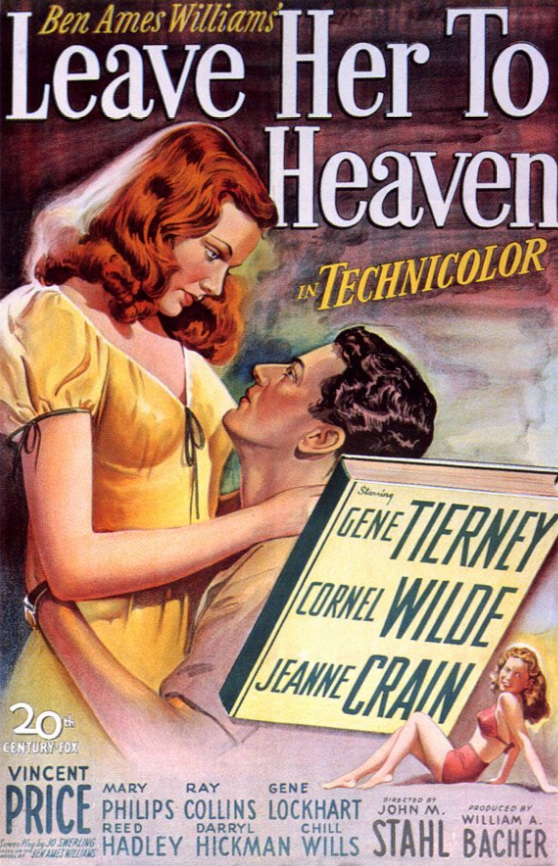
Leave Her to Heaven (Dec. 19, 1945)

Can there be such a thing as a film noir in color? I don’t think there can, but the term noir has been so widely used, popularized, and bastardized that director John M. Stahl’s Technicolor adaptation of Ben Ames Williams’s novel Leave Her to Heaven, made during the heyday of noir in Hollywood, is often referred to as a rare instance of a film noir in color.

A year after she starred as the eponymous Laura (Otto Preminger’s 1944 classic that is also frequently referred to as a noir even though it really has very few characteristics of one, aside from being filmed in black and white), Gene Tierney created a memorably unhinged character named Ellen Berent.

When we first meet Ellen, the first thing we see is her beauty. Sitting across from novelist Richard Harland (Cornel Wilde) in the lounge car of a train, surrounded by green walls, her dark hair and pale face offset by her bright red lips, she looks like a porcelain doll come to life. Quickly, however, we notice something else. The way she is staring at him is predatory. The way she doesn’t speak for a long time after he answers a question is strange. She is beautiful, but there is something wrong with her. We can guess, however, that his relationship with Ellen won’t have a happy ending.

If only Richard saw what the audience can see. Of course, the audience also has the advantage of a framing device. In the first scene of Leave Her to Heaven, we see Richard return to Deer Lake, Maine. His friends and neighbors look at him strangely. As they whisper among themselves, we learn that he has just gotten out of prison after a two-year stint, but we don’t know what the charge was.

Most of the story is told in flashback. Beginning with the scene on the train, we see how Richard fell into Ellen’s clutches. After they disembark, they find that they are both guests at Rancho Jacinto, in New Mexico, where Ellen has gone to scatter her father’s ashes. After telling Richard several times how much he looks like her father (even though a framed photograph of the man looks nothing like Cornel Wilde), the scene in which the stone-faced Tierney rides a horse and scatters her father’s ashes in the mountains is one of the most striking in the picture. When Richard agrees to marry her soon after, it is at her urging. Marrying her is something he thinks he wants, but the words “Will you marry me” never escape his lips. He is caught in her web.

After their marriage, Ellen and Richard go away to his cabin in Maine. She resents the intrusion of anyone else into their lives, such as her sister Ruth (Jeanne Crain) or Richard’s younger brother Danny (Darryl Hickman), who is recovering from polio, and her resentment has deadly consequences.

Ellen is devious, but it’s not always clear how conscious she is of her own cunning. Although the other characters speak of how unnaturally close she was to her father, and how she loves with a childish ferocity that can be dangerous, the viewer is not privy to any deeper psychological insights. There are no scenes of her childhood or flashbacks to any trauma that might have precipitated her madness. It’s refreshing to have a character with sociopathic tendencies that have no pat explanation, but some insight into the jealousy that drives her might have helped flesh out the character.

So what is it that makes Leave Her to Heaven a film noir? The classification is a slippery one, and has become popular enough that nearly every black and white film from the ’40s that is not a musical or a comedy has been called a film noir at some point. In one of the first treatises on the subject, the 1955 book Panorama du film noir américain 1941–1953, French film critics Raymond Borde and Etienne Chaumeton identified the five main facets of film noir. They said that it is “oneiric, strange, erotic, ambivalent, and cruel.” Over the years, the term film noir has grown to encompass certain stylistic elements as well. Stark black and white cinematography and unbalanced constructions that grew out of German Expressionism are both hallmarks of noir, as is a pervading sense of doom.

So does Leave Her to Heaven contain any of these elements? It certainly could be called “strange,” but it’s not particularly dreamlike. It’s not very erotic, either, since Ellen seems to capture Richard in a web that is more psychological than it is sexual. Her actions are sometimes cruel, but the picture as a whole is not terribly ambivalent. Ellen may arouse feelings of both pity and hatred in the viewer, but she is still presented in a straightforward way. She has no crises of conscience or confusion about what she wants. And the lush Technicolor cinematography really pushes Leave Her to Heaven out of the noir category.

Leave Her to Heaven is a melodrama with a couple of shocking scenes, a sociopathic main character, and a courtroom denouement that drags down the pacing of the picture, but which does feature an enjoyable performance by Vincent Price as one of Ellen’s old flames who is now a prosecutor. It is not a film noir, unless we can divorce style from content. The absence of black and white cinematography and a real sense of doom (or a truly unhappy ending) means that Leave Her to Heaven just doesn’t qualify as a film noir. Of course, this shouldn’t stop anyone from seeing it. Whatever its genre, it’s an effective film with an interesting performance by a beautiful actress who didn’t exhibit a great deal of range in any of her roles, but who is chilling in this one.

Leave Her to Heaven was Twentieth Century-Fox’s highest grossing picture of the 1940s. Tierney was nominated for an Academy Award for best actress, and Leon Shamroy won an Oscar for best cinematography in the color category.

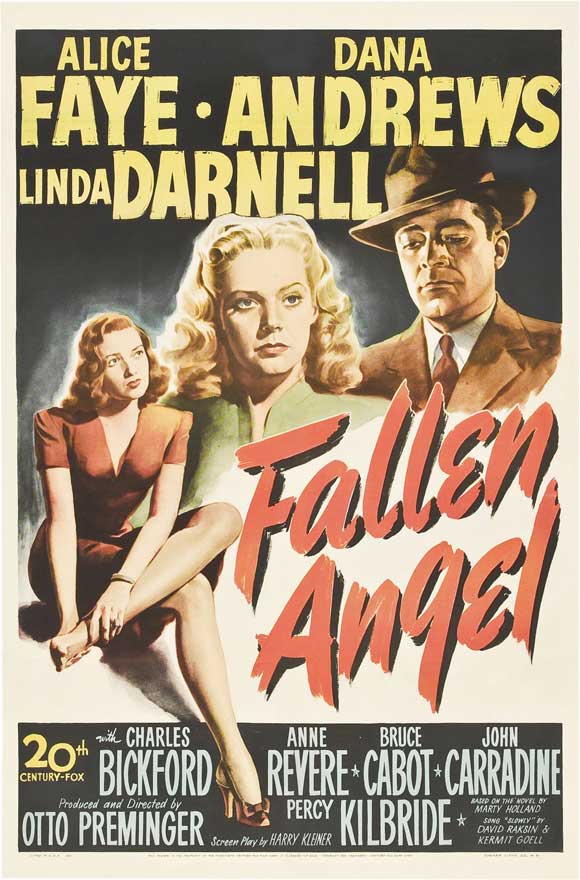
Fallen Angel (Dec. 5, 1945)

Fallen Angel, Otto Preminger’s follow-up to his smash hit Laura (1944), was slapped around by critics and passed over by audiences, but it’s not a bad film. It’s just not involving or memorable in the ways Laura was, and it’s composed of a bunch of elements that never really coalesce.

Fallen Angel reunited Preminger with the star of his previous film, Dana Andrews, and a lot of my enjoyment in the film came from watching Andrews. He’s more of a focal point in Fallen Angel than he was in Laura, and he dominates every scene he’s in. Andrews was 5’10”, but he looks well over six feet in this picture. He’s rough-looking but charming, and imposing and tough without being wooden. At the same time, he projects bitterness and alienation, barely concealed behind a handsome mask. In short, he’s the embodiment of American post-war masculinity. Andrews’s co-stars are all good as well. And I can’t fault Preminger’s direction. The film looks great, and taken one scene at a time, it’s very good.

Where Fallen Angel failed to engage me was in its pacing and storytelling. I haven’t read the Marty Holland novel the film is based on, but Fallen Angel plays like an adaptation of a sprawling book in which each section of the plot is dutifully reenacted, as opposed to a terse adaptation in which unnecessary subplots and themes are jettisoned. When drifter Eric Stanton (Andrews) is thrown off a bus in the small town of Walton, California, because he doesn’t have the $2.25 fare necessary to continue on to San Francisco, he stops in at a place called Pop’s Café. In the first few minutes of the film we’re introduced to all the major players; the phony spiritualist Professor Madley (John Carradine), whom Stanton used to shill for, hard-boiled ex-New York police detective Mark Judd (Charles Bickford), cafe owner Pop (Percy Kilbride), June Mills (Alice Faye), June’s spinster sister Clara (Anne Revere), and Pop’s pouting, sexy waitress Stella (Linda Darnell), whom every man in town seems to be obsessed with (and it’s not hard to see why).

The beginning doesn’t seem rushed, however, or as though too much information is being packed in. A lot of this can be credited to Preminger’s cinematographer, Joseph LaShelle, who also worked with Preminger on Laura, and whose fluid tracking shots and crisp black and white cinematography are both a joy to watch. Eventually, however, the way certain characters dropped out of the picture left me feeling suspended. The grifting medium and his relationship with Stanton could have filled an entire picture (although I admit being partial to John Carradine), but he leaves town before too much time has passed. Later, when Stella is murdered, it happens off screen, and just as I felt her relationship with Stanton was starting to get juicy. His romance with June and Stella could have formed the classic “good girl/bad girl” film noir tension, but his romance with June doesn’t really get started until Stella’s ticket has been punched, and once that happens, Fallen Angel becomes more of a melodrama than a noir. It’s also a mystery, since we don’t know who killed Stella, but this aspect of the film doesn’t come to much, as the second half focuses more on Stanton’s courtship of the sheltered, naïve June, and the question of whether or not he really loves her or is just out to fleece her. Meanwhile, most viewers will have the number of suspects in Stella’s murder narrowed down to two suspects, neither of whom is a more interesting culprit than the other.

I’m probably making Fallen Angel sound worse than it is. Many modern viewers consider it a lost classic of film noir, or just a really great film that has been overlooked. It’s worth seeing, especially if you’re a fan of Preminger or any of the principal actors. I found it disappointing, but that might change years from now with a second viewing.