Tag Archives: British Cinema

Odd Man Out (Jan. 30, 1947)

Odd Man Out
Odd Man Out (1947)
Directed by Carol Reed
Two Cities Films

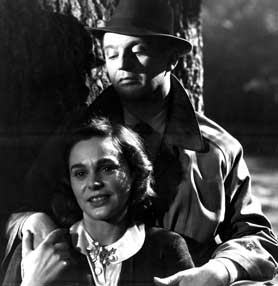
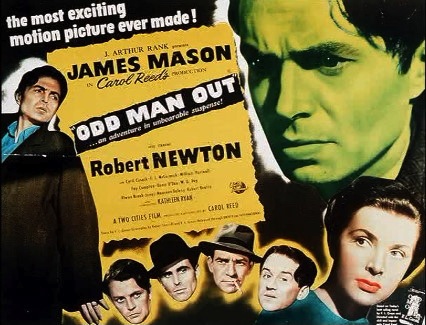
Odd Man Out is a terrific film. It might not be — as the lobby card above boasts — “the most exciting motion picture ever made,” but it’s a damned good one, with masterful direction by Carol Reed and a hypnotic lead performance by James Mason.

The film, which is based on a novel by F.L. Green, opens with a disclaimer that it isn’t “concerned with the struggle between the law and an illegal organisation, but only with the conflict in the hearts of the people when they become unexpectedly involved.”

Mason plays a revolutionary leader named Johnny McQueen, fresh out of the clink and planning a big heist. The Irish Republican Army is never mentioned outright — McQueen’s group is simply called “the organisation” — but the film takes place in Belfast, so you can connect the dots, if you care to.

However you choose to interpret the obfuscation of the I.R.A. in Odd Man Out, there’s little denying that it’s an apolitical film, more concerned with one man’s existential journey than with making any kind of political statement.

In the first scene of the film, we see Johnny McQueen holed up in a safehouse, planning a payroll robbery of a textile mill with his boys. Also present is the woman who loves him, Kathleen Sullivan (played by Kathleen Ryan). Things look and sound all right until one of Johnny’s boys approaches him, and tells him he’s concerned about Johnny’s ability to handle the job. Johnny was in prison for several years for blowing up a police station. He’s only been on the lam a little while, and confined to the safehouse the whole time.

Johnny brushes off his lieutenant’s concerns, but as soon as the plan is in motion, we realize that Johnny might have been wrong to lead the robbery. In a subjective sequence, we see the busy streets of Belfast from Johnny’s point of view. Cars whiz past, streetcars with grinding wheels pass by close enough to touch, people hurry to and fro, and the whole smoky mess looks too cramped and too large at the same time.

If you’re a fan of realistic heist movies, the robbery scene in Odd Man Out will meet with your approval. It’s not overly complicated, and it’s accomplished quickly, but it’s full of tension, especially since Johnny seems about to crack at any moment.

He and his boys make it out with the money, but a mill guard tackles Johnny as he hesitates on the front steps of the factory. The two men wrestle, and each takes a bullet. The wounded Johnny falls off the running board of the getaway car, and his boys lose him in the confusion.

Odd Man Out is a tense film. It takes place over the course of the night following the mill robbery, and Reed and his cinematographer, Robert Krasker, box their subjects in. The members of “the organisation” are pursued by police on foot, through dark alleys, over rooftops, and even through middle-class homes. (Reed frequently juxtaposes the activities of the city’s regular citizens with the activities of its criminal underclass.)

James Mason has little dialogue in the film, but his performance is amazing. He feels guilt, remorse, confusion, anger, loneliness, and even suffers hallucinations as he loses blood and seems to always be marching toward death. His performance is sympathetic, but keeps the viewer at a distance. This isn’t a film noir about a regular Joe who’s caught up in circumstances beyond his control. Every move Johnny made in his life has led him to this point, and he knows it.

Aside from Mason, most of the actors in the film were regulars on the stage of the Abbey Theatre (which could be why none of their accents sound quite right — they’re all from the wrong end of the island). Fans of British cinema and television will recognize plenty of them.

Reed’s most famous film is The Third Man, which he made in 1949. It’s been awhile since I’ve seen The Third Man, but I thought Odd Man Out was a stronger picture. Mason is a more compelling central presence than any of the actors are in The Third Man, and the music, cinematography, editing, and direction are all tighter in Odd Man Out.

Odd Man Out is a difficult film to classify. It starts out as a straightforward crime picture, but by the end of the film, Johnny’s journey takes on a surreal quality. A scene late in the picture in which he’s sheltered by a mad painter (Robert Newton) has the quality of a lively Samuel Beckett play.

The film was nominated for the Golden Lion at the Venice Film Festival in 1947, and received the BAFTA award for Best British Film in 1948. Fergus McDonnell was nominated for an Academy Award in 1948 for best editing, but Francis Lyon and Robert Parrish ended up winning for Body and Soul.
Hungry Hill (Jan. 7, 1947)

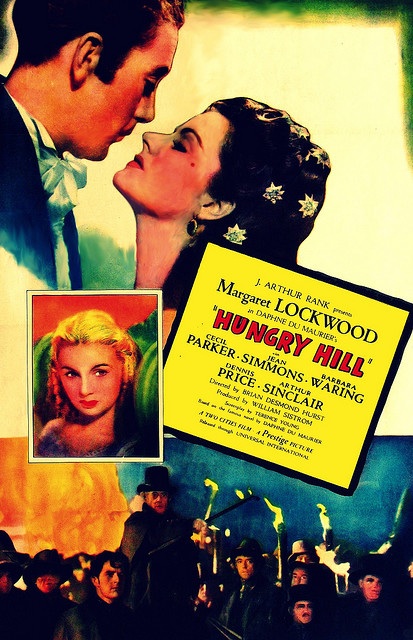
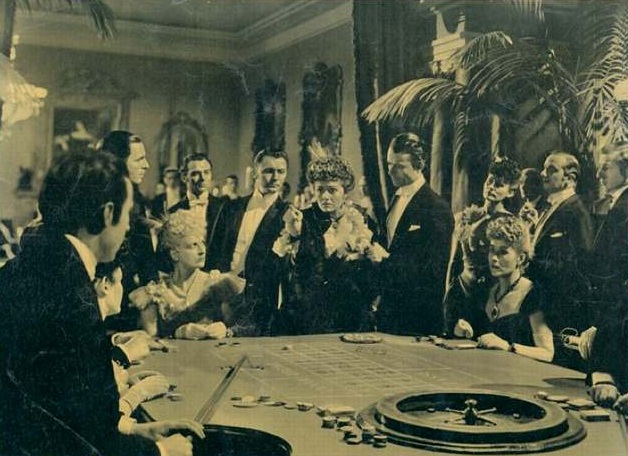
Daphne Du Maurier’s 1943 historical novel Hungry Hill covers a period of 100 years (1820 to 1920) in the lives of five generations of two feuding Irish families. Brian Desmond Hurst’s 1947 film adaptation narrows the scope of the story to three generations and a roughly 50-year timespan, but it’s still a lot to take in over the course of just 100 minutes. If you’re a fan of romantic yet gloomy historical melodramas, Hungry Hill is a filling dish. And if you’re not, Hungry Hill might leave you feeling stuffed and queasy.

Margaret Lockwood gets top billing (and the most time onscreen) as Fanny Rosa, a beautiful and headstrong young woman who marries into the wealthy Brodrick family, who live in a castle called “Clonmere” in County Cork. The patriarch of the clan, John Brodrick (Cecil Parker), has several children, John (Dennis Price), Henry (Michael Denison), and Jane (Jean Simmons). (Honestly, there are a lot of characters in Hungry Hill, and he might have had more children than those three, but they’re the only ones I was able to get a handle on.)

The patriarch of the Donovan clan, old Morty Donovan (Arthur Sinclair), violently objects to John Brodrick’s plans to mine for copper in Hungry Hill, and curses Brodrick and his entire family. (Hungry Hill is located in the beautiful Caha Mountains, which I’ve hiked, so I was disappointed that there wasn’t more location footage — most of the film takes place in drafty old rooms and the bowels of the Brodrick copper mine.)

While the copper mine ends up providing plenty of employment for the Donovan clan and other roustabouts, tensions are always simmering. A labor riot leads to the death of one young man, and a visit of reconciliation leads to a deadly typhoid infection.

Hungry Hill follows a familiar three-generation rise-and-fall story arc. By the time Margaret Lockwood’s hair is brushed through with gray and her face is lined with age makeup, it should come as no surprise to anyone that her handsome son, Johnnie Brodrick (Dermot Walsh), is drinking a bottle of whiskey a day, loving and leaving the ladies, and frittering away his family’s fortune. The scenes between Johnnie and his mother are well-played and affecting, but by that point in the movie I was starting to lose interest in the dismal goings-on.

One thing I can recommend unequivocally is the casting, which is excellent. Not only does Hungry Hill feature the cream of the crop of up-and-coming British actors, but the Brodrick men really do all look like members of the same family, and the Donovans resemble one another, too. Of course, this is a double-edged sword, since it’s sometimes difficult to keep them all straight.

Hurst himself clearly didn’t hold this film in the highest regard. In a letter to John Ford dated April 9, 1951, in which he sang the praises of Siobhan McKenna, who played Kate Donovan in Hungry Hill (Ford was interested in casting her in his film The Quiet Man), Hurst wrote, “There must be a copy of a rather indifferent film I made of Daphne du Maurier’s even more indifferent story ‘Hungry Hill.’ You could get hold of this through Eagle-Lion, but don’t inflict the whole of the picture on yourself. Just see about the last four reels, because she doesn’t come in till then.”

A Matter of Life and Death (Dec. 25, 1946)

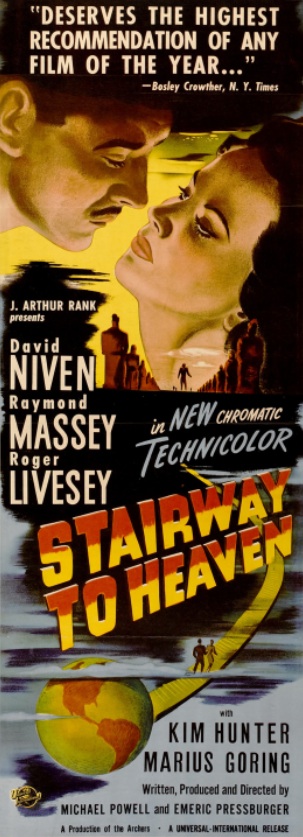
Stairway to Heaven
A Matter of Life and Death (1946)
Directed by Michael Powell and Emeric Pressburger
The Archers / Eagle-Lion / Universal Pictures

Michael Powell and Emeric Pressburger’s brilliant fantasy A Matter of Life and Death premiered in the United Kingdom on November 1, 1946, and later that year in New York City, on Christmas day, retitled Stairway to Heaven. (After World War II, the word “death” was verboten in film titles for awhile in the United States.)

The film begins with the following statement: “This is a story of two worlds — the one we know and another which exists only in the mind of a young airman whose life and imagination have been violently shaped by war. Any resemblance to any other world, known or unknown, is purely coincidental.” It’s a playful opening, and can be interpreted in more than one way. “The Archers” (the name Powell and Pressburger used for their partnership) had a light touch, and were able to weave magical realism into their stories without ever seeming childish or silly.

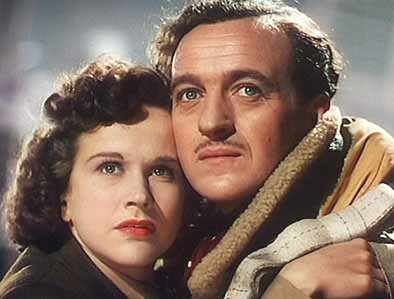
After a cheeky narrated tour through the cosmos, we see Squadron Leader Peter Carter (David Niven), his Lancaster bomber in flames and about to crash. Peter’s parachute is shot too full of holes to function properly, and he is desperately trying to reach someone on the radio. Next to him lies the body of Flying Officer Bob Trubshawe (Robert Coote). Peter manages to get in touch with June (Kim Hunter), an American radio operator, and pours out his heart to her. Finally, he professes his love before leaping out of the bomber without a parachute.

The scene in which Niven wakes up in the pounding surf and believes himself in the afterlife is a masterpiece of subtle humor. He stands, breathes deeply, and walks toward the beach with a beatific gaze, shedding his earthly raiments. The first person he sees is a boy playing a pipe, tending sheep, so why wouldn’t he think he’s passed on to his final reward?

Meanwhile, his mate Bob finds himself in the “other place,” an otherworldly bureacracy in which angel wings arrive en masse on long runners, ready to be attached to newly arrived bodies, and businesslike clerks take names and hand out assignments. Bob is told that there was a clerical error that caused Peter to fall through the cracks, and that he’ll need to be collected forthwith.

The scenes on terra firma are filmed in beautiful Technicolor, while the scenes in the afterlife are filmed in black and white. (Technically it’s “monochrome Technicolor,” not proper black and white, but since I’m not as big of a film nerd as Martin Scorsese, I couldn’t tell the difference.) It’s a simple but brilliant stylistic choice, and it’s way ahead of its time. Films in the ’30s or ’40s that mixed black and white with color film invariably depicted the fantastical world in color and the prosaic world in black and white. To do it the other way around looks forward to the ’80s, when black and white was coming back into vogue, and filmmakers like Scorsese and David Lynch showed just how surreal and otherworldly black and white film could look.

Kim Hunter and David Niven

June and Peter fall in love, but for Peter, time occasionally stops all around him while a ridiculous French aristocrat from the other world known as “Conductor 71” (Marius Goring), pays him visits.

June’s friend Doctor Reeves (Roger Livesey) believes that Peter’s visions aren’t supernatural, but symptoms of a brain injury. Eventually this “matter of life and death” comes to a head as Peter is operated on in our world while simultaneously facing trial in the other.

A Matter of Life and Death is a fantastic film that is satisfying on both a technical level and an emotional level. The performances are all wonderful, and Powell and Pressburger are masterful filmmakers.

Incidentally, in a 2004 poll of 25 film critics in Britain’s Total Film magazine, A Matter of Life and Death was named the second greatest British film of all time, sandwiched between Get Carter (#1) and Trainspotting (#3).

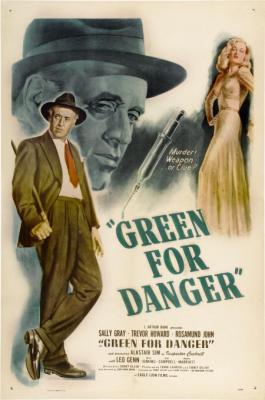
Green for Danger (Dec. 5, 1946)

Sidney Gilliat’s Green for Danger, based on the novel by Christianna Brand, is a terrific whodunnit, replete with the cream of the crop of post-war British film thespians.

The story takes place over the course of one week in 1944 at Heron’s Park Emergency Hospital, a requisitioned and converted Elizabethan manor in the English countryside. The atmosphere is claustrophobic, as the doctors, nurses, and administrators tend to the sick and the wartime wounded while squabbling and engaging in petty jealousies as German bombers fly overhead.

Alastair Sim, who plays Inspector Cockrill, doesn’t show up until halfway through the film, but he narrates it from the beginning, introducing us to a group of doctors and nurses circled around a patient in the operating theater; surgeon Mr. Eden (Leo Genn), a stocky, dark-haired Lothario; anesthetist Dr. Barnes (Trevor Howard), who is engaged to the pretty blonde, Nurse Linley (Sally Gray); hysterical Nurse Sanson (Rosamund John); strait-laced Sister Bates (Judy Campbell); and portly Nurse Woods (Megs Jenkins). Inspector Cockrill informs us that it is August 17, 1944, and that by August 22, 1944, two of these characters will be dead, and one of them will be revealed as a murderer.

I like a mystery that establishes its parameters early in the story, and Green for Danger does exactly that. The fact that we’re quickly introduced to the six main characters while their hair and faces are covered by surgical caps and masks means you’ll have to be paying especially close attention if you want to remember who everyone is at first glance, but if you aren’t, never fear. The characters in this film are sharply drawn, and the actors bring them to life wonderfully.

Trevor Howard as Dr. Barnes is the embodiment of the British middle class; his entire body is one big stiff upper lip. Leo Genn probably isn’t anyone’s current idea of a ladykiller, but his smoothness and charisma make him utterly convincing. Sally Gray is lovely to look at, although when she and Rosamund John were both wearing surgical caps I found them difficult to tell apart. I especially liked Judy Campbell, whose role could have been one-note, but who manages to instill the severe Sister Bates with a good deal of humanity.

The first murder — or was it murder? — takes place when a postman named Higgins (Moore Marriott), injured after a bomb attack, dies on the operating table. Recriminations fly, but his death is written off as an accident until one of the nurses screams during a party that she knows it was murder, and she can prove it. She rushes off into the night, stalked by a killer. This sequence is genuinely terrifying, and is reminiscent of an Italian giallo, with dark shadows, swinging doors, and shutters blowing open and closed in the wind to create dramatic lighting effects.

Inspector Cockrill’s appearance marks a shift in tone, as the film becomes more comic. Cockrill is the diametrical opposite of Dr. Barnes and Mr. Eden. While they are perfectly groomed, neatly coiffed, and sharply attired, he is bald, with shocks of gray hair above his ears, outfitted in an ill-fitting, rumpled suit with a drooping pocket square. He’s a collection of tics, constantly shrugging his shoulders and raising his eyebrows.

He’s also the shrewdest man in the room. When Dr. Barnes disparagingly refers to flat-footed coppers, Cockrill responds, “The police force has not a monopoly of fallen arches, Dr. Barnes. Ask any chiropodist.”

Alastair Sim is a fantastic actor, and he exudes authority as Inspector Cockrill, even when he’s doing a pratfall. Cockrill is a fantastic creation, and watching this film made me wish there were an entire series of films featuring the character. He keeps his suspects constantly off-kilter with inappropriate jokes and ironic comments, and he seems mildly amused by everything, including himself.

Green for Danger was one of the most pleasant surprises I’ve had lately. It’s genuinely good escapist entertainment.

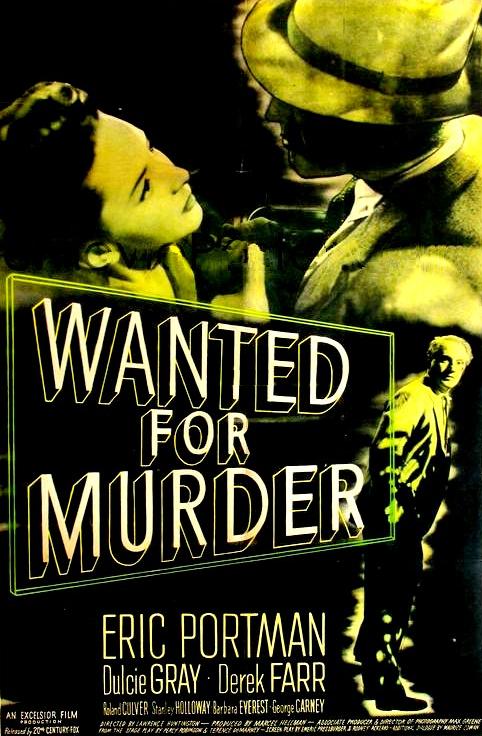
Wanted for Murder (Nov. 2, 1946)

Lawrence Huntington’s Wanted for Murder, which was originally released on June 17, 1946, in the U.K., premiered in the United States on November 2, 1946. It’s an effective chiller with a dependable cast and an excellent screenplay by Rodney Ackland and Emeric Pressburger, based on the stage play by Percy Robinson and Terence de Marney.

The film boasts a terrific sense of place, with scenes filmed in Hampstead Fairground, Madame Tussaud’s wax museum, and the center of London (which, when necessary, appears as rear screen projection stock footage, a technique that can be distractingly fake-looking but here is done fairly skillfully). There are also several atmospheric nighttime murder sequences in Hampstead Heath, Regent’s Park, and Hyde Park.

Particularly effective is the music by Mischa Spoliansky, whose pop-orchestral tune “A Voice in the Night” is a motif that follows the murderer around like his shadow, and which you’ll be hard-pressed not to hum after seeing this picture.

Eric Portman plays middle-class mummy’s boy Victor James Colebrooke, a man who feels haunted by the specter of his late father, William Colebrooke, an executioner to Queen Victoria whose eerie likeness stands in Madame Tussaud’s.

Colebrooke is a handsome, superficially charming gentleman who drink Hendrick’s Gin, lives at home with his mother and a servant, and whose single-breasted suits often sport a white boutonniere and a pocket square. He’s the embodiment of the British fascination with “the murderer next door” — the outwardly ordinary man whose wife’s remains are bricked up in the basement or who strangles working girls on the weekend.

Wispy brunette Dulcie Gray plays Anne Fielding, a young woman who works in a gramophone shop and is dating Colebrooke. A starry-eyed young bus conductor named Jack Williams (Derek Farr) finds her waiting at the fairgrounds and mashes her as hard as he can. She’s attracted to him, but Colebrooke is manipulative and possessive.

Rounding out the fine cast are Roland Culver as Chief Insp. Conway and Stanley Holloway as Sgt. Sullivan, the two Scotland Yard detectives who are on the trail of the killer. Their scenes are some of the film’s most light-hearted, but they are never less than professional, and are dogged in their pursuit of the strangler.

When the first murder occurs, the audience doesn’t know who the killer is, but we strongly suspect Colebrooke. It’s not long before the film removes any doubt about his guilt, which allows for a more interesting and creepy character study than in a whodunnit, where the murderer’s identity is a secret up until the climax.

Most of the film is a game of cat and mouse, with the detectives fairly certain Colebrooke is guilty, but unable to gather anything but circumstantial evidence.

Meanwhile, Colebrooke goes about his dastardly business at night in the parks, telling young women he takes out on dates and strangles that his name is “Tom Mahon.”

Colebrooke blames his sickness on his father, whose killings were all committed in the course of his duty, but whose grim pride in his work earned him the nickname “The Happy Hangman.” The Freudian-minded viewer might blame his overbearing, possessive mother, but the film itself doesn’t draw any such trite conclusions. His father is just a picture on the wall or — in one scene — a disturbingly realistic wax figure, and his mother isn’t a bad person, even encouraging him to find a nice girl and marry her.

Wanted for Murder is a first-rate thriller. Although the adjective hadn’t been invented when it was made, I’d go so far as to call it “Hitchcockian.”

I See a Dark Stranger (July 4, 1946)

Frank Launder’s I See a Dark Stranger, which premiered in the United Kingdom on July 4, 1946, is half a loaf of noir slathered with generous helpings of romance and comedy. It’s a very enjoyable picture that’s notable as a star vehicle for the lovely Deborah Kerr before she was well-known in Hollywood.

The opening of the film is pure noir. Shadows fall heavily on the quiet nighttime streets of a little town with signs all about in French. A panicked man rushes through the town, searching for something. Suddenly there’s a shot of something that doesn’t quite fit, and the narrator’s voice appears on the soundtrack. “An Isle of Man signpost outside a French town,” he says. “That’s odd. But we’ve started this tale at the wrong moment.”

He goes on to tell us that this is really the story of Bridie Quilty (Kerr), and we see the young woman in the pub where she works as she eavesdrops on her father’s boozy tales of the Irish Revolution, rapt, even mouthing the words of his story at one point. Bridie hates the English and the memory of Oliver Cromwell as much as the most hardened member of the I.R.A. does, and wants nothing more than to join the group when she reaches the age of majority, just like her father did. The film treats her fervor lightly, however, and right off the bat the viewer knows that this coming-of-age story will contain a fair measure of disillusionment for its protagonist. But not, of course, before she gets in over her head.

As soon as Bridie turns 21, she heads for Dublin to make contact with a former compatriot of her father, a man named Michael O’Callaghan (Brefni O’Rorke). Far from the fearsome soldier she expected, O’Callaghan is a mild-mannered curator of a museum who doesn’t seem to mind seeing a large painting of Cromwell every day and feels that the terms of the Government of Ireland Act 1920 that partitioned the country were fair enough, which boggles Bridie’s mind. More significantly, he seems to have never heard of her father, which should raise a red flag, but doesn’t, since Bridie is as bull-headed as she is patriotic.

Undeterred by her experience in the museum, Bridie looks for resistance where she can find it, and falls in with a man named Miller (Raymond Huntley). He appears at first glance to be a rumpled Englishman, but Bridie learns that he’s a spy working against the English, so she goes to work for him without a second thought.

Bridie is blithely unaware of politics outside of Ireland and the U.K., and the film is clever enough to share her point of view for some time. Astute viewers, of course, will immediately be able to suss out exactly which nation Miller is spying for, but it’s not directly stated for awhile. As far as Bridie’s concerned, the enemy of her enemy is her friend. After hearing how much Bridie hates every last Englishman, Miller says to her, “For a subject of a neutral country, aren’t you being a little belligerent?” Bridie responds, “There’s nothing belligerent about it. It’s entirely a question of which side I’m neutral on.”

As I said, I See a Dark Stranger is a mixture of noir and comedy. It’s heavier on the comedy than it is on the thrills, especially toward the end, but for the first half, there are some sequences that wouldn’t be out of place in any other espionage potboiler, such as the scene in which Bridie has to dispose of a corpse, and comes up with the ingenious notion of putting the body in a wheelchair and pushing it through town as though she’s just taking an old man for a walk (she’s really heading for the cliffs overlooking the ocean). It’s never very serious, though, and the film is generally more interested in humorous situations and amusing characterizations than it is in plot points.

Kerr is fantastic, and carries the picture with ease. Trevor Howard is great, too. He plays Lt. David Baynes, a Brit who becomes infatuated with Bridie and realizes too late the amount of trouble she’s in. There are also two very funny caricatures of stiff upper-lipped British policemen, Capt. Goodhusband (Garry Marsh) and Lt. Spanswick (Tom Macaulay) who may very well have served as the inspiration for Hergé’s comic characters Dupont et Dupond (Thomson and Thompson in English translation), two detectives who are indistinguishable from each other. Spanswick and Goodhusband are both bald, have neat little black mustaches, and say things like “Cheerio, old boy.” By the end of the picture, however, they’re allowed to grow out of their stereotyped roles, are fairly easy to tell apart, and even get a few intentionally funny lines, such as when Spanswick says to a hotel manager who is afraid that German prisoners of war may have escaped from the nearby internment camp to hide out in her hotel, “If the food I’ve had here is anything to go by, they’re more likely to escape from the hotel and beat it for the internment camp.”

Henry V (June 17, 1946)

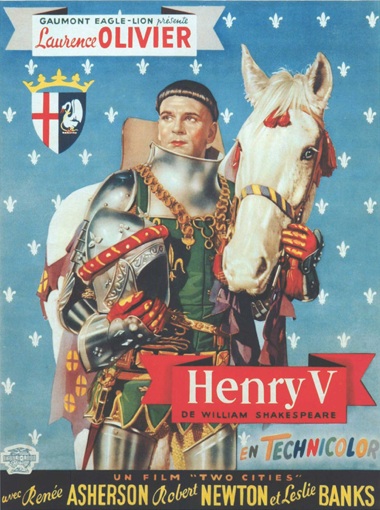
Laurence Olivier’s film adaptation of Shakespeare’s history play Henry V was originally released in the United Kingdom in November of 1944. (The date I’ve listed above is the release date of the film in the United States.) Following its release in the United States, Henry V was nominated for a 1946 Oscar for best picture, as well as Oscars for best actor, best score, and best art direction. It didn’t win in any of its nominated categories, but Olivier did receive an honorary Academy Award “for his outstanding achievement as actor, producer, and director in bringing Henry V to the screen.”

The recognition was well deserved (even though Olivier considered the award a “fob-off” from a jingoistic Academy). This film is a splendid achievement, and holds up remarkably well. Not only is it a fine cinematic adaptation of a great play, it’s a beautifully crafted film within a play within a film, in which Olivier the director has fun with convention while Olivier the actor delivers an assured and commanding performance as Henry, only recently a monarch after a misspent youth (chronicled by Shakespeare in Henry IV parts one and two).

The film’s full title is “The Chronicle History of King Henry the Fift With His Battell Fought at Agincourt in France,” and that’s how the title appears on the opening placard, which invites people to attend “Will” Shakespeare’s play, performed by the Lord Chamberlain’s Men at the Globe Playhouse this day, the first of May, 1600. There follows a panoramic vista in gorgeous, nearly surreal Technicolor of the London of Shakespeare’s day. It’s obviously a model, but it’s an effective one, with wisps of smoke rising from chimneys and tiny vessels dotting the Thames.

The beginning of the film attempts to faithfully recreate the theatrical experience one would have had at the Globe during Shakespeare’s time. There are no set dressings, and the Chorus (Leslie Banks), in each of his appearances, invites the viewer to suspend his or her disbelief, vividly describing the scene that is about to be played, and in so doing draws attention to the artifice of the play. As the film goes on, however, it moves out of the confines of the theater and becomes increasingly realistic, reaching its apex when Henry finally leads his troops in battle against the French at Agincourt.

Artifice and realism aren’t strictly delineated in Henry V, however. When the film first moves out of the theater to the court of France, the ocean is a static sea of waves that looks like the backdrop for a puppet show in Mister Rogers’ Neighborhood. And after the impressive battle, which was filmed in County Wicklow, Ireland (as a neutral country, it wasn’t ravaged by the war), artifice slowly returns in the form of phony-looking backdrops and a return to the stagey castle set of the French court.

When Olivier first appears on screen, it is as Oliver the actor, standing backstage in full costume, waiting for his entrance cue, and coughing into his hand in a decidedly unheroic fashion. As soon as he steps on stage, however, his voice commands attention. By the time he delivers his famous Saint Crispin’s Day speech, I was eating out of his hand. This is no mean feat, either, considering the historically accurate haircut Olivier saddled himself with, as well as his very noticeable eye makeup.

It’s common knowledge that Henry V was made with the cooperation of the British government and designed to be a nationalistic morale booster in the days following the Allied push into Normandy. Consequently, the scene in which Henry threatens to rape women and kill children was excised from the script, along with the hanging of Bardolph and Henry’s order to kill French prisoners. But it’s all in keeping with the tone of the film, which is more a celebration of theater and patriotism than it is a nuanced character study.

I Know Where I’m Going (Nov. 16, 1945)

Michael Powell and Emeric Pressburger, the talented pair of writers, producers, and directors whose early collaborations included One of Our Aircraft Is Missing (1942), The Life and Death of Colonel Blimp (1943), and A Canterbury Tale (1944), worked together under the name “The Archers” throughout the 1940s and 1950s, and produced some of the most enduring films in British history. Powell was a native-born Englishman. Pressburger was a Hungarian Jew who found refuge in London and who prided himself on being “more English than the English.”

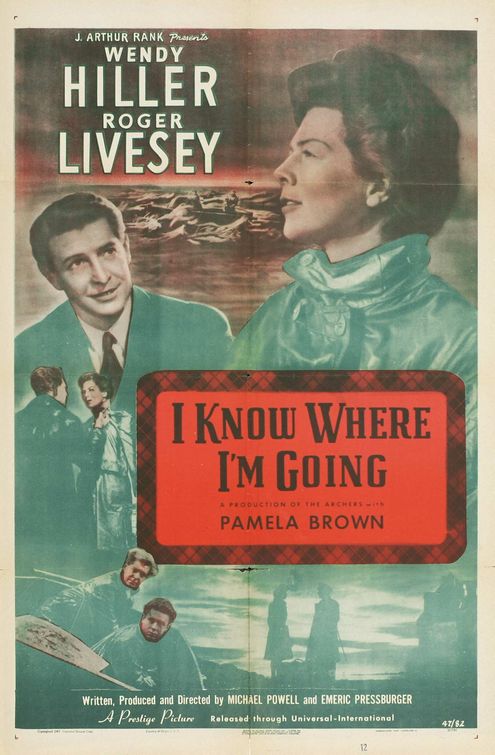
I Know Where I’m Going, which premiered in London on November 16, 1945, is a warm, romantic drama. The film stars Wendy Hiller as Joan Webster, a stubborn young woman who, according the narrator, “always knew where she was going.” After a montage that shows Joan’s growth from headstrong toddler to headstrong teenager to headstrong 25-year-old, we see her dressed in smart clothes, meeting her father (played by George Carney) at a nightclub, where she blithely informs him that she plans to travel to Kiloran island in Scotland to marry Sir Robert Bellinger, a wealthy, middle-aged industrialist whom she has never met. Her father is aghast, but, as always, Joan knows exactly where she’s going and what she’s doing.

Handled differently, this setup could lead to a grim, Victorian melodrama, but I Know Where I’m Going is a playful film with touches of magical realism. On her trek to the Hebrides, Powell and Pressburger delight in each leg of her long journey (and there are many), and pepper the montage with fanciful touches, such as a map with hills made of tartan plaid, a dream sequence in which Joan’s father marries her to the chemical company owned by Bellinger (literally), and an old man’s top hat that becomes the whistling chimney of a steam engine.

On the last leg of her journey, she is forced to put up in the Isle of Mull, as weather conditions do not permit water travel to Kiloran. Joan stays in touch with Bellinger, who is never seen, only heard (as a stuffy voice on the other end of a telephone). While cooling her heels in Mull, Joan meets a charming, soft-spoken serviceman named Torquil MacNeil, who is on an eight-day leave. (Torquil is played by Roger Livesey, in a role originally intended for James Mason.)

The joke implicit in the title becomes more and more clear as Joan and Torquil begin to fall for each other. The closer they become, the more determined she is to reach Kiloran. Eventually willing to risk life and limb to get there, it becomes clear that at least when it comes to love, she has no idea where she is going, and is too hard-headed to see anything clearly.

Livesey, who was in his late thirties when this film was made, was originally told that he was too old and too heavy to play the role of the 33-year-old Torquil, but he very quickly slimmed down to get the part, and he cuts a dashing figure, although not a classically handsome one. Interestingly, Livesey never set foot in the Western Isles of Scotland, where most of the film’s exteriors were shot. He was starring in a play in the West End during filming, so Powell and Pressburger made clever use of a body double for long shots, and filmed all of Livesey’s interior scenes at Denham Studios, in England.

Besides its fine performances and its involving love story, I Know Where I’m Going is enjoyable to watch simply because Powell and Pressburger show such incredible attention to detail. The interiors may be shot on a soundstage, but it’s easy to forget that with effects that perfectly marry them to the location footage, such as rain lashing the windows, subtle lighting, and the shadows of tree branches moving back and forth on the walls of the houses and cottages on the island. There are no short cuts or cut corners in this film. Joan’s dreams don’t appear in a cloud of dry ice or in soft focus, they swirl kaleidoscopically around her head. And elements that might seem silly in another film, such as an ancient curse hanging over Torquil’s head, seem palpably real when they’re embodied by shadowy, decrepit, and glorious real-world locations like Moy Castle.

Dead of Night (Sept. 4, 1945)

DeadOfNightDead of Night is a British anthology of horror stories with many layers and a cyclical story structure. The five segments are based on stories by H.G. Wells, E.F. Benson, John Baines, and Angus MacPhail. Each is great, but the way the stories are told and the way they are linked together is the most interesting thing about the film.
When Dead of Night begins, an architect named Walter Craig (Mervyn Johns) is driven to an English country estate, where he has been hired for a reconstruction project. Once he arrives, and is introduced to the group of people in the living room, he experiences déjà vu. He claims to have dreamed the room and the people in it many times. He is able to predict certain things before they happen in the narrative. A psychiatrist named Dr. Van Straaten (Frederick Valk) refuses to believe any of it, but Craig claims that he is being treated by the doctor, and works hard to dispel the doctor’s doubts. In between the stories that people tell, Craig presages disaster. Horrific events will come to pass, he keeps telling his fellow house guests.

Antony Baird tells the first tale. His character is a race car driver named Hugh Grainger who survives a smash-up on the track, but soon after has disturbing visions of a hearse driver who appears in different guises, but always at a quarter after four, and always speaking the words, “Just room for one inside, sir.” This story provides the template that was followed by every Final Destination film, and it does so in less than seven minutes.

The second story is about a young woman named Sally O’Hara (Sally Ann Howes) who attends a Christmas party. While playing hide-and-seek with the other young people, she is found by a young man who hides with her, and claims that there was a murder committed in the house in 1860 by a mad young woman. Going off on her own, she discovers a passage into a child’s bedroom, where a little boy sits, weeping. He tells her about his older sister. She puts him to bed and sings to him. When she rejoins the party, she learns that the name the little boy gave her was the name of the boy who was murdered by his sister.

In the third story, a woman named Joan Cortland (Googie Withers) recalls buying a birthday present for her fiancé, Peter Cortland (Ralph Michael), a large mirror. He starts seeing strange things in the mirror, such as a room completely different from the one in which he is standing. Increasingly disturbed by her husband’s claims and his strange behavior, Mrs. Cortland tracks down the history of the mirror, and learns that its former owner was a wealthy gentleman who groundlessly accused his wife of infidelity. He murdered his wife, and then sat down in front of the mirror and cut his own throat. Will history repeat itself?

In the fourth story, the owner of the house, and the host of the party, Eliot Foley (Roland Culver), tells a comical ghost story about his two good friends, George Parratt (Basil Radford) and Larry Potter (Naunton Wayne), who were both avid golfers. Bitter rivals on the links, they were the best of friends at all other times, until they both fell in love with the same woman, Mary Lee (Peggy Bryan). They decide to settle things with an unfriendly game of golf. When the game is finished, one of them quite unexpectedly walks into a lake and drowns himself. The winner marries Mary, but is haunted by the voice of his late friend, destroying his golf game for good. (Radford and Wayne played comically sport-obsessed British gentleman in a number of films, including Alfred Hitchcock’s 1938 film The Lady Vanishes. Their alliterative pair of names changed from picture to picture, but the schtick was the same.)

In the final story, Dr. Van Straaten tells his own tale. He was once called to examine a ventriloquist named Maxwell Frere (Michael Redgrave) who was accused of the attempted murder of an American ventriloquist, Sylvester Kee (Hartley Power). Frere’s dummy, Hugo, seemed to have a mind of its own, and threatened to leave Frere for a new owner, Kee. Dummies in horror movies had been done before, (e.g., The Unholy Three), but Dead of Night created a template that many films have used since.

Dead of Night was released on September 4, 1945 in London, and a little less than a year later in the United States, on June 28, 1946, in an edited version. Apparently the U.S. distributors felt that the film’s running time (103 minutes) was too long, so they cut out the golfing story and the Christmas ghost story, leaving only three stories. I can’t imagine seeing this film without them. The structure of the film is deliberate, and all the segments are tied together in a brilliant and surreal climax.

The True Glory (Aug. 27, 1945)

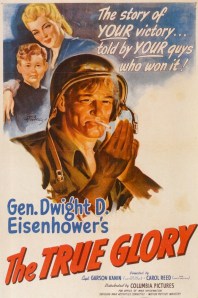
TrueGloryThe True Glory, which was released on August 27, 1945 in the United Kingdom and on October 4, 1945 in the United States, is the granddaddy of every World War II documentary you’ve ever seen on the History Channel. Introduced by the Supreme Commander of Allied Forces in Europe, Gen. Dwight D. Eisenhower, The True Glory tells the story of America and Great Britain’s war against Germany and Italy, starting with the D-Day invasions of June 6, 1944 and ending with V-E Day, May 8, 1945.

The documentary, which won an Academy Award, was pieced together from hundreds of different war photographers’ footage. Several directors worked on the film, but the most commonly credited are Carol Reed and Garson Kanin.

There is some narration, but the majority of the film is told through first-person accounts in voiceover. There are a myriad of British and American soldiers who tell their stories, but there are also the voices of a Parisian family, nurses, clerical staff, an African-American tank gunner, and a member of the French resistance. If you know your World War II history and keep your eyes peeled, you’ll recognize many prominent figures in the footage, including Gen. Eisenhower and Gen. George S. Patton.

Produced by the British Ministry of Information and the U.S. Office of War Information, The True Glory lacks a certain degree of perspective, coming so soon after the end of the war, and is primarily made to celebrate the accomplishments of the Allied forces, but that doesn’t change the fact that the footage is absolutely stunning, and occasionally horrific. The True Glory is a must-see for even the most casual of history buffs.