Tag Archives: Columbia Pictures

The Millerson Case (May 29, 1947)

The Millerson Case
The Millerson Casee (1947)
Directed by George Archainbaud
Columbia Pictures

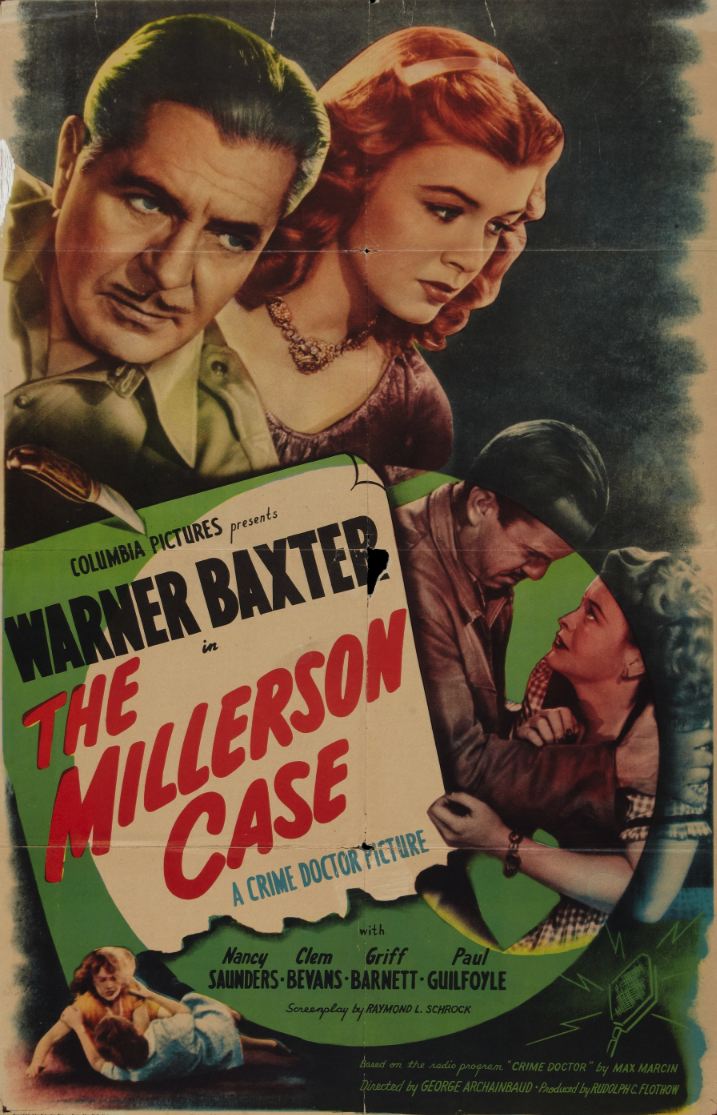
George Archainbaud’s The Millerson Case is the eighth film in the Crime Doctor series from Columbia Pictures and for my money, it’s easily the worst.

Produced by Rudolph C. Flothow, the picture finds Dr. Robert Ordway (Warner Baxter) leaving his Manhattan medical office in the incapable hands of his partner, Dr. Shaw (Walden Boyle), and taking a well-earned vacation in the country for some hunting and fishing.

I’m not sure exactly which remote rural area the film is supposed to depict. Dr. Ordway drives to it from New York City, but it looks suspiciously like California. All I can tell you for certain is that it’s a part of the country where people are always asking, “What fer?”

After a young man named Eben Tuttle (Elvin Field) is shot while carrying a deer on his back, Dr. Ordway comes face to face with the superstitious and uneducated ways of local physician Sam Millerson (Griff Barnett). When an epidemic of typhoid fever breaks out, Doc Millerson dismisses it as “summer complaint” and treats it with “complaint bitters.” He says that he’s been doctorin’ man and beast for 30 years in these parts and he’ll be damned before anyone else tells him what to do.

Three people in the rural community die during the outbreak of typhoid, but one of them, Ward Beechy (Trevor Bardette), has peculiar symptoms. One of the more sensible medical men in the area, Dr. Prescott (Robert Kellard), who’s sent in after the government quarantines the area, isn’t surprised to find evidence of perforated peritonitis in Beechy’s intestinal tract, but he’s never seen a typhoid case with perforations throughout the entire alimentary canal, such as might have been caused by a corrosive poison. Dr. Ordway is unsurprised, since he found no evidence of typhoid bacilli in Beechy’s blood sample and knew something was fishy.

We get a sense of Ward Beechy’s character as he lies dying on his sickbed and he amorously tells his wife’s sister, Belle Englehart (Nancy Saunders), “Sometimes I wish you wasn’t my sister-in-law, Belle.”

This turns out not to be just a typical piece of throwaway hillbilly humor (of which there’s plenty to go around in The Millerson Case). After his death, we learn that Beechy was the local Casanova and had made plenty of enemies — mostly cuckolded husbands and boyfriends who had access to poison. He’s also described as the handsomest man around, which, if you know what Trevor Bardette looks like, should give you some idea of how good-looking the average man in town is.

Doc Millerson, who claims he knows who the guilty party is, receives a note in a woman’s handwriting requesting a meeting at the river bank. He goes there and is killed in an ambush by a rifle shot. With only the note as a clue, Dr. Ordway sets out to find the murderer (or murderers) of Beechy and Millerson and set things right.

I generally like the Crime Doctor series, and while I didn’t hate The Millerson Case, it was the weakest entry yet. There was too much broad humor for my taste, and the mystery just wasn’t very compelling.

Jack Armstrong (15 chapters) (Feb. 6-May 15, 1947)

Jack Armstrong! Jack Armstrong! Jack Armstrong!

Jack Armstrong! The aaaaaaaaaaaaaaall-American boy!

If those words stir something deep within you, you’re probably either a child of the Depression or a freak like me who’s always liked to live in the past.

Beginning in 1933, the eponymous hero of Jack Armstrong, the All-American Boy traveled around the world with his uncle, Jim Fairfield, and his cousins, Betty and Billy Fairfield. The globetrotting quartet battled pirates, evil scientists, gangsters, and restive natives for 15 minutes on the radio every weekday. Sponsored by Wheaties, “the breakfast of champions,” Jack Armstrong gripped the nation’s youth with its blend of high adventure, glacial pacing, and repetitive storytelling until August 22, 1947, when it moved from a quarter-hour, five-day-a-week format to a 30-minute, twice-a-week broadcast.

Beginning in 1945, Jack, Betty, Billy, and Uncle Jim locked horns with the Silencer, a gangland leader who was at war with another crime lord, the Black Avenger. Eventually the Silencer was unmasked and revealed to be Victor Hardy, a brilliant scientist and inventor until a bout of amnesia led him to a life of evildoing (sort of like the Crime Doctor in reverse). After Hardy’s memory was restored, his lent his unique understanding of the criminal mind to Jack Armstrong and his crew. Uncle Jim was phased out of the program, and Vic Hardy became the adult overseer of the group, as well as head of the “Scientific Bureau of Investigation,” or SBI. In 1950, the Jack Armstrong program finally ended and Jack, Betty, and Billy were suddenly grown-ups, heard in a new 30-minute, twice-a-week series called Armstrong of the SBI. The all-American adult version of Jack didn’t last long, though, and Armstrong of the SBI went off the air June 28, 1951.
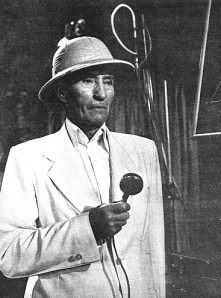
Wallace Fox’s Jack Armstrong is a 15-part serial from Columbia Pictures. All the major characters from the radio play are present (including both Uncle Jim and Vic Hardy), but after a promising first chapter, the serial devolves into repetitious tangles with “natives” on an island somewhere. I don’t know where the island is supposed to be, but I imagine it’s flying distance from California, since Jack Armstrong and the gang get there in a twin-engine plane. One of the bad guys refers to it as “point X,” and the third chapter of Jack Armstrong is called “Island of Deception,” but I think those are both descriptors, not proper names, so let’s just call it “Crazy Island,” shall we?

In this serial, Jack Armstrong is an all-American “boy” in name only, since the actor who plays him, John Hart, was 28 or 29 during filming, and looked about 30. Hart’s dark good looks and slicked-back hair make him look as if he’d be more comfortable romancing a movie producer’s wife on the dance floor of the Cocoanut Grove nightclub than building a nifty jet engine car with his little buddy Billy (Joe Brown), which is what he’s doing when we meet him in the first chapter of the serial, “Mystery of the Cosmic Ray.”

Billy Fairfield is the obligatory horse-faced, comic-relief sidekick. With his bug eyes and big teeth, Brown looks like Mickey Rooney standing in a wind tunnel. He’s obsessed with food, and most of the “humor” in Jack Armstrong comes from his “But when are we going to eat?” quips. Billy’s sister Betty is played by Miss America 1941, Rosemary La Planche, whom I’ve found delightful in every role I’ve seen her in prior to this. In Jack Armstrong, however, she has the same consternated look on her face in every scene, and is forced to wear an unflattering gray sweat suit that makes her look as if she’s suffering through Army PT.

Jack’s jet engine car has no carburetor, no cylinders, no distributor, and can go 50 miles per hour faster than any other car on the road. Jack never explains why it’s riveted, not welded, or how he can hang outside of it during a high-speed chase without getting his hair mussed, but the action in the first chapter is fast-paced enough that I didn’t really care. (And for my money, sped-up films of car chases never get old.)

I was hoping for lots more high-speed action, but after Uncle Jim (Pierre Watkin), the owner of the Fairfield Aviation Co., announces that they’ve picked up unknown cosmic rays, possibly from another country, he and Jack, Betty, and Billy are off to Crazy Island in the second chapter of the serial, “The Far World,” and things get pretty dull.
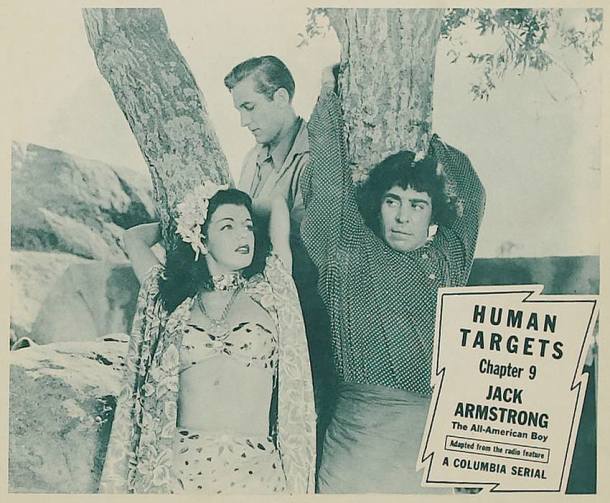
Most of Jack’s time on Crazy Island is spent squaring off against evil mastermind Jason Grood, who’s played by Charles Middleton, the man who played Ming the Merciless in the Flash Gordon serials of the ’30s. Remarkably, he’s just as odd-looking without any of his Ming makeup.

Grood kidnaps Vic Hardy (Hugh Prosser) and forces him to work with his henchman, Prof. Hobart Zorn (Wheeler Oakman), who’s discovered a power “several steps above atomic energy,” which they use to create a “cosmic beam annihilator.” Grood sends the cosmic beam into space as part of his “aeroglobe,” which he explains in the following, 100% scientific fashion: “Where the pull of gravity from the sun and outer solar planets equalizes the pull of earth gravity, there you have ‘zero gravity,’ creating a ‘space platform.’ On this, our aeroglobe rests.”

With the ability to train his cosmic beam annihilator at any spot on earth, Grood plans to hold all the nations of the world hostage. While attempting to foil Grood on Crazy Island, Jack, Uncle Jim, Billy, and Betty face the Pit of Everlasting Fire, escape from quicksand, tangle with angry natives, and are helped by friendly natives led by the sexy and beautiful Princess Alura (Claire James). I honestly couldn’t tell the unfriendly natives from the friendly natives. They all have black page-boy haircuts, wear Madras shirts and sarongs, and look about as “native” as Boris Karloff.

Jack Armstrong suffers from poorly staged action and several cliffhangers that are truly awful. In one, bad guy Gregory Pierce (John Merton) is zapped by an intruder alert field. Are we supposed to care about him? Another chapter ends with Jack and a bad guy rolling down a gentle incline while hitting each other. Not exactly “the jaws of death.”

Plausibility, scientific accuracy, and believable dialogue were never requirements for a good serial, but excitement and fun were, and Jack Armstrong suffers from a lack of both.
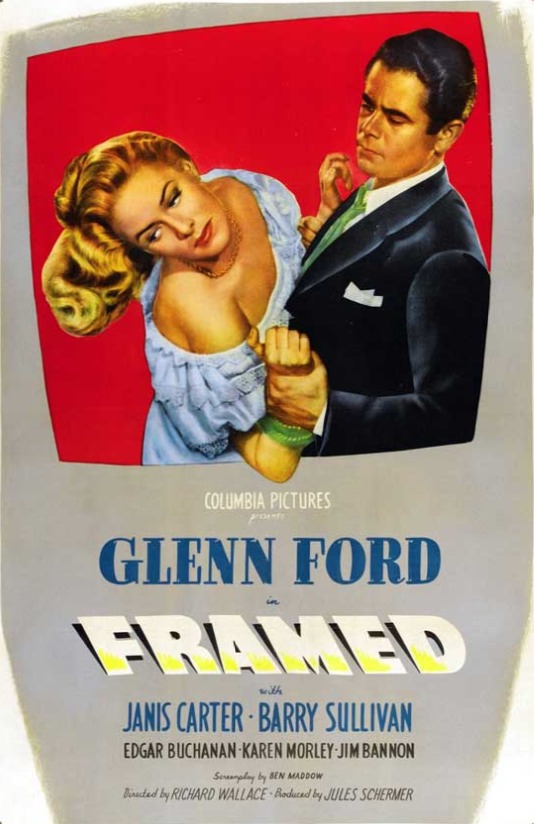
Framed (March 7, 1947)

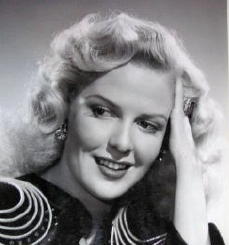
I’ve seen Janis Carter as the female lead in two of Columbia’s “Whistler” pictures, The Mark of the Whistler (1944) and The Power of the Whistler (1945), but I couldn’t have picked her out of a lineup of other glamorous B-movie blondes from the ’40s until I saw her as the death-obsessed femme fatale with a heart of ice in Henry Levin’s Night Editor (1946).

The part she plays in Richard Wallace’s Framed is more nuanced and less irredeemably evil than the role she played in Night Editor, but she’s still a nasty piece of work.

Framed starts out with a bang. We see Mike Lambert (Glenn Ford), his hat pushed back on his head, looking scared and exhausted, behind the wheel of a runaway truck. The first minute of the picture looks like an outtake from Thieves’ Highway (1949) or The Wages of Fear (1953). Mike careens around mountain passes, fighting the gears of the truck every inch of the way, and pumping the brakes to no avail.

It’s a great way to start the picture, and it’s fast-paced and suspenseful enough for the viewer never to stop and wonder why Mike doesn’t try to run the truck off the road just outside of town instead of driving straight down Main Street and smashing his front fender into a parked pickup truck.

Mike Lambert isn’t a guy who thinks things through before doing them. He’s a classic noir character — smart and resourceful, but bullheaded and cursed with a single fatal flaw. In Mike’s case, it’s his habit of getting blackout drunk at all the wrong times, a condition he accepts the way other men accept the weather. “I told you I never remember what I do after I’ve had a couple of drinks,” he says, as though it’s just another one of those things, like not being able to remember people’s names or biting your fingernails.

Mike is an out-of-work mining engineer. He took the job driving the truck with no brakes to make a few bucks, but the truck owner’s refusal to pay him and his citation for reckless driving leave him stranded in the little California town with no choice but to do some time in jail, since he’s flat broke and can’t pay the fine.

A beautiful guardian angel appears in the form of pretty blond waitress Paula Craig (Carter). She pays Mike’s fine for him and even lends him money to get a room in town. It’s not hard to see that she must have ulterior motives, but Carter plays her role well, and has good chemistry with Ford, so it’s easy to sit back and let yourself be lulled for a little while into feeling as though you’re watching a laid-back, romantic drama in which everyone will live happily ever after.

And for awhile, things seem to be going Mike’s way. He befriends the kindly, bedraggled old man (played by Edgar Buchanan) whose truck he hit, and who just happens to have a mining claim he needs help with. Mike also does a good job of keeping Paula at arm’s length with matter-of-fact statements like, “Don’t count on anything I said last night. Liquor blanks me out.”

Soon enough, Paula’s evil schemes become apparent to the viewer, if not to the booze-addled Mike. She’s only working in a greasy spoon to troll for a patsy that she and her boyfriend, Steve Price (Barry Sullivan), need for a scheme they’ve got cooked up. And Mike fits the bill.

Framed is a programmer that benefits greatly from having a rising star like Ford in the lead role. It’s a B movie that’s clearly cast in the same mold as Double Indemnity (1944) and The Postman Always Rings Twice (1946), but I think it succeeds wonderfully on its own terms. The script by Ben Maddow (based on a story by John Patrick) evolves naturally as it chugs forward, and never seems too contrived. Shifting loyalties and the yearnings of the main characters drive the story forward, and it never felt as if plot points were being checked off.

Richard Wallace, the director of Framed, was a hard-working studio hack. His career as a director spanned from 1925 to 1949 (he died in 1951), during which he made 46 features and 15 shorts. Of the films he directed that I’ve seen, Framed is one of the best. It’s a brisk tale of love, lust, and betrayal that might not quite qualify as a classic, but it’s never boring.

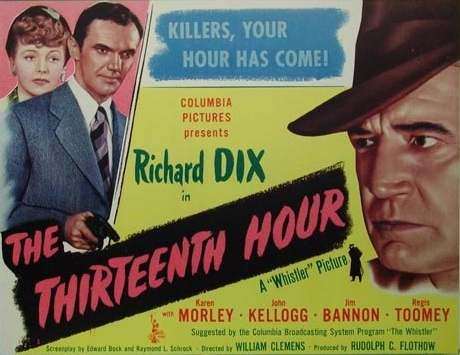
The Thirteenth Hour (Feb. 6, 1947)

The Thirteenth Hour
The Thirteenth Hour (1947)
Directed by William Clemens
Columbia Pictures

Let us bid adieu to Richard Dix.

His role in William Clemens’s The Thirteenth Hour was his last. Dix’s health was in decline when he was starring in the series of B movies based on the radio show The Whistler. After appearing in The Thirteenth Hour, the seventh in the series, Dix retired from acting. He died a couple of years later, at the age of 56, on September 20, 1949, following a heart attack he’d suffered a week earlier. (There would be one last Whistler movie, The Return of the Whistler, in 1948, starring Michael Duane.)

When asked about his role in The Thirteenth Hour, Dix said, “The part is more dramatic than the ones I used to do at Goldwyn’s and Paramount. Then, I played devil-may-care, brassy boys who were strong on wisecracks, and back in some of those early films I made the jokes via printed titles.”

His mention of printed titles is a reference to his early days in Hollywood, when the movies were still silent. Dix had a 30 year-long career, and was one of the first “he-men” of the silver screen; a rugged, square-jawed presence who loomed larger than life. His Whistler films aren’t the best of his career, but they’re nothing to be ashamed of, either. Unlike most of the formulaic, single-character mystery series of the ’40s (e.g., Boston Blackie, the Falcon, the Crime Doctor, Charlie Chan), Dix played a different role in each Whistler film, from the nastiest bad guys to the most well-intentioned good guys.

In The Thirteenth Hour, he plays a regular Joe named Steve Reynolds, a truck driver who operates his own trucking firm. He’s engaged to a roadhouse waitress named Eileen (Karen Morley), who has a young son named Tommy (Mark Dennis).

After a hot-rodding drunk runs Steve off the road one night and straight into an old man’s gas station, his license is revoked for six months. The accident wasn’t Steve’s fault, but a disappearing witness and a motorcycle cop named Don Parker (Regis Toomey), who has a vendetta against Steve, conspire against him.

To make matters worse, Steve has a competitor, Jerry Mason (Jim Bannon), an underworld character who’s undercutting Steve and is determined to run him out of business.

Finally, the night comes when Steve’s mechanic and driver Charlie (John Kellogg) is too sick to work, and Steve has no choice but to deliver a shipment himself. His license hasn’t been reinstated yet, so the decision could have terrible consequences. He starts out in the wee hours of the morning and sticks to back roads, but of course, something goes wrong. When he stops to service his truck, he’s knocked out by a masked man. The mysterious figure not only absconds with Steve’s truck, but he uses it to run over and kill a cop.

Steve goes on the lam and attempts to prove his innocence with the help of Charlie, Eileen, and Tommy. (There’s one weird, funny moment when the cops bust in on Eileen and Tommy right after Steve has slipped out the back. Tommy sits in a living room chair, looking innocent, reading a book. The detective peers at him suspiciously, and the camera zooms in on the book’s title — Studies in Necrophobia.)

If you’ve awake for most of the movie, you’ll have no trouble figuring out exactly who the killer is before Steve finds out. Even so, The Thirteenth Hour is a well-made, brisk mystery that packs plenty of excitement into its barely one-hour running time. The presence of the Whistler (an uncredited Otto Forrest) is less obtrusive than in some of the series’ entries, but he still sets the stage nicely, just as he did on his weekly radio show, which told the stories of “men and women who have stepped into the shadows.”

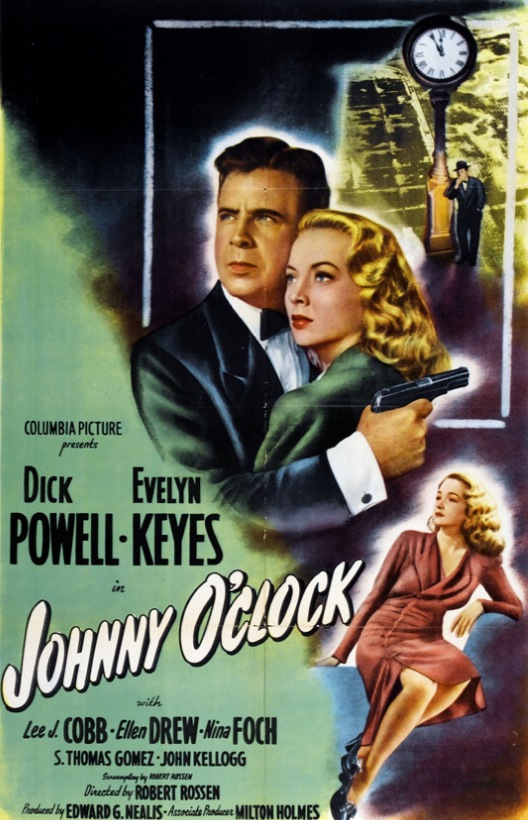
Johnny O’Clock (Jan. 23, 1947)

Robert Rossen’s Johnny O’Clock — yes, it’s really about a man named “Johnny O’Clock” — isn’t as good as some of Rossen’s later films, like The Hustler (1961), but it’s a great start. Rossen was a prolific writer of screenplays, but Johnny O’Clock was his first time in the director’s chair.

The improbably named protagonist is played with a light touch by former crooner Dick Powell. Johnny is a partner in a New York gambling syndicate run by an oily, overweight gangster named Pete Marchettis (Thomas Gomez).

Marchettis is married to a beautiful sloppy drunk named Nelle (Ellen Drew) who’s still carrying a torch for her ex-boyfriend, Johnny, but who loves the dough too much to ever leave Marchettis. Powell’s scenes with Gomez and Drew are some of the best of the picture, as the boozy moll falls all over Johnny in front of Marchettis and his heavy-hitters, seemingly oblivious to her husband’s jealousy. At the same time, Marchettis seems desperate for approval from both Johnny and his wife. In one scene, he goes on and on about the portrait he had a Mexican boy paint of him. When he shows it to Johnny and asks him if he likes it, Johnny simply responds, “It looks like you.”

There’s a police inspector named Koch (Lee J. Cobb) who’s hounding Johnny O’Clock, lurking in the lobby of the hotel where he lives and constantly trying to catch him riding dirty. Johnny’s association with corrupt cop Chuck Blayden (Jim Bannon) rubs the honest Inspector Koch the wrong way, especially since Blayden’s been on the winning end of more than one shootout with Marchettis’s rivals. Koch suspects that Marchettis and Johnny are using Blayden to do their dirty work under the guise of “justifiable homicide.”

When a pretty hat-check girl who works at Johnny O’Clock’s casino goes missing, things heat up. The girl, Harriet Hobson (Nina Foch), was dating Chuck Blayden, and when her body is found in her gas-filled apartment — an apparent suicide — Koch smells foul play. As soon as Harriet’s sister, Nancy Hobson (Evelyn Keyes), arrives in New York to claim her sister’s body, cracks begin to appear in Johnny O’Clock’s carefree exterior. He and Nancy are attracted to each other, but are from different worlds. She makes him want to cash out and run away with her, but if you’ve ever seen a gangster movie, you know that cashing out always comes at a price.

Johnny O’Clock is the third of many noirs to star Powell after he shed his image as a boyish Depression-era crooner and appeared as Philip Marlowe in Edward Dmytryk’s Murder, My Sweet (1944). Johnny O’Clock gives Powell a chance to craft a more three-dimensional character than he had a chance to in either Murder, My Sweet or Dmytryk’s Cornered (1945), and he’s mostly successful, although he didn’t seem fully up to the challenge of some of the more emotional moments in the film’s climax. (Powell was a breezy and charming actor who could project toughness and nastiness when he had to, but raw, naked emotion wasn’t one of the tools in his actor’s toolbox.)

While the story’s twists and turns are sometimes hard to follow, the actors are all good, and enjoyable to watch. Lee J. Cobb’s most famous role is probably as Lt. Kinderman in The Exorcist (1973), so it was fun to see him in a similar role, more than 25 years earlier.

Writer-director Rossen has a fuller vision of his criminal demi-monde that we see in most ’40s noirs, and his characters are convincing within its context. I really liked Johnny O’Clock, and I’d love to see proper DVD releases of more of Dick Powell’s film noirs in the future. I had to watch this one on a janky DVD-R recorded off of television.

Half-Wits Holiday (Jan. 9, 1947)

I normally don’t review shorts, but Half-Wits Holiday (a reworking of the 1935 Three Stooges short Hoi Polloi) marked a milestone for the Stooges, since it was Curly’s last film.

Curly Howard (born Jerome Lester Horwitz in 1903) had suffered a series of minor strokes in 1945, but during the filming of Half-Wits Holiday in 1946, he suffered a severe stroke, which ended his career. (Curly’s older brother Shemp, an original member of the trio, stepped in, and appeared in dozens of shorts with Moe Howard and Larry Fine until his death in 1955.) Curly lived until 1952, but he was unable to perform during the last years of his life.

In this burlesque version of the Pygmalion myth, a couple of egghead “scientists” — Prof. Sedletz (Theodore Lorch) and Prof. Quackenbush (Vernon Dent) — argue over environment vs. heredity and make a $1,000 bet. Quackenbush believes in environment, and claims he can take a man from the lowest strata of life and turn him into a gentleman after just one month in the right situation and with the proper instruction. Enter the Three Stooges. Guess who’s going to win the bet?

When Quackenbush asks Larry, Moe, and Curly if they’d like to make $1,000, Moe asks, “Who do we have to murder?” (And because it’s Moe, he sounds serious.) Quackenbush’s lovely daughter Lulu (Barbara Slater) is home from college, and offers to help tutor the Stooges (see poster above). A month passes, and the Stooges make their grand entrance in society. Moe and Larry acquit themselves well for a few minutes, but the kleptomaniac Curly bites the diamond ring off of a grand dame’s finger when he kisses her hand, pockets champagne (a word he can’t even pronounce), and steals a load of silverware. And before you can say “Sword of Damocles,” a pie stuck to the ceiling falls on a woman’s face, and the party devolves into a pie-in-the-face-athon.

When I was in high school, I bought a $2 VHS tape featuring two Three Stooges shorts, Disorder in the Court (1936) and Sing a Song of Six Pants (1947). I watched it frequently, which led my mother to declare the Three Stooges entartete Kunst.* She even compared them with New Kids on the Block, as a high-water mark of how pop-culturally unenjoyable I should find them. But you know what? I refused to apologize for loving the Three Stooges when I was 15, and I refuse to apologize today.

Unlike every single other genre, I judge comedy by only one criterion — does it make me laugh? The Three Stooges may be aggressively lowbrow, but they crack me up every time. I love them. There, I said it. I’ll say it again. I love the Three Stooges. I would marry them if I wasn’t already married and they weren’t all dead.

*It’s just an expression. My mom’s not a Nazi.

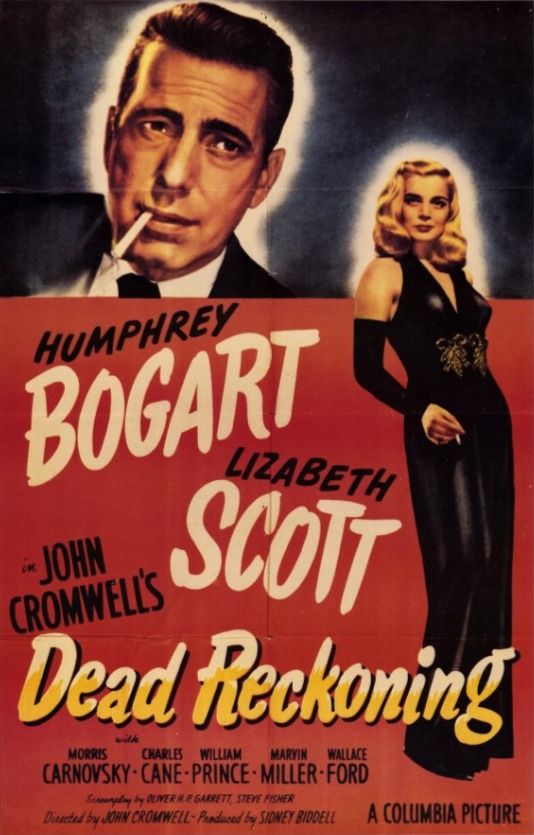
Dead Reckoning (Jan. 2, 1947)

Lizabeth Scott looks a lot like Lauren Bacall. It’s hard not to compare her to Bacall even when she’s not acting opposite Humphrey Bogart.

There’s a lot of that going around in John Cromwell’s Dead Reckoning, a film that isn’t as well known as some of Bogie’s other noirs, like The Maltese Falcon (1941) or The Big Sleep (1946), and which suffers in direct comparison with them. But taken purely on its own merits, it’s a tense, well-made picture, full of post-war desperation, but with little of the silliness of a lot of returning-vet noirs, like Somewhere in the Night (1946).

Bogart plays a paratrooper, Capt. “Rip” Murdock, who was ordered to Washington, D.C., to receive the Distinguished Service Cross along with his buddy, Sgt. Johnny Drake, who was to receive the Congressional Medal of Honor. Before they could get there, Johnny hopped off the train and went on the lam before any newspaper reporters could snap his picture.

Rip finds a Yale pin from the class of ’40 that reveals that Johnny’s real name was John Joseph Preston. Rip follows the clues to Johnny’s hometown of Gulf City. (It’s unclear where Gulf City is supposed to be, but it has to be somewhere along the Gulf Coast. There are palm trees, and Bogie refers at one point to “Southern hospitality.” There is a real Gulf City in Florida, but it’s an unincorporated little town that had a population of zero by the 1920s.)

Rip rolls through the microfiche in the Gulf City public library until he finds a newspaper article dated September 3, 1943, with the headline “Rich realtor slain.” The motive was jealousy — both men loved a woman named Coral Chandler — and Johnny confessed to the murder, but disappeared before he could be sentenced, and enlisted in the army under a false name.

Rip finds a scrap of paper in his hotel room with a single word, “Geronimo,” scrawled on it. It’s from Johnny (it was what they always yelled before jumping out of planes), but the next time Rip sees Johnny, he’s a burnt-up corpse in a twisted car wreck.

Rip tracks down the woman in the case, the beautiful and statuesque Coral “Dusty” Chandler (Lizabeth Scott), a singer in a Gulf City nightclub. The scene in which she sings “Either It’s Love or It Isn’t” under a spotlight to Rip at his table is memorable, though Scott’s lip synching is pretty awful. Rip calls her “Cinderella with a husky voice,” and they embark on a whirlwind love-hate romance.

Most of the film is told in flashback. Rip sits in a pew in a church, his face hidden in the shadows, confessing his sins to Father Logan (James Bell), whom he sought out because he’s a former paratrooper. Logan was known as “the jumping padre, always the first one out of the plane.”

If you’re starting to think that Dead Reckoning might have an overabundance of references to parachuting, you’d be right, and we haven’t even scratched the surface. (The title of the film refers to flying a plane without the aid of electronic instruments — which is a metaphor for Rip’s dangerous, seat-of-the-pants investigation — and the final image of the film is a woman’s face metamorphosing into a billowing white parachute floating to earth along with the whispered word “Geronimo.”)

In many ways, Dead Reckoning feels like a pastiche of earlier Bogart film noirs. The loyalty to a dead man is straight out of The Maltese Falcon (“When a guy’s pal is killed he oughtta do something about it,” Rip says). A villain who rushes to open a door at the climax, only to be shot down, is straight out of The Big Sleep. And the film’s chief antagonists, the effete, cultured Martinelli (Morris Carnovsky) and his brutish, mildly brain-damaged henchman, Krause (Marvin Miller), are straight out of too many noirs to count.

Dead Reckoning carves out its own misanthropic place in the noir pantheon with its doses of brutal violence, fiery finale, and Rip’s distrust of dames, which is nothing new for a noir, but which Dead Reckoning takes to new heights. Rip says things like “I don’t trust anybody, especially women” and “Didn’t I tell you all females are the same with their faces washed?” And his diatribe about how women should all be shrunk down to pocket size has to be heard to be believed.

Dead Reckoning is full of memorable hard-boiled dialogue. Unfortunately, Scott can’t always pull it off the way Bogart can. The dialogue in film noir is often artificial, but it’s artificial in the same way as Shakespearean drama — it can express something more real than “naturalistic” dialogue can, but it takes a very talented actor to make it work.

Bogart had his limitations as an actor, but he perfectly delivered every single line of dialogue in every single film noir in which he appeared. Dead Reckoning is no exception, and while it’s not the greatest film I’ve ever seen, it’s damned good, and I look forward to seeing it again some day.

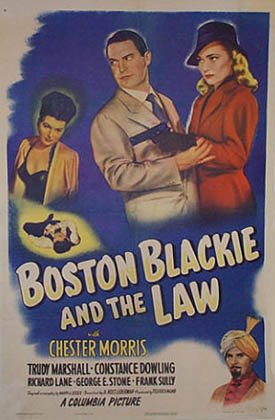
Boston Blackie and the Law (Dec. 12, 1946)

D. Ross Lederman’s Boston Blackie and the Law, produced by Ted Richmond, is the twelfth of 14 Boston Blackie features released by Columbia Pictures from 1941 to 1949.

Horatio “Boston Blackie” Black was a gentleman thief and safecracker created by author Jack Boyle in 1914. Stories featuring Boston Blackie appeared in The American Magazine, Cosmopolitan, and Redbook, and the character showed up in a number of silent films starring a variety of different actors. When Chester Morris stepped into the role in Meet Boston Blackie (1941), however, he was on the road to becoming inseparable from the character. Meet Boston Blackie was the first “talkie” featuring Boston Blackie, and Morris would go on to play Blackie in all 14 programmers released by Columbia Pictures. Morris also played the character on the radio, in a 1944 summer replacement series for Amos & Andy. When Blackie returned to the airwaves in 1945, Richard Kollmar took over the part, and starred in more than 200 episodes.

The radio version of Boston Blackie is the one I’m most familiar with, and while I’m a regular listener, it’s never been one of my favorite shows. Occasionally there’s a really crackerjack episode, but mostly they’re middle-of-the-road mysteries with more corn than the state of Iowa. Judging solely by Boston Blackie and the Law, which is the first Boston Blackie movie I’ve ever seen, the film series is pretty similar. Blackie is a likable rogue, but his puns are pretty lame, and he’s got plenty to go around.

Boston Blackie and the Law begins in a festive fashion, with Blackie performing a magic show at the annual Thanksgiving party at Women’s State Penitentiary. An old lady in the audience says, “I didn’t know Boston Blackie was a magician.” A young blonde responds knowingly, “There isn’t a trick he doesn’t know.”

That young blonde is Dinah Moran, a.k.a. prisoner #31329 (played by Constance Dowling), and when Blackie offers to make someone disappear in his “Phantom Cabinet,” she volunteers. Blackie promises Warden Lund (Selmer Jackson) the disappearance will be only temporary, which gets a laugh from the audience, but no one’s laughing when he pulls back the curtain of the cabinet a second time and Moran is still nowhere to be seen.

Enter the long-suffering Inspector Farraday (Richard Lane) and his bumbling sidekick, Sgt. Matthews (Frank Sully). Farraday is Blackie’s foil; an eternal chump who always suspects Blackie of wrongdoing, and who always trips over his own feet while Blackie effortlessly solves the crime his own way.

After Blackie gives the imbecilic Sgt. Matthews the slip, he and his sidekick, “The Runt” (George E. Stone), follow clues to a stage magician named “Jani” (Warren Ashe) and his pretty, dark-haired assistant Irene (Trudy Marshall).

Jani, whose real name is John Lampau, bears a strong resemblance to Boston Blackie, which comes in handy when Blackie needs to impersonate him. (To enjoy a movie like this, you have to buy that Inspector Farraday and Sgt. Matthews can’t recognize Blackie up close just because he’s wearing a turban and a false Van Dyke beard.)

As usual with these types of B mysteries, I was left with more stupid questions than the film had trite answers when the words “The End” appeared onscreen. But I enjoyed it. Columbia’s mystery series of the ’40s — like The Whistler series and The Crime Doctor series — were top-notch B-movie entertainment, and Boston Blackie and the Law isn’t bad, either.

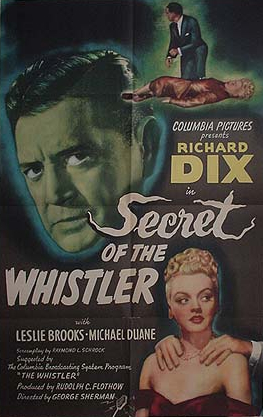
Secret of the Whistler (Nov. 7, 1946)

Secret of the Whistler
Secret of the Whistler (1946)
Directed by George Sherman
Columbia Pictures

George Sherman’s Secret of the Whistler is a solid but unremarkable entry in Columbia Pictures’ series of bottom-of-the-bill programmers based on the radio show The Whistler. Each film in the series starred Richard Dix, a he-man of the silent era whose star was fading. Dix delivered sweaty, paranoid performances in a variety of roles in The Whistler series; businessman, drifter, private investigator, homicidal maniac. His health may have been failing, but he was still a solid performer.

In Secret of the Whistler he plays a painter named Ralph Harrison who is living the high life on his wealthy wife’s dime. He throws lavish parties in his studio/bachelor pad for people who aren’t really his friends, but who don’t mind eating his food and drinking his booze. Among the many attractive young women who pose for Harrison for big money is Kay Morrell (Leslie Brooks), a beautiful blonde with gams that won’t quit.

Meanwhile, Harrison’s wife, Edith Marie Harrison (Mary Currier), lies in bed at home, at death’s door. When the film begins, Harrison seems to genuinely care for his ailing wife, and she adores him. Slowly but surely, however, Harrison begins to fall for Kay. (And after the scene in which she poses for him wearing a small one-piece undergarment, I thought to myself, “Who wouldn’t?”) He buys her expensive presents and lavishes her with attention. His wife isn’t long for this world, so what’s the harm?

The only problem is that Mrs. Harrison comes under the care of a specialist, and makes a miraculous recovery. (Her cardiologist’s course of therapy seems to mostly involve getting out of bed and taking long walks, which is still good advice today.) When she drops by her husband’s studio unannounced, however, her excitement turns to horror when she overhears her husband pitching woo to Kay. She suffers a major setback and promises to write Ralph out of her will.

Fans of The Whistler radio show will have no trouble predicting what will happen next, or the panoply of complications that will arise. True to the radio show, the Whistler himself shows up several times in the film, always as a dark silhouette or a shadow thrown on a wall, speaking directly to Harrison and revealing his murderous thoughts.

The screenplay for Secret of the Whistler by Richard H. Landau and Raymond L. Schrock is the most thematically similar to the radio show of all the films in the series I’ve seen so far. If murdering your wife was your thing, The Whistler was the best show on the air. Nearly every week it seemed as if someone’s spouse was being bumped off for an inheritance and a chance at life with a younger boyfriend or girlfriend, although things never went according to plan.

With a little more than double the running time of a typical episode of the radio show, Secret of the Whistler has more time to develop its characters and its story. On the radio, there just wouldn’t be enough time to show Ralph’s tepid devotion slowly changing to disinterest. At the same time, though, the film feels a little longer than its 65-minute running time, and while its twist ending is good, it doesn’t have the devious ingenuity of the best twists of the radio show.

Still, this is a really good mystery series, with heavy doses of noir atmosphere and performances by Dix that are always interesting to watch. Secret of the Whistler is a lesser entry in the series, but it’s still a pretty good one.

Crime Doctor’s Man Hunt (Oct. 24, 1946)

Crime Doctor's Man Hunt
Crime Doctor’s Man Hunt (1946)
Directed by William Castle
Columbia Pictures

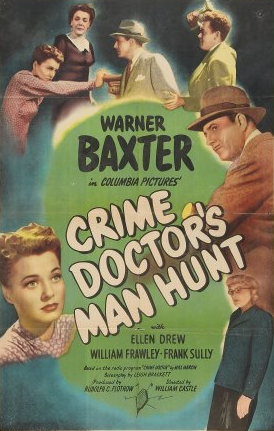
William Castle’s mystery programmer Crime Doctor’s Man Hunt is yet another wacky outing with Warner Baxter as Robert Ordway, M.D., Ph.D. (a.k.a. the Crime Doctor).

The Crime Doctor was a character created by Max Marcin for a Sunday-night mystery radio show that ran from 1940 to 1947 on CBS stations. Like a lot of radio detectives (e.g., Boston Blackie, the Falcon), the Crime Doctor also got his own series of hour-long B movies.

In the first film in the series, Michael Gordon’s Crime Doctor (1943), a Depression-era crook and racketeer named Phil Morgan survives a murder attempt, but suffers from complete amnesia, reinvents himself as “Robert Ordway,” and puts himself through medical school. Once he gets his degree, he focuses on rehabilitating criminals. His past eventually catches up with him, but everything works out all right, and he is able to continue being Dr. Ordway, putting crooks behind bars and helping the helpless.

Crime Doctor is one of the best films in the series. The subsequent films are all a lot of fun, but Dr. Ordway’s checkered past is rarely referred to. Baxter’s performance in the lead role is always top-notch, however, and most of the Crime Doctor pictures are a cut above most other mystery programmers from the ’40s.

In Crime Doctor’s Man Hunt, John Foster (Myron Healey), a young, pencil-mustachioed man suffering from “bomb shock and combat fatigue,” comes to see Dr. Ordway. He’s suffering from fugue states in which he wanders in a daze, always drawn to the same intersection, but he doesn’t know why, and never remembers how he got there. He could get treatment from the Army, but he doesn’t want his fiancée to know about his condition.

His fiancée, Irene Cotter (Ellen Drew), comes to see Dr. Ordway right afterward. (Foster’s attempts to conceal his condition from her were clearly in vain.) Dr. Ordway deflects her questions and tells her that he can’t violate any patient’s confidentiality.

As with most of the Crime Doctor films, things get loonier as the film goes on. We learn that Foster had his fortune cast during a “slumming party” downtown, and was told by a fortuneteller named “Alfredi” (real name “Alfred Hemstead,” played by Ivan Triesault) that he would meet his violent death on the corner of Garth and Davis streets, which is why he is continually drawn there.

There’s also a case of split personality, which I won’t say too much about in order not to give anything away. However, even the dimmer bulbs in the audience will see the “twist” ending coming from a mile away. I’m not even sure it was meant to be a surprise.

Ordway comments at the end of the film that this has been a strange case, first the fugue, then the split personality. “Doctor, I’d like you to come see my wife,” says Police Inspector Harry B. Manning (William Frawley). “Split personality?” asks the doctor. “No personality,” quips the inspector.