Tag Archives: Columbia Pictures

The Jolson Story (Oct. 10, 1946)

The Jolson Story
The Jolson Story (1946)
Directed by Alfred E. Green
Columbia Pictures

Alfred E. Green’s Technicolor extravaganza The Jolson Story purports to tell the story of Al Jolson, one of the most popular singers in the United States in the 1920s and ’30s.

What it actually does is take the bare bones of Jolson’s life story and tell a mostly fictionalized show-biz story of a man’s unalloyed love of music and his tireless quest to touch the hearts of every man, woman, and child in America. That he often touches their hearts while wearing blackface makes The Jolson Story a tricky movie to watch and review in the 21st century.

Apologists for Jolson’s use of blackface usually point to two things; one, Jolson was Jewish, a minority group that itself suffered a great deal of discrimination in the U.S., especially before World War II; two, he genuinely loved the black musical forms that he appropriated. (There are also claims that he fought against segregation on Broadway, but I was unable to find any hard evidence of what he did or when he did it. If anyone has more information, please let me know.)

Unlike the white actors in blackface in D.W. Griffith’s The Birth of a Nation (1915), who blacked up to portray their characters as brutes, villains, and rapists, or the minstrel-show comedians who used burnt cork on their faces to portray “those funny little darkies” as shiftless and uneducated objects of ridicule, Jolson used blackface strictly in the context of musical performance, and there was never anything deliberately mean-spirited about it.

But no matter what the context, it’s hard today to look at a white person with black makeup covering every part of their face except a wide area around the mouth meant to convey the impression of big fat lips and not cringe.

Born Asa Yoelson in 1886, Jolson emigrated from his native Lithuania with his mother and his siblings in 1894. They joined Jolson’s father, Moses Yoelson, who had been rabbi and cantor at the Talmud Torah Synagogue in Washington, D.C., since 1891. Late in 1894, Jolson’s mother died, which had a profound effect on him, and he reportedly became completely withdrawn for seven months. In 1895, however, he was introduced to show business by entertainer Al Reeves, and by 1897, he and his brother Hirsch (whose stage name was “Harry”) were singing on street corners. The brothers continued in show business for several years, but eventually “Al” and “Harry” had a falling out.

Jolson first appeared in blackface in 1904 in a show at Keeney’s Theatre in Brooklyn. According to John Kenrick, blacking up created in Jolson “a sense of freedom and spontaneity he had never known before.” His blackface performances, and his black character, “Gus,” became wildly popular. Jolson probably wasn’t the first American popular musician who ironically experienced feelings of “freedom” by appropriating the appearance and attitude of a black man, but he was the first and perhaps most significant of the century that also gave us Benny Goodman, Elvis Presley, the Beastie Boys, Vanilla Ice, and Justin Timberlake.

Jolson’s popularity grew and grew in the ‘teens and ’20s, culminating in his appearance in the film The Jazz Singer (1927), which was the first “talkie,” or film with a synchronized soundtrack. There wasn’t much dialogue in The Jazz Singer, and most of the sound came from Jolson’s songs, but when he said, “You ain’t heard nothin’ yet” (a phrase he had already made famous in his stage performances), Jolson carved his place into history.

The Jazz Singer tells a fictionalized version of Jolson’s own life. Jolson’s character, Jake Rabinowitz, sings jazz music as “Jack Robin,” and even debuts on Broadway, but he is forever in conflict with his deeply traditional father, who wants Jake to be the sixth generation of Rabinowitz men to sing as cantors in the synagogue. The dramatic conflict is eventually resolved when he nearly misses his Broadway debut to sing the Kol Nidre in the synagogue, allowing his father to die a happy man, and then follows it up with his appearance on the stage, in blackface, in which he goes down on one knee to sing “My Mammy” to his mother, who is sitting in the front row.

In his book Black Like You, John Strausbaugh writes of this scene that, “there’s barely a hint of the racist mockery that’s supposed to be the corrupt heart of blackface entertainment. It’s much more like watching Mick Jagger or Eminem — not mockery, but the sincere mimicry of a non-Black artist who loves Black culture (or what he thinks is Black culture) so dearly he can’t resist imitating it, even to the ridiculous point of blacking up.”

As I said earlier, The Jolson Story takes a lot of liberties with the facts. It begins in Washington, D.C., at the turn of the century. Little Asa Yoelson (Scotty Beckett) is the only boy in the audience at a burlesque theater who sings along with the vaudevillian Steve Martin (William Demarest) when he asks the audience to sing along with him as he performs “On the Banks of the Wabash.” Martin cries, “Give that boy a spotlight!”

Of course, Asa’s Old World parents don’t approve of his love of popular song, especially his father, the cantor (Ludwig Donath). His mother (Tamara Shayne) is a little more understanding.

Little Asa hops a train to Baltimore to follow Martin, who wanted to make him a part of his act, but he gets picked up by a copper and taken to St. Mary’s Home for Boys. His parents come up to collect him, but when they hear him singing “Ave Maria” in the boy’s choir at the orphanage, their hearts soften.

“Singing without his cap on,” Cantor Yoelson tsks-tsks. “It’s not so much what’s on the head, as what’s in the heart,” says Father McGee (Ernest Cossart).

With his parents’ support, Asa goes on the road with Steve Martin. “Give that boy a spotlight” becomes the whole act, with Asa as Martin’s ringer in the audience. When his voice breaks during a performance, Jolson turns it into a whistling performance. He’s a consummate performer, and the show must go on.

The transition from childhood to adulthood in The Jolson Story is nicely done. Scotty Beckett and Larry Parks (who plays Jolson as an adult) look eerily alike, which helps. There’s a montage of Jolson’s performances across the nation represented as postcards sent home to his parents. He performs in all the big cities, as well as smaller towns, like Walla Walla, Washington, “the town so nice they named it twice.” Less than a half hour has gone by, and already his parents (both of whom remain living for the entire picture) are completely supportive of his musical career. The Jolson Story is pretty short on dramatic conflict.

At the half hour mark, we finally see Parks as Jolson black up when he substitutes for a performer named Tom Baron (Bill Goodwin) in Churchill Downs, Kentucky, after Tom wins a “snootful” at the tracks and gets good and drunk. This is Jolson’s breakout moment, and it’s worth noting that the blackface and nappy wig make him anonymous, and indistinguishable from a completely different-looking white performer once he corks up.

Only one person, Lew Dockstader (John Alexander) realizes the deception, and offers him a place in Dockstader’s Minstrels. (A real performing group that Jolson worked with early in his career.)

It’s not long before Jolson bristles against the mawkish and old-fashioned music he performs for Dockstader as part of the chorus. When the group performs in New Orleans, Jolson wanders off into the black part of town. This sequence features the only real black people you’ll see in The Jolson Story, although none of them have speaking parts. Jolson hears genuine ragtime music as he sits in with a band (sans blackface, of course) loving what he is hearing. He goes back to Dockstader and says, “I heard some music tonight called ‘jazz.'” But Dockstader is happy with the show the way it is. “Son, minstrels have been doing fine for fifty years, and we take pride in doing it the way it’s always been done,” Dockstader tells him.

Jolson goes off on his own, and enters a period of creative exploration. He calls the music he’s been listening to and working on, “Music nobody ever heard of before, but the only kind I want to sing.”

By “nobody,” he means, of course, no white people, since the (presumably black) composers and musicians he refers to are never shown. It could have been interesting to see Jolson work with and collaborate with black artists, but after that brief scene in New Orleans, we never see another black person.

Larry Parks

Jolson gets a call from good old Tom Baron, and Jolson tells him he has all kinds of music that just needs to be “polished up” a little (no pun intended) and makes his debut on Broadway, singing “Mammy,” in blackface, down on one knee. Interestingly, he does so without a nappy wig — just his dark hair slicked back — and he sounds “blacker” than he ever did before.

Jolson is depicted as a man who is always desperate to make a connection with his audience. During his show “Honeymoon Express,” he even has the house lights turned up, so he can see everyone in the audience. This was also the scene in which I felt that his blackface looked the most insane. There’s a superimposition of his face singing over a left-to-right pan of the crowd, and the closeup shows just how crazy his blackface looks, with a wide area around his lips un-made up, showing the white skin around his mouth, his pink lips, and his small yellow teeth. His eyes are nearly maniacal, he’s clearly sweating under his makeup, and he’s superimposed over a crowd of laughing, happy white people. It’s the stuff of nightmares.

When it comes to Jolson’s personal life, this picture makes Jolson seem like a singing monk, when in reality he was an inveterate womanizer. In The Jolson Story, he has no relationships with women except for his lifelong chaste romance with childhood friend Ann (Jo-Carroll Dennison).

As soon as she marries another man, however, he meets his future wife, producer Florenz Ziegfeld’s newest female sensation, Julie Benson (Evelyn Keyes). He spots her in the audience at one of his shows, and asks her to request a song. After she says, “April Showers,” he practically lies down on the stage in front of her and sings his heart out. Interestingly, this is the first time in the picture he sings a really heartfelt number without blackface on. Maybe it would have been too strange for audiences of the time to see him romance a white woman while blacked up.

After the show, he finds her mimicking his performance of “California, Here I Come,” perfectly copying his resonant voice and wild arm and leg gesticulations, and he falls, hook, line, and sinker.

Even though “Julie Benson” is a complete fabrication, I would have liked to have seen even more of her. Keyes only gets one proper musical number, showing her in action as part of the Ziegfeld Follies, but her dancing and singing were impressive, not to mention the fact that she has one of the best pair of gams I’ve ever seen.

As I said, there’s not much dramatic tension in this picture. Marrying a shiksa doesn’t raise an eyebrow on either one of his parents’ faces, and the only real conflict comes later in the film, as Julie encourages Jolson to quit show business so they can have a quiet life together, but he clearly misses the limelight, even though he claims he is happy.

Jolson was something of a has-been in 1946, and he was no longer one of the most popular singers in America, but this film was a huge hit, and revitalized interest in his music. It even spawned a sequel, Jolson Sings Again (1949). Larry Parks was nominated for an Academy Award for best actor, but didn’t win. Parks was a relatively unknown B-movie actor before he was cast in this role, which launched him into stardom. Not too many years later, however, his career would be destroyed by the House Un-American Affairs Committee, when he admitted under pressure that he had once been a member of the Communist Party. He testified against his will in 1951, and was never officially blacklisted, but his career hit the skids.

His performance in The Jolson Story really is excellent. He lip-synched all of the songs to recordings of Jolson’s voice, and the effect is seamless. He plays Jolson as a man who is pathologically addicted to stardom, but never makes him seem maniacal or inhuman.

The Jolson Story took home two Oscars in 1947. Morris Stoloff won one for best musical score, and the film also won an Oscar for best sound recording. William Demarest for nominated for best supporting actor, and Joseph Walker was nominated for best color cinematography (the only other nominee in this category, The Yearling, ended up winning).
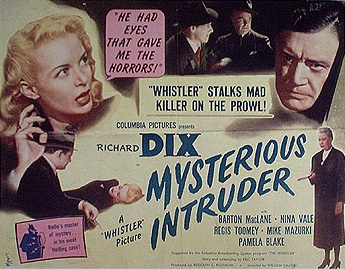
Mysterious Intruder (April 11, 1946)

Mysterious Intruder
Mysterious Intruder (1946)
Directed by William Castle
Columbia Pictures

“I may not be the greatest detective in the world … but I am the most unusual.”

So says Don Gale, the shady private investigator played by Richard Dix in William Castle’s Mysterious Intruder, the fifth entry in Columbia’s mystery series The Whistler. Based on the CBS radio show of the same name, each film in the series featured Dix in the lead role, but unlike other B mystery series of the ’30s and ’40s, like Charlie Chan, The Falcon, Boston Blackie, Michael Shayne, and the Crime Doctor, Dix played a different character in each. The Whistler, who narrated the radio show but never participated directly in the events of the story, made similar appearances in the film series, walking in the shadows, whistling the haunting 13-note theme music by Wilbur Hatch, and occasionally offering a pithy analysis of the trouble the characters were in. The anthology format and Dix’s strange, arresting performances made The Whistler one of the more interesting series of its time.

In Mysterious Intruder, Gale is an oily operator who employs a “photographic model” named Freda Hanson (Helen Mowery) for dirty work. He also has a secretary named Joan (Nina Vale) who hates him. Clearly motivated by money, Gale walks the narrow line between self-interest and outright villainy. He’s an interesting character to watch, since his intentions remain shadowy right up to the end of the picture. This being a B-level programmer, we’re not treated to a deep character study, but Dix is a good enough performer to make Mysterious Intruder worth watching.

When the film begins, Gale is in his office, which has a spectacular view of the city and looks as if it should be home to the most expensive lawyer in town, not a small-time bedroom snooper. He’s visited by Edward Stillwell (Paul Burns), a kindly old music store owner who wishes to track down a young woman whom he hasn’t seen since she was 14, seven years ago. Her name is Elora Lund, and he has something he wants to give her. One hundred dollars is all Stillwell can afford to pay, which isn’t enough to pique Gale’s interest, but he changes his mind when Stillwell tells him that Elora Lund will pay any amount for bringing them together.

Three days pass, and Stillwell receives a visitor in his shop. She’s a tall, attractive blonde, and she convinces Stillwell that she is Elora Lund. (She’s actually Freda Hanson, Gale’s blackmail tool.) Stillwell tells “Elora” that among the countless odds and ends that her late mother brought in for him to sell was one item that will bring a fortune if sold. Unbeknownst to Freda, however, she was tailed to the store by a hulking thug named Pontos, played by dependable character actor Mike Mazurki. (Mazurki is always a welcome sight, but he doesn’t have a lot to do in this picture. It’s not too different from the role he played in Dick Tracy; a vicious killer with few to no lines.) Pontos murders Stillwell, and Freda screams and flees the scene.

Meanwhile, we learn that the real Elora Lund (Pamela Blake) is in a sanitarium, recovering from the effects of an auto accident. She’s appears to be uninjured physically, and why she wasn’t recuperating at home is never explained. Ah, the good old days of “rest cures.”

Before he became the premier schlockmeister of the ’50s and the most famous “gimmick” director in Hollywood, William Castle was a dependable director of one-hour programmers, including several Whistler and Crime Doctor pictures. Mysterious Intruder is a tight, entertaining ride that features plenty of twists and turns, as well as one of my favorite plot conceits, the private dick who constantly contaminates crime scenes and tampers with evidence for his own purposes, all while staying one step ahead of the police.

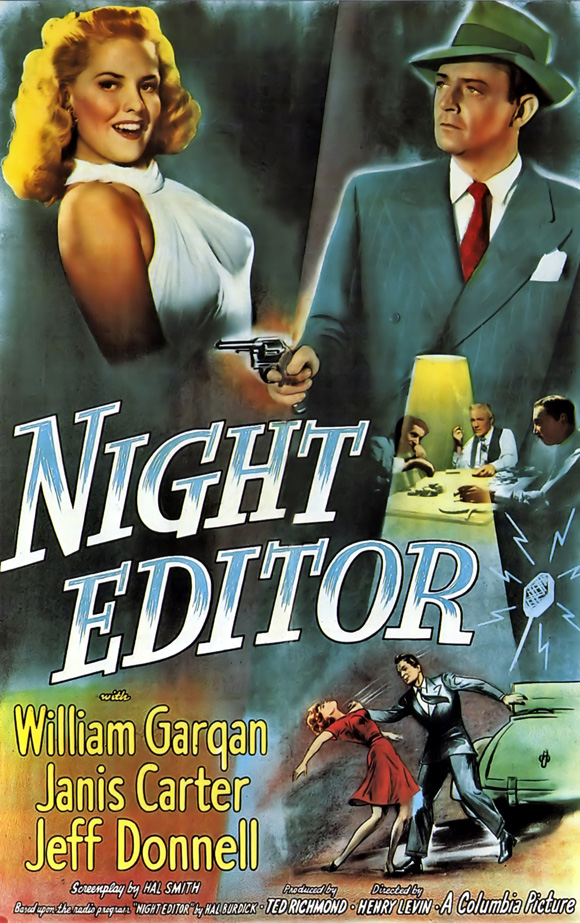
Night Editor (March 29, 1946)

Night Editor
Night Editor (1946)
Directed by Henry Levin
Columbia Pictures

Henry Levin’s Night Editor is — to paraphrase Thomas Hobbes — nasty, brutish, and short. Aside from the happy ending, which feels tacked on, it’s the Platonic ideal of a B noir. The protagonist is tough on the outside but weak and conflicted on the inside. The femme fatale is unfaithful not only to her husband but also her lover, and is excited by violent death. In the world of Night Editor, ambulances are “meat wagons,” and dialogue like, “You’re just no good for me. We both add up to zero,” is what passes for pillow talk. And the movie gets the job done in less than an hour and 10 minutes.

I went into Night Editor not knowing anything about it beyond the title and the fact that it was based on Hal Burdick’s radio show of the same name, which ran from 1934 to 1948. The program was a sort of human-interest editorial column on the radio, with Burdick relating a story and providing all the voices. (There were other characters, and an announcer, but once Burdick got going with his tale, it was all him.)

Night Editor takes place in New York City, and opens with a shot of a neon sign that says “New York Star.” It looks more like a diner sign than anything else, but the Star is a fictional rag, so the prop department was probably feeling expansive. A young reporter named Johnny (Coulter Irwin) walks toward the newspaper office like a zombie, narrowly avoiding getting run over by a street sweeper. He hasn’t been home in two weeks. When he stops in the stairwell to take a slug from his flask, we can see by the thermometer on the wall that it’s 94 degrees in the offices of the Star. These were clearly the days before every office building had central air conditioning.

The newsroom at night is presided over by editor Crane Stewart (Charles D. Brown), who sits with a group of chain-smoking, poker-playing reporters who crack wise about death and destruction. At this point, I thought this picture was going to be a hard-hitting drama about investigative journalists chasing down a big story, like Call Northside 777. But it turns out that the scenes in the city room are just a framing device, as editor Stewart reminisces about a tough cop named Tony Cochrane he once knew, who was involved with a story Stewart covered during Prohibition.

From this point onward, Night Editor is a pitch-black noir. Tony Cochrane, as played by William Gargan, is a working stiff with a good job as a police detective, a dutiful wife, and a young son whom he loves more than anything in the world. But Tony made the mistake of falling for a beautiful blond ice queen, and now finds himself lying to his wife and his colleagues just to sustain an affair that seems to bring him nothing but misery. When Tony picks up wealthy socialite Jill Merrill (Janis Carter) in his car, their first exchange sets the tone of the picture:

“Tony?”
“What?”
“Kiss me before you go.”
“I told you I’d be right back,” he snaps.
“Kiss me,” she says.
“What do you want, blood?”
“Yes, blood.”
“Don’t boil over yet, Jill, it ain’t time yet.”

Their “sweet talk” continues like this for the entire picture. The only thing they share is lust. Other than that they can’t stand each other. Jill says things to Tony like, “I don’t need you. I can buy and sell you.” Tony tells her things like, “You’re worse than blood poisoning.” In my favorite exchange of the picture, Tony tells Jill, “You’re rotten. Pure, no-good, first-rate, high-grade, A-number-one rotten.” She responds by saying, “Tony, I love you.”

Tony drives Jill down to a lonely stretch of beach. He parks the car and they hold each other tightly, whispering sweet words of loathing to each other. Tony compares Jill to a sickness, then to a nightmare with convulsions. She tells him, “You’ll never get away from me, Tony, I won’t let you. You’re like me. There’s an illness inside of you that has to hurt or be hurt. We were meant for each other, Tony.”

Their tryst is interrupted when another car drives down to the beach and parks near them. Jill and Tony see a man step out of the car. The other person in the car, a young woman, remains inside. The man produces a tire iron, and brutally bludgeons the girl to death with it. Tony flashes his car’s lights. The man runs. Tony draws his revolver but Jill yells at him not to do it, to let the man get away. If he doesn’t there will be a scandal, and Tony could lose everything; his job, his house, his wife, and even his son. With anguish on his face, Tony slowly lowers his weapon. He walks to the other car. The corpse’s stockinged legs are sticking out. He looks down at the body, dejected. He returns to his car, but as he starts to drive away, Jill screams that she wants to see the dead body. “I want to look at her, Tony!” she keeps shouting. It’s clear from her frenzied voice and the maniacal look on her face that her interest in the corpse is prurient.

After the murder, Night Editor really gets going. We’re treated to a relatively realistic depiction of police work, at least in terms of how investigative assignments are distributed (which is impressive for any movie made in the days before Dragnet). The movie also does a good job of showing the symbiotic and cheerfully ghoulish relationship between cops and the reporters on the police beat. For the most part, however, the film focuses on Tony’s interviews with suspects, which is as it should be. Tony is wracked with guilt for withholding evidence, but he’s too afraid of what he might lose if he steps forward.

The performances in the film are great. Frank Wilcox is memorable as Douglas Loring, the bank manager whom Tony suspects is the killer he glimpsed after he interviews him. Their scenes together are fraught with tension. Gargan has the face of an everyman, and believably plays the role of hangdog detective with something to hide. (Interestingly, Gargan is one of the few actors who actually was a private detective in real life. He worked for a New York detective agency for about a year for $10 a day plus expenses, but was eventually fired when he lost track of a diamond salesman he was charged with protecting.) Paul E. Burns deserves mention, too. His character, the Scandinavian-accented, milk-drinking detective Ole Strom, could have easily been a foolish stereotype, but Burns invests the character with a sharp-eyed intellect and a real sense of human decency. Janis Carter’s femme fatale Jill is the most one-note character, but she attacks the role with such sadistic brio that it doesn’t matter.

Night Editor is a must-see for noir fans. Originally it was supposed to be the first in a series, but no other Night Editor pictures were ever made. It’s a shame. I like the idea of a series of programmers based on the kind of stories jaded old newspaper editors tell their reporters during the slow periods of the evening.

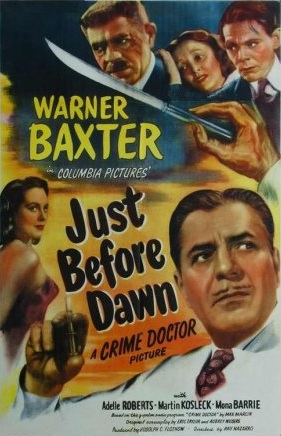
Just Before Dawn (March 7, 1946)

Just Before DawnJust Before Dawn (1946)
Directed by William Castle
Columbia Pictures

Criminal psychiatrist Dr. Robert Ordway, a.k.a. the “Crime Doctor,” is a fictional character created in 1940 by Max Marcin. Crime Doctor was a Sunday-night program that ran on CBS radio stations for seven years. There are only a few extant recordings of the shows, but the ones I’ve heard are comfortable and formulaic little mysteries, not unlike the long-running Mr. Keen, Tracer of Lost Persons.

Like a number of other popular mystery programs, Crime Doctor was adapted as a series of films. Dr. Ordway was played by four different actors over the course of the radio show, but on-screen, he was always played by Warner Baxter. Baxter had been a matinee idol in the silent era, and had won an Oscar for his role as the Cisco Kid in the early talkie In Old Arizona (1928). By the ’40s, however, he was in poor health, and the Crime Doctor series was an easy paycheck for not too much work. Each picture took less than a month to film, and he made roughly two Crime Doctor pictures a year. Baxter doesn’t seem to be coasting in them, though. While he doesn’t ever run or do any stuntwork, he is a fine actor, and his patrician presence is always a treat.

In the first film, Michael Gordon’s Crime Doctor (1943), we learn the character’s origin. A Depression-era crook and racketeer named Phil Morgan is shot and left for dead on the side of the road. Suffering from total amnesia, Morgan calls himself “Robert Ordway” and puts himself through medical school. Once he gets his degree, he focuses on rehabilitating criminals. Eventually, his past catches up with him, but everything works out in the end, allowing him to keep his new name and continue his work as one of the good guys in a series of films released by Columbia Pictures. Crime Doctor was followed by Eugene Forde’s Crime Doctor’s Strangest Case (1943) and Shadows in the Night (1944), George Sherman’s The Crime Doctor’s Courage (1945), and William Castle’s Crime Doctor’s Warning (1945). The film series is less cozy than the radio episodes I’ve heard, and delves into noir territory, with all of its shadows, brutal murders, and mysterious characters.

The sixth film in the series, Just Before Dawn, which was also directed by Castle, begins at night, with a shot of a hulking man (Marvin Miller) walking up to the shadowed entrance of the Ganss Mortuary. He is met by Karl Ganss (Martin Kosleck), who gives him a small leather case that contains a hypodermic needle and a vial of something marked “insulin” that’s not really insulin.

In the next scene, we see Dr. Ordway relaxing at home by the fire with a book when Mrs. Travers (Mona Barrie), his new neighbor, knocks on his door. One of the guests at her party has taken ill, and she can’t get in touch with their regular doctor. This was the good old days, when there was no such thing as dialing 911, but any doctor, even one you’d never met before, would drop everything and walk across the street to your house to take a look at someone who had collapsed on your couch. Dr. Ordway isn’t just any doctor, though, and his reputation precedes him. When he is announced as “Dr. Ordway,” the Travers’s butler Armand (Ted Hecht) excitedly blurts out, “the Crime Doctor!”

The collapsed gentleman in the living room is a diabetic (remember that insulin?) named Walter Foster (George Meeker). Dr. Ordway attends to him, and speaks with Foster’s attractive young sister, Claire (Adelle Roberts), who tells Dr. Ordway that her brother must have forgotten to take his insulin. Dr. Ordway unwittingly prepares a hot dose for Foster, and assures Claire and Mrs. Travers that he’ll be fine. While Dr. Ordway is meeting some of the other party guests, Foster drops dead. He has been poisoned, and the murderer has made Dr. Ordway the instrument of his crime.

The police, generally a bumbling lot in these old mystery series, encourage Dr. Ordway to investigate the crime to redeem himself, especially since he lives right across the street from the Travers home, and it will be easy for him to keep tabs on everyone. I don’t know what city the Crime Doctor series takes place in, but its police force must be one of the laziest in the country.

Dr. Ordway investigates the crime in a by-the-numbers fashion. It turns out that a lot of people at the party (and possibly someone who was not at the party) had reason to want Foster dead. There are obviously nefarious things going on at the Ganss Mortuary, but how they relate to Foster’s murder is not immediately clear.

After the halfway mark, the film really kicks into high gear. After an attempt on his life, Dr. Ordway feigns blindness to lull his antagonists into a false sense of security. He also undergoes a fancy make-up job that turns him into a dead ringer for a vicious killer on the lam named Pete Hastings. Things get really nutty by the end, when Dr. Ordway makes himself temporarily immune to poison by lining his stomach with a heavy emulsion of chalk in order to catch the killer. Just Before Dawn is the only movie I can think of that ends with a shot of the protagonist lying down on an operating table to get his stomach pumped.

I’m a big fan of the director. Castle gained notoriety as a purveyor of high-quality schlock with his “gimmick” films of the late ’50s and early ’60s. Anyone who bought a ticket for Macabre (1958) was automatically insured by Lloyd’s of London, and received a settlement if they died of fright during the picture; House on Haunted Hill (1959) featured a gimmick called “Emergo,” in which a plastic skeleton shot out of a box next to the screen as Vincent Price manipulated his own skeleton on-screen; the gimmick for The Tingler (1959) was called “Percepto,” and involved theater patrons getting their spines buzzed by a wire hidden in their seats; and Homicidal (1961) featured a one-minute “Fright Break” at the climax that allowed anyone who was too scared to keep watching to leave and receive a full refund. Of course, they were lighted with a spotlight as they walked up the aisle and then had to stand in the cardboard “Coward’s Corner” in the lobby until the film ended and their fellow patrons strolled past, so not too many people took advantage of the offer.

Before he carved his unique place in cinematic history, Castle directed dozens of programmers like this one. Prior to making Just Before Dawn, he directed three entries in Columbia Pictures’s Whistler series, The Whistler (1943), The Mark of the Whistler (1944), and Voice of the Whistler (1945). In general, I prefer the Whistler series. The plots are more varied and interesting. I also liked Castle’s prior entry in this series, Crime Doctor’s Warning, a little more than this one. Its depiction of the Greenwich Village art scene and the crazy beatniks who inhabited it was really enjoyable. But Just Before Dawn is, like all of Castle’s movies, still a whole lot of fun for fans of B mysteries and bottom-of-the-bill programmers.

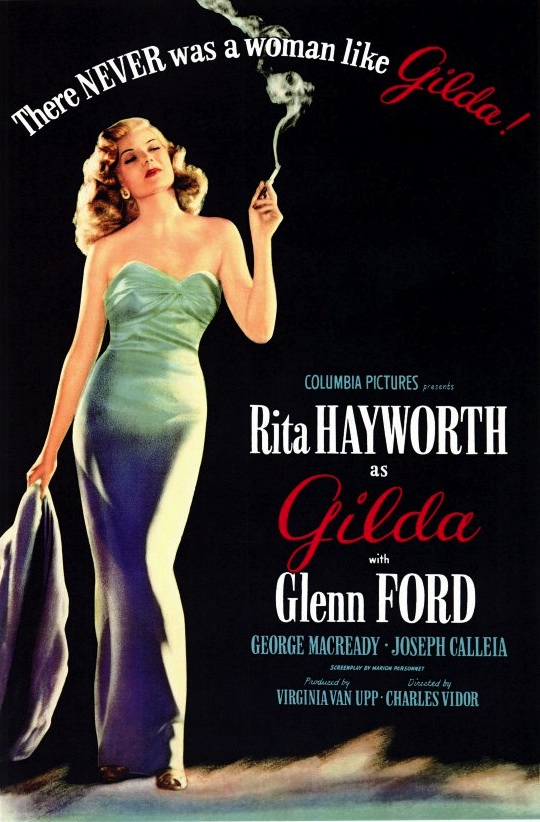
Gilda (Feb. 14, 1946)

Charles Vidor’s Gilda premiered on February 14, 1946, and went into wide release on March 15. It’s best remembered as the film that made Rita Hayworth the biggest sex symbol of the ’40s. (Not that she was a shrinking violet before 1946. I saw her in the 1944 film Cover Girl when I was a kid, and I never forgot her.)

Born Margarita Carmen Cansino in Brooklyn in 1918, Hayworth was the daughter of Spanish flamenco dancer Eduardo Cansino, Sr. and Ziegfeld girl Volga Hayworth. With that kind of pedigree, her hundred-megawatt sex appeal should come as no surprise, but it does, even today. Usually the only image I post with a review is the theatrical poster, but for this review I was tempted to plaster up several cheesecake shots of Hayworth. The only problem with photos of her is that they lack something. She looks great in all of her pinup shots, but her blisteringly hot sexiness is something that needs to be seen on film to be believed. It doesn’t hurt that nearly every line in Gilda is an innuendo. When she first appears on screen, throwing back her mountain of wavy hair, and her husband asks her if she’s decent, the long pause after her bright, “Me?” followed by the husky response, “Sure, I’m decent,” clearly has nothing to do with whether or not she’s fully clothed.

Besides the obvious lascivious value Hayworth offers the production, Gilda is a pretty good movie, full of nasty double-crosses and intrigue in an exotic locale. At one hour and 50 minutes, it overstays its welcome by at least 10 or 15 minutes, but it’s still an entertaining film noir about love-hate relationships, high-stakes gambling, and double-dealing.

When we meet Johnny Farrell (Glenn Ford), he’s just another down-on-his-luck gringo in Buenos Aires, Argentina, a post-war hot spot (and not just for Nazi war criminals on the lam). In noir fashion, Farrell narrates the picture, sounding jaded and world-weary when he’s not twisted up with hatred and lust. Caught cheating at craps, Farrell is saved from a vicious beating at the hands of a bunch of thugs by a dapper gentleman named Ballin Mundson (George Macready) who wields a sword cane. Mundson tells Farrell of a casino where he can go to make some real money; a ritzy, illegal establishment that operates in the open, thanks to bribery. Mundson warns Farrell, however, not to cheat there. The bullheaded Farrell does exactly that, and is caught. A couple of mugs drag him into the second-floor office to face the boss, who turns out to be none other than Mundson. A fast talker, Farrell convinces Mundson to give him a job in the casino, and he quickly rises to the level of right-hand man.

Things go along swimmingly until the day that Mundson ignores his own advice that “Gambling and women don’t mix,” and brings home his new wife, Gilda (Hayworth). From the look on Farrell’s face when he first sees her, he might as well be seeing the atomic bomb being dropped on Nagasaki. Unaware that Farrell and Gilda share a history, Mundson entrusts his right-hand man with Gilda’s care and keeping. Forced to shield Mundson from Gilda’s constant indiscretions with other men, Farrell’s hatred of Gilda increases. Only it isn’t really hatred. It’s that strange brand of love/hate that fueled many a post-war film noir. Or, as Mundson himself puts it at one point, “It warmed me. Hate is the only thing that has ever warmed me.”

Meanwhile, Mundson’s secret plans to form a cartel with a group of Germans to control tungsten production in Argentina slowly comes to light, and Farrell realizes that the Argentine secret police are onto Mundson, and that the whole casino is a powder keg waiting to be ignited.

Argentina had a checkered history during World War II. The nation broke relations with Germany and Japan in 1944 only under heavy pressure from the United States, but continued to maintain its neutrality. On March 27, 1945, Argentina declared war on Germany, when German defeat was a foregone conclusion.

It’s a great setting for a tale of steamy intrigue (with a brief narrative sojourn in Montevideo), but the political and criminal machinations take a back seat to the sexual tension between Farrell and Gilda. Their love/hate relationship takes some nasty turns, both physical and psychological. (In the scene in which Gilda slaps Farrell across both sides of his face, Hayworth reportedly chipped two of Ford’s teeth.) The story also takes a back seat to the sheer physical spectacle of Gilda, in particular the show-stopping number in which she performs “Put the Blame on Mame.” Hayworth lip-synched to Anita Ellis’s singing voice, and did an excellent job. Just from watching the movie I wouldn’t have had any idea she wasn’t singing herself.

“If I’d been a ranch, they would have named me the Bar None,” Gilda says at one point in the film. Truer words have not been spoken.

Voice of the Whistler (Oct. 30, 1945)

Voice_of_the_Whistler
Voice of the Whistler (1945)
Directed by William Castle
Columbia Pictures

The Whistler, which was first heard on the Columbia Broadcasting System on May 16, 1942, ran for more than 13 years and was one of the best mystery and suspense programs on the radio. It didn’t feature the well-known Hollywood stars of Suspense (also broadcast on CBS), but its scripts were some of the most clever and intriguing that old-time radio had to offer, and its final twists were always satisfying, whether or not you saw them coming.

The program was hosted by a mysterious character embodied only by the sounds of footsteps and an eerie, whistled theme song. Each program began the same way, with the narrator saying, “I am the Whistler and I know many things, for I walk by night. I know many strange tales hidden in the hearts of men and women who have stepped into the shadows. Yes, I know the nameless terrors of which they dare not speak.” There were no recurring characters, but the situations were fairly similar from week to week. Greedy or vengeful people driven by dark impulses endeavored to commit perfect crimes, but were undone by a single overlooked detail or their own overreaching. Quite often, each story would contain more twists than just the one at the end. For instance, one program from October 1945 told the story of a man who killed his underworld partner and got away with it. He always wanted to reveal to the police the details of his clever scheme, but of course could not do so and remain a free man. After inadvertently faking his own death when a drifter steals his car and identification, crashes, dies, and is believed to be him, he changes his name and moves out of town. He then writes a mocking letter to the authorities laying out all the details of how he got away with murder. Immediately after mailing it, he hears on the radio that the police have determined that the body in the car wasn’t him after all, so he goes on a furious chase through the state in an attempt to retrieve the letter. He eventually attracts the attention of the police for tampering with the mail and is caught and confesses, only to find out at the end of the program that his letter was returned to his boarding house because it had incorrect postage.

Like Inner Sanctum Mysteries (another popular CBS suspense program), The Whistler was adapted as a series of B movies after it had been on the air for a couple of years. Starting with The Whistler (1944), which was directed by William Castle, the series continued with The Mark of the Whistler (1944), also directed by Castle, and The Power of the Whistler (1945), which was directed by Lew Landers. Each film starred Richard Dix, although he played a different role in each. The films did a great job of capturing the essence of the radio show. The Whistler was seen only in the shadows, just a man in a coat and a hat haunting alleyways and the dark parts of the city at night. Like the radio show, the Whistler’s voiceover often addressed the characters in the story, speaking in the second person, although he never interacted with them directly. (A typical bit might go, “You’ve really done it now, haven’t you? If you leave, they’ll see you, but if stay here, you’ll perish along with your victim. What are you going to do, George? What are you going to do?”)

Voice of the Whistler, which was directed by William Castle and written by Wilfred H. Petitt and Castle, working from a story by Allan Radar, tells the sad story of a successful industrialist named John Sinclair (Dix), whose fabulous wealth failed to provide him with either friends or health. After a breakdown, Sinclair changes his name to “John Carter” and goes away to lose himself. He sees a doctor who advises him to go to the sea coast, get some fresh air, a job, and enjoy himself. “And above everything, try to make friends,” the doctor tells him. “And never forget, Mr. Carter, that loneliness is a disease that can destroy a man’s mind.”

Sinclair moves to the coast of Maine and takes up residence in a lighthouse that has been converted into a private dwelling. Believing he doesn’t have long to live, he convinces a beautiful young nurse named Joan Martin (Lynn Merrick) to marry him. In exchange for her companionship during his last months, she will inherit all of his wealth. Although Joan is in love with a handsome young intern named Fred Graham (James Cardwell), they have been engaged for four years, and have no plans to be married until Fred can make enough money. Against Fred’s protests, Joan marries John, partly because she likes him and pities him, but mostly because his money can give her and Fred the life they’ve always wanted. After John and Joan have been married and living in the lighthouse with their jovial friend Ernie Sparrow (Rhys Williams) for several months, John’s health dramatically improves, and it looks as if Joan might have trouble collecting on their bargain. Meanwhile, John falls more and more in love with her. Eventually Fred shows up for a friendly visit that will have murderous consequences.

Richard Dix, a Hollywood star since the silent era, is great in each Whistler film I’ve seen him in so far. His glory days were behind him, but he was still a fine actor, and was equally adept at playing sympathetic protagonists and villains.

The True Glory (Aug. 27, 1945)

TrueGloryThe True Glory, which was released on August 27, 1945 in the United Kingdom and on October 4, 1945 in the United States, is the granddaddy of every World War II documentary you’ve ever seen on the History Channel. Introduced by the Supreme Commander of Allied Forces in Europe, Gen. Dwight D. Eisenhower, The True Glory tells the story of America and Great Britain’s war against Germany and Italy, starting with the D-Day invasions of June 6, 1944 and ending with V-E Day, May 8, 1945.

The documentary, which won an Academy Award, was pieced together from hundreds of different war photographers’ footage. Several directors worked on the film, but the most commonly credited are Carol Reed and Garson Kanin.

There is some narration, but the majority of the film is told through first-person accounts in voiceover. There are a myriad of British and American soldiers who tell their stories, but there are also the voices of a Parisian family, nurses, clerical staff, an African-American tank gunner, and a member of the French resistance. If you know your World War II history and keep your eyes peeled, you’ll recognize many prominent figures in the footage, including Gen. Eisenhower and Gen. George S. Patton.

Produced by the British Ministry of Information and the U.S. Office of War Information, The True Glory lacks a certain degree of perspective, coming so soon after the end of the war, and is primarily made to celebrate the accomplishments of the Allied forces, but that doesn’t change the fact that the footage is absolutely stunning, and occasionally horrific. The True Glory is a must-see for even the most casual of history buffs.