Tag Archives: Comedy

The Ghost and Mrs. Muir (June 26, 1947)

The Ghost and Mrs. Muir
The Ghost and Mrs. Muir (1947)
Directed by Joseph L. Mankiewicz
20th Century-Fox

Gene Tierney is one of my favorite actresses from the ’40s. (What can I say? I’m a sucker for a cute overbite.) She’s often criticized for being more of a pretty face than a talented performer, but I think that’s unfair. Maybe some of these criticisms spring from her most famous role — Laura (1944) — in which she literally played a painting. I don’t know. What I do know is that when she was given good material and paired with a good director and co-stars, she really shone.

The Ghost and Mrs. Muir was directed by Joseph L. Mankiewicz, who made another wonderful film starring Tierney, Dragonwyck (1946). Mankiewicz clearly cared about helping Tierney craft a fully realized character. And it doesn’t hurt that in this film, she is paired with the great Rex Harrison, who plays the ghost of the title.

Harrison’s scenes with Tierney are the highlights of the film, and the two actors play off each other beautifully. Their relationship runs the gamut of human emotion, from fear to amusement, anger to warmth, reproach to acceptance, and eventually even into the uncharted territory of human-spectral love.

The Ghost and Mrs. Muir takes place in England at the turn of the century. Tierney plays a widow named Lucy Muir who moves with her young daughter Anna (Natalie Wood) and her maid Martha Huggins (Edna Best) to Gull Cottage at Whitecliff-by-the-Sea. Unlike her real estate agent, Mr. Coombe (Robert Coote), who flees from ghostly laughter when showing Lucy the house, Mrs. Muir is sanguine about the prospect of moving in with a ghost. “Haunted,” she says. “How perfectly fascinating.”

Gene Tierney and Rex Harrison

Of course, she’s also a skeptic who doesn’t believe that medieval nonsense like ghosts and hauntings could ever exist in the 20th century. The painting of the fearsome-looking former owner of the house — Capt. Daniel Gregg — is certainly lifelike, but it takes the appearance of the salty old seaman “in the flesh” to convince Lucy that she’s not imagining things.

Philip Dunne’s screenplay for The Ghost and Mrs. Muir is based on a novel by Josephine Leslie, who published it under the masculine-sounding pseudonym “R.A. Dick.” (I’m not sure if that pen name is supposed to be as funny as I find it.) In the novel, Capt. Gregg was just a voice inside Mrs. Muir’s head. He manifests more literally in the film, but in many ways he still symbolizes Lucy’s personal journey from a black crepe-wearing widow bound by convention to a liberated woman who writes and publishes a very unladylike book entitled Blood and Swash (with Capt. Gregg’s help, of course).

Ironically, the ghost of the Captain has no use for superstition or fear, and his plain, unvarnished speech, peppered with curses, speaks the truths that everyone in Lucy’s life has been too straitlaced to ever acknowledge. Also, because he has no corporeal form, the film is able to get away with things that otherwise wouldn’t have been acceptable under the Hay’s Code, such as a widow and a virile man sharing a room and intimate talk. He insists she call him by his Christian name, “Daniel,” and he decides her name should be something more exotic than Lucy, so he calls her “Lucia.”

“Keep on believing in me, and I’ll always be real,” Capt. Gregg tells Lucy, but eventually a real man enters her life — a slippery lothario named Miles Fairley (George Sanders) who writes children’s books under the name “Uncle Neddy” — and the jealous ghost must fade away.

The scene in which he says goodbye to her might be the most weirdly erotic and deeply romantic scenes of all time. She lies down in bed, her eyes close, and he sits down next to her, his face very close to hers as he says, “It’s been a dream, Lucia. And in the morning, and the years after, you’ll only remember it as a dream, and it’ll die, as all dreams must die at waking.”

Mankiewicz’s able direction is aided by the brilliant cinematography of Charles Lang and the luscious musical score of the great Bernard Herrmann. Together, they craft a film that nimbly moves from horror film to comedy, and then from romance to drama. I can’t recommend The Ghost and Mrs. Muir highly enough for lovers of classic cinema.
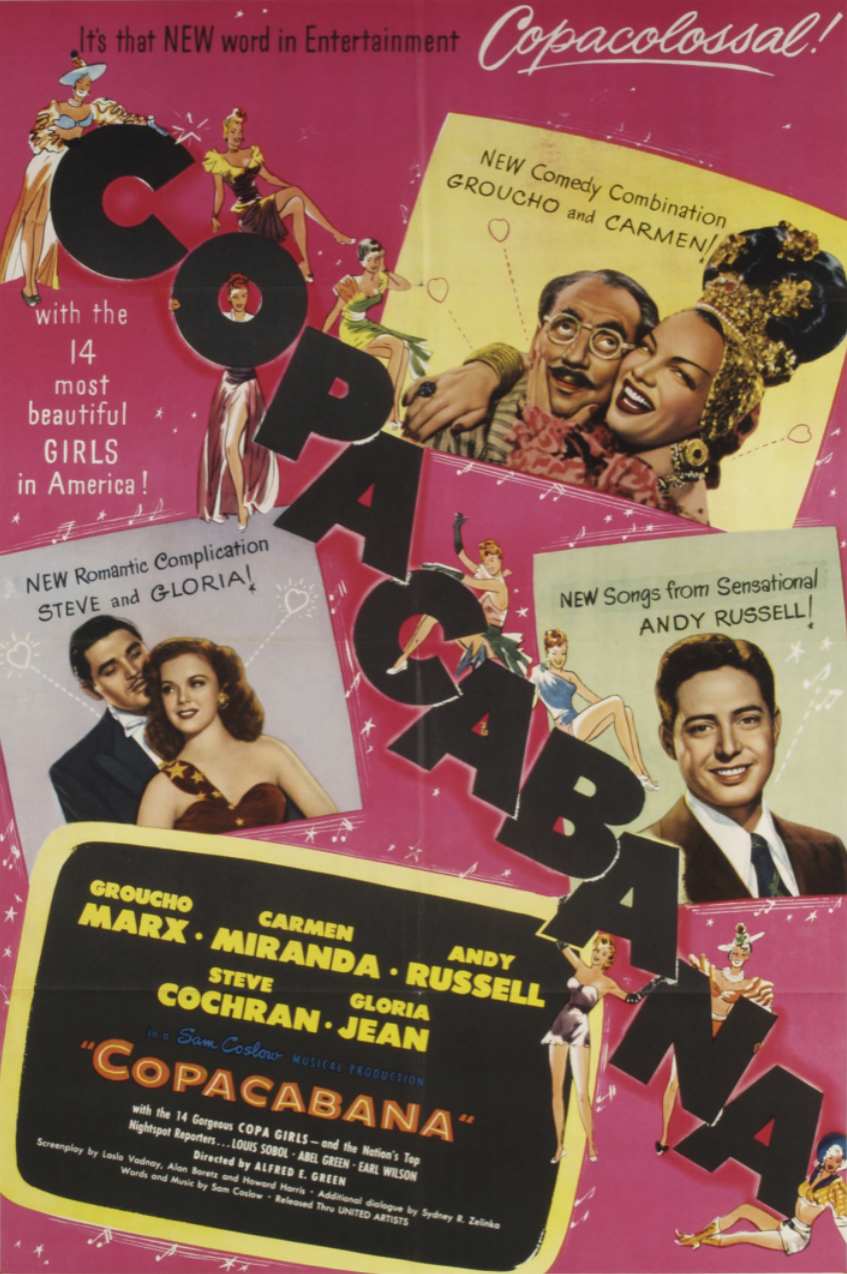
Copacabana (May 30, 1947)

Hey there! Do you like the comedy of Groucho Marx? Do you like the music of Carmen Miranda? Do you like the sweet song stylings of Andy Russell? Do you like beautiful women with nice legs?

You do? Well then, brother, have I got a picture for you.

Alfred E. Green’s Copacabana is a classic example of a Hollywood product that is designed for only one purpose — to entertain.

The plot of the film is little more than an excuse to showcase Groucho Marx’s wordplay and fast-paced comedic line deliveries, Carmen Miranda’s mesmerizing vocal performances, big musical numbers featuring the 14 beautiful “Copa” girls, and Andy Russell’s syrupy, sentimental songs.

The plot, which can summarized on the back of a cocktail napkin, is this: wildly unsuccessful nightclub performer Lionel Q. Deveraux (Groucho Marx) and his fiancée of 10 years, equally unsuccessful nightclub singer Carmen Navarro (Carmen Miranda), decide that desperate measures are called for. Deveraux has been kicked out of more clubs than he can count, and threats like, “This is an outrage. You’ll hear from my lawyer, as soon as he gets a telephone,” clearly aren’t getting him anywhere.

So Deveraux decides to pass himself off as a top talent agent. He arranges for Carmen to perform for Steve Hunt (Steve Cochran), the owner of the most glamorous nightclub in Manhattan, the Copacabana. Without Deveraux onstage with her, Carmen makes a positive impression, but Steve wants to see more of Deveraux’s acts. Naturally, he has only one act — Carmen — but some quick thinking produces a second act, the beautiful and mysterious “Mademoiselle Fifi.”

Mlle. Fifi is of course just Carmen with a white costume straight out of the Arabian Nights, a blond wig piled atop her head, and a heavy veil to cover her face. Deveraux explains to Steve why she never takes the veil off. “No one but her lover is allowed to gaze upon her face,” he says. “Not even her husband.”

Meanwhile, the starry-eyed Anne Stuart (Gloria Jean) toils away in the office of the Copacabana as Steve Hunt’s gal Friday, unable to tell Steve how she really feels. Will she ever be able tell him? Will the wide-eyed, golly-gee naïveté of singer Andy Russell (played by singer Andy Russell) and his encouragement that she express herself through song help? Will that song be called “Stranger Things Have Happened”? You’ll just have to see Copacabana to find out.

I’m not the biggest fan of musicals, but I’m perfectly willing to sit back and be entertained by one if it’s well put together, and Copacabana features plenty of entertainment bang for your buck. It’s especially entertaining if you’re as much of a sucker for great gams as I am. The Copa girls are blessed with pretty faces, good singing voices (although I’m not sure if they were actually singing during their numbers), dancing ability, and — most of all — shapely getaway sticks, which are on display even when they’re in the background. When Mlle. Fifi sings her first number at the Copa, “Je Vous Aime,” the Copa girls are draped all over the place like leggy cats, listening in rapture.

And speaking of perfect pins, I’d be remiss if I didn’t mention Gloria Jean’s final song and dance with Groucho Marx and Carmen Miranda, in which she wears a shorts and high heels outfit that might be the cutest thing I’ve seen in a movie from 1947 so far.

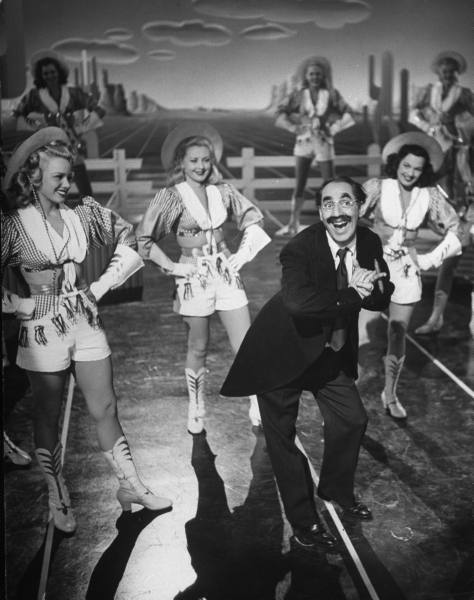
I believe this was the first film in which Groucho Marx appeared without his classic greasepaint mustache and thick glasses get-up. (His actual mustache and regular glasses aren’t wildly different, of course.) Also, his brothers, Harpo, Chico, and sometimes Zeppo, are nowhere to be seen in Copacabana, but it’s still worth seeing if you’re a Marx Brothers fan. It’s not as sublime as Duck Soup (1933) or A Night at the Opera (1935), but it’s still a funny, entertaining film, and offers the last chance to see Groucho in his classic get-up, when he performs Bert Kalmar and Harry Ruby’s song “Go West, Young Man” in a slightly surreal scene. (Click the name of the song to watch the performance.)

Most of the music in Copacabana is written by Sam Coslow. It’s uniformly good, but for my money, the best song in the picture is Carmen Miranda’s performance of “Tico Tico No Fubá,” which was written by Zequinha de Abreu and Aloysio de Oliveira.

Miracle on 34th Street (May 2, 1947)

When I was a kid, I briefly corresponded with Santa Claus. I’m not talking about the annual “letter to Santa” every kid writes, with a list of everything they want in their stocking that year. I dropped Santa a line in the off-season — June or July — and asked him how summers were at the North Pole, how Mrs. Claus and the elves were doing, and what his reindeer liked to eat.

I was eight or nine years old. I didn’t exactly believe in Santa Claus, but I liked the idea of him. Writing a letter to him felt good. And doing it in the summer made me feel unselfish.

I can’t remember if I was surprised or not when I received a response from Santa Claus.

It was a typewritten letter, and it was postmarked the North Pole. Santa thanked me for my letter, let me know what was going on at the North Pole, told me what his reindeer liked to eat, and told me that he liked my drawing of a train and said he assumed I must live near a railroad and that he sincerely hoped I stayed away from the railroad tracks. I didn’t quite understand that last part. There was a freight train that ran through town, but it wasn’t that close to my house, and I never hung out down there, and why wouldn’t Santa know that? Doesn’t he know everything? Surely “plays risky games on the train tracks” would’ve put me in the “naughty” column, wouldn’t it?

He ended the letter by saying that he thought the stamp I’d pasted to the front of the letter was awfully attractive, and asked if I’d ever considered stamp collecting as a hobby. He may have thrown in some stamps to get me started. I can’t remember.

I figured I should probably take Santa’s advice, so I got into stamp collecting and kept up the hobby for several years. It did occur to me that it was a little strange that the last place I saw my letter to Santa was sliding down the mail slot at the post office and that I got a response from some dude calling himself Santa who seemed to be really into philately. (That’s “stamp collecting” for all you non-philatelists out there.)

Around this time, one of my teenaged foster sister’s friends asked me if I believed in Santa Claus, and I responded, “I believe in the spirit of Christmas.”

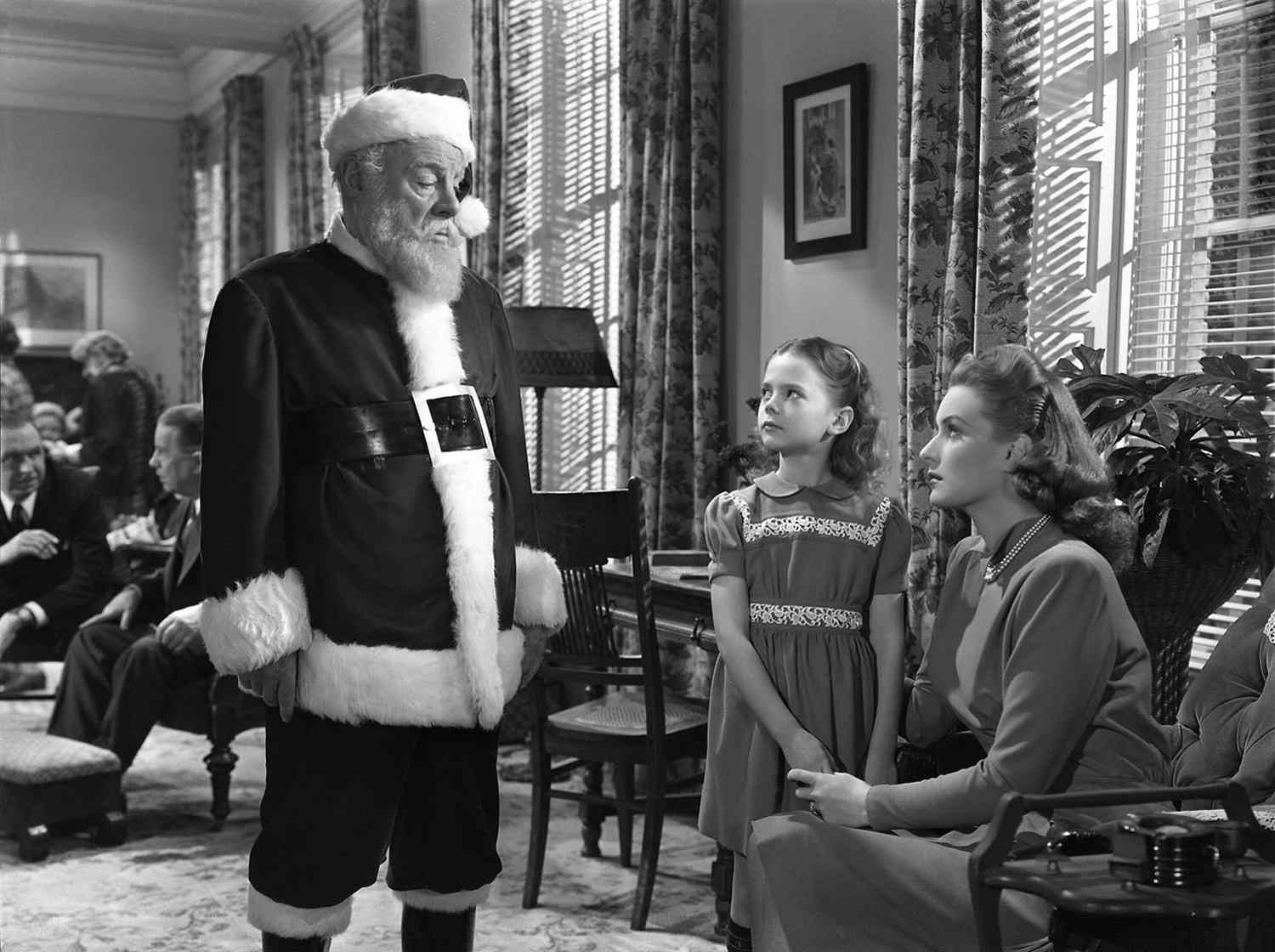
Which brings me around (finally) to George Seaton’s Miracle on 34th Street, which I hadn’t seen since I was a kid. It was just as funny and enjoyable as I remember it being. I found the scene in which Kris Kringle (Edmund Gwenn) tells a shop owner that his store display features his reindeer in the wrong order more whimsical than factual this time around, and the scene in which we see a man in a chintzy Santa suit, drunk as a lord, really disturbed me when I was a kid. This time around, it was merely mildly amusing. (As a jaded adult, Santa Claus-related hijinks have to be a little more disturbing than public intoxication to get a rise out of me.)

Kris Kringle replaces the intoxicated Santa in the Macy’s Thanksgiving Day Parade, and does such a good job that he’s hired as a store Santa. Unlike most department store Santas, he doesn’t shill for his employer. In his first day on the job at Macy’s, he sends a harried mother (Thelma Ritter) to Schoenfeld’s Department Store, which he says is the only place in town that has the toy her son wants. Kringle keeps a very close watch on the toy market, after all. She’s flabbergasted that a department store Santa would send her to a competitor, but she’s delighted, too, and Kringle’s helpfulness creates an enormous wave of good publicity for Macy’s.

The only problem is that Kris believes he really is Santa Claus, and tells everyone so. When the event director who hired him, single mother Doris Walker (Maureen O’Hara), finds out that he’s been filling the head of her six-year-old daughter, Susan (Natalie Wood), full of such nonsense, she’s upset, and pulls his employment card. It lists his address as Brooks’ Memorial Home for the Aged, 126 Maplewood Drive, Great Neck, Long Island, but his date of birth says “As old as my tongue and a little bit older than my teeth,” under “place” he has written “North Pole,” and his eight tiny reindeer are listed as his next of kin.

Dr. Pierce (James Seay), the doctor at Kris’s nursing home, assures Doris that Kris’s delusion is harmless, but a meddling little twit named Granville Sawyer (Porter Hall) who gives psychological evaluations to Macy’s employees conspires to have Kris committed.

In order to prove Kris’s sanity, his lawyer, Fred Gailey (John Payne), announces that he will in fact prove that Kringle is Santa Claus, and therefore not insane. It’s the trial of the century. A series of newspapers blare increasingly wild headlines, culminating in the ridiculous “Kris Kringle Krazy? Kourt Kase Koming ‘Kalamity!’ Kry Kiddies.” (A lot of people will tell you that puns are the lowest form of humor, but they’re not. Alliteration is.)

Miracle on 34th Street is a wonderful film. It walks the tricky line between faith and skepticism without ever going too far in either direction. Every character who has faith is rewarded, but there’s nothing in the film that’s overtly unreal. Doris and Fred find love with each other, and Susan’s only Christmas wish is fulfilled, but in a clever, roundabout way. (There’s no final shot of Kris Kringle shooting out of a chimney or anything.)

It was a little weird to watch this movie in springtime. It created the same type of cognitive dissonance as smelling turkey roasting in August, or attending a Fourth of July barbecue in November. I blame Daryl F. Zanuck, who insisted that the film be released in May, since he said that more people went to the movies in the summer than during the holidays. The studio kept the film’s Christmas theme a secret in its trailer. Also, you’ll note that the theatrical release poster above prominently features Payne and O’Hara, and Gwenn is not dressed up like Santa.

Miracle on 34th Street was nominated for four Academy Awards — Best Picture, Best Supporting Actor (Gwenn), Best Adapted Screenplay (George Seaton), and Best Story (Valentine Davies). It won all of the Oscars it was nominated for except Best Picture, which went to Elia Kazan’s Gentleman’s Agreement.

It Happened on Fifth Avenue (April 19, 1947)

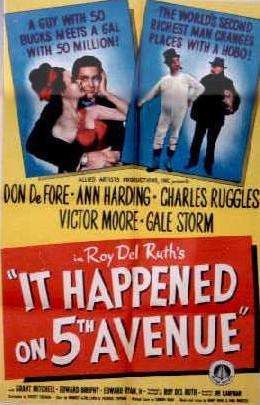
Roy Del Ruth’s It Happened on Fifth Avenue has a small but loyal following. Some people will even tell you that it’s better than It’s a Wonderful Life (1946). They are wrong. It’s a Wonderful Life is the far superior film. But It Happened on Fifth Avenue is still a great picture; warm, human, funny, and perfect for the holiday season.

In a plot inspired by the severe housing shortage that followed World War II, Don DeFore plays an ex-serviceman named Jim Bullock (not to be confused with Jim J. Bullock) who’s thrown out of his rented room under protest. (He’s carried out handcuffed to his bed, wearing only his underwear and his hat.) Dejected, Bullock stews while sitting all alone on a bench in Central Park. He’s approached by Aloysius T. McKeever (Victor Moore), who — with his tuxedo, top hat, and little dog — looks like a gonzo version of Rich Uncle Pennybags (a.k.a. “Mr. Monopoly”). McKeever and his little dog live in one of the stateliest mansions on Fifth Avenue, but they enter through the back, because it’s boarded up while its real owner, multimillionaire Michael J. “Mike” O’Connor, winters in West Virginia.

McKeever lives lightly off O’Connor’s wealth. The only thing he steals is food from the pantry, and he acts as a responsible caretaker. The only downside is that he has to turn off all the lights and make himself scarce every night when security guards sweep the mansion, but it’s a small price to pay.

Bullock settles into McKeever’s way of life quickly, and respects McKeever’s rules, but Bullock can’t help inviting old friends who need housing to join him in the mansion. Eventually, the O’Connors themselves wind up living with McKeever and his big group of friends. The first is the O’Connors’ daughter, Trudy (Gale Storm), who hides the fact that she’s an O’Connor because she likes McKeever’s way of life. Then her father (Charles Ruggles) and her mother (Ann Harding) reluctantly get into the act after their daughter begs them to pass themselves off as destitute people in need of housing.

The O’Connors have been estranged for some time, but their bizarre new living arrangement helps them fall in love with each other again. When Mike O’Connor comes home after a long, hard day of shoveling snow for dimes, he can’t resist the smell of his wife’s slumgullion wafting from the kitchen. It takes him back to better days.

It Happened on Fifth Avenue is a cute movie. Its message is the same as the message of It’s a Wonderful Life, that no man is poor who has friends, and it also ends with a Christmas miracle. It does it in a more contrived and comedic way than It’s a Wonderful Life, but it’s still a sweet, funny, and very enjoyable movie.

Monsieur Verdoux (April 11, 1947)

Monsieur Verdoux
Monsieur Verdoux (1947)
Directed by Charles Chaplin
United Artists

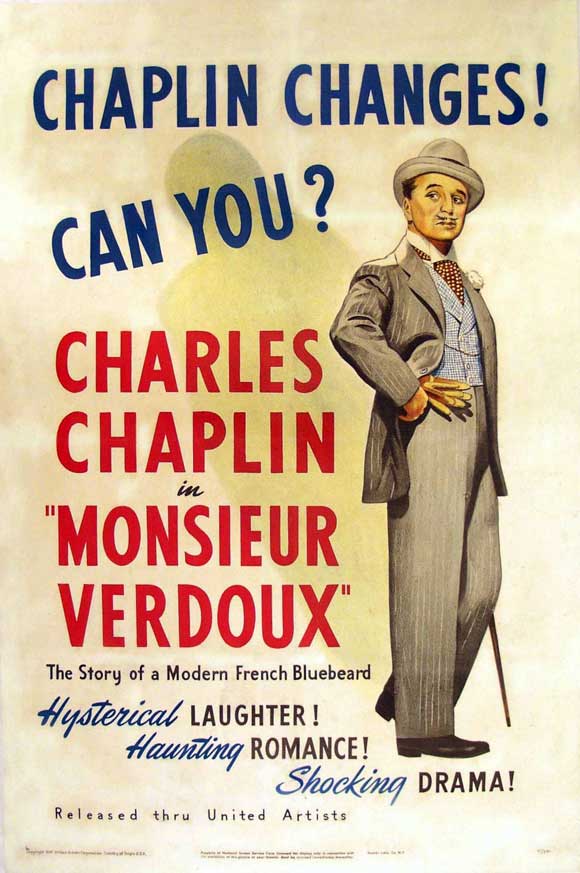
Monsieur Verdoux, “a comedy of murders,” is a product of Charles Chaplin’s Frantic One-Man Band. Besides starring in the film, Chaplin is credited with directing the picture, writing the screenplay, producing the film, and writing the music. Orson Welles wrote the original script and was slated to direct Chaplin in the picture, but at the last minute, Chaplin decided that he didn’t want to be directed by someone else — he’d always been his own director in the past — and bought the script from Welles, crediting him with the “idea” for the film.

The film is based on the career of real-life murderer Henri Désiré Landru, who between 1914 and 1918 seduced a number of women and murdered them after gaining access to their assets. He burned their dismembered bodies in his oven, disposing of them completely, which made prosecuting him a challenge after he was caught. A trail of paperwork and other evidence was enough to eventually convict him of 11 counts of murder (10 women and one of their teenaged sons), and he was executed on the guillotine in 1922.

In Monsieur Verdoux, Chaplin plays a man named Henri Verdoux, who describes himself as an “honest bank clerk.” Honest, that is, until the Depression of 1930, at which point he began his new career, “liquidating members of the opposite sex.” He claims that he began his career as a Bluebeard strictly as a business proposition. This is utter claptrap, as is nearly every other word out of M. Verdoux’s mouth that isn’t plot-advancing dialogue, but we’ll get to that later.

The film takes place in 1932. M. Verdoux had a 30-year career in banking before he began his new career as a murderer, and with his dainty, foppish clothes he looks like a relic of another time. When the film begins, he is living in a villa in the south of France. He’s a tidy little man who loves to garden, but whose incinerator has been going full-blast for the past three days. He’s kind to animals, moving a caterpillar out of his way in the garden path and feeding a cat on the street. M. Verdoux is even a vegetarian.

He is also a lothario with an insatiable appetite for well-heeled widows. But this, M. Verdoux assures us, is just his day job. His heart belongs to his wheelchair-bound wife Mona (Mady Correll) and adorable little boy Peter (Allison Roddan). At home, M. Verdoux lectures Peter when he catches him pulling the cat’s tail that “violence begets violence.” He also tells his son that he has a mean streak. “I don’t know where you get it!” he exclaims.

Aside from the saintly Mme. Verdoux, nearly everyone in the film is a grotesque and obnoxious caricature. In this way, Monsieur Verdoux is a distillation of Chaplin’s career-long vacillation between sentimentality and cruelty. A perfect example of this is the scene in which M. Verdoux brings a girl in off the street to poison her, but thinks better of it after she speaks of how wonderful life can be, and how she loved her husband, crippled in the war. (The girl is played by 20-year-old ingenue Marilyn Nash.)

The few bits of physical comedy in the film are funny, but they’re mostly either too brief or out of character with the rest of the scene in which they take place. Several comedic scenes — such as when M. Verdoux and another man start slapping each other with rapid-fire speed, or when M. Verdoux is romancing the older woman who was going to buy his villa in the beginning of the film, and he’s moving ever closer to her on the couch — fade to black in a quick, unsatisfying way.

When Monsieur Verdoux was released, Chaplin’s reputation was severely tarnished. He hadn’t made a film since The Great Dictator (1940), and he was under attack for both his Leftist political sympathies and his morals (he was the subject of a sensational paternity suit, and was a serial seducer of young women, many of them underage).

Chaplin and Nash

Monsieur Verdoux can be seen as a defiant stand against his critics. It’s the blackest of black comedies, and was a box office disaster in the United States when it was first released (it fared a bit better in Europe), but has built up quite a cult since it was re-released to receptive audiences in the ’60s and ’70s. At the time of its release, however, it polarized critics. James Agee crowned it a masterpiece, and the National Board of Review named it the best English-language film of 1947. Others were less enthusiastic.

I think that Monsieur Verdoux is a deeply flawed film. Chaplin was the preeminent clown of the silent era. He wasn’t quite the master technician of hijinks that Buster Keaton was, but he was able to convey a panoply of emotions through his face and body. His films are not only some of the funniest of the silent era, but are emotionally affecting, too. The ending of City Lights (1931) is still one of the most powerful I have seen in any film.

When he was able to speak onscreen, however, Chaplin was a tedious hack who only thought he was profound. Monsieur Verdoux isn’t as crushingly pretentious and boring as his later film Limelight (1952), but it has its moments.

The end of Monsieur Verdoux is especially problematic. Speaking on his own behalf in court, M. Verdoux says, “I was forced to go into business for myself. As for being a mass killer, does not the world encourage it? Is it not building weapons of destruction for the sole purpose of mass killing? Has it not blown unsuspecting women and little children to pieces? And done it very scientifically? As a mass killer, I am an amateur by comparison. However, I do not wish to lose my temper, because very shortly, I shall lose my head. Nevertheless, upon leaving this spark of earthly existence, I have this to say: I shall see you all… very soon… very soon.”

The problem with this is that the murders of dowdy and grotesque women that we’ve seen M. Verdoux carry out in the film are very different from the mass mechanized killing of the Great War or the genocidal horrors of World War II. They’re intimate crimes, carried out for personal gain, and occasionally hilarious, such as the sequence in which M. Verdoux is repeatedly foiled while attempting to drop a noose around one of his wives’ necks while they are out fishing. It would be one thing if Chaplin were presenting M. Verdoux’s crimes as symptoms of a sick society, but what he seems to be doing is using a sick society as a justification for M. Verdoux’s crimes.

Is M. Verdoux meant to be an unreliable narrator? Perhaps, but he never comes across that way. I think that Chaplin was simply too infatuated with himself to present M. Verdoux as anything but a lovable cad, which makes the entire film uncomfortable and off-putting in ways I’m not sure Chaplin ever intended.

My Favorite Brunette (April 4, 1947)

Elliott Nugent’s My Favorite Brunette begins with baby photographer Ronnie Jackson (Bob Hope) in the death house at San Quentin. Jackson is set to be executed that night, and he’s hoping for a stay from the governor. When none arrives, Jackson quips, “No word? Well, I’ll know who to vote for next time.”

Jackson takes a look into the chamber where he’s set to die. “Gas,” he scoffs. “You haven’t even put in electricity.”

Like any good film noir protagonist, Jackson gets to tell his story before he takes that last, long, lonely walk. (Of course, Jackson isn’t really a noir protagonist, since My Favorite Brunette is a spoof of hard-boiled detective movies, but he doesn’t know that.)

When Jackson’s story begins, he’s desperately trying to get an adorable little Chinese-American boy to smile for the camera, but he’s hungry for bigger problems. Jackson may be San Francisco’s premier baby photographer, but he idolizes the man who has the office across from him, two-fisted he-man Sam McCloud (an uncredited Alan Ladd, who’s clearly able to laugh at himself). Jackson longs to be a detective, too. “It only took brains, courage, and a gun,” Jackson says. “And I had the gun.”

When McCloud has to run off to Chicago for a few days, Jackson just happens to be sitting in his office when the beautiful and exotic Carlotta Montay (Dorothy Lamour) walks in. When she thinks he’s McCloud, he can’t bear to tell her the truth, and is off on his first case, tracking down Carlotta’s missing husband, the Baron Montay. (Or is he her uncle? The story keeps changing.)

I won’t summarize the plot any further, mostly because it’s beside the point, but also because it’s nearly as convoluted as an actual hard-boiled P.I. story. Also, some of Jackson’s hard-boiled narration is so close to the real thing that it’s remarkable. After he’s knocked out in his office, he says in voiceover, “When I came to, I was playing ‘post office’ with the floor. I had a lump on my head the size of my head. Inside, Toscanini was conducting the Anvil Chorus with real blacksmiths. I looked at the bottle of Old Piledriver and decided to stick to double malts.”

Sure, it’s over-the-top, but so was most of the dialogue in hard-boiled detective films. Threats like, “I’ll fill you so full of holes you’ll look like a fat clarinet,” sound funny when they’re coming out of Bob Hope’s mouth, but they’re no more ridiculous than half of the things Humphrey Bogart and Dick Powell growled at tough guys.

Besides the genuinely funny script and manic direction by Nugent, the casting is key to the success of My Favorite Brunette. Dorothy Lamour is attractive and sleepy-eyed enough to be a real femme fatale, and the hulking Lon Chaney Jr. and the sinister Peter Lorre are both on hand to play bad guys. (All that’s missing is Boris Karloff with an eye patch and a hook for a hand.)

I’m not the biggest fan of Bob Hope, but he’s excellent in this movie, and frequently had me in stitches. The comedy mostly comes from the dialogue, but there are some classic bits of physical humor, too. The scene in which Lorre tries to force a false clue on Hope while hiding in various spots in a room, but Hope just keeps missing it, might be the funniest bit in the film.

My Favorite Brunette has fallen into the public domain, and is available to watch at archive.org. You’ll have to wait until the very end for Bing Crosby’s cameo, but it’s worth it.

The Farmer’s Daughter (March 25, 1947)

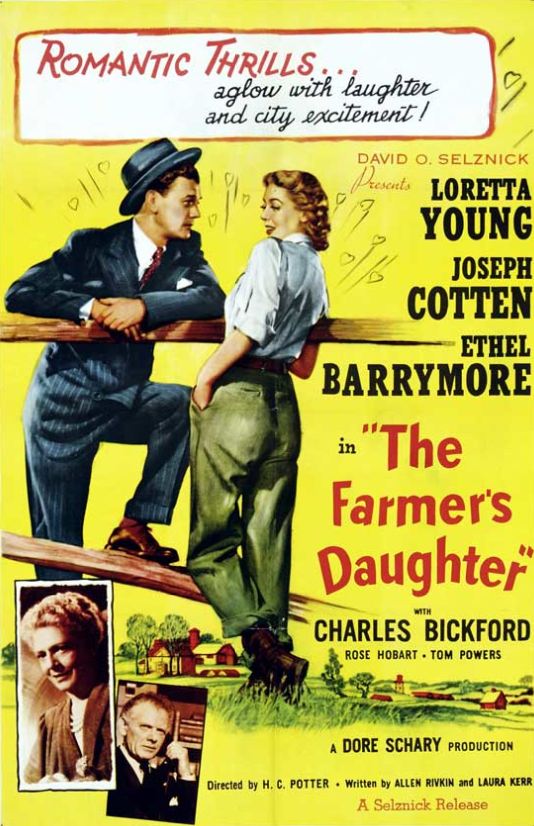
H.C. Potter’s The Farmer’s Daughter has a title that makes it sound as if it might be an extended dirty joke that also involves a traveling salesman, but it’s not. It’s a funny, romantic, and inspiring film about a young woman whose life takes a very different direction than the one she expected it to take when she left home for the big city.

Katrin Holstrom (Loretta Young) lives on a farm in “Redwing County” with her Swedish father and mother (Harry Shannon and Anna Q. Nilsson) and her three brothers, Peter (James Arness), Olaf (Lex Barker), and Sven (Keith Andes). She goes to Capital City (a thinly veiled Chicago) to pursue a nursing degree, but an unscrupulous “friend” of her family named Adolph (Rhys Williams) weasels all of her money out of her and she’s left penniless.

She takes a job as a maid in the palatial home of Agatha Morley (Ethel Barrymore), a grand dame and behind-the-scenes political figure whose son, Glenn Morley (Joseph Cotten), is a congressman. When asked about her qualifications, Katrin tells Ethel that at home, she makes six beds every morning, does the washing and ironing for her three brothers, herself, and mama and papa, cleans all seven rooms and does dishes, helps mama with the canning — preserves, meat, eggs, dill pickles, smoked ham, and bacon — waits on tables (40 hands at harvest time), and makes glögg at Christmas. And that’s just what she does indoors. Outdoors, she plows with a horse and tractor, hoes potatoes, shucks wheat, milks cows, beds horses, butchers pigs, kills and dresses chickens, and cuts wood for both mill and stove.

She’s hired.

She doesn’t mention that she also give back-cracking, limb-twisting, lung-emptying Swedish massages, which she does for Glenn while he’s recovering after falling through the ice while skating with her.

Katrin is also a whip-smart young woman who speaks her mind as easily as she breathes. During a party for political bigwigs at the Morley home, where Katrin is serving drinks, a congressman named Wilbur Johnson (Thurston Hall) says it’s too bad Katrin has only just moved to town, because a vote from a pretty girl like her would have made his victory complete. She responds, “Oh, I’m sorry, sir, if I could have voted, I wouldn’t have voted for you.” He’s taken aback, but her Swedish-accented, lilting, matter-of-fact delivery leaves him speechless.

After the party, Glenn asks Katrin why she doesn’t like congressman Johnson, and she says it’s because he opposes a higher minimum wage. She agrees with Johnson that people should be responsible for themselves, but she believes in a living wage. When Glenn asks her what she means, she responds, “A living wage depends on whether you’re getting it or giving it.”

After Katrin stands up at a political rally and poses a series of hard questions to the Morleys’ candidate, Anders J. Finley (Art Baker), including a number of very specific questions about his record that show she’s done her homework, the opposition party asks her if she’d like to run against Finley for a seat in Congress.

Katrin’s no-nonsense, can-do, take-charge attitude takes her as far in politics as it did back on the farm, but her opposition to the Morleys’ candidate threatens the budding romance between her and Glenn. It also drives her back to her family farm in despair after a vicious smear campaign is launched against her.

As with most political movies, the film is careful not to offend anyone by getting too deeply into hot-button issues. It’s also not very nuanced. By the end of the film, Finley has gone from being a condescending chauvinist to a figure of pure evil who is in league with both gangsters and home-grown fascists.

But The Farmer’s Daughter still manages to be a very funny and occasionally sharp political satire. The script by Allen Rivkin and Laura Kerr is wonderful, and the actors all play their parts to perfection. Ethel Barrymore conveys much without even speaking, and Charles Bickford is especially good as the Morley’s crusty old butler, Joseph Clancy.

Loretta Young was the surprise winner of the Oscar for best actress at the 20th Academy Awards for her role in this film. (Rosalind Russell had been heavily favored for her performance in Mourning Becomes Electra.) I can’t compare Young’s performance to any of the other women who were nominated, because I haven’t seen their films yet, but I think her win was well-deserved. Katrin Holstrom, with her blond hair tied up in coiled buns and her Swedish accent, could have easily been a caricature, but Young imbues her with so much liveliness and depth that I fell in love with her, and was rooting for her all the way.

The Farmer’s Daughter has a light touch, and is very funny, but it’s still an inspiring film. Remember that when it was made, women had only had the right to vote at the national level for slightly more than 25 years, and only 41 women had served in the United States Congress.

It might not be the best movie I’ve seen so far this year, but it is the funniest, warmest, and most moving. Wait … maybe it is the best movie I’ve seen so far this year.

The Egg and I (March 21, 1947)

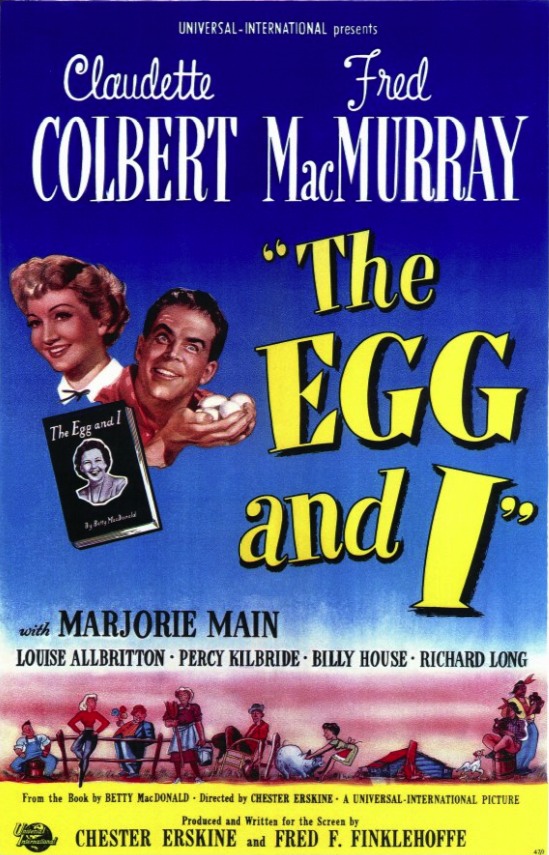
Chester Erskine’s The Egg and I begins with Claudette Colbert dressing down a comical, goggle-eyed Pullman porter. (Was there ever any other kind of Pullman porter in the movies?) The poor fellow drops an egg on the floor of the train car. When he says, “It’s just an egg,” Colbert flips her wig and exclaims, “Just an egg?!?” She asks him if he’s ever stopped to consider how much work it takes to bring an egg into this world. After the chastened porter scurries out, she addresses the camera directly and says, “And I’ll bet you think an egg is something you casually order for breakfast when you can’t think of anything else. Well, so did I once, but that was before the egg and I.”

And then, after the opening credits roll, we’re introduced to Betty MacDonald (played by Colbert), who goes along with her goofily happy, wild-eyed husband Bob’s plan to move out to the country and run a farm.

Bob MacDonald (Fred MacMurray) served in combat in Okinawa, and he’s so happy to be back home that he’s going to make good on his foxhole promise to himself to devote himself to growing things from the soil and raising livestock. Returning to the land. Getting back to basics. The whole nine yards.

Bob actually seems a bit crazy. If this wasn’t a light comedy, I’d say Bob was suffering from post-traumatic stress disorder manifesting as mania. But since it’s a comedy, his zeal is played for laughs. He’s insensitive to everything going on around him. When Betty falls off the roof into a washbucket, he looks down and asks, “What are you doing down there?” He also buys a dog named Sport who’s already bitten everyone in town and can’t be too near livestock. (I hope he didn’t pay too much for him.)

The Egg and I was based on the 1945 best-seller by Betty MacDonald, the author of the popular series of Mrs. Piggle-Wiggle books for children. The Egg and I detailed her real-life experiences as a young woman living on a small chicken farm in Washington State with her first husband, Robert Heskett, from 1927 to 1931. I haven’t read the book, but by all accounts it’s more witty and acerbic than the film adaptation, which suffers from an overabundance of broad comedy.

If you’re in the mood for a slapstick barnyard comedy, however, The Egg and I offers everything you’ll expect — goats eating hats, ramshackle structures, leaky roofs, beds with rusty springs, leaky buckets, rotten boards, Betty sawing off the limb of the tree she’s sitting on, Betty wrestling with a sow and ending up in the mud, and hillbilly stereotypes galore, such as Bob and Betty’s neighbors, “Ma” and “Pa” Kettle, whose front yard has a hand-painted sign that says “beware of the childrun.” When Betty discusses the oldest boy, Tom Kettle (Richard Long) with Ma, and says, “He ought to go to college,” Ma responds, “College?!? What fer?”

Marjorie Main and Percy Kilbride’s earthy performances as Ma and Pa Kettle were so popular in The Egg and I that they went on to star in nine more films as the characters, Ma and Pa Kettle (1949), Ma and Pa Kettle Go to Town (1950), Ma and Pa Kettle Back on the Farm (1951), Ma and Pa Kettle at the Fair (1952), Ma and Pa Kettle on Vacation (1953), Ma and Pa Kettle at Home (1954), Ma and Pa Kettle at Waikiki (1955), The Kettles in the Ozarks (1956), and The Kettles on Old MacDonald’s Farm (1957). Main was even nominated for an Oscar for Best Supporting Actress for her role as Ma Kettle in The Egg and I. (Unsurprisingly, she lost out to Celeste Holm, who co-starred in Gentlemen’s Agreement.)

While The Egg and I was a huge hit in 1947, I can’t say I really enjoyed it. It relied too much on slapstick humor, and Colbert and MacMurray were both much too old for the roles they were playing. I thought it was mostly dumb, and you couldn’t pay me to watch any of the Ma and Pa Kettle films that followed it.*

*This is actually a lie. If you’re interested in paying me to watch any of the Ma and Pa Kettle films, please contact me.

It Happened in Brooklyn (March 13, 1947)

It Happened in Brooklyn
It Happened in Brooklyn (1947)
Directed by Richard Whorf
Metro-Goldwyn-Mayer

I used to be bummed out that I grew up after the era of listening booths in record stores.

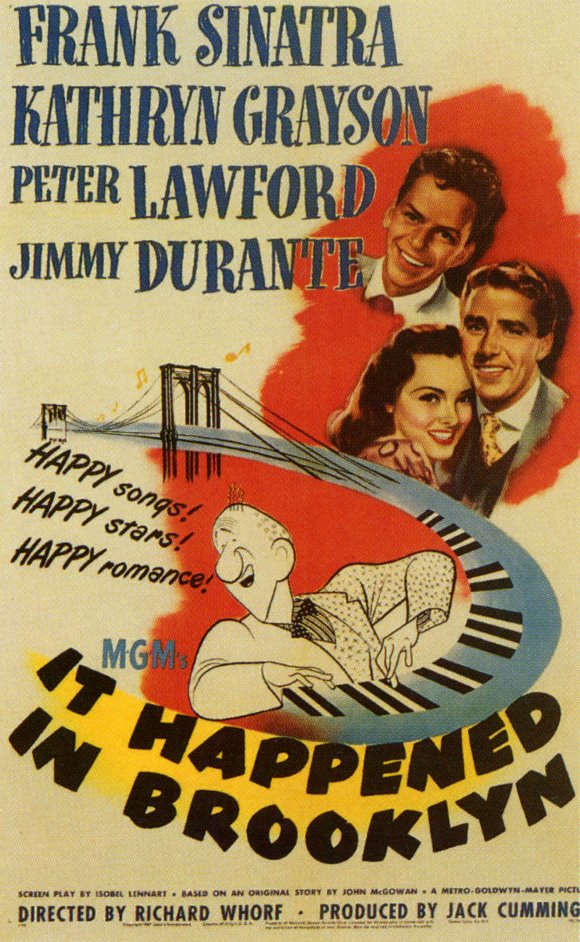
After seeing Richard Whorf’s It Happened in Brooklyn, I’ve realized that as far as regrets go, that’s small potatoes. If this film is to be believed, there was once a music store in Bay Ridge where you could pick out any piece of sheet music and hand it to Frank Sinatra, the in-house “song demonstrator,” and listen to Ol’ Blue Eyes tickle the ivories while he performed it for you. Sure, you had to contend with a teeming crowd of sighing bobby-soxers, but that’s a small price to pay.

When It Happened in Brooklyn begins, Private Danny Miller (Sinatra) has been in the service for four years. World War II is drawing to a close, and he can’t wait to get home to his one true love, Brooklyn.

Danny loves Brooklyn so much that he carries a picture of the Brooklyn Bridge in his wallet. When a pretty Army nurse (Gloria Grahame) from Brooklyn refuses to believe that Danny is really from Brooklyn because he’s so restrained and cool, he pulls out the picture of the bridge and says, “Sure, that’s my pinup girl. Ain’t she a beauty?”

When Danny returns home, a traffic cop asks him why he’s so happy to be in Brooklyn when he could be across the river in New York. Danny looks incredulous and exclaims, “New York? That’s a place to look at Brooklyn from!”

Faced with the post-war housing shortage, Danny moves in with Nick Lombardi (Jimmy Durante), the janitor at New Utrecht High School, Danny’s alma mater. Nick is a kindly old geezer who idolizes the fictional teacher Mr. Chips, and doesn’t understand why all the kids in the school make fun of him.

Danny also befriends a pretty music teacher named Anne Fielding (Kathryn Grayson) and, in a remarkable example of art imitating life, teaches a British drip named Jamie Shellgrove (Peter Lawford) how to be cool.

For an MGM musical, It Happened in Brooklyn is fairly restrained. Unlike Sinatra’s previous film, the Technicolor extravaganza Anchors Aweigh (1945), which also co-starred Grayson, It Happened in Brooklyn is filmed in black and white, clocks in at under two hours, and doesn’t feature any huge production numbers.

Frank Sinatra and Jimmy Durante

Despite this, It Happened in Brooklyn is still a blast, especially if you’re a Sinatra fan. It’s packed with great songs by Sammy Cahn and Jule Styne, including “The Brooklyn Bridge,” “Whose Baby Are You?,” “It’s the Same Old Dream,” “The Song’s Gotta Come From the Heart,” and the classic “Time After Time.” I especially enjoyed Sinatra and Durante’s humorous performance of “I Believe” with a teenaged actor named Bobby Long, who does a great tap number. Does anyone know anything about Long? Why didn’t he ever appear in another movie? Did he have an abrasive personality? Horrible skin? Did he sleep with a producer’s wife after wooing her with his sensuous tap-dancing?

Along with all the great pop numbers, there’s a little “class” squeezed in, too. The classically trained Grayson gets to belt out a couple of operatic numbers — one from Mozart’s Don Giovanni and one from Delibes’s Lakmé — and her student Leo Kardos (Billy Roy) performs a piano concert in hopes of getting a scholarship. (Kardos’s playing was actually done by André Previn, who had just joined the music department of MGM at the age of 17.)

It Happened in Brooklyn is clichéd and occasionally silly, and it doesn’t offer the over-the-top razzle-dazzle of Anchors Aweigh, but it’s still a whole lot of fun.

I’ll Be Yours (Feb. 2, 1947)

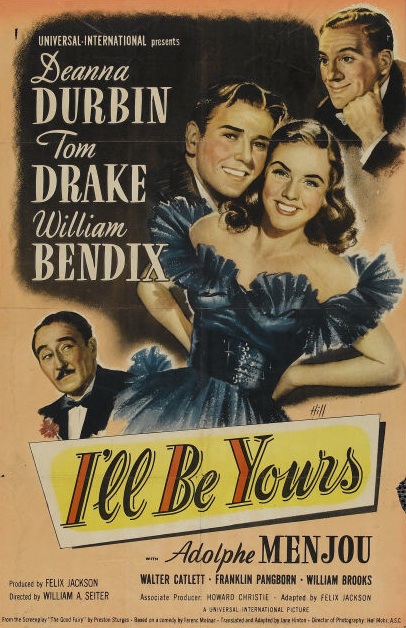
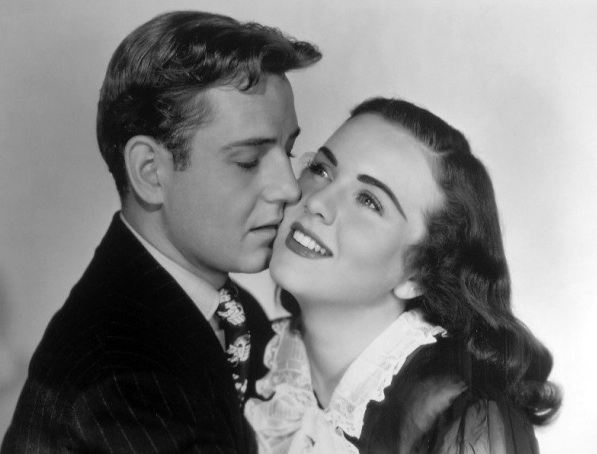
I really liked I’ll Be Yours, and not just because it stars my time-travel girlfriend, Deanna Durbin. It’s a light and frothy romantic comedy — hardly my favorite genre — but the performers are appealing, the humor is genuinely funny, and the musical numbers are great.

Durbin herself can’t be counted among the film’s fans. She retired from acting at the age of 27, after a 12-year career in the movies, and retired to France with her husband. In an interview with David Shipman in 1983, Durbin called her last four films — I’ll Be Yours, Something in the Wind (1947), Up in Central Park (1948), and For the Love of Mary (1948) — “terrible.”

I imagine that Durbin’s negative assessment of her last several films was at least partly due to her dissatisfaction with Hollywood. If she was yearning for a “normal” life and looking for a sign that she should continue acting, I’ll Be Yours is neither groundbreaking nor artful enough to qualify. But if you’re a fan of Deanna Durbin, I’ll Be Yours is wonderful entertainment. She’s as lovely and appealing in it as she was in everything else, and her singing voice was unparalleled among Hollywood ingenues.

In I’ll Be Yours, Durbin plays a naive, wide-eyed young woman with the unwieldy name of Louise Ginglebusher who leaves her hometown of Cobleskill, NY, for a life of excitement in Fun City. While eating lunch on a ridiculously tight budget, she’s befriended by a cranky but kindhearted waiter named Wechsberg (played by William Bendix, another performer who was able to overcome mediocre material).

She’s given a job as an usherette in a palatial movie house by a fellow native of Cobleskill, Mr. Buckingham (Walter Catlett), and shown kindness by a young and handsome lawyer named George Prescott (Tom Drake) who sports an unfortunate Van Dyke beard.

After Wechsberg sneaks Louise into a swanky party he’s working at the Savoy Ritz, she’s snookered into performing a musical number by a philandering millionaire named J. Conrad Nelson (Adolphe Menjou). Naturally, she pulls it off with aplomb, and the song she sings — “Granada” — is a high point of the film.

This leads to J. Conrad Nelson offering Louise a starring role in the Broadway musical he’s financing, but to fend off his advances she invents a husband for herself. In doing so, she underestimates the tenacity of Nelson’s libido. Nelson demands to know who her husband is so he can be put on his payroll and eventually be bought off and done away with.

Forced to produce a husband, Louise turns to Prescott, but his old-man beard will have to go.

All of this is ridiculous, of course, but it’s a thoroughly entertaining vehicle for a quartet of appealing performers. And the music is wonderful.

Felix Jackson wrote the script, which was adapted from Preston Sturges’s The Good Fairy (1935), which was based on a play by Ferenc Molnár. William A. Seiter directed the film.