Tag Archives: Comedy

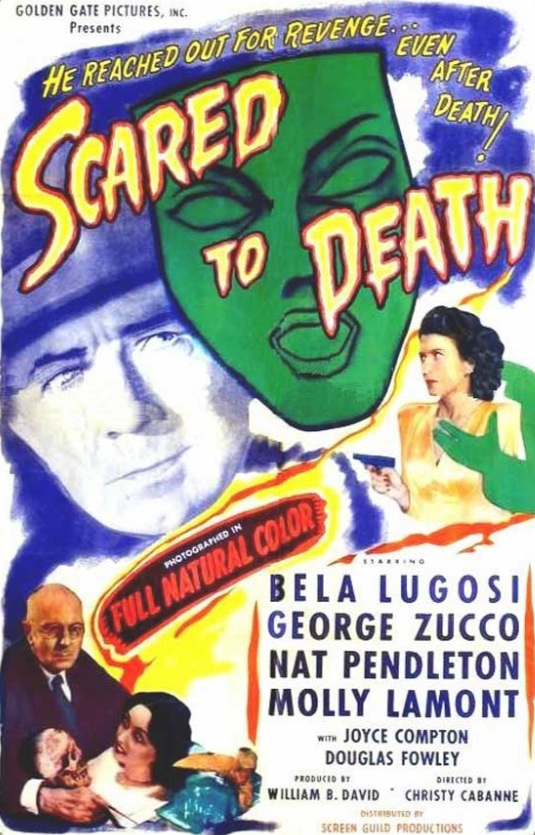
Scared to Death (Feb. 1, 1947)

Christy Cabanne’s Scared to Death is a terrible film, but I had enormous goodwill toward it after the first reel. I get that way when the front door of a house flies open in a movie to reveal Bela Lugosi and little-person actor-extraordinaire Angelo Rossitto standing on the front porch, wearing matching black suits.

If you don’t know Rossitto by name, you might recognize him by sight. He had an incredibly long career in TV and movies, stretching from 1927 to 1987. He was the quiet, dark-haired dwarf in Tod Browning’s Freaks (1932) and Blaster’s better half, Master, in Mad Max Beyond Thunderdome (1985). Unfortunately, he doesn’t have a lot to do in Scared to Death, and the sheer awfulness of the movie ground down all my goodwill to dust by the final reel.

Scared to Death is notable for two reasons — Lugosi only appeared in three color films, and Scared to Death is the only one in which he received top billing. Also, it’s a picture that’s narrated by a dead woman on a slab in a morgue. Trust me when I tell you that neither of these things is a reason to run out and see Scared to Death.

The color process used for Scared to Death was Cinecolor, which is a two-color film process, and it just doesn’t look that good, at least in the public domain print I watched. Also, the narration by the dead woman is interesting at first, but it becomes unbearable after the first dozen or so times her corpse cuts into the action to speak its piece. Part of the problem is that the sound editing is so terrible during the transitions that the viewer will start to dread the corpse’s appearance, especially if the viewer is sensitive to loud, abrupt noises.

Scared to Death is only worth seeing if you love corny old horror-comedies or are a connoisseur of bad films. Lugosi and Rossito are always fun to watch, as is George Zucco, but everyone else in the cast is either flat or intensely grating, like Nat Pendleton, who supplies comic “relief” as the dim-witted police inspector.

Bottom line — among films narrated by a dead person, Scared to Death will never be confused with Sunset Boulevard (1950).

Half-Wits Holiday (Jan. 9, 1947)

I normally don’t review shorts, but Half-Wits Holiday (a reworking of the 1935 Three Stooges short Hoi Polloi) marked a milestone for the Stooges, since it was Curly’s last film.

Curly Howard (born Jerome Lester Horwitz in 1903) had suffered a series of minor strokes in 1945, but during the filming of Half-Wits Holiday in 1946, he suffered a severe stroke, which ended his career. (Curly’s older brother Shemp, an original member of the trio, stepped in, and appeared in dozens of shorts with Moe Howard and Larry Fine until his death in 1955.) Curly lived until 1952, but he was unable to perform during the last years of his life.

In this burlesque version of the Pygmalion myth, a couple of egghead “scientists” — Prof. Sedletz (Theodore Lorch) and Prof. Quackenbush (Vernon Dent) — argue over environment vs. heredity and make a $1,000 bet. Quackenbush believes in environment, and claims he can take a man from the lowest strata of life and turn him into a gentleman after just one month in the right situation and with the proper instruction. Enter the Three Stooges. Guess who’s going to win the bet?

When Quackenbush asks Larry, Moe, and Curly if they’d like to make $1,000, Moe asks, “Who do we have to murder?” (And because it’s Moe, he sounds serious.) Quackenbush’s lovely daughter Lulu (Barbara Slater) is home from college, and offers to help tutor the Stooges (see poster above). A month passes, and the Stooges make their grand entrance in society. Moe and Larry acquit themselves well for a few minutes, but the kleptomaniac Curly bites the diamond ring off of a grand dame’s finger when he kisses her hand, pockets champagne (a word he can’t even pronounce), and steals a load of silverware. And before you can say “Sword of Damocles,” a pie stuck to the ceiling falls on a woman’s face, and the party devolves into a pie-in-the-face-athon.

When I was in high school, I bought a $2 VHS tape featuring two Three Stooges shorts, Disorder in the Court (1936) and Sing a Song of Six Pants (1947). I watched it frequently, which led my mother to declare the Three Stooges entartete Kunst.* She even compared them with New Kids on the Block, as a high-water mark of how pop-culturally unenjoyable I should find them. But you know what? I refused to apologize for loving the Three Stooges when I was 15, and I refuse to apologize today.

Unlike every single other genre, I judge comedy by only one criterion — does it make me laugh? The Three Stooges may be aggressively lowbrow, but they crack me up every time. I love them. There, I said it. I’ll say it again. I love the Three Stooges. I would marry them if I wasn’t already married and they weren’t all dead.

*It’s just an expression. My mom’s not a Nazi.

Sioux City Sue (Nov. 21, 1946)

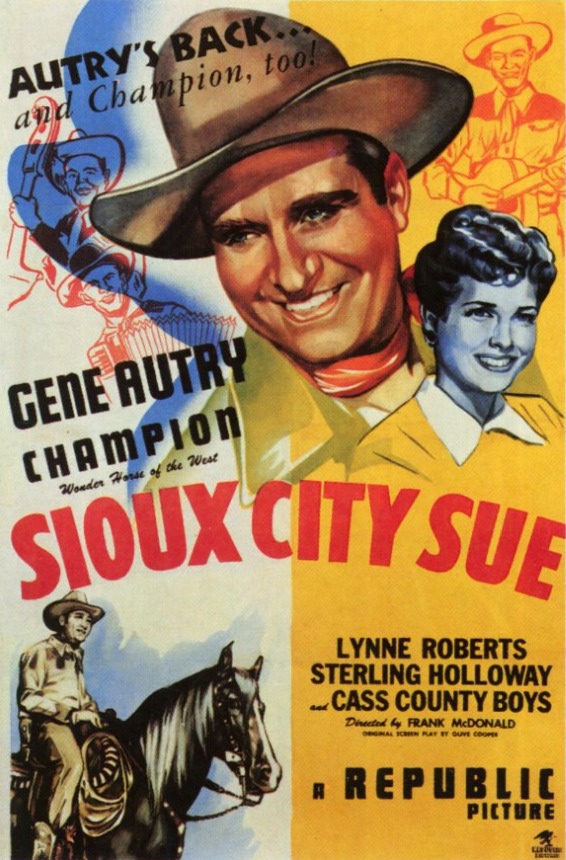
Frank McDonald’s Sioux City Sue repurposes the script from the 1939 comedy She Married a Cop and takes its title from one of the most popular songs of 1946. It was Gene Autry’s first film after he completed his service in the Army Air Corps during World War II.

More comedy than western, Sioux City Sue is lightweight fluff, but if you like Autry’s music, there’s plenty of it. (Although, if you’re like me, you’ll be a little sick of the title song by the end of the picture.)

In a plot that makes no sense if you stop to think about it for longer than half a second, a pretty blond Hollywood talent scout named Sue Warner (Lynne Roberts) casts Autry in an upcoming movie without telling him that he’ll never actually appear onscreen and is in fact voicing a singing donkey in an animated feature.

Things have changed a lot. Now, Hollywood stars regularly lend their voices to animated features. It’s nice work if you can get it; no time in the makeup chair, no difficult location shooting, and you can take your toddlers to the premiere. But in 1946, no star would ever dream of being in a cartoon. It’s hard, though, not to be delighted and amused by the premiere of the cartoon feature in Sioux City Sue. The little donkey with Autry’s voice, singing to his sweetheart on horseback, both of them wearing western duds, is pretty gosh-darned cute.

But Autry’s been lied to, and that rightly doesn’t sit well with the man. Of course, during the making of the film, Sue fell in love with him, so the big question for the second half of the picture is whether or not she’ll be able to convince him she’s sorry. She does her darnedest, quitting her job and coming to work on his ranch as a cook and general menial laborer.

This being a Republic western programmer, there’s an action-packed climax, and it’s up to Autry and his wonder horse Champion to save the day. The last few minutes of the picture, which involve a dynamited dam, a flood, and a cattle stampede, are exciting. But for the most part, Sioux City Sue is a laid-back and easygoing good time.

Easy to Wed (July 25, 1946)

Easy to Wed is a remake of Jack Conway’s 1936 comedy Libeled Lady, which starred Jean Harlow, William Powell, Myrna Loy, and Spencer Tracy. No actors of that caliber appear in Edward Buzzell’s update, which is a lightweight affair from start to finish.

I haven’t seen Libeled Lady, but it was nominated for an Oscar for best picture, and is generally well-regarded in the pantheon of screwball comedies. Easy to Wed is generally regarded as a crummy piece of fluff, and that’s exactly what it is. Like the last MGM Technicolor extravaganza I saw, Ziegfeld Follies (1946), this movie is too long, is jam-packed with everything but a compelling plot and interesting characters, and its humor is mostly of the “painfully unfunny” variety.

The plot can be synopsized on the back of a cocktail napkin. Warren Haggerty (Keenan Wynn), the publisher of the Morning Star, is all set to marry his girl, Gladys Benton (Lucille Ball), but he and his paper are being sued for $2 million by J.B. Allenbury (Cecil Kellaway) after a story they published insinuated that Allenbury’s daughter, Connie (Esther Williams), is a nymphomaniac who goes after married men. The soundest plan Haggerty can come up with is to finagle his star reporter, Bill Chandler (Van Johnson), into a compromising position with Connie so they can produce photographic evidence that she is, indeed, a nympho who goes after married men. The only hitch is that Chandler is single, so Haggerty needs to hand off Gladys to him for a sham marriage for the duration of his assignment. Ridiculous? Sure.

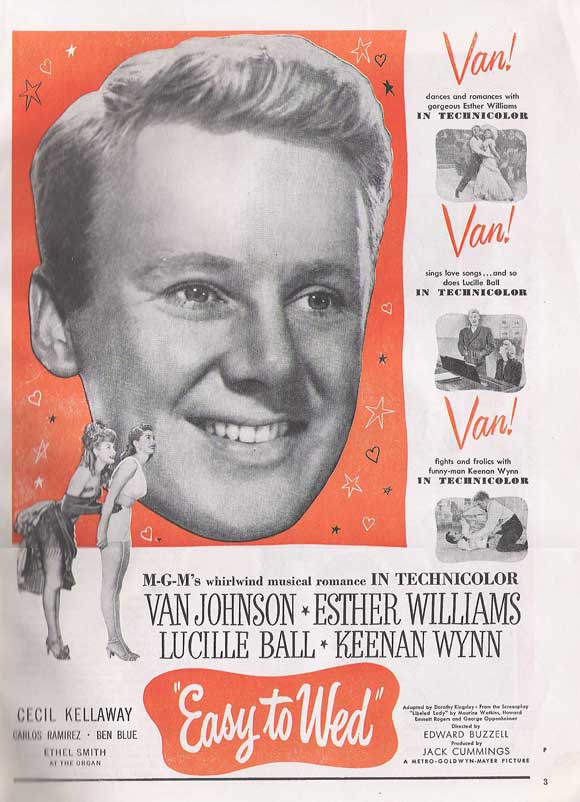
At the time of the film’s release, one of its biggest draws was its leading man, Van Johnson. His appeal mystifies me. There’s nothing wrong with him, but I find his blandness overwhelming.

It’s not that I don’t like movies he’s been in — Thirty Seconds Over Tokyo (1944), in which he plays a heroic bomber pilot, was one of my favorite World War II movies made during the war — but I’d never go out of my way to see a movie just because he was in it, which makes me different from approximately every single woman living in America in the 1940s. I mean, check out that poster above. “Van! … Van! … Van!” What?

Intellectually, I can understand his appeal for the distaff post-war zeitgeist. The metal plate in his head may have kept him out of the war, but he was in enough war movies to give the impression of a returning hero. And unlike the haunted, shell-shocked, sweaty protagonists of countless noirs, Johnson projects nothing but good-natured cheer. He’s the young man you want your daughter to marry, or the even-tempered buddy you introduce to your sister.

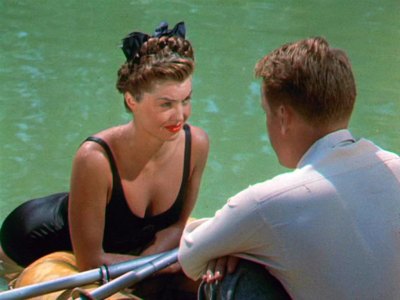
The main selling point of Easy to Wed for me was Esther Williams. There are none of her signature water ballet numbers, but she does spend a lot of time in the water. (Her first kiss with Johnson even takes place underwater.) She is beautiful and sexy, and emerges from the water many times in the picture, sleek and dripping, her makeup still perfect. But she’s beautiful on land, too, and looks great in Technicolor, whether she’s playing a board game by the fire or fully decked-out, singing and dancing in one of the film’s several passable musical numbers.

Besides Williams, the only thing I really liked about Easy to Wed was the crazily outfitted Ethel Smith, who performs a wild musical number at the organ. It’s a scene that borders on the surreal, and I loved it.

A Scandal in Paris (July 19, 1946)

This early film by renowned director Douglas Sirk is based on the life of Eugène François Vidocq, who was the founder of the Sûreté Nationale police force, and is generally regarded as the world’s first private detective. What makes Vidocq fascinating is that he became a crime-fighter only after a fairly lengthy career as a criminal.

Sirk’s film is only very loosely based on Vidocq’s ghost-written memoirs. Vidocq was the father of modern criminology. He is credited with the introduction of modern police methodology and record-keeping, as well as things we now take for granted, such as undercover work, ballistics, and plaster casts of footprints, but you won’t see much of this in A Scandal in Paris (which was also released under the title Thieves’ Holiday). It’s a lighthearted and romantic picaresque adventure in which the focus is firmly on Vidocq’s career as a rake and a rapscallion. The closest he comes to doing any actual police work is when he goes to elaborate and clever lengths to pin his crimes on a romantic rival.

In the world of the film, Vidocq was born in 1775, and came from a poor, honest family, “a little poorer than honest,” he says in voiceover. His mother stole a loaf of bread every time she went into labor in order to give birth in the only shelter available to her — prison. Vidocq claims his mother stole 11 loaves of bread and gave birth to 11 children. He spent the first 30 years of his life engaged in all matter of villainy, and used many surnames, since his father’s name was unknown.

Except for the year of his birth, none of the specifics match the official record, but George Sanders, who plays Vidocq, is such a smooth and engaging performer that I didn’t really care. When he breaks out of prison on his birthday with a file baked into a cake brought to him by the jailer’s daughter, he does so in the best tradition of cinematic Lotharios who can’t utter a true statement to save their lives, but whom you just can’t help but like.

Douglas Sirk was born “Hans Detlef Sierck” in Germany to Danish parents. He grew up in Denmark, but moved to Germany as a teenager. By 1942, he had emigrated to the United States, and was directing the stridently anti-Nazi film Hitler’s Madman (1943), which was made for the Poverty Row studio P.R.C., but was bought and distributed by the prestigious M-G-M. He directed nearly 50 films in Danish, German, and English, but today his reputation rests mainly on the lush melodramas he made in the ’50s, such as All That Heaven Allows (1955), Written on the Wind (1956), and Imitation of Life (1959).

A Scandal in Paris hasn’t gone down in history as a masterpiece, but it’s a pretty good film; light and fluffy, but always visually arresting and with plenty of sly humor. For instance, when we’re told two years have passed while he served in the army, Sanders as Vidocq says that this period of his life was omitted “Out of concern for ‘censorship (military).'”

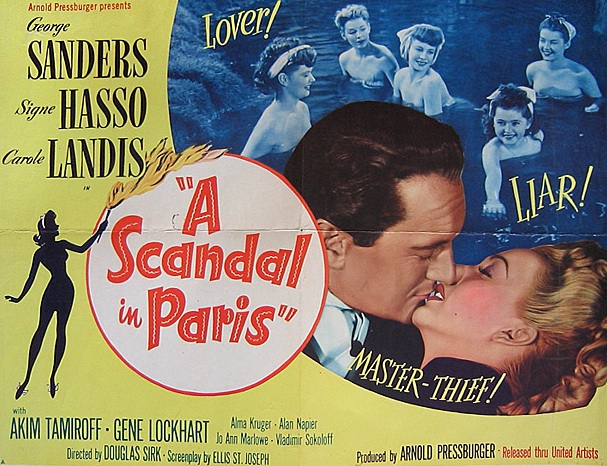
There are a number of interesting motifs running through the film, too. One of these is the English myth of St. George and the dragon. After Vidocq and his cellmate Emile (Akim Tamiroff) escape from prison, they pose for a painting as St. George and the dragon, respectively, before escaping on horseback, still in costume. The painting of them will later show up on a wall of the estate owned by Marquise de Pierremont (Alma Kruger) and Houdon de Pierremont (Alan Napier), the minister of police. Their daughter, Therese de Pierremont (Signe Hasso) falls in love with Vidocq’s image. When she meets him in the flesh, he rides to the rescue of a bunch of bathing beauties (see the poster above) who are terrified by a snake slithering along the banks of a river. Vidocq rides by, and like St. George, kills the serpent. He does so with a nonchalant lash of his riding quirt, not a lance, but the effect is the same. Therese swoons.

The scene is played lightly, as is everything else in the picture. Throughout, Sirk seems to be mocking traditional notions of heroism. Sanders is the perfect actor for the role. He never winks at the camera, but there always seems to be a joke that only he is in on. Lines like, “In crime, as in love, there are only those who do, and those who don’t dare,” could have been awfully clunky coming out of another actor’s mouth, but Sanders’s delivery is perfect.

The Bamboo Blonde (July 15, 1946)

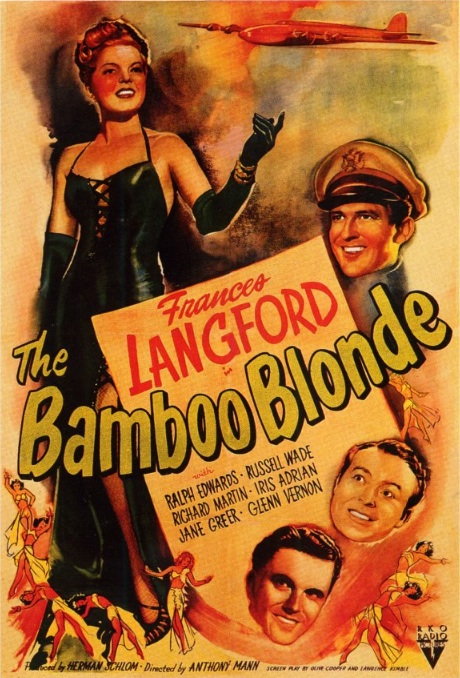
Anthony Mann’s The Bamboo Blonde is a cute little World War II-era programmer based on Wayne Whittaker’s story “Chicago Lulu.” It’s a romantic comedy, but there are nearly enough songs to qualify it as a musical. There are also nearly enough bombing raids over Japan to qualify it as a war movie, but the tone is so light that all the death and destruction on the ground is just there to provide a context for the saucy pinup girl painted on the nose of the bomber. It’s a fun romp — hell and gone from the westerns and noirs on which Mann’s reputation currently rests, but a thoroughly enjoyable way to kill 67 minutes during the dog days of summer.

The film begins with a magazine reporter named Montgomery (Walter Reed) interviewing Eddie Clark (“Truth or Consequences” host/creator Ralph Edwards), the mile-a-minute talker who runs Bamboo Blonde enterprises, an enormous conglomerate that operates a recording studio, furniture manufacturer, hosiery company, cosmetics line, and more. The reporter wants to know how the company got started, and when Eddie finally tires of trying to push Bamboo Blonde brand candy bars on the poor guy, he settles in to tell the story. It all started, Eddie explains, “Around the time Japan was finding out the B-29 wasn’t another American vitamin.”

The picture then begins in earnest, and we see the Ransoms, a wealthy family from Bucks County, Pennsylvania, tearfully send their son, Patrick Ransom, Jr. (Russell Wade), off to war. I say “tearfully,” but I can’t remember if there were any actual tears. The send-off was so wrought with emotion, however, that the presence of waterworks is beside the point. The Ransoms are the type of blue bloods who think nothing of Junior kissing mom on the mouth to say goodbye.

After cutting — or at least loosening — the umbilical cord, young Ransom wanders into Eddie’s Club 50, heedless of the sign outside barring all servicemen from entering. A couple of MPs walk out of the back office, and a perky little blonde named Louise Anderson (Frances Langford) acts quickly, hiding Ransom behind some curtains and then walking onstage to perform the song “I’m Good for Nothing But Love.”

Ransom is the new skipper of a bomber crew, and as the new guy, his boys had sent him to the club as a practical joke, or, as Ransom explains it to Louise over dinner, “Sending me here was a tactical maneuver to ditch me.” The two hit it off right away, and go on the kind of date that was really “on the beam” for the greatest generation, and is still pretty fun today. It starts with dinner at a restaurant with red and white checked tableclothes and candles stuck in bottles that’s run by a woman named “Mom” (Dorothy Vaughan) and it ends in a photo booth. The only thing that seems weird by today’s standards is that Louise sits in the photo booth alone, and Ransom ends up with a little framed photo of her.

That little framed photo will lead to big things. After a disastrous series of runs in the Pacific, Ransom’s B-29 has the worst record in the Air Force, without a single Zero downed. To turn their luck around, one of the guys borrows Ransom’s photo of Louise and paints an Alberto Vargas-style pinup of her with a stacked body “painted from memory.” After a long argument about what exact color hair their sexy new mascot has, they settle on “bamboo blonde,” and they’re well on their way to becoming “that nightmare to the Nips,” as Eddie Clark will later describe them.

The only problem is that Ransom’s crew thinks that Louise is his girlfriend, and he hasn’t disabused them of the notion, even though he has a dark-haired fiancée back home named Eileen Sawyer (Jane Greer, who shows a little bit more of that Out of the Past malevolence than she did in Sunset Pass, which was released a week before this picture). Eileen is a real harpy, and her interest in Ransom is only rekindled because of his growing fame. Meanwhile, Louise first learns that she’s been painted on the side of a bomber while reading a copy of Look magazine that has a picture of Ingrid Bergman on the cover wearing a nun’s habit (presumably from the 1945 film The Bells of St. Mary’s). You don’t have to be a genius to foresee the romantic complications that will arise once Ransom and his boys are called back home for a USO tour with Louise to help sell war bonds.

This is all frothy nonsense, of course, but Mann keeps things moving at a nice clip. Even when working with material that was clearly beneath him, such as this picture and Strange Impersonation (1946), he was able to craft something that was darned watchable. Langford was a classically trained singer, and has a really beautiful voice, which helps. (She was a radio star, and spent a lot of time as a USO performer.) For the most part, the musical numbers are staged in a straightforward fashion, but Mann takes a left turn into the realms of the surreal when Louise sings “Right Along About Evening.” Not only is everything in the idyllic farmland backdrop labeled (e.g., “mailbox,” “dog”), but it end with her rolling up a suddenly two-dimensional Ransom and stuffing him under her pillow before she goes to sleep. Truly odd.

I See a Dark Stranger (July 4, 1946)

Frank Launder’s I See a Dark Stranger, which premiered in the United Kingdom on July 4, 1946, is half a loaf of noir slathered with generous helpings of romance and comedy. It’s a very enjoyable picture that’s notable as a star vehicle for the lovely Deborah Kerr before she was well-known in Hollywood.

The opening of the film is pure noir. Shadows fall heavily on the quiet nighttime streets of a little town with signs all about in French. A panicked man rushes through the town, searching for something. Suddenly there’s a shot of something that doesn’t quite fit, and the narrator’s voice appears on the soundtrack. “An Isle of Man signpost outside a French town,” he says. “That’s odd. But we’ve started this tale at the wrong moment.”

He goes on to tell us that this is really the story of Bridie Quilty (Kerr), and we see the young woman in the pub where she works as she eavesdrops on her father’s boozy tales of the Irish Revolution, rapt, even mouthing the words of his story at one point. Bridie hates the English and the memory of Oliver Cromwell as much as the most hardened member of the I.R.A. does, and wants nothing more than to join the group when she reaches the age of majority, just like her father did. The film treats her fervor lightly, however, and right off the bat the viewer knows that this coming-of-age story will contain a fair measure of disillusionment for its protagonist. But not, of course, before she gets in over her head.

As soon as Bridie turns 21, she heads for Dublin to make contact with a former compatriot of her father, a man named Michael O’Callaghan (Brefni O’Rorke). Far from the fearsome soldier she expected, O’Callaghan is a mild-mannered curator of a museum who doesn’t seem to mind seeing a large painting of Cromwell every day and feels that the terms of the Government of Ireland Act 1920 that partitioned the country were fair enough, which boggles Bridie’s mind. More significantly, he seems to have never heard of her father, which should raise a red flag, but doesn’t, since Bridie is as bull-headed as she is patriotic.

Undeterred by her experience in the museum, Bridie looks for resistance where she can find it, and falls in with a man named Miller (Raymond Huntley). He appears at first glance to be a rumpled Englishman, but Bridie learns that he’s a spy working against the English, so she goes to work for him without a second thought.

Bridie is blithely unaware of politics outside of Ireland and the U.K., and the film is clever enough to share her point of view for some time. Astute viewers, of course, will immediately be able to suss out exactly which nation Miller is spying for, but it’s not directly stated for awhile. As far as Bridie’s concerned, the enemy of her enemy is her friend. After hearing how much Bridie hates every last Englishman, Miller says to her, “For a subject of a neutral country, aren’t you being a little belligerent?” Bridie responds, “There’s nothing belligerent about it. It’s entirely a question of which side I’m neutral on.”

As I said, I See a Dark Stranger is a mixture of noir and comedy. It’s heavier on the comedy than it is on the thrills, especially toward the end, but for the first half, there are some sequences that wouldn’t be out of place in any other espionage potboiler, such as the scene in which Bridie has to dispose of a corpse, and comes up with the ingenious notion of putting the body in a wheelchair and pushing it through town as though she’s just taking an old man for a walk (she’s really heading for the cliffs overlooking the ocean). It’s never very serious, though, and the film is generally more interested in humorous situations and amusing characterizations than it is in plot points.

Kerr is fantastic, and carries the picture with ease. Trevor Howard is great, too. He plays Lt. David Baynes, a Brit who becomes infatuated with Bridie and realizes too late the amount of trouble she’s in. There are also two very funny caricatures of stiff upper-lipped British policemen, Capt. Goodhusband (Garry Marsh) and Lt. Spanswick (Tom Macaulay) who may very well have served as the inspiration for Hergé’s comic characters Dupont et Dupond (Thomson and Thompson in English translation), two detectives who are indistinguishable from each other. Spanswick and Goodhusband are both bald, have neat little black mustaches, and say things like “Cheerio, old boy.” By the end of the picture, however, they’re allowed to grow out of their stereotyped roles, are fairly easy to tell apart, and even get a few intentionally funny lines, such as when Spanswick says to a hotel manager who is afraid that German prisoners of war may have escaped from the nearby internment camp to hide out in her hotel, “If the food I’ve had here is anything to go by, they’re more likely to escape from the hotel and beat it for the internment camp.”

Without Reservations (May 13, 1946)

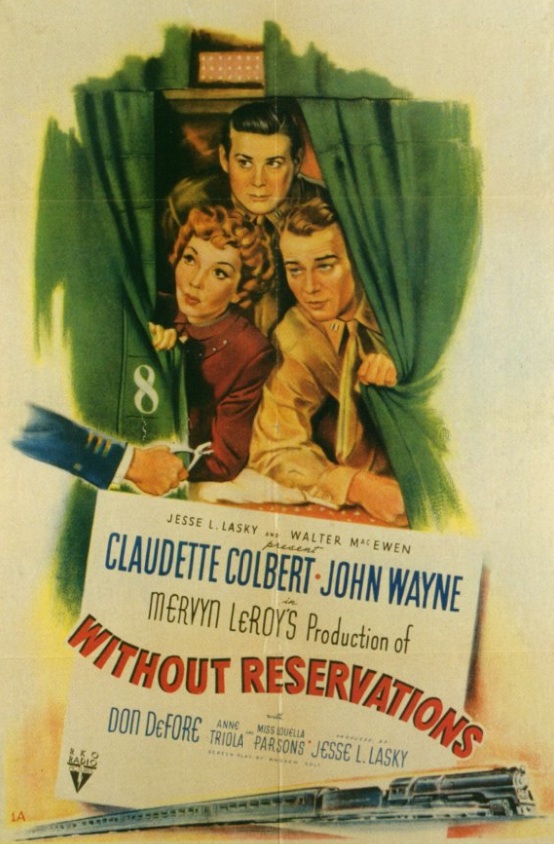
Mervyn LeRoy’s Without Reservations is the kind of old-fashioned romantic comedy that frequently has adjectives like “sparkling” and “breezy” attached to it. It’s also the last film in which John Wayne appeared as one of the leads but did not receive top billing. Claudette Colbert’s star power still shone pretty brightly in 1946.

I thought that LeRoy’s previous film, Thirty Seconds Over Tokyo (1944), was one of the best World War II films I’ve ever seen, so I was looking forward to seeing Without Reservations, but found it mediocre. I enjoyed it, but I didn’t love it.

In the film, Colbert plays Christopher “Kit” Madden, a sort of socially progressive version of Ayn Rand. Her novel Here Is Tomorrow is a runaway best-seller, and is the one book it seems that everyone in post-war America has read. When the film begins, Kit is arguing with film producer Henry Baldwin (Thurston Hall), who is unable to fulfill his promise to secure Cary Grant for the part of Mark Winston, the protagonist of Here Is Tomorrow. Kit won’t consider making the picture without Cary Grant, and begins drafting a letter while traveling by train that will stop production of the film. Anyone who’s been paying attention, however, will notice that the heroic painting of Mark Winston on the cover of her novel looks an awful lot like John Wayne, and will probably be able to predict what will happen next.

Sure enough, Kit meets two Marine pilots, Rusty Thomas (John Wayne) and Dink Watson (Don DeFore), on the train. As soon as she lays her eyes on Rusty, she realizes he’s perfect for the role of Mark Winston, and immediately begins to rewrite her letter. Since she introduces herself only as “Kit,” and the novel was published under her full name, Dink and Rusty don’t realize that she’s the most popular author in America. When she asks Rusty what he thinks of the novel Here Is Tomorrow he rips into it with abandon. His main complaint seems to be that the romance in the novel is unconvincing. Mark Winston, a progressive with grand plans to remake America, is chased around by a woman, but they can’t make things work because she’s a political reactionary.

In reality, of course, it’s Kit who’s the progressive (Mark Winston is merely her mouthpiece) and Rusty who’s the reactionary. Without Reservations is based on the novel Thanks, God! I’ll Take It From Here, by Jane Allen and Mae Livingston. I haven’t read the novel, but if the film is in any way faithful to its source material, the title comes from a speech Rusty makes about the first men in America. According to Rusty, no amount of political disagreement is enough to keep a man and a woman apart if they’re hot for each other. (Can you sense, yet, where the film might be heading?)

Angry about the grand plan laid out for society in Here Is Tomorrow, Rusty says to Kit, “Have you ever heard of some fellows who first came over to this country? You know what they found? They found a howling wilderness, where summer’s too hot and winter’s freezing. And they also found some unpleasant little characters who painted their faces. Do you think these pioneers filled out form number X6277 and sent in a report saying the Indians were a little unreasonable? Did they have insurance for their old age? For their crops? For their homes? They did not. They looked at the land and the forest and the rivers. They looked at their wives, their kids, and their houses. And then they looked up at the sky and they said, ‘Thanks, God. We’ll take it from here.'”

Watching the film in 2010, I found it hard to believe that no one from the Tea Party movement has latched onto this scene and played it on JumboTrons across the country, since its simplistic vision of America’s beginnings and total opposition to the federal government and even the most basic of social programs seem so close to that movement’s weltanshauung. Not to mention that the speech is delivered as only John Wayne can.

There’s a lot of great stuff going on here, and Wayne and Colbert have decent chemistry, even though he’s not that well suited to playing a romantic lead, especially in a comedy. If Without Reservations had kept up the momentum it establishes in its first couple of acts, I would have really liked it. Unfortunately, it goes off the rails and becomes a meandering road movie.

But not before Rusty, Kit, and Dink run afoul of one of the Pullman porters when they stack up the tables in the club car and have Kit “fly a plane” with a stand-up ashtray for a yoke. The drunken Kit eventually falls over, knocking everything to the ground. Like a bunch of goons, they run off, leaving the mess for one of the porters to clean up while they hide in one of the sleeping compartments (see the film’s poster above).

Once on the road, they buy a flashy sports car from its exasperated owner, and it constantly breaks down. They stay with a colorful Mexican family with a hot and spicy daughter named Dolores (Dona Drake) and a fiery patriarch, Señor Ortega (Frank Puglia), who teaches Kit a few things about love, namely how brutal, selfish, and turbulent it is, and should be. “Love and violence walk hand in hand, señorita!” he says.

The strangest thing about Without Reservations is that Colbert and Wayne do not appear in the same scene at any point during the last act of the film. Kit galivants around Hollywood with a series of leading men in an effort to make Rusty jealous, and the viewer is treated to cameos by Cary Grant (playing himself) and Raymond Burr (still young and trim enough to play an up-and-coming leading man named “Paul Gill”). In these sequences it makes sense for Colbert and Wayne to not appear together, since they’re in different physical locations, but when Rusty finally gives in and appears on Kit’s doorstep, we hear him ringing her doorbell and see her run out of her bedroom downstairs to let him in, but the camera pans right and stops and lingers on a shot of her bed as we hear her greet him off screen. Fade to black. It’s about as subtle as a train going into a tunnel.

I know there are legions of people who think Colbert was the epitome of class, beauty, and charm, but I found her unappealing in this film. With her little stick body, hunched shoulders, spastic movements, short hair in a tight perm, and heavy makeup, she looked to me like an eighty-year old woman with a forty-year old face.
Abbott and Costello in Hollywood (Oct. 5, 1945)

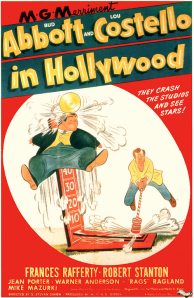
AbbottCostelloHollywoodAbbott and Costello were one of the most popular comedy teams of the ’40s. They’re still famous for their “Who’s on first?” routine, and a lot of their film and radio work is still funny, as long as you’re in the mood for their old-fashioned brand of burlesque antics. If you’re not in the mood for them, or if one of their bits falls flat, Lou Costello is the most irritating man on earth.
In Abbott and Costello in Hollywood they play a couple of bumbling barbers named Buzz Kurtis (Abbott) and Abercrombie (Costello). Who’s ready for lots of physical humor involving shaving cream and shoe polish?

When we first meet the boys, they’re in the supply room of Hollywood Shop: Barbers to the Stars. Even if you’ve never seen an Abbott and Costello picture before, as soon as you see Abbott instructing Costello on how to shave a customer’s face without cutting him while Costello listens attentively, holding a straight razor poised above a balloon covered with shaving cream, you’ll know the balloon is not long for this world. If you have seen an Abbott and Costello picture before, you’ll know that after the balloon breaks and sprays shaving cream all over Costello’s face, there will be a second balloon. Will there be a third balloon? I don’t want to give anything away.

Thankfully, the movie doesn’t coast on barbering gags, since Abbott and Costello decide they want to be Hollywood agents at around the 30-minute mark. As with any Abbott and Costello picture, however, the plot is secondary to gags and wordplay, so it doesn’t really matter whether they’re playing geologists or Portugese noblemen. A lot of the routines in this movie are clunkers, but a few are laugh-out-loud funny, such as the one in which Costello hides out by pretending to be a dummy on the set of a western, and finds himself being punched in the face and thrown over a balcony in take after take by craggy-faced tough-guy character actor Mike Mazurki.

Most of the “stars” they meet in Hollywood (like Rags Ragland) are long forgotten, but if you keep your eyes peeled, you’ll see a young Lucille Ball in a small role.

Lady on a Train (Aug. 17, 1945)

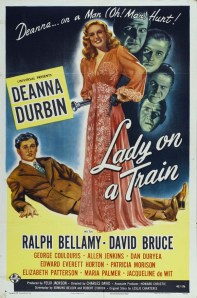
LadyOnATrainDeanna Durbin is an absolute delight in this farcical murder mystery. Durbin, a native of Winnipeg, Manitoba, was once one of the biggest stars in Hollywood, but never made a movie after 1948. (She currently lives in a small village in France, grants no interviews, and is reportedly very happy.) In Lady on a Train, she plays a young woman named Nicki Collins. When the film begins, Collins is sitting by herself in a compartment on a train entering New York on an elevated line. She has come from San Francisco to spend the holidays with her wealthy businessman father, and is currently engrossed in a mystery novel called The Case of the Headless Bride. When the train is briefly delayed, she looks out the window of her train car and witnesses a murder. Through a lighted window, she sees a young man beat an older man to death with a crowbar. She never sees the murderer’s face, however, and when she reports the murder to the police, the desk sergeant dismisses her report as the product of the overheated imagination of a girl who loves murder mysteries and can provide no real specifics of where she was when she saw the murder. Also, it’s Christmas Eve, and who want to traipse around looking for a murder that may or may not have occurred somewhere in Manhattan north of Grand Central Station?
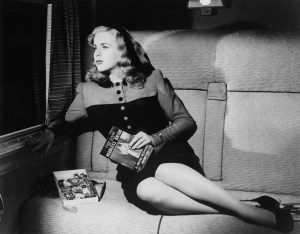
Undeterred, Collins calls up Wayne Morgan (David Bruce), the author of the mystery novel she was reading, and insinuates herself into his life, much to Morgan’s fiancée’s chagrin. After interrupting Morgan on a date at the movies, Collins see the murder victim in a newsreel, and identifies him as Josiah Waring, a shipping magnate. She heads to the Waring estate, where she is mistaken for Circus Club singer Margo Martin, who was Waring’s girlfriend. This allows her to sit in on the reading of Waring’s will, which leaves $1 to his nephew Arnold (Dan Duryea), $1 to his nephew Jonathan (Ralph Bellamy), and the rest of his substantial fortune to Martin.

Sure enough, Collins discovers that Martin has been murdered, throwing suspicion on the Arnold nephews and putting her in a tight spot, since she’s now performing at the club as the murdered girl.

DurbinLady on a Train is part mystery, part musical, part noir, part comedy, and part romance. The most surprising thing about this movie is that each element works perfectly, and they all complement one another. (Calling this film a noir is stretching it, but the final chase in a warehouse contains some striking chiaroscuro shot constructions, and is as tense as one could ask for.) Lady on a Train is also a delight for Durbin fetishists, since she has a different outfit and hairstyle in literally every scene. Sometimes the changes are subtle, but occasionally they’re impossible to miss, such as the scene in which she comes in out of the rain and is suddenly wearing gravity-defying, Pippi Longstocking-style braided pigtails.

Durbin made her film debut in Three Smart Girls (1936) at the age of 14. Apparently she was so popular that she singlehandedly saved Universal Pictures from financial ruin. Here, at the age of 23, she’s a joy to watch. Unlike a lot of former teen stars, she reached maturity while retaining all of her youthful charm, without ever seeming childish or forced.