Tag Archives: Film Noir

The Dark Corner (April 9, 1946)

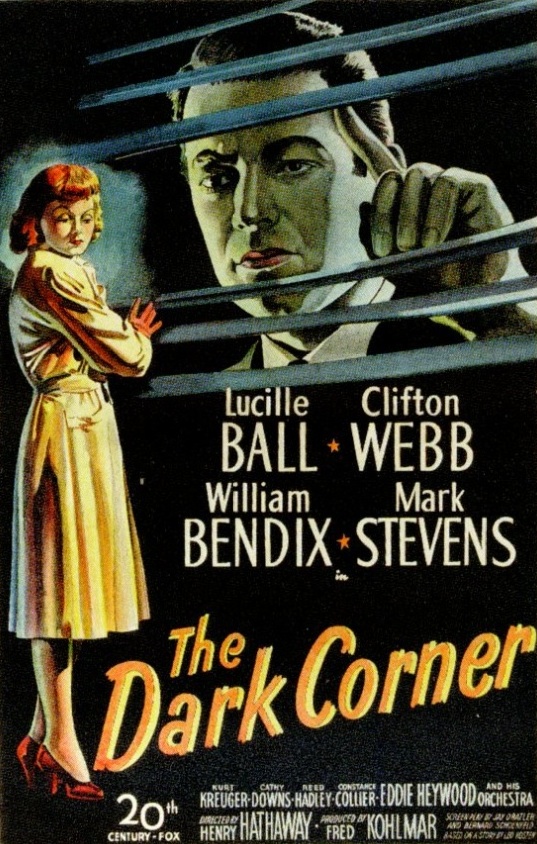
If someone were to say to me, “What exactly is a film noir? I don’t think I’ve ever seen one,” I might direct them to Henry Hathaway’s The Dark Corner. Not because it’s the greatest noir I’ve ever seen, but because it contains so many “noir” elements; a tough-talking P.I. and his sexy secretary, blackmail, frame-ups, violence, creative use of shadows and low-angle shots, and a plethora of quotable tough-guy dialogue like “I can be framed easier than Whistler’s mother.” It’s also not a picture that’s attained the status of a true “classic” like Double Indemnity (1944) or The Big Sleep (1946), so no one’s going to be distracted by great acting, iconic characterizations, or a brilliant storyline. This is pulp. Pure and unvarnished.

I love pulpy noir, so I really enjoyed The Dark Corner. On the other hand, I first saw this movie less than a decade ago, and only remembered one scene, in which one character pushes another out of a skyscraper window and then calmly walks to his dentist appointment. I have pretty good recall, especially when it comes to films, but I didn’t remember anything about this movie, not even after watching it again. Nothing came back. And I have a feeling that I won’t remember much about it 10 years from now, either.

But that doesn’t change the fact that I enjoyed the heck out of it while I was watching it. Mark Stevens isn’t an actor who ever made a big impression on me, but he’s a passable lead. As private investigator Bradford Galt, he delivers his lines with the speed and regularity of a gal in the steno pool pounding the keys of a Smith Corona typewriter. Galt is the kind of guy who makes himself a cocktail by grabbing two bottles with one hand and pouring them into a highball glass together. He’s also the kind of guy who probably wouldn’t do well in today’s litigious corporate environment. When he tells his newly hired secretary Kathleen Stewart (Lucille Ball) that he’s taking her out on a date, she asks, “Is this part of the job?” He responds, “It is tonight.”

It turns out that he’s (mostly) telling the truth, and the reason he’s taking her out on the town is to draw out a tail he’s spotted; a big mug in a hard-to-miss white suit played by William Bendix. Their date was one of my favorite sequences in the movie. There’s a lot of great location footage of New York in The Dark Corner, but the scenes in the Tudor Penny Arcade take the cake. I don’t know if any of the scenes in the arcade were shot in back lots, but the batting cages, the Skeebowl, and the coin-operated Mutoscopes with titles like “Tahitian Nights” and “The Virgin of Bagdad” all looked pretty authentic.

Once Galt gets his hands on the guy tailing him and roughs him up for information, the plot kicks into gear. Bendix’s character, “Fred Foss,” is a heavy who claims to have been hired by a man named Jardine. Galt starts to panic as soon as he hears the name. Jardine was Galt’s partner when he was a P.I. in San Francisco. Jardine had Galt framed, which led to Galt doing two years in the pokey. Jardine (played by the blond, German-accented Kurt Kreuger) is now in New York, but still up to his old tricks, seducing married women and running blackmail schemes. The current object of his affection, Mari Cathcart (Cathy Downs), is married to the effete art dealer Hardy Cathcart, who is played by Clifton Webb. In The Dark Corner, Webb essentially reprises his role from Otto Preminger’s Laura (1944); another film noir in which a painting of a beautiful brunette played a major role.

I won’t summarize the Byzantine plot any further, but it should go without saying that all the pieces tie together. As I said, The Dark Corner isn’t the greatest noir I’ve ever seen, but it’s pretty enjoyable to watch, and it looks fantastic. The dialogue is especially cracking, and consistently verges on the ridiculous. For instance, when Cathcart tells Foss (who is on the phone with Galt) to tell Galt that he wants $200 to leave town, Foss repeats the information to Galt by saying, “I need two yards. Powder money.”
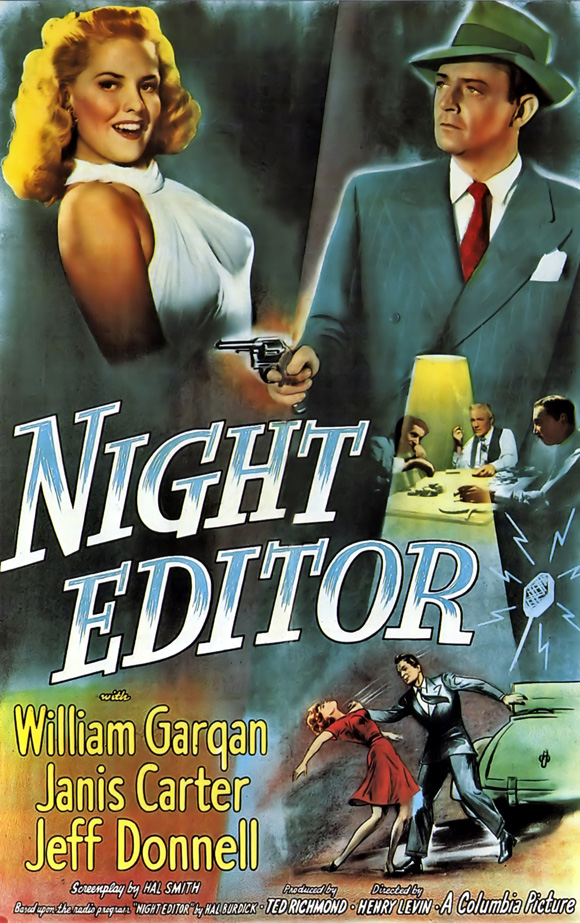
Night Editor (March 29, 1946)

Night Editor
Night Editor (1946)
Directed by Henry Levin
Columbia Pictures

Henry Levin’s Night Editor is — to paraphrase Thomas Hobbes — nasty, brutish, and short. Aside from the happy ending, which feels tacked on, it’s the Platonic ideal of a B noir. The protagonist is tough on the outside but weak and conflicted on the inside. The femme fatale is unfaithful not only to her husband but also her lover, and is excited by violent death. In the world of Night Editor, ambulances are “meat wagons,” and dialogue like, “You’re just no good for me. We both add up to zero,” is what passes for pillow talk. And the movie gets the job done in less than an hour and 10 minutes.

I went into Night Editor not knowing anything about it beyond the title and the fact that it was based on Hal Burdick’s radio show of the same name, which ran from 1934 to 1948. The program was a sort of human-interest editorial column on the radio, with Burdick relating a story and providing all the voices. (There were other characters, and an announcer, but once Burdick got going with his tale, it was all him.)

Night Editor takes place in New York City, and opens with a shot of a neon sign that says “New York Star.” It looks more like a diner sign than anything else, but the Star is a fictional rag, so the prop department was probably feeling expansive. A young reporter named Johnny (Coulter Irwin) walks toward the newspaper office like a zombie, narrowly avoiding getting run over by a street sweeper. He hasn’t been home in two weeks. When he stops in the stairwell to take a slug from his flask, we can see by the thermometer on the wall that it’s 94 degrees in the offices of the Star. These were clearly the days before every office building had central air conditioning.

The newsroom at night is presided over by editor Crane Stewart (Charles D. Brown), who sits with a group of chain-smoking, poker-playing reporters who crack wise about death and destruction. At this point, I thought this picture was going to be a hard-hitting drama about investigative journalists chasing down a big story, like Call Northside 777. But it turns out that the scenes in the city room are just a framing device, as editor Stewart reminisces about a tough cop named Tony Cochrane he once knew, who was involved with a story Stewart covered during Prohibition.

From this point onward, Night Editor is a pitch-black noir. Tony Cochrane, as played by William Gargan, is a working stiff with a good job as a police detective, a dutiful wife, and a young son whom he loves more than anything in the world. But Tony made the mistake of falling for a beautiful blond ice queen, and now finds himself lying to his wife and his colleagues just to sustain an affair that seems to bring him nothing but misery. When Tony picks up wealthy socialite Jill Merrill (Janis Carter) in his car, their first exchange sets the tone of the picture:

“Tony?”
“What?”
“Kiss me before you go.”
“I told you I’d be right back,” he snaps.
“Kiss me,” she says.
“What do you want, blood?”
“Yes, blood.”
“Don’t boil over yet, Jill, it ain’t time yet.”

Their “sweet talk” continues like this for the entire picture. The only thing they share is lust. Other than that they can’t stand each other. Jill says things to Tony like, “I don’t need you. I can buy and sell you.” Tony tells her things like, “You’re worse than blood poisoning.” In my favorite exchange of the picture, Tony tells Jill, “You’re rotten. Pure, no-good, first-rate, high-grade, A-number-one rotten.” She responds by saying, “Tony, I love you.”

Tony drives Jill down to a lonely stretch of beach. He parks the car and they hold each other tightly, whispering sweet words of loathing to each other. Tony compares Jill to a sickness, then to a nightmare with convulsions. She tells him, “You’ll never get away from me, Tony, I won’t let you. You’re like me. There’s an illness inside of you that has to hurt or be hurt. We were meant for each other, Tony.”

Their tryst is interrupted when another car drives down to the beach and parks near them. Jill and Tony see a man step out of the car. The other person in the car, a young woman, remains inside. The man produces a tire iron, and brutally bludgeons the girl to death with it. Tony flashes his car’s lights. The man runs. Tony draws his revolver but Jill yells at him not to do it, to let the man get away. If he doesn’t there will be a scandal, and Tony could lose everything; his job, his house, his wife, and even his son. With anguish on his face, Tony slowly lowers his weapon. He walks to the other car. The corpse’s stockinged legs are sticking out. He looks down at the body, dejected. He returns to his car, but as he starts to drive away, Jill screams that she wants to see the dead body. “I want to look at her, Tony!” she keeps shouting. It’s clear from her frenzied voice and the maniacal look on her face that her interest in the corpse is prurient.

After the murder, Night Editor really gets going. We’re treated to a relatively realistic depiction of police work, at least in terms of how investigative assignments are distributed (which is impressive for any movie made in the days before Dragnet). The movie also does a good job of showing the symbiotic and cheerfully ghoulish relationship between cops and the reporters on the police beat. For the most part, however, the film focuses on Tony’s interviews with suspects, which is as it should be. Tony is wracked with guilt for withholding evidence, but he’s too afraid of what he might lose if he steps forward.

The performances in the film are great. Frank Wilcox is memorable as Douglas Loring, the bank manager whom Tony suspects is the killer he glimpsed after he interviews him. Their scenes together are fraught with tension. Gargan has the face of an everyman, and believably plays the role of hangdog detective with something to hide. (Interestingly, Gargan is one of the few actors who actually was a private detective in real life. He worked for a New York detective agency for about a year for $10 a day plus expenses, but was eventually fired when he lost track of a diamond salesman he was charged with protecting.) Paul E. Burns deserves mention, too. His character, the Scandinavian-accented, milk-drinking detective Ole Strom, could have easily been a foolish stereotype, but Burns invests the character with a sharp-eyed intellect and a real sense of human decency. Janis Carter’s femme fatale Jill is the most one-note character, but she attacks the role with such sadistic brio that it doesn’t matter.

Night Editor is a must-see for noir fans. Originally it was supposed to be the first in a series, but no other Night Editor pictures were ever made. It’s a shame. I like the idea of a series of programmers based on the kind of stories jaded old newspaper editors tell their reporters during the slow periods of the evening.

Strange Impersonation (March 16, 1946)

This isn’t the first time I’ve seen Strange Impersonation. Five years ago I went on a big Anthony Mann kick and watched all the movies he’d directed that I could get my hands on. I really like a lot of his work, especially the film T-Men (1947), a docudrama about Treasury agents investigating a counterfeiting ring that incorporates heavy doses of violence and a lot of subjective film noir techniques into its otherwise straightforward story. His noir revenge drama Raw Deal (1948), which, like T-Men, stars Dennis O’Keefe, is great, too. He also made a number of highly regarded westerns starring James Stewart that are worth seeing.

He made plenty of strictly for-hire programmers, too, and Strange Impersonation definitely falls into this category. Of Mann’s pictures that I’ve seen, it’s my least favorite. Not because it’s any worse than any of his other B pictures, like Railroaded! (1947), but because it breaks my first rule for maintaining audience engagement until the very end, and leaves the viewer feeling robbed.

Upon second viewing, however, and with no expectation that the film’s many plot strands would be resolved, I was able to appreciate the enjoyable lunacy of the plot and the subtexts about gender relations and women in the professional sphere. Also, for a humble programmer, Strange Impersonation looks pretty good. It has great lighting and a few really well thought-out compositions.

The film begins with a scene at the Wilmott Institute for Chemical Research in New York. Scientist Nora Goodrich (Brenda Marshall) is making a presentation to a roomful of her mostly older, male colleagues. “It’s been my aim to develop a new formula which will combine all the best features of present-day anesthetics,” Nora tells the assemblage. Pointing to a model of a human torso and head, she says, “Here is the section of the brain where the reaction will occur. It will come very quickly, within seconds of injection. The anesthesia should be complete for approximately one hour, during which time the mind may indulge in dreams or fantasies, normal or otherwise. That of course would have to be checked. For my present findings, however, the anesthetic is safe and easy to administer. So until my final report, I think that’s all.”

Remember that speech, and you may have some idea of what to expect from the film’s denouement. Upon a second viewing, Strange Impersonation plays fair, but only in the broadest sense. The journey, at least, isn’t a bad one.

Marshall gives a credible performance in the stereotypical role of the “cold fish” female scientist. She’s very attractive, but with her severe hair style and glasses, she doesn’t look like a glamour puss pretending to be a smarty-pants doctor; she comes off as relatively convincing.

The same can’t be said of all of the ridiculous lines she’s forced to spout. When her fiancé, a fellow scientist named Stephen Lindstrom (played by William Gargan with a little mustache and big, nerdy glasses) tries to kiss her in the lab, Nora blurts out, “Stephen, remember! Science!”

Nora and Stephen are engaged, but she’s putting off the wedding until after her experiment is complete. Not to worry, though. The experiment will be complete soon. Why go through all the red tape of clinical tests when you can experiment on yourself, at home, at night, with just a few pieces of laboratory equipment and your friend Arline Cole (Hillary Brooke) to help?

And that’s just what Nora plans to do, except that she hits a wrinkle on her way home. While backing out of her garage, she knocks down a young woman named Jane Karaski (Ruth Ford). As a bystander notes, Jane is “squiffed” (i.e., very drunk), so Nora offers to drive her home. Before she can engage the clutch, however, a weaselly little ambulance chaser named J.W. Rinse (George Chandler) shoves his card into Jane’s hand and promises he can get her a big settlement, even though she doesn’t appear to be injured. Jane lives in a crummy little place with a Murphy bed above a spot called Joe’s Bar and Grill. While putting Jane to bed, Nora learns that Jane is from Mississippi, and has no friends in the big city or family back home.

Nora heads back to her large, tastefully appointed apartment overlooking the city. Stephen drops in for what he hopes will be a tryst, but before too long, Arline shows up, shoos him away, and it’s time for some science with a capital S.

As Nora is drifting to sleep on the couch after dosing herself with her own experimental anesthetic, she says, “Oh, nothing will go wrong. I’m sure I’ve worked this thing out perfectly. Nothing can go wrong. I’ll just go to sleep for a little while. Just go to sleep. For a little while. Just…”

And guess what? Something goes wrong. As soon as Nora’s passed out, Arline starts a chemical reaction that starts a fire right next to Nora on the couch, then dumps the flaming concoction on Nora’s face.

While Nora is recovering in the hospital, Arline tricks the doctor into keeping Stephen away from her, which leads her to believe that he has abandoned her because of her ruined face. Meanwhile, Arline starts putting her hooks into Stephen. It becomes clear that she destroyed Nora’s face not because of any professional jealousy, but because she had designs on Nora’s man.

Eventually, Nora returns home, wearing a veil and sporting some pretty convincing burn make-up. One night, Jane, the girl Nora hit with her car, shows up with a little automatic, apparently egged on by Rinse’s promises of a big settlement that has yet to materialize. She wants money, and she wants it now. The two women struggle for the gun, and Jane is knocked off of Nora’s balcony and falls to her face-decimating death on the sidewalk below. The stolen ring on Jane’s finger leads people to believe it’s Nora’s corpse. Meanwhile, Nora takes advantage of the confusion to slip away to Los Angeles under the name “Jane Karaski,” where she undergoes a very long course of plastic surgery at the Los Angeles Medical Center.

While reading the latest copy of “Chemical Views” in the hospital, Nora learns that Dr. and Mrs. Lindstrom have just bought a house in White Plains. Realizing Arline’s deception, she begs to leave, but is told it will be another three months before her face is fully restored. (She’s already been there about a year.) Her doctor tells her he can tell she never looked the way she does now, and not to think that changing one’s face can change one’s life. This scene is really weird, because once the bandages come off we learn that she gave her doctor pictures of Jane Karaski, and now supposedly looks exactly like the woman she accidentally killed. However, Nora looks exactly the same as she did before, only with black hair.

Apparently the characters in the film are seeing something very different from the viewers in the audience, because once Nora returns to New York and insinuates herself into the lives of Stephen and Arline under the guise of a new laboratory technician named “Jane Karaski,” neither of them recognizes her. I guess we’re just supposed to take it on faith that Nora’s surgery has left her looking like a dead ringer for Ruth Ford, even though she still looks exactly like Brenda Marshall with a black dye job.

If you can accept all the wackiness, there’s plenty to entertain in Strange Impersonation. The final interrogation scene in the police station, for instance, is a classic of feverish noir subjectivity, with all the characters in the film appearing in superimposition to accuse and admonish Nora as she shakes her head from left to right, screaming for them to stop.

Not to worry, though! The film has a happy ending. Just not for the audience.

Gilda (Feb. 14, 1946)

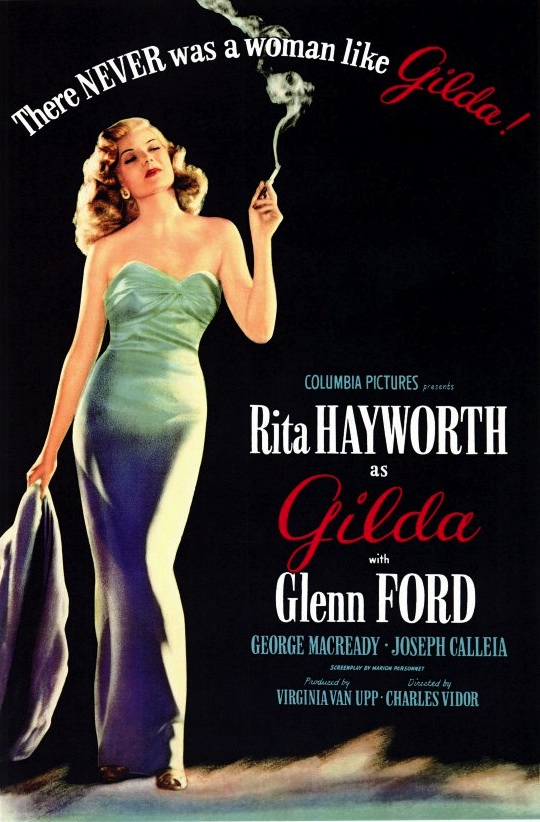
Charles Vidor’s Gilda premiered on February 14, 1946, and went into wide release on March 15. It’s best remembered as the film that made Rita Hayworth the biggest sex symbol of the ’40s. (Not that she was a shrinking violet before 1946. I saw her in the 1944 film Cover Girl when I was a kid, and I never forgot her.)

Born Margarita Carmen Cansino in Brooklyn in 1918, Hayworth was the daughter of Spanish flamenco dancer Eduardo Cansino, Sr. and Ziegfeld girl Volga Hayworth. With that kind of pedigree, her hundred-megawatt sex appeal should come as no surprise, but it does, even today. Usually the only image I post with a review is the theatrical poster, but for this review I was tempted to plaster up several cheesecake shots of Hayworth. The only problem with photos of her is that they lack something. She looks great in all of her pinup shots, but her blisteringly hot sexiness is something that needs to be seen on film to be believed. It doesn’t hurt that nearly every line in Gilda is an innuendo. When she first appears on screen, throwing back her mountain of wavy hair, and her husband asks her if she’s decent, the long pause after her bright, “Me?” followed by the husky response, “Sure, I’m decent,” clearly has nothing to do with whether or not she’s fully clothed.

Besides the obvious lascivious value Hayworth offers the production, Gilda is a pretty good movie, full of nasty double-crosses and intrigue in an exotic locale. At one hour and 50 minutes, it overstays its welcome by at least 10 or 15 minutes, but it’s still an entertaining film noir about love-hate relationships, high-stakes gambling, and double-dealing.

When we meet Johnny Farrell (Glenn Ford), he’s just another down-on-his-luck gringo in Buenos Aires, Argentina, a post-war hot spot (and not just for Nazi war criminals on the lam). In noir fashion, Farrell narrates the picture, sounding jaded and world-weary when he’s not twisted up with hatred and lust. Caught cheating at craps, Farrell is saved from a vicious beating at the hands of a bunch of thugs by a dapper gentleman named Ballin Mundson (George Macready) who wields a sword cane. Mundson tells Farrell of a casino where he can go to make some real money; a ritzy, illegal establishment that operates in the open, thanks to bribery. Mundson warns Farrell, however, not to cheat there. The bullheaded Farrell does exactly that, and is caught. A couple of mugs drag him into the second-floor office to face the boss, who turns out to be none other than Mundson. A fast talker, Farrell convinces Mundson to give him a job in the casino, and he quickly rises to the level of right-hand man.

Things go along swimmingly until the day that Mundson ignores his own advice that “Gambling and women don’t mix,” and brings home his new wife, Gilda (Hayworth). From the look on Farrell’s face when he first sees her, he might as well be seeing the atomic bomb being dropped on Nagasaki. Unaware that Farrell and Gilda share a history, Mundson entrusts his right-hand man with Gilda’s care and keeping. Forced to shield Mundson from Gilda’s constant indiscretions with other men, Farrell’s hatred of Gilda increases. Only it isn’t really hatred. It’s that strange brand of love/hate that fueled many a post-war film noir. Or, as Mundson himself puts it at one point, “It warmed me. Hate is the only thing that has ever warmed me.”

Meanwhile, Mundson’s secret plans to form a cartel with a group of Germans to control tungsten production in Argentina slowly comes to light, and Farrell realizes that the Argentine secret police are onto Mundson, and that the whole casino is a powder keg waiting to be ignited.

Argentina had a checkered history during World War II. The nation broke relations with Germany and Japan in 1944 only under heavy pressure from the United States, but continued to maintain its neutrality. On March 27, 1945, Argentina declared war on Germany, when German defeat was a foregone conclusion.

It’s a great setting for a tale of steamy intrigue (with a brief narrative sojourn in Montevideo), but the political and criminal machinations take a back seat to the sexual tension between Farrell and Gilda. Their love/hate relationship takes some nasty turns, both physical and psychological. (In the scene in which Gilda slaps Farrell across both sides of his face, Hayworth reportedly chipped two of Ford’s teeth.) The story also takes a back seat to the sheer physical spectacle of Gilda, in particular the show-stopping number in which she performs “Put the Blame on Mame.” Hayworth lip-synched to Anita Ellis’s singing voice, and did an excellent job. Just from watching the movie I wouldn’t have had any idea she wasn’t singing herself.

“If I’d been a ranch, they would have named me the Bar None,” Gilda says at one point in the film. Truer words have not been spoken.

Shock (Jan. 10, 1946)

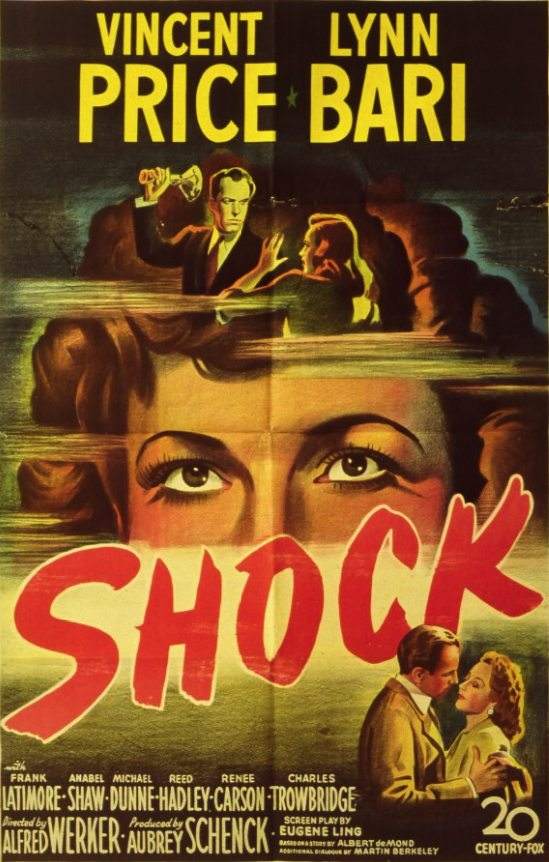
Alfred L. Werker’s thriller Shock, which had its premiere on January 10, 1946, and went into wide release on February 1st, stars Vincent Price as the murderous Dr. Richard Cross and Lynn Bari as his manipulative assistant and lover, Nurse Elaine Jordan. If you were to play a drinking game in which you took a shot of whiskey every time one of the characters in the film said the word “shock,” you would likely require medical attention after the first 20 minutes.

Price wasn’t always a horror icon. In Tower of London (1939), which was as much a costume drama about Richard III as it was a horror picture, he was a supporting player. In Brigham Young (1940), he played the founder of Mormonism, Joseph Smith. In Hudson’s Bay (1941), he played King Charles II. In Laura (1944) and Leave Her to Heaven (1945), he was the aggrieved “other man.” A tall, stately man born in St. Louis, Missouri, in 1911, Price was educated at Yale, where he studied art history and fine art. He radiated charm and erudition. He was a fine actor, and probably could have distinguished himself in any genre. As chance or fate would have it, however, his vocal delivery and arch facial expressions were perfectly suited to the ironic cinematic world of the macabre, and he is best remembered for his roles in horror pictures such as House of Wax (1953), The Fly (1958), House on Haunted Hill (1959), The Tingler (1959), and the innumerable Roger Corman-produced, Poe-influenced horror pictures that he appeared in throughout the 1960s.

While Shock is not a horror film, it has elements of one, and it’s the earliest role I’ve seen Price play in which he demonstrates some of the ghoulish mannerisms that would later make him famous. He doesn’t come close to the histrionics of some of his later horror roles, but there are some glimmerings.

The film opens in San Francisco, where a young woman named Janet (played by the somewhat sickly looking ingénue Anabel Shaw), is checking into a hotel, where she is to meet her husband, Lt. Paul Stewart (Frank Latimore), a former P.O.W. who is finally returning from World War II. Lt. Stewart doesn’t show up when he is supposed to, however, and as his emotionally fragile wife frets alone in her hotel room, she witnesses a murder. From her balcony, she can see through the window of an adjacent room. A man and a woman are arguing, and eventually the man settles the argument with a heavy candlestick.

Witnessing a murder drives Janet into a state of catatonic shock. When her husband finally arrives, she is unresponsive. When world-renowned psychiatrist Dr. Cross is brought in to consult in the case, Janet doesn’t recognize him, but Dr. Cross immediately realizes that the cause of Janet’s state of shock is the murder she witnessed him committing.

Janet is placed in Dr. Cross’s care, and he ignores the Hippocratic oath in order to save his own skin, giving Janet insulin treatments she doesn’t need, as well as using other unethical methods of driving her deeper into a state of shock so she will never be able to identify him. Cross isn’t portrayed as a total monster, however. That role is reserved for his lover, Nurse Jordan, a Lady Macbeth type who goads him on when his resolve to be wicked falters.

Shock is a programmer, to be sure, but it’s a well-made one, and kept me enthralled for all of its 70 minutes.

Scarlet Street (Dec. 28, 1945)

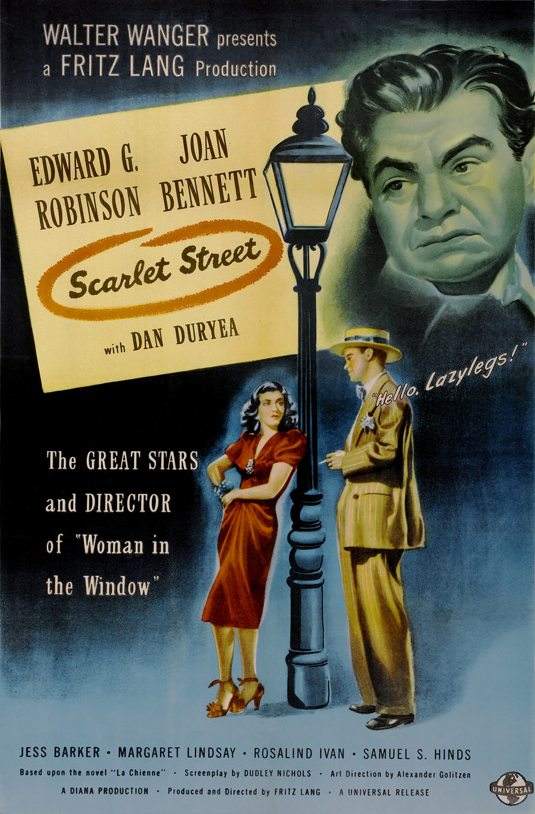
Fritz Lang’s Scarlet Street immediately draws comparisons to Lang’s 1944 film The Woman in the Window. Released just a year apart, both films star Edward G. Robinson, Joan Bennett, and Dan Duryea. Both films feature Bennett as a femme fatale, Robinson as a milquetoast man approaching old age who is desperate for some kind of excitement, and Duryea as a hustler and a punk who’s only out for himself. The two films share motifs; murder with sharp objects, city streets at night, painted portraits, and foolish old men ensnared by mysterious young women.

In terms of tone and plot, however, the two films are quite different. The Woman in the Window is a well-crafted tale of mystery and suspense in which a murder occurs early on, and the protagonist spends the rest of the film dealing with the consequences. It’s a good picture, but its impact is undercut by a cop-out ending (possibly necessitated by the Hays Code) that castrates the grim dénouement and breaks the most basic rule of maintaining audience engagement with a narrative. Scarlet Street, on the other hand, is grim and fatalistic, and its single, horrific murder doesn’t occur until near the end of the picture. Robinson’s character in Scarlet Street isn’t drawn into a suspenseful adventure in which he has to hide evidence and protect a woman’s honor, he’s drawn into a doomed romance with a heartless and conniving young woman, and he only realizes the trap he’s walked into until long after its jaws have clamped shut around him.

Scarlet Street opens on a scene of a party. It’s the kind of party we don’t see very often in the movies anymore. There are no women, and all of the men are dressed in tuxedos. Christopher Cross (Robinson) is receiving a gold pocket watch for his 25 years of service as a cashier in a bank. When Cross’s employer, J.J. Hogarth (Russell Hicks), stands up, he is clearly the man in charge; tall, commanding, and about to leave the party for a date with a blonde. Cross sits on the opposite side of the table and appears diminutive and meek. When Cross reads the engraved message on the watch, “To my friend, Christopher Cross, in token of twenty-five years of faithful service, from J.J. Hogarth, 1909-1934,” he seems genuinely touched by the line, “To my friend,” and pauses briefly after reading the words to smile. He is clearly a man with few friends.

He is also a man locked in a loveless marriage. We later learn that he married his landlady just a few years earlier, after her police detective husband died while trying to save a woman from drowning. Her late husband’s ridiculously large portrait hangs above the mantle in their living room, and Adele Cross (Rosalind Ivan) never misses an opportunity to unfavorably compare Chris with her “heroic” first husband.

On his way home from the party, Cross meanders through the rain-slicked streets of Greenwich Village. He sees a young man beating up a young woman under elevated train tracks, and he impetuously runs to her aid. His rescue attempt can barely be called heroic (he covers his eyes as he jabs her assailant with his umbrella), but it is still an act of courage, which makes what comes next so tragic.

Scarlet Street is based on the novel La Chienne (The Bitch), by Georges de La Fouchardière, which was adapted as a play by André Mouëzy-Éon, and as a film in 1931 by Jean Renoir. The French title pretty much sums up Kitty March (Bennett). She and her “boyfriend” Johnny Prince (Duryea) only care about money and the objects money can buy. As soon as Chris tells Kitty that he paints, she gets the idea in her head that he’s famous and rich, and that she’ll be able to squeeze him for all he’s worth. Of course, he only paints on Sundays as a hobby, but he initially lets her believe that he’s a painter, just as he lets himself believe her claim that she works as an actress.

This being a film from the ’40s, the words “pimp” and “prostitute” are never spoken, but if the viewer infers that Kitty is a prostitute and Johnny is her pimp, absolutely nothing in the film contradicts the idea. (And this was indeed their relationship in La Chienne.) It is clear that Kitty has no regular job, but she regularly ponies up money to give to Johnny. Johnny also has no visible means of support except the money she gives him. He hustles a little here and there, but it seems as if his main source of income is Kitty. At one point in the film she even states that she’s given him a total of $900 over a course of time, and that she’s still waiting for him to buy her a ring with that money. That’s an incredible amount of money for a woman with no job or inheritance to produce in 1945, unless she was tricking. Also, the fact that she’s giving him money that she then asks him to possibly spend on her implies a pimp-prostitute relationship.

The one-way exchanges of money and Johnny’s casual mention of various men from whom Kitty could get $50 for the night isn’t the only thing that marks Johnny as a pimp and Kitty as his whore. The casual way he slaps her around several times over the course of the film implies this, as well as the fact that he constantly refers to her as “Lazylegs.” Later in the film we even learn that Johnny was beating her up in the street at the beginning of the film because she showed up at the end of the night with less money than he expected.

The callousness of Johnny and Kitty and their pimp-prostitute relationship isn’t the only taboo this film breaks. Scarlet Street may very well be the first film made after Hollywood began enforcing the Hays Code that shows a character committing a murder that goes unpunished. Scarlet Street was distributed by Universal Pictures, but it was independently produced by Fritz Lang Productions, which may have given Lang more leeway in the way he presented his conclusion. On the other hand, the end of the film isn’t really about “getting away with murder,” since the hell the murderer is trapped in is worse than any earthly prison. It’s a bleak, existential ending, and one of the most tragic I have ever seen.

Cornered (Dec. 25, 1945)

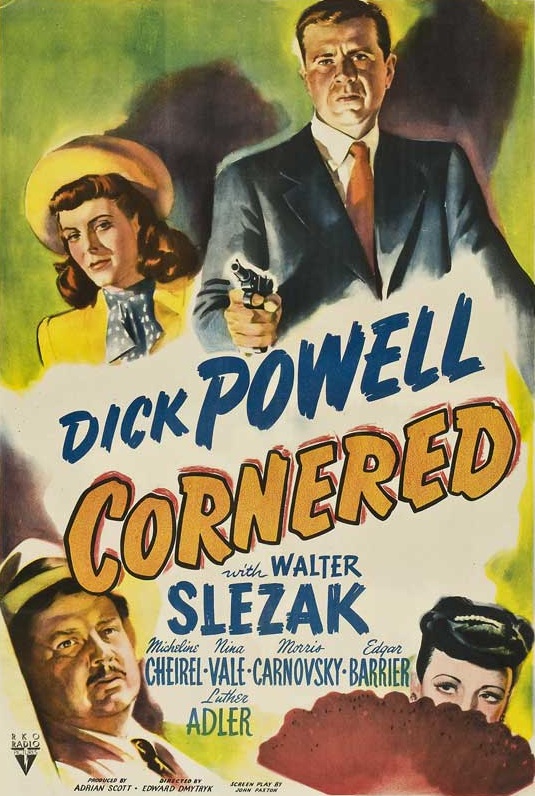
Cornered was director Edward Dmytryk’s second film to star Dick Powell. Powell was a boyish crooner and star of musical comedies who made a 180 degree turn into hard-boiled noir territory at the age of 39 when he played detective Philip Marlowe in Dmytryk’s film Murder, My Sweet (1944), an adaptation of Raymond Chandler’s 1940 novel Farewell, My Lovely. Powell jumped into his new, hard-boiled persona with both feet. Between the two films, Powell started appearing every week on the Mutual Broadcasting System as private investigator Richard Rogue in the radio series Rogue’s Gallery. The series was mostly standard P.I. fare, but it featured one unique element; every time Rogue was knocked out (which was nearly every episode) he’d drift off to “Cloud Eight,” where his alter ego, a little white-bearded gnome named “Eugor,” would taunt him, occasionally dropping a clue for Rogue to pick up on later, when he’d regained consciousness.

Cornered has no fanciful elements like that one, and the devil-may-care charm Powell exhibited in Murder, My Sweet has been completely done away with. In Cornered he plays a broken man who will stop at nothing to exact vengeance.

When we first meet Flight Lieutenant Laurence Gerard (Powell), an RCAF pilot, he is in London, receiving £551 back pay for the time he spent as a P.O.W. His next stop is a passport office, where he seeks passage to France. He wants to settle his wife Celeste’s estate. She was a French citizen, and they were married during the German occupation. When Gerard is told that all passports to the continent require investigation, and that it will take at least a month to clear, he walks out of the office without saying another word. In the next scene, he is alone in a rowboat, crossing the English Channel. When he sees land, he chops a hole in the hull, sinks the boat, and swims to shore.

In a muddy French town that is mostly rubble, Gerard meets with Etienne (Louis Mercier), a former resistance leader, and Celeste’s father. Gerard demands to know who is responsible for her death, and who betrayed her. “If there was any betrayal, I betrayed her, by fathering her in a century of violence,” Etienne tells him. Gerard doesn’t accept this circumspect response, and vows to hunt down the Vichy collaborator Marcel Jarnac, who ordered the killing of Celeste and several other members of the resistance. Jarnac supposedly died in a fire, but Gerard refuses to believe he is dead. He sets out with a single goal; to kill Jarnac.

Gerard follows Jarnac’s trail to Buenos Aires, and it is there that most of the film takes place. As soon as Gerard steps off the plane, he is approached by a fat man in a white suit. This man, Melchior Incza (Walter Slezak), is an operator with no clear allegiances. Gerard is quickly drawn into a world where no one is what they seem. Former Nazis and their collaborators have fled to Buenos Aires, biding their time until the next great war, while a loose-knit, clandestine organization seeks to root them out. Incza introduces Gerard to Jarnac’s wife (or possibly widow), Mme. Madeleine Jarnac (Micheline Cheirel), and even her loyalties are unclear.

While it may sound like a globe-trotting adventure film, Cornered is really a claustrophobic film noir with healthy doses of paranoia and tension. The script, by John Paxton (with uncredited assistance from Ben Hecht), from a story by John Wexley, takes a run-of-the-mill manhunt plot and ratchets up the tension with crisp dialogue, excellent pacing, and a brutal finale. Harry J. Wild’s cinematography is classic film noir, with inky nighttime exteriors, close-quartered interiors, and actors’ shadows frequently preceding them into the frame.

Powell plays Gerard as a shell-shocked man who suffers from frequent headaches. He’s on a mission to avenge a woman to whom he was only married for 20 days. He’s an amateur doing the work of a detective, and while he’s clever enough to connect the dots, he’s still just one man at the mercy of forces beyond his comprehension. “You are sick with fear,” Mme. Jarnac tells him. “You’ve been hurt so deeply you cannot trust anyone but yourself.”

Is there a better description of the classic film noir protagonist?

Leave Her to Heaven (Dec. 19, 1945)

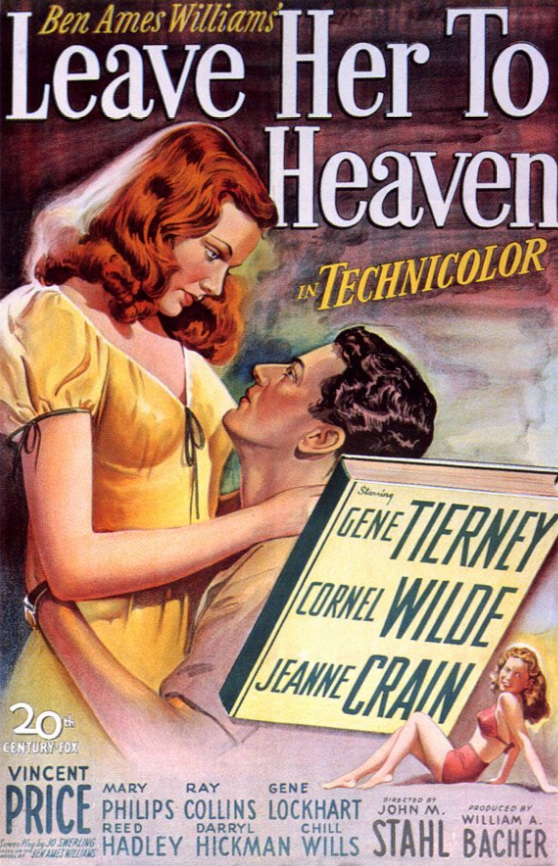
Can there be such a thing as a film noir in color? I don’t think there can, but the term noir has been so widely used, popularized, and bastardized that director John M. Stahl’s Technicolor adaptation of Ben Ames Williams’s novel Leave Her to Heaven, made during the heyday of noir in Hollywood, is often referred to as a rare instance of a film noir in color.

A year after she starred as the eponymous Laura (Otto Preminger’s 1944 classic that is also frequently referred to as a noir even though it really has very few characteristics of one, aside from being filmed in black and white), Gene Tierney created a memorably unhinged character named Ellen Berent.

When we first meet Ellen, the first thing we see is her beauty. Sitting across from novelist Richard Harland (Cornel Wilde) in the lounge car of a train, surrounded by green walls, her dark hair and pale face offset by her bright red lips, she looks like a porcelain doll come to life. Quickly, however, we notice something else. The way she is staring at him is predatory. The way she doesn’t speak for a long time after he answers a question is strange. She is beautiful, but there is something wrong with her. We can guess, however, that his relationship with Ellen won’t have a happy ending.

If only Richard saw what the audience can see. Of course, the audience also has the advantage of a framing device. In the first scene of Leave Her to Heaven, we see Richard return to Deer Lake, Maine. His friends and neighbors look at him strangely. As they whisper among themselves, we learn that he has just gotten out of prison after a two-year stint, but we don’t know what the charge was.

Most of the story is told in flashback. Beginning with the scene on the train, we see how Richard fell into Ellen’s clutches. After they disembark, they find that they are both guests at Rancho Jacinto, in New Mexico, where Ellen has gone to scatter her father’s ashes. After telling Richard several times how much he looks like her father (even though a framed photograph of the man looks nothing like Cornel Wilde), the scene in which the stone-faced Tierney rides a horse and scatters her father’s ashes in the mountains is one of the most striking in the picture. When Richard agrees to marry her soon after, it is at her urging. Marrying her is something he thinks he wants, but the words “Will you marry me” never escape his lips. He is caught in her web.

After their marriage, Ellen and Richard go away to his cabin in Maine. She resents the intrusion of anyone else into their lives, such as her sister Ruth (Jeanne Crain) or Richard’s younger brother Danny (Darryl Hickman), who is recovering from polio, and her resentment has deadly consequences.

Ellen is devious, but it’s not always clear how conscious she is of her own cunning. Although the other characters speak of how unnaturally close she was to her father, and how she loves with a childish ferocity that can be dangerous, the viewer is not privy to any deeper psychological insights. There are no scenes of her childhood or flashbacks to any trauma that might have precipitated her madness. It’s refreshing to have a character with sociopathic tendencies that have no pat explanation, but some insight into the jealousy that drives her might have helped flesh out the character.

So what is it that makes Leave Her to Heaven a film noir? The classification is a slippery one, and has become popular enough that nearly every black and white film from the ’40s that is not a musical or a comedy has been called a film noir at some point. In one of the first treatises on the subject, the 1955 book Panorama du film noir américain 1941–1953, French film critics Raymond Borde and Etienne Chaumeton identified the five main facets of film noir. They said that it is “oneiric, strange, erotic, ambivalent, and cruel.” Over the years, the term film noir has grown to encompass certain stylistic elements as well. Stark black and white cinematography and unbalanced constructions that grew out of German Expressionism are both hallmarks of noir, as is a pervading sense of doom.

So does Leave Her to Heaven contain any of these elements? It certainly could be called “strange,” but it’s not particularly dreamlike. It’s not very erotic, either, since Ellen seems to capture Richard in a web that is more psychological than it is sexual. Her actions are sometimes cruel, but the picture as a whole is not terribly ambivalent. Ellen may arouse feelings of both pity and hatred in the viewer, but she is still presented in a straightforward way. She has no crises of conscience or confusion about what she wants. And the lush Technicolor cinematography really pushes Leave Her to Heaven out of the noir category.

Leave Her to Heaven is a melodrama with a couple of shocking scenes, a sociopathic main character, and a courtroom denouement that drags down the pacing of the picture, but which does feature an enjoyable performance by Vincent Price as one of Ellen’s old flames who is now a prosecutor. It is not a film noir, unless we can divorce style from content. The absence of black and white cinematography and a real sense of doom (or a truly unhappy ending) means that Leave Her to Heaven just doesn’t qualify as a film noir. Of course, this shouldn’t stop anyone from seeing it. Whatever its genre, it’s an effective film with an interesting performance by a beautiful actress who didn’t exhibit a great deal of range in any of her roles, but who is chilling in this one.

Leave Her to Heaven was Twentieth Century-Fox’s highest grossing picture of the 1940s. Tierney was nominated for an Academy Award for best actress, and Leon Shamroy won an Oscar for best cinematography in the color category.

Fallen Angel (Dec. 5, 1945)

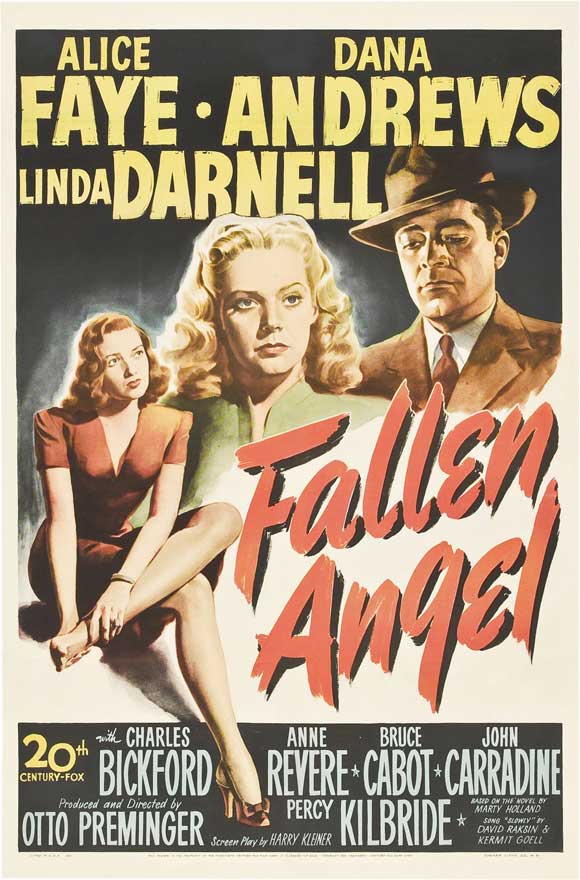
Fallen Angel, Otto Preminger’s follow-up to his smash hit Laura (1944), was slapped around by critics and passed over by audiences, but it’s not a bad film. It’s just not involving or memorable in the ways Laura was, and it’s composed of a bunch of elements that never really coalesce.

Fallen Angel reunited Preminger with the star of his previous film, Dana Andrews, and a lot of my enjoyment in the film came from watching Andrews. He’s more of a focal point in Fallen Angel than he was in Laura, and he dominates every scene he’s in. Andrews was 5’10”, but he looks well over six feet in this picture. He’s rough-looking but charming, and imposing and tough without being wooden. At the same time, he projects bitterness and alienation, barely concealed behind a handsome mask. In short, he’s the embodiment of American post-war masculinity. Andrews’s co-stars are all good as well. And I can’t fault Preminger’s direction. The film looks great, and taken one scene at a time, it’s very good.

Where Fallen Angel failed to engage me was in its pacing and storytelling. I haven’t read the Marty Holland novel the film is based on, but Fallen Angel plays like an adaptation of a sprawling book in which each section of the plot is dutifully reenacted, as opposed to a terse adaptation in which unnecessary subplots and themes are jettisoned. When drifter Eric Stanton (Andrews) is thrown off a bus in the small town of Walton, California, because he doesn’t have the $2.25 fare necessary to continue on to San Francisco, he stops in at a place called Pop’s Café. In the first few minutes of the film we’re introduced to all the major players; the phony spiritualist Professor Madley (John Carradine), whom Stanton used to shill for, hard-boiled ex-New York police detective Mark Judd (Charles Bickford), cafe owner Pop (Percy Kilbride), June Mills (Alice Faye), June’s spinster sister Clara (Anne Revere), and Pop’s pouting, sexy waitress Stella (Linda Darnell), whom every man in town seems to be obsessed with (and it’s not hard to see why).

The beginning doesn’t seem rushed, however, or as though too much information is being packed in. A lot of this can be credited to Preminger’s cinematographer, Joseph LaShelle, who also worked with Preminger on Laura, and whose fluid tracking shots and crisp black and white cinematography are both a joy to watch. Eventually, however, the way certain characters dropped out of the picture left me feeling suspended. The grifting medium and his relationship with Stanton could have filled an entire picture (although I admit being partial to John Carradine), but he leaves town before too much time has passed. Later, when Stella is murdered, it happens off screen, and just as I felt her relationship with Stanton was starting to get juicy. His romance with June and Stella could have formed the classic “good girl/bad girl” film noir tension, but his romance with June doesn’t really get started until Stella’s ticket has been punched, and once that happens, Fallen Angel becomes more of a melodrama than a noir. It’s also a mystery, since we don’t know who killed Stella, but this aspect of the film doesn’t come to much, as the second half focuses more on Stanton’s courtship of the sheltered, naïve June, and the question of whether or not he really loves her or is just out to fleece her. Meanwhile, most viewers will have the number of suspects in Stella’s murder narrowed down to two suspects, neither of whom is a more interesting culprit than the other.

I’m probably making Fallen Angel sound worse than it is. Many modern viewers consider it a lost classic of film noir, or just a really great film that has been overlooked. It’s worth seeing, especially if you’re a fan of Preminger or any of the principal actors. I found it disappointing, but that might change years from now with a second viewing.

Dick Tracy (Dec. 1, 1945)

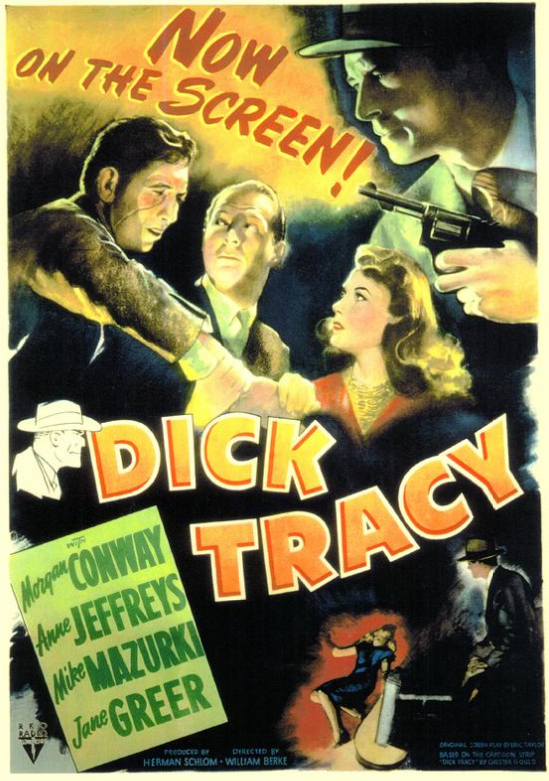
Dick Tracy, directed by William Berke and starring Morgan Conway as Dick Tracy, wasn’t the first filmed adaptation of the most famous detective in the funny pages. There had been four serials prior to it, all of which starred Ralph Byrd; Dick Tracy (1937), Dick Tracy Returns (1938), Dick Tracy’s G-Men (1939), and Dick Tracy vs. Crime Inc. (1941). The first one was also re-edited into a feature in 1937, which was a fairly common practice. These were B pictures, after all. If you had the footage, why not repackage it?

This film, however, took the character in a new direction. Played by Morgan Conway, Tracy is more believable as a real person than the way Byrd played him. Both embody aspects of the character, but they look nothing like each other. Byrd literally looked like a cartoon character. He had small, perfect features and intense eyes. But for me, his voice was too high and his nose too small to really convey the toughness of the character. Conway, on the other hand, is ugly and tough as nails. He looks like what I imagine Tracy might look like if he were a real person, although his nose is more of a “schnoz” than Tracy’s “beak.” He’s decent and brave, but still not above underhanded tricks to get his man. When we’re introduced to him, he’s interrogating a sweaty suspect named Johnny (Tommy Noonan). Tracy makes Johnny believe his mother has been killed so he’ll agree to roll over on someone. After Johnny spills the beans, Tracy admits to having tricked him. “It was the only way I could get you to talk and clear yourself at the same time,” he says. “All right boys, clean up Johnny and send him home.”

This film also features the full supporting cast of characters from Chester Gould’s daily newspaper strip, many of whom had been missing from earlier adaptations; Tracy’s sidekick Pat Patton (Lyle Latell), his best girl Tess Trueheart (Anne Jeffreys), his adopted son Junior (Mickey Kuhn), and Chief Brandon (Joseph Crehan). Gould’s violent, gruesome world is handled well in this film. Its opening may be the darkest of any film based on a comic strip character made before 1970. A high-angle shot shows a man with his back to the camera, leaning against a light pole in a quiet, suburban neighborhood at night, smoking a cigarette. When a bus stops and a single, female passenger (Mary Currier) disembarks, he moves into the shadows. A tracking shot follows her as she walks across the street, then cuts to a static shot of the man’s shadow on a wall, and the viewer can see from the movement of his shadow that he is reaching into his breast pocket for something. This is followed by a tracking shot of the woman with the camera directly behind her, presumably showing his point of view. The woman walks down the sidewalk, her heels clacking. She looks nervous. She turns around. There is no one behind her. She keeps walking. Suddenly, a shadow falls across her and she screams. The man attacks her. There is a cut to a long shot of the street, which shows her body lying on the sidewalk and the man running away.

Dick Tracy discovers a note on the woman’s viciously mutilated body, demanding that $500 in small bills be left in a street sweeper’s trash can on the corner of Lakeview and Ash. The note is signed “Splitface.” The next morning, the mayor of the city (William Halligan) receives a similar note, demanding that $10,000 be paid out or the mayor will be “slashed to pieces.”

The murdered schoolteacher, the mayor, and another man who was killed by Splitface seemingly have nothing to connect them. Tracy and Patton investigate, and Tracy comes to the conclusion that Splitface is motivated by something other than money, since the murdered woman didn’t pay, but the murdered man did.

Dick Tracy has plenty of action, with Dick and Pat chasing down suspects on foot and in cars, but it doesn’t skimp on the investigations that lead them there. It’s not rigorous enough to qualify as a police procedural, but it doesn’t gloss over any details, and Conway’s acting style and line delivery are not unlike Jack Webb’s on Dragnet.

Devotees of the daily strip will probably quibble with details, but I thought this picture did a nice job of balancing the violence with over-the-top characters. There is a loony astronomer and fortune teller named Professor Starling (Trevor Bardette), a ghoulish undertaker named Deathridge (Milton Parsons), and of course the great character actor Mike Mazurki as the villain.

Dick Tracy is a one-hour programmer, and there’s no question that it’s a B movie, but it’s an expertly directed, fast-paced, and thoroughly enjoyable one.