The Search (1948)
Directed by Fred Zinnemann
Metro-Goldwyn-Mayer
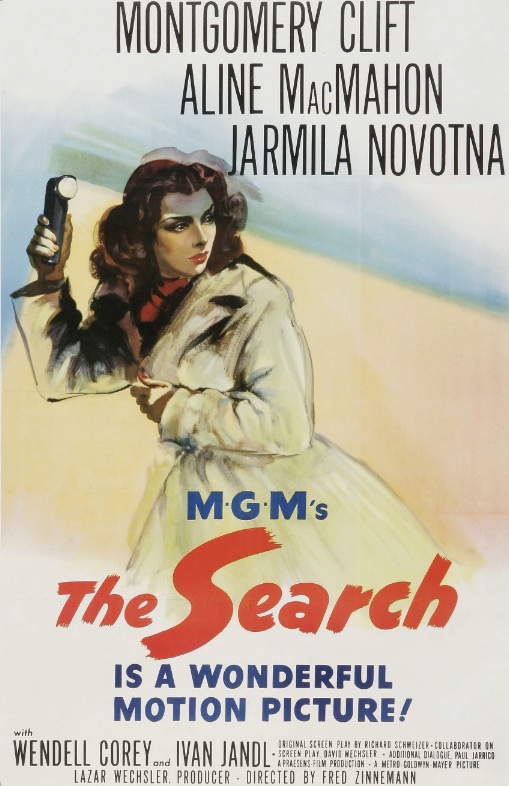
Fred Zinnemann’s The Search premiered in New York City on March 23, 1948, and went into wide release on March 26.
It wasn’t the first film the slim, haunted-looking heartthrob Montgomery Clift starred in, but since the release of Howard Hawks’s Red River, filmed in 1946, was delayed due to legal troubles until August 1948, The Search was the first film many moviegoers saw him in.
Clift doesn’t appear until more than 35 minutes into the picture. The first section of the film follows a group of emaciated, frightened children liberated from concentrations camps and then processed through U.N.R.R.A. (The United Nations Relief and Rehabilitation Administration).
U.N.R.R.A. is in place to help the children, but after years of living in a state of fear, they’re unable to trust adults wearing uniforms. These scenes involve a mixture of languages with no subtitles. The important details are conveyed with voiceover narration in the style of a documentary.
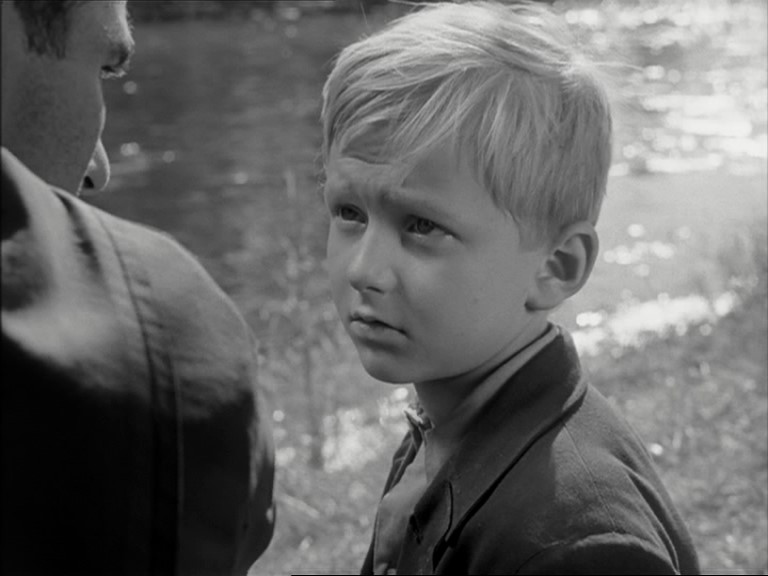
When the children are being transported in ambulances to a new location, one of the ambulances has a broken exhaust pipe. Gas leaks in, and the terrified children break through the glass in the rear doors and escape. Two of the kids, Karel (Ivan Jandl) and his French friend, successfully evade the U.N.R.R.A. soldiers but then are separated when the French boy crosses a river.
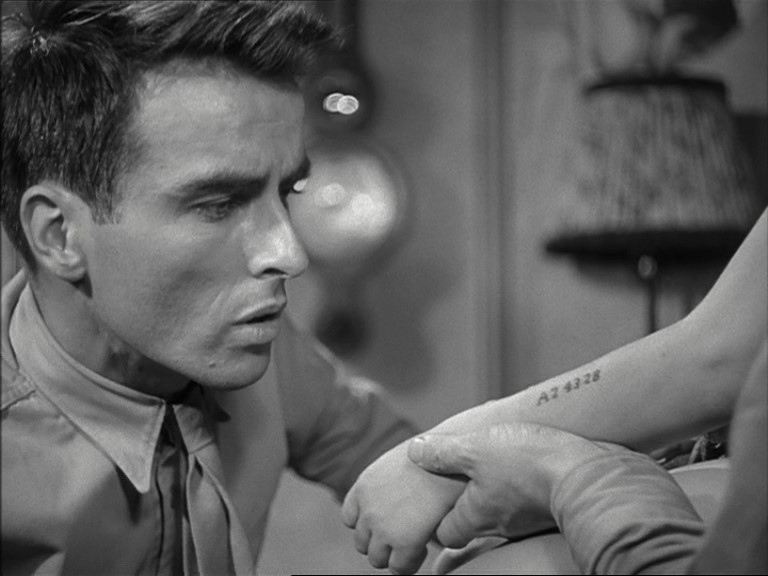
Before the Nazis invaded Czechoslovakia, Karel’s family — his parents and his sister — led the happy life of intellectuals, reading and playing music together. But now little Karel carries a tattoo on his left arm from Auschwitz while his mother (Jarmila Novotna) wanders desolate German highways, searching for her son. She lost her husband and daughter during the war, and she desperately clings to the belief that her son is still alive.
Much of the exterior footage in The Search was filmed in the American zone of West Berlin, and it has elements of the German “Trümmerfilm” (“rubble film”), a style of filmmaking that began with Wolfgang Staudte’s 1946 film Die Mörder sind unter uns (The Murderers Are Among Us) and that used the desolated, bombed-out post-war landscape of Germany as a backdrop.
The emotional core of The Search is the relationship that develops between the nine-year-old Karel and American G.I. Ralph Stevenson (Clift). Slowly but patiently Stevenson gains Karel’s trust and helps him come out of his emotionally shellshocked state. Ironically, he tries to help Karel accept the fact that his mother is dead when she is in fact alive.
The Search is a beautifully made, emotional drama that’s fairly restrained. It would have been easy for director Zinnemann to be manipulative, but he trusts his actors. The character of Karel could have been a real disaster if an adorable Hollywood moppet had played him, but Ivan Jandl was really Czech, and he brings as much authenticity to his role as Clift does to his. Clift’s character also could have been a stereotype, but he’s completely believable as a typical young American.
The Search was nominated for four Academy Awards — best director for Fred Zinnemann, best actor for Montgomery Clift, and best story and best screenplay, both for Richard Schweizer and David Wechsler. Ivan Jandl was given a special award for outstanding juvenile performance.
High Wall (1947)
Directed by Curtis Bernhardt
Metro-Goldwyn-Mayer
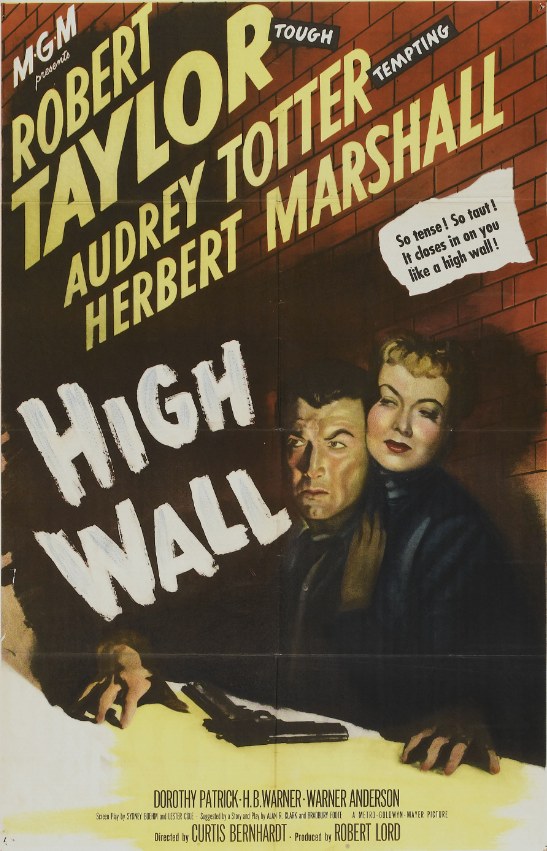
Curtis Bernhardt’s High Wall stars Robert Taylor as that most venerable of film noir archetypes — the amnesiac combat veteran who may or may not have committed murder.
Bernhardt was one of many German filmmakers who fled the Third Reich to work in Hollywood, and whose dark artistic sensibilities helped create what we now know as “film noir.” So far I’ve seen two other films he made, the excellent melodrama My Reputation (1946), which starred Barbara Stanwyck and George Brent, and the equally excellent psychodrama Possessed (1947), which starred Joan Crawford and Van Heflin.
High Wall lets Bernhardt flex his suspense-thriller muscles a little, and he’s more than up to the task.
At first glance, High Wall looks and feels like any number of similar dramas from RKO Radio Pictures — tight, well-made, black and white flicks designed for the bottom of a double bill — but it was actually produced by Metro-Goldwyn-Mayer, a powerhouse of a studio that wasn’t usually in the “noir” business.
High Wall is a pretty lean thriller, but MGM production values are evident in a few scenes, particularly when the protagonist, Steven Kenet (Robert Taylor), is sent to Hamelin County Psychiatric Hospital. The sanitarium features a big cast of extras; there are legions of brusque, businesslike cops and hospital attendants, and dozens of hapless patients lolling around on beds in the open ward. If High Wall had been an on-the-cheap production for Monogram pictures, there probably would have been one night attendant, two other patients, and sets that looked like they were on loan from a theatrical production.
Most of High Wall is shot on sets, so the exteriors are pretty fake-looking, but not distractingly so. Shooting on a soundstage also allows Bernhardt and his cinematographer, Paul Vogel, to create a dramatic rain-swept finale full of rich textures that probably wouldn’t have been possible if they’d been shooting on location.
Also, with such a big cast of loonies, it’s more believable that Kenet has so much difficulty seeing his psychiatrist, Dr. Ann Lorrison (Audrey Totter).
Kenet, you see, looks like the most likely suspect for his wife’s murder. Her strangled corpse was sitting right next to him when he drove his car off a bridge in a daze, after all.
But after Kenet finally gets a few appointments with Dr. Lorrison, she starts to believe that he might be innocent. Lorrison is a no-nonsense salt-of-the-earth gal. (This is evident early in the film when she turns down a male doctor’s offer of a date at the opera because she has Red Sox tickets.)
It’s not just Kenet’s good looks, tragic aura, six-year-old son, and Distinguished Service Cross and Silver Star from World War II that attract Lorrison, it’s nagging evidence of his innocence, so she starts helping him escape from the asylum for periods of time so he can investigate upstanding citizen Willard Whitcombe (Herbert Marshall), a middle-aged man who works for Brattle Press Religious Educational Text Books.
Marshall is the perfect villain for this type of melodrama. His bearing is patrician — and his voice is one of the smoothest and most charming you’ll ever hear — but there’s clearly something very wrong with him.
For a good portion of High Wall, it’s possible to be in doubt of the outcome. Kenet looks guilty, even to the viewer, and he suffers from fainting spells. He has a subdural hematoma in the left lobe that’s causing forgetfulness, irritability, and a possible proclivity toward murder and suicide.
High Wall is a fun movie. When it comes to the question of Audrey Totter’s charm and sexiness, I was a little on the fence after Lady in the Lake (1947), but she’s utterly charming in High Wall, and much more natural in High Wall than in Lady in the Lake. (It’s possible that not requiring her to stare into the camera the whole time might have let her deliver a more natural performance.)
I also really like the preview for High Wall. Its claims are actually accurate, too. “So tense. So taut.” That’s true. High Wall is a well-crafted suspense thriller. Also, when the preview says “Robert Taylor — more exciting than in Undercurrent,” that’s an understatement. Undercurrent is really pretty bad, and High Wall is really pretty good:
Hey, kids, do you think “nostalgia” is only something for baby boomers hazily recalling Woodstock or Generation X’ers and their ’80s dance parties? Guess again.
Nostalgia has been around since there were people old enough to remember their youth and know that they’d never get it back. Charles Walters’s Good News, for instance, took viewers in 1947 and 1948 back to the good old days of 1927, when people were dancing the Charleston, when Will Rogers was elected mayor of Beverly Hills, when Coolidge chose not to run again, when “flaming youth” ran wild, and when a girl was a “flapper” and a boy was a “sheik.”
Unfortunately, Good News is about as convincing a portrait of the ’20s as Grease (1978) was of the ’50s.
It’s a sanitized Technicolor version of the racy original, which was based on the hit Broadway play that premiered in 1927.
In the special features section of the DVD I watched, there were a couple of scenes from the 1930 version of Good News, and in spite of their static camerawork and unimaginative black and white cinematography they were totally and completely electrifying.
Take a look at the scene below, in which Dorothy McNulty performs the song “Varsity Drag.” It’s an athletic, goofy, wild number, full of sexual innuendo and all kinds of good stuff that would be impossible to have on screen after the enforcement of the Hays Code (like the underwear shot at 3 minutes and 20 seconds).
Incidentally, Dorothy McNulty later changed her professional name to Penny Singleton and starred in the Blondie movies. She was also the voice of Jane Jetson on The Jetsons.
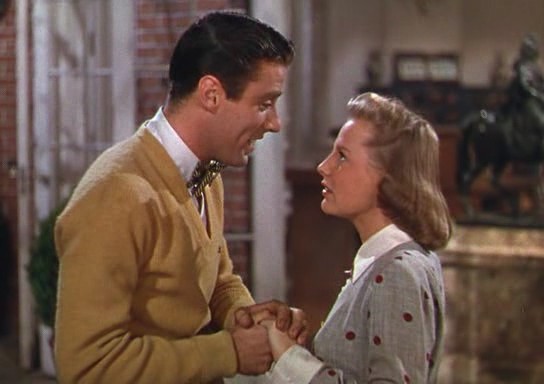
Anyway, the 1947 version of Good News just can’t hold a candle to that kind of wild vivacity. It doesn’t help that Peter Lawford, who stars as B.M.O.C. Tommy Marlowe, was cast more for his appeal as a heartthrob than his talent as a singer. He’s not terrible, but he looks uncomfortable throughout the proceedings, especially when he has to sing and dance at the same time.
His leading lady, June Allyson, who plays shrinking violet Connie Lane, is also a bit of a disappointment, but their funny duet, “The French Lesson,” is an amazing bit of fast-paced wordplay.
The most energetic and fun-to-watch performer in the film is Joan McCracken, who plays the man-hungry Babe Doolittle. Her performance of “Pass That Peace Pipe” is a highlight of the film.
A very young Mel Tormé also shows up for a couple of songs, “Lucky in Love” and “The Best Things in Life Are Free,” so Good News is worth seeing if you’re a fan of The Velvet Fog.
The song “Pass That Peace Pipe,” which was written by Ralph Blane, Hugh Martin, and Roger Edens, was nominated for an Academy Award for best original song, but lost out to “Zip-a-Dee-Doo-Dah” from Song of the South (1946).
Nineteen forty-seven was the year Mickey Rooney turned 27, and the star of the Andy Hardy series and family fare like National Velvet (1944) was looking to stretch his range as an actor and step into more grown-up roles.
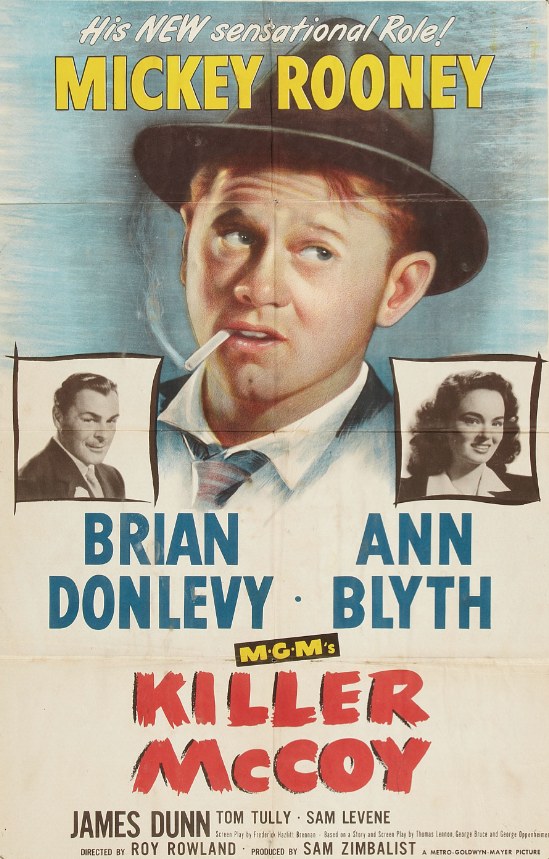
Roy Rowland’s Killer McCoy is a remake of Richard Thorpe’s The Crowd Roars (1938), which starred Robert Taylor as a young pugilist named Tommy “Killer” McCoy who was caught between his no-good father and his gangland manager.
Hopefully there’ll be a second remake next year starring former child star Haley Joel Osment. Maybe they could even throw in a drug-related in-ring breakdown, à la Oliver “The Atomic Bull” McCall, or a tawdry and mysterious death, à la Arturo Gatti.
But I digress.
Killer McCoy isn’t a bad flick, and Mickey Rooney is pretty good in it, but it has the misfortune of being a boxing picture that was released right around the same time as Body and Soul, which is one of the best boxing pictures of all time.
If you’re a fan of knock-down, drag-out fights, Killer McCoy does offer more punches per foot of film than Body and Soul. On the other hand, if the number of punches thrown was the only measure of a boxing film, then Rocky III (1982) and Rocky IV (1985) would be superior to Rocky (1976) and Rocky II (1979), and we all know that ain’t the case.
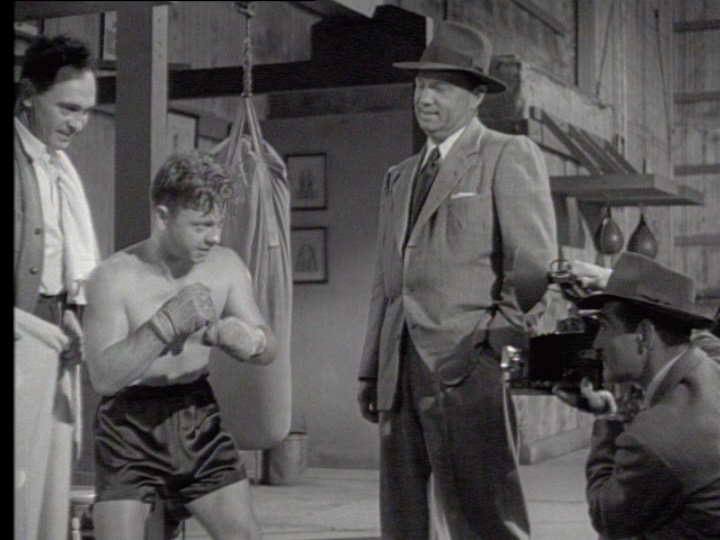
Rooney is pretty convincing as a boxer. The filmmakers don’t try to shoot around how unbelievably tiny he is, so it makes sense that his character starts out fighting as a featherweight and moves up to lightweight. (Although I think in real life Rooney would probably have been more in the flyweight and bantamweight range.) The boxers he faces are mostly little guys, too, like Bob Steele, who plays a former lightweight champion named Sailor Graves.
The supporting cast is generally good. I love seeing diminutive cowboy actor Steele in anything, and the same goes for Brian Donlevy, who plays boxing manager and fight promoter Jim Caighn. And actor James Dunn is great as Tommy McCoy’s drunken father, a former vaudevillian who clings to the past.
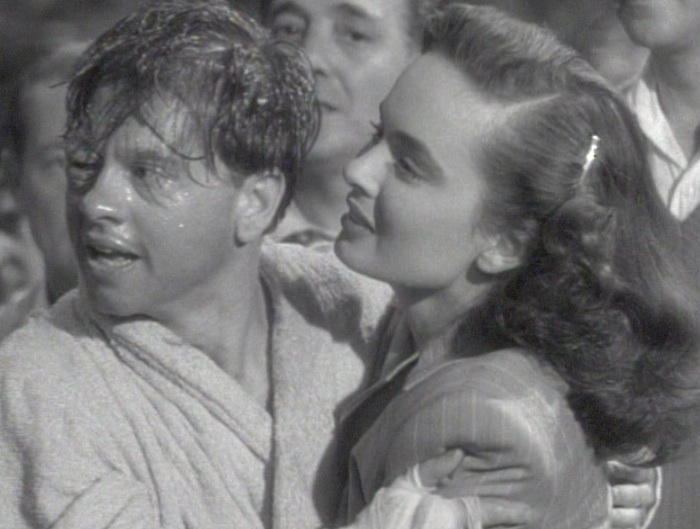
The problem is not with the actors, but with the story, which never really allows its characters to become three-dimensional people. Caighn, the manager, is an especially egregious example. He has a double life as “Carrson,” a Wall Street tycoon who is far removed from the disreputable world of boxing. Caighn doesn’t want his daughter, Sheila Carrson (Ann Blyth), to know about his double life. This is all totally ludicrous, of course, and only exists to manufacture a stumbling block to Sheila’s romance with Tommy McCoy.
Killer McCoy is competently made and entertaining if you’re able tolerate Mickey Rooney, which a lot of people aren’t. Its boxing matches are well choreographed and action-packed. It’s no Body and Soul, but then again, what is?
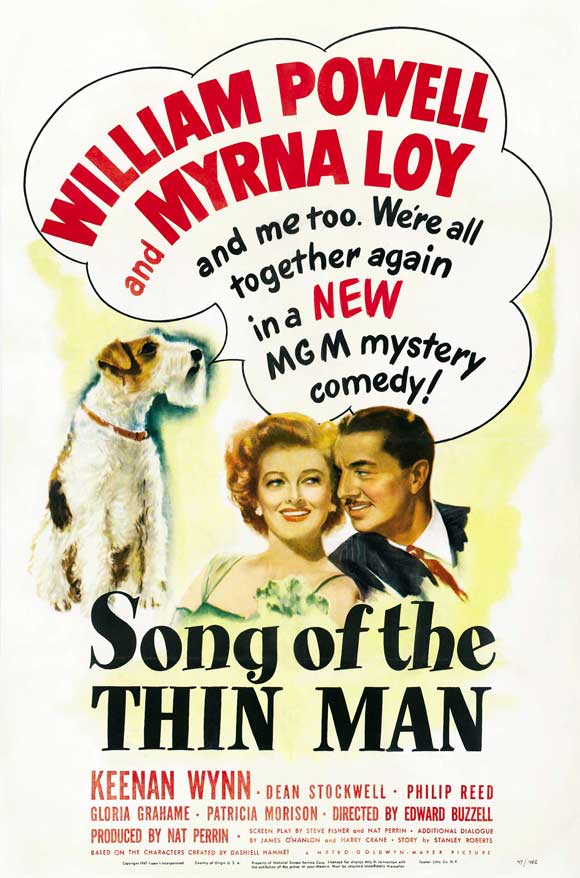
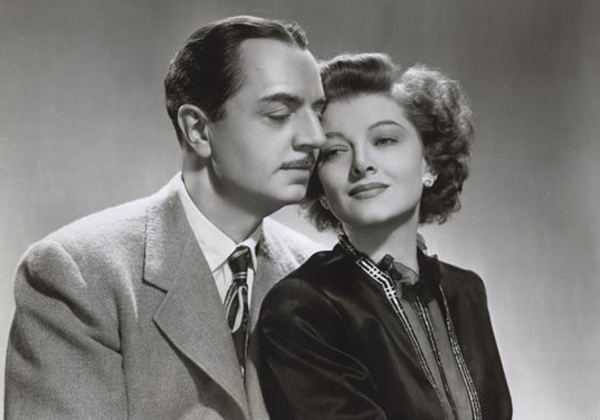
Edward Buzzell’s Song of the Thin Man was a bittersweet viewing experience for me. I’ve been a huge fan of the Thin Man series since the first film, The Thin Man (1934), so it was a little sad to know that Song of the Thin Man would be the last new film I’d see with William Powell and Myrna Loy as everyone’s favorite dipsomaniacal mystery-solving married couple, Nick and Nora Charles.
While some films in the Thin Man series are better than others, all of them are funny, well-made mysteries featuring two of the most appealing actors from Hollywood’s Golden Age.
As always, their little dog Asta is around for yuks, along with a brand new adorable little son, played by Dean Stockwell. (Yes, kids, Dean Stockwell was adorable once.)
But not to worry. Having a young son doesn’t stop Nick and Nora from continuing to booze it up and skulk around at night with flashlights, looking for clues.
The mystery they’re trying to solve this time around is the murder of a jazz band leader named Tommy Drake (Phillip Reed), who is shot aboard the S.S. Fortune, a gambling ship run by a man named Phil Brant (Bruce Cowling).
True to its title, Song of the Thin Man is all about music. Specifically jazz music, and the wacky nightclub performers who jam till dawn, like Drake’s former bandleader Buddy Hollis (Don Taylor) and his famous clarinet. Hollis is a talented musician, but he’s all whacked out from carrying a torch for the hot little cookie Fran Ledue Page (Gloria Grahame), a singer.
Keenan Wynn is also on hand as musician Clarence “Clinker” Krause, and he proves that his incredibly annoying character in The Hucksters (1947) wasn’t a case of lightning striking once.
The mystery in Song of the Thin Man isn’t that clever or involving. But as always with the Thin Man movies, the mystery and its solution is less important than all the fun Nick and Nora have carousing their way through it.
Powell and Loy were 41 years old and 28 years old, respectively, when the series began, so by the time they made Song of the Thin Man together they were starting to get on in years, but Loy looks just as beautiful as she did in 1934, and I don’t think anyone ever went to see the Thin Man movies for Powell’s looks.
All good things must come to an end, but I wish there could have been just a few more Thin Man movies with Powell and Loy.
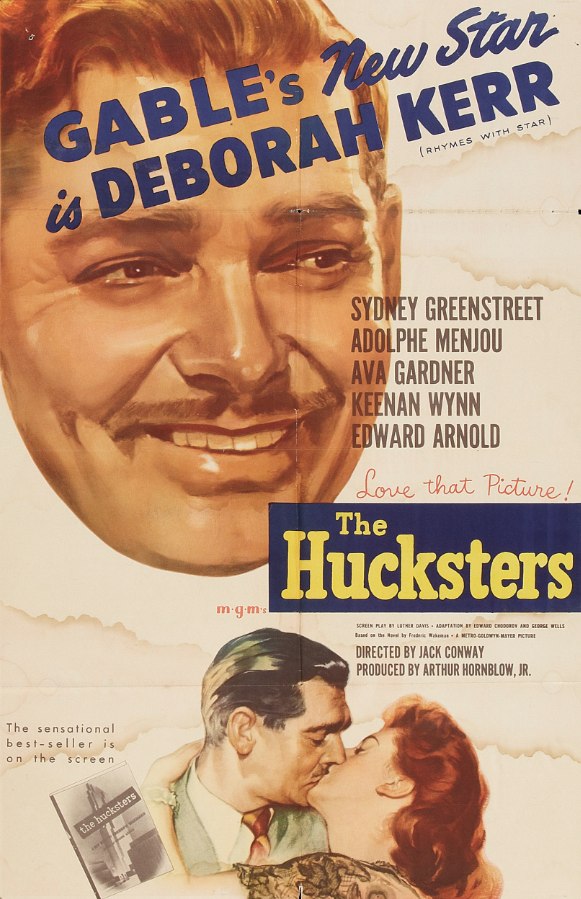
It’s hard to watch Jack Conway’s The Hucksters today and not compare it with Mad Men.
While Mad Men is a TV series that began in 2007 and takes place in the early ’60s and The Hucksters takes place during the time it was filmed (the post-war ’40s), they share a number of similarities, and not just because they’re both about advertising agencies.
Both feature at their center a dashing leading man with rugged good looks as an advertising genius who must navigate the tricky waters of love, sex, and difficult clients. Jon Hamm was in his mid-30s when Mad Men began, while Clark Gable was in his mid-40s in 1947, but both of their characters are veterans of the most recent war and inveterate seducers of women.
The Hucksters is based on Frederic Wakeman’s 1946 novel of the same name, which spent a year at the top of the best-seller lists. Wakeman’s novel was based on a four-part exposé in The Saturday Evening Post, “The Star Spangled Octopus,” about talent and promotional agency MCA.
The novel’s racy subject matter was largely responsible for its success. Life magazine called it “Last year’s best-selling travesty on bigtime advertising.”
Metro-Goldwyn-Mayer paid nearly $200,000 for the rights to Wakeman’s novel in a pre-publication deal. Most of the salacious details, however, never made it into the final shooting script. (Clark Gable’s take on the first draft of the script was, “It’s filthy and it isn’t entertainment.”) For instance, in the novel, Gable’s character, Victor Albee Norman, has an affair with a married woman, but she was changed into a war widow for the film.
Consequently, The Hucksters never quite achieves the satirical bite of Mad Men, but there are number of bits that are funny, particularly if you’re familiar with radio advertising circa 1947.
There are plenty of reasons to see The Hucksters. It was the American film debut of Deborah Kerr, who plays Gable’s widowed love interest, Kay Dorrance, and it also features the beautiful Ava Gardner as a torch singer named Jean Ogilvie. Adolphe Menjou is wonderful as Mr. Kimberly, the head of the advertising agency, and Keenan Wynn is appropriately irritating as a third-rate radio comedian named Buddy Hare.
The most memorable actor in the film, however, is Sydney Greenstreet, who plays Evan Llewellyn Evans, the grotesque and demanding head of Beautee Soap. After Gable’s character, Victor Norman, rejects the more scandalous layout favored by Evans, Evans sits down at the head of the boardroom table, tilts his head back, hawks, and spits on the table. “Mr. Norman, you’ve just seen me do a disgusting thing,” he says. “But you’ll always remember what I just did. You see, Mr. Norman, if nobody remembers your brand, you aren’t gonna sell any soap.”
The Hucksters could have used more moments like that. It’s nearly two hours long, and Gable’s romance with Kerr takes up much of the running time. It’s perfectly well-handled and shot, but it’s a storyline one could see in any number of pictures, while the advertising angle of the story is unique, and the film could have gotten more mileage out of it.
The Hucksters earned a respectable $4.4 million during its domestic release, but was a complete flop overseas, since in those days no one outside the United States was in any way familiar with American advertising or commercial broadcasting.
When I sat down to watch Fiesta, those words in the credits floored me. I can’t conceive of what it was like to grow up in a world without Ricardo Montalban. His suave, white-suit-wearing Mr. Roarke, from Fantasy Island (1977-1984), is a mysterious character who was burned into my mind at a young age. Ditto for his insane and weirdly brilliant role as the villain of Star Trek II: The Wrath of Khan (1982). Or his dapper and hilarious bad guy, Vincent Ludwig, in The Naked Gun (1988). Or his work as the pitchman for Maxwell House Decaf.
Maybe it was just the movies and TV shows that I watched, but Montalban seemed ubiquitous.
By the ’80s, he always appeared to be having fun with his “Latin lover” image, but he was never parodying himself. His smooth charm was undeniable, no matter what kind of ridiculous lines were coming out of his mouth. (Like claiming that decaffeinated coffee was “good to the last drop.”)
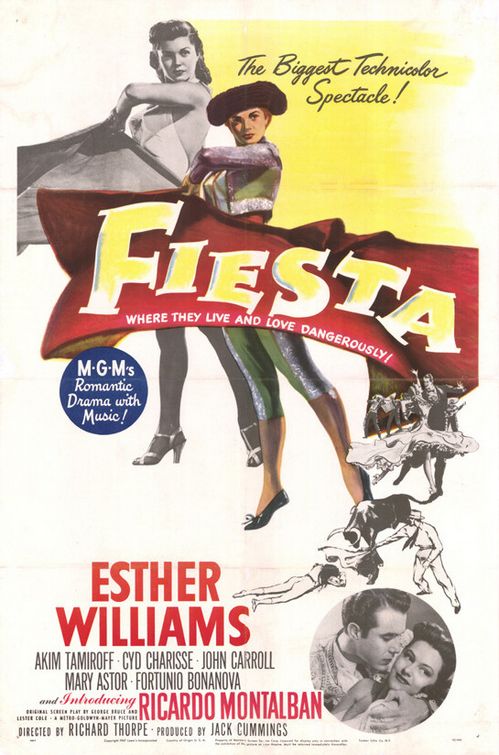
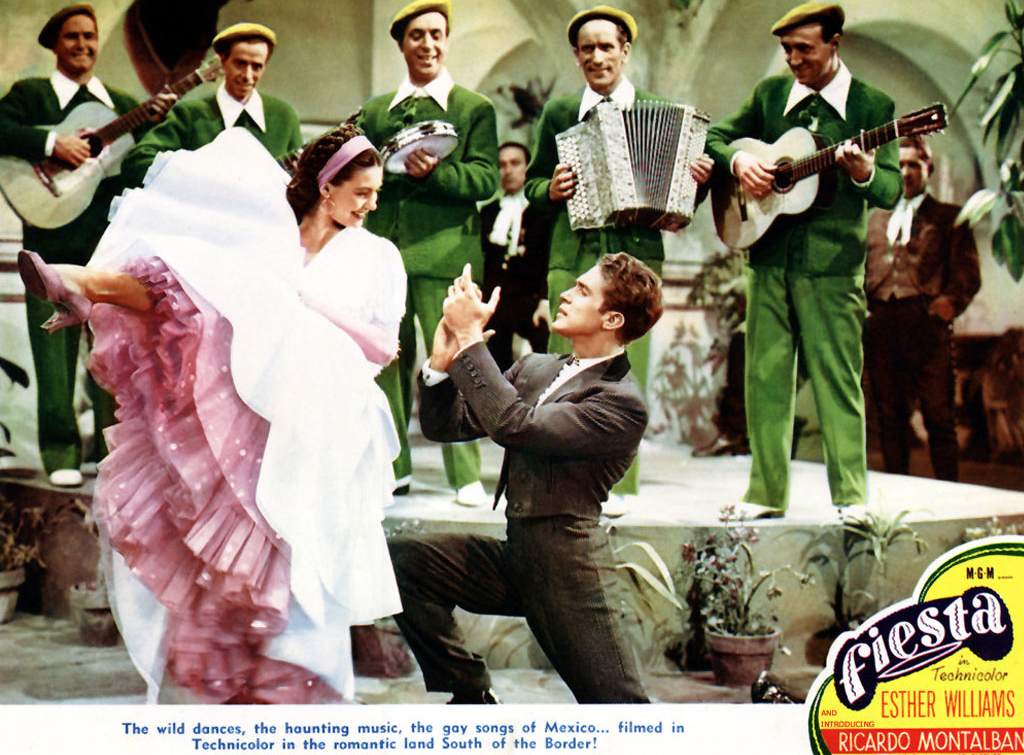
Richard Thorpe’s Fiesta wasn’t the first film to star Montalban. He’d already appeared in more than a dozen films in his native Mexico. But it was his first Hollywood film, and it was his introduction to American audiences. It was also an opportunity for Esther Williams to perform in a dramatic role that was very different from the roles that had made her famous in MGM’s “aquatic musicals.”
Williams and Montalban play twins, Maria and Mario Morales. Their father, Antonio Morales (Fortunio Bonanova), a former matador, always wanted a son to carry on his work in the ring. After confirming that he is indeed not going to have just a daughter, but rather twins, Morales proclaims his son “The future greatest matador in the whole world!”
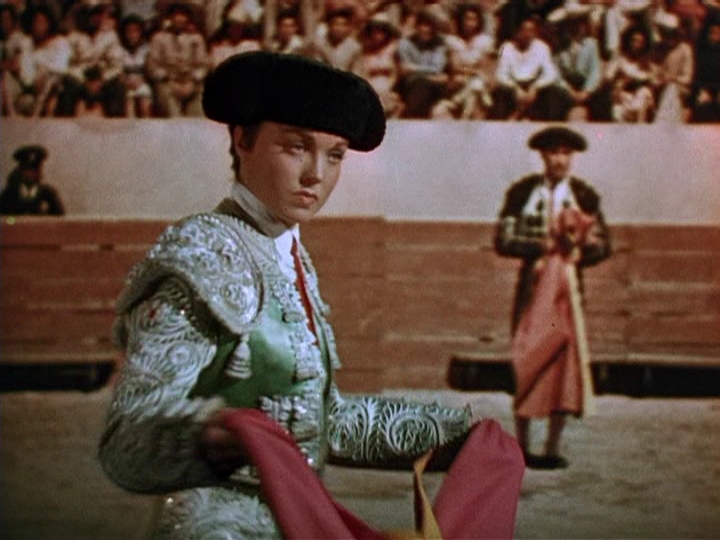
Of course, things don’t work out the way Señor Morales expects. His son Mario is a gifted musician and composer who would much rather make music than wear the traje de luces (“suit of lights”) and fight bulls (even though he’s good at it). His daughter Maria, of course, is the one with the real desire to be a torero, but her gender makes such a thing unthinkable.
Mario is torn between his father’s plans for him and the interest that conductor Maximino Contreras (Hugo Haas) shows in his music. Eventually, Mario flees the ring when he finds out his father lied to him about a visit Señor Contreras made to their house. He does so out of anger, but his action is viewed as cowardice by the spectators. Naturally, Maria comes up with a plan to don the traje de luces and impersonate her brother in the ring.
Fiesta has the kind of shopworn plot and lifeless dialogue that one can suffer through if they’re merely the framework for a musical packed with great songs and exciting dance numbers. But while Fiesta is often classified as a musical, it’s not a really a musical. It’s a turgid, woodenly acted drama whose only high points are a handful of dance sequences.
If you like dancing, then Montalban’s numbers with Cyd Charisse (playing a character named Conchita) are worth seeing. (I especially liked the number they stomped out to “La Bamba,” the traditional Mexican song that Ritchie Valens later made famous.) The scene in which Mario hears one of his compositions played on the radio by Señor Contreras’s orchestra and listens in rapture before sitting down at the piano in the cantina to play along would be at home in a musical, but it’s an organic moment. There are no scenes in Fiesta in which the characters just break into song.
In short, it’s pretty lifeless, especially when compared with other Technicolor extravaganzas from MGM. Most of the cast isn’t very interesting to watch. The great silent star Mary Astor is wasted in a thankless role as Señora Morales. Montalban is enjoyable to watch, but Williams is terribly miscast. It’s not that she doesn’t look “Mexican” (you can see plenty of women who look like Esther Williams if you watch Spanish-language television). It’s that she looks nothing like Montalban, yet the audience is asked to believe that she is a convincing double for him when she dons the traje de luces and enters the ring. Her own stunt double is also a completely unconvincing facsimile of Williams during the bullfighting sequences. His muscular buttocks, lack of breasts, crotch bulge, muscular neck, and big ears are pretty difficult to confuse with Williams’s slightly different attributes.
I like Esther Williams a lot. She’s beautiful and appealing, not to mention a hell of a swimmer. But this was just the wrong role for her. Also, her “romantic” scenes with Jose “Pepe” Ortega (John Carroll) are dead on arrival.
Although the film begins with a statement of sincere thanks to the Mexican people, the production was a troubled one. The cinematographer, Sidney Wagner, and another crew member both died of cholera after eating contaminated street food. Esther Williams’s husband, Ben Gage, and makeup artist George Lane were both expelled from Mexico after a fight with a hotel employee. And a stuntman died of an infection he contracted after being gored in the groin by a bull.
The largest problem the production ran into had to do with bullfighting, which director Thorpe chose to depict in a sanitized fashion. For example, the first time we see Mario’s moves in the ring, he skirmishes with an uninjured bull who charges at him over and over as he dances around the ring and flourishes his cape, avoiding several near misses. Eventually the bull gets too tired to continue, and the fight is over.
During the bullfights in Fiesta, only the bullfighter’s life seems to be in danger. It is presented as a dangerous sport. In reality, the outcome of a bullfight is rarely in question, and it is less a sport than an artistic, ritualized slaughter in which the torero is judged according to his grace and style, not whether or not he kills the bull. (According to this article, which was published last year in The Guardian, only 52 matadors have been killed in the ring since the year 1700. There are myriad injuries, of course, which range from minor to spectacular. If you have a strong stomach, click here.) In Fiesta there are no banderilleros jamming spikes into the bull’s back, bleeding it out and tiring it. There is no taunting of the bull or clownish antics on the part of the other toreadors in the ring, like grabbing the bull’s tail and skiing through the dirt as the bull circles. And, most important of all, there is no killing of the bull with a single sword thrust — the estocada.
Bullfighting is inextricable from the national identity of most Spanish-speaking countries. The people of Mexico were already angry that their own toreadors could not star in the film, so the depiction of bullfighting as a bloodless spectacle added insult to injury. When Thorpe had finished shooting Fiesta, his unit manager Walter Strohm convinced him that the bulls used in the film should all be killed to assuage the anger of the Mexican people. Thorpe acquiesced, even though the bulls had cost $1,000 each, which is nearly $10,000 in today’s dollars.
High Barbaree (1947)
Directed by Jack Conway
Metro-Goldwyn-Mayer
Jack Conway’s High Barbaree pairs America’s boy next door, Van Johnson, with America’s girl next door, June Allyson.
It wasn’t the first time they appeared in a film together. In Two Girls and a Sailor (1944), Johnson played the sailor of the title and Allyson played one of the pair of sisters who were in love with him. (They also both appeared in the 1946 Jerome Kern biopic Till the Clouds Roll By. I haven’t seen it, but I know that it features a cast of thousands, and I’m not sure if they shared any scenes.)
High Barbaree puts the two of them front and center. Their characters’ romance is unencumbered by comedy or contrived stumbling blocks. The title of the film and the poster art imply an exotic tale set in the South Seas, and the tagline of the poster — He wanted to stay in the arms of his first true love — but another woman claimed him! — implies that the film will be about a torrid love triangle. It’s neither of these things. It’s a sweet, earnest love story about two childhood sweethearts.
It’s a story told mostly in flashback. It’s WWII, and Lt. Alec Brooke (Johnson) and Lt. Joe Moore (Cameron Mitchell) are drifting in the Pacific, their plane shot down during a bombing run. Every other man in the crew is dead, and Alec and Joe will soon join them if they’re not picked up.
Their water supply dwindling and their bodies weakening, Alec reminisces with Joe about his childhood. Alec is a corn-fed all-American type from Iowa, and Joe ribs him about it, since he’s a typical cynical kid from Brooklyn. Alec recalls the girl he loved when he was little, Nancy Frazer (played by Gigi Perreau as a child, and by Joan Wells as a young girl). She fearlessly climbed the water tower with him when they were children, and later ran away with him to the circus, and witnessed his brief career as a bicycle-riding daredevil. (Alec is played as a child by Jimmy Hunt, and as a 14-year-old by Claude Jarman Jr., fresh off his success as the lead in The Yearling.)
By time passed, as it must, and Nancy and Alec lost touch. He abandoned his plans to become a doctor like his father, Dr. William G. Brooke (Henry Hull), and went into aviation. He got engaged to the wealthy blond heiress Diana Case (Marilyn Maxwell) and went to work for her father’s airplane manufacturing company. Everything seemed to be going his way until Nancy (played as an adult by June Allyson, natch) re-entered his life, and he realized how lost and unhappy he really was.
At some point in the midst of his recollections, Alec realizes that he and Joe and the wreckage of their PBY Catalina are drifting toward a spot marked on a map long ago by Alec’s vagabond uncle, Capt. Thad Vail (Thomas Mitchell). The spot marks a fabulous island called “High Barbaree.” Uncle Thad described it as a mysterious place that was always just over the horizon, but that was perfectly beautiful and serene. If only they can make it to High Barbaree, Alec says, they’ll be saved.
While the exotic island of High Barbaree gives the film its title, it’s not a central part of the story, the way Shangri-La is central to Lost Horizon. Most of the story takes place in Alec and Nancy’s hometown of Westview, Iowa, which is its own kind of dreamlike phantasmagoria. I’ve never been crazy about Van Johnson (I think his stage name really should have been Bland Johnson), but he and Allyson make an appealing couple, and his earnestness is hard to resist in this picture.
High Barbaree isn’t a great film, but it’s pretty good, and is recommended for anyone who’s craving an old-fashioned romance. It’s based on a novel by Charles Nordhoff and James Norman Hall. The review of the novel in the October 29, 1945, edition of Time magazine said that “It is plainly designed as a refuge for readers who have had enough of wartime realism.” The same can be said of the film.
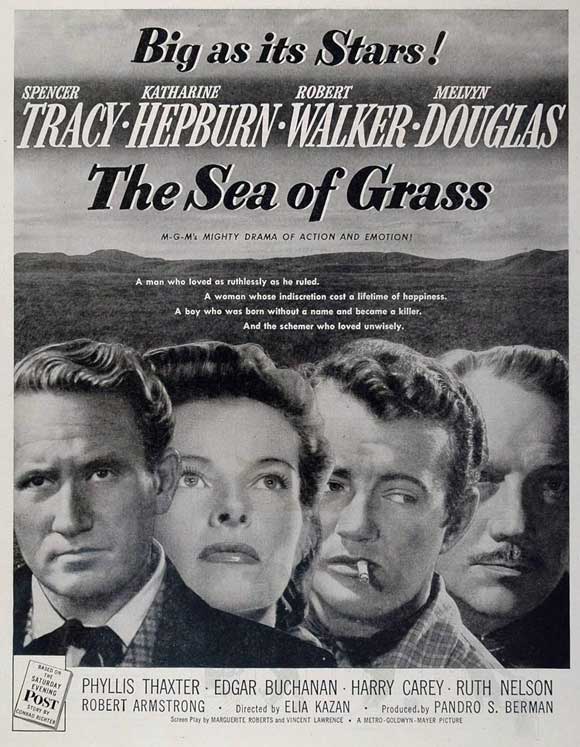
Elia Kazan’s The Sea of Grass premiered February 26, 1947, in Lincoln, Nebraska. It opened in New York City a day later, and went into wide release on April 25, 1947.
In his review of the film in The New York Times on Friday, February 28, Bosley “The Grouch” Crowther referred to the film as “Metro’s new cow-or-plow drama,” which is the best and most succinct description of the film imaginable.
This was Kazan’s second film — his first was A Tree Grows in Brooklyn (1945), and Boomerang (1947), which I reviewed earlier this year, was his third.
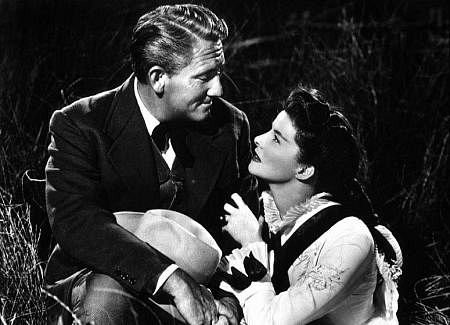
The Sea of Grass is the story of a high-born St. Louis woman, Lutie Cameron (Katharine Hepburn), who marries a cattle baron, Col. Jim Brewton (Spencer Tracy), and leaves the comfortable world of high society for a rough-and-tumble life in a place called Salt Fork, in the Territory of New Mexico. Brewton legally owns very little of the hundreds and hundreds of acres over which his cattle roam, but he fought and bled for the land, and he’ll be damned if any pussy-footing sodbusters are going to come in and reap the rewards he feels he earned for himself. Brewton’s connection to the land is full of mystical reverence, and he’s distant from people, including his wife. Lutie is driven into the arms of Brewton’s mortal enemy, Brice Chamberlain (Melvyn Douglas) — a lawyer who fights for the rights of homesteaders — just long enough to wind up carrying Chamberlain’s child. Lutie returns to Brewton and bears him a second child, a son named Brock (they already have a girl named Sara Beth).
When Brewton discovers that he has been cuckolded, he gives Lutie a choice. She can either leave and take Brock with her, exposing him as a bastard, or she can leave alone and he will raise Brock as his own son. Tearfully, Lutie takes the latter option, and lives in exile. Sara Beth grows into actress Phyllis Thaxter, and Brock grows up into snivelling punk Robert Walker. Brock’s true parentage seems to be an open secret in and around Salt Fork, and he responds by drinking, gambling, sneering, and throwing lead into anyone who disparages him. He’s an early-20th-century rebel without a cause, and tragedy always seems right around the corner whenever he’s onscreen.
The Sea of Grass is based on the 1936 novel by Conrad Richter. Kazan was so attracted to the material that he specifically asked MGM if he could direct it. (Kazan was under contract with Twentieth Century-Fox at the time, but it wasn’t an exclusive contract, and it allowed him to work with other studios.) His vision was of an on-location shoot that would last months, featuring unknown actors with leathery faces and a grand sense of scale that would express the drama and sadness of a way of life in America that is dead and gone.
There are hints of this in a few scenes. The few sweeping shots of the pre-Dust Bowl prairie land of the Great Plains, with the gently rolling oceans of grass that give the film its title, are unspeakably beautiful. But for the most part, The Sea of Grass is a melodrama that’s soapy enough to wash your car with.
Kazan was restricted by the studio to shooting on soundstages, and he found directing Spencer Tracy nearly impossible. Tracy was in a bad way during the making of the film, and he was drinking heavily. His performance isn’t bad, but it’s muted and deeply subdued, as though he’s only partly present most of the time. Katharine Hepburn, on the other hand, is histrionic, and very nearly a haughty parody of herself. There are moments of great visual excitement in the film, such as a violent confrontation between homesteader Sam Hall (James Bell) and Brewton’s men during a windstorm. At more than two hours long, however, The Sea of Grass offers very little in the way of the kind of action I look for in a western, and the soapy drama it’s packed with is pretty turgid.
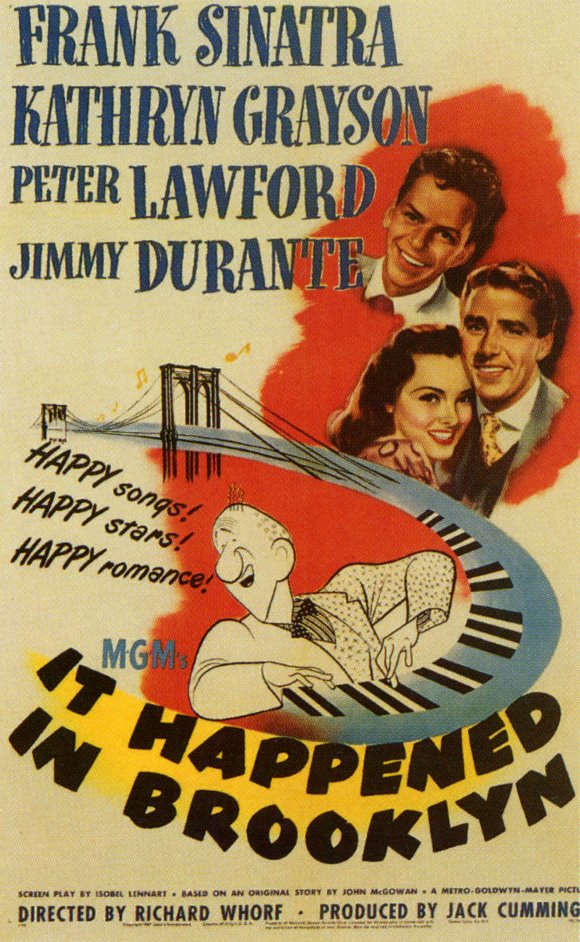
It Happened in Brooklyn (1947)
Directed by Richard Whorf
Metro-Goldwyn-Mayer
I used to be bummed out that I grew up after the era of listening booths in record stores.
After seeing Richard Whorf’s It Happened in Brooklyn, I’ve realized that as far as regrets go, that’s small potatoes. If this film is to be believed, there was once a music store in Bay Ridge where you could pick out any piece of sheet music and hand it to Frank Sinatra, the in-house “song demonstrator,” and listen to Ol’ Blue Eyes tickle the ivories while he performed it for you. Sure, you had to contend with a teeming crowd of sighing bobby-soxers, but that’s a small price to pay.
When It Happened in Brooklyn begins, Private Danny Miller (Sinatra) has been in the service for four years. World War II is drawing to a close, and he can’t wait to get home to his one true love, Brooklyn.
Danny loves Brooklyn so much that he carries a picture of the Brooklyn Bridge in his wallet. When a pretty Army nurse (Gloria Grahame) from Brooklyn refuses to believe that Danny is really from Brooklyn because he’s so restrained and cool, he pulls out the picture of the bridge and says, “Sure, that’s my pinup girl. Ain’t she a beauty?”
When Danny returns home, a traffic cop asks him why he’s so happy to be in Brooklyn when he could be across the river in New York. Danny looks incredulous and exclaims, “New York? That’s a place to look at Brooklyn from!”
Faced with the post-war housing shortage, Danny moves in with Nick Lombardi (Jimmy Durante), the janitor at New Utrecht High School, Danny’s alma mater. Nick is a kindly old geezer who idolizes the fictional teacher Mr. Chips, and doesn’t understand why all the kids in the school make fun of him.
Danny also befriends a pretty music teacher named Anne Fielding (Kathryn Grayson) and, in a remarkable example of art imitating life, teaches a British drip named Jamie Shellgrove (Peter Lawford) how to be cool.
For an MGM musical, It Happened in Brooklyn is fairly restrained. Unlike Sinatra’s previous film, the Technicolor extravaganza Anchors Aweigh (1945), which also co-starred Grayson, It Happened in Brooklyn is filmed in black and white, clocks in at under two hours, and doesn’t feature any huge production numbers.
Despite this, It Happened in Brooklyn is still a blast, especially if you’re a Sinatra fan. It’s packed with great songs by Sammy Cahn and Jule Styne, including “The Brooklyn Bridge,” “Whose Baby Are You?,” “It’s the Same Old Dream,” “The Song’s Gotta Come From the Heart,” and the classic “Time After Time.” I especially enjoyed Sinatra and Durante’s humorous performance of “I Believe” with a teenaged actor named Bobby Long, who does a great tap number. Does anyone know anything about Long? Why didn’t he ever appear in another movie? Did he have an abrasive personality? Horrible skin? Did he sleep with a producer’s wife after wooing her with his sensuous tap-dancing?
Along with all the great pop numbers, there’s a little “class” squeezed in, too. The classically trained Grayson gets to belt out a couple of operatic numbers — one from Mozart’s Don Giovanni and one from Delibes’s Lakmé — and her student Leo Kardos (Billy Roy) performs a piano concert in hopes of getting a scholarship. (Kardos’s playing was actually done by André Previn, who had just joined the music department of MGM at the age of 17.)
It Happened in Brooklyn is clichéd and occasionally silly, and it doesn’t offer the over-the-top razzle-dazzle of Anchors Aweigh, but it’s still a whole lot of fun.




 OCD Viewer