Tag Archives: Mystery

The Thirteenth Hour (Feb. 6, 1947)

The Thirteenth Hour
The Thirteenth Hour (1947)
Directed by William Clemens
Columbia Pictures

Let us bid adieu to Richard Dix.

His role in William Clemens’s The Thirteenth Hour was his last. Dix’s health was in decline when he was starring in the series of B movies based on the radio show The Whistler. After appearing in The Thirteenth Hour, the seventh in the series, Dix retired from acting. He died a couple of years later, at the age of 56, on September 20, 1949, following a heart attack he’d suffered a week earlier. (There would be one last Whistler movie, The Return of the Whistler, in 1948, starring Michael Duane.)

When asked about his role in The Thirteenth Hour, Dix said, “The part is more dramatic than the ones I used to do at Goldwyn’s and Paramount. Then, I played devil-may-care, brassy boys who were strong on wisecracks, and back in some of those early films I made the jokes via printed titles.”

His mention of printed titles is a reference to his early days in Hollywood, when the movies were still silent. Dix had a 30 year-long career, and was one of the first “he-men” of the silver screen; a rugged, square-jawed presence who loomed larger than life. His Whistler films aren’t the best of his career, but they’re nothing to be ashamed of, either. Unlike most of the formulaic, single-character mystery series of the ’40s (e.g., Boston Blackie, the Falcon, the Crime Doctor, Charlie Chan), Dix played a different role in each Whistler film, from the nastiest bad guys to the most well-intentioned good guys.

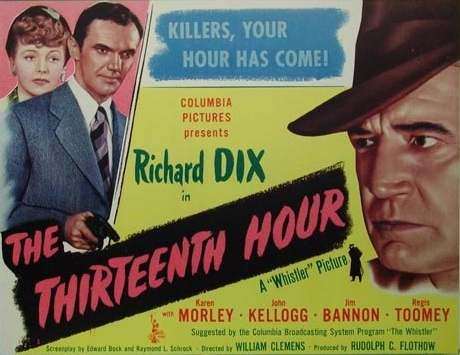
In The Thirteenth Hour, he plays a regular Joe named Steve Reynolds, a truck driver who operates his own trucking firm. He’s engaged to a roadhouse waitress named Eileen (Karen Morley), who has a young son named Tommy (Mark Dennis).

After a hot-rodding drunk runs Steve off the road one night and straight into an old man’s gas station, his license is revoked for six months. The accident wasn’t Steve’s fault, but a disappearing witness and a motorcycle cop named Don Parker (Regis Toomey), who has a vendetta against Steve, conspire against him.

To make matters worse, Steve has a competitor, Jerry Mason (Jim Bannon), an underworld character who’s undercutting Steve and is determined to run him out of business.

Finally, the night comes when Steve’s mechanic and driver Charlie (John Kellogg) is too sick to work, and Steve has no choice but to deliver a shipment himself. His license hasn’t been reinstated yet, so the decision could have terrible consequences. He starts out in the wee hours of the morning and sticks to back roads, but of course, something goes wrong. When he stops to service his truck, he’s knocked out by a masked man. The mysterious figure not only absconds with Steve’s truck, but he uses it to run over and kill a cop.

Steve goes on the lam and attempts to prove his innocence with the help of Charlie, Eileen, and Tommy. (There’s one weird, funny moment when the cops bust in on Eileen and Tommy right after Steve has slipped out the back. Tommy sits in a living room chair, looking innocent, reading a book. The detective peers at him suspiciously, and the camera zooms in on the book’s title — Studies in Necrophobia.)

If you’ve awake for most of the movie, you’ll have no trouble figuring out exactly who the killer is before Steve finds out. Even so, The Thirteenth Hour is a well-made, brisk mystery that packs plenty of excitement into its barely one-hour running time. The presence of the Whistler (an uncredited Otto Forrest) is less obtrusive than in some of the series’ entries, but he still sets the stage nicely, just as he did on his weekly radio show, which told the stories of “men and women who have stepped into the shadows.”

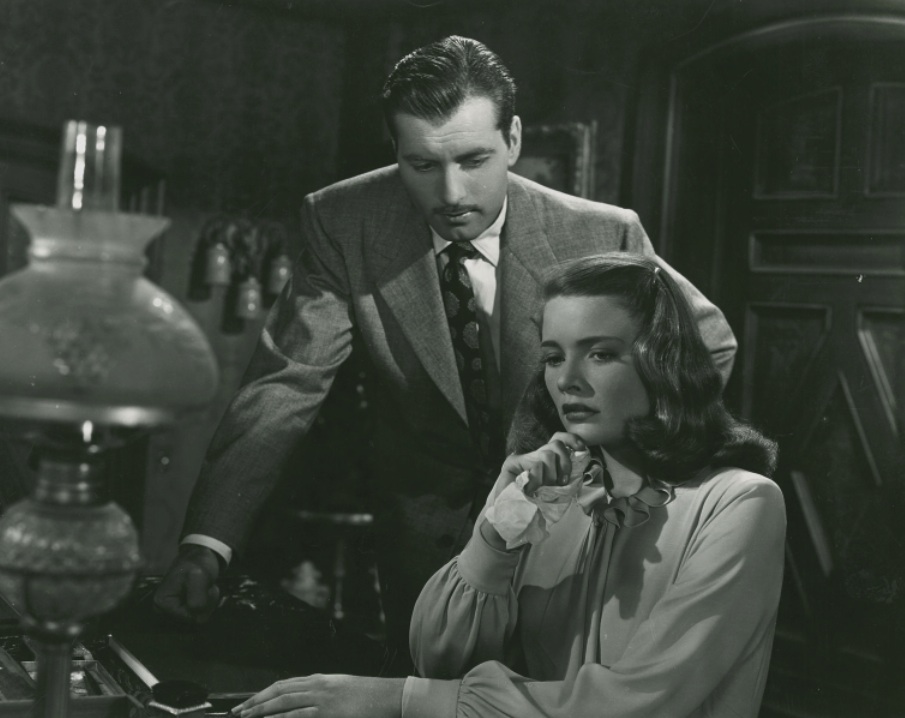
The Brasher Doubloon (Feb. 6, 1947)

Ladies, I don’t know if you know this, but the cure for frigidity is George Montgomery.

Let’s pretend that you are a young woman who is terrified of a man’s touch, due to some unstated trauma in your past. You work for a tyrannical old dowager who has an unnatural attachment to her spoiled, weak-willed son. You tremble at the sound of the old woman’s voice, and you live in her Southern California mansion as a virtual slave.

Then, one day, a man appears at the front door. He’s tall, he’s trim, he’s 30 years old, and he has high cheekbones and a nice mustache. In short, he’s the complete package. He’s come at the behest of your mistress, Mrs. Murdock, who wants him to track down a coin that has been stolen from her. The coin is the Brasher Doubloon of the title, and it’s a coin with “a romantic and violent history.”

If this man approached you privately after meeting with the old woman and you told him you don’t like to have men touch you, and he responded — “Well, in that case you better do something about your appearance. And that perfume you use … Night of Bliss. You just can’t seem to make up your mind, can you, Miss Davis?” — would you accept his offer to “take it very slowly” and cure you of your phobia?

Of course you would.

In John Brahm’s The Brasher Doubloon, private investigator Philip Marlowe (Montgomery) accepts both cases — tracking down the missing coin owned by Mrs. Murdock (Florence Bates) and curing her secretary, Merle Davis, of her frigidity.

Merle is played by Nancy Guild (rhymes with “wild”), who looks a little like a softer-featured Margot Kidder. She and Montgomery are an attractive pair, but their limits as thespians keep The Brasher Doubloon from being a top-flight picture.

Montgomery delivers every line in an emphatic huff. If it’s supposed to be hard-boiled it doesn’t come across that way. When a slimy coin dealer named Elisha Morningstar (Houseley Stevenson) asks Marlowe if he’s threatening him, Marlowe responds, “Yes…,” as though he’s not sure. When Marlowe tell Mrs. Murdock, “I do things my own way,” he sounds like a petulant child.

Throughout the film, Guild looks as though she’s been thrown into the deep end of the pool and doesn’t know how to swim. (This was only her second film — the first was Joseph L. Mankiewicz’s 1946 noir Somewhere in the Night.) Luckily, wide-eyed panic is what her character calls for. Unfortunately, her performance remains pitched at exactly the same level throughout the film.

Dorothy Bennett’s screenplay, which is adapted from Chandler’s 1942 novel The High Window, is pretty good. John Brahm’s direction is excellent. Unlike The Big Sleep (1946), this isn’t a picture that’s overly difficult to follow, and the settings — from baronial mansions to smoky underworld dives and rented rooms — are well-done.

The Brasher Doubloon is one of the least well-known films adapted from a Raymond Chandler novel. After two B movies adapted from Chandler novels that did not retain the Philip Marlowe character were released — The Falcon Takes Over (1942) and Time to Kill (1942), based on Farewell, My Lovely and The High Window, respectively — the two most famous Philip Marlowe movies were made: Murder, My Sweet (1944), which starred Dick Powell as Marlowe, and The Big Sleep (1946), which starred Humphrey Bogart as Marlowe. Robert Montgomery’s Lady in the Lake (1947) rounds out the “big three” Philip Marlowe films of the ’40s, and while it’s not as well-regarded as the other two, it’s available on DVD, and is an interesting picture.

The Brasher Doubloon is currently unavailable on DVD, which is a shame. While the acting by the two leads is pretty bad, and there’s a really cheesy scene at the end in which Marlowe assembles all of the suspects and explains to them who committed the murders, overall this is a pretty tight noir mystery.

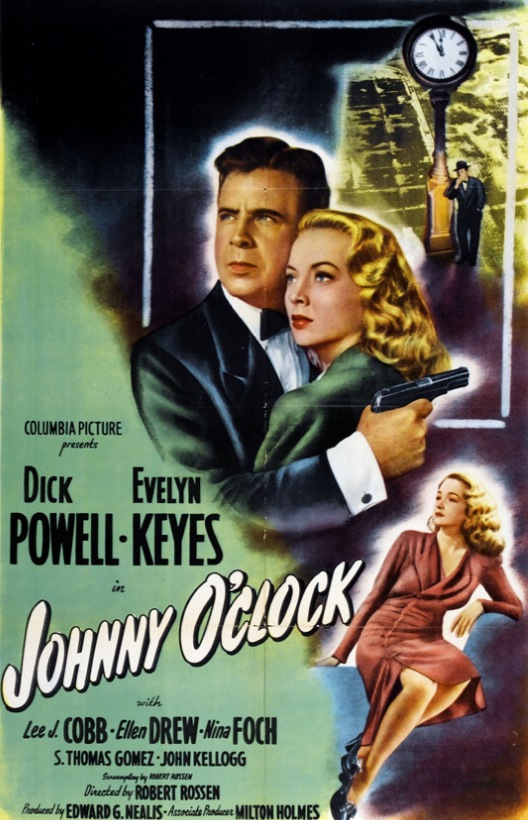
Johnny O’Clock (Jan. 23, 1947)

Robert Rossen’s Johnny O’Clock — yes, it’s really about a man named “Johnny O’Clock” — isn’t as good as some of Rossen’s later films, like The Hustler (1961), but it’s a great start. Rossen was a prolific writer of screenplays, but Johnny O’Clock was his first time in the director’s chair.

The improbably named protagonist is played with a light touch by former crooner Dick Powell. Johnny is a partner in a New York gambling syndicate run by an oily, overweight gangster named Pete Marchettis (Thomas Gomez).

Marchettis is married to a beautiful sloppy drunk named Nelle (Ellen Drew) who’s still carrying a torch for her ex-boyfriend, Johnny, but who loves the dough too much to ever leave Marchettis. Powell’s scenes with Gomez and Drew are some of the best of the picture, as the boozy moll falls all over Johnny in front of Marchettis and his heavy-hitters, seemingly oblivious to her husband’s jealousy. At the same time, Marchettis seems desperate for approval from both Johnny and his wife. In one scene, he goes on and on about the portrait he had a Mexican boy paint of him. When he shows it to Johnny and asks him if he likes it, Johnny simply responds, “It looks like you.”

There’s a police inspector named Koch (Lee J. Cobb) who’s hounding Johnny O’Clock, lurking in the lobby of the hotel where he lives and constantly trying to catch him riding dirty. Johnny’s association with corrupt cop Chuck Blayden (Jim Bannon) rubs the honest Inspector Koch the wrong way, especially since Blayden’s been on the winning end of more than one shootout with Marchettis’s rivals. Koch suspects that Marchettis and Johnny are using Blayden to do their dirty work under the guise of “justifiable homicide.”

When a pretty hat-check girl who works at Johnny O’Clock’s casino goes missing, things heat up. The girl, Harriet Hobson (Nina Foch), was dating Chuck Blayden, and when her body is found in her gas-filled apartment — an apparent suicide — Koch smells foul play. As soon as Harriet’s sister, Nancy Hobson (Evelyn Keyes), arrives in New York to claim her sister’s body, cracks begin to appear in Johnny O’Clock’s carefree exterior. He and Nancy are attracted to each other, but are from different worlds. She makes him want to cash out and run away with her, but if you’ve ever seen a gangster movie, you know that cashing out always comes at a price.

Johnny O’Clock is the third of many noirs to star Powell after he shed his image as a boyish Depression-era crooner and appeared as Philip Marlowe in Edward Dmytryk’s Murder, My Sweet (1944). Johnny O’Clock gives Powell a chance to craft a more three-dimensional character than he had a chance to in either Murder, My Sweet or Dmytryk’s Cornered (1945), and he’s mostly successful, although he didn’t seem fully up to the challenge of some of the more emotional moments in the film’s climax. (Powell was a breezy and charming actor who could project toughness and nastiness when he had to, but raw, naked emotion wasn’t one of the tools in his actor’s toolbox.)

While the story’s twists and turns are sometimes hard to follow, the actors are all good, and enjoyable to watch. Lee J. Cobb’s most famous role is probably as Lt. Kinderman in The Exorcist (1973), so it was fun to see him in a similar role, more than 25 years earlier.

Writer-director Rossen has a fuller vision of his criminal demi-monde that we see in most ’40s noirs, and his characters are convincing within its context. I really liked Johnny O’Clock, and I’d love to see proper DVD releases of more of Dick Powell’s film noirs in the future. I had to watch this one on a janky DVD-R recorded off of television.

Lady in the Lake (Jan. 23, 1947)

Lady in the Lake
Lady in the Lake (1947)
Directed by Robert Montgomery
Metro-Goldwyn-Mayer

Robert Montgomery’s Lady in the Lake is a one-of-a-kind experience. Like a lot of one-of-a-kind experiences, it’s one that some people will never want to experience ever again after it’s over.

It’s not like any other movie you’ll ever see, but the fact that its central gimmick was never used again should tell you something.

The gimmick is that nearly the entire film is shot in a first-person point of view (POV). The film is a series of long tracking shots, but there are a few jump cuts and wipes when necessary. The trailer for Lady in the Lake told audiences that the film stars Robert Montgomery … “and you!” But this isn’t entirely true, for reasons that we’ll get into later.

Lady in the Lake is an adaptation of Raymond Chandler’s 1944 novel The Lady in the Lake, and stars Montgomery as private investigator Philip Marlowe (whose first name in this movie is spelled “Phillip”). Montgomery also directed the film — his first time as director, although he provided uncredited directorial assistance to John Ford when he starred in Ford’s World War II PT boat saga They Were Expendable (1945).

The only parts of the film that aren’t filmed from Marlowe’s POV — every actor interacting directly with the camera, Montgomery’s face only visible if he happens to look in a mirror — are stiff monologues by Montgomery as Marlowe, seated at his desk in his office, speaking directly to the viewer. These monologues are used to introduce the picture and to cover some gaps in the narrative.

Montgomery begins the films by telling viewers that they will be solving the mystery alongside him. He recites a street address and says, “make a note of it.” The problem with this is immediately clear. The film will continue to spool forward for you the same way it does for everyone else in the audience, whether you remember the address or not.

A first-person POV version of a Chandler novel must have made sense on paper. Chandler was a master of first-person narration, and his brilliant prose made first-person narration inextricable from the P.I. genre.

But first-person POV in film is very different from first-person narration in a novel. Despite what many critics of slasher films in the ’80s would have had you believe, first-person POV in a film does not create identification with the killer, it makes the viewer feels trapped and terrified.

While you’re unlikely to feel terrified while watching Lady in the Lake, it does inspire a sense of claustrophobia and surreality that is at odds with its goal of putting the viewer in the center of the action like no film had before.

Lady in the Lake begins in an odd fashion, as Marlowe tries to sell his semi-autobiographical story “If I Should Die Before I Wake” to magazine editor Adrienne Fromsett (Audrey Totter). When Fromsett’s stacked and gorgeous blond secretary (Lila Leeds) enters the office, she makes eyes at Marlowe, and the camera tracks her as she sashays out of the office. The eye contact she maintains with the camera is unbearably erotic. It’s ridiculous in terms of an actual narrative, but it works in the heat of the moment, like a tomahawk flying out of the screen in a 3D western. (Proponents of the “male gaze” theory can have a field day with this film.)

Audrey Totter

The problem with Lady in the Lake isn’t just its technique, it’s the fact that most of the actors interact with the camera in an unnatural fashion. Most of them never look away or even blink. Totter is the worst offender. She’s pretty, but her habit of arching one eyebrow while speaking to the camera is bizarre.

When Marlowe asks Fromsett a question — “What would happen if I kissed you?” — there’s no heat or interplay. It’s a purely technical question. If Marlowe kisses her, where will the camera go? Will it smoosh up against her face?

The only actor who interacts well with the camera is Lloyd Nolan, who plays the nasty and volatile police detective Lt. DeGarmot. Unlike the other actors — who seem afraid to break eye contact with the camera — he looks down, and around, occasionally turns his back on Marlowe, and steps forward to be threatening. In a memorable scene, he even slaps the camera in the “face” several times while sneering.

Lady in the Lake takes place during the Christmas holiday, and there’s very little incidental music, except for an eerie holiday vocal choir that shows up every now and then on the soundtrack.

While the first-person POV of Lady in the Lake doesn’t always work, there are a number of interesting “verité” moments, such as the scene in which Marlowe and the viewer sit around while observing Capt. Kane (Tom Tully) on the phone with his daughter on Christmas Eve. He’s embarrassed to be on a personal call while at work, but he chats with her anyway. There’s also an amazing quiet moment when Marlowe wakes up in Fromsett’s house on Christmas day, and the camera observes her lounging on the opposite couch in the living room, smoke curling out from behind the camera (Marlowe’s having a cigarette), as she and Marlowe listen to an adaptation of “A Christmas Carol” on the radio.

Because of the nature of the film, I still don’t feel as if I’ve ever seen Robert Montgomery play Philip Marlowe. He seems like a good choice for the character, since he bears a resemblance to Marlowe’s creator, Raymond Chandler, but his disembodied voice was too monotone to make up for the fact that he’s off-screen for most of the movie.

First-person POV would be used again in 1947 for the first section of Delmer Daves’s Dark Passage, and for memorable moments in other films, like the opening murder sequence in John Carpenter’s Halloween (1978) and a fistfight in Gordon Parks’s Shaft (1971), but this was the only time it would be used for an entire motion picture.

I actually really enjoyed Lady in the Lake, even though I think it’s a failed experiment. It’s worth seeing at least once by anyone who’s interested in film, and there are enough powerful, uncanny, and interesting moments to make up for the long stretches of flaccidity.

Dick Tracy vs. Cueball (Dec. 18, 1946)

Dick Tracy vs. Cueball begins with a montage of Dick Tracy and his rogues’ gallery from the Sunday funnies — B.O. Plenty, Gravel Gertie, Vitamin Flintheart, Flattop, etc. — and ends with a face that Chester Gould never drew. He’s a chrome-domed, pug-nosed bruiser called Cueball, and his cartoon image eventually dissolves into the visage of the character actor who plays him, Dick Wessel, looking menacing as all get-out as the recently paroled thug.

In the opening scene of the film, Cueball sneaks onto an ocean liner that has just docked, forces his way into the compartment of a passenger named Lester Abbott (Trevor Bardette), and demands he hand over his diamonds. When Abbott fights back, Cueball wraps a braided leather strap around his neck and strangles him to death. It’s not as shocking as the murder that opens Dick Tracy (1945), but it’s still fairly gruesome by ’40s standards. (We see it in silhouette, and Cueball even drives his knee into the small of Abbott’s back as he garrotes him.)

Police detectives Dick Tracy (Morgan Conway) and Pat Patton (Lyle Latell) run down clues and question Abbott’s employer, jeweler Jules Sparkle (Harry Cheshire). Pat trails Sparkle’s diamond cutter, Simon Little (Byron Foulger), to a meeting with his hideous assistant Rudolph (Skelton Knaggs), while Tracy follows Sparkle’s secretary, Mona Clyde (Rita Corday), to a rendezvous with antiques dealer Percival Priceless (Douglas Walton).

Meanwhile, Cueball seeks help from Filthy Flora (Esther Howard), the proprietor of a waterfront dive bar called “The Dripping Dagger,” and it becomes clear that he is a pawn in a game he doesn’t fully understand. He’s a pawn who kills as easily as other men breathe, however, and before the film is over, he’ll have murdered three people in his quest to get $20,000 for a score of diamonds worth $300,000.

Like Morgan Conway’s previous outing as Dick Tracy, this picture is a solid, unpretentious police procedural that moves at a nice clip. Many of the characters never appeared in Chester Gould’s comic strip, but they’re crafted in the right spirit. Gould’s bad guys may have been grotesque caricatures with ridiculous names, but he treated them with dead seriousness. Dick Tracy vs. Cueball does the same thing. There’s plenty of comic relief whenever the pill-popping Vitamin Flintheart (Ian Keith) is onscreen, but there’s nothing funny about Cueball slapping Filthy Flora across the face with his leather braid before he chokes her to death with it.

Gordon M. Douglas directs with energy and élan. His camera setups are utilitarian, but the angles and lighting create a dramatic noir atmosphere. Dick Tracy vs. Cueball is a violent B mystery thriller with 0% body fat and a lot of muscle.

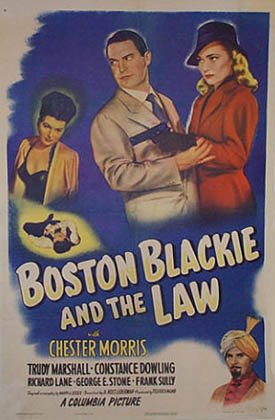
Boston Blackie and the Law (Dec. 12, 1946)

D. Ross Lederman’s Boston Blackie and the Law, produced by Ted Richmond, is the twelfth of 14 Boston Blackie features released by Columbia Pictures from 1941 to 1949.

Horatio “Boston Blackie” Black was a gentleman thief and safecracker created by author Jack Boyle in 1914. Stories featuring Boston Blackie appeared in The American Magazine, Cosmopolitan, and Redbook, and the character showed up in a number of silent films starring a variety of different actors. When Chester Morris stepped into the role in Meet Boston Blackie (1941), however, he was on the road to becoming inseparable from the character. Meet Boston Blackie was the first “talkie” featuring Boston Blackie, and Morris would go on to play Blackie in all 14 programmers released by Columbia Pictures. Morris also played the character on the radio, in a 1944 summer replacement series for Amos & Andy. When Blackie returned to the airwaves in 1945, Richard Kollmar took over the part, and starred in more than 200 episodes.

The radio version of Boston Blackie is the one I’m most familiar with, and while I’m a regular listener, it’s never been one of my favorite shows. Occasionally there’s a really crackerjack episode, but mostly they’re middle-of-the-road mysteries with more corn than the state of Iowa. Judging solely by Boston Blackie and the Law, which is the first Boston Blackie movie I’ve ever seen, the film series is pretty similar. Blackie is a likable rogue, but his puns are pretty lame, and he’s got plenty to go around.

Boston Blackie and the Law begins in a festive fashion, with Blackie performing a magic show at the annual Thanksgiving party at Women’s State Penitentiary. An old lady in the audience says, “I didn’t know Boston Blackie was a magician.” A young blonde responds knowingly, “There isn’t a trick he doesn’t know.”

That young blonde is Dinah Moran, a.k.a. prisoner #31329 (played by Constance Dowling), and when Blackie offers to make someone disappear in his “Phantom Cabinet,” she volunteers. Blackie promises Warden Lund (Selmer Jackson) the disappearance will be only temporary, which gets a laugh from the audience, but no one’s laughing when he pulls back the curtain of the cabinet a second time and Moran is still nowhere to be seen.

Enter the long-suffering Inspector Farraday (Richard Lane) and his bumbling sidekick, Sgt. Matthews (Frank Sully). Farraday is Blackie’s foil; an eternal chump who always suspects Blackie of wrongdoing, and who always trips over his own feet while Blackie effortlessly solves the crime his own way.

After Blackie gives the imbecilic Sgt. Matthews the slip, he and his sidekick, “The Runt” (George E. Stone), follow clues to a stage magician named “Jani” (Warren Ashe) and his pretty, dark-haired assistant Irene (Trudy Marshall).

Jani, whose real name is John Lampau, bears a strong resemblance to Boston Blackie, which comes in handy when Blackie needs to impersonate him. (To enjoy a movie like this, you have to buy that Inspector Farraday and Sgt. Matthews can’t recognize Blackie up close just because he’s wearing a turban and a false Van Dyke beard.)

As usual with these types of B mysteries, I was left with more stupid questions than the film had trite answers when the words “The End” appeared onscreen. But I enjoyed it. Columbia’s mystery series of the ’40s — like The Whistler series and The Crime Doctor series — were top-notch B-movie entertainment, and Boston Blackie and the Law isn’t bad, either.

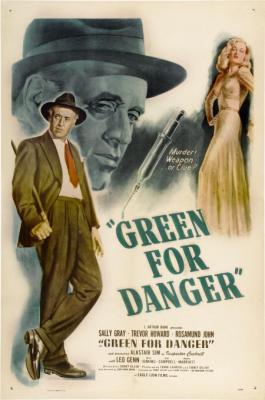
Green for Danger (Dec. 5, 1946)

Sidney Gilliat’s Green for Danger, based on the novel by Christianna Brand, is a terrific whodunnit, replete with the cream of the crop of post-war British film thespians.

The story takes place over the course of one week in 1944 at Heron’s Park Emergency Hospital, a requisitioned and converted Elizabethan manor in the English countryside. The atmosphere is claustrophobic, as the doctors, nurses, and administrators tend to the sick and the wartime wounded while squabbling and engaging in petty jealousies as German bombers fly overhead.

Alastair Sim, who plays Inspector Cockrill, doesn’t show up until halfway through the film, but he narrates it from the beginning, introducing us to a group of doctors and nurses circled around a patient in the operating theater; surgeon Mr. Eden (Leo Genn), a stocky, dark-haired Lothario; anesthetist Dr. Barnes (Trevor Howard), who is engaged to the pretty blonde, Nurse Linley (Sally Gray); hysterical Nurse Sanson (Rosamund John); strait-laced Sister Bates (Judy Campbell); and portly Nurse Woods (Megs Jenkins). Inspector Cockrill informs us that it is August 17, 1944, and that by August 22, 1944, two of these characters will be dead, and one of them will be revealed as a murderer.

I like a mystery that establishes its parameters early in the story, and Green for Danger does exactly that. The fact that we’re quickly introduced to the six main characters while their hair and faces are covered by surgical caps and masks means you’ll have to be paying especially close attention if you want to remember who everyone is at first glance, but if you aren’t, never fear. The characters in this film are sharply drawn, and the actors bring them to life wonderfully.

Trevor Howard as Dr. Barnes is the embodiment of the British middle class; his entire body is one big stiff upper lip. Leo Genn probably isn’t anyone’s current idea of a ladykiller, but his smoothness and charisma make him utterly convincing. Sally Gray is lovely to look at, although when she and Rosamund John were both wearing surgical caps I found them difficult to tell apart. I especially liked Judy Campbell, whose role could have been one-note, but who manages to instill the severe Sister Bates with a good deal of humanity.

The first murder — or was it murder? — takes place when a postman named Higgins (Moore Marriott), injured after a bomb attack, dies on the operating table. Recriminations fly, but his death is written off as an accident until one of the nurses screams during a party that she knows it was murder, and she can prove it. She rushes off into the night, stalked by a killer. This sequence is genuinely terrifying, and is reminiscent of an Italian giallo, with dark shadows, swinging doors, and shutters blowing open and closed in the wind to create dramatic lighting effects.

Inspector Cockrill’s appearance marks a shift in tone, as the film becomes more comic. Cockrill is the diametrical opposite of Dr. Barnes and Mr. Eden. While they are perfectly groomed, neatly coiffed, and sharply attired, he is bald, with shocks of gray hair above his ears, outfitted in an ill-fitting, rumpled suit with a drooping pocket square. He’s a collection of tics, constantly shrugging his shoulders and raising his eyebrows.

He’s also the shrewdest man in the room. When Dr. Barnes disparagingly refers to flat-footed coppers, Cockrill responds, “The police force has not a monopoly of fallen arches, Dr. Barnes. Ask any chiropodist.”

Alastair Sim is a fantastic actor, and he exudes authority as Inspector Cockrill, even when he’s doing a pratfall. Cockrill is a fantastic creation, and watching this film made me wish there were an entire series of films featuring the character. He keeps his suspects constantly off-kilter with inappropriate jokes and ironic comments, and he seems mildly amused by everything, including himself.

Green for Danger was one of the most pleasant surprises I’ve had lately. It’s genuinely good escapist entertainment.

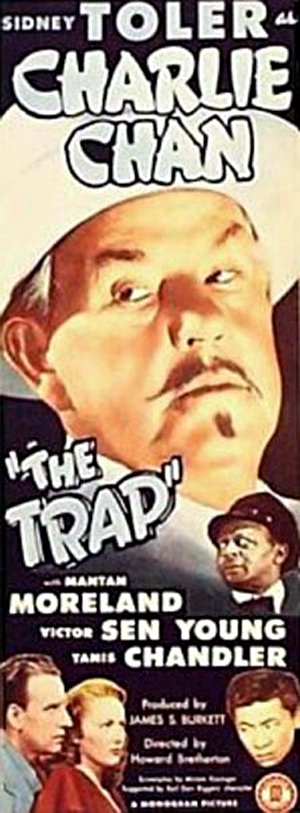
The Trap (Nov. 30, 1946)

Howard Bretherton’s The Trap, produced by James S. Burkett, was Sidney Toler’s last appearance as Charlie Chan. Toler died on February 12, 1947, at the age of 72.

He inherited the role of Chan, a Chinese detective created by the novelist Earl Derr Biggers, from Swedish actor Warner Oland, who died in 1938. Oland played the venerable old detective from 1931 to 1937. He died at the age of 58 from complications due to bronchial pneumonia, possibly related to his alcoholism. (According to Yunte Huang’s recent book about Charlie Chan, Oland like to throw back a few before playing the character, as it helped his fuzzy, drawling, faux-Chinese line delivery. When Toler took over the character, the producers encouraged him to do the same thing.)

The Trap is a run-of-the-mill B mystery from Poverty Row studio Monogram Pictures. A gaggle of showgirls, their impresario, and their press agent all set up camp in a dusty old beach house in Malibu Beach.

After one of them is strangled with a silken cord, the hysterical women telephone Charlie Chan and reach his driver, Birmingham Brown (Mantan Moreland). If you enjoy politically incorrect humor, you’re in for a treat, as the bug-eyed Moreland mugs and twitches in ways black actors never would again.

Accompanied by Birmingham and his “number 2” son Jimmy (Victor Sen Yung), Chan arrives on the scene, and proceeds to unravel the mystery while spouting nonsensical aphorisms like, “Puzzle always deepest near the center.”

The Trap is a standard “old dark house” mystery, with the regular array of stock characters, such as a severe old battle-axe of a housekeeper and a doctor running away from his past. Kirk Alyn, who would go on to play Superman in two serials in 1948 and 1950, plays a tall, handsome motorcycle cop who assists Chan in his investigation, and doesn’t make much of an impression beyond his mustache and dark glasses. The beach setting doesn’t really jibe with the creepy old house — which has a basement and plenty of secret passages — and seems to exist mostly as an excuse for the pretty showgirls to go swimming whenever they can.

The Charlie Chan films remain a historical curiosity. Neither Toler’s makeup nor acting make him convincingly Chinese, but the series still has its fans, even its Chinese fans, such as Huang, the author I mentioned above.

Nocturne (Nov. 11, 1946)

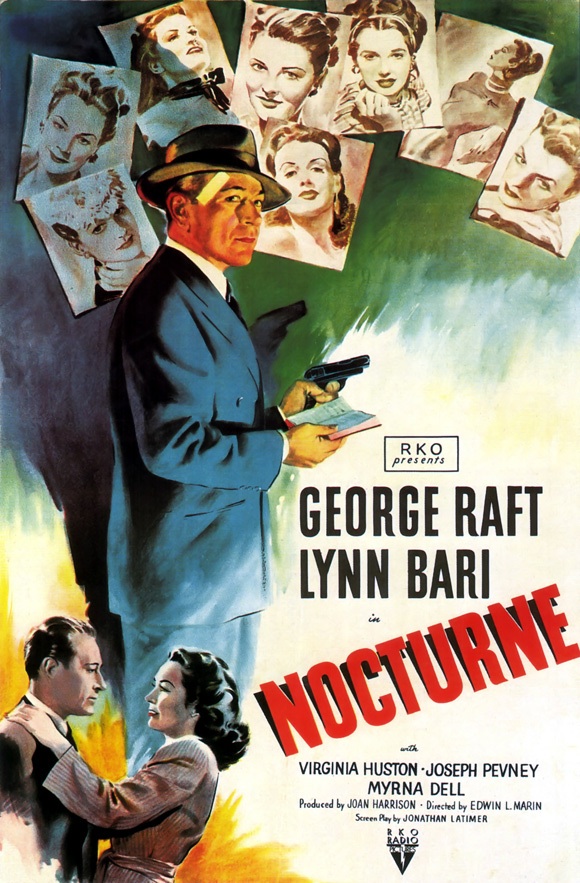
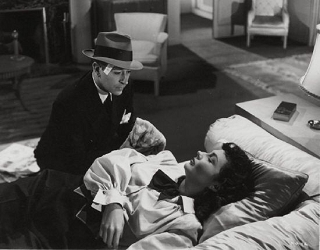
Edwin L. Marin’s Nocturne is close to being a great film noir, but not that close. It’s an entertaining mystery thriller with plenty of clipped, hard-boiled dialogue that’s fun to listen to, if not particularly credible.

George Raft plays Lt. Joe Warne of the Los Angeles police, and it’s a role that seems designed to play to the public’s perception of Raft as a gangster and a thug. Warne conducts his murder investigation with the subtlety of a steamroller, pushing a mustachioed Lothario into the pool when he gets in his way and ripping up the roll of a player piano in a diner when the owner won’t cooperate with him.

And when was the last time you saw a hard-boiled detective who lived at home with his mother? It’s the kind of oddball detail that feels as if it would be more at home in a gangster movie starring James Cagney.

Raft’s first big role was as Paul Muni’s sidekick in Howard Hawks’s Scarface (1932). After that he starred in a string of gangster pictures, and was one of the most popular actors in crime melodramas, along with Cagney and Edward G. Robinson. His boyhood friendship with gangster Owney Madden and association with men like Bugsy Siegel and Meyer Lansky aided the public’s perception of him as a hard man who didn’t just “talk the talk.”

By the ’40s, however, his star was beginning to fade. Turning down the lead roles in High Sierra (1941), The Maltese Falcon (1941), and Double Indemnity (1944) didn’t help matters. (Raft was reportedly functionally illiterate, which may have made choosing scripts difficult.) It’s safe to say that by 1946, he was getting the scripts that Humphrey Bogart used to line his birdcage.

Raft wasn’t a very expressive actor, and he had the range of a T-bone steak, but his tight-lipped acting style was perfect for B movies like Nocturne.

A flamboyant pianist and composer named Keith Vincent (Edward Ashley) is murdered, presumably by one of the nine brunettes he was running around with. He has glamour shots of all of them lining one wall of his living room, and it’s clear they were all interchangeable for him, since he called them all “Dolores.” (This may seem like a clever device to hide the identity of the murderess from the viewer, but it’s not.)

Lt. Warne investigates with ham-handed glee, and his investigative technique is as sloppy as the filmmaking. For instance, in one scene his chief (Robert Malcolm) bawls him out for bothering a character named “Mrs. Billings,” but apparently her scenes were left on the cutting room floor. This is fine, but why leave references to her in the film? Similarly confusing is the fact that Warne’s chief gives him two days to investigate Vincent’s murder on his own, but we only find this out after the two-day period is over. And it’s only after this two-day investigative blitz that Warne goes back to Vincent’s house and notices that one of the pictures is missing, since the pattern is disrupted, and there’s an enormous nail hole in the wall. Looking at the stamp on the back of one of the other pictures leads him to a sleazy photographer named Charles Shawn (John Banner). Wouldn’t a detective worth his salt have noticed all this immediately?

The most enjoyable thing about this film is the atmosphere. Lt. Warne spends a lot of time in smoky nightclubs, including the unique Keyboard Club, in which a hulking man-child named Erik Torp (Bern Hoffman) pushes a pianist named Ned “Fingers” Ford (Joseph Pevney) and his upright around on a rolling platform so they can take requests, table by table. When they get to Warne’s table, he hands Vincent’s unfinished piece “Nocturne” to Fingers to play. When he reaches the end of the handwritten sheet music, Fingers asks, “What did your friend do, run out of notes?” Warne responds, “More or less.”

Plenty of sex and sleaze run right below the surface of the picture, but it’s all pretty lighthearted. There’s a funny scene in a dance studio in which Warne can’t learn even the most basic steps (it’s mostly funny because Raft was a professional dancer), and his romance with his prime suspect, Frances Ransom (Lynn Bari), doesn’t carry much sense of danger or menace.

Nocturne is a really fun picture, despite its shortcomings. It has some of the snappiest, most hard-boiled, least naturalistic dialogue I’ve heard since I watched The Dark Corner (1946). Fans of B noirs are encouraged to seek out this picture.

Crime Doctor’s Man Hunt (Oct. 24, 1946)

Crime Doctor's Man Hunt
Crime Doctor’s Man Hunt (1946)
Directed by William Castle
Columbia Pictures

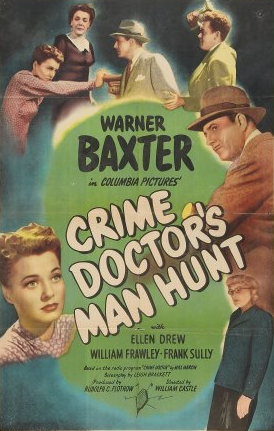
William Castle’s mystery programmer Crime Doctor’s Man Hunt is yet another wacky outing with Warner Baxter as Robert Ordway, M.D., Ph.D. (a.k.a. the Crime Doctor).

The Crime Doctor was a character created by Max Marcin for a Sunday-night mystery radio show that ran from 1940 to 1947 on CBS stations. Like a lot of radio detectives (e.g., Boston Blackie, the Falcon), the Crime Doctor also got his own series of hour-long B movies.

In the first film in the series, Michael Gordon’s Crime Doctor (1943), a Depression-era crook and racketeer named Phil Morgan survives a murder attempt, but suffers from complete amnesia, reinvents himself as “Robert Ordway,” and puts himself through medical school. Once he gets his degree, he focuses on rehabilitating criminals. His past eventually catches up with him, but everything works out all right, and he is able to continue being Dr. Ordway, putting crooks behind bars and helping the helpless.

Crime Doctor is one of the best films in the series. The subsequent films are all a lot of fun, but Dr. Ordway’s checkered past is rarely referred to. Baxter’s performance in the lead role is always top-notch, however, and most of the Crime Doctor pictures are a cut above most other mystery programmers from the ’40s.

In Crime Doctor’s Man Hunt, John Foster (Myron Healey), a young, pencil-mustachioed man suffering from “bomb shock and combat fatigue,” comes to see Dr. Ordway. He’s suffering from fugue states in which he wanders in a daze, always drawn to the same intersection, but he doesn’t know why, and never remembers how he got there. He could get treatment from the Army, but he doesn’t want his fiancée to know about his condition.

His fiancée, Irene Cotter (Ellen Drew), comes to see Dr. Ordway right afterward. (Foster’s attempts to conceal his condition from her were clearly in vain.) Dr. Ordway deflects her questions and tells her that he can’t violate any patient’s confidentiality.

As with most of the Crime Doctor films, things get loonier as the film goes on. We learn that Foster had his fortune cast during a “slumming party” downtown, and was told by a fortuneteller named “Alfredi” (real name “Alfred Hemstead,” played by Ivan Triesault) that he would meet his violent death on the corner of Garth and Davis streets, which is why he is continually drawn there.

There’s also a case of split personality, which I won’t say too much about in order not to give anything away. However, even the dimmer bulbs in the audience will see the “twist” ending coming from a mile away. I’m not even sure it was meant to be a surprise.

Ordway comments at the end of the film that this has been a strange case, first the fugue, then the split personality. “Doctor, I’d like you to come see my wife,” says Police Inspector Harry B. Manning (William Frawley). “Split personality?” asks the doctor. “No personality,” quips the inspector.