Tag Archives: Mystery

The Big Sleep (Aug. 31, 1946)

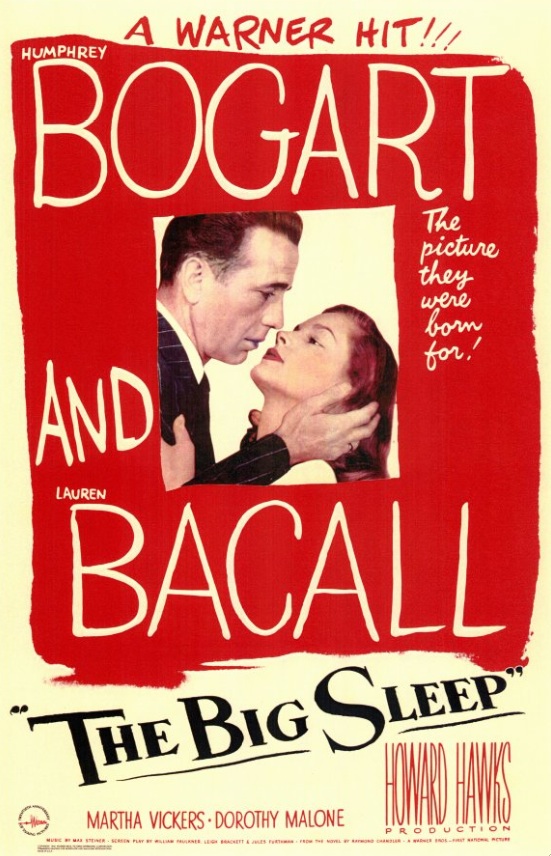
The Big Sleep is a classic of the mystery and noir genres. Humphrey Bogart’s Philip Marlowe is one of cinema’s most memorable shamuses (a term which everyone in this movie pronounces “shah-mus,” not “shay-mus”). It’s also one of the most quotable movies of all time. When asked how he likes his brandy, Marlowe says, “In a glass.” After an encounter with a young coquette, Marlowe says, “She tried to sit in my lap while I was standing up.”

And it’s not just Marlowe who gets all the good lines. Nearly every character in the movie makes an impression, even the ones who are only onscreen for a few minutes. Aging cowboy actor Bob Steele, whom I’ve recently seen in several forgettable B westerns, plays steely-eyed killer Lash Canino with icy resolve, and delivers lines like, “What do you want me to do, count three like they do in the movies?” in a way that makes you believe him.

It’s also a great showcase for Lauren Bacall and her chemistry with Bogart. She was still finding her way as an actress, but as Mrs. Vivian Rutledge, the older daughter of Marlowe’s client, General Sternwood (Charles Waldron), her star quality is undeniable. Beautiful and statuesque, with a deep, sexy voice, she doesn’t “perform” as much as she merely exists. After appearing together in To Have and Have Not (1944), Bacall and Bogart famously fell in love, got married, and — despite their nearly 25-year age difference and his three previous marriages that all ended in divorce — remained married to each other until Bogart’s death early in 1957. Of course, in 1945 no one knew whether their marriage would stand the test of time, but that didn’t stop America and the rest of the movie-going world from falling head over heels in love with “Bogie and Bacall.”

Just 20 years old when she made this film, and reportedly still extremely nervous in front of the camera, her performance was disparaged by many critics, most notoriously by infamous NY Times curmudgeon Bosley Crowther, who wrote in his August 24, 1946, review (published a day after the film’s premiere), “Miss Bacall is a dangerous looking female, but she still hasn’t learned to act.”

Time has proven this criticism unfair, and to be honest, Bogart wasn’t the greatest actor to appear onscreen either. But he was — and is — one of the biggest movie stars of all time. It doesn’t matter that his portrayal of Marlowe isn’t significantly different from his portrayal of Dashiell Hammett’s very different P.I., Sam Spade, in John Huston’s The Maltese Falcon (1941), because he is believable as both. In each of these iconic performances, he serves as the anchor for all of the seamy characters and twisting plot elements swirling around him.

The plot of The Big Sleep is notoriously byzantine. In his review of the film, Crowther wrote, “This is a frequent failing in films made from Raymond Chandler’s books … if you haven’t read the original, as we haven’t, you are stuck.” It’s possible that Crowther never read any of Chandler’s mysteries that were published before this film was released; The Big Sleep (1939), Farewell, My Lovely (1940), The High Window (1942), and The Lady in the Lake (1943). If he had, he might have known that the plots of all of the Philip Marlowe mysteries were incredibly confusing, and that having read one of Chandler’s books was no guarantee that you would understand a film adaptation of it any better than the illiterate person in the seat next to you.

I’ve read The Big Sleep and Farewell, My Lovely, and frequently get details of the two novels confused with each other. This would be a criticism if the point of Chandler’s novels were “whodunnit,” but it never was. Plot was secondary to the writing itself, and to the colorful characters who Marlowe met in the course of his investigations. After reading Farewell, My Lovely, you may forget who did what to whom, but you’re much less likely to forget the first appearance of the hulking Moose Malloy, “not more than six feet five inches tall and not wider than a beer truck … arms hung loose at his sides and a forgotten cigar smoked behind his enormous fingers.”

The dark underbelly of Los Angeles was another thing that Chandler evoked brilliantly, and his convoluted plots helped create a sense of constant movement beneath the surface, and of dark goings-on that even his superlative hero could never fully unravel.

Even Howard Hawks, the director of The Big Sleep, was confused by the novel he was adapting. When he wired Chandler to ask who had killed General Sternwood’s chauffeur, whose corpse is found floating in his sunken car, Chandler replied, “No idea.”

The screenplay by Leigh Brackett, William Faulkner, and Jules Furthman, is a fairly faithful adaptation of its source material, although a few significant elements of the novel (e.g., homosexuality, pornography) were perforce glossed over. But there is one significant moment in which Marlowe sits down in the office of the D.A. and the viewer is led to expect that a recitation of the facts of the case is about to occur. Instead, the screen fades to black, and we rejoin our hero after any explanation has come and gone.

I believe that this scene remained intact in the film’s original version. The Big Sleep was originally shot during World War II, but with the end of the war approaching and a backlog of war films in the can, Warner Bros. released one war picture after another before the public’s appetite for them could diminish too much. A mystery picture like this one, on the other hand, was relatively timeless. (Astute viewers, however, will notice a photograph of President Roosevelt hanging in a bookstore, a reference to “red points,” and the presence of a female cab driver.) Starting in January 1946, many key scenes were reshot to focus more on Bogart and Bacall, and make their romance one of the focal points of the film.

Consequently, several scenes involving the coquette I mentioned in the first paragraph, Carmen Sternwood (Martha Vickers), were left on the cutting room floor, which is too bad. Not only is she beautiful, she’s an interesting and flawed tragic character. Also, the plot was probably made even more confusing. But whether it makes for a less satisfying overall film is debatable. As with Chandler’s novels, the plot is not really that important.
Black Angel (Aug. 2, 1946)

Black Angel was directed by Roy William Neill, the dependable craftsman responsible for eleven of Universal’s fourteen Sherlock Holmes pictures. Black Angel isn’t a masterpiece, but it’s slick, well-made entertainment and a nice opportunity to see what Neill was capable of when he stepped outside of the formula of the Basil Rathbone/Nigel Bruce Holmes films.

The screenplay, by Roy Chanslor, is based on Cornell Woolrich’s novel of the same name. Woolrich was a prolific author, and an instrumental figure in film noir, even though his actual work for the film industry occurred only during the silent era and was brief and unhappy. He apparently wrote a few screenplays under the name “William Irish,” which was one of his pseudonyms. (“George Hopley” was the other.) He was also briefly married as a young man, but it was annulled after less than three years. After that, he headed back to New York City, his hometown, and went back to live with his mother.

Woolrich mostly kept to himself. A closeted homosexual with a drinking problem, Woolrich found his niche writing stories for the pulps. He was a frequent contributor to publications like Black Mask and Argosy. More screenplays for film noirs were adapted from Woolrich’s stories and novels than from the the work of any other crime writer, but that’s not the only reason he was instrumental to the genre. The inky darkness of noir is evident in the titles of his books alone; The Bride Wore Black (1940), The Black Curtain (1941), The Black Path of Fear (1944), and Rendezvous in Black (1948) are just a few. The two novels of his I’ve read were not particularly well-written — he wasn’t a great stylist like Raymond Chandler or Dashiell Hammett — but he conveyed in his writing a sense of overwhelming dread and alienation, both emotions that are central to film noir.

Also, perhaps due to his his drinking, Woolrich’s characters frequently suffer from amnesia and alcohol-induced blackouts. In Fright, written in 1950 under the name George Hopley, a young man is convinced he has committed murder while blind drunk, but it’s not clear for most of the novel whether he actually has or not.

This is a theme that rears its head once again in Black Angel, in which a regular Joe named Kirk Bennett (John Phillips) is convicted of the murder of a blackmailing singer named Mavis Marlowe (Constance Dowling). Bennett’s wife Catherine (June Vincent, who bears a fairly strong resemblance to Dowling) believes he is innocent, and sets out to prove it. She enlists the aid of Martin Blair (Dan Duryea), a composer and piano player who seems like a decent guy despite his alcoholism and unhealthy obsession with the murdered woman. (In the memorable first scene of the picture, we see Duryea leaning against a wall, staring up at the high rise apartment in which Mavis lives.) As Bennett’s execution date looms, the two pose as a professional singer and piano player in order to get closer to their prime suspect, an oily club owner named Marko (Peter Lorre).

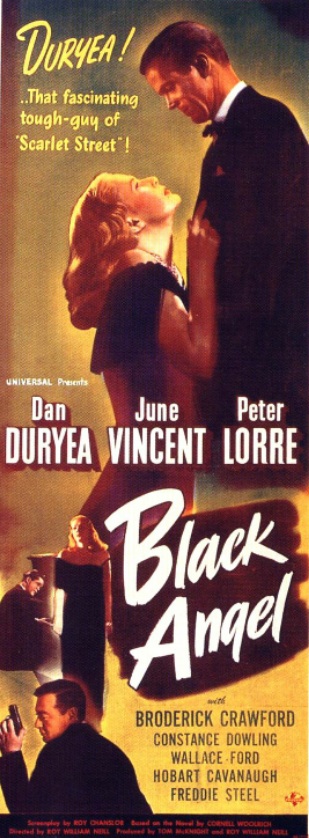
One of the things I liked best about Black Angel was the opportunity to see Duryea in a sympathetic role. He wasn’t perpetually cast early in his career as villains and sniveling punks because he lacked charisma, he had plenty. But he was whip-thin and had a perpetual scowl, and he was good at playing nasty characters. The poster for Black Angel calls him “that fascinating tough guy of Scarlet Street,” and that movie and this one were both instrumental in creating his new image as a violent, dangerous, and sexy antihero.

Sadly, this would be Neill’s last film. He died of a heart attack on December 14, 1946, while visiting relatives in England. He was 59 years old. Neill was a superior craftsman, and his Sherlock Holmes films were some of the most entertaining and well-made programmers of the ’40s. He made all kinds of films, including the campy horror movie Frankenstein Meets the Wolf Man (1943) (a personal favorite), but Black Angel showed what he was capable of in the hard-boiled noir/mystery genre. It’s a shame he wasn’t able to make more movies like it.

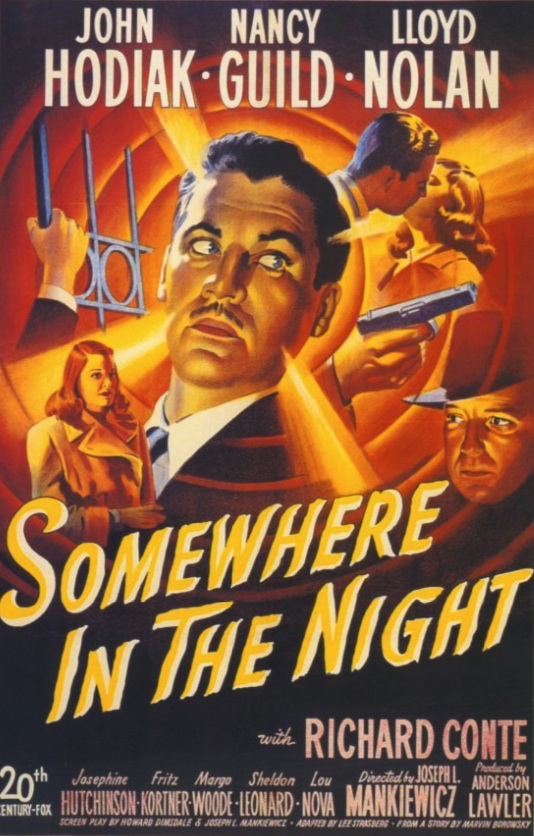
Somewhere in the Night (June 12, 1946)

Joseph L. Mankiewicz’s Somewhere in the Night looks like a noir, talks like a noir, and walks like a noir. But when the credits rolled I felt more like I’d watched a light-hearted mystery farce than a noir. This isn’t to say that Somewhere in the Night is a bad movie. It’s actually a really fun one. But the dark journey promised by the film’s opening never pans out, and the plot twists grow increasingly ludicrous as the picture goes on.

The first few minutes of the picture are mostly shot in first-person P.O.V., as a man (played by John Hodiak) wakes up in an Army field hospital. Through voiceover and the images in front of his face, we learn that he has no idea who he is, and doesn’t remember anything leading up to this point. This opening presages Robert Montgomery’s ill-advised first-person P.O.V. extravaganza Lady in the Lake (1947). Luckily, unlike that picture, the technique is used judiciously in Somewhere in the Night.

Hodiak’s character has Army identification in the name of “George Taylor,” a Dear John letter (it’s really more of an “I Hate You, John” letter), and a letter of credit from someone named “Larry Cravat.” What’s a noir protagonist to do? Clearly, the best course of action is to head for the mean streets of Los Angeles and attempt to track down Larry Cravat, even though “Taylor” has no idea what he’s doing or who all these people are who seem to want him dead. Why should that stop him? Taylor is a Purple Heart recipient and seems to be able to handle himself. It doesn’t hurt that the briefcase he picks up in a Los Angeles train station contains a gun and a letter from Larry Cravat telling Taylor that there is $5,000 deposited in his name in an L.A. bank.

For the first half hour or so, Somewhere in the Night has a few things to say about the plight of returning G.I.s, in particular the disappointments handed them by the women they came home to (or didn’t come home to, in Taylor’s case), and the resentment some servicemen must have felt upon their return.

“You know there’s been a terrible shortage of men,” a beautiful young woman named Phyllis (Margo Woode) tells Taylor.

“Yeah, so we heard in the Pacific,” he responds. “This war must have been murder on you poor women. We used to cry our eyes out about it.”

But, as I said, the longer Somewhere in the Night goes on, the more plot points stack up, and the less time the film has to do anything but crank through its story.

When Taylor goes to the bank to try and collect his $5,000 he arouses the suspicion of the cashier and he ends up fleeing empty-handed. He follows leads to a Turkish bath and then to a nightclub. Set up at the club by the bartender, he ends up hiding from a couple of mugs in the dressing room of a pretty singer named Christy Smith, who is played by the 20-year old Nancy Guild (rhymes with “wild”).

Guild is fresh-faced, has a beautiful voice, and plays her role well. She’s not outstanding, but she does a good job, especially considering this was her first role in a film; not just as leading lady, her first film role, period. Apparently she felt out of her depth, and the production was a struggle for her. In later interviews, she credited Mankiewicz’s generous nature and sensitive direction, and said he was a real father figure to her.

Hodiak also does a decent job, but it’s a one-note performance. He sweats profusely and looks haunted, and does a great job with lines like, “I’m tired of being pushed around. The war’s over for me. I don’t have to live afraid anymore.” He sounds genuinely angry, and he also sounds as if he doesn’t believe his own words one bit.

It wasn’t until after I finished watching Somewhere in the Night that I learned that while Hodiak was born in the United States, he grew up in an immigrant family, spoke Hungarian and Polish at home, and always had to work hard at his English diction. “No part has ever come easily to me,” Hodiak once said. “Every one has been a challenge. I’ve worked as hard as I could on them all.” I never would have guessed from this film that his first language wasn’t English, but there is something about his delivery that is strange and stilted.

Luckily, Guild and Hodiak have wonderful support from two great actors who straddled the line between character actor and leading man; Lloyd Nolan and Richard Conte.

Nolan plays a police detective, Lt. Donald Kendall, who doesn’t eat lunch because it puts him to sleep and doesn’t drink coffee because it keeps him awake. He also wonders aloud several times why detectives in the movies don’t ever take their hats off. (He figures it out by the end of the picture.) And he has plenty of great lines, which he delivers in his trademark wry fashion, like “Big post-war boom in homicide.”

Conte plays a nightclub owner named Mel Phillips, who’s smooth without seeming oily, and whose motives aren’t initially clear. (If you had $5 for every time Conte played a nightclub owner in a noir, you could probably take your whole family out to a nice dinner.)

Somewhere in the Night is a good picture; well-made and a lot of fun. It was all just a little silly for my taste, though.

Dressed to Kill (June 7, 1946)

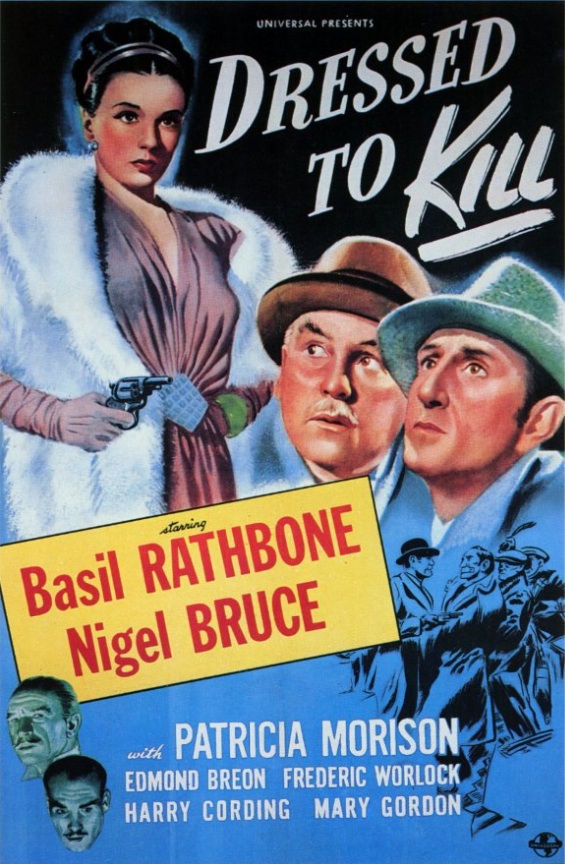
Dressed to Kill was director Roy William Neill’s eleventh Sherlock Holmes film, and the fourteenth and final film starring Basil Rathbone as Holmes and Nigel Bruce as his loyal sidekick Dr. John H. Watson.

This was the year that Rathbone said goodbye to the character. His last appearance on the Mutual Broadcasting System radio program The New Adventures of Sherlock Holmes was in “The Singular Affair of the Baconian Cipher,” broadcast on Monday, May 27, 1946. The next week’s time slot was filled with the summer replacement program The Casebook of Gregory Hood, which starred Gale Gordon as an antique dealer and gourmand living in San Francisco who solved mysteries in his spare time. Like the Sherlock Holmes program, the scripts were written by Holmes aficionados Anthony Boucher and Denis Green. The show was fun, but Gregory Hood was no Sherlock Holmes.

Holmes returned to the airwaves in October, on the American Broadcasting Company. Nigel Bruce reprised his role as Dr. Watson, but Tom Conway took over the role of Sherlock Holmes (although Bruce received top billing). Rathbone, who felt that his association with the character, whom he had played on a regular basis since 1939, was killing his career, so he returned to New York City and the theater. He won a Tony in 1947 for his role in the Broadway play The Heiress, but little significant stage work presented itself to him in the years to come. He had bad luck with films, as well. When The Heiress was made into a film in 1949, Rathbone hoped to appear again as Dr. Sloper, the role for which he had won a Tony, but the part ended up going to Ralph Richardson.

Whatever Rathbone’s feelings about his iconic performances as Holmes, there is no question that he left an indelible mark on the character. (He eventually returned to the role in 1953 when he appeared as Holmes in an episode of the Suspense TV show, as well as starring as Holmes in a play that was written by his wife, Ouida. The play received lukewarm reviews and closed after just three performances.)

In the first scene in Dressed to Kill in which Rathbone and Bruce appear, Rathbone waxes nostalgic about “the woman,” Irene Adler, a character in Sir Arthur Conan Doyle’s 1891 story “A Scandal in Bohemia,” while Watson sits reading The Strand, the magazine in which Conan Doyle’s Sherlock Holmes stories originally appeared. (Later in the film, a smoke bomb will prove the undoing of Watson, and Holmes will taunt him, since Watson described an identical ruse in the story he wrote called “A Scandal in Bohemia.” It’s an enjoyable bit of metafiction of the type Conan Doyle himself engaged in.)

The boys receive a visitor to 221b Baker Street, Julian “Stinky” Emery (Edmund Breon), an old friend of Watson’s. Emery is an avid collector of music boxes, and was robbed the night before. Curiously, the thief (or thieves) knocked him unconscious and then took just one music box, a trifling little thing that Emery had purchased earlier in the day at auction for just £2.

We, the viewers, know that Emery’s music box was one of three manufactured in Dartmoor Prison, so we know that the trio of miscreants tracking them down in London have an ulterior motive, in this case, finding where a pair of original Bank of England plates are hidden, which they will be able to use to produce £5 notes that are not “counterfeit” in the traditional sense. The three music boxes all seem to play the same tune, but with his fine ear for music, Holmes will note minor variations in the melodies, which is the key to the code.

Dressed to Kill features many plot elements that will be familiar to long-time viewers of the series. Mrs. Hilda Courtney (Patricia Morison) is a clever femme fatale in the mold of the eponymous antagonists of The Spider Woman (1944) and The Woman in Green (1945). And the plot device of a number of cheap trinkets holding a code was used before, and to better effect, in The Pearl of Death (1944).

Dressed to Kill is far from the best of Universal’s Sherlock Holmes series, but it’s far from the worst. The Rathbone Holmes pictures are remarkably consistent and terrifically entertaining, however, so the worst picture in the series is still better than most mysteries from the ’40s.

Devil Bat’s Daughter (April 15, 1946)

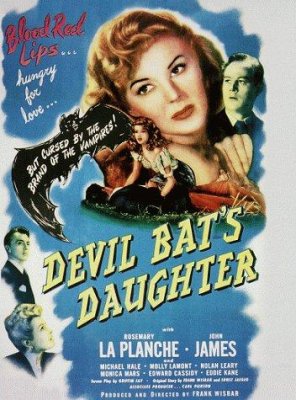
Frank Wisbar’s Devil Bat’s Daughter is a film that follows the template created by Dracula’s Daughter (1936), but doesn’t quite get it right.

Like Dracula’s Daughter, Devil Bat’s Daughter is a sequel to a Bela Lugosi horror film — in this case, The Devil Bat (1940) — that does not feature Lugosi. Instead, the protagonist is … you guessed it, his character’s daughter. But while Dracula’s Daughter was a slick, good-looking Universal horror picture that featured a haunting lead performance by Gloria Holden, Devil Bat’s Daughter is a run-of-the-mill Poverty Row mystery thriller whose connection to its predecessor feels forced.

I haven’t seen The Devil Bat, but based on plot synopses, there seem to be several inconsistencies with how its treated in its sequel. Nina MacCarron (Rosemary La Planche), is the daughter of Dr. Paul Carruthers (Lugosi), of The Devil Bat, but she uses her mother’s maiden name. Returning in a stupor to her father’s home in Wardsley, New York (Heathville, Illinois, in the original), she collapses while searching the basement where he conducted his experiments (the basement was also apparently not present in the first film). She is taken in by the physician Dr. Elliot (Nolan Leary), who cares for her while she lies in a catatonic state. After she escapes from the hospital, Dr. Elliot has her transferred to the care of a psychiatrist, Dr. Clifton Morris (Michael Hale), who treats her while she lives in his home with him and his wife, Ellen Masters Morris (Molly Lamont). With Dr. Morris’s treatments, she slowly returns to normal, but she is plagued by terrifying visions (rippled footage from The Devil Bat).

Intrigue abounds. We learn early on that Dr. Morris has a mistress, Myra Arnold (Monica Mars), who is pressuring him to divorce his wife, whom he only married for her money. When Ted Masters (John James), Mrs. Morris’s son from her first marriage, returns home, he and Nina start to fall for each other, but a series of murders throws Nina’s sanity into question. The film seems confused about what type of picture it wants to be. There’s plenty of talk of vampires (Lugosi was inextricable from his most famous role), but it doesn’t come to anything, and this isn’t really a horror picture.

Devil Bat’s Daughter is modestly entertaining, but I was hoping for more. Director Wisbar was a German émigré, and his previous film, Strangler of the Swamp, was a great-looking, creepy little horror picture. Like Devil Bat’s Daughter, it also starred Rosemary La Planche, Miss America 1941. It’s too bad for genre film fans that La Planche wasn’t in more movies, especially horror movies. She could have been one of the great scream queens. She’s uniquely pretty, with thick eyebrows, big eyes, bow lips, a very straight nose, and mountains of wavy hair. Her face retains its attractiveness even when she’s screaming, and she sure can take a fall while running.

Mysterious Intruder (April 11, 1946)

Mysterious Intruder
Mysterious Intruder (1946)
Directed by William Castle
Columbia Pictures

“I may not be the greatest detective in the world … but I am the most unusual.”

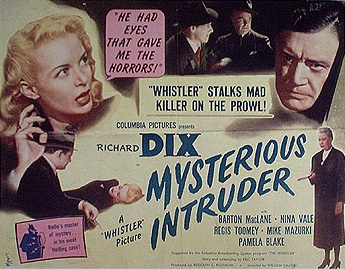
So says Don Gale, the shady private investigator played by Richard Dix in William Castle’s Mysterious Intruder, the fifth entry in Columbia’s mystery series The Whistler. Based on the CBS radio show of the same name, each film in the series featured Dix in the lead role, but unlike other B mystery series of the ’30s and ’40s, like Charlie Chan, The Falcon, Boston Blackie, Michael Shayne, and the Crime Doctor, Dix played a different character in each. The Whistler, who narrated the radio show but never participated directly in the events of the story, made similar appearances in the film series, walking in the shadows, whistling the haunting 13-note theme music by Wilbur Hatch, and occasionally offering a pithy analysis of the trouble the characters were in. The anthology format and Dix’s strange, arresting performances made The Whistler one of the more interesting series of its time.

In Mysterious Intruder, Gale is an oily operator who employs a “photographic model” named Freda Hanson (Helen Mowery) for dirty work. He also has a secretary named Joan (Nina Vale) who hates him. Clearly motivated by money, Gale walks the narrow line between self-interest and outright villainy. He’s an interesting character to watch, since his intentions remain shadowy right up to the end of the picture. This being a B-level programmer, we’re not treated to a deep character study, but Dix is a good enough performer to make Mysterious Intruder worth watching.

When the film begins, Gale is in his office, which has a spectacular view of the city and looks as if it should be home to the most expensive lawyer in town, not a small-time bedroom snooper. He’s visited by Edward Stillwell (Paul Burns), a kindly old music store owner who wishes to track down a young woman whom he hasn’t seen since she was 14, seven years ago. Her name is Elora Lund, and he has something he wants to give her. One hundred dollars is all Stillwell can afford to pay, which isn’t enough to pique Gale’s interest, but he changes his mind when Stillwell tells him that Elora Lund will pay any amount for bringing them together.

Three days pass, and Stillwell receives a visitor in his shop. She’s a tall, attractive blonde, and she convinces Stillwell that she is Elora Lund. (She’s actually Freda Hanson, Gale’s blackmail tool.) Stillwell tells “Elora” that among the countless odds and ends that her late mother brought in for him to sell was one item that will bring a fortune if sold. Unbeknownst to Freda, however, she was tailed to the store by a hulking thug named Pontos, played by dependable character actor Mike Mazurki. (Mazurki is always a welcome sight, but he doesn’t have a lot to do in this picture. It’s not too different from the role he played in Dick Tracy; a vicious killer with few to no lines.) Pontos murders Stillwell, and Freda screams and flees the scene.

Meanwhile, we learn that the real Elora Lund (Pamela Blake) is in a sanitarium, recovering from the effects of an auto accident. She’s appears to be uninjured physically, and why she wasn’t recuperating at home is never explained. Ah, the good old days of “rest cures.”

Before he became the premier schlockmeister of the ’50s and the most famous “gimmick” director in Hollywood, William Castle was a dependable director of one-hour programmers, including several Whistler and Crime Doctor pictures. Mysterious Intruder is a tight, entertaining ride that features plenty of twists and turns, as well as one of my favorite plot conceits, the private dick who constantly contaminates crime scenes and tampers with evidence for his own purposes, all while staying one step ahead of the police.

Just Before Dawn (March 7, 1946)

Just Before DawnJust Before Dawn (1946)
Directed by William Castle
Columbia Pictures

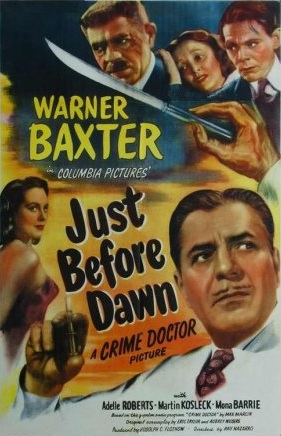
Criminal psychiatrist Dr. Robert Ordway, a.k.a. the “Crime Doctor,” is a fictional character created in 1940 by Max Marcin. Crime Doctor was a Sunday-night program that ran on CBS radio stations for seven years. There are only a few extant recordings of the shows, but the ones I’ve heard are comfortable and formulaic little mysteries, not unlike the long-running Mr. Keen, Tracer of Lost Persons.

Like a number of other popular mystery programs, Crime Doctor was adapted as a series of films. Dr. Ordway was played by four different actors over the course of the radio show, but on-screen, he was always played by Warner Baxter. Baxter had been a matinee idol in the silent era, and had won an Oscar for his role as the Cisco Kid in the early talkie In Old Arizona (1928). By the ’40s, however, he was in poor health, and the Crime Doctor series was an easy paycheck for not too much work. Each picture took less than a month to film, and he made roughly two Crime Doctor pictures a year. Baxter doesn’t seem to be coasting in them, though. While he doesn’t ever run or do any stuntwork, he is a fine actor, and his patrician presence is always a treat.

In the first film, Michael Gordon’s Crime Doctor (1943), we learn the character’s origin. A Depression-era crook and racketeer named Phil Morgan is shot and left for dead on the side of the road. Suffering from total amnesia, Morgan calls himself “Robert Ordway” and puts himself through medical school. Once he gets his degree, he focuses on rehabilitating criminals. Eventually, his past catches up with him, but everything works out in the end, allowing him to keep his new name and continue his work as one of the good guys in a series of films released by Columbia Pictures. Crime Doctor was followed by Eugene Forde’s Crime Doctor’s Strangest Case (1943) and Shadows in the Night (1944), George Sherman’s The Crime Doctor’s Courage (1945), and William Castle’s Crime Doctor’s Warning (1945). The film series is less cozy than the radio episodes I’ve heard, and delves into noir territory, with all of its shadows, brutal murders, and mysterious characters.

The sixth film in the series, Just Before Dawn, which was also directed by Castle, begins at night, with a shot of a hulking man (Marvin Miller) walking up to the shadowed entrance of the Ganss Mortuary. He is met by Karl Ganss (Martin Kosleck), who gives him a small leather case that contains a hypodermic needle and a vial of something marked “insulin” that’s not really insulin.

In the next scene, we see Dr. Ordway relaxing at home by the fire with a book when Mrs. Travers (Mona Barrie), his new neighbor, knocks on his door. One of the guests at her party has taken ill, and she can’t get in touch with their regular doctor. This was the good old days, when there was no such thing as dialing 911, but any doctor, even one you’d never met before, would drop everything and walk across the street to your house to take a look at someone who had collapsed on your couch. Dr. Ordway isn’t just any doctor, though, and his reputation precedes him. When he is announced as “Dr. Ordway,” the Travers’s butler Armand (Ted Hecht) excitedly blurts out, “the Crime Doctor!”

The collapsed gentleman in the living room is a diabetic (remember that insulin?) named Walter Foster (George Meeker). Dr. Ordway attends to him, and speaks with Foster’s attractive young sister, Claire (Adelle Roberts), who tells Dr. Ordway that her brother must have forgotten to take his insulin. Dr. Ordway unwittingly prepares a hot dose for Foster, and assures Claire and Mrs. Travers that he’ll be fine. While Dr. Ordway is meeting some of the other party guests, Foster drops dead. He has been poisoned, and the murderer has made Dr. Ordway the instrument of his crime.

The police, generally a bumbling lot in these old mystery series, encourage Dr. Ordway to investigate the crime to redeem himself, especially since he lives right across the street from the Travers home, and it will be easy for him to keep tabs on everyone. I don’t know what city the Crime Doctor series takes place in, but its police force must be one of the laziest in the country.

Dr. Ordway investigates the crime in a by-the-numbers fashion. It turns out that a lot of people at the party (and possibly someone who was not at the party) had reason to want Foster dead. There are obviously nefarious things going on at the Ganss Mortuary, but how they relate to Foster’s murder is not immediately clear.

After the halfway mark, the film really kicks into high gear. After an attempt on his life, Dr. Ordway feigns blindness to lull his antagonists into a false sense of security. He also undergoes a fancy make-up job that turns him into a dead ringer for a vicious killer on the lam named Pete Hastings. Things get really nutty by the end, when Dr. Ordway makes himself temporarily immune to poison by lining his stomach with a heavy emulsion of chalk in order to catch the killer. Just Before Dawn is the only movie I can think of that ends with a shot of the protagonist lying down on an operating table to get his stomach pumped.

I’m a big fan of the director. Castle gained notoriety as a purveyor of high-quality schlock with his “gimmick” films of the late ’50s and early ’60s. Anyone who bought a ticket for Macabre (1958) was automatically insured by Lloyd’s of London, and received a settlement if they died of fright during the picture; House on Haunted Hill (1959) featured a gimmick called “Emergo,” in which a plastic skeleton shot out of a box next to the screen as Vincent Price manipulated his own skeleton on-screen; the gimmick for The Tingler (1959) was called “Percepto,” and involved theater patrons getting their spines buzzed by a wire hidden in their seats; and Homicidal (1961) featured a one-minute “Fright Break” at the climax that allowed anyone who was too scared to keep watching to leave and receive a full refund. Of course, they were lighted with a spotlight as they walked up the aisle and then had to stand in the cardboard “Coward’s Corner” in the lobby until the film ended and their fellow patrons strolled past, so not too many people took advantage of the offer.

Before he carved his unique place in cinematic history, Castle directed dozens of programmers like this one. Prior to making Just Before Dawn, he directed three entries in Columbia Pictures’s Whistler series, The Whistler (1943), The Mark of the Whistler (1944), and Voice of the Whistler (1945). In general, I prefer the Whistler series. The plots are more varied and interesting. I also liked Castle’s prior entry in this series, Crime Doctor’s Warning, a little more than this one. Its depiction of the Greenwich Village art scene and the crazy beatniks who inhabited it was really enjoyable. But Just Before Dawn is, like all of Castle’s movies, still a whole lot of fun for fans of B mysteries and bottom-of-the-bill programmers.

The Spiral Staircase (Feb. 6, 1946)

Robert Siodmak’s The Spiral Staircase was made in 1945, and released into some theaters in December. The earliest confirmed day of release I could find, however, was February 6, 1946, in New York City, so I’m reviewing it here.

Based on Ethel Lina White’s 1933 novel Some Must Watch, The Spiral Staircase is a slick, good-looking thriller with some striking visual choices. White’s novel took place in contemporary England, but the film is set in early 20th century Massachusetts. Some sources I’ve found claim it takes place circa 1916, but the silent film an audience in a movie house is watching in the first scene of the film is D.W. Griffith’s 1912 short The Sands of Dee, and one of the characters has just returned from Paris, about which he waxes rhapsodic, speaking wistfully of all the beautiful women. So it seems to me that the action of the film must take place before the First World War.

The Spiral Staircase doesn’t take long to deliver its terrifying goods. In one of the rooms above the silent movie house, we see a young woman (Myrna Dell) getting undressed. She walks with a slight limp. When the camera moves into her closet as she hangs up her dress, there is a pause, then the camera moves into the thicket of hanging clothes. They part slightly, and suddenly we see an enormous, maniacal eye fill the screen. We then see the girl reflected in the eye, her lower half blurred (why this is will be explained later).

Alfred Hitchcock used a closeup of Anthony Perkin’s eye to great effect in Psycho (1960). And one of the earliest indelible images in the history of cinema was an eyeball being slit open by a straight razor in Luis Buñuel’s short film Un chien andalou (1929). But a close shot of an eye used in the same way as a violin stab on the soundtrack, or a shadow quickly passing across the frame, to make the audience jump out of their seats, is relatively rare. I thought Bob Clark’s Black Christmas (1974) was the first film to do this — when the killer is shockingly revealed as an eyeball peering out from between an open door and a door jamb — but apparently it wasn’t.

Among the patrons of the movie house, none of whom is questioned by the incompetent local constable (James Bell) after the murder, is a mute woman named Helen Capel (Dorothy McGuire). Her friend, the handsome young Dr. Parry (Kent Smith), gives her a ride home, and tells her that he believes her muteness can be overcome. She silently demurs, and goes home to the creepy old mansion where she is employed as a servant to the bedridden but mentally sharp Mrs. Warren (Ethel Barrymore). Also present in the house are the other domestics, Mr. and Mrs. Oates (Rhys Williams and Elsa Lanchester, who looks a lot frumpier than when she played The Bride of Frankenstein in 1935), Mrs. Warren’s two stepsons, Prof. Albert Warren (George Brent) and ne’er-do-well Steve Warren (Gordon Oliver), the professor’s pretty assistant Blanche (Rhonda Fleming), and Mrs. Warren’s crotchety old nurse (Sarah Allgood).

Once the action settles down and focuses on the Warren estate, The Spiral Staircase becomes a more predictable game of whodunnit, as well as a frustrating game of “when will she find the strength to scream for help, already?”

The film is never boring, however, due in no small part to the brilliant cinematography of Nicholas Musuraca. The Spiral Staircase is all shadows and gaslight, which — along with one of the longest thunderstorms on film — hearkens back to spooky haunted house pictures like James Whale’s The Old Dark House (1932).

The Spiral Staircase is not quite a masterpiece, and it never aspires to be more than a pulse-quickening thriller, but it is exceptionally well-made entertainment.

Terror by Night (Feb. 1, 1946)

Thrillers set on trains have a special place in my heart. It’s not only because I love to travel by train. It’s also because I think a passenger train is the perfect setting for a mystery. It provides a single location and a set cast of characters/suspects, just like any good English country manor, but with the added excitement of constant movement and breakneck speed.

A short list of my favorite thrillers set on trains would include Alfred Hitchcock’s The Lady Vanishes (1938), The Narrow Margin (1952) (the 1990 remake featuring Gene Hackman is worth seeing, as well), and Horror Express (1972). But even lesser efforts set on trains delight me, such as the Michael Shayne mystery Sleepers West (1941) and the Steven Seagal slugfest Under Siege 2: Dark Territory (1995).

So when I saw that Roy William Neill’s tenth outing in the director’s chair for a Sherlock Holmes film (and the thirteenth film in the series overall) was set on a train, I was really looking forward to it.

Terror by Night, which stars Basil Rathbone as Sherlock Holmes and Nigel Bruce as his faithful friend Dr. Watson, does not disappoint. Loosely based on two stories by Sir Arthur Conan Doyle, “The Adventure of the Blue Carbuncle,” from The Adventures of Sherlock Holmes (1891), and “The Disappearance of Lady Frances Carfax,” from His Last Bow (1917), with a few elements taken from The Sign of Four (1890), Terror by Night follows Holmes and Watson as they attempt to foil the theft of a diamond on a train bound for Scotland.

The diamond in question, the ridiculously ostentatious “Star of Rhodesia,” is owned by Lady Margaret Carstairs (Mary Forbes), who is traveling with her fey son Roland (Geoffrey Steele). Also aboard the train is a young woman named Vivian Vedder (Renee Godfrey), who, in the first scene of the picture, has a special coffin prepared, supposedly to transport her mother’s body. The presence of a secret compartment in the coffin, however, alerts the viewer that Miss Vedder is probably up to no good.

Also aboard are an old friend of Dr. Watson’s from his time in India, Maj. Duncan-Bleek (Alan Mowbray), the dependably lunkheaded Inspector Lestrade (Dennis Hoey), Prof. William Kilbane (Frederick Worlock), whom the blustery Watson interrogates in a comical scene, and a skittish married couple (Gerald Hamer and Janet Murdoch).

Universal Pictures’s Sherlock Holmes series is my favorite mystery series of the ’40s. Except for a few duds early in the series that focused too much on World War II-era propaganda, the Holmes pictures with Rathbone and Bruce and some of the most thoroughly enjoyable, clever, and fast-paced mysteries I’ve had the pleasure to see.

Spellbound (Dec. 28, 1945)

Spellbound
Spellbound (1945)
Directed by Alfred Hitchcock
United Artists

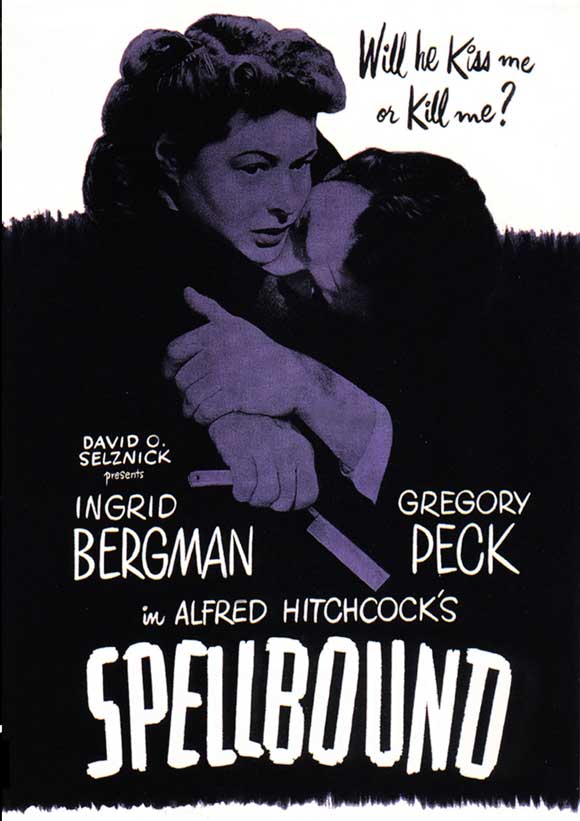
Alfred Hitchcock’s Spellbound gets knocked around for its basis in Freudian theory. Many reviews of the film written in the past 20 years use words like “dated,” “implausible,” and “preposterous.” A lot of these same reviews also praise the dream sequence, which was designed by Salvador Dalí, as the most memorable part of the film.

Freud has been knocked around, criticized, and discredited since the turn of the century, so to dismiss a film’s plot and ideas merely because they are “Freudian” seems like picking low-hanging fruit. Granted, Freud had a lot of wild ideas, but he was a brilliant thinker, and should be viewed as a philosopher and a humanist as much as a doctor or scientist. Also, many people who dismiss Freud out of hand haven’t actually read any of his writing, and cannot discuss his ideas beyond the fact that they’ve heard that they’re loony.

Upon revisiting the film, I found the much-praised dream sequence by Dalí overly gimmicky, adding little to the narrative beyond a “gee whiz” moment. (Hitchcock had almost nothing to do with its production. Dalí worked with a production unit from the Poverty Row studio Monogram Pictures on the sequence.) There’s nothing wrong with “gee whiz” moments, but Spellbound is an underappreciated film in Hitchcock’s oeuvre, and it bears rewatching as a complete work of art, not just as a showcase for pop surrealism or “dated” notions of neuroses and the unconscious.

In 1942, after winning back-to-back Academy Awards for best picture (then called “outstanding production”) for Victor Fleming’s Gone With the Wind (1939) and Alfred Hitchcock’s Rebecca (1940), producer David O. Selznick was morose. He took time off and sought treatment. His experience with the “talking cure” was so positive that he decided to produce a picture with psychoanalysis as its subject. In 1943, Hitchcock mentioned to Selznick that he owned the screen rights to the 1927 novel The House of Dr. Edwardes, written by Hilary St. George Saunders and John Palmer under the pseudonym “Francis Beeding.” The Gothic potboiler was about a homicidal lunatic who kidnaps a doctor named Murchison and impersonates him, taking over his position as head of a mental institution. A female doctor named Constance Sedgwick uncovers the impostor’s ruse and eventually marries the real Dr. Murchison.

In early 1944, Hitchcock and his friend Angus MacPhail crafted a preliminary screenplay in which Dr. Murchison was the outgoing head of the institution and Dr. Edwardes was his successor. They also created a romance between Constance and Dr. Edwardes, as well as the downhill skiing set piece that cures Edwardes of his amnesia. In March 1944, Selznick offered Hitchcock the talents of Ben Hecht, and Hitchcock and Hecht worked together for months to refine the screenplay. They even visited mental institutions, and preliminary versions of Spellbound featured more semi-documentary material than the final product does.

The final product may be, as Hitchcock told François Truffaut, “just another manhunt story wrapped up in pseudo-psychoanalysis.” But with Hitchcock behind the camera, even the most pedestrian manhunt story can become something dazzling. Hitchcock considered Spellbound one of his minor works, but part of his underestimation of the picture could have been due to all the clashes he had with Selznick, who was known for meddling with his productions. Selznick even hired his own therapist, Dr. May E. Romm, as a technical advisor for the film. There’s a story, possibly apocryphal, that when Dr. Romm told Hitchcock that an aspect of psychoanalysis in Spellbound was presented inaccurately, Hitchcock responded, “It’s only a movie.”

In Spellbound, Ingrid Bergman plays Dr. Constance Petersen, a psychoanalyst at Green Manors, a Vermont mental hospital. Dr. Murchison (Leo G. Carroll), the director of Green Manors, is being forced into retirement shortly after returning to work following a nervous breakdown. His replacement is the young, handsome Dr. Anthony Edwardes (Gregory Peck). “My age hasn’t caught up with me,” Dr. Edwardes responds when someone mentions how young he appears. But this isn’t the case, of course. He is actually an amnesiac who has no idea who he is or how he arrived at Green Manors. His state of confusion is such that he initially believed he was Dr. Edwardes, and is now playing the role because he doesn’t know what else to do. Dr. Petersen uncovers the truth, but she has already fallen instantly, madly in love with him. When the rest of the world learns the truth about Dr. Edwardes, he flees Green Manors. He still has amnesia, but he knows that his real initials are “J.B.” He heads for New York, and tells Dr. Petersen not to follow him. Does she follow his advice? Of course she doesn’t.

The romance is a high point of the film. The presentation of Dr. Petersen’s initial “frigidity” is certainly dated, but it leads to one of Hitchcock’s wildest sequences. When Bergman first kisses Peck, a shot of her forehead dissolves into a shot of a door. The door opens, revealing another door, which also opens, revealing another door, and so on.

Bergman’s performance is pitch perfect in every scene. Peck’s performance is less natural, but it works, since he is playing a man who literally doesn’t know who he is. (Apparently Peck craved more direction from Hitchcock, but Hitchcock just kept telling him things like “drain your face of all emotion.” Hitchcock had little patience for method acting.) Also, you would be hard-pressed to find two actors in 1945 who were more physically attractive than Bergman or Peck.

The cinematography by George Barnes is another high point. Each shot in Spellbound is beautifully constructed, and gives off a silvery glow. There are a number of choices that are still shocking, such as a flashback to an accidental death, or the penultimate sequence in the film, in which a P.O.V. shot shows a revolver being turned directly on the audience. When the trigger is pulled, there is a splash of red, the only instance of color in the film. It’s an assault on the audience par excellence from a man who spent his entire career assaulting his audience while almost never alienating them, which is not an easy thing to do.

Miklós Rózsa’s score for the film incorporates a haunting theremin melody, as did his score for The Lost Weekend, released around the same time. Rózsa won an Academy Award for best score for his work on Spellbound. Hitchcock was disappointed in the music, however, since it emphasized the romantic aspects of the film, and was more to Selznick’s liking than his own.

Sometimes creative dissonance leads to great creations, however. Spellbound is a great movie, whether or not its producer and director ever saw eye to eye.