Tag Archives: Universal Pictures

The Seventh Veil (Feb. 15, 1946)

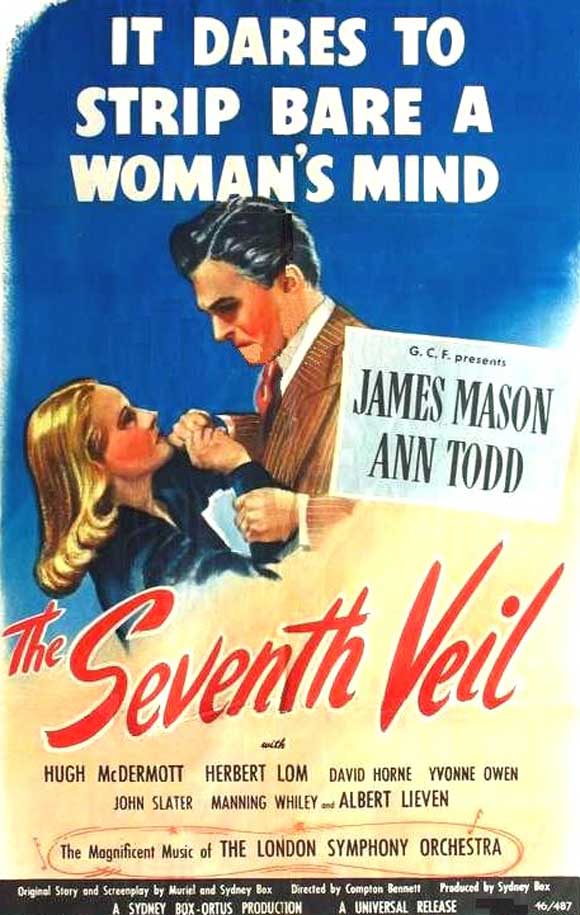
Compton Bennett’s film The Seventh Veil premiered in London on October 18, 1945. It was the biggest box office success of the year in Britain. The first record of its showing in the United States I can find is on Christmas day, 1945, in New York City. It went into wide release in the U.S. on February 15, 1946, and won an Academy Award the next year for best original screenplay. The story and script were by Sydney and Muriel Box. Sydney Box also produced the film.

The title refers to the seven veils that Salomé peeled away in history’s most famous striptease. As Dr. Larsen (Herbert Lom) explains to his colleagues, “The human mind is like Salomé at the beginning of her dance, hidden from the outside world by seven veils. Veils of reserve, shyness, fear. Now, with friends the average person will drop first one veil, then another, maybe three or four altogether. With a lover, she will take off five. Or even six. But never the seventh. Never. You see, the human mind likes to cover its nakedness, too, and keep its private thoughts to itself. Salomé dropped her seventh veil of her own free will, but you will never get the human mind to do that.”

The mind Dr. Larsen is attempting to strip bare is that of Francesca Cunningham (Ann Todd), a concert pianist who has lost the will to live, and who has been hospitalized after a suicide attempt. For the first hour of the film, her psychoanalytic sessions with Dr. Larsen act mostly as a framing device for Francesca’s flashbacks, but by the end, the high-minded hooey is laid on nearly as thick as it is in Alfred Hitchcock’s contemporaneous film Spellbound.

In her first flashback, Francesa recalls her schoolgirl days with her friend Susan Brook (Yvonne Owen). Susan’s insouciance towards academics is responsible for both of them being late to class one too many times. If Susan is punished, we don’t see it. Francesca’s punishment, however, will have dire ramifications. Brutally beaten across the backs of her hands with a ruler on the morning of her scholarship recital, she blows it completely, and is so devastated she gives up the piano.

When she is orphaned at the age of 17, Francesca is taken in by her uncle Nicholas (James Mason), a man whom she barely knows. She learns that the term “uncle” is a misnomer, since Nicholas is actually her father’s second cousin. Interestingly, both Mason and Todd were 36 years old when they appeared in this film. Their lack of an age difference isn’t too distracting, though. Todd has a wan, ethereal visage that lends itself to playing young, and Mason’s dark, Mephistophelian countenance is eternally middle-aged and handsome.

Nicholas is a confirmed bachelor who walks with a slight limp and hates women. He is also a brilliant music teacher, although his own skills as a musician are only average. Under his sometimes cruel tutelage, Francesca practices four to five hours a day, and eventually becomes an accomplished musician. Nicholas’s control over her comes at a cost. While she is studying at the Royal College of Music, Francesca falls in love with an American swing band leader named Peter Gay (Hugh McDermott). When Francesca tells Nicholas that she is engaged, he refuses to give his consent, since she has not yet reached her age of majority (in this case, 21), and tells her she will leave with him for Paris immediately. She does so, and continues her education in Europe.

For a melodrama, The Seventh Veil manages to be fairly gripping, especially if you find depictions of live performances stressful. When Francesca makes her debut with the London Symphony Orchestra (conducted by Muir Mathieson), performing Rachmaninoff’s Piano Concerto No. 2 in C minor and Grieg’s Piano Concerto in A minor, the film cuts between Francesca sitting at the piano, her hands (doubled by the pianist Eileen Joyce), Nicholas standing offstage, and her old friend Susan, who is in the front row. Not only does Susan, now a wealthy socialite, enter late and talk during the performance, but her mere presence reminds Francesca so strongly of the brutal whipping her hands received as a girl that the act of playing becomes almost too much to bear. She makes it through the performance, but when she rises to bow, she collapses from sheer exhaustion.

Francesca’s next trial — and the one that will result in her institutionalization — comes when Nicholas hires an artist named Maxwell Leyden (Albert Lieven) to paint her portrait. Francesca and Maxwell fall in love and go away to live together, despite Nicholas’s violent objections, but after a car accident, Francesca becomes convinced that her hands are irreparably damaged and she will never play again. Dr. Larsen, however, tells her there is nothing physically wrong with her, and he makes it his mission to cure her.

In the end, it is a recording of the simple, beautiful melody of the second movement of Beethoven’s Piano Sonata No. 8, “Pathétique,” along with a good old-fashioned session of hypnosis, that frees Francesca from her mental prison. The climax of the film does not hinge on whether or not she will perform again, however. It hinges on which of the three men in her life she will end up with; Peter, Maxwell, or Nicholas.

As soon as her choice is made, the film ends. There is no depiction of consequences. How satisfying the viewer finds the ending partly depends on which male character they like best, I suppose, although there are other considerations, such as how one feels about the question of whether it is better to be a great artist or to be happy, or even if Francesca can have one without the other. Personally, I found it all a bit ridiculous, but I enjoyed the film overall.

Terror by Night (Feb. 1, 1946)

Thrillers set on trains have a special place in my heart. It’s not only because I love to travel by train. It’s also because I think a passenger train is the perfect setting for a mystery. It provides a single location and a set cast of characters/suspects, just like any good English country manor, but with the added excitement of constant movement and breakneck speed.

A short list of my favorite thrillers set on trains would include Alfred Hitchcock’s The Lady Vanishes (1938), The Narrow Margin (1952) (the 1990 remake featuring Gene Hackman is worth seeing, as well), and Horror Express (1972). But even lesser efforts set on trains delight me, such as the Michael Shayne mystery Sleepers West (1941) and the Steven Seagal slugfest Under Siege 2: Dark Territory (1995).

So when I saw that Roy William Neill’s tenth outing in the director’s chair for a Sherlock Holmes film (and the thirteenth film in the series overall) was set on a train, I was really looking forward to it.

Terror by Night, which stars Basil Rathbone as Sherlock Holmes and Nigel Bruce as his faithful friend Dr. Watson, does not disappoint. Loosely based on two stories by Sir Arthur Conan Doyle, “The Adventure of the Blue Carbuncle,” from The Adventures of Sherlock Holmes (1891), and “The Disappearance of Lady Frances Carfax,” from His Last Bow (1917), with a few elements taken from The Sign of Four (1890), Terror by Night follows Holmes and Watson as they attempt to foil the theft of a diamond on a train bound for Scotland.

The diamond in question, the ridiculously ostentatious “Star of Rhodesia,” is owned by Lady Margaret Carstairs (Mary Forbes), who is traveling with her fey son Roland (Geoffrey Steele). Also aboard the train is a young woman named Vivian Vedder (Renee Godfrey), who, in the first scene of the picture, has a special coffin prepared, supposedly to transport her mother’s body. The presence of a secret compartment in the coffin, however, alerts the viewer that Miss Vedder is probably up to no good.

Also aboard are an old friend of Dr. Watson’s from his time in India, Maj. Duncan-Bleek (Alan Mowbray), the dependably lunkheaded Inspector Lestrade (Dennis Hoey), Prof. William Kilbane (Frederick Worlock), whom the blustery Watson interrogates in a comical scene, and a skittish married couple (Gerald Hamer and Janet Murdoch).

Universal Pictures’s Sherlock Holmes series is my favorite mystery series of the ’40s. Except for a few duds early in the series that focused too much on World War II-era propaganda, the Holmes pictures with Rathbone and Bruce and some of the most thoroughly enjoyable, clever, and fast-paced mysteries I’ve had the pleasure to see.

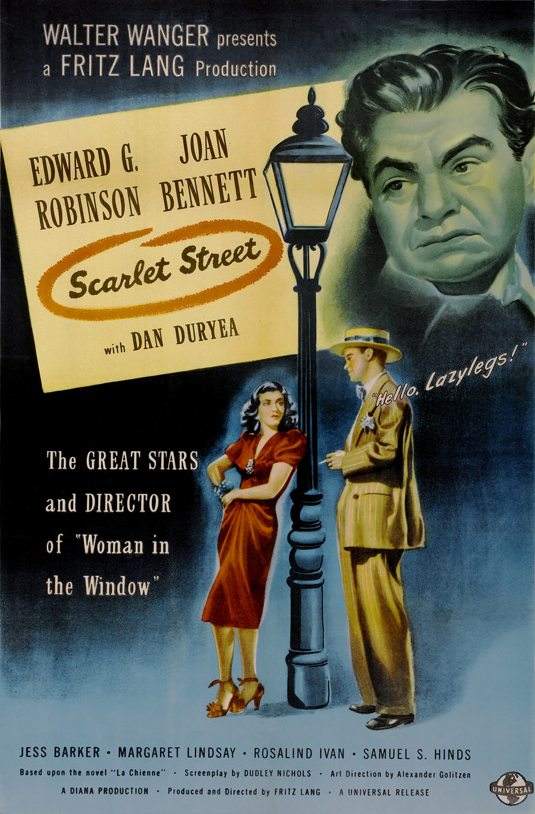
Scarlet Street (Dec. 28, 1945)

Fritz Lang’s Scarlet Street immediately draws comparisons to Lang’s 1944 film The Woman in the Window. Released just a year apart, both films star Edward G. Robinson, Joan Bennett, and Dan Duryea. Both films feature Bennett as a femme fatale, Robinson as a milquetoast man approaching old age who is desperate for some kind of excitement, and Duryea as a hustler and a punk who’s only out for himself. The two films share motifs; murder with sharp objects, city streets at night, painted portraits, and foolish old men ensnared by mysterious young women.

In terms of tone and plot, however, the two films are quite different. The Woman in the Window is a well-crafted tale of mystery and suspense in which a murder occurs early on, and the protagonist spends the rest of the film dealing with the consequences. It’s a good picture, but its impact is undercut by a cop-out ending (possibly necessitated by the Hays Code) that castrates the grim dénouement and breaks the most basic rule of maintaining audience engagement with a narrative. Scarlet Street, on the other hand, is grim and fatalistic, and its single, horrific murder doesn’t occur until near the end of the picture. Robinson’s character in Scarlet Street isn’t drawn into a suspenseful adventure in which he has to hide evidence and protect a woman’s honor, he’s drawn into a doomed romance with a heartless and conniving young woman, and he only realizes the trap he’s walked into until long after its jaws have clamped shut around him.

Scarlet Street opens on a scene of a party. It’s the kind of party we don’t see very often in the movies anymore. There are no women, and all of the men are dressed in tuxedos. Christopher Cross (Robinson) is receiving a gold pocket watch for his 25 years of service as a cashier in a bank. When Cross’s employer, J.J. Hogarth (Russell Hicks), stands up, he is clearly the man in charge; tall, commanding, and about to leave the party for a date with a blonde. Cross sits on the opposite side of the table and appears diminutive and meek. When Cross reads the engraved message on the watch, “To my friend, Christopher Cross, in token of twenty-five years of faithful service, from J.J. Hogarth, 1909-1934,” he seems genuinely touched by the line, “To my friend,” and pauses briefly after reading the words to smile. He is clearly a man with few friends.

He is also a man locked in a loveless marriage. We later learn that he married his landlady just a few years earlier, after her police detective husband died while trying to save a woman from drowning. Her late husband’s ridiculously large portrait hangs above the mantle in their living room, and Adele Cross (Rosalind Ivan) never misses an opportunity to unfavorably compare Chris with her “heroic” first husband.

On his way home from the party, Cross meanders through the rain-slicked streets of Greenwich Village. He sees a young man beating up a young woman under elevated train tracks, and he impetuously runs to her aid. His rescue attempt can barely be called heroic (he covers his eyes as he jabs her assailant with his umbrella), but it is still an act of courage, which makes what comes next so tragic.

Scarlet Street is based on the novel La Chienne (The Bitch), by Georges de La Fouchardière, which was adapted as a play by André Mouëzy-Éon, and as a film in 1931 by Jean Renoir. The French title pretty much sums up Kitty March (Bennett). She and her “boyfriend” Johnny Prince (Duryea) only care about money and the objects money can buy. As soon as Chris tells Kitty that he paints, she gets the idea in her head that he’s famous and rich, and that she’ll be able to squeeze him for all he’s worth. Of course, he only paints on Sundays as a hobby, but he initially lets her believe that he’s a painter, just as he lets himself believe her claim that she works as an actress.

This being a film from the ’40s, the words “pimp” and “prostitute” are never spoken, but if the viewer infers that Kitty is a prostitute and Johnny is her pimp, absolutely nothing in the film contradicts the idea. (And this was indeed their relationship in La Chienne.) It is clear that Kitty has no regular job, but she regularly ponies up money to give to Johnny. Johnny also has no visible means of support except the money she gives him. He hustles a little here and there, but it seems as if his main source of income is Kitty. At one point in the film she even states that she’s given him a total of $900 over a course of time, and that she’s still waiting for him to buy her a ring with that money. That’s an incredible amount of money for a woman with no job or inheritance to produce in 1945, unless she was tricking. Also, the fact that she’s giving him money that she then asks him to possibly spend on her implies a pimp-prostitute relationship.

The one-way exchanges of money and Johnny’s casual mention of various men from whom Kitty could get $50 for the night isn’t the only thing that marks Johnny as a pimp and Kitty as his whore. The casual way he slaps her around several times over the course of the film implies this, as well as the fact that he constantly refers to her as “Lazylegs.” Later in the film we even learn that Johnny was beating her up in the street at the beginning of the film because she showed up at the end of the night with less money than he expected.

The callousness of Johnny and Kitty and their pimp-prostitute relationship isn’t the only taboo this film breaks. Scarlet Street may very well be the first film made after Hollywood began enforcing the Hays Code that shows a character committing a murder that goes unpunished. Scarlet Street was distributed by Universal Pictures, but it was independently produced by Fritz Lang Productions, which may have given Lang more leeway in the way he presented his conclusion. On the other hand, the end of the film isn’t really about “getting away with murder,” since the hell the murderer is trapped in is worse than any earthly prison. It’s a bleak, existential ending, and one of the most tragic I have ever seen.

Pillow of Death (Dec. 14, 1945)

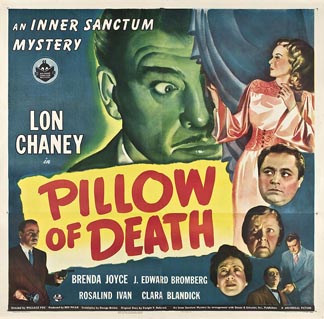
Wallace Fox’s Pillow of Death, the sixth and final film in the Inner Sanctum Mysteries series, is a haunted house mystery, the kind that Charlie Chan and the Crime Doctor excelled at solving. It lacks the ghoulish fun of the Inner Sanctum radio show, and it’s the least memorable of the film series.

The film begins when attorney Wayne Fletcher (Lon Chaney, Jr.) drops his secretary Donna Kincaid (Brenda Joyce) off at her family home after another late night of preparing briefs at the office. The crotchety patriarch of the family, Sam Kincaid (George Cleveland) grumbles, “The Kincaid women never worked,” which is funny, considering the fact that his sister Belle (Clara Blandick) waits on him hand and foot, and he employs Amelia Kincaid (Rosalind Ivan), a poor relative from England, as his housekeeper.

When Fletcher returns home, the police are waiting for him in his living room. Capt. McCracken (Wilton Graff) and his men acted on a tip from a spiritualist named “Julian” (J. Edward Bromberg), who is sitting in Fletcher’s rocking chair like he owns the place. The police inform Fletcher that Julian had a psychic presentiment that one of his adherents, Mrs. Fletcher, had come to harm. When the police arrived at the Fletcher home, they found her murdered corpse. Fletcher is now the prime suspect.

After he’s questioned and released, Fletcher goes to the Kincaid home, as does Julian, and most of the rest of the film takes place there. Donna’s amorous teenaged neighbor Bruce (Bernard Thomas) keeps popping up, skulking around the grounds and saying little, as the bodies start piling up. The haunted house clichés come fast and furious, including a séance presided over by Julian, which gives the roly-poly character actor Bromberg free rein to tilt his head back, roll his eyes up in his head, and speak very, very slowly. It’s not quite entertaining enough to be called “campy,” but it comes close.

Unlike the previous films in the series, the supernatural element is poorly handled and its role in the story is never fully explained. In other Inner Sanctum films, and on the radio show, any supernatural hokum was usually debunked and explained away. Like pulling the mask off the monster at the end of Scooby-Doo, the explanations were sometimes preposterous, but they were usually clever, or at least fun. And since Pillow of Death a straightforward mystery, the lack of explanation seems more like a product of lazy writing than anything else.

Also, with a title like Pillow of Death I was expecting something more overtly supernatural, like a pillow cursed by Satan, or a talking pillow, or possibly even a pillow with a hole in it full of sharp teeth. Instead, an ordinary pillow is used at one point as a murder weapon, in an attempt to smother someone, but that’s it. Given the pillow’s limited role in the film, the title seems almost like a joke.

House of Dracula (Dec. 7, 1945)

House of Dracula followed in the footsteps of Frankenstein Meets the Wolf Man (1943) and House of Frankenstein (1944), Universal Studios’ earlier “monster mash” movies. It would be a few years before the genre descended into outright self parody, but House of Dracula is still campy and fun compared with the more serious scares of Universal classics like Dracula (1931) and The Wolf Man (1941).

The macabre goofiness begins with the opening credits, which drip down like blood dumped on the roof of an A-frame house, coalescing over a shot of a creepy old manse, high atop the cliffs on the shores of what looks suspiciously like the Pacific Ocean. Like most Universal horror movies, House of Dracula seems to takes place in “Europe,” but the details are vague, and everyone speaks English, even though the characters have names like Holtz (Lionel Atwill), Siegfried (Ludwig Stössel), and Dr. Franz Edlemann (Onslow Stevens).

The last time we saw John Carradine as a tall, white-haired, and mustachioed Count Dracula, he was burned up in the sun halfway through the running time of House of Frankenstein. How he came back to life is never explained. How he manages to walk into Dr. Edlemann’s castle without being invited in is also a mystery. But walk in he does, through an unlatched back door, and presents himself to Dr. Edlemann as “Baron Latos.” Dr. Edlemann is a scientific genius with a hunchbacked assistant named Nina (Jane Adams) and a basement full of crazy doodads and contraptions. He is also an expert on the affliction of vampirism. Dracula wants to be cured, and Dr. Edlemann agrees to help him.

The plot thickens when, one evening shortly after sundown but before the rise of the full moon, Dracula is receiving a blood transfusion from Dr. Edlemann in his basement laboratory. A nervous man named Lawrence Talbot (Lon Chaney, Jr.) appears in Dr. Edlemann’s waiting room. Like Dracula, he is looking for a cure. Dr. Edlemann’s pretty nurse, Miliza Morrelle (Martha O’Driscoll), tells Talbot he’ll have to be patient, but he refuses to wait. “There isn’t time!” he shouts, and runs out of the castle, directly to the nearest police station, where he convinces them to lock him up. He transforms into the dreaded Wolf Man while behind bars, which convinces Dr. Edlemann to take him on as a patient.

Luckily for Talbot, the doctor is also an expert on lycanthropy, and he has a pseudoscientific explanation for Talbot’s condition. Pressure upon certain parts of the brain, coupled with Talbot’s firmly held belief that the full moon can cause a change in his body, brings on self-hypnosis, and the glands that govern his metabolism get out of control. Surgery to enlarge the cranial cavity would be a long and dangerous process. Dr. Edlemann has a more sensible solution. He, Nina, and Miliza are growing a hybrid tropical plant that produces a mold that can soften substances composed of calcium salts, like bone, which will allow Dr. Edlemann to enlarge Talbot’s cranium without surgery. (It will also allow him to dissolve Nina’s hump, which he promises her he will do once Talbot is cured.)

Miliza refers to Talbot as a “young man,” and Dr. Edlemann calls him “my boy,” which are both strange appellations for a tired-looking 39-year-old alcoholic with slicked-back hair and a mustache. His behavior is also strange, but that’s standard operating practice for the Wolf Man’s human alter ego in a Universal horror movie.

After a setback, the impatient Talbot unsuccessfully attempts to commit suicide by jumping from the cliffs. The doctor follows him down to one of the seaside caves, where he tells him the conditions are perfect for growing his mold spores, and not to despair. While in the caves, the plot thickens once again when Talbot and Dr. Edlemann find Frankenstein’s monster (Glenn Strange), buried in mud along with the skeleton of Dr. Niemann, who revitalized him back in House of Frankenstein. The villagers chased them into a pit of quicksand, and the mud flow brought them to the caves below Dr. Edlemann’s castle.

The altruistic Dr. Edlemann belts the monster down on an operating table, and wires him for revival, but his reasons for doing this are less clear than his reasons for helping Dracula and the Wolf Man. He says that to not do so would be murder, since the monster is man’s responsibility. (Presumably, if he could speak, the monster would say, “Please bring me back to life so I can destroy you, your laboratory, your home, and everything you’ve worked for.”) Nina and Talbot eventually manage to dissuade Dr. Edlemann from bringing the monster back to life. However, the monster is still hooked up and ready to be reactivated, like a loaded gun carelessly left lying on the floor of a mental institution.

Things start to go south at the halfway mark of House of Dracula, as they tend to when monsters mash. Dr. Edlemann doubles up on the transfusions he’s giving to Dracula, which leads to a fateful accident. Meanwhile, the irrepressible Count casts his hypnotic spell over Miliza, with whom he has a past.

I thought that House of Dracula was a more satisfying picture than House of Frankenstein. The way each monster is introduced is clumsy, but other than that the plot flows smoothly from beginning to end. It’s a spooky good time that doesn’t strain to fit all of its ghoulish pieces into its 67-minute running time.

I Know Where I’m Going (Nov. 16, 1945)

Michael Powell and Emeric Pressburger, the talented pair of writers, producers, and directors whose early collaborations included One of Our Aircraft Is Missing (1942), The Life and Death of Colonel Blimp (1943), and A Canterbury Tale (1944), worked together under the name “The Archers” throughout the 1940s and 1950s, and produced some of the most enduring films in British history. Powell was a native-born Englishman. Pressburger was a Hungarian Jew who found refuge in London and who prided himself on being “more English than the English.”

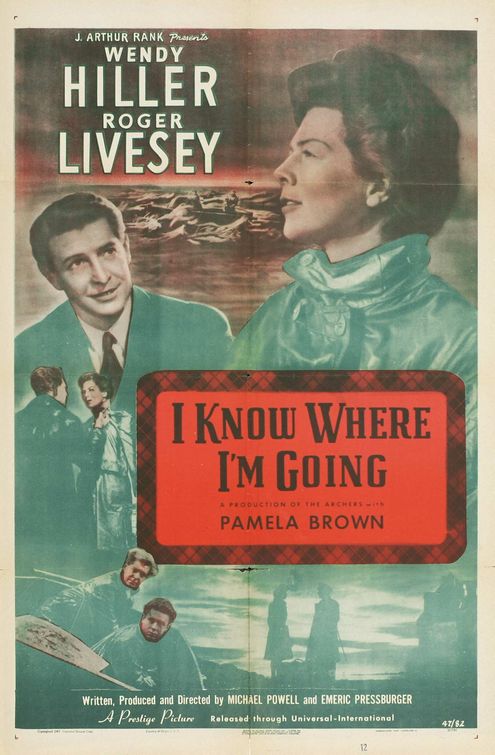
I Know Where I’m Going, which premiered in London on November 16, 1945, is a warm, romantic drama. The film stars Wendy Hiller as Joan Webster, a stubborn young woman who, according the narrator, “always knew where she was going.” After a montage that shows Joan’s growth from headstrong toddler to headstrong teenager to headstrong 25-year-old, we see her dressed in smart clothes, meeting her father (played by George Carney) at a nightclub, where she blithely informs him that she plans to travel to Kiloran island in Scotland to marry Sir Robert Bellinger, a wealthy, middle-aged industrialist whom she has never met. Her father is aghast, but, as always, Joan knows exactly where she’s going and what she’s doing.

Handled differently, this setup could lead to a grim, Victorian melodrama, but I Know Where I’m Going is a playful film with touches of magical realism. On her trek to the Hebrides, Powell and Pressburger delight in each leg of her long journey (and there are many), and pepper the montage with fanciful touches, such as a map with hills made of tartan plaid, a dream sequence in which Joan’s father marries her to the chemical company owned by Bellinger (literally), and an old man’s top hat that becomes the whistling chimney of a steam engine.

On the last leg of her journey, she is forced to put up in the Isle of Mull, as weather conditions do not permit water travel to Kiloran. Joan stays in touch with Bellinger, who is never seen, only heard (as a stuffy voice on the other end of a telephone). While cooling her heels in Mull, Joan meets a charming, soft-spoken serviceman named Torquil MacNeil, who is on an eight-day leave. (Torquil is played by Roger Livesey, in a role originally intended for James Mason.)

The joke implicit in the title becomes more and more clear as Joan and Torquil begin to fall for each other. The closer they become, the more determined she is to reach Kiloran. Eventually willing to risk life and limb to get there, it becomes clear that at least when it comes to love, she has no idea where she is going, and is too hard-headed to see anything clearly.

Livesey, who was in his late thirties when this film was made, was originally told that he was too old and too heavy to play the role of the 33-year-old Torquil, but he very quickly slimmed down to get the part, and he cuts a dashing figure, although not a classically handsome one. Interestingly, Livesey never set foot in the Western Isles of Scotland, where most of the film’s exteriors were shot. He was starring in a play in the West End during filming, so Powell and Pressburger made clever use of a body double for long shots, and filmed all of Livesey’s interior scenes at Denham Studios, in England.

Besides its fine performances and its involving love story, I Know Where I’m Going is enjoyable to watch simply because Powell and Pressburger show such incredible attention to detail. The interiors may be shot on a soundstage, but it’s easy to forget that with effects that perfectly marry them to the location footage, such as rain lashing the windows, subtle lighting, and the shadows of tree branches moving back and forth on the walls of the houses and cottages on the island. There are no short cuts or cut corners in this film. Joan’s dreams don’t appear in a cloud of dry ice or in soft focus, they swirl kaleidoscopically around her head. And elements that might seem silly in another film, such as an ancient curse hanging over Torquil’s head, seem palpably real when they’re embodied by shadowy, decrepit, and glorious real-world locations like Moy Castle.

Pursuit to Algiers (Oct. 26, 1945)

Pursuit_to_AlgiersPursuit to Algiers, the twelfth film to star Basil Rathbone as Sherlock Holmes and Nigel Bruce as his boon companion Dr. John H. Watson, is a minor entry in the series, but a thoroughly enjoyable one. It’s the ninth Holmes picture directed by Roy William Neill, and his sure hand and professionalism are fully in evidence.
The film gets down to business in a wonderfully circuitous fashion, as Holmes and Watson are handed cryptic directions by a series of strangers. In each case, it takes Holmes a few beats to catch on, while Watson is oblivious the whole time. Eventually they are led to a group of men from an unnamed foreign country whose king has just been assassinated. They want Holmes to guard the life of the heir to the throne, Nikolas, who was educated in England. Holmes suggests that Nikolas pose as Watson’s nephew on a steamship voyage to Algiers. Once at sea, the film introduces a worthy cast of drawing room mystery characters, including a trio of sinister but quirky assassins.

Elements of Leonard Lee’s screenplay are taken from an otherwise unrecorded affair mentioned in the beginning of Sir Arthur Conan Doyle’s story “The Adventure of the Norwood Builder,” in particular the use of the steamship Friesland. And at one point in the film, Watson begins to share with his fellow dinner guests aboard the ship his adventure with Holmes that involved the “Giant Rat of Sumatra,” which is mentioned in Doyle’s story “The Adventure of the Sussex Vampire.” These references are similar to what Anthony Boucher and Denis Green would occasionally do in their scripts for the radio show The New Adventures of Sherlock Holmes, which was heard on the Mutual Broadcasting System, and, like the film series, starred Rathbone and Bruce. For instance, in one program, Holmes is willed a patch of land in gratitude for his successful work on a case, and he tells Watson he plans to retire there someday and keep bees. (In Conan Doyle’s stories and novels, the background of Holmes’s retirement in 1903 to the Sussex Downs, where he engaged in beekeeping, was never supplied.)

At times, Pursuit to Algiers comes dangerously close to being a musical, as one of the passengers on the ocean liner is a young and beautiful pianist named Sheila Woodbury (Marjorie Riordan), whom Dr. Watson makes a bit of a fool of himself over. It’s all in good fun, though, and Bruce’s “silly old goat” act is always fun to watch, even if his portrayal of Watson is a bit more ridiculous than Conan Doyle’s original conception of the character. Sheila plays several songs on the piano, including the beautiful “Flow Gently, Sweet Afton.” Watson even joins her at the piano toward the end of the picture for a lovely version of “Loch Lomond.” Director Neill always keeps things moving, however, and despite its minor status, Pursuit to Algiers is still a worthy entry in the Sherlock Holmes series.

Secret Agent X-9 (13 chapters) (July 24-Oct. 16, 1945)

Secret Agent X-9Republic Pictures is the unassailable king of the cliffhangers after the silent era. Most of the best chapterplays of the ’30s and ’40s were Republic productions. Dick Tracy (1937), The Lone Ranger (1938), Zorro’s Fighting Legion (1939), Adventures of Red Ryder (1940), Mysterious Doctor Satan (1940), Adventures of Captain Marvel (1941), Jungle Girl (1941), Spy Smasher (1942), Perils of Nyoka (1942), The Masked Marvel (1943), and Captain America (1944) are just a few of the more than sixty serials produced by Republic Pictures, most of which are still incredibly entertaining. The best Republic serials combined wild action and elaborate stunts with nicely paced stories that could be strung out over 12 to 15 weekly installments with a few subplots here and there, but nothing too complicated or that viewers couldn’t pick up with in the middle. Each chapter ended with a cliffhanger (like Captain Marvel flying toward a woman falling off a dam, or a wall of fire rushing down a tunnel toward Spy Smasher). The next week’s chapter would begin with a minute or two of the previous week’s climax and the resolution, and the cycle would repeat until the final chapter.
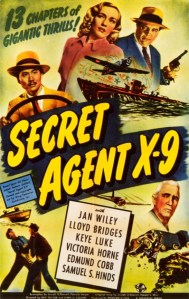
Columbia Pictures and Universal Pictures were the two other major producers of serials in the sound era. Universal ceased production of serials in 1946, leaving only Columbia and Republic to duke it out into the ’50s. One of the last serials made by Universal was Secret Agent X-9, released into theaters starting in July 1945. It was based on a daily newspaper strip created by writer Dashiell Hammett (the author of The Maltese Falcon and The Thin Man) and artist Alex Raymond (who worked on Flash Gordon). Both creators left the project soon after its inception, and the King Features strip continued under various hands, vacillating between espionage and private eye stories.

X-9The first film serial featuring Secret Agent X-9 was made by Universal in 1937, and starred Scott Kolk as Agent X-9, a.k.a. “Dexter,” who sought to recover the crown jewels of Belgravia from a master thief called “Blackstone.” The second featured a boyish-looking 32-year-old Lloyd Bridges as Agent X-9, a.k.a. “Phil Corrigan.” Made toward the end of World War II, the 1945 iteration of the character focused on wartime intrigue and Corrigan’s cat-and-mouse games with Axis spies. Taking a cue from Casablanca (1942), the serial was set in a neutral country called “Shadow Island,” in which Americans, Japanese, Chinese, French, Germans, Australians, and the seafaring riffraff of the world freely intermingle. A fictional island nation off the coast of China, “Shadow Island” has a de facto leader named “Lucky Kamber” (Cy Kendall) who owns a bar called “House of Shadows” and has a finger in every pie, including gambling and espionage. Various German and Japanese military officers, secret agents, and thugs run amuck in this serial, but the one who most stands out is the unfortunately made-up and attired Victoria Horne as “Nabura.” In her role as a Japanese spymaster, Horne is outfitted with eyepieces that cover her upper eyelids, appearing to drag them down from sheer weight. She doesn’t look Asian, she just looks as if her eyes are closed.
While Nabura is played by a white actress in yellowface makeup, the main Chinese character is actually played by a Chinese actor, which was typical in World War II-era Hollywood. Keye Luke, surely one of the hardest working Chinese-American actors in Hollywood history, plays “Ah Fong,” Corrigan’s faithful sidekick. Corrigan is also aided by an Australian double agent named Lynn Moore, played by American actress Jan Wiley. Wiley does nothing to alter her accent, which was also typical for American actors who played Aussies in Hollywood productions during the war.

Secret Agent X-9 has good production values and special effects. The stock footage that shows up in nearly every serial is judiciously used, and integrated well into the newly filmed material. Where this Universal serial just doesn’t measure up to the best Republic offerings is in the pacing and action departments. Republic serials featured stuntwork that still impresses (e.g., Spy Smasher leaping through the air, landing on a mechanic’s creeper chest-first, rolling under a car, and grabbing a goon’s ankles before he can escape). Secret Agent X-9 features ho-hum shootouts, fistfights, and car chases.

Also, instead of a plot that evolves naturally over the course of the series, there is a simple story that seems as if it’s been stretched from a 90-minute feature into 13 chapters, most of which are longer than 20 minutes. Secret Agent X-9 also suffers from poor timing. When the first installment was released, V-E Day had already passed, but the United States was still at war with Japan. By the time the final installment was released, atomic bombs had been dropped on Hiroshima and Nagasaki, Japan had surrendered to the Allies, and a new phase in world history had begun. Secret Agent X-9 is set in 1943, so it’s never out of date, per se, but its MacGuffin, a substitute for aviation fuel called “722,” which everyone in the film is scrambling to secure for themselves, seems like small beer after the advent of the Atomic Age.

Strange Confession (Oct. 5, 1945)

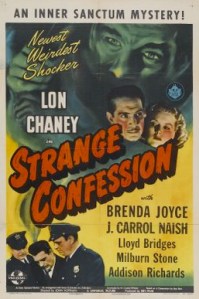
StrangeConfessionApparently populist rage against pharmaceutical giants is nothing new. In Strange Confession, the fifth of six “Inner Sanctum Mysteries” produced by Universal Pictures and released from 1943 to 1945, Lon Chaney, Jr. plays a brilliant chemist named Jeff Carter whose life goes from bad to worse when he twice accepts employment from the unscrupulous owner of the largest medical distributing company in an unnamed American city.
Strange Confession is more of a straight drama than the other films in the Inner Sanctum series. Except for its gruesome finale, it’s free of the Gothic overtones and murderous double-crosses found in the rest of the series. The opening few minutes are gripping, with Jeff clutching a bag in his hand and skulking through the shadowy nighttime city streets, deliberately avoiding a police officer. It’s a very noir beginning, right down to the story structure. Jeff arrives at the home of an old school chum named Mr. Brandon (Wilton Graff) and sits down to confess something horrible. He opens the bag and shows Brandon what’s inside. Brandon recoils, but the camera doesn’t reveal the bag’s contents.

Jeff recalls better days. He once had a well-paying job, a pretty wife named Mary (Brenda Joyce), and a baby boy named Tommy (Gregory Muradian). Unfortunately, his employer, Mr. Graham (J. Carrol Naish) exploited his talents and treated him poorly. He even had Jeff hard at work on Christmas Eve, composing an acceptance speech for him in which he took full credit for Jeff’s accomplishments in the lab. Jeff quit his job and worked for a small pharmacy, forced to labor on his chemistry experiments after hours in his bathroom. He was poor, but happy. But this wasn’t enough for his wife, who wanted better things in life, so a year later, Jeff went back to work for Mr. Graham. Jeff, his wife, and little Tommy started living the good life, with a house in the suburbs and an Irish housekeeper named Mrs. O’Connor (Mary Gordon).

Unfortunately, Graham, in addition to being a bad boss, was a cad. He had designs on Mary, and sent Jeff and his affable assistant Dave (Lloyd Bridges) deep into South America to work on a flu cure called “Zymurgine.” While Jeff and Dave were hard at work testing and perfecting the formula for the drug, Graham romanced Mary, who naïvely saw him as just a friend, taking her out to dinners and shows. Worse, he rushed Zymurgine into the market before Jeff’s fully tested formula was even ready to be shipped back to the United States. In a prescient moment, Graham tells his coterie of underlings, “You can sell almost anything if you advertise it enough.”

Ill-gotten profits trump integrity, and the whole thing comes full circle, personally affecting the principal characters and leading to a bloody conclusion. Strange Confession is quite a good one-hour B picture. Chaney’s performance is better than usual, and Naish is a smooth, oily antagonist. He’s well cast, too. With his hangdog features, black hair, and pencil-thin mustache he looks like a shorter version of Chaney, making him the perfect doppelgänger villain.

Lady on a Train (Aug. 17, 1945)

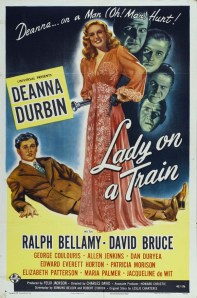
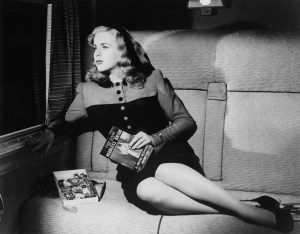
LadyOnATrainDeanna Durbin is an absolute delight in this farcical murder mystery. Durbin, a native of Winnipeg, Manitoba, was once one of the biggest stars in Hollywood, but never made a movie after 1948. (She currently lives in a small village in France, grants no interviews, and is reportedly very happy.) In Lady on a Train, she plays a young woman named Nicki Collins. When the film begins, Collins is sitting by herself in a compartment on a train entering New York on an elevated line. She has come from San Francisco to spend the holidays with her wealthy businessman father, and is currently engrossed in a mystery novel called The Case of the Headless Bride. When the train is briefly delayed, she looks out the window of her train car and witnesses a murder. Through a lighted window, she sees a young man beat an older man to death with a crowbar. She never sees the murderer’s face, however, and when she reports the murder to the police, the desk sergeant dismisses her report as the product of the overheated imagination of a girl who loves murder mysteries and can provide no real specifics of where she was when she saw the murder. Also, it’s Christmas Eve, and who want to traipse around looking for a murder that may or may not have occurred somewhere in Manhattan north of Grand Central Station?
Undeterred, Collins calls up Wayne Morgan (David Bruce), the author of the mystery novel she was reading, and insinuates herself into his life, much to Morgan’s fiancée’s chagrin. After interrupting Morgan on a date at the movies, Collins see the murder victim in a newsreel, and identifies him as Josiah Waring, a shipping magnate. She heads to the Waring estate, where she is mistaken for Circus Club singer Margo Martin, who was Waring’s girlfriend. This allows her to sit in on the reading of Waring’s will, which leaves $1 to his nephew Arnold (Dan Duryea), $1 to his nephew Jonathan (Ralph Bellamy), and the rest of his substantial fortune to Martin.

Sure enough, Collins discovers that Martin has been murdered, throwing suspicion on the Arnold nephews and putting her in a tight spot, since she’s now performing at the club as the murdered girl.

DurbinLady on a Train is part mystery, part musical, part noir, part comedy, and part romance. The most surprising thing about this movie is that each element works perfectly, and they all complement one another. (Calling this film a noir is stretching it, but the final chase in a warehouse contains some striking chiaroscuro shot constructions, and is as tense as one could ask for.) Lady on a Train is also a delight for Durbin fetishists, since she has a different outfit and hairstyle in literally every scene. Sometimes the changes are subtle, but occasionally they’re impossible to miss, such as the scene in which she comes in out of the rain and is suddenly wearing gravity-defying, Pippi Longstocking-style braided pigtails.

Durbin made her film debut in Three Smart Girls (1936) at the age of 14. Apparently she was so popular that she singlehandedly saved Universal Pictures from financial ruin. Here, at the age of 23, she’s a joy to watch. Unlike a lot of former teen stars, she reached maturity while retaining all of her youthful charm, without ever seeming childish or forced.