Tag Archives: Westerns

I Shot Jesse James (Feb. 26, 1949)

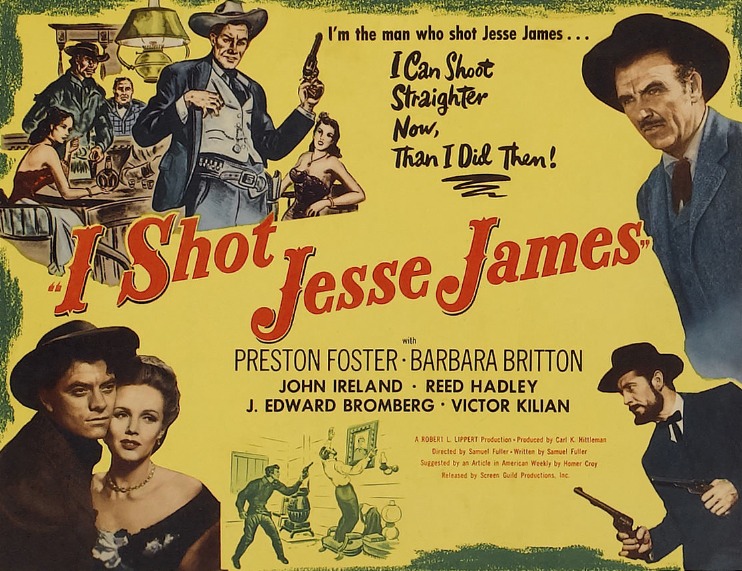
I Shot Jesse James
I Shot Jesse James (1949)
Directed by Samuel Fuller
Lippert Pictures / Screen Guild Productions

If a story doesn’t give you a hard-on in the first couple of scenes, throw it in the goddamn garbage. —Samuel Fuller

Maverick filmmaker Samuel Fuller was shopping scripts around Hollywood when he met producer Robert L. Lippert. Lippert admired Fuller’s 1944 pulp novel The Dark Page and gave Fuller his first crack at directing.

The result was I Shot Jesse James, a low-budget but brilliant revisionist western starring John Ireland as Robert Ford, the member of the James gang who killed Jesse James and collected the bounty.

Fuller had a flair for the dramatic, and when shooting began on I Shot Jesse James, he discharged a round from his Colt .45 into the air instead of yelling “Action.”

Fuller made three films for Lippert, I Shot Jesse James, The Baron of Arizona (1950), and The Steel Helmet (1951). The budgets were tiny and the shooting schedules tight, but Lippert gave Fuller the freedom to make exactly the kind of movies he wanted.

Fuller wrote the script for I Shot Jesse James, and based it on an article by Homer Croy in American Weekly magazine. It’s a sympathetic portrayal of a roundly reviled historical figure (even if you have no sympathy for Jesse James, it’s hard not to instinctively dislike a man who shot his unarmed friend in the back for reward money).
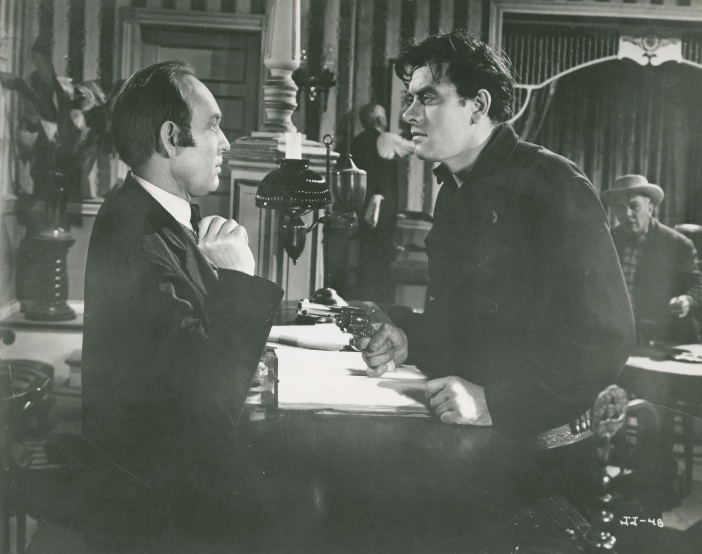
John Ireland

John Ireland plays Robert Ford as a lovesick man who’s tired of life on the run and just wants to marry his girl, the beautiful actress Cynthy Waters (Barbara Britton). He’s tempted by Missouri Governor Thomas Theodore Crittenden’s offer of amnesty for any member of the gang who turns in Jesse James (Reed Hadley), dead or alive.

Fuller depicts the relationship between Jesse and Bob Ford as deeply homoerotic, although the stolid Hadley doesn’t seem aware of anything strange about sitting in a bathtub and asking his friend to scrub his back for him. It’s the tortured Ireland who appears to long for Jesse, and perhaps by killing him he’s killing a part of himself that he despises.

Nothing good comes from it, of course. When Ford tells Cynthy that his killing of Jesse James was legal, she responds in horror, “It was murder.”

He walks through the rest of the picture with a haunted, desperate look on his face. He appears in a stage show in which he reenacts the killing of Jesse James, he dodges bullets from glory-hungry gunmen, and he desperately tries to repair his relationship with Cynthy.

This film explores a lot of the same territory as Andrew Dominik’s The Assassination of Jesse James by the Coward Robert Ford (2007), which starred Casey Affleck as Robert Ford and Brad Pitt as Jesse James. The most poignant parts of both films show Ford facing his own terrible legacy, such as when he appears in the onstage reenactment or confronts a troubadour who sings hymns to his cowardice.

I Shot Jesse James has stock music and its minuscule budget is pretty obvious, but it’s a great portrait of a complicated historical figure. Samuel Fuller would go on to have a long and iconoclastic career, and while I Shot Jesse James is never numbered among his greatest works, it’s his opening salvo as a director, and it’s a powerful one.
3 Godfathers (Dec. 1, 1948)

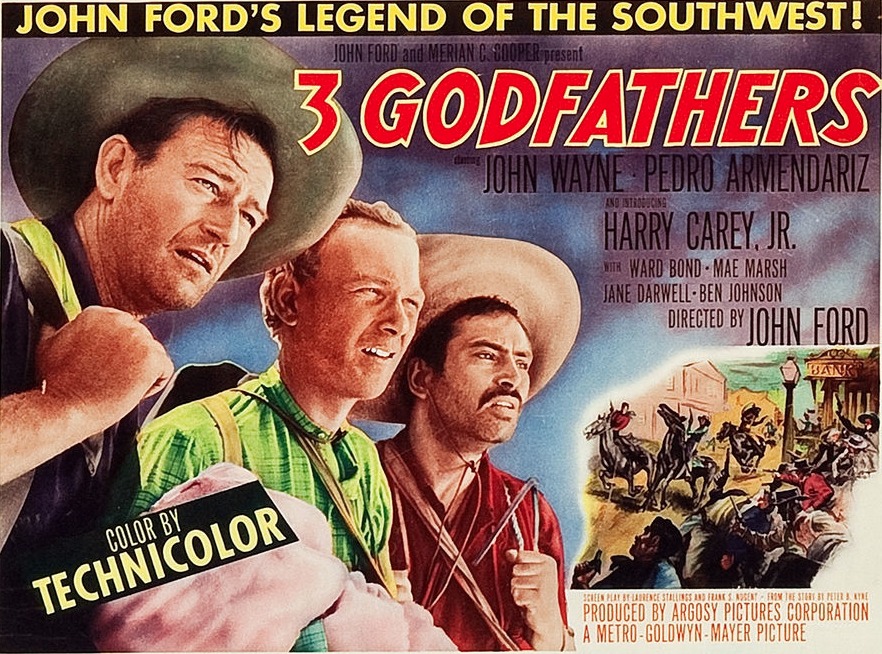
3 Godfathers
3 Godfathers (1948)
Directed by John Ford
Argosy Pictures / Metro-Goldwyn-Mayer

After making the western masterpiece Fort Apache (1948), director John Ford returned to the religious overtones of the movie he made right before Fort Apache, The Fugitive (1947).

3 Godfathers reimagines the biblical story of the three wise men as a story of three bank robbers from Texas who are fleeing a U.S. Marshal in the Arizona Territory.

Unlike Ford’s previous several black & white films, 3 Godfathers is shot in Technicolor. It’s dedicated to the memory of Harry Carey, “Bright Star of the early western sky.” (Carey acted in dozens of Ford’s early films, and died on September 21, 1947.)

3 Godfathers stars John Wayne and Pedro Armendáriz, and “introduces” Harry Carey’s son, Harry Carey, Jr.

I put “introduces” in quotation marks because he’d already had credited roles in several films, including Pursued (1947), Red River (1948), and Moonrise (1948).

The three bank robbers are named Robert Marmaduke Hightower (John Wayne), William Kearney, a.k.a. “The Abilene Kid” (Harry Carey, Jr.), and Pedro “Pete” Roca Fuerte (Pedro Armendáriz). John Wayne’s drinking buddy, Ward Bond, plays the U.S. Marshal who pursues Robert, William, and Pedro after they rob a bank. Bond’s character is named Perley “Buck” Sweet, or “B. Sweet,” a name Robert finds hilarious. Marshal Sweet’s bearlike body and easygoing nature belie his craftiness. When he first pursues the bank robbers, he shoots a hole in their waterskin, then he sets up camp with his deputies at the spot he thinks they’ll have to circle back to in order to get water.

Godfather John Wayne

Wandering through the desert, the three bank robbers find a dying woman (Mildred Natwick), who has just given birth to a baby. She tells them that they will be the boy’s godfathers, and she names her baby after the three of them — Robert William Pedro.

The following section of the film is sort of like a religious version of Three Men and a Baby in the Old West, as the trio of roughnecks try to figure out how to care for a baby in sometimes hilarious ways. When they finally rig up a nursing device and fill the bottle with milk, John Wayne laughs and says, “Boy, he hops to it like a drunkard at a Fourth of July barbecue.”

There are tender moments, too, like the one in which Carey holds the baby and sings “Streets of Laredo” in a beautiful baritone.

The religious aspects of the story are fairly explicit. The three godfathers follow a bright star in the sky toward the town of New Jerusalem, and they do so to the musical strains of “Away in a Manger” as the desert sands blow over the large wooden cross they’ve placed over the baby’s mother’s grave. They also use Bible verses as guides and portents in their journey.

3 Godfathers is based on Peter B. Kyne’s first novel, which was published in 1913. An immensely popular little work, The Three Godfathers was first filmed as The Three Godfathers (1916), a silent film directed by Edward LeSaint that starred Harry Carey. John Ford filmed the story as Marked Men (1919), again starring Carey. Ford made another version of the story called Action in 1921, William Wyler made a version called Hell’s Heroes in 1929, and Richard Boleslawski filmed a version called Three Godfathers in 1936.

I’ll admit that John Ford’s appeal sometimes eludes me. I’m not nearly as in love with some of his masterpieces as others are. But while 3 Godfathers will probably never be counted as one of Ford’s masterpieces, I thought it was a well-crafted, emotionally satisfying film. It’s also the perfect choice if you love westerns and are looking for a good movie to watch around Christmas with your family.

Blood on the Moon (Nov. 9, 1948)

Blood on the Moon
Blood on the Moon (1948)
Directed by Robert Wise
RKO Radio Pictures

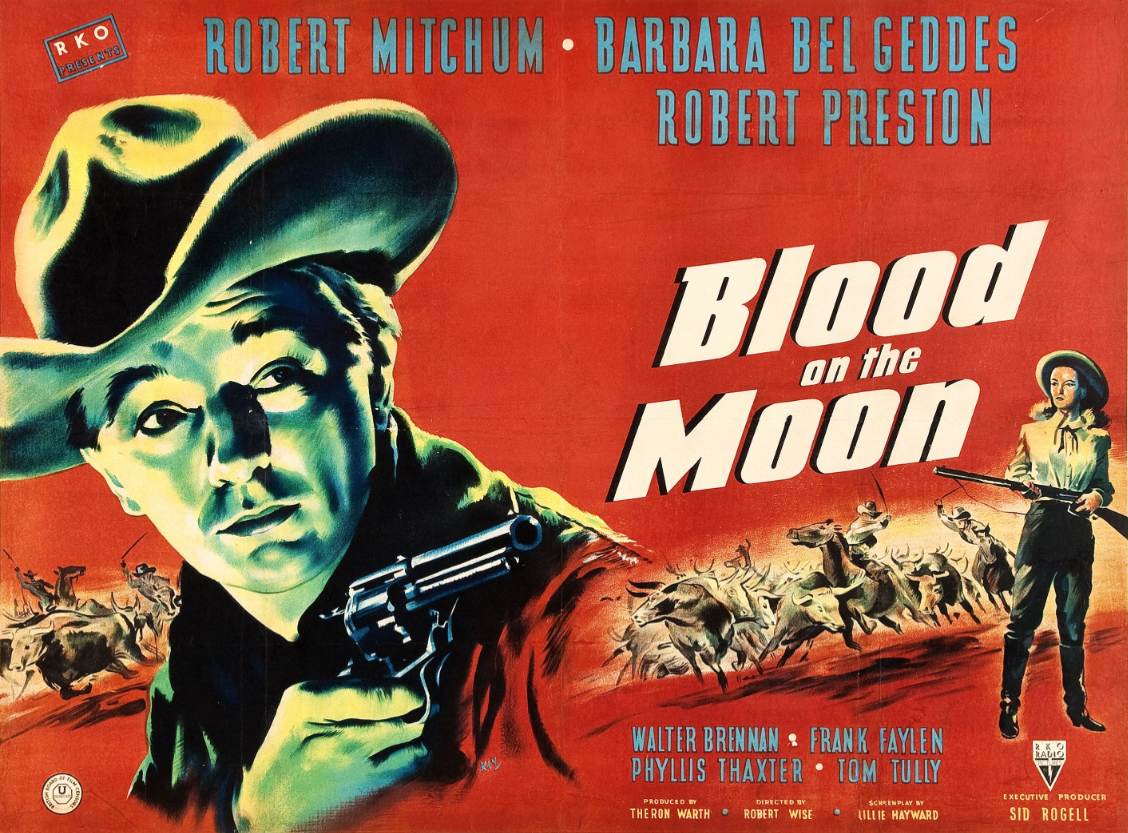
Blood on the Moon is an RKO western directed by Robert Wise. It’s based on Luke Short’s novel Gunman’s Chance, which was originally serialized in The Saturday Evening Post in 1941.

I’ve only read one of Luke Short’s western novels (he wrote more than 50), but judging by it and the two films I’ve seen that were based on his work (this one and André de Toth’s 1947 film Ramrod), dense plotting, terse dialogue, and three-dimensional protagonists were some of Short’s trademarks.

Like most protagonists of westerns in the ’40s and ’50s, the protagonists of Blood on the Moon and Ramrod are on the side of the angels. But they’re more interesting than the cookie-cutter heroes of countless B westerns. Not so much because they’re complex people, but because they’re believable people who exist in a complex world.

First-time viewers of both Ramrod and Blood on the Moon will likely have a little difficulty figuring out who the “good guys” and the “bad guys” are right away, and who’s telling the truth and who’s lying — at least for the first couple of reels.

The hero of Blood on the Moon — Jim Garry — is played by Robert Mitchum. Garry is a solitary cowpoke with a small herd. He’s passing through open country when his herd is run off in a stampede. Rancher John Lufton (Tom Tully), owner of the Lazy J Ranch, apologizes and offers to reimburse Garry for the outfit he lost. Even so, their exchange is tense. Lufton doesn’t trust loose riders, since he’s feuding over grazing land with Jake Pindalest (Frank Faylen), a newly appointed Indian agent who’s thrown Lufton off the reservation grass, and stopped Lufton from supplying the tribe with beef, even though he’d done so for years.

When Garry turns down Lufton’s offer to work for him, the opposition comes knocking in the form of an old friend of Garry’s — a man named Tate Riling (Robert Preston). Tate represents the homesteaders who are opposed to Lufton, and he offers to hire Garry as a gunhand for $10,000. Tate tells Garry, “Lufton’s tough and my ranchers aren’t. You make up the difference.”

“I’ve been mixed up in a lot of things, Tate, but up till now I haven’t been hired for my gun,” Garry says.

“Can you afford to be particular?”

Garry thinks for a moment, then says, “No, I guess I can’t.”

Mitchum

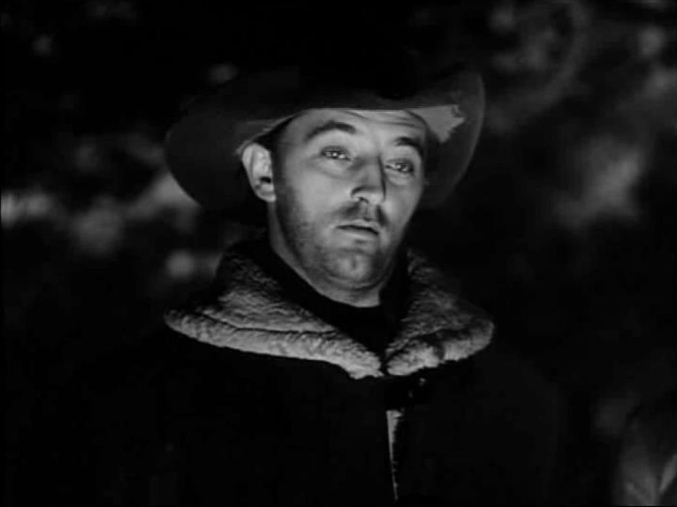
Mitchum is perfect for this type of role. He was a laconic actor who barely ever changed his expression, but he could suggest depths of emotion with his eyes.

I’ve seen him in run-of-the-mill westerns like West of the Pecos (1945), and he’s fine in them, but he did his best work in dark, noirish westerns like this one and Raoul Walsh’s Pursued (1947).

Robert Wise, the director of The Body Snatcher (1945) and Born to Kill (1947), keeps Blood on the Moon moving at a brisk, tense pace. The cinematography by Nicholas Musuraca is full of darkness and shadows. It’s not full-on “noir” like James Wong Howe’s cinematography for Pursued, but Blood on the Moon still spends a lot of time in darkened saloons, lonely country at night, and the streets of a frontier town after dark. Even the exterior scenes that take place in daylight have a sense of gray desolation.

The cast is really great, too. I like seeing Barbara Bel Geddes in just about anything, and I especially liked her as one of Lufton’s two daughters, Amy. (Phyllis Thaxter plays the other daughter, Carol.) Square-jawed, gruff-voiced tough guy Charles McGraw plays a gunhand named Milo Sweet who wears one of the sweetest buffalo coats I’ve ever seen. As a homesteader named Kris Barden, Walter Brennan plays essentially the same character he played in every movie he was ever in, but he finds depths of emotion in his character that he didn’t always get to explore as a comical sidekick. And I always love seeing Tom “Captain Marvel” Tyler in any western, even if he was a pretty wooden actor. In Blood on the Moon, he appears just long enough to be effective — in a tense showdown with Mitchum that’s 10 times as exciting as most western showdowns that have more traditional outcomes.

The tough, no-nonsense screenplay of Blood on the Moon is by Lillie Hayward, from an adaptation of the novel by Luke Short and Harold Shumate.

Blood on the Moon won’t ever be counted as one of the all-time great westerns, but the western was a damned busy genre at the time of its release, and it’s a cut above the rest. It holds up to multiple viewings, and presages the many ways in which the genre would mature in the 1950s.

Red River (Aug. 26, 1948)

Red River
Red River (1948)
Directed by Howard Hawks
United Artists

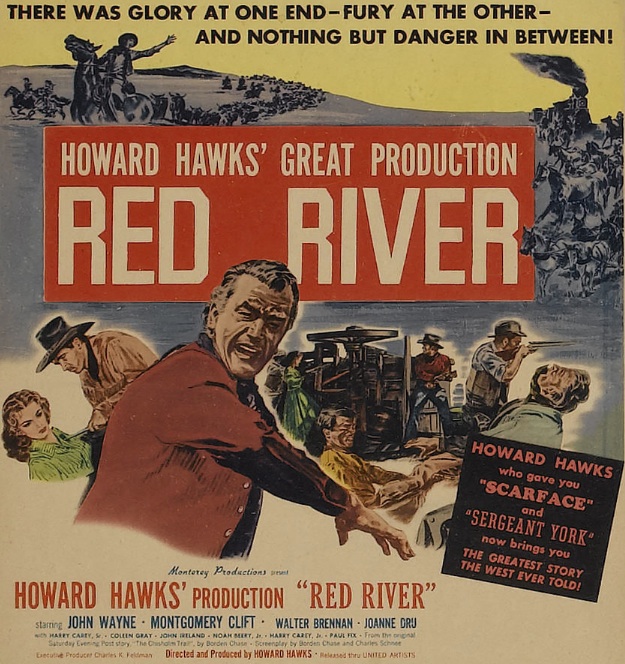
Howard Hawks shot Red River in 1946, but its release was delayed due to legal difficulties. The eccentric Howard Hughes contended that parts of Red River were taken from his “lust in the dust” western The Outlaw (1943), which starred Jane Russell and her magnificent breasts.

Anyone who’s seen both Red River and The Outlaw can tell you that any claim of story infringement is spurious, but there was bad blood between Hughes and Hawks (Hawks had worked on The Outlaw as an uncredited co-director), and it took until August 26, 1948, before Red River finally had its premiere.

So while Fred Zinnemann’s The Search (1948) was the film that introduced many moviegoers to Montgomery Clift, Red River was his first acting role in a feature film.

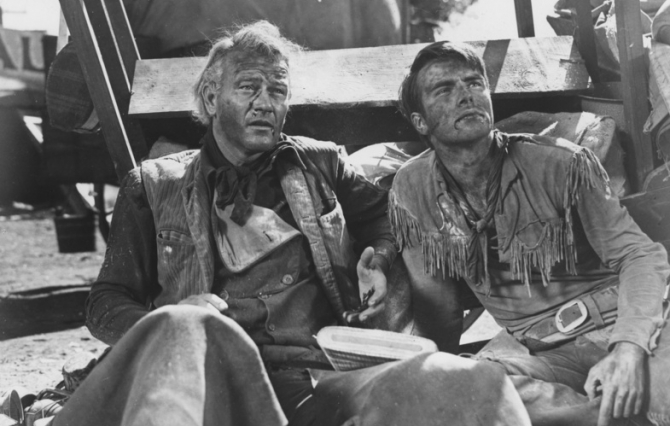
Clift was a born movie star. He was achingly handsome, rail-thin, and blessed with a uniquely vulnerable type of masculinity. On screen, he had a presence that seemed completely natural. Red River is a phenomenal western that works on a number of different levels, but one of its most important aspects is the relationship between Clift and the film’s star, John Wayne.

Wayne and Clift were on opposite ends of the spectrum in every way imaginable; politically, professionally, physically, and sexually. But it’s this contrast that makes Red River work so well.

Wayne and Clift

Red River is the story of a cattle drive along the Chisholm Trail up from Texas. Thomas Dunson (John Wayne) is a big, tough cattleman who took his land by force.

When Dunson was first establishing his grazing land with his best friend Nadine Groot (Walter Brennan), the woman Dunson loved (Coleen Gray) was murdered by Comanches, and he never loved another.

The sole survivor of the massacre, a young man named Matt Garth (played as a boy by Mickey Kuhn) came wandering through the land, leading a cow. Dunson’s bull mated with Garth’s cow, and from this union eventually grew a herd of more than 10,000 longhorns.*

Fourteen years pass, and Garth grows up, now played by Montgomery Clift. The Civil War has ended, and Dunson is no longer able to sell beeves to the impoverished southern states. He decides that he’ll drive his entire herd north to Missouri, where they’ll fetch a fortune. He’s spent his life building his empire, and he wants to pass it down to Matt Garth, his protégé.

The only problem is that Dunson’s greatest strength — his unbending will — is also his greatest weakness, which eventually puts him at loggerheads with the more even-tempered and empathetic Garth.

John Wayne and Montgomery Clift

Borden Chase, who wrote the Saturday Evening Post story on which Red River was based (as well as the screenplay for the film with Charles Schnee), drew liberally from Mutiny on the Bounty in crafting his story.

Despite the fact that his middle name was “Winchester,” this was Howard Hawks’s first directorial credit for a western, which is remarkable considering he’d been directing films since the 1920s and had more than one masterpiece under his belt.

In addition to his own estimable talents as a director, Hawks had some of the finest crew members who ever worked on a Hollywood western when he made Red River. Composer Dimitri Tiomkin’s score is epic. Editor Christian Nyby’s cutting drives the film forward with relentless intensity. And cinematographer Russell Harlan had toiled away for years working on B pictures (mostly westerns) before finally breaking into A pictures with Lewis Milestone’s war movie A Walk in the Sun (1945). He went on to become one of the best cinematographers in the business, and his work on Red River is proof.

Red River is one of the greatest westerns ever made. As I said above, it works on a number of different levels. At its most basic level, Red River is a rousing adventure film about men on a dangerous mission, struggling against the elements and against each other. But on a deeper level, it’s a timeless myth about fathers and sons.

Red River will be shown on TCM this Friday, March 1, 2013, at 10:15 PM ET.

*If you’re a fan of sexual innuendo in old movies, the scene in Red River in which Matt Garth and gunslinger Cherry Valance (John Ireland) compare revolvers is a classic. Many see a gay subtext, which could be there, but gay men hardly have a monopoly on comparing phalluses to see whose is bigger. I think the sexual bonding between men in Red River goes much deeper. Remember that the herd being driven up the Chisholm Trail in Red River are all descended from the union between John Wayne’s bull and Montgomery Clift’s cow. Even though Dunson and Garth are not blood relations, they are bound together.

Return of the Bad Men (July 17, 1948)

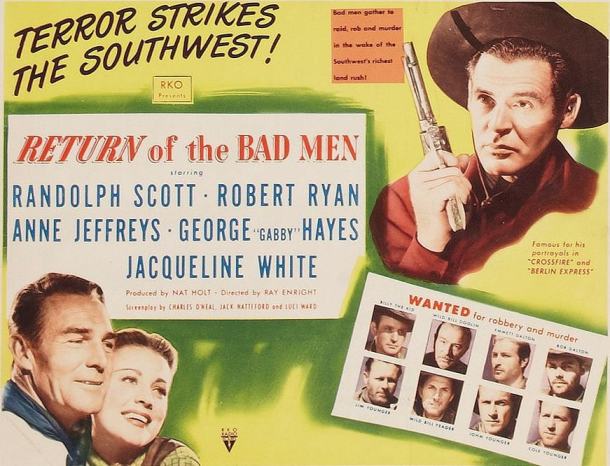
Return of the Bad MenReturn of the Bad Men was the fourth and final film in a series of westerns that director Ray Enright made with legendary horse opera star Randolph Scott. The previous three were Trail Street (1947), Albuquerque (1948), and Coroner Creek (1948).

Most modern viewers will know Randolph Scott primarily for his final role — in Sam Peckinpah’s Ride the High Country (1962) — and be blissfully unaware of the roughly one hundred films he appeared in prior to it.

Ride the High Country is a great western (it co-stars Joel McCrea), but it’s not Scott’s only claim to fame. The westerns he made in the ’50s with director Budd Boetticher are highly regarded among connoisseurs of western cinema. He also appeared in plenty of workmanlike westerns like the ones directed by Ray Enright that aren’t great works of art, but are well-made entertainment, and a cut above the average B western.

Return of the Bad Men takes place in 1889, in the Oklahoma Territory. The U.S. government has just opened up two million acres of prime land for settlers. At high noon on April 22, 1889, the great Oklahoma Land Rush will begin. On the tails of the settlers, however, are a bunch of no-good outlaws (the “bad men” of the title) who only hope to prey on honest folks.

The land run sequence is exciting, although I suspect that most of the footage is taken from an earlier RKO picture, the Oscar-winning Cimarron (1931).

One of the settlers is a beautiful young widow named Madge Allen (Jacqueline White) who has a young son named Johnny (Gary Gray). She also has a boyfriend, Vance Cordell (Randolph Scott), who only wants to marry his sweetheart and move her and her son out to California.

But when Madge’s father, John Pettit (Gabby Hayes), the folksy and tough-talking president of the local bank, picks up stakes and moves from Braxton, Oklahoma, to Guthrie, Oklahoma, Vance, Madge, and Johnny follow. Once in Guthrie, a cavalry officer appoints Vance U.S. Marshal. As a former Texas Ranger and peace officer, he’s the most suitable man to keep order.

Madge just wants her son to grow up in a peaceful, law-abiding world. Her deceased husband was a peace officer killed in the line of duty, and she refuses to marry Vance until he puts things right in Guthrie, trains officers to take his place, and retires.

Meanwhile, a whole mess of outlaws is amassing against the peaceful homesteaders of Guthrie. They’re led by Wild Bill Doolin (Robert Armstrong) and there’s even a woman among them, Doolin’s niece Cheyenne (Anne Jeffreys). When the rough-and-tumble bad men tell her that busting banks is man’s work, she responds that Belle Starr did OK.

The crew of outlaws includes plenty of famous names — the Younger brothers, Cole (Steve Brodie), Jim (Tom Keene) and John (Robert Bray); the Dalton brothers, Emmett (Lex Barker), Bob (Walter Reed), and Grat (Michael Harvey); Billy the Kid (Dean White); the Arkansas Kid (Lew Harvey); Wild Bill Yeager (Tom Tyler) — but the only member of the crew who has much of a chance to distinguish himself (besides Cheyenne) is Robert Ryan as the Sundance Kid.

Sundance is the most vicious of the lot and becomes Vance’s archenemy over the course of the film. Robert Ryan was on his way to becoming a big star after his memorable role in Crossfire (1947). There’s nothing particularly remarkable about his role in Return of the Bad Men, but he plays a charming villain well, and the growing antagonism between Ryan and Scott provides the dramatic push of the film.

Enright keeps the pace fast in Return of the Bad Men. The editing is quick, and the camera frequently moves within shots, which is not the case with a lot of B westerns. For a B western the production values are good, the acting is solid, and the characterizations are well-done.

Below is a clip from the film. I suppose I have to put a spoiler warning on it, since it’s the climactic fight of the film. I think the biggest potential spoiler about it is a single line of dialogue that alludes to the fate of a couple of characters, because if you consider finding out whether the guy with the white hat or the guy with the black hat wins the final fight in a B western a “spoiler” … well … let’s just say I envy your childlike naïveté:

Silver River (May 18, 1948)

Silver River
Silver River (1948)
Directed by Raoul Walsh
Warner Bros.

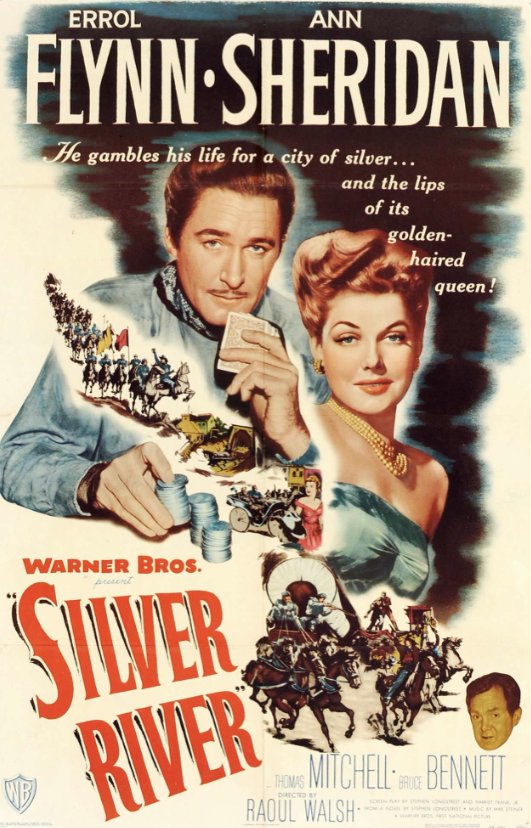
Silver River, which was directed by Raoul Walsh, premiered in Denver on May 18, 1948, and in New York City two days later.

Walsh’s last couple of pictures — Pursued (1947) and Cheyenne (1947) — were both westerns. Silver River takes place after the Civil War, and it’s set in the west, but in terms of action, it doesn’t deliver what I look for in a western. It’s more of a drama, and in fact bears more resemblance to one of Warner’s gangster dramas that it does to a typical Warner Bros. western.

Like Little Caesar (1931), The Public Enemy (1931), and Scarface (1932), Silver River is about a man who takes control of anything and everything around him, wielding his own ruthlessness as a weapon.

Like every good gangster, Michael J. McComb (Errol Flynn) has a faithful right-hand man, “Pistol” Porter (Tom D’Andrea), and he lusts after a woman he can never really attain. And just like every other movie gangster, he finds that once he’s on top, he’s lonelier and more isolated than ever.

When the film begins, McComb is a captain in the Union Army. During the Battle of Gettysburg he burns a wagon-load of payroll money so Jeb Stuart and the Confederates won’t be able get their hands on it. He does this in defiance of an order, so he is court-martialed and dishonorably discharged.

McComb learns his lesson and says, “If there’s gonna be any shoving around, next time I’ll do it.”

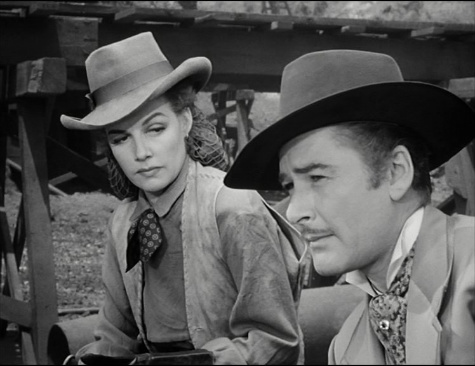
Sheridan and Flynn

So after a stint as a riverboat gambler — in which we get to see Flynn deliver a lot of smooth lines like, “…and speaking of charming ladies,” before he drops four Queens on the table to beat his opponent’s trio of Aces — he and his buddy Pistol move their operation to Silver City and open a casino. The casino rakes in cash hand over fist, which allows McComb to force his way into the Silver River Mining Company run by Stanley Moore (Bruce Bennett).

What McComb really wants, though, is Moore’s wife, the beautiful Southern belle Georgia Moore (Ann Sheridan).

McComb’s lawyer, John Plato Beck (Thomas Mitchell), drunkenly warns McComb against the path he’s headed down, and invokes the Biblical story of King David and his obsession with Bathsheba.

After a number of Warner Bros. pictures starring Errol Flynn suffered costly delays when he became too drunk by the afternoon to continue, Jack Warner was determined that Flynn be kept under control, and he made it clear that any delay in filming due to Flynn’s inebriation would be met with legal action.

I don’t know if Flynn’s controlled but uninspired performance is directly related to his forced sobriety, but throughout the film he seems as if he’s just going through the motions. He hits his marks, but that’s about it. Walsh does a good job of controlling his star and keeping everything moving, but after the pyrotechnics of the opening sequence and the breezy charm of the riverboat gambling scenes, the film settles in for a long melodramatic slog, and there just wasn’t enough action to keep me interested. Worse, when there finally is some action to end the film, it feels like a betrayal of the narrative, and isn’t true to Flynn’s character’s arc.

Fury at Furnace Creek (April 30, 1948)

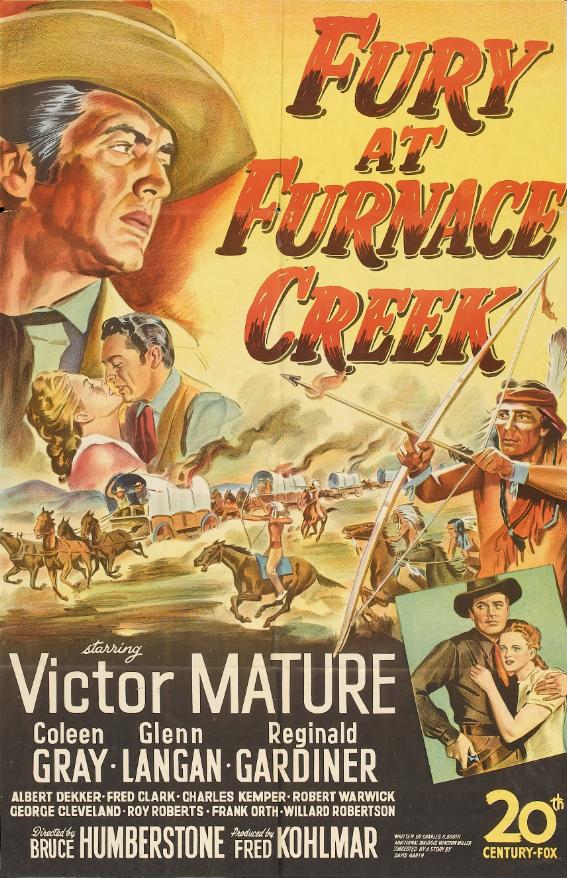
Fury at Furnace Creek might not be a towering classic of western cinema, but I think I flat-out enjoyed it more than any other western I’ve seen recently.

I’ve never been a big fan of Victor Mature, but when he had good material to work with — My Darling Clementine (1946) and Kiss of Death (1947), for instance — he could be an engaging performer. I thought it made a lot of sense for him to play Doc Holliday in My Darling Clementine as a drunk and a gambler, since Mature always looked more at home in a saloon than he did riding the range.

Fury at Furnace Creek allows Mature to stick with this formula, more or less. He plays Cash Blackwell, a fast-on-the-draw gambler who goes undercover to clear his father’s name.

His father, General Fletcher Blackwell (Robert Warwick), died of a stroke during court martial proceedings against him, and not because things we’re going well at his trial. In 1880, the Furnace Hills were still Apache territory, but rumors that the Apaches were using silver in their bullets led to a clamor for the region to be opened to mining. Gen. Blackwell stood accused of issuing an order that left a wagon train unprotected, and the prosecutor implied that this was done purposefully to draw the Apaches into an attack, which directly led to the opening of the area to white settlement.

The evidence is there, too. There is an order, signed by Gen. Blackwell, that supports the prosecution’s case. But even faced with this evidence, Gen. Blackwell still denied ever issuing the order, and he died with the shame of guilt hanging over him.

Enter Cash Blackwell, estranged from his family, but not estranged enough that he doesn’t care about his father’s good name. He goes undercover in Furnace Creek, now a boom town of 10,000 settlers, miners, and merchants. Calling himself “Tex Cameron,” Cash ingratiates himself to the local syndicate by saving the life of Capt. Grover A. Walsh (Reginald Gardiner) at the gambling tables. A gunman named Bird (Fred Clark) planted a card on Capt. Walsh so he could accuse him of cheating and shoot him dead, but Cash sees through the ploy, and puts a bullet in Bird’s gun hand.

“When a man can knock the knuckles off a moving hand at ten paces, I want him on Mr. Leverett’s side,” says Al Shanks (Roy Roberts).

Edward Leverett (Al Dekker) is the head of the Furnace Creek Mining and Development Syndicate, and it’s clear that he’s up to no good, but it’s not clear what his connection to Gen. Blackwell was.

In addition to his detective work, Cash finds time to romance the pretty Molly Baxter (Coleen Gray, who also starred with Mature in Kiss of Death). Molly’s father Bruce died in the massacre at Fort Furnace Creek, and she hates Gen. Blackwell with a passion, potentially complicating things.

And before long, Cash’s brother Capt. Rufe Blackwell (Glenn Langan) also shows up in Furnace Creek with his own plan to clear his father’s name.

Fury at Furnace Creek has a lot of moving parts, but the plot never feels crowded or confusing. Full of coincidences, sure, but not confusing. It’s genuinely suspenseful, and I wasn’t sure how things were going to resolve themselves. It’s a film that occupies the same basic physical space as John Ford’s Fort Apache (1948), but it takes a completely different approach to the western genre. There’s no self-conscious myth-making or grand statements in Fury at Furnace Creek, it’s just a solid, grown-up western with good production values. The music nicely sets the scene, with strains of the cowboy ballad “Bury Me Not on the Lone Prairie” popping up frequently in the score.

The director of Fury at Furnace Creek, Bruce Humberstone (sometimes credited as “H. Bruce Humberstone”), began his career in the silent era and ended up working in just about every genre Hollywood deigned to dip its toe in; musicals, film noir, westerns, war pictures, Charlie Chan mysteries, Tarzan adventures, sports comedies … the list goes on and on. Fury at Furnace Creek is not a great work of art, but it’s made with real flair and craftsmanship. It’s exciting, action-packed, and suspenseful. I enjoyed it a hell of a lot and recommend it to anyone who likes westerns from the Golden Era of Hollywood.

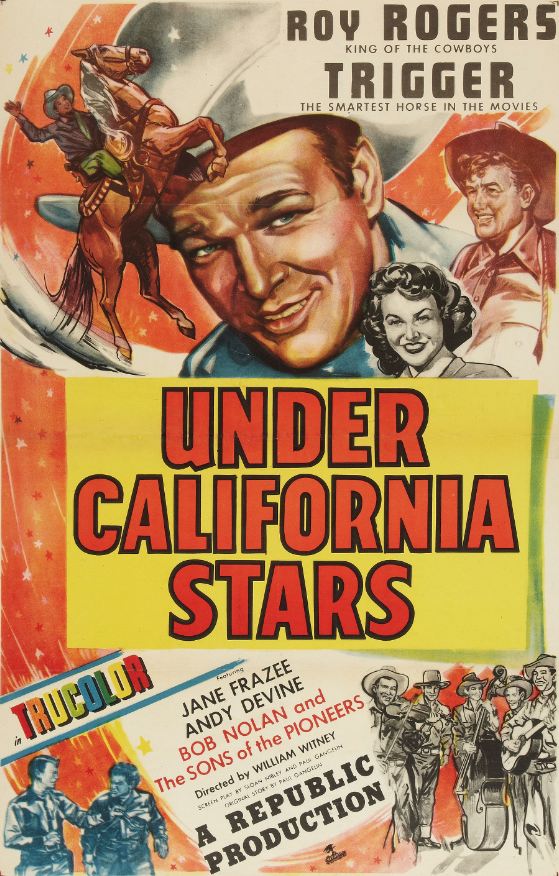
Under California Stars (April 30, 1948)

Under California Stars is one of those “Trigger in peril” pictures in which Roy Rogers’s faithful palomino Trigger, “the smartest horse in movies,” faces terrible danger, and only his best friend Roy Rogers can make things right … with plenty of help from Trigger himself, of course. (Another “Trigger in peril” film, The Golden Stallion, was the subject of a NY Times piece in which Quentin Tarantino waxed rhapsodic about the film’s director. It’s a great article, and you can read it by clicking on this sentence.)

Like most Roy Rogers movies made in the post-war ’40s, Under California Stars was directed by William Witney, a veteran B-movie director born in 1915 who had nearly 40 westerns and serials under his belt by 1948.

Witney was a brilliant director of action. He was reportedly inspired by watching Busby Berkeley direct big musical numbers in which different takes were designed to be cut together for a coherent whole.

Before Witney’s innovative work on action serials, most directors would just train the camera on the stuntmen and let them do their thing, but Witney took a more active role, arranging action set pieces that incorporated elegant camera movements and effective cutting between actors and their stuntmen doubles.

The serials he directed for Republic Pictures were done on a tight budget and an even tighter timeline, so Witney often directed the action segments while his frequent collaborator John English handled the dialogue scenes. (Witney and English directed Adventures of Captain Marvel [1941], which I consider the greatest serial ever made.) Witney’s film work is a far cry from today’s hyperactive, chopped-to-hell action movies, but in many ways he is the father of the modern action movie.

Under California Stars isn’t wall-to-wall action, but the fight scenes are well-done, and like most Witney joints, it’s a classic example of good B filmmaking.

Like most Roy Rogers movies from the ’40s, Under California Stars blurs the line between Roy’s on-screen persona and his real life. He plays a character named “Roy Rogers,” who, when the film begins, is being told by his director, “Roy, you can be mighty proud of your ten years in pictures.” (Roy’s first starring role was in the film Under Western Stars, which was released on April 20, 1938.)

The action quickly shifts from Hollywood to the Double R Ranch, where Trigger and Roy are met by foreman Cookie Bullfincher (Andy Devine), as well as Bob Nolan and the Sons of the Pioneers, who sing a hymn to Roy’s good-natured greatness. Roy is also presented with a 10-year anniversary cake and does a radio broadcast from the Double R in which he sings “Dust,” one of the songs that made him famous.

But not everyone is thrilled to pieces about Roy Rogers and his marvelous horse. Lige McFarland (Wade Crosby) and his henchman Ed (House Peters Jr.) resent the handsome do-gooder and hatch a scheme to kidnap Trigger and ransom him for $100,000 … or else.

Under California Stars is a brisk, well-made Saturday matinee western with good songs and hard-hitting action. The whole film is currently uploaded to YouTube, and you can watch it by clicking on the link below. It’s also currently available to download from archive.org.

http://www.youtube.com/watch?v=pKyQfgvaZhE

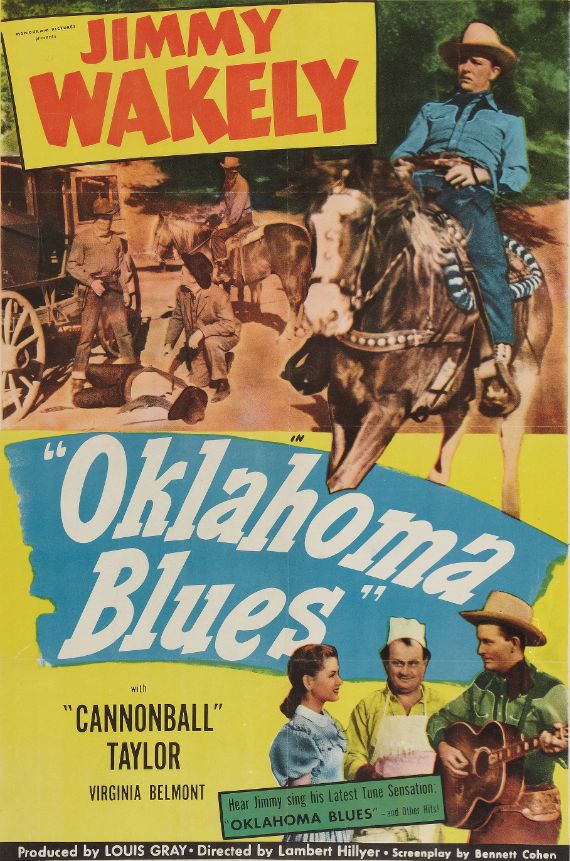
Oklahoma Blues (March 28, 1948)

Oklahoma Blues
Oklahoma Blues (1948)
Directed by Lambert Hillyer
Monogram Pictures

By 1948, the singing cowboy genre was starting to get a little long in the tooth. Television would soon provide a home for a few popular crooning cowboys like Roy Rogers and Gene Autry — as well as countless reruns of B westerns from the ’30s and ’40s — and at this point, a Poverty Row western like Oklahoma Blues feels more clichéd and predictable than ever.

In this 56-minute programmer, directed for Monogram Pictures by dependable workhorse Lambert Hillyer, Jimmy Wakely plays a singing cowboy named “Jimmy Wakely” who ends up posing as an outlaw called “the Melody Kid” after his big-mouthed friend Cannonball Taylor spreads tall tales. (Cannonball Taylor, incidentally, is played by Dub “Cannonball” Taylor.)

Like most singing cowboy flicks, the plot of Oklahoma Blues is nothing you haven’t seen before, and is mostly a framework for a little comedy, a few fistfights, some shootouts, and — most importantly — a bunch of songs sung by Jimmy Wakely.

Oklahoma Blues mostly takes place in a little town called Rainbow’s End. The town fathers are pushing State Commissioner Walton (J.C. Lytton) to make Rainbow’s End the county seat, but there’s stiff competition from Yuba Junction. Their chances look especially grim after a series of holdups perpetrated by the Drago brothers, Matt (Zon Murray) and Slip (George J. Lewis). Commissioner Walton vows not to make Rainbow’s End the county seat unless someone can roust the outlaws and clean the place up, so Sheriff Sam Oldring (Steve Clark), undertaker Beasley (I. Stanford Jolley), and Judge Emerson (Frank LaRue) hire Jimmy Wakely, whom they think is the singing killer called the Melody Kid.

Wakely takes a shine to local restaurant proprietor Judy Joyce (Virginia Belmont), but she bristles at the reputation of the Melody Kid and vows to leave town and close her restaurant if Wakely is hired in an official capacity. Naturally he makes it a condition of his being hired as sheriff that she stay and keep cooking for him.

If you’re a fan of B westerns, this picture delivers exactly what you expect and not much more. As funny sidekicks go, Cannonball Taylor isn’t very funny, and Judy Joyce is a pretty terrible actress, but Oklahoma Blues delivers where it counts — the music. The film features “Oklahoma Blues,” by Jimmy Wakely, “Judy,” by Tiny Stokes, and “On the Strings of My Lonesome Guitar,” by Smiley Burnett and Jimmy Wakely, as well as snippets of other country & western tunes, all sung by Jimmy Wakely.

Incidentally, I recently bought the Monogram Cowboy Collection Volume 1 DVD set, so I’ll be reviewing more of these pictures as they come up in the rotation.

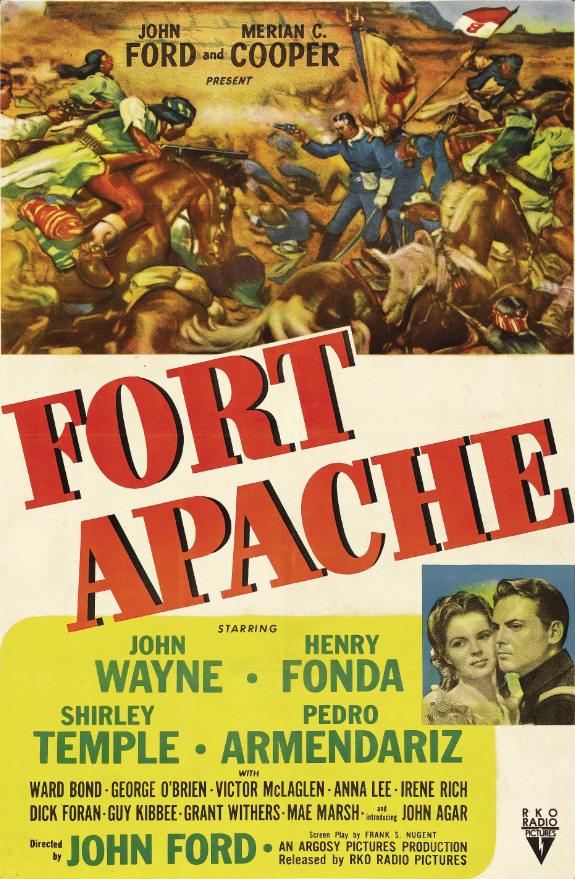
Fort Apache (March 9, 1948)

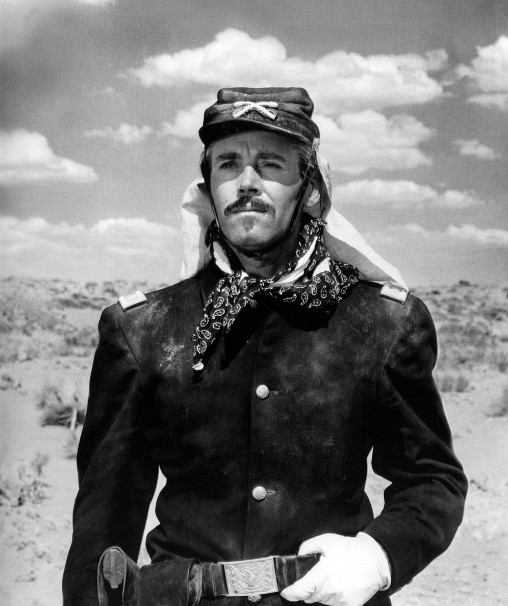
Understand me, gentleman. I am not a martinet, but I do want to take pride in my command. We here have little chance for glory or advancement. While some of our brother officers are leading their well-publicized campaigns against the great Indian nations — the Sioux and the Cheyenne — we are asked to ward off the gnat stings and flea bites of a few cowardly digger Indians.

This irony-laden speech by Lieutenant Colonel Owen Thursday (Henry Fonda) occurs early in the second reel of John Ford’s Fort Apache. It foreshadows the tragic and violent finale of the film, and firmly establishes what kind of man Thursday is. Not only is he the dictionary definition of a martinet, but his underestimation of the Apache will be fatal.

When Captain Kirby York (John Wayne) protests that Cochise and his Apache warriors are far from “digger Indians,” Thursday refuses to listen, and the conflict between Capt. York and Lt. Col. Thursday only intensifies as the film goes on. When York, who is familiar with the customs of the Apaches, arranges a meeting with Cochise (played by Miguel Inclán), Thursday refuses to honor the agreement Kirby makes with Cochise. “There is no question of honor, sir, between an American officer and Cochise,” Thursday says. Kirby simply responds, “There is to me, sir.”

In a lesser film, Thursday’s rigid adherence to discipline would mask cowardice, but Thursday isn’t a coward. He isn’t vainglorious either. When York, who remembers Thursday as a general from Civil War, addresses him as “general,” Thursday curtly corrects him. “I’m not a general, Captain,” he says. “A man is what he’s paid for. I’m paid in the rank of Lieutenant Colonel.”

Fonda’s performance in Fort Apache is remarkable. His character is so clearly in the wrong so much of the time that it would be easy for him to be a stock villain, but he never is.

Fort Apache is a study in heroism and myth-making, and a story of how the messiness of real life will always end up either forgotten or completely remade.

Of course, since it’s a film directed by John Ford, it’s also a film full of broad comedy, mawkish Irish sentimentalism, and lionizations of the common man.

And no matter how much Ford ever deconstructed the idea of heroism and myth-making in any of his films, he couldn’t resist engaging in his own larger-than-life artistry. Just like My Darling Clementine (1946), Ford shot Fort Apache in Monument Valley because it looked good, not because it was where the real events of his story took place.

Fort Apache isn’t a perfect film, but it’s damned close. It’s an excellent western, and a great film about the U.S. Cavalry that doesn’t paint the Apache as mindless savages. There are references to men tied to wagon wheels, roasted alive (off screen, of course), but Cochise and his warriors are never two-dimensional villains.

Fonda and Wayne are the stars of the film, but they have excellent support from the rest of the cast, especially Ward Bond, who plays Sergeant Major Michael O’Rourke, and Pedro Armendáriz, who plays Sergeant Beaufort.

If there’s a weak link for me in the film, it’s John Agar, who plays Second Lieutenant Michael Shannon O’Rourke. When Agar appeared in Fort Apache he was the real-life husband of Shirley Temple, who plays Lt. Col. Thursday’s daughter, Philadelphia Thursday. (Agar and Temple married on September 19, 1945, and were divorced on December 5, 1949. They had one child together.)

In terms of action, Fort Apache is stately and fetishistic. There are no real skirmishes that lead up to the final battle — as there would be in any picture made today — there is only the aftermath of Apache raiding parties.

And in the charge that begins the final battle, the bugler is the first to be killed by Cochise and his men, putting an end to the stirring patriotic music, which is perfectly fitting. The final battle is accompanied only by Apache war whoops, gunshots, and the thunder of hoof beats.

http://www.youtube.com/watch?v=jQFpLdiOf6Y