Tag Archives: Westerns

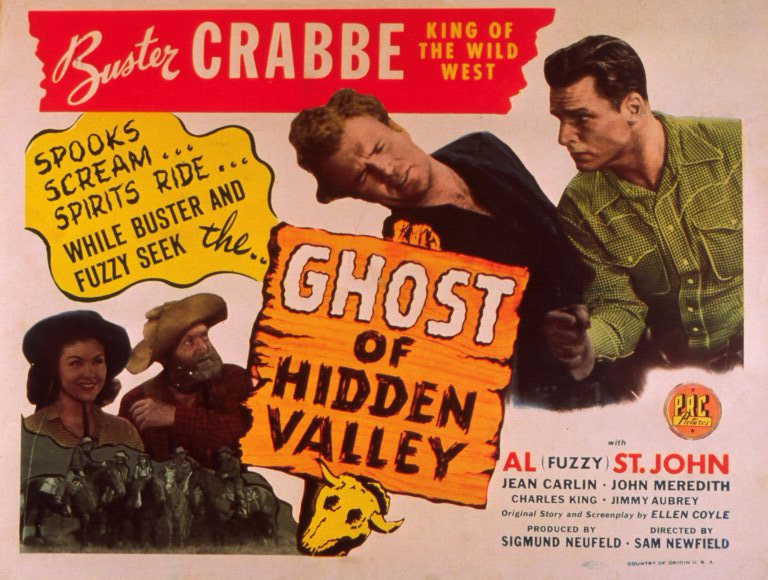
Ghost of Hidden Valley (June 5, 1946)

When it comes to Poverty Row westerns, there’s a fine line between watchable and unwatchable.

I didn’t dislike Ghost of Hidden Valley, and even enjoyed a lot of it. I can’t say whether that’s because it’s a slight cut above other Poverty Row westerns distributed by P.R.C. (Producers Releasing Corporation) that I’ve seen lately, or because my expectations were ground down to a nub by the three other movies directed by Sam Newfield that I’ve watched in the past year.

One of the most prolific directors of all time, Newfield directed more than 250 movies in a career that spanned almost 40 years. Martin Scorsese once said, “Newfield is hard, that’s a hard one, you can’t do too much of that.” This from a man well known for his insatiable appetite for films of all kinds.

Ghost of Hidden Valley begins with some stock footage of an enormous herd of cattle. In the next scene, Ed “Blackie” Dawson (Charles King), the leader of a group of cattle rustlers, shoots an interloper so he won’t tell any tales to the law. “Well, that takes care of that,” Dawson’s henchman says. “The ghost of hidden valley will get all the blame.”

I’m a fan of economical storytelling, even when it’s outlandish.

There is no ghost, of course, and we won’t see any more cattle, either. There will be some weak-sauce comedy in which the grizzled and toothless Fuzzy Q. Jones (Al “Fuzzy” St. John) will mistake the calls of a hoot owl for the spectral cries of a wandering spirit, but that’s it.

After Dawson and his rustlers commit murder, we see cowboy Billy Carson (Buster Crabbe) and his friend Fuzzy at the post office in Canyon City, Arizona. Fuzzy has received a letter from someone named Cecil Trenton. (It comes addressed to “Fuzzy Jones, Esq.”) Cecil’s late brother, Sir Dudley Trenton, spoke well of Fuzzy, as well as his sojourn in America generally. “It was his wish that his son Henry, a young gentleman just out of Oxford, should experience a bit of the rugged life and devote some attention to the property Sir Dudley purchased in your vicinity,” Cecil writes.

“What is this Oxford he just got out of, a penitentiary?” asks Fuzzy.

“No,” Billy responds. “Some sort of a school.”

Henry Trenton (John Meredith) is exactly what you might expect. A fey, snooty-accented tenderfoot wearing a checked shirt, vest, ten-gallon hat, and ridiculous sheepskin chaps. “I always make it a point to dress correctly,” he says. He even has an aristocratic butler in tow named Tweedle (Jimmy Aubrey).

Billy sees the potential of Hidden Valley Ranch, if only someone could knuckle down and work it properly. Will Henry Trenton be that man?

Ghost of Hidden Valley is a typical P.R.C. western, with plenty of shootouts, chases on horseback, and furniture-destroying fistfights to fill out its 56-minute running time, but at least it’s briskly paced. Also, the female lead (Jean Carlin) is pretty, unlike the last Crabbe P.R.C. western I saw, and the script by Ellen Coyle is breezy and relatively entertaining.

There’s still Newfield’s trademark sloppiness and inattention to detail for the viewer to contend with. For instance, there’s one scene in which Crabbe’s skinny stunt double, his loose shirt hanging out of his pants, takes a punch, there’s a cut, and the next shot is of the real Crabbe, his chunky torso unmistakable, and his shirt tightly tucked into his jeans.

Crabbe was my main problem with this film. No longer the dashing young actor he was when he played Flash Gordon in the ’30s, Crabbe phones in his performance, has trouble mounting his horse in at least one scene, and generally looks as if he’d rather be somewhere else.
Sun Valley Cyclone (May 10, 1946)

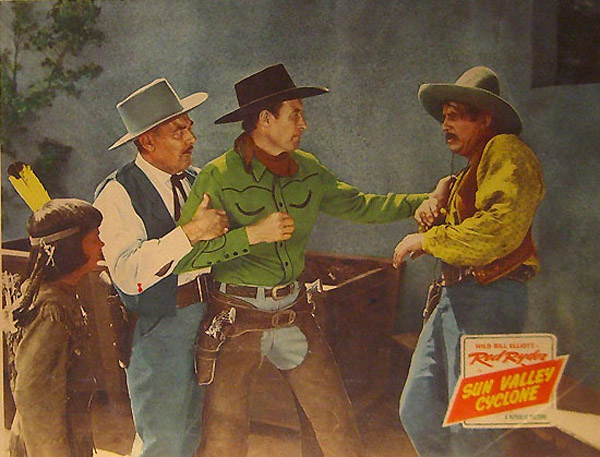
Sun Valley Cyclone, another entry in the Red Ryder film series directed by the dependable R.G. Springsteen, tells the story of how Ryder got his horse, Thunder. These kinds of stories are classic; how Sgt. Preston of the Yukon got his dog King, how the Lone Ranger got Silver, and so on. I don’t know if there was ever a film that told the story of how Roy Rogers got his horse Trigger, but if there wasn’t, then Republic Pictures really dropped the ball.

When Sun Valley Cyclone begins, Ryder (Bill Elliott) is tracking a man who last went by the name of “Blake” in Wyoming, but has probably changed his name several times to evade the law. Ryder is accompanied, as always, by his pint-sized Indian sidekick, Little Beaver (Robert “Bobby” Blake). While discussing the issue with the sheriff of a sleepy Arizona town, Blackie Blake (Roy Barcroft) draws a bead on Ryder from his hiding place. Just in the nick of time, however, the black stallion Thunder rushes to Ryder’s aid, trampling Blake. Blake is basically uninjured, but the townspeople see only a killer horse that must be put down. Ryder intervenes, and says that Thunder must first receive a fair trial.

In the best Saturday matinee tradition, this trial comes in the form of a flashback that takes up most of the running time of the picture, and which tells the story of how Ryder and Thunder came to be acquainted.

When Theodore Roosevelt (played by Ed Cassidy) was putting together his Rough Riders, Ryder headed straight for the recruitment office. In the corral, he saw a black stallion. The horse breaker told Ryder, “He’s got a mean streak in him so deep and wide that nobody’s ever going to be able to ride him. He’s black as a thunder cloud, and as violent as lightning.” Ryder responded, “Well I’ve seen a lot of horses, but not any one of them as ornery as you claim that stallion is. Fact is, horses are like most people. You get to understand them, and they understand you, you get along somehow.”

Colonel Roosevelt arrives just as Ryder is being flung back and forth atop Thunder, but managing to stay in the saddle. Roosevelt admires the man’s bronc-busting ability, and says he’s only known one man in all his years who could break a horse like that. It turns out that Ryder and Roosevelt are old friends (who knew?), and the colonel decides that Ryder’s talents would be better served fighting range outlaws in Wyoming than waging war with the Rough Riders.

I really enjoy the Red Ryder series. Bill Elliott’s moniker of “Wild Bill Elliott” might have helped establish his western bona fides on movie posters, but he’s about the least wild actor I’ve ever seen. In fact, he’s so stolid that after watching him in several films, I can’t help but feel there’s a joke, and that he’s in on it.

For instance, after a long sequence in which the bad guys try to break Thunder, whip him viciously, and then watch him escape with the fancy new saddle belonging to black hat Dow (Kenne Duncan), the scene cuts back to the present, and Elliott, his arms crossed, says, “Of course, some of the things I’m telling you I got second hand. And a considerable time later.” And then it’s back to the flashback. His delivery is perfect, and it’s a funny line. Was it meant to be? It’s hard to say, but I couldn’t help feeling that if Elliott hadn’t died in 1965, he might have found work in Airplane!-style comedies with other deadpan funnymen like Leslie Nielsen, Lloyd Bridges, and Robert Stack.

Sun Valley Cyclone is an enjoyable picture, and not just because of Elliott’s impossibly straight-shooting persona. There’s also a delightful equine love triangle between Thunder, a white mare, and a paint stallion. Their story is told through body language, which means there are plenty of lips curled back from teeth on the part of the guys, and some come-hither hoof pawing on the part of the lady.

Thunder Town (April 12, 1946)

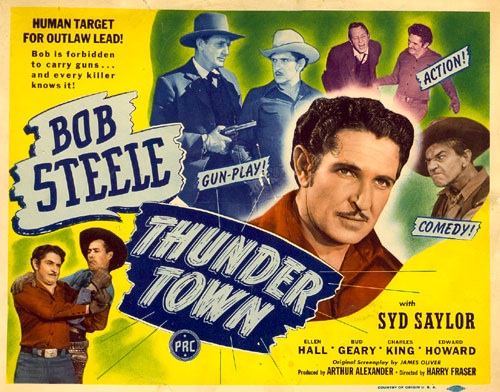
Diminutive cowboy actor Bob Steele rides again! In Harry L. Fraser’s Thunder Town, Steele plays Jim Brandon, a man recently paroled after serving time for a crime he claims he didn’t commit. Things aren’t easy for a parolee out there. As soon as Brandon gets off the stagecoach, he warmly greets the fellow loading it, but the man refuses to shake his hand. Then, while getting some drinking water, the sinister Dunc Rankin (Edward Howard) warns Brandon to stay away from him and his brother.

Brandon has a few friends on the outside, however. Matt Warner (Steve Clark), the local sheriff, recommended his parole, even though he doesn’t believe Brandon’s claim that he and his late partner Jim Donovan were framed. Brandon also claims Donovan’s suicide was really murder, and with the help of small-town ballistics expert Peter Collins (Jimmy Aubrey), he intends to prove it.

He also has a steadfast pal in Utah McGirk (Syd Saylor), who took care of Brandon’s ranch while he was behind bars. McGirk is hanging on to the ranch by his eyeteeth, and even had to take a job as a cook to make ends meet and keep paying taxes on the ranch.

The sheriff firmly reminds Brandon that, as a parolee, he won’t be allowed to carry a firearm. Brandon’s inability to carry a gun means that fisticuffs rule the day. This could have been interesting, but unfortunately he’s too obviously doubled by a stunt homunculus in some of his fight scenes. Also, he doesn’t do anything clever or flashy against his armed opponents, like throwing a knife into their hands or lassoing their guns. Mostly he just flees from them on horseback.

The main heavy in the picture is the aforementioned brother of Dunc Rankin, Bill Rankin (Charles King). Unsurprisingly for a P.R.C. western from the ’40s, the bad guy wants everyone else’s land, and will stop at nothing to get it. He even kidnaps Brandon and threatens to kill him in a bid to force a young woman named Betty Morgan (Ellen Hall) to marry Dunc so they can gain possession of the Morgan ranch. On the plus side, Hall is really easy on the eyes (too often, P.R.C. pictures featured some real dogs as the female leads), but if there was a scene that established her relationship with Brandon, I missed it. Also, the 23-year-old actress looks too young for Steele, who looks older than his 39 years. Strangest of all, the only love scene they share occurs in the last 30 seconds of the picture, and ends with a whispered proposal of marriage.

While Steele continued to appear in films and on television into the early ’70s, in parts both large and small, Thunder Town was his last leading role. He had a good run, though. He was a star of the silent era, and appeared in more than a hundred westerns.

For my money, Thunder Town is the type of western that should have died years earlier. The editing is jumpy, the framing is static, and every scene is lit like a bar after last call, when they turn all the lights on, temporarily blinding the patrons. The actors all deliver their lines in a stilted, cautious fashion, as though their pay will be docked if they flub a line. Steve Clark, who plays the sheriff, is the only supporting player who imbues his lines with any kind of human feeling, and his few scenes with Steele are the only ones that seem as if they belong in a decent movie. Overall, though, the acting is better than the last Steele P.R.C. western I saw, Ambush Trail. Blessedly, Syd Saylor acts like a normal person in this one, instead of the goggle-eyed, rubber-faced mugging machine he was in Ambush Trail. Except, that is, when he’s punched in the face. Then all bets are off. He’s still in this film to provide comic relief, after all.

There are also a few musical numbers shoehorned into the picture that aren’t bad, if you like old-school country music that occasionally involves yodeling.

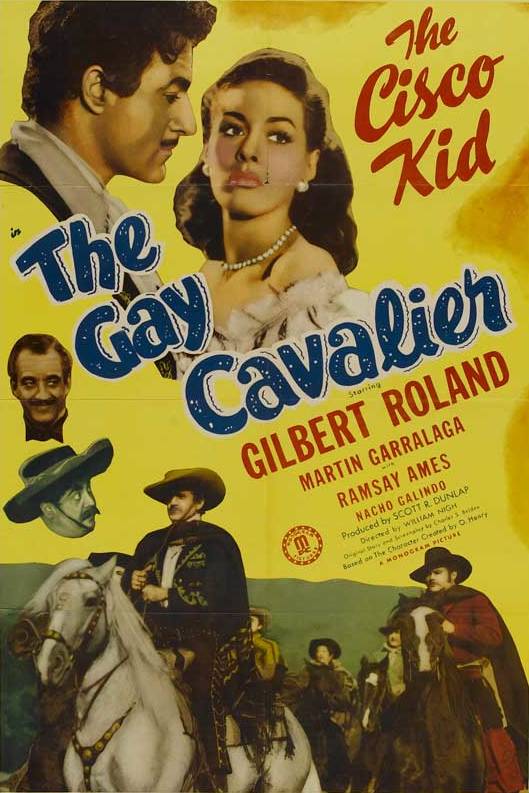
The Gay Cavalier (March 30, 1946)

With this film, handsome 40-year-old actor Gilbert Roland stepped into the role of the Cisco Kid, a Mexican bandit created by O. Henry in his 1907 short story “The Caballero’s Way.” Roland was the fifth man to play the role, after Warner Baxter (in four films, 1928-1939), Cesar Romero (in five films, 1939-1941), Duncan Renaldo (in three films made in 1945), and William R. Dunn, who was the first man to play the Cisco Kid, in the silent short The Caballero’s Way (1914). Roland would go on to play the Cisco Kid in a total of six films released by Monogram Pictures in 1946 and 1947.

In O. Henry’s short story, the Cisco Kid was a vicious and slippery bandit, but by the time Warner Baxter was playing the role, the character had metamorphosed into a noble caballero; a sort of Mexican Robin Hood.

Baby boomers will remember that on TV, the Cisco Kid had a sidekick named Pancho. The first iteration of this character appeared in the 1939 film Return of the Cisco Kid, and he was named “Gordito” (Spanish for “Fatty”). In The Gay Cavalier he’s called “Baby,” and is played by the Mexican actor Nacho Galindo.

Baby gets the first lines of the picture. While Cisco kneels beside a grave, Baby explains to one of his fellow outlaws (presumably one who has just joined the gang and, like the audience, has no idea what’s going on) that Cisco’s father was a notorious bandit. To make up for his father’s exploits, Cisco now robs from the rich and gives to the poor. It’s a clumsy bit of exposition, but no clumsier than most of the rest of the dialogue in the picture. When Baby decides that they’ve spent enough time at the gravesite and he wants to get going, Cisco tells him, “Time is a wonderful thing. It ages wine and mellows women.” Roland is the main reason to see the picture, especially for women who get all hot and bothered for the Latin Lover type. He can really sell lines like this, and not sound too ridiculous.

What Roland is mostly selling, of course, is S-E-X. But not so much that it might offend audiences, or disrupt traditional morality too much. In one scene, Cisco climbs up onto a lovely young señora’s balcony while Baby plays a little music down below. Eventually she reveals that she has a husband who is away on a fishing trip. Cisco responds, “Sometime, when I see your husband, I will tell him the fishing is much better here on land. Adios, beautiful.” He kisses her hand, leaps from the balcony onto his horse, and rides off with his crew and Baby, whose serenade is no longer required.

The Gay Cavalier takes place in California in 1850. The nice thing about old Hollywood westerns that take place in California is that the scenery is authentic, if nothing else. Martin Garralaga, the actor who played “Pancho” in the three 1945 Cisco Kid films with Duncan Renaldo, here plays Don Felipe Geralda, a man who has fallen on hard times. His youngest daughter, Angela (Helen Gerald), is engaged to marry a wealthy American named Lawton (Tristram Coffin), whose money will allow the Geralda hacienda to stay in the family.

Unbeknownst to the Geraldas, Lawton and his partner Lewis (John Merton) are up to no good. In the beginning of the picture, they ambush a wagon carrying a shipment of silver collected from poor people to build a mission in Monterey. They leave one man wounded but alive, and say loudly within earshot of the man, “All right, Cisco, we got what we want. Now we go.”

All of this plays out about as predictably as you’d expect. The enjoyment comes from the particulars. The sultry and beautiful actress Ramsay Ames plays Don Geralda’s eldest daughter, Pepita, and she sings a few numbers that Ames herself is credited with writing. Also, the action is well staged, especially the final showdown between Cisco and Lawton. As he demonstrated in a film I watched last year, Captain Kidd (1945), Roland is a hell of a sword fighter. He and Coffin go at it with no stunt doubles in evidence, although the film is sped up very slightly.

Also, unlike most of the actors who played the Cisco Kidd, Roland was actually Mexican. He was born “Luis Antonio Dámaso de Alonso” in Juarez, Chihuahua, Mexico, in 1905. He took his stage name from his two favorite actors, John Gilbert and Ruth Roland. He’s a very credible swashbuckler, and a lot of fun to watch, even though The Gay Cavalier is strictly a programmer.

One odd note, the DVD from VCI Entertainment I watched uses a print with a strange ADR issue. It didn’t take long before I noticed that every time someone said “Cisco Kid” it was looped in, and not well. I did some research, but couldn’t find exactly why this was the case. This was originally released as a Cisco Kid feature, and there would have been no restriction on using the name, so the prevailing theory seems to be that the film was dubbed for television release in the ’50s, and the character’s name was changed so as not to cause confusion with the Cisco Kid TV show, and one of those prints was the only one they could find, so they dubbed the original character’s name back in. Whatever the reason, it was weird and distracting.

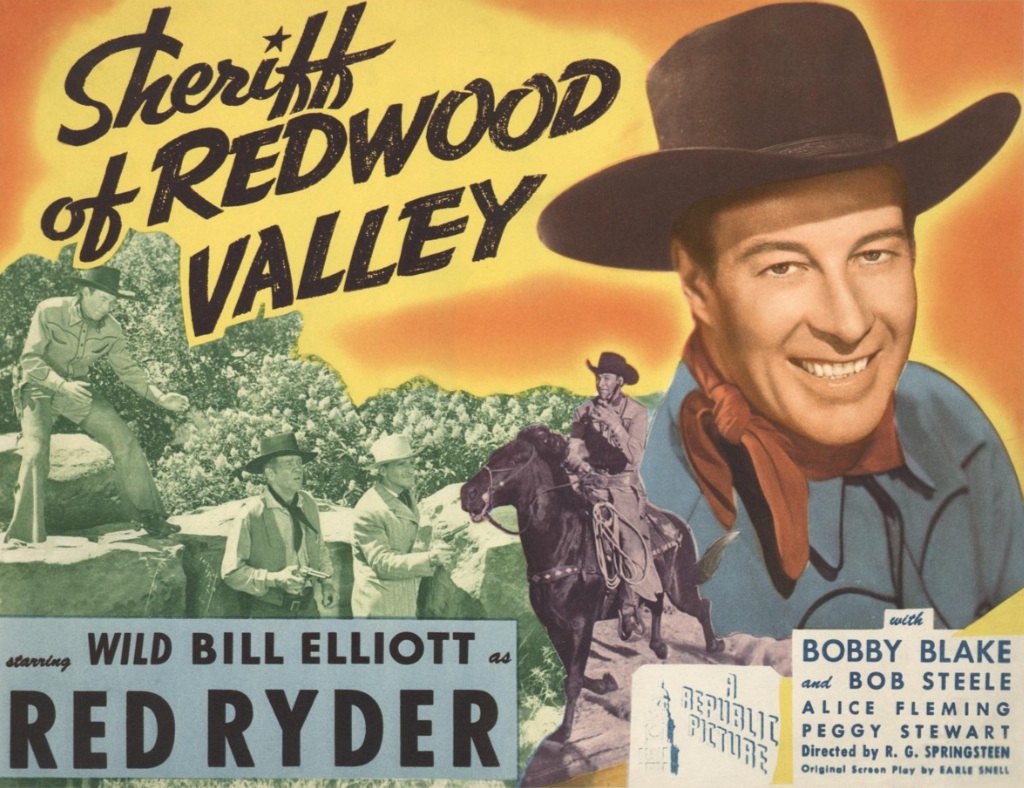
Sheriff of Redwood Valley (March 29, 1946)

I really like the Red Ryder movies with “Wild” Bill Elliott and Bobby Blake. Sheriff of Redwood Valley is the third one I’ve seen, and watching it after a couple of really bad P.R.C. westerns drove home an opinion I’ve long held; a low budget is no excuse for a bad movie.

I have no idea what the budget was for Sheriff of Redwood Valley, or how it compared with the budgets for contemporaneous P.R.C. (Producers Releasing Corporation) westerns starring actors like Buster Crabbe, Bob Steele, and Eddie Dean. Sheriff of Redwood Valley was released by Republic Pictures, which was a more prestigious outfit than the Poverty Row studio P.R.C., so it’s likely the budget was higher, but it’s still clearly a low-budget programmer.

But Republic specialized in low-budget programmers and weekly chapterplays, and made some of the best ones in the history of Hollywood. Most of their stars weren’t great actors, but they were likable and fun to watch. Most of their scripts weren’t brilliantly written, but they were nicely paced and had enough twists and turns to keep you watching. And, like all low-budget productions, they cut corners and used stock footage, but they used it judiciously. Most importantly, their movies had a sense of fun and excitement, and were tailor-made for Saturday matinée viewing down at the local bijou.

It didn’t hurt that Republic employed directors who could put together a watchable movie, like William Witney and John English. The sheer number of pictures directed by Sam Newfield for P.R.C. should tell you something about the studio. (The name “Sam Newfield” isn’t as well-known among connoisseurs of bad movies as “Ed Wood,” but it probably should be.)

All of this is not to say that Republic Pictures never released a bad movie; they released plenty. And P.R.C. distributed a few very good films (including Edgar G. Ulmer’s Detour, for my money the best film of 1945, and one of the best film noirs of all time). But most Republic films are object lessons in how to make a very entertaining movie in spite of a small budget, actors who aren’t that talented, and a limited shooting schedule.

R.G. Springsteen’s Sheriff of Redwood Valley takes place in 1895. The first shot is of San Quentin at night. A shadowy figure runs along the ramparts and jumps down to safety. We learn from a newspaper headline in the next shot that this man was the notorious stagecoach robber the Reno Kid.

The scene shifts to the Redwood Valley, where the big question on everyone’s mind is whether or not the railroad is going to come through their town. If it does, it will be an economic boon. If it doesn’t, their town just might wither up and die. Red Ryder (Bill Elliott) is presiding over a meeting with town leader Bidwell (James Craven), the sheriff (Tom London), and Red Ryder’s aunt and ranch owner the Duchess (Alice Fleming). The townsfolk have raised the $50,000 necessary to dynamite a tunnel through their mountain and bring the railroad to them, so naturally the best way to deliver it to the right people is to hide it in a cowboy boot and get Red Ryder and the sheriff to transport it in a buckboard.

As you might guess, things go wrong. Red and the sheriff are ambushed, both are badly wounded, and the money is stolen. Circumstantial evidence points to the Reno Kid, but Bidwell and his henchman are actually behind the robbery.

It turns out that the Reno Kid (played by the diminutive cowboy actor Bob Steele, last seen in the P.R.C. cheapie Ambush Trail) isn’t such a bad guy after all. He broke out of prison to see his pretty wife Molly (Peggy Stewart) and their sick child Johnny (John Wayne Wright), and to clear his name.

Red Ryder and the Reno Kid’s paths cross after the robbery, when Red’s adorable, pidgin-English-speaking Indian sidekick Little Beaver (Bobby Blake) trusses the injured Red to his horse Thunder and leads him to Molly’s cabin to recover from his wounds. It doesn’t take long for Red to suss out who Reno really is, but he plays it cool in order to apprehend him with a minimum of bloodshed. Eventually, of course, Red realizes that Reno isn’t the villain he’s reputed to be, but it took a lot longer than I was expecting, which added a good amount of suspense to the story.

The Red Ryder series is clearly aimed at kids. Each film begins with an enormous storybook slowly opening, followed by Elliott and Blake stepping out of its pages, Elliott’s guns blazing. (Red Ryder was a long-running character in the Sunday funnies, so it might have made more sense if they’d stepped out of a newspaper, but what the heck? It works.) Also, little Bobby (later Robert) Blake was a veteran of the Our Gang comedy series, and he’s really cute, although to fully enjoy the Red Ryder movies you have to be O.K. with the ridiculous stereotype that Little Beaver is, as well as put out of your mind for a little while the details of Blake’s tragic and violent personal life.

Elliott is fairly stiff as an actor, but I think he’s great in this role, mostly because he acts like someone who’s stiff and plainspoken in real life, not like someone who’s acting that way because he’s a bad actor. His playful relationship with Blake is especially enjoyable to watch. (There’s a running gag in Sheriff of Redwood Valley about Red getting Little Beaver to take medicine and eat food Red finds distasteful.) While the intended audience was kids, I think the Red Ryder series stands up as great B western entertainment for anyone.

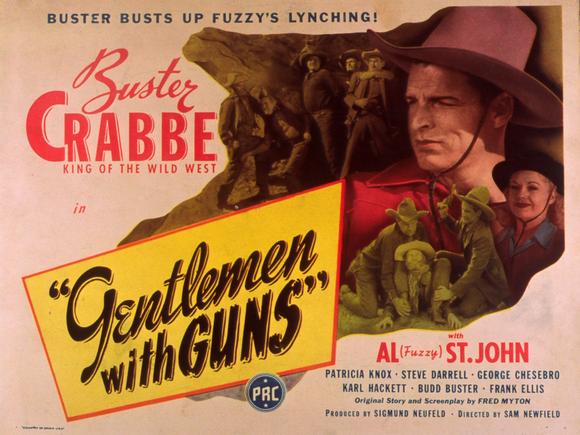
Gentlemen With Guns (March 27, 1946)

Another week, another bargain-basement western from P.R.C. (Producers Releasing Corporation).

Chances are, if you were starring in westerns for P.R.C. in the ’40s, you were either a has-been or a never-was. I guess Buster Crabbe falls into the first category. The last time I remember seeing Crabbe, he was cutting a dashing figure as Flash Gordon in the Universal Pictures serial from 1936. Here, 10 years later, his face haven’t developed any character, and his acting certainly hasn’t improved. He’s just older and a little bit fatter.

In Gentlemen With Guns, which should get an award for “most generic title for a western,” he’s listed in the opening credits as “Buster Crabbe, King of the Wild West,” but just saying it doesn’t make it so. While he’s not the worst cowboy I’ve ever seen, Crabbe doesn’t exhibit any of the qualities I think of when I think of a western star, except earnestness. He earnestly seems to wish he were starring in a better movie.

Alas, only a fool would have cast him in one. While neither unattractive nor truly overweight, by 1946 Crabbe was just far enough over the hill to bear an eerie resemblance to the comedian Bob Odenkirk, of Mr. Show. While there’s nothing wrong with looking like Odenkirk, he’d never be anyone’s first choice to play a cowboy.

The plot of Gentlemen With Guns, such as it is, involves a bunch of black hats attempting to pin a murder on Fuzzy Q. Jones, who is played by Al “Fuzzy” St. John. Fuzzy is the type of bearded, toothless old coot who will be familiar to anyone who’s seen a few western programmers from the ’30s or ’40s. (“Gabby” Hayes made a whole career out of playing this type of character.) The frame-up is fairly ingenious. A man is shot while Fuzzy is talking to him, then the evil sheriff (Budd Buster) moseys on over, his gun drawn, and inspects Fuzzy’s revolver. He switches them and produces a weapon with a single round fired; the round that killed the man. At this point the audience is clued in to the fact that the sheriff is the one who actually did the killing. But wait, it turns out that the supposedly dead gentleman was just playing possum, and he spends the rest of the movie hiding out so Fuzzy can be lynched nice and legal-like. Meanwhile, it’s up to Fuzzy’s friend Billy Carson (Crabbe) to fight the bad guys and eventually discover the ruse.

If the bad guys are so ruthless, however, I’m not sure why they didn’t just murder someone they had it in for and pin it on Fuzzy. But I guess without a faked death there wouldn’t be a movie.

Along with all the fistfights and shootouts, there’s a light-hearted subplot about a mail-order bride named Matilda Boggs (Patricia Knox) who arrives in town thinking that Fuzzy is a young, strapping man who owns a huge ranch. In fact, as soon as she sees Billy, she exclaims, “Fuzzy! Oh, you great, big, wonderful man,” and throws her arms around him.

Gentlemen With Guns was certainly better than Romance of the West, the last P.R.C. western I saw. Unlike Romance of the West, the acting isn’t godawful, and the production values are a little better, even though it’s filmed in regular old black & white, not Cinecolor.

It’s still not anywhere close to being an A-list production. At times, it seems as if the actors are struggling to make their lines heard over the blaring, canned music on the soundtrack. Since the music in a movie is usually added last, however, that can’t possibly be the case, can it? It must just be that their lines are terrible and their delivery is wooden, right?

Maybe I’m being too hard on Crabbe. He can ride a horse without falling off, fire a revolver without dropping it, sit a hat atop his head, and vault over a three foot-high fence and then mount his horse in just two attempts. But as far as former champion swimmers turned western actors go, he’s no Timothy Olyphant.

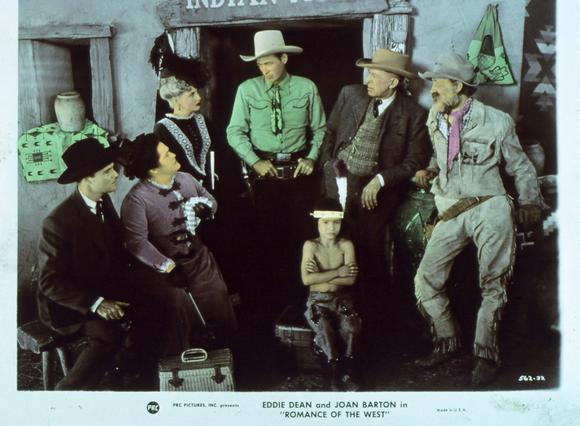
Romance of the West (March 20, 1946)

Romance of the West is a movie with its heart in the right place, if nothing else. It’s filmed in Cinecolor (a two-color film process, a.k.a. “not Technicolor”), which might initially fool you into thinking that it’s a high-class affair. Make no mistake, however. Romance of the West is bottom of the barrel, even by the notoriously low standards of the studio that distributed it, P.R.C. (Producers Releasing Corporation).

In the grand tradition of singing cowboys, country and western star Eddie Dean plays a character named “Eddie Dean.” Eddie is an Indian agent sympathetic to the plight of his American Indian pals. He’s got a great singing voice, but not much else. When delivering lines, Eddie appears to be a life-size mannequin with a string in his back that somebody pulled to make him talk. He’s a lunkhead with a big, dopey mouth and zero screen presence. In a review of one of his films from the ’40s (I don’t know which one), the NY Times said, “Instead of the usual black and white, Eddie Dean’s newest western has been shot in Cinecolor, but it’s not an improvement; you can still see him.”

So why do I say that Romance of the West has its heart in the right place? Well, because it treats its Indian characters with a degree of respect, and there’s mention of all the treaties with them that the United States broke, forcing them into smaller and smaller reservations. But after lip service is paid, the plot goes off the rails. Eddie was supposedly raised by the Indians. So why doesn’t he speak their language with them, or act like them in any way? He’s also a tool of the paternalistic Bureau of Indian Affairs, and toes the line, but it’s presented as a wholly positive thing. When he informs his friend Chief Eagle Feather that the Indians’ land is being stocked with 200 head of cattle, since the buffalo are all dead, the chief acts as if it’s Christmas morning, and he just got the present he always wanted.

The tribe is never named. They’re all “Indians.” There are, however, good Indians and bad Indians. A consortium of powerful men who want the silver that exists on the good Indians’ land gin up some bad Indians to rape and pillage so the good Indians can be blamed for it and driven off their land with the government’s approval.

In a ridiculous scene following a raid by the bad Indians on the good Indians, a little boy is mourning his father’s death. Eddie asks the chief if he know the boy’s name and the chief says, “All I know is that him Indian boy,” or some such twaddle. Never mind that the kid’s at least seven years old and should probably know his own name. Eddie decides he’ll call him “Little Brown Jug” and takes him to be raised by the local monk, Father Sullivan (Forrest Taylor), even though the chief offers to take the boy in. Eddie and Father Sullivan cut Brown Jug’s long hair and dress him like a cowboy. And we’re supposed to believe that Eddie was raised by Indians?

Incidentally, Chief Eagle Feather is played by an actor listed in the credits as “Chief Thundercloud.” Chief Thundercloud was actually a part-Cherokee actor named Victor Daniels, who also had Scottish, Irish, and German ancestors. He played Tonto in two serials and the lead role in Geronimo (1939).

There’s really nothing to recommend Romance of the West aside from the songs, of which there are several; “Ridin’ the Trail to Dreamland,” “Love Song of the Waterfall,” and “Indian Dawn.” The arrangements are good, and Dean has a great voice. A great voice for radio, that is. To paraphrase the Times, the problem with this movie is that you can see him.

Ambush Trail (Feb. 17, 1946)

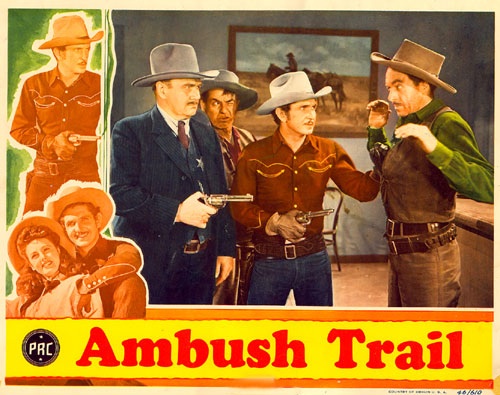
Even by 1946 standards, Ambush Trail looks like a relic of an earlier time. The film stars cowboy actor Bob Steele, who played in more than a hundred westerns from the silent era onward, but Ambush Trail is the first film starring him that I’ve seen. He was a supporting player in The Big Sleep (1946), which I have seen, but I couldn’t have picked him out of a crowd if you paid me. Even though it’s a talkie, Ambush Trail has all the hallmarks of a bad silent film; stilted acting, awkward pauses, and lame comic relief from a rubber-faced sidekick (Syd Saylor). It’s also blocked and edited like a silent movie, and only really comes alive during the fistfights, of which there are many.

A small, trim man (his listed height is 5’5″), Steele had dark, curly hair and a neat little mustache. (Check him out in the lobby card above. He’s the one with the whitest hat, the bluest jeans, and the fanciest shirt.) Steele’s earliest roles were in a series of shorts directed by his father, Robert N. Bradbury. He originally went by his birth name, Bob Bradbury, Jr., and his first film role was at the age of 14, in the Pathé short The Adventures of Bob and Bill (1920), which also starred his twin brother, Bill Bradbury. The two young men went on to star together in more than a dozen semi-documentary nature adventure shorts with titles like Trapping the Wildcat (1921), Outwitting the Timber Wolf (1921), and Trailing the Coyote (1921). As he grew older, Steele became a star in his own right, and a box office draw as a star of westerns.

By the mid-’40s, however, his star was fading, and it’s not hard to see why. Steele may be the best actor in Ambush Trail, but that’s only because everyone else is so God-awful. He plays a cowboy named Curley Thompson who has just purchased the Flying A Ranch. To his surprise, Curley learns that the ranch comes with a pea-brained foreman named Sam Hawkins (Saylor), who can’t even ride a horse. (He can handle a buckboard, however, which will come in handy later in the picture.) Curley quickly runs afoul of the local boss, freight owner Hatch Bolton (I. Stanford Jolley). Bolton is systematically ruining the local ranchers so he can buy them out cheap and sell their ranches to a grain combine in Chicago.

After Sheriff Tom Gordon (Henry Hall) is ambushed and disappears, his brother, Deputy Walter Gordon (Kermit Maynard) takes over. Gordon and his gal pal, Alice Rhodes (Lorraine Miller), join up with Curley and Hawkins in their fight against Bolton. When a local rancher named Joe Moore (Al Ferguson) is shot through a window and murdered while he’s meeting with Curley, Bolton and the crooked Marshal Dawes (Ed Cassidy) pin the murder on Curley. After Deputy Gordon frees him from the local jail, Curley hunts for evidence against Bolton that the missing sheriff may have left behind, and the fight is on.

Throughout the picture, Steele moves and emotes as though he’s in a silent film. He delivers his lines in a competent fashion, but he still looks as if he’d be more comfortable with heavy makeup and a live piano accompaniment. His character is a bit of a wet blanket, too. Curley drinks lemon soda instead of liquor, and even weans his sidekick, Hawkins, off the hard stuff, too. Steele’s not terrible, and neither is Ambush Trail, but it’s not very good, either. It’s a passable B western, but only if you really like B westerns.

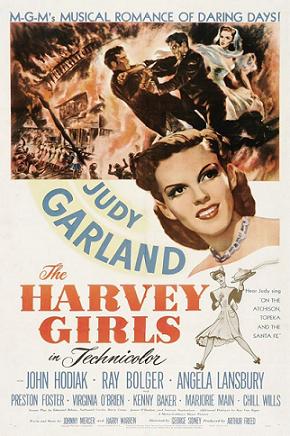
The Harvey Girls (Jan. 18, 1946)

In 1876, a 41-year-old entrepreneur named Fred Harvey opened a string of restaurants along the Atchison, Topeka, and Santa Fe Railway line. The eateries catered to middle-class and wealthy travelers alike, and at the height of the franchise’s success, there were more than 80 Harvey House restaurants. Harvey died in 1901, but the Fred Harvey Company continued to build restaurants into the 1960s.

A restaurant chain might seem an unlikely subject for a big-budget, Technicolor, Hollywood musical, but clearly the young, attractive waitresses in their crisp black and white uniforms were enough of a hook. The film opens with the following portentous prologue:

“When Fred Harvey pushed his chain of restaurants farther and farther west along the lengthening tracks of the Santa Fe, he brought with him one of the first civilizing forces this land had known … the Harvey Girls. These winsome waitresses conquered the west as surely as the Davy Crocketts and the Kit Carsons — not with powder horn and rifle, but with a beefsteak and a cup of coffee. To these unsung pioneers, whose successors today still carry on in the same tradition, we sincerely dedicate this motion picture.”

If all this is to be taken seriously, then who wouldn’t want to lionize these distaff settlers? I haven’t read Samuel Hopkins Adams’s 1942 novel that this film is based on, but it must have been a good story for Hollywood to want to pick it up. Or maybe it was just that Johnny Mercer and Harry Warren realized what a catchy rhythm the phrase “on the Atchison, Topeka, and the Santa Fe” had.

After the prologue and credits, the film opens on a shot of a moving train. Susan Bradley (Garland) is standing on the deck of the caboose, singing a forgettable song about love. She is heading out west to marry a man whom she only knows from the florid love letters he has written her. When her suitor, H.H. Hartsey (Chill Wills), turns out to be a functionally illiterate cowpoke who had a friend play Cyrano for him by penning the letters himself, Susan parts with him (mostly amicably), and becomes a Harvey girl.

The dramatic conflict, such as it is, comes from the local saloon and gambling house, which also features dancing girls. The owner of the palace of sin, Ned Trent (John Hodiak), and his star attraction, Em (played by a young and foxy Angela Lansbury), fear that the opening of the Harvey House will usher in a new era of respectability and crush their business. In real life of course, Trent’s girls would have been prostitutes and Em would have been their madam, but in the world of 1940s M-G-M musicals, dancing the cancan for hooting and hollering cowboys was about as scandalous as they could get.

Garland and Lansbury both give good performances, and are backed up by a large and talented cast. Virginia O’Brien (as the Harvey girl “Alma from Ohio”) is tough and sassy, and Ray Bolger, most famous for playing the Scarecrow in The Wizard of Oz (1939), here gets to play the Cowardly Homosexual, a popular character type in Hollywood pictures for decades. While his sexual preference is never identified outright, Bolger’s character’s effeminacy and fear of any butch labor (such as shoeing horses), as well as his spirited prancing, leaping, and tap dancing make it clear that he doesn’t have any designs on the ladies.

The Harvey Girls is an entertaining mix of musical and western. But if director George Sidney aspired for it to be anything more than breezy entertainment, it doesn’t show. Judy Garland is always a delight, but Vincente Minnelli’s ability to coax a nuanced performance from her and to tell an engaging story from beginning to end in a musical is sorely missed here. The Harvey Girls is enjoyable, but it’s no Meet Me in St. Louis (1944). Also, aside from the standout song, “On the Atchison, Topeka, and the Santa Fe” (which won an Academy Award for best song), no musical number in the picture really stands out.

San Antonio (Dec. 28, 1945)

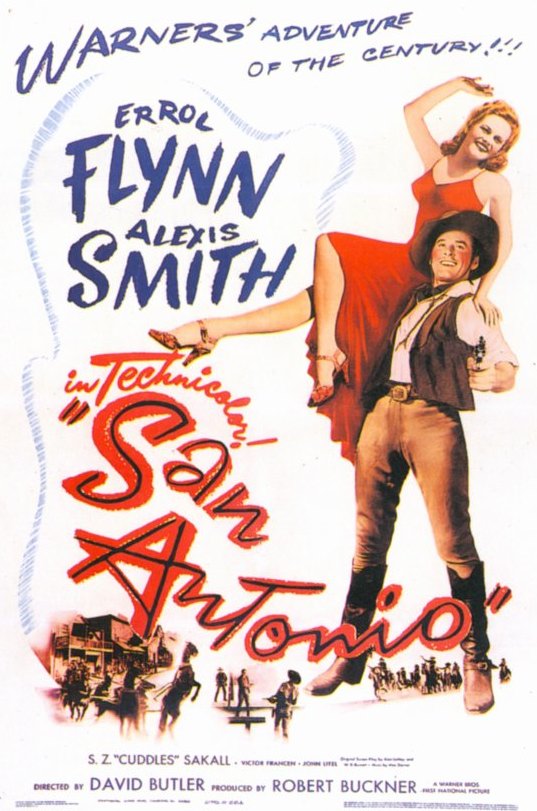
San Antonio, directed by David Butler (with uncredited assistance from Robert Florey and Raoul Walsh), is a journeyman effort from start to finish. A lavish, Technicolor production, the film looks great, and its stuntwork and cinematography are top-notch. The final showdown, a three-way shootout staged at nighttime in the ruins of the Alamo, is especially well-done. But San Antonio never aspires to be anything more than middlebrow entertainment. It’s a star vehicle for Errol Flynn, a showcase for a couple of musical numbers by Alexis Smith, and not much more.

Flynn plays a rancher named Clay Hardin, one of the survivors of a vicious war that has raged for years between ranch owners and the rustlers who decimate their herds by running nightly raids and then rebranding and reselling the cattle at various points along the more than 1,000 miles of border that Texas shares with Mexico. Hardin was falsely branded a criminal, and when the film begins, we find him living in Mexico in exile. He finally has in his possession evidence that could clear his name, a tally book containing records of all the illegal cattle sales made by Roy Stuart (Paul Kelly), the cattle baron of San Antonio. With the tally book and his good friend Charlie Bell (John Litel), Hardin returns to San Antonio prepared to mete out justice. Along the way, he crosses paths with a singer named Jeanne Starr (Smith), as well as her attendant Henrietta (Florence Bates) and her roly-poly manager Sacha Bozic (S.Z. Sakall, who is curiously listed in the credits as “S.Z. ‘Cuddles’ Sakall”). Bozic and Henrietta provide comic relief in helpings that are a little too large, and Jeanne provides romantic interest and a couple of songs.

This wasn’t the first time Smith appeared opposite Flynn. The two starred together in Dive Bomber (1941) and Gentleman Jim (1942). I found their chemistry in San Antonio lukewarm. For a man who was reportedly a stone-cold freak in private, Flynn is remarkably wooden in many of his roles. In San Antonio he’s still working the “dashing” angle he perfected in Captain Blood (1935) and The Adventures of Robin Hood (1938), but he looks closer to the “world weary” angle that he would later play to perfection in the excellent black and white western Rocky Mountain (1950).

San Antonio doesn’t drag, and it’s solid western entertainment. The production values are high, the action is well-staged, and Victor Francen delivers a juicy turn as a villain named Legare, but overall it’s just O.K., with a run-of-the-mill story and passable performances by the leads. If you love the music of the period, Smith’s performance of “Some Sunday Morning” will be a highlight, but if you’re a fan of more historically accurate westerns, the songs in the film date it about as badly as Flynn’s perfect coiffure and jaunty red neckerchief.