Tag Archives: World War II

13 Rue Madeleine (Jan. 15, 1947)

Henry Hathaway’s 13 Rue Madeleine is a spiritual sequel to his espionage docudrama thriller The House on 92nd Street (1945). The address this time around refers not to the headquarters of a Nazi spy ring in New York City, but to Gestapo headquarters in Le Havre, France, during World War II.

Like The House on 92nd Street, 13 Rue Madeleine owes a debt to the style and presentation of Louis de Rochemont’s “March of Time” newsreels. (De Rochemont served as producer of both films.) I enjoyed The House on 92nd Street, but judged purely as a cinematic experience, 13 Rue Madeleine is the superior film.

A lot of that is due to the film’s star. James Cagney is dynamic and arresting in every role I’ve ever seen him play, and I would pay to watch a film in which all he did was order and consume room service by himself.

In this film, Cagney plays Robert Emmett “Bob” Sharkey, an instructor of potential agents in a U.S. agency called “O77.” (The organization is clearly based on the O.S.S., but the name was changed because of certain plot elements that we’ll get to in a moment.)

Early in the film, Sharkey’s boss, Charles Gibson (Walter Abel), informs him that one of his students is a German mole named Wilhelm Kuncel. The mole turns out to be one of his most promising pupils, William H. “Bill” O’Connell (Richard Conte). O’Connell looks and acts as American as apple pie, and during training grew especially close to blond, fresh-faced Jeff Lassiter (Frank Latimore), who never suspected a thing.

Gibson orders Sharkey to pass O’Connell and to not let on what he knows, in order to feed false information to the Germans through O’Connell. Alas, O’Connell proves to be even cannier than Sharkey’s bosses could have predicted, and this decision leads to a series of tragedies.

Conte isn’t an actor I could have picked out of a lineup a year ago, but after seeing him now in several roles, I think he’s a tremendous performer, and I look forward to a lifetime of watching his films. It doesn’t matter for his role as a double agent in 13 Rue Madeleine that he doesn’t look the slightest bit “German.” In a wordless scene in a transport plane over Europe, as O’Connell and Lassiter are preparing to jump, O’Connell suddenly sees what the straight-arrow Lassiter can’t hide, and the look on his face is chilling.

Paisà (Dec. 10, 1946)

Roberto Rossellini’s Paisà (Paisan) is the follow-up to his wildly successful 1945 film Roma, Città Aperta (Rome, Open City).

Roma, Città Aperta is one of the most famous examples of Italian neorealist cinema, and is better known than Paisà, but I think that Paisà stands head and shoulders above Roma, Città Aperta as an artistic achievement. It’s a sprawling, chaotic picture of life in Italy during the last days of World War II. The title of the film comes from the word that American soldiers called Italians — “paisan,” or “buddy” — and over the course of six vignettes the film explores a variety of Italian characters’ attempts to communicate with and understand their occupiers.

Rod Geiger, the American G.I. who carried Roma, Città Aperta back to the United States, worked closely with Rossellini on Paisà, and is listed in the credits as a producer. Most of the Americans in the film were played by off-Broadway actors cast by Geiger’s father, who ran a theater in New York. Depictions of foreigners and foreign cultures in movies are tricky to get right. Usually there are at least a few things that just don’t ring true, but there were times while I was watching Paisà that I forgot that I was watching a “foreign” film featuring American characters. The American actors play their parts in a naturalistic, unaffected fashion, and their dialogue often seem ad-libbed. There are even aspects of the film that ring more true than anything coming out of Hollywood at the time, like an extremely drunk African-American soldier (played by Dots Johnson) who is full of anger and resentment.

Many writers contributed to the film, including Klaus Mann (the son of Thomas Mann), who wrote a treatment. A few of the six episodes that comprise the film function as parables, and have endings that border on being trite, but the overall effect of Paisà is an overwhelming panorama of violence, yearning, friendship, misunderstanding, and horror.

The film is a journey from the south of Italy to the north, and the segments take place in Sicily, Naples, Rome, Florence, a monastery in the Apennine mountains, and in a partison hideout in Porto Tolle. Unlike the American characters, the Italians mostly play themselves. The Sicilians are all played by Sicilian non-actors. The partisans in Porto Tolle are played by real partisans. A street urchin in Naples named Pasquale is played by a real street urchin named Alfonsino Pasca. The monks in the Apennines were really monks, but they were dubbed by different actors, since their accents would have made it clear that they were from the south of Naples, not to the north.

Most of the segments of Paisà end tragically, with characters the audience has grown to care about killed in combat. The deaths are senseless and sudden, and the feeling that no one is safe makes Paisà one of the most affecting and least cliched war films I’ve ever seen.

Green for Danger (Dec. 5, 1946)

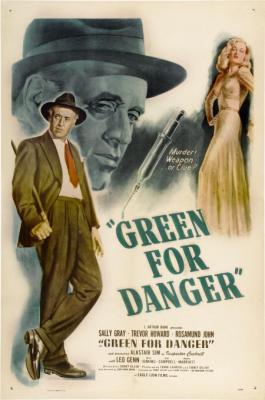
Sidney Gilliat’s Green for Danger, based on the novel by Christianna Brand, is a terrific whodunnit, replete with the cream of the crop of post-war British film thespians.

The story takes place over the course of one week in 1944 at Heron’s Park Emergency Hospital, a requisitioned and converted Elizabethan manor in the English countryside. The atmosphere is claustrophobic, as the doctors, nurses, and administrators tend to the sick and the wartime wounded while squabbling and engaging in petty jealousies as German bombers fly overhead.

Alastair Sim, who plays Inspector Cockrill, doesn’t show up until halfway through the film, but he narrates it from the beginning, introducing us to a group of doctors and nurses circled around a patient in the operating theater; surgeon Mr. Eden (Leo Genn), a stocky, dark-haired Lothario; anesthetist Dr. Barnes (Trevor Howard), who is engaged to the pretty blonde, Nurse Linley (Sally Gray); hysterical Nurse Sanson (Rosamund John); strait-laced Sister Bates (Judy Campbell); and portly Nurse Woods (Megs Jenkins). Inspector Cockrill informs us that it is August 17, 1944, and that by August 22, 1944, two of these characters will be dead, and one of them will be revealed as a murderer.

I like a mystery that establishes its parameters early in the story, and Green for Danger does exactly that. The fact that we’re quickly introduced to the six main characters while their hair and faces are covered by surgical caps and masks means you’ll have to be paying especially close attention if you want to remember who everyone is at first glance, but if you aren’t, never fear. The characters in this film are sharply drawn, and the actors bring them to life wonderfully.

Trevor Howard as Dr. Barnes is the embodiment of the British middle class; his entire body is one big stiff upper lip. Leo Genn probably isn’t anyone’s current idea of a ladykiller, but his smoothness and charisma make him utterly convincing. Sally Gray is lovely to look at, although when she and Rosamund John were both wearing surgical caps I found them difficult to tell apart. I especially liked Judy Campbell, whose role could have been one-note, but who manages to instill the severe Sister Bates with a good deal of humanity.

The first murder — or was it murder? — takes place when a postman named Higgins (Moore Marriott), injured after a bomb attack, dies on the operating table. Recriminations fly, but his death is written off as an accident until one of the nurses screams during a party that she knows it was murder, and she can prove it. She rushes off into the night, stalked by a killer. This sequence is genuinely terrifying, and is reminiscent of an Italian giallo, with dark shadows, swinging doors, and shutters blowing open and closed in the wind to create dramatic lighting effects.

Inspector Cockrill’s appearance marks a shift in tone, as the film becomes more comic. Cockrill is the diametrical opposite of Dr. Barnes and Mr. Eden. While they are perfectly groomed, neatly coiffed, and sharply attired, he is bald, with shocks of gray hair above his ears, outfitted in an ill-fitting, rumpled suit with a drooping pocket square. He’s a collection of tics, constantly shrugging his shoulders and raising his eyebrows.

He’s also the shrewdest man in the room. When Dr. Barnes disparagingly refers to flat-footed coppers, Cockrill responds, “The police force has not a monopoly of fallen arches, Dr. Barnes. Ask any chiropodist.”

Alastair Sim is a fantastic actor, and he exudes authority as Inspector Cockrill, even when he’s doing a pratfall. Cockrill is a fantastic creation, and watching this film made me wish there were an entire series of films featuring the character. He keeps his suspects constantly off-kilter with inappropriate jokes and ironic comments, and he seems mildly amused by everything, including himself.

Green for Danger was one of the most pleasant surprises I’ve had lately. It’s genuinely good escapist entertainment.

The Best Years of Our Lives (Nov. 21, 1946)

The Best Years of Our Lives
The Best Years of Our Lives (1946)
Directed by William Wyler
RKO Radio Pictures

William Wyler’s The Best Years of Our Lives premiered in New York City on November 21, 1946, and in Los Angeles a month later, on Christmas day. It was a hit with both audiences and critics, and was the biggest financial success since Gone With the Wind in 1939.

The film swept the 19th Academy Awards, winning in all but one category in which it was nominated. The film won best picture, Wyler won best director, Fredric March won best actor, Harold Russell won best supporting actor, Robert E. Sherwood won for best screenplay, Daniel Mandell won for best editing, and Hugo Friedhofer won for best score. (The only category in which it was nominated and did not win was best sound recording. The Jolson Story took home that award.)

There are several reasons for the film’s financial and critical success. It perfectly captured the mood of the times. In 1946, returning servicemen faced an enormous housing shortage, an uncertain job market, food shortages, and a turbulent economy (price controls were finally lifted by the O.P.A. around the time the film premiered). Combat veterans also faced their own personal demons in an atmosphere in which discussing feelings was seen as a sign of weakness. By telling the stories of three World War II veterans returning to life in their hometown, The Best Years of Our Lives held a mirror up to American society.

The biggest reason for the film’s success, however, is that it’s a great movie. Plenty of films made in 1945 and 1946 featured characters who were returning veterans, but none before had shown them in such a realistic, unvarnished way. The Best Years of Our Lives doesn’t try to wring tragedy out of its characters’ personal situations. It’s an overwhelming emotional experience precisely because it doesn’t strain for high emotions. The film earns every one of its quietly powerful moments. Hugo Friedhofer’s score is occasionally overbearing, and a little high in the mix, but at its best it’s moving, and a fair approximation of Aaron Copland’s fanfares for common men. Gregg Toland’s deep focus cinematography is phenomenal. Every image in the film — the hustle and bustle of life in a small American city, the quietly expressive faces of its characters, and the interiors of homes, drugstores, bars, banks, and nightclubs — is fascinating to look at. (Toland was Orson Welles’s cinematographer on Citizen Kane, and he was an absolute wizard.)

Russell Andrews March

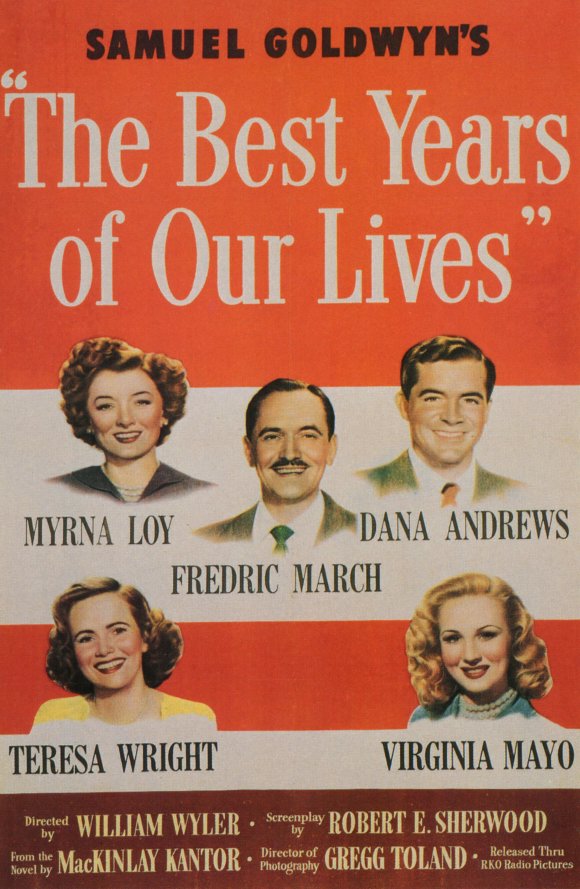
The actors in this film are, without exception, outstanding. Fredric March plays Al Stephenson, an infantry platoon sergeant who fought in the Pacific, and who returns to his job as a bank manager. Myrna Loy plays his wife, Milly, Teresa Wright plays their daughter, Peggy, and Michael Hall plays their son, Rob. Dana Andrews plays the shell-shocked Fred Derry, a decorated bombardier and captain in the Army Air Forces in Europe, who returns home to his beautiful wife Marie (Virginia Mayo), whom he married immediately before leaving to serve. Now that the war is over and they are living together, they realize they have very little in common. Harold Russell plays Homer Parrish, a sailor who lost both his hands when his aircraft carrier was sunk.

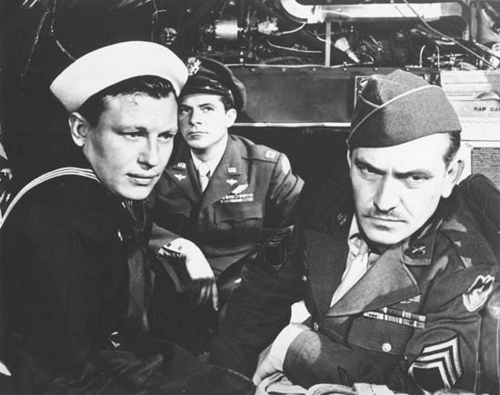
Russell was a non-professional actor who lost his hands in 1944 while serving with the U.S. 13th Airborne Division. He was an Army instructor, and a defective fuse detonated an explosive he was handling while making a training film. Russell’s performance is key to the success of the film. An actor who didn’t actually use two hook prostheses in his everyday life wouldn’t have been able to realistically mimic all the little things that Russell does; lighting cigarettes, handling a rifle, playing a tune on the piano. More importantly, Russell’s performance is amazing. From the very first scene that the camera lingers on his face as he shares a plane ride home with March and Andrews, I felt as if I knew the man.

Russell is so convincing as a man who has quickly adapted to his handicap that it’s gut-wrenching to watch as his exterior slowly breaks down, and we’re drawn deeper into his world. Homer Parrish has a darkness inside him, and he carries with him the constant threat of violence; bayonets adorn the walls of his childhood bedroom and he spends his time alone in the garage, firing his rifle at the woodpile. His next-door neighbor and childhood sweetheart Wilma (Cathy O’Donnell) keeps trying to get close to him, but he pushes her away. In a lesser film, this all might have led to a violent and melodramatic finale, but it merely simmers below the surface, informing his character. Instead, the most emotional scenes with Homer take place in smaller ways, such as when we see that he is not as self-sufficient as he seems, and needs his father’s help every night to remove his prostheses before he goes to sleep.

The Best Years of Our Lives is a great film, and should be seen by everyone who loves movies and is interested in the post-war era. It’s long — just short of three hours — but it didn’t feel long to me. The running time allows its story to develop naturally as the characters enter and re-enter one another’s lives. It also felt more real than any other movie I’ve seen this year. (I can’t think of another movie that wasn’t about alcoholism that featured so many scenes of its characters getting realistically drunk.) And despite all the personal difficulties its characters face, it’s ultimately an uplifting film, full of quiet hope for the future.

Courage of Lassie (Nov. 8, 1946)

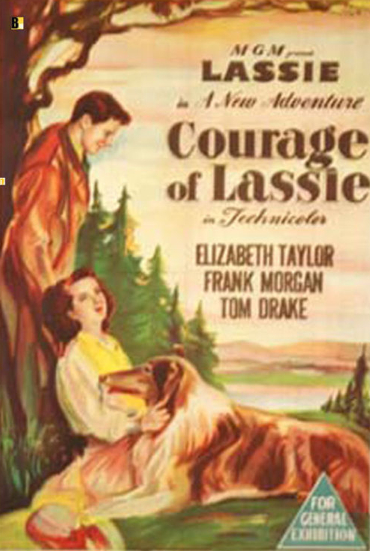
Pal rides again! In Fred M. Wilcox’s Courage of Lassie, the irrepressible little scamp from whose seed all dogs who ever played Lassie are descended plays an orphaned collie. The little guy is left behind in an idyllic, Technicolor wilderness after the old fisherman who owns Lassie rows off with her and what he thinks are all of her puppies.

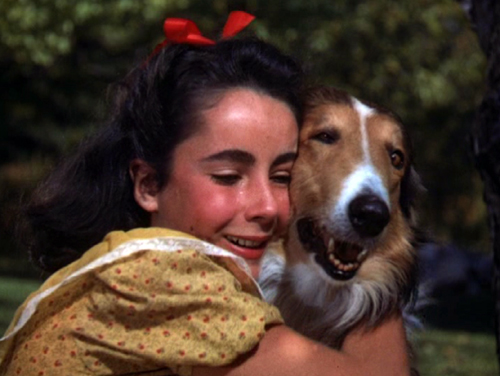
There follows a delightful montage of the little collie frolicking in the woods for days with birds, other four-legged beasties, and even a big black bear. This being a kid’s movie, however, you can be sure that gut-wrenching tragedy is right around the corner. Sure enough, the collie puppy and his little fox friend are caught in stormy rapids, and the fox is washed away, presumably to his death. The puppy, balanced on a tangle of branches, safely makes it to shore. Seemingly unfazed by his little buddy’s demise, the puppy’s next move is to happily run off with Elizabeth Taylor’s pants, and a lifelong bond is formed.

Taylor was 14 years old when she appeared in this film. Just like Pal, she’s playing a different role than she played in the film Lassie Come Home (1943). I think Taylor was a fantastic child actor. Just like in National Velvet (1944), she takes material that could be laughable or treacly and performs it with such conviction that you can’t help but be swept along. As Kathie Merrick, she believes in her dog, whom she names “Bill,” even though her family doesn’t think he has what it takes to be a sheep-herding dog.

By the end of the film Bill will prove that he not only has “the right stuff” in the pasture, but that he can be drafted and serve under heavy fire just like any other red-blooded American boy.

Bill goes through a lot in this film. He’s shot by a couple of dopey young hunters with quick trigger fingers, he’s run over by a truck while herding sheep across the road (and carried off by the well-meaning driver who doesn’t realize Bill belongs to someone), he’s renamed “Duke” at Dr. Colman’s Dog and Cat Hospital in the big city, and he’s trained for war and shipped off to the Aleutians to fight the Japanese.

“Duke” performs bravely despite a bloody neck wound, dragging himself through the mud to deliver a message, then leading the reinforcements back to the troops. He saves the day, but suffers from shell shock. He escapes the train that is taking him home and runs off into the area of the country where he remembers being with Kathie. Unfortunately, his PTSD has taken a toll, and he lives as a feral animal, raiding hen houses and killing local livestock. Kathie saves him from a farmer’s bullet, but he’s still put on trial as a mad dog.

Things look pretty grim for Bill until Harry MacBain (Frank Morgan, who played Prof. Marvel and the Wizard in The Wizard of Oz) makes an impassioned plea for understanding. This is the most interesting part of the film, since MacBain has looked up Bill’s war record, and his speech is a thinly veiled reference to human veterans who may be acting differently after their service overseas. Violent, antisocial behavior and drastic personality changes can be a byproduct of serving in combat, he says, and we on the homefront shouldn’t be so quick to judge our returning veterans. Even if they’re not lovable border collies.

No Regrets for Our Youth (Oct. 29, 1946)

No Regrets for Our Youth
No Regrets for Our Youth (1946)
Directed by Akira Kurosawa
Toho Company

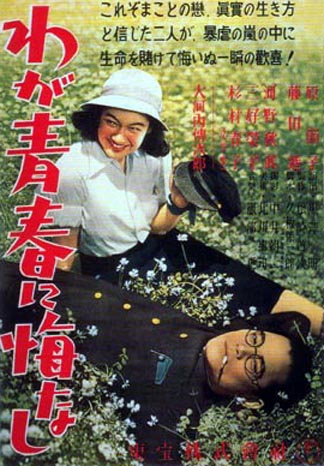
No Regrets for Our Youth was the second film Akira Kurosawa directed after the end of World War II. (The first was Those Who Make Tomorrow, which was released on May 2, 1946. He was forced to direct it by Toho studio bosses. He disliked making the film and never included it in his list of official credits.) No Regrets for Our Youth is an interesting counterpart to two other films I watched this year, Italy’s Roma, città aperta (Rome, Open City) and Germany’s Die Mörder sind unter uns (The Murderers Are Among Us). These three pictures are all early efforts by filmmakers in former Axis powers to come to terms with the enormity of World War II.

Roma, città aperta represents an almost total abnegation of responsibility, which is fair enough, considering the role most Italians played in the war compared with the litany of horrors perpetrated by Germany and Japan. No Regrets for Our Youth is more similar to Die Mörder sind unter uns. Both films are stridently anti-Fascist, but both sidestep the gruesome specifics of what actually went on during the war.

Setsuko Hara stars as Yukie, the daughter of a university professor with leftist leanings. (Hara would only work with Kurosawa once more, when she starred in his film The Idiot in 1951, but she was one of Yasujirô Ozu’s favorite actresses, and starred in six of his films from 1949 to 1961.) The film begins immediately after the 1933 University at Takikawa protests against the Japanese invasion of Manchuria. Yukie is courted by two young men, Ryukichi Noge (Susumu Fujita) and Itokawa (Akitake Kôno). Itokawa is sensible and boring, while Noge is a political firebrand and hot-headed. Yukie is naturally drawn to Noge, but he is arrested after a demonstration and spends four years in prison.

When he is released, he seems to be a changed man; broken in some essential way. Yukie packs up and moves to Tokyo, where she lives for three years, toiling away in a variety of menial jobs. Itokawa and Noge both re-enter her life, and she ends up marrying Noge, who is now involved in espionage. Eventually he is arrested by Imperial forces, and Itokawa, who is now a lawyer, steps in to defend him.

No Regrets for Our Youth is a film with two distinct halves. The second half, in which Yukie goes to visit Noge’s parents, is visually and dramatically stronger than the first. Noge’s parents are both simple farmers living in a remote village. They are terrorized by the other villagers because their son was a spy, and they never go out during the day, only planting at night. Yukie decides to stay with them and fight against adversity, finding value in tilling the land.

It would be decades, of course, before most filmgoers in the West would see this film. The first Kurosawa film to make any impact outside of Japan was Drunken Angel (1948), and Kurosawa didn’t have a true breakout success until Rashomon (1950), which won the Golden Lion at the Venice Film Festival in 1951.

No Regrets for Our Youth is a good film, but it’s not a great one. The performances from the lead actors are excellent, especially from Hara. She ages and grows over the course of the film in a realistic way, which is important when a film covers a period of many years. The story is involving, but not exactly what I would call “gripping.” The scenes in the rural village have a distinctly Soviet flavor to them, and I believe that Kurosawa made this film in an atmosphere of heavy censorship and control by occupying forces.

This is the earliest Kurosawa film I’ve seen, so I don’t know what his pre-war films are like, but it seems to me that he really came into his own as an artist starting in the late ’40s, when he reworked American and European stories and film techniques for pictures like Stray Dog (1949) and High and Low (1963), two of the best police procedurals ever made; Seven Samurai (1954) and Yojimbo (1961), two samurai films that drew heavily from American westerns and were in turn copied over and over by directors making actual westerns; and his reimaginings of Shakespearean dramas set in feudal Japan, Throne of Blood (1957) and Ran (1985).

The Murderers Are Among Us (Oct. 15, 1946)

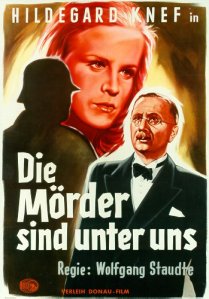
Wolfgang Staudte’s Die Mörder sind unter uns (The Murderers Are Among Us) premiered on October 15, 1946, in the Soviet sector of Berlin (later to be known as East Berlin). It’s an important film, and not just because it was the first film released in Germany after World War II.

It was the first attempt by German filmmakers to come to terms with the enormity of the war crimes committed during the Third Reich. It’s occasionally heavy-handed, and it doesn’t really address the specifics of who died in the Holocaust or why, but these things can be forgiven. It’s a powerful, well-made film with uniformly fine performances from its lead actors.

Die Mörder sind unter uns was the first “Trümmerfilm” (“rubble film”), which were films that used war-ravaged Berlin as a setting. Other Trümmerfilme that followed include Gerhard Lamprecht’s Irgendwo in Berlin (Somewhere in Berlin) (1946), Helmut Käutner’s In jenen Tagen (In Those Days) (1947), Josef von Báky’s … und über uns der Himmel (…And the Sky Above Us) (1947), and Harald Braun’s Zwischen gestern und morgen (Between Yesterday and Tomorrow) (1947).

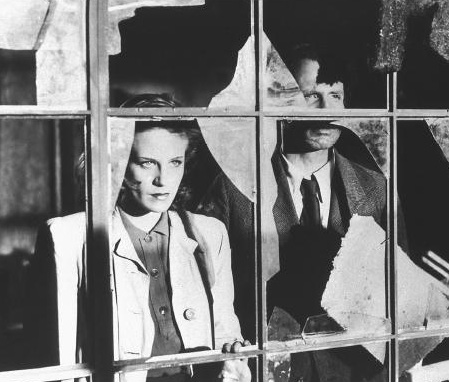
Die Mörder sind unter uns begins with a montage of miserable-looking people slowly making their way through the rubble by train and on foot. Among them is Susanne Wallner (Hildegard Knef), who has just been released from a concentration camp and is going back to the apartment she left in Berlin.

A poster featuring a picturesque castle that says “Das schöne Deutschland” (“beautiful Germany”) hangs askew in a bombed-out train station filled with shabby and emaciated people, including one man, hobbling on crutches, with “PW” stenciled in white on the back of his threadbare topcoat.

Knef is fresh-faced and beautiful, and an unlikely looking camp survivor. (Looks can be deceiving. In reality, the actress fled Berlin toward the end of the war dressed as a boy to avoid being raped by Soviet soldiers. Her ruse worked, and she was sent to a camp for prisoners of war. Eventually, however, her fellow prisoners helped her escape.) Before the end of the war, Knef had acted in a few minor roles in Nazi productions — most of which were released after the war — but as an actress in the post-war years, Knef didn’t try to hide her past. In fact, the crew of Die Mörder sind unter uns was dominated by veterans of the Nazi film industry. The director, Staudte, was involved with making the infamous antisemitic Nazi propaganda film Jud Süß (1940). To make this film, Staudte worked under the auspices of Deutsche Film (DEFA), which was the only production company licensed to operate in the Soviet Zone, and was formed from the ruins of Universum Film AG (Ufa), which was a powerhouse studio in Germany from the silent era through the downfall of the Third Reich.

Early in the film, a kindly old glasses maker named Mondschein (Robert Forsch) tells Susanne, “No, it is easy to forget what happened.” He tells her that she merely needs a goal, and to work.

On the one hand, it’s an ironic statement, since the whole movie is about coming to terms with the past, but it’s a statement that holds true for at least one of the main characters, Ferdinand Brückner (Arno Paulsen), a factory owner who recalls “golden days in gray uniforms,” but who now looks to the future. He wants to rebuild his industry and make a lot of money doing it.

In one memorable scene, Brückner sits at his breakfast table with a newspaper in front of him with a headline that screams, “2 Millionen Menschen vergast!” (“Two million people gassed”), in reference to Auschwitz. The camera tilts up to Brückner taking a sip of coffee or tea, then putting a piece of toast in his mouth and chewing it like a ruminating cow, his face placid and unconcerned.

On the other side of the coin is Dr. Hans Mertens (Ernst Wilhelm Borchert), a man so haunted by the war that he seeks refuge in the bottle but still can’t escape the horrors he carries with him.
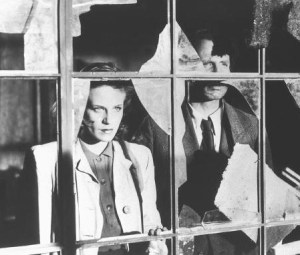
Susanne meets the doctor when she comes home to her old apartment, and finds him living in it. She takes pity on him, and allows him to stay until he can find a new situation. Initially it seems that Dr. Mertens must be guilty of greater wartime crimes than anyone else in the film, if his palpable guilt is anything to go by. In a drunken stupor, lolling around backstage with a bunch of showgirls, he blows smoke over a chessboard. “Doesn’t it look like a battlefield?” he says. He smashes the board, and one of the girls says, “It’s just a harmless game of chess.”

Dr. Mertens responds, “A harmless game with tin soldiers leads down a short, perilous track to the harmless air rifle, to the harmless rifle range, and then to a mass grave.”

The film isn’t just about politics. A romance slowly grows between Susanne and Dr. Mertens, budding as he comes to terms with the things he witnessed during the war, culminating in a powerful finale that takes place on Christmas Eve, 1945. He stands outside of the skeletal remains of a cathedral, listening to the congregation singing “Stille Nacht, heilige Nacht” (“Silent Night, Holy Night”) as snow flurries whirl around him. He has a pistol in his pocket, and is determined to make his old captain pay for what he did during the war.

Dr. Mertens recalls Christmas Eve, 1942, in Poland, when he watched as 36 men, 54 women, and 31 children were gunned down as a reprisal for a single shot fired at the German soldiers by partisans. It isn’t the enormity of this crime that makes the biggest impact on the viewer, it’s the banality of the order given by the captain, and his total disregard for human life as he stands inside, untroubled by the mass execution that is occurring outside as he leads his officers in a Christmas carol.

The film was originally to be called Der Mann den ich töten werde (The Man I Will Kill), and to end with Dr. Mertens exacting justice, but instead the ending was softened, and Susanne convinces him to let the courts dispense justice. Apparently the Soviet authorities who granted the film license were worried that Germans would take the original title and ending as a call for vigilante justice and hunt down the former Nazi war criminals who lived in their midst.

The Bamboo Blonde (July 15, 1946)

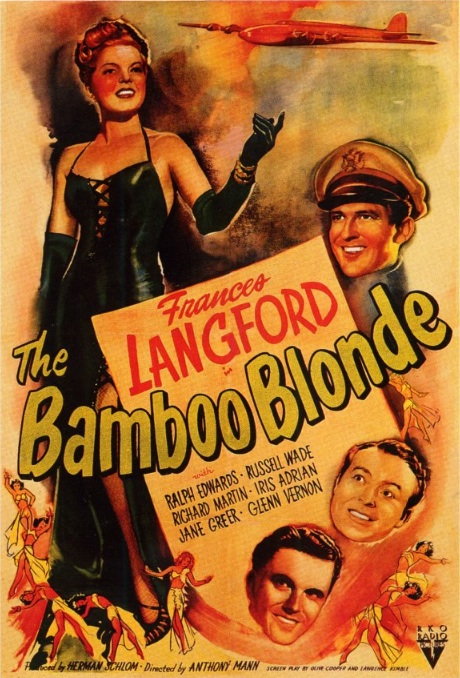
Anthony Mann’s The Bamboo Blonde is a cute little World War II-era programmer based on Wayne Whittaker’s story “Chicago Lulu.” It’s a romantic comedy, but there are nearly enough songs to qualify it as a musical. There are also nearly enough bombing raids over Japan to qualify it as a war movie, but the tone is so light that all the death and destruction on the ground is just there to provide a context for the saucy pinup girl painted on the nose of the bomber. It’s a fun romp — hell and gone from the westerns and noirs on which Mann’s reputation currently rests, but a thoroughly enjoyable way to kill 67 minutes during the dog days of summer.

The film begins with a magazine reporter named Montgomery (Walter Reed) interviewing Eddie Clark (“Truth or Consequences” host/creator Ralph Edwards), the mile-a-minute talker who runs Bamboo Blonde enterprises, an enormous conglomerate that operates a recording studio, furniture manufacturer, hosiery company, cosmetics line, and more. The reporter wants to know how the company got started, and when Eddie finally tires of trying to push Bamboo Blonde brand candy bars on the poor guy, he settles in to tell the story. It all started, Eddie explains, “Around the time Japan was finding out the B-29 wasn’t another American vitamin.”

The picture then begins in earnest, and we see the Ransoms, a wealthy family from Bucks County, Pennsylvania, tearfully send their son, Patrick Ransom, Jr. (Russell Wade), off to war. I say “tearfully,” but I can’t remember if there were any actual tears. The send-off was so wrought with emotion, however, that the presence of waterworks is beside the point. The Ransoms are the type of blue bloods who think nothing of Junior kissing mom on the mouth to say goodbye.

After cutting — or at least loosening — the umbilical cord, young Ransom wanders into Eddie’s Club 50, heedless of the sign outside barring all servicemen from entering. A couple of MPs walk out of the back office, and a perky little blonde named Louise Anderson (Frances Langford) acts quickly, hiding Ransom behind some curtains and then walking onstage to perform the song “I’m Good for Nothing But Love.”

Ransom is the new skipper of a bomber crew, and as the new guy, his boys had sent him to the club as a practical joke, or, as Ransom explains it to Louise over dinner, “Sending me here was a tactical maneuver to ditch me.” The two hit it off right away, and go on the kind of date that was really “on the beam” for the greatest generation, and is still pretty fun today. It starts with dinner at a restaurant with red and white checked tableclothes and candles stuck in bottles that’s run by a woman named “Mom” (Dorothy Vaughan) and it ends in a photo booth. The only thing that seems weird by today’s standards is that Louise sits in the photo booth alone, and Ransom ends up with a little framed photo of her.

That little framed photo will lead to big things. After a disastrous series of runs in the Pacific, Ransom’s B-29 has the worst record in the Air Force, without a single Zero downed. To turn their luck around, one of the guys borrows Ransom’s photo of Louise and paints an Alberto Vargas-style pinup of her with a stacked body “painted from memory.” After a long argument about what exact color hair their sexy new mascot has, they settle on “bamboo blonde,” and they’re well on their way to becoming “that nightmare to the Nips,” as Eddie Clark will later describe them.

The only problem is that Ransom’s crew thinks that Louise is his girlfriend, and he hasn’t disabused them of the notion, even though he has a dark-haired fiancée back home named Eileen Sawyer (Jane Greer, who shows a little bit more of that Out of the Past malevolence than she did in Sunset Pass, which was released a week before this picture). Eileen is a real harpy, and her interest in Ransom is only rekindled because of his growing fame. Meanwhile, Louise first learns that she’s been painted on the side of a bomber while reading a copy of Look magazine that has a picture of Ingrid Bergman on the cover wearing a nun’s habit (presumably from the 1945 film The Bells of St. Mary’s). You don’t have to be a genius to foresee the romantic complications that will arise once Ransom and his boys are called back home for a USO tour with Louise to help sell war bonds.

This is all frothy nonsense, of course, but Mann keeps things moving at a nice clip. Even when working with material that was clearly beneath him, such as this picture and Strange Impersonation (1946), he was able to craft something that was darned watchable. Langford was a classically trained singer, and has a really beautiful voice, which helps. (She was a radio star, and spent a lot of time as a USO performer.) For the most part, the musical numbers are staged in a straightforward fashion, but Mann takes a left turn into the realms of the surreal when Louise sings “Right Along About Evening.” Not only is everything in the idyllic farmland backdrop labeled (e.g., “mailbox,” “dog”), but it end with her rolling up a suddenly two-dimensional Ransom and stuffing him under her pillow before she goes to sleep. Truly odd.

The Stranger (May 25, 1946)

The Stranger isn’t most people’s favorite Orson Welles film, and a lot of people even consider it his worst. (Welles did.) It’s the third film he directed, and as far as Oscar bait goes, it certainly pales in comparison with Citizen Kane (1941) and The Magnificent Ambersons (1942), but I think a lot of the criticism heaped upon it is unfair. The Stranger is a crackerjack thriller with tension and suspense to spare. I was drawn in by the first scene, and was completely involved throughout the film’s 95-minute running time.

Despite its sometimes hackneyed script and implausible situations, The Stranger shows a master in complete control of his craft. The first 15 minutes of the film are some of the most perfect cinematic storytelling I’ve ever seen. Mr. Wilson (Edward G. Robinson), an investigator for the Allied Commission for the Punishment of War Criminals, sets free a Nazi war criminal named Konrad Meinike (Konstantin Shayne) and has him tailed, believing that he will lead them to the secret architect of the Holocaust, Franz Kindler (Welles). Kindler is living in the idyllic little town of Harper, Connecticut, under the name “Charles Rankin” and is a professor at a boy’s school.

Meinike’s journey to find Kindler is an object lesson in how to tell a story with a minimum of dialogue and a maximum of tension. The shots are visually arresting, the editing is rapid without ever being confusing, and the pacing is fast. As openings go, it’s not quite the bravura performance Welles would later put on with his single crane shot that opens Touch of Evil (1958), but it’s just as good in its own way. The disconnect only appears during the first lengthy stretch of dialogue. Once Meinike tracks down Prof. Rankin, the clumsy exposition that Welles grumbles through — which explains who his character is, whom he is marrying, and who his father-in-law will be — sticks out like a sore thumb.

Meinike will prove to be just the beginning of Rankin’s troubles. The noose tightens around his neck as soon as Wilson arrives in town, posing as a dealer in antiques. Robinson plays his role well, in an understated fashion that contrasts nicely with Welles’s bug-eyed histrionics. After a few extreme close-ups of Rankin’s sweaty face as he tells lies to convince his new wife, Mary Longstreet (Loretta Young), that he is an innocent hounded by nefarious forces, there is no doubt about the depths of his villainy.

Not that there every really was any doubt, since Rankin behaves in such a despicable fashion throughout the picture. It’s not just his dinnertime conversation — in which he explicates the warlike soul of the German people and denies that Karl Marx was a German because he was a Jew — it’s his willingness to engage in wet work, killing a troublesome character without a second thought and later beating his new wife’s dog when it attempts to dig up the corpse.

In his review of The Stranger in the July 11, 1946, edition of the NY Times, Bosley Crowther wrote that Welles’s performance “gave no illusion of the sort of depraved and heartless creatures that the Nazi mass-murderers were. He is just Mr. Welles, a young actor, doing a boyishly bad acting job in a role which is highly incredible — another weak feature of the film.” Again, I think this is unfair. Welles got his start in the theater, and as a thespian, he never really grew out of it. His acting was always highly theatrical. He was a man who played to the back row, with grand gestures and a booming voice, but he did so extremely effectively. Not every film performance has to be subtle and understated.

It’s his work behind the camera, however, that really shows Welles in top form. The fast cutting in a scene in a diner, for instance, creates a tense subtext beneath Loretta Young’s seemingly casual banter with Edward G. Robinson by showing each character’s motivations by the looks on their faces. Mary is hiding something, Rankin is coercing her into doing so, and Wilson knows exactly what is going on. Director Welles and editor Ernest J. Nims make it all look easy, but it’s not, or more films would be this well-made.

The film also brilliantly uses sound. For instance, the tolling of the clock in the village square (which the clock-obsessed Rankin has fixed) underscores the tension in the film’s final half hour. The bonging of the clock has a peculiar timbre, and sounds more like incidental music from a ’70s or ’80s suspense or horror flick than any soundtrack from the ’40s I’ve ever heard before. The score itself, by Bronislau Kaper, is quite good, too, and is reminiscent of the work of Bernard Herrmann.

The screenplay, by Anthony Veiller, from a story by Victor Trivas, was imposed on Welles by the studio. The studio and the producer, Sam Spiegel (listed in the credits as “S.P. Eagle”), made plenty of other decisions Welles didn’t like. For instance, Welles wanted Agnes Moorehead to play the part of Wilson, but they forced him to go with Robinson. As far as the studio was concerned, however, everything worked out for the best, since The Stranger was the only film Welles directed that ever made a profit during its initial theatrical run.

The Stranger is a potboiler, to be sure, but it’s such a brilliantly edited, directed, and acted potboiler that it’s remarkable. This is one of those rare movies that I looked forward to seeing again as soon as it was over.

La Bataille du Rail (Feb. 27, 1946)

About five years ago I saw a fantastic World War II movie from 1964 called The Train. Directed by John Frankenheimer, The Train stars Burt Lancaster as a French resistance member who has to stop a train bound for Germany that is carrying priceless art treasures. Filmed in grimy black and white, the film eschews any silliness like having Lancaster put on a fake French accent, and scores high marks as both a drama and an action film.

The reason I bring up The Train is because I couldn’t get it out of my mind while watching René Clément’s film La Bataille du Rail (The Battle of the Rails). If Frankenheimer and his crew didn’t study La Bataille du Rail when they were making The Train, I would be surprised, since Clément’s film is a landmark of vérité war action, and some of its action sequences are very similar to ones found in The Train. The gritty look of the picture also seems to have influenced Frankenheimer. Unfortunately, La Bataille du Rail doesn’t score as highly as a dramatic film, which would be fine if it were a documentary, but it’s not. It only looks like one.

The film opens with the following preamble: “This picture, which recalls actual scenes of the Resistance, was produced in cooperation with the Military Commission of the Resistance National Council.” How accurately any of the action reflects what actually went on during the war, however, I don’t know, but they unquestionably derailed an actual train during the climax, which was impressive.

There are many characters La Bataille du Rail, but they are played by unprofessional actors (who are listed in the opening credits only by surname), and they are never really allowed to develop personalities. The structure of the film is episodic, and depicts an escalating war of attrition. The resistance sabotages trains necessary to the German war effort, and the Germans respond by executing members of the resistance and increasing their military presence on the tracks.

At points, the film reminded me of Sergei Eisenstein’s 1925 film Stachka (Strike) in the way that it placed its numerous human characters against an enormous backdrop of industry. The smoke and grime from the trains covers everything, and the machinery dwarfs the people fighting and dying all around it. There’s an impressive nighttime battle sequence that ends with a resistance member being run over by the treads of a tank. It viscerally drove home the message that while the spirit of a collective can accomplish remarkable things, the integument of a single human body can be crushed by the machinery of war as easily as a person can step on a grape.

Most of the visuals in La Bataille du Rail are impressive because of their scale, but there’s one memorable scene that achieves its impact more subtly. A group of resistance members are lined up against a wall by the Germans and shot one by one. The camera lingers on a single man’s face. He grimaces as each shot is fired. The shot then cuts to what he is seeing; a spider spinning its web along the wall. It’s the last thing he will ever see. It’s a remarkable sequence, and one that makes its point without any dialogue.

I watched La Bataille du Rail immediately after watching Roberto Rossellini’s Roma, città aperta (Rome, Open City), another film about resistance under the Nazis that is shot in a semi-documentary style. In my review of Roma, città aperta I complained about some of the characters and the melodramatic storyline, which I felt undercut the impact of the more vérité material. La Bataille du Rail went completely in the other direction, and never developed its human characters at all. It’s effective in the context of the film, but keeps the viewer at a distance. It’s an impressive film, and I’m glad I saw it, but I’d sooner watch The Train again than La Bataille du Rail. It probably didn’t help that the DVD I watched, from Facets, looked like crap. The film could do with a restoration. The print was fuzzy, and the nighttime scenes looked muddy and were occasionally confusing because of it.