Tag Archives: World War II

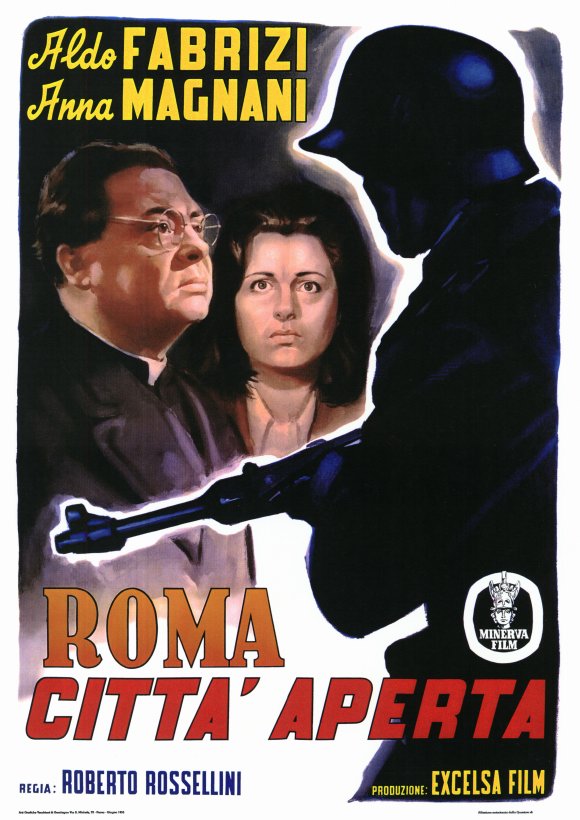
Roma, Città Aperta (Feb. 25, 1946)

Roberto Rossellini’s Roma, Città Aperta (Rome, Open City) premiered in Italy on September 27, 1945, and premiered in New York City on February 25, 1946, at the World Theatre on 49th Street, a 300-seat theater where it would continue to play for nearly two years. It was shown at Cannes in September 1946 and won the festival’s grand prize. It also received the New York Film Critics Circle award for best foreign film of 1946. It’s cited as one of the earliest masterpieces of the Italian neorealism movement, and has been generally accepted as a great film since its release. The problem with instant masterpieces is that sometimes they coast for decades on reputations that might not be fully deserved.

Does Roma, Città Aperta fall into this category? Yes and no. The cartoonish villains and black and white morality sometimes skirt the edge of the ridiculous, and the Italian population is painted as victims of the Nazis to such a large degree that a person who saw this film in a vacuum would be forgiven for thinking that Italy was an occupied Allied power. Also, the exteriors are shot in a verité style that sometimes clashes with the more traditional interior shots. For example, a sun-drenched, slightly overexposed street scene with genuinely angry-looking extras might be followed by a carefully lighted interior scene featuring a stereotypically mincing Nazi officer and his right-hand dyke. For the most part, however, Roma, Città Aperta holds up as a suspenseful, well-crafted wartime espionage yarn that inspires and uplifts, even though … spoiler alert … all the good guys die.

Roma, Città Aperta arrived at just the right time for a positive reception. While Mussolini’s Italy was an Axis power, the country had been completely dependent on Germany since the end of 1941. Rome was occupied by the German army, with help from the Mussolini’s fascist blackshirts, but Italy has never been the most organized or politically unified country, and plenty of Rome’s citizens were understandably restive during this time. Roma, Città Aperta is a story of resistance that takes toward the end of the German occupation of Rome. Rossellini began working on the script with Federico Fellini and Sergio Amidei in August 1944, two months after the Allies had forced the Germans out of Rome, and he began shooting the picture about five months later. The picture’s politics (staunch Communist and anti-Fascist) were also perfectly suited to receive a warm reception from audiences immediately following World War II. If it had been shown in America and Britain just a few years later, the picture’s cheerleading for Communist principles would doubtlessly have gone over less well.

The new DVD from the Criterion Collection I watched looks great. It’s the full version, too, with the blowtorch torture sequence in its entirety, and while the subtitles are merely adequate, they do appear for each line of dialogue (a complaint about one available DVD version I’ve seen is that whole sections of conversation weren’t translated). Even the snatches of conversation in German are subtitled, which seemed unnecessary, since the main baddie, Maj. Bergmann, speaks Italian most of the time. (He’s played by the Austrian actor Harry Feist, who lived in Italy most of his adult life.) Visually, the film captured my interest immediately. The sequence in which resistance member Giorgio Manfredi (Marcello Pagliero) eludes the Gestapo by fleeing along the rooftops is thrilling. The human drama took a little longer to jell for me, partly because there are a lot of characters, and since this is a neorealist picture, they don’t appear at the beginning with title cards explaining their relationships. Aldo Fabrizi gets top billing. He plays the priest, Don Pietro Pellegrini, who ties all the characters together. He transmits messages, cash, and weapons for the resistance. Giorgio’s friend Francesco (Francesco Grandjacquet) is a fellow member of the resistance, but seems less dedicated to the cause than Giorgio. Giorgio’s girlfriend, Marina (Maria Michi), works at a nightclub and doesn’t seem to understand the gravity of Giorgio’s situation. Francesco’s fiancée Pina (Anna Magnani) shelters Giorgio and cares for her young son Marcello (Vito Annicchiarico), who gets involved with his own resistance against the Nazis, a sort of children’s crusade that involves blowing shit up really good.

As I said, it’s the cartoonish villains that seem most silly six decades later. Maj. Bergmann is as prissy and effeminate as he is cruel, which would be easier to ignore if he weren’t paired with an evil lesbian named Ingrid (Giovanna Galletti). The scenes in which Ingrid cajoles the easily manipulated Marina are like something out of a ’60s James Bond film.

There’s an oft-repeated story that Roma, Città Aperta was an ad hoc production, and that it was shot on scraps of discarded film, which gave it its distinctive choppy look. According to David Forgacs’s recent book on the film for the British Film Institute, however, when the Cineteca Nazionale restored the film in 1995, they found that the original negative consisted of just three types of film; one for the exteriors and two different, more sensitive, types of film for the interiors. The inconsistencies and changes in brightness are now blamed on poor processing. It’s an alluring legend, though; Rossellini and his crew shooting in a beautiful, ancient city still damaged by war, picking film up out of the gutters, but it’s just that … a legend. There’s another great story about the film, also of questionable veracity. According to Fellini’s essay “Sweet Beginnings,” the American producer of the film, Rod Geiger, was a half-drunk American private stationed in Rome who bungled his way on to the set and misrepresented himself as a producer with connections. With a copy of the film in his barracks bag, Geiger somehow managed a theatrical distribution deal when he got back to the states, even though, according to Fellini, Geiger was “a nobody and didn’t have a dime.” Geiger disputed Fellini’s account, however, and the essay was the subject of a defamation lawsuit that led to the film being banned due to legal reasons in some countries.

Roma, Città Aperta is a very good film, but I think its reputation as a masterpiece is partly due to when and how it was released. In my opinion, Luchino Visconti’s 1943 film Ossessione is just as good, if not better, but it wasn’t shown in the United States until the ’70s, partly because it was produced during the war, but mostly because it was an unauthorized adaptation of James M. Cain’s 1934 novel The Postman Always Rings Twice and legal trouble affected its distribution. It’s a must-see for students of cinema, especially ones interested in both film noir and neorealism.

A Walk in the Sun (Dec. 25, 1945)

A Walk in the Sun
A Walk in the Sun (1945)
Directed by Lewis Milestone
20th Century-Fox

A Walk in the Sun had its premiere on Monday, December 3, 1945, and went into wide release on Christmas day. Produced and directed by Lewis Milestone, the director of All Quiet on the Western Front (1930), A Walk in the Sun tells the story of the ordinary men who serve in the infantry. Long stretches of the film are filled with the men’s meandering thoughts (both in voiceover and spoken aloud) and their circuitous conversations. When violence occurs, it comes suddenly, and its larger significance is unknown. The film’s exploration of the infantryman’s P.O.V. is similar to William A. Wellman’s The Story of G.I. Joe, released earlier the same year. (Burgess Meredith, who played Ernie Pyle in that film, narrates A Walk in the Sun, although he is not listed in the film’s credits. When I first watched this film I was sure it was Henry Fonda’s voice I was hearing. I was surprised when I looked it up and found out it was Meredith.) Unlike The Story of G.I. Joe, however, A Walk in the Sun covers a much briefer period of time (from a pre-dawn landing to noon the same day), and its ending is more heroic, with little sense of loss or tragedy.

Based on the novel by Harry Brown, A Walk in the Sun takes place in 1943, and tells the story of the lead platoon of the Texas division, and their landing on the beach in Salerno, Italy. Square-jawed Dana Andrews plays Staff Sgt. Bill Tyne, a simple man who never had much desire to travel outside of his hometown of Providence, Rhode Island. Richard Conte plays the Italian-American Pvt. Rivera, a tough soldier who loves opera and wants a wife and lots of children some day. George Tyne plays Pvt. Jake Friedman, a born-and-bred New Yorker. John Ireland plays PFC Windy Craven, a minister’s son from Canton, Ohio, who writes letters to his sister in his head, speaking the words aloud. Lloyd Bridges plays Staff Sgt. Ward, a baby-faced, pipe-smoking farmer. Sterling Holloway plays McWilliams, the platoon’s medic, who is Southern, speaks very slowly, and just might be a little touched. Norman Lloyd plays Pvt. Archimbeau, “platoon scout and prophet,” as Meredith describes him in the opening narration; Archimbeau talks incessantly of the war in Tibet he theorizes will occur in the ’50s. Herbert Rudley plays Staff Sgt. Eddie Porter, an opinionated guy who’s always looking for an argument (Normal Rockwell’s wasting his time painting photo-realistic covers for the Saturday Evening Post, Porter says. He should use a camera. Some day magazine covers will have moving pictures on them anyway.) Richard Benedict plays Pvt. Tranella, who “speaks two languages, Italian and Brooklyn,” and whose fluency in the former will prove useful when the platoon runs across two Italian deserters.

All of these “types” seem clichéd now, but they’re probably not unrealistic characters for the time. The only really dated thing about A Walk in the Sun is the song that appears throughout the film, and helps to narrate the action. “It Was Just a Little Walk in the Sun,” with music by Earl Robinson and lyrics by Millard Lampell, is sung by Kenneth Spencer in the deep, mournful style of a spiritual. I didn’t dislike the song, but its frequent appearance as a kind of Greek chorus felt intrusive.

One thing that really impressed me about A Walk in the Sun was the cinematography by Russell Harlan. While A Walk in the Sun is clearly filmed in California, Harlan makes the most of starkly contrasted black and white shots that could have been shot anywhere. One of the film’s motifs is black figures against a white sky. There are a couple of scenes that reminded me of the famous final scene in Ingmar Bergman’s The Seventh Seal (1957) in which death leads a procession of people down a hill. Several times in A Walk in the Sun, the platoon is depicted as groups of indistinguishable black figures walking down a black hillside, silhouetted against a completely white sky. And in keeping with the infantryman’s P.O.V., when the platoon lies down to rest there are a couple of shots from the ground, looking up at the sky, while arms reach up across the frame and exchange cigarettes.

A Walk in the Sun is one of the better World War II films I’ve seen, and it’s generally well-regarded, but not everyone liked it. Samuel Fuller, who saw combat in World War II as a rifleman in the U.S. 1st Infantry Division and would go on to direct many cult favorites, wrote a letter to Milestone complaining about the film. “Why a man of your calibre should resort to a colonel’s technical advice on what happens in a platoon is something I’ll never figure out,” he wrote. “When colonels are back in their garrison hutments where they belong I’ll come out with a yarn that won’t make any doggie that was ever on the line retch with disgust.”

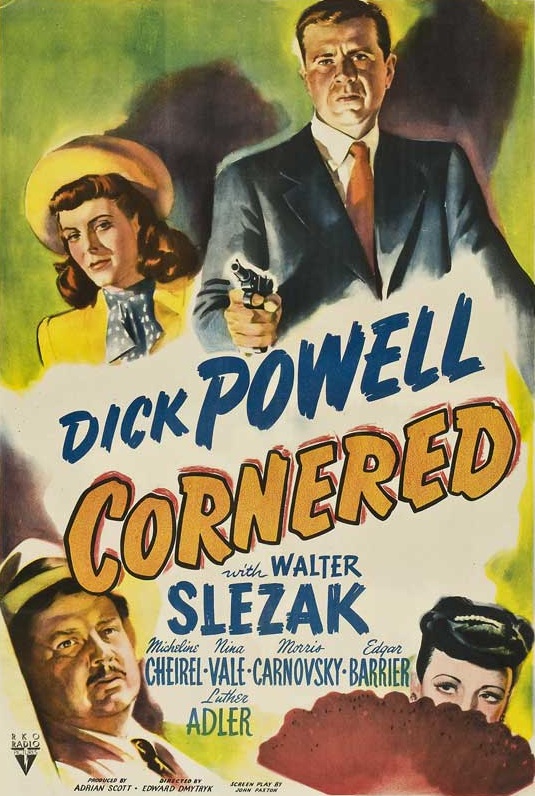
Cornered (Dec. 25, 1945)

Cornered was director Edward Dmytryk’s second film to star Dick Powell. Powell was a boyish crooner and star of musical comedies who made a 180 degree turn into hard-boiled noir territory at the age of 39 when he played detective Philip Marlowe in Dmytryk’s film Murder, My Sweet (1944), an adaptation of Raymond Chandler’s 1940 novel Farewell, My Lovely. Powell jumped into his new, hard-boiled persona with both feet. Between the two films, Powell started appearing every week on the Mutual Broadcasting System as private investigator Richard Rogue in the radio series Rogue’s Gallery. The series was mostly standard P.I. fare, but it featured one unique element; every time Rogue was knocked out (which was nearly every episode) he’d drift off to “Cloud Eight,” where his alter ego, a little white-bearded gnome named “Eugor,” would taunt him, occasionally dropping a clue for Rogue to pick up on later, when he’d regained consciousness.

Cornered has no fanciful elements like that one, and the devil-may-care charm Powell exhibited in Murder, My Sweet has been completely done away with. In Cornered he plays a broken man who will stop at nothing to exact vengeance.

When we first meet Flight Lieutenant Laurence Gerard (Powell), an RCAF pilot, he is in London, receiving £551 back pay for the time he spent as a P.O.W. His next stop is a passport office, where he seeks passage to France. He wants to settle his wife Celeste’s estate. She was a French citizen, and they were married during the German occupation. When Gerard is told that all passports to the continent require investigation, and that it will take at least a month to clear, he walks out of the office without saying another word. In the next scene, he is alone in a rowboat, crossing the English Channel. When he sees land, he chops a hole in the hull, sinks the boat, and swims to shore.

In a muddy French town that is mostly rubble, Gerard meets with Etienne (Louis Mercier), a former resistance leader, and Celeste’s father. Gerard demands to know who is responsible for her death, and who betrayed her. “If there was any betrayal, I betrayed her, by fathering her in a century of violence,” Etienne tells him. Gerard doesn’t accept this circumspect response, and vows to hunt down the Vichy collaborator Marcel Jarnac, who ordered the killing of Celeste and several other members of the resistance. Jarnac supposedly died in a fire, but Gerard refuses to believe he is dead. He sets out with a single goal; to kill Jarnac.

Gerard follows Jarnac’s trail to Buenos Aires, and it is there that most of the film takes place. As soon as Gerard steps off the plane, he is approached by a fat man in a white suit. This man, Melchior Incza (Walter Slezak), is an operator with no clear allegiances. Gerard is quickly drawn into a world where no one is what they seem. Former Nazis and their collaborators have fled to Buenos Aires, biding their time until the next great war, while a loose-knit, clandestine organization seeks to root them out. Incza introduces Gerard to Jarnac’s wife (or possibly widow), Mme. Madeleine Jarnac (Micheline Cheirel), and even her loyalties are unclear.

While it may sound like a globe-trotting adventure film, Cornered is really a claustrophobic film noir with healthy doses of paranoia and tension. The script, by John Paxton (with uncredited assistance from Ben Hecht), from a story by John Wexley, takes a run-of-the-mill manhunt plot and ratchets up the tension with crisp dialogue, excellent pacing, and a brutal finale. Harry J. Wild’s cinematography is classic film noir, with inky nighttime exteriors, close-quartered interiors, and actors’ shadows frequently preceding them into the frame.

Powell plays Gerard as a shell-shocked man who suffers from frequent headaches. He’s on a mission to avenge a woman to whom he was only married for 20 days. He’s an amateur doing the work of a detective, and while he’s clever enough to connect the dots, he’s still just one man at the mercy of forces beyond his comprehension. “You are sick with fear,” Mme. Jarnac tells him. “You’ve been hurt so deeply you cannot trust anyone but yourself.”

Is there a better description of the classic film noir protagonist?

They Were Expendable (Dec. 20, 1945)

It has become clear to me that John Ford does something for others that he doesn’t do for me. Active from the silent era through the ’60s, Ford is regularly listed as one of the greatest American directors of all time, as well as one of the most influential.

It’s not that I don’t like his films. I’ve enjoyed most that I’ve seen. But aside from The Man Who Shot Liberty Valance (1962), I haven’t loved any of them. Ford’s influence on the western is hard to overstate, and I respect what films like Stagecoach (1939) and The Searchers (1956) did to elevate the genre, but I wouldn’t count either as one of my favorite westerns.

They Were Expendable was Ford’s first war movie. It is a fictionalized account of the exploits of Motor Torpedo Boat Squadron 3 in the early, disastrous days of America’s war in the Pacific. Based on the book by William L. White, the film stars Robert Montgomery as Lt. John Brickley, who believes that small, light PT (patrol torpedo) boats are the perfect crafts to use against the much-larger ships in the Japanese fleet. Despite the speed and maneuverability of PT boats, the top Naval brass reject Lt. Brickley’s plan, but he persists in equipping the boats and training his men, and they eventually launch attacks against the Japanese, and even use PT boats to evacuate Gen. Douglas MacArthur and his family when the situation in the Philippines goes from bad to worse.

They Were Expendable is a product of its time. When the actor playing MacArthur is shown (he is never named and has no lines, but it’s clear who he is supposed to be), the musical score is so overblown that it elevates MacArthur to the level of Abraham Lincoln, or possibly Jesus Christ. The bona fides of the film’s star are asserted in the credits; he is listed as “Robert Montgomery, Comdr. U.S.N.R.” (Montgomery really was a PT skipper in World War II, and did some second unit direction on the film.) And in keeping with the film’s patriotic tone, the combat efficacy of PT boats against Japanese destroyers is probably overstated. (This is also the case in White’s book, which was based solely on interviews with the young officers profiled.)

None of this was a problem for me. What was a problem was the inconsistent tone of the picture, exemplified by the two main characters. Montgomery underplays his role, but you can see the anguish behind his stoic mask. He demonstrates the value of bravery in the face of almost certain defeat. On the other hand, John Wayne, as Lt. (J.G.) “Rusty” Ryan, has swagger to spare, and is hell-bent for leather the whole time. He even finds time to romance a pretty nurse, 2nd Lt. Sandy Davyss (played by Donna Reed). Wayne doesn’t deliver a bad performance, but it’s a performance that seems better suited to a western than a film about the darkest days of America’s war against the Japanese.

Maybe we can blame Ford and Wayne’s previous work together, and their comfort with a particular genre. Reports that Ford (who served in the navy in World War II and made combat documentaries) constantly berated Wayne during the filming of They Were Expendable for not serving in the war don’t change the fact that the two men made many westerns together before this, and would make many after it. Several scenes in They Were Expendable feel straight out of a western. Determined to have an Irish wake for one of his fallen brothers, Wayne forces a Filipino bar owner to stay open, even though the bar owner is trying to escape with his family in the face of reports that the Japanese are overrunning the islands. Even more out of place is the scene in which the old shipwright who repairs the PT boats, “Dad” Knowland (Russell Simpson), refuses to leave the shack where he’s lived and worked in the Philippines since the turn of the century. Wayne eventually gives up trying to persuade him to evacuate, and leaves him on his front porch with a shotgun across his lap and a jug of moonshine next to him, as “Red River Valley” plays in the background.

The scenes of combat in They Were Expendable are well-handled, and the picture looks great. Montgomery is particularly good in his role. As war movies from the ’40s go, it’s not bad, but far from the best I’ve seen.

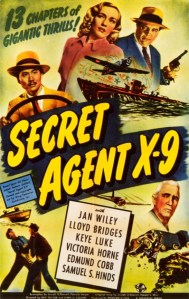
Secret Agent X-9 (13 chapters) (July 24-Oct. 16, 1945)

Secret Agent X-9Republic Pictures is the unassailable king of the cliffhangers after the silent era. Most of the best chapterplays of the ’30s and ’40s were Republic productions. Dick Tracy (1937), The Lone Ranger (1938), Zorro’s Fighting Legion (1939), Adventures of Red Ryder (1940), Mysterious Doctor Satan (1940), Adventures of Captain Marvel (1941), Jungle Girl (1941), Spy Smasher (1942), Perils of Nyoka (1942), The Masked Marvel (1943), and Captain America (1944) are just a few of the more than sixty serials produced by Republic Pictures, most of which are still incredibly entertaining. The best Republic serials combined wild action and elaborate stunts with nicely paced stories that could be strung out over 12 to 15 weekly installments with a few subplots here and there, but nothing too complicated or that viewers couldn’t pick up with in the middle. Each chapter ended with a cliffhanger (like Captain Marvel flying toward a woman falling off a dam, or a wall of fire rushing down a tunnel toward Spy Smasher). The next week’s chapter would begin with a minute or two of the previous week’s climax and the resolution, and the cycle would repeat until the final chapter.
Columbia Pictures and Universal Pictures were the two other major producers of serials in the sound era. Universal ceased production of serials in 1946, leaving only Columbia and Republic to duke it out into the ’50s. One of the last serials made by Universal was Secret Agent X-9, released into theaters starting in July 1945. It was based on a daily newspaper strip created by writer Dashiell Hammett (the author of The Maltese Falcon and The Thin Man) and artist Alex Raymond (who worked on Flash Gordon). Both creators left the project soon after its inception, and the King Features strip continued under various hands, vacillating between espionage and private eye stories.

X-9The first film serial featuring Secret Agent X-9 was made by Universal in 1937, and starred Scott Kolk as Agent X-9, a.k.a. “Dexter,” who sought to recover the crown jewels of Belgravia from a master thief called “Blackstone.” The second featured a boyish-looking 32-year-old Lloyd Bridges as Agent X-9, a.k.a. “Phil Corrigan.” Made toward the end of World War II, the 1945 iteration of the character focused on wartime intrigue and Corrigan’s cat-and-mouse games with Axis spies. Taking a cue from Casablanca (1942), the serial was set in a neutral country called “Shadow Island,” in which Americans, Japanese, Chinese, French, Germans, Australians, and the seafaring riffraff of the world freely intermingle. A fictional island nation off the coast of China, “Shadow Island” has a de facto leader named “Lucky Kamber” (Cy Kendall) who owns a bar called “House of Shadows” and has a finger in every pie, including gambling and espionage. Various German and Japanese military officers, secret agents, and thugs run amuck in this serial, but the one who most stands out is the unfortunately made-up and attired Victoria Horne as “Nabura.” In her role as a Japanese spymaster, Horne is outfitted with eyepieces that cover her upper eyelids, appearing to drag them down from sheer weight. She doesn’t look Asian, she just looks as if her eyes are closed.
While Nabura is played by a white actress in yellowface makeup, the main Chinese character is actually played by a Chinese actor, which was typical in World War II-era Hollywood. Keye Luke, surely one of the hardest working Chinese-American actors in Hollywood history, plays “Ah Fong,” Corrigan’s faithful sidekick. Corrigan is also aided by an Australian double agent named Lynn Moore, played by American actress Jan Wiley. Wiley does nothing to alter her accent, which was also typical for American actors who played Aussies in Hollywood productions during the war.

Secret Agent X-9 has good production values and special effects. The stock footage that shows up in nearly every serial is judiciously used, and integrated well into the newly filmed material. Where this Universal serial just doesn’t measure up to the best Republic offerings is in the pacing and action departments. Republic serials featured stuntwork that still impresses (e.g., Spy Smasher leaping through the air, landing on a mechanic’s creeper chest-first, rolling under a car, and grabbing a goon’s ankles before he can escape). Secret Agent X-9 features ho-hum shootouts, fistfights, and car chases.

Also, instead of a plot that evolves naturally over the course of the series, there is a simple story that seems as if it’s been stretched from a 90-minute feature into 13 chapters, most of which are longer than 20 minutes. Secret Agent X-9 also suffers from poor timing. When the first installment was released, V-E Day had already passed, but the United States was still at war with Japan. By the time the final installment was released, atomic bombs had been dropped on Hiroshima and Nagasaki, Japan had surrendered to the Allies, and a new phase in world history had begun. Secret Agent X-9 is set in 1943, so it’s never out of date, per se, but its MacGuffin, a substitute for aviation fuel called “722,” which everyone in the film is scrambling to secure for themselves, seems like small beer after the advent of the Atomic Age.

The House on 92nd Street (Sept. 10, 1945)

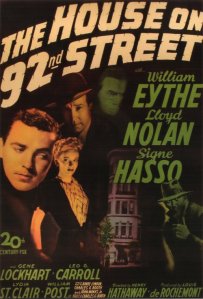
House92ndStWhen The House on 92nd Street was released on DVD in 2005, it was as part of the “Fox Film Noir” collection. This is misleading, since it’s more of a docudrama than it is a noir. It’s a historically important film, however, since it was one of the first to feature location shooting for nearly all the exteriors, and one of the first to skillfully blend fact with fiction while presenting itself as essentially factual. (Charles G. Booth won an Academy Award for best original story for his work on this film.)
The House on 92nd Street stars William Eythe as Bill Dietrich, a second-generation German-American who becomes a double agent for the F.B.I., Lloyd Nolan as his contact in the Bureau, Agent George A. Briggs, and Signe Hasso as the leader of the spy ring, Elsa Gebhardt. The film is a fictionalized account of the F.B.I.’s 1941 operation against the Nazi spy ring led by Fritz Joubert Duquesne. It was one of the largest counterspy operations in U.S. history, and led to the conviction of 33 people. In reality, however, none of them were involved in anything quite as grand as the secrets of the atomic bomb, which is the MacGuffin in The House on 92nd Street. And the real Dietrich was not the all-American boy portrayed by Eythe. He actually was a German-born man named William G. Sebold who served in the German army during World War I but became a naturalized American citizen in 1936. Presumably the war was still too fresh in the minds of the American viewing public for them to accept a German as the hero of a picture.

This film also shows the beginnings of J. Edgar Hoover’s massive publicity campaign for the F.B.I., which he disguised as a simple display of information. In reality, of course, Hoover carefully controlled the information that the public saw about the F.B.I., twisting and distorting as necessary. A good example of this information control is a scene early in the film, in which we see an indoor enclosure the size of an airplane hangar, filled with filing cabinets. The booming voice of the narrator (Reed Hadley) explains that this is the F.B.I.’s collection of 100 million sets of fingerprints, a number that seems unlikely, given that the population of the United States was fewer than 140 million people in 1945. Were they counting each finger? The message, of course, is that there is no hiding from the F.B.I. If you commit a federal crime or spy for another nation, they will find you. (This was also the message of the radio show This Is Your F.B.I., which began broadcasting dramatizations of real federal cases on American Broadcasting Company stations in the spring of 1945, all with the cooperation of Hoover, who called it “the finest dramatic program on the air,” and “our show.”)

The House on 92nd Street was directed by Henry Hathaway, but much of its style can be attributed to producer Louis de Rochemont, who created the “March of Time” newsreel series. When he lacked the footage he wanted, de Rochemont would stage clever recreations, but his newsreels were presented as wholly factual. It’s important to keep in mind that American audiences were less savvy about media trickery in 1945. After all, it had only been six years since people tuned into Orson Welles’s War of the Worlds broadcast midway through the program and thought Martians were vaporizing people in New Jersey.

The House on 92nd Street begins with a compilation of actual footage of people entering and exiting the German embassy, which is interesting. Of course, the characters in this film watch a great deal of surveillance footage. Some of it is real, some is not. It’s not that audiences in 1945 didn’t realize that the film was a blending of reenactments and actual footage, it’s the overall message they were taking away from the film that was perhaps not completely accurate. For instance, in Thomas M. Pryor’s September 27, 1945 review of the film in the New York Times, he wrote the following:

Since the picture, produced by Twentieth Century-Fox with full cooperation from the F.B.I., was completed some months ago, the secret of the atomic bomb has been revealed. Now the picture carries a simple and restrained foreword explaining that the “Process 97” which the Nazi agents are attempting to steal was in reality a part of the atomic bomb formula. It is to the producers’ everlasting credit that this information is not sensationalized in the film.

In reality, however, there is no evidence that there was a single “missing piece” of the atomic bomb process that spies were in danger of transmitting back to Nazi Germany. And of course, film by its very nature presents a sensationalized picture of reality.

Also, a big deal is made at the beginning of the picture that every person playing an F.B.I. agent, aside from the principals, is an actual F.B.I. agent. This, however, does not make what is depicted any more or less truthful than if they were played by actors, but it seems to.

The House on 92nd Street is not a bad picture by any stretch. Taken at face value, it’s tense and exciting. And director Hathaway, when not constrained by the documentary-style approach of de Rochemont, creates some great sequences, such as when Dietrich gets himself arrested just to get in touch with Briggs at the F.B.I., or the meeting between Dietrich and his co-conspirators at a waterfront dive. And the final shootout, which involves tear gas grenades and a surprising disguise, is fantastic. If you’re looking for a film that uses the framework of a docudrama to present a tense film noir, however, you’d be better off watching Anthony Mann’s excellent T-Men (1947).

The True Glory (Aug. 27, 1945)

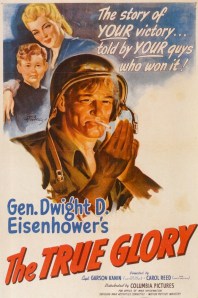
TrueGloryThe True Glory, which was released on August 27, 1945 in the United Kingdom and on October 4, 1945 in the United States, is the granddaddy of every World War II documentary you’ve ever seen on the History Channel. Introduced by the Supreme Commander of Allied Forces in Europe, Gen. Dwight D. Eisenhower, The True Glory tells the story of America and Great Britain’s war against Germany and Italy, starting with the D-Day invasions of June 6, 1944 and ending with V-E Day, May 8, 1945.
The documentary, which won an Academy Award, was pieced together from hundreds of different war photographers’ footage. Several directors worked on the film, but the most commonly credited are Carol Reed and Garson Kanin.

There is some narration, but the majority of the film is told through first-person accounts in voiceover. There are a myriad of British and American soldiers who tell their stories, but there are also the voices of a Parisian family, nurses, clerical staff, an African-American tank gunner, and a member of the French resistance. If you know your World War II history and keep your eyes peeled, you’ll recognize many prominent figures in the footage, including Gen. Eisenhower and Gen. George S. Patton.

Produced by the British Ministry of Information and the U.S. Office of War Information, The True Glory lacks a certain degree of perspective, coming so soon after the end of the war, and is primarily made to celebrate the accomplishments of the Allied forces, but that doesn’t change the fact that the footage is absolutely stunning, and occasionally horrific. The True Glory is a must-see for even the most casual of history buffs.

Ernie Pyle’s “Story of G.I. Joe” (July 13, 1945)

StoryGIJoe
The Story of G.I. Joe (1945)
Directed by William A. Wellman
United Artists

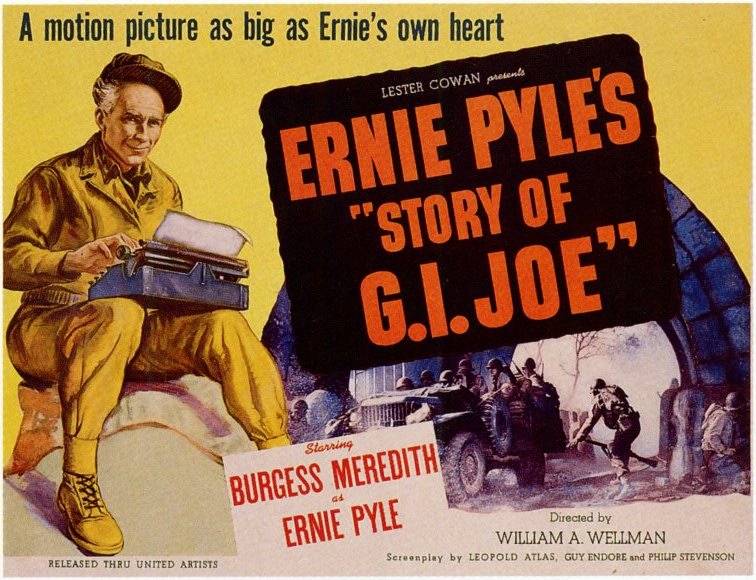
Ernie Pyle was a journalist for the Scripps-Howard newspaper chain. Long before the term “embedded journalist” entered the national consciousness, Pyle traveled with servicemen, writing about the war from their perspective. He had a conversational writing style, and attracted a huge following during World War II. He won the Pulitzer Prize in 1944 for his work as a war correspondent. He was killed in combat in 1945.

William A. Wellman’s film Ernie Pyle’s “Story of G.I. Joe” stars Burgess Meredith as Pyle, and co-stars Robert Mitchum as Lt. (later Capt.) Bill Walker and Freddie Steele as Sgt. Steve Warnicki.

Gen. Dwight D. Eisenhower said it was the finest war film he had ever seen, and I tend to agree with him. Wellman is a superior craftsman. Not only is The Story of G.I. Joe one of the best war movies I’ve seen, its gripping scenes of combat have yet to be improved upon. For all the credit that Saving Private Ryan (1998) got for ushering in a new era of realism to the World War II film, watching this film reminded me that the horrors of war don’t necessarily need to be depicted in gruesome detail to be affecting. The first combat scene comes early in the film, when a German plane attacks the company on the ground, strafing them as they return fire with mounted machine guns and BARs. After the dust has cleared, there’s a low-angle shot of the men looking down, dejected and stunned, followed by Walker brusquely saying, “All right men, in the truck. Come on, make it snappy, the medics’ll take care of him.” As the men disperse, he says to Pyle, “First death’s always the worst.” The corpse is never even shown on the screen, but the impact is huge.

The battle scenes in the film are gripping. Walker and his men fight amidst bombed-out rubble, in close quarters, in the destroyed towns and cities of Italy. But the focus of the film is on the day-to-day lives of the men in the infantry. For most of the film, Warnicki carries a phonograph recording of his baby boy’s voice that he received in the mail, but he can’t ever seem to find a record player. The living conditions of infantrymen are unglamorous. The men are nearly always unshaven, wet, filthy, tired, and underfed. Mud, rain, and fatigue are a few of the running themes. Pvt. Robert “Wingless” Murphy (played by Jack Reilly) is constantly falling asleep on his feet. His sleepiness provides a few comic moments, but not without some sadness. When he marries a WAC and they go the “bridal suite” (a truck), he passes out immediately.

Meredith is the first actor billed, and a large part of the film is about Pyle’s relationship with the men he writes about. When a G.I. asks Pyle his age, he says, “Forty-three,” and crosses himself. The G.I. responds, “I’m twenty-six. If I knew I’d live to be forty-three, I wouldn’t have a worry in the world.” Pyle says, “Oh yes you would. You’d be just like me. Worrying about whether you’d get to be forty-four.” Meredith was actually 37 years old when he made this picture, but with his dyed white hair and bald pate, he looks older. He has a natural rapport with the men, but he doesn’t try too hard to be anyone’s buddy. In fact, in most scenes, he’s almost aloof. He’s also more soft-spoken than the real Pyle, who had a blunt, straightforward style, at least in the single piece of newsreel footage I’ve seen of him.

Pyle’s ordinariness is stressed. He learns that he has been awarded the Pulitzer from a couple of servicemen during mail call. He shrugs off their praise, then sits down at his typewriter to eulogize a man who has just died, and whom he thought of as a friend. “He was just a plain Hoosier boy,” Pyle writes. “You couldn’t imagine him ever killing anybody.”

I liked Mitchum in his supporting role in the 1944 film Thirty Seconds Over Tokyo (another excellent World War II film), but he’s even better here. The Story of G.I. Joe received four Oscar nominations, including one for Mitchum for best supporting actor. It was the only Academy Award nomination he would ever receive. He never won an Oscar. In The Story of G.I. Joe he displays effortless star power, even though the film is not a star vehicle for him.

Director Wellman was a fighter pilot in World War I, where he earned the nickname “Wild Bill.” Like many pilots, he had no use for the infantry, and originally had no interest in making this film. Producer Lester Cowan went to great lengths to cajole Wellman into being his director, but Wellman only agreed to take on the job after meeting Pyle and spending time with him.

An aura of tragedy and sadness pervades the film. Pyle acted as technical advisor on the film. The extras were all American combat veterans of the campaigns in North Africa, Sicily, and Italy. Most of them were in the process of being transferred from active duty in the war in Europe to the war in the Pacific. And many of them were killed fighting in Okinawa, the battle in which Pyle himself was killed.

https://www.youtube.com/watch?v=OSaLIBfeS_E

Back to Bataan (May 31, 1945)

BackBataan
Back to Bataan (1945)
Directed by Edward Dmytryk
RKO Radio Pictures

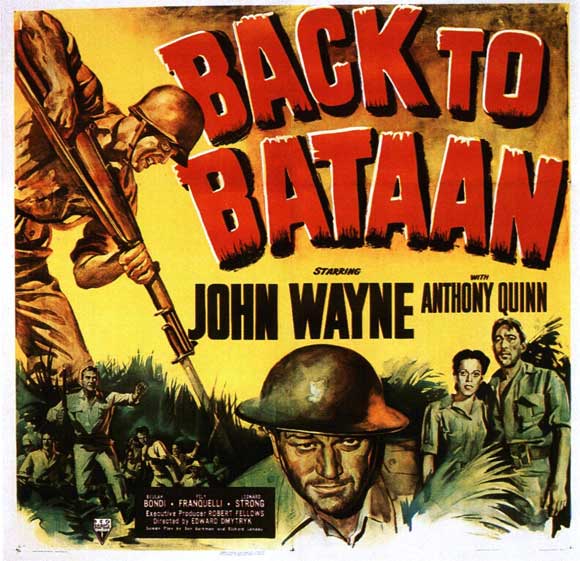
Yes, Back to Bataan is flag-waving agitprop. Yes, it features Anthony Quinn as a Filipino. But under the direction of Edward Dmytryk it’s all done really well. There are a number of gripping battle sequences, and John Wayne in his late 30s was still a lean, mean, ass-kicking machine. The human drama is a little stilted and the politics are simplistic, but when the bullets are flying, Back to Bataan delivers the goods.

The film begins with a battle sequence that depicts the raid at Cabanatuan, a Japanese POW camp, that took place on January 30, 1945. At the time the film was made, the raid was a current event, and was one of the big Allied successes in the Pacific theater. (Filipino guerrillas, Alamo Scouts, and US Army Rangers liberated more than 500 prisoners of war.) After the big opening battle, the film moves back in time to 1942, and tells the story leading up to the raid and the freeing of the POWs. Col. Joseph Madden (Wayne), voluntarily stays in the Philippines after Gen. Douglas MacArthur and his armies pull out. Madden teams up with Filipino guerrilla forces, training them and organizing them. One of his officers, Capt. Andrés Bonifácio (Quinn) is struggling to live up to the reputation of his grandfather, who was a national hero and liberator of the Philippines from Spanish colonial rule. And if that weren’t enough, Capt. Bonifácio’s former fiancée, Dalisay Delgado (Fely Franquelli) has apparently turned traitor, since she now makes regular radio broadcasts radio for the Japanese. Every time he’s near a radio, Capt. Bonifácio has to hear his sweetheart’s mellifluous voice spouting ugly Axis propaganda. Madden, of course, knows that Delgado is actually passing code through these broadcasts, but he’s ordered by his superiors not to tell Bonifácio, so Madden must use all of his skills as a commander to whip Bonifácio into shape and make him a leader of men, no matter how much Bonifácio’s heart may be breaking.

There are conflicting reports of how well Wayne got along with director Dmytryk and screenwriter Ben Barzman, both of whom had communist views. According to Barzman’s wife, they had a humorously antagonistic relationship due to their very different politic views, jokingly calling each other “goddamned communist” and “fascist.” Apparently Barzman and Dmytryk also enjoyed tormenting Wayne, who refused to use a stunt double, by devising scenes that would test his limits. Whether or not this was a friendly game, the results are sometimes stunning. There’s a scene in which Wayne is hugging the ground. A shell explodes right next to him, and his body is flung high into the air and dropped at least 20 feet away. If you rewatch the scene, you can see the wires attached to Wayne’s body, but during the first viewing, when you’re not expecting it, it’s a stunning effect.

The film ends with triumphant footage of some of the real men who were prisoners of war at Cabanatuan. They march together, filmed at low angles, while their names, ranks, and cities of origin are displayed on the screen. After seeing so many Hollywood actors playing soldiers in World War II, it’s interesting to see some of the real men who served. Some of them are handsome enough to have played in the movies. Some aren’t. Almost all of them look relieved and happy, but close to being emaciated. All of them, that is, except for one guy from Chicago who’s really fat and looked deliriously happy. I wonder what his secret was.

The Clock (May 25, 1945)

TheClockThe Clock is the first film Judy Garland made in which she did not sing. She had specifically requested to star in a dramatic role, since the strenuous shooting schedules of lavish musicals were beginning to fray her nerves. Producer Arthur Freed approached her with the script for The Clock (also known as Under the Clock), which was based on an unpublished short story by Paul and Pauline Gallico. Originally Fred Zinnemann was set to direct, but Garland felt they had no chemistry, and she was disappointed by early footage. Zinnemann was removed from the project, and she requested that Vincente Minnelli be brought in to direct.

The Clock is the second film that Minnelli directed that starred Garland. The first was Meet Me in St. Louis (1944), which is one of the great American musicals, a big, Technicolor production with memorable songs and fine performances. It’s worth seeing, even if you’re not crazy about musicals. Minnelli and Garland were involved romantically during the filming of Meet Me in St. Louis, and they were married on June 15, 1945, shortly after The Clock was released.

The Clock seems like a deliberate attempt to make a film as different from Meet Me in St. Louis as Minnelli was capable of making. Filmed in crisp, luminous black and white, The Clock is an intimate story of two people. Cpl. Joe Allen (Robert Walker) is on leave in New York City for the weekend. While trying to find his way around Pennsylvania Station, he meets Alice Mayberry (Garland), a Manhattan “girl next door” who works in an office and isn’t initially thrilled that Joe takes in interest in her. She breaks her heel and he offers to help her, but he’s so pushy that it’s a bit of a turn-off. He refuses to take “no” for an answer, following her onto a bus, questioning her incessantly, and attempting to arrange to see her again. He also does it in such a naïve, corn-pone manner that it’s obvious that a polite girl like Alice would have a really hard time just telling him to shove off. Part of the problem, for me at least, is that Walker just doesn’t have the necessary charisma to pull off the “aw shucks” persona the script calls for and get away with it. In any case, after some indecision (and after ignoring her roommate’s advice that the young serviceman she met is “just looking for a pick-up”), she goes back to the Astor Hotel to meet him under the clock where they first met. They spend the entire night together, exploring New York City, and even end up helping a milkman (James Gleason) make his appointed rounds after a drunk (Keenan Wynn) punches him in the face, partially blinding him. Over the course of the night, they fall in love, but are separated on a busy subway the next morning. How will they ever find each other in a city of seven million people? (I don’t want to give anything away, but the way they find each other again won’t come as a surprise to anyone who’s been paying attention.) After they reconnect, Joe asks Alice to marry him, and she accepts his proposal, but they have to run through a mess of red tape to get the necessary documentation to get married immediately, before Joe has to ship out again.

The Clock has a lot to recommend it. Garland looks beautiful, and her performance is natural and engaging. Walker only has one mode, “wanting Alice,” but Garland wonderfully expresses confusion, excitement, and ambivalence on her path to falling in love. Also, the film does a good job of playing through the stages of love, from initial infatuation to full-blown romantic love, marriage, and even the quiet vicissitude of the “morning after.” The film looks fantastic. Minnelli recreated New York City on the MGM backlots in Culver City, California, mixing sets with stock footage, but I never realized this while watching the movie, and I live in New York. He reportedly spend almost $70,000 recreating Penn Station, and it certainly doesn’t look like a set. (The original Penn Station was torn down before I was born so I can’t say if it’s perfectly accurate, but it certainly fooled me.) I liked The Clock, and would recommend it to anyone who likes old movies, especially anyone who loves tales of wartime romance, but a more interesting actor than Walker in the lead role might have elevated it to a truly great film.

This is a love story, but it’s a melancholy one, especially during its second half. I’m not sure if the sense of sadness that pervades the film is by design, or is due to the fact that both stars were plagued with personal problems throughout filming. Garland became increasingly addicted to the prescription drugs the studio gave her to control her weight and perk her up, and Walker had recently found out that his wife, actress Jennifer Jones, had been cheating on him with producer David O. Selznick and wanted a divorce. Reportedly, Garland would often find Walker drunk in L.A. bars during filming and she would help him sober up during the night so he could appear in front of the cameras the next day.