Category Archives: 1948

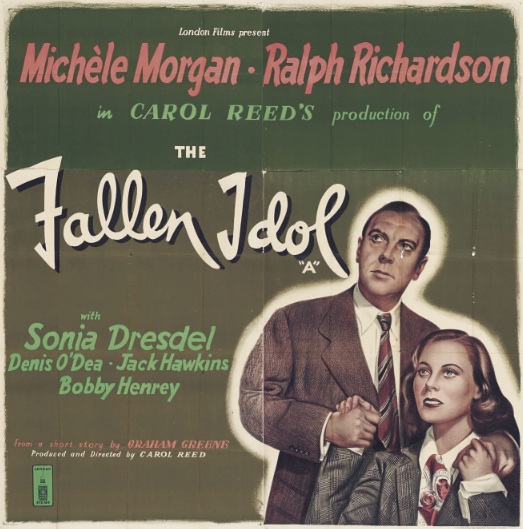
The Fallen Idol (Sept. 30, 1948)

The Fallen Idol
The Fallen Idol (1948)
Directed by Carol Reed
London Film Productions / British Lion Film Corporation

When producer Alexander Korda introduced director Carol Reed to writer Graham Greene, it was the beginning of a fruitful collaboration that would produce Reed’s most enduring film, The Third Man (1949).

But before they made that classic, Greene and Reed collaborated on an equally masterful film, The Fallen Idol, which Greene adapted from his short story “The Basement Room.” (Lesley Storm and William Templeton contributed additional dialogue to the script.)

The Fallen Idol is a tale of lies, deception, and half-truths as seen through the eyes of a young boy named Phillipe who lives in the French Embassy in London.

Phillipe — or “Phile,” as he’s more commonly called (it’s pronounced the same as the name Phil) — is played by Bobby Henrey, a nonprofessional actor who was 8 or 9 years old during filming.

This was the first time I’d seen The Fallen Idol, and while I was watching it I was struck by what an unaffected and natural performance Henrey delivered. The events of the film are seen mostly from Phile’s perspective, and his performance is central to the movie’s effectiveness.

So I was surprised when I watched the 2006 documentary short A Sense of Carol Reed and learned that Henrey’s “performance” was largely created by Reed and his editor, Oswald Hafenrichter.

In the documentary, Guy Hamilton, the assistant director of The Fallen Idol, recalled of Henrey, “He couldn’t act his way out of a paper bag. Much worse was his attention span, which was of a demented flea.” According to Hamilton, they’d sometimes shoot thousands of feet of film to get just one line from Henrey.
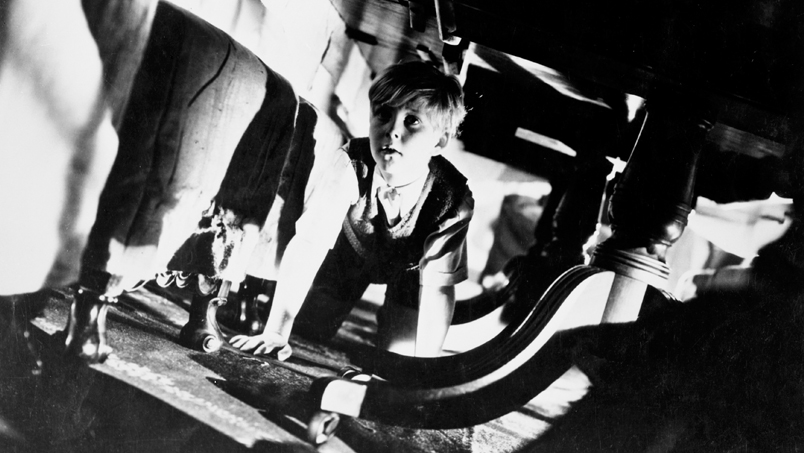
Bobby Henrey

Reed was patient and had a tremendous facility for directing actors of all ages. He never humiliated actors or cut them down in front of the crew. If he was unhappy with a take, he’d rarely yell “Cut!” until the actor had left the frame. On the occasions that he did, he’d do it in a tricky fashion, such as taking a nail from his pocket, dropping it on the floor, then calling out, “Cut! Can we have quiet, please?” Then he’d quietly say something to the actor like, “Since we have to start over anyway, perhaps you could…” — and get the performance he wanted that way.

I don’t think The Fallen Idol would be as brilliant as it is had it starred a seasoned child actor capable of memorizing pages of dialogue. Henrey may have been frustrating to work with, but all that matters is what’s up on screen. Phile seems like a real child, not an adorable singing-and-dancing moppet with a studio contract.

Phile’s parents spend very little time with him, and his only friend in the embassy is his father’s butler, Baines (Ralph Richardson).

Phile’s nemesis is Baines’s wife, Mrs. Baines (Sonia Dresdel), a strict, cruel woman who has no patience for Phile’s antics or his little pet snake, MacGregor.

One day, Phile follows his father figure to a café, where Baines is meeting a young French woman named Julie (Michèle Morgan). And just like that, Phile becomes an accomplice to his hero Baines’s infidelity. He doesn’t fully realize what’s going on — he believes that Julie is Baines’s niece and Baines doesn’t disabuse him of the notion — but any time a child is told by an adult, “No one needs to know about this,” the child will realize that something isn’t quite right.

The film continues in this vein, and the layers of secrecy and deception build until Phile finally believes he has seen Baines do something truly horrid, and he clumsily tries to help his friend by lying to the police for him.
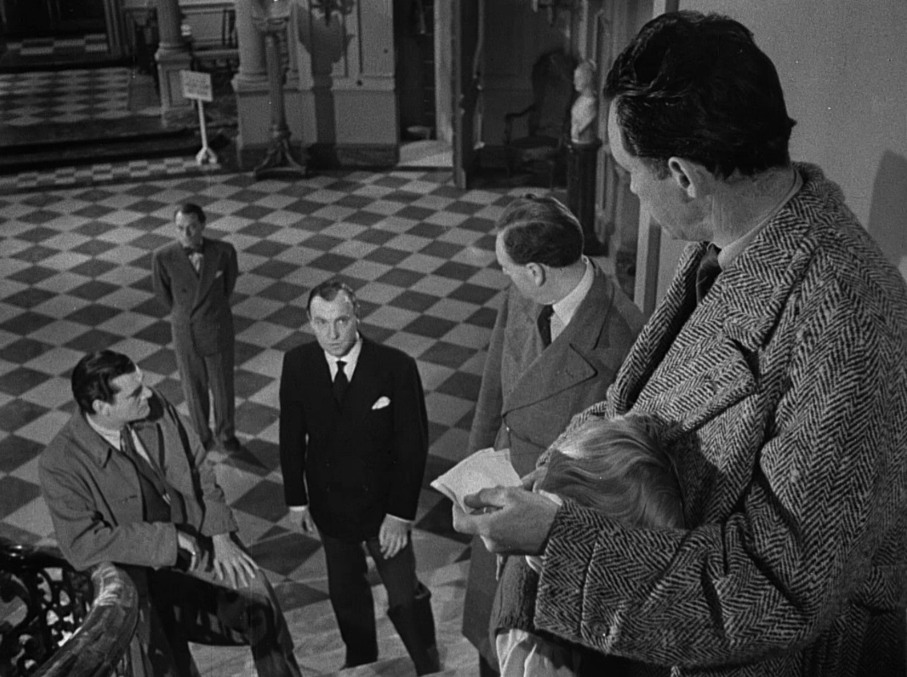
Ralph Richardson

The Fallen Idol is a great film. Vincent Korda’s set design is marvelous, and the spacious interiors of the embassy are as much a character in the film as any of the actors. Georges Périnal’s cinematography is full of unsettling Dutch angles and gorgeous chiaroscuro lighting. All the actors are wonderful, but Ralph Richardson’s performance is pitch perfect — he’s so kind and charming that we can easily see why Phile idolizes him, and when we begin to see the small, tragic man beneath the warm exterior, it’s heart-breaking.

The Fallen Idol is tragic and moving in parts, but Reed and Grahame also have a very light, wry touch, and there’s a great deal of humor and irony in the film. If you’ve never seen it, by all means do so. If you want to make a triple bill of it, first watch Odd Man Out (1947), then The Fallen Idol (1948), and finally The Third Man (1949). They’re as brilliant a trio of films as any director has ever made.
Louisiana Story (Sept. 28, 1948)

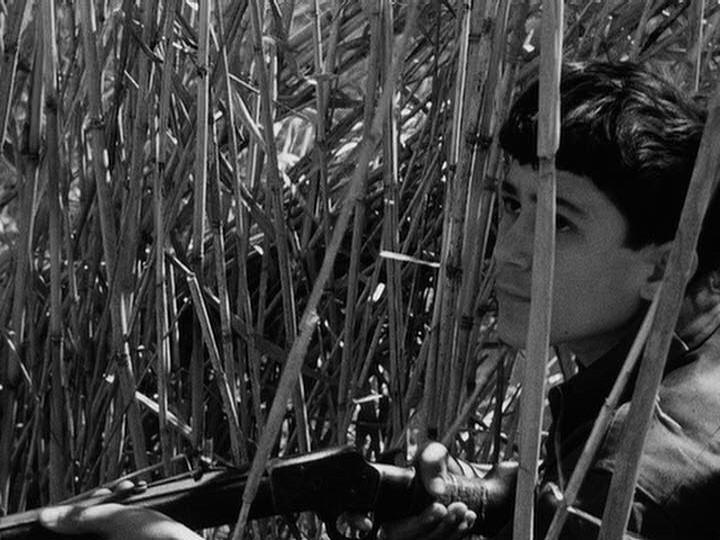
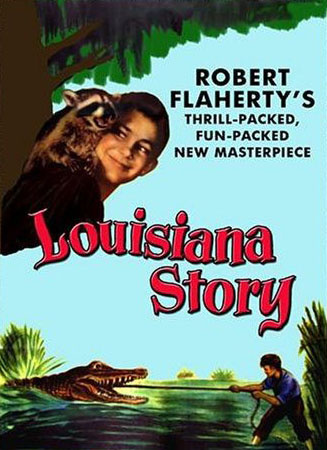
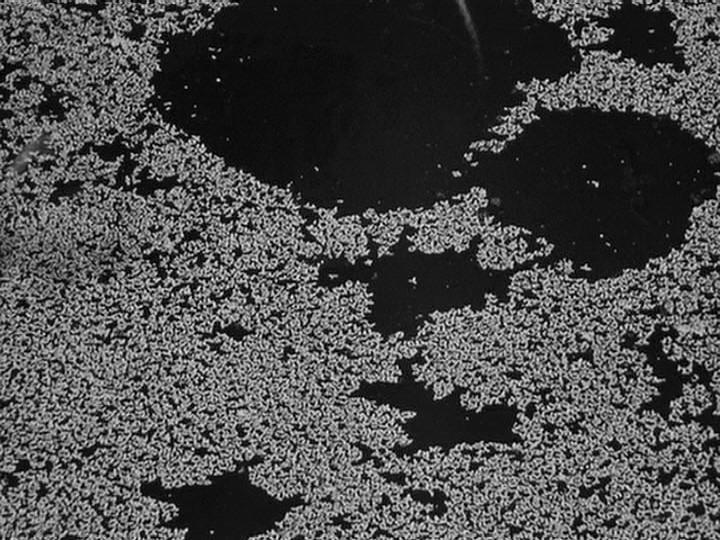
Louisiana StoryThe term “visually arresting” gets thrown around a lot, but I can’t think of any other way to describe Robert J. Flaherty’s Louisiana Story, which was shot by cinematographer Richard Leacock.

I rented Louisiana Story and wasn’t expecting to watch all of it when I first put on the DVD. But from the very first shot of the film, I was unable to move, and watched the film from beginning to end.

I think a lot of people have the sense that black and white is just a low-budget necessity, and that viewers would be able to go even deeper into the world of a film if only it were in beautiful, lifelike color. But Louisiana Story is beautiful precisely because it is gorgeously unreal.

The entire film looks like a photograph by Ansel Adams come to life. Louisiana Story is filmed like a documentary — with all nonprofessional actors — and it’s a shimmering, luminescent, and uncanny view of reality.

It follows a Cajun boy named Alexander Napolean Ulysses Latour (Joseph Boudreaux), who is about 13 years old and spend his days in the idyll of the swamp, rowing his canoe, fishing, shooting, and imagining he sees werewolves behind the trees and mermaids below the water. His father is played by Lionel Le Blanc and his mother is played by Mrs. E. Bienvenu.

Mermaids

Early in Louisiana Story, the quiet of the swamp is rocked by an explosion from a wildcat oil well. The film follows the boy as he rows around the oil derrick, makes friends with the men who work on it, and whiles away his days with his pet raccoon, occasionally running afoul of alligators.

Robert J. Flaherty is best known as the documentary film pioneer who made Nanook of the North (1922) and Man of Aran (1934).

Louisiana Story was Flaherty’s last film. It was commissioned by the Standard Oil Company, which is ironic. The oil workers are all friendly with the young protagonist, and the way Flaherty and Leacock shoot the oil rig is just as beautiful in its own way as the way they shoot the boy’s languorous days in the swamp. But with the constant contrasting between nature and the disruption of nature that the oil well represents, Louisiana Story doesn’t ever feel like a promotion for the petroleum industry.

Joseph Boudreaux

Robert J. Flaherty and his wife Frances H. Flaherty were nominated for an Academy Award for Best Story for Louisiana Story.

I’d be remiss if I didn’t mention the brilliant score for the film by American composer Virgil Thomson. In 1949, Thomson won the Pulitzer Prize for Music for his score for Louisiana Story. His score was inspired by a field tape of Cajun musicians and was performed by the Philadelphia Symphony under the direction of Eugene Ormandy. It’s unlike any other film score I’ve heard from the 1940s and is the perfect accompaniment to the poetic visuals.

Road House (Sept. 22, 1948)

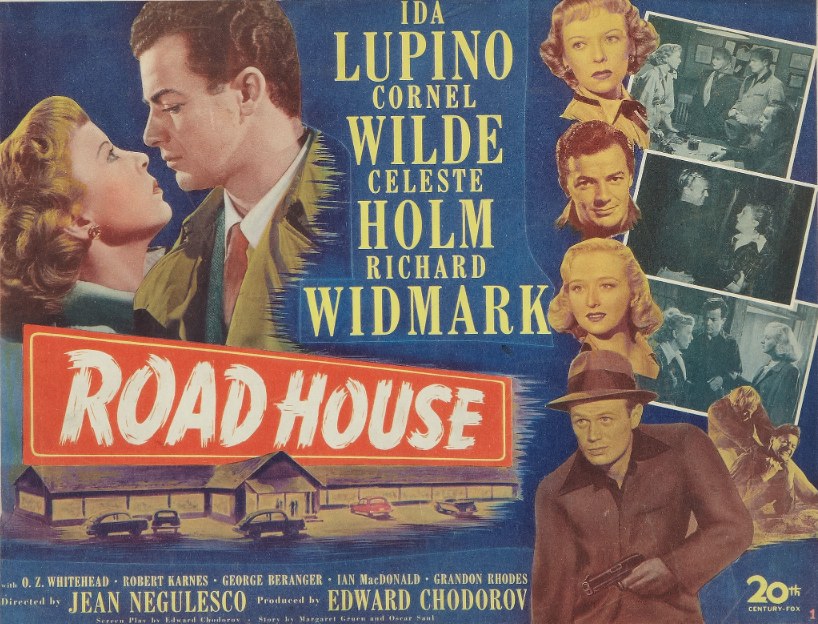
Road HouseThe second feature in our Jean Negulesco double bill is a tad less serious than the first.

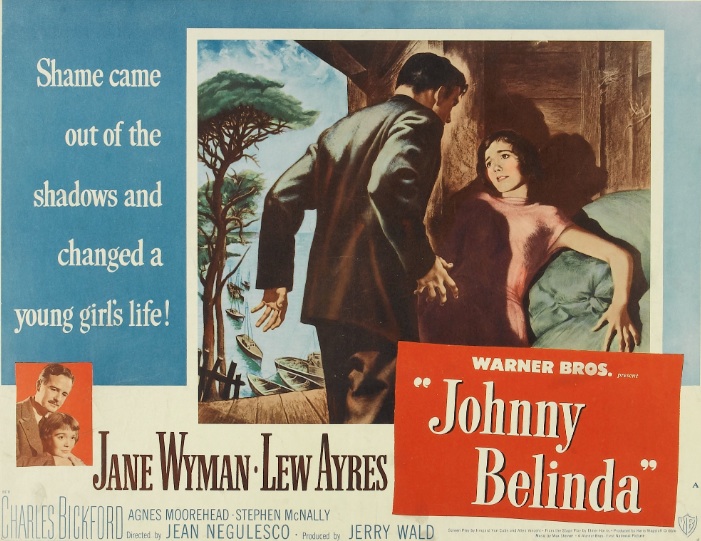
Negulesco’s film Johnny Belinda (1948) is the story of a poor, uneducated deaf-mute girl played by Jane Wyman. It was nominated for 12 Academy Awards, and won one — Wyman took home the Oscar for Best Actress.

Road House, on the other hand, was nominated for zero Academy Awards.

But they’re both very good films, and watched back to back, they really show Negulesco’s facility with both A-quality material and B-quality material.

A truly good potboiler is as hard to pull off as a truly good drama is, and Road House is a truly good potboiler.

In an interview he gave in 1969, Negulesco recalled being given the assignment to direct Road House by 20th Century Fox studio head Darryl F. Zanuck. Negulesco said that Zanuck told him, “This is a bad script. Three directors have refused it. They don’t know what they’re doing, because basically it’s quite good. Remember those pictures we used to make at Warner Bros., with Pat O’Brien and Jimmy Cagney, in which every time the action flagged we staged a fight and every time a man passed a girl she’d adjust her stocking or something, trying to be sexy? That’s the kind of picture we have to have with ‘Road House.'”

Negulesco knew exactly what kind of picture he was directing, and he directed the hell out of it. The first shot of Lily Stevens (Ida Lupino) shows her with her bare leg up on a desk. She’s dealing cards alone, and there’s a smoldering cigarette next to her bare foot.

Lupino was smart, sexy, and talented, and she’s a joy to watch in Road House. When she played a singer in The Man I Love (1947), all of her performances were dubbed by Peg La Centra, but this film finally gave moviegoers an opportunity to hear her real singing voice. As Susie Smith (Celeste Holm) says in the film, “She does more without a voice than anybody I’ve ever heard.”

Lupino may not have been the most impressive chanteuse working in Hollywood, but when she sings “One for My Baby and One More for the Road” in Road House, it’s an emotional scene that tells us more about her character than pages of expository dialogue ever could.

http://www.youtube.com/watch?v=h1Q71t5D8ko

Besides the lovely Lupino and the talented Holm, Road House also features chiseled hunk Cornel Wilde. My favorite scene is the one in which he gives Lupino the angriest, most sexually charged bowling lesson I’ve ever seen in a film.

And last but not least, Road House was the third time Richard Widmark appeared on film, and it was the third time he played a memorable villain. He plays Jefferson T. “Jefty” Robbins, the owner of the juke joint that gives the film its name, and his character is a scheming chump who just can’t take no for an answer.

Johnny Belinda (Sept. 14, 1948)

Johnny BelindaJean Negulesco’s acclaimed film Johnny Belinda stars Jane Wyman as a deaf-mute girl named Belinda McDonald who lives on the island of Cape Breton in Nova Scotia. Wyman was awarded an Oscar for her performance at the 21st Academy Awards on March 24, 1949.

Johnny Belinda is based on Elmer Blaney Harris’s play of the same name. Harris was 62 years old when Johnny Belinda opened on Broadway in 1940. He was a busy man, and by that point in his career he had many plays, films, and screenplays under his belt. Even so, it can’t have been easy for him when the play was savaged by critics. Richard Watts of the New York Herald Tribune dismissed Johnny Belinda as “cheap melodrama” that was full of “shameless sentimentality.” Brooks Atkinson, drama critic for the New York Times, was even less kind when he wrote the following:

Now that Johnny Belinda has reached the stage, there may not be enough drama left to last through the rest of the season. Elmer Harris has shot the works in one evening at the Belasco Theatre. The mortgage is in it; also seduction, childbirth, death by lightning, murder by shotgun, a snowstorm, a Canadian Mounted in scarlet uniform and a court room scene. As minor diversions Mr. Harris throws in a lesson on grinding grain on a water wheel and a scene with a spinning wheel. Being a thorough workman, he also includes the kitchen stove and the kitchen sink.

I’ve never seen the stage play version Johnny Belinda, so I can’t say how sensationalistic or melodramatic it is, but Negulesco’s film version is an excellent piece of work. He took controversial material that could have easily become histrionic twaddle in the hands of a lesser director and used it to craft a deeply affecting movie.

Johnny Belinda has a terrific sense of place. Ted D. McCord’s stark cinematography depicts a windswept, beautiful landscape populated by desperately poor, uneducated people. (McCord was nominated for an Oscar for Best Cinematography, Black and White.) Max Steiner’s Oscar-nominated score reflects the mostly Scottish heritage of the people of Cape Breton.

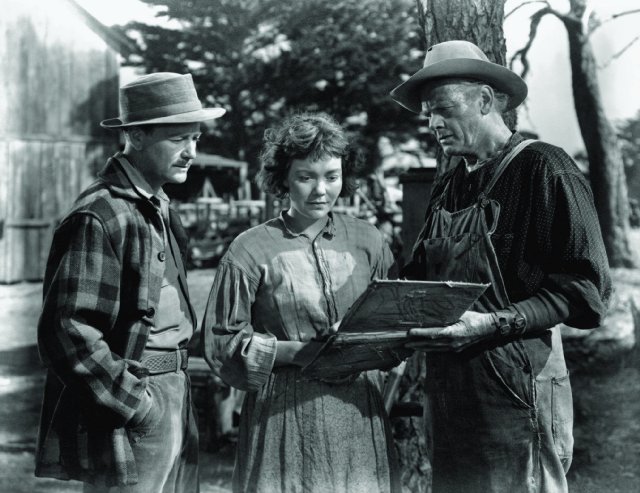
Ayres, Wyman, and Bickford

Much of the success of Johnny Belinda is due to its actors. Wyman deservedly won the Academy Award for Best Actress for her role as Belinda, beating out Irene Dunne in I Remember Mama, Barbara Stanwyck in Sorry, Wrong Number, Ingrid Bergman in Joan of Arc, and Olivia de Havilland in The Snake Pit.

Lew Ayres (nominated for a Best Actor Academy Award) plays Dr. Robert Richardson, the deeply caring physician who teaches Belinda sign language. Charles Bickford (nominated for a Best Supporting Actor Academy Award), plays Belinda’s father, Black MacDonald. Agnes Moorehead (nominated for a Best Supporting Actress Academy Award), plays Belinda’s aunt, Aggie MacDonald. And Stephen McNally, who plays the vicious brute who rapes Belinda, is a despicable villain of the first order.

Johnny Belinda received 12 Academy Award nominations — the most of any film in 1948 — but it only took home one Oscar; Wyman’s award for best actress. I think Johnny Belinda is an excellent, well-acted film. My only reservation about it is the use of a dummy in a murder scene that is one of the most egregiously awful things I’ve ever seen. If you can overlook that (and I can … mostly) and accept that its treatment of its themes are of its time and place, then Johnny Belinda is a film worth seeking out.

Johnny Belinda will be shown on TCM on Thursday, April 11, 2013, at 2:45 PM ET.

The Red Shoes (Sept. 6, 1948)

The Red ShoesMichael Powell and Emeric Pressburger’s The Red Shoes was inspired by Hans Christian Andersen’s 19th-century fairy tale about a girl who can’t stop dancing after she puts on a pair of magical red shoes. An angel appears and tells her she will continue to dance after death as a warning to vain children everywhere. Her feet keep dancing in the red shoes even after they are amputated.

It’s a potentially wonderful parable for the way ballet dancers suffer for their art, but as a cinematic experience, The Red Shoes left me wanting. I’ve been hearing for most of my life about how wonderful this film is, but for me it was the most disappointing production from Powell and Pressburger that I’ve seen so far.

That’s not to say that I didn’t like it, but I had very high expectations, and I felt let down.

In terms of Powell and Pressburger’s filmography, The Red Shoes lacks the warm, human drama of I Know Where I’m Going (1945) and the sublime comedy of a film like A Matter of Life and Death (1946). It’s most similar to Black Narcissus (1947), in which lush visuals eroticized a slight story.

The Red Shoes is beautiful to look at, and the dancing is marvelous, but the story never completely captured my interest, and I found the performances of the actors campy and overblown.

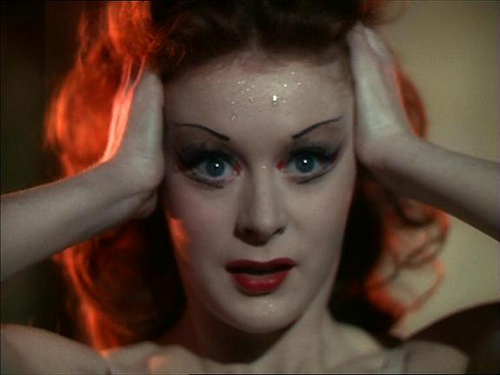
The intense, youthful-looking 51-year-old Austrian actor Anton Walbrook plays composer and ballet impresario Boris Lermontov, the head of the Ballet Lermontov. For him, dance is a religion, and when Lady Neston (Irene Brown) tries to get him to watch her niece dance at a party, he witheringly replies that he doesn’t care to see his religion practiced “in an atmosphere such as this.”

Her niece has real talent, however, and she soon becomes one of Lermontov’s principal dancers. Her name is Victoria Page (“Vicky” for short), and she’s played by the beautiful red-haired ballerina Moira Shearer.

Shearer

Powell and Pressburger wisely chose to cast real ballet dancers who could act a little, rather than actors who could do a little ballet. For the most part it works, but except for Shearer — whose performance in The Red Shoes I find quite wonderful — the ballet dancers don’t have a lot of range as actors.

When there’s no dancing going on in The Red Shoes, things feel a little lifeless. The film is ostensibly about Vicky being torn between her love for the “attractive brute” Lermontov and her love for the young composer Julian Craster (Marius Goring), whose creativity is burgeoning as Lermontov’s is failing. I never felt compelled by either of these relationships, however, and it didn’t help that I found Goring utterly devoid of charisma. It also doesn’t help that this plot device kicks in too late in the film to feel authentic.

The Red Shoes is a visual feast with some wonderful ballet sequences, but dramatically, I found it sodden and overlong.

Bodyguard (Sept. 4, 1948)

Bodyguard
Bodyguard (1948)
Directed by Richard Fleischer
RKO Radio Pictures

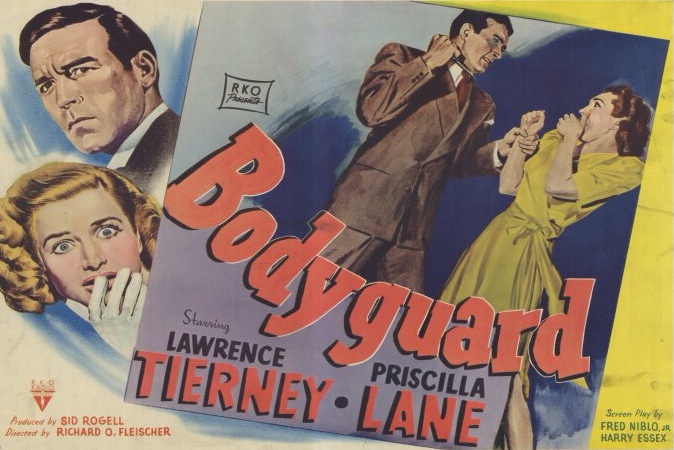
Richard Fleischer’s Bodyguard features Lawrence Tierney doing what Lawrence Tierney did best — knocking down everyone and everything that gets in his way.

In the first sequence of the film, LAPD detective Mike Carter (Tierney) is reprimanded by his lieutenant (played by Frank Fenton) for using his knuckles instead of his brain. Before Mike even has a chance to plead his case to the captain, the lieutenant informs him that he’s already talked to the captain on Mike’s behalf and that Mike is suspended effective immediately.

So Mike uses his knuckles instead of his brain and gets into a glass-breaking fistfight with his lieutenant.

When Mike and the lieutenant are gearing up to throw punches, the film cuts back and forth between the two men as they both step closer to the camera, eventually getting so close their noses are almost touching the lens.

After Mike is bounced from the force, a man named Freddie Dysen (Phillip Reed) approaches him with a proposition. He’ll pay Mike a $2,000 retainer to act as bodyguard to his aunt, Mrs. Gene Dysen (Elisabeth Risdon).

Who can say no to a $2,000 retainer?

Well, apparently Mike Carter can. He’s got better things to do, like spending time with his cute blond fiancée, Doris Brewster (Priscilla Lane, in her final film role), and playing the ponies down at the track.

But when Mike is framed for murder, he’s forced to get into the action. What do Mrs. Dysen and her meat-packing plant have to do with the murder Mike’s been framed for? And was the accidental death of a plant inspector really accidental?

One thing I love is when a B movie gives its peripheral characters interesting lives that in no way advance the plot. For instance, Bodyguard features a scene in an arcade where Mike tries to get the counter girl’s attention as she chats with a couple of sailors. He doesn’t succeed for awhile, and when he finally does, one of the sailors tries to start a fight with him. Bodyguard runs for barely longer than an hour, and has a dense, twisty plot, but it still finds time for entertaining little moments like that.

It also features a ton of location shooting in Los Angeles and great noir cinematography by Robert De Grasse. Bodyguard is unmistakably designed to be the second feature on a double bill, but it’s well-made, well-acted, and holds up as superior entertainment.

The director, Richard Fleischer, had a long career in Hollywood. He was born in 1916 and Bodyguard was only his fourth feature film (he made a number of documentary shorts in the 1940s as well). To put things into perspective, this is the same man who would go on to make The Narrow Margin (1952), 20,000 Leagues Under the Sea (1954), Fantastic Voyage (1966), Soylent Green (1973), Mandingo (1975), and Conan the Destroyer (1984).

Bodyguard is also notable for being the first time acclaimed director Robert Altman got his name in the credits. The screenplay is credited to Fred Niblo Jr. and Harry Essex, and the story is credited to George W. George and Robert B. Altman.*

Tierney

*Altman also worked on the script for Edwin L. Marin’s Christmas Eve (1947), which starred George Raft, but Altman’s name didn’t appear in the credits.

Sorry, Wrong Number (Sept. 1, 1948)

Sorry Wrong Number
Sorry, Wrong Number (1948)
Directed by Anatole Litvak
Hal Wallis Productions / Paramount Pictures

Lucille Fletcher was the greatest playwright who ever worked in the medium of radio.

Fletcher had an instinctive understanding of radio’s limitations and possibilities. Her dramas were often confined to a single location, never had more characters than the listener could keep track of, and exploited simple but primal fears like helplessness, confinement, and being alone in the dark.

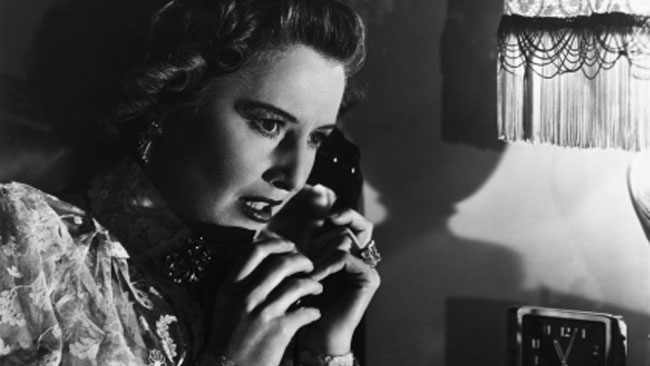
Her most famous radio play was “Sorry, Wrong Number,” which was first broadcast on May 25, 1943, as an episode of the CBS anthology series Suspense. It starred Agnes Moorehead as a bedridden invalid who accidentally overhears a phone conversation between two men who are planning a murder. Distraught, she tries to get the operator to find out where the call came from. When that doesn’t work, she calls the police, but without specific information — she didn’t hear any names or exact places — there isn’t much they can do.

It’s a brilliant setup. Since all the action takes place in a single bedroom and all of the dialogue takes place over the phone, there’s never any confusion about who’s who, or what’s happening. Also, the fact that the story is told completely through sound creates a terrifying sense of intimacy.

“Sorry, Wrong Number” was the most popular episode ever broadcast on Suspense. It was so popular that it was performed seven more times, each time starring Agnes Moorehead; again in 1943, in 1944, in 1945, in 1948, in 1952, in 1957, and for the final time in 1960. (Suspense was on the air from 1942 to 1962.)

Stanwyck

It’s natural that such a popular radio play would be adapted for the big screen, but I wasn’t sure how well it would work expanded to three times its length for a visual medium.

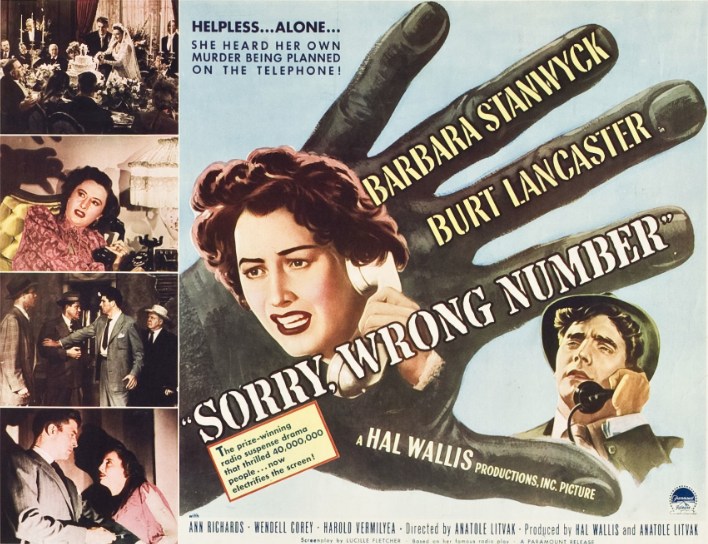
People seem to have mixed feelings about Anatole Litvak’s film version, but I thought it was pretty good. I love Barbara Stanwyck, and she’s a more likeable protagonist than Agnes Moorehead was in the same role on the radio.

I found Sorry, Wrong Number similar in some ways to Robert Siodmak’s film The Killers (1946), which was adapted from the short story by Ernest Hemingway. Both films take a small, perfect little piece of art and expand it into a feature film by adding a bunch of characters and a whole lot of plot that’s not even suggested in the original work. (Incidentally, both films star Burt Lancaster and feature William Conrad in a small but important role.)

How well this works is up to the individual viewer, but I thought that Sorry, Wrong Number worked pretty well as a film. It doesn’t have the same impact as the radio play, but the integrity of the original story remains intact, even though it only occupies the first 15 minutes and the last 10 minutes of the film. The film version also humanizes her husband (played by Lancaster) and turns him into a victim of sorts, which is drastically different from the radio play, in which he is mostly an off-stage presence.

Anyway, I love Lucille Fletcher’s work for radio, so I thought I’d compile a list of some of the shows she wrote scripts for. You can click on the titles below to stream the shows or right-click to download them.

The Hitchhiker (first broadcast November 17, 1941)
This is the June 21, 1946, broadcast of the show on Orson Welles’s Mercury Summer Theatre on the Air. Welles reprises his role as a man driving cross-country who repeatedly see the same hitchhiker on the side of the road, even though there is no possible way the man could be moving from place to place so quickly. The chilling music is by Fletcher’s husband at the time, Bernard Herrmann. Like “Sorry, Wrong Number,” this play was done for radio several times, and was even adapted as an episode of The Twilight Zone in 1960.

The Diary of Sophronia Winters (first broadcast April 27, 1943)
Sophronia Winters (Agnes Moorehead), an unmarried middle-aged woman who is feeling liberated after her father’s death, meets a man named Hiram (Ray Collins) whose sister-in-law was also named “Sophronia.” Hiram marries Sophronia and begins to torment her with tales of the other Sophronia, an ax murderess. This is a claustrophobic, suspenseful story that evokes Charlotte Perkins Gilman’s story “The Yellow Wallpaper,” as well as memories of the real-life case of Lizzie Borden.

Sorry, Wrong Number (first broadcast May 25, 1943)
The original radio version stars Agnes Moorehead and is one of a handful of absolutely indispensable shows if you have any interest in radio drama.

Fugue in C minor (first broadcast June 1, 1944)
Ida Lupino plays a woman in the late Victorian era who is introduced to a widower with two young children. The widower, played by Vincent Price, is a composer, and his children believe that he murdered their mother, and that her spirit is trapped in their father’s organ.

The Search for Henri LeFevre (first broadcast July 6, 1944)
Paul Muni stars as a classical composer who believes his work has been plagiarized and broadcast on the radio by a man named “Henri LeFevre.”

The Furnished Floor (first broadcast September 13, 1945)
Don DeFore plays a man whose wife has died. He moves back into the apartment he used to share with his wife and restores it to exactly the way it was when his wife was still alive. Mildred Natwick plays his landlady.

Dark Journey (first broadcast April 25, 1946)
Nancy Kelly and Cathy Lewis play a pair of old friends who reunite after years apart. One of them is obsessed with a man who has spurned her, and believes that she can make him love her through sheer force of will.

The Thing in the Window (first broadcast December 19, 1946)
Joseph Cotten plays a man who thinks he can see a corpse in the apartment across from him, but he can’t be certain if his mind is playing tricks on him.

As I said, I love Lucille Fletcher’s work, and I hope you will too.

Rope (Aug. 28, 1948)

Rope
Rope (1948)
Directed by Alfred Hitchcock
Warner Bros. / Transatlantic Pictures

Did you know that actor Dick Hogan’s last role was playing a symbolic male orgasm?

It’s true. Hogan — previously mentioned in this blog for his role in Shed No Tears (1948) — was cast in Alfred Hitchcock’s Rope as murder victim David Kentley.

It’s an important role, but a thankless one. As Kentley, Hogan has no lines, and is offscreen for most of the film’s running time.*

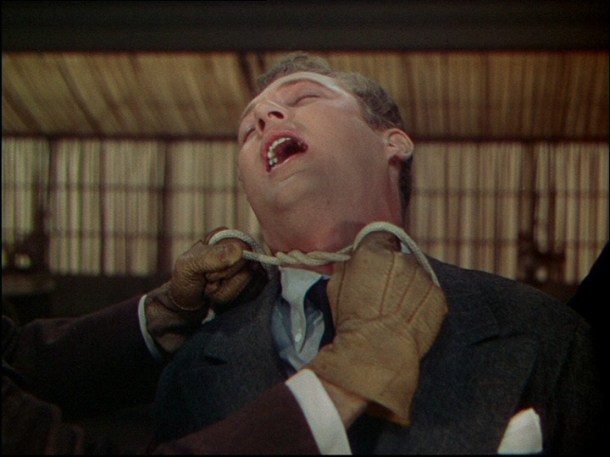
After the film’s opening credits have rolled, we hear his scream, then see him with a rope wrapped around his neck at the moment he is dying. He’s being murdered by a pair of thrill-killers named Brandon (John Dall) and Phillip (Farley Granger) who consider themselves “superior” and most everyone else — including their friend David — “inferior.”

Rope is based on a 1929 play written by British playwright Patrick Hamilton. Brandon and Phillip are thinly veiled versions of Leopold and Loeb, the infamous thrill-killers who in 1924 murdered a 14-year-old boy in an attempt to commit a “perfect crime.”

Leopold and Loeb were law students at the University of Chicago. Both came from wealthy families, and both had muddled ideas about Nietzsche’s concept of the “superman” and their own superiority.

Long story short, their crime was far from perfect, and they were arrested and put on trial. Leopold and Loeb were represented by Clarence Darrow, who was a staunch opponent of capitol punishment. The jury found them guilty and the judge sentenced the two young men to life in prison for murder, plus 99 years for kidnapping. Loeb was killed by another inmate in 1936, but Leopold was eventually paroled in 1958, after 33 years in prison. He died in 1971 of natural causes.

Dick Hogan

But back to the fictionalization of their crime, and that symbolic male orgasm I mentioned at the beginning.

I’m sure some will accuse me of “reading too much into” the film or seeing something that isn’t there, but I think anyone who reads up on the Leopold and Loeb case and then immediately watches Rope will find it impossible not to notice the homosexual undertones. Also, Hitchcock is one of the most self-aware filmmakers of all time, and he was fascinating by unconventional sexuality.

The very first scene — the murder — is a symbolic orgasm shared by the murderers; strangled, intense, and shameful.

The murder is a stand-in for a sexual encounter between Brandon and Phillip. Phillip doesn’t want to turn the lights on right away. “Let’s stay this way for just a minute,” he says, and Brandon lights up a post-coital cigarette. “We couldn’t have done it with the curtains open in the bright sunlight.”

This is about as explicit as a film from 1948 could be when exploring gay sex and gay desire.

Add to this the fact that the two young men are most in danger of being found out by book publisher Rupert Cadell (James Stewart), who was the boys’ headmaster in prep school. The theme of naughty little boys possibly being found out and punished by a boarding-school authority figure is just one of the many skillful pieces of homosexual innuendo that Hitchcock sprinkles throughout Rope.

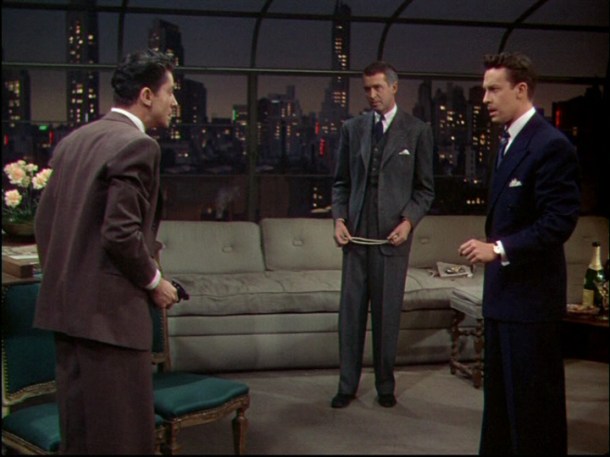
Granger, Stewart, and Dall

Rope is one of Hitchcock’s most impressive technical stunts. He filmed the action in long takes, like a play. Most of the cuts are necessitated by the length of film reels, and are done as seamlessly as possible (e.g., an actor passes in front of the camera, darkening the frame for a moment to facilitate a cut). Most of the action of Rope takes place during a dinner party at Brandon and Phillip’s apartment. They’ve arranged a buffet on top of the trunk in which David Kentley’s corpse has been hidden.

I don’t normally like films adapted from plays, but I love Rope. Stage plays are very different from screenplays, and I think the problem with most play-films is that something seems very, very “off” about the dialogue and the way the characters appear, disappear, and reappear in physical space. By filming Rope exactly like a play, however, Hitchcock ironically created a very exciting movie that works extremely well. There’s a creepy sense of intimacy created by the single setting and the actors all playing off each other without a cut every few seconds. And of course, the fact that every line in the film is colored by the viewer’s knowledge that the corpse of David Kentley is hidden away under everyone’s nose.

The way the film moves from day to night is eerie and impressive, too. The backdrop of the film is an enormous window that looks out over Manhattan, and as the film moves forward in time the sky grows darker and lights come on in the buildings and smoke curls from little smokestacks.

Rope should be seen at least once by everyone who has any interest in how films are made. And for people who love Hitchcock’s gruesome playfulness and gallows humor, it’s a film to be savored over and over.

*Interestingly, Hogan has a speaking role in the film’s trailer, but never utters a word in the film itself. Hitchcock’s films always had some of the most inventive trailers, and Rope is no exception:

Red River (Aug. 26, 1948)

Red River
Red River (1948)
Directed by Howard Hawks
United Artists

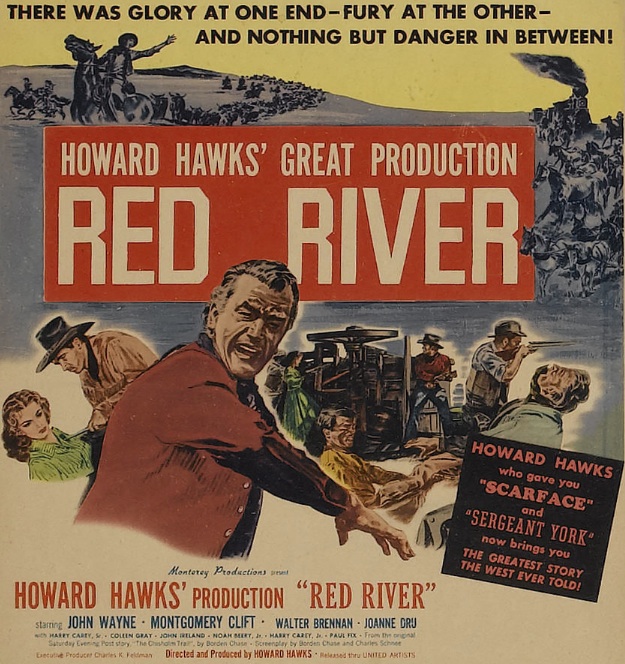
Howard Hawks shot Red River in 1946, but its release was delayed due to legal difficulties. The eccentric Howard Hughes contended that parts of Red River were taken from his “lust in the dust” western The Outlaw (1943), which starred Jane Russell and her magnificent breasts.

Anyone who’s seen both Red River and The Outlaw can tell you that any claim of story infringement is spurious, but there was bad blood between Hughes and Hawks (Hawks had worked on The Outlaw as an uncredited co-director), and it took until August 26, 1948, before Red River finally had its premiere.

So while Fred Zinnemann’s The Search (1948) was the film that introduced many moviegoers to Montgomery Clift, Red River was his first acting role in a feature film.

Clift was a born movie star. He was achingly handsome, rail-thin, and blessed with a uniquely vulnerable type of masculinity. On screen, he had a presence that seemed completely natural. Red River is a phenomenal western that works on a number of different levels, but one of its most important aspects is the relationship between Clift and the film’s star, John Wayne.

Wayne and Clift were on opposite ends of the spectrum in every way imaginable; politically, professionally, physically, and sexually. But it’s this contrast that makes Red River work so well.

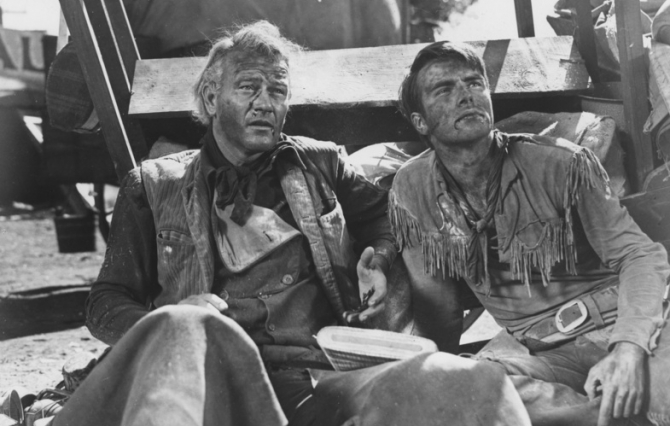
Wayne and Clift

Red River is the story of a cattle drive along the Chisholm Trail up from Texas. Thomas Dunson (John Wayne) is a big, tough cattleman who took his land by force.

When Dunson was first establishing his grazing land with his best friend Nadine Groot (Walter Brennan), the woman Dunson loved (Coleen Gray) was murdered by Comanches, and he never loved another.

The sole survivor of the massacre, a young man named Matt Garth (played as a boy by Mickey Kuhn) came wandering through the land, leading a cow. Dunson’s bull mated with Garth’s cow, and from this union eventually grew a herd of more than 10,000 longhorns.*

Fourteen years pass, and Garth grows up, now played by Montgomery Clift. The Civil War has ended, and Dunson is no longer able to sell beeves to the impoverished southern states. He decides that he’ll drive his entire herd north to Missouri, where they’ll fetch a fortune. He’s spent his life building his empire, and he wants to pass it down to Matt Garth, his protégé.

The only problem is that Dunson’s greatest strength — his unbending will — is also his greatest weakness, which eventually puts him at loggerheads with the more even-tempered and empathetic Garth.

John Wayne and Montgomery Clift

Borden Chase, who wrote the Saturday Evening Post story on which Red River was based (as well as the screenplay for the film with Charles Schnee), drew liberally from Mutiny on the Bounty in crafting his story.

Despite the fact that his middle name was “Winchester,” this was Howard Hawks’s first directorial credit for a western, which is remarkable considering he’d been directing films since the 1920s and had more than one masterpiece under his belt.

In addition to his own estimable talents as a director, Hawks had some of the finest crew members who ever worked on a Hollywood western when he made Red River. Composer Dimitri Tiomkin’s score is epic. Editor Christian Nyby’s cutting drives the film forward with relentless intensity. And cinematographer Russell Harlan had toiled away for years working on B pictures (mostly westerns) before finally breaking into A pictures with Lewis Milestone’s war movie A Walk in the Sun (1945). He went on to become one of the best cinematographers in the business, and his work on Red River is proof.

Red River is one of the greatest westerns ever made. As I said above, it works on a number of different levels. At its most basic level, Red River is a rousing adventure film about men on a dangerous mission, struggling against the elements and against each other. But on a deeper level, it’s a timeless myth about fathers and sons.

Red River will be shown on TCM this Friday, March 1, 2013, at 10:15 PM ET.

*If you’re a fan of sexual innuendo in old movies, the scene in Red River in which Matt Garth and gunslinger Cherry Valance (John Ireland) compare revolvers is a classic. Many see a gay subtext, which could be there, but gay men hardly have a monopoly on comparing phalluses to see whose is bigger. I think the sexual bonding between men in Red River goes much deeper. Remember that the herd being driven up the Chisholm Trail in Red River are all descended from the union between John Wayne’s bull and Montgomery Clift’s cow. Even though Dunson and Garth are not blood relations, they are bound together.

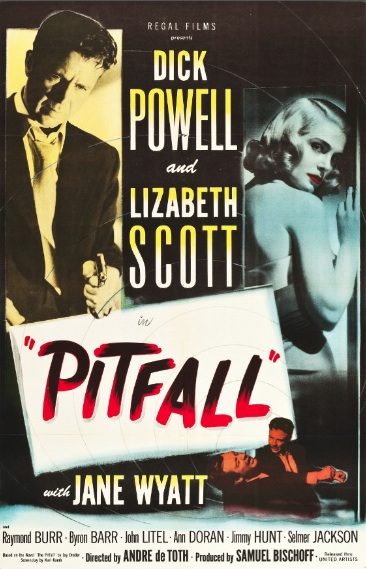
Pitfall (Aug. 24, 1948)

PitfallOne man’s domestic bliss is another man’s prison.

John Forbes (Dick Powell) has what some men only dream of — a home; a steady job with the Olympic Mutual Insurance Company; an attractive, intelligent, and loving wife (Jane Wyatt); and a son (Jimmy Hunt) who thinks his dad is the greatest guy in the world.

And yet, he’s dissatisfied. It’s a formless sort of dissatisfaction. He grumbles about how fast his son Tommy outgrows his shoes. He tells his wife Sue that the world won’t end if he doesn’t show up at his desk every morning at 9 o’clock. He asks Sue what became of those two young kids they were … the two young kids who were going to build a boat and sail around the world.

As Sue drives him to work he tells her, “Sometimes I get to feel like a wheel within a wheel within a wheel.”

“You and fifty million others,” she responds.

“I don’t want to be like fifty million others,” he says.

“But you’re John Forbes, average American, backbone of the country,” she says with a smile.

“I don’t want to be an average American, backbone of the country. I want somebody else to be the backbone and hold me up.”

Later that day — a day shaping up to be like any other — he goes to the apartment of Miss Mona Stevens (Lizabeth Scott), a beautiful but world-weary blonde who received gifts from a man convicted of embezzling.

It’s just part of his job. He doesn’t care one way or the other that one of the gifts he’s recovering is an engagement ring. But Mona sees right through him, and tells him, “You’re a little man with a briefcase. You go to work every morning and you do as you’re told.”

Her words get to him, and he softens towards her. They share a few afternoon drinks in a dark cocktail lounge. They go boating. And he never once mentions his wife or son.

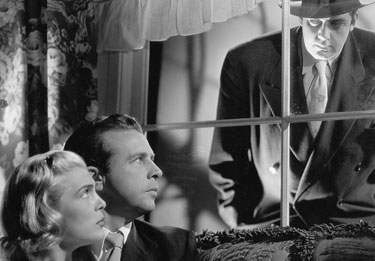
Scott Powell and BurrOne thing I loved about Pitfall is that its characters are real adult people leading real adult lives. They’re not overblown film-noir caricatures, and their actions all have realistic consequences.

Mona is not a femme fatale who sees in John Forbes an easy mark. Aside from being unusually attractive, she’s an average woman who hates that she was involved with a man who was not only stupid enough to embezzle money to spend on her, but stupid enough to get caught. And she gets involved with John Forbes not because she has a dastardly scheme, but because he’s kind to her and she thinks he’s a decent guy. (Mona Stevens has a lot more in common with Ann Sheridan’s character in Nora Prentiss than she does with Barbara Stanwyck’s character in Double Indemnity.)

But Pitfall is not just a tale of marital infidelity and post-war suburban malaise, it’s a noirish thriller, which means there are some nasty surprises lurking.

One of them takes the form of the angry loser who embezzled for love of Mona — Bill Smiley (Byron Barr), whose prison term is nearing an end. The other takes the hulking form of a creepy private detective who is obsessed with Mona — J.B. “Mac” MacDonald (Raymond Burr).

Pitfall has all the ingredients of a great film noir, but director André de Toth mixes them together in interesting ways, and avoids over-the-top contrivances. Cinematographer Harry J. Wild’s solid but unpretentious shots of Los Angeles anchor the film, the actors all deliver really good performances, and Karl Kamb’s screenplay (based on Jay Dratler’s novel The Pitfall) is full of wit and intelligence.