Category Archives: 1948

Race Street (Aug. 22, 1948)

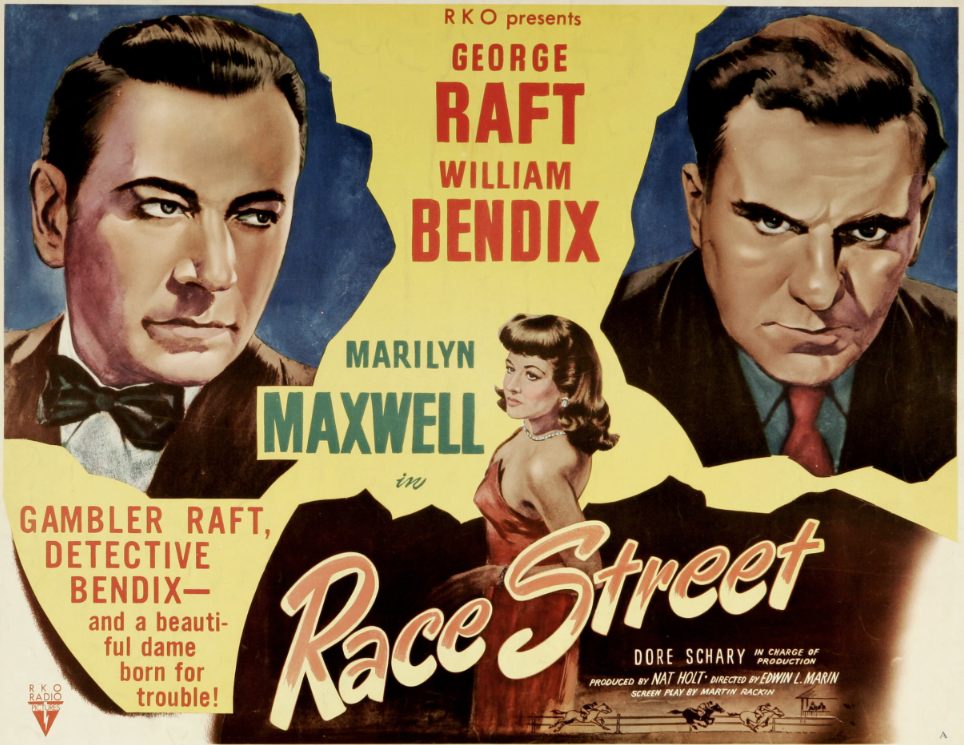
Race StreetYou know what would be a great drinking game for a designated driver to play? Watching Race Street and taking a shot every time George Raft changes his expression.

Raft had no range as an actor, but he did play well with others. When paired with good performers, Raft had real chemistry with them. For instance, my favorite scene in Howard Hawks’s Scarface (1932) is when Ann Dvorak does a sexy, playful dance to try to get a reaction out of Raft. He remains stone-faced, but there’s always a twinkle in his eye.

As an actor, Raft got a lot of mileage out of that twinkle in his eye. Even though he mostly played his characters as expressionless tough guys, his eyes always made it seem as if he was taking in everything around him.

The other thing Raft brought to the table as an actor was a whiff of real-life criminality. He was well-known for his associations with gangsters like Owney Madden, Meyer Lansky, and Bugsy Siegel, which added another dimension to roles like the one he plays in Race Street.

In Race Street, Raft plays a bookie named Dan Gannin. Gannin hides his illegal betting operation behind a respectable facade as an investor. Despite his criminal endeavors, he has an easy friendship with a police detective, Lt. Barney Runson (William Bendix). Lt. Runson knows that his friend Dan is a bookie, but they’re childhood friends, and not much trumps that.

Gannin’s other childhood friend in the film, a fellow bookie named Hal Towers (Harry Morgan), needs a little more taking care of than Runson, and when he begins running afoul of thugs in a protection racket, it’s easy to see that things are going to get complicated for Gannin, who is the standard “nice guy who just wants to go straight” character we’ve seen in a thousand crime movies.

On the distaff side of Gannin’s life is his beautiful sister Elaine (Gale Robbins), a leggy dancer and nightclub singer with whom he’s opening a nightspot called the Turf Club. There’s also a new lady in his life, a brunette named Robbie Lawrence (Marilyn Maxwell).

Race Street was directed by Edwin L. Marin, who directed a bunch of B pictures for RKO with George Raft, including Nocturne (1946), which I enjoyed quite a bit.

As I said above, Raft isn’t the most engaging actor in the world, but he turned in watchable performances when he had a good supporting cast and a decent script, and Race Street succeeds on both counts. I especially liked William Bendix in this film. Bendix was as good at playing comic buffoons as he was at playing sinister villains, and he could do everything in between.

Race Street also has plenty of beautiful footage of San Francisco. A lot of it’s obviously stock footage, but it’s integrated into the film well. This is clearly a B movie, but no studio made B-grade film noirs as well or as consistently as RKO Radio Pictures.

Mr. Peabody and the Mermaid (Aug. 11, 1948)

Mr. Peabody and the MermaidIrving Pichel’s Mr. Peabody and the Mermaid is an enchanting little fantasy that’s perfect for chasing away the winter doldrums.

This movie is an old favorite of mine. I first saw it on TV when I was a kid and absolutely loved it. It was a lot of fun to revisit, and was just as charming and funny as I remember.

Mr. Arthur Peabody (William Powell) is a dignified Bostonian on the verge of turning 50, that dreaded age that says, “if you’re not already having a midlife crisis, you’d better start now.” Mr. Peabody and his slightly younger wife, Mrs. Polly Peabody (Irene Hervey), go on vacation to the British Caribbean (now commonly referred to as the British Virgin Islands), and Mr. Peabody has a life-changing experience. While out fishing, he hooks a mermaid.

The mermaid is played by the beautiful and doll-like Ann Blyth. She’s listed in the credits as just “Mermaid,” but in the film, Mr. Peabody decides her name is “Lenore.”

Mr. Peabody and the Mermaid is book-ended by scenes of Mr. Peabody talking to a psychiatrist, Dr. Harvey (Art Smith). No one but Peabody ever sees the mermaid, so naturally his wife and everyone else all assume that he’s crazy.

The film is coy about Lenore’s existence, but she does seem to exist in physical reality. Mrs. Peabody see the mermaid’s fins sticking out of a bubble bath and scolds her husband for cleaning a fish in the tub. The mermaid also spits water on a man before darting back into the water, and when a woman whom the mermaid considers a rival for Mr. Peabody’s affection goes swimming, the mermaid bites her on the leg.

But there’s still a sense of unreality about “Lenore,” and not just because she’s a mythical creature. Lenore never speaks, but seems to understand everything Mr. Peabody says to her, and adores him. She’s his middle-aged fantasy come to achingly beautiful life.

There are parallel stories about Mrs. Peabody’s flirtation with a handsome chap, Major Hadley (Hugh French), and the beautiful adventuress, Cathy Livingston (Andrea King), who sets her sights on Mr. Peabody. The film wrings a lot of humor out of this situation, as Mrs. Peabody thinks Mr. Peabody is dallying with Miss Livingston while in fact he’s trying to keep the mermaid’s existence secret while planning on running away with her to the Florida Keys.

Mr. Peabody and the Mermaid is a lovely escapist fantasy, and is currently streaming on Netflix and Amazon. Highly recommended, especially if you’re sick of cold weather and aren’t going on vacation anytime soon.

Blyth and Powell

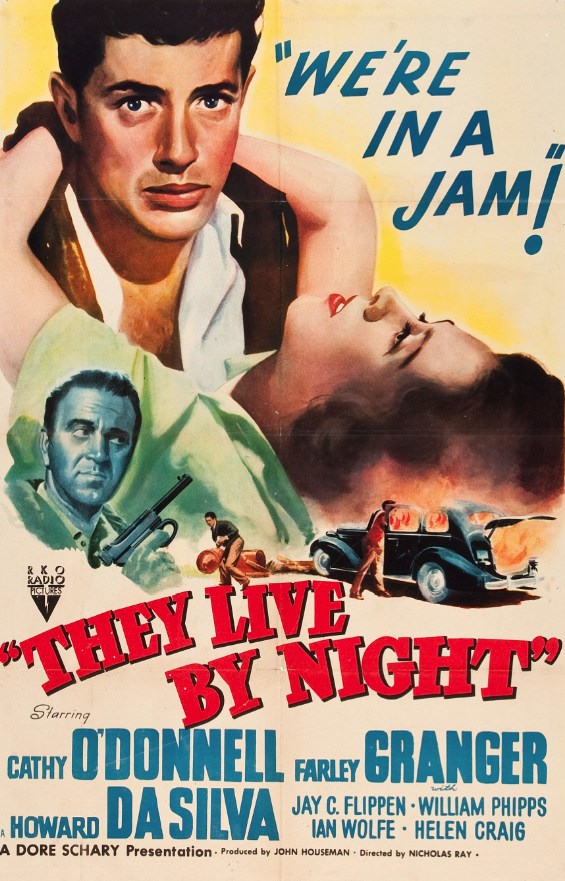
They Live by Night (Aug. 5, 1948)

They Live by Night
They Live by Night (1948)
Directed by Nicholas Ray
RKO Radio Pictures

This movie grabbed me with its first frame and never let go.

They Live by Night is unlike any other movie I’ve seen so far from 1948. Obviously I know what lay ahead for its director, Nicholas Ray, but even if I didn’t, this is the kind of film that would make me sit up and take notice of his name, and look forward to seeing everything he directed next.

Come to think of it, my knowledge of Ray’s filmography is pretty spotty. In high school, Rebel Without a Cause (1955) was one of my favorite films. I watched it over and over, but never thought to explore more of Ray’s films. Years later, I saw In a Lonely Place (1950) and loved it, but didn’t make the connection that it was the same director who made Rebel. But now I’ve got so many Nicholas Ray films to look forward to!

Like all innovative films made more than 50 years ago, They Live by Night doesn’t contain anything we haven’t seen in hundreds of films since, but when viewed in its proper context, it’s exhilarating. Just look at the opening of the film. Unlike nearly every other film of the era that began with a title card followed by a credit roll, They Live by Night begins with shot of two deliriously happy young lovers as the following words flash on the screen: “This boy… and this girl… were never properly introduced to the world we live in… To tell their story…” And suddenly the music becomes grim and portentous, we cut to a shot of a speeding car, and the film’s title appears. The speeding car is filmed from a helicopter, and it’s the earliest instance of action shot from a helicopter that I’ve seen in a film. It’s just one of the innovative ways that Ray creates tension, drama, and excitement with filmmaking techniques that are common practice now, but that were revolutionary at the time.

They Live by Night was based on Edward Anderson’s novel Thieves Like Us (1937). Farley Granger plays a young man named “Bowie” Bowers (his first name is pronounced “Boo-ee,” just like Jim Bowie). When the film begins, he’s an escaped con running from a murder sentence, and his luck will only get worse as the film goes on.

Except for one thing. He falls in love with a young woman named Keechie (Cathy O’Donnell), and while they’re on the run together, they’re happy as only two young people in love can be happy.

There are obvious comparisons to be drawn with Joseph H. Lewis’s Gun Crazy (1950) and Arthur Penn’s Bonnie and Clyde (1967). They Live by Night shares the Depression-era setting with Bonnie and Clyde, and it’s visually similar to Gun Crazy, but unlike both of those films, Keechie isn’t an active participant in any criminal activity and the film focuses more on her romance with Bowie than it does on Bowie’s crime spree.

Ray makes so many surprising and smart choices in this film. He doesn’t show most of Bowie’s bank robberies, which focuses our attention on Bowie’s romance with Keechie. His crime spree across Texas is a matter of grim necessity, and all he wants to do is escape. This has the effect of making a radio news report about Bowie’s growing infamy surprising to the audience. Ray makes it easy to forget much of the time that Bowie is a criminal, which make the intrusions of hard reality into Bowie and Keechie’s lives all the more shocking.

Ray also has a knack for depicting life in a way that feels authentic. Even minor characters with just a few lines feel like fully realized, three-dimensional people. When Bowie and Keechie go to a nightclub on a date, the African-American singer Marie Bryant does a rendition of “Your Red Wagon” and collects dollar tips from the crowd, which she folds and clasps between her fingers. Most Hollywood productions would never show a nightclub singer taking tips — it would ruin the illusion of glamour. But the nightclub in They Live by Night looks and feels like a real place. When Bowie goes into the men’s room, he has a brief conversation with the African-American bathroom attendant. In a lesser film, the attendant would be comic relief, and in a lower-budget film, he wouldn’t exist at all.

They Live by Night features top-notch work by all of its cast and crew. Leigh Harline’s music (with uncredited assistance from Woody Guthrie) is phenomenal. George E. Diskant’s cinematography is some of the most beautiful and most noirish I’ve ever seen (they really do live by night in this movie), and Sherman Todd’s film editing is soothing when it needs to be and jarring when it needs to be. Todd and Ray made a lot of risky choices in the editing room, but for my money, they all paid off.

Ray filmed They Live by Night in 1947, but RKO wasn’t sure how to market the film, and it ended up premiering in the United Kingdom in a single theater on August 5, 1948. It wasn’t released in the United States until November 1949, and didn’t end up being a financial success, but it had been screened privately in Hollywood for many actors and producers, which led to Ray’s next film, Knock on Any Door (1949), with Humphrey Bogart, as well as to Farley Granger being cast in Alfred Hitchcock’s Rope (1948).

Key Largo (July 31, 1948)

Key LargoJohn Huston’s Key Largo was the fourth and final film Lauren Bacall and Humphrey Bogart made together.

Hard to believe, isn’t it? Bogie and Bacall are one of the most famous couples — perhaps the most famous couple — in Hollywood history. And yet, their onscreen work together boils down to just four films made over the course of five years: To Have and Have Not (1944), The Big Sleep (1946), Dark Passage (1947), and Key Largo.

Key Largo is very loosely based on the 1939 play by Maxwell Anderson. I often don’t like films adapted from plays. The dialogue and the way the characters enter and re-enter the action usually feels very strange. But Key Largo never feels “stagey,” and confining the action to a single location only heightens the tension between the characters.

The film opens with beautiful footage of the Florida Keys. By opening with establishing shots of the steamy, summertime Keys, by the time the action is confined to a hotel while a hurricane rages outside, nothing about Key Largo feels stagey or stilted. The viewer is right in the middle of the action, and the suspense grows as the film goes on.

Summertime is the off season in the Florida Keys, when the mercury never dips below 100 degrees, and all the hotels are closed. Bogart plays Frank McCloud, a veteran of World War II who is in Key Largo to visit James Temple (Lionel Barrymore), a wheelchair-bound man whose son George was killed in the war. (McCloud was George Temple’s commanding officer.) Temple runs a hotel in Key Largo with George’s widow, Nora (Lauren Bacall).

When Bogart sits down at the bar in the Largo Hotel, he laconically introduces himself to the boozy moll Gaye Dawn (Claire Trevor) as “McCloud. Frank. By John, out of Ellen.”

Gaye is not the only oddball occupant of the Largo Hotel. There are also a trio of men — Curly (Thomas Gomez), Angel (Dan Seymour), and Toots (Harry Lewis) — and with names like those, it’s clear that their story about coming down to the Keys from Milwaukee to do a little fishing isn’t on the up-and-up.

The full terror of the situation becomes apparent when we catch our first glimpse of gangster Johnny Rocco (Edward G. Robinson), sitting in a bathtub in one of the upstairs rooms of the hotel, chewing a cigar and exuding menace.

Robinson is a great actor, and Johnny Rocco is one of his most memorable creations. Rocco craves power and money, and there will never be enough power and money to satisfy him. He delights in toying with his hostages, taunting them with their helplessness. He even goes so far as to give one of them a pistol, daring them to kill him. But his bullying takes all forms. One of the most harrowing scenes in the film is when he humiliates Gaye by forcing her to sing for everyone before he’ll give her another drink. And like most bullies, Johnny Rocco is a coward at heart. As the hurricane builds in ferocity outside the hotel, so does his fear.

Key Largo was John Huston’s second film to be released in 1948. (The first was another collaboration with Bogart, The Treasure of the Sierra Madre.) Key Largo is a masterfully directed film. The actors are all at the top of their game (Claire Trevor won the Academy Award for Best Supporting Actress for her role). The film’s music, by Max Steiner, is perfect; full of tension and menace, and — when the scene calls for it — a crushing sense of inevitability. Rudi Fehr’s editing accentuates the tension, and Karl Freund’s cinematography is beautiful.

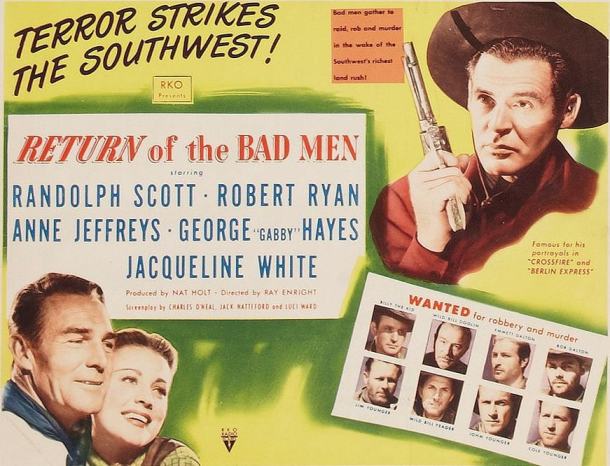
Return of the Bad Men (July 17, 1948)

Return of the Bad MenReturn of the Bad Men was the fourth and final film in a series of westerns that director Ray Enright made with legendary horse opera star Randolph Scott. The previous three were Trail Street (1947), Albuquerque (1948), and Coroner Creek (1948).

Most modern viewers will know Randolph Scott primarily for his final role — in Sam Peckinpah’s Ride the High Country (1962) — and be blissfully unaware of the roughly one hundred films he appeared in prior to it.

Ride the High Country is a great western (it co-stars Joel McCrea), but it’s not Scott’s only claim to fame. The westerns he made in the ’50s with director Budd Boetticher are highly regarded among connoisseurs of western cinema. He also appeared in plenty of workmanlike westerns like the ones directed by Ray Enright that aren’t great works of art, but are well-made entertainment, and a cut above the average B western.

Return of the Bad Men takes place in 1889, in the Oklahoma Territory. The U.S. government has just opened up two million acres of prime land for settlers. At high noon on April 22, 1889, the great Oklahoma Land Rush will begin. On the tails of the settlers, however, are a bunch of no-good outlaws (the “bad men” of the title) who only hope to prey on honest folks.

The land run sequence is exciting, although I suspect that most of the footage is taken from an earlier RKO picture, the Oscar-winning Cimarron (1931).

One of the settlers is a beautiful young widow named Madge Allen (Jacqueline White) who has a young son named Johnny (Gary Gray). She also has a boyfriend, Vance Cordell (Randolph Scott), who only wants to marry his sweetheart and move her and her son out to California.

But when Madge’s father, John Pettit (Gabby Hayes), the folksy and tough-talking president of the local bank, picks up stakes and moves from Braxton, Oklahoma, to Guthrie, Oklahoma, Vance, Madge, and Johnny follow. Once in Guthrie, a cavalry officer appoints Vance U.S. Marshal. As a former Texas Ranger and peace officer, he’s the most suitable man to keep order.

Madge just wants her son to grow up in a peaceful, law-abiding world. Her deceased husband was a peace officer killed in the line of duty, and she refuses to marry Vance until he puts things right in Guthrie, trains officers to take his place, and retires.

Meanwhile, a whole mess of outlaws is amassing against the peaceful homesteaders of Guthrie. They’re led by Wild Bill Doolin (Robert Armstrong) and there’s even a woman among them, Doolin’s niece Cheyenne (Anne Jeffreys). When the rough-and-tumble bad men tell her that busting banks is man’s work, she responds that Belle Starr did OK.

The crew of outlaws includes plenty of famous names — the Younger brothers, Cole (Steve Brodie), Jim (Tom Keene) and John (Robert Bray); the Dalton brothers, Emmett (Lex Barker), Bob (Walter Reed), and Grat (Michael Harvey); Billy the Kid (Dean White); the Arkansas Kid (Lew Harvey); Wild Bill Yeager (Tom Tyler) — but the only member of the crew who has much of a chance to distinguish himself (besides Cheyenne) is Robert Ryan as the Sundance Kid.

Sundance is the most vicious of the lot and becomes Vance’s archenemy over the course of the film. Robert Ryan was on his way to becoming a big star after his memorable role in Crossfire (1947). There’s nothing particularly remarkable about his role in Return of the Bad Men, but he plays a charming villain well, and the growing antagonism between Ryan and Scott provides the dramatic push of the film.

Enright keeps the pace fast in Return of the Bad Men. The editing is quick, and the camera frequently moves within shots, which is not the case with a lot of B westerns. For a B western the production values are good, the acting is solid, and the characterizations are well-done.

Below is a clip from the film. I suppose I have to put a spoiler warning on it, since it’s the climactic fight of the film. I think the biggest potential spoiler about it is a single line of dialogue that alludes to the fate of a couple of characters, because if you consider finding out whether the guy with the white hat or the guy with the black hat wins the final fight in a B western a “spoiler” … well … let’s just say I envy your childlike naïveté:

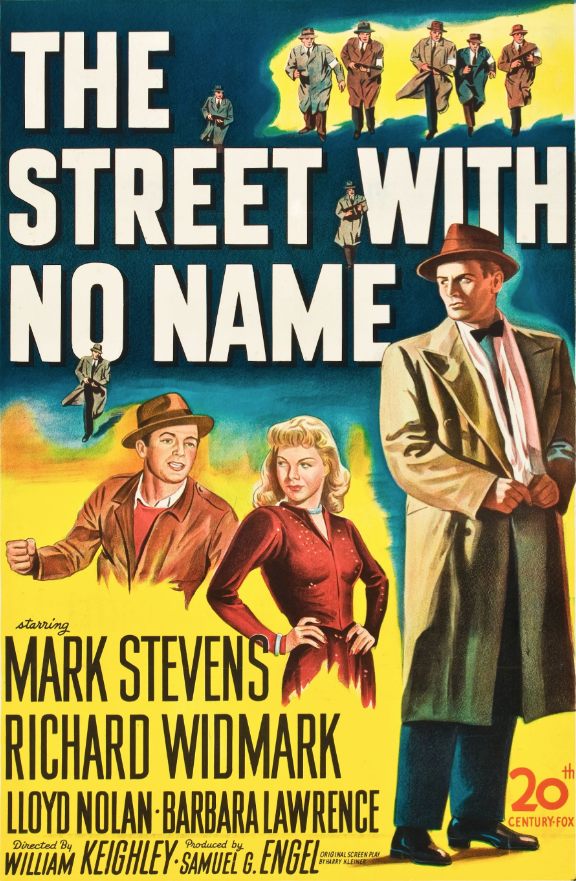
The Street With No Name (July 14, 1948)

By the time William Keighley’s The Street With No Name was released, noirish docudramas were practically a genre unto themselves. The docudrama craze began with The House on 92nd Street (1945), which was loosely based on a real case of nuclear espionage during World War II and was produced by Louis de Rochemont, the creator of the March of Time newsreels.

More “ripped from the headlines” stories followed. Spy thrillers like 13 Rue Madeleine (1947) and The Iron Curtain (1948), tales of miscarried justice like Boomerang (1947) and Call Northside 777 (1948), and even films like Kiss of Death (1947), which wasn’t based on any single real event, but presented its crime story as realistically as possible by eschewing a musical score and filming all the action on location — in prisons, schools, and city streets.

The Street With No Name begins with the following words: “The motion picture you are about to see was adapted from the files of the Federal Bureau of Investigation. Wherever possible it was photographed in the original locale and played by the actual F.B.I. personnel involved.”

Then, a quote from J. Edgar Hoover appears as it is pounded out by invisible hands on a sheet of paper stuck in a typewriter:

The street on which crime flourishes is the street extending across America. It is the street with no name. Organized gangsterism is once again returning. If permitted to go unchecked three out of every four Americans will eventually become its victims. Wherever law and order break down there you will find public indifference. An alert and vigilant America will make for a secure America.

The docudrama that I think The Street With No Name most closely resembles is Anthony Mann’s T-Men (1947), which uses the same kind of “government-approved” patriotic opening, but eventually devolves into a film noir in which the underworld setting and stylistic elements are more interesting than the clean-shaven protagonists. T-Men, however, showed its protagonists becoming drawn deeper into their undercover roles while The Street With No Name doesn’t really develop its protagonist beyond his play-acting heroics.

The Street With No Name opens with a murder at the Meadowbrook night club, a typical road house in a typical city called “Center City.” (The Street With No Name was filmed in and around Los Angeles, and while there is a neighborhood of San Diego called “Center City,” I think that “Center City” was just meant to be a generic name for “Anytown, USA.”)

A second crime by the same masked gang — the murder of a bank guard — draws the FBI into the case, since bank robberies are a federal crime. Leading the investigation is FBI Inspector George A. Briggs, who is played by Lloyd Nolan. (Briggs is the same character Nolan played in The House on 92nd Street.)

According to Briggs, these new gangs are “the juvenile delinquents of yesterday” and they are even more ruthless than the pre-war gangs. The only way to break this gang is to send in an undercover agent.

Enter Mark Stevens as FBI cadet Gene Cordell, who we know is a prime candidate for the assignment because he knows exactly which targets to shoot — and which ones not to shoot — in a Hogan’s Alley sequence filmed at Quantico, VA.

Stevens goes undercover as “George Manly” in the skid row section of Center City, which is full of pool halls, boxing gyms, and peep show machines, and where apparently the only song anyone ever plays on the jukebox is an instrumental version of “I’m Looking Over a Four-Leaf Clover.”

Despite Stevens’s total lack of proficiency in the boxing ring (he looks less competent than Charlie Chapin was meant to in City Lights), the robbery gang he’s after is impressed with his skills and takes him in as one of their own.

The gang’s leader is named Alec Stiles, and he’s played by Richard Widmark. This was Widmark’s second big-screen role, and it’s similar to his first, the psychopathic Tommy Udo in Kiss of Death. Stiles’s teeth aren’t quite as big as Udo’s were, but his maniacal leer is the same. Widmark delivers a good performance, but character details like Stiles’s germaphobia and wife-beating aren’t quite enough to make you forget Udo if you’ve recently watched Kiss of Death.

But character details and plot points aren’t what makes The Street With No Name a standout docudrama film noir. What makes the film memorable is the overriding sense of tension and the dark, shadowy cinematography of Joseph MacDonald.

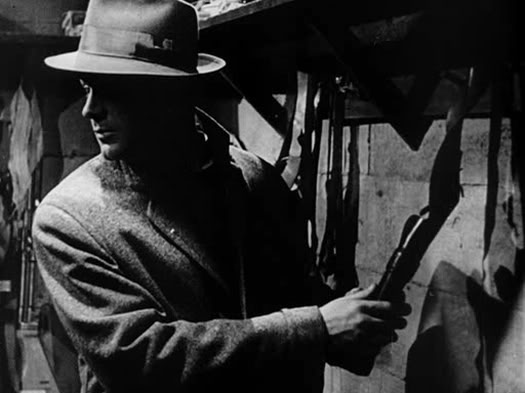
Stevens isn’t as strong a protagonist as Dennis O’Keefe and Alfred Ryder were in T-Men, and the most memorable sequences in The Street With No Name are completely wordless. The first is a chase in a ferryboat station (filmed at the Municipal Ferry in San Pedro, CA) and the second follows Stevens as he tries to get ballistic evidence by breaking into the gang’s weapons cache in a warehouse with Widmark hot on his heels.

Despite a generic story and a bland protagonist, The Street With No Name has great pacing, lots of suspense, style to spare, and a solid villain. I recommend it to all fans of FBI stories and film noir.

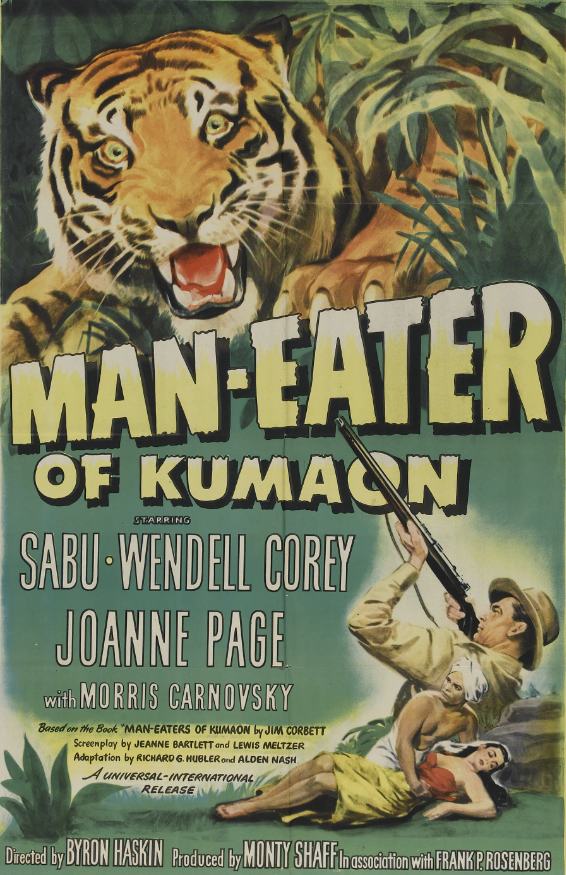
Man-Eater of Kumaon (July 1, 1948)

Man-Eater of Kumaon
Man-Eater of Kumaon (1948)
Directed by Byron Haskin
Universal Pictures

Jim Corbett was the archetypal “great white hunter.”

He was born Edward James Corbett in 1875 in Nainital, in the Kumaon region of northern India (now known as Uttarakhand), and was the eighth of 13 children. Corbett would go on to work for the Bengal and North Western Railway. He also attained the rank of colonel in the British Indian Army.

Between 1907 and 1938, Corbett killed a documented 33 man-eating tigers and leopards (the first tiger he brought down was responsible for more than 400 deaths). Despite his fearsome reputation as a hunter, Corbett was committed to conserving endangered Bengal tigers and their natural habitats, and India’s first national park was renamed in his honor in 1957.

His book The Man-Eaters of Kumaon was published in 1944 and was a great success, so it was natural that a Hollywood movie would soon arrive that bore little resemblance to it.

That movie is Man-Eater of Kumaon, and it stars Wendell Corey as Dr. John Collins, a successful but disillusioned physician who has given up the Manhattan rat race for the thrill of big game hunting. Dr. Collins bears no resemblance to Jim Corbett, and he’s not meant to. For better or for worse, the screenplay by Jeanne Bartlett and Lewis Meltzer is mostly an invention, and not directly based on any of Corbett’s stories.

The director, Byron Haskin, was a Hollywood veteran, and the film looks great despite obviously having been filmed on soundstages and at the Corriganville ranch in Simi Valley, California. William C. Mellor’s cinematography is dramatically lighted and ominously shadowed, and the nighttime scenes look especially good. The story and dialogue are overly serious to the point of ridiculousness, however, and Wendell Corey has neither the acting chops nor the charisma to carry a mediocre film.

Corey’s facial expressions range from glum to deeply depressed, and voiceover narration strings together much of the film. More than one scene involves Corey smoking a cigarette, pacing back and forth, and looking pensive as the narrator explains to the audience what he is feeling.

Indian actor Sabu plays a young man named Narain, and he acquits himself well, but he doesn’t have very much to do. (Sabu does get top billing over Corey, although I’m pretty sure Corey has more screen time.) Morris Carnovsky’s performance as the village elder Ganga Ram is overly mannered and soporific, but part of the blame can be placed on the stilted dialogue. Joanne Page, who plays Narain’s wife Lali, acts her part well, but she isn’t given much to do either.

The most interesting thing about Man-Eater of Kumaon is the Bengal tiger who is shot by Corey at the beginning of the film. Throughout the film the tiger is wounded and tracking the man who has harmed him, leaving a path of death and terror in his wake. (As one character in the film says, “A tiger will not forget the man who wounded him.”) The footage of the tiger is really spectacular, and it seems to be mostly original, unlike most jungle adventure pictures, which rely heavily on stock footage.

https://www.youtube.com/watch?v=4EEGET-d5bI

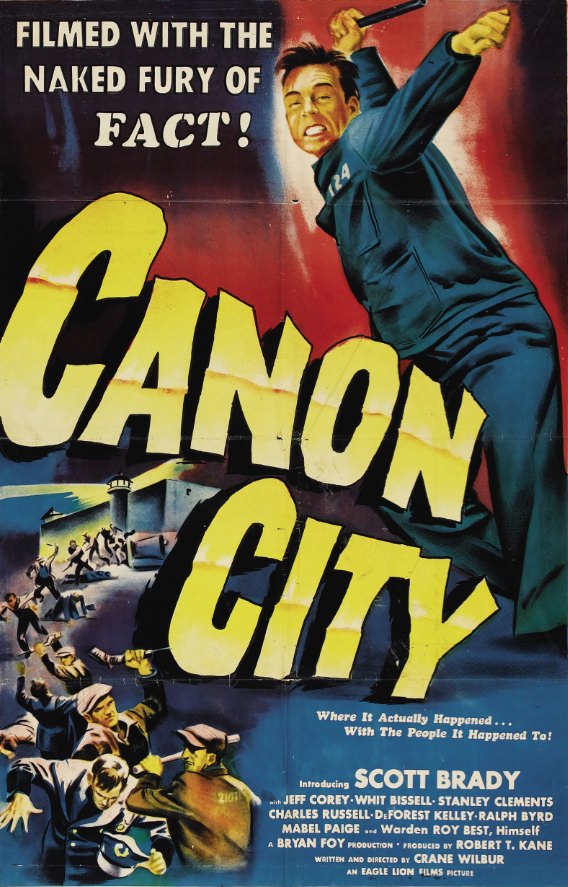
Canon City (June 30, 1948)

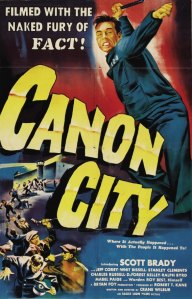
Crane Wilbur’s Canon City is a low-budget entry in the docudrama genre, a genre that began in 1945 with the Louis de Rochemont-produced espionage melodrama The House on 92nd Street and enjoyed enormous popularity in post-war Hollywood.

Docudramas were dramatizations of actual events that featured actors but that strove for authenticity by filming in actual locations, using real documents in key scenes, and featuring participants in the case playing themselves in bit parts.

After The House on 92nd Street followed more fact-based spy thrillers like 13 Rue Madeleine (1947) and The Iron Curtain (1948), and legal docudramas like Boomerang (1947) and Call Northside 777 (1948).

Some films, like Kiss of Death (1947), T-Men (1947), and The Naked City (1948), were mostly fictional, but were presented in a docudrama fashion and filmed on location to add authenticity to otherwise run-of-the-mill crime stories.

Canon City uses a combination of docudrama techniques. It begins in a straightforward documentary style, and slowly draws us into the fictional world of its incarcerated protagonists. The obligatory scroll of text that opens the film informs the viewer that all events depicted in the film are based on actual events that took place in and around the Colorado State Prison in Canon City on the night of December 30, 1947. (Canon City is pronounced “Canyon City,” and is sometimes spelled Cañon City.) It goes on to say that the convicts shown in the film are the actual convicts involved in the case, and that Roy Best, the warden of the prison, plays himself. Finally, we are told that “the details of the break are portrayed exactly as they occurred and were photographed where they happened.”

Reed Hadley narrates the opening in his signature style (docudramas provided a lot of work for Hadley). He describes the Colorado State Penitentiary in Canon City as “a home for those who like to have their own way too much, and have taken forbidden steps to achieve their aims. All kinds are here; murderers, kidnappers, thieves, robbers, embezzlers.”

Warden Best and the disembodied voice of Hadley lead the viewer on a tour of the prison, introducing the variety of work that the prisoners do and conducting short interviews with actual inmates of various types; a man soon to be paroled, an old man who’s been doing time since 1897, a 14-year-old murderer sentenced to 20-30 years who’s working on a hooked rug in the art shop, and a murderer whose death sentence was commuted to life by the warden, and who now hopes to be paroled in 1949.

We then see the process of nighttime lockdown, and at the 9-minute mark of the film Hadley’s narration introduces the viewer to a pair of inmates with adjoining cells: Jim Sherbondy, a 29-year-old inmate who was sentenced at the age of 17 for killing a police officer, and Johnson, a long-termer who is working on the model of a ship. (His real work — a zip gun — is hidden behind the ship. He’s part of a plan to break out.)
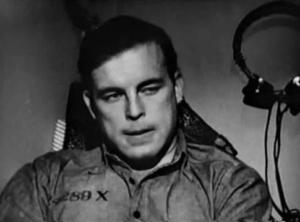
Hadley’s narration doesn’t stop after Sherbondy and Johnson are introduced, and the film continues in a semi-documentary style, but the introduction of these two characters marks the moment when the film moves from fact to fiction. Remember that opening text from the beginning of the film I mentioned? The one that said “The convicts you will see are the actual convicts”?

Well, this was clearly a lie, since Sherbondy and Johnson are both played by actors, not actual convicts. This is par for the course, though. Despite what they invariably claimed, docudramas in the ’40s usually had a tricky relationship with the truth.

I couldn’t figure out who the uncredited actor who plays Johnson is (if you know, please comment on this review), but Sherbondy is played by Scott Brady, the younger brother of notorious tough-guy actor Lawrence Tierney. (Lawrence Tierney and Scott Brady’s youngest brother, Edward Tierney, who turned 20 years old in 1948, also had a career in the movies starting in the ’50s.) Brady was born Gerard Kenneth Tierney, and Canon City was his first major film acting role, and the first film in which he was credited as “Scott Brady.” (His first appearance was a small role in Sam Newfield’s 1948 film The Counterfeiters, in which he was credited as “Gerard Gilbert.”)

Brady bears an uncanny resemblance to his older brother, but his face is a little softer and more innocent-looking, which works well for his role in Canon City. Sherbondy is a reluctant participant in the breakout. He has a job in the prison’s photography shop working in the darkroom, which is the perfect place for the conspirators to hide a load of zip guns, since the darkroom requires guards to wait outside until it’s safe to turn the lights on and open the door.

I wonder if anyone who saw Canon City during its initial theatrical run noticed Brady’s resemblance to Lawrence Tierney, or if there were any astute viewers who noticed the slim, bespectacled Whit Bissell and said to themselves, “Hey, wasn’t that guy in Brute Force?”

I also wonder how many viewers didn’t specifically recognize any of the actors but were able to tell that they were watching actors and not the actual participants in the case. And if they did, did they feel cheated after the opening claim of total and complete veracity?

I wonder these things because I do think that Canon City is remarkably skillful in the way it draws the viewer in and the way it manages to feel raw and real throughout. A little before the half-hour mark, the breakout kicks into high gear with an assault on a guard and a furious rush to fit all the pieces of the plan together. For nearly an hour, Canon City is as tense a picture as one could ask for. A dozen men pour out into a snowy night, disguised as prison guards. The prison alarm tolls throughout the small town. Terrified moviegoers swarm out of a theater whose marquee shows the Abbott and Costello comedy The Noose Hangs High (which wasn’t released until the spring of 1948, incidentally) and people on the streets rush to get home. But home offers no solace, as the convicts break into house after house looking for shelter, food, and weapons.

The cinematographer of Canon City was John Alton, who was responsible for brilliant work on many film noirs (most notably his collaborations with Anthony Mann). There aren’t a lot of memorable “noir” setups in Canon City, but overly stylized lighting wouldn’t have fit with the docudrama approach to the material. The darkness and the driving blizzard are terrifying enough filmed in a straightforward fashion. Canon City is the kind of movie where the cold gets into your bones just watching it.

Canon City is a film that is dated in many ways, but it still packs a punch if you can go along with the semi-documentary style. Writer-director Crane Wilbur gets the most out of his limited budget by filming inside the prison and in the rugged beauty of the southern Colorado landscape around Cañon City, and the pacing is swift and brutal once the breakout occurs.

Oh, and if you’re a Star Trek fan, keep your eyes peeled for a young DeForest Kelley as one of the dozen escapees.
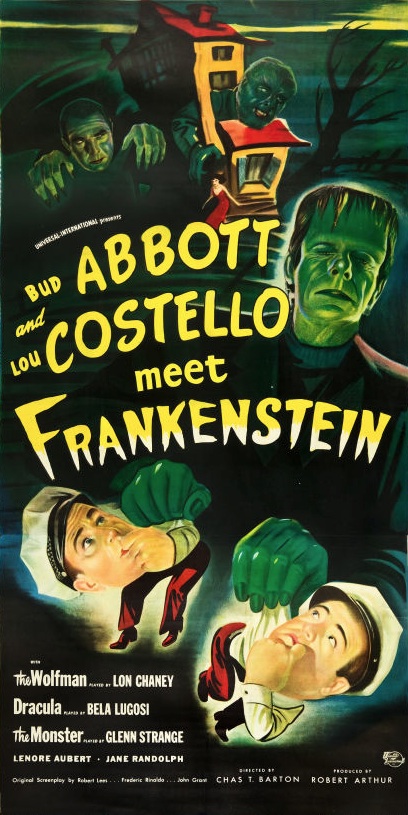
Abbott and Costello Meet Frankenstein (June 15, 1948)

There are two schools of thought regarding Charles Barton’s Abbott and Costello Meet Frankenstein.

On the one hand, it was the final nail in the coffin of the increasingly moribund Universal monster series. If you’re a horror purist, then Abbott and Costello Meet Frankenstein represents the nadir of Universal Studios’ monster movies.

On the other hand, if you’re someone who loves horror-comedies, then Abbott and Costello Meet Frankenstein represents one of the best-known and most enduring films in the genre.

It wasn’t the first horror-comedy. Paul Leni’s silent film The Cat and the Canary (1927) was the cornerstone of Universal’s horror machine, and it had plenty of comedic elements. James Whale’s The Old Dark House (1932) is both scary and incredibly funny, which is not an easy mixture to pull off.

And the practice of throwing comedians into a horror-movie scenario didn’t start with this film either.

The Ritz Brothers were paired with Bela Lugosi in The Gorilla (1939), and Bob Hope and Paulette Godard starred together in a remake of The Cat and the Canary (1939) and the horror-comedy The Ghost Breakers in (1940).

So by the time Abbott and Costello Meet Frankenstein was released, not only were horror-comedies an established part of the box-office landscape, but Universal Studios had firmly demonstrated that they had run out of ideas beyond the “mix and match” approach, which gave us Frankenstein Meets the Wolf Man (1943), House of Frankenstein (1944), and House of Dracula (1945), each one more campy and silly than the last. (And the last “straight” monster movie that Universal released in the ’40s — Jean Yarbrough’s 1946 film She-Wolf of London — was pretty dull.)

My main problem with Abbott and Costello Meet Frankenstein is that I don’t find Abbott and Costello funny. The duo started in vaudeville, and every comedic set piece in their films feels to me as if it needs to be watched in the midst of an easily amused, wildly guffawing audience for the full effect. Watching their films at home just doesn’t work for me. (I felt the same way about Mel Brooks’s 1974 horror-comedy Young Frankenstein when I rented it years ago. After hearing for most of my life that it was one of the funniest movies ever made, I was shocked by its obvious jokes, its incredibly slow pacing, and the way Gene Wilder mugged for the camera. The problem, I think, is that the jokes are timed to allow for a large audience to rock with laughter before the next joke is dropped. If you’re watching it for the first time alone, however, it can feel awfully slow.)

As a nearly life-long aficionado of Universal monster movies, I appreciated the look of Abbott and Costello Meet Frankenstein. The film is set in Florida, and the sets are an effective mix of castle-like structures and steamy swamps. I also enjoyed seeing Bela Lugosi reprise his most famous role — Dracula. John Carradine played the Count in House of Frankenstein and House of Dracula, and he was fine, but there’s no beating Lugosi. And it’s always fun to see Lon Chaney Jr. as Larry Talbot, a.k.a. The Wolf Man.

I also liked that Abbott and Costello Meet Frankenstein wasn’t overloaded with characters. Lugosi performs a kind of double duty. As Dracula, he turns into a bat and bends people to his will, but he’s also a mad scientist, scheming to bring Frankenstein’s monster (Glenn Strange) back to life to do his bidding. (The gag is that he plans to use the brain of Lou Costello, one of the dumbest characters in the history of cinematic comedy.)

Despite its classic Universal-horror look, there’s really nothing scary about Abbott and Costello Meet Frankenstein. The director, Charles Barton, was a hard-working journeyman who had a lot of experience directing comedies and none directing horror. But the special effects do look really good. The main thing that stood out for me was Dracula’s transformations into a bat, which look much better here than they did in Dracula (1931). In Abbott and Costello Meet Frankenstein the transformations are achieved with a mixture of hand-drawn animation and puppetry. Still, I’ll take the eerie power of the original and its rubber bat on a string over an Abbott and Costello horror-comedy any day.

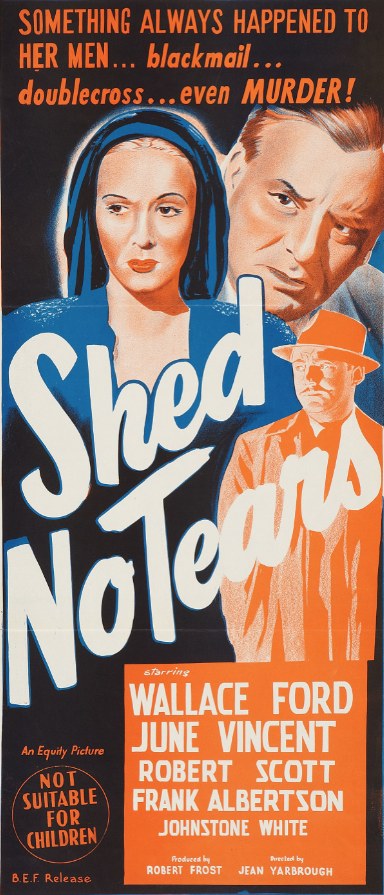
Shed No Tears (June 9, 1948)

If I’ve said it once, I’ve said it a million times … only a chump fakes his own death.

And yet, that’s exactly what Sam Grover (Wallace Ford) does in the very first scene of Jean Yarbrough’s Shed No Tears. He sets fire to his hotel room and leaves a cadaver behind as he sneaks out the back way. It’s all part of a scheme he’s cooked up with his wife Edna, an icy blonde played by June Vincent, whose best-known film noir performance was probably in Roy William Neill’s Black Angel (1946).

Edna is as young and beautiful as Sam Grover is middle-aged and schlubby. When an old woman on the bus sees Sam looking adoringly at a picture of Edna, she asks him if it’s a picture of his daughter. “My granddaughter,” he responds with a sigh.

If you’ve ever seen a B noir before, you’ll know that Edna’s up to no good before Sam even kicks over the flaming wastebasket in his hotel room, but all doubt is erased a few minutes into the film when Sam scurries off to hide out and Edna falls into the well-muscled arms of her handsome young boyfriend Ray (Mark Roberts, listed in the credits as “Robert Scott”).

The plot thickens when Sam’s adult son, Tom (Dick Hogan), suspects foul play and engages the services of a slippery and pompous private investigator named Huntington Stewart (Johnstone White). Meanwhile, Sam grows restless in hiding and gets itchier and itchier as he waits for Edna to come through with the insurance dough for his “death.”

Shed No Tears is based on the novel by Don Martin. Its dialogue is heavy on exposition, but the editing and visual storytelling are tight. The acting by everyone except the always dependable Wallace Ford is merely passable, with Dick Hogan’s stilted performance qualifying as the most egregious. I suspect that he was cast more for his cute little face than for his acting ability. Incidentally, this was one of Hogan’s last roles. After Shed No Tears he would go on to appear in the Alan Ladd vehicle Beyond Glory (1948) and Alfred Hitchcock’s Rope (1948), in which he played the murder victim.

Shed No Tears never rises above the level of a B-movie programmer, but for what it is, it’s an entertaining 70-minute melodrama. It’s in the public domain, and there’s an OK-looking DVD available from Alpha Home Entertainment that was transferred from a 16mm print. There are also a few versions currently streaming on YouTube:

http://www.youtube.com/watch?v=naMdpcjHnWo