Category Archives: 1949

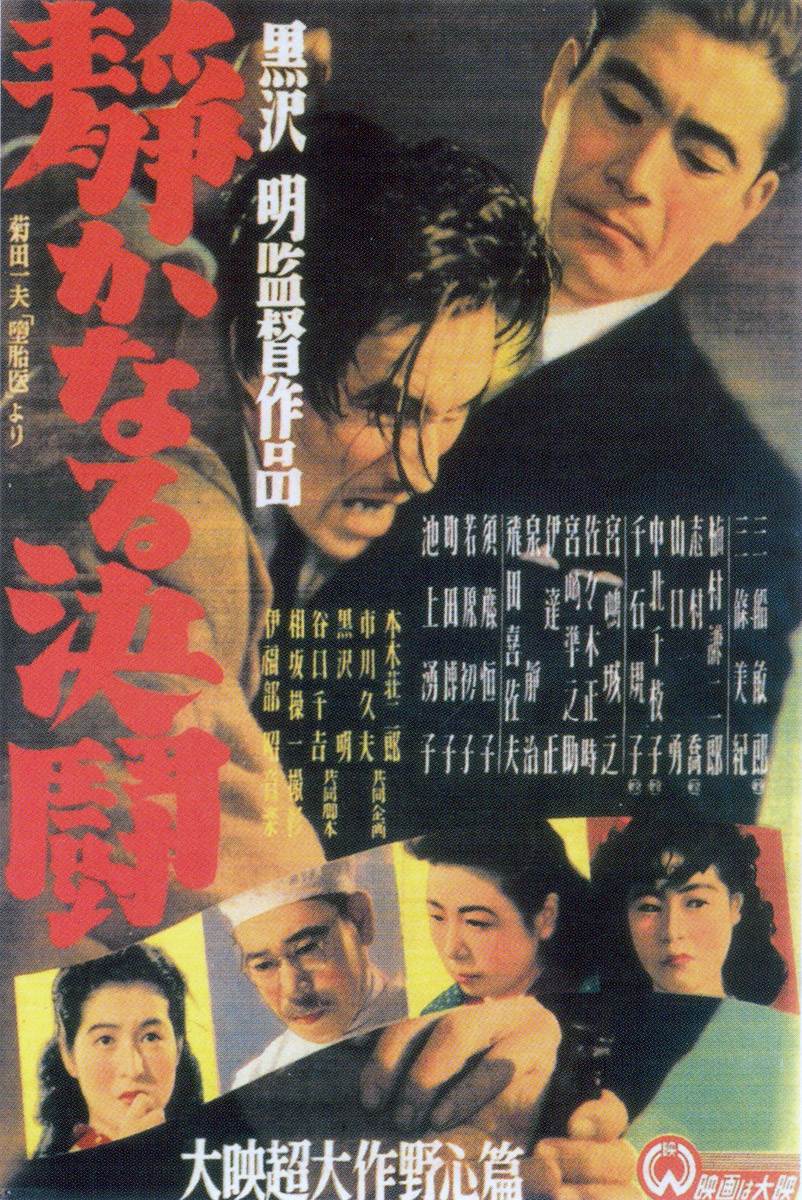
The Quiet Duel (March 13, 1949)

The Quiet Duel
The Quiet Duel (1949)
Directed by Akira Kurosawa
Daiei Motion Picture Company

The Quiet Duel is not one of director Akira Kurosawa’s major works. Most reviewers treat it as a lamentable, melodramatic footnote in his career, but I don’t think that’s fair.

Unlike No Regrets for Our Youth (1946), which I think all but the most dedicated Kurosawa completists can skip, The Quiet Duel is worth seeing at least once if you’re a Kurosawa fan. It also functions as a thematic bridge between two of Kurosawa’s major early works, Drunken Angel (1948) and Stray Dog (1949).

Like both of those films, The Quiet Duel pairs two of the director’s most dependable stars: Toshirô Mifune and Takashi Shimura. It shares with Drunken Angel the theme of a doctor who struggles with his own conscience, and it presages the major theme of Stray Dog — two young men who face the same difficult circumstances but who make very different ethical decisions.

Mifune and Shimura are always interesting to watch when they’re on screen together, and if The Quiet Duel is their least interesting pairing in Kurosawa’s body of work, it’s only because most of their appearances together for Kurosawa were in films that are all-time classics.

The Quiet Duel (or The Silent Duel, as it’s also translated), is based on a play by Kazuo Kikuta. Mifune plays Dr. Kyoji Fujisaki, a young physician who contracts syphilis when he cuts himself while performing surgery in a field hospital during World War II.
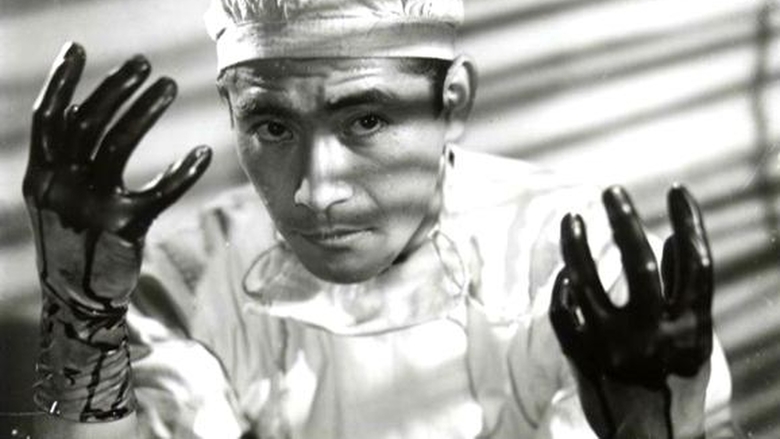
Mifune

After the war, he returns to work with his father, Dr. Konosuke Fujisaki (Shimura). Kyoji rejects his fiancée, Misao (played by Miki Sanjō), without an explanation. He treats himself with Salvarsan in total secrecy. (Salvarsan is the trade name for arsphenamine, the first effective treatment for syphilis.) And he struggles with his sexual desire and romantic longing, both of which he completely stifles so he won’t infect anyone else with his malady.

Later in the film, he again crosses paths with the man he operated on during the war. Unlike Kyoji, this man treats his syphilis as a trifling matter, and doesn’t care who else he infects (his wife is pregnant). We’ll see this moral theme again in Kurosawa’s next film, Stray Dog (1949), in which Mifune plays a young police detective whose gun is stolen. The “stray dog” of the title is a young man who suffered the same indignities and deprivations as Mifune following the war. Unlike Mifune, he chose to take his pain out on the world, and goes on a crime spree with Mifune’s gun.

Most of The Quiet Duel is pretty stagey, and the story is melodramatic. But when Mifune finally lets loose, he lets loose as only he could, and it’s something to behold. And while the film isn’t a great showcase for Kurosawa’s directorial talents, there are a few scenes — especially the surgery sequence that opens the film — that rank among the best work he did.
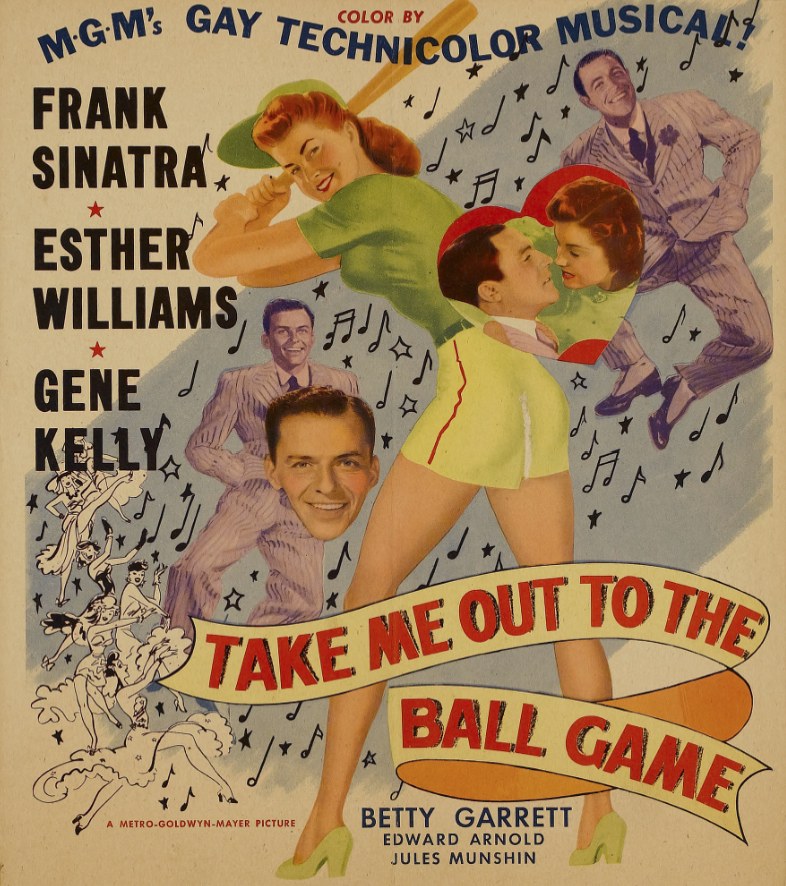
Take Me Out to the Ball Game (March 9, 1949)

Take Me Out to the Ball Game
Take Me Out to the Ball Game (1949)
Directed by Busby Berkeley
Metro-Goldwyn-Mayer

By 1948, when Take Me Out to the Ball Game was filmed, legendary musical director Busby Berkeley was suffering from problems with alcohol and with his own temperament. No studio trusted him to both direct and choreograph a picture, so when he was given Take Me Out to the Ball Game to direct, the choreography was handled by Stanley Donen and Gene Kelly.

Just judging by what’s on screen, Berkeley had no problem putting together a fun, well-made Technicolor musical for M-G-M.

Take Me Out to the Ball Game reunited Frank Sinatra with Gene Kelly. The two had previously starred together in Anchors Aweigh (1945). Sinatra’s career had hit a bit of a lull in 1948, and M-G-M thought it would be a good idea to pair him with his co-star from the most financially successful film he’d ever made.

Sinatra plays Dennis Ryan, the second baseman of the baseball team The Wolves, and Kelly plays O’Brien, the shortstop. When Ryan and O’Brien aren’t playing baseball, they’re one of the most popular Vaudeville duos in the country. Take Me Out to the Ball Game takes place in 1909, so the notion of two professional baseball players also working as Vaudevillians is only half as ludicrous as it would have been in 1949.

When Ryan and O’Brien report for spring training in Sarasota, they find out that a new owner — K.C. Higgins — has inherited the team. None of the players are happy about this, and they all assume that this Higgins fellow will be a fathead who doesn’t know the first thing about baseball. Unsurprisingly, K.C. Higgins turns out to be a woman (see also Major League).

Of course, K.C. is a baseball whiz, and since she’s played by swimmer Esther Williams, she gets some time in the water, too. The first time Ryan and O’Brien see her cavorting in the hotel pool, one of them remarks, “Not bad for a dame who can field a hot grounder.”

Sinatra and Kelly

The comedy in Take Me Out to the Ball Game is passable, but it’s the singing and dancing that make a musical, and the picture succeeds on both counts. Kelly isn’t quite the singer Sinatra is, and Sinatra isn’t quite the dancer Kelly is, but the same magic they worked in Anchors Aweigh is onscreen here, and it’s a joy to watch.

The songs are all pretty good. “Take Me Out to the Ball Game” is heard more than once, and there are also highlights like “The Right Girl for Me,” which Sinatra croons to Williams in the moonlight, and “The Hat My Dear Old Father Wore Upon St. Patrick’s Day,” which Kelly sings while doing a jig, wearing a battered green hat, and brandishing a shillelagh.

If you listen to the lyrics of “Yes, Indeedy,” which is about loving and leaving gals across the country, you’ll catch a line about a lovesick Vassar girl who committed suicide after Sinatra loved her and left her, and a Southern belle who turned out to be 11 years old, which is why Gene Kelly had to leave her. The risqué things you can get away with really change from generation to generation, don’t they?

Just like in It Happened in Brooklyn (1947), plenty of humor is wrung from Sinatra’s slender frame. We see him gorging himself on steak and buttered rolls to gain weight during spring training, as well as sucking down milkshakes like they’re water. But alas, he remains a beanpole, and the vivacious and lovesick Shirley Delwyn (played by Betty Garrett) is able to sling him over her shoulder in a fireman’s carry during one of their musical numbers together.

Take Me Out to the Ball Game is, by all accounts, not as good as Kelly and Sinatra’s next collaboration, On the Town (1949), which I haven’t seen yet. But I enjoyed the heck out of it.

A Woman’s Secret (March 5, 1949)

A Woman's Secret
A Woman’s Secret (1949)
Directed by Nicholas Ray
RKO Radio Pictures

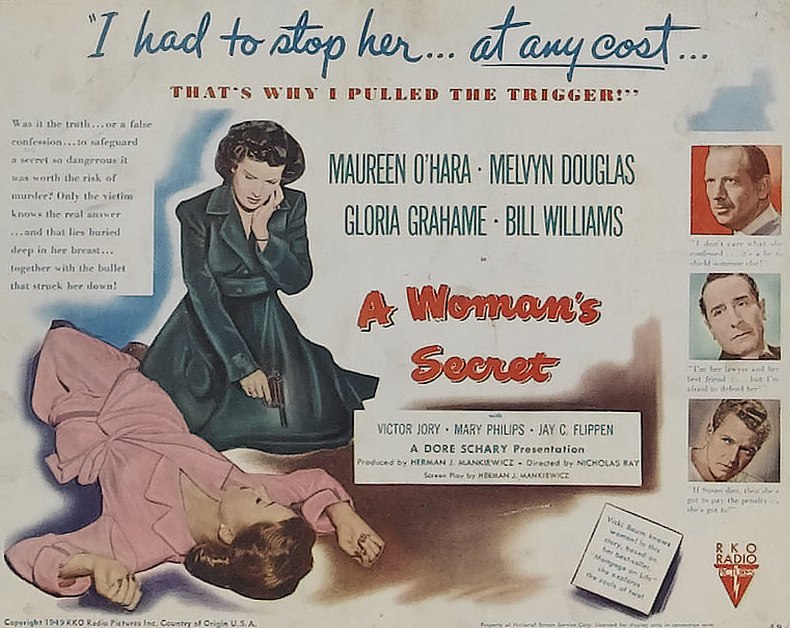
A Woman’s Secret is the third Nicholas Ray film I’ve reviewed on this blog, but it was the second film he directed.

Ray completed his first film, They Live by Night, in 1947, but RKO wasn’t sure how to market it. It premiered in the United Kingdom in a single theater on August 5, 1948.

The success of Ray’s third film, Knock on Any Door (1949), led to his first two films being released in the United States in 1949 by a newly confident RKO Radio Pictures.

Of his first three pictures, A Woman’s Secret is easily the weakest, and is significant mostly because it’s how Ray met his second wife, actress Gloria Grahame.

After shooting wrapped, the two were married in Las Vegas on June 1, 1948. It was the second marriage for both of them. (They had to live in Nevada for the required six weeks before Grahame could get her quickie divorce from actor Stanley Clements). Before they divorced in 1952, Grahame starred in one of Ray’s greatest films, In a Lonely Place (1950), which also starred Humphrey Bogart.

A Woman’s Secret was a contract job for Ray. The screenplay was adapted from Austrian writer Vicki Baum’s 1946 novel Verpfändetes Leben (Mortgage on Life) by the film’s producer, Herman J. Mankiewicz. Ray had no script input, so it’s easy to write it off as a studio-imposed footnote in Ray’s career.

Gloria Grahame

A Woman’s Secret is a “women’s picture” wrapped in a mystery. It’s no In a Lonely Place, but it’s worth watching at least once.

The central relationship in the film is the one between Marian Washburn (Maureen O’Hara) and her protégé, Susan Caldwell (Gloria Grahame). Marian is a singer who has lost her voice, and she’s completely shaped and guided Susan’s career, rechristening her “Estrellita.” One night, after the two argue bitterly, a shot rings out. Susan lies on the floor near death, a bullet lodged near her heart. Marian is holding the smoking gun, but this is a mystery picture, so don’t assume anything yet.

Most of the film’s plot unspools as a series of flashbacks as Susan lies in the hospital and the detective assigned to the case — Inspector Fowler (Jay C. Flippen) — tries to piece together the facts. He spends a good deal of time with composer and pianist Luke Jordan (Melvyn Douglas), who is Marian’s boyfriend. Fowler also gets plenty of help from his wife, Mrs. Fowler (Mary Philips), who’s running an investigation of her own.

There are a lot of interesting things going on in A Woman’s Secret, but nothing really jells. The film is too crowded with plot and characters for the central relationship between Marian and Susan to ever be fully explored. Melvyn Douglas and Jay C. Flippen are fine performers, and both inject their two-dimensional characters with enough life to make their scenes interesting. Philips gets a juicy role as Inspector Fowler’s wife, and her nosiness isn’t just played for laughs. She actually knows what she’s doing, much to her husband’s chagrin.

Most people who write about Ray’s career either gloss over or completely ignore this film. There’s not much about it that fits in with his obsessions and themes. But despite a studio-imposed script, there are interesting themes and tensions bubbling below the surface. Grahame’s role as Susan/Estrellita in particular feels at home in Ray’s oeuvre. She’s a misunderstood, inarticulate, unhappy, and tragic outsider — a character type that would recur again and again in Ray’s films.

I Shot Jesse James (Feb. 26, 1949)

I Shot Jesse James
I Shot Jesse James (1949)
Directed by Samuel Fuller
Lippert Pictures / Screen Guild Productions

If a story doesn’t give you a hard-on in the first couple of scenes, throw it in the goddamn garbage. —Samuel Fuller

Maverick filmmaker Samuel Fuller was shopping scripts around Hollywood when he met producer Robert L. Lippert. Lippert admired Fuller’s 1944 pulp novel The Dark Page and gave Fuller his first crack at directing.

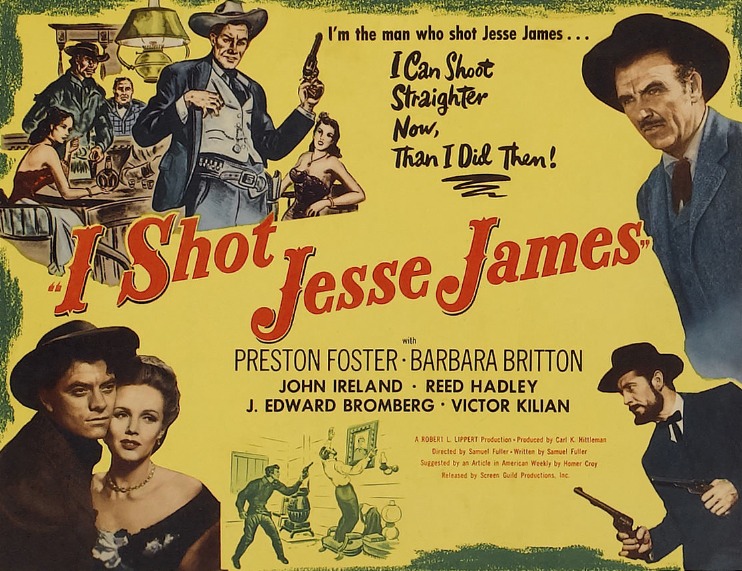
The result was I Shot Jesse James, a low-budget but brilliant revisionist western starring John Ireland as Robert Ford, the member of the James gang who killed Jesse James and collected the bounty.

Fuller had a flair for the dramatic, and when shooting began on I Shot Jesse James, he discharged a round from his Colt .45 into the air instead of yelling “Action.”

Fuller made three films for Lippert, I Shot Jesse James, The Baron of Arizona (1950), and The Steel Helmet (1951). The budgets were tiny and the shooting schedules tight, but Lippert gave Fuller the freedom to make exactly the kind of movies he wanted.

Fuller wrote the script for I Shot Jesse James, and based it on an article by Homer Croy in American Weekly magazine. It’s a sympathetic portrayal of a roundly reviled historical figure (even if you have no sympathy for Jesse James, it’s hard not to instinctively dislike a man who shot his unarmed friend in the back for reward money).

John Ireland

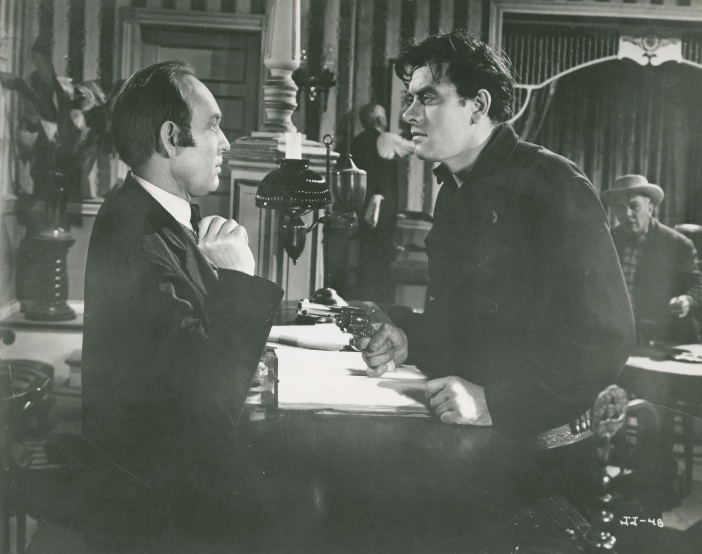
John Ireland plays Robert Ford as a lovesick man who’s tired of life on the run and just wants to marry his girl, the beautiful actress Cynthy Waters (Barbara Britton). He’s tempted by Missouri Governor Thomas Theodore Crittenden’s offer of amnesty for any member of the gang who turns in Jesse James (Reed Hadley), dead or alive.

Fuller depicts the relationship between Jesse and Bob Ford as deeply homoerotic, although the stolid Hadley doesn’t seem aware of anything strange about sitting in a bathtub and asking his friend to scrub his back for him. It’s the tortured Ireland who appears to long for Jesse, and perhaps by killing him he’s killing a part of himself that he despises.

Nothing good comes from it, of course. When Ford tells Cynthy that his killing of Jesse James was legal, she responds in horror, “It was murder.”

He walks through the rest of the picture with a haunted, desperate look on his face. He appears in a stage show in which he reenacts the killing of Jesse James, he dodges bullets from glory-hungry gunmen, and he desperately tries to repair his relationship with Cynthy.

This film explores a lot of the same territory as Andrew Dominik’s The Assassination of Jesse James by the Coward Robert Ford (2007), which starred Casey Affleck as Robert Ford and Brad Pitt as Jesse James. The most poignant parts of both films show Ford facing his own terrible legacy, such as when he appears in the onstage reenactment or confronts a troubadour who sings hymns to his cowardice.

I Shot Jesse James has stock music and its minuscule budget is pretty obvious, but it’s a great portrait of a complicated historical figure. Samuel Fuller would go on to have a long and iconoclastic career, and while I Shot Jesse James is never numbered among his greatest works, it’s his opening salvo as a director, and it’s a powerful one.

Knock on Any Door (Feb. 21, 1949)

Knock on Any Door
Knock on Any Door (1949)
Directed by Nicholas Ray
Santana Pictures Corporation / Columbia Pictures

SPOILER ALERT. This review will discuss plot points of this film that you may not want to know if you haven’t already seen it.

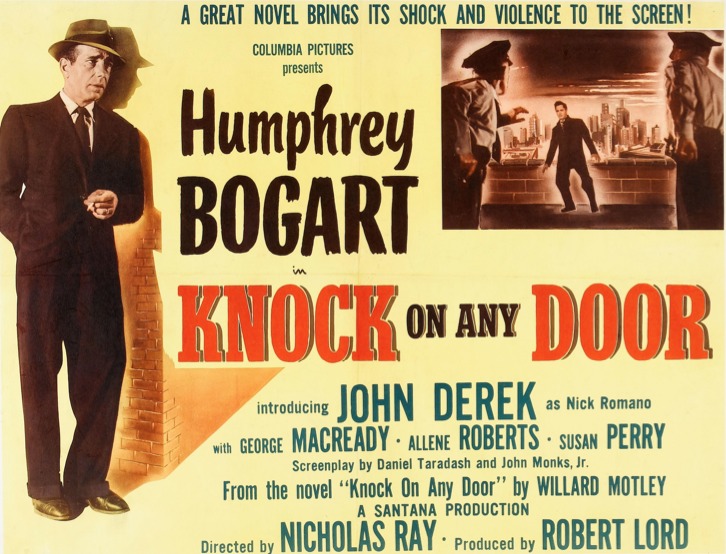
Knock on Any Door was the third film Nicholas Ray directed, but it was the first of his films to have a wide theatrical release.

Ray directed his first film, They Live by Night, in 1947, but RKO didn’t know how to market it, and it premiered in the United Kingdom in a single theater on August 5, 1948.

They didn’t know how to market his second film, either — A Woman’s Secret — which he directed in 1948.

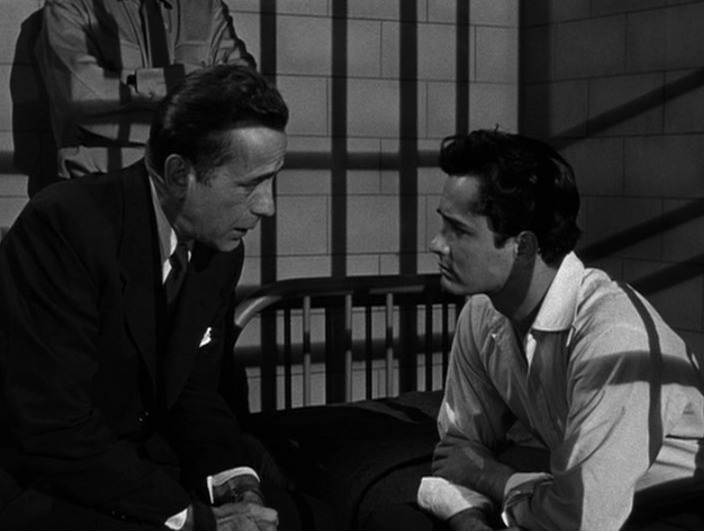
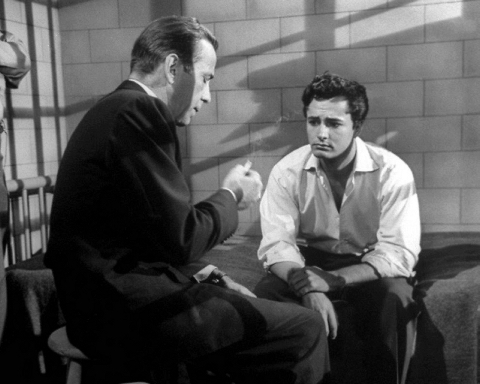
However, They Live by Night had been screened privately for many actors and producers in Hollywood. Humphrey Bogart was impressed by it, and he enlisted Ray to direct Knock on Any Door, the first film made by Bogart’s independent production company, Santana Pictures.

Knock on Any Door was an enormous success, and Ray’s earlier films soon found their way into theaters; A Woman’s Secret in March 1949, and They Live by Night in November 1949.

Bogart and Derek

The screenplay for Knock on Any Door, by Daniel Taradash and John Monks Jr., was based on the best-selling 1947 novel by Willard Motley, an African-American writer from Chicago.

Motley’s novel is the story of a young Italian-American named Nick Romano who went from being an altar boy to a career criminal after growing up in a crime-ridden neighborhood and being cycled through the juvenile justice system.

In the film, “Pretty Boy” Nick Romano is played by John Derek. It was Derek’s first credit for a motion picture, although he’d had small roles in a few films before it. The 22-year-old actor was pretty much the perfect choice to play a young hood called “Pretty Boy.”

Much is made of Derek’s good looks. When he’s put on trial for murdering a police officer, his lawyer, Andrew Morton (Humphrey Bogart), makes sure to get as many women on the jury as he can.

Morton feels responsible for the man Romano has become, since his lackadaisical legal work for the Romano family when Nick was a young man doomed Nick’s father to prison. He wants to stack the jury with as many women as possible, since he believes they’ll be swayed by his cherubic face.

Morton’s argument in court is that while Nick Romano has a criminal past, he is innocent of the crime of murder. And because Morton feels partially responsible for Nick’s criminal career, he fights for him with everything he’s got.

Bogart and Derek

Knock on Any Door superficially resembles Call Northside 777 (1948), another movie set in Chicago about a man on a crusade to prove that a second-generation American accused of murdering a police officer has been railroaded. But there’s a major difference between Knock on Any Door and Call Northside 777, and it’s why I put a spoiler alert at the beginning of this review. “Pretty Boy” Nick Romano is guilty.

I don’t know if this is obvious to some viewers. It wasn’t obvious to me. In fact, I felt so completely hoodwinked by Knock on Any Door that I couldn’t stop thinking about its climax after I watched it. Humphrey Bogart is such a likable protagonist, and his adversary — District Attorney Kerman (George Macready) — is so unlikable that I never once stopped to consider that Romano might actually be guilty. The film even sets up Romano as a handsome foil for the D.A., whose face is scarred. It’s strongly implied during all of the cross-examination scenes that Kerman is jealous of the young man’s good looks.

But then the film pulls the rug out from under the viewer. Not only does Romano finally break down on the stand and admit his guilt, but the last shot of the film is of Romano with the back of his head shaved, walking down a long corridor to the electric chair. I couldn’t believe it.

After Romano’s confession and before his walk to the death chamber, Bogart has a chance to speechify as only Bogart could. It’s a well-delivered speech about how crime is everyone’s fault when it’s grown in the Petri dish of the slums, but in the decades since Knock on Any Door was made, “Don’t blame me, blame society” has become a cliché.

The shouted message of the film didn’t have the same impact as the simple fact that I had grown to like Romano and was looking forward to seeing him found not guilty. When the film ended I felt betrayed and devastated.

Tarzan’s Magic Fountain (Feb. 5, 1949)

Tarzans Magic Fountain
Tarzan’s Magic Fountain (1949)
Directed by Lee Sholem
Sol Lesser Productions / RKO Radio Pictures

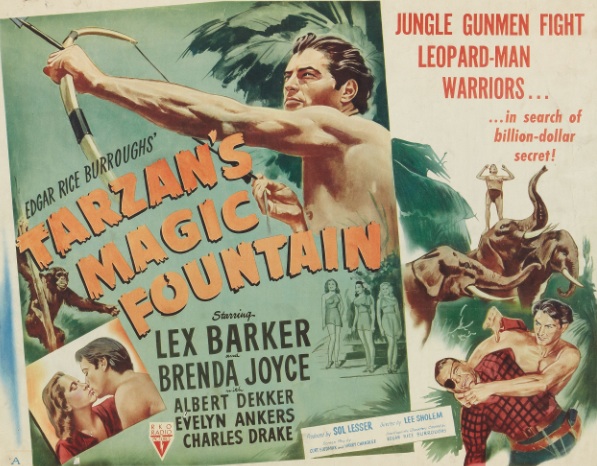
Tarzan’s Magic Fountain marked the beginning of a new era for Tarzan movies.

Johnny Weissmuller, the Olympic swimmer turned actor who first played Edgar Rice Burroughs’s lord of the jungle in Tarzan the Ape Man (1932), left the series after appearing in Tarzan and the Mermaids (1948).

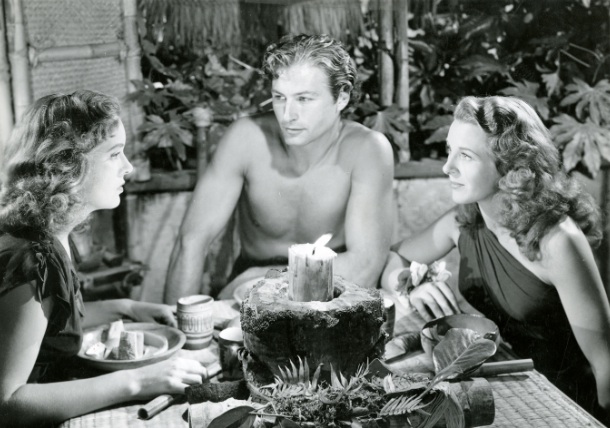
The hunt was on for a hot young male actor to take his place, and producer Sol Lesser reportedly interviewed more than a thousand of them. He and RKO Radio Pictures eventually settled on 29-year-old hunk Lex Barker.

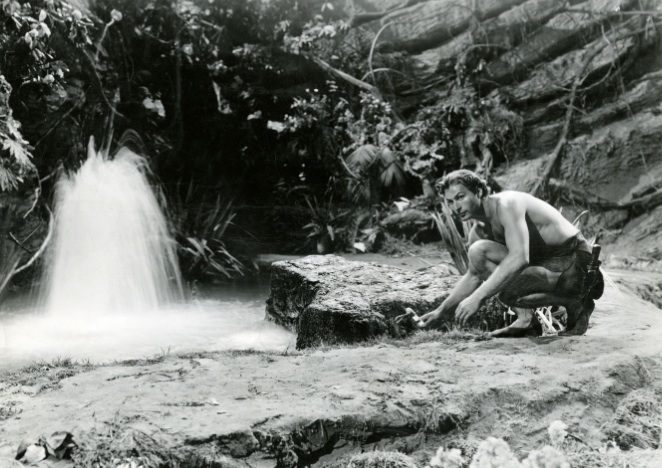
Barker was a native of Rye, New York, a member of a prominent family who disowned him when he went into acting, and a veteran of World War II. He had chiseled features and an even more chiseled physique. The only thing he needed to do to play Tarzan was shave his chest and learn to speak in the clipped, pidgin English that Weissmuller had made famous.

Barker 1949

The script for Tarzan’s Magic Fountain, by Curt Siodmak and Harry Chandlee, tells a story that will be familiar to fans of the film series. Greedy outsiders become aware of something very valuable hidden deep within the jungle, and Tarzan must act as a buffer between the tribe who guard it and the outside world.

An aviatrix named Gloria James Jessup (Evelyn Ankers), who was lost and presumed dead (à la Amelia Earhart), walks out of the jungle one day. She doesn’t appear to have aged a day since she disappeared. Her reasons for resurfacing are purely altruistic, but the evil Mr. Trask (Albert Dekker) realizes that if she’s telling the truth — and there really is a fountain of youth — that he could stand to make millions selling the water.

The beautiful and shapely Brenda Joyce returns in the role of Jane. She appeared in four Tarzan films opposite Weissmuller, and her presence in Tarzan’s Magic Fountain helps to make the transition from Weissmuller to Barker a smooth one.

She also plays a pivotal role in the film’s story, as she becomes close friends with Gloria and decides she will do anything to help Gloria be happy — even if it means doing exactly what Tarzan warns her not to do.

Joyce Barker Ankers

Tarzan’s Magic Fountain is a fun entry in the series. It’s full of excitement, fantasy, and amusing animal action. Elmo Lincoln, who played Tarzan in the first film adaptation of Burroughs’s novel, Tarzan of the Apes (1918), has an uncredited cameo as a fisherman repairing his net.

Barker makes for a fine Tarzan, but he’s lacking that special something that Weissmuller had. Even in his later years, Weissmuller moved like a panther and cut through the water like a fish. Barker is a beautiful physical specimen, and he moves well, but he lacks Weissmuller’s unique, leonine grace.

Shockproof (Jan. 25, 1949)

Shockproof
Shockproof (1949)
Directed by Douglas Sirk
Columbia Pictures

This review originally appeared earlier this year at Film Noir of the Week.

Real-life married couples can have strange chemistry when they appear together in a film. For every Bogie and Bacall there’s also a Cruise and Kidman. Just because two actors want to tie the knot and spend the rest of their lives together (or in most cases, several years of their lives together before separating), it doesn’t mean their real-life chemistry will translate to the big screen.

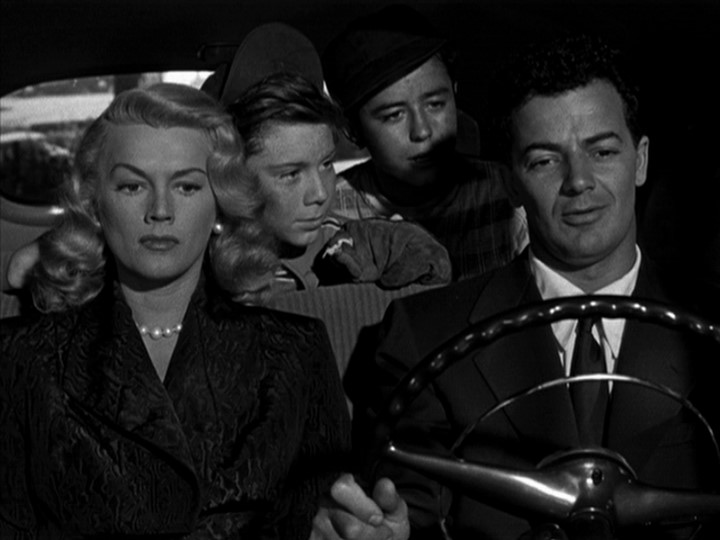
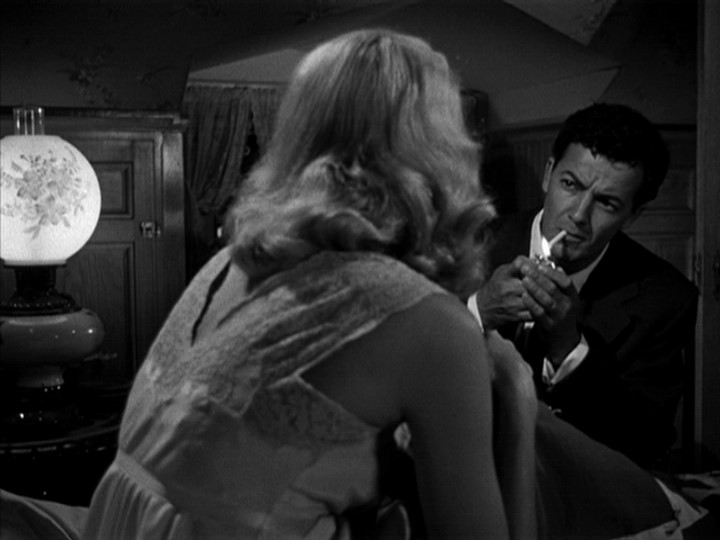
When Patricia Knight and Cornel Wilde starred together in Shockproof, they had been married 11 years. It was the only film they made together.

In Shockproof, Knight plays a woman named Jenny Marsh who has been paroled after a five-year stint in prison for murder. She committed the murder to protect her lover, Harry Wesson (John Baragrey). Jenny grew up in poverty, neglected by her parents, and the smooth-talking, wealthy Wesson swept her off her feet. The problem is, he’s a criminal through and through.

Jenny’s parole officer, Griff Marat (Wilde), believes that all she needs is to spend time with normal, decent people, and she’ll straighten out her life. Griff is a “hands-on” parole officer, and he nominates himself (along with his mother and adorable kid brother) as the most suitable decent people for Jenny to spend time with, and his romantic notions carry the force of the law.

As an actor, Wilde’s line delivery was never as impressive as his physique, but in his scenes with Knight he still comes off as the more seasoned thespian. Knight’s face is lovely in an angular sort of way, but her performance is the stuff of high camp. Whatever sparks existed in their real-life relationship, they’re hard to see in Shockproof.

Knight and Wilde

Shockproof was also an intersection for two men whose best work lay ahead of them: Samuel Fuller and Douglas Sirk.

Sirk, the director of Shockproof, was born in Europe and made several films there before immigrating to the U.S. in 1941. He would go on to direct some of the most acclaimed American films of all time — the lush Technicolor melodramas Magnificent Obsession (1954), All That Heaven Allows (1955), Written on the Wind (1956), and Imitation of Life (1959) (which, to be technically nitpicky, was filmed in Eastmancolor, not Technicolor).

At the time he made Shockproof, however, his Hollywood filmography amounted to a number of well-made potboilers that had a gloss of European sophistication; Hitler’s Madman (1943), Summer Storm (1944), A Scandal in Paris (1946), The Strange Woman (1946) (The Strange Woman was directed by Edgar G. Ulmer, but Sirk also did some uncredited directorial work on the film), Lured (1947), and Sleep, My Love (1948).

Samuel Fuller, the screenwriter of Shockproof, was a newspaperman (he got his start as a copy boy at the age of 12), a pulp novelist, a screenwriter, a ghostwriter, and a veteran of World War II who had served with the 16th Infantry Regiment, 1st Infantry Division. Fuller would go on to become an acclaimed screenwriter and director of cult films like Pickup on South Street (1953), Shock Corridor (1963), and The Naked Kiss (1964).

Shockproof is the only collaboration between Sirk and Fuller. Fuller’s screenplay was originally called The Lovers, and it told the story of a man and woman doomed by their love for each other.

Knight and Wilde

Fuller’s screenplay for The Lovers was the film Sirk signed on to make, but it wasn’t the film that ended up being released into theaters. Co-producer Helen Deutsch rewrote the script and tacked on a ridiculous happy ending. (If you’re a connoisseur of trashy cinema, Deutsch’s best work also lay ahead of her, since her last film credit was the screenplay for Valley of the Dolls, which she co-wrote with Dorothy Kingsley.)

Deutsch’s rewrite makes the entire film feel pointless, since it undercuts all of the ethical lines that Griff crosses because of his love for Jenny. It also neuters any sense of doom or tragedy that was present in Fuller’s original script. Even the change of title from The Lovers to Shockproof feels wrong. The term “The Lovers” recurs throughout the film, and it’s what Griff and Jenny are dubbed by the tabloid press. What does “Shockproof” even mean in the context of this film?

Even though Sirk and Fuller never met, Shockproof has Fuller’s fingerprints all over it. It’s a choppy, uneven film, but like everything that Fuller wrote, there’s a nasty passion always bubbling beneath the surface. It doesn’t matter so much why people are doing things, just that they’re doing them and going for broke, pedal to the metal, damned and proud, racing toward oblivion.

Of course, to pull this off successfully a film needs to have actors who are utterly convincing no matter how contrived their actions are, as well as a script that has the courage of its convictions. Unfortunately, Shockproof has neither of these things, and while there is much that’s good about it, ultimately it’s an interesting failure.

A Letter to Three Wives (Jan. 20, 1949)

A Letter to Three Wives
A Letter to Three Wives (1949)
Directed by Joseph L. Mankiewicz
20th Century-Fox

At the 22nd Academy Awards in 1950, Joseph L. Mankiewicz received two Oscars for A Letter to Three Wives. One was for best director and the other was for best screenplay. (A Letter to Three Wives was also nominated for best picture, but didn’t win.)

The film was based on a novel by John Klempner originally published in Cosmopolitan magazine in 1945. The novel was called Letter to Five Wives, but the original script for the film version omitted one of the wives and was called A Letter to Four Wives.

Mankiewicz felt the shooting script was still too long, so he cut out one of the four wives. (Sorry, Anne Baxter.)

A Letter to Three Wives is divided into three sections, each dominated by a flashback sequence.

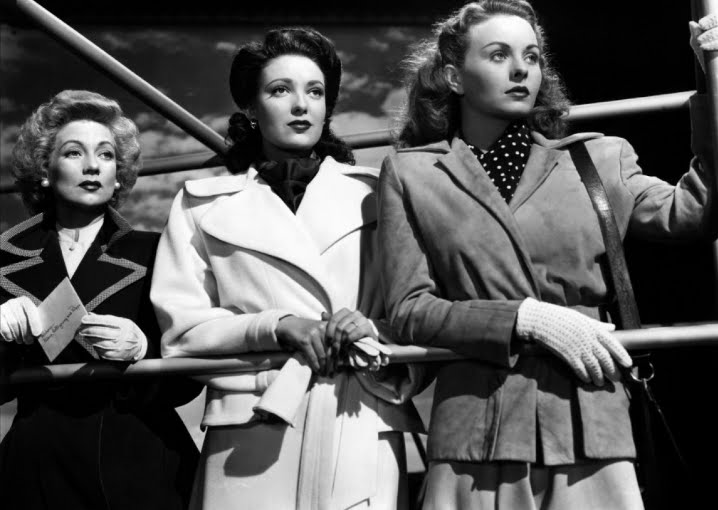
The first section focuses on Deborah Bishop (Jeanne Crain) and her husband Brad (Jeffrey Lynn), who met when they were both serving in the Navy.

The second section focuses on Rita Phipps (Ann Sothern), a writer of radio dramas, and her husband George (Kirk Douglas), a schoolteacher.

The final section of the film focuses on Lora Mae Hollingsway (Linda Darnell) and her husband Porter Hollingsway (Paul Douglas), an appliance-store magnate.

While each section focuses on a different couple, this is not an anthology film. The viewer meets all the characters in the early going, but sometimes just for a moment. Watching A Letter to Three Wives is a little like being introduced to a rush of people at a party. As the evening wears on, you become better acquainted with everyone and you learn how their lives intersect in often messy and hilarious ways.

A Letter to Three Wives takes place in an upper-middle-class Eastern community that’s 28 minutes from the big city, or “23 if you catch the morning express,” as Addie Ross tells the viewer. Addie Ross is the most beautiful and alluring woman in town, and although her presence dominates the film, we never see her. We only hear her voice as she cuts in to narrate and comment on bits of the story. (Addie Ross is voiced by the uncredited Celeste Holm).

Rita, Lora Mae, and Deborah are on their way to help run a day trip for underprivileged children when they receive a letter from Addie informing them that she’s leaving town for good, but she’s not leaving empty-handed — she’s taking one of their husbands with her. The three friends are forced to board the boat, and all of them stare longingly at the public telephone on the dock as they drift into the water. They won’t be able to find out which one of their husbands is missing in action until the day is done.

Sothern Darnell and Crain

Mankiewicz directed some fine films before this one, including the Gothic thriller Dragonwyck (1946), the film noir Somewhere in the Night (1946), and the brilliant romantic comedy The Ghost and Mrs. Muir (1947), but A Letter to Three Wives is head and shoulders above all of them.

Mankiewicz was a witty, intelligent, and acerbic writer-director, and A Letter to Three Wives shows him in top form. It’s one of the smartest and funniest films I’ve seen from the ’40s about marriage and the American class structure. Deborah is a farm girl and never feels at home with the country-club set she’s married into. Rita has a demanding, high-paying job, and she makes a lot more money than her schoolteacher husband. Lora Mae is a trophy wife to a fabulously wealthy, boorish, and bullheaded man.

Kirk Douglas, who plays Rita’s schoolteacher husband, is fantastic in this film, and delivers one of the most eviscerating speeches I’ve ever heard about anti-intellectualism and the idiocy of appealing to the lowest common denominator. And Paul Douglas, who plays Lora Mae’s husband, gives a phenomenal performance as well. He was a stage actor, and this was his first appearance in a feature film, but he owns the screen, and would go on to have an interesting career.

A Letter to Three Wives is a masterpiece of scriptwriting and direction. Addie Ross is really just a plot device to tell a character-driven story, and toward the end of the film, I realized that I’d been told a very different story than the one I thought I was watching.