Sorry, Wrong Number (Sept. 1, 1948)

Sorry Wrong Number
Sorry, Wrong Number (1948)
Directed by Anatole Litvak
Hal Wallis Productions / Paramount Pictures

Lucille Fletcher was the greatest playwright who ever worked in the medium of radio.

Fletcher had an instinctive understanding of radio’s limitations and possibilities. Her dramas were often confined to a single location, never had more characters than the listener could keep track of, and exploited simple but primal fears like helplessness, confinement, and being alone in the dark.

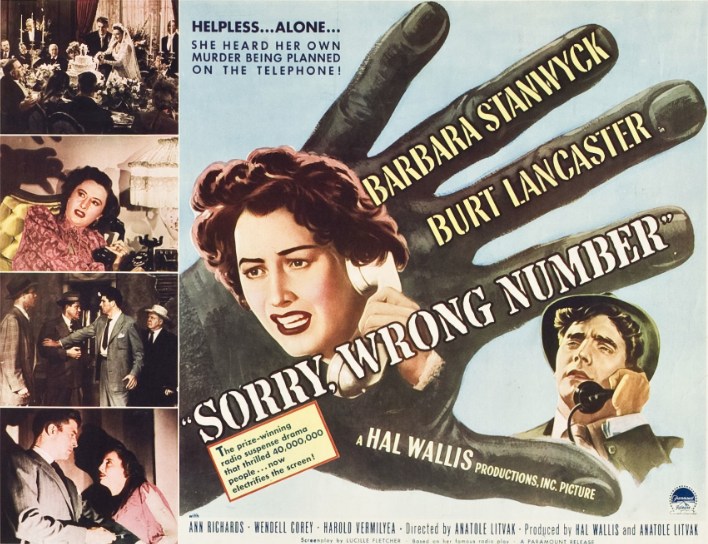
Her most famous radio play was “Sorry, Wrong Number,” which was first broadcast on May 25, 1943, as an episode of the CBS anthology series Suspense. It starred Agnes Moorehead as a bedridden invalid who accidentally overhears a phone conversation between two men who are planning a murder. Distraught, she tries to get the operator to find out where the call came from. When that doesn’t work, she calls the police, but without specific information — she didn’t hear any names or exact places — there isn’t much they can do.

It’s a brilliant setup. Since all the action takes place in a single bedroom and all of the dialogue takes place over the phone, there’s never any confusion about who’s who, or what’s happening. Also, the fact that the story is told completely through sound creates a terrifying sense of intimacy.

“Sorry, Wrong Number” was the most popular episode ever broadcast on Suspense. It was so popular that it was performed seven more times, each time starring Agnes Moorehead; again in 1943, in 1944, in 1945, in 1948, in 1952, in 1957, and for the final time in 1960. (Suspense was on the air from 1942 to 1962.)
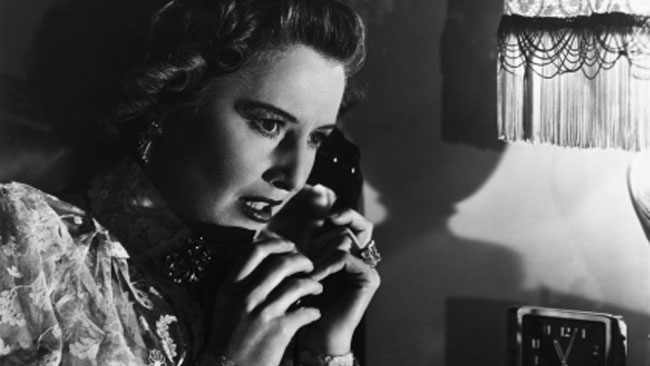
Stanwyck

It’s natural that such a popular radio play would be adapted for the big screen, but I wasn’t sure how well it would work expanded to three times its length for a visual medium.

People seem to have mixed feelings about Anatole Litvak’s film version, but I thought it was pretty good. I love Barbara Stanwyck, and she’s a more likeable protagonist than Agnes Moorehead was in the same role on the radio.

I found Sorry, Wrong Number similar in some ways to Robert Siodmak’s film The Killers (1946), which was adapted from the short story by Ernest Hemingway. Both films take a small, perfect little piece of art and expand it into a feature film by adding a bunch of characters and a whole lot of plot that’s not even suggested in the original work. (Incidentally, both films star Burt Lancaster and feature William Conrad in a small but important role.)

How well this works is up to the individual viewer, but I thought that Sorry, Wrong Number worked pretty well as a film. It doesn’t have the same impact as the radio play, but the integrity of the original story remains intact, even though it only occupies the first 15 minutes and the last 10 minutes of the film. The film version also humanizes her husband (played by Lancaster) and turns him into a victim of sorts, which is drastically different from the radio play, in which he is mostly an off-stage presence.

Anyway, I love Lucille Fletcher’s work for radio, so I thought I’d compile a list of some of the shows she wrote scripts for. You can click on the titles below to stream the shows or right-click to download them.

The Hitchhiker (first broadcast November 17, 1941)
This is the June 21, 1946, broadcast of the show on Orson Welles’s Mercury Summer Theatre on the Air. Welles reprises his role as a man driving cross-country who repeatedly see the same hitchhiker on the side of the road, even though there is no possible way the man could be moving from place to place so quickly. The chilling music is by Fletcher’s husband at the time, Bernard Herrmann. Like “Sorry, Wrong Number,” this play was done for radio several times, and was even adapted as an episode of The Twilight Zone in 1960.

The Diary of Sophronia Winters (first broadcast April 27, 1943)
Sophronia Winters (Agnes Moorehead), an unmarried middle-aged woman who is feeling liberated after her father’s death, meets a man named Hiram (Ray Collins) whose sister-in-law was also named “Sophronia.” Hiram marries Sophronia and begins to torment her with tales of the other Sophronia, an ax murderess. This is a claustrophobic, suspenseful story that evokes Charlotte Perkins Gilman’s story “The Yellow Wallpaper,” as well as memories of the real-life case of Lizzie Borden.

Sorry, Wrong Number (first broadcast May 25, 1943)
The original radio version stars Agnes Moorehead and is one of a handful of absolutely indispensable shows if you have any interest in radio drama.

Fugue in C minor (first broadcast June 1, 1944)
Ida Lupino plays a woman in the late Victorian era who is introduced to a widower with two young children. The widower, played by Vincent Price, is a composer, and his children believe that he murdered their mother, and that her spirit is trapped in their father’s organ.

The Search for Henri LeFevre (first broadcast July 6, 1944)
Paul Muni stars as a classical composer who believes his work has been plagiarized and broadcast on the radio by a man named “Henri LeFevre.”

The Furnished Floor (first broadcast September 13, 1945)
Don DeFore plays a man whose wife has died. He moves back into the apartment he used to share with his wife and restores it to exactly the way it was when his wife was still alive. Mildred Natwick plays his landlady.

Dark Journey (first broadcast April 25, 1946)
Nancy Kelly and Cathy Lewis play a pair of old friends who reunite after years apart. One of them is obsessed with a man who has spurned her, and believes that she can make him love her through sheer force of will.

The Thing in the Window (first broadcast December 19, 1946)
Joseph Cotten plays a man who thinks he can see a corpse in the apartment across from him, but he can’t be certain if his mind is playing tricks on him.

As I said, I love Lucille Fletcher’s work, and I hope you will too.

Rope (Aug. 28, 1948)

Rope
Rope (1948)
Directed by Alfred Hitchcock
Warner Bros. / Transatlantic Pictures

Did you know that actor Dick Hogan’s last role was playing a symbolic male orgasm?

It’s true. Hogan — previously mentioned in this blog for his role in Shed No Tears (1948) — was cast in Alfred Hitchcock’s Rope as murder victim David Kentley.

It’s an important role, but a thankless one. As Kentley, Hogan has no lines, and is offscreen for most of the film’s running time.*

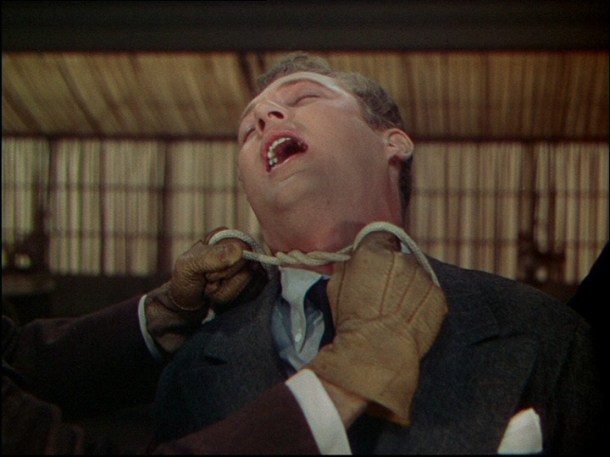
After the film’s opening credits have rolled, we hear his scream, then see him with a rope wrapped around his neck at the moment he is dying. He’s being murdered by a pair of thrill-killers named Brandon (John Dall) and Phillip (Farley Granger) who consider themselves “superior” and most everyone else — including their friend David — “inferior.”

Rope is based on a 1929 play written by British playwright Patrick Hamilton. Brandon and Phillip are thinly veiled versions of Leopold and Loeb, the infamous thrill-killers who in 1924 murdered a 14-year-old boy in an attempt to commit a “perfect crime.”

Leopold and Loeb were law students at the University of Chicago. Both came from wealthy families, and both had muddled ideas about Nietzsche’s concept of the “superman” and their own superiority.

Long story short, their crime was far from perfect, and they were arrested and put on trial. Leopold and Loeb were represented by Clarence Darrow, who was a staunch opponent of capitol punishment. The jury found them guilty and the judge sentenced the two young men to life in prison for murder, plus 99 years for kidnapping. Loeb was killed by another inmate in 1936, but Leopold was eventually paroled in 1958, after 33 years in prison. He died in 1971 of natural causes.

Dick Hogan

But back to the fictionalization of their crime, and that symbolic male orgasm I mentioned at the beginning.

I’m sure some will accuse me of “reading too much into” the film or seeing something that isn’t there, but I think anyone who reads up on the Leopold and Loeb case and then immediately watches Rope will find it impossible not to notice the homosexual undertones. Also, Hitchcock is one of the most self-aware filmmakers of all time, and he was fascinating by unconventional sexuality.

The very first scene — the murder — is a symbolic orgasm shared by the murderers; strangled, intense, and shameful.

The murder is a stand-in for a sexual encounter between Brandon and Phillip. Phillip doesn’t want to turn the lights on right away. “Let’s stay this way for just a minute,” he says, and Brandon lights up a post-coital cigarette. “We couldn’t have done it with the curtains open in the bright sunlight.”

This is about as explicit as a film from 1948 could be when exploring gay sex and gay desire.

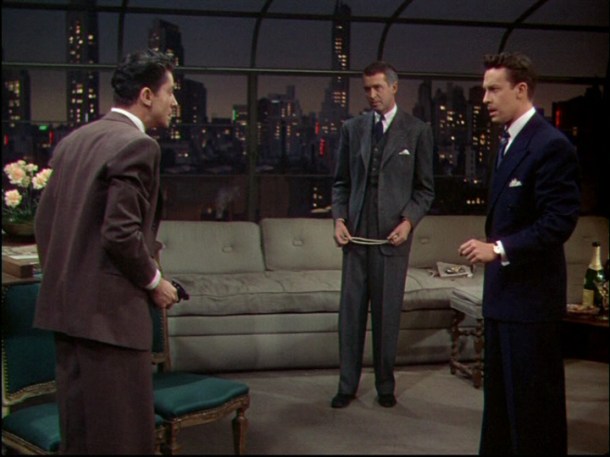
Add to this the fact that the two young men are most in danger of being found out by book publisher Rupert Cadell (James Stewart), who was the boys’ headmaster in prep school. The theme of naughty little boys possibly being found out and punished by a boarding-school authority figure is just one of the many skillful pieces of homosexual innuendo that Hitchcock sprinkles throughout Rope.

Granger, Stewart, and Dall

Rope is one of Hitchcock’s most impressive technical stunts. He filmed the action in long takes, like a play. Most of the cuts are necessitated by the length of film reels, and are done as seamlessly as possible (e.g., an actor passes in front of the camera, darkening the frame for a moment to facilitate a cut). Most of the action of Rope takes place during a dinner party at Brandon and Phillip’s apartment. They’ve arranged a buffet on top of the trunk in which David Kentley’s corpse has been hidden.

I don’t normally like films adapted from plays, but I love Rope. Stage plays are very different from screenplays, and I think the problem with most play-films is that something seems very, very “off” about the dialogue and the way the characters appear, disappear, and reappear in physical space. By filming Rope exactly like a play, however, Hitchcock ironically created a very exciting movie that works extremely well. There’s a creepy sense of intimacy created by the single setting and the actors all playing off each other without a cut every few seconds. And of course, the fact that every line in the film is colored by the viewer’s knowledge that the corpse of David Kentley is hidden away under everyone’s nose.

The way the film moves from day to night is eerie and impressive, too. The backdrop of the film is an enormous window that looks out over Manhattan, and as the film moves forward in time the sky grows darker and lights come on in the buildings and smoke curls from little smokestacks.

Rope should be seen at least once by everyone who has any interest in how films are made. And for people who love Hitchcock’s gruesome playfulness and gallows humor, it’s a film to be savored over and over.

*Interestingly, Hogan has a speaking role in the film’s trailer, but never utters a word in the film itself. Hitchcock’s films always had some of the most inventive trailers, and Rope is no exception:

Red River (Aug. 26, 1948)

Red River
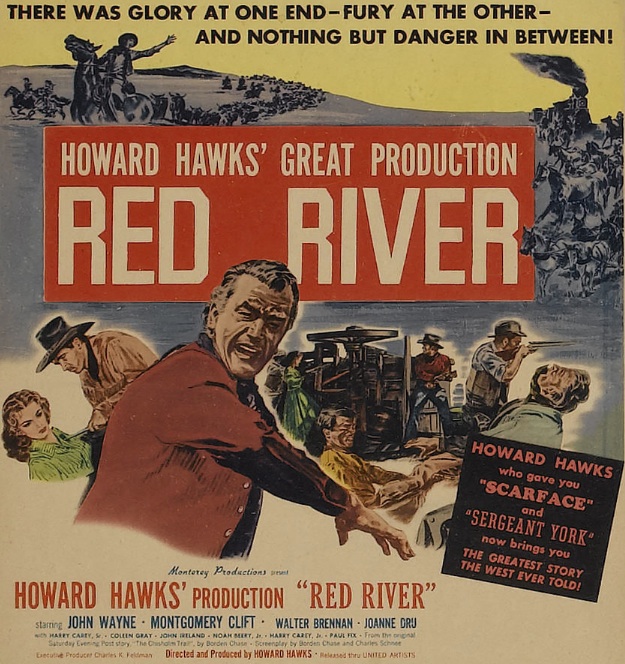
Red River (1948)
Directed by Howard Hawks
United Artists

Howard Hawks shot Red River in 1946, but its release was delayed due to legal difficulties. The eccentric Howard Hughes contended that parts of Red River were taken from his “lust in the dust” western The Outlaw (1943), which starred Jane Russell and her magnificent breasts.

Anyone who’s seen both Red River and The Outlaw can tell you that any claim of story infringement is spurious, but there was bad blood between Hughes and Hawks (Hawks had worked on The Outlaw as an uncredited co-director), and it took until August 26, 1948, before Red River finally had its premiere.

So while Fred Zinnemann’s The Search (1948) was the film that introduced many moviegoers to Montgomery Clift, Red River was his first acting role in a feature film.

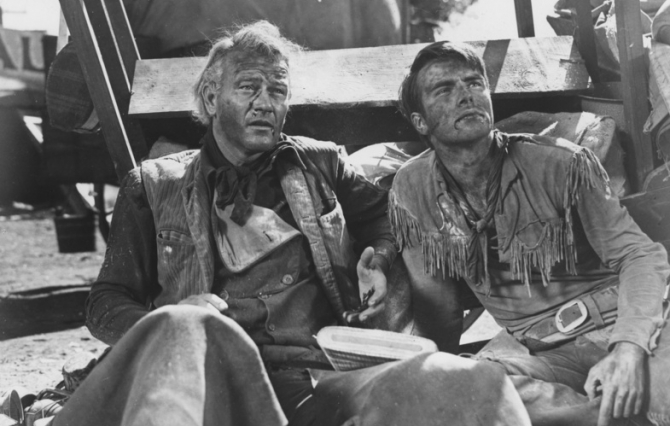
Clift was a born movie star. He was achingly handsome, rail-thin, and blessed with a uniquely vulnerable type of masculinity. On screen, he had a presence that seemed completely natural. Red River is a phenomenal western that works on a number of different levels, but one of its most important aspects is the relationship between Clift and the film’s star, John Wayne.

Wayne and Clift were on opposite ends of the spectrum in every way imaginable; politically, professionally, physically, and sexually. But it’s this contrast that makes Red River work so well.

Wayne and Clift

Red River is the story of a cattle drive along the Chisholm Trail up from Texas. Thomas Dunson (John Wayne) is a big, tough cattleman who took his land by force.

When Dunson was first establishing his grazing land with his best friend Nadine Groot (Walter Brennan), the woman Dunson loved (Coleen Gray) was murdered by Comanches, and he never loved another.

The sole survivor of the massacre, a young man named Matt Garth (played as a boy by Mickey Kuhn) came wandering through the land, leading a cow. Dunson’s bull mated with Garth’s cow, and from this union eventually grew a herd of more than 10,000 longhorns.*

Fourteen years pass, and Garth grows up, now played by Montgomery Clift. The Civil War has ended, and Dunson is no longer able to sell beeves to the impoverished southern states. He decides that he’ll drive his entire herd north to Missouri, where they’ll fetch a fortune. He’s spent his life building his empire, and he wants to pass it down to Matt Garth, his protégé.

The only problem is that Dunson’s greatest strength — his unbending will — is also his greatest weakness, which eventually puts him at loggerheads with the more even-tempered and empathetic Garth.

John Wayne and Montgomery Clift

Borden Chase, who wrote the Saturday Evening Post story on which Red River was based (as well as the screenplay for the film with Charles Schnee), drew liberally from Mutiny on the Bounty in crafting his story.

Despite the fact that his middle name was “Winchester,” this was Howard Hawks’s first directorial credit for a western, which is remarkable considering he’d been directing films since the 1920s and had more than one masterpiece under his belt.

In addition to his own estimable talents as a director, Hawks had some of the finest crew members who ever worked on a Hollywood western when he made Red River. Composer Dimitri Tiomkin’s score is epic. Editor Christian Nyby’s cutting drives the film forward with relentless intensity. And cinematographer Russell Harlan had toiled away for years working on B pictures (mostly westerns) before finally breaking into A pictures with Lewis Milestone’s war movie A Walk in the Sun (1945). He went on to become one of the best cinematographers in the business, and his work on Red River is proof.

Red River is one of the greatest westerns ever made. As I said above, it works on a number of different levels. At its most basic level, Red River is a rousing adventure film about men on a dangerous mission, struggling against the elements and against each other. But on a deeper level, it’s a timeless myth about fathers and sons.

Red River will be shown on TCM this Friday, March 1, 2013, at 10:15 PM ET.

*If you’re a fan of sexual innuendo in old movies, the scene in Red River in which Matt Garth and gunslinger Cherry Valance (John Ireland) compare revolvers is a classic. Many see a gay subtext, which could be there, but gay men hardly have a monopoly on comparing phalluses to see whose is bigger. I think the sexual bonding between men in Red River goes much deeper. Remember that the herd being driven up the Chisholm Trail in Red River are all descended from the union between John Wayne’s bull and Montgomery Clift’s cow. Even though Dunson and Garth are not blood relations, they are bound together.

Pitfall (Aug. 24, 1948)

PitfallOne man’s domestic bliss is another man’s prison.

John Forbes (Dick Powell) has what some men only dream of — a home; a steady job with the Olympic Mutual Insurance Company; an attractive, intelligent, and loving wife (Jane Wyatt); and a son (Jimmy Hunt) who thinks his dad is the greatest guy in the world.

And yet, he’s dissatisfied. It’s a formless sort of dissatisfaction. He grumbles about how fast his son Tommy outgrows his shoes. He tells his wife Sue that the world won’t end if he doesn’t show up at his desk every morning at 9 o’clock. He asks Sue what became of those two young kids they were … the two young kids who were going to build a boat and sail around the world.

As Sue drives him to work he tells her, “Sometimes I get to feel like a wheel within a wheel within a wheel.”

“You and fifty million others,” she responds.

“I don’t want to be like fifty million others,” he says.

“But you’re John Forbes, average American, backbone of the country,” she says with a smile.

“I don’t want to be an average American, backbone of the country. I want somebody else to be the backbone and hold me up.”

Later that day — a day shaping up to be like any other — he goes to the apartment of Miss Mona Stevens (Lizabeth Scott), a beautiful but world-weary blonde who received gifts from a man convicted of embezzling.

It’s just part of his job. He doesn’t care one way or the other that one of the gifts he’s recovering is an engagement ring. But Mona sees right through him, and tells him, “You’re a little man with a briefcase. You go to work every morning and you do as you’re told.”

Her words get to him, and he softens towards her. They share a few afternoon drinks in a dark cocktail lounge. They go boating. And he never once mentions his wife or son.

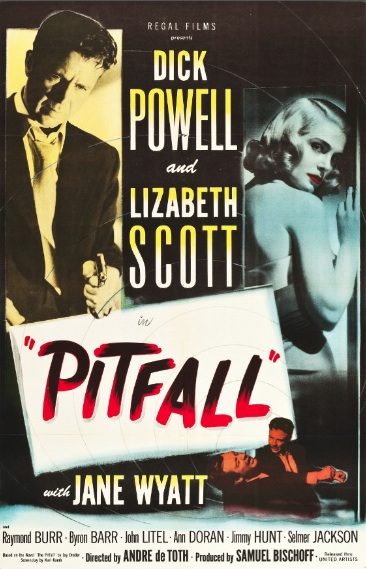
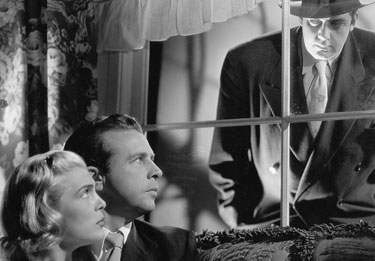
Scott Powell and BurrOne thing I loved about Pitfall is that its characters are real adult people leading real adult lives. They’re not overblown film-noir caricatures, and their actions all have realistic consequences.

Mona is not a femme fatale who sees in John Forbes an easy mark. Aside from being unusually attractive, she’s an average woman who hates that she was involved with a man who was not only stupid enough to embezzle money to spend on her, but stupid enough to get caught. And she gets involved with John Forbes not because she has a dastardly scheme, but because he’s kind to her and she thinks he’s a decent guy. (Mona Stevens has a lot more in common with Ann Sheridan’s character in Nora Prentiss than she does with Barbara Stanwyck’s character in Double Indemnity.)

But Pitfall is not just a tale of marital infidelity and post-war suburban malaise, it’s a noirish thriller, which means there are some nasty surprises lurking.

One of them takes the form of the angry loser who embezzled for love of Mona — Bill Smiley (Byron Barr), whose prison term is nearing an end. The other takes the hulking form of a creepy private detective who is obsessed with Mona — J.B. “Mac” MacDonald (Raymond Burr).

Pitfall has all the ingredients of a great film noir, but director André de Toth mixes them together in interesting ways, and avoids over-the-top contrivances. Cinematographer Harry J. Wild’s solid but unpretentious shots of Los Angeles anchor the film, the actors all deliver really good performances, and Karl Kamb’s screenplay (based on Jay Dratler’s novel The Pitfall) is full of wit and intelligence.

Race Street (Aug. 22, 1948)

Race StreetYou know what would be a great drinking game for a designated driver to play? Watching Race Street and taking a shot every time George Raft changes his expression.

Raft had no range as an actor, but he did play well with others. When paired with good performers, Raft had real chemistry with them. For instance, my favorite scene in Howard Hawks’s Scarface (1932) is when Ann Dvorak does a sexy, playful dance to try to get a reaction out of Raft. He remains stone-faced, but there’s always a twinkle in his eye.

As an actor, Raft got a lot of mileage out of that twinkle in his eye. Even though he mostly played his characters as expressionless tough guys, his eyes always made it seem as if he was taking in everything around him.

The other thing Raft brought to the table as an actor was a whiff of real-life criminality. He was well-known for his associations with gangsters like Owney Madden, Meyer Lansky, and Bugsy Siegel, which added another dimension to roles like the one he plays in Race Street.

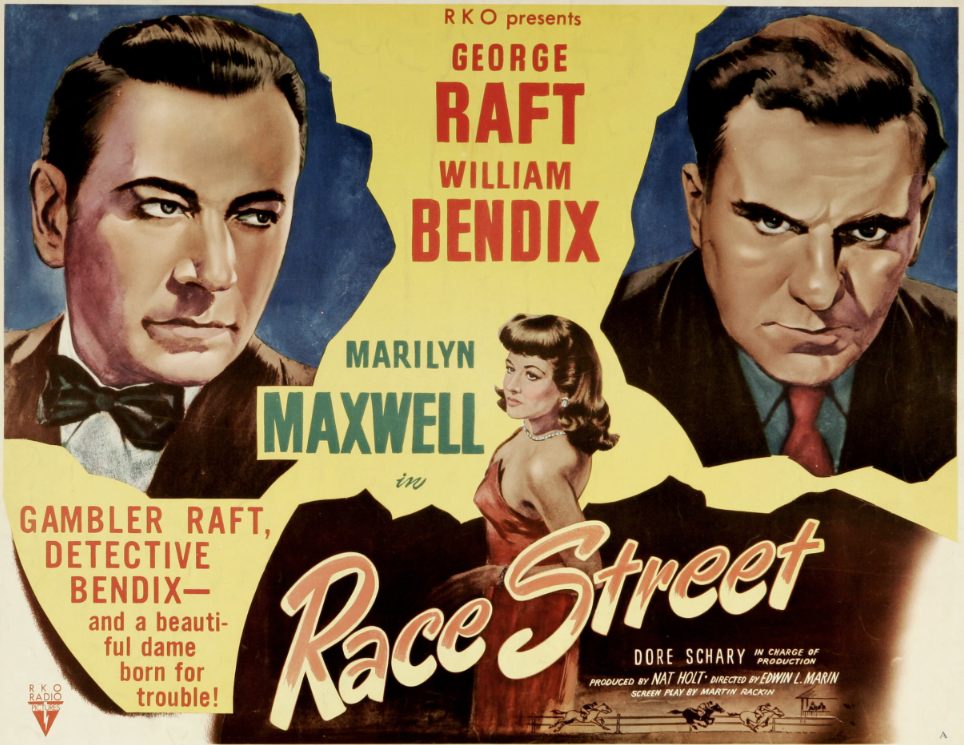
In Race Street, Raft plays a bookie named Dan Gannin. Gannin hides his illegal betting operation behind a respectable facade as an investor. Despite his criminal endeavors, he has an easy friendship with a police detective, Lt. Barney Runson (William Bendix). Lt. Runson knows that his friend Dan is a bookie, but they’re childhood friends, and not much trumps that.

Gannin’s other childhood friend in the film, a fellow bookie named Hal Towers (Harry Morgan), needs a little more taking care of than Runson, and when he begins running afoul of thugs in a protection racket, it’s easy to see that things are going to get complicated for Gannin, who is the standard “nice guy who just wants to go straight” character we’ve seen in a thousand crime movies.

On the distaff side of Gannin’s life is his beautiful sister Elaine (Gale Robbins), a leggy dancer and nightclub singer with whom he’s opening a nightspot called the Turf Club. There’s also a new lady in his life, a brunette named Robbie Lawrence (Marilyn Maxwell).

Race Street was directed by Edwin L. Marin, who directed a bunch of B pictures for RKO with George Raft, including Nocturne (1946), which I enjoyed quite a bit.

As I said above, Raft isn’t the most engaging actor in the world, but he turned in watchable performances when he had a good supporting cast and a decent script, and Race Street succeeds on both counts. I especially liked William Bendix in this film. Bendix was as good at playing comic buffoons as he was at playing sinister villains, and he could do everything in between.

Race Street also has plenty of beautiful footage of San Francisco. A lot of it’s obviously stock footage, but it’s integrated into the film well. This is clearly a B movie, but no studio made B-grade film noirs as well or as consistently as RKO Radio Pictures.

Mr. Peabody and the Mermaid (Aug. 11, 1948)

Mr. Peabody and the MermaidIrving Pichel’s Mr. Peabody and the Mermaid is an enchanting little fantasy that’s perfect for chasing away the winter doldrums.

This movie is an old favorite of mine. I first saw it on TV when I was a kid and absolutely loved it. It was a lot of fun to revisit, and was just as charming and funny as I remember.

Mr. Arthur Peabody (William Powell) is a dignified Bostonian on the verge of turning 50, that dreaded age that says, “if you’re not already having a midlife crisis, you’d better start now.” Mr. Peabody and his slightly younger wife, Mrs. Polly Peabody (Irene Hervey), go on vacation to the British Caribbean (now commonly referred to as the British Virgin Islands), and Mr. Peabody has a life-changing experience. While out fishing, he hooks a mermaid.

The mermaid is played by the beautiful and doll-like Ann Blyth. She’s listed in the credits as just “Mermaid,” but in the film, Mr. Peabody decides her name is “Lenore.”

Mr. Peabody and the Mermaid is book-ended by scenes of Mr. Peabody talking to a psychiatrist, Dr. Harvey (Art Smith). No one but Peabody ever sees the mermaid, so naturally his wife and everyone else all assume that he’s crazy.

The film is coy about Lenore’s existence, but she does seem to exist in physical reality. Mrs. Peabody see the mermaid’s fins sticking out of a bubble bath and scolds her husband for cleaning a fish in the tub. The mermaid also spits water on a man before darting back into the water, and when a woman whom the mermaid considers a rival for Mr. Peabody’s affection goes swimming, the mermaid bites her on the leg.

But there’s still a sense of unreality about “Lenore,” and not just because she’s a mythical creature. Lenore never speaks, but seems to understand everything Mr. Peabody says to her, and adores him. She’s his middle-aged fantasy come to achingly beautiful life.

There are parallel stories about Mrs. Peabody’s flirtation with a handsome chap, Major Hadley (Hugh French), and the beautiful adventuress, Cathy Livingston (Andrea King), who sets her sights on Mr. Peabody. The film wrings a lot of humor out of this situation, as Mrs. Peabody thinks Mr. Peabody is dallying with Miss Livingston while in fact he’s trying to keep the mermaid’s existence secret while planning on running away with her to the Florida Keys.

Mr. Peabody and the Mermaid is a lovely escapist fantasy, and is currently streaming on Netflix and Amazon. Highly recommended, especially if you’re sick of cold weather and aren’t going on vacation anytime soon.

Blyth and Powell

They Live by Night (Aug. 5, 1948)

They Live by Night
They Live by Night (1948)
Directed by Nicholas Ray
RKO Radio Pictures

This movie grabbed me with its first frame and never let go.

They Live by Night is unlike any other movie I’ve seen so far from 1948. Obviously I know what lay ahead for its director, Nicholas Ray, but even if I didn’t, this is the kind of film that would make me sit up and take notice of his name, and look forward to seeing everything he directed next.

Come to think of it, my knowledge of Ray’s filmography is pretty spotty. In high school, Rebel Without a Cause (1955) was one of my favorite films. I watched it over and over, but never thought to explore more of Ray’s films. Years later, I saw In a Lonely Place (1950) and loved it, but didn’t make the connection that it was the same director who made Rebel. But now I’ve got so many Nicholas Ray films to look forward to!

Like all innovative films made more than 50 years ago, They Live by Night doesn’t contain anything we haven’t seen in hundreds of films since, but when viewed in its proper context, it’s exhilarating. Just look at the opening of the film. Unlike nearly every other film of the era that began with a title card followed by a credit roll, They Live by Night begins with shot of two deliriously happy young lovers as the following words flash on the screen: “This boy… and this girl… were never properly introduced to the world we live in… To tell their story…” And suddenly the music becomes grim and portentous, we cut to a shot of a speeding car, and the film’s title appears. The speeding car is filmed from a helicopter, and it’s the earliest instance of action shot from a helicopter that I’ve seen in a film. It’s just one of the innovative ways that Ray creates tension, drama, and excitement with filmmaking techniques that are common practice now, but that were revolutionary at the time.

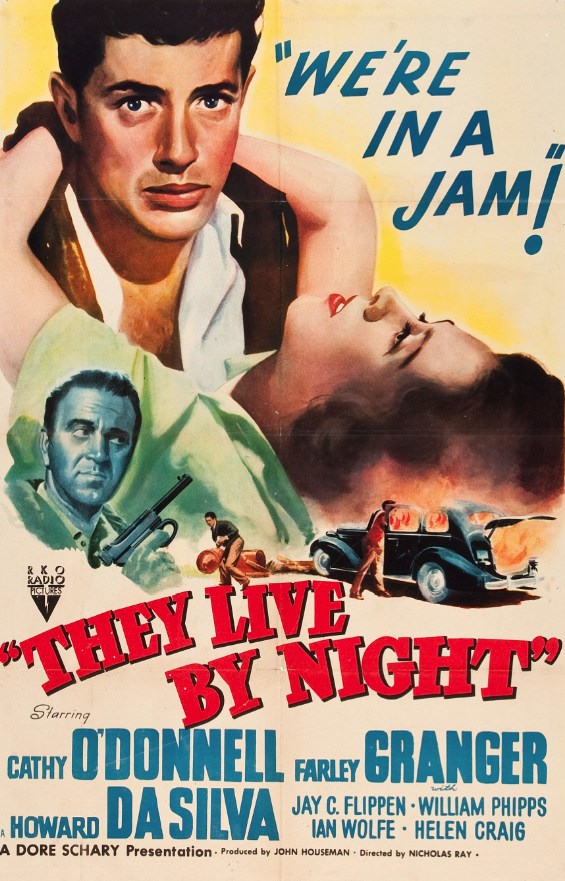
They Live by Night was based on Edward Anderson’s novel Thieves Like Us (1937). Farley Granger plays a young man named “Bowie” Bowers (his first name is pronounced “Boo-ee,” just like Jim Bowie). When the film begins, he’s an escaped con running from a murder sentence, and his luck will only get worse as the film goes on.

Except for one thing. He falls in love with a young woman named Keechie (Cathy O’Donnell), and while they’re on the run together, they’re happy as only two young people in love can be happy.

There are obvious comparisons to be drawn with Joseph H. Lewis’s Gun Crazy (1950) and Arthur Penn’s Bonnie and Clyde (1967). They Live by Night shares the Depression-era setting with Bonnie and Clyde, and it’s visually similar to Gun Crazy, but unlike both of those films, Keechie isn’t an active participant in any criminal activity and the film focuses more on her romance with Bowie than it does on Bowie’s crime spree.

Ray makes so many surprising and smart choices in this film. He doesn’t show most of Bowie’s bank robberies, which focuses our attention on Bowie’s romance with Keechie. His crime spree across Texas is a matter of grim necessity, and all he wants to do is escape. This has the effect of making a radio news report about Bowie’s growing infamy surprising to the audience. Ray makes it easy to forget much of the time that Bowie is a criminal, which make the intrusions of hard reality into Bowie and Keechie’s lives all the more shocking.

Ray also has a knack for depicting life in a way that feels authentic. Even minor characters with just a few lines feel like fully realized, three-dimensional people. When Bowie and Keechie go to a nightclub on a date, the African-American singer Marie Bryant does a rendition of “Your Red Wagon” and collects dollar tips from the crowd, which she folds and clasps between her fingers. Most Hollywood productions would never show a nightclub singer taking tips — it would ruin the illusion of glamour. But the nightclub in They Live by Night looks and feels like a real place. When Bowie goes into the men’s room, he has a brief conversation with the African-American bathroom attendant. In a lesser film, the attendant would be comic relief, and in a lower-budget film, he wouldn’t exist at all.

They Live by Night features top-notch work by all of its cast and crew. Leigh Harline’s music (with uncredited assistance from Woody Guthrie) is phenomenal. George E. Diskant’s cinematography is some of the most beautiful and most noirish I’ve ever seen (they really do live by night in this movie), and Sherman Todd’s film editing is soothing when it needs to be and jarring when it needs to be. Todd and Ray made a lot of risky choices in the editing room, but for my money, they all paid off.

Ray filmed They Live by Night in 1947, but RKO wasn’t sure how to market the film, and it ended up premiering in the United Kingdom in a single theater on August 5, 1948. It wasn’t released in the United States until November 1949, and didn’t end up being a financial success, but it had been screened privately in Hollywood for many actors and producers, which led to Ray’s next film, Knock on Any Door (1949), with Humphrey Bogart, as well as to Farley Granger being cast in Alfred Hitchcock’s Rope (1948).

Key Largo (July 31, 1948)

Key LargoJohn Huston’s Key Largo was the fourth and final film Lauren Bacall and Humphrey Bogart made together.

Hard to believe, isn’t it? Bogie and Bacall are one of the most famous couples — perhaps the most famous couple — in Hollywood history. And yet, their onscreen work together boils down to just four films made over the course of five years: To Have and Have Not (1944), The Big Sleep (1946), Dark Passage (1947), and Key Largo.

Key Largo is very loosely based on the 1939 play by Maxwell Anderson. I often don’t like films adapted from plays. The dialogue and the way the characters enter and re-enter the action usually feels very strange. But Key Largo never feels “stagey,” and confining the action to a single location only heightens the tension between the characters.

The film opens with beautiful footage of the Florida Keys. By opening with establishing shots of the steamy, summertime Keys, by the time the action is confined to a hotel while a hurricane rages outside, nothing about Key Largo feels stagey or stilted. The viewer is right in the middle of the action, and the suspense grows as the film goes on.

Summertime is the off season in the Florida Keys, when the mercury never dips below 100 degrees, and all the hotels are closed. Bogart plays Frank McCloud, a veteran of World War II who is in Key Largo to visit James Temple (Lionel Barrymore), a wheelchair-bound man whose son George was killed in the war. (McCloud was George Temple’s commanding officer.) Temple runs a hotel in Key Largo with George’s widow, Nora (Lauren Bacall).

When Bogart sits down at the bar in the Largo Hotel, he laconically introduces himself to the boozy moll Gaye Dawn (Claire Trevor) as “McCloud. Frank. By John, out of Ellen.”

Gaye is not the only oddball occupant of the Largo Hotel. There are also a trio of men — Curly (Thomas Gomez), Angel (Dan Seymour), and Toots (Harry Lewis) — and with names like those, it’s clear that their story about coming down to the Keys from Milwaukee to do a little fishing isn’t on the up-and-up.

The full terror of the situation becomes apparent when we catch our first glimpse of gangster Johnny Rocco (Edward G. Robinson), sitting in a bathtub in one of the upstairs rooms of the hotel, chewing a cigar and exuding menace.

Robinson is a great actor, and Johnny Rocco is one of his most memorable creations. Rocco craves power and money, and there will never be enough power and money to satisfy him. He delights in toying with his hostages, taunting them with their helplessness. He even goes so far as to give one of them a pistol, daring them to kill him. But his bullying takes all forms. One of the most harrowing scenes in the film is when he humiliates Gaye by forcing her to sing for everyone before he’ll give her another drink. And like most bullies, Johnny Rocco is a coward at heart. As the hurricane builds in ferocity outside the hotel, so does his fear.

Key Largo was John Huston’s second film to be released in 1948. (The first was another collaboration with Bogart, The Treasure of the Sierra Madre.) Key Largo is a masterfully directed film. The actors are all at the top of their game (Claire Trevor won the Academy Award for Best Supporting Actress for her role). The film’s music, by Max Steiner, is perfect; full of tension and menace, and — when the scene calls for it — a crushing sense of inevitability. Rudi Fehr’s editing accentuates the tension, and Karl Freund’s cinematography is beautiful.

Return of the Bad Men (July 17, 1948)

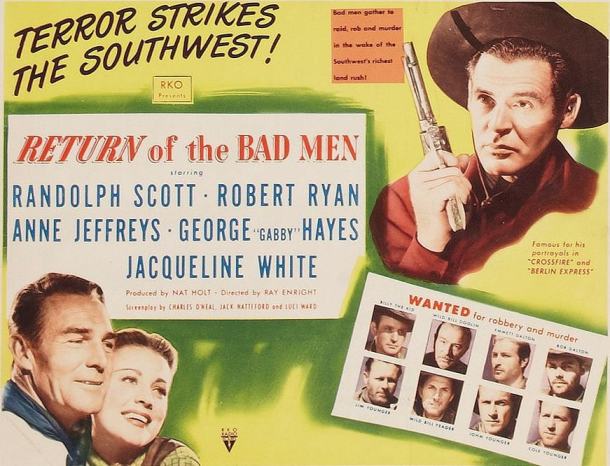
Return of the Bad MenReturn of the Bad Men was the fourth and final film in a series of westerns that director Ray Enright made with legendary horse opera star Randolph Scott. The previous three were Trail Street (1947), Albuquerque (1948), and Coroner Creek (1948).

Most modern viewers will know Randolph Scott primarily for his final role — in Sam Peckinpah’s Ride the High Country (1962) — and be blissfully unaware of the roughly one hundred films he appeared in prior to it.

Ride the High Country is a great western (it co-stars Joel McCrea), but it’s not Scott’s only claim to fame. The westerns he made in the ’50s with director Budd Boetticher are highly regarded among connoisseurs of western cinema. He also appeared in plenty of workmanlike westerns like the ones directed by Ray Enright that aren’t great works of art, but are well-made entertainment, and a cut above the average B western.

Return of the Bad Men takes place in 1889, in the Oklahoma Territory. The U.S. government has just opened up two million acres of prime land for settlers. At high noon on April 22, 1889, the great Oklahoma Land Rush will begin. On the tails of the settlers, however, are a bunch of no-good outlaws (the “bad men” of the title) who only hope to prey on honest folks.

The land run sequence is exciting, although I suspect that most of the footage is taken from an earlier RKO picture, the Oscar-winning Cimarron (1931).

One of the settlers is a beautiful young widow named Madge Allen (Jacqueline White) who has a young son named Johnny (Gary Gray). She also has a boyfriend, Vance Cordell (Randolph Scott), who only wants to marry his sweetheart and move her and her son out to California.

But when Madge’s father, John Pettit (Gabby Hayes), the folksy and tough-talking president of the local bank, picks up stakes and moves from Braxton, Oklahoma, to Guthrie, Oklahoma, Vance, Madge, and Johnny follow. Once in Guthrie, a cavalry officer appoints Vance U.S. Marshal. As a former Texas Ranger and peace officer, he’s the most suitable man to keep order.

Madge just wants her son to grow up in a peaceful, law-abiding world. Her deceased husband was a peace officer killed in the line of duty, and she refuses to marry Vance until he puts things right in Guthrie, trains officers to take his place, and retires.

Meanwhile, a whole mess of outlaws is amassing against the peaceful homesteaders of Guthrie. They’re led by Wild Bill Doolin (Robert Armstrong) and there’s even a woman among them, Doolin’s niece Cheyenne (Anne Jeffreys). When the rough-and-tumble bad men tell her that busting banks is man’s work, she responds that Belle Starr did OK.

The crew of outlaws includes plenty of famous names — the Younger brothers, Cole (Steve Brodie), Jim (Tom Keene) and John (Robert Bray); the Dalton brothers, Emmett (Lex Barker), Bob (Walter Reed), and Grat (Michael Harvey); Billy the Kid (Dean White); the Arkansas Kid (Lew Harvey); Wild Bill Yeager (Tom Tyler) — but the only member of the crew who has much of a chance to distinguish himself (besides Cheyenne) is Robert Ryan as the Sundance Kid.

Sundance is the most vicious of the lot and becomes Vance’s archenemy over the course of the film. Robert Ryan was on his way to becoming a big star after his memorable role in Crossfire (1947). There’s nothing particularly remarkable about his role in Return of the Bad Men, but he plays a charming villain well, and the growing antagonism between Ryan and Scott provides the dramatic push of the film.

Enright keeps the pace fast in Return of the Bad Men. The editing is quick, and the camera frequently moves within shots, which is not the case with a lot of B westerns. For a B western the production values are good, the acting is solid, and the characterizations are well-done.

Below is a clip from the film. I suppose I have to put a spoiler warning on it, since it’s the climactic fight of the film. I think the biggest potential spoiler about it is a single line of dialogue that alludes to the fate of a couple of characters, because if you consider finding out whether the guy with the white hat or the guy with the black hat wins the final fight in a B western a “spoiler” … well … let’s just say I envy your childlike naïveté:

The Street With No Name (July 14, 1948)

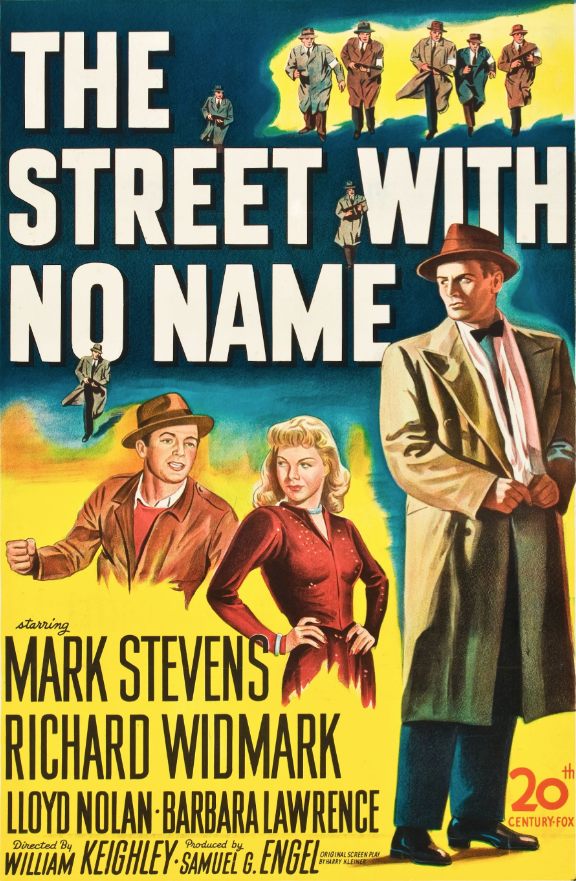
By the time William Keighley’s The Street With No Name was released, noirish docudramas were practically a genre unto themselves. The docudrama craze began with The House on 92nd Street (1945), which was loosely based on a real case of nuclear espionage during World War II and was produced by Louis de Rochemont, the creator of the March of Time newsreels.

More “ripped from the headlines” stories followed. Spy thrillers like 13 Rue Madeleine (1947) and The Iron Curtain (1948), tales of miscarried justice like Boomerang (1947) and Call Northside 777 (1948), and even films like Kiss of Death (1947), which wasn’t based on any single real event, but presented its crime story as realistically as possible by eschewing a musical score and filming all the action on location — in prisons, schools, and city streets.

The Street With No Name begins with the following words: “The motion picture you are about to see was adapted from the files of the Federal Bureau of Investigation. Wherever possible it was photographed in the original locale and played by the actual F.B.I. personnel involved.”

Then, a quote from J. Edgar Hoover appears as it is pounded out by invisible hands on a sheet of paper stuck in a typewriter:

The street on which crime flourishes is the street extending across America. It is the street with no name. Organized gangsterism is once again returning. If permitted to go unchecked three out of every four Americans will eventually become its victims. Wherever law and order break down there you will find public indifference. An alert and vigilant America will make for a secure America.

The docudrama that I think The Street With No Name most closely resembles is Anthony Mann’s T-Men (1947), which uses the same kind of “government-approved” patriotic opening, but eventually devolves into a film noir in which the underworld setting and stylistic elements are more interesting than the clean-shaven protagonists. T-Men, however, showed its protagonists becoming drawn deeper into their undercover roles while The Street With No Name doesn’t really develop its protagonist beyond his play-acting heroics.

The Street With No Name opens with a murder at the Meadowbrook night club, a typical road house in a typical city called “Center City.” (The Street With No Name was filmed in and around Los Angeles, and while there is a neighborhood of San Diego called “Center City,” I think that “Center City” was just meant to be a generic name for “Anytown, USA.”)

A second crime by the same masked gang — the murder of a bank guard — draws the FBI into the case, since bank robberies are a federal crime. Leading the investigation is FBI Inspector George A. Briggs, who is played by Lloyd Nolan. (Briggs is the same character Nolan played in The House on 92nd Street.)

According to Briggs, these new gangs are “the juvenile delinquents of yesterday” and they are even more ruthless than the pre-war gangs. The only way to break this gang is to send in an undercover agent.

Enter Mark Stevens as FBI cadet Gene Cordell, who we know is a prime candidate for the assignment because he knows exactly which targets to shoot — and which ones not to shoot — in a Hogan’s Alley sequence filmed at Quantico, VA.

Stevens goes undercover as “George Manly” in the skid row section of Center City, which is full of pool halls, boxing gyms, and peep show machines, and where apparently the only song anyone ever plays on the jukebox is an instrumental version of “I’m Looking Over a Four-Leaf Clover.”

Despite Stevens’s total lack of proficiency in the boxing ring (he looks less competent than Charlie Chapin was meant to in City Lights), the robbery gang he’s after is impressed with his skills and takes him in as one of their own.

The gang’s leader is named Alec Stiles, and he’s played by Richard Widmark. This was Widmark’s second big-screen role, and it’s similar to his first, the psychopathic Tommy Udo in Kiss of Death. Stiles’s teeth aren’t quite as big as Udo’s were, but his maniacal leer is the same. Widmark delivers a good performance, but character details like Stiles’s germaphobia and wife-beating aren’t quite enough to make you forget Udo if you’ve recently watched Kiss of Death.

But character details and plot points aren’t what makes The Street With No Name a standout docudrama film noir. What makes the film memorable is the overriding sense of tension and the dark, shadowy cinematography of Joseph MacDonald.

Stevens isn’t as strong a protagonist as Dennis O’Keefe and Alfred Ryder were in T-Men, and the most memorable sequences in The Street With No Name are completely wordless. The first is a chase in a ferryboat station (filmed at the Municipal Ferry in San Pedro, CA) and the second follows Stevens as he tries to get ballistic evidence by breaking into the gang’s weapons cache in a warehouse with Widmark hot on his heels.

Despite a generic story and a bland protagonist, The Street With No Name has great pacing, lots of suspense, style to spare, and a solid villain. I recommend it to all fans of FBI stories and film noir.