The Devil’s Sleep (1949)
Directed by W. Merle Connell
Screen Classics
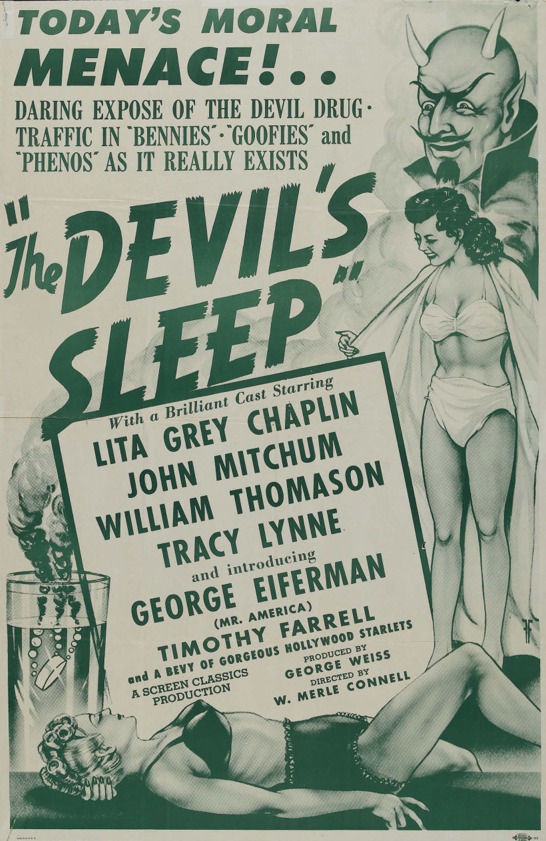
The men who brought you the sexploitation classic Test Tube Babies (1948) are at it again.
In The Devil’s Sleep, producer George Weiss and director W. Merle Connell expose the shocking truth about “reds” and “bennies” (a.k.a. Seconal and Benzedrine). Namely, that they’re being peddled out of swank health clubs to unwitting overweight middle-aged women who want to “reduce,” as well as to bored teenagers looking for kicks.
Bennies might have been great for keeping soldiers and aviators alert and awake during World War II, but we don’t want them on the tree-lined streets of our idyllic suburban neighborhoods, gosh darn it!
Timothy Farrell plays the mustachioed owner of the health club, Umberto Scalli, and William Thomason plays Detective Sergeant Dave Kerrigan, the man who’s warm on his trail.
If you’ve seen Test Tube Babies you may remember Thomason as the husband with the malfunctioning semen.
Timothy Farrell should be immediately recognizable to aficionados of bad movies. He got his start in Test Tube Babies and went on to a long and semi-illustrious career. He played the “Umberto Scalli” character in two more exploitation movies, Racket Girls (1951) and Dance Hall Racket (1953). Farrell also narrated legendarily bad filmmaker Ed Wood’s first movie, Glen or Glenda (1953), and appeared in it as a doctor.
Both Test Tube Babies and The Devil’s Sleep are awful movies, but they’re amusingly awful. Both use their “social message” aspect as an excuse for lots of scantily clad ladies and brief nudity. The Devil’s Sleep one-ups Test Tube Babies in this department, because it uses its health-club setting to also show off lots of male eye candy, most notably Mr. America 1948, George Eiferman.
The Devil’s Sleep is currently available in its entirety on YouTube. You can also download it from archive.org.
The Window (1949)
Directed by Ted Tetzlaff
RKO Radio Pictures
Ted Tetzlaff worked as a cinematographer on more than a hundred films dating back to the silent era. After shooting Notorious (1946) for Alfred Hitchcock, he moved to directing full time.
Tetzlaff directed a relatively small number of films, but the two I’ve seen so far have both been fantastic. The first was Riffraff (1947), a visually inventive detective thriller in a tropical setting. The second was this one, which I thought was even better than Riffraff.
Apparently The Window was filmed in 1947, but its release was delayed when Howard Hughes acquired RKO Radio Pictures.
The Window is based on a story by Cornell Woolrich called “The Boy Cried Murder” (also reprinted under the title “Fire Escape”). The story was originally published in Mystery Book Magazine in March 1947. The screenplay was adapted from the story by Mel Dinelli, who also scripted the terrific RKO thriller The Spiral Staircase (1945).
The Window opens with a quote from Aesop’s fable “The Boy Who Cried Wolf.” I guess they were concerned that people weren’t going to pick up on the concept immediately, so they’d get it out of the way before the movie even started.
Even without the opening text, I don’t think you’d need a PhD in Comp Lit to pick up on the “boy who cried wolf” theme pretty quickly.
The Window stars Bobby Driscoll, a child actor on loan from Disney. Driscoll plays Tommy Woodry, a nine-year-old boy who lives in a working class neighborhood of New York with his parents, Ed and Mary (Arthur Kennedy and Barbara Hale). Tommy is an only child who plays in the street and in an abandoned building with the other boys in the neighborhood. He’s a bright kid, and he loves playing make-believe and telling tall tales.
“If it isn’t Indians it’s gangsters, and if it’s not gangsters it’s something else,” his mother complains. (Incidentally, Barbara Hale was 27 years old when The Window premiered in 1949. Driscoll was 12. What this means is that Kennedy, who plays Driscoll’s dad, would have been 23 when his 14-year-old wife gave birth. In fairness, Hale is made up to look older than she is, and I don’t think the filmmakers were trying to imply statutory rape and teen pregnancy.)
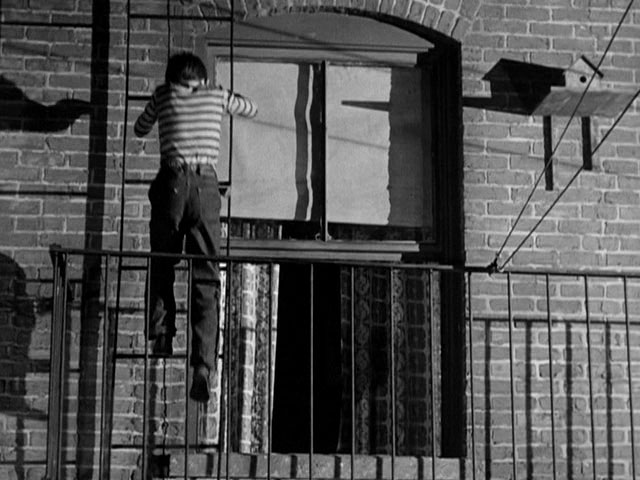
One sweltering summer night, Tommy asks permission to sleep out on the fire escape because it’s a little cooler outside. He lies down and gazes up at the black sky, pinpoints of stars, and white laundry flapping on a line above him. Still too hot, he climbs up one story to the top floor, where it’s slightly cooler. He drifts off to sleep, but wakes up later and witnesses something terrible. He thinks he sees his neighbors kill a man.
“With all the stories you tell it’s no wonder you have nightmares,” his mother tells him when he wakes her up.
Tommy persists with his story, but his parents refuse to believe him. When he takes his story to the police, it only makes things worse.
The wonderful thing about The Window is how believably adults relate to Tommy. His parents are both patient and understanding people, especially his dad. They’re not clueless buffoons or coldly abusive, the way so many parents are in movies with child protagonists. That they refuse to believe him is not their fault. It’s how the situation would play out in real life.
The police don’t just dismiss his story either. They are kind and indulgent. But when they investigate Tommy’s upstairs neighbors, everything seems to be all right, so they drop the matter. Again, this is probably how the situation would play out in real life.
The Window is genuinely suspenseful, and it has a fairly shocking climax. This is one of those films where everything comes together perfectly. The actors are wonderful, the writing is great, and the pacing is perfect. Tetzlaff and his cinematographers, Robert De Grasse and William O. Steiner, crafted a great-looking film that seamlessly blended New York locations and studio soundstages.
I always have more movies I want to watch than I can find the time to watch (and review), so I rarely watch movies twice, but I liked The Window so much that I watched it a second time and enjoyed it even more than I did the first time.
Incidentally, Bobby Driscoll ended up having a very sad life. I don’t feel like getting into it here, but if you’d like to know more about him, Google him.
The Window will be shown on TCM on March 10, 2014.
The Barkleys of Broadway (1949)
Directed by Charles Walters
Metro-Goldwyn-Mayer
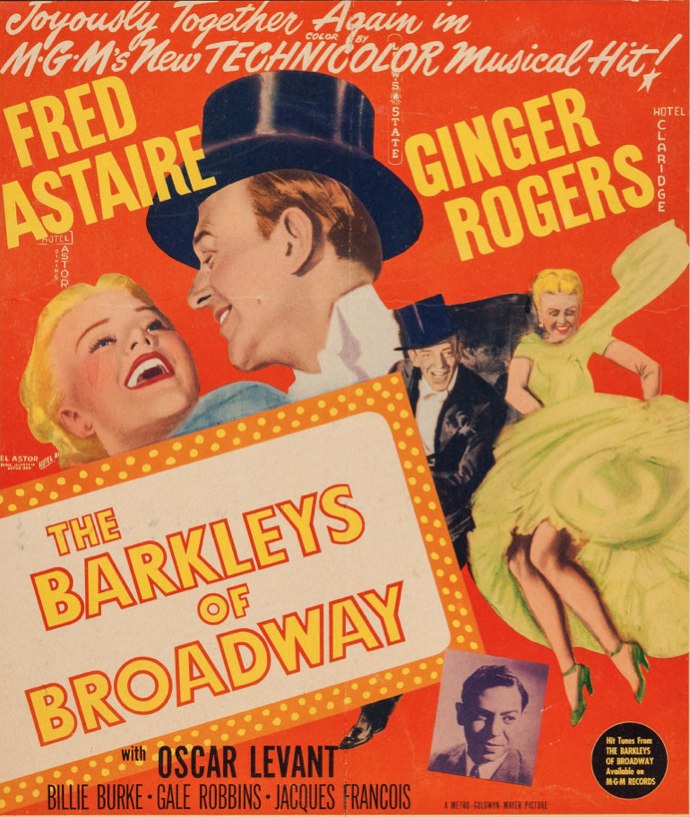
Fred Astaire and Ginger Rogers are back, for one final engagement!
The Barkleys of Broadway was their first pairing in a decade. It was also the only film they made for Metro-Goldwyn-Mayer, and the only time they were onscreen together in Technicolor.
During the 1930s, Astaire and Rogers appeared together in nine films released by RKO Radio Pictures: Flying Down to Rio (1933), The Gay Divorcee (1934), Roberta (1935), Top Hat (1935), Follow the Fleet (1936), Swing Time (1936), Shall We Dance (1937), Carefree (1938), and The Story of Vernon and Irene Castle (1939).
In the 1940s, Ginger Rogers established herself as an actress in dramas and comedies, and Fred Astaire established himself as a successful solo star in musicals like Holiday Inn (1942) and Easter Parade (1948).
Astaire was set to make another film with Judy Garland, his co-star in Easter Parade. It was going to be called “You Made Me Love You,” after one of Garland’s hit songs. But when she was forced to drop out of the project, producer Arthur Freed cast Ginger Rogers to replace her … because the world can never have too much Ginger Rogers and Fred Astaire.
When the two perform their first tap number in The Barkleys of Broadway, it’s joyful and exhilarating, and it’s hard to believe that more than 10 years have passed since they made a film together.
In The Barkleys of Broadway, Astaire and Rogers play Josh and Dinah Barkley, a married couple who are wildly successful onstage but who can’t go two minutes without bickering offstage. Their partner Ezra Millar (Oscar Levant) tries his best to keep them in check, but even he can’t keep them together when a handsome French playwright named Jacques Pierre Barredout (played by Jacques François) convinces Dinah that she should become a “serious” actress and star in his new play about Sarah Bernhardt.
Josh continues performing on his own. The high point of his solo career is the impressively surreal number “Shoes With Wings On,” in which a bunch of dancing shoes live up to their name.
Dinah struggles under Barredout’s dictatorial direction, so Josh takes to impersonating the Frenchman over the phone after rehearsals to give Dinah the kind of direction he knows will help her.
Eventually they are brought back together by Ezra’s machinations, which leads to an emotional performance of the song “They Can’t Take That Away From Me,” which Astaire had previously sung to Rogers in the film Shall We Dance, but which they had never danced to on film before.
The Barkleys of Broadway is a lot of fun. It’s great to see Astaire and Rogers back together, and Oscar Levant is his usual acerbic, deadpan self. (He also gets a chance to do what he does best — entertain on the piano.)
The film’s music is mostly by Harry Warren, with lyrics by Ira Gershwin. (“They Can’t Take That Away From Me” is by George and Ira Gershwin.)
The story is inconsequential, but that’s the case with most movie musicals. This film is an excuse for some singing, dancing, and comedy, and it’s all wonderful. The fact that Ginger Rogers and Fred Astaire would never make another film together makes it a slightly bittersweet viewing experience, but it’s not that bittersweet. After all, they left us with a tremendous cinematic legacy, and nothing lasts forever.
Champion (1949)
Directed by Mark Robson
United Artists
SPOILER ALERT. This review will discuss plot points of this film that you may not want to know if you haven’t already seen it.
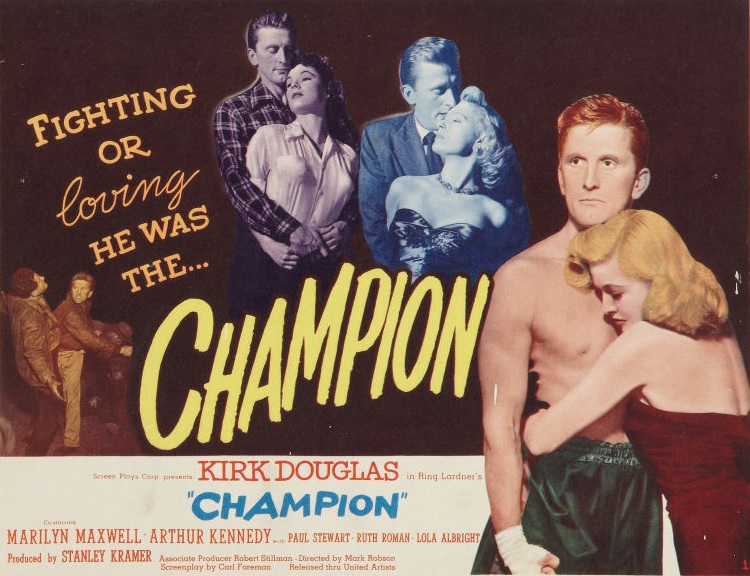
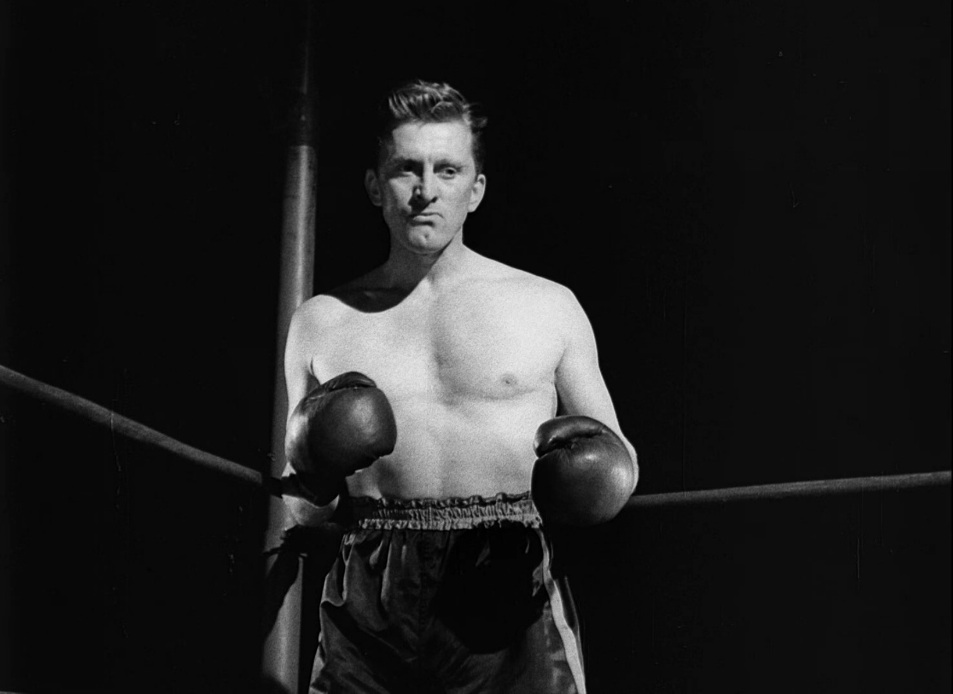
Mark Robson’s Champion is not a film about a man destroyed by fame. It’s a film about a man whose resentment, anger, selfishness, and cruelty are given free rein by fame and fortune.
It’s not an uplifting film, but it’s an occasionally powerful one, since it depicts a man who stands up to everyone who tries to take advantage of him, mistreats everyone who ever cared about him, and becomes middleweight champion of the world and dies of a brain hemorrhage without ever showing an ounce of remorse.
It’s also a tremendous showcase for Kirk Douglas, who made his film debut in The Strange Love of Martha Ivers (1946). He played an uncharacteristically milquetoast character in that film, but his next role, in Out of the Past (1947), was more of an indication of what lay ahead for Douglas. His character “Dink” in Out of the Past is a vicious crime boss, as was the character he played opposite Burt Lancaster in I Walk Alone (1948).
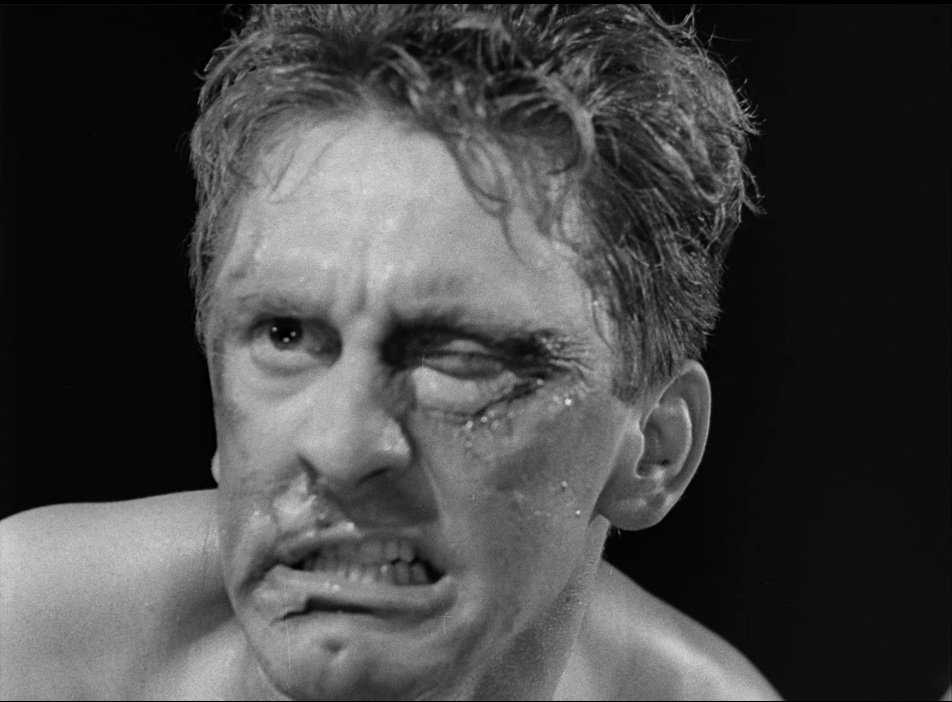
Not every character Douglas played in the 1940s was a strutting, snarling alpha male — his wonderful performance in A Letter to Three Wives (1949) is a great example of his range — but he excelled at playing macho men, and Champion cemented that image. With his jutting cleft chin, puffed-out chest, intense eyes, and lean, muscular physique, Douglas dominates every scene in Champion.
If Kirk Douglas had a spirit animal, it would probably be a banty rooster.
Douglas’s physical intensity carries him through Champion fairly well, which is good, because he’s not that convincing as a boxer. He looks the part, but he doesn’t move like a world-class middleweight. He lacks the right combination of speed and power.
Champion was based on a story by Ring Lardner and was nominated for six Academy Awards (best actor for Douglas, best supporting actor for Arthur Kennedy, best screenplay for Carl Foreman, best score for Dimitri Tiomkin, best black & white cinematography for Franz Planer, and best editing for Harry Gerstad), and won one — the Oscar for editing.
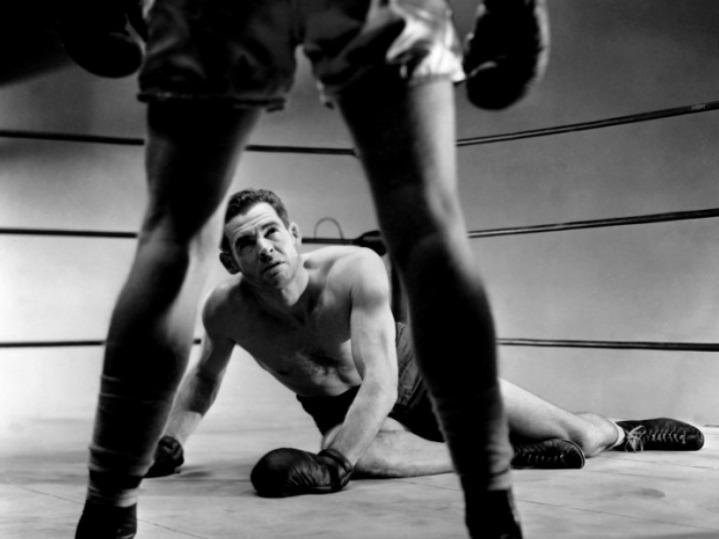
But now that almost 70 years have passed, I think Champion compares really unfavorably to Robert Wise’s The Set-Up (1949), which was released around the same time and was nominated for zero Oscars. First of all, Robert Ryan boxed as an amateur heavyweight, so he was utterly convincing as a professional fighter who loses more often than he wins. (Asking us to accept Douglas as the world middleweight champion is too much, I think.)
Also, The Set-Up is a tightly coiled masterpiece from beginning to end, while Champion feels sloppy. Douglas’s training and his rise up the boxing rankings are both done as cheesy montages with a light tone. The film doesn’t really get going until more than a half hour has passed, when Douglas’s character, Michael “Midge” Kelly, refuses to throw a fight to Johnny Dunne (John Daheim). For the next hour, Champion is a good film. Not a great film, but a good one. The always-great Arthur Kennedy turns in a good performance as Midge’s sad-sack brother, Connie, and Ruth Roman and Marilyn Maxwell are both good as the women Midge uses and abuses.
I found the penultimate sequence of the film particularly harrowing, but modern-day viewers might miss its implications.
Ruth Roman’s character, Emma, is romanced by Midge early in the film, which leads to her father forcing them to marry at gunpoint. As soon as it’s official, however, Midge drops her like a bad habit, and she eventually finds love with his brother Connie.
Toward the end of the film, when Emma is preparing to get a divorce from Midge in Reno so she can marry Connie, Midge forces himself on her. He kisses her, says “It’s still there, isn’t it?” She walks away from him and says, “Leave me alone.” He walks toward her and says, “You’re my wife.” She looks scared, and the screen fades to black.
Plenty of classic films show women yielding to an aggressive man, but I think it’s significant that the fade-to-black happens without showing her acquiesce to a kiss or yield in any pleasurable way. His line “You’re my wife” strongly implies that he is going to have sexual intercourse with her whether she likes it or not. It’s his legal right, and the concept of “marital rape” was not a criminal act in 1949. But it’s a rape, and it’s a violation of his brother’s trust, since Midge and Emma were married in name only. His brother’s rage in the next scene is also a pretty clear indication that something awful has happened.
After Midge wins his final fight and collapses and dies in his dressing room, the press asks Connie for a statement. “He was a credit to the fight game, to the very end,” Connie says, because he can’t bring himself to say that Midge was a credit to humanity, or to anyone else.
Much like Midge Kelly himself, Champion was a hard film for me to like. It’s a good movie, but not nearly as good as some of its contemporaries, like Body and Soul (1947) and The Set-Up.
The Set-Up (1949)
Directed by Robert Wise
RKO Radio Pictures
My favorite sports movies are all boxing movies. Body and Soul (1947), The Harder They Fall (1956), Rocky (1976), Rocky II (1979), Raging Bull (1980), When We Were Kings (1996). The list goes on and on.
I love watching boxing, which is one reason I love movies about it, but that’s not the only reason I love boxing movies.
Boxing is an individual sport that lends itself well to film drama. Most of the movies about team sports that I like are comedies — The Longest Yard (1974), Slap Shot (1977), Major League (1989). That’s not to say there aren’t good dramas about team sports. There are plenty, like Hoosiers (1986), Eight Men Out (1988), and Friday Night Lights (2004), but there’s something about one fighter facing another in the ring that makes for a great drama. And the brutality and widespread corruption of the boxing world makes for great film noirs.
The Set-Up is based on Joseph Moncure March’s long, narrative poem of the same name, which was written in 1928. (March’s other enduring work is the narrative poem The Wild Party, also written in 1928, which was republished in 1994 with illustrations by Art Spiegelman.)
March’s The Set-Up is a masterpiece of hard-boiled writing, and especially impressive considering that it’s written in verse.
Pansy had the stuff, but his skin was brown
And he never got a chance at the middleweight crown.
Mean as a panther,
Crafty as a fox,
He could hit like a mule,
And he knew how to box.
A dark-skinned jinx
With eyes like a lynx,
A heart like a lion,
And a face like the Sphinx:
Battered, flat, massive:
Grim,
Always impassive.
The film version is only loosely based on March’s poem. Significantly, it sidesteps the racial angle by casting a white actor, Robert Ryan, in the lead. It also renames its pugilist protagonist “Stoker.”
Judged solely on its own merits, however, The Set-Up is a great film. It’s one of the great noirs, as well as one of the best films about boxing ever made. It’s lean and mean — just 72 minutes long — and unfolds more or less in real time.
Bill “Stoker” Thompson (Ryan) is gearing up to face a 23-year-old opponent in the ring. Stoker is 35 years old, which in his business makes him an old man. (John Garfield’s character in Body and Soul was also facing his own mortality as a boxer at the age of 35.)
Stoker’s wife, Julie (Audrey Totter), wants him to retire. His days as a fully functioning human being are numbered if he keeps fighting for measly purses and absorbing massive amounts of punishment in the process.
Stoker tries to reassure her, but his eyes tell their own story a little later in the film as he watches a punchy fighter repeat himself for the dozenth time before leaving the locker room for his fight. Gus, a trainer played by Wallace Ford, shakes his head and says, “I guess you can only stop so many.”
The boxing milieu depicted in The Set-Up is exceptionally sleazy. The arena where Stoker faces his opponent, Tiger Nelson (Hal Fieberling), advertises “Boxing Wednesdays, Wrestling Fridays,” and is located in Paradise City, a low-rent strip of arcades, dance halls, and chop suey joints.
Worst of all, Stoker’s manager, Tiny (George Tobias), has arranged with local hoods for Stoker to take a dive without telling Stoker about his plan. He’s that certain his man will lose.
Robert Wise’s direction is tight and unpretentious. His cinematographer, Milton R. Krasner, lenses some of the most starkly beautiful black & white images ever captured on film. There’s a scene early in the film where Stoker walks across the street from his rented room toward the arena with his bag in his hand. He moves straight toward the camera, and he looks like the archetype of every lonely hero who has faced a tragic fate without blinking.
Robert Ryan is key to the film’s authenticity. The 6’4″ actor was on the boxing team at Dartmouth College and had a 5-0 win-loss record, with 3 KOs. He continued to box while serving in the Marine Corps.
The Set-Up is a brutal, violent film, but despite its real-time plot that uncoils with ruthless efficiency, there are still quiet and reflective moments, like the sequence in which Audrey Totter walks the streets of Paradise City through a gauntlet of drunks and mashers. She eventually winds up on a bridge over a highway and slowly rips up her ticket to the fight and watches the scraps float down as a streetcar rumbles by.
Robert Wise had a long and interesting career in Hollywood. While The Set-Up will never be a crowd-pleaser like West Side Story (1961) or a family favorite like The Sound of Music (1965), it’s still one of Wise’s best films, and one of the all-time great noirs.
The Undercover Man (1949)
Directed by Joseph H. Lewis
Columbia Pictures
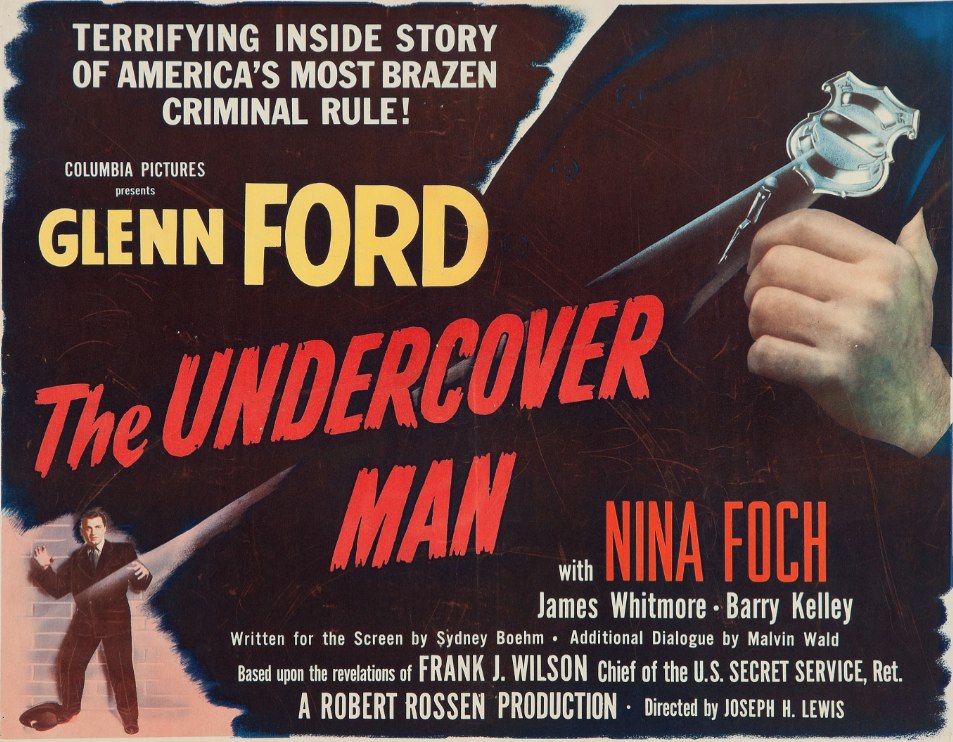
The Undercover Man is a tightly paced, hard-driving procedural that grabbed me from the first few minutes and never let go. It’s a fictionalized version of the federal case against Al Capone in which Capone not only never appears onscreen, his name is never spoken aloud. He’s referred to simply as “The Big Fellow,” even in newspaper headlines.
Director Joseph H. Lewis’s two most enduring films — Gun Crazy (1950) and The Big Combo (1955) — lay ahead of him, but he’d been working in Hollywood for more than a decade and had directed more than two dozen pictures (mostly westerns) before he directed The Undercover Man. The only one I’ve seen is The Swordsman (1948). I never thought I’d enjoy a Technicolor swashbuckler starring Larry Parks that took place in the Scottish highlands, but I really enjoyed The Swordsman.
Lewis made stylish films with great pacing. The Undercover Man has a standard story and stock characters, but it kept me involved because it’s paced really well. It’s loosely based on the career of Treasury agent Frank J. Wilson, who was involved with the 1931 prosecution of Al Capone and investigated the Lindbergh kidnapping. The film takes place in the present day, however, and isn’t specifically about Capone.
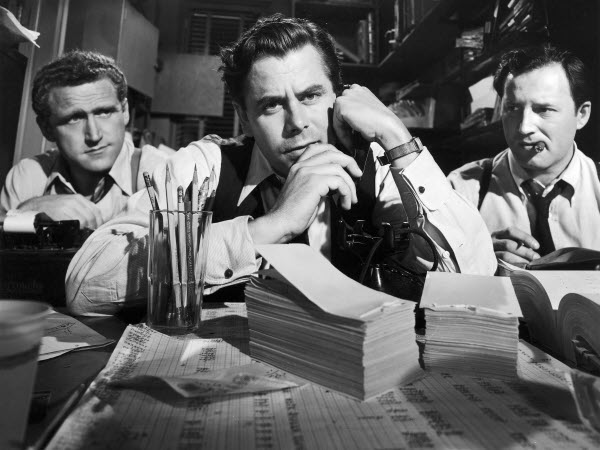
Glenn Ford plays a fictionalized version of Frank J. Wilson, named “Frank Warren.” The title of the film is misleading, since Warren doesn’t go undercover. The only “undercover man” in the film is a contact of Warren’s who’s gunned down by mobsters in the early going.
The film sticks to the tax evasion angle of the Capone case, and most of the drama involves Warren poring over financial records and butting heads with The Big Fellow’s crooked attorney, Edward O’Rourke (Barry Kelley). So if you’re looking for an accountant who picks up a shotgun and blasts mobsters by the dozen, like Charles Martin Smith does in Brian De Palma’s The Untouchables (1987), then you might find The Undercover Man pretty boring.
But if you’re looking for a hard-nosed flick about cops and criminals made in a semi-documentary style, you can’t go wrong with The Undercover Man.
The Quiet Duel (1949)
Directed by Akira Kurosawa
Daiei Motion Picture Company
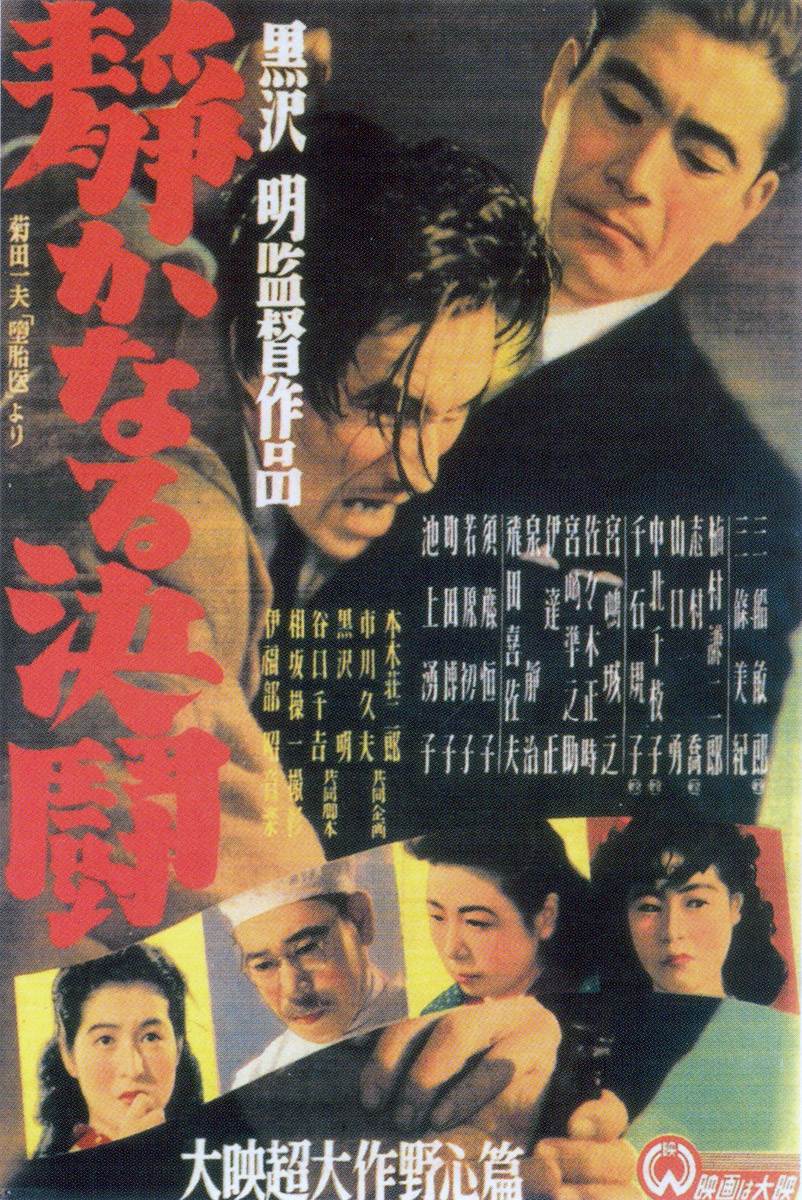
The Quiet Duel is not one of director Akira Kurosawa’s major works. Most reviewers treat it as a lamentable, melodramatic footnote in his career, but I don’t think that’s fair.
Unlike No Regrets for Our Youth (1946), which I think all but the most dedicated Kurosawa completists can skip, The Quiet Duel is worth seeing at least once if you’re a Kurosawa fan. It also functions as a thematic bridge between two of Kurosawa’s major early works, Drunken Angel (1948) and Stray Dog (1949).
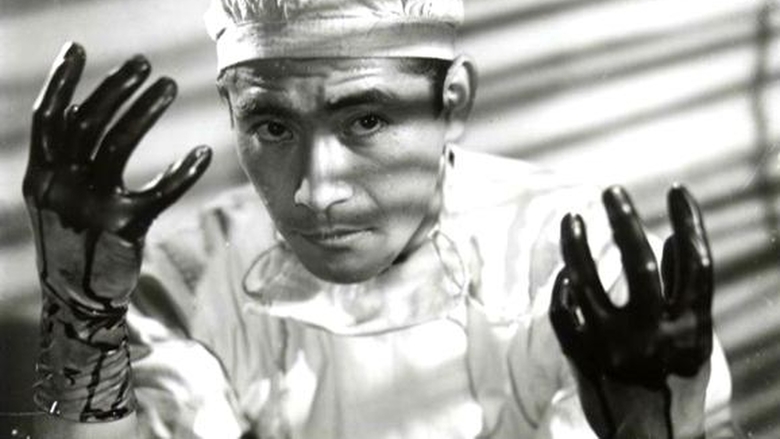
Like both of those films, The Quiet Duel pairs two of the director’s most dependable stars: Toshirô Mifune and Takashi Shimura. It shares with Drunken Angel the theme of a doctor who struggles with his own conscience, and it presages the major theme of Stray Dog — two young men who face the same difficult circumstances but who make very different ethical decisions.
Mifune and Shimura are always interesting to watch when they’re on screen together, and if The Quiet Duel is their least interesting pairing in Kurosawa’s body of work, it’s only because most of their appearances together for Kurosawa were in films that are all-time classics.
The Quiet Duel (or The Silent Duel, as it’s also translated), is based on a play by Kazuo Kikuta. Mifune plays Dr. Kyoji Fujisaki, a young physician who contracts syphilis when he cuts himself while performing surgery in a field hospital during World War II.
After the war, he returns to work with his father, Dr. Konosuke Fujisaki (Shimura). Kyoji rejects his fiancée, Misao (played by Miki Sanjō), without an explanation. He treats himself with Salvarsan in total secrecy. (Salvarsan is the trade name for arsphenamine, the first effective treatment for syphilis.) And he struggles with his sexual desire and romantic longing, both of which he completely stifles so he won’t infect anyone else with his malady.
Later in the film, he again crosses paths with the man he operated on during the war. Unlike Kyoji, this man treats his syphilis as a trifling matter, and doesn’t care who else he infects (his wife is pregnant). We’ll see this moral theme again in Kurosawa’s next film, Stray Dog (1949), in which Mifune plays a young police detective whose gun is stolen. The “stray dog” of the title is a young man who suffered the same indignities and deprivations as Mifune following the war. Unlike Mifune, he chose to take his pain out on the world, and goes on a crime spree with Mifune’s gun.
Most of The Quiet Duel is pretty stagey, and the story is melodramatic. But when Mifune finally lets loose, he lets loose as only he could, and it’s something to behold. And while the film isn’t a great showcase for Kurosawa’s directorial talents, there are a few scenes — especially the surgery sequence that opens the film — that rank among the best work he did.
Take Me Out to the Ball Game (1949)
Directed by Busby Berkeley
Metro-Goldwyn-Mayer
By 1948, when Take Me Out to the Ball Game was filmed, legendary musical director Busby Berkeley was suffering from problems with alcohol and with his own temperament. No studio trusted him to both direct and choreograph a picture, so when he was given Take Me Out to the Ball Game to direct, the choreography was handled by Stanley Donen and Gene Kelly.
Just judging by what’s on screen, Berkeley had no problem putting together a fun, well-made Technicolor musical for M-G-M.
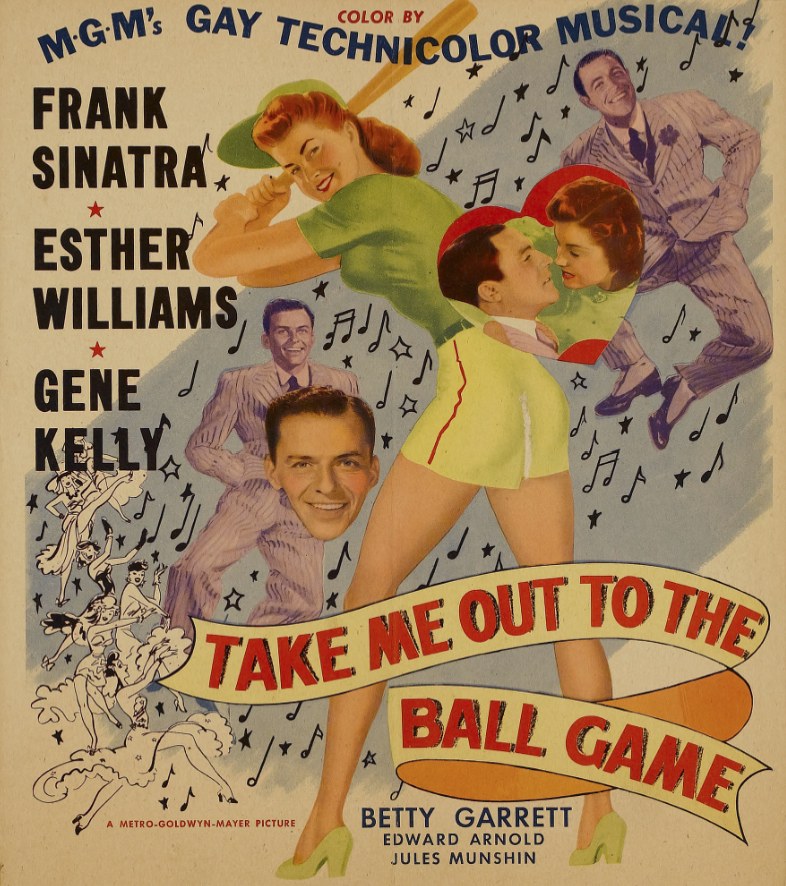
Take Me Out to the Ball Game reunited Frank Sinatra with Gene Kelly. The two had previously starred together in Anchors Aweigh (1945). Sinatra’s career had hit a bit of a lull in 1948, and M-G-M thought it would be a good idea to pair him with his co-star from the most financially successful film he’d ever made.
Sinatra plays Dennis Ryan, the second baseman of the baseball team The Wolves, and Kelly plays O’Brien, the shortstop. When Ryan and O’Brien aren’t playing baseball, they’re one of the most popular Vaudeville duos in the country. Take Me Out to the Ball Game takes place in 1909, so the notion of two professional baseball players also working as Vaudevillians is only half as ludicrous as it would have been in 1949.
When Ryan and O’Brien report for spring training in Sarasota, they find out that a new owner — K.C. Higgins — has inherited the team. None of the players are happy about this, and they all assume that this Higgins fellow will be a fathead who doesn’t know the first thing about baseball. Unsurprisingly, K.C. Higgins turns out to be a woman (see also Major League).
Of course, K.C. is a baseball whiz, and since she’s played by swimmer Esther Williams, she gets some time in the water, too. The first time Ryan and O’Brien see her cavorting in the hotel pool, one of them remarks, “Not bad for a dame who can field a hot grounder.”
The comedy in Take Me Out to the Ball Game is passable, but it’s the singing and dancing that make a musical, and the picture succeeds on both counts. Kelly isn’t quite the singer Sinatra is, and Sinatra isn’t quite the dancer Kelly is, but the same magic they worked in Anchors Aweigh is onscreen here, and it’s a joy to watch.
The songs are all pretty good. “Take Me Out to the Ball Game” is heard more than once, and there are also highlights like “The Right Girl for Me,” which Sinatra croons to Williams in the moonlight, and “The Hat My Dear Old Father Wore Upon St. Patrick’s Day,” which Kelly sings while doing a jig, wearing a battered green hat, and brandishing a shillelagh.
If you listen to the lyrics of “Yes, Indeedy,” which is about loving and leaving gals across the country, you’ll catch a line about a lovesick Vassar girl who committed suicide after Sinatra loved her and left her, and a Southern belle who turned out to be 11 years old, which is why Gene Kelly had to leave her. The risqué things you can get away with really change from generation to generation, don’t they?
Just like in It Happened in Brooklyn (1947), plenty of humor is wrung from Sinatra’s slender frame. We see him gorging himself on steak and buttered rolls to gain weight during spring training, as well as sucking down milkshakes like they’re water. But alas, he remains a beanpole, and the vivacious and lovesick Shirley Delwyn (played by Betty Garrett) is able to sling him over her shoulder in a fireman’s carry during one of their musical numbers together.
Take Me Out to the Ball Game is, by all accounts, not as good as Kelly and Sinatra’s next collaboration, On the Town (1949), which I haven’t seen yet. But I enjoyed the heck out of it.
A Woman’s Secret (1949)
Directed by Nicholas Ray
RKO Radio Pictures
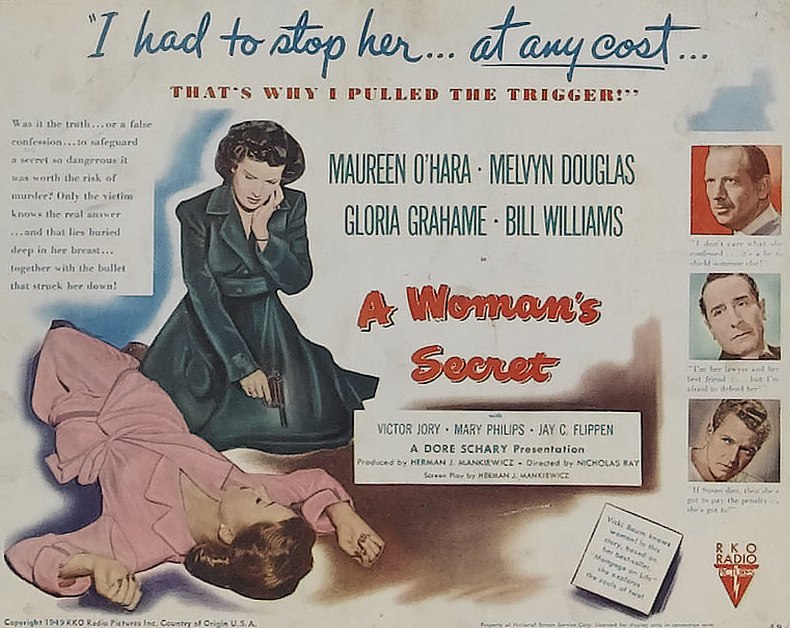
A Woman’s Secret is the third Nicholas Ray film I’ve reviewed on this blog, but it was the second film he directed.
Ray completed his first film, They Live by Night, in 1947, but RKO wasn’t sure how to market it. It premiered in the United Kingdom in a single theater on August 5, 1948.
The success of Ray’s third film, Knock on Any Door (1949), led to his first two films being released in the United States in 1949 by a newly confident RKO Radio Pictures.
Of his first three pictures, A Woman’s Secret is easily the weakest, and is significant mostly because it’s how Ray met his second wife, actress Gloria Grahame.
After shooting wrapped, the two were married in Las Vegas on June 1, 1948. It was the second marriage for both of them. (They had to live in Nevada for the required six weeks before Grahame could get her quickie divorce from actor Stanley Clements). Before they divorced in 1952, Grahame starred in one of Ray’s greatest films, In a Lonely Place (1950), which also starred Humphrey Bogart.
A Woman’s Secret was a contract job for Ray. The screenplay was adapted from Austrian writer Vicki Baum’s 1946 novel Verpfändetes Leben (Mortgage on Life) by the film’s producer, Herman J. Mankiewicz. Ray had no script input, so it’s easy to write it off as a studio-imposed footnote in Ray’s career.
A Woman’s Secret is a “women’s picture” wrapped in a mystery. It’s no In a Lonely Place, but it’s worth watching at least once.
The central relationship in the film is the one between Marian Washburn (Maureen O’Hara) and her protégé, Susan Caldwell (Gloria Grahame). Marian is a singer who has lost her voice, and she’s completely shaped and guided Susan’s career, rechristening her “Estrellita.” One night, after the two argue bitterly, a shot rings out. Susan lies on the floor near death, a bullet lodged near her heart. Marian is holding the smoking gun, but this is a mystery picture, so don’t assume anything yet.
Most of the film’s plot unspools as a series of flashbacks as Susan lies in the hospital and the detective assigned to the case — Inspector Fowler (Jay C. Flippen) — tries to piece together the facts. He spends a good deal of time with composer and pianist Luke Jordan (Melvyn Douglas), who is Marian’s boyfriend. Fowler also gets plenty of help from his wife, Mrs. Fowler (Mary Philips), who’s running an investigation of her own.
There are a lot of interesting things going on in A Woman’s Secret, but nothing really jells. The film is too crowded with plot and characters for the central relationship between Marian and Susan to ever be fully explored. Melvyn Douglas and Jay C. Flippen are fine performers, and both inject their two-dimensional characters with enough life to make their scenes interesting. Philips gets a juicy role as Inspector Fowler’s wife, and her nosiness isn’t just played for laughs. She actually knows what she’s doing, much to her husband’s chagrin.
Most people who write about Ray’s career either gloss over or completely ignore this film. There’s not much about it that fits in with his obsessions and themes. But despite a studio-imposed script, there are interesting themes and tensions bubbling below the surface. Grahame’s role as Susan/Estrellita in particular feels at home in Ray’s oeuvre. She’s a misunderstood, inarticulate, unhappy, and tragic outsider — a character type that would recur again and again in Ray’s films.
I Shot Jesse James (1949)
Directed by Samuel Fuller
Lippert Pictures / Screen Guild Productions
If a story doesn’t give you a hard-on in the first couple of scenes, throw it in the goddamn garbage. —Samuel Fuller
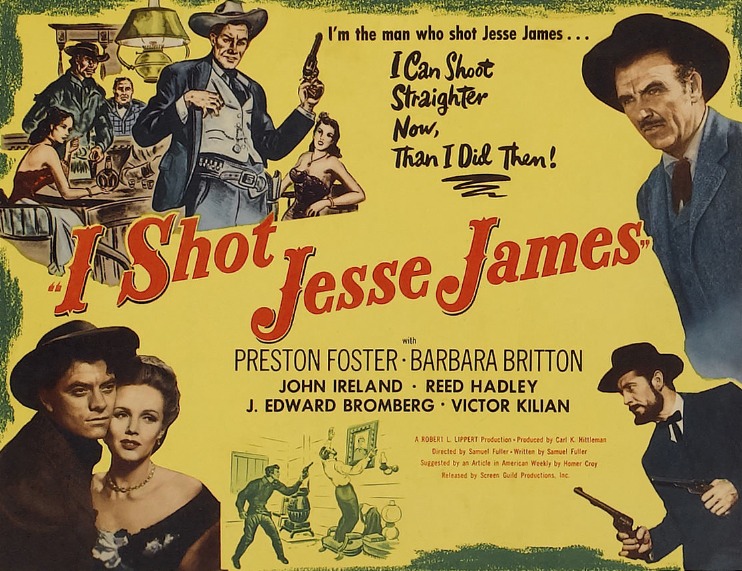
Maverick filmmaker Samuel Fuller was shopping scripts around Hollywood when he met producer Robert L. Lippert. Lippert admired Fuller’s 1944 pulp novel The Dark Page and gave Fuller his first crack at directing.
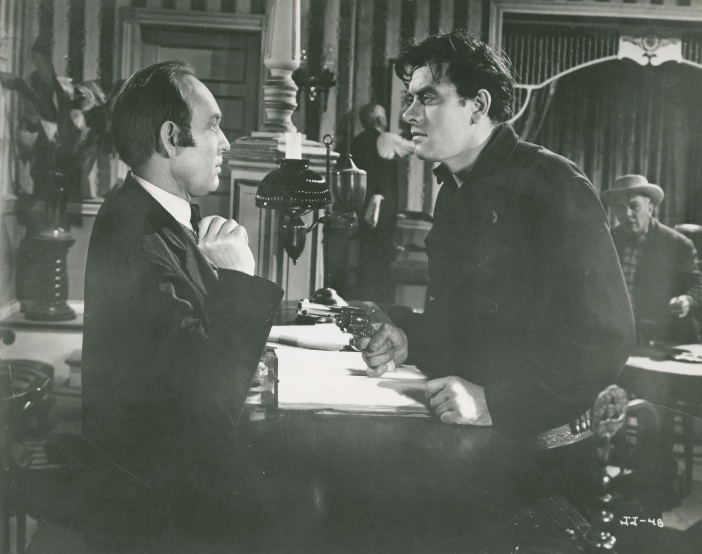
The result was I Shot Jesse James, a low-budget but brilliant revisionist western starring John Ireland as Robert Ford, the member of the James gang who killed Jesse James and collected the bounty.
Fuller had a flair for the dramatic, and when shooting began on I Shot Jesse James, he discharged a round from his Colt .45 into the air instead of yelling “Action.”
Fuller made three films for Lippert, I Shot Jesse James, The Baron of Arizona (1950), and The Steel Helmet (1951). The budgets were tiny and the shooting schedules tight, but Lippert gave Fuller the freedom to make exactly the kind of movies he wanted.
Fuller wrote the script for I Shot Jesse James, and based it on an article by Homer Croy in American Weekly magazine. It’s a sympathetic portrayal of a roundly reviled historical figure (even if you have no sympathy for Jesse James, it’s hard not to instinctively dislike a man who shot his unarmed friend in the back for reward money).
John Ireland plays Robert Ford as a lovesick man who’s tired of life on the run and just wants to marry his girl, the beautiful actress Cynthy Waters (Barbara Britton). He’s tempted by Missouri Governor Thomas Theodore Crittenden’s offer of amnesty for any member of the gang who turns in Jesse James (Reed Hadley), dead or alive.
Fuller depicts the relationship between Jesse and Bob Ford as deeply homoerotic, although the stolid Hadley doesn’t seem aware of anything strange about sitting in a bathtub and asking his friend to scrub his back for him. It’s the tortured Ireland who appears to long for Jesse, and perhaps by killing him he’s killing a part of himself that he despises.
Nothing good comes from it, of course. When Ford tells Cynthy that his killing of Jesse James was legal, she responds in horror, “It was murder.”
He walks through the rest of the picture with a haunted, desperate look on his face. He appears in a stage show in which he reenacts the killing of Jesse James, he dodges bullets from glory-hungry gunmen, and he desperately tries to repair his relationship with Cynthy.
This film explores a lot of the same territory as Andrew Dominik’s The Assassination of Jesse James by the Coward Robert Ford (2007), which starred Casey Affleck as Robert Ford and Brad Pitt as Jesse James. The most poignant parts of both films show Ford facing his own terrible legacy, such as when he appears in the onstage reenactment or confronts a troubadour who sings hymns to his cowardice.
I Shot Jesse James has stock music and its minuscule budget is pretty obvious, but it’s a great portrait of a complicated historical figure. Samuel Fuller would go on to have a long and iconoclastic career, and while I Shot Jesse James is never numbered among his greatest works, it’s his opening salvo as a director, and it’s a powerful one.




 OCD Viewer