
Winchester ’73 (1950)
Directed by Anthony Mann
Universal Pictures
Among film geeks, Anthony Mann is revered for two things — his hard-boiled film noirs of the 1940s and his “psychological westerns” of the 1950s.
Mann’s western phase kicked off in 1950 with three films, Winchester ’73 with James Stewart, The Furies with Barbara Stanwyck, and Devil’s Doorway with Robert Taylor.
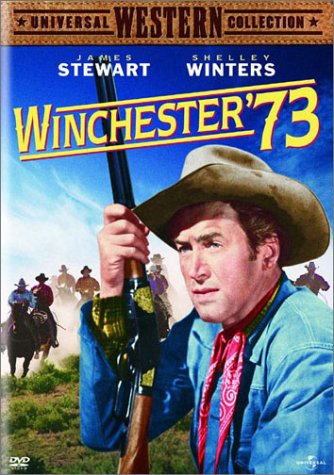
Winchester ’73 was significant because it was Mann’s first film with Jimmy Stewart, the most likeable beanpole everyman in Hollywood, and it helped Stewart craft a new image for himself.
Mann and Stewart went on to make seven more films together, but it is their five westerns that are best-regarded today. After Winchester ’73 came Bend of the River (1952), The Naked Spur (1953), The Far Country (1954), and The Man From Laramie (1955).
I first saw Winchester ’73 about 15 years ago, after being completely blown away by Mann’s noirs T-Men (1947) and Raw Deal (1948), and wasn’t as excited by Winchester ’73.
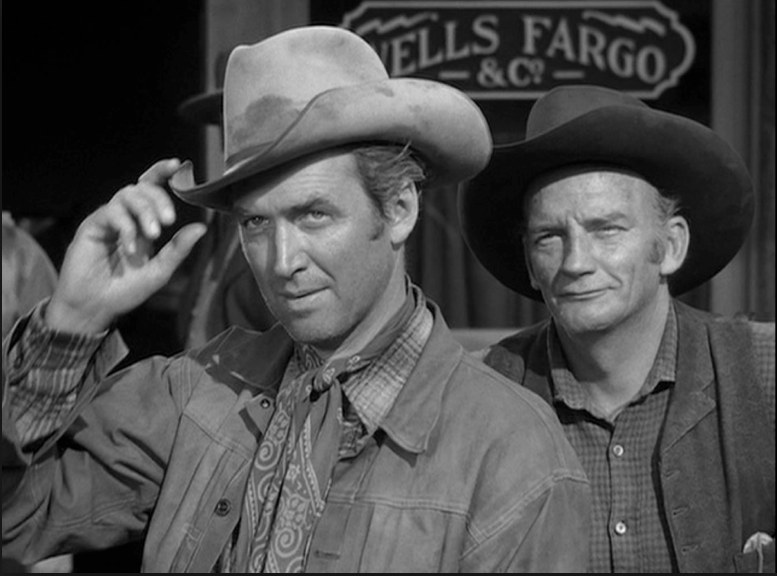
Winchester ’73 is regularly lauded as the first “adult western,” and the beginning of a richer and more complicated era for the genre.
I don’t totally buy this. While the majority of westerns in the 1930s and ’40s may have been aimed at kids (it’s almost impossible for an adult to watch a Buster Crabbe western without clawing their eyes out), there were westerns aimed at adult viewers going all the way back to the birth of cinema. To say that Winchester ’73 is the first “adult western” is to ignore the westerns directed by John Ford, Raoul Walsh, André De Toth, and plenty of others.
Don’t get me wrong, I think the 1950s was the best decade for westerns in the history of Hollywood, and Winchester ’73 is a really good western with complex characters and excellent performances. It just doesn’t totally work for me. It has an episodic structure that follows the “priceless … one in a thousand” Winchester ’73 rifle as it passes from owner to owner, and most of the episodes don’t do much for me until Dan Duryea shows up toward the end. (Although I do always get a perverse thrill from seeing Rock Hudson playing a shirtless Native American.)
I find the last third of Winchester ’73 incredibly thrilling and fun to watch. Duryea plays runty, nasty villains like no one else, and its during his episode of the film that Stewart finally shakes off his nice guy image and does stuff on screen that he’d never done before.

While it’s not my favorite western of all time, I still would recommend Winchester ’73 to any fans of westerns, as well as any film fans who want to explore the western genre. It’s a well-made movie, an important western, and William H. Daniels’s cinematography is gorgeous.
Also, the DVD of this film released in 2003 is a must-have for classic film fans. The special features listed on the DVD case only refer to an “Interview with James Stewart,” which is the most insane piece of underselling I’ve ever seen on a DVD.
That interview is actually an entire commentary track for the film. It’s guided by an interviewer who asks questions, but it’s still Jimmy Stewart talking about the movie as it goes, occasionally commenting on what’s happening onscreen, but mostly just sharing recollections of old Hollywood and old talent, as well as waxing philosophical about the old studio system. It’s incredibly enjoyable to listen to for anyone who’s a classic film fan. It was originally recorded in 1989 for a LaserDisc release of the film. Toward the end of the commentary with the interviewer, Jimmy Stewart marvels at how far technology has come and says, “laser, huh?”
It’s incredibly rare to have this kind of commentary track from a star as old as Stewart, and it’s something to be treasured.
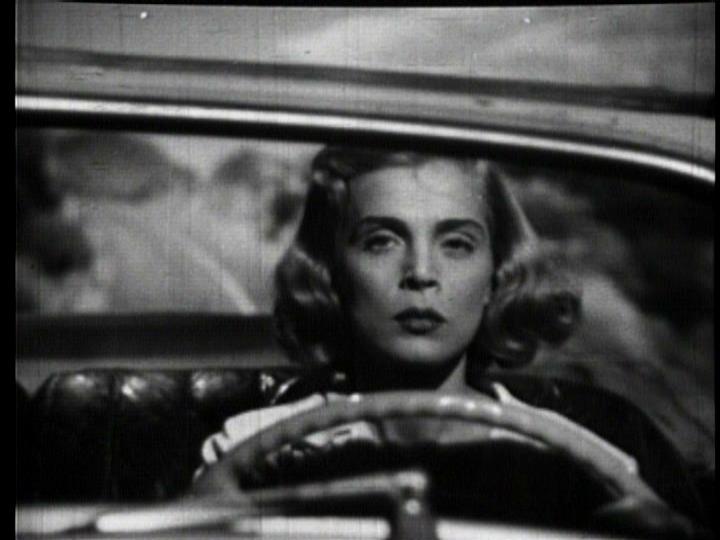
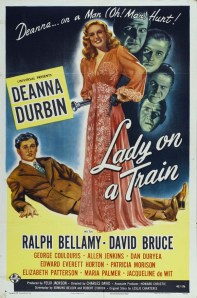 Deanna Durbin is an absolute delight in this farcical murder mystery. Durbin, a native of Winnipeg, Manitoba, was once one of the biggest stars in Hollywood, but never made a movie after 1948. (She currently lives in a small village in France, grants no interviews, and is reportedly very happy.) In Lady on a Train, she plays a young woman named Nicki Collins. When the film begins, Collins is sitting by herself in a compartment on a train entering New York on an elevated line. She has come from San Francisco to spend the holidays with her wealthy businessman father, and is currently engrossed in a mystery novel called The Case of the Headless Bride. When the train is briefly delayed, she looks out the window of her train car and witnesses a murder. Through a lighted window, she sees a young man beat an older man to death with a crowbar. She never sees the murderer’s face, however, and when she reports the murder to the police, the desk sergeant dismisses her report as the product of the overheated imagination of a girl who loves murder mysteries and can provide no real specifics of where she was when she saw the murder. Also, it’s Christmas Eve, and who want to traipse around looking for a murder that may or may not have occurred somewhere in Manhattan north of Grand Central Station?
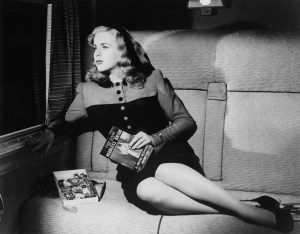 Lady on a Train is part mystery, part musical, part noir, part comedy, and part romance. The most surprising thing about this movie is that each element works perfectly, and they all complement one another. (Calling this film a noir is stretching it, but the final chase in a warehouse contains some striking chiaroscuro shot constructions, and is as tense as one could ask for.) Lady on a Train is also a delight for Durbin fetishists, since she has a different outfit and hairstyle in literally every scene. Sometimes the changes are subtle, but occasionally they’re impossible to miss, such as the scene in which she comes in out of the rain and is suddenly wearing gravity-defying, Pippi Longstocking-style braided pigtails.
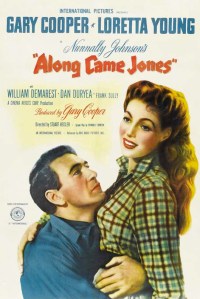 Along Came Jones is a silly little western that verges on being a spoof of the genre, but it’s worth seeing for a couple of reasons. Gary Cooper pokes fun at his stalwart image without devolving into parody, and the gender reversals in some of the action scenes are still surprising.
 OCD Viewer