Tag Archives: Drama

The Man I Love (Jan. 11, 1947)

The Man I Love
The Man I Love (1947)
Directed by Raoul Walsh
Warner Bros.

Loving the popular music of the ’30s and ’40s isn’t a prerequisite for enjoying Raoul Walsh’s The Man I Love, but it sure helps.

If you don’t like old pop standards (I do, and found myself humming “The Man I Love” constantly for about a day after I watched this movie), then you’d better like “women’s pictures,” because that’s what this is. (I’ve seen The Man I Love called a film noir, but it’s not. Half the movie takes place in nightclubs, and there’s a hint of criminal malice every now and then, but that alone does not a noir make.)

The most prominent tune is the one that gives the film its title, George and Ira Gershwin’s sublime “The Man I Love” — both as a smoky nightclub number and as a constant refrain in Max Steiner’s lissome score — but there are plenty of other great songs, like Jerome Kern and Oscar Hammerstein’s “Why Was I Born?” and James P. Johnson and Henry Creamer’s “If I Could Be With You.” There are also tunes just tinkled out on the piano, like George Gershwin’s “Liza (All the Clouds’ll Roll Away)” and Johnny Green’s “Body and Soul,” suffusing the film with a nostalgic languor that’s a nice counterpoint to all the melodrama.

When New York nightclub singer Petey Brown (Ida Lupino) packs her bags for Los Angeles to visit her siblings, she’ll find love, lose love, flirt with danger, and leave things a little better off than she found them. The poster for The Man I Love features the following tagline: “There should be a law against knowing the things I found out about men!” This is a bit of an overstatement, since most of what Petey finds out about men in this picture is what most clear-eyed women already know; most of them are rotten, some are crazy, some are sweet but naive and dim-witted, and the few you fall for are probably in love with another dame who they’ll never get over.

Petey’s sister Sally Otis (Andrea King) has a young son and a husband, Roy Otis (John Ridgely), who’s languishing in a ward for shell-shocked soldiers. Sally lives with the youngest Brown sister, Ginny (Martha Vickers), who’s 18 and should be enjoying life, but instead spends most of her time caring for the infant twins of their across-the-hall neighbors, Johnny and Gloria O’Connor (Don McGuire and Dolores Moran). Joe Brown (Warren Douglas) — the girls’ brother — is hip-deep in trouble. He’s working for a slimy nightclub owner named Nicky Toresca (Robert Alda) and seems destined for a one-way trip to the big house.

There are a few potentially interesting stories that never really go anywhere, such as Ginny’s attraction to Johnny, whose wife is two-timing him, and Sally’s relationship with her mentally ill husband. For better and for worse, Lupino is the star of The Man I Love, and her dangerous dealings with Nicky Toresca and her doomed romance with a pianist named San Thomas (Bruce Bennett) who’s given up on life dominate the running time of the picture.

The actors are all fine, and the stories are involving, but it’s the music that elevates this picture. Ida Lupino expertly lip synchs her numbers, which were sung by Peg La Centra (who can be seen in the flesh in the 1946 film Humoresque, singing and playing the piano in two scenes in a dive bar).

There’s also at least one allusion to a popular song in the dialogue. When Petey sees the twins and asks “Who hit the daily double?” Gloria responds gloomily, “Everything happens to me,” which is the title of a Matt Dennis and Tom Adair song first made popular by Frank Sinatra when he was singing for Tommy Dorsey’s band. There are probably other little in-jokes like that sprinkled throughout, but that was the only one I caught.
Hungry Hill (Jan. 7, 1947)

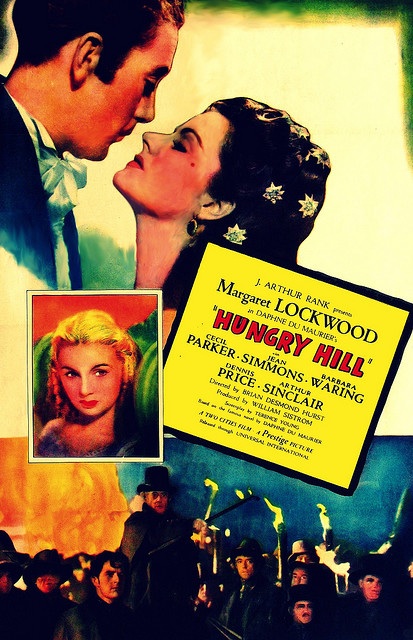
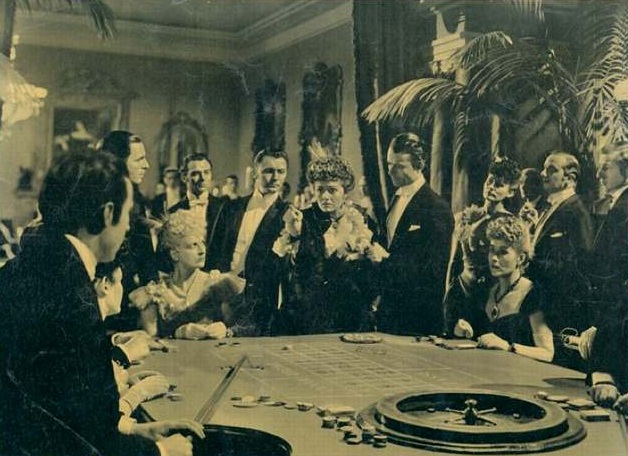
Daphne Du Maurier’s 1943 historical novel Hungry Hill covers a period of 100 years (1820 to 1920) in the lives of five generations of two feuding Irish families. Brian Desmond Hurst’s 1947 film adaptation narrows the scope of the story to three generations and a roughly 50-year timespan, but it’s still a lot to take in over the course of just 100 minutes. If you’re a fan of romantic yet gloomy historical melodramas, Hungry Hill is a filling dish. And if you’re not, Hungry Hill might leave you feeling stuffed and queasy.

Margaret Lockwood gets top billing (and the most time onscreen) as Fanny Rosa, a beautiful and headstrong young woman who marries into the wealthy Brodrick family, who live in a castle called “Clonmere” in County Cork. The patriarch of the clan, John Brodrick (Cecil Parker), has several children, John (Dennis Price), Henry (Michael Denison), and Jane (Jean Simmons). (Honestly, there are a lot of characters in Hungry Hill, and he might have had more children than those three, but they’re the only ones I was able to get a handle on.)

The patriarch of the Donovan clan, old Morty Donovan (Arthur Sinclair), violently objects to John Brodrick’s plans to mine for copper in Hungry Hill, and curses Brodrick and his entire family. (Hungry Hill is located in the beautiful Caha Mountains, which I’ve hiked, so I was disappointed that there wasn’t more location footage — most of the film takes place in drafty old rooms and the bowels of the Brodrick copper mine.)

While the copper mine ends up providing plenty of employment for the Donovan clan and other roustabouts, tensions are always simmering. A labor riot leads to the death of one young man, and a visit of reconciliation leads to a deadly typhoid infection.

Hungry Hill follows a familiar three-generation rise-and-fall story arc. By the time Margaret Lockwood’s hair is brushed through with gray and her face is lined with age makeup, it should come as no surprise to anyone that her handsome son, Johnnie Brodrick (Dermot Walsh), is drinking a bottle of whiskey a day, loving and leaving the ladies, and frittering away his family’s fortune. The scenes between Johnnie and his mother are well-played and affecting, but by that point in the movie I was starting to lose interest in the dismal goings-on.

One thing I can recommend unequivocally is the casting, which is excellent. Not only does Hungry Hill feature the cream of the crop of up-and-coming British actors, but the Brodrick men really do all look like members of the same family, and the Donovans resemble one another, too. Of course, this is a double-edged sword, since it’s sometimes difficult to keep them all straight.

Hurst himself clearly didn’t hold this film in the highest regard. In a letter to John Ford dated April 9, 1951, in which he sang the praises of Siobhan McKenna, who played Kate Donovan in Hungry Hill (Ford was interested in casting her in his film The Quiet Man), Hurst wrote, “There must be a copy of a rather indifferent film I made of Daphne du Maurier’s even more indifferent story ‘Hungry Hill.’ You could get hold of this through Eagle-Lion, but don’t inflict the whole of the picture on yourself. Just see about the last four reels, because she doesn’t come in till then.”

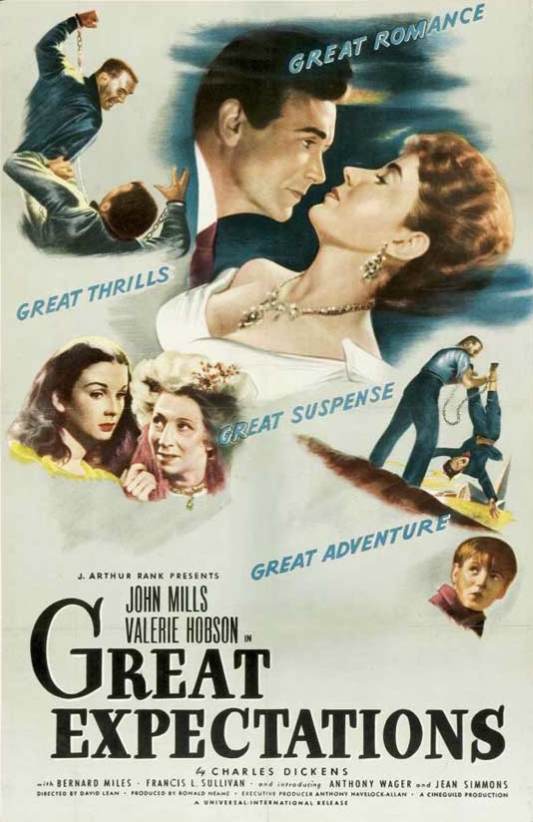
Great Expectations (Dec. 26, 1946)

I’ve never held Charles Dickens in the high esteem that many others do. Granted, I’ve only read one of his novels in its entirety — Hard Times (1854). Based solely on that book and the story “A Christmas Carol,” which I’m pretty sure I’ve read in its original form at least once, Dickens was a splendid caricaturist. I could picture every facet of the grotesque antagonists and tenacious protagonists of Hard Times. They looked and acted like real people. But it was all on the surface. None of them felt like real people, and I was never convinced that they had internal lives or realistic motivations. I’m a big fan of psychological realism and believable characters, so if I’m going to read a Victorian novel, I’d much rather it be by George Eliot or Thomas Hardy than by Dickens.

The only other Dickens novel I’ve ever taken a crack at was Great Expectations (1861), which was assigned reading in my 9th-grade English class. I never finished it. (Sorry, Ms. Lee-Tino.)

But based on the roughly 25% of the novel that I did read, David Lean’s Great Expectations seems like a pretty solid adaptation. Orphaned boy Phillip “Pip” Pirrip (Anthony Wager) lives with his ill-tempered older sister (Freda Jackson) and her husband, Joe Gargery (Bernard Miles), a kind-hearted blacksmith. One night, out on the moors, Pip is accosted by an escaped convict, Abel Magwitch (Finlay Currie), who makes him promise to return with food and a file with which to saw through his chains. The terrified Pip keeps his promise, but the authorities arrive on the scene, Magwitch attacks another escapee, and they’re both taken back to prison.

Soon, we meet one of Dickens’s great grotesque characters, Miss Havisham (Martita Hunt), a mentally twisted shut-in who is gleefully brainwashing her beautiful young charge Estella (Jean Simmons) to be the ultimate heartbreaker, and punish men who are foolish enough to fall in love with her. Pip is sent to Miss Havisham’s on a regular basis to improve his manners, but it should go without saying that he ends up receiving a very different kind of education.

All of this is very well done, and beautifully filmed — especially the scenes at night on the moors. The problem for me came after about 40 minutes, when several years pass and Anthony Wager is replaced by John Mills — as the adult version of Pip — for the rest of the picture. Although Pip has only supposed to have aged a few years (from boyhood to manhood), Mills was 38 years old, and the effect is jarring. He’s perfectly handsome, but he just doesn’t look like a young man starting out in the world. The other major actor to change is Estella, which is even more jarring. The gorgeous 17 year-old Jean Simmons is replaced by the 29 year-old Valerie Hobson, who is far less charming than Simmons and looks nothing like her.

Great Expectations premiered in the United Kingdom on December 26, 1946, and opened in the United States during the spring of 1947. At the 20th Academy Awards, it was nominated for best picture, David Lean was nominated for best director, and the film was nominated for best adapted screenplay. It won two awards, one for best black and white cinematography and one for best black and white art direction.

I enjoyed it, but the change of actors in midstream and the general Dickensian nonsense of the plot kept me at arm’s length. Great Expectations is beloved by a great many people, however, so if it sounds as if it’s up your alley, by all means check it out.

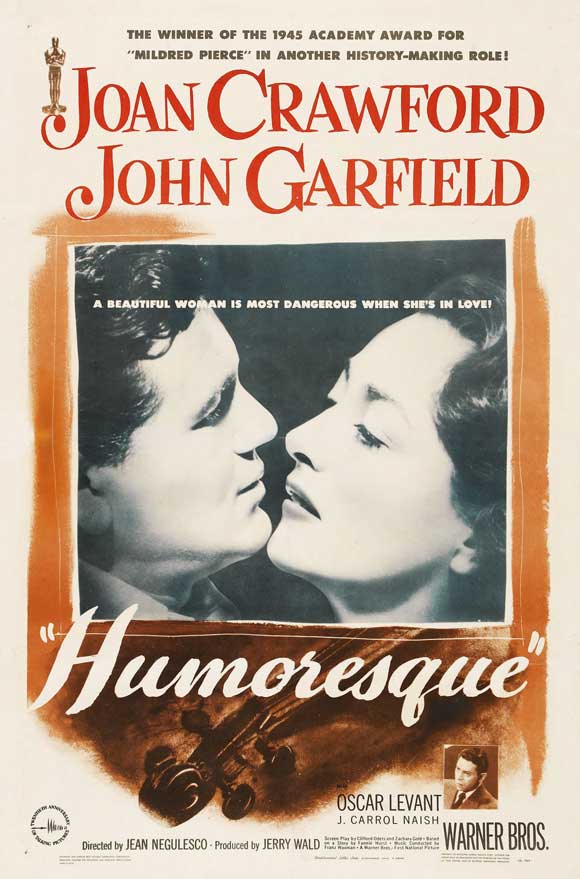
Humoresque (Dec. 25, 1946)

In a recent NY Times interview with David O. Russell, the director of the Oscar-nominated biopic The Fighter (2010), he compared his star, Mark Wahlberg, to John Garfield. Russell said that — like Garfield — Wahlberg is “always kind of in character, because it’s always him in some way.”

Garfield might seem as unlikely a choice as Wahlberg to play a concert violinist, but Humoresque never tries to pass Garfield off as something he wasn’t. His character, Paul Boray, spends his boyhood in what appears to be New York’s Lower East Side, in an immigrant family that has neither the time nor the money for classical music. (Garfield was born Jacob Julius Garfinkle, the son of Russian Jewish immigrants, and grew up in Brooklyn and the Bronx, where he was enrolled in a school for difficult children.) At a high society party, a tipsy young woman refuses to believe Boray when he tells her he’s a violinist. She pegs him as a prizefighter, and refuses to believe he even knows what end of a violin the music comes out of. “It comes out of the middle,” he responds. (Garfield would, however, play a boxer in his next film, Body and Soul.)

There are plenty of hoary cliches in the early sections of the film. Bobby Blake plays Boray as a child. His immigrant father (J. Carrol Naish) works hard and always has his eye on the bottom line, while his mother (Ruth Nelson) is more sensitive, and grows to believe in Paul’s desire to play music. All of these scenes are pretty laborious.

Perhaps director Jean Negulesco wanted to be explicit about how a rough young man from the slums could become a dedicated concert musician, but all of the scenes of Boray’s childhood are less effective than a short sequence later in the picture in which the adult Boray storms out of a recording studio after being forced to cut a major chunk from a piece for radio time. He returns to his apartment to play alone, and the wildness of his music is reflected in a herky-jerky montage of chaotic city streets and teeming masses of people.

Long stretches of Humoresque are told through music, which is beautifully played by violinist Isaac Stern, but there’s plenty of snappy dialogue, too. When Boray gets in an argument with his friend, accompanist, and mentor Sid Jeffers (played by pianist and wit Oscar Levant), Jeffers tells him, “You’ll do all right. You have all the characteristics of a successful virtuoso. You’re self-indulgent, self-dedicated, and the hero of all your dreams.” Boray responds, “You oughta try a few dreams yourself, it might make you less cynical. When I look at you, I know what I want to avoid.” (And to give you an idea of the rapidity of the dialogue in the film, that exchange takes place in less than 12 seconds.)

The plot, such as it is, kick in around the 30-minute mark, when Joan Crawford shows up as Mrs. Helen Wright, a myopic, dipsomaniac socialite with a sharp tongue. Her husband is a cultured, sensitive man, but — by his own admission — very weak, and as soon as Helen takes an interest in Paul and his career, tongues begin to wag.

Garfield and Crawford have great chemistry, and both are good enough actors to give their relationship depth. It’s unclear for a time exactly what each wants from the other, but her alcoholism and his deep-seated anger make for plenty of stormy scenes. At one point, Paul blows up and yells at her, “Well, you didn’t do any of this for me, really. You did it for yourself, the way you buy a racehorse, or build a yacht, or collect paintings. You just added a violin player to your possessions, that’s all.”

In Bosley Crowther’s review of Humoresque in the December 26, 1946, issue of the NY Times, he wrote, “The music, we must say, is splendid — and, if you will only shut your eyes so that you don’t have to watch Mr. Garfield leaning his soulful face against that violin or Miss Crawford violently emoting (‘She’s as complex as a Bach fugue,’ Oscar says), and if you will only shut your ears when folks are talking other such fatuous dialogue, provided by Zachary Gold and Clifford Odets, you may enjoy it very much.”

I love Crowther’s reviews. Maybe if I’d been around when he was writing them I would have resented the stranglehold he had on public perception, but in retrospect they’re fantastically entertaining. I liked Humoresque more than he did, but I don’t disagree with his assessment. One has to take into account his longstanding hatred of Joan Crawford, of course, but by the time the credits rolled I was more moved by the music than by any of the vacuous melodrama.

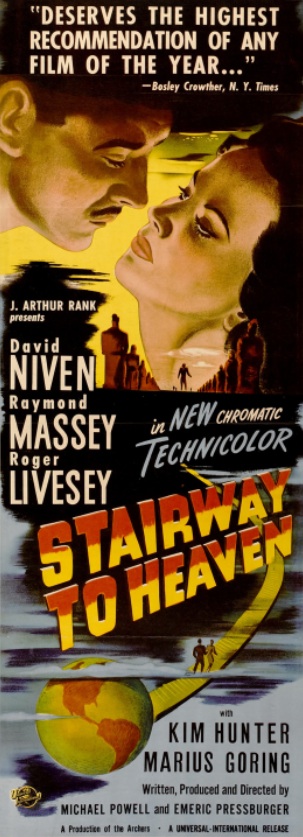
A Matter of Life and Death (Dec. 25, 1946)

Stairway to Heaven
A Matter of Life and Death (1946)
Directed by Michael Powell and Emeric Pressburger
The Archers / Eagle-Lion / Universal Pictures

Michael Powell and Emeric Pressburger’s brilliant fantasy A Matter of Life and Death premiered in the United Kingdom on November 1, 1946, and later that year in New York City, on Christmas day, retitled Stairway to Heaven. (After World War II, the word “death” was verboten in film titles for awhile in the United States.)

The film begins with the following statement: “This is a story of two worlds — the one we know and another which exists only in the mind of a young airman whose life and imagination have been violently shaped by war. Any resemblance to any other world, known or unknown, is purely coincidental.” It’s a playful opening, and can be interpreted in more than one way. “The Archers” (the name Powell and Pressburger used for their partnership) had a light touch, and were able to weave magical realism into their stories without ever seeming childish or silly.

After a cheeky narrated tour through the cosmos, we see Squadron Leader Peter Carter (David Niven), his Lancaster bomber in flames and about to crash. Peter’s parachute is shot too full of holes to function properly, and he is desperately trying to reach someone on the radio. Next to him lies the body of Flying Officer Bob Trubshawe (Robert Coote). Peter manages to get in touch with June (Kim Hunter), an American radio operator, and pours out his heart to her. Finally, he professes his love before leaping out of the bomber without a parachute.

The scene in which Niven wakes up in the pounding surf and believes himself in the afterlife is a masterpiece of subtle humor. He stands, breathes deeply, and walks toward the beach with a beatific gaze, shedding his earthly raiments. The first person he sees is a boy playing a pipe, tending sheep, so why wouldn’t he think he’s passed on to his final reward?

Meanwhile, his mate Bob finds himself in the “other place,” an otherworldly bureacracy in which angel wings arrive en masse on long runners, ready to be attached to newly arrived bodies, and businesslike clerks take names and hand out assignments. Bob is told that there was a clerical error that caused Peter to fall through the cracks, and that he’ll need to be collected forthwith.

The scenes on terra firma are filmed in beautiful Technicolor, while the scenes in the afterlife are filmed in black and white. (Technically it’s “monochrome Technicolor,” not proper black and white, but since I’m not as big of a film nerd as Martin Scorsese, I couldn’t tell the difference.) It’s a simple but brilliant stylistic choice, and it’s way ahead of its time. Films in the ’30s or ’40s that mixed black and white with color film invariably depicted the fantastical world in color and the prosaic world in black and white. To do it the other way around looks forward to the ’80s, when black and white was coming back into vogue, and filmmakers like Scorsese and David Lynch showed just how surreal and otherworldly black and white film could look.

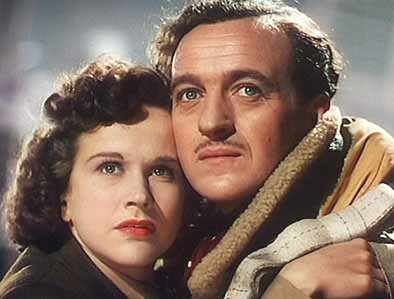
Kim Hunter and David Niven

June and Peter fall in love, but for Peter, time occasionally stops all around him while a ridiculous French aristocrat from the other world known as “Conductor 71” (Marius Goring), pays him visits.

June’s friend Doctor Reeves (Roger Livesey) believes that Peter’s visions aren’t supernatural, but symptoms of a brain injury. Eventually this “matter of life and death” comes to a head as Peter is operated on in our world while simultaneously facing trial in the other.

A Matter of Life and Death is a fantastic film that is satisfying on both a technical level and an emotional level. The performances are all wonderful, and Powell and Pressburger are masterful filmmakers.

Incidentally, in a 2004 poll of 25 film critics in Britain’s Total Film magazine, A Matter of Life and Death was named the second greatest British film of all time, sandwiched between Get Carter (#1) and Trainspotting (#3).

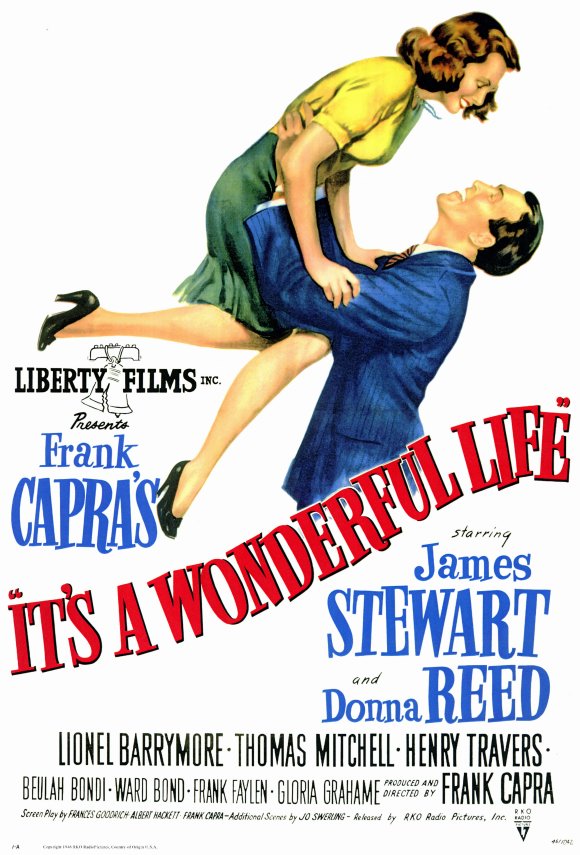
It’s a Wonderful Life (Dec. 20, 1946)

I can’t count the number of times I’ve seen Frank Capra’s It’s a Wonderful Life, and I’m not alone. When I was a kid, not a Christmas went by that it wasn’t shown on television multiple times. For many families, it’s required holiday viewing.

Like a lot of people, I didn’t see the film in its entirety until I’d already seen bits and pieces over the years and seen it satirized and referred to in countless TV shows and movies.

My first memory of seeing part of it was on my grandmother’s 13″ black & white TV. The film was almost over, and I had no idea what it was about. George Bailey (James Stewart) is experiencing what life would have been like if he’d never been born. He’s disheveled and looks terrified. Police officer Bert (Ward Bond) and cab driver Ernie (Frank Faylen) watch as he explores the abandoned, ramshackle version of his own home. The scene is full of darkness and shadows. It has the look of a film noir, and I found it scary.

If you’ve never seen It’s a Wonderful Life, you might think it’s the exact opposite — sappy and sentimental — but that’s not the case. It’s a film full of dark moments, with a sense of desperation that’s always threatening to bubble to the surface. The most famous part of the film — George seeing what life would have been like in Bedford Falls, NY, if he’d never been born — occupies a relatively small amount of the total running time. Most of the film tells the story of an ordinary man who ended up living a very different life than he dreamed he would.

When he was young, George dreamed of going to college, traveling the world, and becoming a titan of industry. His life is an emotional game of tug. He puts off college, stays in Bedford Falls, and even gives away the money he and his wife Mary (Donna Reed) put aside for their honeymoon in order to save the family business, Bailey Building & Loan. George always does the right thing because he’s a decent person, but he’s a real person, too. Each little depredation eats away at him. He loves his wife and four children, but when the evil old Mr. Potter (Lionel Barrymore) spirits away $8,000 from his absent-minded Uncle Billy (Thomas Mitchell), George loses hope. It looks as if the family business might not only be ruined, but George might also be headed to prison.

George asks Potter for a loan, and Potter points out that while he needs $8,000, he carries a life insurance policy worth $15,000, which means he’s worth more dead than alive. The desperate George takes this cruel assessment to heart. He heads home, yells at his children, trashes part of the house, and goes out to get good and drunk. After getting punched in the face in the bar, he crashes his car, stumbles to a bridge, and contemplates killing himself. It’s at this point that a frumpy angel named Clarence (Henry Travers), who has “the I.Q. of a rabbit and the faith of a child,” arrives to show him just how much he really is worth.

It’s a Wonderful Life works as well as it does because it earns every one of its emotional moments. Take, for instance, one of the pivotal moments of George Bailey’s boyhood. George (played by the wonderful Bobbie Anderson, later to be known professionally as Robert J. Anderson) has an after-school job in the local pharmacy, and stops old Mr. Gower (H.B. Warner) from making a fatal mistake. The audience knows that Gower has slipped up not only because he’s drunk, but because he’s distraught following the death of his son. When George returns, having failed to deliver the poisonous “medicine,” Gower beats him savagely. When Gower finally realizes the fatal mistake George has stopped him from making, he breaks down and embraces the boy in an outpouring of emotion.

I really meant to re-watch It’s a Wonderful Life and write a review of it before Christmas. But one thing led to another and I got behind in my movie-watching schedule. I’m glad I didn’t get around to seeing it until now, though. It reminded me just what a great film it is. So many “holiday films” are unwatchable after December 25, but It’s a Wonderful Life was just as engaging and emotionally satisfying in mid-January as it is any other time of the year.

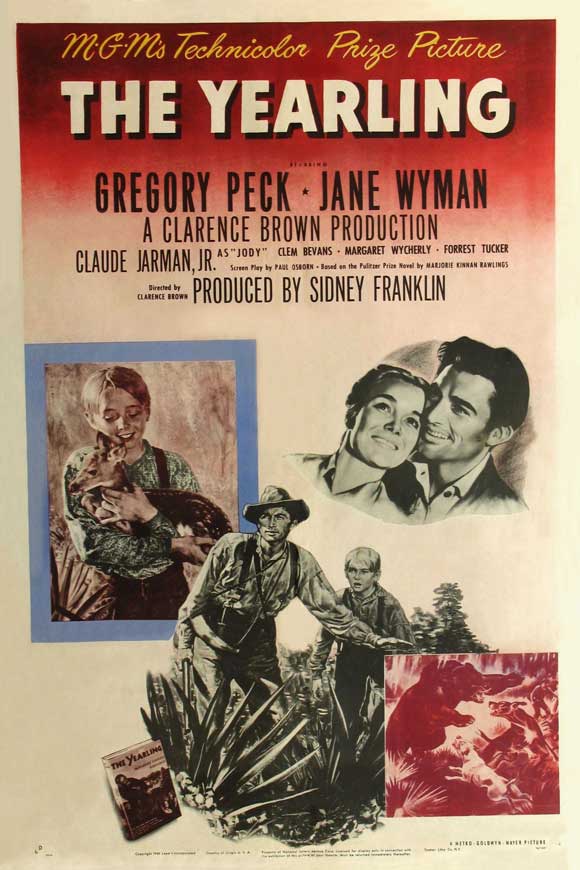
The Yearling (Dec. 18, 1946)

The Yearling
The Yearling (1946)
Directed by Clarence Brown
Metro-Goldwyn-Mayer

The Yearling, which is based on the Pulitzer Prize-winning novel by Marjorie Kinnan Rawlings, is a hard movie for me to review. It’s a beautifully filmed picture, and is a great example of just how good the sometimes-gaudy Technicolor process could look.

But it’s also one of the saddest “family” films I’ve ever seen. I would certainly never show it to a child under the age of 12, and would only show it to a child 12 or older if they knew the basic story and specifically requested to see it. I’ve seen The Yearling called “heart-warming,” but I found it emotionally draining and depressing.

I don’t know why so many animal stories for young people involve a beloved pet dying, but they do. Unlike The Yearling, however, the animals in Where the Red Fern Grows and Old Yeller at least die after a heroic struggle of some kind. In The Yearling, the 12-year-old protagonist is forced to shoot his beloved deer, whom he raised from a fawn, because it’s eating their cash crops. The message, obviously, is that life is hard, and growing up and becoming a man involves unpleasant tasks, but it still left me feeling more dejected than inspired.

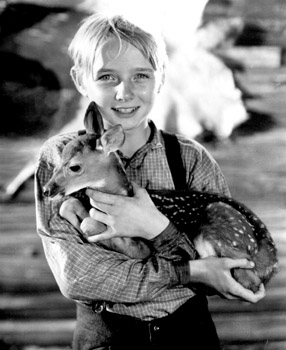
Young Jody Baxter (Claude Jarman, Jr.) is a dreamer — sweet and sensitive despite his hardscrabble life in the Florida scrub country in the late 19th century. He has an easy rapport with his father, Ezra “Penny” Baxter (Gregory Peck), but a more difficult relationship with his mother, Orry (Jane Wyman), who is as hard and unforgiving as pioneer women come. Early in the film, Penny tells his wife, “Don’t be afraid to love the boy.” The film cuts to a scene of Wyman standing in front of the graves of all her dead children, David Baxter, who died at the age of 1 year, 3 months, Ora Baxter, who died at the age of 2 years, 4 months, and Ezra, Jr., who was stillborn, and we see precisely why she is afraid to let down her guard around her only son.

Jody yearns for a little pet of his own, but his parents never let him have one for practical reasons. After Penny is bit by a rattlesnake, however, he shoots a doe for its heart and liver, which can pull the poison from his wound. (I’m pretty sure this is what we would now call “unscientific.”) The doe leaves behind a little fawn, which Jody’s parents allow him to adopt. Jody names the fawn “Flag.”

But why? Why do they finally relent in that situation? The Baxters are practical people who could have seen the handwriting on the wall. When you’re a family that depends on every last penny of income your meager crops provide, having a domesticated deer living on your farm is bound to cause trouble.

Claude Jarman Jr

And trouble Flag causes. Jody’s parents are patient after the year-old Flag eats a large portion of their cash crop of tobacco. Penny and Jody plant a new crop of corn to help make up for the loss. But when Flag eats most of the corn, Jody promises to erect a fence so tall that Flag won’t be able to get over it. His father injures his back, and can’t help him, even though he wants to.

If this was just a story about learning responsibility, then Jody toiling far into the night, in the rain, over the course of several days, all alone, just to build a fence (which appears to be more than six-feet tall) to not only save his family’s crop but also the life of his beloved pet would be enough. But the moment Flag easily jumps over the fence and goes back to work on the corn, my heart dropped. I knew what was coming next, but still couldn’t quite believe it when it happened.

There are plenty of positive interpretations of The Yearling. Death is a part of life, and we all must learn this sooner or later. It could also be seen as a young boy coming to understand his mother’s pain and hardship. Like her, he has now lost something fragile and beautiful that died too young. But these were all things my head understood after watching the movie. My heart felt empty, as though I had just been shown the utter futility of cherishing anything frivolous or out of the ordinary.

The Yearling won three Academy Awards; one for Best Color Interior Direction (Cedric Gibbons, Paul Groesse, and Edwin B. Willis), one for Best Color Cinematography (Charles Rosher, Leonard Smith, and Arthur Arling), and one honorary Oscar for the young star of the film, Claude Jarman, Jr., who was given an award for “Outstanding Child Actor of 1946.” I thought that Jarman’s performance was good, but I didn’t believe him during two scenes in which he registers horror and disbelief. Peck is good, as always, but he seems miscast. He registers earnestness and decency, but his accent is never quite right. Wyman, I thought, gave the best performance in the film, which was impressive, considering how unsympathetic her character was for most of the running time.

Oh, and there’s a disclaimer at the end that all scenes involving animals were supervised by the American Humane Association. We’re used to seeing this now, but it was fairly new in the ’40s. After several horses were killed during the making of Charge of the Light Brigade (1936) and Jesse James (1939), there were numerous audience protests, which led to supervision by American Humane of most Hollywood films involving animal performers. This said, I’d really like to see behind the scenes for the amazing sequence in which Penny and Jody hunt a bear, and their dogs attack it over and over. I guess the bear was just hugging the dogs before it tossed them safely away, but it looked pretty damned real to me.

The Best Years of Our Lives (Nov. 21, 1946)

The Best Years of Our Lives
The Best Years of Our Lives (1946)
Directed by William Wyler
RKO Radio Pictures

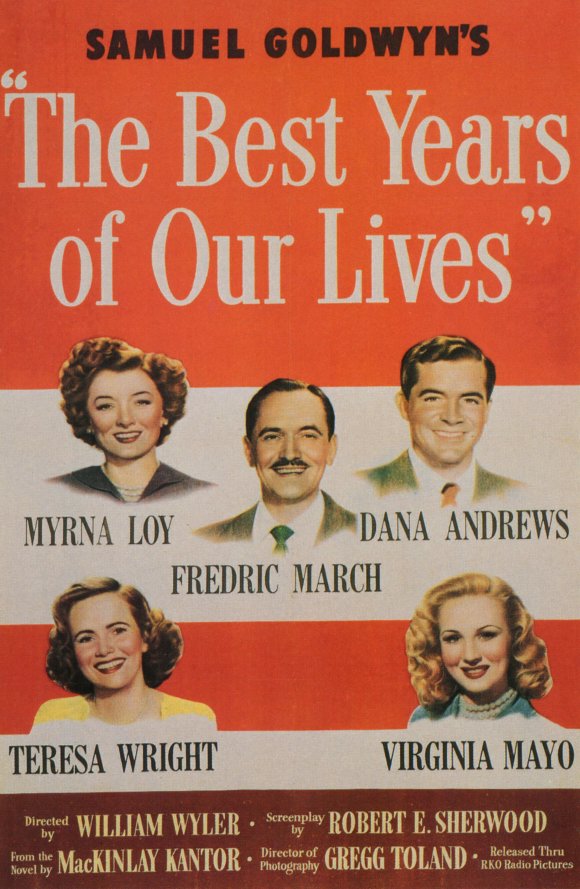
William Wyler’s The Best Years of Our Lives premiered in New York City on November 21, 1946, and in Los Angeles a month later, on Christmas day. It was a hit with both audiences and critics, and was the biggest financial success since Gone With the Wind in 1939.

The film swept the 19th Academy Awards, winning in all but one category in which it was nominated. The film won best picture, Wyler won best director, Fredric March won best actor, Harold Russell won best supporting actor, Robert E. Sherwood won for best screenplay, Daniel Mandell won for best editing, and Hugo Friedhofer won for best score. (The only category in which it was nominated and did not win was best sound recording. The Jolson Story took home that award.)

There are several reasons for the film’s financial and critical success. It perfectly captured the mood of the times. In 1946, returning servicemen faced an enormous housing shortage, an uncertain job market, food shortages, and a turbulent economy (price controls were finally lifted by the O.P.A. around the time the film premiered). Combat veterans also faced their own personal demons in an atmosphere in which discussing feelings was seen as a sign of weakness. By telling the stories of three World War II veterans returning to life in their hometown, The Best Years of Our Lives held a mirror up to American society.

The biggest reason for the film’s success, however, is that it’s a great movie. Plenty of films made in 1945 and 1946 featured characters who were returning veterans, but none before had shown them in such a realistic, unvarnished way. The Best Years of Our Lives doesn’t try to wring tragedy out of its characters’ personal situations. It’s an overwhelming emotional experience precisely because it doesn’t strain for high emotions. The film earns every one of its quietly powerful moments. Hugo Friedhofer’s score is occasionally overbearing, and a little high in the mix, but at its best it’s moving, and a fair approximation of Aaron Copland’s fanfares for common men. Gregg Toland’s deep focus cinematography is phenomenal. Every image in the film — the hustle and bustle of life in a small American city, the quietly expressive faces of its characters, and the interiors of homes, drugstores, bars, banks, and nightclubs — is fascinating to look at. (Toland was Orson Welles’s cinematographer on Citizen Kane, and he was an absolute wizard.)

Russell Andrews March

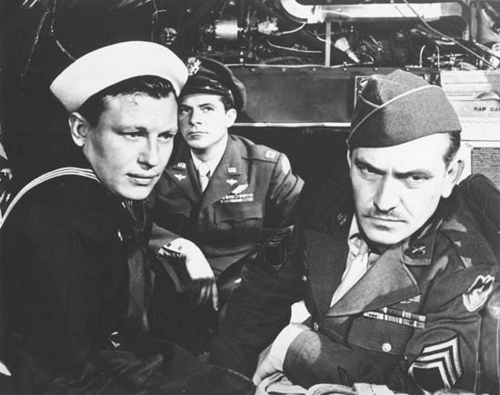
The actors in this film are, without exception, outstanding. Fredric March plays Al Stephenson, an infantry platoon sergeant who fought in the Pacific, and who returns to his job as a bank manager. Myrna Loy plays his wife, Milly, Teresa Wright plays their daughter, Peggy, and Michael Hall plays their son, Rob. Dana Andrews plays the shell-shocked Fred Derry, a decorated bombardier and captain in the Army Air Forces in Europe, who returns home to his beautiful wife Marie (Virginia Mayo), whom he married immediately before leaving to serve. Now that the war is over and they are living together, they realize they have very little in common. Harold Russell plays Homer Parrish, a sailor who lost both his hands when his aircraft carrier was sunk.

Russell was a non-professional actor who lost his hands in 1944 while serving with the U.S. 13th Airborne Division. He was an Army instructor, and a defective fuse detonated an explosive he was handling while making a training film. Russell’s performance is key to the success of the film. An actor who didn’t actually use two hook prostheses in his everyday life wouldn’t have been able to realistically mimic all the little things that Russell does; lighting cigarettes, handling a rifle, playing a tune on the piano. More importantly, Russell’s performance is amazing. From the very first scene that the camera lingers on his face as he shares a plane ride home with March and Andrews, I felt as if I knew the man.

Russell is so convincing as a man who has quickly adapted to his handicap that it’s gut-wrenching to watch as his exterior slowly breaks down, and we’re drawn deeper into his world. Homer Parrish has a darkness inside him, and he carries with him the constant threat of violence; bayonets adorn the walls of his childhood bedroom and he spends his time alone in the garage, firing his rifle at the woodpile. His next-door neighbor and childhood sweetheart Wilma (Cathy O’Donnell) keeps trying to get close to him, but he pushes her away. In a lesser film, this all might have led to a violent and melodramatic finale, but it merely simmers below the surface, informing his character. Instead, the most emotional scenes with Homer take place in smaller ways, such as when we see that he is not as self-sufficient as he seems, and needs his father’s help every night to remove his prostheses before he goes to sleep.

The Best Years of Our Lives is a great film, and should be seen by everyone who loves movies and is interested in the post-war era. It’s long — just short of three hours — but it didn’t feel long to me. The running time allows its story to develop naturally as the characters enter and re-enter one another’s lives. It also felt more real than any other movie I’ve seen this year. (I can’t think of another movie that wasn’t about alcoholism that featured so many scenes of its characters getting realistically drunk.) And despite all the personal difficulties its characters face, it’s ultimately an uplifting film, full of quiet hope for the future.

The Razor’s Edge (Nov. 19, 1946)

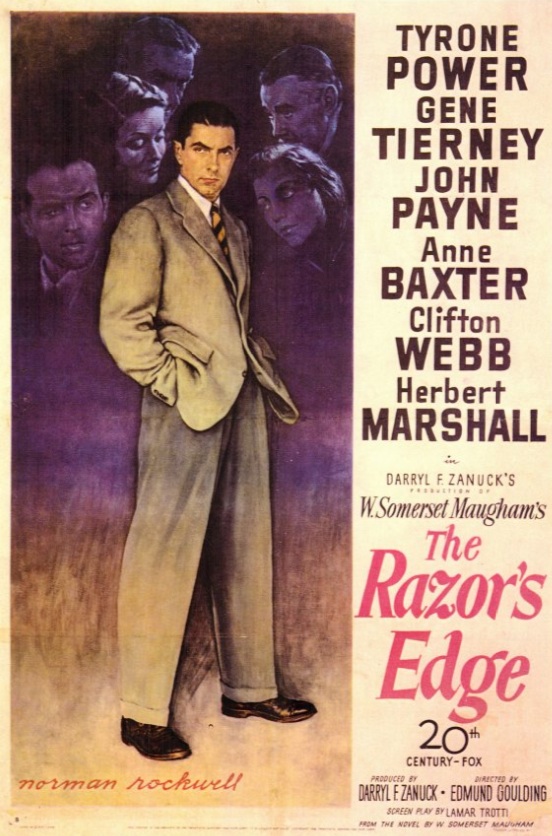
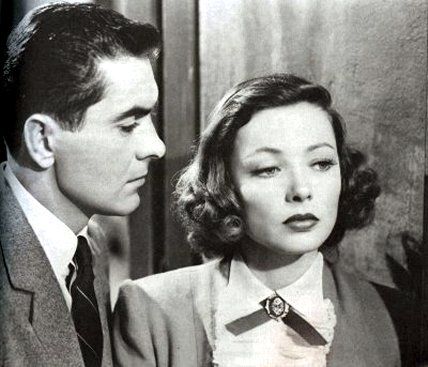
Edmund Goulding’s The Razor’s Edge, based on the best-selling 1944 novel by W. Somerset Maugham, features an Academy Award-winning performance by Anne Baxter in a supporting role, great-looking sets, deliciously bitchy acting by Clifton Webb, and a chance for Tyrone Power and Gene Tierney to show that they were better actors than they are usually given credit for.

So why didn’t I like it? Everything about this film reeks of “Oscar bait.” It’s high-minded, pretentious, and self-important, but ultimately shallow. There are a number of interesting characters in the framing sections of the film, but the central story about a young man named Larry Darrell (Tyrone Power) seeking enlightenment in Eastern spirituality falls flat, and everything else in the movie hangs on it.

Darrell is a veteran of the Great War who returns home to Chicago in 1919 questioning life after a fellow soldier — a friend of his — died saving his life. His confusion and guilt lead him to reject ordinary life and travel the world searching for meaning. He leaves behind his fiancée, porcelain-skinned beauty Isabel Bradley (Gene Tierney), as well as a sharply drawn cast of supporting characters; Isabel’s uncle, the fabulously wealthy and snobbish Elliott Templeton (Clifton Webb), the tragic hanger-on Sophie MacDonald (Anne Baxter), and “regular guy” Gray Maturin (John Payne). Just as in the novel, Maugham himself (played by Herbert Marshall) pops in and out of these characters’ lives.

When Tyrone Power first appears in the film, the character of Maugham says in voiceover, “This is the young man of whom I write. He is not famous. It may be that when his life at last comes to an end, he will leave no more trace of his sojourn on this earth than a stone thrown into a river leaves on the surface of the water. Yet it may be that the way of life he has chosen for himself may have an ever-growing influence over his fellow men, so that, long after his death perhaps, it may be realized that there lived in this age a very remarkable creature.”

Maugham’s words are prophetic. In the decades after he wrote The Razor’s Edge, many young men (and some women) would seek wisdom and enlightenment just as Larry does, traveling the world working a series of menial jobs and seeking truth in non-Christian religions.

While working in a coal mine in France, Larry plays cards and drinks with an old man who eventually turns out to be (unshockingly, based on the dialogue that passes between them) a defrocked priest running away from himself. The priest tells Larry of an Indian holy man who is vastly wise, and who may be able to set Larry straight.

Larry makes his way to India, and it was at this point that — at least for me — the movie took a nosedive. While all kinds of terrible things are happening to the other characters — Isabel is in a loveless marriage, Sophie loses her baby and becomes an alcoholic, etc. — Larry hangs out in a set that looks left over from Anna and the King of Siam and studies with an Indian guru who is ridiculously played by British actor Cecil Humphreys. The holy man speaks only of “God,” nothing specific, and certainly nothing polytheistic. His mysticism is inoffensive New Age stuff along the lines of Deepak Chopra’s vague aphorisms.

After Larry learns all he can from books, the holy man sends him on a pilgrimage to the mountains, where he receives “enlightenment” in the form of a matte painting of sun bursting out from behind the clouds and one last mealy-mouthed conversation with the guru.

All of this might have been meaningful in the novel. I can’t say, as I haven’t read it. But at least in this film, Larry’s spiritual journey is a bunch of vague nonsense that trades on the supposed exoticism of the East without actually including anything strange or specific enough to offend Peoria. Worst of all, he returns to his circle of friends, who are now bumming around Europe, with what amounts to a bag of parlor tricks. He does some hypnosis, forcing his friend Gray to drop a coin after he counts to ten and then tells Gray that he will feel pain no longer. Stuff like that. I was surprised he hadn’t learned to turn himself invisible, like Lamont Cranston in The Shadow.

When the movie ends, we’re supposed to believe that everyone who came into contact with Larry is better, somehow, because he is possessed of the most powerful force in the universe, goodness. But what is it about him makes him so good? He agrees to marry Sophie when she is in the depths of her alcoholism, which leads another character to describe him as being in the grips of self-sacrifice, which seems more apt.

Is Larry a good person because, at the end of the film, he works his way back to America on a tramp steamer? So do legions of cruder, simpler men. Does the mere fact of Larry’s enlightened attitude make his manual labor somehow nobler than the manual labor of “lesser” men? If it does, then why? The film never answers this question, but rather asks us to accept its thesis at face value.

I love all the actors in The Razor’s Edge, and they give some of the best performances of their careers in this film. But while it contains plenty of strong individual scenes, it’s a sodden, overlong snoozefest.

The Strange Woman (Oct. 25, 1946)

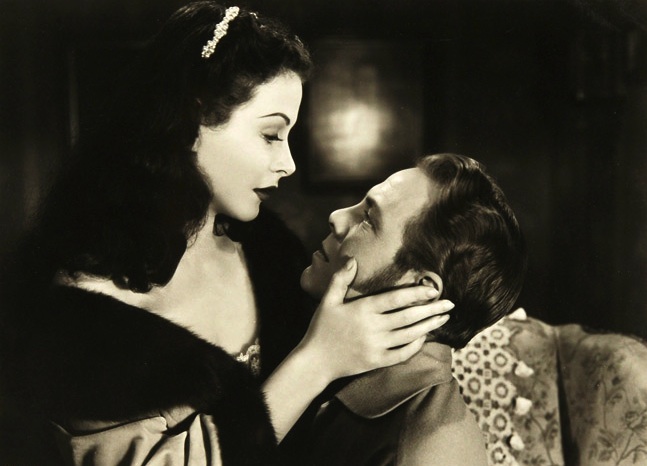
Edgar G. Ulmer’s The Strange Woman, directed with uncredited assistance from Douglas Sirk, is based on the 1945 novel of the same name by Ben Ames Williams.

Born in 1889, Williams was a prolific novelist who is probably best known today for the same reason he was famous in 1946; he wrote the novel Leave Her to Heaven in 1944, which was made into a hit film in 1945 starring Gene Tierney as Ellen Berent, a calculating sociopath with twisted ideas about love.

The Strange Woman was a natural choice to be made into a film following the success of Leave Her to Heaven. Both stories are psychosexual portraits of women with Electra complexes who use their allure to ensnare men and who don’t allow conventional morality to keep them from their goals; even taboos like murder mean nothing to them.

Unlike Leave Her to Heaven, The Strange Woman is a period piece. The film begins in Bangor, Maine, in 1824. Young Jenny Hager (Jo Ann Marlowe) is being raised by a single father (Dennis Hoey) whose only love in life seems to be drink. After Mr. Hager receives stern words from prosperous shop keeper and importer Isaiah Poster (Gene Lockhart) when he once again begs a jug of liquor off of him, the scene switches to a river bank, where young Jenny is tormenting Mr. Poster’s son Ephraim (Christopher Severn), a sickly boy who can’t swim. She pushes him into the river and holds his head under with her bare foot, but when Judge Henry Saladine (Alan Napier) arrives in a carriage, she says, “Poor, poor Ephraim,” and jumps in. She drags him to shore and blames his predicament on the boys she was with.

The judge is disgusted with Mr. Hager for stumbling through life drunk and failing to care for his daughter, but once Jenny and her father are alone, it’s clear that she loves him unconditionally. “Before long we’ll have everything,” she says. “Just as soon as I grow up we’ll have everything we want, because I’m going to be beautiful.” Mr. Hager tosses his empty jug into the river, and when the ripples clear, child actress Marlowe’s reflection has become that of the beautiful Hedy Lamarr.

Jenny may be all grown up, but clearly only a few years have passed. All the adults are played by the same actors, and things are much the same in Bangor. Her father is still a hopeless drunk and Mr. Poster is still the wealthiest, most powerful man in town. Bangor appears to be a little rowdier, however, with more commerce coming through the docks, and more drunken sailors stumbling around. Jenny and her friend Lena (June Storey) hang around the waterfront, attracting the attention of sailors. Lena tells Jenny that, with her looks, she could get the youngest and best-looking men around, but Jenny replies that she’s only interested in snagging the richest.

When her father confronts her, she flaunts her sexuality, bragging that she can make any man want her, and he beats her viciously. The whipping he gives her, while they stand face to face, is a little ambiguous, and more than a little sexual.

She runs away to Mr. Poster’s house, and shows him the stripes on her back, throwing her hair forward and dropping the back of her dress, as if she’s posing for a racy portrait, and his face registers both shock and lust.

It’s not long before Jenny marries Mr. Poster. It’s clear that he is a replacement for her father. Her physical longing, at least for the moment, is focused on her old friend — and new son-in-law — Ephraim, who has been sent away to school. She writes Ephraim a letter telling him how lucky he is to have a “nice young mother” and that she will “demand obedience and love.” She writes that if he refuses her, “I will punish you by not kissing you good night” and ends her letter with the line “…come home and see what a fine parent I can be. I do think families should be close, don’t you? Your loving mother, Jenny.”

Ephraim (now played by Louis Hayward) returns home, and he and Jenny slowly but surely fall for each other.

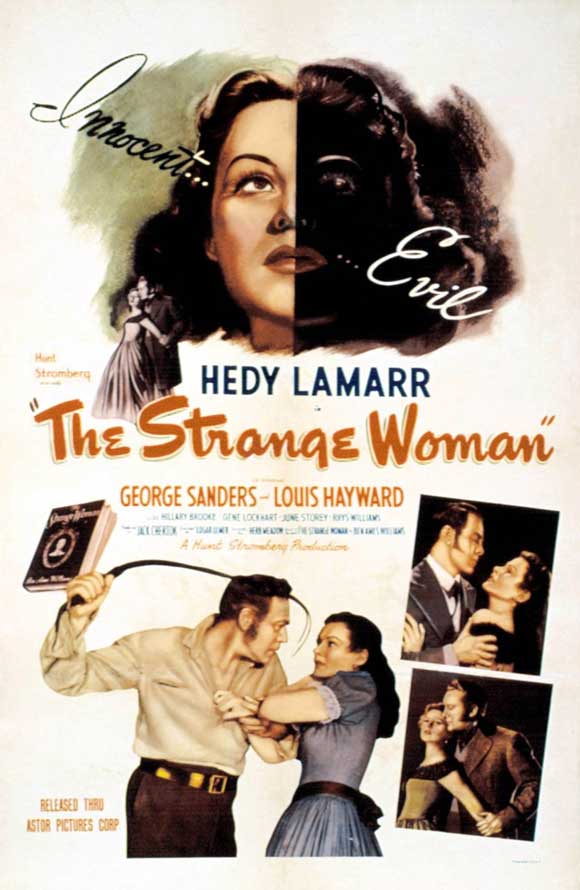
As the film poster above rather obviously shows, Jenny has two faces. For instance, when she and Ephraim sit on the banks of the river together, her recollection of pushing him into the river when he was a boy is flawed. She tells him that those rotten boys did it to him, and she tried to save him. Is she lying? Does she know she is lying? Does he know? Does he go along with it because he loves her, or does he truly believe her?

Jenny’s dual nature mirrors the nature of Bangor itself. On the one hand it is a prosperous New England town with an active churchgoing population of well-to-do people (like Mr. Poster and his young wife), but on the other hand it is a seedy little port city full of drunken sailors and “grog shops and low houses” (a.k.a. pubs and brothels). Jenny uses her husband’s money from his shipping and lumber businesses to improve the town, shaming him publicly into contributing large sums to the church. In private, however, she is carrying on with Ephraim, and even encourages him to arrange an “accident” for his father so they can be married.

Ephraim won’t be the last man in Jenny’s trail of conquest, either. As soon as she lays her eyes on John Evered (George Sanders), the tall, strapping foreman of Mr. Poster’s lumber business, it’s clear that the weak-willed Ephraim doesn’t stand a chance.

The Strange Woman is a well-made film with fine performances all around (with perhaps the exception of Gene Lockhart, who as Mr. Poster exhibits some of the most over-the-top reaction shots I’ve seen since watching Grayson Hall on Dark Shadows). Its narrative is sprawling, and clearly adapted from a novel, but the filmmakers keep everything moving along nicely.

Director Ulmer was a talented craftsman who toiled away in Poverty Row for most of his career, producing a few masterpieces, a few awful pictures, and plenty of films in between. The Strange Woman represents the rare film on his résumé with a decent budget and a reasonable shooting schedule. He was lent out by P.R.C. (Producer’s Releasing Corporation) at Lamarr’s insistence (apparently they were friends back in their native Austria-Hungary). He was paid $250 a week for the job. P.R.C. studio boss Leon Fromkess, on the other hand, received roughly $2,500 from United Artists. While he may have gotten the short end of the stick financially, the deal gave Ulmer a chance to work with a professional cinematographer (Lucien Andriot), a major star or two, a well-written script based on a hot property, and major studio distribution.