Tag Archives: Drama

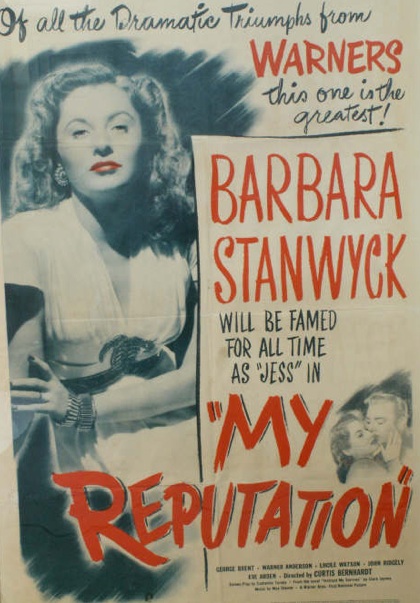
My Reputation (Jan. 25, 1946)

Curtis Bernhardt’s My Reputation, which premiered on January 25, 1946, and went into wide release a day later, was filmed in 1944. Prior to its stateside theatrical release, My Reputation was released for military use, and was shown to troops as entertainment during World War II. The screenplay, by Catherine Turney, is based on the novel Instruct My Sorrow, by Clare Jaynes.

On paper, this movie didn’t interest me, and I probably never would have watched it if I wasn’t doing this project. A prototypical “women’s picture,” My Reputation is about a young widow living among the upper crust of Lake Forest, Illinois, in 1942. Once I started watching it, however, it quickly drew me in. It’s a quality picture from beginning to end. The actors all deliver heartfelt performances, the situations and dialogue are realistic, and the direction, editing, and cinematography are all top-notch.

Barbara Stanwyck plays the protagonist, Jessica Drummond. When the film begins, Jessica’s husband has just died, leaving her a widow and their two sons, aged 12 and 14, fatherless. The executor of the late Mr. Drummond’s estate, lawyer Frank Everett (Warner Anderson) clearly has feelings for Jessica, but they are not reciprocated. Jessica’s mother, Mrs. Mary Kimball (Lucile Watson) has worn mourning clothes ever since her own husband died decades earlier. Jessica’s mother is scandalized when Jessica refuses to dress differently after her husband’s death. “Our kind of people wear black,” she says matter-of-factly.

My Reputation reminded me a little of Mildred Pierce (1945) in its nuanced portrayal of a single woman navigating tricky social waters. It didn’t hurt that Eve Arden, who played Mildred’s best friend, here performs a similar duty as Jessica’s reliable gal pal, Ginna Abbott.

When Jessica goes on a skiing vacation with Ginna and her husband, Cary (John Ridgely), she meets the the insouciant and charming Maj. Scott Landis (George Brent), who is on leave from the war. The two strike up a friendship that blossoms into a romance, but Jessica distances herself from him when he becomes too sexually forward. Landis isn’t a heel, but he is a bit of a rogue, and clearly states that he has no plans to marry. Despite this, Jessica can’t get him out of her mind, and when their paths cross again, she gives in to his advances, consenting to at least kissing. Whether more transpires between them is left up to the viewer, but there is no implication that they consumate their love. This doesn’t change the scandalous nature of their relationship, and Jessica quickly finds herself ostracized from the gossipy circles in which she runs. She stands up for herself, but the disapproval of her mother and her friends is nothing compared with the criticism she receives from children, especially her younger son, who says, “But you belong to dad. It doesn’t make any difference whether he’s dead or not.”

My Reputation ends on a hopeful note, but its depiction of an intelligent, sensitive woman living in a stifling social milieu is still hard to watch. The viewer’s frustration is mitigated, however, by the excellence of the production, especially the attention to detail that makes a well-made film such a joy to watch. For instance, in a scene in which Jessica confronts her mother, the shot is framed so that a large portrait of Jessica as a child and her mother as a younger woman hangs in the background between them. The juxtaposition says nearly as much as their heated words.

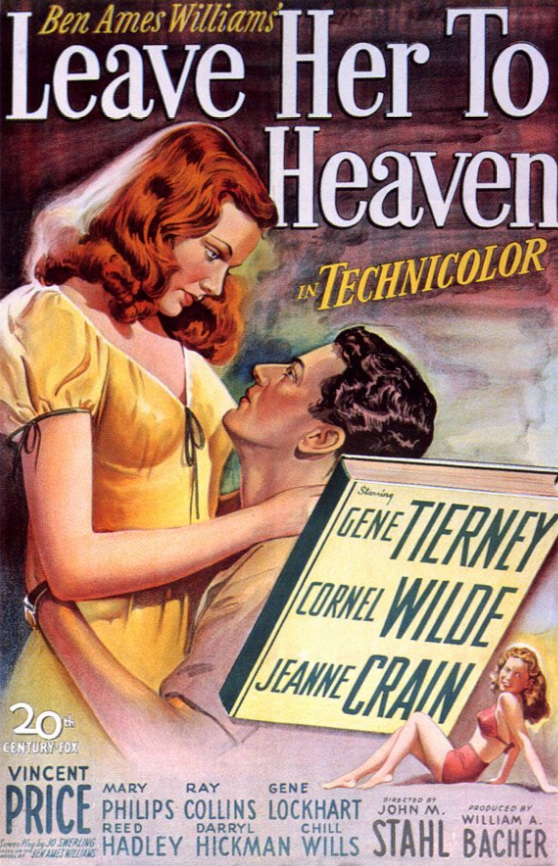
Leave Her to Heaven (Dec. 19, 1945)

Can there be such a thing as a film noir in color? I don’t think there can, but the term noir has been so widely used, popularized, and bastardized that director John M. Stahl’s Technicolor adaptation of Ben Ames Williams’s novel Leave Her to Heaven, made during the heyday of noir in Hollywood, is often referred to as a rare instance of a film noir in color.

A year after she starred as the eponymous Laura (Otto Preminger’s 1944 classic that is also frequently referred to as a noir even though it really has very few characteristics of one, aside from being filmed in black and white), Gene Tierney created a memorably unhinged character named Ellen Berent.

When we first meet Ellen, the first thing we see is her beauty. Sitting across from novelist Richard Harland (Cornel Wilde) in the lounge car of a train, surrounded by green walls, her dark hair and pale face offset by her bright red lips, she looks like a porcelain doll come to life. Quickly, however, we notice something else. The way she is staring at him is predatory. The way she doesn’t speak for a long time after he answers a question is strange. She is beautiful, but there is something wrong with her. We can guess, however, that his relationship with Ellen won’t have a happy ending.

If only Richard saw what the audience can see. Of course, the audience also has the advantage of a framing device. In the first scene of Leave Her to Heaven, we see Richard return to Deer Lake, Maine. His friends and neighbors look at him strangely. As they whisper among themselves, we learn that he has just gotten out of prison after a two-year stint, but we don’t know what the charge was.

Most of the story is told in flashback. Beginning with the scene on the train, we see how Richard fell into Ellen’s clutches. After they disembark, they find that they are both guests at Rancho Jacinto, in New Mexico, where Ellen has gone to scatter her father’s ashes. After telling Richard several times how much he looks like her father (even though a framed photograph of the man looks nothing like Cornel Wilde), the scene in which the stone-faced Tierney rides a horse and scatters her father’s ashes in the mountains is one of the most striking in the picture. When Richard agrees to marry her soon after, it is at her urging. Marrying her is something he thinks he wants, but the words “Will you marry me” never escape his lips. He is caught in her web.

After their marriage, Ellen and Richard go away to his cabin in Maine. She resents the intrusion of anyone else into their lives, such as her sister Ruth (Jeanne Crain) or Richard’s younger brother Danny (Darryl Hickman), who is recovering from polio, and her resentment has deadly consequences.

Ellen is devious, but it’s not always clear how conscious she is of her own cunning. Although the other characters speak of how unnaturally close she was to her father, and how she loves with a childish ferocity that can be dangerous, the viewer is not privy to any deeper psychological insights. There are no scenes of her childhood or flashbacks to any trauma that might have precipitated her madness. It’s refreshing to have a character with sociopathic tendencies that have no pat explanation, but some insight into the jealousy that drives her might have helped flesh out the character.

So what is it that makes Leave Her to Heaven a film noir? The classification is a slippery one, and has become popular enough that nearly every black and white film from the ’40s that is not a musical or a comedy has been called a film noir at some point. In one of the first treatises on the subject, the 1955 book Panorama du film noir américain 1941–1953, French film critics Raymond Borde and Etienne Chaumeton identified the five main facets of film noir. They said that it is “oneiric, strange, erotic, ambivalent, and cruel.” Over the years, the term film noir has grown to encompass certain stylistic elements as well. Stark black and white cinematography and unbalanced constructions that grew out of German Expressionism are both hallmarks of noir, as is a pervading sense of doom.

So does Leave Her to Heaven contain any of these elements? It certainly could be called “strange,” but it’s not particularly dreamlike. It’s not very erotic, either, since Ellen seems to capture Richard in a web that is more psychological than it is sexual. Her actions are sometimes cruel, but the picture as a whole is not terribly ambivalent. Ellen may arouse feelings of both pity and hatred in the viewer, but she is still presented in a straightforward way. She has no crises of conscience or confusion about what she wants. And the lush Technicolor cinematography really pushes Leave Her to Heaven out of the noir category.

Leave Her to Heaven is a melodrama with a couple of shocking scenes, a sociopathic main character, and a courtroom denouement that drags down the pacing of the picture, but which does feature an enjoyable performance by Vincent Price as one of Ellen’s old flames who is now a prosecutor. It is not a film noir, unless we can divorce style from content. The absence of black and white cinematography and a real sense of doom (or a truly unhappy ending) means that Leave Her to Heaven just doesn’t qualify as a film noir. Of course, this shouldn’t stop anyone from seeing it. Whatever its genre, it’s an effective film with an interesting performance by a beautiful actress who didn’t exhibit a great deal of range in any of her roles, but who is chilling in this one.

Leave Her to Heaven was Twentieth Century-Fox’s highest grossing picture of the 1940s. Tierney was nominated for an Academy Award for best actress, and Leon Shamroy won an Oscar for best cinematography in the color category.

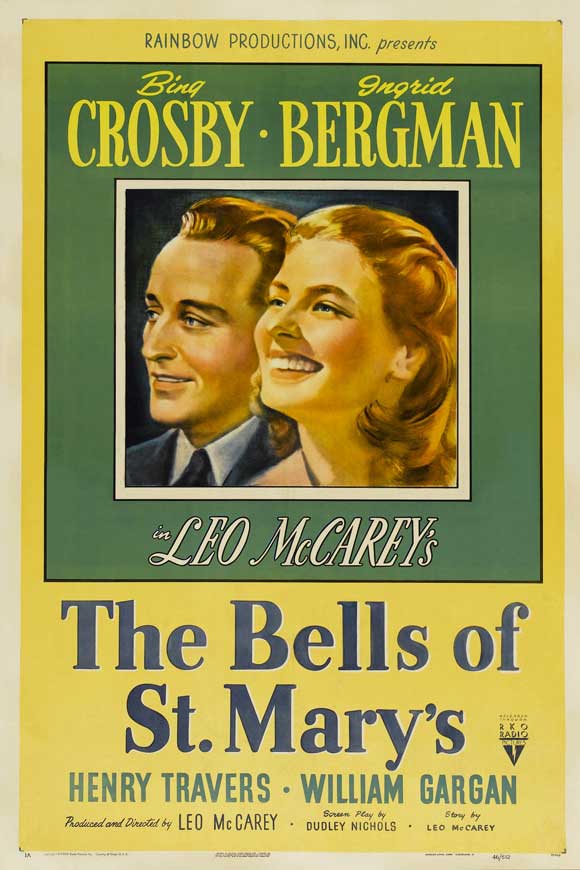
The Bells of St. Mary’s (Dec. 6, 1945)

The Bells of St. Mary’s, Leo McCarey’s follow-up to his smash hit Going My Way (which won the Academy Award for best picture of 1944), premiered in New York City on December 6, 1945. It was one of the first really “respectable” sequels, and, like Going My Way, was nominated for Oscars in all the big categories; best picture, director, actor, and actress. (Billy Wilder’s The Lost Weekend ended up taking home the awards for best picture, director, and actor, and Joan Crawford won the best actress award for Mildred Pierce.)

In The Bells of St. Mary’s, Bing Crosby reprises the role of Father O’Malley, for which he won an Academy Award for best actor of 1944, and he is joined by Ingrid Bergman, the best actress winner of 1944 (for Gaslight). The talent pool might be heavy, but the film itself is pretty light. There’s a disease, but it’s not fatal; there’s a bunch of needy kids running around, but the word “orphan” is never heard; and the sisters are in danger of losing St. Mary’s, but keep your fingers crossed for a Christmas miracle.

Like a lot of sequels, The Bells of St. Mary’s sticks with the formula of its predecessor. Father O’Malley is still the new guy in town, he’s still freewheeling and freethinking, and he butts heads with the other members of the clergy. His foil in Going My Way was Barry Fitzgerald as a crotchety old Irish priest, and in The Bells of St. Mary’s it’s the luminous Ingrid Bergman as Sister Benedict, a nun who was born in Sweden and raised in Minnesota. Bergman projects equal parts wisdom and naivete, and her performance is beatific enough, at least on the surface, to make up for what the role lacks in substance. The scene in which she masters the techniques of boxing by reading a book and then teaches the sweet science to a young boy who is being bullied is both funny and touching.

Crosby builds on his characterization of Father O’Malley. He’s a little older and wiser than he was in Going My Way, but not much else has changed. He’s still a “modern” thinker. He’s still a magnet for young girls in trouble, and if someone has a problem that can be solved with a song, he’s still happy to sit down at a piano and lend his golden pipes to the situation. Crosby will never be mistaken for Laurence Olivier, but he’s believable and charismatic in this picture. Enough so that he can deliver lines like, “If you’re ever in trouble, just dial ‘O’ … for O’Malley,” and not automatically trigger the viewer’s gag reflex.

The world of The Bells of St. Mary’s is much like our own, but the problems in it are solved with broad strokes and last-minute changes of heart instead of time and hard work. All it takes to mend a broken family is simply locating the wayward father, and getting a new parish is no harder than praying for it (and cajoling an old millionaire to donate his latest high-rise condominium).

Going My Way and The Bells of St. Mary’s are both holiday classics, even though neither focuses too much on Christmas. There’s a cute scene in The Bells of St. Mary’s in which some very small children stumble and improvise their way through a rehearsal of a Christmas pageant, but that’s about it. Oh, and a year later, astute viewers will be able to spot The Bells of St. Mary’s on the marquee of the local movie house in Bedford Falls when Jimmy Stewart runs through downtown wishing everyone and everything a Merry Christmas at the end of It’s a Wonderful Life.

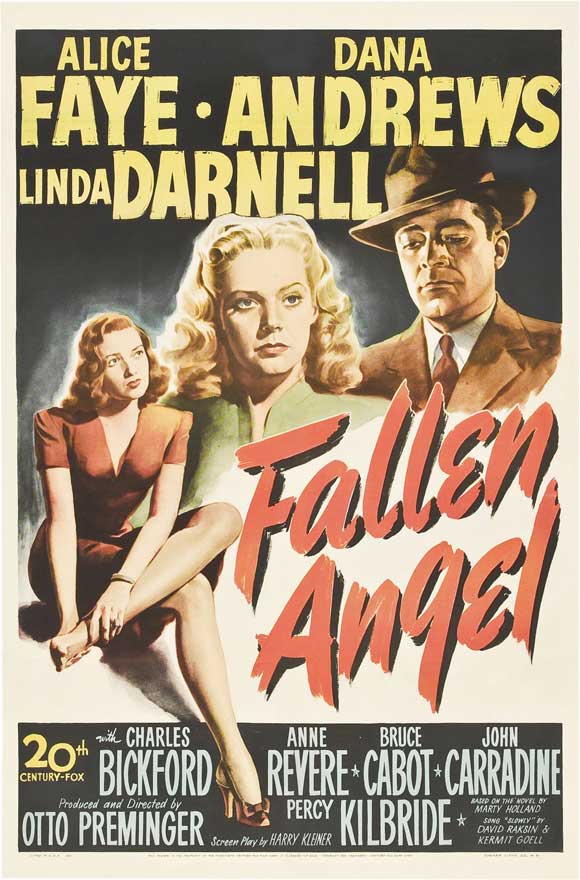
Fallen Angel (Dec. 5, 1945)

Fallen Angel, Otto Preminger’s follow-up to his smash hit Laura (1944), was slapped around by critics and passed over by audiences, but it’s not a bad film. It’s just not involving or memorable in the ways Laura was, and it’s composed of a bunch of elements that never really coalesce.

Fallen Angel reunited Preminger with the star of his previous film, Dana Andrews, and a lot of my enjoyment in the film came from watching Andrews. He’s more of a focal point in Fallen Angel than he was in Laura, and he dominates every scene he’s in. Andrews was 5’10”, but he looks well over six feet in this picture. He’s rough-looking but charming, and imposing and tough without being wooden. At the same time, he projects bitterness and alienation, barely concealed behind a handsome mask. In short, he’s the embodiment of American post-war masculinity. Andrews’s co-stars are all good as well. And I can’t fault Preminger’s direction. The film looks great, and taken one scene at a time, it’s very good.

Where Fallen Angel failed to engage me was in its pacing and storytelling. I haven’t read the Marty Holland novel the film is based on, but Fallen Angel plays like an adaptation of a sprawling book in which each section of the plot is dutifully reenacted, as opposed to a terse adaptation in which unnecessary subplots and themes are jettisoned. When drifter Eric Stanton (Andrews) is thrown off a bus in the small town of Walton, California, because he doesn’t have the $2.25 fare necessary to continue on to San Francisco, he stops in at a place called Pop’s Café. In the first few minutes of the film we’re introduced to all the major players; the phony spiritualist Professor Madley (John Carradine), whom Stanton used to shill for, hard-boiled ex-New York police detective Mark Judd (Charles Bickford), cafe owner Pop (Percy Kilbride), June Mills (Alice Faye), June’s spinster sister Clara (Anne Revere), and Pop’s pouting, sexy waitress Stella (Linda Darnell), whom every man in town seems to be obsessed with (and it’s not hard to see why).

The beginning doesn’t seem rushed, however, or as though too much information is being packed in. A lot of this can be credited to Preminger’s cinematographer, Joseph LaShelle, who also worked with Preminger on Laura, and whose fluid tracking shots and crisp black and white cinematography are both a joy to watch. Eventually, however, the way certain characters dropped out of the picture left me feeling suspended. The grifting medium and his relationship with Stanton could have filled an entire picture (although I admit being partial to John Carradine), but he leaves town before too much time has passed. Later, when Stella is murdered, it happens off screen, and just as I felt her relationship with Stanton was starting to get juicy. His romance with June and Stella could have formed the classic “good girl/bad girl” film noir tension, but his romance with June doesn’t really get started until Stella’s ticket has been punched, and once that happens, Fallen Angel becomes more of a melodrama than a noir. It’s also a mystery, since we don’t know who killed Stella, but this aspect of the film doesn’t come to much, as the second half focuses more on Stanton’s courtship of the sheltered, naïve June, and the question of whether or not he really loves her or is just out to fleece her. Meanwhile, most viewers will have the number of suspects in Stella’s murder narrowed down to two suspects, neither of whom is a more interesting culprit than the other.

I’m probably making Fallen Angel sound worse than it is. Many modern viewers consider it a lost classic of film noir, or just a really great film that has been overlooked. It’s worth seeing, especially if you’re a fan of Preminger or any of the principal actors. I found it disappointing, but that might change years from now with a second viewing.

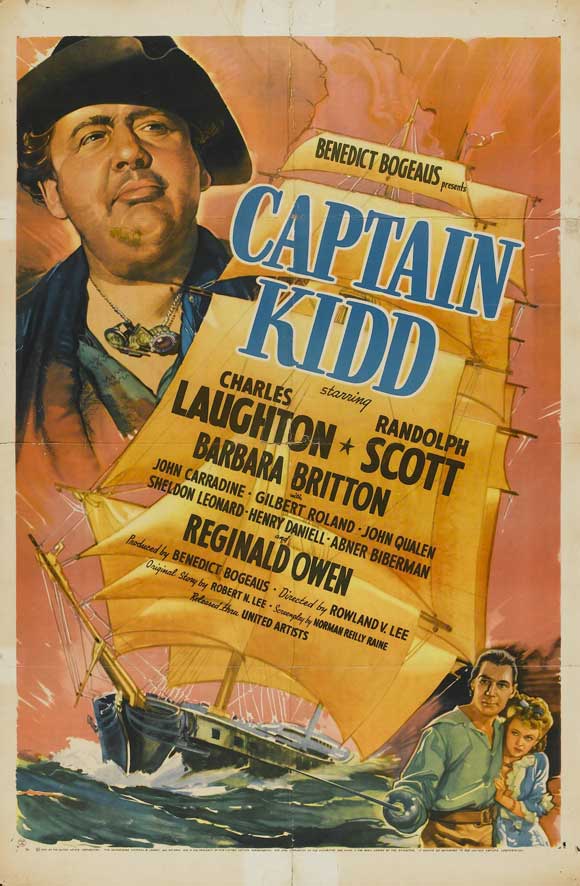
Captain Kidd (Nov. 22, 1945)

Released on Thanksgiving day in 1945, director Rowland V. Lee’s Captain Kidd is a pretty good swashbuckler, even though it’s not exactly a history lesson.

The real William Kidd was hanged for piracy in 1701, but there is still debate about the extent of his crimes on the high seas, and whether or not he should even be considered a pirate, as opposed to a privateer; someone employed by a nation to attack foreign shipping during time of war. But no matter how unjust his execution might have been, the name “Captain Kidd” and rumors of his buried treasure have passed into pirate legend along with names like Blackbeard and Calico Jack.

The film’s prologue shows the “ruthless” (according to the narrator) Captain William Kidd (Charles Laughton) and his pirate crew reduce the English galleon The Twelve Apostles to a smoking ruin near Madagascar and sneak off to a cove to bury their booty before high tide. His band of cutthroats includes B-movie stalwarts John Carradine and Gilbert Roland (playing characters named Orange Povey and José Lorenzo, respectively). When there is a dispute over the spoils, Kidd shoots one of his crew and buries him with the treasure. The impromptu eulogy he says over the grave is a masterpiece of irony.

The action moves forward to London, 1699. Kidd is receiving instructions on how to be a gentleman from a man named Shadwell (Reginald Owen), such as “A gentleman never sucks his teeth” and “A gentleman never pays his domestics high wages.” Kidd’s lust for gold is clearly matched by his lust for power. When he is granted an audience with King William III (Henry Daniell), he convinces the king that he is the right man to sail to India and give a treasure-laden ship called the Quedagh Merchant safe passage through the pirate-infested waters of Madagascar. In exchange he wants a castle and the title of a lord.

William III in this movie is pretty easily manipulated, because he also agrees to Kidd’s insane demand that he be given a crew of condemned pirates. Kidd claims the irreedeemable brigands will be loyal as long as they know a royal pardon awaits them at the completion of a successful mission. Along with some of his old mates from Newgate Prison, Kidd frees a wild card; a tall, well-spoken man named Adam Mercy (Randolph Scott), who was the master gunner to another pirate, Captain Avery. Mercy’s motives are mysterious, but it should come as no surprise to the audience when the stalwart and handsome Scott steps into the role of protagonist.

Scott is best known for his many roles in westerns. His physical appearance and his acting style were the Platonic ideal of a western hero, but he makes a decent swashbuckler, too. Scott doesn’t try too hard to hide his American accent in this movie, but he has a patrician bearing that makes up for it, and the scene in which he locks swords with Roland (who went on to play the Cisco Kid in a number of pictures) is exciting and masterfully directed. And the fact that he does it to protect Lady Anne Dunstan (Barbara Britton) from Roland’s unwanted advances should delight people who like to read into a scene’s Freudian undertones. (Scott and Roland are the two most virile men on the ship, and as they sword fight, the camera keeps cutting back to Britton, who gasps at each clash of steel on steel.)

Laughton and Scott were the same age, but they might as well have been from different species. While Scott was heroic and laconic, Laughton was a grotesque, blubbery-lipped character actor, and much of the pleasure in watching this film comes from his fantastic performance. No one else can deliver a line like, “Of all the slummocky blackguards!” and sound genuinely appalled while at the same time disgusting the viewer with his own loathsomeness.

The Lost Weekend (Nov. 16, 1945)

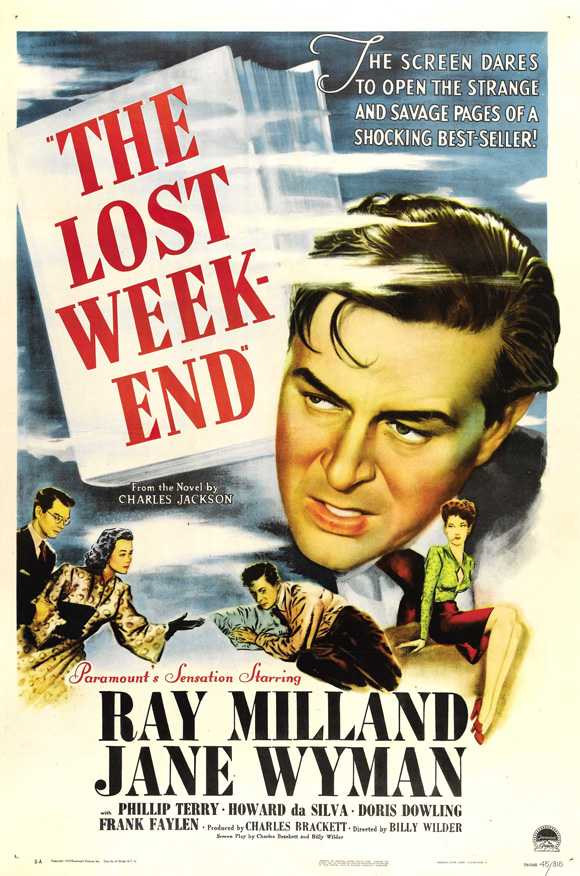
In the decades since Billy Wilder made The Lost Weekend, an entire vocabulary about alcoholism has entered the national consciousness through self-help books, 12-step programs, and daytime talk shows, such as “codependency,” “enabler,” “denial,” “intervention,” “addiction,” “recovery,” and “relapse.” None of these terms are heard in The Lost Weekend, but the film depicts the concepts they represent with grim thoroughness. (At the time of the film’s release, even the widespread understanding of the term “alcoholic” was fairly new, since Alcoholics Anonymous was founded in 1935.)

Don Birnam (Ray Milland) is a handsome, intelligent, and charming man who shares an apartment in Manhattan with his brother Wick (Phillip Terry). After receiving praise for his short stories during his time at Cornell University, Don dropped out before graduation and moved to New York to pursue his dreams of becoming a famous and respected author. Now in his 30s, Don has finished nothing and published nothing in all his time in New York. He has no money and no prospects. He survives on handouts from his brother, and he is an alcoholic.

As the film begins, he has supposedly abstained from drinking for several weeks, and is packing for a long weekend in the country with Wick. What his brother and his long-suffering girlfriend, Helen St. James (Jane Wyman), don’t know is that he has a bottle of cheap rye cleverly hidden. It’s hanging out his bedroom window on a string. Wick and Helen are optimistic about Don’s progress, but like so many people who love alcoholics, they are deluding themselves. Although perhaps only partly. When Helen says, “You’re trying not to drink, and I’m trying not to love you,” it encapsulates years of sadness and betrayal. In preparation for the getaway, Helen brings Don a care package with a new James Thurber novel, two Agatha Christie books, cigarettes, and chewing gum. Don is irritable and evasive, however. When Wick talks about looking forward to apple cider in the country, Don snaps, “Why this emphasis on liquids? Very dull liquids?” Wick eventually discovers the bottle of rye hanging out the window and pours it out. Don weasels out of the situation by claiming it was something he hid weeks ago, during a binge, and forget about. He then convinces Wick and Helen to go to the symphony without him, telling them he just needs a few hours to clear his head before they catch their train.

His denials and his lies are classic alcoholic behavior, and it comes as no surprise when, as soon as they leave, he turns over the apartment looking for money and anyplace he might have hidden liquor and forgotten about. He finds $10 intended for the cleaning lady and goes to the liquor store to buy two bottles of rye. The proprietor (Eddie Laughton) initially refuses to sell them to him, but it doesn’t take long for him to cave in.

“Your brother was in,” he says. “He said he’s not gonna pay for you anymore. That was the last time.”
“Two bottles of rye!” Don says, showing his money.
“What brand?”
“You know what brand, Mr. Brophy, the cheapest. None of that twelve-year-old aged-in-the-wood chichi. Not for me. Liquor’s all one anyway.”
“You want a bag?”
“Yes I want a bag.”
“Your brother said not to sell you anything even if you did have the money to pay for it, but I can’t stop anybody, can I? Not unless you’re a minor.”
“I’m not a minor, Mr. Brophy. And just to ease your conscience, I’m buying this to refill my cigarette lighter.”

Milland’s performance as an alcoholic is masterful. Before The Lost Weekend drunks in Hollywood movies were all bums on skid row or comical, hiccupping buffoons who saw pink elephants. No matter how drunk Birnam gets, he never slurs his words. He simply becomes more grandiose and irrational, and more desperate to keep drinking. After he hides his booze at home, he stops in at Nat’s Bar for a few shots before the weekend. After Nat (Howard Da Silva) pours him his first glass of rye, he moves to wipe up the bar.

“Don’t wipe it away, Nat,” he says. “Let me have my little vicious circle. You know, the circle is the perfect geometric figure. No end, no beginning. What time is it?”
“Quarter of four.”
“Good! We have the whole afternoon together. Will you let me know when it’s a quarter of six? It’s very important. I’m going to the country for a weekend with my brother.”

Don then delivers a monologue about his plan to smuggle rye on his weekend. He plans to hide one bottle in a copy of The Saturday Evening Post, so his brother can discover it, which will set his mind at ease. The other will be hidden in his brother’s luggage, and Don will retrieve it and hide it in an old apple tree. He doesn’t need it, he says, he just needs to know that it’s there if he needs it. When the scene ends, Don lifts a glass to his lips, and the camera shows that there are five “vicious circles” in front of him; five rings of booze on the surface of the bar.

Back at home, Wick and Helen give up on waiting for Don to arrive, and Wick leaves without him. Helen pleads with him and defends Don. “He’s a sick person,” she says. “It’s as though there were something wrong with his heart or his lungs. You wouldn’t walk out on him if he had an attack. He needs our help!” But both of them–the two people in the world who really care about Don–are at the ends of their ropes.

The rest of the film alternates between Don’s nightmarish bender that eventually finds him in the alcoholic ward of a hospital with no memory of how he got there, and flashbacks to his corrosive relationships with Helen and his brother. We see Wick make excuses for Don and even lie for him, and we see Helen fall in love with Don, lie to herself about the depth of his problem, and struggle to help him. “But there must be a reason you drink, Don,” she says. “The right doctor could find it!” “The reason is me,” he responds. “What I am. Or rather, What I’m not. What I wanted to become, and didn’t.”

Wilder does not depict Don’s descent into delirium in a purely subjective fashion, but there are a lot of brilliant little moments in the film that put us inside Don’s head. The extreme close-up on Don’s eye as it slowly opens while a phone rings in the background will strike a chord with anyone who’s ever had a crippling hangover, and Miklós Rózsa’s brilliant score, which incorporates haunting melodies played on a Theremin, mirrors Don’s altered mental states. The Theremin would become ubiquitous in science fiction films in the ’50s, but in 1945, most Americans had never heard the instrument before, and it must have sounded incredibly eerie. The rubber bat that Don imagines he sees in his apartment is less effective, however.

But The Lost Weekend is still a brilliant film, and remains one of the most honest portrayals of addiction ever put on film. When I first saw it years ago, I thought it had a happy ending. Watching it now, I’m not so sure. Don’s promise to stop drinking and finish his novel could just be one more lie; one that the audience itself wants to believe because the alternative is unbearable, that Don’s life is the vicious circle he referred to in Nat’s Bar, and that there is no hope for him. After all, Charles R. Jackson, whose semi-autobiographical novel was the basis for this film, did eventually commit suicide.

Paramount Pictures was initially reluctant to release The Lost Weekend. They were encouraged to bury it not only by the liquor industry, but also by temperance groups who felt the film would only encourage drinking. Critics loved it in limited release, however, so Paramount released it in theaters nationwide, and it went on to win numerous awards. The Lost Weekend is the only film to win both the Academy Award for Best Picture and the Cannes Film Festival Grand Prix du Festival International Film. Milland won the Academy Award for Best Actor, Charles Brackett and Wilder won the Academy Award for Best Screenplay, and Wilder won the Academy Award for Best Director.
I Know Where I’m Going (Nov. 16, 1945)

Michael Powell and Emeric Pressburger, the talented pair of writers, producers, and directors whose early collaborations included One of Our Aircraft Is Missing (1942), The Life and Death of Colonel Blimp (1943), and A Canterbury Tale (1944), worked together under the name “The Archers” throughout the 1940s and 1950s, and produced some of the most enduring films in British history. Powell was a native-born Englishman. Pressburger was a Hungarian Jew who found refuge in London and who prided himself on being “more English than the English.”

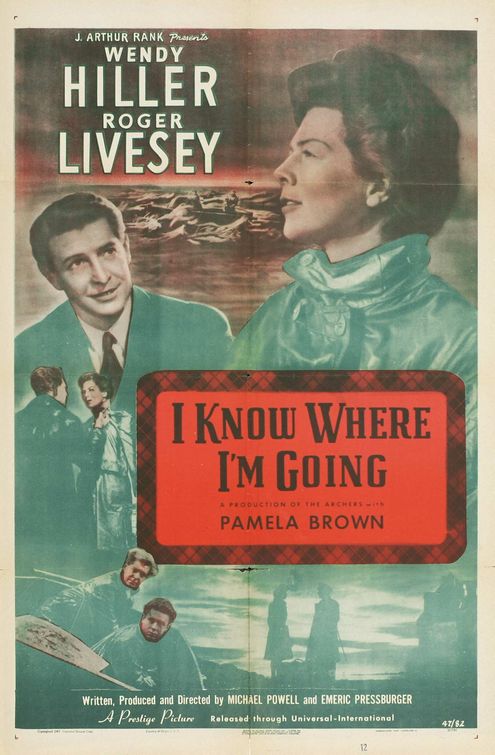
I Know Where I’m Going, which premiered in London on November 16, 1945, is a warm, romantic drama. The film stars Wendy Hiller as Joan Webster, a stubborn young woman who, according the narrator, “always knew where she was going.” After a montage that shows Joan’s growth from headstrong toddler to headstrong teenager to headstrong 25-year-old, we see her dressed in smart clothes, meeting her father (played by George Carney) at a nightclub, where she blithely informs him that she plans to travel to Kiloran island in Scotland to marry Sir Robert Bellinger, a wealthy, middle-aged industrialist whom she has never met. Her father is aghast, but, as always, Joan knows exactly where she’s going and what she’s doing.

Handled differently, this setup could lead to a grim, Victorian melodrama, but I Know Where I’m Going is a playful film with touches of magical realism. On her trek to the Hebrides, Powell and Pressburger delight in each leg of her long journey (and there are many), and pepper the montage with fanciful touches, such as a map with hills made of tartan plaid, a dream sequence in which Joan’s father marries her to the chemical company owned by Bellinger (literally), and an old man’s top hat that becomes the whistling chimney of a steam engine.

On the last leg of her journey, she is forced to put up in the Isle of Mull, as weather conditions do not permit water travel to Kiloran. Joan stays in touch with Bellinger, who is never seen, only heard (as a stuffy voice on the other end of a telephone). While cooling her heels in Mull, Joan meets a charming, soft-spoken serviceman named Torquil MacNeil, who is on an eight-day leave. (Torquil is played by Roger Livesey, in a role originally intended for James Mason.)

The joke implicit in the title becomes more and more clear as Joan and Torquil begin to fall for each other. The closer they become, the more determined she is to reach Kiloran. Eventually willing to risk life and limb to get there, it becomes clear that at least when it comes to love, she has no idea where she is going, and is too hard-headed to see anything clearly.

Livesey, who was in his late thirties when this film was made, was originally told that he was too old and too heavy to play the role of the 33-year-old Torquil, but he very quickly slimmed down to get the part, and he cuts a dashing figure, although not a classically handsome one. Interestingly, Livesey never set foot in the Western Isles of Scotland, where most of the film’s exteriors were shot. He was starring in a play in the West End during filming, so Powell and Pressburger made clever use of a body double for long shots, and filmed all of Livesey’s interior scenes at Denham Studios, in England.

Besides its fine performances and its involving love story, I Know Where I’m Going is enjoyable to watch simply because Powell and Pressburger show such incredible attention to detail. The interiors may be shot on a soundstage, but it’s easy to forget that with effects that perfectly marry them to the location footage, such as rain lashing the windows, subtle lighting, and the shadows of tree branches moving back and forth on the walls of the houses and cottages on the island. There are no short cuts or cut corners in this film. Joan’s dreams don’t appear in a cloud of dry ice or in soft focus, they swirl kaleidoscopically around her head. And elements that might seem silly in another film, such as an ancient curse hanging over Torquil’s head, seem palpably real when they’re embodied by shadowy, decrepit, and glorious real-world locations like Moy Castle.

Mildred Pierce (Oct. 20, 1945)

Mildred_PierceIf you’ve only seen the film adaptation of James M. Cain’s 1941 novel Mildred Pierce, you’re forgiven for never wondering whether the striking murder set piece that opens the film and informs the entire picture was an invention of the producer and the screenwriters that never occurred in the novel.
It was. But it’s a brilliant invention. Even though long stretches of Mildred Pierce (told in flashback) are essentially melodrama, the sequence that opens the film is one of the greatest examples of film noir I’ve ever seen. It is nighttime. Heavy shadows fall over caddish playboy Monte Beragon (Zachary Scott), resplendent in a tuxedo, as he is gunned down in a Malibu beach house. Not every shot hits him. A few smash into the mirror behind him. But enough hit him to kill him, and he falls to the floor. Mildred Pierce (Joan Crawford) flees from the house, walks down the boardwalk, and looks as though she is contemplating suicide by jumping into the Pacific Ocean, but is stopped by a policeman. She talks her way out of the situation and later entices the beefy and amorous Wally Fay (Jack Carson) back to the house on the beach and locks him in, with the intention of pinning the murder on him. The scenes in which Wally realizes Mildred has left him alone in a locked house with a corpse and a revolver and he attempts to escape are stunning, and are one of the greatest noir sequences in film history.

Unlike Billy Wilder’s Double Indemnity (1944), another noir classic adapted from a novel by Cain, Michael Curtiz’s Mildred Pierce takes a lot of liberties with its source material. This is partly due to necessity. I loved Cain’s novel, and found it every bit as good as his 1934 crime classic The Postman Always Twice and more believable than his 1937 novel Serenade, which is about a male opera singer who loses his voice after he gives in to homosexual temptation. Cain’s Mildred Pierce contains no murders, just plenty of bad behavior, and the most despicable character waltzes off at the end with no punishment in sight. Apparently the moral tone of the novel was troubling to the Breen Office, so producer Jerry Wald devised a murder plot with a culprit who could be punished, which sufficiently palliated the concerns of producer and studio head Jack L. Warner, and he purchased the rights to the novel in 1944. The script for the film went through eight different versions before Ranald MacDougall’s version was accepted. William Faulkner and Catherine Turney both made uncredited contributions. (And we can all thank our lucky stars that Faulkner’s scene in which Mildred’s maid, played by Butterfly McQueen, consoled Mildred while singing a gospel song was either never filmed or was left on the cutting room floor.)

Mildred Pierce is a fantastic film. Crawford’s longtime nemesis Bette Davis and fellow fading star Rosalind Russell were both considered for the lead role, but both turned it down. It’s impossible for me to imagine anyone but Crawford playing Mildred Pierce. She brings not only her finely controlled histrionics to the role, but her own life history as a woman who crawled up from nothing.

When the picture opened, it was a huge hit, both with critics and audiences. It was nominated for best picture, best actress, best supporting actress (for Eve Arden, who plays Mildred’s wisecracking best friend), best writing, and best black and white cinematography. Joan Crawford won the Academy Award for best actress, and accepted the statuette at home, where she was sick in bed. (Her adopted daughter Christina claims she was faking, but this is hardly the worst accusation she has lobbed at her mother.)

Strange Confession (Oct. 5, 1945)

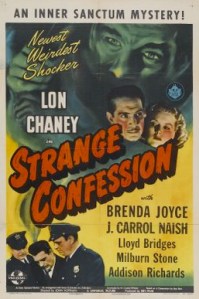
StrangeConfessionApparently populist rage against pharmaceutical giants is nothing new. In Strange Confession, the fifth of six “Inner Sanctum Mysteries” produced by Universal Pictures and released from 1943 to 1945, Lon Chaney, Jr. plays a brilliant chemist named Jeff Carter whose life goes from bad to worse when he twice accepts employment from the unscrupulous owner of the largest medical distributing company in an unnamed American city.
Strange Confession is more of a straight drama than the other films in the Inner Sanctum series. Except for its gruesome finale, it’s free of the Gothic overtones and murderous double-crosses found in the rest of the series. The opening few minutes are gripping, with Jeff clutching a bag in his hand and skulking through the shadowy nighttime city streets, deliberately avoiding a police officer. It’s a very noir beginning, right down to the story structure. Jeff arrives at the home of an old school chum named Mr. Brandon (Wilton Graff) and sits down to confess something horrible. He opens the bag and shows Brandon what’s inside. Brandon recoils, but the camera doesn’t reveal the bag’s contents.

Jeff recalls better days. He once had a well-paying job, a pretty wife named Mary (Brenda Joyce), and a baby boy named Tommy (Gregory Muradian). Unfortunately, his employer, Mr. Graham (J. Carrol Naish) exploited his talents and treated him poorly. He even had Jeff hard at work on Christmas Eve, composing an acceptance speech for him in which he took full credit for Jeff’s accomplishments in the lab. Jeff quit his job and worked for a small pharmacy, forced to labor on his chemistry experiments after hours in his bathroom. He was poor, but happy. But this wasn’t enough for his wife, who wanted better things in life, so a year later, Jeff went back to work for Mr. Graham. Jeff, his wife, and little Tommy started living the good life, with a house in the suburbs and an Irish housekeeper named Mrs. O’Connor (Mary Gordon).

Unfortunately, Graham, in addition to being a bad boss, was a cad. He had designs on Mary, and sent Jeff and his affable assistant Dave (Lloyd Bridges) deep into South America to work on a flu cure called “Zymurgine.” While Jeff and Dave were hard at work testing and perfecting the formula for the drug, Graham romanced Mary, who naïvely saw him as just a friend, taking her out to dinners and shows. Worse, he rushed Zymurgine into the market before Jeff’s fully tested formula was even ready to be shipped back to the United States. In a prescient moment, Graham tells his coterie of underlings, “You can sell almost anything if you advertise it enough.”

Ill-gotten profits trump integrity, and the whole thing comes full circle, personally affecting the principal characters and leading to a bloody conclusion. Strange Confession is quite a good one-hour B picture. Chaney’s performance is better than usual, and Naish is a smooth, oily antagonist. He’s well cast, too. With his hangdog features, black hair, and pencil-thin mustache he looks like a shorter version of Chaney, making him the perfect doppelgänger villain.

Les Dames du Bois de Boulogne (Sept. 21, 1945)

LesdamesduboisdeboulogneFrench film director Robert Bresson is famous for his use of non-professional actors. Prior to watching Les Dames du Bois de Boulogne, I had only seen one Bresson film, Pickpocket (1959), whose protagonist was most certainly not a professional actor. He shambled through the proceedings like a man on a heavy dose of tranquilizers, his movements slow, his eyes haunted. It was an interesting film, and one I may watch again some day, but it didn’t move me.

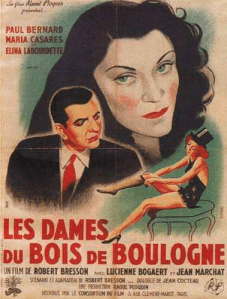
It wasn’t always this way. Les Dames du Bois de Boulogne, Bresson’s second film, features a cast of professional actors, and is based on a short novel by Denis Diderot with dialogue written by Jean Cocteau. The result is a polished and romantic film that completely engrossed me.

María Casares plays a haughty member of high society named Hélène who has long had a loosely defined relationship with a handsome gentleman named Jean (Paul Bernard). They may have other dalliances, but they are committed to each other, more or less. As the film begins, Hélène is on a date at the opera with a gentleman friend named Jacques (Jean Marchat), who warns her that Jean’s passion for her is cooling. When Jean later shows up at Hélène’s apartment, apologizing for having forgotten her birthday, Hélène tells him she would prefer they end their romance and become simply friends. She says this merely as a ploy, and she is devastated when he tells her he feels the same way, and leaves her apartment unperturbed by the momentous decision to end their affair. Left alone, she vows revenge.

The power of the film comes from Bresson’s ability to depict the emotions that rage behind placid exteriors. He is aided by Casares, whose performance is truly astounding. Without ever raising her voice or engaging in histrionics, she plays the “scorned woman” to the hilt. She is fascinating to watch, and sometimes even frightening. Part of the fascination comes from the fact that Jean and the young woman Hélène befriends, Agnès (Elina Labourdette), are unaware of how they are being manipulated by the cold Hélène. They are preoccupied with each other. More importantly, they are preoccupied with themselves, especially Agnès, who has a sordid past and doesn’t feel worthy of being loved by Jean. She hides her true self from him, but the longer she hides, the more devastating Hélène’s revenge will be.

Les Dames du Bois de Boulogne is a film about the redemptive power of love and the corrosive allure of vengeance. Many modern viewers may find the social mores on display in the film outdated, but if they look past the surface, they may find that the world hasn’t changed as much as they think it has. The lives of the Parisian leisure class may look and feel very different from the lives of most people who view the film today, but the story Bresson tells is timeless.