Tag Archives: RKO Radio Pictures

The Set-Up (March 29, 1949)

The Set-Up
The Set-Up (1949)
Directed by Robert Wise
RKO Radio Pictures

My favorite sports movies are all boxing movies. Body and Soul (1947), The Harder They Fall (1956), Rocky (1976), Rocky II (1979), Raging Bull (1980), When We Were Kings (1996). The list goes on and on.

I love watching boxing, which is one reason I love movies about it, but that’s not the only reason I love boxing movies.

Boxing is an individual sport that lends itself well to film drama. Most of the movies about team sports that I like are comedies — The Longest Yard (1974), Slap Shot (1977), Major League (1989). That’s not to say there aren’t good dramas about team sports. There are plenty, like Hoosiers (1986), Eight Men Out (1988), and Friday Night Lights (2004), but there’s something about one fighter facing another in the ring that makes for a great drama. And the brutality and widespread corruption of the boxing world makes for great film noirs.

The Set-Up is based on Joseph Moncure March’s long, narrative poem of the same name, which was written in 1928. (March’s other enduring work is the narrative poem The Wild Party, also written in 1928, which was republished in 1994 with illustrations by Art Spiegelman.)

March’s The Set-Up is a masterpiece of hard-boiled writing, and especially impressive considering that it’s written in verse.

Pansy had the stuff, but his skin was brown
And he never got a chance at the middleweight crown.

Mean as a panther,
Crafty as a fox,
He could hit like a mule,
And he knew how to box.
A dark-skinned jinx
With eyes like a lynx,
A heart like a lion,
And a face like the Sphinx:
Battered, flat, massive:
Grim,
Always impassive.

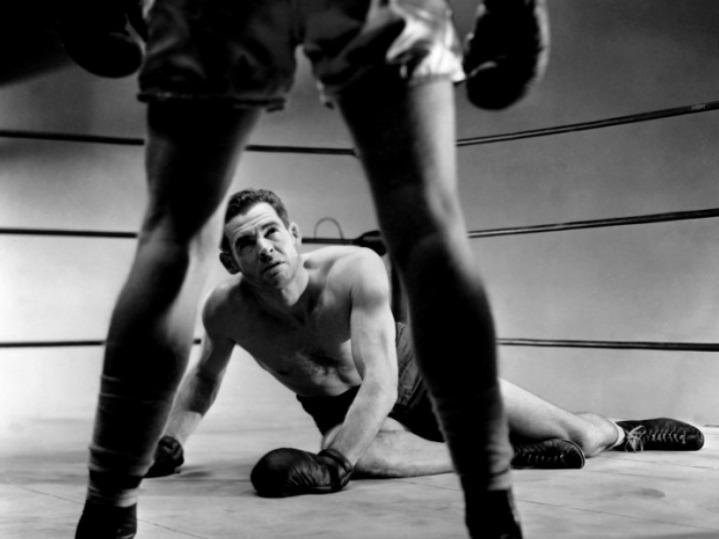
The film version is only loosely based on March’s poem. Significantly, it sidesteps the racial angle by casting a white actor, Robert Ryan, in the lead. It also renames its pugilist protagonist “Stoker.”
Robert Ryan

Judged solely on its own merits, however, The Set-Up is a great film. It’s one of the great noirs, as well as one of the best films about boxing ever made. It’s lean and mean — just 72 minutes long — and unfolds more or less in real time.

Bill “Stoker” Thompson (Ryan) is gearing up to face a 23-year-old opponent in the ring. Stoker is 35 years old, which in his business makes him an old man. (John Garfield’s character in Body and Soul was also facing his own mortality as a boxer at the age of 35.)

Stoker’s wife, Julie (Audrey Totter), wants him to retire. His days as a fully functioning human being are numbered if he keeps fighting for measly purses and absorbing massive amounts of punishment in the process.

Stoker tries to reassure her, but his eyes tell their own story a little later in the film as he watches a punchy fighter repeat himself for the dozenth time before leaving the locker room for his fight. Gus, a trainer played by Wallace Ford, shakes his head and says, “I guess you can only stop so many.”

The boxing milieu depicted in The Set-Up is exceptionally sleazy. The arena where Stoker faces his opponent, Tiger Nelson (Hal Fieberling), advertises “Boxing Wednesdays, Wrestling Fridays,” and is located in Paradise City, a low-rent strip of arcades, dance halls, and chop suey joints.

Worst of all, Stoker’s manager, Tiny (George Tobias), has arranged with local hoods for Stoker to take a dive without telling Stoker about his plan. He’s that certain his man will lose.

Robert Wise’s direction is tight and unpretentious. His cinematographer, Milton R. Krasner, lenses some of the most starkly beautiful black & white images ever captured on film. There’s a scene early in the film where Stoker walks across the street from his rented room toward the arena with his bag in his hand. He moves straight toward the camera, and he looks like the archetype of every lonely hero who has faced a tragic fate without blinking.

Robert Ryan is key to the film’s authenticity. The 6’4″ actor was on the boxing team at Dartmouth College and had a 5-0 win-loss record, with 3 KOs. He continued to box while serving in the Marine Corps.

The Set-Up is a brutal, violent film, but despite its real-time plot that uncoils with ruthless efficiency, there are still quiet and reflective moments, like the sequence in which Audrey Totter walks the streets of Paradise City through a gauntlet of drunks and mashers. She eventually winds up on a bridge over a highway and slowly rips up her ticket to the fight and watches the scraps float down as a streetcar rumbles by.

Robert Wise had a long and interesting career in Hollywood. While The Set-Up will never be a crowd-pleaser like West Side Story (1961) or a family favorite like The Sound of Music (1965), it’s still one of Wise’s best films, and one of the all-time great noirs.
A Woman’s Secret (March 5, 1949)

A Woman's Secret
A Woman’s Secret (1949)
Directed by Nicholas Ray
RKO Radio Pictures

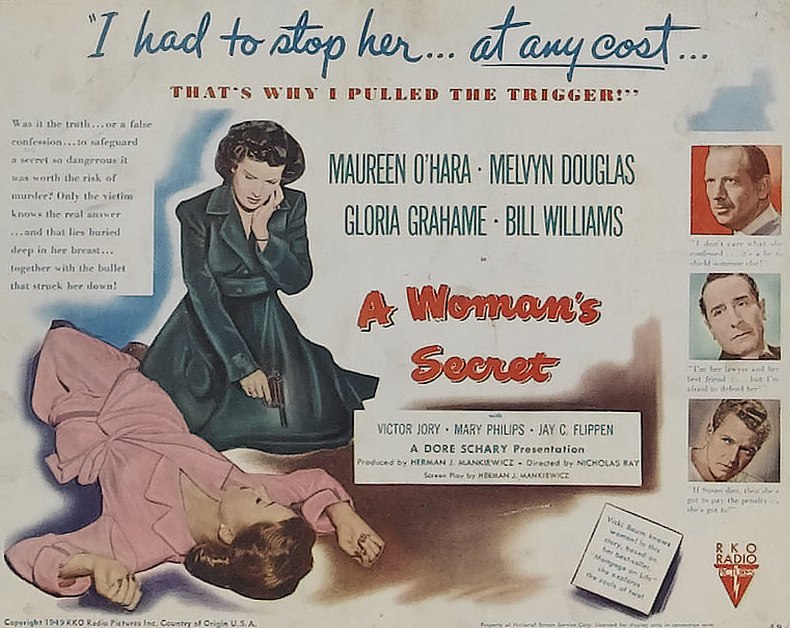
A Woman’s Secret is the third Nicholas Ray film I’ve reviewed on this blog, but it was the second film he directed.

Ray completed his first film, They Live by Night, in 1947, but RKO wasn’t sure how to market it. It premiered in the United Kingdom in a single theater on August 5, 1948.

The success of Ray’s third film, Knock on Any Door (1949), led to his first two films being released in the United States in 1949 by a newly confident RKO Radio Pictures.

Of his first three pictures, A Woman’s Secret is easily the weakest, and is significant mostly because it’s how Ray met his second wife, actress Gloria Grahame.

After shooting wrapped, the two were married in Las Vegas on June 1, 1948. It was the second marriage for both of them. (They had to live in Nevada for the required six weeks before Grahame could get her quickie divorce from actor Stanley Clements). Before they divorced in 1952, Grahame starred in one of Ray’s greatest films, In a Lonely Place (1950), which also starred Humphrey Bogart.

A Woman’s Secret was a contract job for Ray. The screenplay was adapted from Austrian writer Vicki Baum’s 1946 novel Verpfändetes Leben (Mortgage on Life) by the film’s producer, Herman J. Mankiewicz. Ray had no script input, so it’s easy to write it off as a studio-imposed footnote in Ray’s career.

Gloria Grahame

A Woman’s Secret is a “women’s picture” wrapped in a mystery. It’s no In a Lonely Place, but it’s worth watching at least once.

The central relationship in the film is the one between Marian Washburn (Maureen O’Hara) and her protégé, Susan Caldwell (Gloria Grahame). Marian is a singer who has lost her voice, and she’s completely shaped and guided Susan’s career, rechristening her “Estrellita.” One night, after the two argue bitterly, a shot rings out. Susan lies on the floor near death, a bullet lodged near her heart. Marian is holding the smoking gun, but this is a mystery picture, so don’t assume anything yet.

Most of the film’s plot unspools as a series of flashbacks as Susan lies in the hospital and the detective assigned to the case — Inspector Fowler (Jay C. Flippen) — tries to piece together the facts. He spends a good deal of time with composer and pianist Luke Jordan (Melvyn Douglas), who is Marian’s boyfriend. Fowler also gets plenty of help from his wife, Mrs. Fowler (Mary Philips), who’s running an investigation of her own.

There are a lot of interesting things going on in A Woman’s Secret, but nothing really jells. The film is too crowded with plot and characters for the central relationship between Marian and Susan to ever be fully explored. Melvyn Douglas and Jay C. Flippen are fine performers, and both inject their two-dimensional characters with enough life to make their scenes interesting. Philips gets a juicy role as Inspector Fowler’s wife, and her nosiness isn’t just played for laughs. She actually knows what she’s doing, much to her husband’s chagrin.

Most people who write about Ray’s career either gloss over or completely ignore this film. There’s not much about it that fits in with his obsessions and themes. But despite a studio-imposed script, there are interesting themes and tensions bubbling below the surface. Grahame’s role as Susan/Estrellita in particular feels at home in Ray’s oeuvre. She’s a misunderstood, inarticulate, unhappy, and tragic outsider — a character type that would recur again and again in Ray’s films.

Tarzan’s Magic Fountain (Feb. 5, 1949)

Tarzans Magic Fountain
Tarzan’s Magic Fountain (1949)
Directed by Lee Sholem
Sol Lesser Productions / RKO Radio Pictures

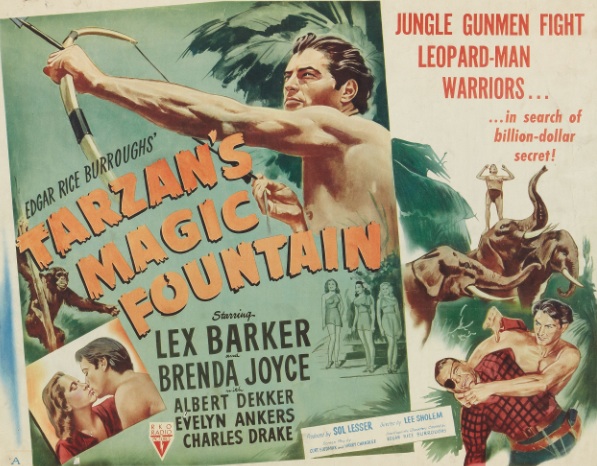
Tarzan’s Magic Fountain marked the beginning of a new era for Tarzan movies.

Johnny Weissmuller, the Olympic swimmer turned actor who first played Edgar Rice Burroughs’s lord of the jungle in Tarzan the Ape Man (1932), left the series after appearing in Tarzan and the Mermaids (1948).

The hunt was on for a hot young male actor to take his place, and producer Sol Lesser reportedly interviewed more than a thousand of them. He and RKO Radio Pictures eventually settled on 29-year-old hunk Lex Barker.

Barker was a native of Rye, New York, a member of a prominent family who disowned him when he went into acting, and a veteran of World War II. He had chiseled features and an even more chiseled physique. The only thing he needed to do to play Tarzan was shave his chest and learn to speak in the clipped, pidgin English that Weissmuller had made famous.

Barker 1949

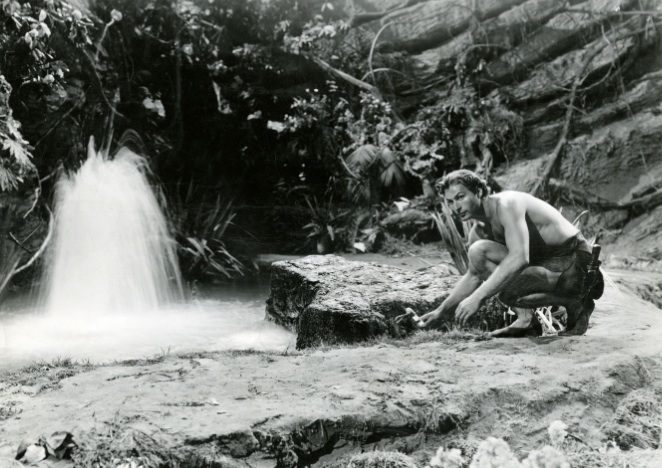
The script for Tarzan’s Magic Fountain, by Curt Siodmak and Harry Chandlee, tells a story that will be familiar to fans of the film series. Greedy outsiders become aware of something very valuable hidden deep within the jungle, and Tarzan must act as a buffer between the tribe who guard it and the outside world.

An aviatrix named Gloria James Jessup (Evelyn Ankers), who was lost and presumed dead (à la Amelia Earhart), walks out of the jungle one day. She doesn’t appear to have aged a day since she disappeared. Her reasons for resurfacing are purely altruistic, but the evil Mr. Trask (Albert Dekker) realizes that if she’s telling the truth — and there really is a fountain of youth — that he could stand to make millions selling the water.

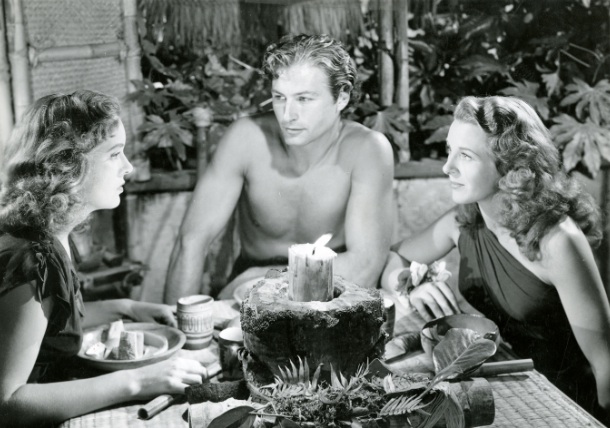
The beautiful and shapely Brenda Joyce returns in the role of Jane. She appeared in four Tarzan films opposite Weissmuller, and her presence in Tarzan’s Magic Fountain helps to make the transition from Weissmuller to Barker a smooth one.

She also plays a pivotal role in the film’s story, as she becomes close friends with Gloria and decides she will do anything to help Gloria be happy — even if it means doing exactly what Tarzan warns her not to do.

Joyce Barker Ankers

Tarzan’s Magic Fountain is a fun entry in the series. It’s full of excitement, fantasy, and amusing animal action. Elmo Lincoln, who played Tarzan in the first film adaptation of Burroughs’s novel, Tarzan of the Apes (1918), has an uncredited cameo as a fisherman repairing his net.

Barker makes for a fine Tarzan, but he’s lacking that special something that Weissmuller had. Even in his later years, Weissmuller moved like a panther and cut through the water like a fish. Barker is a beautiful physical specimen, and he moves well, but he lacks Weissmuller’s unique, leonine grace.

http://www.youtube.com/watch?v=2Ae3pFkUPb4

The Boy With Green Hair (Nov. 16, 1948)

The Boy With Green Hair

The Boy With Green Hair (1948)
Directed by Joseph Losey
RKO Radio Pictures

If you only know Dean Stockwell as the craggy character actor who appeared in TV shows like Quantum Leap and Battlestar Galactica, it might be hard to believe that he was ever an adorable little 12-year-old boy.

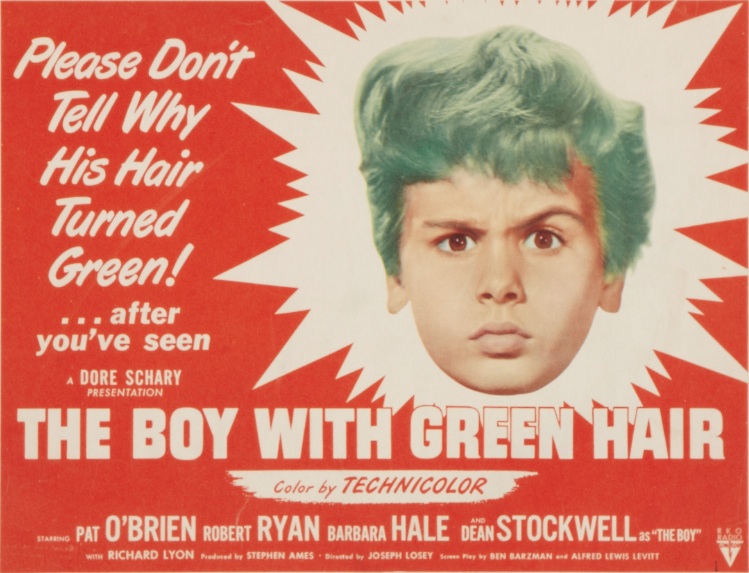
Well, he was. Even with a shaved head, which is how he first appears in The Boy With Green Hair, in the 1940s Stockwell was cuter than a barrel of baby pandas.

The Boy With Green Hair was Joseph Losey’s first feature-length film. It’s a lovely little Technicolor parable that opens with the song “Nature Boy.” (You know, the one about “a very strange, enchanted boy”?) Nat King Cole’s recording of the tune was a big hit in 1948, and was the #1 single in the United States for seven weeks. The melody of the song recurs throughout the film.

It’s the story of a boy named Peter Fry (Stockwell), whose parents are dead, but no one seems to want to tell him. He’s shuttled around from home to home, always carrying a letter to show his foster parents (who he refers to as his “aunts and uncles”), although he’s not aware of the contents.

Eventually he settles down with “Gramp,” a former vaudevillian and magician (and current singing waiter) played by likeable old Irishman Pat O’Brien.

Peter thrives under Gramp’s care, feeling good enough about life that he no longer has to sleep with a baseball bat (though he keeps it on the floor next to him just in case). One day, however, his school holds a charity drive for war orphans. As Peter stands in front of a poster with a black and white photograph of an “Unidentified War Orphan,” he’s forced to confront the truth about his parents. They died in the London Blitz, and Peter can no longer deny the horrors of war. All of a sudden, war orphans aren’t just “over there,” they are right here, and he is one of them.

O'Brien and Stockwell

Not long after this revelation, he wakes up one morning with bright green hair. Punks with brightly dyed hair turned heads in the 1970s, and it was even more unheard of in the 1940s. Peter is instantly ostracized by people who happily tousled his hair when it was brown. His teacher, Miss Brand (Barbara Hale), tries to make him feel OK about his condition. He may be the only kid in class with green hair, but there’s also only one boy who has red hair. But nothing stops the bullying and name-calling. The world is cruel to those who are different.

The Boy With Green Hair is told in flashback, as Peter sits in a police station with a shaved head, telling his story to kindly child psychologist Dr. Evans (Robert Ryan). The message of the film might seem simple, but Losey’s direction and Stockwell’s assured performance elevate it to something haunting and strange that can’t be boiled down to a single slogan. It’s a movie that tells a serious, allegorical story about a child that other children can understand.

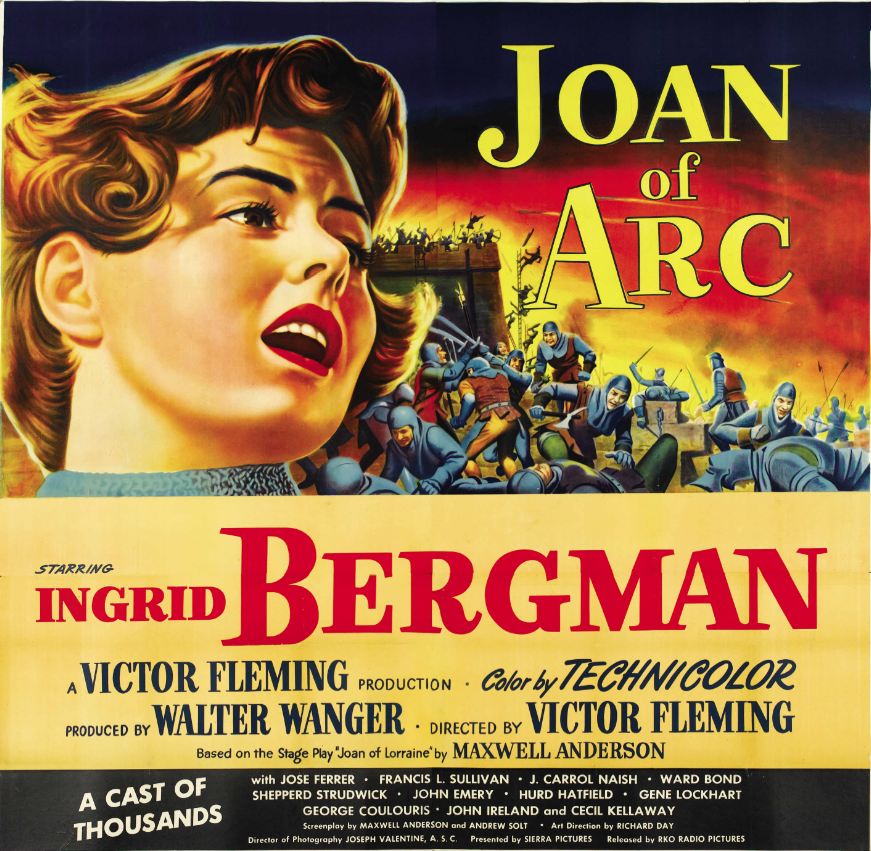
Joan of Arc (Nov. 11, 1948)

Joan of Arc
Joan of Arc (1948)
Directed by Victor Fleming
Sierra Pictures / RKO Radio Pictures

Joan of Arc was always a force to be reckoned with.

In life, she had heavenly visions, led the French army to several victories against the English during the Hundred Years’ War, paved the way for Charles VII to become King of France, and was tried for heresy and burned at the stake in 1431. When she died, she was only 19 years old.

In death, she exerted a powerful influence over the imaginations of artists and writers. From Shakespeare’s largely unflattering portrayal in Henry VI, Part 1 to Mark Twain’s largely forgotten historical novel Personal Recollections of Joan of Arc, the Maid of Orléans was a devil to some, and a saint to others.

Over time, the English decided to stop caring so much, and she came to be seen by more and more people as a holy figure. In 1920 the Catholic Church decided to make it official, and canonized her, which reignited interest in her life. Her trial for heresy, which was held in 15 sessions from February 21 to March 17, 1431, was exhaustively recorded. Most fictional portrayals of Joan of Arc, like George Bernard Shaw’s play Saint Joan (1923), drew from these official records.

Maxwell Anderson’s play Joan of Lorraine opened on Broadway on November 18, 1946, and played for 199 performances at the Alvin Theatre. The last performance was on May 10, 1947. The original production starred Ingrid Bergman as Mary Grey, an actress playing Joan of Arc who struggles with her director, Jimmy Masters (played by Sam Wanamaker), over how Joan should be portrayed.

Joan of Lorraine was the basis for the 1948 film Joan of Arc, which also stars Ingrid Bergman, but the “play within a play” concept was jettisoned in favor of straight historical drama. Much of Anderson’s original dialogue was retained, however, with additional scripting and added characters by Andrew Solt.

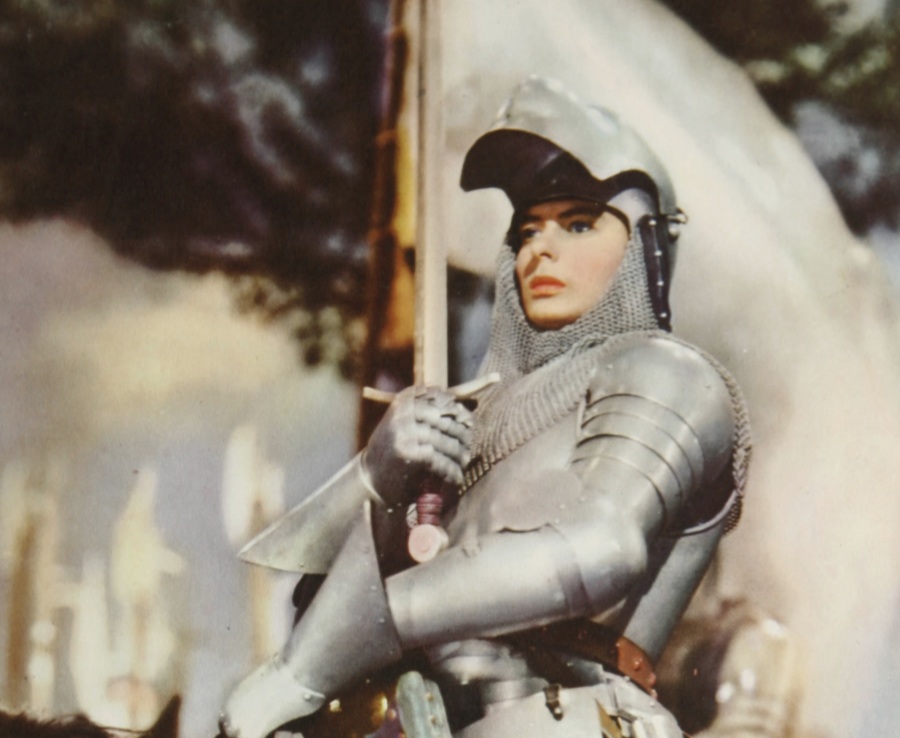
Ingrid Bergman

Joan of Arc was the last film that Victor Fleming directed. The man who directed The Wizard of Oz (1939) and Gone With the Wind (1939), as well as many other memorable films, died of a heart attack on January 6, 1949. He was 59 years old. While it might not be as fondly remembered as some of his other films, it’s still a pretty good one to go out on. It’s a big, sprawling, Technicolor costume drama (although there is a cut version that is just 1 hour and 40 minutes, the original cut of the film is 2 hours and 25 minutes long). Most importantly, Joan of Arc features a brilliant lead performance by Bergman. Most of the other actors are pretty good, especially José Ferrer (in his first film role) as the Dauphin, later Charles VII. With a cast of thousands, however, there are bound to be a few duds, and there are, although Ward Bond, whom I more closely associate with westerns than European historical dramas, was better than I was expecting. John Ireland? Not so much.

Joan of Arc is also heavy on dialogue and light on spectacle. With the film looks great, there’s only one big battle scene, and it doesn’t come close to matching similar scenes that Fleming directed for Gone With the Wind. While Joan of Arc is by no means a bad film, without Bergman’s performance it would lose most of its impact.

It’s certainly worth seeing, but if you’re only going to see one film about Joan of Arc in your lifetime, it should be Carl Theodor Dreyer’s silent film The Passion of Joan of Arc (1928), which stars Maria Falconetti in one of the most hypnotic film performances of all time. With spare sets and simple costumes, Dreyer achieves effects Fleming could only dream of. Falconetti’s performance in The Passion of Joan of Arc walks the fine line between madness and mysticism. Religious faith is a tricky thing to depict on film, but Dreyer’s film is one of the few that gets it exactly right.

The fiery finale of Fleming’s Joan of Arc is powerful, too. And as far as visual depictions of religious martyrdom go, I think both films are more powerful statements than the geek-show excesses of The Passion of the Christ (2004).

In the run-up to the 21st Academy Awards, Joan of Arc was the first film to receive seven nominations without a nomination for best picture. Ingrid Bergman was nominated for best actress, José Ferrer was nominated for best supporting actor, Hugo Friedhofer was nominated for best dramatic or comedy score, Richard Day was nominated for best art direction in a color film, and Frank Sullivan was nominated for best editing. The film won in two categories; Joseph Valentine, William V. Skall, and Winton Hoch won the Oscar for best cinematography in a color film, and Dorothy Jeakins and Barbara Karinska won for best costume design in a color film.

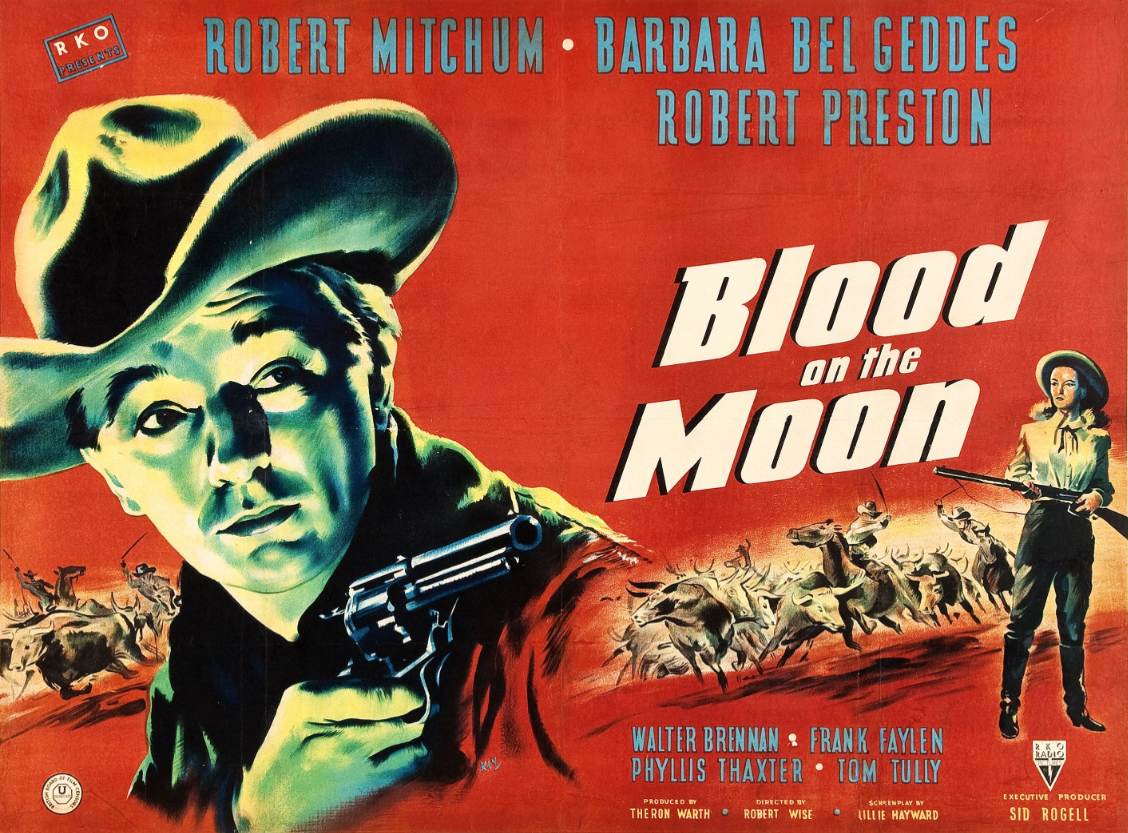
Blood on the Moon (Nov. 9, 1948)

Blood on the Moon
Blood on the Moon (1948)
Directed by Robert Wise
RKO Radio Pictures

Blood on the Moon is an RKO western directed by Robert Wise. It’s based on Luke Short’s novel Gunman’s Chance, which was originally serialized in The Saturday Evening Post in 1941.

I’ve only read one of Luke Short’s western novels (he wrote more than 50), but judging by it and the two films I’ve seen that were based on his work (this one and André de Toth’s 1947 film Ramrod), dense plotting, terse dialogue, and three-dimensional protagonists were some of Short’s trademarks.

Like most protagonists of westerns in the ’40s and ’50s, the protagonists of Blood on the Moon and Ramrod are on the side of the angels. But they’re more interesting than the cookie-cutter heroes of countless B westerns. Not so much because they’re complex people, but because they’re believable people who exist in a complex world.

First-time viewers of both Ramrod and Blood on the Moon will likely have a little difficulty figuring out who the “good guys” and the “bad guys” are right away, and who’s telling the truth and who’s lying — at least for the first couple of reels.

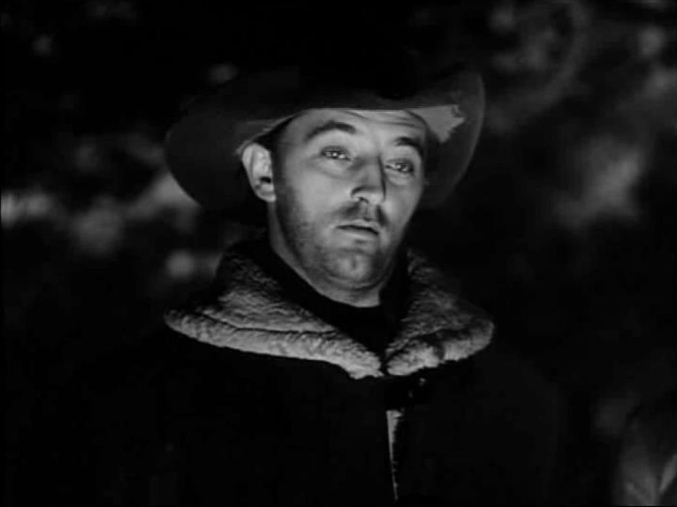
The hero of Blood on the Moon — Jim Garry — is played by Robert Mitchum. Garry is a solitary cowpoke with a small herd. He’s passing through open country when his herd is run off in a stampede. Rancher John Lufton (Tom Tully), owner of the Lazy J Ranch, apologizes and offers to reimburse Garry for the outfit he lost. Even so, their exchange is tense. Lufton doesn’t trust loose riders, since he’s feuding over grazing land with Jake Pindalest (Frank Faylen), a newly appointed Indian agent who’s thrown Lufton off the reservation grass, and stopped Lufton from supplying the tribe with beef, even though he’d done so for years.

When Garry turns down Lufton’s offer to work for him, the opposition comes knocking in the form of an old friend of Garry’s — a man named Tate Riling (Robert Preston). Tate represents the homesteaders who are opposed to Lufton, and he offers to hire Garry as a gunhand for $10,000. Tate tells Garry, “Lufton’s tough and my ranchers aren’t. You make up the difference.”

“I’ve been mixed up in a lot of things, Tate, but up till now I haven’t been hired for my gun,” Garry says.

“Can you afford to be particular?”

Garry thinks for a moment, then says, “No, I guess I can’t.”

Mitchum

Mitchum is perfect for this type of role. He was a laconic actor who barely ever changed his expression, but he could suggest depths of emotion with his eyes.

I’ve seen him in run-of-the-mill westerns like West of the Pecos (1945), and he’s fine in them, but he did his best work in dark, noirish westerns like this one and Raoul Walsh’s Pursued (1947).

Robert Wise, the director of The Body Snatcher (1945) and Born to Kill (1947), keeps Blood on the Moon moving at a brisk, tense pace. The cinematography by Nicholas Musuraca is full of darkness and shadows. It’s not full-on “noir” like James Wong Howe’s cinematography for Pursued, but Blood on the Moon still spends a lot of time in darkened saloons, lonely country at night, and the streets of a frontier town after dark. Even the exterior scenes that take place in daylight have a sense of gray desolation.

The cast is really great, too. I like seeing Barbara Bel Geddes in just about anything, and I especially liked her as one of Lufton’s two daughters, Amy. (Phyllis Thaxter plays the other daughter, Carol.) Square-jawed, gruff-voiced tough guy Charles McGraw plays a gunhand named Milo Sweet who wears one of the sweetest buffalo coats I’ve ever seen. As a homesteader named Kris Barden, Walter Brennan plays essentially the same character he played in every movie he was ever in, but he finds depths of emotion in his character that he didn’t always get to explore as a comical sidekick. And I always love seeing Tom “Captain Marvel” Tyler in any western, even if he was a pretty wooden actor. In Blood on the Moon, he appears just long enough to be effective — in a tense showdown with Mitchum that’s 10 times as exciting as most western showdowns that have more traditional outcomes.

The tough, no-nonsense screenplay of Blood on the Moon is by Lillie Hayward, from an adaptation of the novel by Luke Short and Harold Shumate.

Blood on the Moon won’t ever be counted as one of the all-time great westerns, but the western was a damned busy genre at the time of its release, and it’s a cut above the rest. It holds up to multiple viewings, and presages the many ways in which the genre would mature in the 1950s.

Bodyguard (Sept. 4, 1948)

Bodyguard
Bodyguard (1948)
Directed by Richard Fleischer
RKO Radio Pictures

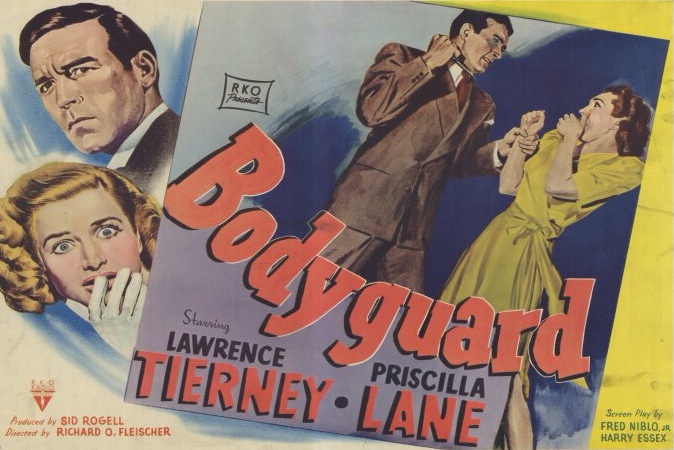
Richard Fleischer’s Bodyguard features Lawrence Tierney doing what Lawrence Tierney did best — knocking down everyone and everything that gets in his way.

In the first sequence of the film, LAPD detective Mike Carter (Tierney) is reprimanded by his lieutenant (played by Frank Fenton) for using his knuckles instead of his brain. Before Mike even has a chance to plead his case to the captain, the lieutenant informs him that he’s already talked to the captain on Mike’s behalf and that Mike is suspended effective immediately.

So Mike uses his knuckles instead of his brain and gets into a glass-breaking fistfight with his lieutenant.

When Mike and the lieutenant are gearing up to throw punches, the film cuts back and forth between the two men as they both step closer to the camera, eventually getting so close their noses are almost touching the lens.

After Mike is bounced from the force, a man named Freddie Dysen (Phillip Reed) approaches him with a proposition. He’ll pay Mike a $2,000 retainer to act as bodyguard to his aunt, Mrs. Gene Dysen (Elisabeth Risdon).

Who can say no to a $2,000 retainer?

Well, apparently Mike Carter can. He’s got better things to do, like spending time with his cute blond fiancée, Doris Brewster (Priscilla Lane, in her final film role), and playing the ponies down at the track.

But when Mike is framed for murder, he’s forced to get into the action. What do Mrs. Dysen and her meat-packing plant have to do with the murder Mike’s been framed for? And was the accidental death of a plant inspector really accidental?

One thing I love is when a B movie gives its peripheral characters interesting lives that in no way advance the plot. For instance, Bodyguard features a scene in an arcade where Mike tries to get the counter girl’s attention as she chats with a couple of sailors. He doesn’t succeed for awhile, and when he finally does, one of the sailors tries to start a fight with him. Bodyguard runs for barely longer than an hour, and has a dense, twisty plot, but it still finds time for entertaining little moments like that.

It also features a ton of location shooting in Los Angeles and great noir cinematography by Robert De Grasse. Bodyguard is unmistakably designed to be the second feature on a double bill, but it’s well-made, well-acted, and holds up as superior entertainment.

The director, Richard Fleischer, had a long career in Hollywood. He was born in 1916 and Bodyguard was only his fourth feature film (he made a number of documentary shorts in the 1940s as well). To put things into perspective, this is the same man who would go on to make The Narrow Margin (1952), 20,000 Leagues Under the Sea (1954), Fantastic Voyage (1966), Soylent Green (1973), Mandingo (1975), and Conan the Destroyer (1984).

Bodyguard is also notable for being the first time acclaimed director Robert Altman got his name in the credits. The screenplay is credited to Fred Niblo Jr. and Harry Essex, and the story is credited to George W. George and Robert B. Altman.*

Tierney

*Altman also worked on the script for Edwin L. Marin’s Christmas Eve (1947), which starred George Raft, but Altman’s name didn’t appear in the credits.

Race Street (Aug. 22, 1948)

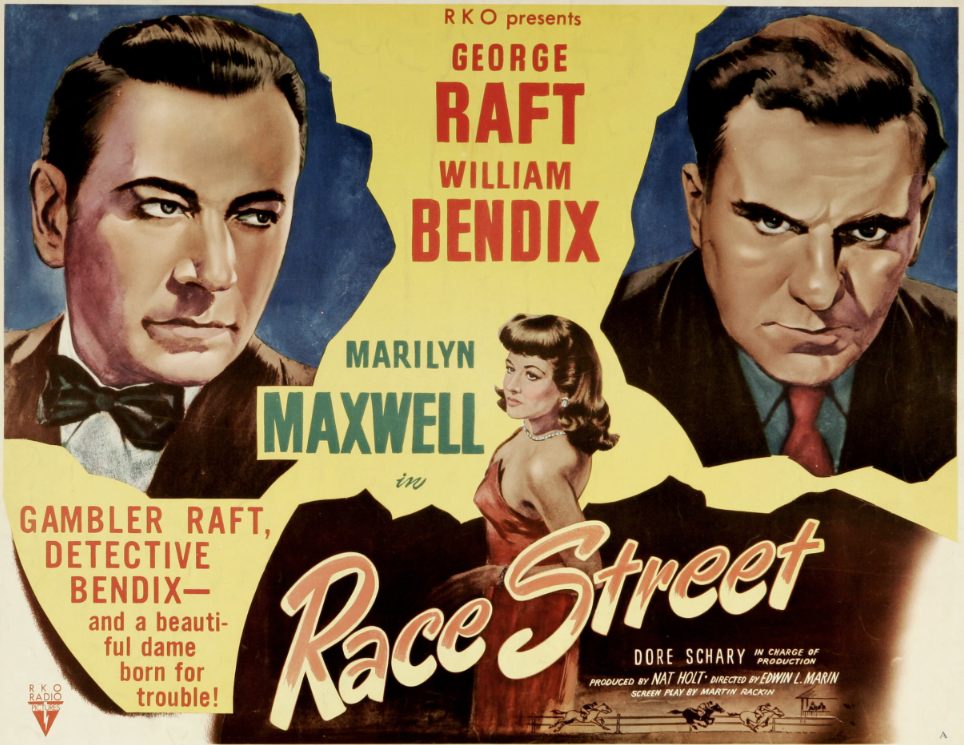
Race StreetYou know what would be a great drinking game for a designated driver to play? Watching Race Street and taking a shot every time George Raft changes his expression.

Raft had no range as an actor, but he did play well with others. When paired with good performers, Raft had real chemistry with them. For instance, my favorite scene in Howard Hawks’s Scarface (1932) is when Ann Dvorak does a sexy, playful dance to try to get a reaction out of Raft. He remains stone-faced, but there’s always a twinkle in his eye.

As an actor, Raft got a lot of mileage out of that twinkle in his eye. Even though he mostly played his characters as expressionless tough guys, his eyes always made it seem as if he was taking in everything around him.

The other thing Raft brought to the table as an actor was a whiff of real-life criminality. He was well-known for his associations with gangsters like Owney Madden, Meyer Lansky, and Bugsy Siegel, which added another dimension to roles like the one he plays in Race Street.

In Race Street, Raft plays a bookie named Dan Gannin. Gannin hides his illegal betting operation behind a respectable facade as an investor. Despite his criminal endeavors, he has an easy friendship with a police detective, Lt. Barney Runson (William Bendix). Lt. Runson knows that his friend Dan is a bookie, but they’re childhood friends, and not much trumps that.

Gannin’s other childhood friend in the film, a fellow bookie named Hal Towers (Harry Morgan), needs a little more taking care of than Runson, and when he begins running afoul of thugs in a protection racket, it’s easy to see that things are going to get complicated for Gannin, who is the standard “nice guy who just wants to go straight” character we’ve seen in a thousand crime movies.

On the distaff side of Gannin’s life is his beautiful sister Elaine (Gale Robbins), a leggy dancer and nightclub singer with whom he’s opening a nightspot called the Turf Club. There’s also a new lady in his life, a brunette named Robbie Lawrence (Marilyn Maxwell).

Race Street was directed by Edwin L. Marin, who directed a bunch of B pictures for RKO with George Raft, including Nocturne (1946), which I enjoyed quite a bit.

As I said above, Raft isn’t the most engaging actor in the world, but he turned in watchable performances when he had a good supporting cast and a decent script, and Race Street succeeds on both counts. I especially liked William Bendix in this film. Bendix was as good at playing comic buffoons as he was at playing sinister villains, and he could do everything in between.

Race Street also has plenty of beautiful footage of San Francisco. A lot of it’s obviously stock footage, but it’s integrated into the film well. This is clearly a B movie, but no studio made B-grade film noirs as well or as consistently as RKO Radio Pictures.

They Live by Night (Aug. 5, 1948)

They Live by Night
They Live by Night (1948)
Directed by Nicholas Ray
RKO Radio Pictures

This movie grabbed me with its first frame and never let go.

They Live by Night is unlike any other movie I’ve seen so far from 1948. Obviously I know what lay ahead for its director, Nicholas Ray, but even if I didn’t, this is the kind of film that would make me sit up and take notice of his name, and look forward to seeing everything he directed next.

Come to think of it, my knowledge of Ray’s filmography is pretty spotty. In high school, Rebel Without a Cause (1955) was one of my favorite films. I watched it over and over, but never thought to explore more of Ray’s films. Years later, I saw In a Lonely Place (1950) and loved it, but didn’t make the connection that it was the same director who made Rebel. But now I’ve got so many Nicholas Ray films to look forward to!

Like all innovative films made more than 50 years ago, They Live by Night doesn’t contain anything we haven’t seen in hundreds of films since, but when viewed in its proper context, it’s exhilarating. Just look at the opening of the film. Unlike nearly every other film of the era that began with a title card followed by a credit roll, They Live by Night begins with shot of two deliriously happy young lovers as the following words flash on the screen: “This boy… and this girl… were never properly introduced to the world we live in… To tell their story…” And suddenly the music becomes grim and portentous, we cut to a shot of a speeding car, and the film’s title appears. The speeding car is filmed from a helicopter, and it’s the earliest instance of action shot from a helicopter that I’ve seen in a film. It’s just one of the innovative ways that Ray creates tension, drama, and excitement with filmmaking techniques that are common practice now, but that were revolutionary at the time.

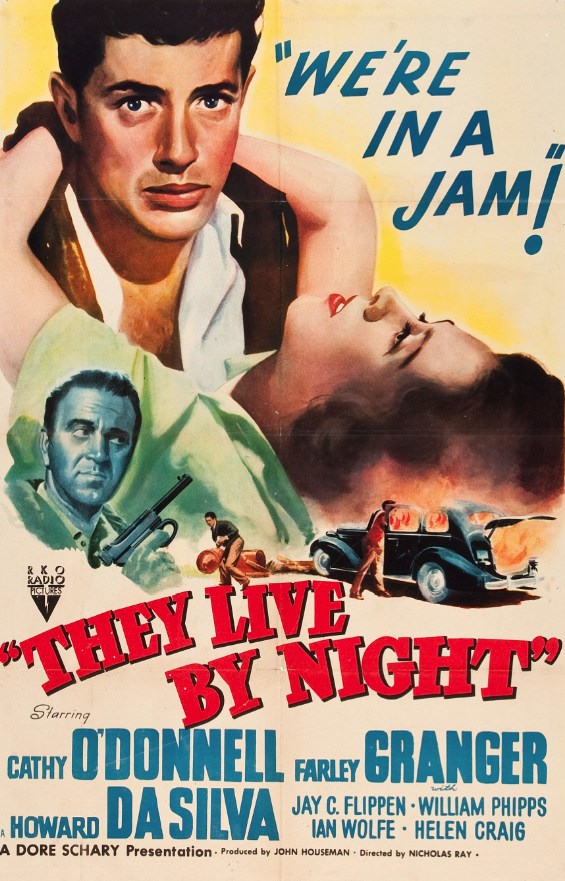
They Live by Night was based on Edward Anderson’s novel Thieves Like Us (1937). Farley Granger plays a young man named “Bowie” Bowers (his first name is pronounced “Boo-ee,” just like Jim Bowie). When the film begins, he’s an escaped con running from a murder sentence, and his luck will only get worse as the film goes on.

Except for one thing. He falls in love with a young woman named Keechie (Cathy O’Donnell), and while they’re on the run together, they’re happy as only two young people in love can be happy.

There are obvious comparisons to be drawn with Joseph H. Lewis’s Gun Crazy (1950) and Arthur Penn’s Bonnie and Clyde (1967). They Live by Night shares the Depression-era setting with Bonnie and Clyde, and it’s visually similar to Gun Crazy, but unlike both of those films, Keechie isn’t an active participant in any criminal activity and the film focuses more on her romance with Bowie than it does on Bowie’s crime spree.

Ray makes so many surprising and smart choices in this film. He doesn’t show most of Bowie’s bank robberies, which focuses our attention on Bowie’s romance with Keechie. His crime spree across Texas is a matter of grim necessity, and all he wants to do is escape. This has the effect of making a radio news report about Bowie’s growing infamy surprising to the audience. Ray makes it easy to forget much of the time that Bowie is a criminal, which make the intrusions of hard reality into Bowie and Keechie’s lives all the more shocking.

Ray also has a knack for depicting life in a way that feels authentic. Even minor characters with just a few lines feel like fully realized, three-dimensional people. When Bowie and Keechie go to a nightclub on a date, the African-American singer Marie Bryant does a rendition of “Your Red Wagon” and collects dollar tips from the crowd, which she folds and clasps between her fingers. Most Hollywood productions would never show a nightclub singer taking tips — it would ruin the illusion of glamour. But the nightclub in They Live by Night looks and feels like a real place. When Bowie goes into the men’s room, he has a brief conversation with the African-American bathroom attendant. In a lesser film, the attendant would be comic relief, and in a lower-budget film, he wouldn’t exist at all.

They Live by Night features top-notch work by all of its cast and crew. Leigh Harline’s music (with uncredited assistance from Woody Guthrie) is phenomenal. George E. Diskant’s cinematography is some of the most beautiful and most noirish I’ve ever seen (they really do live by night in this movie), and Sherman Todd’s film editing is soothing when it needs to be and jarring when it needs to be. Todd and Ray made a lot of risky choices in the editing room, but for my money, they all paid off.

Ray filmed They Live by Night in 1947, but RKO wasn’t sure how to market the film, and it ended up premiering in the United Kingdom in a single theater on August 5, 1948. It wasn’t released in the United States until November 1949, and didn’t end up being a financial success, but it had been screened privately in Hollywood for many actors and producers, which led to Ray’s next film, Knock on Any Door (1949), with Humphrey Bogart, as well as to Farley Granger being cast in Alfred Hitchcock’s Rope (1948).

Return of the Bad Men (July 17, 1948)

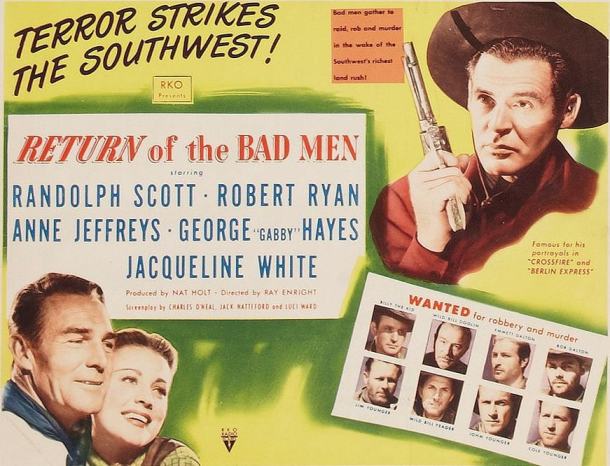
Return of the Bad MenReturn of the Bad Men was the fourth and final film in a series of westerns that director Ray Enright made with legendary horse opera star Randolph Scott. The previous three were Trail Street (1947), Albuquerque (1948), and Coroner Creek (1948).

Most modern viewers will know Randolph Scott primarily for his final role — in Sam Peckinpah’s Ride the High Country (1962) — and be blissfully unaware of the roughly one hundred films he appeared in prior to it.

Ride the High Country is a great western (it co-stars Joel McCrea), but it’s not Scott’s only claim to fame. The westerns he made in the ’50s with director Budd Boetticher are highly regarded among connoisseurs of western cinema. He also appeared in plenty of workmanlike westerns like the ones directed by Ray Enright that aren’t great works of art, but are well-made entertainment, and a cut above the average B western.

Return of the Bad Men takes place in 1889, in the Oklahoma Territory. The U.S. government has just opened up two million acres of prime land for settlers. At high noon on April 22, 1889, the great Oklahoma Land Rush will begin. On the tails of the settlers, however, are a bunch of no-good outlaws (the “bad men” of the title) who only hope to prey on honest folks.

The land run sequence is exciting, although I suspect that most of the footage is taken from an earlier RKO picture, the Oscar-winning Cimarron (1931).

One of the settlers is a beautiful young widow named Madge Allen (Jacqueline White) who has a young son named Johnny (Gary Gray). She also has a boyfriend, Vance Cordell (Randolph Scott), who only wants to marry his sweetheart and move her and her son out to California.

But when Madge’s father, John Pettit (Gabby Hayes), the folksy and tough-talking president of the local bank, picks up stakes and moves from Braxton, Oklahoma, to Guthrie, Oklahoma, Vance, Madge, and Johnny follow. Once in Guthrie, a cavalry officer appoints Vance U.S. Marshal. As a former Texas Ranger and peace officer, he’s the most suitable man to keep order.

Madge just wants her son to grow up in a peaceful, law-abiding world. Her deceased husband was a peace officer killed in the line of duty, and she refuses to marry Vance until he puts things right in Guthrie, trains officers to take his place, and retires.

Meanwhile, a whole mess of outlaws is amassing against the peaceful homesteaders of Guthrie. They’re led by Wild Bill Doolin (Robert Armstrong) and there’s even a woman among them, Doolin’s niece Cheyenne (Anne Jeffreys). When the rough-and-tumble bad men tell her that busting banks is man’s work, she responds that Belle Starr did OK.

The crew of outlaws includes plenty of famous names — the Younger brothers, Cole (Steve Brodie), Jim (Tom Keene) and John (Robert Bray); the Dalton brothers, Emmett (Lex Barker), Bob (Walter Reed), and Grat (Michael Harvey); Billy the Kid (Dean White); the Arkansas Kid (Lew Harvey); Wild Bill Yeager (Tom Tyler) — but the only member of the crew who has much of a chance to distinguish himself (besides Cheyenne) is Robert Ryan as the Sundance Kid.

Sundance is the most vicious of the lot and becomes Vance’s archenemy over the course of the film. Robert Ryan was on his way to becoming a big star after his memorable role in Crossfire (1947). There’s nothing particularly remarkable about his role in Return of the Bad Men, but he plays a charming villain well, and the growing antagonism between Ryan and Scott provides the dramatic push of the film.

Enright keeps the pace fast in Return of the Bad Men. The editing is quick, and the camera frequently moves within shots, which is not the case with a lot of B westerns. For a B western the production values are good, the acting is solid, and the characterizations are well-done.

Below is a clip from the film. I suppose I have to put a spoiler warning on it, since it’s the climactic fight of the film. I think the biggest potential spoiler about it is a single line of dialogue that alludes to the fate of a couple of characters, because if you consider finding out whether the guy with the white hat or the guy with the black hat wins the final fight in a B western a “spoiler” … well … let’s just say I envy your childlike naïveté: