Tag Archives: Romance

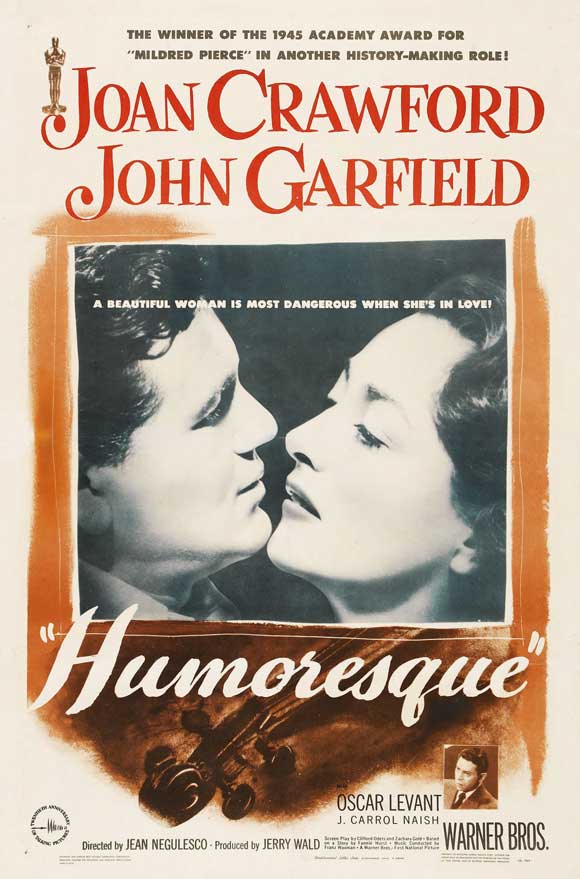
Humoresque (Dec. 25, 1946)

In a recent NY Times interview with David O. Russell, the director of the Oscar-nominated biopic The Fighter (2010), he compared his star, Mark Wahlberg, to John Garfield. Russell said that — like Garfield — Wahlberg is “always kind of in character, because it’s always him in some way.”

Garfield might seem as unlikely a choice as Wahlberg to play a concert violinist, but Humoresque never tries to pass Garfield off as something he wasn’t. His character, Paul Boray, spends his boyhood in what appears to be New York’s Lower East Side, in an immigrant family that has neither the time nor the money for classical music. (Garfield was born Jacob Julius Garfinkle, the son of Russian Jewish immigrants, and grew up in Brooklyn and the Bronx, where he was enrolled in a school for difficult children.) At a high society party, a tipsy young woman refuses to believe Boray when he tells her he’s a violinist. She pegs him as a prizefighter, and refuses to believe he even knows what end of a violin the music comes out of. “It comes out of the middle,” he responds. (Garfield would, however, play a boxer in his next film, Body and Soul.)

There are plenty of hoary cliches in the early sections of the film. Bobby Blake plays Boray as a child. His immigrant father (J. Carrol Naish) works hard and always has his eye on the bottom line, while his mother (Ruth Nelson) is more sensitive, and grows to believe in Paul’s desire to play music. All of these scenes are pretty laborious.

Perhaps director Jean Negulesco wanted to be explicit about how a rough young man from the slums could become a dedicated concert musician, but all of the scenes of Boray’s childhood are less effective than a short sequence later in the picture in which the adult Boray storms out of a recording studio after being forced to cut a major chunk from a piece for radio time. He returns to his apartment to play alone, and the wildness of his music is reflected in a herky-jerky montage of chaotic city streets and teeming masses of people.

Long stretches of Humoresque are told through music, which is beautifully played by violinist Isaac Stern, but there’s plenty of snappy dialogue, too. When Boray gets in an argument with his friend, accompanist, and mentor Sid Jeffers (played by pianist and wit Oscar Levant), Jeffers tells him, “You’ll do all right. You have all the characteristics of a successful virtuoso. You’re self-indulgent, self-dedicated, and the hero of all your dreams.” Boray responds, “You oughta try a few dreams yourself, it might make you less cynical. When I look at you, I know what I want to avoid.” (And to give you an idea of the rapidity of the dialogue in the film, that exchange takes place in less than 12 seconds.)

The plot, such as it is, kick in around the 30-minute mark, when Joan Crawford shows up as Mrs. Helen Wright, a myopic, dipsomaniac socialite with a sharp tongue. Her husband is a cultured, sensitive man, but — by his own admission — very weak, and as soon as Helen takes an interest in Paul and his career, tongues begin to wag.

Garfield and Crawford have great chemistry, and both are good enough actors to give their relationship depth. It’s unclear for a time exactly what each wants from the other, but her alcoholism and his deep-seated anger make for plenty of stormy scenes. At one point, Paul blows up and yells at her, “Well, you didn’t do any of this for me, really. You did it for yourself, the way you buy a racehorse, or build a yacht, or collect paintings. You just added a violin player to your possessions, that’s all.”

In Bosley Crowther’s review of Humoresque in the December 26, 1946, issue of the NY Times, he wrote, “The music, we must say, is splendid — and, if you will only shut your eyes so that you don’t have to watch Mr. Garfield leaning his soulful face against that violin or Miss Crawford violently emoting (‘She’s as complex as a Bach fugue,’ Oscar says), and if you will only shut your ears when folks are talking other such fatuous dialogue, provided by Zachary Gold and Clifford Odets, you may enjoy it very much.”

I love Crowther’s reviews. Maybe if I’d been around when he was writing them I would have resented the stranglehold he had on public perception, but in retrospect they’re fantastically entertaining. I liked Humoresque more than he did, but I don’t disagree with his assessment. One has to take into account his longstanding hatred of Joan Crawford, of course, but by the time the credits rolled I was more moved by the music than by any of the vacuous melodrama.
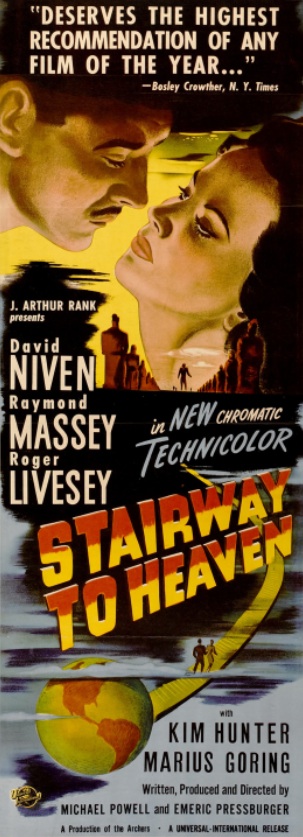
A Matter of Life and Death (Dec. 25, 1946)

Stairway to Heaven
A Matter of Life and Death (1946)
Directed by Michael Powell and Emeric Pressburger
The Archers / Eagle-Lion / Universal Pictures

Michael Powell and Emeric Pressburger’s brilliant fantasy A Matter of Life and Death premiered in the United Kingdom on November 1, 1946, and later that year in New York City, on Christmas day, retitled Stairway to Heaven. (After World War II, the word “death” was verboten in film titles for awhile in the United States.)

The film begins with the following statement: “This is a story of two worlds — the one we know and another which exists only in the mind of a young airman whose life and imagination have been violently shaped by war. Any resemblance to any other world, known or unknown, is purely coincidental.” It’s a playful opening, and can be interpreted in more than one way. “The Archers” (the name Powell and Pressburger used for their partnership) had a light touch, and were able to weave magical realism into their stories without ever seeming childish or silly.

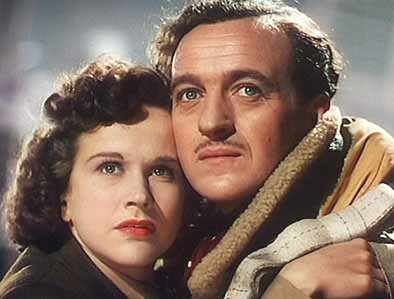
After a cheeky narrated tour through the cosmos, we see Squadron Leader Peter Carter (David Niven), his Lancaster bomber in flames and about to crash. Peter’s parachute is shot too full of holes to function properly, and he is desperately trying to reach someone on the radio. Next to him lies the body of Flying Officer Bob Trubshawe (Robert Coote). Peter manages to get in touch with June (Kim Hunter), an American radio operator, and pours out his heart to her. Finally, he professes his love before leaping out of the bomber without a parachute.

The scene in which Niven wakes up in the pounding surf and believes himself in the afterlife is a masterpiece of subtle humor. He stands, breathes deeply, and walks toward the beach with a beatific gaze, shedding his earthly raiments. The first person he sees is a boy playing a pipe, tending sheep, so why wouldn’t he think he’s passed on to his final reward?

Meanwhile, his mate Bob finds himself in the “other place,” an otherworldly bureacracy in which angel wings arrive en masse on long runners, ready to be attached to newly arrived bodies, and businesslike clerks take names and hand out assignments. Bob is told that there was a clerical error that caused Peter to fall through the cracks, and that he’ll need to be collected forthwith.

The scenes on terra firma are filmed in beautiful Technicolor, while the scenes in the afterlife are filmed in black and white. (Technically it’s “monochrome Technicolor,” not proper black and white, but since I’m not as big of a film nerd as Martin Scorsese, I couldn’t tell the difference.) It’s a simple but brilliant stylistic choice, and it’s way ahead of its time. Films in the ’30s or ’40s that mixed black and white with color film invariably depicted the fantastical world in color and the prosaic world in black and white. To do it the other way around looks forward to the ’80s, when black and white was coming back into vogue, and filmmakers like Scorsese and David Lynch showed just how surreal and otherworldly black and white film could look.

Kim Hunter and David Niven

June and Peter fall in love, but for Peter, time occasionally stops all around him while a ridiculous French aristocrat from the other world known as “Conductor 71” (Marius Goring), pays him visits.

June’s friend Doctor Reeves (Roger Livesey) believes that Peter’s visions aren’t supernatural, but symptoms of a brain injury. Eventually this “matter of life and death” comes to a head as Peter is operated on in our world while simultaneously facing trial in the other.

A Matter of Life and Death is a fantastic film that is satisfying on both a technical level and an emotional level. The performances are all wonderful, and Powell and Pressburger are masterful filmmakers.

Incidentally, in a 2004 poll of 25 film critics in Britain’s Total Film magazine, A Matter of Life and Death was named the second greatest British film of all time, sandwiched between Get Carter (#1) and Trainspotting (#3).

La Belle et la Bête (Oct. 29, 1946)

La belle et la bête
La Belle et la Bête (Beauty and the Beast) (1946)
Directed by Jean Cocteau
DisCina

Jean Cocteau began filming La Belle et la Bête (Beauty and the Beast) almost immediately after the end of the Nazi occupation of France. It wasn’t a quick or an easy shoot. Cocteau had to contend with limited film stock of varying quality, cameras that jammed, aircraft flying overhead that ruined the sound, and the general disarray of post-war France.

The 56-year-old Cocteau was a well-known writer, poet, visual artist, and director of avant-garde films, but this was his first foray into mainstream filmmaking. It begins with an exhortation to audiences to remember what it is to be a child, and to experience magic without the jaundiced eyes of an adult.

This is probably a direct reaction to the critics (most notably Jean-Paul Sartre) who felt that Cocteau was not political enough. Cocteau’s only allegiance in life was to art, and it is appropriate that he made this film as a reaction to critics, since it’s one of the most beautiful and magical pieces of filmmaking I’ve ever seen. His plea to audiences that opens the film seems unnecessary. This is a film that speaks for itself.

In adapting the 18th-century fairy tale, Cocteau used a lot of the same techniques he used when he made his experimental 1930 film Le sang d’un poète (The Blood of a Poet); simple special effects, an obsession with mirrors, statues that come to life, and tricks of speed and perspective.

As in the original story (most famously written by Mme Jeanne-Marie Le Prince de Beaumont in 1756, although she didn’t create the tale), Belle (played by Josette Day) lives with her merchant father (Marcel André) and her two nasty, selfish sisters, here named Félicie (Mila Parély) and Adélaïde (Nane Germon). Cocteau added two male characters, Belle’s brother Ludovic (Michel Auclair) and her handsome but shallow suitor, Avenant (Jean Marais).

The domestic scenes in the film are designed and lighted to look like paintings by Vermeer and Rembrandt. The characters all wear 17th-century costumes, and the interiors are beautiful to look at, even though the human drama is stifling and petty. Félicie and Adélaïde bicker and ridicule Belle, and are indifferent to their father’s rising debts. Meanwhile, Ludovic and Avenant avoid all responsibility and are only interested in the pursuit of leisure.

When Belle’s father rides off into the woods, the mood of the film dramatically shifts. Using a combination of real parks and woodlands with studio sets, Cocteau creates a magical fairy-tale world directly based on 19th-century engravings by Gustave Doré.

La Belle

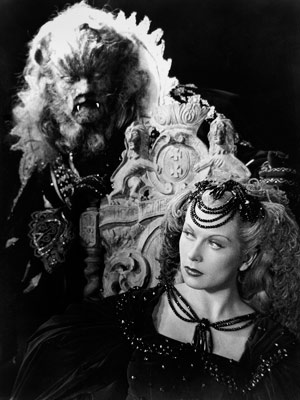
When Belle’s father first enters la Bête’s castle — revealed when a gate of tree branches magically parts — his shadow moves against the castle entrance even though he is standing still. Once inside, candelabras held by human arms mounted into the wall magically spring to light. It doesn’t matter that you can see wires holding the candelabras aloft; the simple but painstaking special effects are still breathtaking. When Belle’s father sits down in the banquet hall, sculptures of human faces on the mantel of the fireplace are actually the faces of human actors covered with soot, their bright eyes the only thing about them that looks alive as smoke pours out of their nostrils.

This delineation between fantasy and reality continues throughout the film. When Belle enters the castle to fulfill the punishment meted out to her father for picking one of la Bête’s white flowers, she floats through long corridors full of billowing white curtains in dreamy slow-motion. There are doors and mirrors that speak to her, and a bed with a white fur spread that slithers open. The special effects are simple, and a lot of them are done “in the can” by simply reversing the film.

It’s been awhile since I’ve seen Disney’s 1991 version of this fairy tale, but that film bears an enormous debt to Cocteau’s version. Everything from the look of the beast to the costumes, set design, and subplot about Belle’s jealous suitor are lifted directly from this film. While the Disney version is perfectly competent, it doesn’t have the otherworldly power of Cocteau’s vision. La Bête, in particular, is less cuddly and more uncanny here. He’s played by Jean Marais, who also plays Belle’s suitor, Avenant, which would be distracting if he wasn’t completely unrecognizable under the heavy makeup and mountains of hair. Marais plays la Bête as a noble, leonine creature with a deep nasal monotone. Unlike the lovable furball of the Disney film, there are a few moments in which he is truly frightening; appearing as if by magic when Belle’s father picks a flower, drinking from a brook on all fours like an animal, or standing over the carcass of a deer that he has mutilated.

Given that Cocteau was gay and Marais was his longtime lover, it’s tempting to read a lot into this film. For Freudian readings of heterosexual power dynamics and the vagaries of lust, the Beauty and the Beast myth is second perhaps only to the story of Bluebeard. Are all men beasts who must stifle bloodthirsty and rapacious urges in order to be with women? Did Cocteau, who had begun to suffer from painful eczema, feel like a beast himself?

All theories are welcome, but I prefer to heed Cocteau’s advice in the preface and take this magical film at face value.

Notorious (Sept. 6, 1946)

Notorious
Notorious (1946)
Directed by Alfred Hitchcock
RKO Radio Pictures

Notorious was Alfred Hitchcock’s second film to star Ingrid Bergman. Like the first, Spellbound (1945), it’s a perfect marriage of director and star. Later in his career, Hitchcock had a penchant for casting blond ice queens like Grace Kelly and Tippi Hedren, so it’s easy to forget how good he and the brown-haired Bergman were when they worked together.

In Notorious, Bergman plays Alicia Huberman, the daughter of a German-American man convicted of spying for the Nazis. As soon as the trial is over, she throws a little party in her Miami bungalow and gets good and blotto. The sense of intimacy that Bergman creates in this scene is remarkable. She doesn’t slur her words or make a fool of herself, but through her drunken ramblings she reveals some of her innermost thoughts.

Not so with the handsome stranger (Cary Grant) who sits alone at her party. He remains an enigma for awhile. After she throws everyone else out, she takes him out for some good old fashioned drunk driving. (And all the herky-jerky rear projection stuff made me feel a little inebriated, too.) When a motorcycle cop pulls her over, the stranger flashes a badge of some kind, and the cop lets them go. Alicia’s mood sours. She hates policemen.

Alicia learns that this handsome stranger’s name is Devlin, and he’s a government agent. He has listened to the recordings of conversations she had with her father, and knows that she is loyal to the United States, despite her anger about his imprisonment. Because of her father’s espionage work against America, however, she is the perfect person to infiltrate a group of Nazis who fled to Brazil after the war.

While waiting to begin her assignment in Rio de Janeiro, she falls in love with Devlin. It happens — as these things tend to in the movies — quickly and with little explanation. Devlin seems to love her, too, but when it comes time to put her into the field he is all business. And since part of her assignment is to seduce Alex Sebastian (Claude Rains), an old friend of her father’s and a member of the Nazi inner circle in Rio, Devlin chooses duty over love, and is cold enough to her that she eventually accepts Alex’s proposal of marriage.

Needless to say, living with a man she doesn’t love and his creepy, controlling mother (Leopoldine Konstantin) in a mansion in Rio, surrounded by Nazis who think nothing of killing traitors, is a dangerous proposition for poor Alicia, especially since her romance with Devlin continues to grow, despite both of their efforts to quell their own feelings.

Ingrid Bergman

Unlike Spellbound, which had all manner of baroque, Freudian lunacy, Notorious is an elegant and understated picture. The espionage plot isn’t overcomplicated, and it’s not really the focus of the movie. The love triangle is, as well as all the suspense and danger related to it. A sequence at one of Alex’s parties, in which Alicia and Devlin pass a key from hand to hand, achieves greatest emotional significance and more suspense than a complicated cryptography system or a series of twists and double-crosses ever could.

As a pure cinematic experience, I prefer Spellbound, despite — or perhaps because of — its craziness. Notorious is still a great movie, and Cary Grant is a less inert leading man than Gregory Peck. Ingrid Bergman is stunningly beautiful in this film, too. It’s not just the contours of her face, which are lovingly illuminated by cinematographer Ted Tetzlaff, it’s her intelligence and openness, and an ineffable quality of vulnerability.

Notorious was a critical and commercial success, and one of the biggest hits of 1946. Claude Rains was nominated for an Oscar for best supporting actor and Ben Hecht was nominated for best original screenplay, although neither won.

Easy to Wed (July 25, 1946)

Easy to Wed is a remake of Jack Conway’s 1936 comedy Libeled Lady, which starred Jean Harlow, William Powell, Myrna Loy, and Spencer Tracy. No actors of that caliber appear in Edward Buzzell’s update, which is a lightweight affair from start to finish.

I haven’t seen Libeled Lady, but it was nominated for an Oscar for best picture, and is generally well-regarded in the pantheon of screwball comedies. Easy to Wed is generally regarded as a crummy piece of fluff, and that’s exactly what it is. Like the last MGM Technicolor extravaganza I saw, Ziegfeld Follies (1946), this movie is too long, is jam-packed with everything but a compelling plot and interesting characters, and its humor is mostly of the “painfully unfunny” variety.

The plot can be synopsized on the back of a cocktail napkin. Warren Haggerty (Keenan Wynn), the publisher of the Morning Star, is all set to marry his girl, Gladys Benton (Lucille Ball), but he and his paper are being sued for $2 million by J.B. Allenbury (Cecil Kellaway) after a story they published insinuated that Allenbury’s daughter, Connie (Esther Williams), is a nymphomaniac who goes after married men. The soundest plan Haggerty can come up with is to finagle his star reporter, Bill Chandler (Van Johnson), into a compromising position with Connie so they can produce photographic evidence that she is, indeed, a nympho who goes after married men. The only hitch is that Chandler is single, so Haggerty needs to hand off Gladys to him for a sham marriage for the duration of his assignment. Ridiculous? Sure.

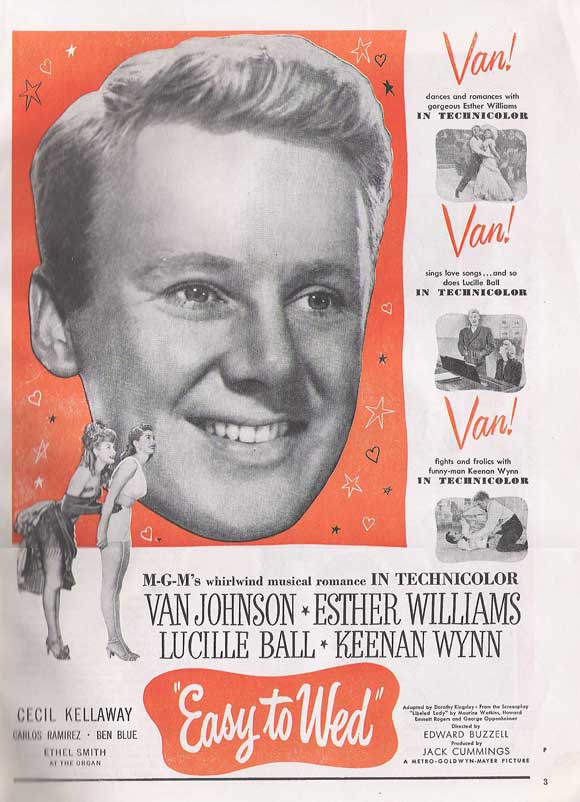
At the time of the film’s release, one of its biggest draws was its leading man, Van Johnson. His appeal mystifies me. There’s nothing wrong with him, but I find his blandness overwhelming.

It’s not that I don’t like movies he’s been in — Thirty Seconds Over Tokyo (1944), in which he plays a heroic bomber pilot, was one of my favorite World War II movies made during the war — but I’d never go out of my way to see a movie just because he was in it, which makes me different from approximately every single woman living in America in the 1940s. I mean, check out that poster above. “Van! … Van! … Van!” What?

Intellectually, I can understand his appeal for the distaff post-war zeitgeist. The metal plate in his head may have kept him out of the war, but he was in enough war movies to give the impression of a returning hero. And unlike the haunted, shell-shocked, sweaty protagonists of countless noirs, Johnson projects nothing but good-natured cheer. He’s the young man you want your daughter to marry, or the even-tempered buddy you introduce to your sister.

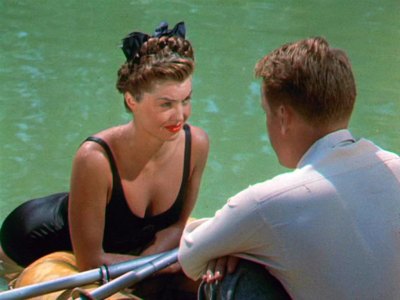
The main selling point of Easy to Wed for me was Esther Williams. There are none of her signature water ballet numbers, but she does spend a lot of time in the water. (Her first kiss with Johnson even takes place underwater.) She is beautiful and sexy, and emerges from the water many times in the picture, sleek and dripping, her makeup still perfect. But she’s beautiful on land, too, and looks great in Technicolor, whether she’s playing a board game by the fire or fully decked-out, singing and dancing in one of the film’s several passable musical numbers.

Besides Williams, the only thing I really liked about Easy to Wed was the crazily outfitted Ethel Smith, who performs a wild musical number at the organ. It’s a scene that borders on the surreal, and I loved it.

A Scandal in Paris (July 19, 1946)

This early film by renowned director Douglas Sirk is based on the life of Eugène François Vidocq, who was the founder of the Sûreté Nationale police force, and is generally regarded as the world’s first private detective. What makes Vidocq fascinating is that he became a crime-fighter only after a fairly lengthy career as a criminal.

Sirk’s film is only very loosely based on Vidocq’s ghost-written memoirs. Vidocq was the father of modern criminology. He is credited with the introduction of modern police methodology and record-keeping, as well as things we now take for granted, such as undercover work, ballistics, and plaster casts of footprints, but you won’t see much of this in A Scandal in Paris (which was also released under the title Thieves’ Holiday). It’s a lighthearted and romantic picaresque adventure in which the focus is firmly on Vidocq’s career as a rake and a rapscallion. The closest he comes to doing any actual police work is when he goes to elaborate and clever lengths to pin his crimes on a romantic rival.

In the world of the film, Vidocq was born in 1775, and came from a poor, honest family, “a little poorer than honest,” he says in voiceover. His mother stole a loaf of bread every time she went into labor in order to give birth in the only shelter available to her — prison. Vidocq claims his mother stole 11 loaves of bread and gave birth to 11 children. He spent the first 30 years of his life engaged in all matter of villainy, and used many surnames, since his father’s name was unknown.

Except for the year of his birth, none of the specifics match the official record, but George Sanders, who plays Vidocq, is such a smooth and engaging performer that I didn’t really care. When he breaks out of prison on his birthday with a file baked into a cake brought to him by the jailer’s daughter, he does so in the best tradition of cinematic Lotharios who can’t utter a true statement to save their lives, but whom you just can’t help but like.

Douglas Sirk was born “Hans Detlef Sierck” in Germany to Danish parents. He grew up in Denmark, but moved to Germany as a teenager. By 1942, he had emigrated to the United States, and was directing the stridently anti-Nazi film Hitler’s Madman (1943), which was made for the Poverty Row studio P.R.C., but was bought and distributed by the prestigious M-G-M. He directed nearly 50 films in Danish, German, and English, but today his reputation rests mainly on the lush melodramas he made in the ’50s, such as All That Heaven Allows (1955), Written on the Wind (1956), and Imitation of Life (1959).

A Scandal in Paris hasn’t gone down in history as a masterpiece, but it’s a pretty good film; light and fluffy, but always visually arresting and with plenty of sly humor. For instance, when we’re told two years have passed while he served in the army, Sanders as Vidocq says that this period of his life was omitted “Out of concern for ‘censorship (military).'”

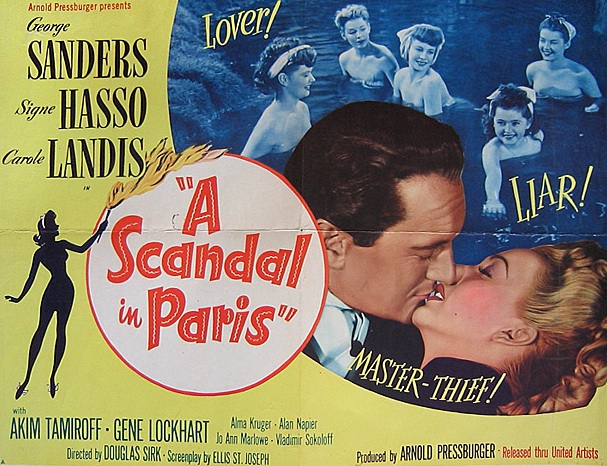
There are a number of interesting motifs running through the film, too. One of these is the English myth of St. George and the dragon. After Vidocq and his cellmate Emile (Akim Tamiroff) escape from prison, they pose for a painting as St. George and the dragon, respectively, before escaping on horseback, still in costume. The painting of them will later show up on a wall of the estate owned by Marquise de Pierremont (Alma Kruger) and Houdon de Pierremont (Alan Napier), the minister of police. Their daughter, Therese de Pierremont (Signe Hasso) falls in love with Vidocq’s image. When she meets him in the flesh, he rides to the rescue of a bunch of bathing beauties (see the poster above) who are terrified by a snake slithering along the banks of a river. Vidocq rides by, and like St. George, kills the serpent. He does so with a nonchalant lash of his riding quirt, not a lance, but the effect is the same. Therese swoons.

The scene is played lightly, as is everything else in the picture. Throughout, Sirk seems to be mocking traditional notions of heroism. Sanders is the perfect actor for the role. He never winks at the camera, but there always seems to be a joke that only he is in on. Lines like, “In crime, as in love, there are only those who do, and those who don’t dare,” could have been awfully clunky coming out of another actor’s mouth, but Sanders’s delivery is perfect.

The Bamboo Blonde (July 15, 1946)

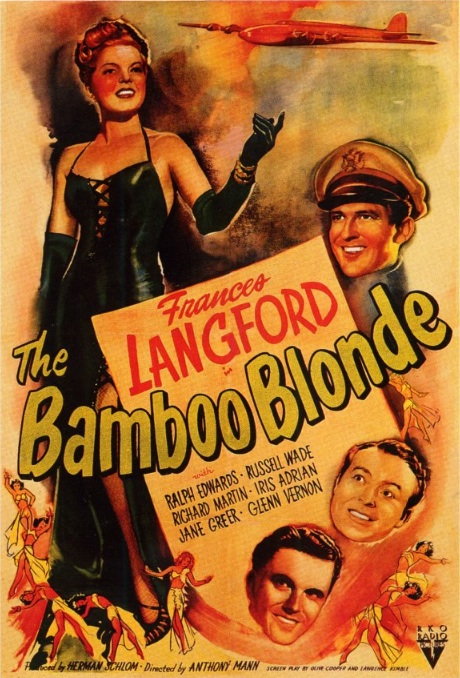
Anthony Mann’s The Bamboo Blonde is a cute little World War II-era programmer based on Wayne Whittaker’s story “Chicago Lulu.” It’s a romantic comedy, but there are nearly enough songs to qualify it as a musical. There are also nearly enough bombing raids over Japan to qualify it as a war movie, but the tone is so light that all the death and destruction on the ground is just there to provide a context for the saucy pinup girl painted on the nose of the bomber. It’s a fun romp — hell and gone from the westerns and noirs on which Mann’s reputation currently rests, but a thoroughly enjoyable way to kill 67 minutes during the dog days of summer.

The film begins with a magazine reporter named Montgomery (Walter Reed) interviewing Eddie Clark (“Truth or Consequences” host/creator Ralph Edwards), the mile-a-minute talker who runs Bamboo Blonde enterprises, an enormous conglomerate that operates a recording studio, furniture manufacturer, hosiery company, cosmetics line, and more. The reporter wants to know how the company got started, and when Eddie finally tires of trying to push Bamboo Blonde brand candy bars on the poor guy, he settles in to tell the story. It all started, Eddie explains, “Around the time Japan was finding out the B-29 wasn’t another American vitamin.”

The picture then begins in earnest, and we see the Ransoms, a wealthy family from Bucks County, Pennsylvania, tearfully send their son, Patrick Ransom, Jr. (Russell Wade), off to war. I say “tearfully,” but I can’t remember if there were any actual tears. The send-off was so wrought with emotion, however, that the presence of waterworks is beside the point. The Ransoms are the type of blue bloods who think nothing of Junior kissing mom on the mouth to say goodbye.

After cutting — or at least loosening — the umbilical cord, young Ransom wanders into Eddie’s Club 50, heedless of the sign outside barring all servicemen from entering. A couple of MPs walk out of the back office, and a perky little blonde named Louise Anderson (Frances Langford) acts quickly, hiding Ransom behind some curtains and then walking onstage to perform the song “I’m Good for Nothing But Love.”

Ransom is the new skipper of a bomber crew, and as the new guy, his boys had sent him to the club as a practical joke, or, as Ransom explains it to Louise over dinner, “Sending me here was a tactical maneuver to ditch me.” The two hit it off right away, and go on the kind of date that was really “on the beam” for the greatest generation, and is still pretty fun today. It starts with dinner at a restaurant with red and white checked tableclothes and candles stuck in bottles that’s run by a woman named “Mom” (Dorothy Vaughan) and it ends in a photo booth. The only thing that seems weird by today’s standards is that Louise sits in the photo booth alone, and Ransom ends up with a little framed photo of her.

That little framed photo will lead to big things. After a disastrous series of runs in the Pacific, Ransom’s B-29 has the worst record in the Air Force, without a single Zero downed. To turn their luck around, one of the guys borrows Ransom’s photo of Louise and paints an Alberto Vargas-style pinup of her with a stacked body “painted from memory.” After a long argument about what exact color hair their sexy new mascot has, they settle on “bamboo blonde,” and they’re well on their way to becoming “that nightmare to the Nips,” as Eddie Clark will later describe them.

The only problem is that Ransom’s crew thinks that Louise is his girlfriend, and he hasn’t disabused them of the notion, even though he has a dark-haired fiancée back home named Eileen Sawyer (Jane Greer, who shows a little bit more of that Out of the Past malevolence than she did in Sunset Pass, which was released a week before this picture). Eileen is a real harpy, and her interest in Ransom is only rekindled because of his growing fame. Meanwhile, Louise first learns that she’s been painted on the side of a bomber while reading a copy of Look magazine that has a picture of Ingrid Bergman on the cover wearing a nun’s habit (presumably from the 1945 film The Bells of St. Mary’s). You don’t have to be a genius to foresee the romantic complications that will arise once Ransom and his boys are called back home for a USO tour with Louise to help sell war bonds.

This is all frothy nonsense, of course, but Mann keeps things moving at a nice clip. Even when working with material that was clearly beneath him, such as this picture and Strange Impersonation (1946), he was able to craft something that was darned watchable. Langford was a classically trained singer, and has a really beautiful voice, which helps. (She was a radio star, and spent a lot of time as a USO performer.) For the most part, the musical numbers are staged in a straightforward fashion, but Mann takes a left turn into the realms of the surreal when Louise sings “Right Along About Evening.” Not only is everything in the idyllic farmland backdrop labeled (e.g., “mailbox,” “dog”), but it end with her rolling up a suddenly two-dimensional Ransom and stuffing him under her pillow before she goes to sleep. Truly odd.

Without Reservations (May 13, 1946)

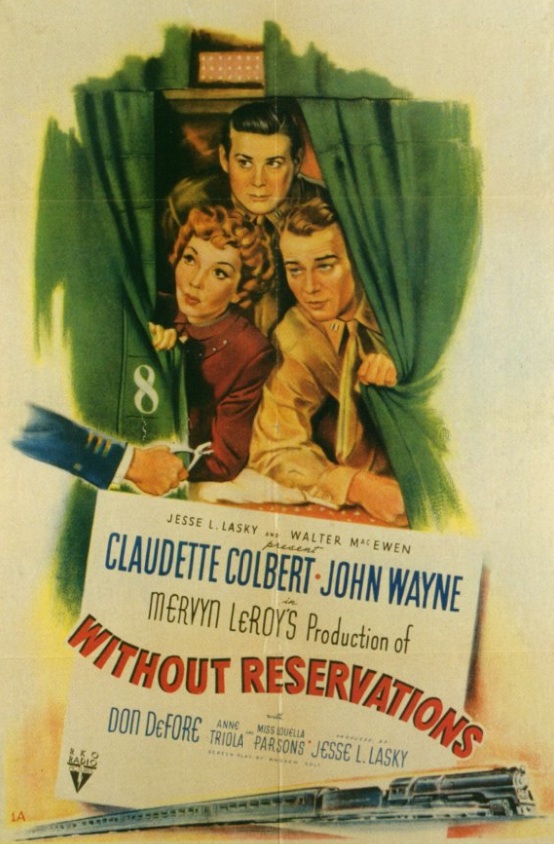
Mervyn LeRoy’s Without Reservations is the kind of old-fashioned romantic comedy that frequently has adjectives like “sparkling” and “breezy” attached to it. It’s also the last film in which John Wayne appeared as one of the leads but did not receive top billing. Claudette Colbert’s star power still shone pretty brightly in 1946.

I thought that LeRoy’s previous film, Thirty Seconds Over Tokyo (1944), was one of the best World War II films I’ve ever seen, so I was looking forward to seeing Without Reservations, but found it mediocre. I enjoyed it, but I didn’t love it.

In the film, Colbert plays Christopher “Kit” Madden, a sort of socially progressive version of Ayn Rand. Her novel Here Is Tomorrow is a runaway best-seller, and is the one book it seems that everyone in post-war America has read. When the film begins, Kit is arguing with film producer Henry Baldwin (Thurston Hall), who is unable to fulfill his promise to secure Cary Grant for the part of Mark Winston, the protagonist of Here Is Tomorrow. Kit won’t consider making the picture without Cary Grant, and begins drafting a letter while traveling by train that will stop production of the film. Anyone who’s been paying attention, however, will notice that the heroic painting of Mark Winston on the cover of her novel looks an awful lot like John Wayne, and will probably be able to predict what will happen next.

Sure enough, Kit meets two Marine pilots, Rusty Thomas (John Wayne) and Dink Watson (Don DeFore), on the train. As soon as she lays her eyes on Rusty, she realizes he’s perfect for the role of Mark Winston, and immediately begins to rewrite her letter. Since she introduces herself only as “Kit,” and the novel was published under her full name, Dink and Rusty don’t realize that she’s the most popular author in America. When she asks Rusty what he thinks of the novel Here Is Tomorrow he rips into it with abandon. His main complaint seems to be that the romance in the novel is unconvincing. Mark Winston, a progressive with grand plans to remake America, is chased around by a woman, but they can’t make things work because she’s a political reactionary.

In reality, of course, it’s Kit who’s the progressive (Mark Winston is merely her mouthpiece) and Rusty who’s the reactionary. Without Reservations is based on the novel Thanks, God! I’ll Take It From Here, by Jane Allen and Mae Livingston. I haven’t read the novel, but if the film is in any way faithful to its source material, the title comes from a speech Rusty makes about the first men in America. According to Rusty, no amount of political disagreement is enough to keep a man and a woman apart if they’re hot for each other. (Can you sense, yet, where the film might be heading?)

Angry about the grand plan laid out for society in Here Is Tomorrow, Rusty says to Kit, “Have you ever heard of some fellows who first came over to this country? You know what they found? They found a howling wilderness, where summer’s too hot and winter’s freezing. And they also found some unpleasant little characters who painted their faces. Do you think these pioneers filled out form number X6277 and sent in a report saying the Indians were a little unreasonable? Did they have insurance for their old age? For their crops? For their homes? They did not. They looked at the land and the forest and the rivers. They looked at their wives, their kids, and their houses. And then they looked up at the sky and they said, ‘Thanks, God. We’ll take it from here.'”

Watching the film in 2010, I found it hard to believe that no one from the Tea Party movement has latched onto this scene and played it on JumboTrons across the country, since its simplistic vision of America’s beginnings and total opposition to the federal government and even the most basic of social programs seem so close to that movement’s weltanshauung. Not to mention that the speech is delivered as only John Wayne can.

There’s a lot of great stuff going on here, and Wayne and Colbert have decent chemistry, even though he’s not that well suited to playing a romantic lead, especially in a comedy. If Without Reservations had kept up the momentum it establishes in its first couple of acts, I would have really liked it. Unfortunately, it goes off the rails and becomes a meandering road movie.

But not before Rusty, Kit, and Dink run afoul of one of the Pullman porters when they stack up the tables in the club car and have Kit “fly a plane” with a stand-up ashtray for a yoke. The drunken Kit eventually falls over, knocking everything to the ground. Like a bunch of goons, they run off, leaving the mess for one of the porters to clean up while they hide in one of the sleeping compartments (see the film’s poster above).

Once on the road, they buy a flashy sports car from its exasperated owner, and it constantly breaks down. They stay with a colorful Mexican family with a hot and spicy daughter named Dolores (Dona Drake) and a fiery patriarch, Señor Ortega (Frank Puglia), who teaches Kit a few things about love, namely how brutal, selfish, and turbulent it is, and should be. “Love and violence walk hand in hand, señorita!” he says.

The strangest thing about Without Reservations is that Colbert and Wayne do not appear in the same scene at any point during the last act of the film. Kit galivants around Hollywood with a series of leading men in an effort to make Rusty jealous, and the viewer is treated to cameos by Cary Grant (playing himself) and Raymond Burr (still young and trim enough to play an up-and-coming leading man named “Paul Gill”). In these sequences it makes sense for Colbert and Wayne to not appear together, since they’re in different physical locations, but when Rusty finally gives in and appears on Kit’s doorstep, we hear him ringing her doorbell and see her run out of her bedroom downstairs to let him in, but the camera pans right and stops and lingers on a shot of her bed as we hear her greet him off screen. Fade to black. It’s about as subtle as a train going into a tunnel.

I know there are legions of people who think Colbert was the epitome of class, beauty, and charm, but I found her unappealing in this film. With her little stick body, hunched shoulders, spastic movements, short hair in a tight perm, and heavy makeup, she looked to me like an eighty-year old woman with a forty-year old face.

The Seventh Veil (Feb. 15, 1946)

Compton Bennett’s film The Seventh Veil premiered in London on October 18, 1945. It was the biggest box office success of the year in Britain. The first record of its showing in the United States I can find is on Christmas day, 1945, in New York City. It went into wide release in the U.S. on February 15, 1946, and won an Academy Award the next year for best original screenplay. The story and script were by Sydney and Muriel Box. Sydney Box also produced the film.

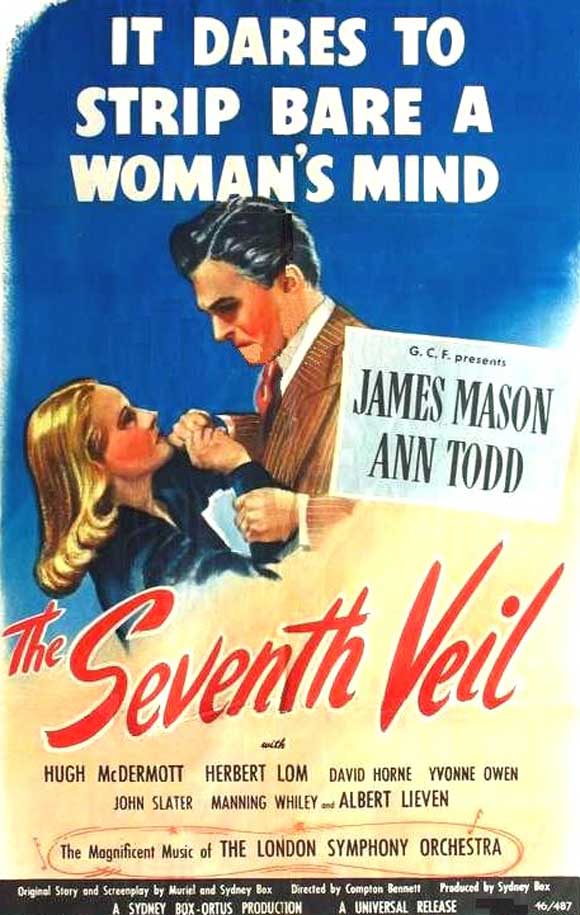
The title refers to the seven veils that Salomé peeled away in history’s most famous striptease. As Dr. Larsen (Herbert Lom) explains to his colleagues, “The human mind is like Salomé at the beginning of her dance, hidden from the outside world by seven veils. Veils of reserve, shyness, fear. Now, with friends the average person will drop first one veil, then another, maybe three or four altogether. With a lover, she will take off five. Or even six. But never the seventh. Never. You see, the human mind likes to cover its nakedness, too, and keep its private thoughts to itself. Salomé dropped her seventh veil of her own free will, but you will never get the human mind to do that.”

The mind Dr. Larsen is attempting to strip bare is that of Francesca Cunningham (Ann Todd), a concert pianist who has lost the will to live, and who has been hospitalized after a suicide attempt. For the first hour of the film, her psychoanalytic sessions with Dr. Larsen act mostly as a framing device for Francesca’s flashbacks, but by the end, the high-minded hooey is laid on nearly as thick as it is in Alfred Hitchcock’s contemporaneous film Spellbound.

In her first flashback, Francesa recalls her schoolgirl days with her friend Susan Brook (Yvonne Owen). Susan’s insouciance towards academics is responsible for both of them being late to class one too many times. If Susan is punished, we don’t see it. Francesca’s punishment, however, will have dire ramifications. Brutally beaten across the backs of her hands with a ruler on the morning of her scholarship recital, she blows it completely, and is so devastated she gives up the piano.

When she is orphaned at the age of 17, Francesca is taken in by her uncle Nicholas (James Mason), a man whom she barely knows. She learns that the term “uncle” is a misnomer, since Nicholas is actually her father’s second cousin. Interestingly, both Mason and Todd were 36 years old when they appeared in this film. Their lack of an age difference isn’t too distracting, though. Todd has a wan, ethereal visage that lends itself to playing young, and Mason’s dark, Mephistophelian countenance is eternally middle-aged and handsome.

Nicholas is a confirmed bachelor who walks with a slight limp and hates women. He is also a brilliant music teacher, although his own skills as a musician are only average. Under his sometimes cruel tutelage, Francesca practices four to five hours a day, and eventually becomes an accomplished musician. Nicholas’s control over her comes at a cost. While she is studying at the Royal College of Music, Francesca falls in love with an American swing band leader named Peter Gay (Hugh McDermott). When Francesca tells Nicholas that she is engaged, he refuses to give his consent, since she has not yet reached her age of majority (in this case, 21), and tells her she will leave with him for Paris immediately. She does so, and continues her education in Europe.

For a melodrama, The Seventh Veil manages to be fairly gripping, especially if you find depictions of live performances stressful. When Francesca makes her debut with the London Symphony Orchestra (conducted by Muir Mathieson), performing Rachmaninoff’s Piano Concerto No. 2 in C minor and Grieg’s Piano Concerto in A minor, the film cuts between Francesca sitting at the piano, her hands (doubled by the pianist Eileen Joyce), Nicholas standing offstage, and her old friend Susan, who is in the front row. Not only does Susan, now a wealthy socialite, enter late and talk during the performance, but her mere presence reminds Francesca so strongly of the brutal whipping her hands received as a girl that the act of playing becomes almost too much to bear. She makes it through the performance, but when she rises to bow, she collapses from sheer exhaustion.

Francesca’s next trial — and the one that will result in her institutionalization — comes when Nicholas hires an artist named Maxwell Leyden (Albert Lieven) to paint her portrait. Francesca and Maxwell fall in love and go away to live together, despite Nicholas’s violent objections, but after a car accident, Francesca becomes convinced that her hands are irreparably damaged and she will never play again. Dr. Larsen, however, tells her there is nothing physically wrong with her, and he makes it his mission to cure her.

In the end, it is a recording of the simple, beautiful melody of the second movement of Beethoven’s Piano Sonata No. 8, “Pathétique,” along with a good old-fashioned session of hypnosis, that frees Francesca from her mental prison. The climax of the film does not hinge on whether or not she will perform again, however. It hinges on which of the three men in her life she will end up with; Peter, Maxwell, or Nicholas.

As soon as her choice is made, the film ends. There is no depiction of consequences. How satisfying the viewer finds the ending partly depends on which male character they like best, I suppose, although there are other considerations, such as how one feels about the question of whether it is better to be a great artist or to be happy, or even if Francesca can have one without the other. Personally, I found it all a bit ridiculous, but I enjoyed the film overall.

Spellbound (Dec. 28, 1945)

Spellbound
Spellbound (1945)
Directed by Alfred Hitchcock
United Artists

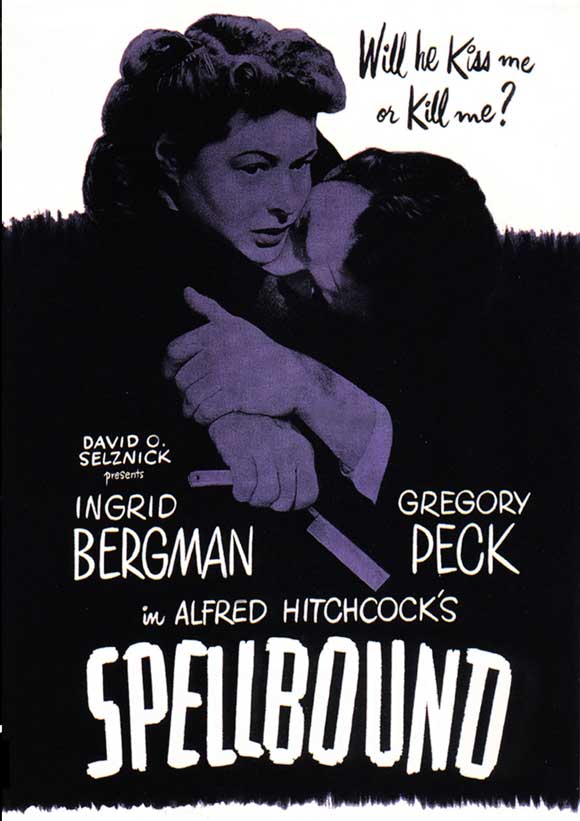
Alfred Hitchcock’s Spellbound gets knocked around for its basis in Freudian theory. Many reviews of the film written in the past 20 years use words like “dated,” “implausible,” and “preposterous.” A lot of these same reviews also praise the dream sequence, which was designed by Salvador Dalí, as the most memorable part of the film.

Freud has been knocked around, criticized, and discredited since the turn of the century, so to dismiss a film’s plot and ideas merely because they are “Freudian” seems like picking low-hanging fruit. Granted, Freud had a lot of wild ideas, but he was a brilliant thinker, and should be viewed as a philosopher and a humanist as much as a doctor or scientist. Also, many people who dismiss Freud out of hand haven’t actually read any of his writing, and cannot discuss his ideas beyond the fact that they’ve heard that they’re loony.

Upon revisiting the film, I found the much-praised dream sequence by Dalí overly gimmicky, adding little to the narrative beyond a “gee whiz” moment. (Hitchcock had almost nothing to do with its production. Dalí worked with a production unit from the Poverty Row studio Monogram Pictures on the sequence.) There’s nothing wrong with “gee whiz” moments, but Spellbound is an underappreciated film in Hitchcock’s oeuvre, and it bears rewatching as a complete work of art, not just as a showcase for pop surrealism or “dated” notions of neuroses and the unconscious.

In 1942, after winning back-to-back Academy Awards for best picture (then called “outstanding production”) for Victor Fleming’s Gone With the Wind (1939) and Alfred Hitchcock’s Rebecca (1940), producer David O. Selznick was morose. He took time off and sought treatment. His experience with the “talking cure” was so positive that he decided to produce a picture with psychoanalysis as its subject. In 1943, Hitchcock mentioned to Selznick that he owned the screen rights to the 1927 novel The House of Dr. Edwardes, written by Hilary St. George Saunders and John Palmer under the pseudonym “Francis Beeding.” The Gothic potboiler was about a homicidal lunatic who kidnaps a doctor named Murchison and impersonates him, taking over his position as head of a mental institution. A female doctor named Constance Sedgwick uncovers the impostor’s ruse and eventually marries the real Dr. Murchison.

In early 1944, Hitchcock and his friend Angus MacPhail crafted a preliminary screenplay in which Dr. Murchison was the outgoing head of the institution and Dr. Edwardes was his successor. They also created a romance between Constance and Dr. Edwardes, as well as the downhill skiing set piece that cures Edwardes of his amnesia. In March 1944, Selznick offered Hitchcock the talents of Ben Hecht, and Hitchcock and Hecht worked together for months to refine the screenplay. They even visited mental institutions, and preliminary versions of Spellbound featured more semi-documentary material than the final product does.

The final product may be, as Hitchcock told François Truffaut, “just another manhunt story wrapped up in pseudo-psychoanalysis.” But with Hitchcock behind the camera, even the most pedestrian manhunt story can become something dazzling. Hitchcock considered Spellbound one of his minor works, but part of his underestimation of the picture could have been due to all the clashes he had with Selznick, who was known for meddling with his productions. Selznick even hired his own therapist, Dr. May E. Romm, as a technical advisor for the film. There’s a story, possibly apocryphal, that when Dr. Romm told Hitchcock that an aspect of psychoanalysis in Spellbound was presented inaccurately, Hitchcock responded, “It’s only a movie.”

In Spellbound, Ingrid Bergman plays Dr. Constance Petersen, a psychoanalyst at Green Manors, a Vermont mental hospital. Dr. Murchison (Leo G. Carroll), the director of Green Manors, is being forced into retirement shortly after returning to work following a nervous breakdown. His replacement is the young, handsome Dr. Anthony Edwardes (Gregory Peck). “My age hasn’t caught up with me,” Dr. Edwardes responds when someone mentions how young he appears. But this isn’t the case, of course. He is actually an amnesiac who has no idea who he is or how he arrived at Green Manors. His state of confusion is such that he initially believed he was Dr. Edwardes, and is now playing the role because he doesn’t know what else to do. Dr. Petersen uncovers the truth, but she has already fallen instantly, madly in love with him. When the rest of the world learns the truth about Dr. Edwardes, he flees Green Manors. He still has amnesia, but he knows that his real initials are “J.B.” He heads for New York, and tells Dr. Petersen not to follow him. Does she follow his advice? Of course she doesn’t.

The romance is a high point of the film. The presentation of Dr. Petersen’s initial “frigidity” is certainly dated, but it leads to one of Hitchcock’s wildest sequences. When Bergman first kisses Peck, a shot of her forehead dissolves into a shot of a door. The door opens, revealing another door, which also opens, revealing another door, and so on.

Bergman’s performance is pitch perfect in every scene. Peck’s performance is less natural, but it works, since he is playing a man who literally doesn’t know who he is. (Apparently Peck craved more direction from Hitchcock, but Hitchcock just kept telling him things like “drain your face of all emotion.” Hitchcock had little patience for method acting.) Also, you would be hard-pressed to find two actors in 1945 who were more physically attractive than Bergman or Peck.

The cinematography by George Barnes is another high point. Each shot in Spellbound is beautifully constructed, and gives off a silvery glow. There are a number of choices that are still shocking, such as a flashback to an accidental death, or the penultimate sequence in the film, in which a P.O.V. shot shows a revolver being turned directly on the audience. When the trigger is pulled, there is a splash of red, the only instance of color in the film. It’s an assault on the audience par excellence from a man who spent his entire career assaulting his audience while almost never alienating them, which is not an easy thing to do.

Miklós Rózsa’s score for the film incorporates a haunting theremin melody, as did his score for The Lost Weekend, released around the same time. Rózsa won an Academy Award for best score for his work on Spellbound. Hitchcock was disappointed in the music, however, since it emphasized the romantic aspects of the film, and was more to Selznick’s liking than his own.

Sometimes creative dissonance leads to great creations, however. Spellbound is a great movie, whether or not its producer and director ever saw eye to eye.