Author Archives: Adam Lounsbery

Ambush Trail (Feb. 17, 1946)

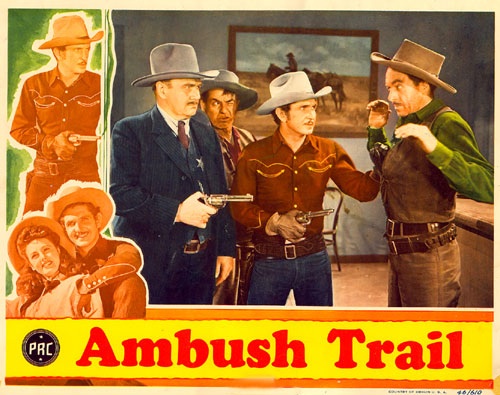
Even by 1946 standards, Ambush Trail looks like a relic of an earlier time. The film stars cowboy actor Bob Steele, who played in more than a hundred westerns from the silent era onward, but Ambush Trail is the first film starring him that I’ve seen. He was a supporting player in The Big Sleep (1946), which I have seen, but I couldn’t have picked him out of a crowd if you paid me. Even though it’s a talkie, Ambush Trail has all the hallmarks of a bad silent film; stilted acting, awkward pauses, and lame comic relief from a rubber-faced sidekick (Syd Saylor). It’s also blocked and edited like a silent movie, and only really comes alive during the fistfights, of which there are many.

A small, trim man (his listed height is 5’5″), Steele had dark, curly hair and a neat little mustache. (Check him out in the lobby card above. He’s the one with the whitest hat, the bluest jeans, and the fanciest shirt.) Steele’s earliest roles were in a series of shorts directed by his father, Robert N. Bradbury. He originally went by his birth name, Bob Bradbury, Jr., and his first film role was at the age of 14, in the Pathé short The Adventures of Bob and Bill (1920), which also starred his twin brother, Bill Bradbury. The two young men went on to star together in more than a dozen semi-documentary nature adventure shorts with titles like Trapping the Wildcat (1921), Outwitting the Timber Wolf (1921), and Trailing the Coyote (1921). As he grew older, Steele became a star in his own right, and a box office draw as a star of westerns.

By the mid-’40s, however, his star was fading, and it’s not hard to see why. Steele may be the best actor in Ambush Trail, but that’s only because everyone else is so God-awful. He plays a cowboy named Curley Thompson who has just purchased the Flying A Ranch. To his surprise, Curley learns that the ranch comes with a pea-brained foreman named Sam Hawkins (Saylor), who can’t even ride a horse. (He can handle a buckboard, however, which will come in handy later in the picture.) Curley quickly runs afoul of the local boss, freight owner Hatch Bolton (I. Stanford Jolley). Bolton is systematically ruining the local ranchers so he can buy them out cheap and sell their ranches to a grain combine in Chicago.

After Sheriff Tom Gordon (Henry Hall) is ambushed and disappears, his brother, Deputy Walter Gordon (Kermit Maynard) takes over. Gordon and his gal pal, Alice Rhodes (Lorraine Miller), join up with Curley and Hawkins in their fight against Bolton. When a local rancher named Joe Moore (Al Ferguson) is shot through a window and murdered while he’s meeting with Curley, Bolton and the crooked Marshal Dawes (Ed Cassidy) pin the murder on Curley. After Deputy Gordon frees him from the local jail, Curley hunts for evidence against Bolton that the missing sheriff may have left behind, and the fight is on.

Throughout the picture, Steele moves and emotes as though he’s in a silent film. He delivers his lines in a competent fashion, but he still looks as if he’d be more comfortable with heavy makeup and a live piano accompaniment. His character is a bit of a wet blanket, too. Curley drinks lemon soda instead of liquor, and even weans his sidekick, Hawkins, off the hard stuff, too. Steele’s not terrible, and neither is Ambush Trail, but it’s not very good, either. It’s a passable B western, but only if you really like B westerns.
The Seventh Veil (Feb. 15, 1946)

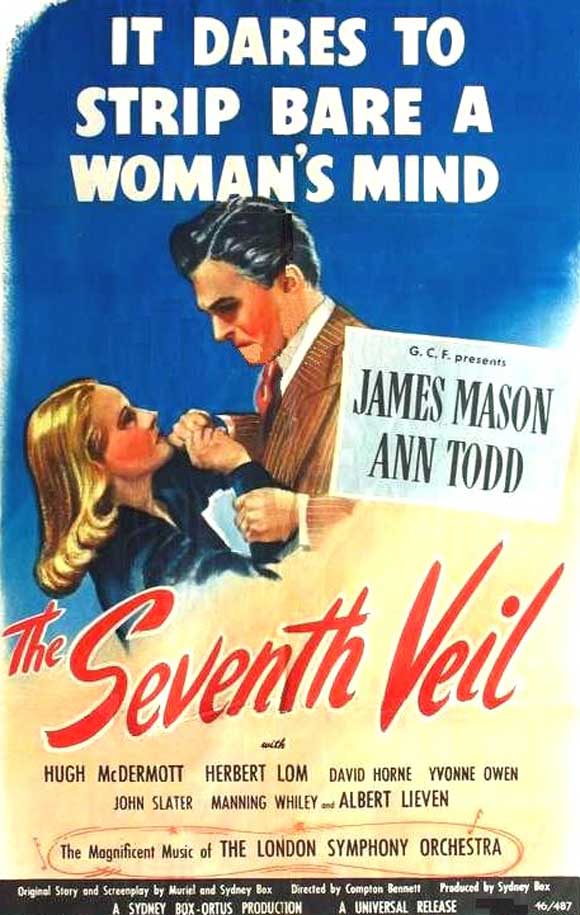
Compton Bennett’s film The Seventh Veil premiered in London on October 18, 1945. It was the biggest box office success of the year in Britain. The first record of its showing in the United States I can find is on Christmas day, 1945, in New York City. It went into wide release in the U.S. on February 15, 1946, and won an Academy Award the next year for best original screenplay. The story and script were by Sydney and Muriel Box. Sydney Box also produced the film.

The title refers to the seven veils that Salomé peeled away in history’s most famous striptease. As Dr. Larsen (Herbert Lom) explains to his colleagues, “The human mind is like Salomé at the beginning of her dance, hidden from the outside world by seven veils. Veils of reserve, shyness, fear. Now, with friends the average person will drop first one veil, then another, maybe three or four altogether. With a lover, she will take off five. Or even six. But never the seventh. Never. You see, the human mind likes to cover its nakedness, too, and keep its private thoughts to itself. Salomé dropped her seventh veil of her own free will, but you will never get the human mind to do that.”

The mind Dr. Larsen is attempting to strip bare is that of Francesca Cunningham (Ann Todd), a concert pianist who has lost the will to live, and who has been hospitalized after a suicide attempt. For the first hour of the film, her psychoanalytic sessions with Dr. Larsen act mostly as a framing device for Francesca’s flashbacks, but by the end, the high-minded hooey is laid on nearly as thick as it is in Alfred Hitchcock’s contemporaneous film Spellbound.

In her first flashback, Francesa recalls her schoolgirl days with her friend Susan Brook (Yvonne Owen). Susan’s insouciance towards academics is responsible for both of them being late to class one too many times. If Susan is punished, we don’t see it. Francesca’s punishment, however, will have dire ramifications. Brutally beaten across the backs of her hands with a ruler on the morning of her scholarship recital, she blows it completely, and is so devastated she gives up the piano.

When she is orphaned at the age of 17, Francesca is taken in by her uncle Nicholas (James Mason), a man whom she barely knows. She learns that the term “uncle” is a misnomer, since Nicholas is actually her father’s second cousin. Interestingly, both Mason and Todd were 36 years old when they appeared in this film. Their lack of an age difference isn’t too distracting, though. Todd has a wan, ethereal visage that lends itself to playing young, and Mason’s dark, Mephistophelian countenance is eternally middle-aged and handsome.

Nicholas is a confirmed bachelor who walks with a slight limp and hates women. He is also a brilliant music teacher, although his own skills as a musician are only average. Under his sometimes cruel tutelage, Francesca practices four to five hours a day, and eventually becomes an accomplished musician. Nicholas’s control over her comes at a cost. While she is studying at the Royal College of Music, Francesca falls in love with an American swing band leader named Peter Gay (Hugh McDermott). When Francesca tells Nicholas that she is engaged, he refuses to give his consent, since she has not yet reached her age of majority (in this case, 21), and tells her she will leave with him for Paris immediately. She does so, and continues her education in Europe.

For a melodrama, The Seventh Veil manages to be fairly gripping, especially if you find depictions of live performances stressful. When Francesca makes her debut with the London Symphony Orchestra (conducted by Muir Mathieson), performing Rachmaninoff’s Piano Concerto No. 2 in C minor and Grieg’s Piano Concerto in A minor, the film cuts between Francesca sitting at the piano, her hands (doubled by the pianist Eileen Joyce), Nicholas standing offstage, and her old friend Susan, who is in the front row. Not only does Susan, now a wealthy socialite, enter late and talk during the performance, but her mere presence reminds Francesca so strongly of the brutal whipping her hands received as a girl that the act of playing becomes almost too much to bear. She makes it through the performance, but when she rises to bow, she collapses from sheer exhaustion.

Francesca’s next trial — and the one that will result in her institutionalization — comes when Nicholas hires an artist named Maxwell Leyden (Albert Lieven) to paint her portrait. Francesca and Maxwell fall in love and go away to live together, despite Nicholas’s violent objections, but after a car accident, Francesca becomes convinced that her hands are irreparably damaged and she will never play again. Dr. Larsen, however, tells her there is nothing physically wrong with her, and he makes it his mission to cure her.

In the end, it is a recording of the simple, beautiful melody of the second movement of Beethoven’s Piano Sonata No. 8, “Pathétique,” along with a good old-fashioned session of hypnosis, that frees Francesca from her mental prison. The climax of the film does not hinge on whether or not she will perform again, however. It hinges on which of the three men in her life she will end up with; Peter, Maxwell, or Nicholas.

As soon as her choice is made, the film ends. There is no depiction of consequences. How satisfying the viewer finds the ending partly depends on which male character they like best, I suppose, although there are other considerations, such as how one feels about the question of whether it is better to be a great artist or to be happy, or even if Francesca can have one without the other. Personally, I found it all a bit ridiculous, but I enjoyed the film overall.

Gilda (Feb. 14, 1946)

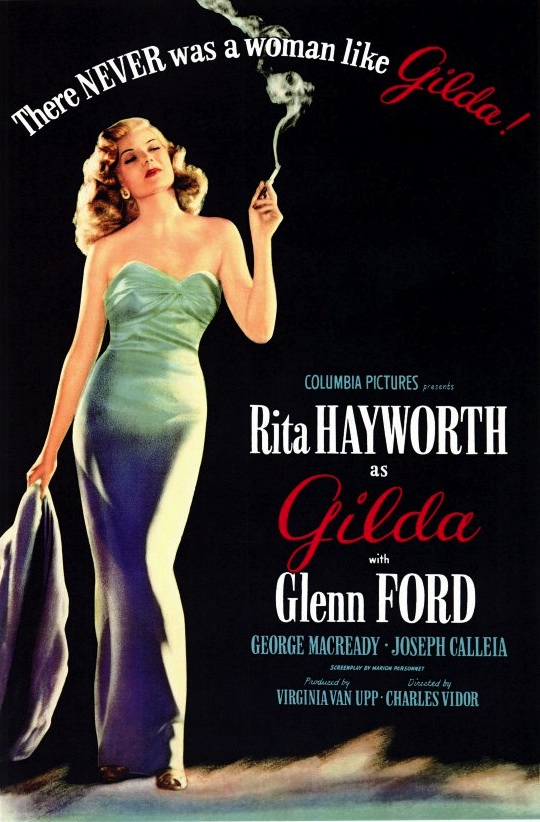
Charles Vidor’s Gilda premiered on February 14, 1946, and went into wide release on March 15. It’s best remembered as the film that made Rita Hayworth the biggest sex symbol of the ’40s. (Not that she was a shrinking violet before 1946. I saw her in the 1944 film Cover Girl when I was a kid, and I never forgot her.)

Born Margarita Carmen Cansino in Brooklyn in 1918, Hayworth was the daughter of Spanish flamenco dancer Eduardo Cansino, Sr. and Ziegfeld girl Volga Hayworth. With that kind of pedigree, her hundred-megawatt sex appeal should come as no surprise, but it does, even today. Usually the only image I post with a review is the theatrical poster, but for this review I was tempted to plaster up several cheesecake shots of Hayworth. The only problem with photos of her is that they lack something. She looks great in all of her pinup shots, but her blisteringly hot sexiness is something that needs to be seen on film to be believed. It doesn’t hurt that nearly every line in Gilda is an innuendo. When she first appears on screen, throwing back her mountain of wavy hair, and her husband asks her if she’s decent, the long pause after her bright, “Me?” followed by the husky response, “Sure, I’m decent,” clearly has nothing to do with whether or not she’s fully clothed.

Besides the obvious lascivious value Hayworth offers the production, Gilda is a pretty good movie, full of nasty double-crosses and intrigue in an exotic locale. At one hour and 50 minutes, it overstays its welcome by at least 10 or 15 minutes, but it’s still an entertaining film noir about love-hate relationships, high-stakes gambling, and double-dealing.

When we meet Johnny Farrell (Glenn Ford), he’s just another down-on-his-luck gringo in Buenos Aires, Argentina, a post-war hot spot (and not just for Nazi war criminals on the lam). In noir fashion, Farrell narrates the picture, sounding jaded and world-weary when he’s not twisted up with hatred and lust. Caught cheating at craps, Farrell is saved from a vicious beating at the hands of a bunch of thugs by a dapper gentleman named Ballin Mundson (George Macready) who wields a sword cane. Mundson tells Farrell of a casino where he can go to make some real money; a ritzy, illegal establishment that operates in the open, thanks to bribery. Mundson warns Farrell, however, not to cheat there. The bullheaded Farrell does exactly that, and is caught. A couple of mugs drag him into the second-floor office to face the boss, who turns out to be none other than Mundson. A fast talker, Farrell convinces Mundson to give him a job in the casino, and he quickly rises to the level of right-hand man.

Things go along swimmingly until the day that Mundson ignores his own advice that “Gambling and women don’t mix,” and brings home his new wife, Gilda (Hayworth). From the look on Farrell’s face when he first sees her, he might as well be seeing the atomic bomb being dropped on Nagasaki. Unaware that Farrell and Gilda share a history, Mundson entrusts his right-hand man with Gilda’s care and keeping. Forced to shield Mundson from Gilda’s constant indiscretions with other men, Farrell’s hatred of Gilda increases. Only it isn’t really hatred. It’s that strange brand of love/hate that fueled many a post-war film noir. Or, as Mundson himself puts it at one point, “It warmed me. Hate is the only thing that has ever warmed me.”

Meanwhile, Mundson’s secret plans to form a cartel with a group of Germans to control tungsten production in Argentina slowly comes to light, and Farrell realizes that the Argentine secret police are onto Mundson, and that the whole casino is a powder keg waiting to be ignited.

Argentina had a checkered history during World War II. The nation broke relations with Germany and Japan in 1944 only under heavy pressure from the United States, but continued to maintain its neutrality. On March 27, 1945, Argentina declared war on Germany, when German defeat was a foregone conclusion.

It’s a great setting for a tale of steamy intrigue (with a brief narrative sojourn in Montevideo), but the political and criminal machinations take a back seat to the sexual tension between Farrell and Gilda. Their love/hate relationship takes some nasty turns, both physical and psychological. (In the scene in which Gilda slaps Farrell across both sides of his face, Hayworth reportedly chipped two of Ford’s teeth.) The story also takes a back seat to the sheer physical spectacle of Gilda, in particular the show-stopping number in which she performs “Put the Blame on Mame.” Hayworth lip-synched to Anita Ellis’s singing voice, and did an excellent job. Just from watching the movie I wouldn’t have had any idea she wasn’t singing herself.

“If I’d been a ranch, they would have named me the Bar None,” Gilda says at one point in the film. Truer words have not been spoken.

The Spiral Staircase (Feb. 6, 1946)

Robert Siodmak’s The Spiral Staircase was made in 1945, and released into some theaters in December. The earliest confirmed day of release I could find, however, was February 6, 1946, in New York City, so I’m reviewing it here.

Based on Ethel Lina White’s 1933 novel Some Must Watch, The Spiral Staircase is a slick, good-looking thriller with some striking visual choices. White’s novel took place in contemporary England, but the film is set in early 20th century Massachusetts. Some sources I’ve found claim it takes place circa 1916, but the silent film an audience in a movie house is watching in the first scene of the film is D.W. Griffith’s 1912 short The Sands of Dee, and one of the characters has just returned from Paris, about which he waxes rhapsodic, speaking wistfully of all the beautiful women. So it seems to me that the action of the film must take place before the First World War.

The Spiral Staircase doesn’t take long to deliver its terrifying goods. In one of the rooms above the silent movie house, we see a young woman (Myrna Dell) getting undressed. She walks with a slight limp. When the camera moves into her closet as she hangs up her dress, there is a pause, then the camera moves into the thicket of hanging clothes. They part slightly, and suddenly we see an enormous, maniacal eye fill the screen. We then see the girl reflected in the eye, her lower half blurred (why this is will be explained later).

Alfred Hitchcock used a closeup of Anthony Perkin’s eye to great effect in Psycho (1960). And one of the earliest indelible images in the history of cinema was an eyeball being slit open by a straight razor in Luis Buñuel’s short film Un chien andalou (1929). But a close shot of an eye used in the same way as a violin stab on the soundtrack, or a shadow quickly passing across the frame, to make the audience jump out of their seats, is relatively rare. I thought Bob Clark’s Black Christmas (1974) was the first film to do this — when the killer is shockingly revealed as an eyeball peering out from between an open door and a door jamb — but apparently it wasn’t.

Among the patrons of the movie house, none of whom is questioned by the incompetent local constable (James Bell) after the murder, is a mute woman named Helen Capel (Dorothy McGuire). Her friend, the handsome young Dr. Parry (Kent Smith), gives her a ride home, and tells her that he believes her muteness can be overcome. She silently demurs, and goes home to the creepy old mansion where she is employed as a servant to the bedridden but mentally sharp Mrs. Warren (Ethel Barrymore). Also present in the house are the other domestics, Mr. and Mrs. Oates (Rhys Williams and Elsa Lanchester, who looks a lot frumpier than when she played The Bride of Frankenstein in 1935), Mrs. Warren’s two stepsons, Prof. Albert Warren (George Brent) and ne’er-do-well Steve Warren (Gordon Oliver), the professor’s pretty assistant Blanche (Rhonda Fleming), and Mrs. Warren’s crotchety old nurse (Sarah Allgood).

Once the action settles down and focuses on the Warren estate, The Spiral Staircase becomes a more predictable game of whodunnit, as well as a frustrating game of “when will she find the strength to scream for help, already?”

The film is never boring, however, due in no small part to the brilliant cinematography of Nicholas Musuraca. The Spiral Staircase is all shadows and gaslight, which — along with one of the longest thunderstorms on film — hearkens back to spooky haunted house pictures like James Whale’s The Old Dark House (1932).

The Spiral Staircase is not quite a masterpiece, and it never aspires to be more than a pulse-quickening thriller, but it is exceptionally well-made entertainment.

Terror by Night (Feb. 1, 1946)

Thrillers set on trains have a special place in my heart. It’s not only because I love to travel by train. It’s also because I think a passenger train is the perfect setting for a mystery. It provides a single location and a set cast of characters/suspects, just like any good English country manor, but with the added excitement of constant movement and breakneck speed.

A short list of my favorite thrillers set on trains would include Alfred Hitchcock’s The Lady Vanishes (1938), The Narrow Margin (1952) (the 1990 remake featuring Gene Hackman is worth seeing, as well), and Horror Express (1972). But even lesser efforts set on trains delight me, such as the Michael Shayne mystery Sleepers West (1941) and the Steven Seagal slugfest Under Siege 2: Dark Territory (1995).

So when I saw that Roy William Neill’s tenth outing in the director’s chair for a Sherlock Holmes film (and the thirteenth film in the series overall) was set on a train, I was really looking forward to it.

Terror by Night, which stars Basil Rathbone as Sherlock Holmes and Nigel Bruce as his faithful friend Dr. Watson, does not disappoint. Loosely based on two stories by Sir Arthur Conan Doyle, “The Adventure of the Blue Carbuncle,” from The Adventures of Sherlock Holmes (1891), and “The Disappearance of Lady Frances Carfax,” from His Last Bow (1917), with a few elements taken from The Sign of Four (1890), Terror by Night follows Holmes and Watson as they attempt to foil the theft of a diamond on a train bound for Scotland.

The diamond in question, the ridiculously ostentatious “Star of Rhodesia,” is owned by Lady Margaret Carstairs (Mary Forbes), who is traveling with her fey son Roland (Geoffrey Steele). Also aboard the train is a young woman named Vivian Vedder (Renee Godfrey), who, in the first scene of the picture, has a special coffin prepared, supposedly to transport her mother’s body. The presence of a secret compartment in the coffin, however, alerts the viewer that Miss Vedder is probably up to no good.

Also aboard are an old friend of Dr. Watson’s from his time in India, Maj. Duncan-Bleek (Alan Mowbray), the dependably lunkheaded Inspector Lestrade (Dennis Hoey), Prof. William Kilbane (Frederick Worlock), whom the blustery Watson interrogates in a comical scene, and a skittish married couple (Gerald Hamer and Janet Murdoch).

Universal Pictures’s Sherlock Holmes series is my favorite mystery series of the ’40s. Except for a few duds early in the series that focused too much on World War II-era propaganda, the Holmes pictures with Rathbone and Bruce and some of the most thoroughly enjoyable, clever, and fast-paced mysteries I’ve had the pleasure to see.

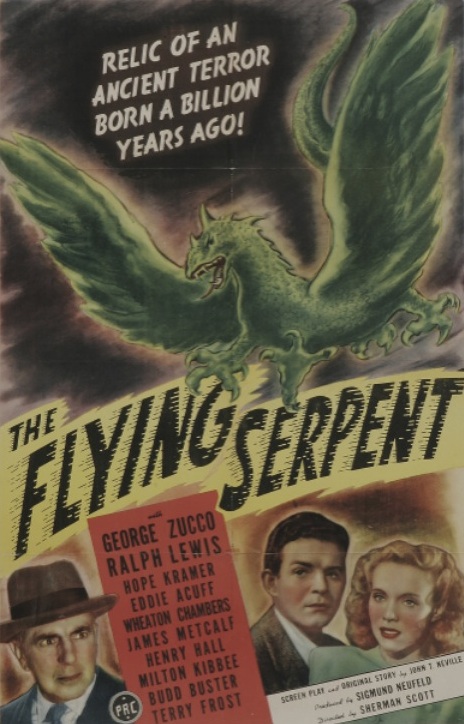
The Flying Serpent (Feb. 1, 1946)

George Zucco was born in 1886 in Manchester, England. He appeared in nearly 100 movies during his 20-year career. He was a fine actor, but he appeared in a lot of bad movies. Case in point: The Flying Serpent, which was directed by prolific schlockmeister Sam Newfield under the pseudonym “Sherman Scott.”

Like White Pongo (1945) — the last steaming pile of celluloid by Newfield that I saw — The Flying Serpent begins with an onscreen prologue that raises more questions than it answers. The viewer is told that the “wiley [sic] Emperor Montezuma,” in order to outsmart Cortez, hid his treasure somewhere far to the north of San Juan, New Mexico, where the Aztec ruins are located, and implored his guards to protect it.

I’m pretty sure none of that is true. And I’m pretty sure the filmmakers are confusing San Juan County in New Mexico, where the Aztec Ruins National Monument is located, with the town of San Juan, which is in a neighboring county. I’m also pretty sure they either didn’t know or didn’t care that the name of this national monument is a misnomer, since the ruins are actually ancestral Pueblo structures, and have nothing to do with the Aztecs. But I digress.

Before you can ask how anyone sent by Montezuma to protect treasure 500 years ago could still be around to fulfill his duty, enter Quetzalcoatl, the feathered serpent. First seen in the shadows (or possibly just the murk of the lousy print used for the public domain DVD I watched), Quetzalcoatl is a puppet of indeterminate size locked safely behind iron bars in a secret mountain lair attended to by the archaeologist Dr. Andrew Forbes (Zucco). When Dr. Forbes pulls a lever, the stone roof of the cage opens, and the flying serpent takes wing. In flight, with nothing to give the puppet a sense of scale, it looks a little like the giant flying monster in the Japanese film Rodan (1956).

The only other appearance of Quetzalcoatl on film I can think of right now is Larry Cohen’s B movie classic Q (1982), in which the enormous Mesoamerican deity terrorizes Manhattan. Unlike Rodan or Q, however, the monster in The Flying Serpent turns out to be ridiculously small once it appears in the same frame as a human. When it lands on its first victim, Dr. John Lambert (James Metcalf), it looks as if he’s being attacked by a feathered Labrador Retriever with wings.

The Flying Serpent isn’t nearly as bad a film as White Pongo, but it never quite reaches the level of craziness I demand from an entertaining bad B movie. Zucco is always entertaining to watch, though, no matter how far down in the gutter he’s slumming.

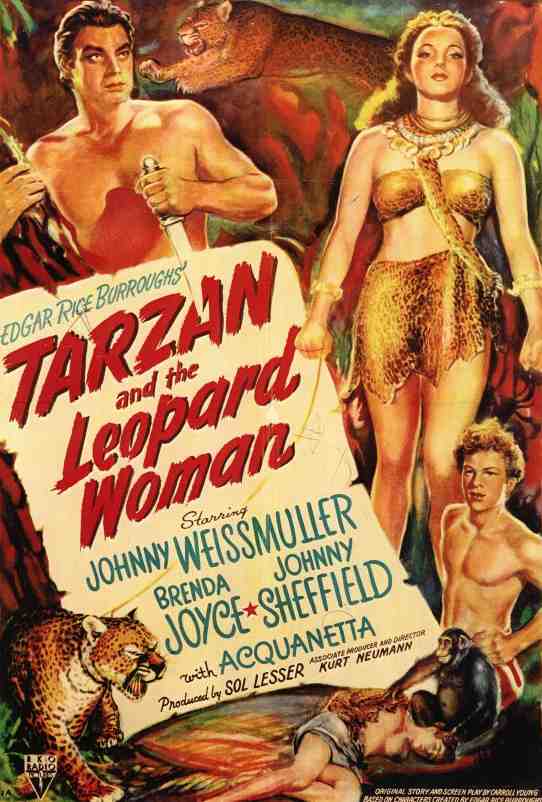
Tarzan and the Leopard Woman (January 1946)

A lot of fans of Johnny Weissmuller’s work as Tarzan in the MGM series of the ’30s like to beat up on the RKO Radio Pictures Tarzan pictures of the ’40s. They’re campier, the production values are cheaper, and Weissmuller was older when he made them. I say, so what? They’re still great Saturday-matinee entertainment, especially this one. Tarzan and the Leopard Woman moves at a good pace, it’s loony without being over-the-top, and Weissmuller is in better shape than he was in the previous few entries in the series.

Weissmuller was a big guy; 6’3″ and 190 pounds in his prime. Like a lot of athletes, he had a tendency to gain weight when he wasn’t competing professionally (when he was making the Jungle Jim series in the ’50s, he was reportedly fined $5,000 for every pound he was overweight). In Tarzan and the Leopard Woman, however, he was 41 years old, and looked better than he had in years. His face looks older and his eyes are a little pouchy, but three divorces (including one from the physically abusive Lupe Velez) will do that do a guy. Even though he was nearing middle age when he made this picture, Weissmuller was still a sight to behold. When he jumps into a river to save four winsome Zambesi maidens (played by Iris Flores, Helen Gerald, Lillian Molieri, and Kay Solinas) from crocodiles, he knifes through the water, and it’s not hard to see why he won five Olympic gold medals for swimming, and was the first man to swim the 100-meter freestyle in less than a minute.

When Tarzan and the Leopard Woman begins, the local commissioner (Dennis Hoey) is speaking to Dr. Ameer Lazar (Edgar Barrier), a native who has been educated and “civilized.” The commissioner is concerned about a spate of attacks by what seem to be leopards. Dr. Lazar appears to share his concern, but we soon learn that Lazar is a wolf in sheep’s clothing. Privately he spouts anti-Western doctrine that sounds suspiciously like Marxism, and is the leader of a tribe of men who worship leopards and wear their skins. Tarzan believes that the “leopard” attacks are really the work of men, so to throw off suspicion, Lazar releases a trio of actual leopards as cannon fodder. Their attack against the caravan is repelled, the leopards are killed, and everyone is satisfied that the terror has passed. Everyone, that is, except Tarzan, who still smells a rat.

The original shooting title of Tarzan and the Leopard Woman was Tarzan and the Leopard Men, which is probably a more accurate title, but definitely a less sexy one, especially once you see the leopard men. The eponymous leopard woman is Dr. Lazar’s sister, Lea, high priestess of the leopard cult. Played by the exotic-looking actress Acquanetta, Lea makes a few memorable appearances in the beginning of the film with her voluptuous breasts barely concealed behind a gauzy wrap, but after the halfway mark she wears a more concealing leopard-print dress, and spends most of her time standing on an altar, goading on the leopard men’s dastardly acts. For the most part, the leopard men are paunchy, pigeon-chested, middle-aged men whose poorly choreographed ritual “dancing” never stops being unintentionally hilarious.

Acquanetta was born Mildred Davenport in Ozone, Wyoming, in 1921. She changed her name to “Burnu Acquanetta,” then to just “Acquanetta,” and starred in films like Rhythm of the Islands (1943), Captive Wild Woman (1943), and Jungle Woman (1944). The raison d’être of most island pictures and jungle movies in the ’40s was to show a whole lot more skin than was considered appropriate in any other genre of the ’40s, and on that count, Tarzan and the Leopard Woman succeeds. Weissmuller’s loincloth is as skimpy as it ever was, and the scene in which he’s scratched all over by the leopard men’s metal claws, then tied tightly to a pillar and menaced by Lea surely excited plenty of future little sadomasochists in the audience.

Former model Brenda Joyce, in her second outing as Jane, has really grown into the role, and looks great. I missed Maureen O’Sullivan when she left the franchise, but Joyce has really grown on me since Tarzan and the Amazons (1945). She’s pretty and charming, not to mention stacked.

There’s a subplot in Tarzan and the Leopard Woman that I’m going to call “Battle of the Boys.” Johnny Sheffield is still playing Tarzan and Jane’s adopted son, “Boy,” but he’s quickly outgrowing the moniker. Sheffield was 14 when he made this film, but he looks older. Unlike a lot of cute child stars to whom puberty was unkind, Sheffield looks like he’s in better shape than anyone else in the movie, and he’s good-looking. Unfortunately, the same cannot be said for Tommy Cook, who’s a year older than Sheffield, but looks younger and weirder. The last time I saw Cook, he played the cute little sidekick named “Kimbu” in the 1941 Republic serial The Jungle Girl. Here, in an enormous thespic stretch, he plays Lea’s younger brother “Kimba,” who insinuates himself into the lives of Tarzan, Jane, and Boy. He might as well have been named “Bad Boy,” since he’s Boy’s evil doppelgänger. Jane takes pity on Kimba and cares for him, but his true intention is to cut out her heart in order to become a full-fledged warrior among the leopard men.

I don’t think I’ll be giving anything away if I say that Tarzan, Jane, Boy, and their pet chimp Cheetah make it through the proceedings relatively unscathed, while the bad guys all die horrible, gruesome deaths. Tarzan and the Leopard Woman might not be the greatest entry in the Tarzan franchise, but it’s far from the worst, and packs plenty of action and thrills into its 72-minute running time.

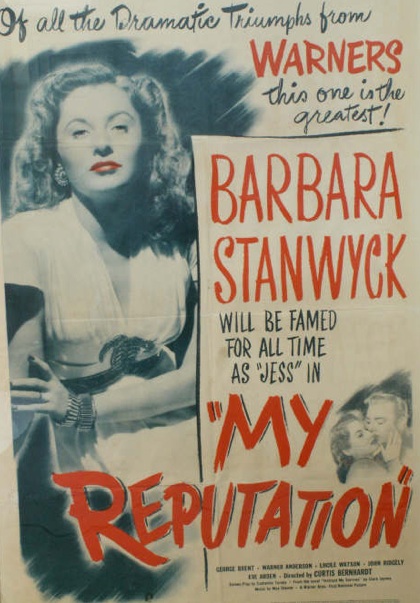
My Reputation (Jan. 25, 1946)

Curtis Bernhardt’s My Reputation, which premiered on January 25, 1946, and went into wide release a day later, was filmed in 1944. Prior to its stateside theatrical release, My Reputation was released for military use, and was shown to troops as entertainment during World War II. The screenplay, by Catherine Turney, is based on the novel Instruct My Sorrow, by Clare Jaynes.

On paper, this movie didn’t interest me, and I probably never would have watched it if I wasn’t doing this project. A prototypical “women’s picture,” My Reputation is about a young widow living among the upper crust of Lake Forest, Illinois, in 1942. Once I started watching it, however, it quickly drew me in. It’s a quality picture from beginning to end. The actors all deliver heartfelt performances, the situations and dialogue are realistic, and the direction, editing, and cinematography are all top-notch.

Barbara Stanwyck plays the protagonist, Jessica Drummond. When the film begins, Jessica’s husband has just died, leaving her a widow and their two sons, aged 12 and 14, fatherless. The executor of the late Mr. Drummond’s estate, lawyer Frank Everett (Warner Anderson) clearly has feelings for Jessica, but they are not reciprocated. Jessica’s mother, Mrs. Mary Kimball (Lucile Watson) has worn mourning clothes ever since her own husband died decades earlier. Jessica’s mother is scandalized when Jessica refuses to dress differently after her husband’s death. “Our kind of people wear black,” she says matter-of-factly.

My Reputation reminded me a little of Mildred Pierce (1945) in its nuanced portrayal of a single woman navigating tricky social waters. It didn’t hurt that Eve Arden, who played Mildred’s best friend, here performs a similar duty as Jessica’s reliable gal pal, Ginna Abbott.

When Jessica goes on a skiing vacation with Ginna and her husband, Cary (John Ridgely), she meets the the insouciant and charming Maj. Scott Landis (George Brent), who is on leave from the war. The two strike up a friendship that blossoms into a romance, but Jessica distances herself from him when he becomes too sexually forward. Landis isn’t a heel, but he is a bit of a rogue, and clearly states that he has no plans to marry. Despite this, Jessica can’t get him out of her mind, and when their paths cross again, she gives in to his advances, consenting to at least kissing. Whether more transpires between them is left up to the viewer, but there is no implication that they consumate their love. This doesn’t change the scandalous nature of their relationship, and Jessica quickly finds herself ostracized from the gossipy circles in which she runs. She stands up for herself, but the disapproval of her mother and her friends is nothing compared with the criticism she receives from children, especially her younger son, who says, “But you belong to dad. It doesn’t make any difference whether he’s dead or not.”

My Reputation ends on a hopeful note, but its depiction of an intelligent, sensitive woman living in a stifling social milieu is still hard to watch. The viewer’s frustration is mitigated, however, by the excellence of the production, especially the attention to detail that makes a well-made film such a joy to watch. For instance, in a scene in which Jessica confronts her mother, the shot is framed so that a large portrait of Jessica as a child and her mother as a younger woman hangs in the background between them. The juxtaposition says nearly as much as their heated words.

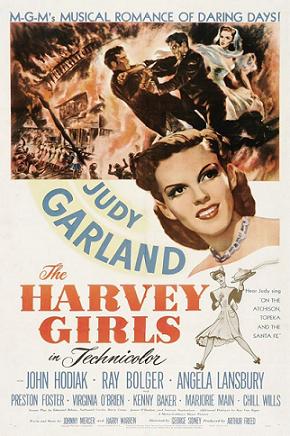
The Harvey Girls (Jan. 18, 1946)

In 1876, a 41-year-old entrepreneur named Fred Harvey opened a string of restaurants along the Atchison, Topeka, and Santa Fe Railway line. The eateries catered to middle-class and wealthy travelers alike, and at the height of the franchise’s success, there were more than 80 Harvey House restaurants. Harvey died in 1901, but the Fred Harvey Company continued to build restaurants into the 1960s.

A restaurant chain might seem an unlikely subject for a big-budget, Technicolor, Hollywood musical, but clearly the young, attractive waitresses in their crisp black and white uniforms were enough of a hook. The film opens with the following portentous prologue:

“When Fred Harvey pushed his chain of restaurants farther and farther west along the lengthening tracks of the Santa Fe, he brought with him one of the first civilizing forces this land had known … the Harvey Girls. These winsome waitresses conquered the west as surely as the Davy Crocketts and the Kit Carsons — not with powder horn and rifle, but with a beefsteak and a cup of coffee. To these unsung pioneers, whose successors today still carry on in the same tradition, we sincerely dedicate this motion picture.”

If all this is to be taken seriously, then who wouldn’t want to lionize these distaff settlers? I haven’t read Samuel Hopkins Adams’s 1942 novel that this film is based on, but it must have been a good story for Hollywood to want to pick it up. Or maybe it was just that Johnny Mercer and Harry Warren realized what a catchy rhythm the phrase “on the Atchison, Topeka, and the Santa Fe” had.

After the prologue and credits, the film opens on a shot of a moving train. Susan Bradley (Garland) is standing on the deck of the caboose, singing a forgettable song about love. She is heading out west to marry a man whom she only knows from the florid love letters he has written her. When her suitor, H.H. Hartsey (Chill Wills), turns out to be a functionally illiterate cowpoke who had a friend play Cyrano for him by penning the letters himself, Susan parts with him (mostly amicably), and becomes a Harvey girl.

The dramatic conflict, such as it is, comes from the local saloon and gambling house, which also features dancing girls. The owner of the palace of sin, Ned Trent (John Hodiak), and his star attraction, Em (played by a young and foxy Angela Lansbury), fear that the opening of the Harvey House will usher in a new era of respectability and crush their business. In real life of course, Trent’s girls would have been prostitutes and Em would have been their madam, but in the world of 1940s M-G-M musicals, dancing the cancan for hooting and hollering cowboys was about as scandalous as they could get.

Garland and Lansbury both give good performances, and are backed up by a large and talented cast. Virginia O’Brien (as the Harvey girl “Alma from Ohio”) is tough and sassy, and Ray Bolger, most famous for playing the Scarecrow in The Wizard of Oz (1939), here gets to play the Cowardly Homosexual, a popular character type in Hollywood pictures for decades. While his sexual preference is never identified outright, Bolger’s character’s effeminacy and fear of any butch labor (such as shoeing horses), as well as his spirited prancing, leaping, and tap dancing make it clear that he doesn’t have any designs on the ladies.

The Harvey Girls is an entertaining mix of musical and western. But if director George Sidney aspired for it to be anything more than breezy entertainment, it doesn’t show. Judy Garland is always a delight, but Vincente Minnelli’s ability to coax a nuanced performance from her and to tell an engaging story from beginning to end in a musical is sorely missed here. The Harvey Girls is enjoyable, but it’s no Meet Me in St. Louis (1944). Also, aside from the standout song, “On the Atchison, Topeka, and the Santa Fe” (which won an Academy Award for best song), no musical number in the picture really stands out.

Shock (Jan. 10, 1946)

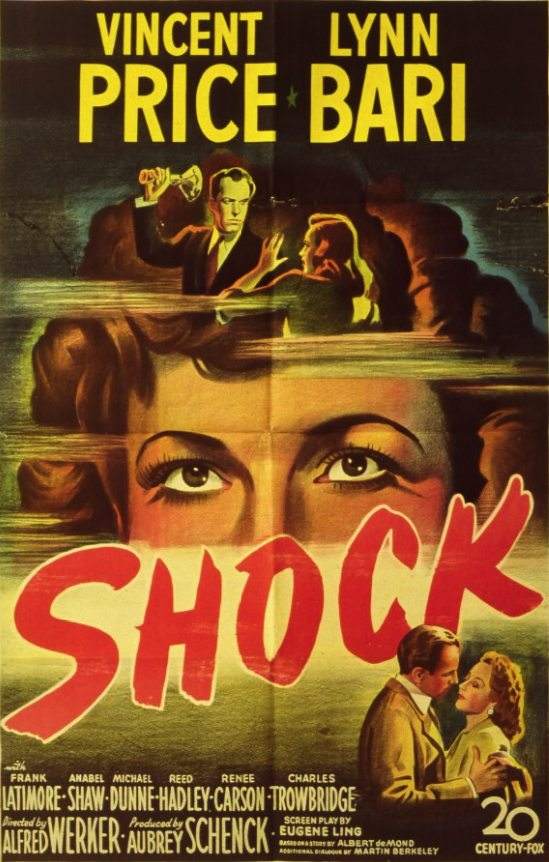
Alfred L. Werker’s thriller Shock, which had its premiere on January 10, 1946, and went into wide release on February 1st, stars Vincent Price as the murderous Dr. Richard Cross and Lynn Bari as his manipulative assistant and lover, Nurse Elaine Jordan. If you were to play a drinking game in which you took a shot of whiskey every time one of the characters in the film said the word “shock,” you would likely require medical attention after the first 20 minutes.

Price wasn’t always a horror icon. In Tower of London (1939), which was as much a costume drama about Richard III as it was a horror picture, he was a supporting player. In Brigham Young (1940), he played the founder of Mormonism, Joseph Smith. In Hudson’s Bay (1941), he played King Charles II. In Laura (1944) and Leave Her to Heaven (1945), he was the aggrieved “other man.” A tall, stately man born in St. Louis, Missouri, in 1911, Price was educated at Yale, where he studied art history and fine art. He radiated charm and erudition. He was a fine actor, and probably could have distinguished himself in any genre. As chance or fate would have it, however, his vocal delivery and arch facial expressions were perfectly suited to the ironic cinematic world of the macabre, and he is best remembered for his roles in horror pictures such as House of Wax (1953), The Fly (1958), House on Haunted Hill (1959), The Tingler (1959), and the innumerable Roger Corman-produced, Poe-influenced horror pictures that he appeared in throughout the 1960s.

While Shock is not a horror film, it has elements of one, and it’s the earliest role I’ve seen Price play in which he demonstrates some of the ghoulish mannerisms that would later make him famous. He doesn’t come close to the histrionics of some of his later horror roles, but there are some glimmerings.

The film opens in San Francisco, where a young woman named Janet (played by the somewhat sickly looking ingénue Anabel Shaw), is checking into a hotel, where she is to meet her husband, Lt. Paul Stewart (Frank Latimore), a former P.O.W. who is finally returning from World War II. Lt. Stewart doesn’t show up when he is supposed to, however, and as his emotionally fragile wife frets alone in her hotel room, she witnesses a murder. From her balcony, she can see through the window of an adjacent room. A man and a woman are arguing, and eventually the man settles the argument with a heavy candlestick.

Witnessing a murder drives Janet into a state of catatonic shock. When her husband finally arrives, she is unresponsive. When world-renowned psychiatrist Dr. Cross is brought in to consult in the case, Janet doesn’t recognize him, but Dr. Cross immediately realizes that the cause of Janet’s state of shock is the murder she witnessed him committing.

Janet is placed in Dr. Cross’s care, and he ignores the Hippocratic oath in order to save his own skin, giving Janet insulin treatments she doesn’t need, as well as using other unethical methods of driving her deeper into a state of shock so she will never be able to identify him. Cross isn’t portrayed as a total monster, however. That role is reserved for his lover, Nurse Jordan, a Lady Macbeth type who goads him on when his resolve to be wicked falters.

Shock is a programmer, to be sure, but it’s a well-made one, and kept me enthralled for all of its 70 minutes.