Tag Archives: Columbia Pictures

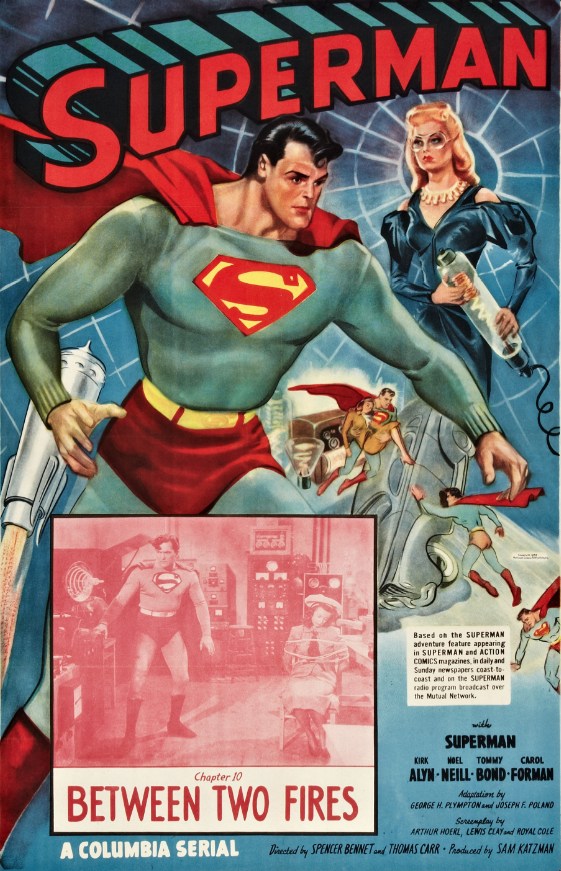
Superman (15 chapters) (July 15-Oct. 21, 1948)

Superman Chapter 10
Superman (15 chapters) (1948)
Directed by Spencer Gordon Bennet and Thomas Carr
Columbia Pictures

Here it is, folks — the very first live-action Superman film.

Superman, in case you’ve been living under a rock, is one of the most popular and recognizable superheroes of the 20th century. Created by Jerry Siegel and Joe Shuster, Superman made his first appearance in Action Comics #1 in June 1938. His popularity grew quickly, leading to a second comic series, simply titled Superman, in 1939, a radio serial — The Adventures of Superman — in 1940, a series of Max Fleischer cartoons (1941-1943), and a third comic series, which debuted in 1941 as “World’s Best Comics,” but was changed after the first issue to World’s Finest, and featured stories about Superman and Batman & Robin, as well as other DC Comics superheroes.

Aspects of all of those source materials can be seen in the 15-chapter serial Superman, which was produced by Sam Katzman for Columbia Pictures and directed by Spencer Gordon Bennet and Thomas Carr. Katzman produced a ton of cheapjack serials for Columbia, and he was sometimes known as “Jungle Sam” on account of all the action-adventure pictures he made that were set in tropical locations.

I’ve reviewed a few of Katzman’s serials on this blog already — Jack Armstrong (1947), The Sea Hound (1947), and Brick Bradford (1948) — but I’ve barely scratched the surface of his voluminous output. To be honest, I really don’t want to dig any deeper. Katzman produced some fun low-budget sci-fi pictures in the 1950s, but all of his serials that I’ve seen so far have been tedious, cheaply made, and poorly acted, and Superman is no exception.

In 1948, the Max Fleischer animated shorts about Superman were still the most impressive cinematic versions of the character. They were gorgeously animated, full of vibrant color, packed with action, and even featured the talents of Bud Collyer, the voice of Superman on the radio. In short, they were comic books come to life.

http://www.youtube.com/watch?v=6B5urEc3Eao

In fact, they were so impressive that Katzman’s black and white serial Superman features an animated Superman in all of the flying sequences. It’s a very different approach to a flying superhero than the practical effects featured in Adventures of Captain Marvel (1941), which for my money is the greatest serial ever made.

Adventures of Captain Marvel featured a dummy that zipped along a wire, which sounds cheesier than it is. The effect actually works quite well, thanks to simple techniques like reversing the film so the dummy can fly upward, shooting in silhouette, and creative editing. The animated flying sequences in Superman, on the other hand, are well-done for what they are, but the technique of turning live action into animation and back again was always jarring for me.

http://www.youtube.com/watch?v=aNp_Yx0CDiA

If you’re a Superman fan, this serial is a must-see for its historical value, but it’s just not that great. The low-budget black and white filmmaking is less vibrant than the Max Fleischer cartoons, the storytelling is less inventive and involving than the radio show, and the physical appearance of Superman just isn’t as impressive as it was in the comic books.

At the beginning of every chapter, the Superman comic magazine flashes on screen, then Kirk Alyn bursts from its pages and stands there for awhile looking as if he’s not sure what he should do next.

Alyn was a 37-year-old actor who’d had bit parts in a bunch of B movies, but this was his first leading role. Alyn has the right face and the right hair to play Superman, but his body, mannerisms, and physical presence all feel wrong. (This is another area where Adventures of Captain Marvel excelled. Tom Tyler looked very much like the Captain Marvel of the comic books, and his physicality was impressive.)

Alyn fares a little better as Superman’s alter ego, mild-mannered reporter Clark Kent. I like the slightly alien edge he gives the character, but in some scenes his alien peculiarity just seems like bad acting.

My favorite actor in Superman is Noel Neill, who was so good as Lois Lane that she went on to play Lois in the Adventures of Superman TV series with George Reeves that premiered in 1951. The same honor was not accorded to either Tommy Bond (who plays cub reporter Jimmy Olsen) or Pierre Watkin (who plays Daily Planet editor-in-chief Perry White). I actually really liked Watkin as Perry White, but I thought Bond was obnoxious and irritating as Olsen, and not just because he’s the guy who played Butch in the Our Gang comedies.

Also, Los Angeles and the surrounding countryside don’t make for a very convincing Metropolis, but California locations are to be expected in any serial.

The antagonist of the serial is called The Spider Lady (Carol Forman), a master criminal who wears a slinky black cocktail dress and a black domino mask. The Spider Lady is after a MacGuffin called a “reducer ray,” and like every good serial villain, she has an army of disposable goons who carry out her cockamamie plans in chapter after chapter. She also has a henchman named Hackett who is introduced in Chapter 6, “Superman in Danger.” Hackett is a brilliant but deranged scientist who has broken out of prison. He’s played by Charles Quigley, who starred in The Crimson Ghost (1946), and other serials.
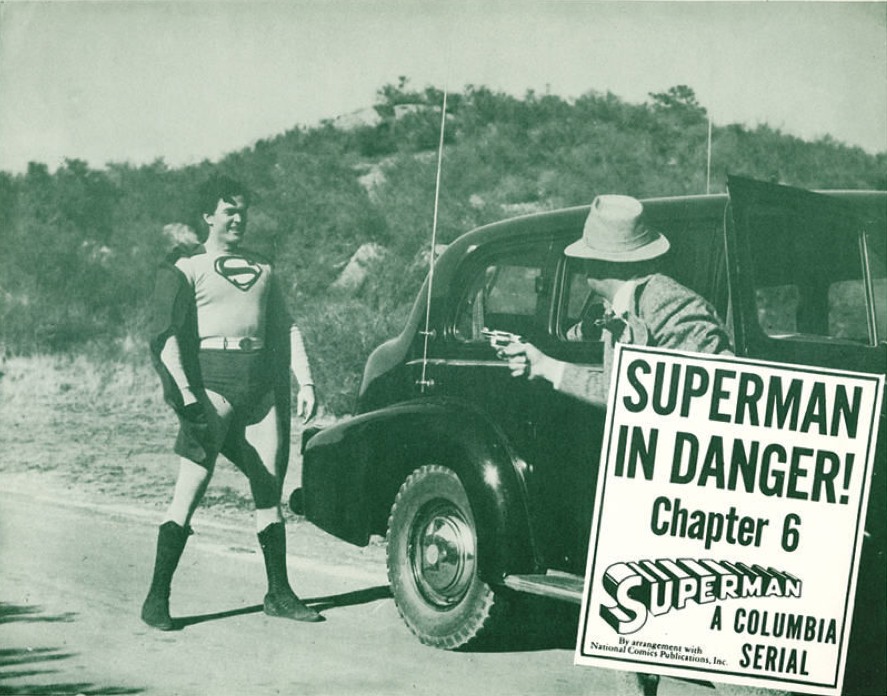
Superman Chapter 6

I love serials — even the bad ones — and I certainly enjoyed aspects of Superman. But every superhero movie is only as convincing as its lead actor, and Kirk Alyn just isn’t up to the task. I’m sure in 1948 it was thrilling for plenty of kids to see their hero come to life on the big screen. It was a time when Superman was such a mythic, larger-than-life figure that the actors who played him were never credited. When Bud Collyer made an announcement about something that wasn’t a part of the radio show’s serialized story, he was still introduced as “Superman.” Similarly, in the cast of characters list that flashes on the screen at the beginning of every chapter of Superman, Kirk Alyn is the only actor whose name isn’t listed. The first name in the credits is simply SUPERMAN.

Still, I wonder how many children in 1948 were somewhat disappointed by Kirk Alyn (perhaps in ways they couldn’t verbalize). After all, he doesn’t have the impressive voice of Bud Collyer, and he’s so much scrawnier than the strapping hero of the comics. Worst of all, he flits around like Peter Pan, and his cape frequently gets in the way during the action.
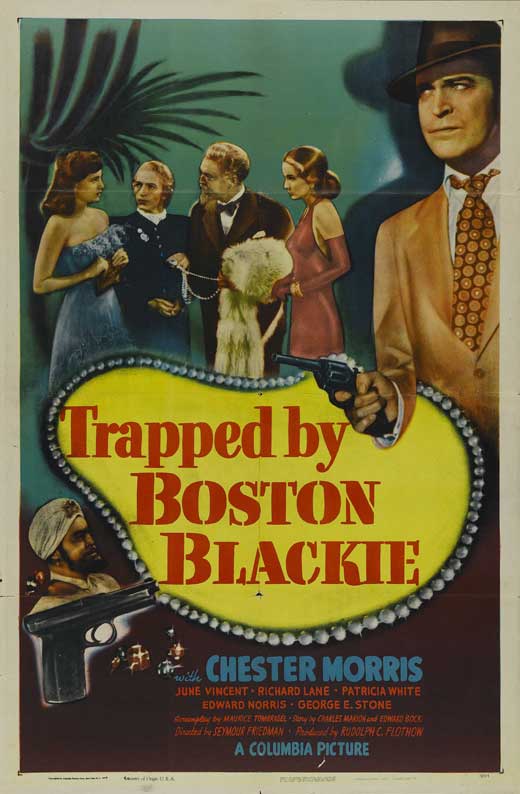
Trapped by Boston Blackie (May 13, 1948)

I listen to radio shows. A lot of radio shows.

I’ve amassed a large collection over the years, and each radio show is identified by date broadcast so I can listen to them on the same day of the week they were originally broadcast, and on roughly the same date. (For 64 years ago, you add 3 to the day’s date.) I have enough old-time radio shows on MP3 that I’m rarely able to listen to all of each day’s programming, which is fine — in the ’40s no one listened to everything, and I’m sure plenty of people missed their favorite shows if they were out for the evening.

Currently, the shows from 64 years ago that I hate to miss include The Adventures of Sam Spade with Howard Duff and Lurene Tuttle, Suspense, The Whistler, The Great Gildersleeve with Harold Peary, and The Adventures of Philip Marlowe with Gerald Mohr.

I have plenty of episodes of Boston Blackie downloaded, but most weeks it’s not a show I go out of my way to listen to. On the other hand, whenever I do listen to it, I have a good time.

I feel the same way about both Boston Blackie movies I’ve seen — Boston Blackie and the Law (1946) and this one, Trapped by Boston Blackie (1948), which was directed by Seymour Friedman and released by Columbia Pictures — it wasn’t on my “must watch” list, but I taped it when it was on TCM a few months ago, and I had a good time watching it.

Horatio Black, a.k.a. “Boston Blackie” was created by writer Jack Boyle in 1914. Blackie started out as a professional thief but eventually became a crime-fighter and detective-for-hire. The character appeared in a variety of magazine stories and a number of silent films starring different actors. It wasn’t until the first sound film about the character, however, that one actor would play the character more than twice. Meet Boston Blackie (1941) starred Chester Morris as the gentleman safecracker and high-society thief, and Morris would go on to play Boston Blackie in a total of 14 films. (Except for a brief run during the summer of 1944 that starred Morris, the radio version of Boston Blackie that most people remember starred Richard Kollmar. The series that starred Kollmar was syndicated to Mutual and other stations and ran from 1945 to 1950.)

The film version of Boston Blackie doesn’t make quite as make puns and wisecracks as his radio counterpart, but they’re both smooth-talking, distinguished gentlemen who still have a streak of criminality, despite being mostly reformed.

Trapped by Boston Blackie was the penultimate film in the series. (The last was Boston Blackie’s Chinese Venture, released in 1949.)

In Trapped by Boston Blackie, Blackie and his weaselly sidekick, “The Runt” (George E. Stone), are hired to protect a valuable pearl necklace at a high-society party, but it goes missing from under Blackie’s nose, and he and The Runt are the prime suspects.

After the theft, The Runt says to Blackie, “At least we’re innocent.” Pause. “Or are we?”

Blackie spends most of the film’s running time wearing some kind of ridiculous disguise. First he dresses up as an Eastern mystic in order to circulate freely around the party and keep an eye on the necklace (and kids, when Blackie examines his costume before putting it on and holds up the turban and exclaims “Gay!” it doesn’t mean what you think it means).

Later, in order to track down the necklace, Blackie disguises himself as a fussy old man with The Runt in drag as his wife. (The Runt uses his old-lady disguise as an excuse to give a pretty young woman played by Patricia Barry a creepy and overly familiar hug.) Later, Blackie affixes a fake mustache to his upper lip and passes himself off as an insurance investigator.

And of course he’s dogged all along the way by his arch-nemesis and sorta-pal, Inspector Farraday (Richard Lane), who’s assisted by the extremely dim-witted Detective Sergeant Matthews (Frank Sully).

Trapped by Boston Blackie is not the first mystery programmer from Columbia Pictures I’d recommend if you’ve never seen one before, but if you’re a fan of the Boston Blackie series, it’s solid good fun.

Brick Bradford (15 chapters) (Jan. 5-April 12, 1948)

Brick Bradford is the worst of the three Columbia serials produced by “Jungle” Sam Katzman that I’ve seen so far, and that’s saying something.

The previous couple of Katzman-produced serials I watched — Jack Armstrong and The Sea Hound (both made in 1947) — suffered from a similar lack of focus across their 15 weekly chapters, but Brick Bradford takes it to a new level by setting up a tantalizingly trashy science-fiction scenario and then abandoning it halfway through.

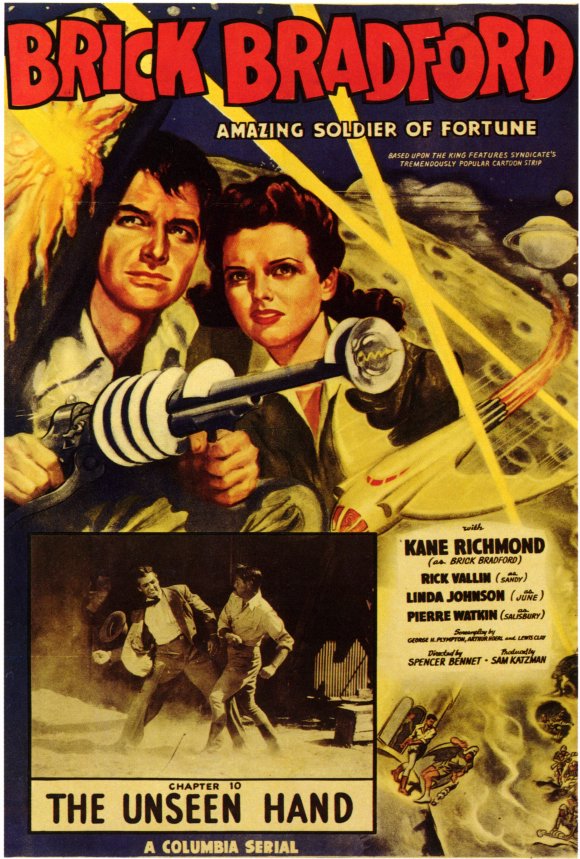
Brick Bradford was directed by Spencer Gordon Bennet and Thomas Carr and based on the daily newspaper strip created by writer William Ritt and artist Clarence Gray that began in 1933.

Brick Bradford was a square-jawed, spacefaring, time-traveling adventurer in the mold of Buck Rogers and Flash Gordon. He’s played by serial superstar Kane Richmond, who also starred in Spy Smasher (1942), one of my favorite serials, and as Lamont Cranston, a.k.a. The Shadow, in The Shadow Returns, Behind the Mask, and The Missing Lady (all 1946), as well as innumerable other B movies and chapterplays over the course of his career. When he appeared in Brick Bradford he was pushing 41, and he would only appear in one more film before retiring from acting — William Nigh’s Stage Struck (1948).

Richmond is definitely not the problem with Brick Bradford. He still looks great and can carry himself in a fistfight. The problem is that it leaves so many plot threads hanging at the end.

Chrome-domed, bespectacled scientist Dr. Gregor Tymak (John Merton) invents an “interceptor ray” that could be used to shoot down atomic weapons, but that could also be easily tinkered with and made into a terrifying weapon. Definitely not something that should fall into the wrong hands.

Tymak has also invented a “crystal door” that can be used to move through space and time, or through what Tymak calls “the fifth dimension.” He uses it to travel to the far side of the moon, which no one has ever seen before. Despite what you may have heard, the dark side of the moon is as bright as high noon in California, has a breathable atmosphere, and is the perfect place to mine “lunarium.” It also has plenty of moonhabitants, who are mostly overweight middle-aged men with capes and Centurion helmets.

Unsurprisingly, producer Katzman’s vision of life on the moon isn’t too far removed from his vision of life in the jungle, but I felt like there was some cheesy good fun to be had on the moon with the evil dictator Zuntar (Robert Barron) and his queen Khana (Carol Forman), and their war against the “exiles,” a group of scientists from the earth who were able to reach the moon and form a utopian civilization. For the first half of Brick Bradford, Brick and his sidekick Sandy (Rick Vallin) travel back and forth to the moon through the crystal door, battling the evil super spy Laydron (Charles Quigley, the hero of the 1946 Republic serial The Crimson Ghost) on terra firma and Zuntar and Khana in orbit.

In chapter 8 of the serial, however, Brick and Sandy use Tymak’s experimental “Time Top” to travel from 1948 America to 1748 Brazil and team up with pirates to find some secret plans Tymak hid in the past among some buried treasure. This diversion is mercifully brief, but when it’s over there is literally not one more mention of the moon or anything that happened on it.

There’s some fun stuff with Tymak’s “Z-ray machine,” which is worn around the neck like a tourist’s camera (Tymak explains that the Z-ray “creates the illusion of invisibility, just as the mirror reflects the illusion of form”), but aside from that the last five chapters of the serial are a boring collection of fistfights and cliffhangers in and around Tymak’s farmhouse in the California countryside. It’s standard serial stuff, and I probably wouldn’t have found it so frustrating if I hadn’t spent every minute wondering what was going on up on the moon. Imagine if a Flash Gordon serial introduced Ming the Merciless in the first several chapters and then completely forgot about him for the climax!

http://www.youtube.com/watch?v=upICEV6yCbE

The Return of the Whistler (March 18, 1948)

The Return of the Whistler
The Return of the Whistler (1948)
Directed by D. Ross Lederman
Columbia Pictures

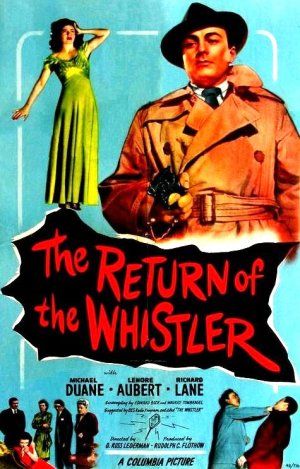
The Return of the Whistler was the final entry in the Columbia Pictures series based on the CBS radio show. It’s the only Whistler film that doesn’t star Richard Dix, who was in poor health when it was made (he died on September 20, 1949, at the age of 56).

Not only were the Whistler films excellent B-movie programmers, they were remarkably faithful to their source material. Just like the radio show, The Return of the Whistler begins with the eerie whistled theme music. The camera tracks the shadow of a walking man as he narrates in voiceover: I am the Whistler, and I know many things, for I walk by night. I know many strange tales hidden in the hearts of men and women who have stepped into the shadows. Yes, I know the nameless terrors of which they dare not speak.

Michael Duane and Lenore Aubert star as Ted Nichols and his fiancée Alice, who — when the film begins — are driving through a dark and story night to be married by a justice of the peace. Alice is a Frenchwoman, and Ted has only known her for two weeks. He found her under mysterious circumstances, limping through the woods near his summer cabin, running away from someone or something. There’s a lot about her past that he doesn’t know, but he does know one thing — he loves her more than anything in the world.

Naturally, things don’t go according to plan. First their car breaks down, then they discover that the justice of the peace is out of town, trapped by bad weather. Ted and Alice can’t stay in a hotel room together for the night because they aren’t legally married yet, so Ted leaves Alice at the hotel alone and walks to a nearby garage to have his car fixed. The shadow of the Whistler follows him.

This isn’t just the way you’d planned your honeymoon is it, Ted? But don’t be too unhappy, it’s only a few more hours before you and Alice will be united forever.

Like most things the Whistler says, those words drip with sardonic irony, because when Ted returns to the hotel the next morning Alice is gone, and the cranky night clerk (played by Olin Howland) claims not to know anything.

The Return of the Whistler is a fine capper to the series. The pacing is excellent and the actors all turn in solid performances. The mystery of what happened to Alice isn’t attenuated unnecessarily, and the movie is more suspenseful because of it, getting us involved in her predicament and Ted’s desperate fight to find out what’s going on before it’s too late.

The Return of the Whistler was directed by D. Ross Lederman, produced by Rudolph C. Flothow, and written by Edward Bock and Maurice Tombragel, based on a story by Cornell Woolrich. There are currently a few uploads of The Return of the Whistler on YouTube. You can watch one of them below:

I Love Trouble (Jan. 10, 1948)

Are there any fans of the old ABC TV series 77 Sunset Strip (1958-1964) out there?

If you have fond memories of that hepper than hep private eye show, you might be interested to know that this little mystery programmer is where it all started.

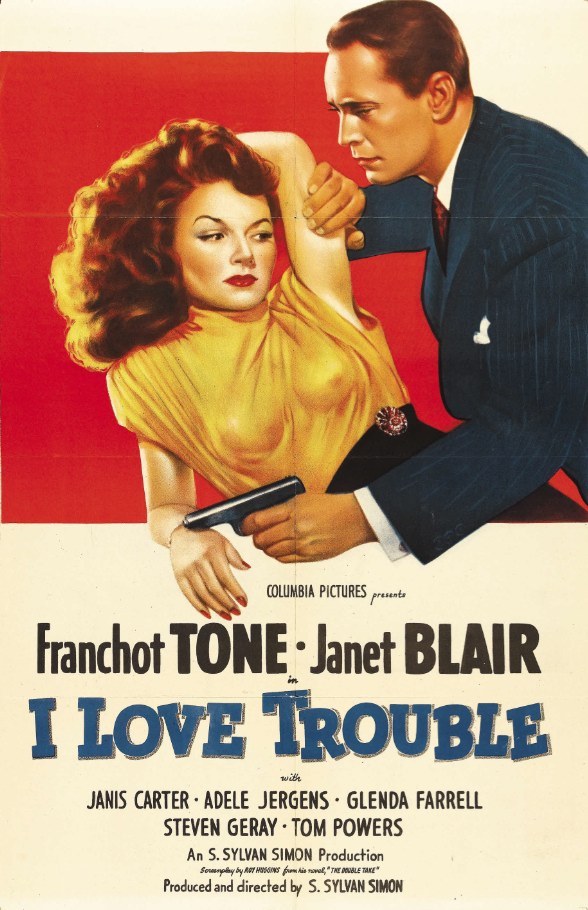
S. Sylvan Simon’s I Love Trouble is based on Roy Huggins’s novel The Double Take, and stars Franchot Tone as Stuart Bailey, a pencil-necked P.I. with a high forehead and an eye for the ladies.

Bailey was later (and more famously) played by Efrem Zimbalist Jr. — first in “Anything for Money,” an episode of the ABC series Conflict (1956-1957), and then in the ongoing series 77 Sunset Strip, where he was paired with a partner, Jeff Spencer (Roger Smith).

I haven’t read any novels by Roy Huggins, but if I Love Trouble is any indication, he was a writer firmly in the mold of Dashiell Hammett and Raymond Chandler. With a title like I Love Trouble, I was expecting a lighthearted mystery-comedy, so I was pleasantly surprised when it turned out to be a hard-boiled mystery with crisp dialogue and a well-rendered Los Angeles backdrop.

Ralph Johnston (Tom Powers), a wealthy gentleman who used to run with “a pretty rugged crowd,” hires Stuart Bailey to find out more about his wife Jane, who has been receiving threatening letters. Johnston says Jane is sheltered, unaccustomed to trouble, and couldn’t possibly be mixed up with anything shady. He believes one of his old friends resents Jane, got plastered, and sent her a threatening letter. Bailey responds that Jane spotted him tailing her, and that’s pretty uncommon for someone who was just a “nice quiet sorority girl at UCLA.”

Although he suspects there’s more to the story than Johnston is telling him, Bailey heads for Portland, Jane’s hometown, where he finds out that a high school diploma wasn’t the only piece of paper she picked up. She also got a work permit to dance at “Keller’s Carousel,” a seedy little club on South Broadway.

Keller (Steven Geray) and his henchman Reno (John Ireland) don’t take kindly to snoopers, and they send Bailey home with a few black-and-blue souvenirs.

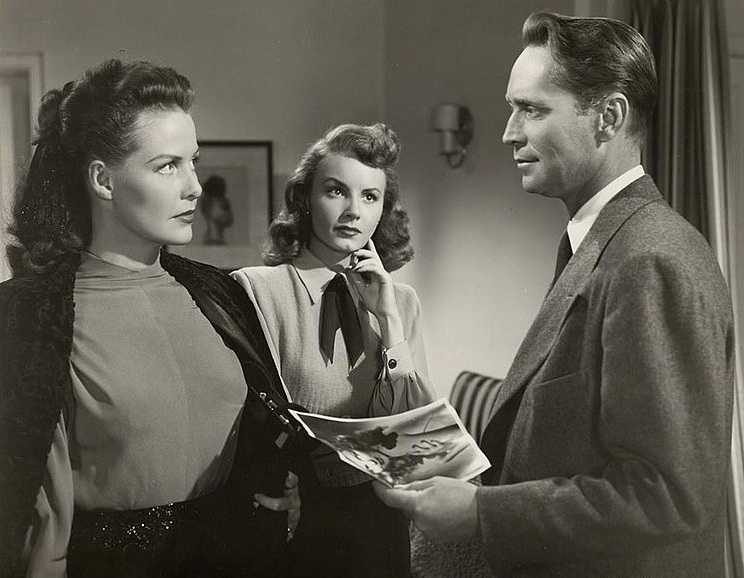
Back in Los Angeles, Bailey is approached by a woman named Norma Shannon (Janet Blair), who claims to be Jane’s sister from Portland. But she doesn’t recognize the theatrical head shot of Jane sitting in Bailey’s apartment. What’s going on?

I Love Trouble is a solid B movie from Columbia Pictures. It’s chock-full of beautiful actresses (Adele Jergens doesn’t even rate a mention in my plot summary, but I sure was happy to see her in a swimsuit). It’s sometimes hard to distinguish one from another, but if you’re paying attention (and have ever read Chandler’s Lady in the Lake), you’ll realize why that actually works in the film’s favor.

As played by Tone, Stuart Bailey isn’t a very memorable character. Tone is simply too gangly and effete to be fully believable as a hard-boiled P.I, but the story is good, the dialogue is hard-boiled, and the action is tough and fast-paced. I especially enjoyed Bailey’s wisecracking secretary, Hazel “Bix” Bixby (Glenda Farrell).

The Swordsman (Jan. 2, 1948)

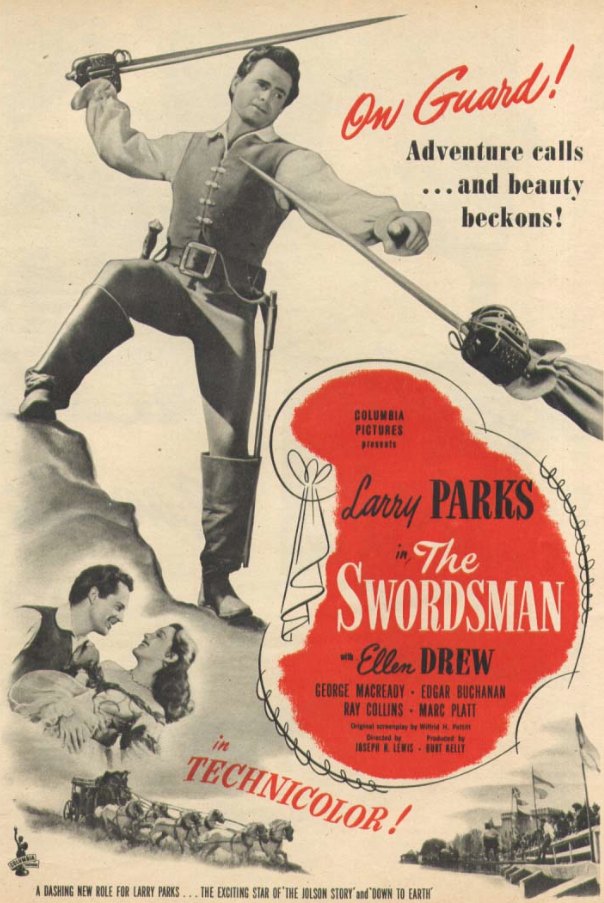
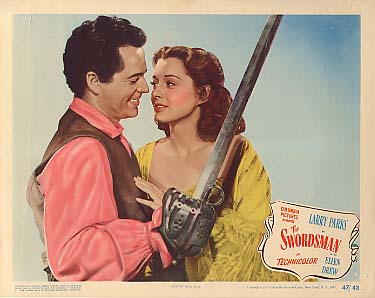
Joseph H. Lewis’s Technicolor spectacle The Swordsman takes place in the Scottish highlands toward the end of the 17th century. Clan warfare is what the highlanders live and breathe, and no clan war is as bitter as the one between the MacArdens and the Glowans.

So when Alexander MacArden (Larry Parks) falls into the skirts of the beautiful Barbara Glowan (Ellen Drew) after leaping onto her moving coach (as swashbuckling heroes in Technicolor spectacles are wont to do) he naturally tells her his name is “Duncan Fraser.”

This little deception allows him to go “undercover” amongst the Glowans along with his rotund, Falstaffian sidekick Angus MacArden (Edgar Buchanan).

After the obligatory sequence of highland games (including a javelin throwing competition that I’m not sure is culturally accurate as well as a “walk the greased plank to grab a caged piglet” competition that you probably won’t be seeing at your local highland games anytime soon), Alexander is found out by the Glowans and has to flee.

The rest of the film is a well-paced and exciting adventure story. Alexander and Barbara’s star-crossed love suffers the predictable travails, but I liked that there were few contrived misunderstandings between the two.

Alexander attempts to broker peace between the Glowans and the MacArden, and there’s nothing like a marriage to do it.

But restive elements in both clans work against a truce, and there’s plenty of double-dealing and murder afoot.

Wilfred H. Petitt’s script doesn’t always jibe with what we see on screen. For all the talk of “claymores” I never saw one of those fearsome two-handed Scottish long swords, only rapiers.

Larry Parks will never be mistaken for swashbuckling superstars like Errol Flynn or Tyrone Power, but at this point I can’t remember the last swashbuckling film Flynn made, and while I love Power, there’s no question that The Swordsman contains more thrills per minute than the ambitious but flawed Captain From Castile (1947).

The Swordsman is a really fun adventure picture. The pacing of the film is excellent, and Hugo Friedhofer’s score is rousing and exciting. I wasn’t bored for a single moment of the film’s 80-minute running time.

The Lady From Shanghai (Dec. 24, 1947)

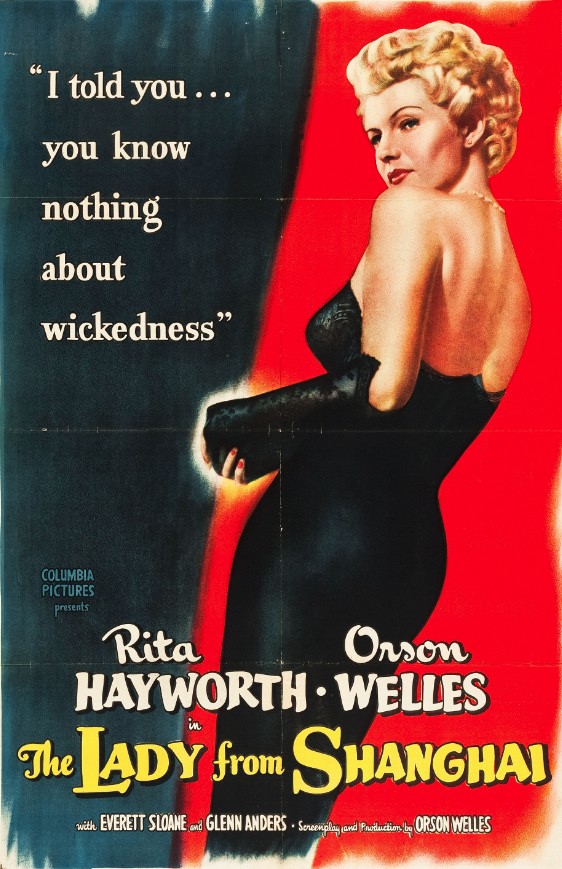
Orson Welles’s The Lady From Shanghai premiered in France on Christmas Eve, 1947, and in the United States nearly half a year later, on June 9, 1948.

The film is something of a minor classic now, but at the time of its release it was generally a disappointment; a disappointment to critics, to the studio, to audiences, and to Welles himself, who had little control over the final product released into theaters.

The Lady From Shanghai was filmed in 1946, and the original cut ran more than two and a half hours. Executives at Columbia Pictures made numerous cuts, and the final musical score was not to Welles’s liking. The litany of complaints from all sides were legion, and are outside the scope of this review.

But before I get into a discussion of the film itself, I need to mention the complaint that I find most mystifying. Welles chose to radically alter the looks of his leading lady, Rita Hayworth (to whom he was married from 1943 to 1948), by chopping her long tresses and dying her hair platinum blond. This decision caused a whirlwind of controversy, and was blamed by some in Hollywood for the dismal box office performance of The Lady From Shanghai.

Was the movie-going public in 1948 composed entirely of people whose tonsorial proclivities were identical to the Son of Sam’s? I think that Rita Hayworth is stunningly beautiful and alluring no matter what her hairstyle, and The Lady From Shanghai is all the proof I need.

The Lady From Shanghai stars Welles as a “black Irish” rascal and drifter named Michael O’Hara who saves a beautiful young woman named Elsa Bannister (Hayworth) from a group of muggers in Central Park, and then becomes embroiled in a byzantine scheme that involves a faked death.

The plan is hatched by her husband’s law partner, George Grisby (Glenn Anders), who wants O’Hara to confess to murdering him after Grisby leaves the country, never to return. The rub is that without a body, the authorities won’t be able to convict O’Hara, and he’ll pocket a lump sum of cash for his trouble while Grisby pockets the insurance money. But Elsa’s husband, Arthur Bannister (Everett Sloane), has noticed the way Elsa and O’Hara make eyes at each other, and he’s got his own wild scheme.

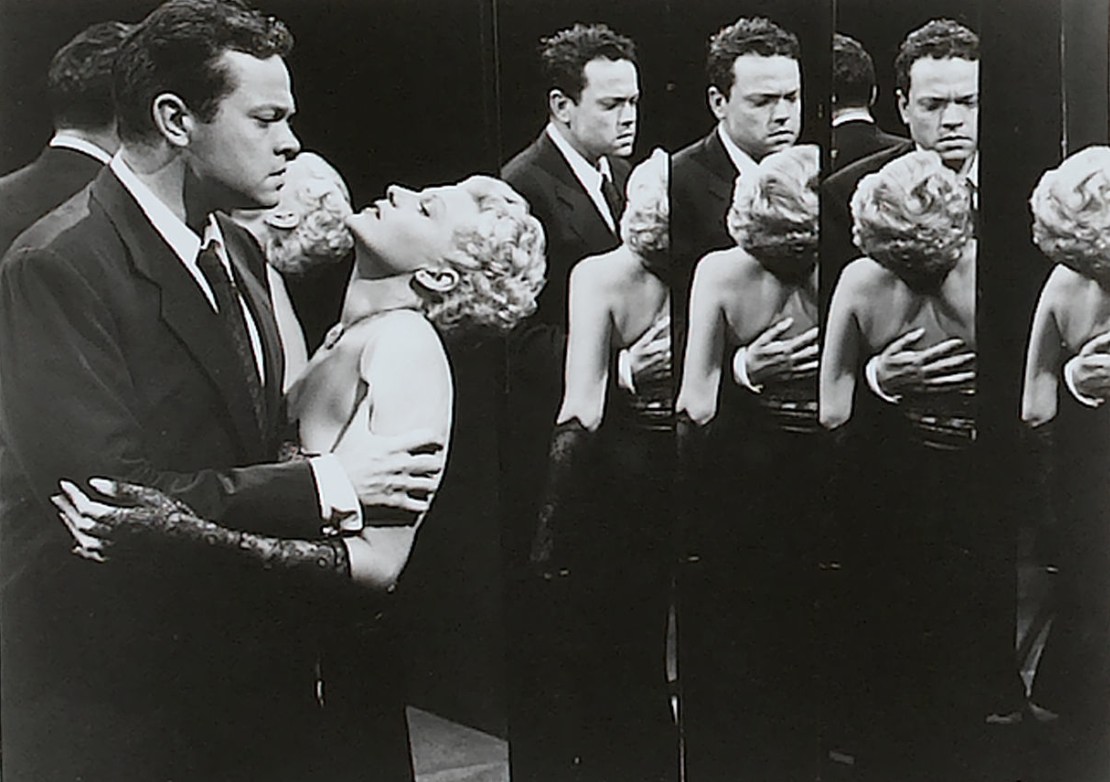
Even for a movie that was hacked down from 155 minutes to just 87, The Lady From Shanghai covers a lot of ground, and much of it is crazy. O’Hara accompanies the Bannisters and their entourage on a yacht tour of Mexico on their way from New York to San Francisco before the plot really gets rolling. Then, after the triple-cross scheme plays out, there’s a farcical courtroom scene that is genuinely funny and truly bizarre. Finally, there is a wild and phantasmagoric journey through San Francisco’s Chinatown that culminates in a chase through an abandoned fairground, and the film’s famous climax in the hall of mirrors of The Crazy House.

Given the studio-imposed cuts in the film’s running time, it’s probably not Welles’s fault that the plot is full of holes. But it’s hard to imagine any additional footage or story elements that would make the wild shifts in tone and byzantine plot any more digestible.

Ultimately, though, it really doesn’t matter. If you can get over Welles’s bad Irish accent and the general confusion of ideas in The Lady From Shanghai, it’s a brilliant, engrossing film that’s a joy to watch. Besides the gorgeous black and white cinematography and wonderful performances from Sloane, Hayworth, and Anders (and Welles, more or less), Welles is a director who was decades ahead of his time in terms of action and pacing. The slightly sped-up camerawork during fight scenes and the rapid editing isn’t like anything else you’ll see from the mid- to late-’40s.

There are a lot of things about The Lady From Shanghai that are totally unlike anything else in cinema at the time of its release. Welles’s reach usually exceeded his grasp, but as a director I think he was without parallel. The Lady From Shanghai may not be a perfectly formed work of art like Citizen Kane (1941), but it’s a fascinating and incredibly entertaining film.

The Sea Hound (15 chapters) (Sept. 11-Dec. 18, 1947)

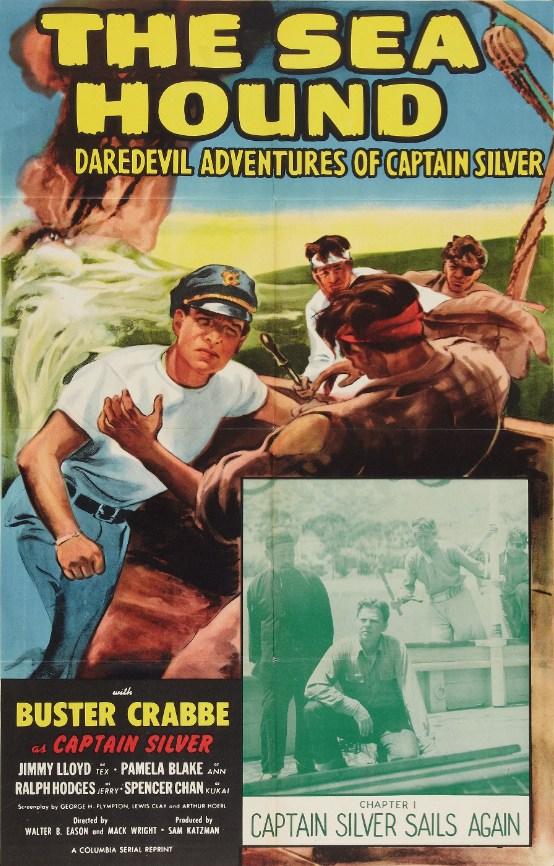
The Sea Hound, subtitled the “Dare Devil Adventures of Captain Silver,” stars serial superstar Buster Crabbe as Capt. Silver, a broad-shouldered, fearless adventure-seeker who sails the waters of the South Pacific with his faithful crew of oddballs, goofballs, and racial stereotypes. It’s unclear how the crew of the Sea Hound came together, or what their mission is — aside from committing acts of random bravery and wild derring-do — but if you want to enjoy a chapterplay it’s best not to ask too many questions.

The Sea Hound was produced for Columbia Pictures by Sam Katzman. The credits say it was “based on the well known radio program and cartoon magazine.” The comic was published by Avon, but I haven’t been able to find much information about publication dates.

The radio show ran as a weekday serial from 1942 to 1944 on the Blue Network and from 1946 to 1947 on the Mutual Broadcasting System, then briefly on ABC in 1948 as a half-hour adventure show with a complete story each week. The radio plays were focused on Capt. Silver’s youthful crewman Jerry. Jerry’s a character in The Sea Hound serial (played by Ralph Hodges), but there’s no mistaking who the hero is — it’s Buster Motherf—ing Crabbe, that’s who.

Crabbe was pushing 40 when he made The Sea Hound, and he was no longer the trim, leonine figure he was when he starred in the Flash Gordon serials. But after seeing him with his shirt off in The Sea Hound (which happens with alarming regularity) I felt bad about ripping on him for looking out-of-shape in all those PRC westerns he made. Crabbe had packed on some bulk since the Flash Gordon serials, but most of us do when we’re no longer in our 20s, and while he might not look like Flash Gordon anymore, he’s still a square-jawed, muscular hero-type, and he still cuts through the water like only an Olympic Gold Medalist can.

Katzman would eventually be humorously known as “Jungle Sam,” and The Sea Hound uses its ridiculously cheap tropical locations to maximum effect, just as Katzman did with his serial Jack Armstrong (1947). (The Sea Hound actually hits a lot of the same notes as Jack Armstrong. Hugh Prosser even plays nearly exactly the same potentially treacherous ally character.)

The plot of The Sea Hound involves Capt. Silver coming to the aid of Ann Whitney (Pamela Blake), whose father has gone missing on a treasure-hunting expedition. Opposing Capt. Silver is the dastardly Admiral (Robert Barron), who commands the vessel Albatross and has a motley crew of men with names like “Manila Pete” (Rick Vallin) and “Black Mike” (Stanley Blystone).

The wild cards in the story are the deadly tribe of “Ryaks,” who — much like the “natives” in Katzman’s Jack Armstrong — are a bunch of middle-aged men with bare torsos, floral-print sarongs, and headbands.

The Sea Hound isn’t Oscar-caliber entertainment. It’s not even as good as the best of the Republic serials. But for a Columbia serial, I’ve seen a lot worse. It helps that Buster Crabbe is in fine form, and like I said, he’s the motherf—ing king of the serials.

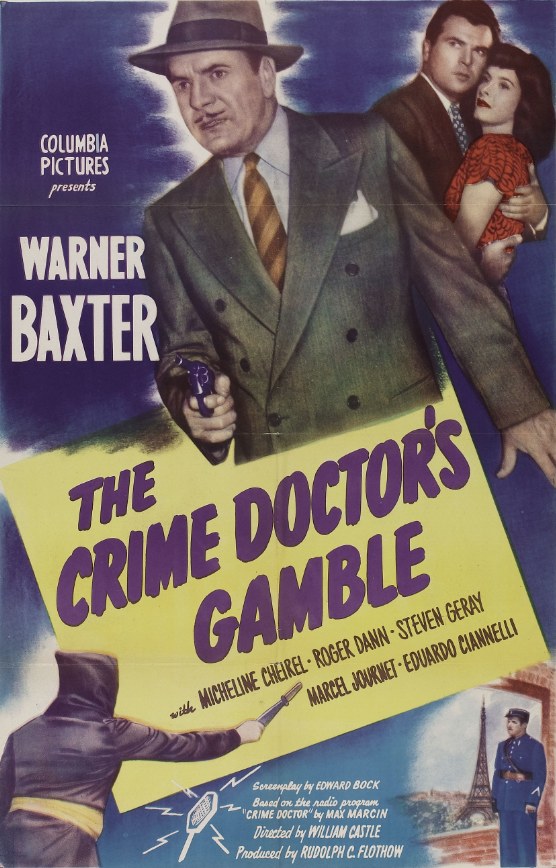
The Crime Doctor’s Gamble (Nov. 27, 1947)

Crime Doctor's Gamble
The Crime Doctor’s Gamble (1947)
Directed by William Castle
Columbia Pictures

William Castle’s 66-minute mystery The Crime Doctor’s Gamble was the ninth film in the series of programmers from Columbia Pictures.

Based on Max Marcin’s radio series Crime Doctor (1940-1947), the films starred Warner Baxter as Dr. Robert Ordway, a former amnesiac and reformed criminal who now works as a psychiatrist and solves mysteries in his spare time.

Every entry had a little something special to distinguish it from all the other entries. The gimmick of The Crime Doctor’s Gamble is that it takes place in Paris, which is a step up from the hillbilly setting of the last entry in the series, The Millerson Case (1947), which was my least favorite of the Crime Doctor features so far.

The Crime Doctor’s Gamble opens at the Institution Psycho-Pathologique des Invalides Mentaux, where Dr. Ordway is lecturing on crime deduction, modern psychiatry, criminal tendencies, and crime prevention to a roomful of old white-haired gents.

Dr. Ordway is in Paris for two weeks, and has three lectures to give. He’s also visiting his old friend Inspector Jacques Morrell (Marcel Journet), but he doesn’t intend to become involved with any police matters during his time in Paris.

Good luck with that plan, Crime Doctor.

After a champagne-soaked night on the town, Inspector Morrell and Dr. Ordway go to a little hole in the wall club with a rooster on the door, where they watch a couple of very acrobatic dancers — a man and a woman whose act includes such spectacles as the woman being swung around by her hair.

The dancers are followed on stage by a man dressed all in black who wears an executioner’s hood and throws knives at a woman wearing a white porcelain mask. Inspector Morrell muses how ease it would be for a trained knife thrower to commit murder and Dr. Ordway asks him if they’re on a busman’s holiday.

Morrell denies it, but the next morning, back at the Préfecture de Police, Morrell invites Dr. Ordway to talk with murder suspect Henri Jardin (Roger Dann), whose father threatened to cut him out of his will after his marriage to Mignon Duval (Micheline Cheirel), the daughter of the knife thrower they saw the night before.

Jardin remembers going into a rage the night his father was stabbed to death, but doesn’t remember what happened after their argument.

Morrell has a personal interest in Henri. The two men spent time together in a concentration camp during the war. After the war, Henri spent six months in a psychoneurotic institution, but Morrell doubts his guilt.

The mystery in The Crime Doctor’s Gamble is well paced and fairly involving. There’s a good collection of suspects — the Jardins’ butler, Theodore (Jean del Val), who overheard an argument the night of the murder, but thought nothing of it; the Jardins’ attorney, Jules Daudet (Steven Geray) who has never practiced criminal law, but who feels it is his duty to defend Henri for his father’s murder; Anton Geroux (Maurice Marsac), an expert painter of reproductions, or forgeries, depending on who’s doing the buying; the knife thrower, Maurice Duval (Eduardo Ciannelli), who says nothing good would have come of his daughter’s marriage to Jardin, and then says that even though Jardin was stabbed, that’s not how a knife thrower would kill with a knife, and drives his point home by throwing a knife into the door next to Ordway’s head; and, of course, Mignon and Henri … could one of them be guilty?

Despite its soupçon of Parisian flavor, The Crime Doctor’s Gamble is obviously all filmed on the Columbia sound stages. The signs in the film are in French, but all the actors speak English, even when they are not speaking to Dr. Ordway.

If you can overlook the cheapness of the production, however, The Crime Doctor’s Gamble is a good mystery. It’s also the type of series programmer that was on the verge of extinction with the coming popularity of television.

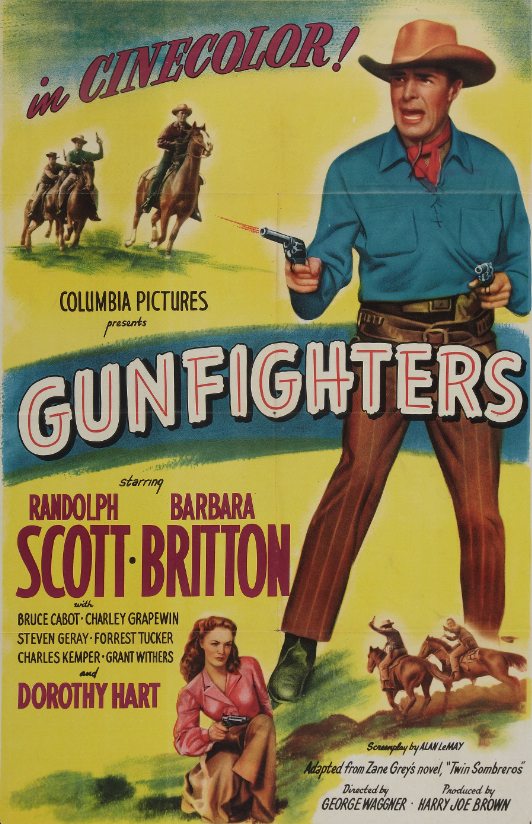
Gunfighters (July 1, 1947)

Another day, another western based on a Zane Grey novel.

Unlike the last movie I watched that was based on a book by Zane Grey — Thunder Mountain, which was a fun little 60-minute black and white western from RKO Radio Pictures — George Waggner’s Gunfighters gets the prestige treatment from Columbia Pictures. It’s a feature-length film (almost 90 minutes long), and it’s shot in Cinecolor.

Cinecolor was a two-color film process that was cheaper than Technicolor, and could sometimes look washed-out or unnaturally reddish, but Gunfighters looks great. For what it is, the production values are high, and legendary cowboy star Randolph Scott is always fun to watch.

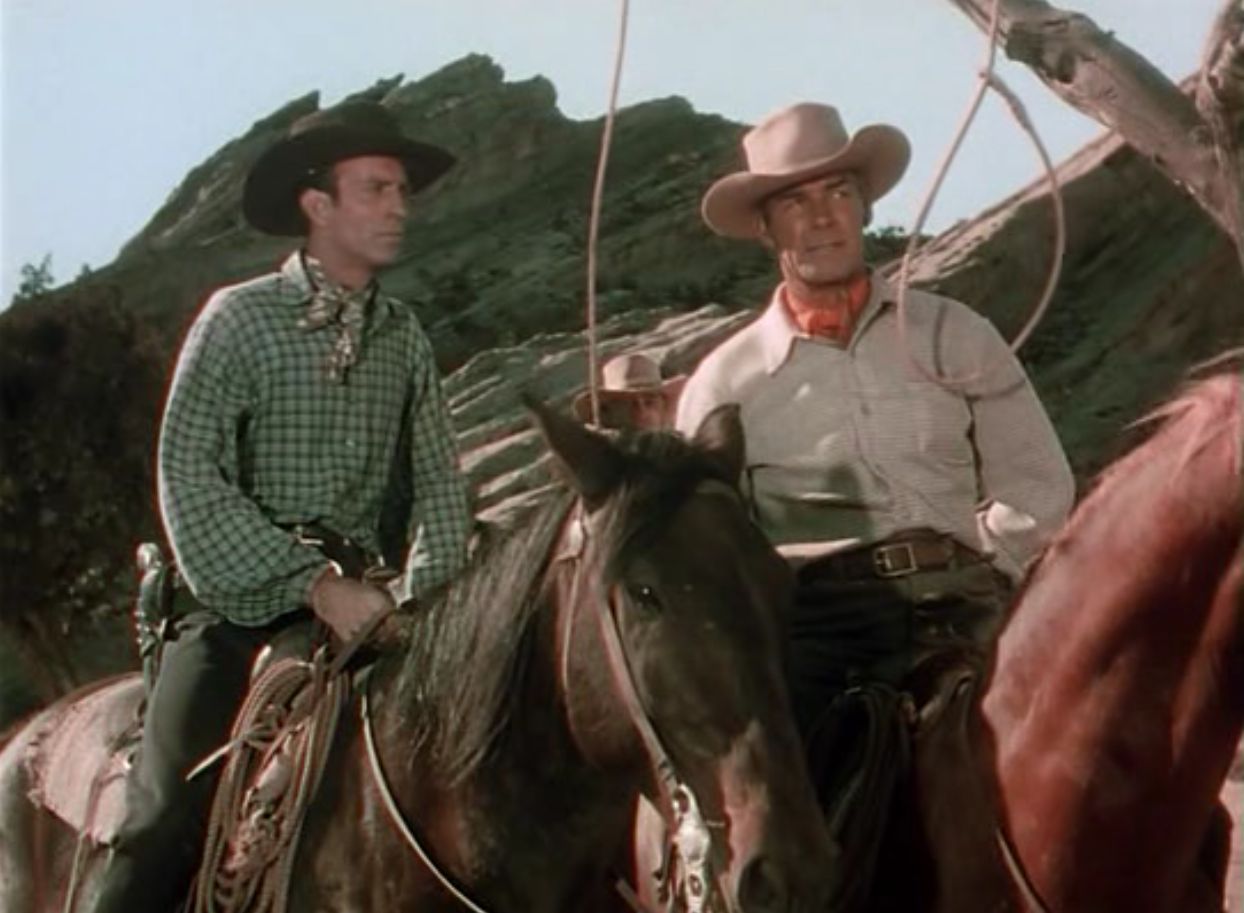
In Gunfighters, which is based on Zane Grey’s posthumously published novel Twin Sombreros, Scott plays a seasoned gunman with the unlikely name of Brazos Kane.

Brazos is the veteran of so many shootouts that as soon as the opening credits are done rolling, his best friend steps out of a cantina, calls him out, and Brazos is forced to kill him. As his friend lies dying, he offers no explanation for starting the duel. In the world of Gunfighters, gunmen are like mountain climbers — ask mountain climbers why they want to climb a mountain, and they’ll respond, “Because it’s there.” Likewise, Brazos’s friend just had to know who was the faster draw.

But Brazos doesn’t want to be a part of this topsy-turvy fast-draw world anymore. As he says in one of the film’s bits of sporadic voice-over, “When your best friend tries to beat you to the draw, it’s time to put up your guns.”

But it’s the same everywhere he goes — the Texas Panhandle, Wichita, Dodge — so Brazos heads for the Inskip Ranch, where he plans to ride the range with his old friend Bob Tyrell.

And that’s just what they do. After Brazos arrives at the Inskip Ranch, he and his old buddy Bob herd cattle, bust broncos, sleep under the stars, start their days with strong coffee and hot biscuits, pass a jug of whiskey around the campfire at night, tell tall tales, and live happily for all the days of their life, making Gunfighters unique among ’40s westerns, since it contains almost no gunplay or violence.

Ha ha! Just kidding. As soon as Brazos shows up at the Inskip Ranch, he finds Tyrell’s corpse facedown in a creek.

And even worse, he’s immediately blamed for the murder, and finds himself on the wrong end of a lynch mob.

Gunfighters has plenty to recommend it. It looks good and contains some of the most impressive chases on horseback I’ve seen in a western. But for every exciting five-minute stretch there’s a boring one, and the final showdown between Brazos and the bad guys seems to take forever to get to.

I enjoyed the performances of both Dorothy Hart and Barbara Britton, who play sisters Jane and Bess Banner. Most of the humor in the film comes from the fact that the two sisters look enough alike to be mistaken for twins, and there’s plenty of cases of mistaken identity, if that’s your thing.

Forrest Tucker, who is probably best remembered for playing Sergeant O’Rourke on the TV show F Troop, makes a great sneering bad guy, but the other major villain, Bruce Cabot (of King Kong fame), never makes much of an impression.

I didn’t love Gunfighters, but I didn’t hate it, either. And you can’t beat scenes like the one in which Brazos tells a crooked sheriff’s deputy played by Grant Withers, “Never mind my shots. Count my guns.”