Tag Archives: Film Noir

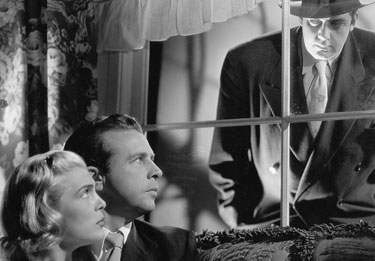
Pitfall (Aug. 24, 1948)

PitfallOne man’s domestic bliss is another man’s prison.

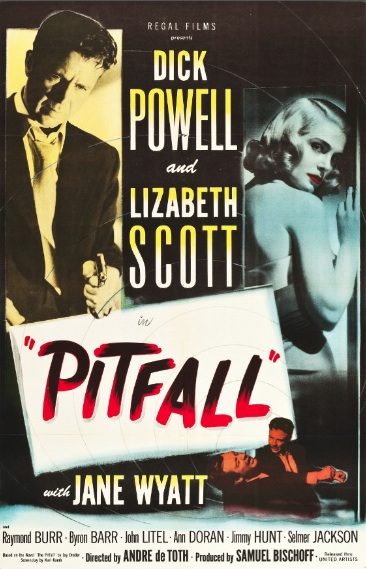
John Forbes (Dick Powell) has what some men only dream of — a home; a steady job with the Olympic Mutual Insurance Company; an attractive, intelligent, and loving wife (Jane Wyatt); and a son (Jimmy Hunt) who thinks his dad is the greatest guy in the world.

And yet, he’s dissatisfied. It’s a formless sort of dissatisfaction. He grumbles about how fast his son Tommy outgrows his shoes. He tells his wife Sue that the world won’t end if he doesn’t show up at his desk every morning at 9 o’clock. He asks Sue what became of those two young kids they were … the two young kids who were going to build a boat and sail around the world.

As Sue drives him to work he tells her, “Sometimes I get to feel like a wheel within a wheel within a wheel.”

“You and fifty million others,” she responds.

“I don’t want to be like fifty million others,” he says.

“But you’re John Forbes, average American, backbone of the country,” she says with a smile.

“I don’t want to be an average American, backbone of the country. I want somebody else to be the backbone and hold me up.”

Later that day — a day shaping up to be like any other — he goes to the apartment of Miss Mona Stevens (Lizabeth Scott), a beautiful but world-weary blonde who received gifts from a man convicted of embezzling.

It’s just part of his job. He doesn’t care one way or the other that one of the gifts he’s recovering is an engagement ring. But Mona sees right through him, and tells him, “You’re a little man with a briefcase. You go to work every morning and you do as you’re told.”

Her words get to him, and he softens towards her. They share a few afternoon drinks in a dark cocktail lounge. They go boating. And he never once mentions his wife or son.

Scott Powell and BurrOne thing I loved about Pitfall is that its characters are real adult people leading real adult lives. They’re not overblown film-noir caricatures, and their actions all have realistic consequences.

Mona is not a femme fatale who sees in John Forbes an easy mark. Aside from being unusually attractive, she’s an average woman who hates that she was involved with a man who was not only stupid enough to embezzle money to spend on her, but stupid enough to get caught. And she gets involved with John Forbes not because she has a dastardly scheme, but because he’s kind to her and she thinks he’s a decent guy. (Mona Stevens has a lot more in common with Ann Sheridan’s character in Nora Prentiss than she does with Barbara Stanwyck’s character in Double Indemnity.)

But Pitfall is not just a tale of marital infidelity and post-war suburban malaise, it’s a noirish thriller, which means there are some nasty surprises lurking.

One of them takes the form of the angry loser who embezzled for love of Mona — Bill Smiley (Byron Barr), whose prison term is nearing an end. The other takes the hulking form of a creepy private detective who is obsessed with Mona — J.B. “Mac” MacDonald (Raymond Burr).

Pitfall has all the ingredients of a great film noir, but director André de Toth mixes them together in interesting ways, and avoids over-the-top contrivances. Cinematographer Harry J. Wild’s solid but unpretentious shots of Los Angeles anchor the film, the actors all deliver really good performances, and Karl Kamb’s screenplay (based on Jay Dratler’s novel The Pitfall) is full of wit and intelligence.

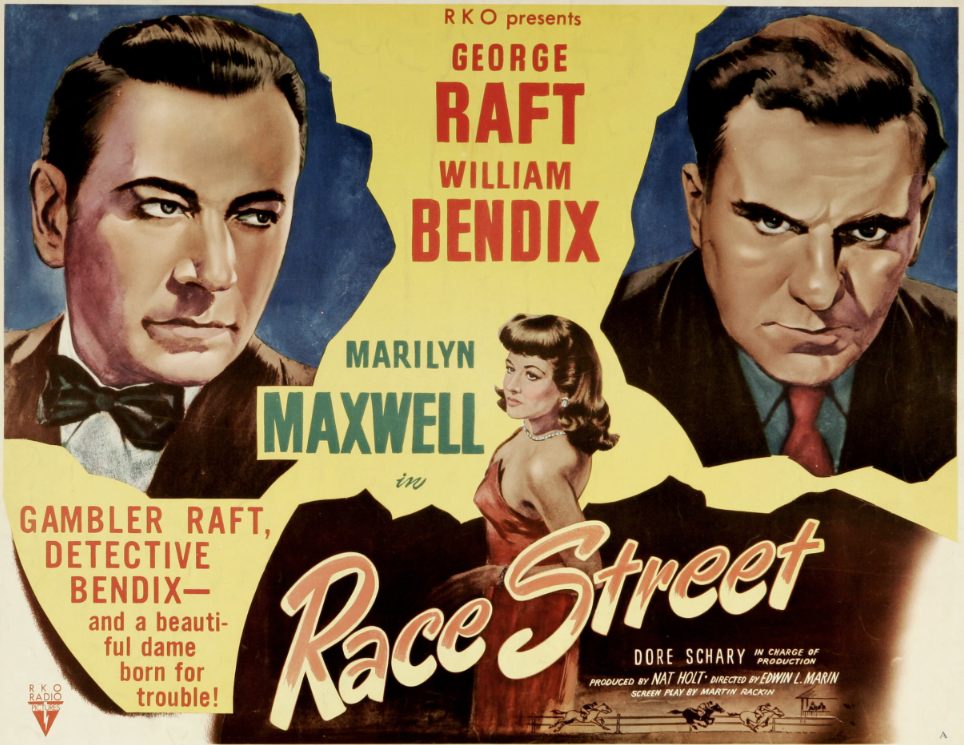
Race Street (Aug. 22, 1948)

Race StreetYou know what would be a great drinking game for a designated driver to play? Watching Race Street and taking a shot every time George Raft changes his expression.

Raft had no range as an actor, but he did play well with others. When paired with good performers, Raft had real chemistry with them. For instance, my favorite scene in Howard Hawks’s Scarface (1932) is when Ann Dvorak does a sexy, playful dance to try to get a reaction out of Raft. He remains stone-faced, but there’s always a twinkle in his eye.

As an actor, Raft got a lot of mileage out of that twinkle in his eye. Even though he mostly played his characters as expressionless tough guys, his eyes always made it seem as if he was taking in everything around him.

The other thing Raft brought to the table as an actor was a whiff of real-life criminality. He was well-known for his associations with gangsters like Owney Madden, Meyer Lansky, and Bugsy Siegel, which added another dimension to roles like the one he plays in Race Street.

In Race Street, Raft plays a bookie named Dan Gannin. Gannin hides his illegal betting operation behind a respectable facade as an investor. Despite his criminal endeavors, he has an easy friendship with a police detective, Lt. Barney Runson (William Bendix). Lt. Runson knows that his friend Dan is a bookie, but they’re childhood friends, and not much trumps that.

Gannin’s other childhood friend in the film, a fellow bookie named Hal Towers (Harry Morgan), needs a little more taking care of than Runson, and when he begins running afoul of thugs in a protection racket, it’s easy to see that things are going to get complicated for Gannin, who is the standard “nice guy who just wants to go straight” character we’ve seen in a thousand crime movies.

On the distaff side of Gannin’s life is his beautiful sister Elaine (Gale Robbins), a leggy dancer and nightclub singer with whom he’s opening a nightspot called the Turf Club. There’s also a new lady in his life, a brunette named Robbie Lawrence (Marilyn Maxwell).

Race Street was directed by Edwin L. Marin, who directed a bunch of B pictures for RKO with George Raft, including Nocturne (1946), which I enjoyed quite a bit.

As I said above, Raft isn’t the most engaging actor in the world, but he turned in watchable performances when he had a good supporting cast and a decent script, and Race Street succeeds on both counts. I especially liked William Bendix in this film. Bendix was as good at playing comic buffoons as he was at playing sinister villains, and he could do everything in between.

Race Street also has plenty of beautiful footage of San Francisco. A lot of it’s obviously stock footage, but it’s integrated into the film well. This is clearly a B movie, but no studio made B-grade film noirs as well or as consistently as RKO Radio Pictures.

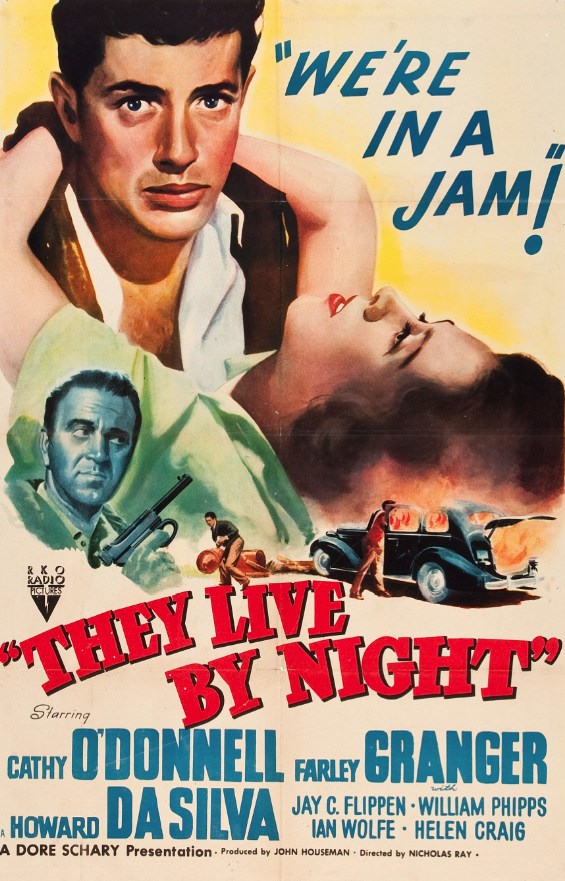
They Live by Night (Aug. 5, 1948)

They Live by Night
They Live by Night (1948)
Directed by Nicholas Ray
RKO Radio Pictures

This movie grabbed me with its first frame and never let go.

They Live by Night is unlike any other movie I’ve seen so far from 1948. Obviously I know what lay ahead for its director, Nicholas Ray, but even if I didn’t, this is the kind of film that would make me sit up and take notice of his name, and look forward to seeing everything he directed next.

Come to think of it, my knowledge of Ray’s filmography is pretty spotty. In high school, Rebel Without a Cause (1955) was one of my favorite films. I watched it over and over, but never thought to explore more of Ray’s films. Years later, I saw In a Lonely Place (1950) and loved it, but didn’t make the connection that it was the same director who made Rebel. But now I’ve got so many Nicholas Ray films to look forward to!

Like all innovative films made more than 50 years ago, They Live by Night doesn’t contain anything we haven’t seen in hundreds of films since, but when viewed in its proper context, it’s exhilarating. Just look at the opening of the film. Unlike nearly every other film of the era that began with a title card followed by a credit roll, They Live by Night begins with shot of two deliriously happy young lovers as the following words flash on the screen: “This boy… and this girl… were never properly introduced to the world we live in… To tell their story…” And suddenly the music becomes grim and portentous, we cut to a shot of a speeding car, and the film’s title appears. The speeding car is filmed from a helicopter, and it’s the earliest instance of action shot from a helicopter that I’ve seen in a film. It’s just one of the innovative ways that Ray creates tension, drama, and excitement with filmmaking techniques that are common practice now, but that were revolutionary at the time.

They Live by Night was based on Edward Anderson’s novel Thieves Like Us (1937). Farley Granger plays a young man named “Bowie” Bowers (his first name is pronounced “Boo-ee,” just like Jim Bowie). When the film begins, he’s an escaped con running from a murder sentence, and his luck will only get worse as the film goes on.

Except for one thing. He falls in love with a young woman named Keechie (Cathy O’Donnell), and while they’re on the run together, they’re happy as only two young people in love can be happy.

There are obvious comparisons to be drawn with Joseph H. Lewis’s Gun Crazy (1950) and Arthur Penn’s Bonnie and Clyde (1967). They Live by Night shares the Depression-era setting with Bonnie and Clyde, and it’s visually similar to Gun Crazy, but unlike both of those films, Keechie isn’t an active participant in any criminal activity and the film focuses more on her romance with Bowie than it does on Bowie’s crime spree.

Ray makes so many surprising and smart choices in this film. He doesn’t show most of Bowie’s bank robberies, which focuses our attention on Bowie’s romance with Keechie. His crime spree across Texas is a matter of grim necessity, and all he wants to do is escape. This has the effect of making a radio news report about Bowie’s growing infamy surprising to the audience. Ray makes it easy to forget much of the time that Bowie is a criminal, which make the intrusions of hard reality into Bowie and Keechie’s lives all the more shocking.

Ray also has a knack for depicting life in a way that feels authentic. Even minor characters with just a few lines feel like fully realized, three-dimensional people. When Bowie and Keechie go to a nightclub on a date, the African-American singer Marie Bryant does a rendition of “Your Red Wagon” and collects dollar tips from the crowd, which she folds and clasps between her fingers. Most Hollywood productions would never show a nightclub singer taking tips — it would ruin the illusion of glamour. But the nightclub in They Live by Night looks and feels like a real place. When Bowie goes into the men’s room, he has a brief conversation with the African-American bathroom attendant. In a lesser film, the attendant would be comic relief, and in a lower-budget film, he wouldn’t exist at all.

They Live by Night features top-notch work by all of its cast and crew. Leigh Harline’s music (with uncredited assistance from Woody Guthrie) is phenomenal. George E. Diskant’s cinematography is some of the most beautiful and most noirish I’ve ever seen (they really do live by night in this movie), and Sherman Todd’s film editing is soothing when it needs to be and jarring when it needs to be. Todd and Ray made a lot of risky choices in the editing room, but for my money, they all paid off.

Ray filmed They Live by Night in 1947, but RKO wasn’t sure how to market the film, and it ended up premiering in the United Kingdom in a single theater on August 5, 1948. It wasn’t released in the United States until November 1949, and didn’t end up being a financial success, but it had been screened privately in Hollywood for many actors and producers, which led to Ray’s next film, Knock on Any Door (1949), with Humphrey Bogart, as well as to Farley Granger being cast in Alfred Hitchcock’s Rope (1948).

Key Largo (July 31, 1948)

Key LargoJohn Huston’s Key Largo was the fourth and final film Lauren Bacall and Humphrey Bogart made together.

Hard to believe, isn’t it? Bogie and Bacall are one of the most famous couples — perhaps the most famous couple — in Hollywood history. And yet, their onscreen work together boils down to just four films made over the course of five years: To Have and Have Not (1944), The Big Sleep (1946), Dark Passage (1947), and Key Largo.

Key Largo is very loosely based on the 1939 play by Maxwell Anderson. I often don’t like films adapted from plays. The dialogue and the way the characters enter and re-enter the action usually feels very strange. But Key Largo never feels “stagey,” and confining the action to a single location only heightens the tension between the characters.

The film opens with beautiful footage of the Florida Keys. By opening with establishing shots of the steamy, summertime Keys, by the time the action is confined to a hotel while a hurricane rages outside, nothing about Key Largo feels stagey or stilted. The viewer is right in the middle of the action, and the suspense grows as the film goes on.

Summertime is the off season in the Florida Keys, when the mercury never dips below 100 degrees, and all the hotels are closed. Bogart plays Frank McCloud, a veteran of World War II who is in Key Largo to visit James Temple (Lionel Barrymore), a wheelchair-bound man whose son George was killed in the war. (McCloud was George Temple’s commanding officer.) Temple runs a hotel in Key Largo with George’s widow, Nora (Lauren Bacall).

When Bogart sits down at the bar in the Largo Hotel, he laconically introduces himself to the boozy moll Gaye Dawn (Claire Trevor) as “McCloud. Frank. By John, out of Ellen.”

Gaye is not the only oddball occupant of the Largo Hotel. There are also a trio of men — Curly (Thomas Gomez), Angel (Dan Seymour), and Toots (Harry Lewis) — and with names like those, it’s clear that their story about coming down to the Keys from Milwaukee to do a little fishing isn’t on the up-and-up.

The full terror of the situation becomes apparent when we catch our first glimpse of gangster Johnny Rocco (Edward G. Robinson), sitting in a bathtub in one of the upstairs rooms of the hotel, chewing a cigar and exuding menace.

Robinson is a great actor, and Johnny Rocco is one of his most memorable creations. Rocco craves power and money, and there will never be enough power and money to satisfy him. He delights in toying with his hostages, taunting them with their helplessness. He even goes so far as to give one of them a pistol, daring them to kill him. But his bullying takes all forms. One of the most harrowing scenes in the film is when he humiliates Gaye by forcing her to sing for everyone before he’ll give her another drink. And like most bullies, Johnny Rocco is a coward at heart. As the hurricane builds in ferocity outside the hotel, so does his fear.

Key Largo was John Huston’s second film to be released in 1948. (The first was another collaboration with Bogart, The Treasure of the Sierra Madre.) Key Largo is a masterfully directed film. The actors are all at the top of their game (Claire Trevor won the Academy Award for Best Supporting Actress for her role). The film’s music, by Max Steiner, is perfect; full of tension and menace, and — when the scene calls for it — a crushing sense of inevitability. Rudi Fehr’s editing accentuates the tension, and Karl Freund’s cinematography is beautiful.

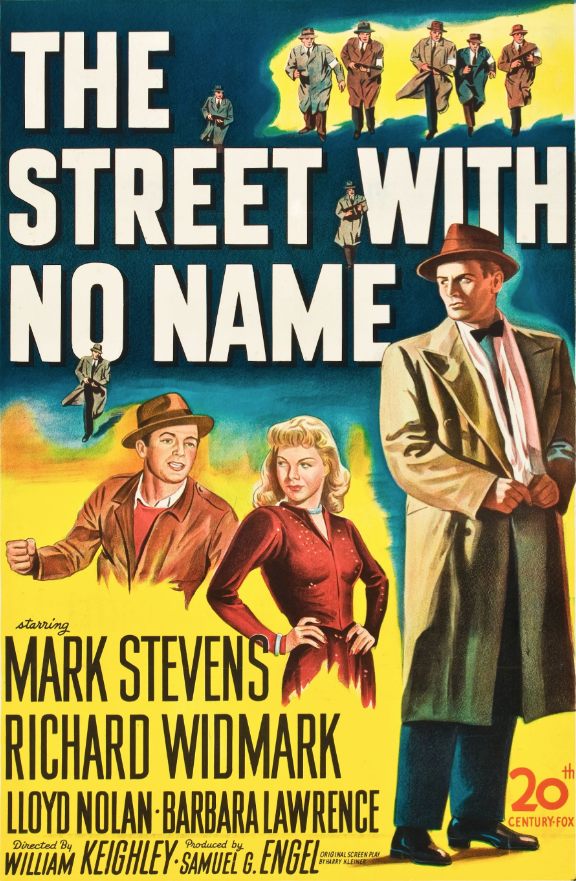
The Street With No Name (July 14, 1948)

By the time William Keighley’s The Street With No Name was released, noirish docudramas were practically a genre unto themselves. The docudrama craze began with The House on 92nd Street (1945), which was loosely based on a real case of nuclear espionage during World War II and was produced by Louis de Rochemont, the creator of the March of Time newsreels.

More “ripped from the headlines” stories followed. Spy thrillers like 13 Rue Madeleine (1947) and The Iron Curtain (1948), tales of miscarried justice like Boomerang (1947) and Call Northside 777 (1948), and even films like Kiss of Death (1947), which wasn’t based on any single real event, but presented its crime story as realistically as possible by eschewing a musical score and filming all the action on location — in prisons, schools, and city streets.

The Street With No Name begins with the following words: “The motion picture you are about to see was adapted from the files of the Federal Bureau of Investigation. Wherever possible it was photographed in the original locale and played by the actual F.B.I. personnel involved.”

Then, a quote from J. Edgar Hoover appears as it is pounded out by invisible hands on a sheet of paper stuck in a typewriter:

The street on which crime flourishes is the street extending across America. It is the street with no name. Organized gangsterism is once again returning. If permitted to go unchecked three out of every four Americans will eventually become its victims. Wherever law and order break down there you will find public indifference. An alert and vigilant America will make for a secure America.

The docudrama that I think The Street With No Name most closely resembles is Anthony Mann’s T-Men (1947), which uses the same kind of “government-approved” patriotic opening, but eventually devolves into a film noir in which the underworld setting and stylistic elements are more interesting than the clean-shaven protagonists. T-Men, however, showed its protagonists becoming drawn deeper into their undercover roles while The Street With No Name doesn’t really develop its protagonist beyond his play-acting heroics.

The Street With No Name opens with a murder at the Meadowbrook night club, a typical road house in a typical city called “Center City.” (The Street With No Name was filmed in and around Los Angeles, and while there is a neighborhood of San Diego called “Center City,” I think that “Center City” was just meant to be a generic name for “Anytown, USA.”)

A second crime by the same masked gang — the murder of a bank guard — draws the FBI into the case, since bank robberies are a federal crime. Leading the investigation is FBI Inspector George A. Briggs, who is played by Lloyd Nolan. (Briggs is the same character Nolan played in The House on 92nd Street.)

According to Briggs, these new gangs are “the juvenile delinquents of yesterday” and they are even more ruthless than the pre-war gangs. The only way to break this gang is to send in an undercover agent.

Enter Mark Stevens as FBI cadet Gene Cordell, who we know is a prime candidate for the assignment because he knows exactly which targets to shoot — and which ones not to shoot — in a Hogan’s Alley sequence filmed at Quantico, VA.

Stevens goes undercover as “George Manly” in the skid row section of Center City, which is full of pool halls, boxing gyms, and peep show machines, and where apparently the only song anyone ever plays on the jukebox is an instrumental version of “I’m Looking Over a Four-Leaf Clover.”

Despite Stevens’s total lack of proficiency in the boxing ring (he looks less competent than Charlie Chapin was meant to in City Lights), the robbery gang he’s after is impressed with his skills and takes him in as one of their own.

The gang’s leader is named Alec Stiles, and he’s played by Richard Widmark. This was Widmark’s second big-screen role, and it’s similar to his first, the psychopathic Tommy Udo in Kiss of Death. Stiles’s teeth aren’t quite as big as Udo’s were, but his maniacal leer is the same. Widmark delivers a good performance, but character details like Stiles’s germaphobia and wife-beating aren’t quite enough to make you forget Udo if you’ve recently watched Kiss of Death.

But character details and plot points aren’t what makes The Street With No Name a standout docudrama film noir. What makes the film memorable is the overriding sense of tension and the dark, shadowy cinematography of Joseph MacDonald.

Stevens isn’t as strong a protagonist as Dennis O’Keefe and Alfred Ryder were in T-Men, and the most memorable sequences in The Street With No Name are completely wordless. The first is a chase in a ferryboat station (filmed at the Municipal Ferry in San Pedro, CA) and the second follows Stevens as he tries to get ballistic evidence by breaking into the gang’s weapons cache in a warehouse with Widmark hot on his heels.

Despite a generic story and a bland protagonist, The Street With No Name has great pacing, lots of suspense, style to spare, and a solid villain. I recommend it to all fans of FBI stories and film noir.

Canon City (June 30, 1948)

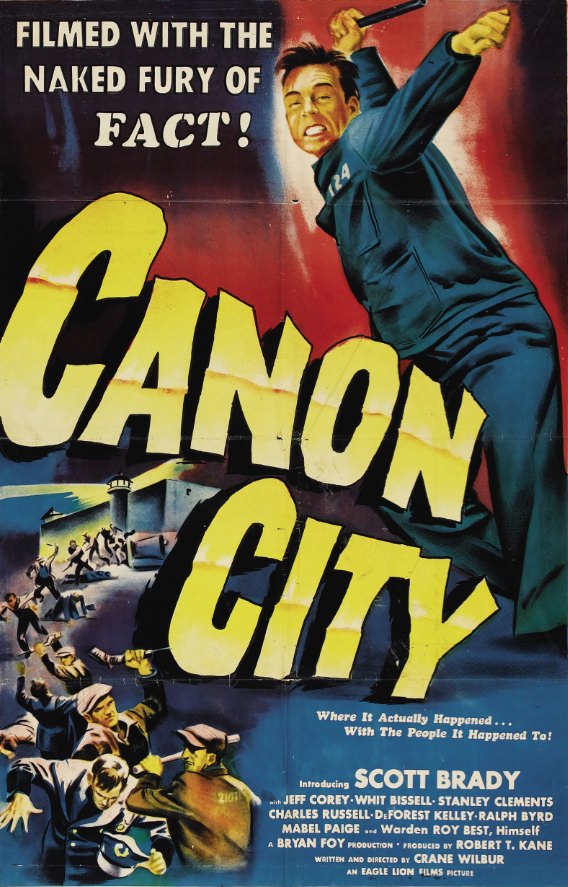
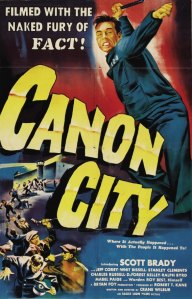
Crane Wilbur’s Canon City is a low-budget entry in the docudrama genre, a genre that began in 1945 with the Louis de Rochemont-produced espionage melodrama The House on 92nd Street and enjoyed enormous popularity in post-war Hollywood.

Docudramas were dramatizations of actual events that featured actors but that strove for authenticity by filming in actual locations, using real documents in key scenes, and featuring participants in the case playing themselves in bit parts.

After The House on 92nd Street followed more fact-based spy thrillers like 13 Rue Madeleine (1947) and The Iron Curtain (1948), and legal docudramas like Boomerang (1947) and Call Northside 777 (1948).

Some films, like Kiss of Death (1947), T-Men (1947), and The Naked City (1948), were mostly fictional, but were presented in a docudrama fashion and filmed on location to add authenticity to otherwise run-of-the-mill crime stories.

Canon City uses a combination of docudrama techniques. It begins in a straightforward documentary style, and slowly draws us into the fictional world of its incarcerated protagonists. The obligatory scroll of text that opens the film informs the viewer that all events depicted in the film are based on actual events that took place in and around the Colorado State Prison in Canon City on the night of December 30, 1947. (Canon City is pronounced “Canyon City,” and is sometimes spelled Cañon City.) It goes on to say that the convicts shown in the film are the actual convicts involved in the case, and that Roy Best, the warden of the prison, plays himself. Finally, we are told that “the details of the break are portrayed exactly as they occurred and were photographed where they happened.”

Reed Hadley narrates the opening in his signature style (docudramas provided a lot of work for Hadley). He describes the Colorado State Penitentiary in Canon City as “a home for those who like to have their own way too much, and have taken forbidden steps to achieve their aims. All kinds are here; murderers, kidnappers, thieves, robbers, embezzlers.”

Warden Best and the disembodied voice of Hadley lead the viewer on a tour of the prison, introducing the variety of work that the prisoners do and conducting short interviews with actual inmates of various types; a man soon to be paroled, an old man who’s been doing time since 1897, a 14-year-old murderer sentenced to 20-30 years who’s working on a hooked rug in the art shop, and a murderer whose death sentence was commuted to life by the warden, and who now hopes to be paroled in 1949.

We then see the process of nighttime lockdown, and at the 9-minute mark of the film Hadley’s narration introduces the viewer to a pair of inmates with adjoining cells: Jim Sherbondy, a 29-year-old inmate who was sentenced at the age of 17 for killing a police officer, and Johnson, a long-termer who is working on the model of a ship. (His real work — a zip gun — is hidden behind the ship. He’s part of a plan to break out.)
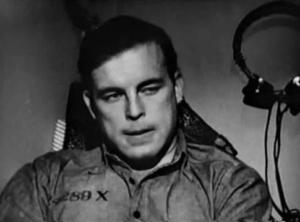
Hadley’s narration doesn’t stop after Sherbondy and Johnson are introduced, and the film continues in a semi-documentary style, but the introduction of these two characters marks the moment when the film moves from fact to fiction. Remember that opening text from the beginning of the film I mentioned? The one that said “The convicts you will see are the actual convicts”?

Well, this was clearly a lie, since Sherbondy and Johnson are both played by actors, not actual convicts. This is par for the course, though. Despite what they invariably claimed, docudramas in the ’40s usually had a tricky relationship with the truth.

I couldn’t figure out who the uncredited actor who plays Johnson is (if you know, please comment on this review), but Sherbondy is played by Scott Brady, the younger brother of notorious tough-guy actor Lawrence Tierney. (Lawrence Tierney and Scott Brady’s youngest brother, Edward Tierney, who turned 20 years old in 1948, also had a career in the movies starting in the ’50s.) Brady was born Gerard Kenneth Tierney, and Canon City was his first major film acting role, and the first film in which he was credited as “Scott Brady.” (His first appearance was a small role in Sam Newfield’s 1948 film The Counterfeiters, in which he was credited as “Gerard Gilbert.”)

Brady bears an uncanny resemblance to his older brother, but his face is a little softer and more innocent-looking, which works well for his role in Canon City. Sherbondy is a reluctant participant in the breakout. He has a job in the prison’s photography shop working in the darkroom, which is the perfect place for the conspirators to hide a load of zip guns, since the darkroom requires guards to wait outside until it’s safe to turn the lights on and open the door.

I wonder if anyone who saw Canon City during its initial theatrical run noticed Brady’s resemblance to Lawrence Tierney, or if there were any astute viewers who noticed the slim, bespectacled Whit Bissell and said to themselves, “Hey, wasn’t that guy in Brute Force?”

I also wonder how many viewers didn’t specifically recognize any of the actors but were able to tell that they were watching actors and not the actual participants in the case. And if they did, did they feel cheated after the opening claim of total and complete veracity?

I wonder these things because I do think that Canon City is remarkably skillful in the way it draws the viewer in and the way it manages to feel raw and real throughout. A little before the half-hour mark, the breakout kicks into high gear with an assault on a guard and a furious rush to fit all the pieces of the plan together. For nearly an hour, Canon City is as tense a picture as one could ask for. A dozen men pour out into a snowy night, disguised as prison guards. The prison alarm tolls throughout the small town. Terrified moviegoers swarm out of a theater whose marquee shows the Abbott and Costello comedy The Noose Hangs High (which wasn’t released until the spring of 1948, incidentally) and people on the streets rush to get home. But home offers no solace, as the convicts break into house after house looking for shelter, food, and weapons.

The cinematographer of Canon City was John Alton, who was responsible for brilliant work on many film noirs (most notably his collaborations with Anthony Mann). There aren’t a lot of memorable “noir” setups in Canon City, but overly stylized lighting wouldn’t have fit with the docudrama approach to the material. The darkness and the driving blizzard are terrifying enough filmed in a straightforward fashion. Canon City is the kind of movie where the cold gets into your bones just watching it.

Canon City is a film that is dated in many ways, but it still packs a punch if you can go along with the semi-documentary style. Writer-director Crane Wilbur gets the most out of his limited budget by filming inside the prison and in the rugged beauty of the southern Colorado landscape around Cañon City, and the pacing is swift and brutal once the breakout occurs.

Oh, and if you’re a Star Trek fan, keep your eyes peeled for a young DeForest Kelley as one of the dozen escapees.
Shed No Tears (June 9, 1948)

If I’ve said it once, I’ve said it a million times … only a chump fakes his own death.

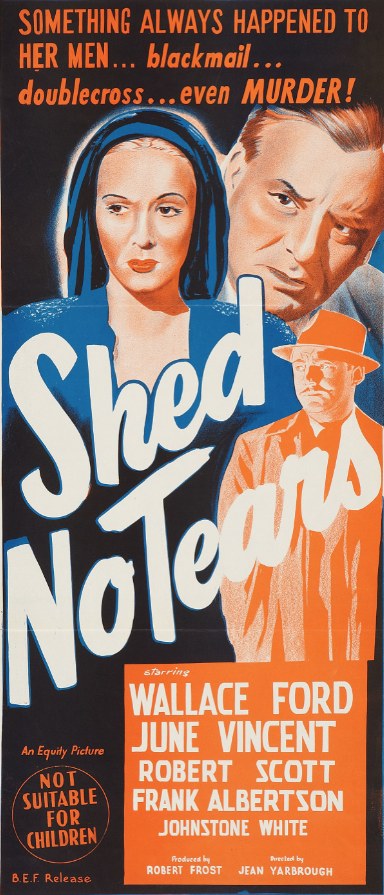
And yet, that’s exactly what Sam Grover (Wallace Ford) does in the very first scene of Jean Yarbrough’s Shed No Tears. He sets fire to his hotel room and leaves a cadaver behind as he sneaks out the back way. It’s all part of a scheme he’s cooked up with his wife Edna, an icy blonde played by June Vincent, whose best-known film noir performance was probably in Roy William Neill’s Black Angel (1946).

Edna is as young and beautiful as Sam Grover is middle-aged and schlubby. When an old woman on the bus sees Sam looking adoringly at a picture of Edna, she asks him if it’s a picture of his daughter. “My granddaughter,” he responds with a sigh.

If you’ve ever seen a B noir before, you’ll know that Edna’s up to no good before Sam even kicks over the flaming wastebasket in his hotel room, but all doubt is erased a few minutes into the film when Sam scurries off to hide out and Edna falls into the well-muscled arms of her handsome young boyfriend Ray (Mark Roberts, listed in the credits as “Robert Scott”).

The plot thickens when Sam’s adult son, Tom (Dick Hogan), suspects foul play and engages the services of a slippery and pompous private investigator named Huntington Stewart (Johnstone White). Meanwhile, Sam grows restless in hiding and gets itchier and itchier as he waits for Edna to come through with the insurance dough for his “death.”

Shed No Tears is based on the novel by Don Martin. Its dialogue is heavy on exposition, but the editing and visual storytelling are tight. The acting by everyone except the always dependable Wallace Ford is merely passable, with Dick Hogan’s stilted performance qualifying as the most egregious. I suspect that he was cast more for his cute little face than for his acting ability. Incidentally, this was one of Hogan’s last roles. After Shed No Tears he would go on to appear in the Alan Ladd vehicle Beyond Glory (1948) and Alfred Hitchcock’s Rope (1948), in which he played the murder victim.

Shed No Tears never rises above the level of a B-movie programmer, but for what it is, it’s an entertaining 70-minute melodrama. It’s in the public domain, and there’s an OK-looking DVD available from Alpha Home Entertainment that was transferred from a 16mm print. There are also a few versions currently streaming on YouTube:

http://www.youtube.com/watch?v=naMdpcjHnWo

Raw Deal (May 26, 1948)

Raw Deal
Raw Deal (1948)
Directed by Anthony Mann
Eagle-Lion Films

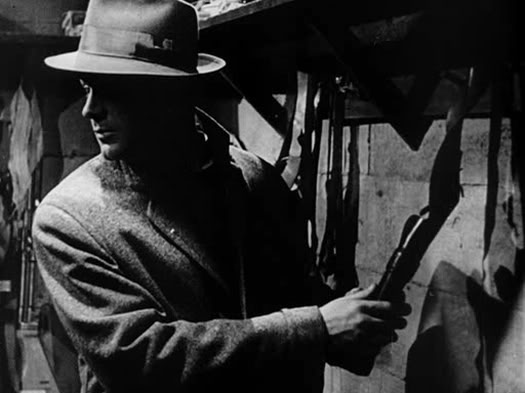
Anthony Mann’s T-Men (1947) and Raw Deal (1948) together form one of the most powerful one-two punches in the history or film noir.

Both films star Dennis O’Keefe, both feature musical scores by Paul Sawtell, John C. Higgins has a writing credit on both, and both feature the exquisite cinematography of John Alton.

What makes these two films such a great one-two punch is that they are each one side of the film noir coin. T-Men is a docudrama, purportedly made to show square-jawed agents of the Treasury Department cracking a big case, but like all great noir docudramas, the depiction of the criminal demimonde and the gray areas of its protagonists’ moral codes are the most interesting parts of the film.

Raw Deal is the other side of the coin. It’s a film noir purely about crime and criminals, and it has all the great elements of noir — a doomed male protagonist on the run, a “good girl” and a “bad girl” competing for his love, dream-like voice-over narration, a casually sadistic villain, and it’s set in one of the great noir cities — San Francisco.

Like Billy Wilder’s Double Indemnity (1944), Edgar G. Ulmer’s Detour (1945), and Jacques Tourneur’s Out of the Past (1947), Raw Deal is the Platonic ideal of a film noir.

Raw Deal begins with aging gun moll Pat Cameron (Claire Trevor) going to visit Joe Sullivan (Dennis O’Keefe) in prison. Right away Raw Deal establishes that it is not a run-of-the-mill crime film, as Claire Trevor’s voice-over narration is accompanied by a haunting theme played on a theremin. The element of the theremin is only present in Paul Sawtell’s score during these voice-overs, and establishes Pat’s point of view as dreamy and hyperreal. Raw Deal is the first film in which I’ve heard a theremin since Miklós Rózsa’s masterful scores for Billy Wilder’s The Lost Weekend (1945) and Alfred Hitchcock’s Spellbound (1945), both of which used the eerie sound of a theremin to establish altered states of perception.

When she arrives at the prison, however, Pat is told she has to wait a little while because Joe already has a visitor — Ann Martin (Marsha Hunt). Ann works for Joe’s defense lawyer’s office and she cares about his case and wants to see him paroled, but she admits that he will probably have to wait at least three years. She leaves, Pat enters, and Joe is faced with a more tantalizing prospect. Gang boss Rick Coyle (Raymond Burr) has devised an escape plan for Joe. If he can make it over the wall Pat will be there waiting in a getaway car.

Of course, nothing is what it seems to be on the surface, and Coyle — whose double-cross is how Joe ended up in prison in the first place and who still owes Joe his cut from a robbery — is hoping that Joe will be shot by prison guards during his escape, taking care of Coyle’s problem for good.

Burr formerly played a memorable villain in Mann’s noir Desperate (1947), but he’s an even nastier and more violent character in Raw Deal, casually setting his girlfriend on fire in a shocking scene of cruelty that presages a similar scene in Fritz Lang’s The Big Heat (1953). His right-hand man, the bizarrely named “Fantail,” is solidly played by John Ireland, who formerly starred in Mann’s noir Railroaded (1947).

First and foremost, Raw Deal is a masterpiece of suspense. For most of the movie Joe, Pat, and Ann are on the run from the police, and the film hits all of the classic “fugitive movie” moments — navigating a road block, hiding out in a cabin in the woods, one narrow escape after another, etc. Finally, for the last act of the film, the type of suspense changes, and a ticking clock takes the film closer and closer to its inevitable violent confrontation.

Since so much of Raw Deal takes place on the open road, there aren’t as many opportunities for Alton to flex his cinematographic muscles in the same way he did in T-Men, which mostly took place in urban environments. But he makes the most of what he has to work with. There’s a lot of day-for-night shooting in Raw Deal, and it’s a technique that never looks quite right, but at least with Alton operating the camera it always looks good. Finally, scenes toward the end with Claire Trevor’s face reflected in a ticking clock as she weighs a decision in her mind are absolutely masterful.

Anthony Mann was a great director who made wonderful films in all genres, but among his film noirs, I’ll never be able to decide if I like Raw Deal or T-Men better. They’re both great, must-see pictures for every aficionado of film noir.

Berlin Express (May 1, 1948)

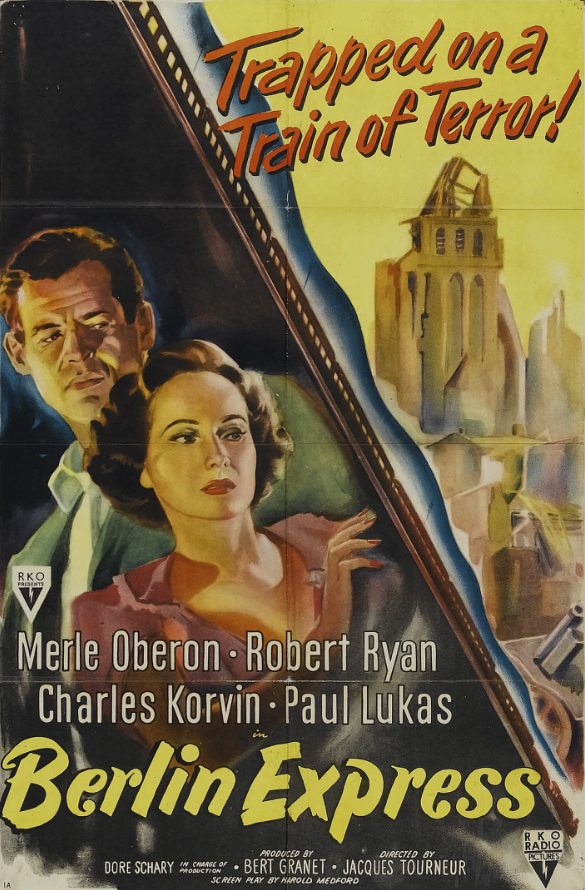
Jacques Tourneur’s crisp thriller Berlin Express presents occupied Germany in miniature. Every nation associated with Allied-occupied Germany is represented by the film’s characters — the United States, France, Germany, England, and Russia.

It’s filmed in the semi-documentary style that was popular in the late ’40s. Europeans speak to each other in their own languages, with no subtitles (there is a voiceover narrator to explain to the viewer what’s transpiring), and much of Berlin Express was filmed on location in Paris, Frankfurt, and Berlin. (According to IMDb.com, it was the first Hollywood production in Europe after World War II.)

Berlin Express has stylistic elements of the German “Trümmerfilm” (“rubble film”), like Die Mörder sind unter uns (The Murderers Are Among Us) (1946). The German rubble films used the war-ravaged backdrops that were plentiful in German cities heavily bombed during the war. Berlin Express doesn’t have the same gravitas or overwhelming sense of tragedy as the rubble films, but the location footage gives it a sense of authenticity not found in most run-of-the-mill thrillers.

Compared with Jacques Tourneur’s previous film, the film noir masterpiece Out of the Past (1947), Berlin Express is a lesser effort, but Tourneur is a pro, and every one of his films that I’ve seen has been a work of solid craftsmanship.

The MacGuffin in Berlin Express is a note that falls into the hands of the Deuxième Bureau that reads: “21:45 / D / 9850 / Sulzbach.” The first part seems to refer to a time of day (9:45 PM), but there are Sulzbachs in every occupied zone of Germany. What’s happening? And where will it happen?

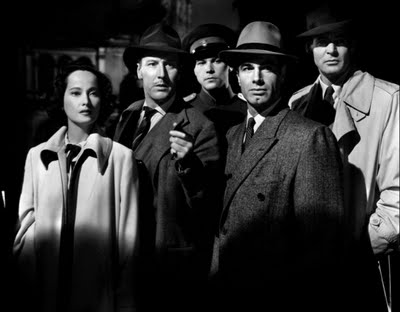
Enter a multinational motley crew of characters traveling aboard the Berlin Express. In compartment A is Robert J. Lindley (Robert Ryan), a United States Government Agricultural Expert. In compartment B is Lucienne Mirbeau (Merle Oberon), a secretary from France. In compartment C is Herr Otto Franzen (Fritz Kortner), once a German industrialist, now a dealer in scrap iron. Compartment D is unoccupied, but is being held for a “person of importance.” Compartment E is shared by two men, a former British soldier named James Sterling (Robert Coote), and a military aide for the Russian Occupation Authority, Lt. Maxim Kiroshilov (Roman Toporow). In compartment F is Henri Perrot (Charles Korvin), once a member of the French Underground, now a man of commerce. And finally, in compartment G, is Hans Schmidt (Peter von Zerneck), whose occupation is a mystery to the viewer (the whistle of the train covers what the narrator is saying, which is a cute touch).

Of course, this is an espionage thriller, so it should go without saying that not everyone is what they appear to be, and there will be at least one big reveal or switcheroo before the credits roll.

Berlin Express was made during that curious little space in time when World War II was over but the Cold War had not yet kicked into high gear. Its villains may not seem very plausible or consequential to modern viewers, but for my money, a good thriller is a good thriller. The voiceover narration is a little heavy-handed, but for the most part Berlin Express keeps things tight, fast-paced, and properly thrilling.

Drunken Angel (April 27, 1948)

Drunken Angel
Drunken Angel (1948)
Directed by Akira Kurosawa
Toho Company

Now seems as good a time as any to talk about how Akira Kurosawa changed my life.

When I was 11 or 12 years old, my mom took me to see Ran (1985) on the big screen. I always loved going to the movies, and since we didn’t have a television, we went to the movies a lot. Until I saw Kurosawa’s Ran, however, I don’t think I’d thought much about what actually went into making a movie.

Ran changed all that. Everything about it was vividly present onscreen — bold color choices, meticulously arranged visual compositions, music too quiet and gentle for the bloody violence it accompanies, the overly theatrical makeup for the actors — and I drank it all in.

I’ve read some critics talk about seeing Citizen Kane (1941) for the first time and becoming acutely aware of cinematography, music, camera movements, and so on. That was my experience with Ran, and it began my love affair with Kurosawa. It was a love affair that continued with Seven Samurai (1954) (which I also saw on the big screen in a revival house shortly after seeing Ran), Throne of Blood (1957), Yojimbo (1961), Dreams (1990), Rashômon (1950), Kagemusha (1980), Ikiru (1952), High and Low (1963), The Hidden Fortress (1958), and Stray Dog (1949).

I can’t claim to be a Kurosawa completist, though. He directed a lot of movies that I haven’t seen. I think I’m spacing them out, since in most cases I’m blown away all over again and if there’s a Kurosawa movie out there that I haven’t seen, it’s something to look forward to.

While I wasn’t exactly blown away by the last new-to-me Kurosawa film I watched and reviewed, No Regrets for Our Youth (Waga seishun ni kuinashi) (1946), I was blown away by Drunken Angel (Yoidore tenshi), which I’d also never seen before.

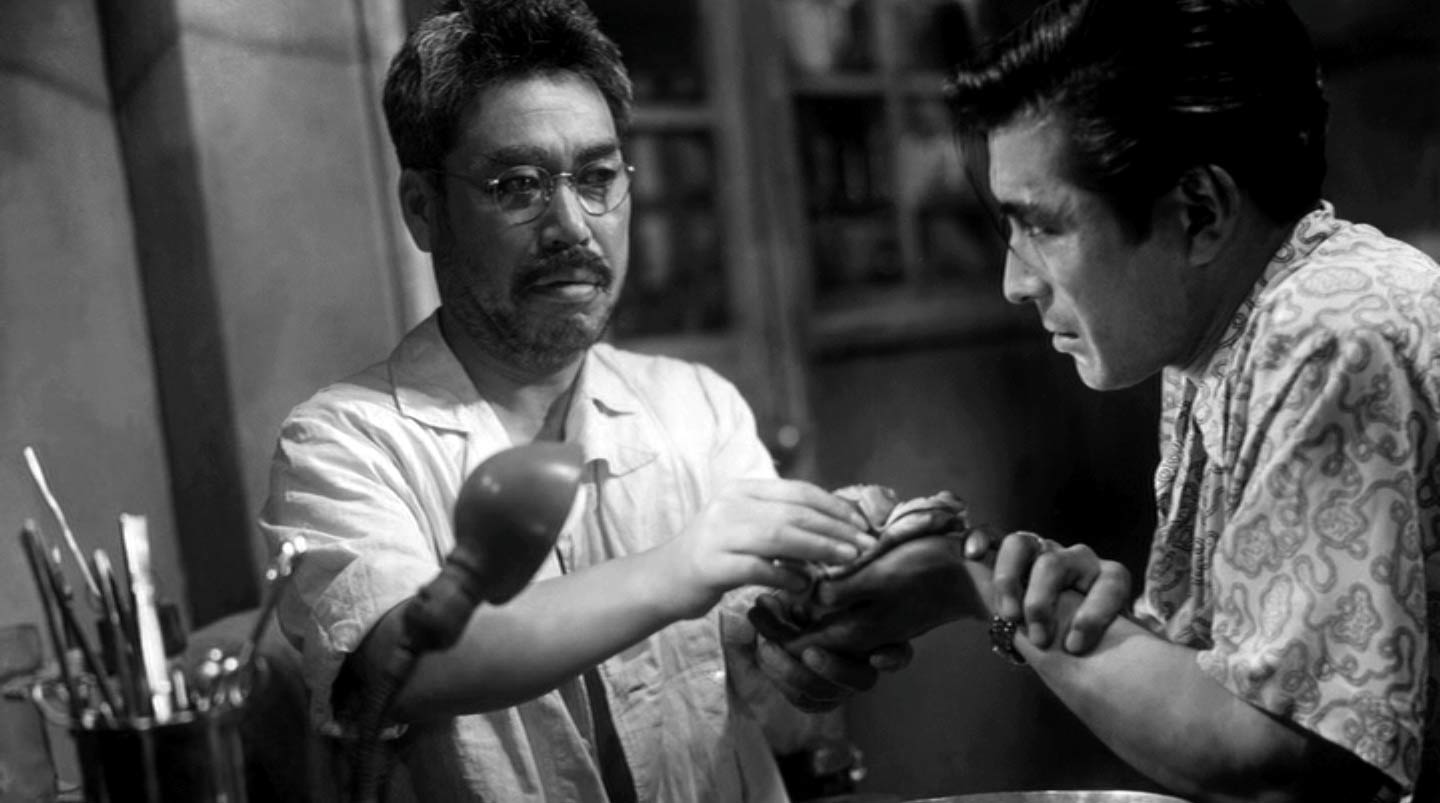
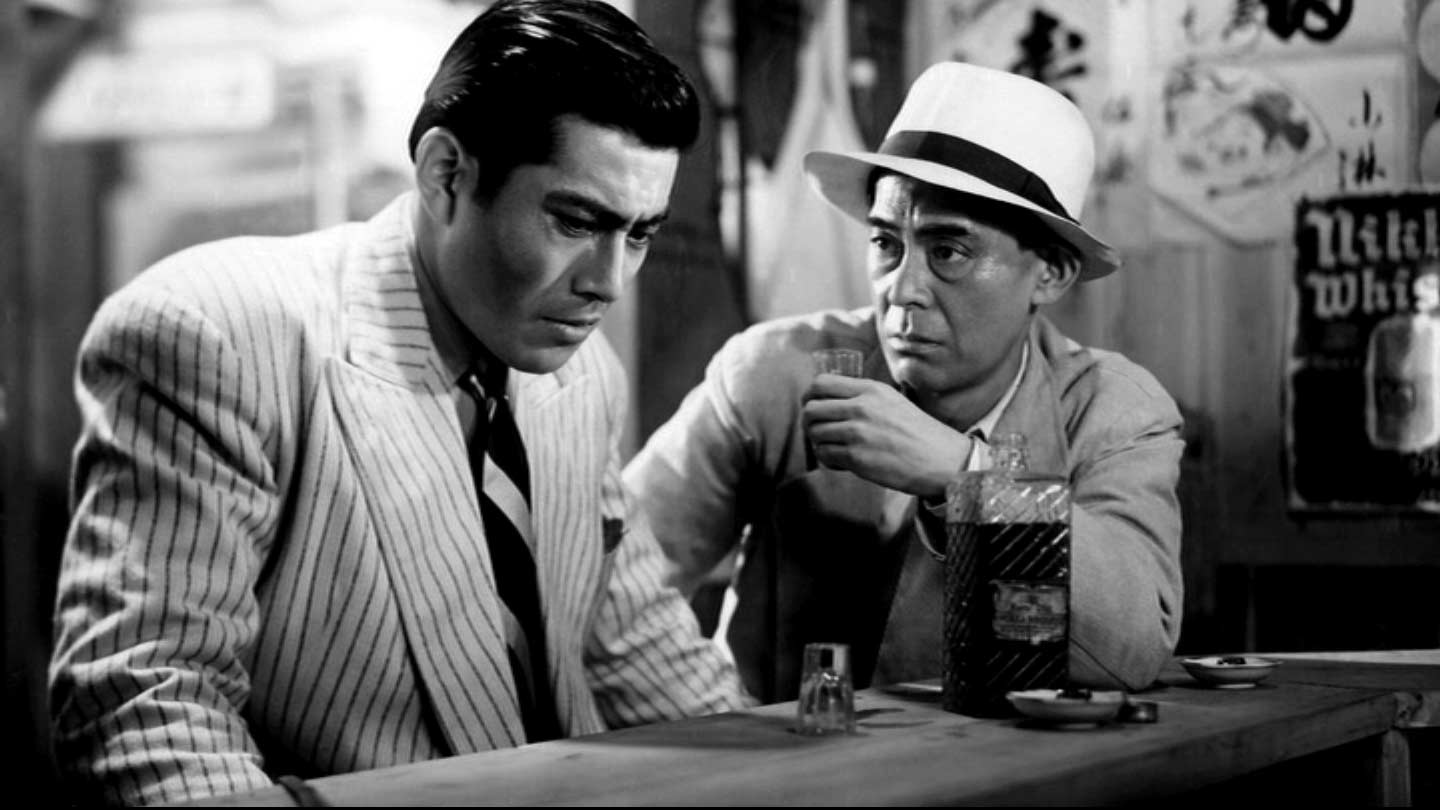
Drunken Angel was Kurosawa’s seventh film. “At last, my own style has come through in this film,” he once said of the film, and I tend to agree. While it seemed as if something was missing from No Regrets for Our Youth, all the elements I look for in a Kurosawa film were present in Drunken Angel. One of those elements is force-of-nature actor Toshirô Mifune, who plays a cocky young Yakuza. Another element is Takashi Shimura, who plays an alcoholic doctor with good intentions but a terrible bedside manner (the “drunken angel” of the title). (Shimura also appeared in No Regrets for Our Youth, but his role was less central than it is in Drunken Angel.) Shimura and Mifune would eventually appear together in 15 of Kurosawa’s films, but this was the first.*

It’s not just the actors that make Drunken Angel a great film. The ways the visuals help to tell the story, the three-dimensional characters, and the way the film’s themes are clear and straightforward without being heavy-handed … all of these are hallmarks of Kurosawa’s best films.

Dr. Sanada (Shimura) practices medicine in a ramshackle post-war community in which only the clubs, bars, and black market seem to be thriving. It’s an overcrowded warren surrounding an enormous cesspool filled with garbage and teeming with disease. (In a scene early in the film, Sanada angrily chases off a group of boys who are blithely playing in the filth.)

One day a young Yakuza thug named Matsunaga (Mifune) walks into Sanada’s office to have a hand wound treated, but the doctor suspects Matsunaga has a bigger problem — tuberculosis, which was rampant in post-war Japan. With the swagger typical of a young gangster, Matsunaga refuses to submit to treatment or to doctor’s orders, a problem compounded by Sanada’s angry and blunt way of talking to his reluctant patient.

Things are made even more complicated by the reappearance of Matsunaga’s gangster boss, Okada (Reisaburô Yamamoto), who returns from prison in a haunting and memorable scene.

I referred earlier to Mifune as a “force of nature.” Even here, as a young actor, he throws everything he has into the role. Mifune was an actor who used his entire body to tell a story — he could have been a great silent film actor.

The setting of the film is almost a character itself. The cramped, overcrowded little city was designed as a large open-air square by production designer Takashi Matsuyama, who originally built it for These Foolish Times (1947), a comedy about the post-war black market. It was expensive, so instead of demolishing it, the Toho Company wanted Kurosawa to use it for his next film. Kurosawa had about a third of the set torn down to create the enormous cesspool in its center.

During the American occupation of Japan from 1945 to 1952 there were multiple censorship boards that forbid things like the use of U.S. military uniforms in Japanese films, so Kurosawa had to find a way to depict the occupation without actually showing it. Images of westernization abound, even though no Americans actually appear in the film, and the visual symbolism of the cesspool is pretty easy to interpret, especially when the city is reflected in the darkness of its bubbling surface.

Drunken Angel wasn’t released in U.S. theaters until December 30, 1959. Kurosawa wasn’t well-known outside of Japan until Rashômon (1950), which was a big hit on the film festival circuit in 1951.

If you’ve never seen any of Kurosawa’s films, Drunken Angel is not a bad place to start. Seven Samurai might be his most exciting, iconic, and accessible picture, but it’s nearly three and a half hours long. If you’re unsure about Kurosawa and don’t want to invest more than two hours of your life finding out if his films are for you, Drunken Angel is about an hour and 40 minutes long, and it’s an excellent movie.

*Although Drunken Angel was the first time Mifune and Shimura acted together in one of Kurosawa’s films, it was not the first time they acted together. Their previous collaboration was in Senkichi Taniguchi’s Snow Trail (Ginrei no hate) (1947), which was written as well as edited by Kurosawa, and is about a trio of bank robbers hiding out in the mountains with a father and daughter who do not suspect that they are criminals.