Tag Archives: Metro-Goldwyn-Mayer

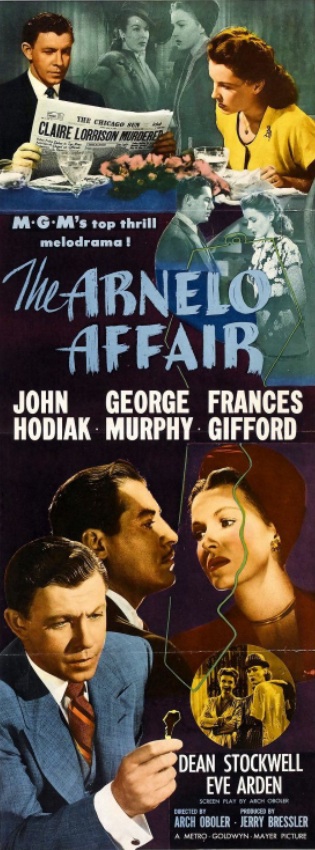
The Arnelo Affair (Feb. 13, 1947)

Arch Oboler’s The Arnelo Affair is a crime melodrama with so much voiceover narration that most of it can easily be understood and enjoyed by blind people.

Oboler cut his teeth in radio. His most famous work was for the horror anthology Lights Out, which is one of the scariest and most gruesome radio shows of all time. Oboler was a native of Chicago and the child of Jewish immigrants from Latvia. He was a prolific writer — one of the most talented in the medium of radio. His work as a film director is more hit or miss.

The Arnelo Affair, his third film, is based on a story by Jane Burr and takes place in Chicago. It starts out promisingly, with a lot of heat between its protagonist, Anne Parkson (Frances Gifford), and the magnetic, mustachioed nightclub owner Tony Arnelo (John Hodiak). Anne is married to a lawyer and all-around stuffed shirt named Ted (George Murphy), who’s such a drip that he won’t let their 9 year-old son, Ricky (Dean Stockwell), touch any of the tools in the room in their house marked “Ricky’s Workshop.”

The Parksons have been married for 12 years (which, if Gifford’s character is the same age as she is, means they got hitched when she was only 14 or 15), and Anne is clearly neglected and unloved. When her path crosses Arnelo’s, his persistence and menacing charm draw her to him.

Eve Arden, at this point typecast as the worldly and knowing friend of the troubled female protagonist (see also Mildred Pierce and My Reputation), plays Anne’s friend Vivian, who cautions Anne that “Canaries and hawks don’t make good playmates.”

She’s right, of course, and when Arnelo murders one of his other girlfriends in order to draw Anne closer to him, Anne will realize what a dangerous game she’s been playing.

Oboler’s script is perceptive about infidelity, and the dialogue is more believable than in most melodramas, but Oboler’s direction is flat, and he relies too heavily on voiceover narration by Gifford to explicate her character’s emotions. The Arnelo Affair isn’t bad, but after 45 minutes it loses momentum and never really picks up again. It might have made a better 60-minute B movie programmer from one of the small studios than a 90-minute maudlin MGM melodrama.

Lady in the Lake (Jan. 23, 1947)

Lady in the Lake
Lady in the Lake (1947)
Directed by Robert Montgomery
Metro-Goldwyn-Mayer

Robert Montgomery’s Lady in the Lake is a one-of-a-kind experience. Like a lot of one-of-a-kind experiences, it’s one that some people will never want to experience ever again after it’s over.

It’s not like any other movie you’ll ever see, but the fact that its central gimmick was never used again should tell you something.

The gimmick is that nearly the entire film is shot in a first-person point of view (POV). The film is a series of long tracking shots, but there are a few jump cuts and wipes when necessary. The trailer for Lady in the Lake told audiences that the film stars Robert Montgomery … “and you!” But this isn’t entirely true, for reasons that we’ll get into later.

Lady in the Lake is an adaptation of Raymond Chandler’s 1944 novel The Lady in the Lake, and stars Montgomery as private investigator Philip Marlowe (whose first name in this movie is spelled “Phillip”). Montgomery also directed the film — his first time as director, although he provided uncredited directorial assistance to John Ford when he starred in Ford’s World War II PT boat saga They Were Expendable (1945).

The only parts of the film that aren’t filmed from Marlowe’s POV — every actor interacting directly with the camera, Montgomery’s face only visible if he happens to look in a mirror — are stiff monologues by Montgomery as Marlowe, seated at his desk in his office, speaking directly to the viewer. These monologues are used to introduce the picture and to cover some gaps in the narrative.

Montgomery begins the films by telling viewers that they will be solving the mystery alongside him. He recites a street address and says, “make a note of it.” The problem with this is immediately clear. The film will continue to spool forward for you the same way it does for everyone else in the audience, whether you remember the address or not.

A first-person POV version of a Chandler novel must have made sense on paper. Chandler was a master of first-person narration, and his brilliant prose made first-person narration inextricable from the P.I. genre.

But first-person POV in film is very different from first-person narration in a novel. Despite what many critics of slasher films in the ’80s would have had you believe, first-person POV in a film does not create identification with the killer, it makes the viewer feels trapped and terrified.

While you’re unlikely to feel terrified while watching Lady in the Lake, it does inspire a sense of claustrophobia and surreality that is at odds with its goal of putting the viewer in the center of the action like no film had before.

Lady in the Lake begins in an odd fashion, as Marlowe tries to sell his semi-autobiographical story “If I Should Die Before I Wake” to magazine editor Adrienne Fromsett (Audrey Totter). When Fromsett’s stacked and gorgeous blond secretary (Lila Leeds) enters the office, she makes eyes at Marlowe, and the camera tracks her as she sashays out of the office. The eye contact she maintains with the camera is unbearably erotic. It’s ridiculous in terms of an actual narrative, but it works in the heat of the moment, like a tomahawk flying out of the screen in a 3D western. (Proponents of the “male gaze” theory can have a field day with this film.)

Audrey Totter

The problem with Lady in the Lake isn’t just its technique, it’s the fact that most of the actors interact with the camera in an unnatural fashion. Most of them never look away or even blink. Totter is the worst offender. She’s pretty, but her habit of arching one eyebrow while speaking to the camera is bizarre.

When Marlowe asks Fromsett a question — “What would happen if I kissed you?” — there’s no heat or interplay. It’s a purely technical question. If Marlowe kisses her, where will the camera go? Will it smoosh up against her face?

The only actor who interacts well with the camera is Lloyd Nolan, who plays the nasty and volatile police detective Lt. DeGarmot. Unlike the other actors — who seem afraid to break eye contact with the camera — he looks down, and around, occasionally turns his back on Marlowe, and steps forward to be threatening. In a memorable scene, he even slaps the camera in the “face” several times while sneering.

Lady in the Lake takes place during the Christmas holiday, and there’s very little incidental music, except for an eerie holiday vocal choir that shows up every now and then on the soundtrack.

While the first-person POV of Lady in the Lake doesn’t always work, there are a number of interesting “verité” moments, such as the scene in which Marlowe and the viewer sit around while observing Capt. Kane (Tom Tully) on the phone with his daughter on Christmas Eve. He’s embarrassed to be on a personal call while at work, but he chats with her anyway. There’s also an amazing quiet moment when Marlowe wakes up in Fromsett’s house on Christmas day, and the camera observes her lounging on the opposite couch in the living room, smoke curling out from behind the camera (Marlowe’s having a cigarette), as she and Marlowe listen to an adaptation of “A Christmas Carol” on the radio.

Because of the nature of the film, I still don’t feel as if I’ve ever seen Robert Montgomery play Philip Marlowe. He seems like a good choice for the character, since he bears a resemblance to Marlowe’s creator, Raymond Chandler, but his disembodied voice was too monotone to make up for the fact that he’s off-screen for most of the movie.

First-person POV would be used again in 1947 for the first section of Delmer Daves’s Dark Passage, and for memorable moments in other films, like the opening murder sequence in John Carpenter’s Halloween (1978) and a fistfight in Gordon Parks’s Shaft (1971), but this was the only time it would be used for an entire motion picture.

I actually really enjoyed Lady in the Lake, even though I think it’s a failed experiment. It’s worth seeing at least once by anyone who’s interested in film, and there are enough powerful, uncanny, and interesting moments to make up for the long stretches of flaccidity.

The Yearling (Dec. 18, 1946)

The Yearling
The Yearling (1946)
Directed by Clarence Brown
Metro-Goldwyn-Mayer

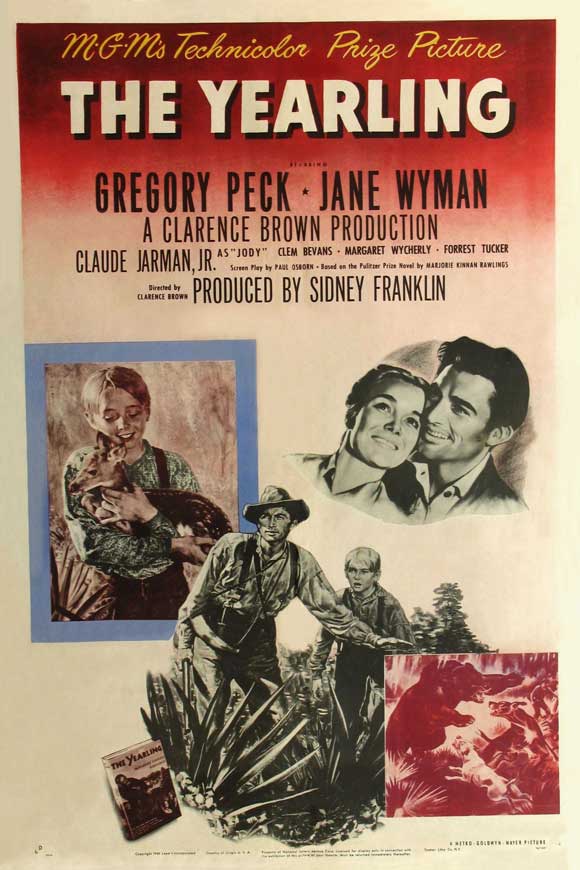
The Yearling, which is based on the Pulitzer Prize-winning novel by Marjorie Kinnan Rawlings, is a hard movie for me to review. It’s a beautifully filmed picture, and is a great example of just how good the sometimes-gaudy Technicolor process could look.

But it’s also one of the saddest “family” films I’ve ever seen. I would certainly never show it to a child under the age of 12, and would only show it to a child 12 or older if they knew the basic story and specifically requested to see it. I’ve seen The Yearling called “heart-warming,” but I found it emotionally draining and depressing.

I don’t know why so many animal stories for young people involve a beloved pet dying, but they do. Unlike The Yearling, however, the animals in Where the Red Fern Grows and Old Yeller at least die after a heroic struggle of some kind. In The Yearling, the 12-year-old protagonist is forced to shoot his beloved deer, whom he raised from a fawn, because it’s eating their cash crops. The message, obviously, is that life is hard, and growing up and becoming a man involves unpleasant tasks, but it still left me feeling more dejected than inspired.

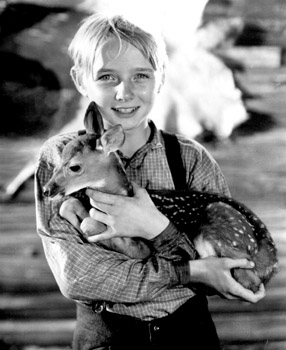
Young Jody Baxter (Claude Jarman, Jr.) is a dreamer — sweet and sensitive despite his hardscrabble life in the Florida scrub country in the late 19th century. He has an easy rapport with his father, Ezra “Penny” Baxter (Gregory Peck), but a more difficult relationship with his mother, Orry (Jane Wyman), who is as hard and unforgiving as pioneer women come. Early in the film, Penny tells his wife, “Don’t be afraid to love the boy.” The film cuts to a scene of Wyman standing in front of the graves of all her dead children, David Baxter, who died at the age of 1 year, 3 months, Ora Baxter, who died at the age of 2 years, 4 months, and Ezra, Jr., who was stillborn, and we see precisely why she is afraid to let down her guard around her only son.

Jody yearns for a little pet of his own, but his parents never let him have one for practical reasons. After Penny is bit by a rattlesnake, however, he shoots a doe for its heart and liver, which can pull the poison from his wound. (I’m pretty sure this is what we would now call “unscientific.”) The doe leaves behind a little fawn, which Jody’s parents allow him to adopt. Jody names the fawn “Flag.”

But why? Why do they finally relent in that situation? The Baxters are practical people who could have seen the handwriting on the wall. When you’re a family that depends on every last penny of income your meager crops provide, having a domesticated deer living on your farm is bound to cause trouble.

Claude Jarman Jr

And trouble Flag causes. Jody’s parents are patient after the year-old Flag eats a large portion of their cash crop of tobacco. Penny and Jody plant a new crop of corn to help make up for the loss. But when Flag eats most of the corn, Jody promises to erect a fence so tall that Flag won’t be able to get over it. His father injures his back, and can’t help him, even though he wants to.

If this was just a story about learning responsibility, then Jody toiling far into the night, in the rain, over the course of several days, all alone, just to build a fence (which appears to be more than six-feet tall) to not only save his family’s crop but also the life of his beloved pet would be enough. But the moment Flag easily jumps over the fence and goes back to work on the corn, my heart dropped. I knew what was coming next, but still couldn’t quite believe it when it happened.

There are plenty of positive interpretations of The Yearling. Death is a part of life, and we all must learn this sooner or later. It could also be seen as a young boy coming to understand his mother’s pain and hardship. Like her, he has now lost something fragile and beautiful that died too young. But these were all things my head understood after watching the movie. My heart felt empty, as though I had just been shown the utter futility of cherishing anything frivolous or out of the ordinary.

The Yearling won three Academy Awards; one for Best Color Interior Direction (Cedric Gibbons, Paul Groesse, and Edwin B. Willis), one for Best Color Cinematography (Charles Rosher, Leonard Smith, and Arthur Arling), and one honorary Oscar for the young star of the film, Claude Jarman, Jr., who was given an award for “Outstanding Child Actor of 1946.” I thought that Jarman’s performance was good, but I didn’t believe him during two scenes in which he registers horror and disbelief. Peck is good, as always, but he seems miscast. He registers earnestness and decency, but his accent is never quite right. Wyman, I thought, gave the best performance in the film, which was impressive, considering how unsympathetic her character was for most of the running time.

Oh, and there’s a disclaimer at the end that all scenes involving animals were supervised by the American Humane Association. We’re used to seeing this now, but it was fairly new in the ’40s. After several horses were killed during the making of Charge of the Light Brigade (1936) and Jesse James (1939), there were numerous audience protests, which led to supervision by American Humane of most Hollywood films involving animal performers. This said, I’d really like to see behind the scenes for the amazing sequence in which Penny and Jody hunt a bear, and their dogs attack it over and over. I guess the bear was just hugging the dogs before it tossed them safely away, but it looked pretty damned real to me.

Paisà (Dec. 10, 1946)

Roberto Rossellini’s Paisà (Paisan) is the follow-up to his wildly successful 1945 film Roma, Città Aperta (Rome, Open City).

Roma, Città Aperta is one of the most famous examples of Italian neorealist cinema, and is better known than Paisà, but I think that Paisà stands head and shoulders above Roma, Città Aperta as an artistic achievement. It’s a sprawling, chaotic picture of life in Italy during the last days of World War II. The title of the film comes from the word that American soldiers called Italians — “paisan,” or “buddy” — and over the course of six vignettes the film explores a variety of Italian characters’ attempts to communicate with and understand their occupiers.

Rod Geiger, the American G.I. who carried Roma, Città Aperta back to the United States, worked closely with Rossellini on Paisà, and is listed in the credits as a producer. Most of the Americans in the film were played by off-Broadway actors cast by Geiger’s father, who ran a theater in New York. Depictions of foreigners and foreign cultures in movies are tricky to get right. Usually there are at least a few things that just don’t ring true, but there were times while I was watching Paisà that I forgot that I was watching a “foreign” film featuring American characters. The American actors play their parts in a naturalistic, unaffected fashion, and their dialogue often seem ad-libbed. There are even aspects of the film that ring more true than anything coming out of Hollywood at the time, like an extremely drunk African-American soldier (played by Dots Johnson) who is full of anger and resentment.

Many writers contributed to the film, including Klaus Mann (the son of Thomas Mann), who wrote a treatment. A few of the six episodes that comprise the film function as parables, and have endings that border on being trite, but the overall effect of Paisà is an overwhelming panorama of violence, yearning, friendship, misunderstanding, and horror.

The film is a journey from the south of Italy to the north, and the segments take place in Sicily, Naples, Rome, Florence, a monastery in the Apennine mountains, and in a partison hideout in Porto Tolle. Unlike the American characters, the Italians mostly play themselves. The Sicilians are all played by Sicilian non-actors. The partisans in Porto Tolle are played by real partisans. A street urchin in Naples named Pasquale is played by a real street urchin named Alfonsino Pasca. The monks in the Apennines were really monks, but they were dubbed by different actors, since their accents would have made it clear that they were from the south of Naples, not to the north.

Most of the segments of Paisà end tragically, with characters the audience has grown to care about killed in combat. The deaths are senseless and sudden, and the feeling that no one is safe makes Paisà one of the most affecting and least cliched war films I’ve ever seen.

Undercurrent (Nov. 28, 1946)

Undercurrent
Undercurrent (1946)
Directed by Vincente Minnelli
Metro-Goldwyn-Mayer

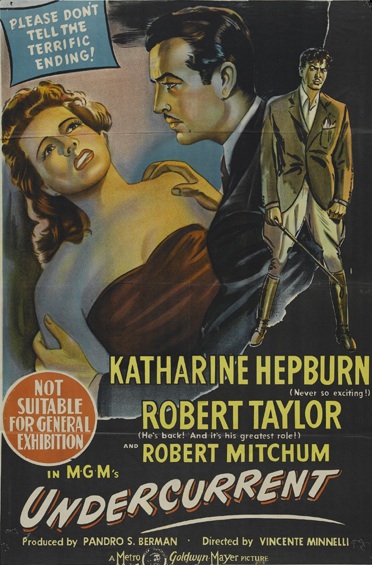
The next time you and a friend see a turgid, overlong thriller with too many twists and turns, bogus storytelling, and good actors wasted, and your friend says, “They don’t make ’em like they used to,” you can show your friend Undercurrent and prove that they make ’em exactly like they used to.

Pound for pound, Undercurrent might have boasted more talent than any other mystery melodrama in 1946. Director Vincente Minnelli and cinematographer Karl Freund were both gifted craftsmen with numerous acclaimed films under their belts. Herbert Stothart’s music is moody and evocative, especially the film’s haunting theme. Actors Robert Taylor and Katharine Hepburn were both stars of the highest magnitude, and hadn’t been seen onscreen for some time. Taylor had just finished his term of service as a flying instructor in the U.S. Naval Air Corps and Hepburn hadn’t appeared in a movie for a year and a half.

So what’s the problem? While studio tinkering could have played some part, the problem seems to mostly be Edward Chodorov’s screenplay, which was based on a story by Thelma Strabel. In a word, it’s silly. As soon as a promising situation is established, the story goes in a different direction, which serves to undercut the tension. The review of the film in the November 11, 1946, issue of Time called the plot “indigestible,” and said it was like “a woman’s magazine serial consumed at one gulp.”

Hepburn plays a young woman named Ann Hamilton who lives with her father, chemistry professor “Dink” Hamilton (Edmund Gwenn). Ann is herself chemically inclined, and prefers to spend time tinkering in the laboratory than entertaining proposals from eligible young men. All that changes when the handsome, mustachioed, and fabulously wealthy Alan Garroway (Taylor) enters her life. Alan is the inventor of the Garroway Distance Controller, which helped win the war.

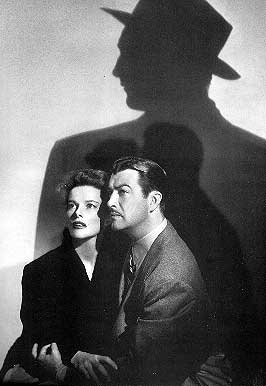
Hepburn and Taylor in the shadow of Mitchum

Alan and Ann marry, and he takes her away with him to Washington, D.C., where she feels completely out of her depth in high society. Meanwhile, Alan starts making sinister insinuations about his brother Michael, who supposedly went missing years earlier with a large sum of money embezzled from the family business, and who is offscreen for most of the picture. The film seems to be setting up “What happened to Michael Garroway?” as the central mystery, but if you’ve looked at a cast list with character names, this plot thread won’t be that mysterious for you.

When Alan takes Ann away to his lovely country home in Middleburg, Virginia, the film threatens to settle down and become a solid Gothic melodrama. The estate has no phone line, and Alan’s behavior is increasingly bizarre. And as one critic noted, the central theme of Gothic fiction seems to be, “Someone is trying to kill me, and I think it may be my husband.”

True to form, however, the film goes in yet another direction, with Ann going off to explore Michael Garroway’s ludicrously appointed mansion-cum-bachelor pad, where she explores his musical instruments and books of poetry with copious underlinings, and seems to be falling in love with a man she has never met. I’m sure a good film could be made about a love triangle with one-third of the equation missing for most of the film’s running time, but this isn’t it. As Bosley Crowther said in his review of Undercurrent in the November 29, 1946, issue of the NY Times, “And if that also sounds a trifle senseless, let us hasten to assure you that it is.”

Robert Mitchum — one of my favorite actors of all time, ever since I saw him host Saturday Night Live in 1987 and asked my mom, “Who is that?” — is also in Undercurrent, but he doesn’t show up until more than halfway through the film’s running time, and only has a few scenes.

I may have made Undercurrent sound terrible. It’s not. It’s mediocre popcorn entertainment, and I had fun watching it. And it’s no worse than most of the “neo-noirs” that littered multiplexes throughout the 1990s … it’s just not much better, either.

Courage of Lassie (Nov. 8, 1946)

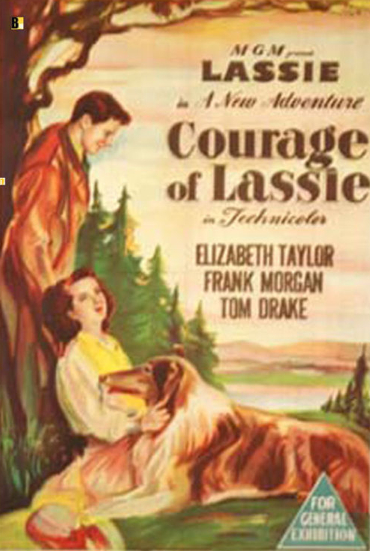
Pal rides again! In Fred M. Wilcox’s Courage of Lassie, the irrepressible little scamp from whose seed all dogs who ever played Lassie are descended plays an orphaned collie. The little guy is left behind in an idyllic, Technicolor wilderness after the old fisherman who owns Lassie rows off with her and what he thinks are all of her puppies.

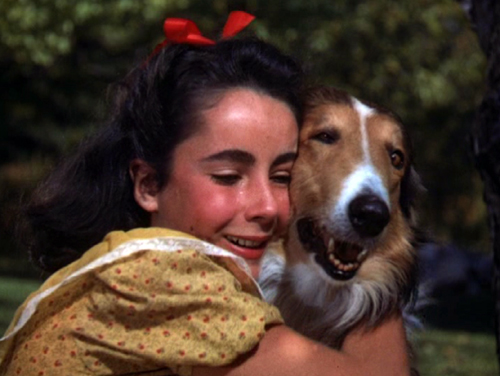
There follows a delightful montage of the little collie frolicking in the woods for days with birds, other four-legged beasties, and even a big black bear. This being a kid’s movie, however, you can be sure that gut-wrenching tragedy is right around the corner. Sure enough, the collie puppy and his little fox friend are caught in stormy rapids, and the fox is washed away, presumably to his death. The puppy, balanced on a tangle of branches, safely makes it to shore. Seemingly unfazed by his little buddy’s demise, the puppy’s next move is to happily run off with Elizabeth Taylor’s pants, and a lifelong bond is formed.

Taylor was 14 years old when she appeared in this film. Just like Pal, she’s playing a different role than she played in the film Lassie Come Home (1943). I think Taylor was a fantastic child actor. Just like in National Velvet (1944), she takes material that could be laughable or treacly and performs it with such conviction that you can’t help but be swept along. As Kathie Merrick, she believes in her dog, whom she names “Bill,” even though her family doesn’t think he has what it takes to be a sheep-herding dog.

By the end of the film Bill will prove that he not only has “the right stuff” in the pasture, but that he can be drafted and serve under heavy fire just like any other red-blooded American boy.

Bill goes through a lot in this film. He’s shot by a couple of dopey young hunters with quick trigger fingers, he’s run over by a truck while herding sheep across the road (and carried off by the well-meaning driver who doesn’t realize Bill belongs to someone), he’s renamed “Duke” at Dr. Colman’s Dog and Cat Hospital in the big city, and he’s trained for war and shipped off to the Aleutians to fight the Japanese.

“Duke” performs bravely despite a bloody neck wound, dragging himself through the mud to deliver a message, then leading the reinforcements back to the troops. He saves the day, but suffers from shell shock. He escapes the train that is taking him home and runs off into the area of the country where he remembers being with Kathie. Unfortunately, his PTSD has taken a toll, and he lives as a feral animal, raiding hen houses and killing local livestock. Kathie saves him from a farmer’s bullet, but he’s still put on trial as a mad dog.

Things look pretty grim for Bill until Harry MacBain (Frank Morgan, who played Prof. Marvel and the Wizard in The Wizard of Oz) makes an impassioned plea for understanding. This is the most interesting part of the film, since MacBain has looked up Bill’s war record, and his speech is a thinly veiled reference to human veterans who may be acting differently after their service overseas. Violent, antisocial behavior and drastic personality changes can be a byproduct of serving in combat, he says, and we on the homefront shouldn’t be so quick to judge our returning veterans. Even if they’re not lovable border collies.

Easy to Wed (July 25, 1946)

Easy to Wed is a remake of Jack Conway’s 1936 comedy Libeled Lady, which starred Jean Harlow, William Powell, Myrna Loy, and Spencer Tracy. No actors of that caliber appear in Edward Buzzell’s update, which is a lightweight affair from start to finish.

I haven’t seen Libeled Lady, but it was nominated for an Oscar for best picture, and is generally well-regarded in the pantheon of screwball comedies. Easy to Wed is generally regarded as a crummy piece of fluff, and that’s exactly what it is. Like the last MGM Technicolor extravaganza I saw, Ziegfeld Follies (1946), this movie is too long, is jam-packed with everything but a compelling plot and interesting characters, and its humor is mostly of the “painfully unfunny” variety.

The plot can be synopsized on the back of a cocktail napkin. Warren Haggerty (Keenan Wynn), the publisher of the Morning Star, is all set to marry his girl, Gladys Benton (Lucille Ball), but he and his paper are being sued for $2 million by J.B. Allenbury (Cecil Kellaway) after a story they published insinuated that Allenbury’s daughter, Connie (Esther Williams), is a nymphomaniac who goes after married men. The soundest plan Haggerty can come up with is to finagle his star reporter, Bill Chandler (Van Johnson), into a compromising position with Connie so they can produce photographic evidence that she is, indeed, a nympho who goes after married men. The only hitch is that Chandler is single, so Haggerty needs to hand off Gladys to him for a sham marriage for the duration of his assignment. Ridiculous? Sure.

At the time of the film’s release, one of its biggest draws was its leading man, Van Johnson. His appeal mystifies me. There’s nothing wrong with him, but I find his blandness overwhelming.

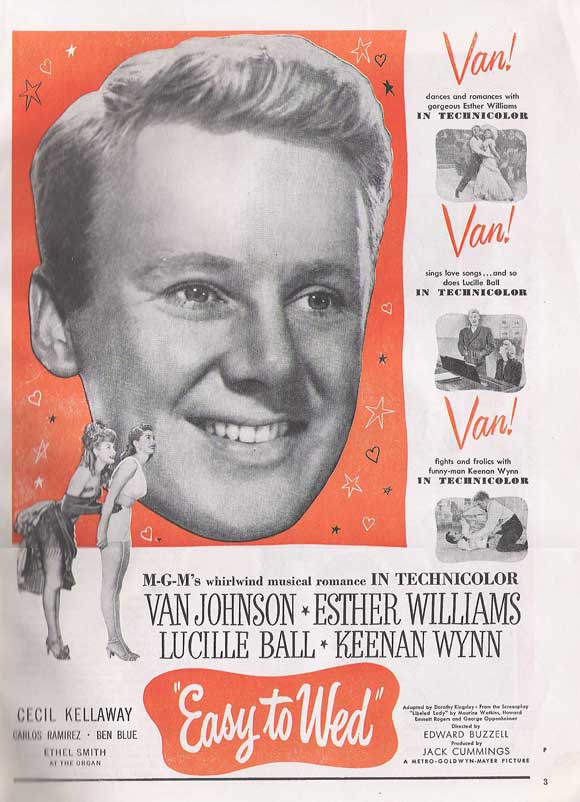
It’s not that I don’t like movies he’s been in — Thirty Seconds Over Tokyo (1944), in which he plays a heroic bomber pilot, was one of my favorite World War II movies made during the war — but I’d never go out of my way to see a movie just because he was in it, which makes me different from approximately every single woman living in America in the 1940s. I mean, check out that poster above. “Van! … Van! … Van!” What?

Intellectually, I can understand his appeal for the distaff post-war zeitgeist. The metal plate in his head may have kept him out of the war, but he was in enough war movies to give the impression of a returning hero. And unlike the haunted, shell-shocked, sweaty protagonists of countless noirs, Johnson projects nothing but good-natured cheer. He’s the young man you want your daughter to marry, or the even-tempered buddy you introduce to your sister.

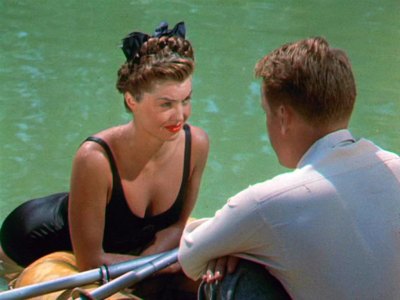
The main selling point of Easy to Wed for me was Esther Williams. There are none of her signature water ballet numbers, but she does spend a lot of time in the water. (Her first kiss with Johnson even takes place underwater.) She is beautiful and sexy, and emerges from the water many times in the picture, sleek and dripping, her makeup still perfect. But she’s beautiful on land, too, and looks great in Technicolor, whether she’s playing a board game by the fire or fully decked-out, singing and dancing in one of the film’s several passable musical numbers.

Besides Williams, the only thing I really liked about Easy to Wed was the crazily outfitted Ethel Smith, who performs a wild musical number at the organ. It’s a scene that borders on the surreal, and I loved it.

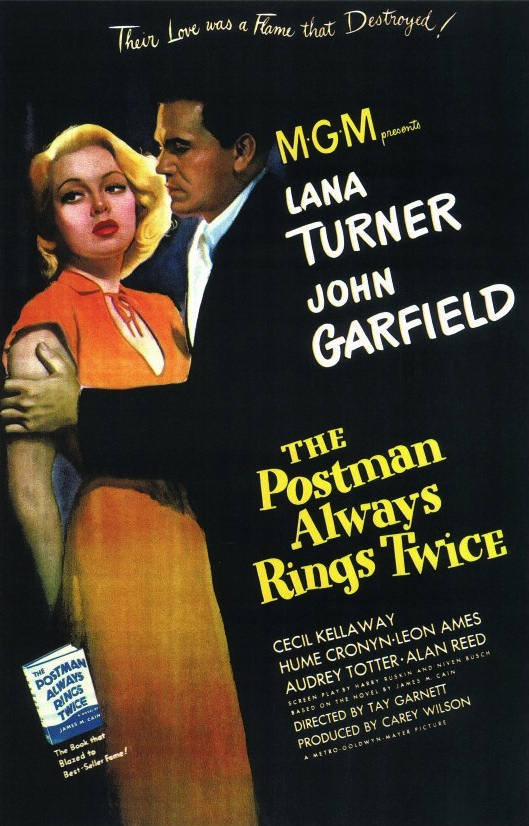
The Postman Always Rings Twice (May 2, 1946)

The Postman Always Rings Twice

The Postman Always Rings Twice (1946)
Directed by Tay Garnett
Metro-Goldwyn-Mayer

Tay Garnett’s The Postman Always Rings Twice, based on the 1934 novel by James M. Cain, opens on a lonely stretch of highway outside of Los Angeles, with a shot of a sign hanging outside a gas station that says “Man Wanted.” We’ll soon learn that the sign has a double meaning.

Itinerant drifter Frank Chambers (John Garfield) is hitchhiking from San Francisco, and has thumbed a ride with a nattily dressed man (Leon Ames) whom we’ll soon learn is the local district attorney. Nick Smith (Cecil Kellaway), the owner of the gas station/lunch counter, runs out and greets Frank, assuming he has come about the job.

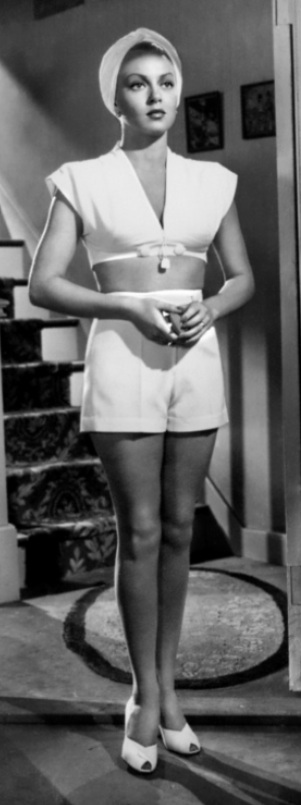
It isn’t long before Frank meets Nick’s wife, Cora, (Lana Turner), in one of the best introductions of a sexpot in ’40s cinema. As he’s eating at Nick’s lunch counter, a tube of lipstick rolls across the floor, the camera focuses on it, then pans back along the floor until it comes to rest on Turner’s legs. Cut to Garfield, his breath quickening, then to a full shot of Turner, in a skimpy white two-piece playsuit that would still turn heads today (although her turban might stand out as being a little odd).

As soon as Cora appears, we know Frank will take the job working for Nick just to be close to her. In the book, Nick is a Greek, and described in detail as a physically repulsive character. In the film, he’s just a harmless old fuddy-duddy. Things play out the same, however. Cora leaves a “Dear Nick” letter and she and Frank run off together, but life on the open road, hitchhiking with a delighted-looking Frank, who has two suitcases under his arm, doesn’t agree with Cora or her white blouse, or her white peekaboo toe pumps.

Lana Turner

So they return before Nick comes home and finds the note, and pick up again with their unhappy triangle. One murder attempt designed to look like an accident goes wrong, and after Nick announces that he is selling the business and taking Cora with him, Frank and Cora devise a simpler plan to just get Nick drunk and push him off a cliff in his car.

Technically The Postman Always Rings Twice is a film noir, but it occasionally borders on farce, especially after the murder, and is filmed in a professional and well-lighted but ultimately flat style. Too much of the film’s running time is taken up by courtroom machinations and the gamesmanship between Arthur Keats (Hume Cronyn), Frank and Cora’s lawyer, and district attorney Kyle Sackett (Ames). It’s all well-done and entertaining, but in a light and breezy way. There’s the threat of execution in the gas chamber for our two protagonists, but there’s no sense of impending doom during the courtroom proceedings, and with the focus on Ames and Cronyn, it borders on comedy. Things pick up in the noir department towards the end of the picture, but it takes too long to get there, and is undercut by a ridiculous, moralizing denouement. In some editions, Cain’s novel is barely more than 100 pages long, but this film is bloated and overlong at 113 minutes. More minutes in the film than there are pages in the original novel? There oughta be a law.

MGM wasn’t known for this kind of picture. In general, they didn’t even do crime pictures or thrillers. After the runaway success of Billy Wilder’s Double Indemnity in 1944, however, every big studio released at least one similar picture in an attempt to cash in on the craze, with all the attendant love triangles, murders, and doomed protagonists. What better choice for MGM than another novel by Cain? Especially the one most similar in its basic plot? Cain’s 1941 novel Mildred Pierce had already been done, and with a murder plot that was never in the novel, which was more of a straight kitchen sink drama. His 1937 novel Serenade was too weird. It featured a love triangle, but between a spicy Mexican prostitute, her opera-singing boyfriend who loses his voice when he’s tempted by homosexual desires, and the orchestra conductor whose magnetism threatens to draw him into a gay tryst. (Eventually Serenade was made into a film in 1956 starring tenor Mario Lanza and directed by Anthony Mann, but the gay theme was jettisoned.) And his 1942 novel Love’s Lovely Counterfeit, about a town full of gangsters and crooked politicians, seems as though it would have been a more appropriate vehicle for James Cagney or George Raft 10 or 15 years earlier.

So The Postman Always Rings Twice was a natural choice for MGM, a powerhouse of a studio that churned out high-quality product week in, week out. The film works as well as it does because of the presence of Lana Turner, who in 1946 may have been the sexiest woman in Hollywood. John Garfield turns in a credible performance, but he and Turner never quite click. So much of the film is spent setting up and knocking down plot points that their relationship seems almost like an afterthought.

A better adaptation of Cain’s novel is an unauthorized one, Luchino Visconti’s Ossessione (1943). (Cain’s publishers sued for copyright infringement, and kept the film off American movie screens until 1976.) Both the grimy working class milieu and desperate, sweaty love affair are better handled in Visconti’s film. The American version is just too sterile.

http://www.youtube.com/watch?v=Mi4UaQWN_H8

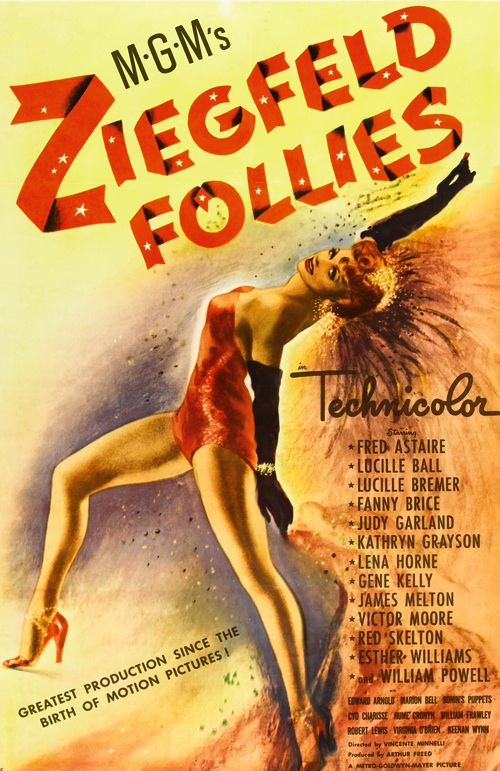
Ziegfeld Follies (April 8, 1946)

Ziegfeld Follies premiered in Boston on August 13, 1945. It was first shown in New York on March 22, 1946, and went into wide release on Monday, April 8, 1946. On some theatrical release posters, the film’s title was Ziegfeld Follies of 1946. The film is a lavish, old-fashioned musical pieced together from a big bag of spare parts. It was a pet project of producer Arthur Freed, and was originally intended to mark Metro-Goldwyn-Mayer’s 20th anniversary in 1944, but it went through so many edits and revisions that it missed the mark by more than a year.

Despite the studio’s boast on the theatrical release poster that Ziegfeld Follies is the “greatest production since the birth of motion pictures,” I really didn’t enjoy it that much. The musical numbers are hit and miss, and the comedy bits all hit the ground like lead zeppelins. There are a lot of impressive set pieces, and the colors are really bright, but as far as plotless extravaganzas go, it just doesn’t have the latter-day stoner appeal of Fantasia (1940).

The film begins with little models of Shakespeare’s Globe Theatre, then P.T. Barnum’s big top, then Florenz Ziegfeld, Jr.’s theater. That’s it, folks. The only three shows in the history of the world that matter. Clearly humility is not on the program for the evening.

William Powell, who played “Flo” Ziegfeld in The Great Ziegfeld (1936), reprises his role for the first segment of the picture. He’s on a set that looks like the kind of pad Liberace and Louis XVI might have picked out for themselves if they were roommates, talking a lot of nonsense about magic and the theater (it took me a little while to catch on to the fact that he’s supposed to be in heaven). We’re then treated to an elaborate stop-motion recreation of Ziegfeld’s 1907 opening by the Bunin puppets. All of his great stars are recreated as puppets; Marilyn Miller, Fanny Brice, Will Rogers, and even Eddie Cantor in blackface.

Each segment that follows is introduced by a storybook page. Fred Astaire appears in the first, “Here’s to the Girls.” He acknowledges that “Ziggy,” as he calls him, never had much use for villains or plots, then sings an ode to the American girls who were Ziegfeld’s main attractions. Cyd Charisse dances a little solo and then Lucille Ball cracks a whip over eight chorus girls dressed as panthers. Finally, Virginia O’Brien hollers for some fellers, and then sings, “Bring on Those Wonderful Men.” It’s a punishing spectacle that sets the tone for what is to come.

In the next segment, Esther Williams appears in … surprise, surprise … a water ballet. It’s fine, and she spends a lot of time underwater, which is neat, but what is the sequence even doing in this picture?

Next, Keenan Wynn appears in the comedy short “Number, Please.” I found it completely unfunny, but maybe that’s because I can’t stand “frustrating” humor. Basically, all he wants to do is make a phone call, but he’s thwarted at every turn, until his face is red and steam is coming out of his ears. For me it dragged the movie to a halt like a sweaty punchline comic working the in-betweens at a burlesque strip show.

Next, James Melton and Marion Bell sing “La Traviata.” Yawn.

Ooh, goody, more comedy! Victor Moore and Edward Arnold appear in “Pay the Two Dollars,” in which a man spits on the subway and is trapped in a legal nightmare because his attorney won’t let him just pay the $2 fine. Again, what’s up with the horribly frustrating situational humor? Not only did this segment not make me laugh, it made me feel as if I was watching a stage adaptation of a Kafka story.

Next, Fred Astaire and Lucille Bremer appear in a “dance story” called “This Heart of Mine,” with music by Harry Warren and words by Arthur Freed. It’s pretty good. It took me back to the days when lighting a girl’s cigarette and then dancing while smoking was still classy. On the other hand, no one glides across a ballroom like old Fred, so the rotating circular centerpiece seemed wholly unnecessary. Who did the director think he was dealing with, Clark Gable?

The next comedy segment is called “A Sweepstakes Ticket,” and for some reason it’s filmed on a regular set, not the impressionistic “stage” sets used in all the previous comedy bits. Hume Cronyn gives away a winning Irish sweepstakes ticket to make up the few bucks he was short on the rent, and he and his wife Fanny Brice try to get it back from their landlord. Again, it’s not at all funny, just frustrating.

The next segment, “Love,” with Lena Horne (R.I.P.), was a nice opportunity to see black people in Technicolor, and in a steamy tropical setting no less. It should have been longer.

Next, Red Skelton shows us all what will happen “When Television Comes.” He does a promo for “Guzzler’s Gin.” He drinks a whole bunch each take and acts more and more stinko. If you’re amused by cross-eyed drunkenness and double-takes, this will still do the trick. Although it’s possible audiences in 1946 were amused by this segment, I can’t imagine they were left with a very clear idea of what the advent of television would mean for the country.

Up next is “Limehouse Blues,” in which Fred Astaire and Lucille Bremer return, only this time in yellowface. The Chinatown tropes are offensive, but the colors and imagery are quite beautiful and impressive, in a non-P.C. sort of way. Once we get to the actual dance number, however, the piece is hamstrung by its own ridiculous conceit. It doesn’t help that in all the medium shots, Astaire’s makeup makes him look a lot like Boris Karloff in The Mask of Fu Manchu (1932).

In “A Great Lady Has an Interview,” Judy Garland seems to be lampooning Katharine Hepburn or possibly Greer Garson. I got the feeling that there were a lot of industry in-jokes that I wasn’t getting. For me, Garland is always a treat, however, so I didn’t mind it that much.

And then, like a terrible party that suddenly becomes fun 20 minutes before the police arrive to break it up, Fred Astaire and Gene Kelly appear in “The Babbitt and the Bromide,” by George and Ira Gershwin. Their dialogue is funnier than any of the “comedy” bits in the movie, and their side-by-side dance number is transcendent. Ziegfeld Follies is worth seeing for this sequence alone.

Finally, Kathryn Grayson sings “Beauty,” by Warren and Freed. It’s standard stuff, but there are enormous piles of bubbles that I thought were pretty cool.

In other news, the last living Ziegfeld Follies “girl,” Doris Eaton Travis, died yesterday at the age of 106. I hope it doesn’t seem as if I’m beating up on the Follies themselves. I’d love to go back in time and see a Ziegfeld revue on Broadway. This film just doesn’t really capture the magic.
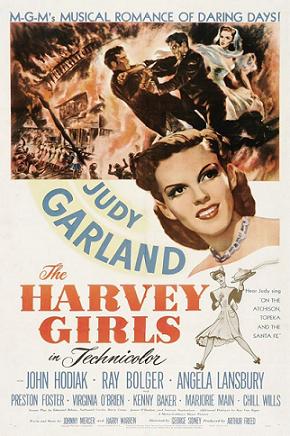
The Harvey Girls (Jan. 18, 1946)

In 1876, a 41-year-old entrepreneur named Fred Harvey opened a string of restaurants along the Atchison, Topeka, and Santa Fe Railway line. The eateries catered to middle-class and wealthy travelers alike, and at the height of the franchise’s success, there were more than 80 Harvey House restaurants. Harvey died in 1901, but the Fred Harvey Company continued to build restaurants into the 1960s.

A restaurant chain might seem an unlikely subject for a big-budget, Technicolor, Hollywood musical, but clearly the young, attractive waitresses in their crisp black and white uniforms were enough of a hook. The film opens with the following portentous prologue:

“When Fred Harvey pushed his chain of restaurants farther and farther west along the lengthening tracks of the Santa Fe, he brought with him one of the first civilizing forces this land had known … the Harvey Girls. These winsome waitresses conquered the west as surely as the Davy Crocketts and the Kit Carsons — not with powder horn and rifle, but with a beefsteak and a cup of coffee. To these unsung pioneers, whose successors today still carry on in the same tradition, we sincerely dedicate this motion picture.”

If all this is to be taken seriously, then who wouldn’t want to lionize these distaff settlers? I haven’t read Samuel Hopkins Adams’s 1942 novel that this film is based on, but it must have been a good story for Hollywood to want to pick it up. Or maybe it was just that Johnny Mercer and Harry Warren realized what a catchy rhythm the phrase “on the Atchison, Topeka, and the Santa Fe” had.

After the prologue and credits, the film opens on a shot of a moving train. Susan Bradley (Garland) is standing on the deck of the caboose, singing a forgettable song about love. She is heading out west to marry a man whom she only knows from the florid love letters he has written her. When her suitor, H.H. Hartsey (Chill Wills), turns out to be a functionally illiterate cowpoke who had a friend play Cyrano for him by penning the letters himself, Susan parts with him (mostly amicably), and becomes a Harvey girl.

The dramatic conflict, such as it is, comes from the local saloon and gambling house, which also features dancing girls. The owner of the palace of sin, Ned Trent (John Hodiak), and his star attraction, Em (played by a young and foxy Angela Lansbury), fear that the opening of the Harvey House will usher in a new era of respectability and crush their business. In real life of course, Trent’s girls would have been prostitutes and Em would have been their madam, but in the world of 1940s M-G-M musicals, dancing the cancan for hooting and hollering cowboys was about as scandalous as they could get.

Garland and Lansbury both give good performances, and are backed up by a large and talented cast. Virginia O’Brien (as the Harvey girl “Alma from Ohio”) is tough and sassy, and Ray Bolger, most famous for playing the Scarecrow in The Wizard of Oz (1939), here gets to play the Cowardly Homosexual, a popular character type in Hollywood pictures for decades. While his sexual preference is never identified outright, Bolger’s character’s effeminacy and fear of any butch labor (such as shoeing horses), as well as his spirited prancing, leaping, and tap dancing make it clear that he doesn’t have any designs on the ladies.

The Harvey Girls is an entertaining mix of musical and western. But if director George Sidney aspired for it to be anything more than breezy entertainment, it doesn’t show. Judy Garland is always a delight, but Vincente Minnelli’s ability to coax a nuanced performance from her and to tell an engaging story from beginning to end in a musical is sorely missed here. The Harvey Girls is enjoyable, but it’s no Meet Me in St. Louis (1944). Also, aside from the standout song, “On the Atchison, Topeka, and the Santa Fe” (which won an Academy Award for best song), no musical number in the picture really stands out.