Tag Archives: RKO Radio Pictures

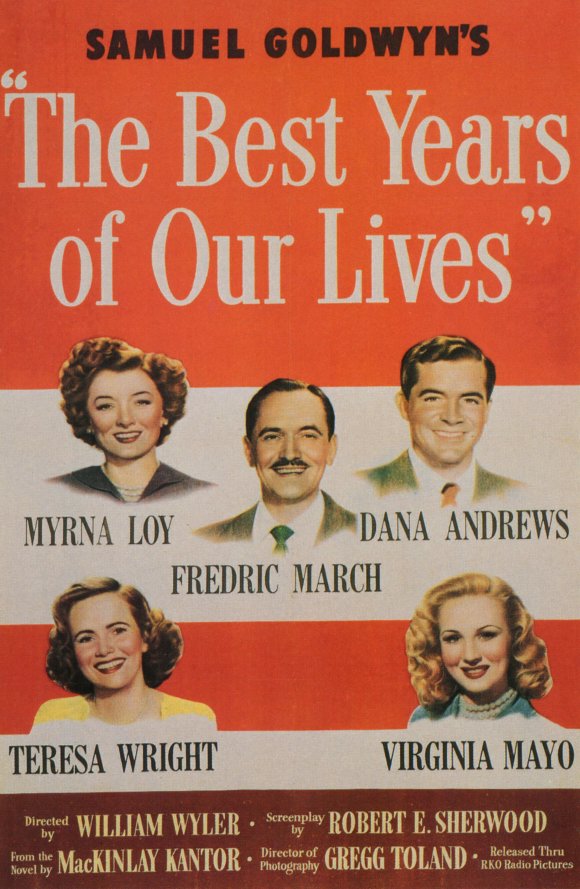
The Best Years of Our Lives (Nov. 21, 1946)

The Best Years of Our Lives
The Best Years of Our Lives (1946)
Directed by William Wyler
RKO Radio Pictures

William Wyler’s The Best Years of Our Lives premiered in New York City on November 21, 1946, and in Los Angeles a month later, on Christmas day. It was a hit with both audiences and critics, and was the biggest financial success since Gone With the Wind in 1939.

The film swept the 19th Academy Awards, winning in all but one category in which it was nominated. The film won best picture, Wyler won best director, Fredric March won best actor, Harold Russell won best supporting actor, Robert E. Sherwood won for best screenplay, Daniel Mandell won for best editing, and Hugo Friedhofer won for best score. (The only category in which it was nominated and did not win was best sound recording. The Jolson Story took home that award.)

There are several reasons for the film’s financial and critical success. It perfectly captured the mood of the times. In 1946, returning servicemen faced an enormous housing shortage, an uncertain job market, food shortages, and a turbulent economy (price controls were finally lifted by the O.P.A. around the time the film premiered). Combat veterans also faced their own personal demons in an atmosphere in which discussing feelings was seen as a sign of weakness. By telling the stories of three World War II veterans returning to life in their hometown, The Best Years of Our Lives held a mirror up to American society.

The biggest reason for the film’s success, however, is that it’s a great movie. Plenty of films made in 1945 and 1946 featured characters who were returning veterans, but none before had shown them in such a realistic, unvarnished way. The Best Years of Our Lives doesn’t try to wring tragedy out of its characters’ personal situations. It’s an overwhelming emotional experience precisely because it doesn’t strain for high emotions. The film earns every one of its quietly powerful moments. Hugo Friedhofer’s score is occasionally overbearing, and a little high in the mix, but at its best it’s moving, and a fair approximation of Aaron Copland’s fanfares for common men. Gregg Toland’s deep focus cinematography is phenomenal. Every image in the film — the hustle and bustle of life in a small American city, the quietly expressive faces of its characters, and the interiors of homes, drugstores, bars, banks, and nightclubs — is fascinating to look at. (Toland was Orson Welles’s cinematographer on Citizen Kane, and he was an absolute wizard.)
Russell Andrews March

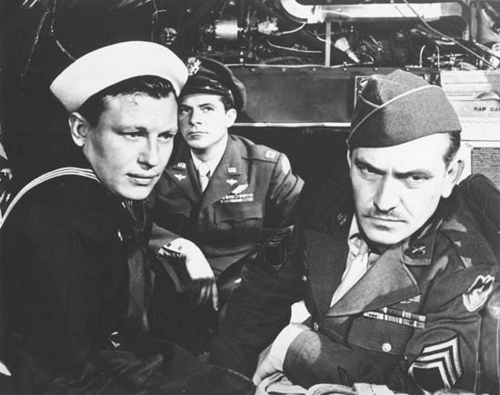
The actors in this film are, without exception, outstanding. Fredric March plays Al Stephenson, an infantry platoon sergeant who fought in the Pacific, and who returns to his job as a bank manager. Myrna Loy plays his wife, Milly, Teresa Wright plays their daughter, Peggy, and Michael Hall plays their son, Rob. Dana Andrews plays the shell-shocked Fred Derry, a decorated bombardier and captain in the Army Air Forces in Europe, who returns home to his beautiful wife Marie (Virginia Mayo), whom he married immediately before leaving to serve. Now that the war is over and they are living together, they realize they have very little in common. Harold Russell plays Homer Parrish, a sailor who lost both his hands when his aircraft carrier was sunk.

Russell was a non-professional actor who lost his hands in 1944 while serving with the U.S. 13th Airborne Division. He was an Army instructor, and a defective fuse detonated an explosive he was handling while making a training film. Russell’s performance is key to the success of the film. An actor who didn’t actually use two hook prostheses in his everyday life wouldn’t have been able to realistically mimic all the little things that Russell does; lighting cigarettes, handling a rifle, playing a tune on the piano. More importantly, Russell’s performance is amazing. From the very first scene that the camera lingers on his face as he shares a plane ride home with March and Andrews, I felt as if I knew the man.

Russell is so convincing as a man who has quickly adapted to his handicap that it’s gut-wrenching to watch as his exterior slowly breaks down, and we’re drawn deeper into his world. Homer Parrish has a darkness inside him, and he carries with him the constant threat of violence; bayonets adorn the walls of his childhood bedroom and he spends his time alone in the garage, firing his rifle at the woodpile. His next-door neighbor and childhood sweetheart Wilma (Cathy O’Donnell) keeps trying to get close to him, but he pushes her away. In a lesser film, this all might have led to a violent and melodramatic finale, but it merely simmers below the surface, informing his character. Instead, the most emotional scenes with Homer take place in smaller ways, such as when we see that he is not as self-sufficient as he seems, and needs his father’s help every night to remove his prostheses before he goes to sleep.

The Best Years of Our Lives is a great film, and should be seen by everyone who loves movies and is interested in the post-war era. It’s long — just short of three hours — but it didn’t feel long to me. The running time allows its story to develop naturally as the characters enter and re-enter one another’s lives. It also felt more real than any other movie I’ve seen this year. (I can’t think of another movie that wasn’t about alcoholism that featured so many scenes of its characters getting realistically drunk.) And despite all the personal difficulties its characters face, it’s ultimately an uplifting film, full of quiet hope for the future.
Song of the South (Nov. 12, 1946)


Song of the South
(1946)
Directed by Wilfred Jackson and Harve Foster

Walt Disney Productions / RKO Radio Pictures

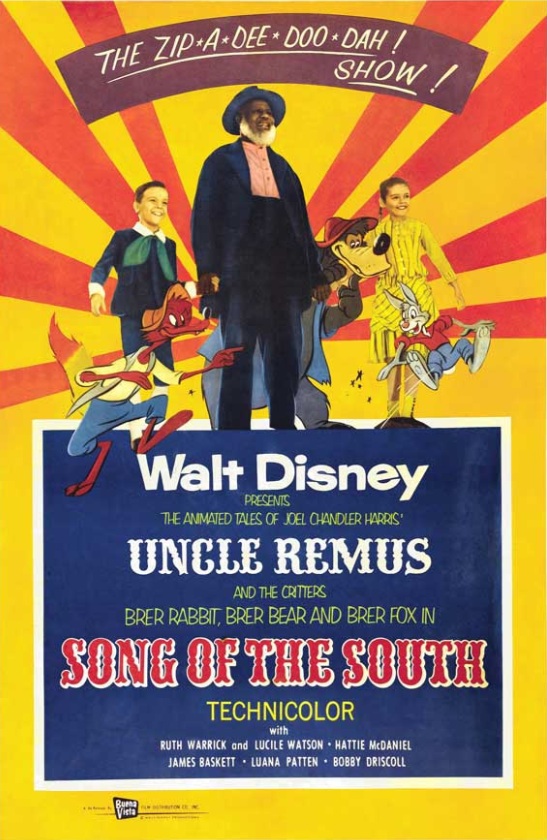
Walt Disney’s Song of the South is the first movie I ever saw. (I think my mother may have taken me to some movies when I was a baby, but that doesn’t count.) Seeing it in the theater was a big deal for me. The most sophisticated piece of electronics we had growing up was a KLH radio, and the only time I saw television was at my grandmother’s house. (She had a 13″ black & white Zenith.) I don’t know exactly when I saw Song of the South, but it must have been during the film’s 1980 re-release.

Song of the South premiered in Atlanta on November 12, 1946. It was the first film to have its premiere there since Gone With the Wind in 1939.

Based on Joel Chandler Harris’s books about an old storyteller named Uncle Remus, the film was controversial even before it went into production. In 1944, the Production Code Administration suggested a number of changes to Dalton Reymond’s script to minimize its potential to offend black filmgoers, including the following: that the phrase “old man” be substituted for “old darkie,” that the term “Mister John” be substituted for “Marse Jawn,” and that it be made clear that Uncle Remus belongs to a bygone era. Walt Disney did not, however, take their suggestion that it be made clear that the film takes place after the Civil War, when slavery was abolished, which is what got him into the most trouble.

Disney was not insensitive to the potential that Song of the South had to upset audiences. To deflect some potential flak, he brought in left-leaning Maurice Rapf, an emeritus director of film studies and an adjunct professor at Dartmouth College, to write a treatment of Reymond’s script that had the main white family living in a run-down farmhouse, not a beautiful plantation, and cut out scenes of black plantation workers going about their duties in a happy and docile fashion while singing uplifting spirituals. (Rapf, who was both Jewish and a Communist, denies that Walt Disney was intolerant, and said that while Disney was a conservative, he accepted the political and religious differences of the men who worked for him, many of whom were Jewish and/or leftists.)

For whatever reason, however, all of the aforementioned changes remained in their original form in the final cut of the film. In the cinema section of the November 18, 1946, issue of Time magazine, their reviewer wrote that “Tattered ol’ Uncle Remus, who cheerfully ‘knew his place’ in the easygoing world of late 19th Century Georgia … is a character bound to enrage all educated Negroes, and a number of damyankees.”

Walter White, executive secretary of the NAACP, sent a telegram to the press on November 27, 1946, that said the following: “The National Association for the Advancement of Colored People recognizes in ‘Song of the South’ remarkable artistic merit in the music and in the combination of living actors and the cartoon technique. It regrets, however, that in an effort neither to offend audiences in the north or south, the production helps to perpetuate a dangerously glorified picture of slavery. Making use of the beautiful Uncle Remus folklore, ‘Song of the South’ unfortunately gives the impression of an idyllic master-slave relationship which is a distortion of the facts.”

Ebony magazine was less tempered in their criticism of the film. They wrote, in a full-page jeremiad against the film, that Song of the South promoted “Uncle Tomism as the model of how Negroes should behave in white company.” Of the film’s star, they wrote, “James Baskett, who symbolically enough was taken from the Amos ‘n’ Andy radio show to portray Remus, is an Uncle Tom-Aunt Jemima caricature complete with all the fawning standard equipment thereof — the toothy smile, battered hat, grey beard, and a profusion of ‘dis’ and ‘dat’ talk. He lives up to his ‘lovable’ billing — certainly to Dixie audiences for whom any Negro who bows and scrapes is ‘lovable.'”

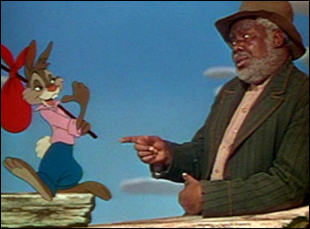
Most negative reviews of the film did, however, praise the animated sections of the film, which featured the antics of the crafty Br’er Rabbit, the diabolical Br’er Fox, and the slow-witted Br’er Bear. And the Academy of Motion Picture Arts and Sciences liked Baskett’s performance as Remus enough to give him an honorary award at the 20th Academy Awards in 1948 “For his able and heart-warming characterization of Uncle Remus, friend and story teller to the children of the world, in Walt Disney’s Song of the South.” (On the other hand, this took him out of the running for a real Oscar.)

While I don’t disagree with Ebony magazine’s assessment of the character of Uncle Remus, I do think Baskett gives a remarkable performance, full of warmth and humanity. There are some cringe-worthy moments, but overall I was moved by the character he created. It’s worth pointing out that Baskett also provided the voice for Br’er Fox, whose malevolent, mile-a-minute line delivery is so different from Remus’s slow, rich baritone that I never would have guessed it was Baskett’s voice if I hadn’t looked it up.

Remus comes into the life of a young white boy named Johnny (Bobby Driscoll) just when Johnny needs him most. Johnny’s father has left for Atlanta, and the boy wants to run away from home. Unlike Johnny’s mother, Remus understands the psychology of children, and instead of telling Johnny he shouldn’t run away, he gently steers him in the right direction by first agreeing to go with him, then telling him a story about a time when Br’er Rabbit was fed up and wanted to run away from all his troubles.

While the film presents a bucolic and idealized view of the Old South, there’s plenty of sadness, if you care to look for it. Johnny’s friendship with a black boy his own age is presented in a sweet, uncomplicated fashion, but look deeper. When the boy, Toby (Glenn Leedy), comes into Johnny’s room in the morning before a day of playing together, the first thing he does is pour water into the basin on top of Johnny’s bureau. Also, when Johnny runs off, Toby is viciously scolded by the older black servants in Johnny’s family, because it was Toby’s job to care for Johnny. Johnny is still the master and Toby is still the servant, and it’s doubtful that the two would have been able to remain friends into adolescence.

There’s also a running conflict between Johnny and two poor white boys who want to drown the puppy that Johnny got from them. While Uncle Remus scolds the two boys and runs them off when they bully Johnny, his authority only goes so far. When Johnny’s mother orders him to give back the puppy, Remus’s impotent rage is truly heartbreaking.

It’s hard to enjoy the third cartoon segment if you’re preoccupied with wondering whether or not the bad boys drowned that puppy. And while the puppy shows up for the final sequence of the film, the whole thing has a sense of unreality about it, since all the cartoon characters show up to interact with the happy children and Uncle Remus, who rubs his eyes ’cause he can’t hardly believe what he’s seeing! Br’er Rabbit right there? Yes indeed.

While Song of the South was re-released in U.S. theaters in 1956, 1972, 1980, and 1986, it has never been released in the United States on any home video format, and there are currently no plans to do so. Earlier this year, Disney CEO Robert Iger reiterated that there are no plans to release the film on DVD in the United States. He called Song of the South “antiquated” and “fairly offensive.” (Apparently this is something of an annual tradition at Disney shareholder meetings.)

Re-watching this film after 30 years was an interesting experience. While I didn’t pick up on all the subtleties when I first saw the film, I was surprised by how much I remembered. The cartoon sequences are a lot of fun, and the live-action sections contain much that is noteworthy. If Disney had taken Rapf’s advice — or if they had gone even further and removed every human actor except for Baskett and Driscoll — you’d probably be able to buy a deluxe DVD edition of Song of the South this Christmas for your kids.

It’s worth remembering, though, that no matter how the film’s themes had been presented, the star of Song of the South would not have been able to attend the film’s premiere in Atlanta. In 1946, it was still a segregated city. While Baskett would have been able to stay in one of the city’s black-owned hotels, he simply would not have been allowed to participate in any of the public events associated with the premiere.

Nocturne (Nov. 11, 1946)

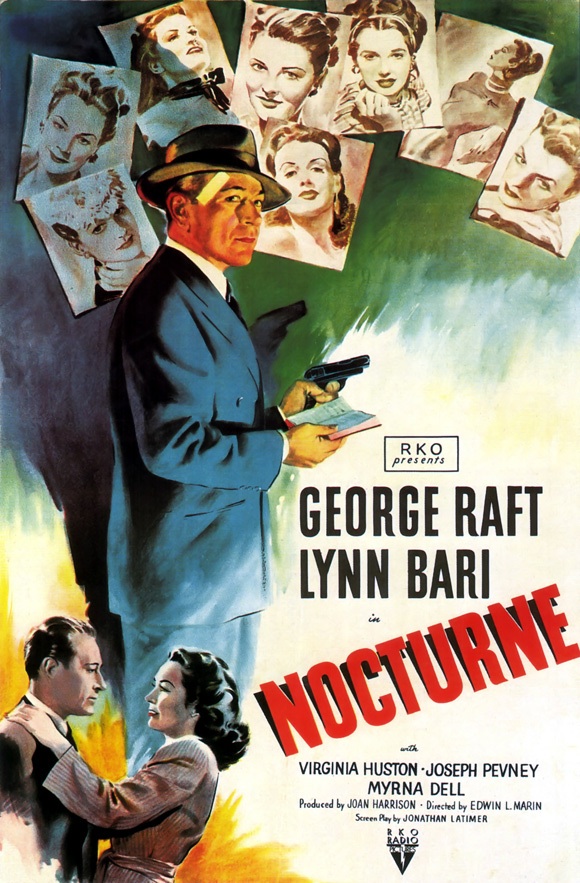
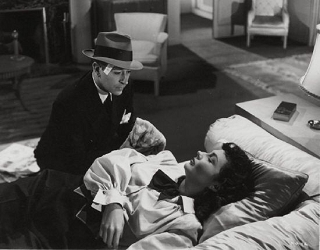
Edwin L. Marin’s Nocturne is close to being a great film noir, but not that close. It’s an entertaining mystery thriller with plenty of clipped, hard-boiled dialogue that’s fun to listen to, if not particularly credible.

George Raft plays Lt. Joe Warne of the Los Angeles police, and it’s a role that seems designed to play to the public’s perception of Raft as a gangster and a thug. Warne conducts his murder investigation with the subtlety of a steamroller, pushing a mustachioed Lothario into the pool when he gets in his way and ripping up the roll of a player piano in a diner when the owner won’t cooperate with him.

And when was the last time you saw a hard-boiled detective who lived at home with his mother? It’s the kind of oddball detail that feels as if it would be more at home in a gangster movie starring James Cagney.

Raft’s first big role was as Paul Muni’s sidekick in Howard Hawks’s Scarface (1932). After that he starred in a string of gangster pictures, and was one of the most popular actors in crime melodramas, along with Cagney and Edward G. Robinson. His boyhood friendship with gangster Owney Madden and association with men like Bugsy Siegel and Meyer Lansky aided the public’s perception of him as a hard man who didn’t just “talk the talk.”

By the ’40s, however, his star was beginning to fade. Turning down the lead roles in High Sierra (1941), The Maltese Falcon (1941), and Double Indemnity (1944) didn’t help matters. (Raft was reportedly functionally illiterate, which may have made choosing scripts difficult.) It’s safe to say that by 1946, he was getting the scripts that Humphrey Bogart used to line his birdcage.

Raft wasn’t a very expressive actor, and he had the range of a T-bone steak, but his tight-lipped acting style was perfect for B movies like Nocturne.

A flamboyant pianist and composer named Keith Vincent (Edward Ashley) is murdered, presumably by one of the nine brunettes he was running around with. He has glamour shots of all of them lining one wall of his living room, and it’s clear they were all interchangeable for him, since he called them all “Dolores.” (This may seem like a clever device to hide the identity of the murderess from the viewer, but it’s not.)

Lt. Warne investigates with ham-handed glee, and his investigative technique is as sloppy as the filmmaking. For instance, in one scene his chief (Robert Malcolm) bawls him out for bothering a character named “Mrs. Billings,” but apparently her scenes were left on the cutting room floor. This is fine, but why leave references to her in the film? Similarly confusing is the fact that Warne’s chief gives him two days to investigate Vincent’s murder on his own, but we only find this out after the two-day period is over. And it’s only after this two-day investigative blitz that Warne goes back to Vincent’s house and notices that one of the pictures is missing, since the pattern is disrupted, and there’s an enormous nail hole in the wall. Looking at the stamp on the back of one of the other pictures leads him to a sleazy photographer named Charles Shawn (John Banner). Wouldn’t a detective worth his salt have noticed all this immediately?

The most enjoyable thing about this film is the atmosphere. Lt. Warne spends a lot of time in smoky nightclubs, including the unique Keyboard Club, in which a hulking man-child named Erik Torp (Bern Hoffman) pushes a pianist named Ned “Fingers” Ford (Joseph Pevney) and his upright around on a rolling platform so they can take requests, table by table. When they get to Warne’s table, he hands Vincent’s unfinished piece “Nocturne” to Fingers to play. When he reaches the end of the handwritten sheet music, Fingers asks, “What did your friend do, run out of notes?” Warne responds, “More or less.”

Plenty of sex and sleaze run right below the surface of the picture, but it’s all pretty lighthearted. There’s a funny scene in a dance studio in which Warne can’t learn even the most basic steps (it’s mostly funny because Raft was a professional dancer), and his romance with his prime suspect, Frances Ransom (Lynn Bari), doesn’t carry much sense of danger or menace.

Nocturne is a really fun picture, despite its shortcomings. It has some of the snappiest, most hard-boiled, least naturalistic dialogue I’ve heard since I watched The Dark Corner (1946). Fans of B noirs are encouraged to seek out this picture.

Notorious (Sept. 6, 1946)

Notorious
Notorious (1946)
Directed by Alfred Hitchcock
RKO Radio Pictures

Notorious was Alfred Hitchcock’s second film to star Ingrid Bergman. Like the first, Spellbound (1945), it’s a perfect marriage of director and star. Later in his career, Hitchcock had a penchant for casting blond ice queens like Grace Kelly and Tippi Hedren, so it’s easy to forget how good he and the brown-haired Bergman were when they worked together.

In Notorious, Bergman plays Alicia Huberman, the daughter of a German-American man convicted of spying for the Nazis. As soon as the trial is over, she throws a little party in her Miami bungalow and gets good and blotto. The sense of intimacy that Bergman creates in this scene is remarkable. She doesn’t slur her words or make a fool of herself, but through her drunken ramblings she reveals some of her innermost thoughts.

Not so with the handsome stranger (Cary Grant) who sits alone at her party. He remains an enigma for awhile. After she throws everyone else out, she takes him out for some good old fashioned drunk driving. (And all the herky-jerky rear projection stuff made me feel a little inebriated, too.) When a motorcycle cop pulls her over, the stranger flashes a badge of some kind, and the cop lets them go. Alicia’s mood sours. She hates policemen.

Alicia learns that this handsome stranger’s name is Devlin, and he’s a government agent. He has listened to the recordings of conversations she had with her father, and knows that she is loyal to the United States, despite her anger about his imprisonment. Because of her father’s espionage work against America, however, she is the perfect person to infiltrate a group of Nazis who fled to Brazil after the war.

While waiting to begin her assignment in Rio de Janeiro, she falls in love with Devlin. It happens — as these things tend to in the movies — quickly and with little explanation. Devlin seems to love her, too, but when it comes time to put her into the field he is all business. And since part of her assignment is to seduce Alex Sebastian (Claude Rains), an old friend of her father’s and a member of the Nazi inner circle in Rio, Devlin chooses duty over love, and is cold enough to her that she eventually accepts Alex’s proposal of marriage.

Needless to say, living with a man she doesn’t love and his creepy, controlling mother (Leopoldine Konstantin) in a mansion in Rio, surrounded by Nazis who think nothing of killing traitors, is a dangerous proposition for poor Alicia, especially since her romance with Devlin continues to grow, despite both of their efforts to quell their own feelings.

Ingrid Bergman

Unlike Spellbound, which had all manner of baroque, Freudian lunacy, Notorious is an elegant and understated picture. The espionage plot isn’t overcomplicated, and it’s not really the focus of the movie. The love triangle is, as well as all the suspense and danger related to it. A sequence at one of Alex’s parties, in which Alicia and Devlin pass a key from hand to hand, achieves greatest emotional significance and more suspense than a complicated cryptography system or a series of twists and double-crosses ever could.

As a pure cinematic experience, I prefer Spellbound, despite — or perhaps because of — its craziness. Notorious is still a great movie, and Cary Grant is a less inert leading man than Gregory Peck. Ingrid Bergman is stunningly beautiful in this film, too. It’s not just the contours of her face, which are lovingly illuminated by cinematographer Ted Tetzlaff, it’s her intelligence and openness, and an ineffable quality of vulnerability.

Notorious was a critical and commercial success, and one of the biggest hits of 1946. Claude Rains was nominated for an Oscar for best supporting actor and Ben Hecht was nominated for best original screenplay, although neither won.

Make Mine Music (Aug. 15, 1946)

Make Mine Music

Make Mine Music (1946)
Directed by Robert Cormack, Clyde Geronimi, Jack Kinney, Hamilton Luske, and Joshua Meador
Walt Disney Productions / RKO Radio Pictures

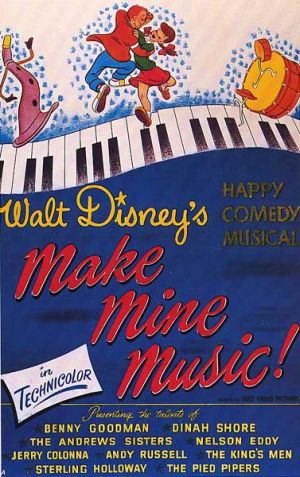
From 1937 to 1942, Walt Disney Pictures produced some of their best and most famous animated features — Snow White and the Seven Dwarfs (1937), Pinocchio (1940), Fantasia (1940) Dumbo (1941), and Bambi (1942).

During World War II, however, the U.S. Army contracted Disney to make training and instruction films like Victory Through Air Power (1943), as well as propaganda shorts like Education for Death: The Making of the Nazi (1943), which is still an effective and chilling piece, and Der Fuehrer’s Face (1943), in which Donald Duck has a nightmare and imagines himself a factory worker for the Third Reich. (Have you ever wanted to see Donald Duck read Mein Kampf and give the Sieg Heil salute while quacking “Heil Hitler!” over and over? Of course you have. Check it out if you haven’t already seen it.) These films didn’t generate any income for the studio, so in the post-war years Disney’s feature-length animated films were inexpensive repackagings of short subjects; Make Mine Music (1946), Fun and Fancy Free (1947), and Melody Time (1948).

Like any compilation, Make Mine Music is a mixed bag. It begins with “a rustic ballad,” as the title card tells us. The King’s Men sing “The Martins and the Coys,” a comedic take on the famous Hatfield and McCoy feud of the late 19th century. Sadly, hillbilly humor is something we’ve lost in this country. As cable TV has spread to the farthest reaches of the nation and more people have moved from remote rural areas to suburbs, barefooted hicks who tote shotguns, sleep with their arm around a pig, drink “mountain dew” (a.k.a. moonshine), and never wear a shirt under their overalls have gone the way of the dodo. In 1946, however, there were still plenty of those “reckless mountain boys” running around, and this segment lampoons them in grand style. The Martins and the Coys blast one another to pieces with shotguns until their clans are each left with just one representative. One a young man, the other a young woman. The punchline? They fall in love, get married, and then the bickering and the feuding start all over again, while their deceased ancestors watch with approval from their perches on clouds up in hillbilly heaven.

The second feature is “a tone poem.” The Ken Darby Chorus sing “Blue Bayou” while what appears to be an egret lazily flies around a blue bayou full of dark, dripping colors. Eventually the egret meets a second egret and they slowly disappear into the sky together. This short is audiovisual heroin, and I felt as if I was being shot up against my will.

Luckily, the third feature, “a jazz interlude” featuring Benny Goodman and his Orchestra called “All the Cats Join In,” really knocks it out of the park. Stylized images are created in a sketch book by an oversized pencil and then come to life. First a cat is drawn, then erased, then replaced by an Archie Andrews lookalike. There are even a few risqué images, with a bobby soxer jumping in the shower to get ready for a date, then running around barely covered by a towel, then jumping into her clothes and exposing her frilly underthings while bent over and rummaging around in her closet. All the while her younger sister mimics her every move. Then it’s into the jalopy with the rest of the gang and off to the malt shop. The music in this one is genuinely good, and the animation style looks about 15 years ahead of its time.

At this point, the structure of Make Mine Music becomes clear, as this fun and jazzy number is followed by another mawkish piece of visual barbiturate — “a ballad in blue” — featuring Andy Russell singing “Without You.” Rivulets of water running down a windowpane create one maudlin image after another, none of them memorable, but all designed to evoke a sense of pretty desolation — trees without leaves against a sunset, etc. Eventually we come back in through the window and the piece ends with the image of a dark blue sky surrounded by black with a single star in the sky, mirroring the lyrics of the song. This short is not recommended for the clinically depressed or anyone who’s just been dumped.

True to the established pattern, the next short is tons o’ fun. It’s “a musical recitation” by Jerry Colonna of “Casey at the Bat.” It opens with a series of turn-of-the-century stills and enlightened lyrics like, “The ladies don’t understand baseball a bit, they don’t know a strike from a foul or a hit,” followed by typical goofy “humorous” Disney animation. It’s all silly fun, and the final strikeout sequence is especially over the top.

Unsurprisingly, this is followed by a “ballade ballet” with animated versions of dancers Tania Riabouchinskaya (listed in the credits as just “Riabouchinska”) and David Lichine, accompanied by Dinah Shore singing “Two Silhouettes.” The white silhouetes are clearly based on real figures, and are gag-inducing, but can’t hold a candle in the gorge-rising department to the chubby white cherub silhouettes who fly in at the very end to drape the dancers with something or other.

Next up is “a fairy tale with music,” which is a version of Prokofiev’s “Peter and the Wolf” narrated by Sterling Holloway. If you took a field trip to the symphony when you were a child, chances are “Peter and the Wolf” was on the program, since it’s a great way to introduce young people to a variety of instruments and the concept of musical motifs. Like “Casey at the Bat,” this segment is serviceable, but not wildly memorable.

Following this is the Goodman Quartet performing “After You’ve Gone.” Little anthropomorphic instruments dance around. It’s short and sweet.

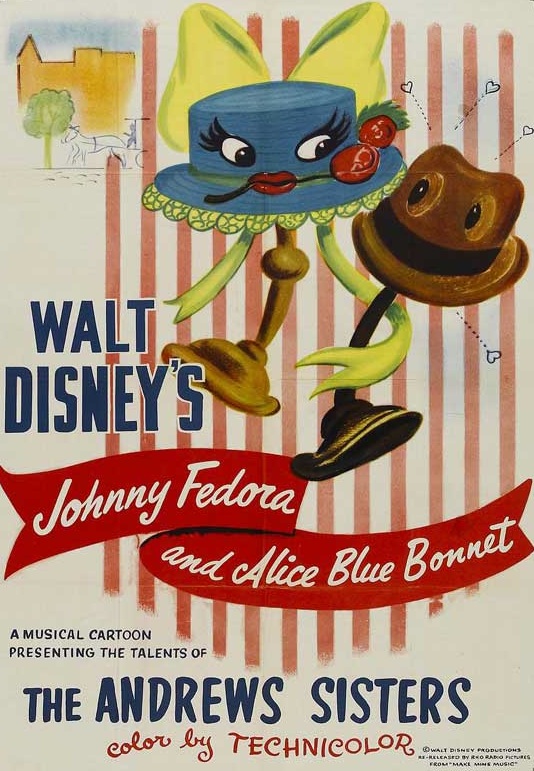
Johnny Fedora and Alice Blue Bonnet

The high point of Make Mine Music is “a love story” sung by the Andrews Sisters, “Johnnie Fedora and Alice Bluebonnet.” This one is just adorable. Anthropomorphic hats have the potential to be really creepy, but they’re both pretty cute — especially Johnnie, whose expressive eyes are formed from the divets in the front of the fedora above the hat band. Long story short, Johnnie Fedora and Alice Bluebonnet sit next to each other in a department store window, fall in love, are separated, and eventually find each other again.

Make Mine Music was the first movie my mother remembers seeing. When I was a little kid, I asked her about the first movie she’d ever seen, and the only thing she specifically remembered was “Johnnie Fedora and Alice Bluebonnet.” She even sang the first few bars of the song, and got the melody just right, although not with the Andrews Sisters’ adenoidal twang.

The final short is an “opera pathetique” performed by Nelson Eddy, who does all the voices for the “tragic story” of “The Whale Who Wanted to Sing at the Met.” An impresario from the Met named “Teti Tati” takes off after Willie the whale after reading about him in the newspaper, because he believes that an opera singer has been swallowed by the whale, like Jonah. When Teti Tati discovers that Willie can sing in three voices, he believes that the whale has swallowed three different opera singers. (We get to see a whole lot of Willie’s three vibrating uvulas.) There follows a fantastic dream sequence in which Willie imagines himself in a variety of roles, his bulk spilling out over the stage. He showers himself with “tears” from his blowhole while singing Pagliacci. He appears in flames as Mephistopheles. But unfortunately, it’s all a fantasy, and eventually the impresario succeeds in harpooning Willie. Unlike the duck in “Peter and the Wolf,” however, Willie doesn’t come back. Sure, the conclusion shows us that he’s in heaven singing in “a hundred voices,” but what consolation is that to a five-year-old? Or to a thirty-five-year-old, for that matter?

If you like this movie enough to rent or purchase it on DVD, you’ll find that the first short, “The Martins and the Coys,” has been completely cut out, and the King’s Men have been deleted from the opening credits. Why? Because as a corporate entity, Disney constantly rewrites its own artistic history. When Melody Time was released for the home video market in 1998, a cigarette dangling from Pecos Bill’s mouth was digitally removed. Also, lyrics in the opening song of Aladdin (1992) were altered under pressure from the American-Arab Anti-Discrimination Committee.

This is nothing new. When Fantasia was re-released in the late ’40s, some incredibly racist caricatures were excised. Were they offensive? Of course. Should Disney be allowed to get away with whitewashing (no pun intended) their own work? I don’t think so.

Why was “The Martins and the Coys” removed, anyway? A common explanation given is that it contains gunplay, but so does “Johnnie Fedora.” Was it because of stereotypes of rural Americans? What about the Italian stereotypes in “The Whale Who Wanted to Sing at the Met”? Or the chauvinistic lyrics in “Casey at the Bat”?

Will some day the wonderful “All the Cats Join In” be removed from prints of this film under pressure from the fat-acceptance crowd, since in one scene a bobby soxer is drawn a little heavy in the hips, leading a boy to shake his head until the pencil and eraser come back in to “fix” her?

At least when Disney released Der Fuehrer’s Face on DVD as part of the Walt Disney Treasures — On the Front Lines collection, they didn’t mess with it. All you have to do is suffer through Leonard Maltin explaining that during wartime, stereotypes were sometimes used and abused. (And you do have to suffer through it every time you watch it. The DVD is programmed so you can’t fast forward past it.) Disclaimers like that are fine with me. Rewriting history is not.

http://www.youtube.com/watch?v=_3lAztMhIWI

The Bamboo Blonde (July 15, 1946)

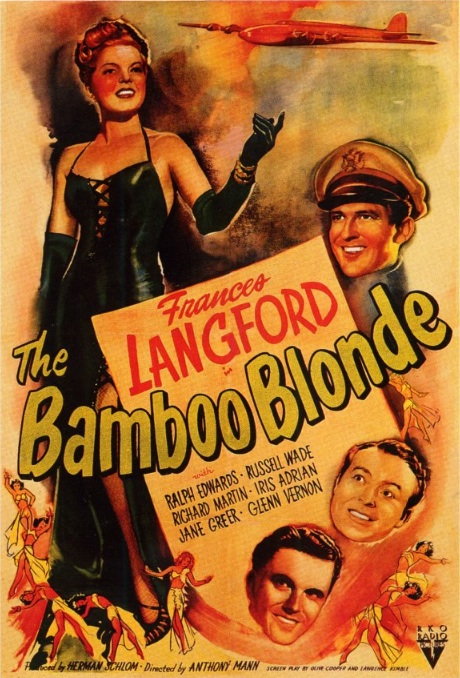
Anthony Mann’s The Bamboo Blonde is a cute little World War II-era programmer based on Wayne Whittaker’s story “Chicago Lulu.” It’s a romantic comedy, but there are nearly enough songs to qualify it as a musical. There are also nearly enough bombing raids over Japan to qualify it as a war movie, but the tone is so light that all the death and destruction on the ground is just there to provide a context for the saucy pinup girl painted on the nose of the bomber. It’s a fun romp — hell and gone from the westerns and noirs on which Mann’s reputation currently rests, but a thoroughly enjoyable way to kill 67 minutes during the dog days of summer.

The film begins with a magazine reporter named Montgomery (Walter Reed) interviewing Eddie Clark (“Truth or Consequences” host/creator Ralph Edwards), the mile-a-minute talker who runs Bamboo Blonde enterprises, an enormous conglomerate that operates a recording studio, furniture manufacturer, hosiery company, cosmetics line, and more. The reporter wants to know how the company got started, and when Eddie finally tires of trying to push Bamboo Blonde brand candy bars on the poor guy, he settles in to tell the story. It all started, Eddie explains, “Around the time Japan was finding out the B-29 wasn’t another American vitamin.”

The picture then begins in earnest, and we see the Ransoms, a wealthy family from Bucks County, Pennsylvania, tearfully send their son, Patrick Ransom, Jr. (Russell Wade), off to war. I say “tearfully,” but I can’t remember if there were any actual tears. The send-off was so wrought with emotion, however, that the presence of waterworks is beside the point. The Ransoms are the type of blue bloods who think nothing of Junior kissing mom on the mouth to say goodbye.

After cutting — or at least loosening — the umbilical cord, young Ransom wanders into Eddie’s Club 50, heedless of the sign outside barring all servicemen from entering. A couple of MPs walk out of the back office, and a perky little blonde named Louise Anderson (Frances Langford) acts quickly, hiding Ransom behind some curtains and then walking onstage to perform the song “I’m Good for Nothing But Love.”

Ransom is the new skipper of a bomber crew, and as the new guy, his boys had sent him to the club as a practical joke, or, as Ransom explains it to Louise over dinner, “Sending me here was a tactical maneuver to ditch me.” The two hit it off right away, and go on the kind of date that was really “on the beam” for the greatest generation, and is still pretty fun today. It starts with dinner at a restaurant with red and white checked tableclothes and candles stuck in bottles that’s run by a woman named “Mom” (Dorothy Vaughan) and it ends in a photo booth. The only thing that seems weird by today’s standards is that Louise sits in the photo booth alone, and Ransom ends up with a little framed photo of her.

That little framed photo will lead to big things. After a disastrous series of runs in the Pacific, Ransom’s B-29 has the worst record in the Air Force, without a single Zero downed. To turn their luck around, one of the guys borrows Ransom’s photo of Louise and paints an Alberto Vargas-style pinup of her with a stacked body “painted from memory.” After a long argument about what exact color hair their sexy new mascot has, they settle on “bamboo blonde,” and they’re well on their way to becoming “that nightmare to the Nips,” as Eddie Clark will later describe them.

The only problem is that Ransom’s crew thinks that Louise is his girlfriend, and he hasn’t disabused them of the notion, even though he has a dark-haired fiancée back home named Eileen Sawyer (Jane Greer, who shows a little bit more of that Out of the Past malevolence than she did in Sunset Pass, which was released a week before this picture). Eileen is a real harpy, and her interest in Ransom is only rekindled because of his growing fame. Meanwhile, Louise first learns that she’s been painted on the side of a bomber while reading a copy of Look magazine that has a picture of Ingrid Bergman on the cover wearing a nun’s habit (presumably from the 1945 film The Bells of St. Mary’s). You don’t have to be a genius to foresee the romantic complications that will arise once Ransom and his boys are called back home for a USO tour with Louise to help sell war bonds.

This is all frothy nonsense, of course, but Mann keeps things moving at a nice clip. Even when working with material that was clearly beneath him, such as this picture and Strange Impersonation (1946), he was able to craft something that was darned watchable. Langford was a classically trained singer, and has a really beautiful voice, which helps. (She was a radio star, and spent a lot of time as a USO performer.) For the most part, the musical numbers are staged in a straightforward fashion, but Mann takes a left turn into the realms of the surreal when Louise sings “Right Along About Evening.” Not only is everything in the idyllic farmland backdrop labeled (e.g., “mailbox,” “dog”), but it end with her rolling up a suddenly two-dimensional Ransom and stuffing him under her pillow before she goes to sleep. Truly odd.

Sunset Pass (July 8, 1946)

Judging by the only Zane Grey novel I’ve read, Riders of the Purple Sage, which was published in 1912, Grey was the most influential and important writer to ever mythologize the American west.

He was also a hack, and his florid prose made me wish for the more psychologically realistic and straightforward portrayals of the west I grew up reading in westerns by Louis L’Amour. Part of this is due to the era in which he was writing. By the ’40s and ’50s, passages like the following would have seemed ridiculous:

Her head was bowing to the inevitable. She was grasping the truth, when suddenly there came, in inward constriction, a hardening of gentle forces within her breast. Like a steel bar it was stiffening all that had been soft and weak in her. She felt a birth in her of something new and unintelligible.

The word “overwrought” doesn’t begin to describe the world Grey creates. His hero, Lassiter, wears an outfit that would make Richard Boone as Paladin in the TV series Have Gun — Will Travel (1957-1963) look positively conservative. Not only is Lassiter dressed all in black leather, but his black sombrero boasts a band of silver dollars, and his long-barreled revolvers are sexualized to a ridiculous degree. And, of course, the action is fast, furious, implausible, and frequently accentuated by exclamation marks. I’d be tempted to call the novel Riders of the Purple Prose if it didn’t contain such raw power in its descriptions of landscapes.

Low swells of prairie-like ground sloped up to the west. Dark, lonely cedar-trees, few and far between, stood out strikingly, and at long distances ruins of red rocks. Farther on, up the gradual slope, rose a broken wall, a huge monument, looming dark purple and stretching its solitary, mystic way, a wavering line that faded in the north. Here to the westward was the light and color and beauty. Northward the slope descended to a dim line of canyons from which rose an up-Hinging of the earth, not mountainous, but a vast heave of purple uplands, with ribbed and fan-shaped walls, castle-crowned cliffs, and gray escarpments. Over it all crept the lengthening, waning afternoon shadows.

Grey had the soul of a Romantic. In his world, emotion trumps reason and the physical world mirrors the longings and passions of the people who exist in it. For better or for worse, it is this vision of the old west that captured the imagination of the reading public in the early 20th century, and informs the western genre to this very day.

I don’t really know why I’m going on and on about Riders of the Purple Sage, except that William Berke’s film Sunset Pass, which I’m reviewing today, is based on the 1931 novel of the same name by Zane Grey, and watching it made me think back to the only novel by Grey that I’ve read. (There’s an earlier filmed version of Sunset Pass that was directed by Henry Hathaway and starred Randolph Scott. It was released in 1933. I haven’t seen it.)

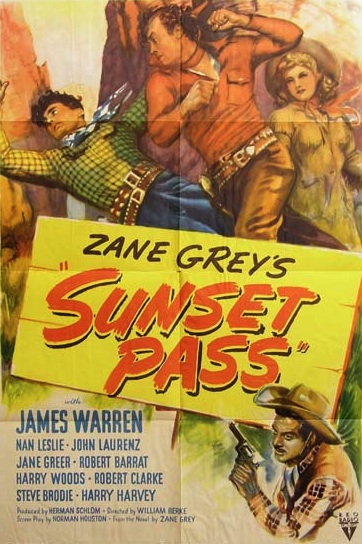
Sunset Pass, which was released by RKO Radio Pictures, hasn’t gone down in history as one of the great westerns, and it certainly can’t hold a candle to John Ford’s early westerns, but it’s a sight better than the stuff P.R.C. and Monogram were churning out week after week in the ’40s. The print I watched was clean and crisp. The black and white cinematography looked great. Neither Berke’s direction nor Norman Houston’s screenplay, however, capture Grey’s febrile world or antiquated dialogue. This is a by-the-numbers oater with plenty of shootouts, fistfights, chases on horseback, romance, and a few songs.

The film begins with an exciting but nonsensical scene. A cowboy named Rocky (James Warren) and his Mexican sidekick Chito (John Laurenz) tie up their horses in a stand of trees and watch a passenger train chugging toward them. They leave their horses and run alongside the train, which appears to be moving at top speed, and hop aboard. They take their seats, flirt with the ladies, and are in place to attempt to foil a train robbery. I say “attempt,” because a young woman named Jane Preston (Nan Leslie) knocks Rocky’s rifle barrel to the side when he attempts to shoot one of the robbers, allowing him to make his getaway. The men are all masked, but it’s clear that she recognizes him, and intervenes to save his life.

It turns out that Rocky and Chito are undercover agents employed by the railroad to stop robberies. If this is the case, what was the purpose of them not only leaving their horses in a remote area but also boarding the train in the middle of its journey? If anyone can explain it to me, please do. Were they hungover and missed the train? That’s the only explanation I can think of.

With the money stolen, Rocky and Chito are in hot water with the railroad company. Rocky rides off to track down the stolen loot while Chito grabs his guitar and makes love to showgirl Helen “Lolita” Baxter (played by Jane Greer, who exhibits none of the malevolence she would exude a little more than a year later in her most famous role as the femme fatale who ensnares Robert Mitchum in Out of the Past).

Eventually Rocky catches up with the robbers, but he’s shot and badly wounded. Luckily, he’s spirited away by a young man named Ash (Robert Clarke), who turns out to be Jane’s brother.

Clarke gives the best performance of the film as Ash Preston, and when his character faces ethical dilemmas, the movie really comes alive.

James Warren is a decent hero, but his performance is more one-note than Clarke’s. Tall, lean, and blond, with a perpetual scowl, Warren is sort of a Sterling Hayden Lite.

The villain of Sunset Pass, Cinnabar (Harry Woods), is good, too, but his name sounds like a candy bar or a coffee bar chain, and the other characters in the film refer to him a lot by name, which I found unintentionally funny.

Sunset Pass is standard western fare, but it was an enjoyable enough way to while away an hour and 5 minutes.

The Stranger (May 25, 1946)

The Stranger isn’t most people’s favorite Orson Welles film, and a lot of people even consider it his worst. (Welles did.) It’s the third film he directed, and as far as Oscar bait goes, it certainly pales in comparison with Citizen Kane (1941) and The Magnificent Ambersons (1942), but I think a lot of the criticism heaped upon it is unfair. The Stranger is a crackerjack thriller with tension and suspense to spare. I was drawn in by the first scene, and was completely involved throughout the film’s 95-minute running time.

Despite its sometimes hackneyed script and implausible situations, The Stranger shows a master in complete control of his craft. The first 15 minutes of the film are some of the most perfect cinematic storytelling I’ve ever seen. Mr. Wilson (Edward G. Robinson), an investigator for the Allied Commission for the Punishment of War Criminals, sets free a Nazi war criminal named Konrad Meinike (Konstantin Shayne) and has him tailed, believing that he will lead them to the secret architect of the Holocaust, Franz Kindler (Welles). Kindler is living in the idyllic little town of Harper, Connecticut, under the name “Charles Rankin” and is a professor at a boy’s school.

Meinike’s journey to find Kindler is an object lesson in how to tell a story with a minimum of dialogue and a maximum of tension. The shots are visually arresting, the editing is rapid without ever being confusing, and the pacing is fast. As openings go, it’s not quite the bravura performance Welles would later put on with his single crane shot that opens Touch of Evil (1958), but it’s just as good in its own way. The disconnect only appears during the first lengthy stretch of dialogue. Once Meinike tracks down Prof. Rankin, the clumsy exposition that Welles grumbles through — which explains who his character is, whom he is marrying, and who his father-in-law will be — sticks out like a sore thumb.

Meinike will prove to be just the beginning of Rankin’s troubles. The noose tightens around his neck as soon as Wilson arrives in town, posing as a dealer in antiques. Robinson plays his role well, in an understated fashion that contrasts nicely with Welles’s bug-eyed histrionics. After a few extreme close-ups of Rankin’s sweaty face as he tells lies to convince his new wife, Mary Longstreet (Loretta Young), that he is an innocent hounded by nefarious forces, there is no doubt about the depths of his villainy.

Not that there every really was any doubt, since Rankin behaves in such a despicable fashion throughout the picture. It’s not just his dinnertime conversation — in which he explicates the warlike soul of the German people and denies that Karl Marx was a German because he was a Jew — it’s his willingness to engage in wet work, killing a troublesome character without a second thought and later beating his new wife’s dog when it attempts to dig up the corpse.

In his review of The Stranger in the July 11, 1946, edition of the NY Times, Bosley Crowther wrote that Welles’s performance “gave no illusion of the sort of depraved and heartless creatures that the Nazi mass-murderers were. He is just Mr. Welles, a young actor, doing a boyishly bad acting job in a role which is highly incredible — another weak feature of the film.” Again, I think this is unfair. Welles got his start in the theater, and as a thespian, he never really grew out of it. His acting was always highly theatrical. He was a man who played to the back row, with grand gestures and a booming voice, but he did so extremely effectively. Not every film performance has to be subtle and understated.

It’s his work behind the camera, however, that really shows Welles in top form. The fast cutting in a scene in a diner, for instance, creates a tense subtext beneath Loretta Young’s seemingly casual banter with Edward G. Robinson by showing each character’s motivations by the looks on their faces. Mary is hiding something, Rankin is coercing her into doing so, and Wilson knows exactly what is going on. Director Welles and editor Ernest J. Nims make it all look easy, but it’s not, or more films would be this well-made.

The film also brilliantly uses sound. For instance, the tolling of the clock in the village square (which the clock-obsessed Rankin has fixed) underscores the tension in the film’s final half hour. The bonging of the clock has a peculiar timbre, and sounds more like incidental music from a ’70s or ’80s suspense or horror flick than any soundtrack from the ’40s I’ve ever heard before. The score itself, by Bronislau Kaper, is quite good, too, and is reminiscent of the work of Bernard Herrmann.

The screenplay, by Anthony Veiller, from a story by Victor Trivas, was imposed on Welles by the studio. The studio and the producer, Sam Spiegel (listed in the credits as “S.P. Eagle”), made plenty of other decisions Welles didn’t like. For instance, Welles wanted Agnes Moorehead to play the part of Wilson, but they forced him to go with Robinson. As far as the studio was concerned, however, everything worked out for the best, since The Stranger was the only film Welles directed that ever made a profit during its initial theatrical run.

The Stranger is a potboiler, to be sure, but it’s such a brilliantly edited, directed, and acted potboiler that it’s remarkable. This is one of those rare movies that I looked forward to seeing again as soon as it was over.

Without Reservations (May 13, 1946)

Mervyn LeRoy’s Without Reservations is the kind of old-fashioned romantic comedy that frequently has adjectives like “sparkling” and “breezy” attached to it. It’s also the last film in which John Wayne appeared as one of the leads but did not receive top billing. Claudette Colbert’s star power still shone pretty brightly in 1946.

I thought that LeRoy’s previous film, Thirty Seconds Over Tokyo (1944), was one of the best World War II films I’ve ever seen, so I was looking forward to seeing Without Reservations, but found it mediocre. I enjoyed it, but I didn’t love it.

In the film, Colbert plays Christopher “Kit” Madden, a sort of socially progressive version of Ayn Rand. Her novel Here Is Tomorrow is a runaway best-seller, and is the one book it seems that everyone in post-war America has read. When the film begins, Kit is arguing with film producer Henry Baldwin (Thurston Hall), who is unable to fulfill his promise to secure Cary Grant for the part of Mark Winston, the protagonist of Here Is Tomorrow. Kit won’t consider making the picture without Cary Grant, and begins drafting a letter while traveling by train that will stop production of the film. Anyone who’s been paying attention, however, will notice that the heroic painting of Mark Winston on the cover of her novel looks an awful lot like John Wayne, and will probably be able to predict what will happen next.

Sure enough, Kit meets two Marine pilots, Rusty Thomas (John Wayne) and Dink Watson (Don DeFore), on the train. As soon as she lays her eyes on Rusty, she realizes he’s perfect for the role of Mark Winston, and immediately begins to rewrite her letter. Since she introduces herself only as “Kit,” and the novel was published under her full name, Dink and Rusty don’t realize that she’s the most popular author in America. When she asks Rusty what he thinks of the novel Here Is Tomorrow he rips into it with abandon. His main complaint seems to be that the romance in the novel is unconvincing. Mark Winston, a progressive with grand plans to remake America, is chased around by a woman, but they can’t make things work because she’s a political reactionary.

In reality, of course, it’s Kit who’s the progressive (Mark Winston is merely her mouthpiece) and Rusty who’s the reactionary. Without Reservations is based on the novel Thanks, God! I’ll Take It From Here, by Jane Allen and Mae Livingston. I haven’t read the novel, but if the film is in any way faithful to its source material, the title comes from a speech Rusty makes about the first men in America. According to Rusty, no amount of political disagreement is enough to keep a man and a woman apart if they’re hot for each other. (Can you sense, yet, where the film might be heading?)

Angry about the grand plan laid out for society in Here Is Tomorrow, Rusty says to Kit, “Have you ever heard of some fellows who first came over to this country? You know what they found? They found a howling wilderness, where summer’s too hot and winter’s freezing. And they also found some unpleasant little characters who painted their faces. Do you think these pioneers filled out form number X6277 and sent in a report saying the Indians were a little unreasonable? Did they have insurance for their old age? For their crops? For their homes? They did not. They looked at the land and the forest and the rivers. They looked at their wives, their kids, and their houses. And then they looked up at the sky and they said, ‘Thanks, God. We’ll take it from here.'”

Watching the film in 2010, I found it hard to believe that no one from the Tea Party movement has latched onto this scene and played it on JumboTrons across the country, since its simplistic vision of America’s beginnings and total opposition to the federal government and even the most basic of social programs seem so close to that movement’s weltanshauung. Not to mention that the speech is delivered as only John Wayne can.

There’s a lot of great stuff going on here, and Wayne and Colbert have decent chemistry, even though he’s not that well suited to playing a romantic lead, especially in a comedy. If Without Reservations had kept up the momentum it establishes in its first couple of acts, I would have really liked it. Unfortunately, it goes off the rails and becomes a meandering road movie.

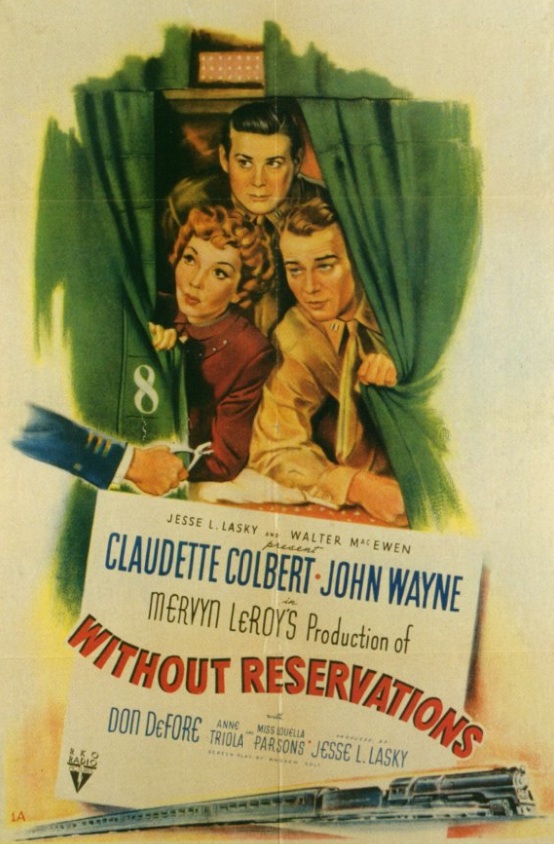
But not before Rusty, Kit, and Dink run afoul of one of the Pullman porters when they stack up the tables in the club car and have Kit “fly a plane” with a stand-up ashtray for a yoke. The drunken Kit eventually falls over, knocking everything to the ground. Like a bunch of goons, they run off, leaving the mess for one of the porters to clean up while they hide in one of the sleeping compartments (see the film’s poster above).

Once on the road, they buy a flashy sports car from its exasperated owner, and it constantly breaks down. They stay with a colorful Mexican family with a hot and spicy daughter named Dolores (Dona Drake) and a fiery patriarch, Señor Ortega (Frank Puglia), who teaches Kit a few things about love, namely how brutal, selfish, and turbulent it is, and should be. “Love and violence walk hand in hand, señorita!” he says.

The strangest thing about Without Reservations is that Colbert and Wayne do not appear in the same scene at any point during the last act of the film. Kit galivants around Hollywood with a series of leading men in an effort to make Rusty jealous, and the viewer is treated to cameos by Cary Grant (playing himself) and Raymond Burr (still young and trim enough to play an up-and-coming leading man named “Paul Gill”). In these sequences it makes sense for Colbert and Wayne to not appear together, since they’re in different physical locations, but when Rusty finally gives in and appears on Kit’s doorstep, we hear him ringing her doorbell and see her run out of her bedroom downstairs to let him in, but the camera pans right and stops and lingers on a shot of her bed as we hear her greet him off screen. Fade to black. It’s about as subtle as a train going into a tunnel.

I know there are legions of people who think Colbert was the epitome of class, beauty, and charm, but I found her unappealing in this film. With her little stick body, hunched shoulders, spastic movements, short hair in a tight perm, and heavy makeup, she looked to me like an eighty-year old woman with a forty-year old face.

Bedlam (May 10, 1946)

Bedlam,jpg
Bedlam (1946)
Directed by Mark Robson
RKO Radio Pictures

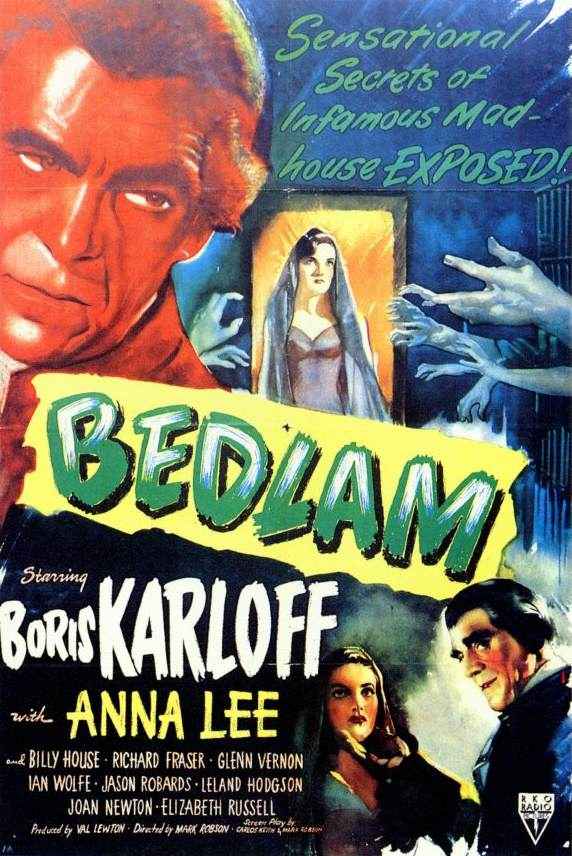
Mark Robson’s Bedlam, produced by the legendary Val Lewton, takes place in London in 1761. It was Lewton’s ninth and final horror film.

A novelist, screenwriter, and producer, Lewton was a master of suggestion and eerie ambience. His films were the antithesis of Universal’s horror offerings, which offered iconic monsters and more overt shocks. Lewton had phenomenal success with his first horror picture for RKO, Cat People (1942, directed by Jacques Tourneur), and his reputation continued to grow with a string of classic and near-classic horror pictures; I Walked With a Zombie (1943, dir. Jacques Tourneur), The Leopard Man (1943, dir. Jacques Tourneur), The Seventh Victim (1943, dir. Mark Robson), The Ghost Ship (1943, dir. Mark Robson), The Curse of the Cat People (1944, dir. Gunther von Fritsch and Robert Wise), The Body Snatcher (1945, dir. Robert Wise), Isle of the Dead (1945, dir. Mark Robson), and Bedlam (1946, dir. Mark Robson).

The screenplay for Bedlam, which was written by Robson and Lewton (under the name “Carlos Keith”), was inspired by the William Hogarth engraving of Bethlehem Hospital (a.k.a. Bedlam); the final plate in his 1735 series “The Rake’s Progress,” which depicts in detail the journey of its hero, William Rakewell, from an inheritor of his father’s wealth and happy cad to a broken man locked up in an insane asylum.

Neither Rakewell nor anyone like him appears as a character in the film Bedlam. Rather, Lewton and Robson took the nightmarish images Hogarth created with such elaborate care in his depiction of Bedlam and shaped them into the window dressing of a film that, like The Ghost Ship and Isle of the Dead, is a meditation on the abuse of power. Hogarth’s vision was of a morally bankrupt society, from the monarchy and the church all the way down to the commoners on the street. Lewton and Robson took this idea and shaped it to their own ends. The inmates of Bedlam may be strange and threatening, but it is the men who control them who are the real monsters.

This idea is exemplified in the first scene of the picture. A lunatic is attempting to escape St. Mary’s of Bethlehem Asylum by scaling the wall. He is forced to jump to his death when a guard carrying a lantern grinds his boot down on the man’s hand.

The man who fell turns out to be an acquaintance of the grotesque Lord Mortimer (Billy House), who arrives at Bedlam that night for a spot of entertainment gawking at the loonies. “Everyone who goes to Bedlam expires from laughter,” he tells his companion, Nell Bowen (Anna Lee). When he discovers that his acquaintance has fallen to his death, however, Lord Mortimer is upset. He had paid the man for poetry to be delivered at a later date, and he feels he is now owed a night of entertainment. Enter George Sims (Boris Karloff), the apothecary general of Bedlam. Master Sims promises Lord Mortimer a play performed by his lunatics.

Sims is a combination of the worst qualities of the characters Karloff played in his previous two collaborations with Lewton; the pure malevolence of cabman John Gray in The Body Snatcher and the twisted abuser of power General Nikolas Pherides in Isle of the Dead.

Disturbed by what she sees at Bedlam, but not fully able to admit it, Lord Mortimer’s companion Nell returns to Bedlam alone and is taken on a tour by Sims. Leering, he tells her, “Ours is a human world, theirs is a bestial world, without reason, without soul. They’re animals. Some are dogs; these, I beat. Some are pigs; those, I let wallow in their own filth. Some are tigers; these, I cage. Some, like this one, are doves.” (Students of script machinations, however, will want to keep an eye on that “dove,” a woman in white who stands immobile, not speaking or blinking.) Also, it should go without saying that Sims’s ability to have anyone he wants committed to Bedlam, regardless of their sanity, will put Nell in grave danger when she breaks with Lord Mortimer and publicly ridicules him.

The rhythm of speech and the language of the script is excellent, and evokes 18th century Britain in a way few of the hackneyed period pieces of the ’40s did. Even if it’s not a perfect replication of the time, it does a pretty good job, and all of the little details are a joy to pick out, such as the words “I love sweet Betty Careless” scrawled on the wall in Bedlam, a detail inspired by the man in the Hogarth plate who has scrawled the initials of his beloved, “Charming Betty Careless” — a famous prostitute of the day — on a banister.

Viewers looking for a straight horror picture might be disappointed by Bedlam, although its scenes within the insane asylum walls deliver plenty of chills. Like many of Lewton’s later horror pictures, it’s an ambitious film that uses the trappings of horror to deliver a deeper message about a sick society.